Statement of Cash Flows Further research – Financial Institutions
July 2026
Executive Summary
1 In January 2026, the UKEB commenced research to understand how banks and insurance companies could provide better information to users of their financial statements.
2 The research suggests that there is no single solution, but rather a set of complementary improvements that could enhance the usefulness of cash flow-related information. These include simplifying the presentation of the statement of cash flows, increasing disaggregation in the notes, and, most importantly, improving the linkage between IFRS financial statements and regulatory capital, liquidity and solvency information.
User priorities
3 This research paper highlights the distinction between the business models, and cash generation, of banks and insurance companies (life and general insurance companies), and the extent to which the users of their financial statements are looking for different information in the financial statements.
4 Banks and insurance companies operate in heavily regulated environments. As a result, their investors’ common information needs include:
- reconciliations that ‘bridge the gap’ between the statement of cash flows (and other primary financial statements, where relevant) and key regulatory metrics that constrain the operation of the business, such as liquidity adequacy (for banks) and solvency requirements (for insurance companies); and
- information about the limitations on dividend payouts, linked to surplus regulatory capital or shareholder funds.
5 Different types of users of bank and insurance companies’ financial statements use their statement of cash flows for different purposes. As a result, there is diversity in views amongst those users about the usefulness of the statement of cash flows for such entities.
6 Giving banks and insurance companies an option to provide a simplified statement of cash flows, contingent on those regulated entities providing (i) regulatory returns on capital and liquidity or solvency to the relevant regulator in its jurisdiction, and (ii) reconciliations to key constraining regulatory metrics being included in the financial statements, could meet users’ needs, including enhancing comparability, whilst potentially reducing costs for preparers.
7 Stakeholders considered that whilst regulatory regimes are not globally consistent, a principle-based approach, potentially anchored to widely adopted frameworks, like the Basel framework for banks1, may be an appropriate way to scope any requirements. It may be more challenging for insurers, given that regulatory regimes are not as widely adopted e.g. Solvency II is Europe-based.
Preparer concerns
8 Preparers acknowledge that the statement of cash flows for banks and insurance companies is of limited use to users and support the provision of supplementary disclosures that ‘bridge the gap’ between regulatory metrics and the IFRS financial statements.
9 There are divergent views from preparers as to whether the statement of cash flows should be retained for banks and insurance companies. They raised concerns that any new requirements should avoid duplicating regulatory information, adding to the reporting burden, requiring disclosure of sensitive information and unintended consequences (such as bringing additional regulatory information within audit scope).
10 In addition, preparers raised concerns with the current requirements in IAS 7 Statement of Cash Flows for:
- Cash and cash equivalents – the request was to more closely align with how banks and insurance companies manage liquidity/solvency in practice (this is similar to the concerns raised by preparers in non-financial institutions). Bank preparers are also seeking more guidance on whether, and when, specific items such as central bank deposits can be included in cash equivalents.
- Classification of cash flows – whilst IFRS 18 introduces guidance on main business activities in relation to the income statement, preparers are calling for more guidance in relation to classification in the statement of cash flows.
Potential approaches
11 The potential approaches that the IASB could consider, based on UKEB research with stakeholders, are:
- A Simplified Statement of Cash Flows – albeit simplification alone may not solve users’ needs.
- Limited supplementary disclosures, mainly:
- reconciliations, that ‘bridge the gap’ between key regulatory metrics (liquidity and solvency) and the statement of cash flows, and;
- information about constraints on capital distribution (i.e. dividend payout capacity).
- A choice of options to improve the definition of ‘cash and cash equivalents’:
12 Stakeholders considered that the IASB should explore defining a scope that is global and principle based. They cite both previous examples in IFRS Standards, and the possibility of using regulatory definitions.
13 It is suggested that the IASB reconsider the fundamental question of the purpose of the standard IAS 7 Statement of Cash Flows before it considers the relevance for banks and insurance companies, and ensure that any new requirements consider the regulated environment within which such institutions operate, and the users’ information needs for those entities.
Next steps
14 The IASB is expected to publish an Exposure Draft of proposed changes to IAS 7, and potential changes to other IFRS Accounting Standards, in 2027.
15 The views expressed in this paper are those conveyed by UK stakeholders during the outreach carried out by the UKEB. They do not represent UKEB member views and will not necessarily affect the conclusions in any endorsement and adoption assessment by the UKEB on new, or amended, IFRS Accounting Standards.
Introduction
Purpose and objective of research paper
16 Building on earlier work in its Statement of Cash Flows and Related Matters project, the UKEB has undertaken further research on the usefulness of the statement of cash flows for certain financial institutions to help identify reporting that could better meet investor needs.
17 In May 2025, the IASB tentatively decided to explore how its project might address financial institutions, focusing on:
- improvements to the statement of cash flows generally before deciding how any changes might apply to the requirements for financial institutions;
- exemptions for financial institutions from some or all of the requirements for presenting a statement of cash flows; and
- any presentation or supplementary disclosure requirements specific to financial institutions that might enhance the usefulness of information about cash flows for such entities.
18 The IASB decided the research should focus on whether to retain, eliminate, or simplify, the statement of cash flows for financial institutions.
Research process and methodology
19 In November 2024, the UKEB agreed to explore improvements specific to financial institutions, particularly insurance companies and banks, where user focus for such regulated companies is often on capital generation rather than cash generation, as whilst cash is needed to pay out dividends, dividend payout capacity is restricted by available surplus regulatory capital.
20 This paper incorporates findings from outreach conducted in early 2026 with members of the UKEB Advisory and Working Groups5. Interviews were also undertaken with preparers from banks and insurance companies. Discussions focused on:
- the usefulness of cash flow statements for banks and insurance companies and reasons for limited relevance for users; and
- potential approaches the IASB could consider to improve the usefulness of information provided to users.
21 These findings were triangulated with other research, which comprised:
- Financial statement analysis: reviewing annual reports of UK banks and insurance companies to identify useful voluntary disclosures, such as reconciliations of regulatory capital and liquidity and solvency metrics to IFRS figures.
- Review of other disclosures: examining cash flow and liquidity-related information presented outside the financial statements, including regulatory reporting that is publicly available.
Background
Existing requirements under IAS 7 Statement of Cash Flows
22 IAS 7 does not differentiate between financial and non-financial entities. As noted in paragraph 3 of IAS 7, the standard requires all entities to present a statement of cash flows on the basis that users need information on how cash is generated and used, regardless of business model. Accordingly, no exemption from preparing a statement of cash flows is available for financial institutions.
23 Paragraph 4 of IAS 7 says that a “statement of cash flows, when used in conjunction with the rest of the financial statements, provides information that enables users to evaluate the changes in net assets of an entity, its financial structure (including its liquidity and solvency) and its ability to affect the amounts and timing of cash flows in order to adapt to changing circumstances and opportunities”.
24 Given the heavily regulated environment within which banks and insurance companies operate, users place more reliance on published regulatory information to understand the liquidity and solvency of banks and insurance companies, than the statement of cash flows. Therefore, if one of the objectives of the standard is to provide information to users to evaluate liquidity and solvency, then the importance of regulatory information to users for regulated entities should be considered, as part of the requirements of the standard.
25 Furthermore, the current objective of the standard, as set out in its opening paragraph is “to require the provision of information about the historical changes in cash and cash equivalents of an entity by means of a statement of cash flows which classifies cash flows during the period from operating, investing and financing activities”, but this does not appear to set out a clear purpose. If the objective is as set out in paragraph 4 “to enable users to evaluate the changes in net assets of an entity and its financial structure (including its liquidity and solvency)”, then the standard needs to set out requirements to achieve that purpose for all entities, including regulated institutions, such as banks and insurance companies.
26 Whilst paragraph 13 of IAS 7 recognises that one of the important assessments of users is to understand the dividend payout capacity of a company, it does not acknowledge that such capacity can be restricted by other legal and regulatory restrictions.
27 Further, whilst paragraphs 48–49 of IAS 7 notes that “an entity shall disclose, together with a commentary by management, the amount of significant cash and cash equivalent balances held by the entity that are not available for use by the group”, paragraph 50 of IAS 7 only encourages disclosure of “additional information (that) may be relevant to users in understanding the financial position and liquidity of an entity”.
28 Therefore, it could be argued that IAS 7 does not meet its fundamental purposes for some financial institutions, as it does not require companies to inform investors about liquidity/solvency nor its dividend payout capacity to investors, especially given that regulated entities are constrained by regulatory capital, not cash flows.
29 If the statement of cash flows does provide some useful information to users, then a solution needs to be found that retains the usefulness but improves the information available to investors about liquidity/solvency and restrictions in dividend distribution.
Diversity of financial institutions
30 Financial institutions encompass a wide range of business models, including banks (retail/commercial), central banks, insurance and reinsurance companies6, investment banks, asset managers, mortgage companies, and other entities. However, cash flow statements, required for all entities, are considered to provide information of only limited usefulness for some financial institutions, particularly banks and insurance companies.
31 Both banks and insurance companies are subject to substantial regulatory capital and liquidity or solvency requirements (see Annex 1 for details of the UK regulatory regime). However, the underlying drivers of capital and liquidity/solvency management for banks and insurance companies differ. Therefore, the information needs of investors to assess the effect of regulatory capital and liquidity or solvency requirements may also differ depending on whether they are banks or insurance companies7.
Banks
32 For banks8, the statement of cash flows often provides limited information. Core activities such as lending and deposit-taking do not consistently result in movements in cash and cash equivalents. For example,
- loan issuance or repayment only affect cash when the customer transfers funds between banks.
- interest income and expense frequently do not result in immediate cash movements, as they are often settled through internal account balances rather than external cash transfers.
33 Banks are also subject to regulatory requirements in relation to capital adequacy to fulfil any claims against their assets.
Insurance companies
34 Insurance companies9 typically receive premiums from policyholders upfront (premiums float), then invest (typically in high-quality liquid fixed income investments, like government and corporate bonds. These investments provide stable and predictable returns to ensure that funds are available when claims need to be paid) to generate investment income to sustain their operations and grow their businesses.
35 However, there are significant differences between life insurance and non-life (general) insurance cash flows due to the duration, predictability, and investment characteristics of liabilities.
36 Cash flow statements for general insurance companies focus on short-term underwriting and claims, while life insurance cash flows are shaped by long-term policy obligations and investment strategies10. This means that their cash flow statements are structurally and functionally different despite following the same IAS 7 framework.
37 For non-life general insurance companies, the claim ratios (claims to premiums) are important. Life insurance companies provide coverage related to a person's mortality and can include savings and protection plans. Financial analysis often focuses on the long-term investment income generated from premium investments, as these policies tend to have longer durations.
38 Such companies must also comply with regulatory requirements to maintain adequate equity reserves so they are financially able to fulfil claims i.e. they must be solvent.
Usefulness of the Statement of Cash Flows of Banks and Insurance companies
39 The findings included in the UKEB third research paper Statement of Cash Flows: UK User and Preparer Perspectives11, support the feedback also received by the IASB on the limited usefulness of the statement of cash flows for banks and insurance companies:
- ✓ Most users and preparers believe that the statement of cash flows for banks and insurance companies provides limited incremental value –
- banks and insurance companies typically manage portfolios of liquid assets beyond what is included within ‘cash and cash equivalents’.
- the statement of cash flows only represents a subset of such portfolios and therefore does not align with how the overall business is managed.
- ✓ Preparers also expressed that it was rare to receive questions from users on cash flows.
- ✓ When explicitly asked about the usefulness of the risk management disclosures required by IFRS 7 Financial Instruments: Disclosures, there were mixed views on the extent to which the required disclosures were useful.
- ✓ Preparers and users place greater focus and reliance on information provided using non-GAAP measures and within regulatory reporting. Information contained within regulatory reporting was noted to be more standardised and disclosures around liquidity and capital management were noted to be more extensive, resulting in enhanced comparability and relevance.
Investors and other users’ views
40 Investors find the statement of cash flows is useful for banks and insurance companies:
- As a bridge between the statement of financial performance and statement of financial position.
- It provides a sense check of liquidity and explains differences between accounting and cash movements.
41 They also noted that certain items, where available in the statement of cash flows, are useful for all entities, including for banks and insurance companies, such as dividends paid, capital issuance/repayment, share option exercises, interest paid/received, debt movements, and business acquisitions and disposals.
42 However, investors generally observed that, over and above those aspects, the statement of cash flows has limited usefulness, noting the following key challenges:
- the statement of cash flows does not reflect how financial institutions manage cash or liquidity risk in practice;
- ‘operating’ and ‘financing’ activities are indistinguishable because financial institutions’ operating assets are financial assets (potentially breaking the usual operating–investing–financing model of IAS 7);
- the statement of cash flows does not differentiate between cash belonging to shareholders and customer/policyholder cash; and
- investors focus more on regulatory capital generation and constraints, not gross cash movements.
Usefulness of other disclosures
43 Users of financial statements for banks and insurance companies place greater reliance on regulatory capital and liquidity (banks) and solvency (insurance companies) disclosures due to the likely constraint placed on dividend payouts.
44 While IFRS standards (outside IAS 7) include some liquidity-related disclosures and are considered useful, there is a notable gap in clearly linking financial statements with regulatory information. This leads users in the UK to rely on publicly available regulatory data to attempt to create their own reconciliations.
45 IFRS 7 Financial Instruments: Disclosures provides requirements for preparing information on liquidity, which might be considered sufficient for some users:
- Paragraph B11E of IFRS 7 requires disclosure of maturity analysis of financial assets held for managing liquidity risk.
- IFRS 7 (paragraph 39, 42E(e) and B11B), and IAS 1 Presentation of Financial Statements (paragraph 65) (replaced by IFRS 18 Presentation and Disclosure in Financial Statements effective 1 January 2027) also require information about the maturity analysis of financial liabilities.
- Information on liquidity gap disclosures showing whether there is an excess of assets or liabilities in specific time buckets might also be useful.
- Regarding information on encumbered assets, disclosures on financial assets pledged as collateral, as required by paragraph 14–15 of IFRS 7.
46 For insurance companies, in addition to the information required in IFRS 7, IFRS 17 Insurance Contracts includes the following disclosure requirements:
- Paragraph 132(b) of IFRS 17 requires maturity analyses of insurance and reinsurance contracts.
- Paragraph 126 of IFRS 17 requires an entity to “disclose information about the effect of the regulatory frameworks in which it operates; for example, minimum capital requirements or required interest-rate guarantees”. This should lead to insurance companies disclosing any constraints such as dividend payout capacity, but to ensure comparability, it may be necessary for this disclosure requirement to be more prescriptive.
47 In addition, paragraphs 134–136 of IAS 112 require an entity to “disclose information that enables users of its financial statements to evaluate the entity’s objectives, policies and processes for managing capital”. Some entities go beyond those capital disclosures, providing disclosures involving forward-looking information, such as dividend payout capacity (although insurance companies are expected to disclose this information under IFRS 17 requirements, as noted above).
48 Potentially, most information for capital flows could be derived from the statement of changes in equity and other disclosures.
49 Similarly, information about the collection and uses of cash resources could be derived from the statement of financial position and related breakdowns of the line items in the notes (where disaggregation is sufficient), which serve the purposes of showing the sources of funding and their uses. It may be useful if companies were required to provide a single cohesive disclosure note. Some companies in the UK voluntarily provide such disclosures.
50 Users identified the most valuable information as the disclosures that link regulatory capital and liquidity/solvency information to the financial statements. Opportunities to link existing IFRS requirements, including those listed above, should be considered before requiring new liquidity/solvency information for banks and insurance companies.
Preparer and accounting firm views
51 There was broad agreement amongst preparers and accounting firm representatives that the statement of cash flows has limited usefulness for banks and insurance companies.
52 One accounting firm representative observed that liquidity (banks) and solvency (insurance companies) is primarily managed through regulatory frameworks, stress testing and ratios, rather than IAS 7 cash flow metrics. They concurred with investors that IAS 7 classifications (operating, investing and financing, and the definition of cash equivalents) do not align well with financial institution business models, where liquidity instruments exist along a spectrum, making the concept of ‘cash equivalents’ somewhat artificial and leading to inconsistent practices.
53 Preparers, particularly banks, described the statement as backward-looking, produced for compliance purposes and not used internally for decision-making or liquidity management. They emphasised that banking is inherently liquidity-driven, with constant balance sheet movement. More relevant and decision-useful information is already provided through regulatory disclosures in the UK. These disclosures include liquidity coverage ratios and other risk metrics.
54 Importantly, the ‘financing’ section is seen as valuable for understanding capital and funding actions, such as dividends, buybacks, and issuance or redemption of debt. While this information could theoretically be disclosed in notes, doing so may reduce prominence and comparability across banks.
55 Preparers’ primary concerns related to improving the definition of cash and cash equivalents and improving the consistent classification of cash flows.
Definition of cash and cash equivalents
56 Consistent with previous UKEB research for all entities13, stakeholder outreach with accounting firm representatives and preparers at financial institutions identified significant concerns with the IAS 7 definition of ‘cash and cash equivalents’, particularly for banks. Some preparers described the definition as counterintuitive and misaligned with banking practice, creating unnecessary complexity.
57 A key issue is IAS 7’s reliance on ‘original maturity’ (the date of acquisition of an investment) rather than ‘remaining maturity’ (how long before the investment matures after the reporting date). This results in economically identical High-Quality Liquid Assets being classified differently based solely on when they were acquired, despite having the same near-term liquidity profile.
58 This approach conflicts with regulatory liquidity management, which focuses on ‘remaining maturity’. This means that banks are often forced to maintain parallel data sets, increasing operational burden without clear benefit. Aligning with ‘remaining maturity’, however, would mean that the passage of time changes classification from investment to cash equivalents, when no cash movement has occurred.
59 IAS 7 is also believed to drive management behaviour i.e. investing in shorter term investments as the reporting period end approaches, if management’s driver is to appear to hold more cash and cash equivalents.
60 Similarly, mandatory central bank deposits—while economically equivalent to cash—are often restricted and therefore fall outside IAS 7 definitions, leading to imperfect workarounds by preparers, such as creating ‘restricted cash’ classifications. Specific guidance on central bank deposits (and other restricted items) may be needed in IAS 7 to ensure that the requirements are more consistently applied.
61 These definitional issues were described by one stakeholder as a major “policy bugbear,” with many stakeholders calling for solutions to these issues to be prioritised by the IASB. More broadly, stakeholders emphasised that banks operate across a continuum of liquidity instruments—from overnight to longer-dated maturities—making the binary concept of ‘cash equivalents’ inherently artificial.
62 Although concerns were generally raised by preparers and accounting firms, some users also suggested improvements, such as tightening and standardising the reconciliation of ‘cash and cash equivalents’, noting that the measure currently lacks consistency and may include items such as required central bank deposits, collateral, restricted balances and short-dated instruments.
Consistent classification of cash flows
63 An accounting firm representative noted that for financial institutions, traditional cash flow categories do not align well with business models. Activities typically classified as ‘investing’ or ‘financing’ are often core, revenue-generating operations.
64 A preparer from an insurance company noted that premiums received, and subsequently invested to meet regulatory capital requirements, are often classified as ‘investing’ rather than ‘operating’, despite being central to their business model.
65 Stakeholders suggested redefining the categories for financial institutions, including a revised concept of ‘financing’ linked more directly to capital.
66 Although IFRS 18 introduces similar classification labels for the income statement, stakeholders do not expect the guidance in IFRS 18 to resolve their concerns, as the underlying mismatch with business activities of financial institutions remains.
67 Whilst IAS 7 does provide an illustrative example for financial institutions, the example appears to be for banking activity and is presented using the direct method only. In the absence of more guidance, diversity in classification is likely to persist.
Stakeholder Recommendations
Simplified Statement of Cash Flows
68 One way to solve the classification challenges that banks and insurance companies face might be to permit banks and insurance companies to provide a simplified statement of cash flows, without classification labels, but with sufficient disaggregated information (consistent with the disaggregation principles introduced in IFRS 1814). Annex 2 includes a sample of a simplified cash flow statement produced by an insurance company.
69 Users and accounting firms interviewed were supportive, as long as relevant disaggregated information is provided in the notes to the accounts. This might provide a proportionate approach given the perceived limited usefulness to users of the statement of cash flow of financial institutions.
70 However, one insurance preparer interviewed, was concerned that while removing the ‘operating’, ‘investing’, and ‘financing’ categories from the cash flow statement might reduce preparation effort, it could damage comparability. They considered comparability critical, especially among UK insurance companies, and more valuable than cost savings for preparers.
71 It is worth noting that the IASB has tentatively decided to introduce new requirements, to address stakeholder feedback on the need for more information for non-cash transactions and other non-cash items. These may require all entities (financial and non-financial) to provide:
- a ‘working capital’ movement note, showing components of operating assets and liabilities, and reconcile the movements shown in the statement of financial position to the movement shown in the cash flow statement.
- a mandatory reconciliation of changes in financing activities, as currently suggested in IAS 7.44D, to satisfy the requirement in IAS 7.44A.
72 Should these requirements be introduced by the IASB then single line entries on the face of the statement of cash flows would suffice for ‘changes in working capital’ and ‘net cash flows from financing activities’. Each single line could be cross-referenced and reconciled to a detailed note in the financial statements. This would further simplify the statement of cash flows produced by all entities.
Enhanced disaggregation
73 Simplified cash flow statements, if permitted, would need to be supplemented by appropriate disaggregated information in the notes.
74 Investors strongly supported enhanced presentation and disaggregation of cash flow information. They view this as the most practical solution while also being the least burdensome to preparers and capable of improving comparability without fully rewriting IAS 7.
75 Investors suggested that targeted disaggregation by meaningful drivers is desirable. This would be consistent with the principles in IFRS 18, as this would reflect diversified business models, and provide clearer presentation, which could be provided in the notes rather than on the face of the statement of cash flows.
76 The IASB would need to consider whether existing requirements are sufficient to ensure that users are still able to access cash flow information related to certain items that stakeholders have highlighted need to be transparent. These include dividend payments, capital issued and repaid, share options exercised, business acquisitions and disposals, interest payments and receipts, and changes in debt.
Limited supplementary disclosures
77 Internationally, banks, insurance companies, and some other financial institutions operate in a highly regulated environment and are bound by a regime of capital and risk management, to ensure their financial stability and resilience. Banks are further bound by leverage and liquidity requirements, and insurance companies by solvency requirements. This includes provision of extensive reporting to regulators, some of which may be publicly available. See Annex 1 for details of the UK regulatory regime.
78 As noted above, users of financial statements for banks and insurance companies, place greater reliance upon the regulatory disclosures rather than on the statement of cash flows, as part of their decision-making processes. Due to the notable gap in clearly linking financial statements with regulatory information, users rely on publicly available regulatory data to attempt to create their own reconciliations to the IFRS statements.
Reconciling to Regulatory Liquidity, Solvency and Capital information
Banks – Regulatory liquidity and capital disclosures
79 Pillar III of the Basel framework15 requires a comprehensive set of disclosures for banks to be publicly available16. Therefore, extensive disclosures are already provided by UK (and other) banks in publicly available regulatory information, investor packs, in the front half of the annual report, or voluntarily in financial statements. These disclosures include Liquidity Cover Ratio, Net Stable Funding Ratio and High-Quality Liquid Assets by UK banks.
80 Preparers acknowledged that supplementary disclosures that ‘bridge the gap’ and reconcile regulatory information to the statement of cash flows (and other primary financial statements) might provide users with better information. For example, if an entity provides capital and liquidity reporting to an external regulator, providing a reconciliation of those key performance indicators to an IFRS measure would be helpful, and would mean a simplified statement of cash flows could be sufficient.
81 Many preparer and accounting firm representatives suggested that investors and analysts tend to focus more on:
- Capital adequacy and risk-weighted assets (RWAs)17.
- Forward looking liquidity metrics, such as Liquidity Cover Ratio and Net Stable Funding Ratio.
82 Investors suggested enhanced disclosures and better linkage of cash flow movements to regulatory capital requirements would significantly improve usefulness. Several investors emphasised that users currently manually derive connections from multiple notes. They felt that this approach would be the most useful to investors, the least burdensome to preparers, and capable of improving comparability without fully rewriting IAS 7.
83 If regulatory capital disclosures are reconciled to cash flow, then the regulatory capital disclosures would be more useful, because rather than just disclosing the year-end capital position (currently shown), it would quantify the cause of the change during the year. For example, whether a bank has generated regulatory capital from operating activities or from an equity injection (financing activities).
84 A credit manager at a UK bank noted that bank liquidity is assessed largely through the liquidity and funding stack, not through ‘cash from operating activities’. They went on to note that since this cash flow-related information is decision-useful for investors and users of accounts, the IASB should require its inclusion. They noted that users need to understand the size and quality of the liquidity buffer, i.e. High-Quality Liquid Assets18, and how it maps to the Liquidity Cover Ratio eligible assets, and the degree of funding stability, through the Net Stable Funding Ratio19.
85 One accounting firm representative suggested that liquidity and expected cash flow disclosures are more relevant for banks and insurance companies than an IAS 7-style statement of cash flows. For example:
- IFRS 7 liquidity tables currently show contractual maturities, which often paint an unrealistic picture – “all banks appear insolvent” if deposits are shown as on‑demand.
- Expected maturity profiles or disclosures aligned with regulatory liquidity metrics (e.g. Liquidity Cover Ratio-related insights) may be more meaningful.
- Some voluntary UK‑specific disclosures by banks (and building societies), e.g. disclosures of expected credit loss (DECL)20, provide helpful visibility into gross loan movements (net new money, portfolio changes), but these are not mandatory or globally. The stakeholder noted this asymmetry could justify improved international disclosure requirements.
Insurance companies: Regulatory solvency and capital disclosures
86 Solvency UK (Solvency II) requires a comprehensive set of disclosures for UK insurance companies to be publicly available in Solvency and Financial Condition Reports (SFCR)21, including disclosures of:
- Reconciliation of IFRS balance sheet to Solvency UK balance sheet22.
- Reconciliation of IFRS equity to Solvency II Excess of Assets over Liabilities23.
87 Some UK insurance companies include a section in their financial statements for alternative performance measures (APMs) that specifically include APMs derived from Solvency II measures24. However, not all insurers include Solvency II or Solvency UK metrics in their APM note in the financial statements.
88 In the life insurance sector, companies often disclose in annual reports a key performance metric (KPI) for operational cash generation (OCG), which is regulatory surplus generation, however the nature of this KPI may not be transparent to users. Should the IASB extend the requirements for management-defined performance measures (MPMs) introduced in IFRS 18 for income and expense measures25, to cash flow measures, the calculation of such KPIs would become more transparent for users given the requirement for MPMs to be reconciled to IFRS-defined measures.
89 One preparer (insurance) interviewed stated that anchoring cash flow reporting for insurance companies around capital would result in a stronger alignment between IAS 7 and capital disclosures currently in IAS 126.
90 The preparer also advocates improving IAS 7, with more detailed guidance tailored to financial institutions, including a requirement to distinguish between cash attributable to shareholders and amounts belonging to policyholders.
91 The preparer suggested that bringing similar information into IFRS financial statements would not materially increase audit burden and could improve overall financial reporting quality. They considered that providing an explicit link between cash flows and capital and other regulatory constraints would make information in the financial statements more decision-useful than relying on external disclosures.
92 Users suggested that it may not be necessary to require IFRS Accounting Standards to replicate regulatory templates, but IFRS Standards could close the gap with:
- a limited, auditable bridge, that requires financial institutions to provide a clear reconciliation from ‘cash and cash equivalents’ to liquidity resources and constraints; and
- a short commentary explaining the main drivers when the liquidity buffer moves materially.
Benefits and challenges of providing supplementary disclosures
93 The main benefit of requiring certain financial institutions to provide additional limited disclosure of key metrics, defined by regulators, against which those financial institutions monitor the success of their businesses, is to bridge the gap between those key metrics and IFRS defined measures. This would help users understand how they are reconciled, thus improving transparency of information. Users will benefit from not having to attempt their own reconciliation between the regulatory metrics and the audited financial statements.
94 The challenge will be assessing which specific metrics provide the most useful information for users on a global basis, and how financial institutions might present required reconciliations without unnecessarily duplicating information required to be disclosed outside the financial statements.
Scoping
95 One of the most significant issues for any proposals would be the practical challenges in clearly defining the entities that should qualify for alternative or supplementary disclosures, particularly for diversified groups (conglomerates) that include both financial and non-financial activities (e.g. manufacturing groups with financing arms)27.
96 Investors acknowledged that while an exemption from, or adjustments to, the requirement to prepare a statement of cash flows for financial institutions may be conceptually attractive, it would be difficult to implement in practice.
97 Investors and accounting firm representatives readily acknowledge the challenge of defining the scope, particularly for conglomerates.
98 Some stakeholders suggested limiting any exemption to entities whose primary business is clearly banking and recognised as such by markets or regulators, thereby excluding mixed business models.
99 Other stakeholders noted that precedents for scoping already exist in IFRS, such as IFRS 7’s reference to Value-at-Risk, demonstrating that IFRS can incorporate externally developed methodologies. Similarly, past IASB work defining insurance companies based on liability ratios suggests that quantitative thresholds could be used for scoping28.
100 One stakeholder pointed to IAS 30 Disclosures in the Financial Statements of Banks and Similar Financial Institutions29 as a potential starting point, which defined banks based on core activities (deposit-taking and lending). However, this approach may still be difficult to apply consistently across jurisdictions. Also, the nature of banking has changed since IAS 30 was developed, with the rise of ‘fin tech’ firms and challenger banks.
101 It was also suggested that the IASB could refer to Applying IFRS 9 Financial Instruments with IFRS 4 Insurance Contracts (Amendments to IFRS 4)30, where the concept of activities predominantly connected with insurance was introduced.
102 Definitions from sustainability standards (e.g. IFRS S2 Climate-related Disclosures) could also provide a basis for scoping.
103 Alternatively, scoping could be based on whether other regulatory reporting is required for an entity (e.g. Pillar III/Solvency II). However, definitional challenges are compounded by the global diversity of regulatory frameworks. Financial institutions are typically defined through legal and regulatory constructs that vary by jurisdiction, making it difficult to translate these into a consistent IFRS-based scope.
104 Participants also emphasised that the IASB could not rely solely on jurisdiction-specific regulatory definitions and would instead need a globally consistent, principle-based approach, potentially anchored to widely adopted frameworks like Basel for banks. It may be more challenging for insurers, given that Solvency II is Europe-based, and there are different regulatory regimes globally.
105 Despite these challenges, some stakeholders believe a feasible path exists. However, they stressed that any alternative requirements should not introduce new burdens, commercially sensitive disclosures, or additional reporting complexity. Therefore, any alternatives would need to rely on information already prepared and clearly add value for users.
106 Ultimately, stakeholders noted that any reform would need to carefully assess whether the benefits of change outweigh the costs and consider more flexible, principle-based solutions, such as explicitly applying materiality to the presentation of the statement of cash flows.
Concluding observations
107 The research confirms a broad and consistent view across investors, preparers and accounting firms that the statement of cash flows, as currently required by IAS 7, provides only limited incremental insight to users of financial statements for banks and insurance companies.
108 While certain elements, particularly those relating to financing and capital movements, remain useful, the overall structure and definitions within IAS 7 do not align well with financial institution business models or with how liquidity/solvency and capital are managed in practice. As a result, users rely more heavily on regulatory and alternative disclosures, which are better aligned to decision-making needs but are not clearly linked to IFRS financial statements.
109 The findings suggest that there is no single solution, but rather a set of complementary improvements that could enhance the usefulness of cash flow-related information. These include:
- Improving the linkage between IFRS financial statements and regulatory information through targeted supplementary disclosures, such as reconciliations between IFRS measures and regulatory capital, liquidity and solvency information.
- Simplifying the presentation of the statement of cash flows.
- Improving disaggregation in the notes.
This approach appears to offer a proportionate means of addressing user needs without duplicating existing reporting or imposing unnecessary burden on preparers.
110 However, defining the scope of financial institutions eligible for any modification or exemption remains a significant practical challenge, particularly given the diversity of business models and regulatory regimes globally. A principle-based approach, building on existing IFRS requirements and leveraging established regulatory frameworks, may offer the most pragmatic path forward while ensuring that any changes deliver clear benefits to users relative to their cost and complexity.
Annex 1: UK Regulatory regime
111 In the UK, day-to-day regulation and supervision of the UK financial services industry (including banks and insurance companies) is divided between the Prudential Regulation Authority (PRA), a division of the Bank of England (BoE), and the Financial Conduct Authority (FCA)31. In addition, the European Central Bank's policies hold relevance for banks operating internationally or within the EU. These policies influence banking regulations, impacting how banks function and comply with global standards.
112 For multi-national groups, operations, including overseas branches, subsidiaries and associates, can be subject to many rules and regulations applicable to the conduct of banking and other financial services business in each of the jurisdictions in which a group operates.
113 The table below shows some of the regulatory requirements for banks and insurance companies in the UK:
| Company | Banks | Insurance – general (non-life) | Insurance – life |
|---|---|---|---|
| Regulator | Bank of England’s Prudential Regulation Authority (PRA) | Bank of England’s Prudential Regulation Authority (PRA) | Bank of England’s Prudential Regulation Authority (PRA) |
| Regime | ✓ Basel Committee for Banking Supervision (BCBS) | ✓ Solvency UK (Solvency II directive under Basel) | ✓ Solvency UK (Solvency II directive under Basel) |
| Liquidity requirements | ✓ Liquidity Cover Ratio (LCR) ✓ Unencumbered High-quality Liquid Assets (HQLA) ✓ Net stable funding ratio (NSFR) |
||
| Pillar 1 – Quantitative financial and solvency information – capital management | ✓ Minimum Capital Requirement (MCR) ✓ Minimum requirements for own funds and eligible liabilities (MREL) ✓ Risk Weighted assets (RWA) ✓ Tier 1 Capital = Common Equity Tier 1 (CET1) and Additional Tier 1 (AT1) instruments ✓ Tier 1 Capital Leverage Ratio = Tier 1 Capital ÷ Total Consolidated Assets × 100 ✓ Debt to equity ratio, Debt to assets ratio, Debt to capital ratio ✓ Supplementary Leverage Ratio (SLR) - minimum level of Tier 1 capital against total exposures i.e. on-balance-sheet assets (loans, securities) and off-balance-sheet items (derivatives, guarantees) |
✓ Minimum Capital Requirement (MCR) 25% – 45% of SCR ✓ Solvency Capital Requirement (SCR) ✓ UK Solvency II Own Funds |
✓ Minimum Capital Requirement (MCR) 25% – 45% of SCR ✓ Solvency Capital Requirement (SCR) ✓ UK Solvency II Own Funds |
| Pillar II - Governance and Risk Management | ✓ Banks disclose Pillar 2 requirements and leverage ratio Pillar 2 requirements on an annual basis, and the ECB publishes the consolidated Pillar 2 requirements of all the banks it supervises, subject to permission by the bank. | ✓ Own Risk and Solvency Assessment (ORSA) ✓ Analysis of Change (AOC) in SCR over time |
✓ Own Risk and Solvency Assessment (ORSA) ✓ Analysis of Change (AOC) in SCR over time |
| Pillar III – Supervisory Reporting and Disclosure | ✓ Pillar III published disclosures - unaudited | ✓ Annual Solvency and Financial Condition Report (SFCR) - audited32 | ✓ Annual Solvency and Financial Condition Report (SFCR) - audited32 |
Banks – Regulatory liquidity and capital disclosures
114 Banks are required to comply with capital, leverage and liquidity requirements and provide regular regulatory returns to the PRA33, including Liquidity Cover Ratio, High-Quality Liquid Assets, Net Stable Funding Ratio and encumbered assets.
115 The Liquidity Cover Ratio requirement takes into account the relative stability of different sources of funding and potential incremental funding requirements in a stress situation34. The Liquidity Cover Ratio is designed to promote short-term resilience of a bank's liquidity risk profile by holding sufficient High-Quality Liquid Assets to survive an acute stress scenario lasting for 30 days. The Net Stable Funding Ratio has been developed to promote a sustainable and stable structure of assets and liabilities.
Insurance companies – Regulatory liquidity and capital disclosures
116 Insurance company regulatory reporting requirements are governed by the Solvency UK reporting part of the PRA Rulebook35, which includes a requirement for regulated firms to produce an annual Solvency and Financial Condition Report (SFCR) and provide regular information on the Solvency Capital Requirement, Solvency UK liquidity reporting and UK Solvency II Own Funds.
117 The Solvency Capital Requirement36 is mandated by the Solvency II Directive issued by the European Union (EU) in 200937 and is a critical financial mandate for insurance and reinsurance companies in the EU, ensuring they maintain sufficient capital to cover all quantifiable risks, like underwriting and operational risks. Solvency II or Solvency UK requires a Solvency Capital Requirement annual recalculation for accurate risk management. If authorities find the requirement does not reflect the risk of a specific insurance type, they can raise the capital requirement. A Solvency Capital Requirement ensures these companies can meet their financial obligations to policyholders with a 99.5% probability over a 12-month period, meaning financial ruin is less than once in 200 cases. The formula uses a modular approach, assessing and then combining exposure to each risk category.
118 In addition to the Solvency Capital Requirement, a Minimum Capital Requirement must also be calculated. The Minimum Capital Requirement is a safety threshold below which national regulators would intervene, if breached. The Minimum Capital Requirement aims for an 85% probability of adequacy over a year. Understanding the Solvency Capital Requirement alongside the Minimum Capital Requirement helps firms avoid potential regulatory interventions and stabilize their operations in a competitive market.
119 The equivalent of equity in a Solvency UK balance sheet is the Solvency II Own Funds figure. Insurance companies tend to hold more own funds than the Solvency Capital Requirement. Insurance companies usually set a metric, the Solvency Ratio, being Total Own Funds divided by the Solvency Capital Requirement, e.g. say 140%–180% of the Solvency Capital Requirement, so that they hold a significant buffer for having the capacity to support the payout of dividends, the reinvestment of cash into its own activities, to support organic growth of the business and inorganic growth (acquisitions).
Annex 2: Simplified Cash Flow Statement example
The main items contributing to the operating cash inflow are as follows:
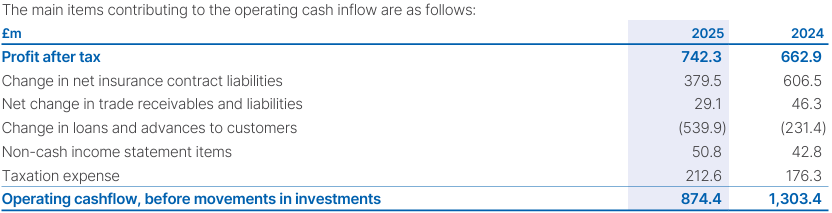
Cashflow
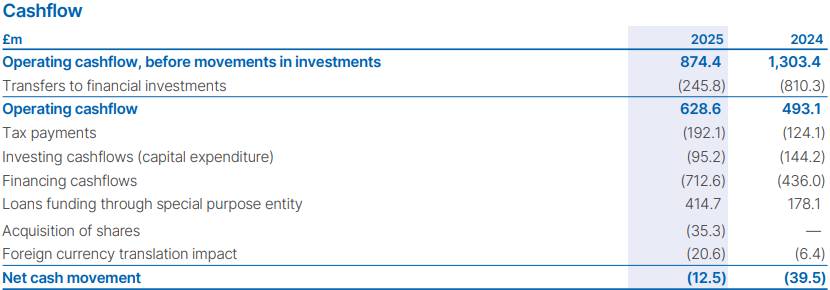
Source: Admiral Group plc Annual Report and Accounts 2025 Group capital structure and financial position included in the Strategic Report (pages 53).
By comparison, the full IAS 7 statement of cash flows reported in the financial statements can be found on page 209 of the annual report and is reproduced below for ease of reference. Amounts in both excerpts have been colour-keyed to show how the statement has been simplified.
Note: The sub-total prior to the foreign currency translation impact is 8.1, as see in the full statement of cash flows below.
120 Whilst there is no cross-reference on the above statement to the financial statement notes, it would be expected that each of the line items be cross-referenced to the respective notes to the financial statements, to show how the cash flow movement relate to the respective balance sheet movements.
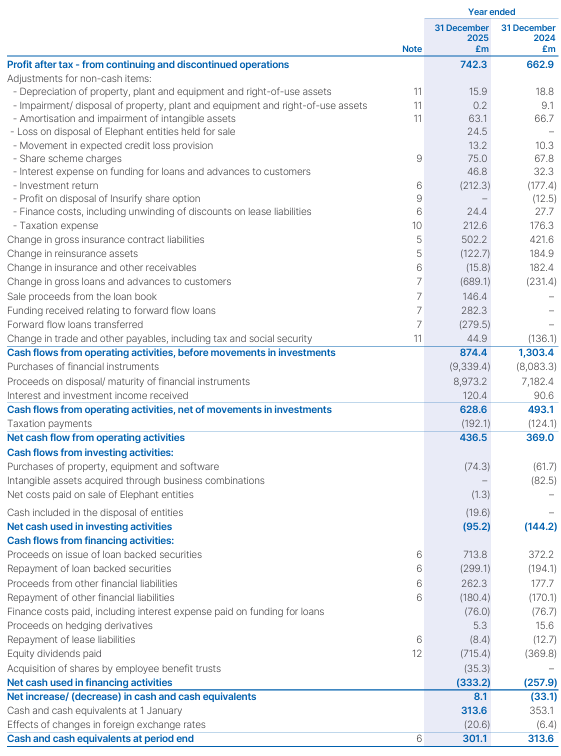
Note: The net increase/(decrease) in cash and cash equivalents of £8.1m plus the effects of change in FX rates of £(20.6)m, equals £(12.5)m, which represents the movement between the opening and closing cash and cash equivalents £313.6m to £301.1m = £(12.5)m, as shown in the simplified statement.
Contact Us
UK Endorsement Board
13th Floor | 1 Harbour Exchange | Harbour Exchange Square | London | E14 9GE
www.endorsement-board.uk
Footnotes
Footnotes
-
The Basel Committee on Banking Supervision (BCBS) is a global standard setter for banking regulation, aimed at enhancing financial stability through improved banking supervision and regulation. Its primary purpose is to provide a forum for regular cooperation on banking supervisory matters and to develop standards for the prudential regulation of banks (Source: https://www.bis.org/bcbs/index.htm). ↩
-
Paragraph 7 of IAS 7 (Emphasis added): Cash equivalents are held for the purpose of meeting short‑term cash commitments rather than for investment or other purposes. For an investment to qualify as a cash equivalent it must be readily convertible to a known amount of cash and be subject to an insignificant risk of changes in value. Therefore, an investment normally qualifies as a cash equivalent only when it has a short maturity of, say, three months or less from the date of acquisition. Equity investments are excluded from cash equivalents unless they are, in substance, cash equivalents, for example in the case of preferred shares acquired within a short period of their maturity and with a specified redemption date. ↩
-
See paragraph 46 of IAS 7: “In view of the variety of cash management practices and banking arrangements around the world and in order to comply with IAS 1 Presentation of Financial Statements, an entity discloses the policy which it adopts in determining the composition of cash and cash equivalents”. ↩
-
Some banks provide a maturity analysis of financial assets, incl. cash and cash equivalents, per paragraph B11E of IFRS 7 introduced by Improving Disclosures about Financial Instruments (Amendments to IFRS 7), issued in March 2009. However, a company uses its judgement to determine an appropriate number of time bands and these may not provide sufficient details for cash and cash equivalents if yearly time buckets are used e.g. less than one year, one to five years, etc. ↩
-
The meeting summary for the UKEB Investor Advisory Group meeting on 2 February 2026 can be found on the UKEB website here: https://www.endorsement-board.uk/about-us/structure/advisory-groups/investor-advisory-group/. The meeting summary for the UKEB Accounting Firms and Institutes Advisory Group meeting on 10 March 2026 can be found here: https://www.endorsement-board.uk/about-us/structure/advisory-groups/accounting-firms-and-institutes-advisory-group/. Details of the UKEB Financial Instruments Working Group can be found on the UKEB website here: https://www.endorsement-board.uk/about-us/structure/advisory-groups/financial-instruments-working-group/. ↩
-
Reinsurers are insurers for insurance companies, enabling insurance companies to reduce their exposure to significant claims, by paying insurance premiums to reinsurers for the transfer of insurance liabilities. Reinsurers reinvest the insurance premiums they receive. By offsetting the risk of loss in insurance liabilities, insurance companies do not need to keep as much capital on hand to cover potential losses. Thus, they can invest the capital elsewhere to increase their revenues. ↩
-
Paragraphs 87 of the Staff Agenda Paper 20A for the IASB March 2025 meeting. ↩
-
For three example of statements of cash flows disclosed by banks, see Lloyds Banking Group plc Annual Report and Accounts 2025, Consolidated Cash Flows Statement (page 217) and related note 40 (pages 295-296), Barclays PLC Annual Report 2025, Consolidated Cash Flows Statement (page 401) and HSBC Holdings plc Annual Report and Accounts 2025, Consolidated Cash Flows Statement (page 82). ↩
-
For example of statements of cash flows disclosed by insurance companies (life and non-life) see Aviva plc Annual Report and Accounts 2025 Consolidated Statement of Cash Flows (page 188) and Admiral Group plc Annual Report and Accounts 2025 Consolidated Cash Flow Statement (page 209). ↩
-
The balance sheets of life insurers include ‘unit linked’ and ‘with profit’ assets that belong to their policyholders with a corresponding ‘unit linked’ and ‘with profit’ liability (either insurance or investment contract liabilities). The cash flow statement is not as useful for users, as most users are not interested in the ‘unit linked’ and ‘with profit’ cash and movements, but rather are interested in the shareholder and non-profit cash flows. ↩
-
See paragraphs C170–C178 of the UKEB third research paper Statement of Cash Flows: UK User and Preparer Perspectives. ↩
-
IAS 1 is replaced by IFRS 18 effective 1 January 2027. These specific paragraphs are replaced by paragraphs 126–129 of IFRS 18 which require an entity to “disclose in the notes information that enables users of financial statements to evaluate the entity’s objectives, policies and processes for managing capital” (emphasis added). ↩
-
See the paragraphs C147–C151 of UKEB third research paper Statement of Cash Flows and Related Matters: UK User and Preparer Perspectives (March 2025). ↩
-
See Section 2.4 Grouping of Information of Effects Analysis–IFRS 18 Presentation and Disclosure in Financial Statements published by the IFRS Foundation in April 2024. ↩
-
The Pillar III standard is part of the Basel Committee on Banking Supervision (BCBS) Consolidated Framework, which lays out a comprehensive set of public disclosure requirements that seek to provide investors, analysts, and other market participants with sufficient information to assess an internationally active bank's material risks, risk management practices and capital adequacy. The requirements aim to improve the ability of market participants to assess the risk profile of financial institutions and to make informed decisions regarding investment. In the UK, the Prudential Regulation Authority (PRA) regulatory requirements include certain Basel III standards that were retained in the UK regulatory framework from 1 January 2022 as part of the UK's withdrawal from the EU. ↩
-
See example: HSBC Pillar 3 disclosures at 31 December 2025. ↩
-
Risk-weighted assets (RWAs) are used to link the minimum amount of capital that banks must hold, with the risk profile of the bank’s lending activities (and other assets). ↩
-
The liquidity cover ratio (LCR) determines if a bank holds sufficient High Quality Liquid Assets to survive a short-term liquidity stress for a period of 30 days. Banks are required to maintain LCR at a minimum of 100%. ↩
-
Net stable funding ratio (NSFR) determines if a bank holds sufficient long-term stable funding to cover the duration of their long-term assets. Banks are required to maintain minimum NSFR of 100% on standalone as well as consolidated level at all times, as assessed based on regulatory guidelines (Annex III of the Bank of England’s Prudential Regulation Authority covers instructions for reporting on stable funding). ↩
-
The Taskforce on Disclosures about Expected Credit Losses (DECL), sponsored by the Financial Conduct Authority (FCA), the Financial Reporting Council (FRC) and the Prudential Regulation Authority (PRA), published guidance on a complete set of high quality IFRS 9 Expected Credit Loss accounting (ECL) disclosures. Its third report comprises a comparison of preparers’ and users’ assessments of adoption of Taskforce recommendations and good practice disclosure examples – see https://www.frc.org/news-and-events/news/2022/09/taskforce-on-disclosures-about-expected-credit-losses-decl-updated-guidance/. The guidance is aimed primarily at the biggest UK-headquartered banks and building societies but is also likely to be relevant to a much wider group of preparers. ↩
-
The Solvency and Financial Condition Report (‘SFCR’) is a regulatory report required by the Reporting and Group parts of the Prudential Regulation Authority (‘PRA’) Rulebook. This report, including the accompanying Quantitative Reporting Templates (‘QRTs’), sets out aspects of a Group’s business and performance, system of governance, risk profile, valuation methods used for solvency purposes and capital management. All UK insurers and PRA supervised insurance groups subject to Solvency II are required to publish a SFCR. The PRA’s current rules impose an independent external audit requirement over all such SFCRs, except for any insurer that meets the definition of a ‘small firm for external audit purposes’ and of any group that meets the definition of a ‘small group for external audit purposes’. ↩
-
For an example see Aviva plc Single Group wide Solvency and Financial Condition Report (SFCR) for the year ended 31 December 2025 – Balance sheet–IFRS and Solvency II (page 54). ↩
-
For an example see Aviva plc Single Group wide Solvency and Financial Condition Report (SFCR) for the year ended 31 December 2025 (page 97). ↩
-
For an example see Aviva plc Annual Report and Accounts 2025 APMs Derived from Solvency II measures (pages 328–334). Such Solvency II APMs include: Solvency II shareholder cover ratio; Value of new business on an adjusted Solvency II basis (VNB); Solvency II Present Value of New Business Premium (PVNBP); Annual premium equivalent (APE); Health In-Force Premiums; Solvency II operating own funds generation (Solvency II OFG); Solvency II operating capital generation (Solvency II OCG); Solvency II return on equity (Solvency II Return on Equity); Solvency II net asset value per share (Solvency II NAV per share); and Solvency II debt leverage ratio. ↩
-
See Section 2.3 Management-defined performance measure of Effects Analysis–IFRS 18 Presentation and Disclosure in Financial Statements published by the IFRS Foundation in April 2024. ↩
-
IAS 1 Presentation of Financial Statements (paragraphs 134–136). ↩
-
These issues are explored in more detail in Accounting Miscellany blog: Cash flow statements for banks, insurance companies and investment funds (published 16 May 2025). ↩
-
See slides 6–7 of September 2016 IFRS Project Summary and Feedback Statement Applying IFRS 9 Financial Instruments with IFRS 4 Insurance Contracts (Amendments to IFRS 4). A company’s activities are predominantly connected with insurance, if, and only if: a) the amount of its insurance liabilities is significant compared with its total amount of liabilities; and b) the percentage of its liabilities connected with insurance relative to its total amount of liabilities is: i. greater than 90 per cent; or ii. less than or equal to 90 per cent but greater than 80 per cent, and the company does not engage in a significant activity unconnected with insurance. Liabilities connected with insurance include investment contracts measured at FVPL, and liabilities that arise because the insurer issues, or fulfils obligations arising from, these contracts (such as deferred tax liabilities arising on its insurance contracts). ↩
-
IAS 30 Disclosures in the Financial Statements of Banks and Similar Financial Institutions was effective 1 January 1991 and superseded by IFRS 7 Financial Instruments: Disclosures, effective 1 Jan 2007. ↩
-
The IASB issued “Applying IFRS 9 Financial Instruments with IFRS 4 Insurance Contracts (Amendments to IFRS 4)” on 12 September 2016. The amendments address concerns arising from implementing the financial instruments Standard, IFRS 9, before implementing IFRS 17 Insurance Contracts; the amendments also supplemented existing options in IFRS 4 to address those concerns. IFRS 9 Financial Instruments was issued on 24 July 2014 and became effective on 1 January 2018. IFRS 17 was issued on 18 May 2017 and became effective on 1 January 2023. ↩
-
Both the PRA and the FCA apply standards that generally either anticipate or go beyond requirements established by global or European Union (EU) standards, whether in relation to capital, leverage and liquidity, resolvability and resolution or matters of conduct. The UK is in the process of reviewing, repealing and, where relevant, replacing the EU legislation that was on shored into UK law following the UK’s departure from the EU (known as “assimilated law”). The Financial Services and Markets Act 2023 (FSMA 2023) established a framework for the revocation of assimilated law relating to financial services. However, the Government is not expected to revoke assimilated law relating to financial services unless the FCA and/or PRA have drafted and consulted on rules in the relevant areas, where it is appropriate that the provisions are replaced. There is a significant volume of assimilated law for the UK Government to repeal and replace, so this process remains ongoing and the regulatory landscape continues to develop. There is potential for an increase in regulatory implementation costs to adapt systems and controls, as a result of these developments, although areas of divergence from assimilated law have been limited to date. [see pages 342–346 of the Barclays PLC Annual Report 2025]. ↩
-
All UK insurers and PRA supervised insurance groups subject to Solvency II are required to publish a Solvency and Financial Condition Report (SFCR). The PRA’s current rules impose an independent external audit requirement over all such SFCRs, except for any insurer that meets the definition of a ‘small firm for external audit purposes’ and of any group that meets the definition of a ‘small group for external audit purposes’. The auditor is required to gather sufficient appropriate evidence to provide an overall reasonable assurance opinion that the public disclosure in scope complies in all material respects with PRA rules and Solvency II Regulations. ↩↩
-
See https://www.bankofengland.co.uk/prudential-regulation/regulatory-reporting/regulatory-reporting-banking-sector/banks-building-societies-and-investment-firms. ↩
-
Market stress events such as the March 2020 ‘dash for cash’ at the onset of the Covid-19 pandemic, and the September 2022 liability-driven investment (LDI) crisis. ↩
-
See https://www.bankofengland.co.uk/prudential-regulation/regulatory-reporting/regulatory-reporting-insurance-sector. ↩
-
https://www.investopedia.com/terms/s/solvency-capital-requirement.asp. The EU Solvency II directive designates three pillars or tiers for capital requirements. Pillar I covers the quantitative requirements; that is, the amount of capital an insurer should hold. Pillar II establishes requirements for the governance, effective supervision, and risk management of insurance companies. Pillar III details disclosure and transparency requirements. Solvency Capital Requirements (SCR) are critical to maintaining the financial stability of insurance and reinsurance companies within the EU. As a result, insurance companies are required to manage and disclose risks accurately, fostering reliability and trust in the sector. ↩
-
In the UK, the EU Solvency II regime was adapted by the PRA’s 2024 reforms and the phased implementation of ‘Solvency UK’ was completed on 31 December 2024, following the UK’s departure from the EU. Solvency UK is referenced except when referring to financial metrics, when Solvency II is referred to in line with the current PRA guidance and consistent with the prudential regime in the PRA policy manual. Solvency UK was designed to make the UK insurance market more competitive, dynamic, and capable of supporting domestic investment, while still ensuring financial stability and policyholder security under the PRA objectives. See https://www.pwc.co.uk/financial-services/assets/pdf/pra-finalises-new-solvency-uk-framework.pdf. ↩