UKEB 2026 Research Strategy
Background
In February 2026, the Board approved the Regulatory Strategy 2026/27. That strategy identified areas where the UKEB could provide thought leadership, consistent with its statutory role to contribute to the development of high-quality international accounting standards and to influence the work of the IASB.
The draft Regulatory Strategy highlighted three potential research themes:
- accounting for intangible assets;
- carbon and other environmental credits; and
- fundamental gaps in IFRS Accounting Standards.
This paper summarises stakeholder feedback on those themes and sets out the Secretariat’s proposed research priorities for the remainder of the 2026/27 financial year.
Feedback received
The UKEB received five responses to the draft Regulatory Strategy. Overall, respondents were supportive of the proposed direction of travel, with a clear preference for focused research in areas where the UKEB can have the greatest international impact.
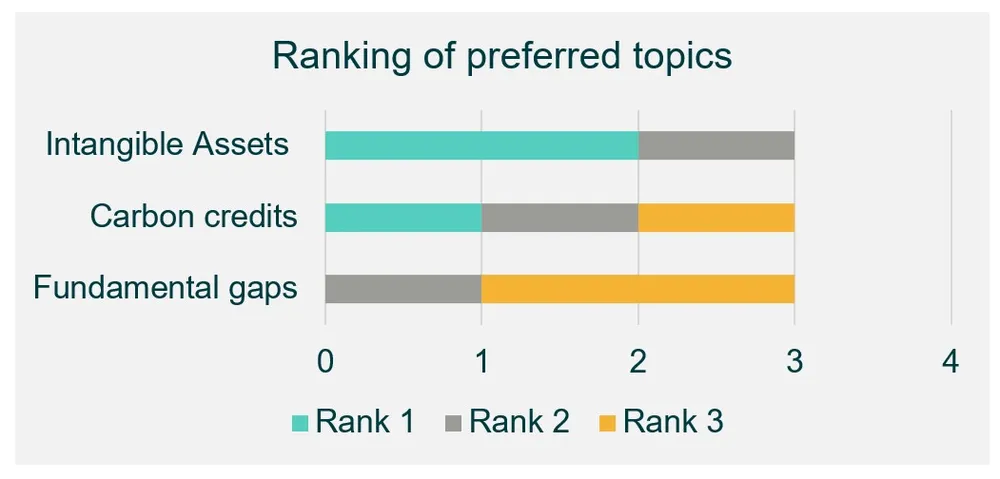
The key feedback is summarised below. Respondents were also asked to rank the proposed topics:
Intangible Assets
Respondents strongly supported continuation of the UKEB’s work on intangible assets and welcomed the progress made to date.
Feedback endorsed further work to:
- deepen understanding of user information needs through engagement with UK stakeholders;
- develop a principles-based framework to support improvements to recognition, measurement and disclosure; and
- consider connectivity with IFRS Sustainability Disclosure Standards.
Stakeholders emphasised the importance of aligning UKEB work with the IASB’s active project on intangibles. Specific areas identified for further research included:
- cryptoassets;
- customer-related intangibles; and
- connectivity with sustainability reporting.
Overall, respondents view intangible assets as a high-priority topic, with significant potential for the UKEB to influence international standard-setting, particularly given the limitations of IAS 38 and the IASB’s ongoing work.
Carbon and other environmental credits
Respondents expressed clear support for further UKEB research in this area.
Stakeholders supported work to:
- document the range of environmental credit schemes and current accounting practices;
- assess the diversity of treatments applied in practice; and
- explore potential principles-based approaches to accounting.
Feedback highlighted:
- the increasing economic importance of environmental credits in the transition to net zero;
- significant diversity in accounting practice; and
- a need for greater clarity and consistency.
This topic is viewed as an emerging area of growing significance, where the UKEB is well placed to contribute to the development of practice and influence future standard-setting.
Fundamental gaps in IFRS Accounting Standards
This theme was ranked lower by stakeholders.
While respondents identified a number of topics (including levies, non-reciprocal transactions and aspects of insurance accounting), feedback indicated:
- no clearly prioritised issue; and
- a more fragmented set of concerns.
As a result, this theme is considered less suitable as a standalone proactive research programme. However, targeted work may be appropriate in the context of existing projects.
Depending on developments in the IASB project pipeline, limited research on levies and non-reciprocal transactions could be undertaken as part of the UKEB’s work on provisions.
Other topics
One respondent highlighted the growing importance of Artificial Intelligence (AI), particularly in relation to how users extract and analyse information from financial reports.
While this is an area of increasing relevance, the Secretariat considers that any work should initially be exploratory and undertaken on an ad hoc basis, subject to resource availability.
Research Strategy
In developing this strategy, the UKEB considered:
- Relevance, including stakeholder views and the broader UK context;
- Impact, including previous UKEB engagement and expected importance of the topic to the future IASB agenda;
- Feasibility, including UKEB’s capacity to undertake research.
The UKEB has a budget to outsource some research. This allows the UKEB to focus its internal resources where they are likely to have the greatest impact, while continuing to develop evidence on a wider range of relevant topics. Research may be outsourced where it is primarily descriptive in nature and aimed at providing evidence on the prevalence and nature of specific accounting issues. Research focused on understanding stakeholder perspectives and developing policy recommendations would be undertaken using in-house resources.
Based on these considerations, the UKEB will focus its research programme on two priority themes, supported by targeted ad hoc work.
Intangible Assets
Intangible assets is the UKEB’s primary research priority given:
- strong stakeholder support and the existing UKEB research base;
- direct alignment with an active IASB project; and
- a clear opportunity to influence international standard-setting.
Proposed research
The UKEB will continue to build on its existing work, with the objective of developing key principles that could support future standard-setting, including:
- recognition and measurement of intangible items; and
- improved disclosure of intangible resources.
A detailed research proposal is expected to be presented in Q3 2026.
In addition, the UKEB will undertake targeted research on digital assets. This reflects both stakeholder feedback that specifically identified this topic, and the IASB’s addition of cryptoassets to its research pipeline (November 2025). Research in this area will complement, and contribute to, the existing UKEB intangibles research and support the Board in responding to future IASB work.
This work will involve:
- desk-based research;
- analysis of financial statements;
- engagement with preparers and market participants.
This research will be descriptive in nature, and focused on understanding the prevalence and nature of cryptoassets in the UK listed company environment. Given current resource prioritisation for the Secretariat, this work will be outsourced.
Environmental Credits
Environmental credits is the second priority research theme, reflecting:
- strong stakeholder support;
- increasing policy relevance in the context of net zero; and
- evidence of diversity in accounting practice.
The topic is closely linked to intangible assets but raises broader accounting questions beyond just asset recognition. It also builds on research previously undertaken by the UKEB linked to climate-related matters and connectivity between IASB and ISSB standards (Climate-related Matters).
The IASB has also identified pollutant pricing mechanisms as a potential future research topic (November 2025), and the research would support the UKEB in responding to any future IASB project in this area.
Proposed research
The UKEB expects to undertake a comprehensive research project to:
- analyse the extent and nature of environmental credit schemes;
- assess current accounting treatments and disclosures;
- identify areas of diversity and inconsistency; and
- consider potential principles-based approaches.
The work will include:
- desk-based research and financial statement analysis;
- market analysis of voluntary and regulatory schemes;
- stakeholder engagement.
This initial research will be descriptive in nature, and focused on understanding the prevalence and nature of environmental credits in the UK listed company environment. Given current resource prioritisation for the Secretariat, we expect that this work will be outsourced. A detailed proposal is expected to be presented to the Board in the second half of 2026.
Ad Hoc Research
The UKEB undertakes a range of ad hoc research relevant to projects it is undertaking. These projects may be incorporated into existing influencing and endorsement projects, or may be standalone research projects. The research is generally designed to provide the Board with additional evidence to support their decision making, and contribute to international meetings.
Currently the UKEB is undertaking three ad hoc projects:
- Rate Regulated Activities wider economic effects report. This forms part of the IFRS 20 endorsement work and is being outsourced due to its specialised nature.
- Users of capital markets analysis. This has emerged from the UKEB’s IFRS 20 endorsement work, though it will have wider implications for the work of the UKEB. It is being undertaken by the UKEB’s economics team.
- IFRS 17 Insurance Contracts: Capital Markets Effects report. This forms part of the UKEB’s Postimplementation Review of IFRS 17 and is being outsourced due to resource constraints.
Future ad hoc research will be driven by:
- IASB developments; and
- UKEB project priorities.
Potential areas include:
- levies and non-reciprocal transactions (in the context of provisions); and
- hedge accounting (in the context of the IFRS 9 PIR of hedging).
Ad hoc work may be undertaken internally or outsourced, depending on nature and resource availability, with proposals brought to the Board as part of the normal project cycle.