10 IASB General Update
28 March 2025 Agenda Paper 10

Executive Summary
| Project Type | Influencing |
| Project Scope | Various |
Purpose of the paper
This paper provides the Board with an update on projects the Secretariat is currently monitoring, including the work of the IFRS Interpretations Committee.
As agreed with the Board, the Secretariat monitors projects being undertaken by the IASB and IFRS Interpretations Committee. This is undertaken to inform the Board about the progress and decisions being made by the IASB on active projects. Discussion by the Board may also help inform interactions with international standard setter meetings, including the IASB's Accounting Standards Advisory Forum (ASAF).
Summary of the Issue
Topics addressed in this paper include those discussed by the IASB at its February 2025 meeting.
Topics for discussion
- Updating IFRS 19 Subsidiaries without Public Accountability: Disclosure
- Amortised Cost Measurement
- Intangible Assets
Topics for noting
- Climate-related Risks and Other Uncertainties in the Financial Statements
- IASB Fourth Agenda Consultation
IFRIC Update
Questions for the Board
Topics for discussion
Updating IFRS 19 Subsidiaries without Public Accountability (Appendix A)
- Do Board members have any questions or comments on the IASB's tentative decisions taken at the February 2025 meeting?
Amortised Cost Measurement (Appendix B)
-
Do Board members have any questions or comments on the information about the IASB's Amortised Cost Measurement project presented in this Appendix?
-
What is your advice on the level of stakeholder engagement the Secretariat should be carrying out during the research phase of this project?
Intangibles (Appendix C)
- Do Board members have any questions or comments on the update provided in the paper?
Topics for noting
Do Board members have any questions or comments on the topics for noting?
IFRIC Update
There are no questions for the Board this month.
Recommendation
N/A
Appendices
- Appendix A: Updating IFRS 19 Subsidiaries without Public Accountability
- Appendix B: Amortised Cost Measurement
- Appendix C: Intangible Assets
- Appendix D: Climate-related Risks and Other Uncertainties in the Financial Statements
- Appendix E: IASB Fourth Agenda Consultation
- Appendix F: Interpretations Committee Update
- Appendix G: List of IASB projects
Appendix A: Updating IFRS 19 Subsidiaries without Public Accountability: Disclosures
| Project Stage | Research / Pipeline | Discussion paper | Redeliberation | Exposure Draft | Redeliberation | Final standard | Post Implementation Review |
|---|---|---|---|---|---|---|---|
| IASB | Research / Influencing | Research / Monitoring | Influencing | Monitoring | Endorsement | Influencing | |
| UKEB | Research / Influencing | Research / Monitoring | Influencing | Monitoring | Endorsement | Influencing |
UKEB project page UKEB Final Comment Letter (published 28 November 2024)
Background
A1IFRS 19 Subsidiaries without Public Accountability: Disclosures issued in May 2024 included reduced disclosure requirements for IFRS Accounting Standards issued before 28 February 2021.
A2In July 2024, the IASB published the Exposure Draft Amendments to IFRS 19 (ED) that proposed reductions to disclosure requirements for new or amended IFRS Accounting Standards issued between 28 February 2021 and May 2024.
A3In January 2025, the IASB discussed the feedback in comment letters and from outreach events on the ED 1.
Purpose of this update
A4This paper provides an update on the February 2025 meeting where the IASB made tentative decisions on the ED.
IASB discussion
A5At the meeting IASB members commented on the following topics of the ED:
- Supplier finance arrangement (SFA). One IASB member disagreed with deleting the requirement to disclose the range of payment due dates for both the financial liabilities that are part of a SFA and comparable trade payables that are not part of an SFA. In the view of that IASB member, this disclosure enables users of financial statements to assess how these arrangements affect the entity's cash flows. This is relevant for users of subsidiaries' financial statements who are particularly interested in information about short-term cash flows. However, in considering costs and benefits, the IASB has decided to delete this disclosure requirement.
- International Tax Reform—Pillar Two Model Rules (Pillar Two). One IASB member said that the disclosure requirements are of limited relevance because the Pillar Two rules are already in effect in many jurisdictions. The IASB staff paper 2 explained that in a future review of IFRS 19, if the disclosure requirements have become entirely irrelevant, the Standard could be amended at that point to delete the disclosure requirements.
- Lack of exchangeability (LOE).
- IASB members had mixed views on the disclosure requirements for LOE, in particular on the staff recommendation to delete the requirement to disclose: - qualitative information about each type of risk to which the entity is exposed because the currency is not exchangeable into the other currency, and the nature and carrying amount of assets and liabilities exposed to each type of risk; and - the requirement to disclose summarised financial information for foreign operations.
- Some IASB members supported the IASB staff recommendation because the costs of the requirements for preparers would exceed the benefits to users.
- However, two IASB members strongly disagreed and said that these disclosures would enable users to understand the financial impact of a currency not being exchangeable into another currency, in particular, when the subsidiary is materially impacted. In contrast, these two IASB members also said that the benefits of the information to users exceed the costs for preparers i.e. subsidiaries would already have this information available for consolidation purposes.
IASB tentative decisions
A6The table below summarises the IASB's proposals contained in the ED, the recommendations made by the UKEB in its comment letter 3, and the tentative decisions made by the IASB. We note that in many respects the final IASB position is aligned with the views expressed in the UKEB comment letter.
| ED proposal | UKEB comment letter 4 | IASB tentative decision |
|---|---|---|
| IFRS 18 Presentation and Disclosure in Financial Statements | ||
| Retained all the disclosure requirements in IFRS 18, except the disclosure objective from a disclosure requirement relating to non-current liabilities. | The UKEB comment letter agreed with the proposals and did not identify any potential reduction to the disclosure requirements in IFRS 18. | The IASB has decided to retain these proposals. |
| Replaced the requirements relating to management-defined performance measures (MPMs) with a cross-reference to those requirements in IFRS 18. | ||
| Supplier finance arrangements | ||
| Added the definition of supplier finance arrangements (SFA) from paragraph 44G of IAS 7 Statement of Cash Flows. | The UKEB comment letter did not support this proposal because in general IFRS 19 does not include definitions or descriptions. | The IASB has decided to delete this definition. |
| Retained all the disclosure requirements relating to SFA, except the disclosure objective. | The UKEB comment letter recommended providing an explanation of how benefits outweigh the costs for disclosure of liabilities (part of SFA) for which suppliers have already received payment from the finance providers. | The IASB has retained the proposal to delete the disclosure objective. In considering costs and benefits, the IASB has decided to delete the requirement to disclose the range of payment due dates for both the financial liabilities that are part of a SFA and comparable trade payables that are not part of SFA. |
| International Tax Reform—Pillar Two Model Rules | ||
| Removed: | The UKEB comment letter agreed with the proposals. | The IASB has decided to clarify the disclosure requirements by adding the phrase 'known or reasonably estimable' from paragraph 198 of IFRS 19 (the disclosure objective which the ED proposed to delete) to paragraph 199 of IFRS 19 to ensure the requirements are not more onerous for eligible subsidiaries. |
| - the disclosure objective i.e. the whole of paragraph 198 of IFRS 19; and, | ||
| - the reference to a disclosure objective in paragraph 199 of IFRS 19 i.e. the first sentence of this paragraph. | ||
| Lack of exchangeability | ||
| Retained all the disclosure requirements relating to lack of exchangeability, except the disclosure objective. | The UKEB comment letter agreed with the proposal. | The IASB has retained the proposal to delete the disclosure objective. |
| Amendments to the Classification and Measurement of Financial Instruments | ||
| No reductions were proposed for disclosures related to changes in contractual cash flows (paragraphs 20B–20D of IFRS 7 Financial Instruments: Disclosures). | The UKEB comment letter agreed with the proposal but suggested the IASB consider whether paragraph 56C 5 of the consequential amendments, which appears to be disclosure guidance, should be included in IFRS 19. | The IASB has decided to delete: |
| - paragraph 56C of IFRS 19 consistent with the principle of not including any guidance in IFRS 19; and | ||
| - the second sentence of paragraph 56A 6 of IFRS 19 because it is akin to guidance. |
Next steps
A7In a future IASB meeting, the staff will bring an agenda paper to discuss other matters (e.g. effective date, transition requirements), due process and an effects analysis, and will ask permission from the IASB to begin the balloting process.
A8The IASB's aim is to finalise the amendments to IFRS 19 in Q3 2025.
A9The IASB will decide whether to develop reduced disclosures for the forthcoming IFRS Accounting Standard Regulatory Assets and Regulatory Liabilities (RARL Standard) separately at its March 2025 meeting because the amendments to IFRS 19 are expected to be finalised before the IASB issues the RARL Standard. The UKEB Secretariat will continue to monitor the IASB discussions on this topic and provide feedback to the Board as required.
A10The UKEB plans to assess both IFRS 19 and the final amendments resulting from the ED as a package for adoption and will present a Project Initiation Plan for the endorsement assessment of IFRS 19 in due course.
Question for the Board
- Do Board members have any questions or comments on the IASB's tentative decisions taken at the February 2025 meeting?
Appendix B: Amortised Cost Measurement
| Project Stage | Research / Pipeline | Discussion paper | Redeliberation | Exposure Draft | Redeliberation | Final standard | Post Implementation Review |
|---|---|---|---|---|---|---|---|
| IASB | Research / Influencing | Research / Monitoring | Influencing | Monitoring | Endorsement | Influencing | |
| UKEB | Research / Influencing | Research / Influencing | Monitoring | Influencing | Monitoring | Endorsement | Influencing |
IASB Next Milestone:
- IASB outreach activities with preparers from March 2025.
- Decide project direction: H1 2026
B1In February 2025, the IASB was presented with a summary of feedback from consultative groups, the IASB staff analysis of that feedback, and suggested next steps on its Amortised Cost Measurement project 1. The IASB was not asked to make decisions at that meeting.
B2The purpose of this paper is to provide the Board with an update on these matters.
Background
B3At its September 2024 meeting, the IASB commenced its research project Amortised Cost Measurement. The UKEB was provided with an update on that meeting along with background project information in the October 2024 General IASB Update.
B4In November and December 2024, the IASB sought feedback on the project objectives, approach and scope from consultative groups 2 including the Accounting Standards Advisory Forum (ASAF), of which the UKEB is a member.
Project objectives and approach
Project objectives
B5The IASB's objectives for the project are:
- "to address application matters arising from the amortised cost measurement requirements in IFRS 9, that are widespread and have a material effect on entities' financial statements; and
- to improve specific information provided to users of financial statements about financial instruments measured at amortised cost. "3
Project approach
B6The IASB will take a 'targeted improvements' approach to this project. The intention behind this approach is to clarify the underlying principles of the amortised cost measurement requirements in IFRS 9 and develop new principles where required. In this way, the IASB aims to address the root causes of the application issues and the resulting diversity in practice which has been highlighted by stakeholders.
B7Overall, consultative groups were broadly supportive of the project objectives and approach. Consistent with the IASB's discussion in September 2024, some consultative group members (including the UKEB) observed that diversity in practice is not necessarily indicative of an issue which needs to be solved 5 and stressed the importance of identifying the root causes of diversity in practice by consulting with preparers.
B8Members of consultative groups and the IASB also noted the importance of clear communication with stakeholders about the project approach, to ensure it is well understood. Applying a principle-based approach, targeted improvements could result in potentially significant impact for some entities (e.g., to system infrastructure), and potential changes to long standing accounting practice. Therefore, it will be important to draw a clear distinction between such an approach and, for example, a 'narrow-scope' approach which would typically involve limited amendments for a specific feature of financial instruments or a particular fact pattern, without clarifying underlying principles 6.
B9Consultative groups and IASB members alike highlighted the need for timely completion of the project.
Project criteria
B10When the project was launched in September 2024, the IASB staff developed criteria for determining the issues in scope of the project, being those:
- "that are widespread and have a material effect on entities' financial statements;
- for which financial reporting would be improved through clarifications aimed at reducing diversity in practice. That is, the diversity resulting from unclear requirements or insufficient application guidance in IFRS 9.
- for which the benefits to investors from the resulting information outweigh the implementation costs for preparers. When evaluating this condition, the IASB will consider factors such as whether a potential solution was previously dismissed due to operational complexity; and
- that can be resolved by the IASB efficiently and effectively without:
- fundamentally rewriting the requirements of IFRS 9;
- creating internal inconsistencies in IFRS 9; and
- amending other IFRS Accounting Standards (except for consequential amendments)."7
B11Discussions at the September 2024 IASB meeting and the December 2024 ASAF meeting referred to the need to focus on resolving those issues which would result in useful information for investors, especially considering that much of the feedback on the project thus far has come from preparers or auditors 8. This will have to be balanced against the costs for preparers and the need to develop solutions which are operational in practice (see paragraph B10.c) above).
B12The wording of the criteria will be aligned to the IASB Prioritisation Framework once that is finalised.
Scope
B13When the project was launched in September 2024, the IASB identified eleven issues for potential inclusion, which were set out in a table in Appendix A of September 2024 IASB Agenda Paper 11.
B14These issues were subsequently discussed with consultative groups to ensure the list was complete and to identify any missing issues. Most consultative group members confirmed that the list was complete. However, some members (including the UKEB) suggested that the IASB was being ambitious in seeking to address all issues on the list and recommended some method of prioritisation.
B15However, the IASB staff note that "the application issues in this project are interrelated" 9 and therefore, it would not be effective or efficient to consider the issues in isolation. Rather than viewing the list of issues as discrete application matters requiring separate solutions, the IABS staff consider that the issues in scope should be considered thematically.
B16The overarching theme of the eleven application issues in the IASB's list is considered to be the question of "how to account for a change in expected cash flows of a financial instrument measured at amortised cost. "10 A change in expected cash flows could include:
- "changes in expected cash flows that affect the EIR 11 (both at initial recognition and subsequent measurement); and
- changes in expected cash flows that affect the carrying amount.”12
B17In the IASB staff view, focusing on the measurement principles underpinning these two themes would allow the IASB to explore principle-based solutions for application issues and holistically consider the interactions between different requirements.
Indicative project timeline
B18This is currently a research project and the IASB is expected to decide project direction in H1 2026. The IASB is consulting with stakeholders during Q1 and Q2 2025. An indicative timeline for the IASB's deliberations during the research phase of the project is summarised below:
| Area | Topic (Items in bold are prioritised by consultative groups—see Feb.2025 IASB staff paper 11, paragraph 22) | Indicative timeline |
|---|---|---|
| Changes in expected cash flows that affect the EIR | Determining EIR with conditions attached to the contractual interest rate | Q2 / Q3 2025 |
| Accounting for subsequent changes in estimated cash flows | ||
| The effect of modifications on EIR | ||
| Changes in expected cash flows that affect the carrying amount | What constitutes a 'modification' of financial instruments | Q4 2025 |
| Assessment of modifications that lead to derecognition | ||
| Partial derecognition vs modification of a financial instrument | ||
| Accounting for modification gains or losses | ||
| Accounting for unamortised transaction costs and fees received in modifications | ||
| Accounting for 'fees and costs incurred' as required by paragraph 5.4.3 of IFRS 9 | ||
| Boundaries between modification, derecognition, and impairment | Q1 2026 | |
| The IASB to reconsider whether it can solve the issues relating to accounting for write-offs effectively and efficiently. | Q1 2026 |
Source: Paragraph 50 of the February 2025 IASB Agenda Paper 11
Next steps
B19The IASB staff will consult with preparers in different industries and across different geographic regions (see paragraph B7 above) on matters such as the root causes of diversity in practice. These meetings are expected to take place from March 2025.
B20The IASB staff will also consult with investors as the project progresses, particularly in evaluating potential solutions (see paragraph B11 above).
B21At the ASAF meeting in December 2024, the UKEB highlighted the importance of early stakeholder engagement on this project and offered to assist the IASB with UK outreach. The UKEB Secretariat is liaising with the IASB staff on this matter. The Secretariat will continue to monitor project developments.
Questions for the Board
- Do Board members have any questions or comments on the information about the IASB's Amortised Cost Measurement project presented in this Appendix?
- What is your advice on the level of stakeholder engagement the Secretariat should be carrying out during the research phase of this project?
Appendix C: Intangible Assets
| Project Stage | Research / Pipeline | Discussion paper | Redeliberation | Exposure Draft | Redeliberation | Final standard | Post Implementation Review |
|---|---|---|---|---|---|---|---|
| IASB | Research / Influencing | Research / Monitoring | Influencing | Monitoring | Endorsement | Influencing | |
| UKEB | Research / Influencing | Research / Influencing | Monitoring | Influencing | Monitoring | Endorsement | Influencing |
UKEB project page IASB next milestone: Decide project direction
Background
C1Following the Third Agenda Consultation in 2022, the IASB added a project on intangible assets to its research pipeline to "comprehensively review the requirements in IAS 38 Intangible Assets."1
C2The IASB commenced the project in April 2024 2 and has discussed stakeholder feedback and the output of research activities at subsequent meetings.
Purpose of this update
C3This paper provides an update on the IASB March 2025 meeting, where the IASB discussed Agenda Paper 17A which "provides staff analysis of the feedback and other evidence gathered in the initial phase of the Intangible Assets project and staff's initial thoughts on possible objective(s) of the project and broad groups of topics that the IASB could explore in the project."3 The IASB was not asked to make any decisions at this meeting.
C4The table below sets out the possible objectives and topics which were presented in the paper, as well as the IASB staff's initial thoughts on these topics and the IASB's related discussions.
| Topic | Inclusion in project: Initial thinking of IASB staff | IASB comments from March 2025 meeting |
|---|---|---|
| Possible objectives of the project | ||
| IAS 38 is outdated | Yes - strong support from stakeholders, possible project objective | Members supported the staff's initial thinking that the objectives of the project could be to: |
| - Originally issued in September 1998 and requires modernisation and futureproofing | 1. modernise IAS 38 so that it copes with newer types of intangibles and new ways to use them; and | |
| - IAS 38 requirements "do not work well for new types of assets not envisaged when it was developed (such as cryptocurrencies and carbon credits) and new ways of operating..."4 | 2. improve information entities provide about intangibles in the financial statements. | |
| Members thought the two objectives are a good starting point for the project as they are broad and would allow the board to address the various concerns that have been raised by stakeholders. The objectives can then be further refined as the project progresses, and the issues to focus on become clearer. | ||
| Several members expressed concerns about the wording of objective one. Of particular concern was the use of the word 'modernising'. Members thought the use of this word may potentially create confusion among stakeholders as it may suggest the board plans on doing a complete overhaul of IAS 38, which is not the intention with this project. | ||
| Financial statements provide insufficient information about intangibles | Yes - strong support from stakeholders, possible project objective | Members agreed with feedback from stakeholders that the financial statements need to provide sufficient information about an entity's intangible assets. |
| - "Most commonly, information was seen as insufficient for data, human capital and customer-related intangibles" 5 | One member said presenting better information for users is less about the balance sheet and more about better portraying financial performance in the statement of profit or loss and statement of cash flows and related disclosures. The Chair cautioned against not considering the importance of the balance sheet on this project as the balance sheet was useful in helping users answer questions that the other statements cannot. | |
| Gap between market value and book value | No - paragraph 1.7 of the Conceptual Framework states that "[g]eneral purpose financial reports are not designed to show the value of a reporting entity". Therefore, this may not be an appropriate objective of the project | One member said while the project does not aim to close the gap between book value and the market value, or the gap between acquired and internally generated intangible assets, the work done during the course of the project may lead to consequences that are not contradictory to this. |
| Lack of comparability of information about internally generated and acquired intangible assets | No - mixed support for this proposed objective | A member said the only way the issue of comparability between internally generated and acquired intangible assets could be addressed is through subsequent measurement at fair value. However, stakeholders hadn't shared any views about doing this. |
| - Commonly mentioned as a problem during outreach, although there are mixed views about whether this should be a project objective | ||
| - In follow up meetings, most users expressed a preference for improved disclosures | ||
| Lack of recognition of internally generated intangible assets e.g., brands, R&D costs and cloud computing arrangements | No - limited support for addressing this issue | A member said users and investors had been clear in the feedback that they want better application consistency of the standard and not recognition of more intangible assets. Application inconsistency is the reason users make adjustments to the information in the financial statements, not because of a lack of recognised intangible assets. |
| IAS 38 is a residual standard i.e. it applies to intangible assets that are not within the scope of another IFRS Accounting Standard | No - limited support for addressing this issue | No views were shared on this topic. |
| Difference between IFRS Accounting Standards and US GAAP resulting in reduced comparability | No - limited support for addressing this issue | No views were shared on this topic. |
| Groups of topics for the IASB to explore – scoping topics | ||
| Topic 1: Intangible assets held for investment, such as cryptocurrencies and carbon credits | Unclear - strong support from stakeholders for exploring the topic but no clear direction. For cryptocurrencies and carbon credits the IASB could: | Members who commented on Topic 1 supported exploring this topic. A member proposed that staff use cryptocurrencies and Pollutant Pricing Mechanisms (PPMs) as a test case before conducting further work on the other topics. Another member supported this and said using cryptocurrencies and PPMs would allow staff to test for recognition, measurement and disclosure of intangible assets. |
| - Exploring this topic would be in line with the objective of modernising IAS 38 | "(a) apply a principle-based approach and explore accounting for intangible assets based on their use; or | |
| - Some concern about whether cryptocurrencies and carbon credits should be in scope as some stakeholders consider them more akin to financial assets. | (b) use cryptocurrencies or carbon credits or both as 'test cases' in exploring application challenges for newer intangible assets." 6 The results of this work and IASB decisions in the next agenda consultation could inform whether these items need to be scoped out of IAS 38. | |
| Topic 2: Accounting for a broader range of intangibles | No - medium support for this topic from stakeholders but initially maintaining a narrow scope would keep the project manageable. Topic 8 on disclosure (see below) may address some of the feedback received from stakeholders. In addition, "other projects and activities of the IFRS Foundation are considering users' needs for information on a broader range of intangibles and the connectivity between this information and information in the financial statements."7 | Only a few members supported focusing on this topic. Members who commented and were not in support of exploring this topic said: |
| - There is demand for improved information about these currently unrecognised assets | 1. Investors have said in their feedback that they do not support the recognition of more intangible assets. | |
| - Concerns about whether these items belong in the financial statements, measurement issues and the possibility of having to update the asset definition in the Conceptual Framework for Financial Reporting (the Conceptual Framework) to accommodate recognition of such assets | 2. When investors are asked what they want to see in the financial statements, they often share very sector specific issues or issues related to business models and not issues that are principle-based. This is therefore not an issue for the IASB to solve. | |
| Topic 3: Accounting for intangible assets covered by other IFRS Accounting Standards | No - medium support for this topic from stakeholders but initially maintaining a narrow scope would keep the project manageable. Goodwill may be considered later if other developments in the project (e.g. in relation to Topic 6 on intangible assets recognised in a business combination) significantly affect the accounting for goodwill. | 3. Investors at times do not make a clear distinction between information they source from the financial statements and information from other sources which makes their requests more challenging to address. Members who commented on this topic had mixed views, with only one member being in support of including the topic in the project. Two members disagreed with including the topic, while two other members said that it could be considered at a later stage as it may have interactions with IFRS 18 or may already be covered by other standards such as IFRS 3. |
| - Feedback mainly on goodwill which is often material and of interest to users | ||
| - However, the IASB has concluded that evidence collected during the Post Implementation Review (PIR) of IFRS 3 Business Combinations "did not demonstrate a compelling case to change its previous decision about accounting for goodwill (in which the IASB explicitly decided not to allow amortisation of goodwill)"8 | ||
| Groups of topics for the IASB to explore – subject area topics | ||
| Topic 4: Updating the definition of an intangible asset and associated guidance to make them easier to apply, particularly to newer types of intangible assets | Yes - strong support for this topic from stakeholders, especially preparers. The IASB's approach could be to initially explore several test cases and assess the broader effects on intangible assets. | Members who commented on this topic were in support of it being explored as users, in particular investors, had highlighted its importance. |
| - New, material intangibles exist due to digitalisation of the economy, such as cloud computing and data resources | ||
| - However, developing a comprehensive solution could be complex and could be approached in various ways | ||
| Topic 5: Investigating whether more intangibles should be reported on the balance sheet | Unclear - limited support for addressing this topic. However, the IASB consider that there may be "real effects for entities as a result of lack of recognition, such as difficulties in raising finance or paying dividends, which could justify exploring this topic."9 It may also be useful to consider recognition once there is a definition (see Topic 4). | Of the members who commented on this topic, most were in favour of including this topic in the project, with some members being of the view that it should be the starting point for further work to be done by staff. One member said that while the IASB does not aim to recognise more intangible assets, the work done during the course of the project may lead to consequences that are not contradictory to this. |
| - Could improve information for users about the entity's capital investment, reduce diversity in practice for accounting for certain items and improve comparability of information about acquired and internally generated intangibles | ||
| Topic 6: Improving comparability of information about acquired and internally generated intangible assets | Unclear - medium support for this topic from stakeholders. The IASB could wait until it has progressed its project work on disclosure and recognition to see if that results in more comparable information for users. | Only a few members commented on this topic. One member said that addressing topic 6 would be an easy win, however, he was unsure how beneficial this would be for the project as a whole. Other members noted that the topic does not appear to have strong support from stakeholders. |
| - Feedback suggests that it is "difficult to compare entities that grow organically and those that grow through acquisitions" 10 and that material differences may exist in the balance sheet values of such entities. Therefore, exploring the topic could improve comparability of information for users | ||
| Topic 7: Improving measurement of intangible assets | Unclear - medium support for this topic, mainly from preparers. However, this does not appear to be a priority for stakeholders. | No views were shared on this topic. |
| - This is currently a challenging area of accounting for intangible assets | ||
| - However, there was mixed support for addressing the issue with the least support for exploring fair value accounting | ||
| Topic 8: Improving disclosure about capitalised and expensed intangibles | Yes - strong support for this topic, especially from users. However, the IASB will need to consider whether information requested by users belongs in the financial statements or in another document. The IASB could undertake an initial assessment of user information needs but explore the topic more fully at a later stage to take account of the work done on other topics, and the effects of implementing IFRS 18 Presentation and Disclosure in Financial Statements and IFRS S1 General Requirements for Disclosure of Sustainability-related Financial Information. | The Chair said the research work conducted by the UKEB had identified some expenses that are future-related and could potentially be recognised as assets. While these expenses may not meet the definition of an asset today, it may be worth exploring them as they have future revenue creation potential. He therefore suggested that this topic not be taken off the list of issues to consider at this stage. Another member who commented on this topic was in support of it being included in the project. |
| - Expected to improve information in the financial statements about intangible assets | ||
| - However, there is a risk of boilerplate disclosures due to concerns about commercial sensitivity, the judgements involved and costs | ||
| - In addition, "some stakeholders cautioned against using disclosure as a substitute for recognition and measurement" 11 | ||
| Topic 9: Improving consistency of labels for different intangibles e.g. a single label for customer relationships, customer base and customer lists | No - limited support for addressing this topic. However, the IASB could consider consistent labels and terminology when exploring other topics, such as Topic 8. | Members who commented said the topic did not seem to have support. However, one member was of the view that not having significant support would be reason enough to eliminate the topic at this stage of the project. |
Next steps
C5The IASB staff agreed with the IASB's view that it was better to start with broader topics and then narrow things down as the project progresses. Due to the level of interaction between the topics, the staff will revisit the approach on how to proceed and include their proposals in the next paper presented to the IASB. The views shared by ASAF members at the March 2025 meeting will also be considering in drafting future papers presented to the IASB.
Question for the Board
- Do Board members have any questions or comments on the update provided in the paper?
Appendix D: Climate-Related and Other Uncertainties in the Financial Statements (CROUFS)
| Project Stage | Research / Pipeline | Discussion paper | Redeliberation | Exposure Draft | Redeliberation | Final standard (n/a) | Post Implementation Review (n/a) |
|---|---|---|---|---|---|---|---|
| IASB | Research / Influencing | Research / Monitoring | Influencing | Monitoring | Endorsement (n/a) | Influencing (n/a) | |
| UKEB | Research / Influencing | Research / Influencing | Monitoring | Influencing | Monitoring | Endorsement (n/a) | Influencing (n/a) |
UKEB project page UKEB Final Comment Letter (published 3 December 2024)
Context
D1The IASB and ISSB held a joint four-hour meeting on 19 February 2025 to discuss stakeholder feedback on the IASB's Climate-Related and Other Uncertainties in the Financial Statements (CROUFS) Exposure Draft 1 (ED). The ED was published by the IASB in July 2024 and contained eight proposed illustrative examples. Annex A of this paper provides an overview of the eight proposed illustrative examples in the ED.
D2The UKEB commented on the ED in the interest of ensuring connectivity and high-quality reporting. However, the UKEB will not endorse or adopt these examples, as they are not proposed to form a part of the mandatory IFRS Accounting Standards.
D3The purpose of the joint meeting was to help the IASB determine the project's direction and to consider implications for the connectivity-related activities of the two boards. Neither board was asked to make any decisions
D4The IASB has since scheduled an ad-hoc virtual ASAF meeting on 28 May 2025, at which the IASB staff will provide an overview on the feedback received in response to the ED and seek ASAF members' views on the project's direction.
D5In preparation for the May ASAF session, the UKEB Secretariat will provide further information on the IASB's redeliberations and ask for UKEB members' views on the project's direction at future UKEB public meetings.
Background
D6The aim of the CROUFS project is to improve the application of IFRS Accounting Standards, raise awareness of the requirements in IFRS Accounting Standards and strengthen connections between the financial statements and sustainability-related financial disclosures.
D7The IASB received 125 comment letters before its 28 November 2024 deadline. The UKEB approved a final comment letter 2 for publication at its November 2024 meeting.
D8The IASB staff papers 3 presented the feedback received in the following areas:
- providing illustrative examples;
- the approach to developing the examples;
- connectivity;
- detailed feedback on the eight proposed illustrative examples; and
- transition and effective date.
IASB and ISSB joint board discussion
D9Both boards discussed the feedback received but the IASB alone discussed the feedback on transition and effective date.
Providing illustrative examples
D10Most stakeholders agreed that the examples would improve the reporting of the effects of climate-related and other uncertainties in the financial statements. Many IASB members supported revising the examples but also acknowledged a tension with stakeholder demand for timely guidance.
Approach to developing the examples
D11Most stakeholders had also agreed with the proposed approach that the examples should accompany but not form a mandatory part of the accounting standards. Some IASB members were concerned that the illustrative examples may be perceived as authoritative requirements while others were concerned that by not including them in the mandatory part of the accounting standards, some jurisdictions may not consider them.
D12Many stakeholders commented on the lack of examples related to 'other uncertainties' and expressed concerns with specific technical aspects of examples.
D13Several IASB members considered that if the illustrative examples did not have sufficient impact, then potential changes could be considered as future minor improvements to accounting standards. However, other members commented that based on previous discussions on the project approach 4 standard-setting had already been ruled out.
Connectivity
D14It was noted that many stakeholders had emphasised the importance of connectivity between the financial statements and sustainability disclosures and had encouraged the IASB to conduct further work in this area.
D15An IASB member commented that the proposed examples lacked illustrations of connectivity between sustainability reporting and financial reporting. It was noted that while connectivity to the financial statements is explicit in IFRS Sustainability Disclosure Standards, connections from IFRS Accounting Standards to sustainability reporting were only implicit.
D16Several ISSB members acknowledged that stakeholders appeared to have different interpretations of the term 'connectivity', and that the project alone was unlikely to be sufficient to address this. However, it was considered that there was more work for both boards to do to provide guidance to stakeholders on connectivity.
D17One of the ISSB Vice-Chairs suggested that the ISSB could use the finalised examples to illustrate how IFRS Sustainability Disclosure Standards would be applied. It was suggested that this may help clarify the coherence between sustainability disclosures and financial statements. Another ISSB member suggested that this could take the form of joint examples similar to those presented at the World Standard Setters' Conference in September 20245.
Detailed feedback on the eight proposed illustrative examples
D18In response to the feedback received, most IASB members considered that revisions would be required to Examples 1 & 2 6. These examples focused on the assessment of materiality and generated the most comments from stakeholders. It was noted that while some stakeholders were supportive of these examples, others raised concerns that the technical analysis of IAS 1 paragraph 31 had gone beyond the requirements. These examples were the focus of the Board discussion.
Examples 1 and 2
D19One IASB member commented that some stakeholders appeared to have concluded that the examples implied a lower materiality threshold for climate-related risks. He noted that this was a misinterpretation and should be clarified. The IASB member also expressed the view that this may indicate that materiality assessments had become too focused on quantitative aspects, without adequate consideration of the qualitative aspects.
D20Some IASB members proposed combining these examples to potentially improve coherence while other IASB members suggested that they should be withdrawn, taking account of ongoing developments with IFRS Sustainability Disclosure Standards.
D21Several IASB members expressed support for expanding the coverage of the examples to recognition and measurement, rather than focusing purely on disclosure.
D22The IASB will consider whether it may be more appropriate to delay the release of these two examples until there is more maturity of disclosures in practice.
Transition and effective date
D23IASB members' views were mixed regarding whether transitional provisions or an effective date for the illustrative examples was appropriate as the examples only clarified existing requirements.
D24Concerns were expressed that setting an effective date or transitional provisions could signal that the IASB was introducing new expectations or requirements.
D25Several IASB members noted that changing the format of the examples (e.g. integrating them in international accounting standards or issuing the examples as IFRS Interpretations Committee agenda decisions) would delay their publication.
Next steps
D26The IASB will continue to analyse stakeholder feedback in its further deliberations, which are expected to resume in either April or May 2025. As noted in the context section, the IASB has scheduled an ad-hoc virtual ASAF meeting on 28 May 2025.
D27The UKEB Secretariat will continue to monitor the IASB's redeliberations and provide further updates to the Board as appropriate.
Annex A: CROUFS: Proposed illustrative examples
- This annex provides a high-level overview of the eight illustrative examples.
- Example 1 illustrates the application of materiality to a scenario in which the fact pattern and circumstance appear to have no immediate effect on the financial statements.
- Example 2 illustrates a scenario in which no disclosure is required of climate transition risks. This is due to there being no effects on the entity beyond the entity's existing use of renewable energy and carbon offsets. It is assumed that users of financial statements would not reasonably expect there to be any material financial impacts in this industry.
- Example 3 is relevant to entities in industries with high greenhouse gas emissions and significant amounts of goodwill. The application section focuses on the measurement and disclosure requirements of IAS 36.
- Example 4 addresses a scenario when IAS 36 has no specific relevant disclosure requirement, but there is a significant risk of a material adjustment in less than 1 year and therefore disclosures under IAS 1.125 are applicable.
- Example 5 addresses a fact pattern in which the entity's key assumption is that a deferred tax asset (DTA) is likely to be fully utilised before new regulations come into force curtailing the entity's ability to operate and generate profits. The conclusion is that additional disclosure is required to understand fully the impact of future events, as required by IAS 1.31.
- Example 6 illustrates how climate-related risks, such as flooding risks, may manifest themselves in loan portfolios.
- Example 7 illustrates disclosures concerning the uncertainties involved in determining provisions under IAS 37. While the topic of the example is related to climate-related and sustainability matters, the principle is of general application.
- Example 8 illustrates how disaggregated information can be necessary to understand the different characteristics of items including their risks. The example illustrates an entity which has significant amounts of PPE with a range of different exposures to climate-related risks.
Appendix E: Fourth Agenda Consultation
| Project Stage | Research / Pipeline | Discussion paper | Redeliberation | Exposure Draft | Redeliberation | Final standard | Post Implementation Review |
|---|---|---|---|---|---|---|---|
| IASB | Research / Influencing | Research / Monitoring | Influencing | Monitoring | Endorsement | Influencing | |
| UKEB | Research / Influencing | Research / Influencing | Monitoring | Influencing | Monitoring | Endorsement | Influencing |
IASB Next Milestone: Request for Information (Q4 2025)
Background
E1At its March 2025 meeting, the IASB held an initial discussion regarding the Fourth Agenda Consultation for the work plan period 2027–2031. It is expected the IASB will issue a Request for Information (Rfl) for stakeholder consultation in Q4 2025 1.
E2The purpose of the IASB's discussion was to consider the staff's proposed approach to the consultation. This covered:
- Background to agenda consultations.
- Reflections on the Third Agenda Consultation.
- The staff's proposed approach.
- A tentative list of potential projects to describe in the Rfl.
- The staff's proposed project plan.
E3The IASB's Third Agenda Consultation for the work plan period 2022–2026 took place in 2021 2. The UKEB conducted an influencing project, culminating in a final comment letter 3 in response to the Rfl.
IASB staff proposals and IASB discussion
Strategy
E4The approach taken to the Third Agenda Consultation was considered effective and therefore appropriate to reuse for the Fourth Agenda Consultation. However, it was noted that some adaptation would be required to cater for the establishment of the International Sustainability Standards Board (ISSB).
E5Most IASB members supported the proposed strategy, and many emphasised the need for clear communication to manage stakeholders' expectations. A member noted that potential projects should be strategic in nature and that the IASB should seek stakeholder views specifically on these topics.
E6Several IASB members noted that Intangible Assets and Statement of Cash Flows and Related Matters were large projects and still at a relatively early stage. It was emphasised that stakeholders should be made aware that these would take up significant time and resources to complete. Consequently, stakeholders would need to be aware of capacity limitations and that trade-offs would be required.
E7Several IASB members also advocated maintaining flexibility in the work plan to address urgent issues as it arose. The examples of Pillar Two and Power Purchase Agreements from the 2022–2026 work plan period were cited.
E8The IFRS Interpretations Committee Chair commented that due to the speed of change in the business environment there were likely to be more requests for maintenance projects than larger longer-term projects. The IASB Chair cautioned that a change in focus towards more maintenance projects may result in IFRS becoming less principles-based and more rules-based over time.
E9Several members emphasised the importance of investor requirements and priorities as a key assessment in the priority of potential projects.
Connectivity with the ISSB
E10Connectivity between the IASB and ISSB was described in the staff paper as either 'core' (ensuring each board's respective requirements were compatible and avoided potential inconsistencies or conflicts) or potential 'joint' projects.
E11To align the consultation approaches of both the IASB and ISSB, it was proposed that should the ISSB decide to conduct an agenda consultation before the end of the IASB's Fourth Agenda Consultation period, then the IASB would consult again.
Assessment of additional projects
E12The IASB's updated prioritisation framework 4 will be used to assess any additional projects to be added to its work plan.
Active projects and project reprioritisation
E13No active projects would be considered for withdrawal nor would projects already in the IASB pipeline be considered for reprioritisation.
Projects in scope
E14A list of potential projects will be included in the Rfl which may include potential joint IASB–ISSB projects. However, joint projects would have to be considered a high priority for both boards and both boards would be required to approve the project. Please refer to Annex A for the list of potential projects.
E15IASB members had mixed views regarding the length of the project list and its contents. Some members favoured a longer list of projects as it would allow stakeholders to holistically consider relative priorities. Other members felt that the proposed list was too long and should be further streamlined. A member noted that feedback from IFASS indicated an appetite for a narrower range of high priority projects for consultation.
E16Several IASB members supported a work plan balanced between standard-setting, consistent application and maintenance projects. However, given the two large standard-setting projects in progress, other IASB members considered the focus should be on application and maintenance.
E17A member considered that the potential project on going concern disclosures may not be as significant an issue as it had been at the time of the Third Agenda Consultation, during the covid-19 pandemic.
E18A member suggested that the IASB staff should review the proposed list of projects based on its own awareness of the key issues, project delivery experience and known capacity constraints. A revised list could then be discussed with the consultative groups before the IASB finalised the Rfl. This suggestion received support from several members and the Chair.
E19The IASB Vice-Chair noted that several projects in the proposed list were sourced from the Post-Implementation Review (PIR) process. She acknowledged the strong stakeholder feedback received about the PIR process.
Capacity
E20The IASB would only add new projects to the pipeline if it expected to have capacity to commence them before 2031. The Rfl could also include 'capacity indicators' in relation to how many large, medium and small projects the IASB had capacity to start during the period of the work plan.
Proposed project plan
E21The staff proposed the following high-level timeline for the consultation.
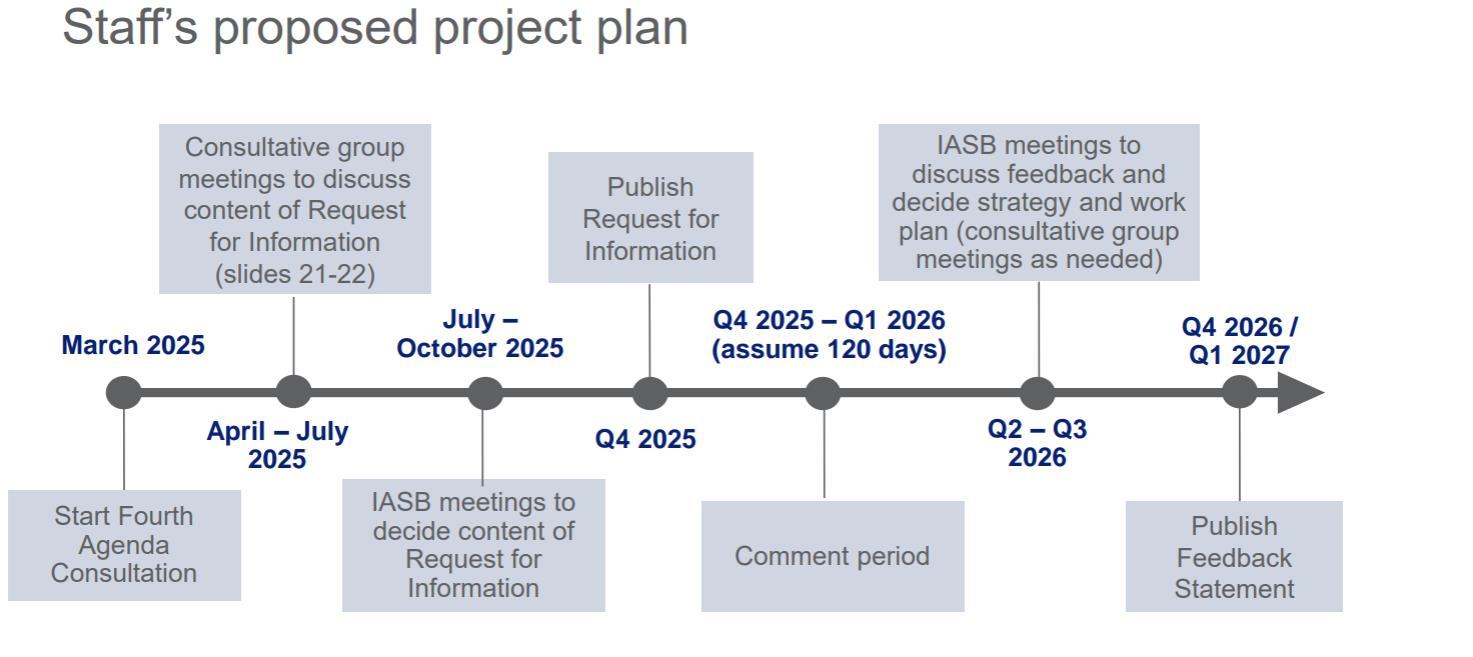
Source: IASB Agenda paper 24, for March 2025 meeting.
E22IASB members were supportive of the high-level timeline and planned activities.
E23The UKEB Secretariat notes that the Rfl for the Third Agenda Consultation, which asked for feedback on 22 potential projects, had a 180-day comment period while the proposed project plan assumes a 120-day comment period.
Next steps
E24The IASB staff meetings with consultative groups is expected to include a discussion at the July 2025 ASAF meeting.
E25The Secretariat will continue to monitor IASB discussions and provide updates to future meetings as appropriate. The UKEB will hold an initial discussion on the IASB's Fourth Agenda Consultation approach at a future meeting.
Annex A: Tentative project list for the Request for Information
- The staff proposed a tentative project list for the Rfl. The projects in the table below were categorised by source, but not priority or scope.
- Table A contains a list of potential IASB projects, and the following Table B contains a list of potential joint IASB and ISSB projects.
| Potential IASB projects (Table A) |
|---|
| Source: Third Agenda Consultation |
| Cryptocurrencies and related transactions |
| Going concern disclosures |
| Income tax disclosures |
| Operating segments |
| Pollutant pricing mechanisms |
| Source: Horizon-scanning |
| Hyperinflationary accounting |
| Cross-cutting |
| - Applying IFRS 15 Revenue from Contracts with Customers with IFRIC 12 Service Concession Arrangements |
| - Collaborative arrangements |
| - Corporate wrappers |
| - Financial guarantee contracts |
| Source: Post-Implementation Reviews |
| IFRS 10 Consolidated Financial Statements, IFRS 11 Joint Arrangements and IFRS 12 Disclosure of Interests in Other Entities |
| - Disclosures about interests in other entities |
| - Subsidiaries that are investment entities |
| - Transactions changing relationships between an investor and an investee |
| IFRS 15 Revenue from Contracts with Customers |
| - Consideration payable to a customer |
| - Principal vs. agent |
| To be determined – projects outside the scope of active projects |
Source: IASB Agenda paper 24, for March 2025 meeting.
| Potential joint IASB-ISSB projects (Table B) |
|---|
| A framework, such as a conceptual framework |
| - addressing connected reporting |
| - clarifying boundaries between different general purpose financial reports covering sustainability reporting |
| Integration in reporting |
Source: IASB Agenda paper 24, for March 2025 meeting.
Appendix F: Interpretations Committee Update
| UKEB Project Status: Monitoring | IASB Next Milestone: N/A |
|---|---|
Background
F1The UKEB's Due Process Handbook notes that the UKEB expects to respond to a limited number of tentative agenda decisions published by the IFRS Interpretations Committee (Interpretations Committee). Some factors to consider when deciding whether to respond may be:
- the degree of impact of the tentative agenda decision on UK companies (for example, in cases where the tentative agenda decision is expected to affect a significant number of UK companies);
- disagreement with the Interpretations Committee's analysis; or
- usefulness of the explanations and clarifications included in the tentative agenda decision.
F2The Interpretations Committee met on 11 March 2025. The next Interpretations Committee meeting is on 25 to 26 June 2025.
F3At its March 2025 meeting, the Interpretations Committee discussed the staff analyses of the comment letters received on the tentative agenda decisions set out in the tables below, except for Assessing indicators of hyperinflationary economies, which will be discussed at a future meeting.
F4In addition to discussing the feedback on the tentative agenda decisions, at its March 2025 meeting the Interpretations Committee provided input on a possible way forward in response to feedback on an aspect of the proposed translation method in the Exposure Draft Translation to a Hyperinflationary Presentation Currency. This discussion forms part of the wider stakeholder engagement on this project and is not discussed in this update.
F5At the time of writing, no new matters have been received by the Interpretations Committee.
F6The remainder of this update summarises the tentative agenda decisions. Where relevant the summaries have been updated to reflect responses received by the Interpretations Committee.
| TENTATIVE AGENDA DECISIONS CLOSED FOR COMMENT | | * | *Assessing indicators of hyperinflationary economies | | Standard | IAS 29 Financial Reporting in Hyperinflationary Economies | | Deadline | 3 February 2025 | | Question 1 | Clarification is requested on: | | | 1. Whether all indicators in paragraph 3 of IAS 29 should be considered in the assessment of when an economy becomes hyperinflationary when one indicator listed has been met. | | | 2. Whether other indicators not listed in IAS 29 should be considered in the assessment. | | | 3. Whether paragraphs 4 and 35 of IAS 29 require both a subsidiary and the consolidated group to apply IAS 29 consistently. | | Tentative conclusion 2 | For question 1, evidence gathered by the Committee did not indicate that there is widespread diversity in understanding the requirements of IAS 29. | | | For questions 2 and 3, evidence gathered by the Committee did not indicate that there is diversity within the responses to these questions. | | | On the basis of that evidence, the Committee concluded that the matter described in the request does not have widespread effect. Consequently, the Committee decided not to add a standard-setting project to the work plan. | | Comment | IAS 29 is applied to the financial statements of an entity whose functional currency is the currency of a hyperinflationary economy. | | | The Secretariat's preliminary assessment was that the matter was unlikely to impact a significant number of UK companies. | | | At its October 2024 and November 2024 Board meetings the UKEB decided it would not undertake further work on this matter at this time. | | | The IFRS Interpretations Committee received 10 responses, including one from a UK-based respondent. The majority of respondents supported the tentative agenda decision. | | | NB: the IASB discussed stakeholders' concerns and challenges related to applying IAS 29 Financial Reporting in Hyperinflationary Economies in its January 2025 meeting as part of its work plan update. The IASB was not asked to make any decisions. |
| AGENDA DECISIONS WAITING FOR IASB RATIFICATION |
| AGENDA DECISIONS WAITING FOR IASB RATIFICATION | | **Topic | Recognition of intangible assets resulting from climate-related commitments |
List of IASB projects
Amortised Cost Measurement
UKEB Project Status: Monitoring IASB Next Milestone: Decide Project Direction H1 2026
Business Combinations—Disclosures, Goodwill and Impairment
UKEB Project Status: Monitoring IASB Next Milestone: Decide Project Direction 2026
- UKEB project page (Influencing)
- UKEB Project Initiation Plan (Published March 2024)
- UKEB Draft Comment Letter (Published May 2024)
- UKEB Final Comment Letter (Published July 2024)
- UKEB Feedback Statement (Published July 2024)
- UKEB Due Process Compliance Statement (Published September 2024)
Climate-related and Other Uncertainties in the Financial Statements
UKEB Project Status: Influencing IASB Next Milestone: Decide Project Direction May 2025
- UKEB project page
- UKEB Project Initiation Plan (Published July 2024)
- UKEB Draft Comment Letter (Published September 2024)
- UKEB Final Comment Letter (Published December 2024)
- UKEB Feedback Statement (Published December 2024)
- UKEB Due Process Compliance Statement (Published December 2024)
Dynamic Risk Management
UKEB Project Status: Monitoring IASB Next Milestone: Exposure Draft Q2 2025
- UKEB project page (Discussion Paper)
- UKEB Final Comment Letter on the Discussion Paper (Published January 2021)
- UKEB Feedback Statement (Published March 2021)
- UKEB Report: Subsequent Measurement of Goodwill - A Hybrid Model (Published September 2022)
Equity Method
UKEB Project Status: Influencing IASB Next Milestone: Exposure Draft Feedback May 2025
- UKEB project page
- UKEB Project Initiation Plan (Published October 2024)
- UKEB Draft Comment Letter (Published October 2024)
- UKEB Final Comment Letter (Published December 2024)
- UKEB Feedback Statement (Published December 2024)
- UKEB Due Process Compliance Statement (Published January 2025)
Financial Instruments with Characteristics of Equity
UKEB Project Status: Monitoring IASB Next Milestone: Final Amendments 2026
- UKEB project page
- UKEB Project Initiation Plan (Published October 2023)
- UKEB Draft Comment Letter (Published February 2024)
- UKEB Final Comment Letter (Published April 2024)
- UKEB Feedback Statement (Published April 2024)
- UKEB Due Process Compliance Statement (Published April 2024)
Intangible Assets
UKEB Project Status: Monitoring IASB Next Milestone: Decide Project Direction Q2 2025
- UKEB project page
- Accounting for Intangibles a Survey of Users' Views (Published May 2024)
- Accounting for Intangibles a Quantitative Analysis of UK Financial Reports (Published May 2024)
- UKEB Project Initiation Plan Updated (Published June 2023)
- Accounting for Intangibles UK Stakeholders' Views (Published 2023)
Post-implementation Review of IFRS 16—Leases
UKEB Project Status: Monitoring IASB Next Milestone: Request for Information Q2 2025
- UKEB Final Comment Letter (Published March 2025)
- UKEB Feedback Statement (Published March 2025)
Provisions—Targeted Improvements
UKEB Project Status: Influencing IASB Next Milestone: Exposure Draft Feedback Q2 2025
- UKEB project page
- UKEB Project Initiation Plan (Published October 2024)
- UKEB Draft Comment Letter (Published December 2024)
Rate-regulated Activities
UKEB Project Status: Monitoring IASB Next Milestone: IFRS Accounting Standard H2 2025
- UKEB project page (Pre-endorsement)
- UKEB Preliminary Economic Assessment (Published April 2024)
- UKEB letter to the IASB (Published July 2024)
- UKEB Secretariat's top-down approach (Published July 2024)
- UKEB project page (Influencing)
- UKEB Draft Comment Letter (Published July 2021)
- UKEB Final Comment Letter (Published August 2021)
- UKEB Feedback Statement (Published April 2022)
Statement of Cash Flows and Related Matters
UKEB Project Status: Monitoring IASB Next Milestone: Review Research March 2025
Translation to a Hyperinflationary Presentation Currency (IAS 21)
UKEB Project Status: Monitoring [UKEB Deferred Project] IASB Next Milestone: Exposure Draft Feedback May 2025
Updating IFRS 19 Subsidiaries without Public Accountability: Disclosures
UKEB Project Status: Influencing IASB Next Milestone: Final Amendment Q3 2025
- UKEB project page
- UKEB Project Initiation Plan (Published July 2024)
- UKEB Draft Comment Letter (September 2024)
- UKEB Final Comment Letter (Published November 2024)
- UKEB Feedback Statement (Published November 2024)
- UKEB Due Process Compliance Statement (Published December 2024)
Footnotes
Footnotes
-
This provides a summary of the question only. Please refer to the IFRS website for the full details. ↩↩↩↩↩↩
-
This provides a summary of the IFRS Interpretations Committee's tentative conclusion only. Please refer to the IFRS website for the full details. ↩↩↩↩↩↩
-
This provides a summary of the question only. Please refer to the IFRS website for the full details. ↩↩↩↩↩
-
This provides a summary of the IFRS Interpretations Committee's tentative conclusion only. Please refer to the IFRS website for the full details. ↩↩↩↩
-
This provides a summary of the question only. Please refer to the IFRS website for the full details. ↩↩↩↩
-
This provides a summary of the IFRS Interpretations Committee's tentative conclusion only. Please refer to the IFRS website for the full details. ↩↩↩↩
-
This provides a summary of the question only. Please refer to the IFRS website for the full details. ↩↩
-
This provides a summary of the IFRS Interpretations Committee's tentative conclusion only. Please refer to the IFRS website for the full details. ↩↩