Project Initiation Plan - Financial Instruments with Characteristics of Equity
| Project Type | Influencing |
|---|---|
| Project Scope | Moderate |
Purpose
1This paper sets out the plan to influence the proposed Amendments Financial Instruments with Characteristics of Equity to IAS 32 Financial Instruments: Presentation (the Amendments), which are expected to be published by the IASB in November 2023.
Background
2Following stakeholder feedback on the IASB's 2018 Discussion Paper on this topic, the IASB decided to make clarificatory amendments to IAS 32 to improve understanding of its principles and the consistency of its application.
3The IASB expects to issue an Exposure Draft (ED) for this project in November 2023.
4From May 2021 to May 2023, the IASB has taken tentative decisions which suggest that the ED will make the following clarifications:
- It will introduce principles for assessing whether financial instruments meet the fixed-for-fixed condition.1
- It will prohibit reclassification other than for changes in the substance of the contractual terms arising for changes in circumstances outside the contract.
- It will specify further recognition, classification and measurement requirements for contingent settlement provisions as well as clarifying the meaning of certain terms in that context.
- It will clarify certain requirements on the scope, classification, remeasurement and presentation of obligations to redeem own equity instruments.
- In relation to instruments that have a contractual obligation to deliver cash at the discretion of the issuer's shareholders, it will introduce a factor-based approach to assess whether a decision of shareholders is a decision of the entity.
- It will specify the effects of laws to be taken into account when classifying financial instruments as liabilities or equity.
- It will introduce additional disclosure requirements for issued financial instruments, including in relation to potential dilution and priority of claims.
Project plan rationale
5The following considerations have shaped the project plan.
The scope of the IASB project is to make amendments clarifying IAS 32
6Following stakeholder feedback on the 2018 Discussion Paper, the IASB tentatively decided to scope the project as clarifying some principles within IAS 32 and providing additional application guidance to IAS 32, in order to reduce diversity in practice, and further developing some presentation and disclosure requirements.
7The Amendments are therefore not expected to change the principles of IAS 32. However, existing practice may change, if the Amendments specify requirements in areas in which entities considered they had a choice of accounting policy. The project may also result in some additional presentation or disclosure requirements.
8The Amendments may affect any entity that has issued capital instruments. However, we expect they may be of particular interest to entities subject to regulatory capital requirements.
Initial engagement with UK stakeholders suggests they welcome the project in this important area
9At its September 2023 meeting, the Financial Instruments Working Group (the FIWG) considered the first four topics (A4 (a) to (d) above) in relation to which the IASB has proposed amendments and will be considering the remaining ones at its November 2023 meeting. Overall, the FIWG welcomed the IASB's project to make clarifying amendments to IAS 32. Nonetheless, together with our desk-based research, their initial feedback has highlighted areas where the wording of the ED will require especially close review.
Setting up an ad-hoc advisory group is not necessary
10The Financial Instruments Working Group is well placed to provide feedback on this project, so it is not considered necessary to set up a separate ad-hoc advisory group specific for this project.
Project milestones
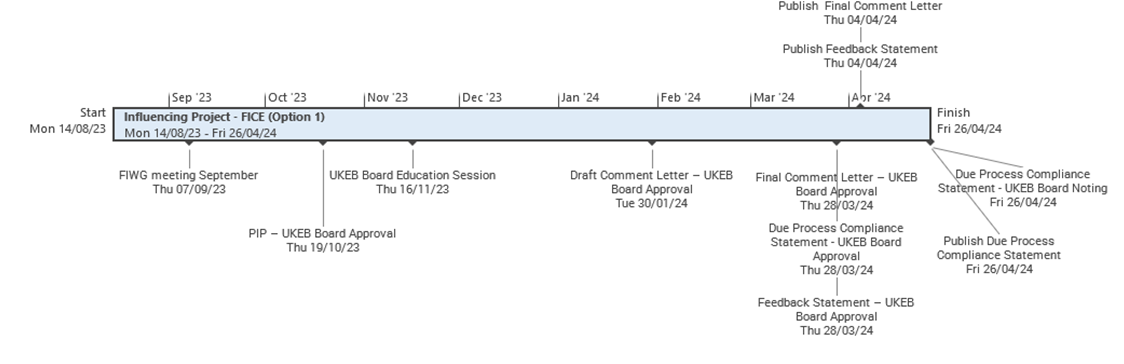
11A proportionate approach is proposed, incorporating mandatory milestones listed in paragraph 5.3 of the UKEB's Due Process Handbook (Handbook). The table below provides a brief description of the work we have done and that we intend to do as part of this project.
12Future dates are based on current expectations and are, therefore, subject to subsequent modification. The Board will be alerted to any significant changes.
| Milestone/activity | Brief description ``
If it's a section defined by a number, use the section-number format:## 1. Executive Summary {: #section-1 }`
For this document, only main headings (H2) are suitable:
```markdown
| Project Type | Influencing |
|---|---|
| Project Scope | Moderate |
Purpose
1This paper sets out the plan to influence the proposed Amendments Financial Instruments with Characteristics of Equity to IAS 32 Financial Instruments: Presentation (the Amendments), which are expected to be published by the IASB in November 2023.
Background
2Following stakeholder feedback on the IASB's 2018 Discussion Paper on this topic, the IASB decided to make clarificatory amendments to IAS 32 to improve understanding of its principles and the consistency of its application.
3The IASB expects to issue an Exposure Draft (ED) for this project in November 2023.
4From May 2021 to May 2023, the IASB has taken tentative decisions which suggest that the ED will make the following clarifications:
- It will introduce principles for assessing whether financial instruments meet the fixed-for-fixed condition.1
- It will prohibit reclassification other than for changes in the substance of the contractual terms arising for changes in circumstances outside the contract.
- It will specify further recognition, classification and measurement requirements for contingent settlement provisions as well as clarifying the meaning of certain terms in that context.
- It will clarify certain requirements on the scope, classification, remeasurement and presentation of obligations to redeem own equity instruments.
- In relation to instruments that have a contractual obligation to deliver cash at the discretion of the issuer's shareholders, it will introduce a factor-based approach to assess whether a decision of shareholders is a decision of the entity.
- It will specify the effects of laws to be taken into account when classifying financial instruments as liabilities or equity.
- It will introduce additional disclosure requirements for issued financial instruments, including in relation to potential dilution and priority of claims.
Project plan rationale
5The following considerations have shaped the project plan.
The scope of the IASB project is to make amendments clarifying IAS 32
6Following stakeholder feedback on the 2018 Discussion Paper, the IASB tentatively decided to scope the project as clarifying some principles within IAS 32 and providing additional application guidance to IAS 32, in order to reduce diversity in practice, and further developing some presentation and disclosure requirements.
7The Amendments are therefore not expected to change the principles of IAS 32. However, existing practice may change, if the Amendments specify requirements in areas in which entities considered they had a choice of accounting policy. The project may also result in some additional presentation or disclosure requirements.
8The Amendments may affect any entity that has issued capital instruments. However, we expect they may be of particular interest to entities subject to regulatory capital requirements.
Initial engagement with UK stakeholders suggests they welcome the project in this important area
9At its September 2023 meeting, the Financial Instruments Working Group (the FIWG) considered the first four topics (A4 (a) to (d) above) in relation to which the IASB has proposed amendments and will be considering the remaining ones at its November 2023 meeting. Overall, the FIWG welcomed the IASB's project to make clarifying amendments to IAS 32. Nonetheless, together with our desk-based research, their initial feedback has highlighted areas where the wording of the ED will require especially close review.
Setting up an ad-hoc advisory group is not necessary
10The Financial Instruments Working Group is well placed to provide feedback on this project, so it is not considered necessary to set up a separate ad-hoc advisory group specific for this project.
Project milestones
11A proportionate approach is proposed, incorporating mandatory milestones listed in paragraph 5.3 of the UKEB's Due Process Handbook (Handbook). The table below provides a brief description of the work we have done and that we intend to do as part of this project.
12Future dates are based on current expectations and are, therefore, subject to subsequent modification. The Board will be alerted to any significant changes.
| Milestone/activity | Brief description | Status |
|---|---|---|
| Technical project added to UKEB technical work plan (mandatory) [Handbook 4.30(b)] | Added to UKEB technical work plan. | Completed. |
| Education session on IASB proposals on FICE (optional) [Handbook 4.10] | An education session on the FICE project was provided to the board in November 2022. A further education session on the anticipated ED proposals will be provided to the Board at a future meeting. | First session completed in November 2022. A second session is currently planned for the 16 November 2023 Board meeting. |
| Desk-based research (optional) [Handbook 5.9] | The Secretariat has begun its programme of desk-based research, to include review of IASB staff papers, publications from regulators, accounting firms and other relevant sources including accounting manuals as well as the ED when published. | In progress. |
| Outreach activities (mandatory) [Handbook 5.11] | We have already begun to engage with the Financial Instruments Working Group and will continue to engage with the members in its November 2023 and January 2024 meetings. In addition, we plan to seek feedback from:
|
In progress. |
| Project Initiation Plan (PIP) (mandatory) [Handbook 5.4 to 5.8] | This paper | To be brought to the 19 October 2023 Board meeting, ahead of the IASB's publication of the ED. |
| Draft comment letter (DCL) published for comment (generally mandatory) [Handbook paragraphs 5.13 to 5.17] | The Secretariat will publish the approved DCL for public comment for a minimum of 30 days following the Board meeting on 30 January 2024. The exact duration of the comment period will be finalised following that Board meeting. The Secretariat will bring a preparatory technical paper to the 14 December 2023 Board meeting for discussion. | As soon as possible after the 30 January 2024 Board meeting. |
| UKEB submits final comment letter (FCL) to the IASB (mandatory) [Handbook paragraph 5.18] | The IASB comment period is expected to close at the end of March 2024, either before or on the same day as the UKEB meeting. The Secretariat will submit the FCL to the IASB as soon as possible following approval at the 28 March 2024 UKEB meeting. | As soon as possible after the 28 March 2024 Board meeting. |
| Feedback statement and due process compliance statement for influencing stage of project | Secretariat publishes Feedback Statement and Due Process Compliance Statement on UKEB website. | To be completed. |
Resources allocated
13On the basis of this project plan, we consider that a project team consisting of one Project Director (0.8 FTE), one Project Manager and technical support and oversight from a Senior Project Director should ensure the project timelines are achievable. Input from the economics team and communications support will be obtained as appropriate.
Detailed project timeline
| Date | Milestone |
|---|---|
| October to November 2023 | Preliminary analysis and outreach before publication of Exposure Draft |
| 19 October 2023 | Board: Discusses and approves Project Initiation Plan (this document). |
| 16 November 2023 | Board: Education session on proposed topics for Amendments. |
| November 2023 | IASB publishes ED with 120-day comment period. |
| November 2023 to January 2024 | Secretariat: Outreach with advisory groups, FIWG and relevant industry groups. |
| 7 December 2023 | Secretariat: Submits technical paper to Board. |
| 14 December 2023 | Board: Discusses technical paper. |
| 30 January 2024 | Board: Discusses and approves DCL. |
| 6 February 2024 | Secretariat: Alerts key stakeholders to publication of DCL. |
| 6 February to 5 March 2024 | Minimum of 30-day comment period. The exact duration will be determined following the 30 January 2024 Board meeting. |
| 28 March 2024 | Board: Discusses and approves Final Comment Letter (FCL), Feedback Statement and Due Process Compliance Statement. |
| As soon as possible after Board discussion | Secretariat: Submits FCL to IASB and publishes FCL on website. |
| 26 April 2024 | Board: Notes Due Process Compliance Statement. |