Project Initiation Plan - Post Implementation Review of IFRS 9 - Impairment
| Project Type | Influencing – Post Implementation Review |
|---|---|
| Project Scope | Moderate |
Purpose
A1. This paper sets out the plan to influence the IASB in relation to the Post-implementation Review of IFRS 9 – Impairment. The associated IASB Request for Information (Rfl) is expected to be published in May 2023.
Background
A2. In July 2014 the IASB issued IFRS 9 Financial Instruments. The Standard was effective for annual periods commencing on or after 1 January 2018. Insurers could defer the effective date until 1 January 2023 to align with the implementation of IFRS 17 Insurance Contracts if certain conditions were met.
A3. IFRS 9 replaced IAS 39 Financial Instruments: Recognition and Measurement. IFRS 9 introduced changes to the IAS 39 accounting requirements in three main areas: classification and measurement, impairment (introduction of Expected Credit Loss model) and hedge accounting.
A4. The IASB has split its post-implementation review of IFRS 9 into three parts. This part of the review focuses only on the impairment requirements of IFRS 9, together with the related disclosure requirements in IFRS 7.
A5. The IASB expects to issue its Rfl for this project in late May 2023, with an expected comment deadline in late September 2023.
A6. Tentative decisions from the IASB February 2023 meeting suggest the Rfl will include the following topics:
-
The general approach to recognising expected credit losses (ECL), specifically:
- the effects of the approach on the usefulness of information about changes in credit risk to the users of financial statements; and
- the costs and benefits of applying the approach to particular transactions, such as intercompany loans.
-
Significant increases in credit risk, specifically:
- the use of judgement in determining significant increases in credit risk; and
- the evidence about the causes of and the extent of diversity in how entities assess significant increases in credit risk.
-
The measurement of ECL, specifically:
- using multiple forward-looking scenarios; and
- measuring ECL in periods of enhanced economic uncertainty, including the use of post-model management adjustments or overlays.
- The prevalence of questions from entities on how to apply the ECL requirements for purchased or originated credit-impaired financial assets.
-
The simplified approach to recognising ECL for trade receivables, contract assets and lease receivables, specifically:
- the effects of the relief provided by the IASB through this approach; and
- the inclusion of forward-looking information when applying this approach.
- The accounting for loan commitments, collateral and other credit enhancements held and financial guarantee contracts issued that are within the scope of IFRS 9.
- The application of the ECL requirements in combination with other requirements in IFRS 9 or in other IFRS Accounting Standards.
- The effects of transition reliefs provided by the IASB and the balance between reducing costs for preparers of financial statements and providing useful information to users of financial statements.
-
The credit risk disclosure requirements in IFRS 7, specifically:
- whether the combination of disclosure principles and minimum disclosure requirements achieves an appropriate balance between comparable information and relevant information for users of financial statements about the effect of credit risk on the amount, timing and uncertainty of future cash flows; and
- the compatibility of the requirements with digital reporting.
Initial stakeholder feedback
A7. We have consulted members of the Financial Instruments Working Group (FIWG), the Investors Advisory Group (IAG), the Preparers Advisory Group (PAG) and the Accounting Firms and Institutes Advisory Group (AFIAG) on this project.
A8. The feedback from these groups suggests that, overall, the impairment requirements of IFRS 9 are working well, do not contain “fatal flaws”, and represent an improvement on the impairment requirements in IAS 39.
A9. These groups identified a number of specific topics within the IFRS 9 impairment requirements that nonetheless were causing significant concern, and where action following the post-implementation review would be welcome. They also provided suggestions to assist the IASB further improve the standard. These topics were:
- A lack of clarity regarding the interaction of ECL and contract modifications/derecognitions and write-offs. Feedback suggests that resolving the modification/derecognition issues identified for resolution in the IASB pipeline project Amortised Cost Measurement will do much to provide clarity on this issue. However, further explicit guidance on the order in which the relevant tests and events should be applied would be helpful and should be requested in the feedback on this PIR.
- Recent IFRIC decisions¹ highlighting the definition of credit loss should be considered and potentially included in the Rfl response. There is concern that as currently defined an expected "credit loss” would include shortfalls in contractual cashflows for any reason, not just losses arising from credit events. It may be more useful to users of financial statements if the reasons for non-credit losses were more clearly explained rather than just being disclosed under an umbrella of “credit losses”.
- Some smaller (non-financial services) companies find even the simplified calculation and disclosure regime for receivables to be disproportionate given the nature of their business and the typically short duration of receivable balances. They told us the use of forward-looking factors and extensive disclosure was disproportionate in such circumstances.
- The insurance industry has not yet had adequate opportunity to use IFRS 9 in practice. The PIR of IFRS 17 should address the use of IFRS 9 by insurers.
- Stakeholders suggested certain information contained in subsequent IASB and Transition Resource Group publications be included in IFRS 9 itself, rather than being fragmented across multiple documents. This includes guidance on the application of judgement in IFRS 9 issued in relation to the Covid-19 pandemic.
- In the UK the Taskforce on Disclosure about Expected Credit Losses (DECL) has published a series of reports containing guidance on IFRS 9 disclosure. The IAG told us from a global perspective they consider the UK to have one of the highest standards of disclosure in this area. Other stakeholders have suggested it would be helpful to share key requirements arising from the DECL taskforce with the IASB, as this may be useful in assisting them develop further illustrative examples or guidance.
Project plan rationale
A10. The following considerations have shaped the project plan.
The threshold for change is high
A11. The IASB Due Process Handbook notes that there is no presumption that a post implementation review will lead to any changes to a standard². The IASB website explains that, should it decide to take action, only high priority matters would be actioned as soon as possible. Lower priority actions could be added to the research pipeline or considered in the next agenda consultation. The IASB takes action if there is evidence that:
- there are fundamental questions (i.e. ‘fatal flaws') about the clarity and suitability of the core objectives or principles in the new requirements; or
- the benefits to users of financial statements of the information arising from applying the new requirements are significantly lower than expected (for example, there is significant diversity in application); or
- the costs of applying some or all of the new requirements and auditing and enforcing their application are significantly greater than expected (or there is a significant market development since the new requirements were issued for which it is costly to apply the new requirements consistently).
Stakeholder feedback to date suggests that the IFRS 9 requirements are broadly working well
A12. Feedback provided by the UKEB advisory groups and the Financial Instruments Working Group indicates that IFRS 9's impairment requirements do not contain any fatal flaws and are, broadly, working as intended.
A13. Feedback from these groups suggests that limited improvement is required in a small number of specific areas.
Implications for the project plan
A14. As noted in paragraphs A11-A13 above, the threshold for IASB change as a result of this PIR is high and stakeholders are broadly satisfied that IFRS 9's requirements are working as intended. Accordingly, we propose only limited further outreach activity, and a relatively light touch when creating the comment letter for the IASB.
A15. The project plan set out below is dependent on availability of Secretariat resource and Board time, and interaction with other live UKEB projects. If these factors lead to a material variation in the plan, a revised PIP would be submitted to the Board.
Setting up an ad-hoc advisory group is not necessary
A16. The Financial Instruments Working Group is well placed to provide feedback on this project, and therefore it is not considered necessary to set up a separate, ad-hoc advisory group specific for this project.
Project milestones
A17. A proportionate approach is proposed, incorporating mandatory milestones listed in paragraph 5.3 of the UKEB's Due Process Handbook (Handbook)³. The table below provides a brief description of the work we have done and that we intend to do as part of this project.
| Milestone/activity | Brief description | Status |
|---|---|---|
| Influencing | ||
| Technical project added to UKEB technical work plan (mandatory) [Handbook 4.30(b)] |
Added to UKEB technical work plan. | Completed. |
| Education session on IFRS 9 - Impairments (optional) [Handbook 4.10] |
A two part education session on the requirements of IFRS 9 – Impairments was provided to the board. | Completed at the July 2022 and September 2022 private Board meetings. |
| Desk-based research (optional) [Handbook 5.9] |
The Secretariat is reviewing selected publications from regulators and accounting firms, including FRC thematic reviews of IFRS 9 disclosures and Covid-19 related matters. | In progress. |
| Outreach activities (mandatory) [Handbook 5.11] |
We have already received feedback on IFRS 9 Impairment from the UKEB: 1. Investors Advisory Group (8 February 2023) 2. Financial Instruments Working Group (20 March 2023) 3. Preparers Advisory Group (28 March 2023) 4. Accounting Firms and Institutes Advisory Group (30 March 2023). In addition we plan to: - Seek feedback from relevant regulators. - Observe/discuss with relevant industry working groups to the extent possible. - Publish a project page on the UKEB website which will include a request for stakeholders to contact the project team if they have feedback. We will draw attention to this with UKEB News Alerts and LinkedIn posts. - Hold discussions with other National Standard Setters. |
In progress |
| Project Initiation Plan (mandatory) [Handbook 5.4 to 5.8] |
This paper. | To be brought to April 2023 Board meeting |
| DCL published for comment (generally mandatory) [Handbook paragraphs 5.13 to 5.17] |
A DCL will be prepared for approval at an additional early August Board meeting. This will be issued for 30 days' consultation. Feedback received will be considered when preparing the final comment letter. | To be completed. |
| UKEB submits FCL before IASB comment period ends (mandatory). | The IASB comment period is expected to end in late September 2023. It is possible this date may conflict with/be close to the UKEB September Board meeting. We have discussed this possibility with IASB staff and they have confirmed that a submission which is a few days late can be accepted and included in their analysis. To consider further once the Rfl is published and the actual deadline is known. | To be completed. |
| Feedback statement and due process compliance statement for influencing stage of project (mandatory) [Handbook paragraphs 5.19 and 5.23] |
Secretariat publishes Feedback Statement and Due Process Compliance Statement on UKEB website. | To be completed. |
Resources allocated
A18. Resources will be shared across this project and the Amendments to the Classification and Measurement of Financial Instruments exposure draft project. This will provide maximum flexibility to allocate work effort to the most urgent aspects of each project when resources are available to do so.
A19. To achieve the project milestones these two projects will be collectively staffed by two Project Directors (approximately 1.5 FTEs) and two Project Managers (approximately 1.0 FTE).
Project timelines
A20. We expect the Rfl to be published in late May 2023 and the IASB comment deadline to be late September 2023.
A21. The primary outreach for this project has involved the UKEB advisory and working groups and took place during February and March 2023.
A22. In June 2023 work will focus on considering the published Rfl and whether any further feedback should be sought (e.g. from the June advisory and working group meetings). It may also include discussion with other relevant stakeholder groups if necessary.
A23. We anticipate the IASB comment deadline will be close to the date of the UKEB September Board meeting. We have discussed this possibility with IASB staff and they have confirmed that a submission which is a few days late can be accepted and included in their analysis. This will be considered further once the Rfl has been published and the actual deadline is known.
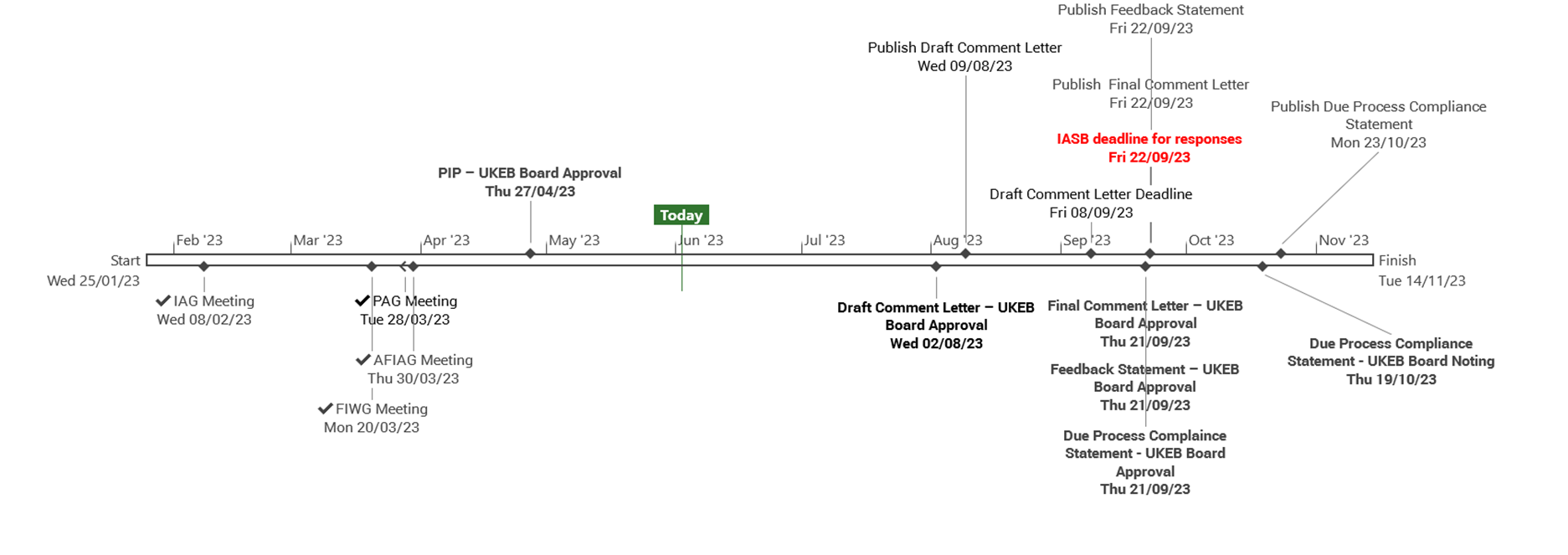
Timeline
| Date | Milestone |
|---|---|
| Influencing phase | |
| July 2022 | Board: Education sessions |
| September 2022 | |
| February – March 2023 | Outreach with UKEB advisory/working groups. |
| 27 April 2023 | Board: Considers the PIP Secretariat: Revises PIP for any Board comments |
| May 2023 | IASB publishes Request for Information |
| May–June 2023 | Further outreach as described in project milestones table in paragraph A17. |
| Additional Board meeting, 2 August 2023 | Board: Considers Draft Comment Letter Secretariat: Revises DCL for any Board comments |
| Week commencing 6 August | Secretariat: Publishes Draft Comment Letter, comment period 30 days. |
| 21 September 2023 | Board: Considers Final Comment Letter, Feedback Statement, draft Due Process Compliance Statement Secretariat: Revises documents for any Board comments. |
| 22 September 2023 (estimate) | IASB comment period ends Secretariat: submits Final Comment Letter Secretariat: Final Comment Letter and Feedback Statement published on website |
| 19 October 2023 | Board: Approves final Due Process Compliance Statement |
27 April 2023
Agenda Paper 5: Appendix A
Footnotes:
Footnotes
-
Agenda decision Lessor Forgiveness of Lease Payments (IFRS9 and IFRS 16), October 2022 ↩
-
IASB Due Process Handbook 2022 p6.58 ↩