Project Initiation Plan - Amendments to the Classification and Measurement of Financial
| Project Type | Influencing – Exposure Draft |
|---|---|
| Project Scope | Moderate |
Purpose
A1.This paper sets out the plan to influence the International Accounting Standards Board (IASB) in relation to the Amendments to the Classification and Measurement of Financial Instruments Exposure Draft (the C&M ED), which was published on 21 March 2023.
Background
A2.The IASB's project is a response to feedback the IASB received during the Post-implementation Review of IFRS 9 – Classification and Measurement.
A3.The UKEB highlighted the following key concerns in its feedback to the IASB on the Post-implementation review of IFRS 9 - Classification & Measurement:
- The challenges surrounding the classification of financial instruments with features linked to environmental, social and governance (ESG) concerns, including difficulties with the application of the contractual cash flow characteristics test to such instruments;
- The unclear boundary between contractually linked instruments and non-recourse finance;
- The need for clearer application guidance in relation to amortised cost and the effective interest method, particularly when applying paragraphs B5.4.5 and B5.4.6 of the standard; and
- The potential unintended consequences of the (then) IFRS Interpretations Committee (IFRIC) tentative agenda decision Cash Received via Electronic Transfer as Settlement for a Financial Asset (“Electronic Cash Transfers").
A4.The concerns raised at A3 a, b, and d are within the scope of this exposure draft. The issue raised at A3 c will be included in the IASB pipeline research project Amortised Cost Measurement.
Initial stakeholder feedback
A5.We plan to conduct a detailed discussion on the C&M ED with the Financial Instruments Working Group (FIWG) on 24 April 2023.
A6.Feedback received from the FIWG prior to publication of the C&M ED (based on IASB staff papers and IASB discussion) included the following:
- Electronic cash transfers
- It was unclear whether there would be symmetry between accounting for derecognition of a financial liability and the related financial asset of the counterparty. If asymmetry was created this could potentially cause issues on consolidation.
- An inconsistency was noted in the use of the term "practical" when describing the criteria to apply the proposed derecognition treatment.1
- There was a call for a definition of "payment mechanism”.
- It was noted that the implications for payments using credit cards and cheques were currently unclear.
- Contractual cash flows
- It is not always clear at what level in the reporting group the cash flow characteristics test should be performed, and guidance as to how "borrower” should be interpreted in this context would be welcome.
- The examples included in recent IASB staff papers appeared overly simplistic and arrived directly at a conclusion, rather than demonstrating the analysis process. It was hoped more complex examples would be included in the exposure draft, including analysis against each of the proposed criteria.
Desk-based research
A7.In addition to the above, initial desk-based research by the Secretariat suggests the following areas of the C&M ED will need particular consideration:
- Electronic Cash Transfers
- The exposure draft focuses on liabilities, whereas the original IFRIC question was about assets. We need to understand whether this creates any practical issues for stakeholders.
- The criteria for use of the exemption to settlement date accounting for liabilities continues to include inconsistent use of the term "practical" as explained at A6 a ii.
- Several key terms are not defined in the standard including "short period", "standard administrative process” and “electronic payment system".
- Contractual cash flows
- The exposure draft includes a number of clarifications to the classification of financial assets. Further analysis is required to understand whether the amendments are sufficiently clear to achieve consistent application in practice, and can be successfully applied on a principles basis beyond the examples provided in the standard.
- Some key terms are not defined in the standard such as “debtor”.
- Initial analysis suggests that loans where the ESG-linked feature references another part of the group (for example if ESG targets are set at a parent or consolidated level) will not meet the contractual cash flow criteria to achieve amortised cost accounting.
Project plan rationale
A8.The following considerations have shaped the project plan.
The changes address issues the UKEB has previously highlighted as significant concerns
A9.The proposals in the C&M ED address issues which were of significant concern to UK stakeholders during the Post-implementation Review of IFRS 9 – Classification and Measurement. Additionally, as part of this feedback, the UKEB urged the IASB to resolve the issues related to the classification of financial instruments with ESG-linked features as a matter of urgency.
These issues remain important to stakeholders
A10.Prior to publication of the C&M ED, stakeholders were monitoring IASB discussions on these topics and providing feedback to the UKEB Secretariat. These issues remain topical, and the feedback received is summarised at paragraph A6 above.
Implications for project plan
A11.Based on the considerations described in paragraphs A9-A10 we propose a proportionate project plan that involves outreach to UKEB advisory groups, public consultation on a draft comment letter, and discussions with other relevant groups to the extent possible.
Setting up an ad-hoc advisory group is not necessary
A12.The Financial Instruments Working Group is well placed to provide feedback on this project, and therefore it is not considered necessary to set up a separate, ad-hoc advisory group specific for this project.
Project milestones
A13.A proportionate approach is proposed, incorporating mandatory milestones listed in paragraph 5.3 of the UKEB's Due Process Handbook (Handbook)2. The table below provides a brief description of the work we have done and that we intend to do as part of this project.
| Milestone/activity | Brief description | Status |
|---|---|---|
| Influencing | ||
| Technical project added to UKEB technical work plan (mandatory) [Handbook 4.30(b)] | Added to UKEB technical work plan. | Completed. |
| Education session on IFRS 9 - C&M ED (optional) [Handbook 4.10] | An education session on the proposals in the ED will be provided to the Board. | To take place at the April 2023 meeting. |
| Desk-based research (optional) [Handbook 5.9] | The Secretariat to review selected publications from regulators, accounting firms, and other relevant sources. | In progress. |
| Milestone/activity | Brief description | Status |
|---|---|---|
| Outreach activities (mandatory) [Handbook 5.11] | We will seek feedback on this project from the: 1. Financial Instruments Working Group (24 April 2023) 2. Investor Advisory Group (June 2023). 3. Preparer Advisory Group (June 2023) 4. Accounting Firms and Institutes Advisory Group (June 2023). In addition we plan to: - Seek feedback from relevant regulators. - Observe/discuss with relevant industry working groups to the extent possible. Consider roundtable events, or similar, with relevant stakeholders. - Publish a project page on the UKEB website which will include a request for stakeholders to contact the project team if they have feedback. We will draw attention to this with UKEB News Alerts and LinkedIn posts. - Raise awareness of the proposals for the derecognition of financial liabilities that will be settled with cash using an electronic payment system, possibly by producing a brief educational video for the website, or similar. - Hold discussions with other National Standard Setters. |
In progress |
| Project Initiation Plan (mandatory) [Handbook 5.4 to 5.8] | This paper. | To be brought to April 2023 Board meeting |
| DCL published for comment (generally mandatory) | A DCL will be prepared for approval at the May 2023 board meeting. This will be issued for 30 days' consultation. | To be completed. |
| Milestone/activity | Brief description | Status |
|---|---|---|
| UKEB submits FCL before IASB comment period ends (mandatory). [Handbook paragraph 5.18] | A final comment letter will be presented to the board meeting on 13 July 2023 and will be submitted to the IASB prior to their deadline of 19 July 2023. | To be completed. |
| Feedback statement and due process compliance statement for influencing stage of project (mandatory) [Handbook paragraphs 5.19 and 5.23] | Secretariat to publish Feedback Statement and Due Process Compliance Statement on UKEB website. | To be completed. |
Resources allocated
A14.Resources will be shared across this project and the Post-implementation Review of IFRS 9 - Impairment project. This will provide maximum flexibility to allocate work effort to the most urgent aspects of each project when resources are available to do so.
A15.To achieve the project milestones these two projects will be collectively staffed by two Project Directors (approximately 1.5 FTEs) and two Project Managers (approximately 1.0 FTE).
Project timelines
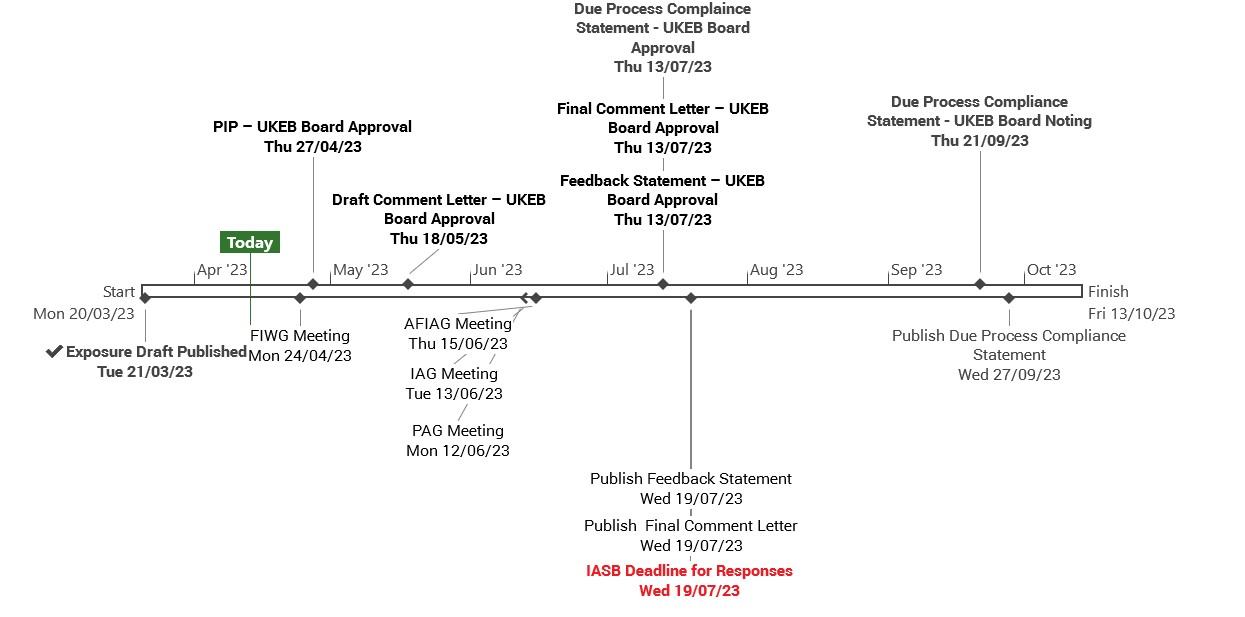
A16.Following publication of the exposure draft on 21 March 2023, we plan to seek feedback from the Financial Instruments Working Group in April 2023 and publish a draft comment letter for public consultation in May 2023. Further selected outreach, including with other UKEB advisory groups, will take place in May and June 2023.
A17.The IASB deadline for feedback is 19 July 2023, and a final comment letter will be presented for consideration at the 13 July 2023 UKEB board meeting.
A18.Further information on the project timeline is presented in the table below.
Classification & Measurement Exposure Draft Timeline
| Date | Milestone |
|---|---|
| Influencing phase | |
| 24 April 2023 | Outreach with the UKEB FIWG |
| 27 April 2023 | Board: Education session |
| 27 April 2023 | Board: Considers the PIP Secretariat: Revises PIP for any Board comments |
| 18 May 2023 | Board: Considers Draft Comment Letter Secretariat: Revises DCL for any Board comments |
| May 2023 | Secretariat: Publishes Draft Comment Letter, comment period 30 days. |
| May-June 2023 | Further outreach as described in project milestones table in paragraph A13. |
| 13 July 2023 | Board: Considers Final Comment Letter, Feedback Statement, draft Due Process Compliance Statement Secretariat: Revises documents for any Board comments. |
| 19 July 2023 | IASB comment period ends Secretariat: submits Final Comment Letter Secretariat: Final Comment Letter and Feedback Statement published on website |
| 21 September 2023 | Board: Approves final Due Process Compliance Compliance Statement |
Timelines