Project Initiation Plan - International Tax Reform - Pillar Two Model Rules (Proposed amendments to IAS 12)
| Project Type | Influencing, endorsement and adoption |
|---|---|
| Project Scope | Narrow-scope |
Purpose
A1.This paper sets out the plan to influence and to assess whether to adopt[^1] the narrow-scope Amendments International Tax Reform – Pillar Two Model Rules[^2] to IAS 12 Income Taxes (the Amendments), currently issued by the IASB as an Exposure Draft (ED).
A2.The UKEB's statutory functions mean that it must consider the Amendments against the statutory adoption criteria before their formal adoption for use in the UK. UK entities cannot use the Amendments until formal adoption has taken place.
A3.The Organisation for Economic Co-Operation and Development (OECD) Pillar Two model rules propose a worldwide 15% tax rate, which the UK is likely to enact by summer 2023. Stakeholders have expressed concerns that it is not clear how IAS 12 applies to Pillar Two taxes and that accounting for deferred tax arising from the Pillar Two model rules would not be practicable and could lead to diversity in practice. Given the urgency of the Amendments and the IASB's accelerated timetable, this PIP addresses both the influencing and the endorsement and adoption stages of the project together.
Background
A4.In December 2021, the OECD finalised the model rules for Pillar Two, one of the two Pillars designed to address the tax challenges presented by the globalisation and digitalisation of the economy.
A5.The Pillar Two model rules introduce a minimum tax rate for multinational groups and entities with turnover of €750m or above. In jurisdictions where a group's effective tax rate is below 15%, the Pillar Two model rules require the entity to increase the tax it pays to that rate, by applying a top-up tax.
A6.Stakeholders have expressed concerns to the IASB around whether tax arising under the model rules is in all circumstances an income tax within the scope of IAS 12, and around the uncertainty over how to account for deferred tax arising from the top-up tax. Questions raised include:
- which tax rate to use to measure deferred taxes;
- whether additional temporary differences arise from the Pillar Two model rules, i.e. is it possible to link the recovery or settlement of the carrying amount of assets or liabilities directly to future top-up tax payments; and
- whether domestic temporary differences should be remeasured.
A7.Some stakeholders have also commented that accounting for deferred tax arising from Pillar Two top-up tax could be extremely complex and that the costs of doing so might therefore outweigh the benefits to users.
A8.Stakeholders have further observed that this matter is urgent, as some jurisdictions are already in the process of enacting or substantively enacting Pillar Two legislation and others, including the UK, are expected to do so by summer 2023.
A9.In response, the IASB published the ED proposing to amend IAS 12 on 9 January 2023. The ED seeks to provide relief for affected entities and avoid inconsistent application of IAS 12.
Description of the Amendments to IAS 12
A10.The proposed Amendments to IAS 12 are described briefly in the table below.
| Narrow-scope Amendments to IAS 12: International Tax Reform – Pillar Two model rules | ```
Purpose
A1.This paper sets out the plan to influence and to assess whether to adopt[^1] the narrow-scope Amendments International Tax Reform – Pillar Two Model Rules[^2] to IAS 12 Income Taxes (the Amendments), currently issued by the IASB as an Exposure Draft (ED).
A2.The UKEB's statutory functions mean that it must consider the Amendments against the statutory adoption criteria before their formal adoption for use in the UK. UK entities cannot use the Amendments until formal adoption has taken place.
A3.The Organisation for Economic Co-Operation and Development (OECD) Pillar Two model rules propose a worldwide 15% tax rate, which the UK is likely to enact by summer 2023. Stakeholders have expressed concerns that it is not clear how IAS 12 applies to Pillar Two taxes and that accounting for deferred tax arising from the Pillar Two model rules would not be practicable and could lead to diversity in practice. Given the urgency of the Amendments and the IASB's accelerated timetable, this PIP addresses both the influencing and the endorsement and adoption stages of the project together.
Background
A4.In December 2021, the OECD finalised the model rules for Pillar Two, one of the two Pillars designed to address the tax challenges presented by the globalisation and digitalisation of the economy.
A5.The Pillar Two model rules introduce a minimum tax rate for multinational groups and entities with turnover of €750m or above. In jurisdictions where a group's effective tax rate is below 15%, the Pillar Two model rules require the entity to increase the tax it pays to that rate, by applying a top-up tax.
A6.Stakeholders have expressed concerns to the IASB around whether tax arising under the model rules is in all circumstances an income tax within the scope of IAS 12, and around the uncertainty over how to account for deferred tax arising from the top-up tax. Questions raised include:
- which tax rate to use to measure deferred taxes;
- whether additional temporary differences arise from the Pillar Two model rules, i.e. is it possible to link the recovery or settlement of the carrying amount of assets or liabilities directly to future top-up tax payments; and
- whether domestic temporary differences should be remeasured.
A7.Some stakeholders have also commented that accounting for deferred tax arising from Pillar Two top-up tax could be extremely complex and that the costs of doing so might therefore outweigh the benefits to users.
A8.Stakeholders have further observed that this matter is urgent, as some jurisdictions are already in the process of enacting or substantively enacting Pillar Two legislation and others, including the UK, are expected to do so by summer 2023.
A9.In response, the IASB published the ED proposing to amend IAS 12 on 9 January 2023. The ED seeks to provide relief for affected entities and avoid inconsistent application of IAS 12.
Description of the Amendments to IAS 12
A10.The proposed Amendments to IAS 12 are described briefly in the table below.
| Narrow-scope Amendments to IAS 12: International Tax Reform – Pillar Two model rules | ## Financial Major Section
| Header 1 | Header 2 |
|---|---|
| Data 1 | Data 2 |
The above table continues from the previous page.
A17.Although not explicitly addressed by the relevant legislation [SI 2019/685], our understanding[^3] is that if UK adoption occurs before the approval of the relevant financial statements, entities are able to apply a standard or amendment issued by the IASB, where that standard or amendment itself permits or requires early adoption.
A18.The ED paragraph 98M(a) requires both the exception, and disclosure that the exception has been taken (paragraphs 4A and 88A), to be "immediately and retrospectively" applied. It requires the additional proposed disclosures (paragraphs 88B-88C) to be applied for annual reporting periods beginning on or after 1 January 2023. We consider therefore that the requirements of paragraphs 4A and 88A would need to be applied prior to the date of adoption.
A19.If the Amendments are adopted before a group's financial statements are approved, the group should apply the exception from deferred tax accounting, disclose that it has done so and make the disclosures required by paragraphs 88B and 88C as applicable.
Project milestones
A20.A proportionate approach is proposed, incorporating the mandatory milestones listed in paragraph 6.11 of the UKEB's Due Process Handbook (Handbook)[^4]. The table below provides a brief description of the work we have done and that we intend to do as part of this project.
| Milestone/activity | Brief description | Status |
|---|---|---|
| Influencing | ||
| Technical project added to UKEB technical work plan (mandatory) [Handbook 4.30(d)] | Added to UKEB technical work plan. | Completed. |
| Education session on tax reform (optional) [Handbook 4.10] | HMRC Pillar Two policy experts provided an explanation of the background to the reform and of how Pillar Two works. | Completed at the January 2023 private Board meeting. |
| Desk-based research (optional) [Handbook 5.9] | The Secretariat has reviewed:
|
In progress. |
| Outreach activities (mandatory) [Handbook 5.11] | We have gathered input from the Investors Advisory Group, and held roundtables with (a) preparers and investors and (b) accounting firms and institutes. We have also distributed a questionnaire to selected preparers requesting information on the costs and benefits of endorsing or not endorsing the Amendments. | Completed. |
| Education session on accounting Amendments (optional) [Handbook 4.10] | Short education session on the need for the Amendments with UKEB Secretariat team. | To be brought to February 2023 private Board meeting |
| Project Initiation Plan (mandatory) [Handbook 5.4 to 5.8 and 5.13 to 5.14] | This paper. | To be brought to February 2023 Board meeting |
| DCL published for comment (generally mandatory) [Handbook paragraphs 5.13 to 5.17 and 3.9[^5]] | The Secretariat will publish the approved DCL for public comment, albeit for a short period (see timelines below). The Secretariat will encourage responses by alerting in particular roundtable participants and advisory groups. At its February meeting, the Board approved a late paper to agree the FCL, in order to accommodate the 7-day comment period whilst still permitting submission of the FCL by the IASB's deadline. | As soon as possible after the February 2023 Board meeting |
| Endorsement and adoption (after IASB redeliberates and publishes final Amendments) | ||
| Desk-based research (optional) [Handbook 6.17] | The Secretariat will review: The IASB's further work on the Amendments Accounting manuals and press releases for guidance and illustrative examples Comment letters on the ED received by the IASB from UK stakeholders. Comment letters on the ED received by the UKEB. | To be completed. |
| Issue of a DECA (mandatory) [Handbook 6.23 to 6.26] | The Secretariat will develop a draft Endorsement Criteria Assessment (DECA) to assess whether the Amendments meet the UK's statutory requirements for adoption. | To be completed. |
| Outreach activities (mandatory) [Handbook 6.18 to 6.22] | Publish DECA for stakeholder comment on the UKEB website. The Secretariat also intend to reach out directly to UK stakeholders who have previously provided feedback to the IASB and/or UKEB. We will also discuss the DECA with the UKEB advisory groups, as timing allows. | To be completed. |
| Consultation period for the DECA (mandatory) [Handbook 6.28 and 6.29 and 3.9] | The DECA will be issued for comment for 14 days, the minimum time to consult on a DECA. | To be completed. |
| Project closure [Handbook 6.30] | The project closure process for endorsement projects will comprise the following mandatory steps. Preparation of an adoption package by the Secretariat comprising: the final Endorsement Criteria Assessment (ECA), Feedback Statement, the Adoption Statement, the text of the UK-adopted international accounting standard amendments, and a Due Process Compliance Statement for the project; and Voting on the adoption of the Amendments. | To be completed. |
Resources allocated
A21.On the basis of this project plan, we consider that a project team consisting of one Project Manager, technical support and oversight from a Senior Project Director, input will be obtained from the economics team for the long-term public good assessment, and communications support should ensure the project timelines are achievable.
Setting up an ad-hoc advisory group is not necessary
A22.Given the narrow-scope nature of the Amendments and initial feedback, it is not considered necessary to set up a separate, ad-hoc advisory group specific for this project. However, in order to gather feedback, we have held project-specific roundtables for (a) accounting firms and institutes and (b) preparers and investors.
Project timelines
A23.The project timelines address both the influencing and the endorsement and adoption phases of the project.
Influencing stage
A24.The DCL will be published with a seven-day comment period. This option is feasible as the Handbook does not stipulate a minimum comment period for a DCL. Taking this option allows for public input to the comment letter while enabling the Board to meet the IASB's accelerated timetable.
A25.However, the comment period may be too short to allow many stakeholders to respond in a meaningful way. Some stakeholders may miss the comment deadline. The Secretariat will prepare a Feedback Statement.
Endorsement and adoption stage
A26.The plan proposes an endorsement decision in July, assuming the IASB publishes the Amendments by early June.
A27.This timeline would minimise the risk that groups wishing to apply the Amendments (in particular the exception from deferred tax accounting for Pillar Two top-up taxes) would be unable to do so, should the Board decide to adopt them. For example, reporters with May, June or July period ends, whose financial statements are approved in August or September – or even at the very end of July – would be able to apply the Amendments.
A28.The disadvantage would be that the Draft Endorsement Criteria Assessment (DECA) would be published with a significantly reduced timeframe for preparation and public consultation. Relevant points could therefore be omitted from the final ECA.]
A29.If the IASB does not issue the Amendments by early June (contrary to the current expectation), the project plan would be reassessed and new proposals brought back to the Board.
Influencing Phase
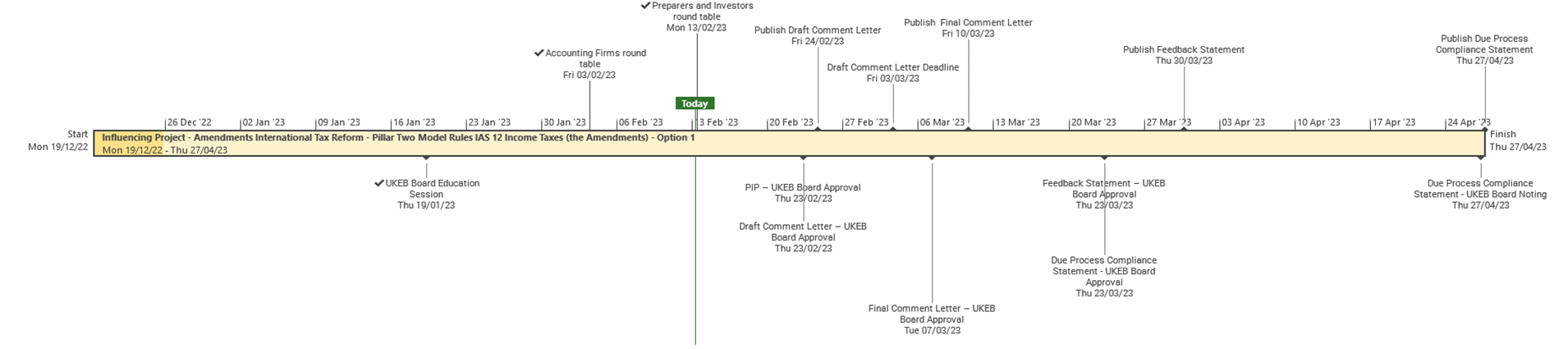
| Date | Milestone |
|---|---|
| Influencing phase | |
| 9 January 2023 | IASB published Exposure Draft with 60-day comment period |
| 19 January 2023 | Board: Introductory discussion of proposed Amendments (public meeting) and education session on tax reform (private meeting) |
| February 2023 | Outreach including roundtables |
| 23 February 2023 | Board: Discusses and approves PIP and DCL. Secretariat: Revises DCL for Board comments. |
| 24 February 2023 | Secretariat: Publishes DCL (7-day comment period from 24 February to 3 March) |
| Late February – early March | Secretariat: Alerts key stakeholders to publication of DCL |
| 7 March 2023 | Additional board meeting scheduled for approval of Final Comment Letter |
| 10 March 2023 | IASB comment period ends Secretariat: submits Final Comment Letter Secretariat: Final Comment Letter published on website |
| 23 March 2023 | Board: Discusses and approves Feedback Statement and Due Process Compliance Statement for influencing phase of project |
| April-May 2023 | IASB redeliberates |
| May 2023 | IASB publishes final Amendments |
Endorsement and Adoption Phase
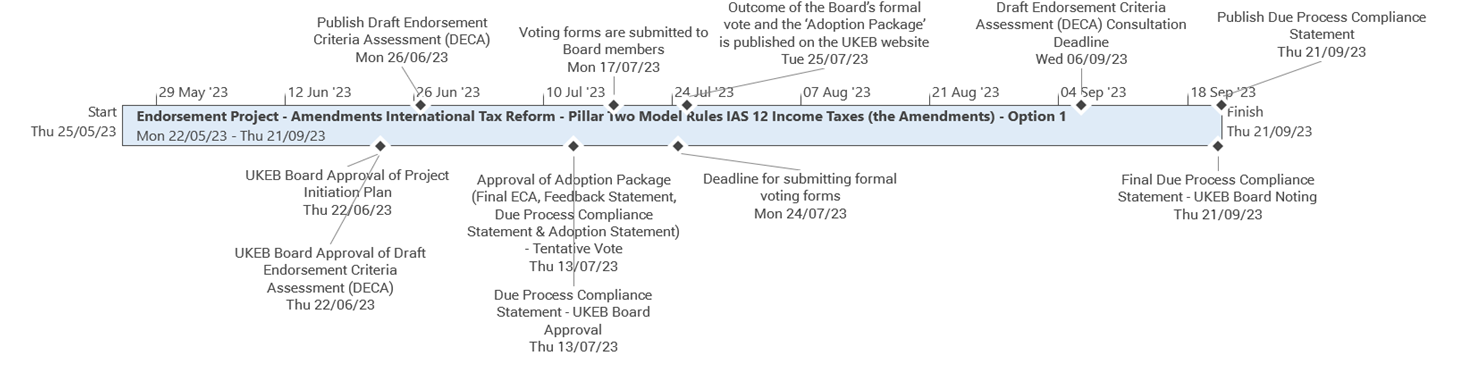
| Date | Milestone |
|---|---|
| Endorsement and adoption phase | |
| 22 June 2023 | Board: Discusses and approves DECA and PIP (revised if necessary) |
| 26 June 2023 | Secretariat: Publishes DECA with 14-day comment period to 10 July 2023 |
| 6 July 2023 | Secretariat: Prepares the adoption package and a draft Due Process Compliance Statement for the project. |
| 13 July 2023 | Board: Considers an adoption package for approval and considers the draft Due Process Compliance Statement for the project. Board members provide a tentative vote. |
| w/c 17 July 2023 | Voting form is sent to board members. |
| w/c 24 July 2023 | Board: Deadline for submitting vote Publication of adoption decision |
| 21 September 2023 | Board: Final Due Process Compliance Statement for noting. |
Timelines
Influencing Phase
Endorsement and Adoption Phase
[^1] The UK's statutory requirements for adoption of international accounting standards are set out in the International Accounting Standards and European Public Limited-Liability Company (Amendment etc.) (EU Exit) Regulations SI 2019/685. [^2] The ED and Basis for Conclusions can be accessed here: https://www.ifrs.org/content/dam/ifrs/project/international-tax-reform-pillar-two-model-rules/exposure-draft-and-comment-letters/iasb-ed-2023-international-tax-reform-pillar-two.pdf [^3] The Secretariat's expectation is that the UK position should be consistent with that in the EU. [^4] Due Process Handbook (kc-usercontent.com) [^5] Paragraph 3.9 states: "The UKEB may decide not to undertake a 'mandatory' milestone for a particular project (refer to paragraph 3.6 above). The UKEB should discuss the reasons for this decision at a public Board meeting. The PIP of the applicable project should clearly outline these reasons."