Feedback Statement - Agenda Consultation
IASB Third Agenda Consultation September 2021
The UK Endorsement Board (UKEB) is responsible for endorsement and adoption of IFRS for use in the UK and therefore is the UK's National Standard Setter for IFRS. The UKEB also leads the UK's engagement with the IFRS Foundation (Foundation) on the development of new standards, amendments and interpretations.
This feedback statement forms part of those influencing activities and is intended to contribute to the International Accounting Standards Board's (IASB) due process. The views expressed by the UKEB in this letter are separate from, and will not necessarily affect the conclusions in, any endorsement and adoption assessment on new or amended International Accounting Standards undertaken by the UKEB.
Foreword

The UKEB welcomes the opportunity to respond to the IASB's Third Agenda Consultation and to contribute to the development of international financial reporting.
The rise of ESG and the impact of digitalisation make this a significant moment in the development of financial reporting. Our response to the IASB's consultation reflects the imperative to remain relevant in the face of these significant changes for reporting entities around the world.
The UKEB welcomed engagement from 150 stakeholders during outreach work on this project. There was strong convergence of views across different stakeholder groups on the high priority projects to be added to IASB's work plan. The constructive and insightful feedback from UK stakeholders has been incorporated into our final comment letter to the IASB.
We look forward to continuing to engage in the debate as IASB deliberates responses received and shapes its forthcoming workplan.
Pauline Wallace, Chair, UK Endorsement Board
Purpose of this feedback statement
This feedback statement presents the views of UK stakeholders heard during the UKEB's outreach activities on the IASB's Third Agenda Consultation and explains how the UKEB's comment letter addressed those views.
The IASB's Request for Information
The IASB's Request for Information (RFI) was published in March 2021 with a comment deadline of 27 September 2021.
The IASB's objective in undertaking this project was to obtain stakeholder feedback to shape its workplan for 2022 – 2026.
The RFI sought stakeholder views on the projects to be added to the IASB's work plan for its next work cycle. It also asked for stakeholder views on the IASB's strategic direction and balance of activities, and the criteria IASB uses to assess whether projects should be added to its work plan.
IASB's main questions
1. IASB's strategic direction and balance of activities
The IASB sought feedback on whether the balance of resources across its main activities was appropriate, or whether the allocation of resource across the main activities should change. (Slide 10 details IASB's main activities).
2. Criteria to assess potential projects for IASB's work plan
The IASB requested feedback on the criteria it uses to decide whether to add a potential project to its work plan. (Slide 11 details IASB's criteria).
3. Priority projects to be added to IASB's work plan
The RFI included details of 22 potential projects that the IASB had identified through initial outreach. Since the IASB has limited capacity to add new projects to its work plan, it asked respondents to assess whether each project was high, medium or low priority. (Slide 13 shows IASB's 22 potential projects).
Pie chart showing the breakdown of IASB's main questions: 1. IASB's strategic direction and balance of activities 2. Criteria to assess potential projects for IASB's work plan 3. Priority projects to be added to IASB's work plan
The UKEB comment letter
The UKEB comment letter expressed the following views on the IASB's main questions:
1. IASB's strategic direction and balance of activities
The UKEB broadly supported the strategic direction and balance of activities, and recommended that the IASB:
- Retain sufficient flexibility in its work plan to interact with any future international sustainability standards board
- Allocate more resource to digital reporting
- Include a structured and visible research programme within its standard-setting activity
- Consider whether any projects on its current work plan could be paused in order to free up resource for the priorities above
2. Criteria to assess potential projects for IASB's work plan
The UKEB agreed with the criteria IASB uses to assess potential projects for its work plan.
In addition, the UKEB recommended that IASB add a criterion to assess whether the potential project is expected to remain relevant when it reaches implementation stage.
The UKEB also recommended that two existing criteria should be redrafted to provide additional clarity.
3. Priority projects to be added to IASB's work plan
The UKEB identified the following projects as high priority:
- Climate-related risks
- Intangible assets
- Statement of cash flows
The UKEB recommended that a cross-standard approach be taken to the climate-related risks and intangible assets projects, to support consistency and efficiency. The UKEB also recommended that the project on intangible assets should incorporate PPMs1 and crypto-currencies.
Outreach approach
The UKEB's outreach activities took place between June 2021 and August 2021.
The outreach approach was underpinned by the UKEB's guiding principles of thought leadership, transparency, independence, and accountability.
Outreach activities included:
- Hosting a series of roundtables with stakeholder groups. The stakeholder groups included preparers, audit firms, regulators, and users of financial statements;
- Public consultation through a joint IASB panel discussion;
- Public consultation on the UKEB's draft comment letter; and
- Promotion through social media platforms.
Outreach activities resulted in largely convergent views from stakeholders on the three main questions raised in the IASB's RFI.
All comments and views were considered in reaching the UKEB final views on the questions raised.
Strategic direction
IASB's areas of activity, stakeholder views, and UKEB position
| IASB's area of activity | UKEB draft position | Stakeholder views2 | UKEB final position |
|---|---|---|---|
| Developing new IFRS Standards and major amendments to IFRS Standards | Satisfied with the current allocation of resources. However, flexibility must be retained for interaction with any future sustainability standards board and a more structured and visible research programme should be incorporated so that responses are developed in real-time for emerging issues. | Stakeholders strongly supported the UKEB draft position. | As draft position. |
| Maintaining IFRS Standards and supporting their consistent application | |||
| Developing and maintaining the IFRS for SMEs Standard | Pause the Second Comprehensive Review of IFRS for SMEs in order to allocate more resource to higher priority areas. | No objections raised. | No objections raised. |
| Supporting digital financial reporting by developing and maintaining the IFRS Taxonomy | Allocate more resource to digital reporting in order to develop a digital strategy and to support the IFRS taxonomy, given that digital production and consumption of financial information will become more prevalent over the IASB's next work cycle. | Stakeholders strongly supported the UKEB draft position. | As draft position. |
Pie chart indicating "1. IASB's strategic direction and balance of activities" as a key area.
The UKEB and stakeholders supported the current level of resource IASB allocates to its two other main areas of activity (stakeholder engagement and understandability and accessibility of the Standards).
Criteria used to prioritise projects
IASB's criteria, stakeholder views, and UKEB position
| IASB's criteria for assessing financial reporting issues | UKEB draft position | Stakeholder views3 | UKEB final position |
|---|---|---|---|
| Whether there is any deficiency in the way companies report the type of transaction or activity in financial reports. | Recommend the IASB redrafts due to the potential for the current wording to capture application issues. | Strong support for UKEB draft position. | Recommend the IASB redrafts to 'whether there is a deficiency in the way companies report the type of transaction or activity and whether that deficiency can be remedied through standard-setting.' |
| The type of companies that the matter is likely to affect, including whether the matter is more prevalent in some jurisdictions than others. | Recommend the IASB redrafts as the current wording suggests that some sectors and jurisdictions will be prioritised over others. | Strong support for UKEB draft position. | Recommend the IASB redrafts to 'the extent to which the matter is prevalent across jurisdictions and sectors.' |
| The importance of the matter to investors. | Redraft this criteria to be consistent with the current wording in the IASB's Due Process Handbook. | Strong support for UKEB draft position. | Redraft this criteria to be consistent with the current wording in the IASB's due process handbook, which refers to 'users' rather than 'investors.' |
| Additional UKEB proposed criterion IASB should add a criterion to assess whether the project is expected to remain relevant when it reaches implementation stage. |
Strong support for UKEB draft position. | As per draft position. |
Pie chart indicating "2. Criteria to assess potential projects for IASB's work plan" as a key area.
UKEB and stakeholders agree with the three other criteria used by the IASB to prioritise projects. The three other criteria are: 1. How pervasive or acute the matter is likely to be for companies. 2. The potential project's interaction with other projects on the work plan. 3. The complexity and feasibility of the potential project and its solutions and the capacity of the Board and its stakeholders to make timely progress on the potential project.
Priority projects
Stakeholder views and UKEB position
| UKEB draft position | Stakeholder views4 | UKEB final position | |
|---|---|---|---|
| Climate-related risks | High priority due to the rise of ESG reporting and the need to engage with and identify synergies with any future sustainability standards board. | Agreed with the UKEB's high priority ranking. | High priority. |
| Intangible assets | High priority due to the transition to knowledge-based economies and investor needs for relevant information on intangible assets. The scope of a project on intangible assets could encompass pollutant pricing mechanisms and cryptocurrencies and related transactions. | Agreed with the UKEB's high priority ranking. | High priority. |
| Statements of cash flow and related matters | High priority due to potential to extend Primary Financial Statements project to a more comprehensive review of the statement of cash flows. The importance of a comprehensive review has been underlined by the recent focus on supply chain finance. | Agreed with the UKEB's high priority ranking. | High priority. |
Pie chart indicating "3. Priority projects to be added to IASB's work plan" as a key area.
Slide 13 shows the priority ranking of all projects following stakeholder outreach.
Diagram showing recommended prioritisation of potential projects.
Projects are arranged in concentric circles, with higher priority projects closer to the centre.
Highest Priority Projects (central circle): * Intangible assets (including crypto and PPMs) * Climate-related risks * Statement of cash flows and related matters
Other Potential Projects (outer circles, varying priority implied by distance): * Borrowing costs * Negative interest rates * Discontinued operations and disposal groups * Foreign currencies * Operating segments * Commodity transactions * Income taxes * Discount rates * Government grants * Inflation * Separate financial statements * Other comprehensive income * Variable and contingent consideration * Going concern * Expenses - Inventory and cost of sales * Employee benefits * Interim financial reporting
Pie chart indicating "3. Priority projects to be added to IASB's work plan" as a key area.
- This chart illustrates our recommended prioritisation of potential projects based on outreach with UK stakeholders and desk-based research.
- The highest priority projects are closest to the centre.
- Projects are classified as high priority or low priority. The projects within the central circle are high priority.
Outreach events and participants
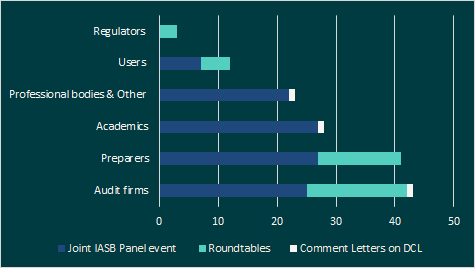
In total, 150 stakeholders engaged in outreach activities. The graph analyses participants by outreach activity and by type of organisation represented.
Disclaimer
This feedback statement has been produced in order to set out the UKEB's response to stakeholder comments received on the IASB's Third Agenda Consultation Request for Information and should not be relied upon for any other purpose. The views expressed in this feedback statement are those of the UKEB at the point of publication. Any sentiment or opinion expressed within this feedback statement will not necessarily bind the conclusions, decisions, endorsement or adoption of any new or amended IFRS by the UKEB.
Contact Us
UK Endorsement Board
8th Floor | 125 London Wall | London | EC2Y 5AS | United Kingdom
Email: [email protected] Web: www.endorsement-board.uk