5 Intangible Assets
22 October 2026
Agenda Paper 5
Executive Summary
| Body | Research / Pipeline | Discussion Paper | Redeliberation | Exposure Draft | Redeliberation | Final Standard | Post Implementation Review |
|---|---|---|---|---|---|---|---|
| IASB | Research / Pipeline | Discussion Paper | Redeliberation | Exposure Draft | Redeliberation | Final Standard | Post Implementation Review |
| UKEB | Research / Influencing | Research / Influencing | Monitoring | Influencing | Monitoring | Endorsement | Influencing / UKEB Post Implementation Review |
Project Type: Research Project
Project Scope: Significant
Purpose of the Paper
This paper:
- Summarises the background to the UKEB’s Intangible Assets research project and the evidence gathered through the qualitative research, quantitative analysis and investor survey.
- Outlines the key themes emerging from the UKEB’s case study research.
- Seeks the Board's views on whether the principles underpinning the recognition of intangible assets remain fit for purpose and identifies areas that may warrant further consideration as the project progresses. (see Appendix 5A)
Summary of the Issue
The UKEB's research on intangible assets has explored stakeholder views through qualitative research, quantitative analysis, an investor survey and, most recently, four case studies focused on training costs, research and development, carbon credits and data.
Although the case studies involved different fact patterns, participants frequently raised a common set of questions relating to: 1. the definition of an asset; 2. the unit of account; 3. the definition of control; 4. uncertainty; and 5. the role of the business model.
These recurring themes suggest that the challenges identified may extend beyond specific requirements in IAS 38 and instead reflect broader questions regarding the principles used to identify and recognise intangible assets.
Discussion Questions for the Board
In the context of the material presented in Appendix A, the Board is asked to discuss the following questions that underpin the principles driving the recognition of intangible assets.
Definition of an asset 1. The research suggests stakeholders often believe an economic resource exists even when it is not recognised. Does this indicate that the current definition and recognition requirements are too restrictive?
The unit of account 2. The research suggests stakeholders often view value as arising from workforces, portfolios and ecosystems rather than individual resources. Does this indicate that the current unit of account is too narrowly defined?
Definition of control 3. The research suggests stakeholders often view resources as valuable even where legal rights are incomplete or non-exclusive. Does this indicate that the current notion of control is too restrictive?
The impact of uncertainty 4. The research suggests stakeholders often believe an economic resource exists despite significant uncertainty. Does this indicate that uncertainty plays too great a role in determining whether an asset is recognised?
The role of a business model 5. The research suggests stakeholders identify different resources as drivers of value in different business models. Does this indicate that current accounting gives insufficient weight to how businesses create value?
Recommendation
N/A
Appendices
Appendix 5A Intangible Assets: Exploring principles emerging from UKEB research
Background
1The UKEB initiated its Intangible Assets research project following feedback received during the IASB's Third Agenda Consultation, which identified intangible assets as an area warranting further consideration by the IASB. The project was designed to understand UK stakeholder views on the accounting for intangibles and gather evidence on the UK intangibles landscape.
2Consistent with this objective, the UKEB undertook a programme of research comprising:
- qualitative research exploring stakeholder views on the accounting for intangible assets;
- a quantitative analysis of reporting by UK listed companies;
- an investor survey examining users' information needs; and
- case study research exploring the accounting challenges associated with specific examples of intangible resources.
3The findings from each strand of research are summarised below.
4In addition, the Financial Reporting Council (FRC) has published its Thematic Review: Reporting intangible value drivers report which “highlights practical opportunities for companies to strengthen the quality, clarity and usefulness of their corporate reporting [of intangible value drivers].” The review is based on 10 selected company reports and accounts across various sectors and recommends that companies provide clearer, more connected and decisions useful disclosures about intangible value drivers that underpin value creation. This includes those that are not recognised as assets in the financial statements.
Previous Research
Stakeholder Views Research
5The UKEB's initial qualitative research sought to understand stakeholder perspectives on the accounting for intangible assets and identify areas where current reporting requirements may not adequately reflect modern business activity. Input was obtained from preparers, investors, auditors, academics and standard setters, providing a broad range of perspectives on the challenges associated with accounting for intangibles.
6Participants consistently observed that intangible resources play an increasingly important role in value creation across many sectors of the economy. Stakeholders highlighted a range of resources, including research capabilities, data, customer relationships, brands and workforce-related assets, as significant contributors to enterprise value.
7At the same time, many participants expressed concern that financial statements do not always reflect the economic significance of these resources. Stakeholders noted that substantial investments are frequently recognised as expenses despite creating benefits that extend beyond the current reporting period. A recurring concern was that recognised amounts often fail to align with how businesses create, maintain and develop value.
8While participants differed regarding potential solutions, the research identified a number of recurring themes, including questions regarding the definition of an asset, the distinction between acquired and internally generated intangibles, the role of uncertainty, and the extent to which disclosures can compensate for limitations in recognition requirements.
Quantitative Analysis of UK Financial Reports
9The UKEB's quantitative research examined the reporting of intangible assets by a sample of UK listed companies. The objective was to provide an evidence-based assessment of how current accounting requirements operate in practice and the extent to which recognised intangible assets are reflected within corporate reporting.
10The analysis found that recognised intangible assets represent a significant and growing component of many entities' balance sheets. However, recognised balances were concentrated within a relatively small subset of companies and often arose from business combinations rather than internally generated activities.
11The research identified significant differences between businesses that grow organically and those that grow through acquisition. Similar economic resources may be recognised as assets when acquired from another entity but remain unrecognised when developed internally. As a result, economically similar businesses may report materially different financial positions and performance measures.
12The findings suggested that a substantial proportion of intangible investment is not reflected in recognised assets under current accounting requirements. This evidence reinforced stakeholder concerns that there may be a disconnect between the role of intangible resources in value creation and their representation in financial statements.
Investor Survey
13The UKEB's investor survey explored how users of financial statements assess intangible resources and the information they require to support investment decisions. The survey sought to understand both the relevance of intangible-related information and the extent to which existing reporting requirements meet user needs.
14Respondents generally agreed that intangible resources are increasingly important drivers of business performance, competitive advantage and long-term value creation. Investors indicated that understanding investments in intangible resources forms an important part of their analysis, particularly for businesses operating in knowledge-intensive or technology-driven sectors.
15Despite this importance, many respondents expressed reservations regarding the usefulness of information currently available within financial statements. Investors reported relying on information from a range of sources and often making adjustments to reported information when assessing the value and performance of businesses with significant intangible resources.
16The survey highlighted a nuanced perspective on potential reforms. While respondents identified limitations in the current accounting framework, many did not view broader capitalisation as a complete solution. Instead, investors frequently emphasised the importance of improved disclosures that provide greater insight into the nature of intangible investments, their contribution to value creation and their relationship to future performance.
Case Study Research
17Building on the earlier stages of the project, the UKEB developed four case studies focused on training costs, research and development, data and carbon credits. The case studies were designed to move beyond high-level observations and explore how stakeholders assess specific examples of resources that may contribute to value creation but present challenges when applying existing accounting requirements.
18The case studies were discussed with approximately 100 stakeholders, including preparers, users, auditors and academics. Participants were invited to consider whether an asset exists, what the relevant unit of account should be, whether control is present, and how uncertainty should influence accounting outcomes.
19While views often differed regarding the appropriate accounting treatment, stakeholders frequently agreed that the resources being discussed were economically significant and contributed to value creation. However, there was considerably less agreement regarding how those resources should be recognised as assets, how they should be measured and whether disclosures might provide a more effective means of communicating relevant information.
Themes emerging from research
20Although the research considered different resources, industries and fact patterns, a consistent set of themes emerged. Stakeholders frequently returned to questions regarding:
- the definition of an asset;
- the unit of account;
- control;
- uncertainty; and
- the role of the business model.
21Taken together, the research suggests that stakeholders often identify economically significant resources that contribute to value creation but are not recognised as assets under current accounting requirements. However, there is considerably less agreement regarding whether this reflects an appropriate application of existing accounting principles or a need to reconsider the principles underpinning the recognition of intangible assets.
22These themes extend beyond any individual case study and raise broader questions regarding the principles used to identify and recognise intangible assets. In particular, they highlight differing views regarding the relationship between economic significance and asset recognition, and the extent to which current accounting requirements reflect how modern businesses create value.
Objective of this discussion
23Consistent with the approach set out in the Project Initiation Plan, the Secretariat is now seeking to move from the evidence-gathering phase of the project towards a discussion of the broader principles that underpin accounting for intangible resources.
24The purpose of this session is therefore not to revisit the findings of the individual research reports. Instead, Appendix 5A uses the evidence gathered throughout the project as a basis for exploring whether the principles underpinning the recognition of intangible assets remain fit for purpose and continue to provide an appropriate foundation for financial reporting.
Questions for the Board
In the context of the material presented in Appendix 5A, the Board is asked to discuss the following questions that underpin the principles driving the recognition of intangible assets.
Definition of an asset 1. The research suggests stakeholders often believe an economic resource exists even when it is not recognised. Does this indicate that the current definition and recognition requirements are too restrictive?
The unit of account 2. The research suggests stakeholders often view value as arising from workforces, portfolios and ecosystems rather than individual resources. Does this indicate that the current unit of account is too narrowly defined?
Definition of control 3. The research suggests stakeholders often view resources as valuable even where legal rights are incomplete or non-exclusive. Does this indicate that the current notion of control is too restrictive?
The impact of uncertainty 4. The research suggests stakeholders often believe an economic resource exists despite significant uncertainty. Does this indicate that uncertainty plays too great a role in determining whether an asset is recognised?
The role of a business model 5. The research suggests stakeholders identify different resources as drivers of value in different business models. Does this indicate that current accounting gives insufficient weight to how businesses create value?
Appendix A: Intangible Assets - Exploring principles emerging from UKEB research
The views expressed in this presentation are those of the presenter and not necessarily those of the Endorsement Board, nor are they necessarily reflective of any official policy or position.
- Executive Summary
- Background
- Previous Research
- Themes emerging from research
- Objective of this discussion
- Appendix A: Intangible Assets - Exploring principles emerging from UKEB research
- What is in company financial statements
- Conceptual Framework recognition criteria
- IAS 38 recognition criteria - General
- IAS 38 recognition criteria – R&D
- IAS 38 recognition criteria - Explicitly Excluded
- Unrecognised intangibles
- What we heard from the research
- Intangible assets research
- Summary of cross-cutting themes
- The definition of an asset
- Unrecognised intangibles could be assets
- How other IFRS Standards Reflect Different Views of Assets
- Questions for the Board
- The unit of account
- The definition of control
- The impact of uncertainty
- The role of the business model
- Next steps
- Contact Us
Reminder: IAS 38 Requirements
Objective of IAS 38 Intangible Assets
The objective of IAS 38 is to:
- Prescribe the accounting treatment for intangible assets that are not dealt with specifically in another Standard.
- Require an entity to recognise an intangible asset, if, and only if, specified criteria are met. The Standard also specifies how to measure the carrying amount of intangible assets and requires specified disclosures about intangible assets.
Scope of IAS 38
Scope of IAS 38 Decision Flowchart
-
Is the asset dealt with in another specific Standard? - Yes → Apply the relevant Standard. - No → Consider the criteria in IAS 38.
-
Has the definition of an asset been satisfied? - No → Not in the scope of IAS 38. - Yes → Has the definition of an intangible asset been satisfied?
- No → Not in the scope of IAS 38 (Not recognised).
- Yes → Apply IAS 38.
Another specific Standard?
IAS 38 shall be applied in accounting for intangible assets except:
- Intangible assets that are within the scope of another Standard;
- Financial assets, as defined in IAS 32 Financial Instruments: Presentation;
- The recognition and measurement of exploration and evaluation assets in IFRS 6 Exploration for and Evaluation of Mineral Resources; and
- Expenditure on the development and extraction of minerals, oil, natural gas and similar non-regenerative resources
Comparing the Conceptual Framework asset definition and the IAS 38 intangible asset definition
| Component | Conceptual Framework | IAS 38 |
|---|---|---|
| Definition | A present economic resource controlled by the entity as a result of past events. | An identifiable, non-monetary asset without physical substance. |
| Nature of resource | Focuses on the existence of a present economic resource, defined as a right with the potential to produce economic benefits | Focuses on a specific category of asset: an identifiable intangible resource. |
| Economic benefits | Resource must have the potential to produce economic benefits for the entity. | Future economic benefits may arise from revenues, cost savings or other benefits generated by the asset. |
| Control | Entity must be able to direct the use of the resource and prevent others from obtaining benefits from it. | Entity must have the power to obtain future economic benefits and restrict others' access to those benefits. Control typically stems from legal rights. |
| Role of rights | Rights often arise from contracts, legislation or similar means, but may also arise from know-how or constructive obligations. | Identifiability may arise through contractual or other legal rights, regardless of transferability. |
| Identifiability | No explicit requirement for separability or identifiability. | Asset must be identifiable, meaning it is either separable or arises from contractual/legal rights. |
| Physical substance | No requirement relating to physical substance. | Must be without physical substance. |
Examples of potential intangibles
Examples of Potential Intangibles:
- Brands
- Copyrights
- Patents
- Technical know-how
- Carbon credits
- Workforce skills/training
- Databases
- AI models
- Machine learning models
- Software
- Scientific formulations
- Research and development
- Source code
- Trademarks
- Customer lists
- Licenses
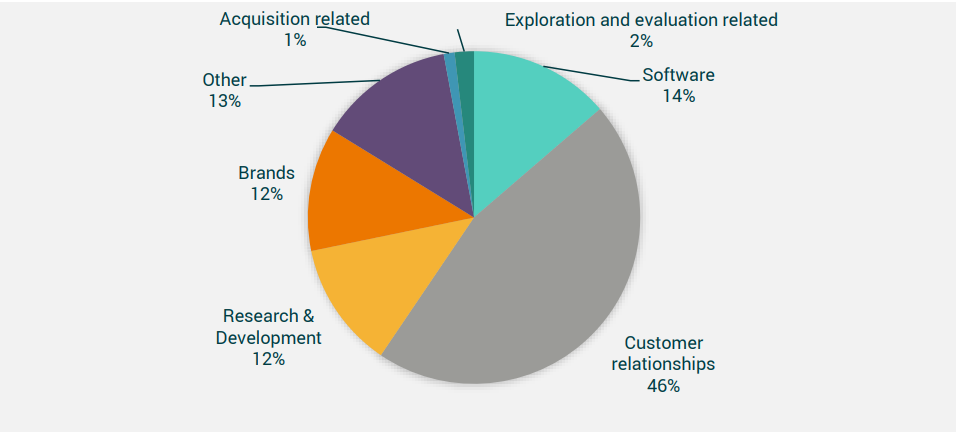
What is in company financial statements
Based on the sample of 80 companies analysed in the UKEB Quantitative Report, the following identifiable intangible assets were among those most commonly reported by UK companies.
Conceptual Framework recognition criteria
The Conceptual Framework states that an asset is recognised only if recognition of that asset provides users of financial statements with information that is useful. Information is useful if it is:
- Relevant information about the asset; and
- Faithfully represents the asset
| Recognition consideration | Explanation |
|---|---|
| Provides relevant information about the asset | Recognition should provide information that is capable of making a difference to users' decisions. |
| Faithfully represents the asset | The asset, and any resulting income or expenses, can be represented completely, neutrally and free from material error. |
| Cost vs Benefit | The benefits of providing the information should justify the costs of providing and using it. |
IAS 38 recognition criteria - General
IAS 38 states that an intangible asset may be recognised only if an entity can demonstrate that the item meets:
- the definition of an intangible asset; and
- the recognition criteria.
IAS 38 recognition criteria
An intangible asset shall be recognised if, and only if:
- it is probable that the expected future economic benefits that are attributable to the asset will flow to the entity; and
- the cost of the asset can be measured reliably.
An entity shall also assess the probability of expected future economic benefits using reasonable and supportable assumptions that represent management’s best estimate of the set of economic conditions that will exist over the useful life of the asset.
An entity uses judgement to assess the degree of certainty attached to the flow of future economic benefits that are attributable to the use of the asset on the basis of the evidence available at the time of initial recognition, giving greater weight to external evidence.
IAS 38 recognition criteria – R&D
An intangible asset arising from the development (or from the development phase of an internal project) shall be recognised if, and only if, an entity can demonstrate all of the following:
- The technical feasibility of completing the intangible asset so that it will be available for use or sale.
- Its intention to complete the intangible asset and use or sell it.
- Its ability to use or sell the intangible asset.
- How the intangible asset will generate probable future economic benefits. Among other things, the entity can demonstrate the existence of a market for the output of the intangible asset or the intangible asset itself or, if it is to be used internally, the usefulness of the intangible asset.
- The availability of adequate technical, financial and other resources to complete the development and to use or sell the intangible asset.
- Its ability to measure reliably the expenditure attributable to the intangible asset during its development.
IAS 38 recognition criteria - Explicitly Excluded
IAS 38.48
- Internally generated goodwill shall not be recognised as an asset.
IAS 38.54
- All expenditure incurred during the research phase of an internal project must be recognised as an expense when incurred.
IAS 38.63 – The following shall not be recognised as an asset
- Internally generated brands.
- Internally generated mastheads.
- Internally generated publishing titles.
- Internally generated customer lists.
- Items similar in substance to the above.
IAS 38.69 – The following shall be expensed
- Start-up costs.
- Employee training.
- Advertising campaigns.
- Brand-building expenditure.
- Promotional expenditure.
Unrecognised intangibles
Many potential intangibles are unrecognised because they:
- fail to meet the definition of control;
- fail to meet the “probable” requirement;
- fail to meet the research and development requirements; or
- are explicitly excluded.
Unless they are purchased!
Potential internally generated intangibles that are unrecognised under IAS 38:
- AI models
- Databases
- Customer lists
- Carbon/Environmental credits
- Machine learning models
- Source code
- Scientific formulations
- Technical know-how
- Research
- Workforce skills/Training
What we heard from the research
Intangible assets research
Across stakeholder outreach, quantitative analysis, investor research and case study research, a consistent message emerged:
- Intangible resources are increasingly important drivers of value creation.
- Stakeholders frequently identify economically significant resources that are not recognised as assets.
- Stakeholders often agree that these resources exist and contribute to value creation.
- However, views diverge on whether they should be recognised, how they should be measured and what information should be disclosed.
Summary of cross-cutting themes
Across the UKEB research, a common set of issues arose which suggest that broader challenges regarding the accounting for intangible items. In today’s session we will explore a number of these related to recognition.
Summary of cross-cutting themes diagram:
- Business Model (outer framework)
- Definition of control
- Measurement & Existence
- Existence & Outcome
- Definition of an asset
- Measurement & Existence
- Uncertainty
- Measurement & Outcome
- Unit of account
- Existence & Outcome
- Uncertainty
The definition of an asset
The research suggests stakeholders often believe an economic resource exists even when it is not recognised. Does this indicate that the current definition and recognition requirements are too restrictive?
Identifying the relevant asset to be accounted for where value arises from a combination of resources, activities and capabilities is important.
Current IAS 38 principle
- An intangible asset must be identifiable.
- The asset must be capable of being distinguished from other resources.
Challenges identified from research
- Significant value may exist even where current requirements exclude recognition.
- Value is often created through a combination of resources and activities.
- The boundary of the asset is often unclear.
Unrecognised intangibles could be assets
Trained workforce / organisational capability
“...if a company did not have the rights/knowledge/skills associated with the intangibles, they probably wouldn't generate the profits we expect.” (Credit rating agency respondent)
Combinations of resources
“Intangibles are in many sectors the major drivers of future financial performance, investment in them is the best indicator of future success for the business.” (Institutional investor)
Internally generated intangibles matter
“Competitive advantage is almost always somewhat related to brand, research and development. You basically cannot properly estimate competitive advantage without an understanding of intangible assets and their value.” (Equity analyst)
How other IFRS Standards Reflect Different Views of Assets
IFRS 3 Business Combinations
Requires recognition of many acquired intangible assets that would not be recognised if internally generated, including customer relationships, brands, in-process R&D and technology.
IFRS 16 Leases
Recognises a right-of-use asset even though the entity does not own the underlying asset. Focuses on the economic resource represented by access and use.
IFRS 15 Revenue from Contracts with Customers
Recognises contract assets where rights to future benefits exist despite ongoing performance obligations and uncertainty. Recognition is not dependent on the existence of a separable asset.
IAS 41 Agriculture
Recognises biological assets despite significant uncertainty regarding future outcomes and value. Uncertainty affects measurement but does not necessarily prevent recognition.
IAS 2 Inventories
Uncertainty about future sales does not prevent recognition of the underlying resource.
Questions for the Board
1. The research suggests stakeholders often believe an economic resource exists even when it is not recognised. Does this indicate that the current definition and recognition requirements are too restrictive?
The unit of account
The research suggests stakeholders often view value as arising from workforces, portfolios and ecosystems rather than individual resources. Does this indicate that the current unit of account is too narrowly defined?
The unit of account emerged as a fundamental unresolved issue when considering modern intangibles.
Current IAS 38 principle
- The unit of account is not explicitly defined.
- Focuses on identifiable assets.
- Relies on separability and contractual/legal rights.
Challenges identified from research
- Value is often created through a combination of resources and activities therefore leading to questions about whether a separate resource or a portfolio are the relevant unit of account.
- The relevant unit of account could be a contract, project or a portfolio.
- The unit of account may differ across business models.
What is the unit of account?
Workforce
> "The value does not reside in any single employee; it resides in the organisation's ability to attract, develop and retain talent."
Research
> "Investors often focus on the strength of an R&D programme or pipeline rather than individual development projects."
How other IFRS Standards Reflect Different Views of the Unit of Account
IFRS 9 Financial Instruments
Risk management and impairment models often operate at a portfolio level rather than asset-by-asset. Reflects the economics of managing financial assets as a group.
IFRS 17 Insurance Contracts
Measurement is based on groups of insurance contracts, not individual contracts. The standard explicitly adopts a broader unit of account where this better reflects economics.
IFRS 3 Business Combinations
Recognises individual intangible assets acquired in a business combination, but many derive value from being part of a wider business, customer base or platform. Highlights the difficulty of separating individual assets from broader value-generating systems.
Questions for the Board
1. The research suggests stakeholders often view value as arising from workforces, portfolios and ecosystems rather than individual resources. Does this indicate that the current unit of account is too narrowly defined?
The definition of control
The research suggests stakeholders often view resources as valuable even where legal rights are incomplete or non-exclusive. Does this indicate that the current notion of control is too restrictive?
The main concern is whether the traditional definition of control remains appropriate for modern intangibles.
Current IAS 38 principle
- Control is a key requirement for asset recognition.
- Control is often demonstrated through legal rights or enforceable arrangements.
Challenges identified from research
- Access and use can still generate value without exclusive ownership of an asset.
- Control may be better reflected by the ability to direct and benefit from a resource.
- The impact of control on the recognition and measurement requirements should be carefully considered.
What constitutes control?
Workforce
> "You don't control individuals, but you control your workforce."
Data
> "Does it actually matter if someone else is using it?... As long as there is a contractual agreement."
How other IFRS Standards Reflect Different Views of Control
IFRS 10 Consolidated Financial Statements
Control is determined through the ability to direct relevant activities and obtain benefits. Ownership is not required if control exists in substance.
IFRS 15 Revenue from Contracts with Customers
Control is assessed based on the ability to direct the use of, and obtain benefits from, an asset. The assessment focuses on economic substance rather than legal title alone.
IFRS 16 Leases
A lessee recognises a right-of-use asset despite not owning the underlying asset. Accounting reflects control over use rather than ownership.
IAS 41 Agriculture
An entity may control biological transformation and harvest future benefits without possessing the degree of legal protection often seen for traditional intangible assets. The focus is on access to future economic benefits arising from the resource.
IFRS 17 Insurance Contracts
Places substantial weight on the substance of contractual rights and obligations rather than legal ownership of economic resources.
IFRS 9 Financial Instruments
Control is assessed based on whether the transferee has the practical ability to sell the transferred financial asset unilaterally and without restriction. If that ability exists, control is regarded as having passed to the transferee.
Questions for the Board
1. The research suggests stakeholders often view resources as valuable even where legal rights are incomplete or non-exclusive. Does this indicate that the current notion of control is too restrictive?
The impact of uncertainty
The research suggests stakeholders often believe an economic resource exists despite significant uncertainty. Does this indicate that uncertainty plays too great a role in determining whether an asset is recognised?
Uncertainty is a pervasive issue which affects the unit of account, definition of control, definition of an asset and the business models of modern intangibles.
The Conceptual Framework states the following definitions:
- Existence uncertainty – when it is uncertain whether an asset or liability exists. (Asset definition and control definition)
- Measurement uncertainty – when the monetary amounts in financial reports cannot be observed directly and must be estimated. (Asset definition and unit of account)
- Outcome uncertainty – arises when there is uncertainty about the amount or timing of any inflow or outflow of economic benefits that will result from an asset or liability. (Control definition and unit of account)
How should uncertainty affect recognition?
R&D case study
> "The fact that there is uncertainty does not mean there is no asset."
> "The market clearly attributes value to the pipeline before approval."
> "Uncertainty is really a valuation issue rather than an existence issue."
> "Investors routinely assess uncertain future cash flows; uncertainty does not make the resource irrelevant."
How other IFRS Standards Reflect Different Views of Uncertainty
IAS 37 Provisions
Recognition requires uncertainty regarding timing and amount. Accounting does not conclude that uncertainty means no liability exists. Uncertainty is dealt with through estimation and measurement.
IFRS 9 Financial Instruments
Expected credit losses are recognised using probability-weighted estimates of future outcomes. Significant uncertainty is incorporated into measurement rather than preventing recognition.
IAS 41 Agriculture
Biological assets are recognised despite uncertainty regarding future growth, yields and prices. Fair value measurement explicitly incorporates uncertainty.
IFRS 15 Revenue from Contracts with Customers
Revenue estimates may include highly uncertain variable consideration. The standard uses constraints and estimation techniques rather than treating uncertainty as a barrier to recognition.
IFRS 17 Insurance Contracts
The entire measurement model is built around uncertainty. The standard does not conclude that uncertainty prevents recognition.
Questions for the Board
1. The research suggests stakeholders often believe an economic resource exists despite significant uncertainty. Does this indicate that uncertainty plays too great a role in determining whether an asset is recognised?
The role of the business model
The research suggests stakeholders identify different resources as drivers of value in different business models. Does this indicate that current accounting gives insufficient weight to how businesses create value?
Research feedback indicates that the business model is the starting point for understanding modern intangibles
Current IAS 38 principle
IAS 38 does not contain the concept of a business model and instead focuses on: - Recognition of separately identifiable assets; - Driven by the nature of the expenditure incurred; and - Whether control over the identifiable asset exists.
Challenges identified from research
Tension exist in the following areas when trying to account for modern intangibles: - Value creation in modern intangibles is often understood through the business model. - Several resources and activities collectively create value instead of a single asset. - The business model therefore impacts asset identification, control and the unit of account.
From our research
> "The starting point should be understanding how the business creates value."
> "What matters is not necessarily the individual expenditure but how it contributes to the broader value-generating activities of the entity."
Data case study
> "The value is not in the data alone, but in the business's ability to use it."
Investor perspective
> "Different businesses derive value from different types of intangibles."
R&D case study
> "A pharmaceutical company's pipeline may be central to value creation, whereas for another entity the same expenditure may be incidental."
How other IFRS Standards Reflect Different Views of Uncertainty
IFRS 9 Financial Instruments
Classification and measurement depend on the entity's business model for managing financial assets. The same financial asset may be accounted for differently depending on how the entity generates value from it.
IFRS 15 Revenue from Contracts with Customers
Revenue recognition reflects how an entity delivers value to its customers. The accounting reflects the substance of the entity's business activities and performance obligations.
IAS 40 Investment Property
Distinguishes assets held to earn rentals or for capital appreciation from owner-occupied property. The intended use of the asset influences the accounting model applied.
IFRS 17 Insurance Contracts
Measurement reflects how insurance entities generate value and manage obligations. The standard incorporates features specific to the insurance business model.
Questions for the Board
1. The research suggests stakeholders identify different resources as drivers of value in different business models. Does this indicate that current accounting gives insufficient weight to how businesses create value?
Next steps
Future Board discussions are expected to cover:
Measurement
- How recognised intangible assets should be measured.
- How measurement uncertainty should affect subsequent measurement.
- Potential measurement approaches for different business models.
Disclosure
- Information investors need when recognition is not appropriate.
- Whether disclosures can better communicate investments in intangible resources.
- The relationship between recognition and disclosure.
Practical implications
- Comparability and consistency.
- Reliability and verifiability.
- Cost-benefit considerations.
- Potential effects on financial reporting outcomes.
Contact Us
UK Endorsement Board 1 Harbour Exchange
| London | E14 9GE www.endorsement-board.uk