Project Initiation Plan – Post-implementation Review of IFRS 9—Hedge Accounting Instruments[
Purpose
1 This paper sets out the plan to influence the Post-implementation Review (PIR) of IFRS 9—Hedge Accounting. The associated IASB Request for Information (RFI) is expected to be published in September 2026.
Background
2 In July 2014 the IASB issued IFRS 9 Financial Instruments. The Standard was effective for annual periods commencing on or after 1 January 2018. Insurers could defer the effective date until 1 January 2023 to align with the implementation of IFRS 17 Insurance Contracts if certain conditions were met.
3 IFRS 9 replaced IAS 39 Financial Instruments: Recognition and Measurement. It changed accounting requirements in three main areas for financial instruments: classification and measurement, impairment (introduction of the Expected Credit Loss model) and hedge accounting.
4 The IASB split its PIR of IFRS 9 into three parts1. This part of the review focuses only on the hedge accounting requirements of IFRS 9, together with the related disclosure requirements in IFRS 7 Financial Instruments: Disclosures.
5 The objective of the hedge accounting requirements in IFRS 9 is to represent, in the financial statements, the effect of an entity’s risk management activities that use financial instruments to manage exposures arising from particular risks that could affect profit or loss (or other comprehensive income, in the case of investments in equity instruments for which an entity has elected to present changes in fair value in other comprehensive income).
6 An entity may, as an accounting policy choice:
- continue to apply IAS 39 to all hedge relationships; or
- apply IFRS 9, either to:
- all hedge relationships; or
- all hedge relationships except for fair value hedges of the interest rate exposure of a portfolio of financial assets or financial liabilities (macro hedge accounting), for which it may apply the specific requirements in IAS 39.
7 The hedge accounting disclosure requirements set out in IFRS 7 apply regardless of the accounting policy choice for hedge accounting2.
Summary of Request for Information
8 The IASB has said it plans to publish the RFI in September 2026. The Secretariat expects the comment deadline to be in late January 2027.
9 Tentative decisions from the July 2026 IASB meeting suggest the RFI will include separate questions about the hedge accounting requirements in IFRS 9 and related disclosure requirements in IFRS 7 to assess whether:
- those requirements are meeting their objectives;
- the benefits to users of the information arising from applying those requirements are as expected; and
- the costs of applying those requirements, and auditing and enforcing their application, are as expected.
Project Plan
Proportionality Assessment
Significance and Size
IASB Project Scope
10 The IASB has established a high threshold for initiating amendments following a PIR. The IASB’s objective of a PIR is “to assess whether the effects of applying new requirements on users, preparers, auditors and regulators of financial statements are as intended when the IASB developed those new requirements”3. This ensures that only significant issues or widespread concerns prompt additional action, thereby maintaining the integrity and stability of the standards.
UK context and complexity
11 Preliminary feedback from the UKEB’s Financial Instruments Working Group (FIWG) in April 2025 and Accounting Firms and Institutes Advisory Group (AFIAG) in June 2025 indicates that the IFRS 9 hedge accounting requirements are working well and no fatal flaws have been identified by those applying these requirements.
12 Desk-based research carried out by the UKEB Secretariat indicates that the majority of UK banks, who are typically the most significant users of hedge accounting, continue to apply the hedge accounting requirements of IAS 39. This may impact their ability to provide detailed feedback on IFRS 9 hedge accounting requirements, which will restrict the evidence base from UK entities to a degree. However, as noted above, the hedge accounting disclosure requirements in IFRS 7 apply to all entities, regardless of whether they apply the hedge accounting model in IAS 39 or IFRS 9.
13 Across all industries (including banks), the Secretariat reviewed 68 listed UK entities applying hedge accounting. This preliminary research indicates that 72% of those entities apply IFRS 9 hedge accounting and 22% continue to use IAS 39. However, in a number of cases it was not clear which standard was being applied. Also, it is not clear how significant hedge accounting was for a number of entities.
Expected Timeline / Urgency
14 There is no indication of any need for urgent resolution or accelerated timeline in the UK.
Expected Interest / Sensitivity
15 There is no indication of wider UK concerns in relation to this project.
However, there is likely to be interest amongst financial institutions, in particular banks and building societies. The extensive use of IAS 39 hedge accounting by these entities will be impacted by the IASB’s stated plan to withdraw IAS 39 once the Risk Mitigation Accounting project is concluded.
Feedback from Initial Outreach
16 As noted above, preliminary feedback from UK stakeholders indicates no fatal flaws with the hedge accounting requirements. However, the following potential issues have been identified from initial outreach with stakeholders (UKEB advisory groups), and UKEB Secretariat desk-based research. The nature and extent of these issues will be tested as part of our stakeholder outreach. They include:
- Variable notional—allowing entities to designate a variable amount as the hedged item, similar to the exception for contracts referencing nature-dependent electricity. This would improve the alignment of accounting with risk management.
- Foreign exchange cost of hedging—complexity in assessing effectiveness which is burdensome.
- Deal contingent hedging—the challenge in meeting the “highly probable” criterion.
Connectivity
17 No connectivity implications have been identified.
Recommended UKEB Project Scope
18 Based on the proportionality assessment above we recommend a ‘Moderate’ project scope, and the approach described in this document reflects this. The project will:
- Publish a Draft Comment Letter (DCL), which will be primarily based on a high-level overview of the findings from desk-based research and feedback from initial outreach with stakeholders.
- Include an Invitation to Comment (ITC) accompanying the DCL.
- Allow for a slightly longer consultation period on the DCL to mitigate the fact that this period overlaps with the end-of-year holiday period for a significant number of UK stakeholders.
- Undertake descriptive research, aimed at providing evidence on the nature and prevalence of hedge accounting in the UK to incorporate into the FCL and inform future influencing activities.
Project milestones and activities
19 The table below summarises the key project milestones as set out in the UKEB’s Due Process Handbook (DPH) as well as the activities planned.
| DPH | Date | Milestones and activities |
|---|---|---|
| 5.4-5.8 Mandatory |
17.09.26 | Project Initiation Plan for Board approval |
| 4.10b Optional |
24.11.26 | Board Education |
| 5.9 Optional |
Q3/4 2026 | Desk-based research to support the proportionality assessment including: a) Review of accounting firm manuals and publications. b) Review of IASB papers, presentations, meetings, and education materials. c) Review of direct communication received from stakeholders. |
| 5.10-5.12 Mandatory |
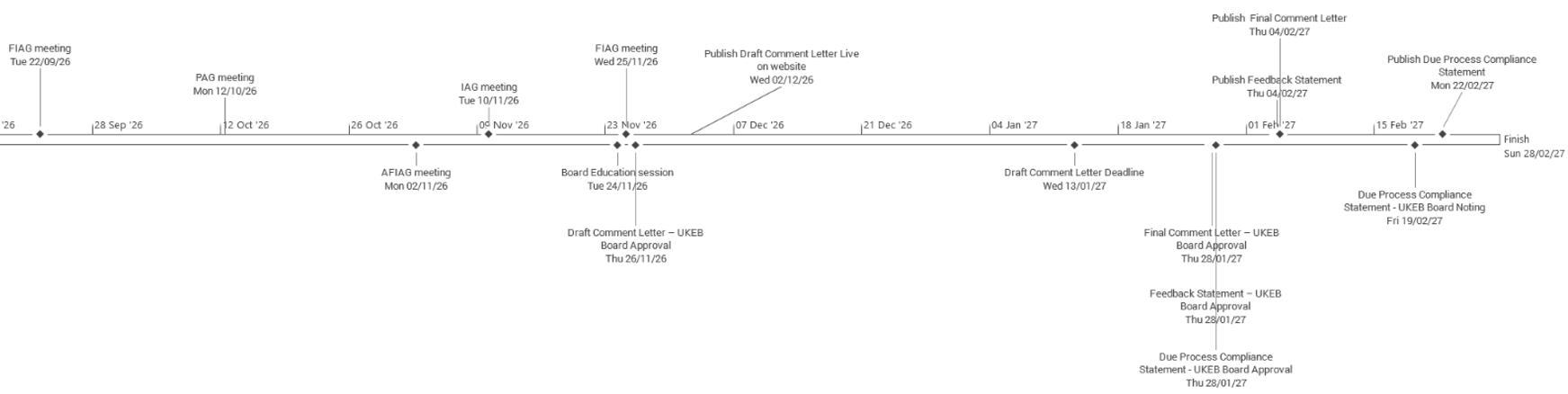
Q3/4 2026 | Stakeholder outreach: Pre-DCL publication Present to UKEB advisory groups on the following dates: a) Financial Instruments Advisory Group4, 22 September 2026 and 25 November 2026. b) Preparer Advisory Group, 12 October 2026. c) Accounting Firms and Institutes Advisory Group, 2 November 2026. d) Investor Advisory Group, 10 November 2026. Post-DCL publication Conduct limited and targeted outreach with UK IFRS reporters on the ongoing costs and benefits of applying IFRS 9 hedge accounting. |
| 5.13-5.17 Generally mandatory |
26.11.26 | Draft Comment Letter (DCL) for Board approval The DCL will be published on the UKEB website for public consultation. Announcement of the publication of the DCL and ITC will be made via the UKEB News Alert publication, and LinkedIn posts. The DCL and ITC will be issued for comment for at least 30 days. Estimated DCL consultation period (42 days): 02 December 2026 – 13 January 2027. |
| 5.18 Mandatory |
28.01.27 | Final Comment Letter (FCL) for Board approval An FCL will be created for Board approval, submission to the IASB, and publication on the UKEB website. The preliminary findings from the descriptive research work will be incorporated in the FCL. The FCL will be submitted to the IASB as soon as possible after Board Meeting. |
| 5.19-5.26 Mandatory |
28.01.27 | Project Closure A Feedback Statement and Due Process Compliance Statement will be prepared for Board approval. Once approved by the Board these documents will be published on the UKEB website. |
Resources Allocated
20 To undertake the activities described in this project plan, a project team has been assigned, consisting of a Project Director supported by a Project Manager. The required resources are allowed for in the 2026/27 UKEB plan and budget.
21 In addition, some input from the economics team has been allocated.
Setting up an Ad Hoc Advisory Body
22 Existing UKEB advisory groups have the necessary skills and expertise to support this project and will be consulted, as outlined in the project plan.
Project Timeline
23 The diagram below is a graphical view of the mandatory milestone activities described in Table 1 above. This provides a best estimate based on information known at this time. If necessary, a revised PIP will be presented to the Board, to reflect any major changes, as the project progresses.
Footnotes
-
The PIR of classification and measurement requirements was completed in December 2022 and the PIR of impairment requirements was completed in July 2024. ↩
-
An entity is required to provide the disclosures in paragraphs 21B–24F of IFRS 7 for those risk exposures that an entity hedges and for which it elects to apply hedge accounting. ↩
-
See for example slide 9 of the Accounting Standards Advisory Forum meeting March 2026 IASB Staff Paper Agenda Reference 8 Phase 1 – Identifying matters to be examined. ↩
-
In September 2026, the Financial Instruments Working Group (FIWG) becomes an Advisory Group which will directly advise the UKEB Board (UKEB Working Groups advise the UKEB Secretariat). ↩