12 IASB General Update
17 September 2026 Agenda Paper 12
OFFICIAL - PUBLIC
Executive Summary
| Metadata | Details |
|---|---|
| Project Type | Influencing |
| Project Scope | Various |
| Purpose of the paper | This paper provides the Board with an update on projects the Secretariat is currently monitoring. As agreed with the Board, the Secretariat monitors projects being undertaken by the IASB. This is to inform the Board about the progress and decisions made by the IASB on active projects. Discussion by the Board may also help inform interactions with international standard setter meetings, including the IASB’s Accounting Standards Advisory Forum (ASAF), of which the UKEB is a member. |
| Summary of the Issue | Topics addressed in this paper include topics discussed by the IASB at its July 2026 meeting. It also includes topics to be discussed at the October 2026 ASAF meeting. |
Topics for discussion
- Provisions—Targeted Improvements
- Amortised Cost Measurement
- Intangible Assets
- Statement of Cash Flows and Related Matters
Topics for noting
- Equity Method
- Business Combinations—Disclosures, Goodwill and Impairment
- Presentation of Taxes and Other Charges that Are Not Tax Expense or Tax Income Applying IAS 12 Income Taxes (IFRS 18)
- Post-implementation Review of IFRS 16 Leases
Decisions for the Board
Topics for discussion
Provisions—Targeted Improvements (Appendix A)
1 With respect to the proposed application requirements for levies, do Board Members share any of the concerns outlined in paragraphs A6 ‒ A14 and Table 1 of this paper?
2 Are Board Members aware of any other jurisdictions that have a similar number of, or similar degree of complexity to, levies in the UK?
3 Do Board Members have any other views or comments on the questions to be discussed at the ASAF meeting in October? (see paragraph A8 above).
4 Do Board Members have any concerns about the proposed requirement relating to obligations arising from “soft” laws?
5 Do Board Members have any real-life examples of “soft” laws that can be shared with the IASB?
Amortised Cost Measurement (Appendix B)
1 Do Board Members support the proposed key messages for ASAF in paragraphs B15–B17 supporting Approach 1 (set out in Table 2)?
2 Do Board Members have any other feedback on the ASAF questions in paragraph B6, or the Secretariat’s preliminary analysis in paragraphs B10–B14?
Intangible Assets (Appendix C)
1 Does the Board have any feedback on the key messages to be delivered at ASAF?
Statement of Cash Flows and Related Matters (Appendix D)
1 Do Board Members support the UKEB Secretariat’s preliminary view on the reasons for limited usefulness of the statement of cash flows for financial institutions, and whether entities should qualify for an exemption based on business activities?
2 Do Board Members support the UKEB Secretariat’s preliminary view that referring to regulatory frameworks would be the preferred approach to the scoping of entities that would apply any potential changes to IAS 7? If not, what is the preferred approach and why?
3 Do Board Members consider that there are other approaches to scoping that could be considered, not mentioned above?
4 Are Board Members aware of any additional risks presented by conglomerates, other than those in paragraph D25 above, that the IASB needs to consider when scoping an exemption / new requirements?
Topics for noting
Do Board members have any comments or questions on the topics for noting?
Recommendation
N/A
Appendices
- Appendix A: Provisions—Targeted Improvements
- Appendix B: Amortised Cost Measurement
- Appendix C: Intangible Assets
- Appendix D: Statement of Cash Flows and Related Matters
- Appendix E: Equity Method
- Appendix F: Business Combinations—Disclosures, Goodwill and Impairment
- Appendix G: Presentation of Taxes and Other Charges that Are Not Tax Expense or Tax Income Applying IAS 12 Income Taxes (IFRS 18)
- Appendix H: Post-implementation Review of IFRS 16 Leases
- Appendix I: List of IASB projects
Appendix A: Provisions—Targeted Improvements
Project Stage
| IASB Stages | Research / Pipeline | Discussion Paper | Redeliberation | Exposure Draft | Redeliberation | Final Standard | Post Implementation Review | |
|---|---|---|---|---|---|---|---|---|
| UKEB Stages | Research / Influencing | Research / Influencing | Monitoring | Influencing | Monitoring | Endorsement | Influencing | UKEB Post Implementation Review |
UKEB project page
UKEB Final Comment Letter (published 13 March 2025)
IASB Next Milestone: Final amendments H1 2027
Purpose
A1 This paper:
- provides a summary of proposals relating to levies that will be discussed at the upcoming meeting of the Accounting Standards Advisory Forum (ASAF) in October 2026;
- seeks Board views on the questions the IASB will ask ASAF members at the upcoming meeting; and
- provides an update of the IASB’s redeliberation of proposed amendments to IAS 37 Provisions, Contingent Liabilities and Contingent Assets at its June 2026 meeting.
Background
A2 The IASB published its Exposure Draft Provisions–Targeted Improvements (ED) in November 2024 proposing amendments to IAS 37.
A3 The Board has received regular updates on IASB’s decisions/tentative decisions. At its June 2026 meeting, the UKEB received a comprehensive view of the proposed amendments to IAS 371 setting out the extent of the IASB’s tentative decisions made to date.
October 2026 ASAF meeting
A4 An update on the development of the possible application requirements for levies, including revised drafting2 will be presented to the October 2026 ASAF meeting. ASAF members will have the opportunity to comment on the proposed requirements, with a particular focus on whether the requirements would have any unintended consequences.
A5 The Annex at the end of this Appendix provides background information on the IASB’s development of proposed application requirements for accounting for levies. For a more comprehensive analysis of the IASB’s proposed application requirements for levies, refer to the papers presented to the UKEB at its June 2026 meeting3.
Levy requirements: feedback from specialists at accounting firms
A6 Agenda papers for the ASAF meeting include a summary of feedback on the proposed application requirements received by the IASB from targeted outreach with five specialists. While the specialists are from accounting firms, they responded in their capacity as individuals and their views did not necessarily reflect the views of their firms.
A7 The IASB note that, overall, they heard favourable views, with some specialists expressing the view that the proposed requirements address some stakeholders’ concerns about withdrawing IFRIC 21 Levies. However, a range of concerns were also expressed. These concerns, together with the IASB’s response, are outlined in Table 1 below.
Table 1: Main topics of feedback and the IASB’s response
| Feedback from specialists | IASB response |
|---|---|
| One specialist noted that a better outcome may not be achieved for all levies. For some levies, the outcome is the same as under IFRIC 21 (for example, the central bank levy illustrated in proposed Example 5). | The IASB has acknowledged that the model is not perfect. The IASB investigated if it would be possible to make the model more suitable for levies, but concluded that adapted model (including a rebuttable presumption) would be significantly more complex for all levies, less consistent with the general requirements in IAS 37, and of benefit only in rare cases. |
| Feedback from those specialists indicated the need to use judgement when applying the proposed requirements (for example, requirements relating to identification of the “relevant activity”), noting that additional guidance may be required to support consistent application of the proposed changes. | IASB staff have expanded the analysis in three illustrative examples. The analysis now includes factors that have influenced management’s judgement in identifying the relevant economic benefit or activity. These expanded examples will be presented to ASAF in October 20264. IASB members have previously stated their expectation that entities subject to the same levy will reach the same conclusion about the relevant activity, as the relevant activity is determined through assessment of levy legislation rather than the levy-payer’s individual circumstances. |
| The proposed amendments define a levy as “non-reciprocal charge that a government imposes on entities that obtain a specific economic benefit or conduct a specific activity.” (proposed paragraph 10). A concern raised by those specialists is that the proposed definition of a levy could be interpreted more broadly than intended, meaning the definition may capture taxes and charges not currently within the scope of IAS 37. | The ASAF agenda papers note that it is not the IASB’s intention to change the scope of IAS 37. |
| Feedback from those specialists also indicated that the proposals would require greater clarity on the appropriate treatment of cases in which the past-event condition is met while the requirement to pay a levy remains conditional on a future event. | Based on this feedback, IASB staff have prepared expanded draft application requirements for levies for discussion at the ASAF meeting in October 2026. In particular, IASB staff added two paragraphs to aid the application of the recognition criteria relating to the ‘probable transfer of economic benefits’ and the ‘reliable estimate of the obligation’ to levies:
|
A8 ASAF will be asked the following questions:
- Have you seen any levies in practice for which the possible application requirements described in this paper would:
- compel preparers of financial statements to apply an accounting policy that results in information less useful than that provided by applying IFRIC 12 Levies; or
- carry a high risk of significant diversity in practice among entities paying the levy?
- Do you foresee any other major unintended consequences of the possible application requirements?
Secretariat initial views
Levies requiring an entity to take two or more actions
A9 The Secretariat has heard concerns about the application of the proposed requirements for levies. In particular, the Secretariat is aware of concerns about the “supporting principle”, which is relevant when accounting for levies that require an entity to take two or more actions. The supporting principle proposes that if more than one economic benefit or activity is required by levy legislation for a levy to be payable, the relevant economic benefit or activity is the one that best reflects the economic benefit or activity the government is seeking to levy.
A10 The supporting principle might be interpreted as requiring preparers to use judgement to determine what motivated politicians to pass certain legislation. This may create an increased risk of diversity in practice in the identification of the “relevant” activity.
A11 For example, the UK’s Producer Responsibility Obligations (Packaging and Packaging Waste) Regulations 2024 (or the “packaging Extended Producer Responsibility (pEPR) Regulations”) require liable producers to pay a fee for packaging they supply to the UK market. A fee would only be payable where three separate criteria are met:
- The entity must meet the definition of a “producer” set out in the Regulations.
- The producer must be a “large” producer, based on thresholds for both turnover and amount of packaging supplied in a previous period.
- The producer must supply packaging in the calendar year preceding the assessment year.
To apply the proposed requirements, the preparer would need to identify which of the activities listed above is the “relevant” activity. The Secretariat has heard concerns that preparers may not all identify the same activity as the “relevant” activity, which would lead to diversity in practice.
Definition of ‘levy’
A12 The Secretariat notes that there is a potential interaction between this project and the IASB’s project exploring the presentation of taxes or other charges that are not income taxes applying IAS 12 Income Taxes (which may lead to amendments to IFRS 18 Presentation and Disclosure in Financial Statements).
A13 IASB staff papers relating to the presentation of non-income taxes proposed that an ED may look to specify that industry-specific levies charged in addition to an income tax would not meet certain classification criteria. Some settled positions may become unsettled as the addition of new definitions on the two projects may differ from the current application on the ground. For example, the Secretariat has concerns about how presentation of industry-specific levies such as the Energy Profits Levy (which the Secretariat understands is a surcharge on profits levied in addition to Corporation Tax and is currently accounted for as an income tax) might be affected.
A14 It is not yet possible to test wording or determine how amendments to IFRS 18 might affect the presentation of industry-specific levies as the ED on amendments to IFRS 18 is not yet available. The Secretariat will continue to monitor this matter.
Number of levies
A15 The Secretariat has so far identified in excess of 20 items that may meet the proposed definition of a levy. An assessment of all of these items would be required to identify whether and how the proposed amendments might be applied.
A16 Work undertaken by the Secretariat indicates that the extent of use of levies by the UK Government may be higher than in other jurisdictions. The Secretariat welcomes evidence from the Board to allow us to corroborate or correct our understanding in this respect.
Questions for the Board
1 With respect to the proposed application requirements for levies, do Board Members share any of the concerns outlined in paragraphs A6–A14 and Table 1 of this paper?
2 Are Board Members aware of any other jurisdictions that have a similar number of, or similar degree of complexity to, levies in the UK?
3 Do Board Members have any other views or comments on the questions to be discussed at the ASAF meeting in October? (see paragraph A8 above).
Non-levy obligations
A17 While not related to levies, the Secretariat has also heard concerns about proposed requirements for accounting for obligations arising from so-called “soft” law, in which the law is not conventionally enforceable. For example, the entity may be required to settle its obligation in a novel way, e.g. by changing future operations rather than paying penalties.
A18 Paragraph 14F(a)(ii) of the IASB’s proposed requirements states that an entity has no practical ability to avoid discharging a responsibility, in the case of a legal obligation, “if the counterparty has a right to take another form of action against the entity for failing to discharge the responsibility and, as a result, the economic consequences for the entity of not discharging the responsibility are expected to be significantly worse than the costs of discharging it.”
A19 This proposed requirement creates a high hurdle when accounting for obligations arising from “soft” law through use of the phrase “significantly worse”. The Secretariat notes that the current drafting echoes paragraph 4.34 of the Conceptual Framework. However, the Secretariat has heard concerns that paragraph 4.34 of the Conceptual Framework was written with constructive, rather than legal, obligations in mind. While it is clear to some stakeholders why a high hurdle is necessary in the context of certain constructive obligations, it is unclear why the high hurdle is necessary before provisions arising from legal obligations in “soft” laws would be recognised.
Question for the Board
4 Do Board Members have any concerns about the proposed requirement relating to obligations arising from “soft” laws?
5 Do Board Members have any real-life examples of “soft” laws that can be shared with the IASB?
June 2026 IASB meeting
A20 At its meeting on 22 June 2026, the IASB discussed plans for completing the redeliberation of the project. The IASB was not asked to make any decisions.
A21 IASB members expressed their support for planned targeted outreach to help identify any remaining issues and potential unintended consequences of the proposed amendments. One IASB member noted that, as a lot of work has already been performed on the proposed amendments relating to levies, consideration should be given to possible unintended consequences relating to non-levy obligations.
Next steps
A22 The IASB will discuss feedback on aspects of the proposals it has not yet redeliberated, as well as any evidence indicating major unintended consequences that might arise from the draft application requirements for levies, at a future meeting.
A23 The Secretariat will continue to monitor the project and bring updates to the Board where appropriate.
Annex: Background information on proposed requirements for levy provisions
Provisions for levies: application requirements
Current requirements
IFRIC 21 addresses the accounting for a levy liability, if that liability is within the scope of IAS 37, or if the timing and amount of the levy are certain. The obligating (past) event that gives rise to the liability is the activity that triggers payment of the levy, as identified by the legislation. Therefore, if two or more activities are required for a levy to be payable, an entity recognises the liability for the levy when *the last activity
- has been conducted.
The liability is recognised progressively if the obligating event occurs over a period of time (i.e. if the activity triggering payment of the levy occurs over a period of time).
If an obligation to pay a levy is triggered when a minimum activity threshold is reached, the corresponding liability is recognised only when that minimum threshold is reached.
Exposure Draft proposals
The IASB proposed to withdraw IFRIC 21 *Levies
- and replace it with amendments to IAS 37 and illustrative examples in the revised Guidance on Implementing IAS 37 accompanying the ED.
The proposed amendments to IAS 37 would change the timing of recognition of some provisions (for both levy and non-levy obligations). The relevant proposed requirements are contained in the ED paragraphs 14M-14R, which address the proposed ‘past-event condition’ for recognition of a provision.
Levies requiring an entity to take two or more actions
One of the IASB’s stated objectives for the proposals was to amend the present obligation recognition criterion because of stakeholder dissatisfaction with IFRIC 21. In particular, the IASB noted criticism from stakeholders with respect to the application of IFRIC 21 to levies that require an entity to take two or more separate actions. In such cases, IFRIC 21 results in entities recognising some recurring periodic levies as expenses at a single point in time late in the period for which they are charged (see paragraph BC14 to the ED).
In response, the ED proposed requirements that would change the timing of recognition of provisions in situations where an entity faces an obligation if it takes two or more separate actions. The ED proposed that the past-event condition would be met as soon as the entity had taken any of the actions provided it had no practical ability to avoid the remaining actions.
Applying the proposed requirements, an entity might recognise a provision earlier and might accrue that provision progressively instead of recognising a provision at a point in time when the last action has been taken.
Obligations arising when an entity exceeds certain thresholds
The ED’s proposed amendments reflect the IASB’s conclusion that “the action that satisfies the past-event condition is all activity that contributes to the total activity on which the cost is assessed, both activity below the threshold and activity above the threshold.” (see paragraph BC41 of the ED, with emphasis added).
Applying the ED’s proposed requirements, the past-event condition starts to be met as soon as an entity starts carrying out the activity that contributes to the total being assessed. Depending on whether all other recognition criteria are met, an entity may be required to recognise a provision before it has exceeded relevant thresholds.
This proposed requirement is relevant to all threshold-based obligations (both levy and non-levy obligations).
UKEB Comment Letter
The UKEB comment letter to the IASB in response to the ED expressed significant concerns about the proposed amendments to the recognition criteria. In particular, the UKEB:
- Expressed the view that the IASB’s aims of combining a clarification of the general requirements for obligations in the scope of IAS 37 with a change in the timing of the recognition of certain levies appeared to be in conflict.
- Requested that the IASB enhance the clarity of certain requirements to avoid an increased risk of diversity in practice.
- Expressed concern about whether and, if so, how the proposed threshold-triggered cost guidance might apply when the threshold is a balance sheet-based measure, where it is unclear how the proposed requirements will change the accounting.
- Suggested that the IASB should assess whether the accounting for levies could be addressed more effectively if considered separately from the accounting for non-levy obligations.
The UKEB supported the proposed requirements with respect to income statement-related threshold-triggered costs, expressing the view that the resulting accounting outcome seems sensible. The UKEB did not raise any concerns about bringing forward the timing of recognition of a provision in this respect.
IASB tentative decisions
At its May 2026 meeting, the IASB tentatively decided to add application requirements for levies to IAS 375.
Levies requiring an entity to take two or more actions
The proposed application requirements introduce a supporting principle, which is intended to help entities determine when the past-event condition is met. The proposed principle explains that if more than one economic benefit or activity is required for a levy to be payable, the “relevant” economic benefit or activity is the one that best reflects the economic benefit or activity the government is seeking to levy.
Threshold-triggered levies
The proposed application requirements reflect the proposals in the ED, specifying that at any date within the period, the entity’s present obligation is a portion of the total levy the entity expects to pay for the period (based on activity conducted to that date). That is, an entity may be required to recognise a provision before it exceeds the relevant threshold(s).
Appendix B: Amortised Cost Measurement
Project Stage
| IASB Stages | Research / Pipeline | Discussion Paper | Redeliberation | Exposure Draft | Redeliberation | Final Standard | Post Implementation Review |
|---|---|---|---|---|---|---|---|
| UKEB Stages | Research / Influencing | Research / Influencing | Monitoring | Influencing | Monitoring | Endorsement | Influencing |
IASB Next Milestone: Exposure Draft 2027
Purpose
B1 The purpose of this paper is to seek Board Member views ahead of the October 2026 IASB’s Accounting Standards Advisory Forum (ASAF) meeting. At the ASAF meeting, ASAF Members will be asked for views on two possible approaches to measure financial liabilities arising from contingent settlement provisions.
Background
B2 The IASB commenced its Amortised Cost Measurement project in response to stakeholder feedback seeking greater clarity and consistency in the measurement of financial assets and liabilities. The IASB intends for the project to make targeted improvements to the amortised cost measurement requirements in IFRS 9, addressing application issues that are widespread and have a material effect on entities’ financial statements.
B3 Information about the project was previously presented to the Board in the form of IASB general updates between March 2025 and July 20266.
B4 The measurement of financial liabilities arising from contingent settlement provisions was previously considered in the Exposure Draft Financial Instruments with Characteristics of Equity (ED). In April 2026, the IASB tentatively decided to move this topic into the Amortised Cost Measurement project in response to feedback to the ED. This aligns with the recommendation in the UKEB’s FCL to the ED.
B5 In July 2026, the IASB received feedback on two possible approaches to measure financial liabilities arising from contingent settlement provisions at the IASB Financial Instruments Consultative Group (FICG).
October 2026 ASAF Meeting
B6 In October 2026, the IASB will provide an overview of tentative decisions on the project to date, and will ask for ASAF members’ input on the following questions7:
Questions for ASAF members
- Do you agree with the initial staff views on page 22 [ASAF Agenda Paper 1B]? Specifically, do you agree that initially measuring a financial liability arising from a contingent settlement at its transaction price addresses the challenges identified with the proposed FICE Exposure Draft amendment?
- Have you identified any alternatives that might better address those challenges? If so, how would that alternative address stakeholder concerns about faithful reflection of the obligation arising from a contingent settlement provision and provide useful information to users of financial statements?
ASAF members will also be given the opportunity to provide feedback on the project overview [ASAF Agenda Paper 1A].
IASB staff proposals
B7 During stakeholder outreach, IASB staff identified some challenges in applying the ED proposals relating to measuring financial liabilities arising from contingent settlement provisions. Table 1 summarises the ED proposals and challenges identified.
Table 1: Challenges in applying the ED proposals
| Challenges in applying the ED proposals |
|---|
| ED proposals relating to measuring financial liabilities arising from contingent settlement provisions |
| The ED proposed clarifying that: - the initial and subsequent measurement of a financial liability (or liability component) would not reflect the probability, and estimated timing, of a contingent event; |
feedback to the ED. This aligns with the recommendation in the UKEB’s DCL to the ED.
B5 In July 2026, the IASB received feedback on two possible approaches to measure financial liabilities arising from contingent settlement provisions at the IASB Financial Instruments Consultative Group (FICG).
October 2026 ASAF Meeting
B6 In October 2026, the IASB will provide an overview of tentative decisions on the project to date, and will ask for ASAF members’ input on the following questions8:
Questions for ASAF members
- Do you agree with the initial staff views on page 22 [ASAF Agenda Paper 1B]? Specifically, do you agree that initially measuring a financial liability arising from a contingent settlement at its transaction price addresses the challenges identified with the proposed FICE Exposure Draft amendment?
- Have you identified any alternatives that might better address those challenges? If so, how would that alternative address stakeholder concerns about faithful reflection of the obligation arising from a contingent settlement provision and provide useful information to users of financial statements?
ASAF members will also be given the opportunity to provide feedback on the project overview [ASAF Agenda Paper 1A].
IASB staff proposals
B7 During stakeholder outreach, IASB staff identified some challenges in applying the ED proposals relating to measuring financial liabilities arising from contingent settlement provisions. Table 1 summarises the ED proposals and challenges identified.
| Table 1: Challenges in applying the ED proposals |
|---|
| ED proposals relating to measuring financial liabilities arising from contingent settlement provisions |
| The ED proposed clarifying that: • the initial and subsequent measurement of a financial liability (or liability component) would not reflect the probability, and estimated timing, of a contingent event; • a financial liability (or liability component) arising from a contingent settlement provision is measured at the present value of the settlement amount, both on initial recognition and subsequently; • the settlement amount is discounted, assuming settlement will occur at the earliest possible settlement date specified in the contract; and • any gains or losses on remeasurement of the financial liability are recognised in profit or loss. |
| UKEB FCL feedback |
| The UKEB FCL recommended that this topic be addressed as part of the Amortised Cost Measurement Project instead of with the FICE Project. The FCL also highlighted a concern that the ED proposals could lead to the recognition of a debit in equity on initial recognition where the settlement amount of the liability was greater than the fair value of instrument. |
| Challenges in applying the ED proposals |
| Stakeholders who disagreed with the ED proposals recommended measuring these financial liabilities in accordance with IFRS 9, and expressed concerns that: • The ED proposals would not provide useful information, as market participants’ perspectives on the occurrence of the contingent event are not considered. • The settlement amount does not reflect the economic substance of the instrument, as liabilities might be either overstated or understated. • The proposals introduce a new measurement basis for particular financial liabilities, which would reduce comparability rather than improve it. Stakeholders who agreed with the ED proposals asked for clarification of the proposals, including: • Day One gains or losses: how to account for differences between the settlement amount and transaction price on initial recognition. • Discount rate: how to determine the discount rate for calculating the present value of the settlement amount. • Settlement amount: how to determine the settlement amount if there are multiple contingent settlement provisions, multiple settlement dates, or if the settlement amount is based on future performance targets. • Embedded derivatives: how the measurement proposals relate to the IFRS 9 requirements for separating embedded derivatives from the host financial liability. |
B8 Based on stakeholder feedback, the ASAF paper identifies Approach 1 and Approach 2 as set out in Table 2 below. For a summary of advantages and disadvantages of each approach, refer to pages 16 and 20 of IASB ASAF October 2026 Agenda Paper 1B.
| Potential Approaches to Measure Financial Liabilities arising from Contingent Settlement Provisions | Approach 1: Recognise liability at transaction price (similar to ED proposals) | Approach 2: Recognise liability based on expected value |
|---|---|---|
| Initial Measurement9 | • At transaction price. • Not discounted. (paragraph B5.1.1 of IFRS 9) |
The initial measurement considers the probability and expected timing of the occurrence of the contingent event. (applying IFRS 9/IFRS 13 fair value principles) |
| Subsequent Measurement [Under both approaches, the catch-up adjustment would be recognised in the statement of profit or loss.] |
If measured at amortised cost, recognise a catch-up adjustment only when the expected settlement amount is higher than the transaction price. (paragraph B5.4.6 of IFRS 9) |
If measured at amortised cost, recognise a catch-up adjustment for changes in the issuer’s expectations about the amount and timing of cash flows to settle the liability. (paragraph B5.4.6 of IFRS 9) |
B9 On the basis of feedback received at the July 2026 FICG meeting, the initial IASB staff view supports Approach 1 as capable of addressing the challenges identified in applying the proposed amendment in the FICE ED, and achieving a more appropriate balance between costs for preparers and benefits for users of financial statements.
UKEB Secretariat Preliminary Analysis
B10 The Secretariat has not identified any significant concern in relation to the measurement of financial liabilities with contingent settlement provisions in the UK. The Secretariat understands that contingent settlement features in UK-issued regulatory capital instruments10 do not generally lead to liability classification for these instruments.
B11 The Secretariat notes the significant support voiced for Approach 1 at the IASB’s July 2026 FICG meeting. Specifically, stakeholders noted that:
- Approach 1 appears to be a pragmatic solution, which is likely to be closer to current practice, and should be operable without significant additional cost.
- Approach 1 avoids the counter-intuitive effects under Approach 2 of recognising a loss when a non-viability event becomes more likely.
B12 Approach 1 appears to address the concern identified in the UKEB FCL of the possibility of a debit in equity on initial recognition of an instrument with a contingent settlement feature which could pay more than the proceeds from issuing the overall instrument.
B13 A possible concern we have identified is whether Approach 1 would deal appropriately with an instrument where the transaction price is higher than the maximum amount payable under a contingent settlement provision. However, if this is considered a potential problem, it could be addressed by requiring the initial measurement to be based on the lower of the transaction price or the maximum amount payable under the contingent settlement provision.
B14 We have provided updates to the Board previously on the progress of the overall project. We have not identified any significant concerns in relation to the tentative decisions in ASAF Agenda Paper 1A. The Secretariat expect to engage with the Financial Instruments Advisory Group (FIAG) on these topics over coming months. If any significant matters arise from this engagement, we will provide a further update to the Board.
Proposed UKEB Key Messages at ASAF
B15 The UKEB welcomes the further thinking on this topic by IASB staff. While we have only had the opportunity to obtain limited feedback, we believe Approach 1 would be practicable. It would also address the main remaining concerns we identified in our response to the FICE ED on this topic. We recommend that the IASB staff consider whether guidance is required in circumstances where the transaction price is less than the maximum amount contingent settlement amount.
B16 The UKEB has not identified any alternatives that might better address the challenges identified. The UKEB believes that the subjectivity of Approach 2 would present significant challenges for preparers and auditors. We are concerned that users would not welcome the recognition of significant gains or losses as the occurrence of a contingent event became more or less likely.
B17 The UKEB welcomes the progress to date on this project. We expect to engage with our Financial Instruments Advisory Group on the tentative decisions to date over the coming months. If any significant feedback emerges from that engagement in advance of the publication of the Exposure Draft we will engage with the IASB Staff.
Questions for the Board
- Do Board Members support the proposed key messages for ASAF in paragraphs B15–B17 supporting Approach 1 (set out in Table 2)?
- Do Board Members have any other feedback on the ASAF questions in paragraph B6, or the Secretariat’s preliminary analysis in paragraphs B10–B14?
Next steps
B18 Feedback will be sought on these ASAF questions at the FIAG meeting on 22 September 2026. Any significant feedback from that group will be incorporated into the UKEB ASAF feedback. The Board will receive feedback on the FIAG meeting at the October 2026 UKEB meeting.
Appendix C: Intangible Assets
| Body | Research / Pipeline | Discussion Paper | Redeliberation | Exposure Draft | Redeliberation | Final Standard | Post Implementation Review |
|---|---|---|---|---|---|---|---|
| IASB | Research / Pipeline | Discussion Paper | Redeliberation | Exposure Draft | Redeliberation | Final Standard | Post Implementation Review |
| UKEB | Research / Influencing | Research / Influencing | Monitoring | Influencing | Monitoring | Endorsement | Influencing | UKEB Post Implementation Review |
IASB Next Milestone: Decide Project Direction (H2 2026)
Objective
C1 This paper:
- Provides the Board with an update on the International Accounting Standards Board (IASB)’s discussion of a test case related to ‘Software as a Service’ i.e. SaaS arrangements, at its July 2026 Board meeting. The IASB was not asked to make any decisions at this meeting.
- Sets out the Secretariat’s preliminary views on the direction of this project and seeks the Board’s input in response to the IASB’s request for advice, (to inform the October 1–2, 2026, ASAF meeting).
Background
C2 In May 2025, the IASB decided to progress its Intangible Assets project by grouping topics into workstreams. The IASB agreed to proceed in a targeted way, on two parallel workstreams: (i) exploring possible changes to the definition of an intangible asset and the recognition criteria in IAS 38 Intangible Assets, using test cases related to newer intangible items; and (ii) exploring user information needs in more detail.
C3 In May 2026, based on feedback from the user information needs workstream, the IASB expressed preliminary preferences on whether topics should remain on track or be reprioritised, with a focus on areas that could deliver the most useful information to users in a timely manner. The IASB plans to further consider the views of its consultative groups when deciding on the project direction in H2 2026 through to early 2027.
C4 In July 2026, the IASB held its first substantive discussion on the definition/recognition criteria workstream through preliminary analysis of a test case aimed at developing a customer accounting model for intellectual property (IP) licensing contracts. The test case analyses a cloud-based software delivery contract (commonly known as ‘software as a service’ i.e. SaaS arrangement). The focus is on determining whether costs incurred in accessing IP digitally result in assets or expenses for the customer.
C5 Through their analysis, IASB staff aim to develop a generally applicable rights-based model by primarily drawing from (i) asset definition and related concepts in the Conceptual Framework for Financial Reporting (Conceptual Framework), and (ii) nature of contractual rights and pattern of delivery of such rights in an IP licensing contract from IFRS 15 Revenue from Contracts with Customers (given the absence of specific IAS 38 guidance for licensing arrangements).
Proposed model characteristics
C6 IASB Agenda Paper 17 describes the characteristics of the proposed model. In summary, the proposed rights-based model focuses on11:
- identifying the underlying item over which the customer has rights;
- identifying the rights the customer has obtained: a right to direct the use of intellectual property, a right to access it, or a right to receive a service; and
- determining whether those rights give rise to an asset.
C7 The IASB staff think improvements based on this model could:
- provide clarity for entities applying IAS 38 requirements to the different ways intellectual property is accessed today, particularly as cloud-based software and AI solutions become more common; and
- help align IAS 38 with the updated thinking in the Conceptual Framework and IFRS 1512.
C8 Additionally, IASB staff believe that an analysis of fact patterns using this model will also be useful in assessing implications of these suggested improvements for more traditional intangible assets.
C9 To explore this model, two basic fact patterns were presented:
- Fact pattern 1 described a traditional software licensing arrangement whereby a customer downloads and runs the software on its own infrastructure.
- Fact pattern 2 described a basic SaaS arrangement.
C10 Further details of the fact patterns are provided in Annex 1.
Identifying nature of the underlying item: applicability to fact patterns
C11 IASB staff’s initial view was that the underlying item in an IP licensing contract is the IP itself, and not a copy of the IP. IASB Staff asserted that an entity’s ability to generate future economic benefits is intricately linked to IP functionality, which is embodied in the underlying intellectual creation itself e.g. software code. Consequently, mode of access considerations i.e. physical or downloadable copy versus cloud access, do not affect functionality but can give rise to differences in customer rights.
C12 IASB staff argued that the ability to duplicate underlying IP at negligible cost, and its simultaneous access and use by multiple customers, represent characteristics of the IP itself rather than giving rise to a distinct item.
C13 Additionally, IP licensing contracts, such as SaaS arrangements, can have multiple deliverables (e.g. software access, utilisation of infrastructure including data storage and computing power, software updates, and configuration and customisation activities).
C14 IASB staff noted that analogous to paragraphs 22–30 of IFRS 15 (principles related to identification of performance obligations), in the case of IP licensing contracts with multiple deliverables a customer can conclude that a deliverable (a good or service) represents a distinct underlying item if:
- the good or service can independently benefit the customer on its own; or
- the supplier’s promise to transfer the good or service to the customer is separately identifiable from other promises in the contract due to absence of interdependence among, integration of, or modification/customisation of some goods/services in the contract by other goods/services.
C15 Applicability Fact pattern 1: IASB staff are of the view that the deliverable and the only underlying item is the supplier’s intellectual property i.e. the software.
C16 Applicability Fact pattern 2: IASB staff think that a customer might conclude that there are two deliverables in the arrangement:
- the supplier’s intellectual property i.e. the software, including supplier maintenance and updates integral to current version and functionality; and
- utilisation of supplier’s infrastructure such as servers and data storage, as necessary for software access and use.
C17 For fact pattern 2, IASB staff are of the view that the two deliverables are highly interconnected and that the customer cannot benefit from these separately. Therefore, the customer should consider these as one combined underlying item, which is the supplier's intellectual property (the software). Access to infrastructure, maintenance, and data storage enable access but do not change the nature of what the customer is obtaining.
Identifying customer rights in respect of the underlying item: applicability to fact patterns
C18 Drawing from paragraphs B24–B30 of IFRS 16 Leases (right to direct use of an identified asset) and paragraphs 4.7 and 4.20 of the Conceptual Framework (notions of right and control related to definition of an asset), IASB staff believe that in an IP licensing contract, a customer can only obtain either:
- a right to access the intellectual property i.e. the customer interacts with the IP and controls utilisation of access to obtain economic benefits; or
- a right to receive a service i.e. customer obtains output of supplier’s work without access to, or decision-making rights over IP itself.
C19 IASB staff are of the view that the right to direct use of the IP in a licensing contract remains with the supplier as the supplier retains all intellectual property and ownership rights, together with the associated risks and rewards of ownership.
C20 IASB staff took the view that since the customer directly interacts with the underlying item to obtain economic benefits and can decide how to utilise its right to access (subject to contractual restrictions), an IP licensing contract conveys a right to access IP.
C21 IASB staff also stated that due to the nature of IP access (non-exclusive, possibility of simultaneous access by multiple customers), each customer controls its own right to access the software (contractually distinct from other rights to access). Therefore, each customer derives economic benefits from its own right to access.
C22 Further, IASB staff suggested that the right to access is located between a right to receive a service and a right to direct the use of an underlying item, with the exact position depending on the extent of the rights conveyed.
C23 In designating the right to access category, IASB staff assert they are drawing from IFRS 15, where the same expression is used to describe rights conveyed to a customer under an IP licence, while the supplier continues to direct the use of the intellectual property.
C24 Applicability Fact Pattern 1: The customer does not obtain right to direct use of the software since the supplier retains all IP and ownership rights, and all risks and rewards associated with ownership of the IP. Since the customer directly interacts with the software to generate its own economic benefits, it does not obtain a right to receive service. Instead, the customer obtains a right to access the software as per contract terms. The customer controls this right as it can decide how, when and who will access and utilise the software. That right is non-transferable, non-sub-licensable, non-exclusive and revocable.
C25 Applicability Fact Pattern 2: Same as fact pattern 1 as regards software element. However, one of the multiple deliverables in the contract includes utilisation of supplier’s infrastructure (see Annex 1: fact pattern 2). IASB staff consider that this utilisation is a right to receive a service on the basis that the customer does not directly access this infrastructure. IASB staff intend to return to the IASB in future with an analysis of how such a right to receive a service embedded in an IP licensing contract can affect accounting outcomes.
Determining whether right to access constitutes an asset: applicability to fact patterns
C26 In considering the existence of a right to access for intellectual property, the IASB staff considered:
- whether the right to access is an asset as defined in the Conceptual Framework; and
- if so, based on the pattern of delivery of the right to access, what type of asset does it represent.
C27 Drawing from paragraphs 4.3–4.4 of the Conceptual Framework (asset definition), IASB staff conclude that a right to access satisfies elements of the definition of an asset i.e. a contractual right, potential to produce economic benefits, therefore an economic resource, and control over the economic resource.
C28 IASB staff further considered that IFRS 15 (paragraphs B58–B60 on determining nature of an entity’s promise under IP licensing contracts) provides a useful basis for differentiating between rights delivered over time and rights delivered at a point in time. This differentiation is deemed critical in assessing how the customer obtains potential economic benefits in an IP licensing contract and is therefore useful when thinking about the pattern of delivery of the right to access from the supplier to the customer.
C29 Accordingly, using the IFRS 15 analogy, IASB staff observed that the customer obtains and controls a right of access at a point in time where all benefits are delivered upfront. In contrast, IASB staff noted that right of access is obtained over time when the supplier is expected to (a) undertake activities that significantly change the form or functionality of the underlying item or affect the customer’s ability to benefit from it, with the customer being directly exposed to the effects of those activities in either case, and (b) the activities do not themselves result in delivery of a good/service to the customer when they occur.
C30 IASB staff referred to IFRIC’s March 2019 agenda decision (SaaS contracts), to assert that rights to access obtained over time and consumed immediately have been traditionally treated as a service. However, IASB staff also acknowledged that the Conceptual Framework suggests that rights obtained over time and consumed immediately (analogous to employee services), momentarily meet the asset definition. Consequently, IASB staff concluded that since rights to access IP constitute rights of a single type and give rise to the same asset category, if rights to access obtained at a point in time (and consumed gradually) meet the intangible asset definition, then so must rights obtained over time and consumed immediately.
C31 However, IASB staff also maintained that this interpretation need not pre-determine accounting outcomes as the IASB can prescribe distinct treatment for immediately consumed rights (e.g. on cost-benefit considerations). IASB staff pointed towards further discussion on this aspect at a future meeting.
C32 Applicability Fact Pattern 1: As per paragraph C27 above, IASB staff conclude that the customer has an asset. Further, IASB staff concluded that the customer obtains the right to access the software at a single point in time as all economic benefits related to the software are delivered on the date of agreement. The supplier is also not expected to perform further activities related to the software. The customer would therefore recognise an intangible asset and amortise it over the licence period.
C33 Applicability Fact Pattern 2: As per paragraph C27 above, IASB staff concluded that the customer has an asset. Further, IASB staff are of the view that the customer obtains the right to access the software over time because the supplier continues to:
- maintain and update the software and cloud infrastructure; and
- provide ongoing access to the software according to agreed service levels.
C34 As these activities can affect software functionality and consequently, customer ability to obtain benefits therefrom, the customer receives and immediately consumes the rights to access software throughout the contract period.
Summary of IASB member views
C35 IASB members broadly supported the rights-based approach adopted by staff and were appreciative of the model’s grounding in control-based principles from IFRS 15. Several IASB members found the rights-based classification (right to direct use / right to access / right to receive a service) a useful mechanism around which to organise further work on the test cases.
C36 However, several IASB members also raised substantive concerns which were not resolved at the meeting. These are detailed below.
Distinguishing a right to access from a right to receive a service
C37 Some IASB members found it challenging to substantively distinguish between pattern of control transfer in a right to service contract and a right of access obtained over the contract term. These included concerns that:
- the boundary between the two remains unclear;
- examples in the fact pattern do not clearly demonstrate the difference; and
- small changes in facts could potentially lead to significantly different accounting outcomes.
Determining the correct unit of account and distinctiveness of bundled arrangements
C38 Some IASB members questioned whether the model adequately distinguishes a licence from an accompanying maintenance or service contract (and, where applicable, an infrastructure lease), and whether principles developed for IP rights under IFRS 15 transfer cleanly to non-IP elements bundled within the same arrangement.
C39 Some IASB members suggested replacing references to ‘delivery’ with ‘transfer of control’ to avoid ambiguity about risks and rewards, and recommended distinguishing more clearly between static licences (right to use) and dynamic licences (right to access). Other IASB members noted that, having disaggregated the rights, the analysis will need to address what those rights are combined with (e.g. other intangible or tangible assets).
C40 Overall, IASB members agreed that identifying the correct unit of account before considering recognition would be important in the IASB staff’s future analysis.
Determining whether rights in a SaaS arrangement meet the definition of an intangible asset that can be recognised
C41 Some IASB members expressed uncertainty about whether the fact patterns created a recognisable asset and questioned whether:
- the customer truly controls anything from a SaaS arrangement;
- the customer controls the asset or simply receives a future service; and
- the rights obtained by the customer differ significantly from those in an executory contract.
Broader concerns related to scope and approach
C42 Several IASB members urged IASB staff to test the fundamental recognition question (see paragraph C41) before proceeding further with detailed model-building.
C43 Some IASB members also questioned how much time should be spent on rapidly evolving technologies i.e. whether the conclusions reached in the SaaS arrangements would apply beyond software arrangements and whether there were other intangible assets on which time should be spent.
C44 One IASB member referred to a disconnect between the May 2026 findings that investors prefer disclosure over recognition/measurement, and this paper’s recognition focus. The acting Chair (IASB Vice-Chair) responded that she did not see an inherent conflict between pursuing user need for enhanced disclosures and exploring the asset definition-recognition question, and that doing so would be consistent with the IASB’s mandate as a responsible standard-setter.
IASB next steps
C45 The IASB staff will test the proposed model against more complex SaaS arrangements, then against other fact patterns e.g. agile software development, data, and AI related resources. The views of IASB consultative groups will also be sought in H2 2026.
C46 At future meetings the IASB will discuss:
- What accounting treatment would best represent the economic substance of the contract and provide the most useful information to users (including whether to recognise the asset, presentation and disclosure).
- Whether, and if so how, any service embedded in the contract could affect the accounting outcome.
- How the suggested model would apply to more complex variations of the basic SaaS test case.
C47 The IASB staff will then consider how the suggested improvements apply to other types of intangible assets, how the improvements could be integrated into IAS 38 and the implications of the improvements for more traditional intangible assets.
UKEB Secretariat views
C48 Subject to the Board's feedback, the Secretariat proposes that the UKEB's key messages continue to be based on the following.
C49 At previous ASAF meetings, the UKEB has highlighted the importance of the Intangible Assets project and encouraged the IASB to be ambitious in this opportunity to take a comprehensive approach to the accounting for intangibles.
C50 Consistent with these views, the UKEB has discussed the IASB’s Intangible Assets project at a number of its previous meetings13 where it reached the following positions:
- That a thorough exploration of stakeholder views about different alternatives would be important. This includes examining recognition, measurement, and disclosure of intangible expenditure in financial statements.
- It is important to ensure that the project is sufficiently aligned with stakeholder priorities.
- The approach undertaken by the IASB should address stakeholder feedback through a focus on the underpinning principles of the standard, rather than developing bespoke accounting for specific types of assets.
- Related to (c), the UKEB has consistently maintained (i) the centrality of the business model concept to a principles-based approach, (ii) the significance of adopting a unified approach that also accommodates intangible assets held for investment/trading, and (iii) the importance of addressing the asymmetry between externally acquired and internally generated intangible assets.
- While disclosure is an important element, especially when accounting for intangible expenditure that is not recognised as an asset, a ‘disclosure-first’ or ‘disclosure-only’ approach should be avoided.
C51 The SaaS test case demonstrates a positive first step towards exploring principles-based recognition. However, important conceptual questions related to asset existence, unit of account and distinction between rights categories need to be resolved in a manner that is sufficiently generalisable. A business model approach may better enable focus on establishing whether a right exists, nature of the right and how the entity intends to derive value from that right, thereby allowing for testing and analysis of a wide range of fact-patterns. The IASB should accelerate the test case workstream and consider using a business-model approach so that the feasibility of developing coherent transferable principles can be assessed earlier.
C52 At the October 2026 ASAF meeting, IASB staff will provide an update on this work stream i.e. exploring potential changes to some aspects of the definition of an intangible asset and recognition requirements based on test cases. No specific questions or views are solicited.
UKEB key messages
Question to the Board
- Does the Board have any feedback on the key messages to be delivered at ASAF?
Annex 1: Fact Patterns 1 and 2
(extract from IASB Agenda Paper 17, July 2026)
Fact pattern 1: Software downloaded and run on a customer’s own infrastructure
C53 A customer contracts to pay for a licence to utilise a supplier’s software for a three-year period from 1 January 20X7 to 31 December 20X9. The licence allows the customer to allocate 250 end users for the duration of the licence. The customer installs and runs the software on its own servers, and all the customer’s data associated with the software is stored on those servers. The customer pays the supplier CU1,440,000 for the software licence.
C54 The supplier retains the intellectual property rights over the software and grants the customer only the contractual right to utilise the software during the licence period.
Fact pattern 2: Software obtained via a SaaS arrangement
C55 A customer contracts to pay for access to a supplier’s software via the cloud for a three-year period from 1 January 20X7 to 31 December 20X9. The contract permits access for 250 users at CU160 per user per month. The SaaS arrangement renews automatically for successive 12-month terms unless terminated within 30 days’ written notice. The supplier offers only cloud-based software delivery activities, and the software is not available for digital download or via a physical copy such as a compact disk.
C56 The customer accesses the software through a web browser and application interface and does not manage or control the underlying infrastructure (networks, servers or storage), operating system or software code. For the software to run as intended, the customer’s data associated with the software will be stored on a public cloud on the supplier’s infrastructure. At the end of the arrangement, the customer will lose access to the software but retain ownership of, and the ability to extract, its data.
C57 The software runs on cloud infrastructure managed and controlled by the supplier. The supplier performs regular maintenance and updates to the software and cloud infrastructure. The supplier retains the intellectual property rights over the software and merely grants the customer access to the software during the term of the arrangement.
Appendix D: Statement of Cash Flows and Related Matters
Project Stage
| IASB | Research / Pipeline | Discussion Paper | Redeliberation | Exposure Draft | Redeliberation | Final Standard | Post Implementation Review | |
| UKEB | Research / Influencing | Research / Influencing | Monitoring | Influencing | Monitoring | Endorsement | Influencing | UKEB Post Implementation Review |
IASB Next Milestone: Exposure Draft (ED) expected in 2027
UKEB project page
Purpose
D1 The purpose of this paper is to ask for Board Members’ views on the key messages that the UKEB plans to convey at the October 2026 Accounting Standards Advisory Forum (ASAF) meeting. At the meeting, the IASB technical staff will seek ASAF members’ views on scoping any possible changes to the requirements in IAS 7 Statement of Cash Flows for financial institutions.
D2 Questions for the Board are set out in paragraphs D14, D22 and D27 below.
D3 Annex 1 to this paper also provides the Board with an update14 on the status of the Statement of Cash Flows and Related Matters project, following the IASB’s meetings in June and July 2026, at which the IASB discussed:
- improvements to the classification and presentation of cash flows, specifically those related to derivatives and government grants;
- improvements to disclosures about non-cash transactions; and
- planned work and areas of focus on the statement of cash flows for financial institutions.
Background
D4 Last year, at its May 2025 meeting, the IASB decided that this project would address five topics:
- The transparency of information communicated about cash flow measures not specified in IFRS Accounting Standards.
- The disaggregation of cash flow information in the financial statements.
- The reporting of information about non-cash transactions in the financial statements.
- The consistent application of requirements for classification of cash flows i.e. ‘operating’, ‘investing’ or ‘financing’.
- The consistent application of the definition of ‘cash equivalents’.
D5 The project moved to the IASB’s standard setting work plan in January 2026.
D6 The tentative decisions made by the IASB to date on this project can be found in Appendix A of Staff Agenda Paper 20 for the July 2026 IASB meeting15.
D7 At the start of the project, the IASB decided to consider any additional changes to cash flow statement requirements for financial institutions only after concluding discussions on the topics in D4 above. The IASB began discussing its approach to financial institutions in July 2026 (see paragraph D41–D45 below), ahead of its planned work in the second half of 2026.
October 2026 ASAF meeting
Scoping of financial institutions16
D8 At its ASAF meeting in October 2026, the IASB will ask members for feedback on the scope of entities (financial institutions) that would apply any potential changes to IAS 7 Statement of Cash Flows arising from its work, including possible exemptions from some or all of the requirements for presenting a statement of cash flows. Specifically, ASAF members’ views will be sought on:
- which approach to use to determine the financial institutions that should qualify for an exemption;
- which mechanism to use to define the scope of an exemption; and
- the risks presented by conglomerates and how to address them.
Determining which financial institutions should qualify for an exemption
D9 The IASB’s approach to determining which entities should qualify for an exemption is to:
- identify those financial institutions for which the statement of cash flows provides limited useful information;
- analyse why the statement of cash flows provides limited useful information; and
- use these reasons in b) to help describe the financial institutions that should qualify for an exemption.
Reasons why the statement of cash flows of banks and insurers is of limited usefulness
D10 To date, the IASB has received clear feedback that the statement of cash flows is of limited usefulness to users for retail banks, commercial banks, insurers and reinsurance companies. The IASB staff are undertaking an investor survey17 and conducting outreach with prudential regulators to understand what cash flow information is useful for different types of financial institutions. Based on the results, the IASB plan to undertake a similar analysis, to that which they have undertaken for banks and insurance companies, of the reasons why the statement of cash flows provides limited useful information.
D11 Below is an excerpt from October 2026 ASAF paper, setting out why the statement of cash flows provides limited useful information for banks and insurers:
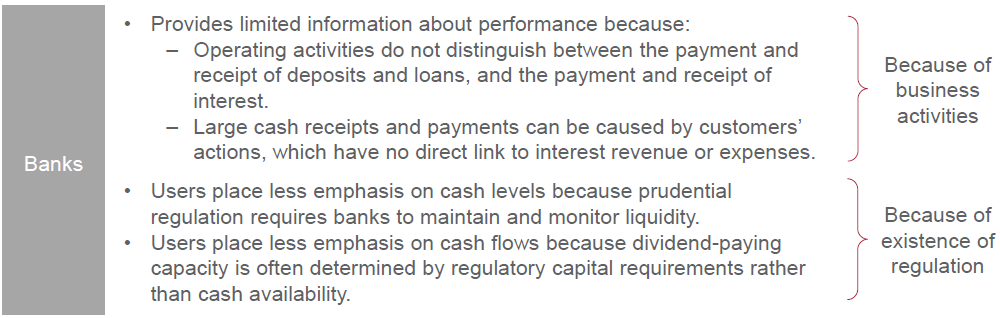
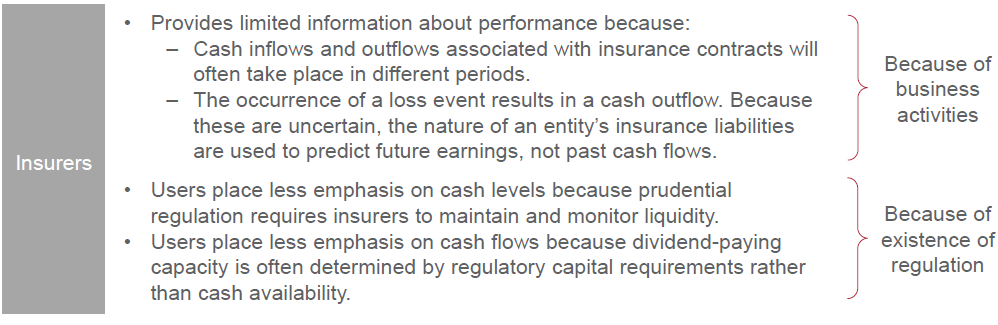
and why insurers and banks are regulated:
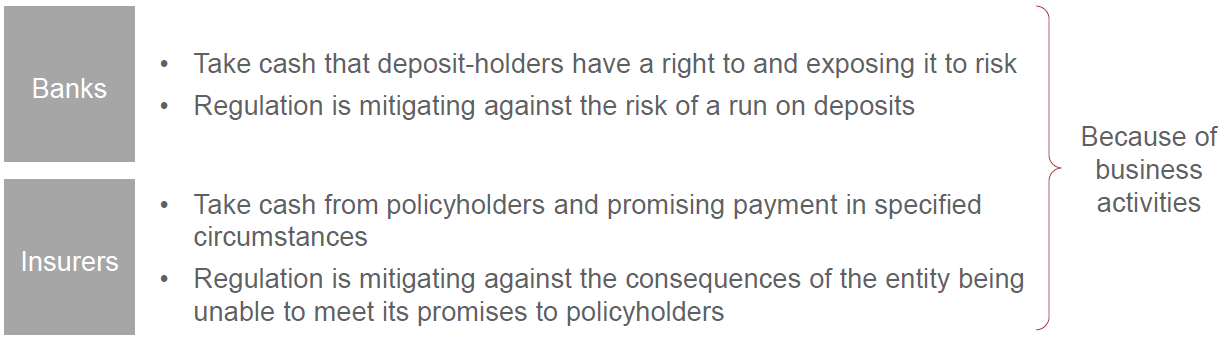
ASAF questions
D12 ASAF members will be asked:
- Have you identified any reasons, in addition to those listed (in paragraph D11 above), why the statement of cash flows of banks and insurers is less useful compared to other non-financial entities?
- Do you agree with determining which financial institutions should qualify for an exemption based on their business activities, and not on whether they are regulated?
UKEB Secretariat view
D13 The Secretariat agrees with the reasons outlined above for the limited usefulness of the statement of cash flows for banks and insurers, due to the business models of those institutions. These reasons are consistent with the findings in the UKEB sixth research paper on the Statement of Cash Flows and Related Matters for financial institutions18.
D14 However, basing any scoping of new requirements on business activities alone, and not on whether an entity is regulated could be challenging to define. Having public access to regulatory reports on liquidity/solvency, such as those required by Basel (Pillar III) for banks and Solvency II for insurers, provides users with additional assurance, especially if such regulatory information is audited or reconciled to the financial statements. Allowing an entity to be exempt from providing a statement of cash flows, because of its business activity, as opposed to whether other regulatory information is publicly available, may reduce the assurance for users. It is likely that users would prefer to receive a statement of cash flows, where no other information about solvency or liquidity is publicly available.
Question for the Board
- Do Board Members support the UKEB Secretariat’s preliminary view on the reasons for limited usefulness of the statement of cash flows for financial institutions, and whether entities should qualify for an exemption based on business activities?
Mechanisms for defining the scope of an exemption
D15 The IASB is considering the pros and cons of three different bases on which it might scope entities that would be exempt from providing some or all of the requirements in IAS 7, or be required to provide alternative or supplementary disclosures, namely:
- use existing requirements and terms in IFRS Accounting Standards; or
- refer to externally developed requirements and terms; or
- develop new requirements and terms.
D16 The IASB recognises that it is unlikely that a single requirement or term will be able to define the scope of any exemption. Therefore, a multi-factor approach to defining scope will be needed, using requirements and terms from IFRS Accounting Standards where possible. IASB analysis suggests it would be better to use requirements and terms from IFRS Accounting Standards, instead of externally developed requirements or terms from other frameworks and standards. However, they think that they can learn from the approaches used in other frameworks and standards.
D17 The table below set out the advantages and disadvantages, and examples where relevant, that the IASB staff have considered for each of the three bases:
A. Use existing concepts, terminology, requirements and terms that appear elsewhere in IFRS Accounting Standards
Advantages:
- Builds on understanding and knowledge of requirements and terms that are already being applied, so efficient for preparers
- Builds on previous work used to develop requirements and terms, so efficient use of IASB’s resources
- The IASB has authority to amend the requirements and terms in IFRS Accounting Standards, so can assess the effect of doing so on any exemption
Disadvantages:
- Adaptions are likely to be necessary as the requirements and terms were developed for different purposes (see ‘Possible adaptions’ section below)
- Adapting existing requirements and terms could affect how entities currently apply them
Examples:
IAS 7: * Definition of operating activities: The principal revenue producing activities of an entity and other activities that are not investing or financing activities. * Paragraph 24: Cash flows arising from each of the following activities of a financial institution ... : a) cash receipts and payments for the acceptance and repayment of deposits with a fixed maturity date; b) the placement of deposits with and withdrawal of deposits from other financial institutions; and c) cash advances and loans made to customers and the repayment of those advances and loans.
IFRS 17 Insurance Contracts: Definition of insurance contract, insurance contract services and reinsurance contract.
IFRS 18 Presentation and Disclosure in Financial Statements: * Paragraph 49: ... an entity shall assess whether it has a specified main business activity... of: a) investing in particular types of assets ... ; or b) providing financing to customers. * Paragraph 24: Exception that requires an entity to present all assets and liabilities in order of liquidity in the statement of financial position when this provides a more useful, structured summary.
IFRS 19 Subsidiaries without Public Accountability: Disclosures: * Paragraph 11: An entity has public accountability if: a) ... b) it holds assets in a fiduciary capacity for a broad group of outsiders as one of its primary businesses (for example, banks, credit unions, insurance companies, securities brokers/dealers, mutual funds and investment banks often meet this second criterion).
Possible adaptations:
The existing requirement or term is unsuitable because: * Activity is not unique to banks or insurers. For example: * issuing insurance contracts as defined in IFRS 17 * ‘holding assets in a fiduciary capacity’ in IFRS 19 * Term or requirement could include conglomerates. For example: * ‘specified main business activities’ in IFRS 18
Therefore, possible adaptions to existing terminology might be to only scope an exemption for: * entities for which the statement of cash flows provides limited useful information * conglomerates where the extent of banking and insurance activities means the statement of cash flows provides limited useful information
B. Refer to terminology and requirements from standards, regulation and frameworks developed by other bodies
Advantages:
- Builds on understanding and knowledge of requirements and terms that are already being applied, so efficient for preparers
- Builds on the work of others to develop requirements and terms, so efficient use of IASB’s resources
Disadvantages:
- Developed for a purpose that is different to general purpose financial reporting
- The requirements and terms can be amended by a body external to the IASB
- Requirements and terms might not be used in some jurisdictions or at a different entity-level compared to IFRS Accounting Standards
Examples:
- Global Industry Classification Standard (GICS®) developed by the MSCI and S&P Dow Jones Indices:
- Framework that classifies companies that have issued equity securities into an asset class based on their industry
- Classifications based on the activities that generate more than 60% of the company’s’ total revenues. Quantitative thresholds used to classify conglomerates
- Developed and maintained by MSCI and S&P Dow Jones, who award the classifications
- Basel Framework developed by the Basel Committee on Banking Supervision19:
- Framework used for prudential regulation
- Scope of entities focused on banking groups (described as ‘groups that engage predominantly in banking activities’)
- The framework establishes the intended scope of the framework and each jurisdiction determines the population of entities that are subject to it (that is, the scope is defined at a local level)
C. Develop new requirements and terms for the purpose of defining the scope
Advantages:
- Can be developed specifically for the intended objective of the exemption
- Avoids any potential restrictions and sensitivities associated with using existing requirements and terms that entities are currently applying
Disadvantages:
- Adds another set of requirements to IFRS Standards for entities to understand and apply
- Greater resources and time needed to develop and test, as greater uncertainty about which the entities the exemption will capture
ASAF questions
D18 ASAF members will be asked:
- Do you have any comments on the approaches to defining the scope (in paragraph D17 above)? For example: * suggestions of any other requirements or terms in IFRS Standards, or other frameworks and standards, that the IASB could use to define the scope? * concerns about any of the other (externally developed) frameworks or standards?
UKEB Secretariat view
D19 During UKEB research on financial institutions20, stakeholders considered the scoping of entities that would apply any potential changes to IAS 7 to be challenging and acknowledged that while an exemption from, or adjustments to, the requirement to prepare a statement of cash flows may be conceptually attractive for some financial institutions, it could be difficult to implement in practice.
D20 Despite the challenges, the Secretariat thinks that the preferred approach to scoping entities is based on non-IFRS externally developed regulatory requirements to submit solvency metrics (for insurers) or liquidity metrics (for banks) to regulators in their respective jurisdictions. Whilst there could be definitional challenges due to the global diversity of frameworks, particularly for insurers given that regulatory regimes for insurers are not as widely adopted as say the Basel framework for banks, eligibility for any exemption or alternative disclosures would be straight-forward to apply. This approach would ensure that only entities that are publicly disclosing solvency/liquidity information, albeit outside the financial statements, would be eligible to not provide a statement of cash flows.
D21 As highlighted in the UKEB’s sixth research paper21, bridging the gap between key liquidity/solvency regulatory metrics (that constrain the operation of the business) and the IFRS financial statements, would meet the common information needs of users. If entities are not required to submit regulatory reports to a regulator, then allowing an entity an exemption from preparing a cash flow statement might reduce the overall usefulness of the financial statements to users.
D22 The UKEB Secretariat considers that an activity basis is not a preferred approach, given that the boundaries of which entities qualify as ‘in scope’ could be eroded over time, as companies, such as fintechs and diversified groups, expand financial activity. The UKEB Secretariat also suggests that using IFRS precedents approach may not be suitable, considering the adaptions that would be required, which could change how the requirements are currently applied.
Questions for Board
- Do Board Members support the UKEB Secretariat’s preliminary view that referring to regulatory frameworks would be the preferred approach to the scoping of entities that would apply any potential changes to IAS 7? If not, what is the preferred approach and why?
- Do Board Members consider that there are other approaches to scoping that could be considered, not mentioned above?
Risks presented by conglomerates
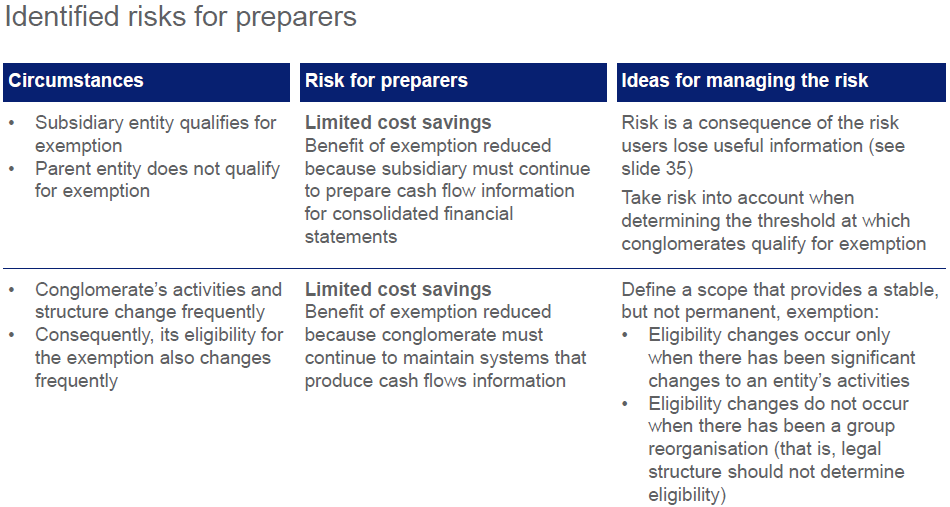
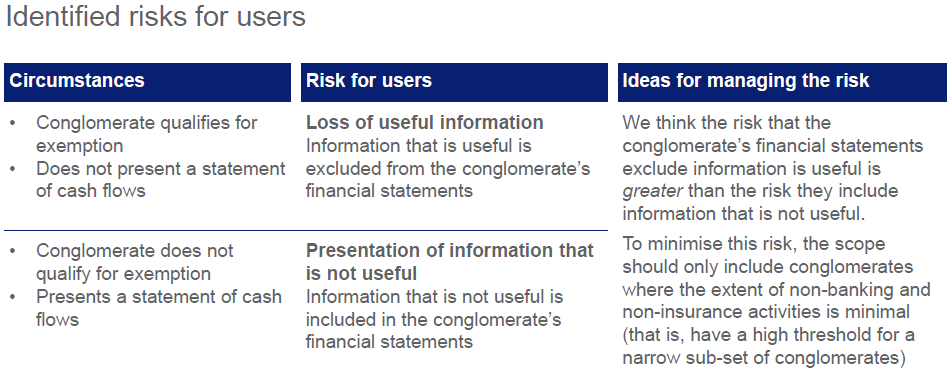
D23 The IASB consider that conglomerates present risks to scoping because:
- Banking and insurance services are often provided alongside other financial services and not confined to specialist entities; non-financial entities can also provide services similar to banks and insurers (for example, providing finance to customers).
- Group structures of financial institutions are often highly complex because they must comply with different legal, regulatory and governance requirements, and structures can often change, as merger and acquisitions are common within the financial services industry.
D24 Separate cash flow information is generally only available when specifically required by the group’s structure, or it is provided voluntarily. Cash flow information is typically not provided below the consolidated level because:
- Entities are not required to report cash flow information for each reportable segment (IFRS 8 Operating Segments).
- Entities are only required to disclose summarised cash flows for each subsidiary that has non-controlling interests that are material to the reporting entity (IFRS 12 Disclosure of Interests in Other Entities).
D25 In the October 2026 ASAF paper, the IASB has identified the following circumstances where there are risks for preparers and users, along with ideas for managing those risks:
ASAF questions
D26 ASAF members will be asked:
- Have you identified any risks, in addition to those described above, presented by conglomerates that we need to consider when defining the scope of any exemption? * Do you have any suggestions about how to manage the risks you have identified?
UKEB Secretariat view
D27 The Secretariat is not aware of any additional risks related to conglomerates.
Question for Board
- Are Board Members aware of any additional risks presented by conglomerates, other than those in paragraph D25 above, that the IASB needs to consider when scoping an exemption / new requirements?
Next steps
D28 In H2 2026, the IASB plans to discuss:
- specified line items in the statement of cash flows;
- disclosures of specific non-cash changes within working capital;
- cash equivalents;
- classification issues (including acquisition-related payments and IAS 7 paragraph 11); and
- possible exemptions or supplementary requirements for financial institutions.
D29 The UKEB Secretariat will continue to monitor the IASB’s redeliberation and tentative decisions and will provide the Board with updates accordingly.
Annex 1: For noting
D30 The following paragraphs provide the Board with an update on the IASB’s recent discussions and tentative decisions at its June 2026 and July 2026 meetings.
June 2026 IASB meeting
Classification and presentation of cash flows related to derivatives and government grants
D31 In December 2025, the IASB tentatively decided to explore developing requirements to improve the consistent classification and presentation of cash flows in several areas. At its June 2026 meeting, the IASB focused on two of those areas, derivatives and government grants. As noted in paragraph D28d) above, other classification issues will be considered at future IASB meetings.
Cash flows related to derivatives
D32 The IASB discussed alternative approaches to classifying cash flows from derivatives:
- Used to manage identified risks (not designated in a hedging relationship applying IFRS 9 Financial Instruments).
- That manage identified risks of multiple items (not designated in a hedging relationship applying IFRS 9).
D33 In addition, the IASB discussed how to classify cash flows from a derivative not used to manage identified risks.
D34 The IASB’s tentative decisions made at the June 2026 meeting are set out below:
| Cash flows related to derivatives |
|---|
| Current requirements |
| Paragraph 6 of IAS 7 provides the definition of ‘investing’ activities as the ‘acquisition and disposal of long-term assets and other investments not included in cash equivalents’. Paragraph 16 of IAS 7 states that ‘only expenditures that result in a recognised asset in the statement of financial position are eligible for classification as investing activities’. Paragraph 16 (g) and (h) of IAS 7 provides examples of cash flows arising from ‘investing’ activities as cash payments for and cash receipts from ‘futures contracts, forward contracts, option contracts and swap contracts except when the contracts are held for dealing or trading purposes, or the payments/receipts are classified as financing activities’. Paragraph 16 of IAS 7 concludes that ‘when a contract is accounted for as a hedge of an identifiable position the cash flows of the contract are classified in the same manner as the cash flows of the position being hedged’. |
| IASB tentative decision |
At its June 2026 meeting, the IASB tentatively decided to propose requiring an entity to classify cash flows from a derivative used to manage identified risks (and not designated in a hedging relationship in accordance with IFRS 9):
This approach to classification would also apply to cash flows from derivatives that manage identified risks of multiple items (not designated in a hedging relationship applying IFRS 9).23 The IASB also tentatively decided to propose requiring an entity to classify cash flows from a derivative not used to manage identified risks as cash flows from ‘financing’ activities, if the derivative relates to a transaction that involves only the raising of finance. The IASB rejected the proposal to classify all other derivatives not used in risk management in ‘operating’ activities.24 |
| UKEB Secretariat views |
| IASB tentative decisions The Secretariat welcomes the IASB’s tentative decisions to improve the consistent classification of cash flows from derivatives (not designated in a hedging relationship in accordance with IFRS 9). The lack of guidance was highlighted in the UKEB research on the statement of cash flows25, where users emphasised the importance of understanding derivative cash flows to help them evaluate the financial impact of a derivative strategy and to assess whether there is sufficient liquidity to meet future obligations arising from derivative contracts. The proposed classification is consistent with how designated hedges are already classified in paragraph 16 of IAS 7 and better reflects the risk management activities of the entity. As noted in paragraphs 170–172 of the UKEB fourth research paper, paragraph 16 of IAS 7 states that “when a contract is accounted for as a hedge of an identifiable position, the cash flows of the contract are classified in the same manner as the cash flows of the position being hedged”. However, there are differing interpretations about whether the requirement in paragraph 16 of IAS 7 for classifying cash flows from derivatives an entity uses to hedge (in a hedging relationship applying IFRS 9) also applies to derivatives used to manage identified risks (not designated in a hedging relationship applying IFRS 9). In addition, IAS 7 does not specify whether such hedging cash flows should be separately identifiable, similar to the requirements for separately identifying the cash flows of the underlying identifiable position. For example, where the hedging instrument manages two risks, but only one of those risks is designated in the hedging relationship, whilst the derivative cash flows relate to both risks. For cash flows from a derivative used to manage identified risks (and not designated in a hedging relationship in accordance with IFRS 9), the relief provided where it involves undue cost or effort to classify cash flows in the same manner as the cash flows from the item(s) whose identified risks are being managed, uses a default ‘operating’ category. It is noted that this proposal effectively changes the default category for derivatives in IAS 7 from ‘investing’ to ‘operating’, and that this proposal was only marginally supported. The Secretariat notes that IASB staff considered stakeholder views in providing a relief and acknowledges that large corporates often manage risks centrally through treasury functions, that net positions can change frequently making allocation costly, and therefore a relief may be needed to avoid excessive implementation costs. However, once a company has identified the risk being managed, it should normally be able to identify the relevant category. It would be helpful for stakeholders if the IASB adequately defines the ‘undue cost or effort’ threshold it is prescribing. Otherwise, this default category of ‘operating’ will be more often used. The Secretariat questions how transparent cash flows from derivatives used to manage identified risks will be when classified as ‘operating’ under the indirect method, and whether this provides sufficient information for users to evaluate the financial impact of a derivative strategy. The IASB rejected moving the default classification of derivatives not used for risk management from ‘investing’ to ‘operating’ (except to classify as ‘financing’, when they relate solely to raising finance). This seems an appropriate decision, given that investors indicated that, whilst derivative cash flows are rarely separately identified in |
The proposed classification is consistent with how designated hedges are already classified in paragraph 16 of IAS 7 and better reflects the risk management activities of the entity. As noted in paragraphs 170–172 of the UKEB fourth research paper, paragraph 16 of IAS 7 states that “when a contract is accounted for as a hedge of an identifiable position, the cash flows of the contract are classified in the same manner as the cash flows of the position being hedged”. However, there are differing interpretations about whether the requirement in paragraph 16 of IAS 7 for classifying cash flows from derivatives an entity uses to hedge (in a hedging relationship applying IFRS 9) also applies to derivatives used to manage identified risks (not designated in a hedging relationship applying IFRS 9). In addition, IAS 7 does not specify whether such hedging cash flows should be separately identifiable, similar to the requirements for separately identifying the cash flows of the underlying identifiable position. For example, where the hedging instrument manages two risks, but only one of those risks is designated in the hedging relationship, whilst the derivative cash flows relate to both risks.
For cash flows from a derivative used to manage identified risks (and not designated in a hedging relationship in accordance with IFRS 9), the relief provided where it involves undue cost or effort to classify cash flows in the same manner as the cash flows from the item(s) whose identified risks are being managed, uses a default ‘operating’ category. It is noted that this proposal effectively changes the default category for derivatives in IAS 7 from ‘investing’ to ‘operating’, and that this proposal was only marginally supported. The Secretariat notes that IASB staff considered stakeholder views in providing a relief and acknowledges that large corporates often manage risks centrally through treasury functions, that net positions can change frequently making allocation costly, and therefore a relief may be needed to avoid excessive implementation costs. However, once a company has identified the risk being managed, it should normally be able to identify the relevant category. It would be helpful for stakeholders if the IASB adequately defines the ‘undue cost or effort’ threshold it is prescribing. Otherwise, this default category of ‘operating’ will be more often used. The Secretariat questions how transparent cash flows from derivatives used to manage identified risks will be when classified as ‘operating’ under the indirect method, and whether this provides sufficient information for users to evaluate the financial impact of a derivative strategy.
The IASB rejected moving the default classification of derivatives not used for risk management from ‘investing’ to ‘operating’ (except to classify as ‘financing’, when they relate solely to raising finance). This seems an appropriate decision, given that investors indicated that, whilst derivative cash flows are rarely separately identified in practice and have limited impact on common metrics such as ‘free cash flow’, nonetheless, classifying under ‘investing’ activities is useful to provide greater visibility of unusual derivative cash flows, than would be apparent if classified within cash flows from ‘operating’ activities. However, the Secretariat notes that in the IASB published tentative decision, it was not clear that the default category for classification of derivatives not used for risk management is ‘investing’. The IASB should consider making this clearer when drafting an ED.
Other comments
The Secretariat thinks that enhanced disclosure for derivatives would also provide the information that users need, without the need for any additional guidance. UKEB research highlights additional disclosures that require more granularity about derivative cash flows would be appreciated by users:
- It would be useful for companies to explain in an accounting policy note, the entity-specific classification of derivative cash flows:
- in circumstances where hedge accounting is applied (i.e. how they meet the requirement in paragraph 16 of IAS 7), and
- those circumstances where hedge accounting is not applied.
- Where companies enter into hedges relating to ‘operating’ activities, it would be useful for companies to disclose the impact of those derivatives on the ‘operating’ activities section of the statement of cash flows.
Cash flows related to government grants
D35 The IASB considered alternative approaches to classifying receipts of government grants. The IASB staff proposed an entity classifies receipts of government grants:
- in the same manner as the cash flows of the asset, liability or expense to which the grant relates (the related items); and
- if it is impracticable to classify those cash flows in the same manner as the cash flows of the related items:
- as ‘investing’ activities for a grant related to assets (as defined in IAS 20 Accounting for Government Grants and Disclosure of Government Assistance); and
- as ‘operating’ activities for a grant related to income (as defined in IAS 20, that is, a grant other than one related to assets).
D36 The IASB also discussed:
- Classification when the grants are only loosely related to specific assets, liabilities or expenses or relate to multiple assets, liabilities or expenses.
- Whether grants related to assets should be presented gross or net in the statement of cash flows.
| Cash flows related to government grants |
|---|
| Current requirements |
| IAS 7 does not include specific requirements for classification of receipts from government grants in the statement of cash flows. Paragraph 24 of IAS 20 requires an entity to present government grants related to assets in the statement of financial position. Paragraph 29 of IAS 20 requires an entity to classify government grants related to income in the statement of profit or loss in accordance with the requirements in IFRS 18. Paragraph 22 of IAS 7 explains when an entity may report cash flows on a net basis, with paragraphs 23–24 providing examples. However, none of them refers directly to government grants. |
| IASB tentative decision |
At its June 2026 meeting, the IASB tentatively decided to propose requiring an entity to:
|
| UKEB Secretariat views |
| During UKEB outreach, a preparer highlighted that the absence of guidance on how to account for ‘grants and contributions received from customers’ led to diversity in practice in their industry. Therefore, the Secretariat welcomes the IASB’s tentative decisions, as it will reduce diversity in classification of receipts of government grants. Whilst the alternative approach proposed by the IASB staff, i.e. classifying in the same manner as the related item (and an impracticability exception to classify as ‘operating’), might better reflect the underlying economics of the grant, the IASB agreed on a simplified approach which also aligns with IAS 20 and should be straight-forward to apply, reduces judgement and risk of inconsistency in identifying ‘related items’. Income related grants may be less transparent where the indirect method is used for cash flows from ‘operating’ activities, and the cash flows from grants are classified as ‘operating’. The IASB should consider how entities should disclose material exceptional items classified in ‘operating’, to give greater transparency to such items. |
It is worth noting that receipts of government grants can be non-cash. There is lack of guidance on how such non-cash transactions should be disclosed. Consultation with preparers highlighted an example of research and developments grants when cash is not received (i.e. there is no cash inflow). Instead, the government grant is received by way of a reduced tax liability (i.e. a company’s tax cash outflows to the government are reduced by the amount of the grant). In this situation it is unclear whether the tax cash outflow should be grossed up, and a deemed government grant cash inflow recognised. On the basis that non-cash items should not be included in the statement of cash flows (paragraph 43 of IAS 7), clarity needs to be provided on how such non-cash transactions should be disclosed.
July 2026 IASB meeting
D37 At its July 2026 meeting, the IASB discussed:
- Improvements to disclosures about non-cash transactions from ‘investing’ and ‘financing’ activities.
- Planned work and areas of focus on the statement of cash flows for financial institutions.
Non-cash transactions
D38 In October 2025, the IASB tentatively decided to develop potential requirements specifying the content and location of information an entity discloses about non-cash transactions from ‘investing’ and ‘financing’ activities that are within the scope of paragraphs 43–44 of IAS 7.
D39 At the July 2026 meeting, the IASB discussed proposals for:
- application guidance to clarify the non-cash transactions that are in the scope of paragraphs 43–44 of IAS 7, and whether to include examples26;
- a disclosure objective or other approaches (in addition to, or instead of, a disclosure objective) to address preparers’ concern of having clear guidance about how to make effective materiality judgements27;
- disclosure about non-cash transactions in a single note; and
- a package of possible disclosures for non-cash transactions28.
D40 The debate focused on balancing investor demands for transparency against preparer concerns about cost and complexity.
| Non-cash transactions |
|---|
| Current requirements |
| Paragraphs 43–44 of IAS 7 state [emphasis added]: “Investing and financing transactions that do not require the use of cash or cash equivalents shall be excluded from a statement of cash flows. Such transactions shall be disclosed elsewhere in the financial statements in a way that provides all the relevant information about these investing and financing activities. Many investing and financing activities do not have a direct impact on current cash flows although they do affect the capital and asset structure of an entity. The exclusion of non-cash transactions from the statement of cash flows is consistent with the objective of a statement of cash flows as these items do not involve cash flows in the current period. Examples of non-cash transactions are:
Paragraph 40(d) of IAS 7 requires an entity to disclose, in aggregate, for both obtaining and losing control of subsidiaries or other businesses during the period, the amount of assets and liabilities (other than cash or cash equivalents) in those subsidiaries or businesses. |
| IASB tentative decision |
| At its July 2026 meeting, the IASB tentatively decided to propose in a future ED: 1. Adding application guidance to clarify the non-cash transactions within the scope of paragraphs 43–44 of IAS 7. Specifically, the guidance would: a) Explain that to identify non-cash transactions, an entity identifies non-cash additions and disposals of assets, and non-cash issuances and redemptions of liabilities and equity items, for which cash flows would be classified as ‘investing’ or ‘financing’ activities. b) Include examples of non-cash changes in the items described in a) that are within the scope29 of the disclosure requirements, and examples that are outside that scope30. 2. Adding a disclosure objective that would require an entity to disclose information about non-cash transactions that enables investors to understand changes in the entity’s net assets and its ability to generate future cash flows. 3. Requiring an entity to disclose information about non-cash transactions in a single note. 4. Adding requirements to paragraphs 43–44 of IAS 7 for an entity to disclose: a) A list of non-cash transactions and applicable cross-references that identify the location of any related information in other notes. b) The transaction amount, that is, the consideration attributed to the transaction in accordance with IFRS Accounting Standards. The entity would also be required to disclose information about the related ‘investing’, ‘financing’ and ‘operating’ activities from which the transaction arises. ‘Operating’ activities would only be included in the scope of these proposed requirements if involved in a transaction that involves both ‘operating’ and ‘investing’ or ‘financing’. c) The effect of non-cash transactions on assets, liabilities and equity alongside the amounts of similar cash transactions. The entity would be required to add these amounts to show their combined effect on its activities in the statement of cash flows. 5. Requiring an entity to provide the information described in 4. in a structured format, like a table. 6. Requiring an entity to explain the nature of the information available in the related notes identified in cross-references disclosed, as described in 4.a) if the transaction amounts are not separately identifiable in those notes. |
| UKEB Secretariat views |
| The Secretariat welcomes the IASB’s tentative decisions. The Secretariat appreciates the disclosure objective, as investors use information on non-cash transactions to calculate measures such as enterprise value (EV) and free cash flow (FCF). The Secretariat noted that several IASB members challenged whether a disclosure objective alone could resolve preparers’ concerns about materiality judgements, with one IASB member observing that preparers usually understand how to apply materiality, whereas difficulties often arise with auditors and regulators evaluating those judgements. The UKEB initial outreach carried out in December 2024–March 2025, and the User poll conducted in March–April 2025, suggested that information about non-cash transactions was one of the highest priorities for users. As noted in the UKEB first research paper31, there is an argument that, excluding all non-cash transactions from the statement of cash flows does not result in comparable information for similar cash and non-cash transactions that give rise to a similar outcome. Users were challenged to identify material non-cash ‘investing’ and ‘financing’ transactions, due to:
Whilst IAS 7 currently requires disclosure, it provides little guidance on:
The approach proposed appears consistent with the recommendation in the UKEB’s fourth research paper on the statement of cash flows, that such information needs might be met if companies were required to disclose non-cash information in a single note in the financial statements, as information is often scattered and difficult to find. A single standalone note should not significantly increase preparer costs because ‘material’ non-cash information should already exist elsewhere in the financial statements, but it would improve accessibility and transparency, reduce investors’ search costs and support digital reporting and machine readability, allowing them to more readily analyse economic activity irrespective of whether it was settled in cash. The requirements should improve the visibility of leases, debt-equity swaps, share-based payments and similar transactions. The Secretariat acknowledges concerns raised by some IASB members about having a total column in the single note, adding material cash and material non-cash transactions, as this might imply completeness, which is not intended, it is expected that only material items would be included in the note. The Secretariat agrees that cross-referencing will provide a stronger link between the primary financial statements and the related notes, whilst acknowledging that different notes are prepared using different aggregation and materiality judgements, so amounts in the non-cash note may not tie directly to amounts disclosed elsewhere, which might lead preparers to increase detail elsewhere in the financial statements. The Secretariat agrees that adding examples to clarify what constitutes a non-cash transaction should help address diversity in interpretation and help preparers identify relevant transactions. The Secretariat noted one IASB investor member’s concern about the proposed exclusion from non-cash transactions of ‘liabilities assumed in a business combination, particularly assumed debt’, given that investors often view assumed debt as part of the economic cost or EV of an acquisition and may expect it to be reflected in any disclosure package32; other IASB members suggested this issue be revisited alongside future discussions on acquisition-related cash flows. The Secretariat believes that including, in any examples, material cash flows and non-cash transactions related to supplier finance and factoring arrangements, would help preparers in applying any new proposals, without adding detailed specific guidance on such transactions. |
Approach to the statement of cash flows for financial institutions
D41 In July, the IASB discussed the plan for future work on the statement of cash flows for financial institutions, which includes prioritising research and stakeholder engagement on:
- defining the scope of entities that would apply any potential changes to IAS 7 arising from this work; and
- considering possible exemptions for financial institutions from some or all the requirements for presenting a statement of cash flows.
D42 The IASB was not asked to make any decisions but generally supported the staff’s proposed work. There was little enthusiasm for spending further time considering how proposals developed for non-financial entities might apply to financial institutions.
D43 Many IASB members identified scope as the project’s most important challenge and suggested that prudential regulators are an important stakeholder during the planned outreach.
D44 Members expressed caution against developing large new disclosure packages and the creation of regulatory reporting disclosures within IFRS financial statements, and to ensure proposals remain within the scope of the project, whilst preserving only genuinely useful information if exemptions are introduced.
D45 Consistent with feedback at the July 2026 ASAF meeting, at which the UKEB presented its sixth research paper on the Statement of Cash Flows and Related Matters for Financial Institutions, the IASB suggested taking a staged, multi-factor approach, starting with a narrowly defined group of entities and understanding why they are different. The scope should be stable and accommodate group structures.
Appendix E: Equity Method
| Actor | Phase 1 | Phase 2 | Phase 3 | Phase 4 | Phase 5 (Current) | Phase 6 | Phase 7 | Phase 8 |
|---|---|---|---|---|---|---|---|---|
| IASB | Research / Pipeline | Discussion Paper | Redeliberation | Exposure Draft | Redeliberation | Final Standard | Post Implementation Review | |
| UKEB | Research / Influencing | Research / Influencing | Monitoring | Influencing | Monitoring | Endorsement | Influencing | UKEB Post Implementation Review |
UKEB project page
UKEB Final Comment Letter (published 16 December 2024)
IASB Next Milestone: Final Amendments (expected H1 2027)
Purpose
E1 The purpose of this paper is to provide an update on the IASB’s redeliberation at its July 2026 meeting, on the proposals in the Exposure Draft (ED) ‘Equity Method of Accounting IAS 28 Investments in Associates and Joint Ventures (revised 202x)’.
Background
E2 In September 2024, the IASB published its ED, which aimed to:
- clarify and add to the requirements in IAS 28 Investments in Associates and Joint Ventures, to answer application questions about the equity method of accounting;
- reorder the requirements in a more logical and consistent way to help companies apply the Standard i.e. improve the understandability; and
- improve the disclosure requirements in IFRS 12 Disclosure of Interests in Other Entities and IAS 27 Separate Financial Statements to complement the proposed amendments to IAS 28.
E3 The UKEB undertook a ‘light touch’ approach in responding to the ED and is not aware of pervasive or material concerns for the UK arising from the ED proposals. Therefore, the UKEB supported the proposals in the ED, but did not comment on each specific proposal.
E4 The Board has received regular updates on IASB’s decisions/tentative decisions33. A summary of the tentative decisions can be found in Appendix B of Staff Agenda Paper 13 for the July 2026 IASB meeting34.
IASB redeliberation: July 2026
E5 At its July 2026 meeting, the IASB continued its redeliberation of the ED proposals and made tentative decisions on:
- transactions with associates: disclosure requirements;
- transition requirements in IAS 28 (revised 202x);
- transition requirements for first-time adopters; and
- sweep issues.
Transactions with associates: disclosure requirements
Background
E6 At its July 2026 meeting, the IASB continued its discussions on disclosure requirements related to gains and losses on transactions with associates35, and considered:
- when an investor should be required to disclose ‘upstream’ and/or ‘downstream’ transactions with an associate; and
- the possible introduction of an exemption from disclosing some or all of the information about gains or losses from transactions with associates, if the disclosure could be expected to seriously prejudice the investor, e.g. to avoid revealing commercially sensitive information.
| Proposed amendments to the disclosure requirements in IFRS 12 |
|---|
| Current requirements |
| IFRS 12 requires an entity to provide a reconciliation of the summarised information presented about an associate to the carrying amount of that investment in the statement of financial position. |
| Exposure Draft proposals |
| The ED proposed amendments to IFRS 12 and IAS 7 Statement of Cash Flows to require an entity to disclose information about gains or losses resulting from ‘downstream’ transactions with associates (such as a sale of assets from an investor to an associate). The proposed disclosure requirements would also apply to equity accounted subsidiaries in separate financial statements. |
| UKEB Comment Letter |
| The UKEB Final Comment Letter generally supported the ED proposals but did not comment on each specific proposal. |
| IASB tentative decisions |
| At its July 2026 meeting, the IASB confirmed its tentative decision to require an entity to disclose its accounting policy choice for the recognition of gains or losses from transactions with associates. In addition, the IASB tentatively decided:
|
| UKEB Secretariat preliminary view |
| Requiring disclosure of gains/losses from both ‘upstream’ and ‘downstream’ transactions when an entity (investor) chooses to restrict the recognition of gains/losses from transactions with an associate, should address concerns raised by some respondents to the ED about earnings management and a lack of transparency. The Secretariat shares the concerns raised by IASB members regarding the proposed disclosure exemption. Care will be needed in the drafting to ensure that any disclosure exemption is tightly framed in order that the exemption is only used as the IASB intends. |
Transition requirements in IAS 28 (revised 202x)
E7 The IASB considered stakeholder feedback on its proposals in the ED relating to transition requirements.
| Transition requirements in IAS 28 (revised 202x) |
|---|
| Current requirements |
| N/A |
| Exposure Draft proposals |
In relation to transition requirements, the ED includes proposals to require an investor:
The IASB also proposed that if an investor increased the carrying amount of an investment in an associate as a result of the transition requirements and had estimated the recoverable amount of that investment in accordance with IAS 36 Impairment of Assets at the transition date, the investor would reduce that carrying amount to that recoverable amount, if applicable. Any impairment loss would be recognised in the opening balance of retained earnings at the transition date. In addition, the IASB proposed relief from restating any prior period presented in addition to the comparative period and from disclosing the effects of the proposed requirements on the current period or any unadjusted additional prior period. |
| UKEB Comment Letter |
| The UKEB Final Comment Letter generally supported the ED proposals, which included transition requirements, but the UKEB did not comment on each specific proposal. |
| IASB tentative decisions |
| At its July 2026 meeting, the IASB discussed whether a change in accounting policy for recognising gains or losses from transactions with associates should be applied retrospectively unless impracticable. The IASB agreed that “impracticable” would be too high a hurdle and instead agreed to require retrospective application unless this would involve undue cost or effort. Additionally, in relation to transactions with associates, the IASB tentatively decided that retrospective application is required only for the unrecognised portion of a previously restricted gain or loss at the transition date. The IASB tentatively decided to confirm its other proposals in the ED and to add a transition requirement relevant to an investor that has unrecognised losses in the associate at the transition date. |
| UKEB Secretariat preliminary view |
| The IASB’s tentative decisions are broadly consistent with the ED proposals with additional clarifications. The clarifications that the IASB tentatively agreed to add to the proposed requirements should ensure their consistent application. |
Transition requirements for first-time adopters
E8 The IASB discussed whether to introduce transition requirements for an entity’s first financial statements prepared in accordance with IFRS Accounting Standards.
| Transition requirements for first-time adopters |
|---|
| Current requirements |
| N/A. |
| Exposure Draft proposals |
| The ED did not propose amendments to IFRS 1 First-time Adoption of International Financial Reporting Standards38. |
| UKEB Comment Letter |
| The UKEB Final Comment Letter generally supported the ED proposals, which included transition requirements, but the UKEB did not comment on each specific proposal. |
| IASB decisions: |
| The IASB tentatively decided: a. to clarify that the exemption in paragraph C5 of IFRS 139 for past acquisitions of investments in associates also applies on purchase of an additional ownership interest while retaining significant influence; and b. not to include in IFRS 1 any other transition requirements for the amendments to IAS 28. |
| UKEB Secretariat preliminary view |
| The IASB’s tentative decisions to provide limited clarifications to IFRS 1, should be helpful for first-time adopters. |
Sweep issues
| Sweep issues |
|---|
| Current requirements |
| Paragraph 32 of IAS 28 requires the presentation of any gain on bargain purchase as income in the determination of the entity’s share of the associate’s profit or loss in the period in which the investment is acquired. |
| Exposure Draft proposals |
| The ED proposed removing the above presentation requirement. |
| UKEB Comment Letter |
| The UKEB Final Comment Letter generally supported the ED proposals but did not comment on each specific proposal. |
| IASB tentative decisions |
The IASB tentatively decided:
|
- Not to add requirements on ‘sidestream’ transactions (e.g. transactions between two associates).
- To confirm the ED’s proposal to remove the presentation requirement to include a gain on bargain purchase within the line item for the entity’s share of profit or loss from an associate.
- To withdraw the IFRS Interpretations Committee’s Agenda Decisions:
- Potential effect of IFRS 3 Business Combinations (as revised in 2008) and IAS 27 Consolidated and Separate Financial Statements (as amended in 2008) on equity method accounting (IAS 28 Investments in Associates)—July 2009;
- Impairment of an Equity Security (IAS 39 Financial Instruments: Recognition and Measurement)—June 2005; and
- Meaning of ‘significant or prolonged’ (IAS 39 Financial Instruments: Recognition and Measurement)—July 2009.
- To amend the Agenda Decision Contributing property, plant and equipment to an associate (IAS 28 Investments in Associates and Joint Ventures)—January 2018 to reflect the IASB’s decision to allow an accounting policy choice for gains or losses from transactions with associates.
UKEB Secretariat preliminary view
The Secretariat supports the tentative decisions made in relation to the sweep issues. Adding guidance for narrow fact patterns, such as loss of control of a non-business subsidiary, transfer to an associate, or retention of a financial instrument accounted for under IFRS 9, would be overly specific and unnecessarily complicated. ‘Sidestream’ transactions are beyond the project scope and addressing them would potentially reopen broader conceptual issues.
Next steps
E9 The IASB will discuss the implications of the disclosure requirements related to gains and losses on transactions with associates on IFRS 19 Subsidiaries without Public Accountability: Disclosures and IAS 27 at a future meeting. This will complete the IASB’s redeliberation of the ED proposals (subject to identifying additional sweep issues).
E10 The IASB is expected to issue a revised Standard in H1 2027.
E11 The UKEB Secretariat will continue to monitor the IASB’s redeliberation and tentative decisions and update the Board.
Appendix F: Business Combinations—Disclosures, Goodwill and Impairment
Project Stage
| IASB | Research / Pipeline | Discussion Paper | Redeliberation | Exposure Draft | Redeliberation | Final Standard | Post Implementation Review | |
|---|---|---|---|---|---|---|---|---|
| UKEB | Research / Influencing | Research / Influencing | Monitoring | Influencing | Monitoring | Endorsement | Influencing | UKEB Post Implementation Review |
UKEB project page
UKEB Final Comment Letter on Exposure Draft (published 19 July 2024)
IASB Next Milestone: Decide Project Direction Q4 2026
Purpose of this paper
F1 This paper provides the Board with an update on the International Accounting Standards Board (IASB)’s redeliberation at its July 2026 meeting of the proposals in the Exposure Draft Business Combinations—Disclosures, Goodwill and Impairment (the ED)41.
Background
F2 The IASB’s objective for this project is to explore whether entities can, at a reasonable cost, provide users with more useful information about business combinations (by amending the requirements in IFRS 3 Business Combinations).
F3 The resulting information should assist users to make better decisions, by helping them to understand and assess:
- the strategic rationale behind an acquisition;
- how the acquired business is performing; and
- whether the acquirer’s management has been effective and efficient in using the entity’s economic resources to acquire the business.
F4 Within this project, the IASB aims to improve the effectiveness and reduce the cost and complexity of the impairment test in IAS 36 Impairment of Assets.
IASB meeting 21 July 2026
Updated package of disclosures about the post-acquisition performance of a business combination
F5 At its July 2026 meeting, the IASB considered a proposed package of disclosures about the performance of a business combination (see section 4 of the table below paragraph F7 for more details)42. IASB members were asked whether the updated package could improve financial reporting.
F6 The July 2026 updated package represents a substantial simplification of the proposals in the ED. The package aims to address concerns raised about the proposed requirements in the ED by both stakeholders and IASB members. The main concerns included the following:
- Forward looking information: some information required by the ED is considered outside the scope of financial statements. The commercial sensitivity of making certain disclosures was also raised as a concern.
- Auditability: concerns were raised over how certain information required by the ED would be verified.
- Population of business combinations that would be required to report subsequent performance information: whether it would be too limited.
F7 Details on the rationale for the July 2026 updated package and the IASB discussion of the package are set out in the table below.
Changes to the proposed ‘ED package’ of acquisition-date expected synergies and key objectives and targets, and subsequent performance information
1. Current requirements
Paragraph B64(e) of IFRS 3 requires an acquiring company to disclose, for each business combination that occurs during the reporting period, a qualitative description of the factors that make up the goodwill recognised (such as expected synergies, intangible assets that do not qualify for separate recognition, or other factors).
There are currently no requirements for an acquirer to disclose separate quantitative expected synergies, nor post-acquisition performance in relation to an acquired business.
2. ED proposals
To provide users with more useful information about the subsequent performance of a business combination, the ED proposed to require an entity to disclose:
- information about the entity’s acquisition-date key objectives and related targets (KOTs) for a business combination; and
- whether these KOTs are being met in subsequent periods.
The ED proposed such disclosures would only be required for ‘strategic’ business combinations43. Certain exemptions from some disclosure requirements were proposed.
The ED also proposed requirements to disclose quantitative information about expected synergies, including a description of expected synergies by category and, for each category of synergies:
- the estimated amounts, or range of amounts, of the expected synergies;
- the estimated costs, or range of costs, to achieve these synergies; and
- the time from which the benefits from the synergies are expected to start and how long they are expected to last.
Diagram 1 provides a summary of the proposed requirements for disclosure of information about expected synergies and the subsequent performance of a business combination (the ‘ED package’).
Diagram 1: ED package44

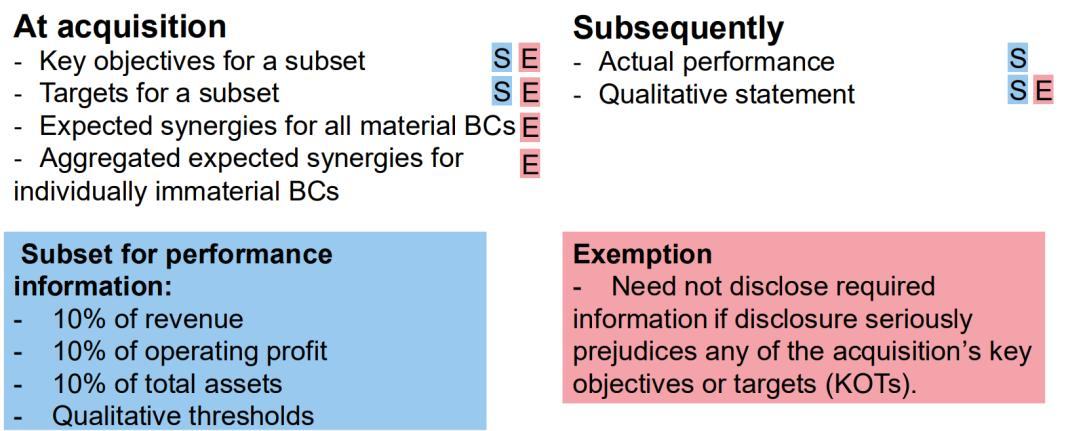
3. UKEB Comment Letter
The UKEB broadly supported the IASB’s proposals to require disclosure of information about the performance of business combinations, based on the acquirer’s acquisition-date KOTs, for only a subset of the most important business combinations. However, the UKEB considers that the proposed exhaustive list of quantitative and qualitative thresholds45, may not capture the most important acquisitions. Instead, the UKEB recommended a principle-based approach, including a rebuttable presumption, focusing on the importance of the acquisition to achieve the acquirer’s overall business strategy (see paragraphs 6 and 8 of the UKEB Comment letter).
The UKEB highlighted concerns with the ‘operating profit’ threshold due to volatility (see paragraphs A19–A20 of the UKEB Comment Letter).
The UKEB also suggested that the IASB should require disclosures for a series of business combinations that individually may not appear to be strategic but are part of a series of acquisitions which are collectively strategic (see UKEB Comment Letter paragraphs A11–A15).
4. Recent IASB discussions
At its July 2026 meeting, the IASB considered a substantially simplified alternative package of disclosures about the performance of a business combination (the ‘July 2026 updated package’)46.
This package represents an update to the ‘May 2026 suggested package’ rather than to the ED47. Diagram 3 (below) provides a summary of the ‘July 2026 updated package’ and how it differs from the proposals in the ‘May 2026 suggested package’.
The main features of the ‘July 2026 updated package’ are as follows:
- The package does not propose any disclosure requirements for quantitative information about expected synergies, nor acquisition-date targets.
- The threshold for identifying a subset of the most important ‘strategic’ business combinations is removed from the proposals. This would expand the population of business combinations for which disclosure of key objectives and subsequent performance is required to all ‘material’ business combinations.
- No exemption from certain aspects of disclosure is proposed.
Diagram 3: July 2026 updated package48
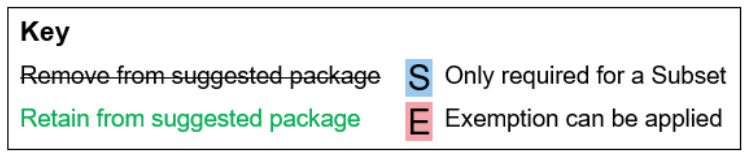
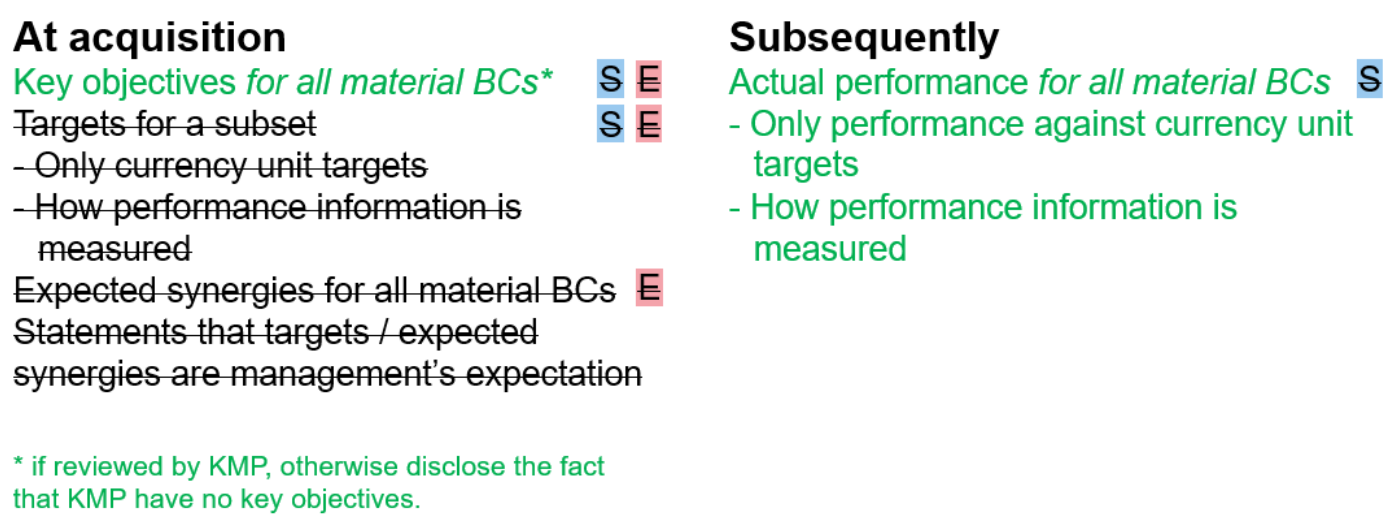
During the meeting, IASB members expressed concern that successive updates to the proposed requirements had diluted the package and distorted the ‘management approach’ (i.e. the extent to which users would receive information about how management actually monitors acquisitions).
Some IASB members questioned the proposal to restrict disclosures about targets to only those expressed in currency units (which had originally been introduced in the ‘May 2026 suggested package’ primarily to address auditability concerns). This restriction may mean that information about certain important performance indicators would be excluded from disclosure of subsequent performance information.
Several IASB members noted that without information on acquisition-date targets, users cannot assess whether post-acquisition performance is good or bad.
IASB members discussed how the subsequent performance information might be improved, and asked the IASB staff to explore two approaches:
- Full management approach – an expanded management approach that would retain the basic structure of the ‘July 2026 updated package’ but without the currency unit restriction. This would provide more authentic information about management stewardship.
- Specified metrics approach – a more prescriptive approach requiring disclosure of specified metrics, for example, requiring all entities to disclose revenue and operating profit from a business combination for a specified period of time after the business combination. This would provide standardised, comparable information that investors could analyse more easily.
5. UKEB Secretariat views
One of the objectives for the project is for users to understand why a company paid the price it did for an acquisition, so that investors can hold management to account.
IFRS 3 already requires disclosure of qualitative information on expected synergies. The UKEB Secretariat therefore remains of the view (as expressed in the UKEB’s comment letter) that companies should be encouraged to disclose the qualitative effect of the same expected synergies, where practical and material, to support the price paid. The Secretariat acknowledges, however, that the financial statements may not be the best place for this forward-looking information.
The UKEB Secretariat shares the concerns expressed by several IASB members about the usefulness of information on subsequent performance without information on acquisition-date targets. Unless entities can be required to provide this information, the Secretariat is of the view that the proposals will not sufficiently improve the information that users receive. The IASB may therefore need to proceed only with the changes proposed in the ED to simplify the impairment test in IAS 36 Impairment of Assets49.
Next Steps
F8 The IASB will continue redeliberating the proposals in the ED and will consider a further revised package of disclosure at a future meeting.
F9 The UKEB Secretariat will continue to monitor the IASB’s redeliberation and tentative decisions and will provide the Board with updates accordingly.
Appendix G: Presentation of Taxes or Other Charges that Are Not Tax Expense or Tax Income Applying IAS 12 Income Taxes (IFRS 18)
Project Stage
| IASB | Research / Pipeline | Discussion Paper | Deliberation | Exposure Draft | Redeliberation | Final Standard | Post Implementation Review | |
|---|---|---|---|---|---|---|---|---|
| UKEB | Research / Influencing | Research / Influencing | Monitoring | Influencing | Monitoring | Endorsement | Influencing | UKEB Post Implementation Review |
UKEB project page
IASB Next Milestone: Exposure Draft (expected Q4 2026)
Purpose
G1 The purpose of this paper is to update the Board on the tentative decisions made by the IASB at its meeting in July 2026 regarding potential amendments to IFRS 18 Presentation and Disclosure in Financial Statements. The potential amendments relate to the presentation of certain tax charges that are not within the scope of IAS 12 Income Taxes.
Background
G2 At its meeting in October 2025, the IASB asked the IFRS Interpretations Committee (‘the Committee’) to consider a consistent application matter related to the presentation of taxes or other charges that are not income taxes within the scope of IAS 12 Income Taxes by an entity applying IFRS 18.
G3 The Committee tentatively concluded that an entity applying IFRS 18 is not permitted to present such taxes or charges in the ‘Income tax expense or income’ line item or ‘Income taxes’ category of the statement of profit or loss. The Committee tentatively decided not to add a standard setting project to the work plan and issued a Tentative Agenda Decision (TAD) in November 2025.
G4 The Board has previously considered this topic at its November 202550, January 202651, May 202652 and June 202653 meetings. At its November 2025 meeting the Board agreed that the UKEB will not respond to the Committee’s invitation to comment on the Tentative Agenda Decision (TAD).
G5 The Committee received 49 comment letters in response to the TAD, of which 34 came from respondents in Saudi Arabia. Respondents from Saudi Arabia were broadly of the view that the TAD would lead to classification of Saudi Arabia’s zakat (SA zakat) in the operating category. Respondents commented that such classification would fail to reflect the economic substance of SA zakat, which in their view, is similar to that of income taxes. The Committee acknowledged the concerns and decided to report these concerns to the IASB.
IASB June 2026 meeting
G6 The UKEB Secretariat provided a verbal update on the IASB’s discussion of these proposals to the UKEB at its June meeting, including a summary of proposed amendments to IFRS 18 discussed by the IASB at its meeting on 23 June 202654. The proposed amendments included:
- making reference to the definition of “covered taxes” under the Pillar Two model rules55 into IFRS 18; and
- allowing (rather than requiring) an entity to classify other covered taxes in the income taxes category.
G7 IASB members raised several concerns about the proposals. The IASB therefore decided to explore alternative proposals at a future meeting.
IASB July 2026 meeting
G8 At its meeting on 21 July 202656, the IASB considered two alternative approaches for requiring entities to classify specific tax charges within the income taxes category of the statement of profit or loss.
Approach A—Tax charges imposed as a direct substitute for income taxes
G9 Under Approach A, entities would be required to classify, in the income taxes category (albeit disaggregated from income taxes), tax charges imposed by a government as a direct substitute for income taxes. This approach would apply in situations in which legislation specifies that:
- entities are allowed a choice between being taxed either on their taxable profits or on an alternative basis (a non-income tax charge such as the UK’s tonnage tax); or
- entities that would otherwise be taxed on their taxable profits are instead taxed on an alternative basis (a non-income tax charge, such as SA zakat) under specified situations or conditions.
G10 The following examples would not meet the classification criteria:
- industry-specific levies, if an entity operating in a particular industry is subject to levies in addition to an income tax;
- non-mandatory contributions paid in addition to an income tax, such as zakat contributions in Malaysia; and
- tax charges imposed in jurisdictions without an income tax regime.
Approach B—Narrowly-specified non-income tax charges
G11 Approach B would require classification in the income taxes category only for tax charges meeting certain narrowly-specified characteristics derived largely from SA zakat. Non-income taxes would be disaggregated from income taxes.
Proposed amendments to other requirements in IFRS 1857
G12 The IASB considered other consequential amendments in IFRS 18. These included proposals to:
- label the subtotals in a way that faithfully represents the amounts included in those subtotals;
- not amend the requirements related to income tax recognised in other comprehensive income; and
- require an entity to disclose the effect on other tax charges classified in the income taxes category for each item disclosed in the reconciliation required for MPMs.
IASB Discussion
G13 Most IASB members supported Approach A. IASB members generally viewed it as a principle-based solution that could improve financial reporting beyond the specific concerns raised by stakeholders regarding SA zakat.
G14 It was also noted that exposing the proposals for comment would provide an opportunity to test the operability of the proposals and obtain evidence from stakeholders before reaching a final decision.
G15 A minority of IASB members opposed the proposals. Concerns focused on:
- whether the issue is sufficiently widespread to justify the implementation costs;
- potential disruption given ongoing implementation of IFRS 18; and
- whether it would be more appropriate to amend IAS 12, as this may better address underlying issues with accounting for income-like taxes.
G16 Concerns were also raised about the proposal to not amend the requirements relating to income tax recognised in other comprehensive income. However, IASB members broadly agreed that extending the proposals to requirements relating to other comprehensive income could raise broader recognition and measurement issues beyond the narrow scope of this project.
G17 The IASB agreed to proceed with development of an Exposure Draft based on Approach A (10 of 12 IASB members agreed with this decision).
UKEB Secretariat preliminary view
G18 The Secretariat shares concerns expressed by some IASB members that the expected benefits of potential amendments may not justify the implementation costs, particularly as entities are currently working to implement IFRS 18. Entities may need to reassess policies, systems and processes developed for the implementation of IFRS 18, creating duplication of effort and additional costs for preparers. The Secretariat also questions whether the project addresses a sufficiently pervasive reporting issue to justify prioritisation at this time.
G19 The IASB’s discussion identified matters likely to have unintended consequences that would require further consideration during consultation. For example, the proposals may result in economically similar charges being presented differently across jurisdictions depending on the legislation, specifically whether a charge is made in addition to an income tax or is a direct substitute for an income tax.
G20 The Secretariat notes that there is a potential interaction between this project and the IASB’s proposed amendments to IAS 37 Provisions, Contingent Liabilities and Contingent Assets. There is a risk that any changes arising from the two projects could create inconsistencies or unintended consequences when considered together.
G21 The IASB staff papers proposed that an Exposure Draft (ED) may look to specify that industry-specific levies charged in addition to an income tax would not meet certain classification criteria. We are concerned that some settled positions may become unsettled as the addition of new definitions on the two projects may differ from the current application on the ground. For example, the Secretariat has concerns about how presentation of industry-specific levies such as the Energy Profits Levy (which the Secretariat understands is a surcharge on profits levied in addition to Corporation Tax and is currently accounted for as an income tax) might be affected.
G22 It is not yet possible to test wording or determine how the levy definition may affect the presentation of non-income taxes as an ED on amendments to IFRS 18 is not yet available. The Secretariat will monitor this matter.
Next steps
G23 The IASB will discuss the remaining aspects of the proposed amendments at a future meeting. The Exposure Draft is expected to be published in Q4 2026 with the consultation period expected to conclude by mid-Q2 2027. Subject to stakeholder feedback and the extent of further analysis and redeliberation required, the IASB could issue final amendments in Q4 2027.
G24 The UKEB Secretariat will continue to monitor the IASB’s discussions and tentative decisions and update the Board.
Appendix H: Post–implementation Review of IFRS 16 Leases
Executive Summary
Project Stage
| IASB | Research / Pipeline | Discussion Paper | Redeliberation | Exposure Draft | Redeliberation | Final Standard | Post Implementation Review | |
|---|---|---|---|---|---|---|---|---|
| UKEB | Research / Influencing | Research / Influencing | Monitoring | Influencing | Monitoring | Endorsement | Influencing | UKEB Post Implementation Review |
UKEB project page
UKEB Final Comment Letter (published 16 October 2025)
IASB Next Milestone: Prepare project summary and feedback statement
Purpose
H1 The purpose of this paper is to provide the Board with an update on the IASB’s Post-implementation Review (PIR) of IFRS 16 Leases following the IASB’s June and July 2026 meetings.
Background
H2 In June 2025 the IASB published its Request for Information (RFI) to seek stakeholders’ views on the requirements in IFRS 16, with a comment period ending on 15 October 2025. The UKEB’s final comment letter (FCL) to the IASB was submitted on 15 October 2025. The IASB received 122 responses to the RFI and held 35 outreach events.
Feedback from meetings
H3 The IASB met in June and July 2026 to finalise its redeliberations of stakeholder feedback on the RFI for the PIR of IFRS 16. The IASB also decided on the final direction of the project.
H4 Feedback from stakeholders suggested that:
- it is still unclear how a lessee applies IFRS 16 with IFRS 9 Financial Instruments when accounting for rent concessions;
- it might be difficult in some situations to determine whether the transfer of an asset by the seller-lessee in a sale and leaseback transaction is a sale in accordance with IFRS 15 Revenue from contracts with Customers;
- some stakeholders have concerns about partial gain or loss recognition in sale and leaseback transactions; and
- most stakeholders including accounting firms, standard-setters, users and preparers said IFRS 16 largely meets its objective and that its core principles are clearly understood.
IASB tentative decisions
H5 The IASB decided that sufficient work has been completed to conclude the PIR and to prepare a project summary and feedback statement of the PIR in the fourth quarter of 2026.
H6 The IASB tentatively decided to add to its project pipeline:
- A narrow-scope project to clarify how a lessee applies the requirements in IFRS 16 and IFRS 9 to account for rent concessions (in which the only change to the lease contract is the lessor’s forgiveness of lease payments due from the lessee under that contract).
- A research project to explore how to mitigate the higher-than-expected ongoing costs for lessees of applying the measurement requirements in IFRS 16 without a significant negative effect on the usefulness of lease-related information. The project will explore reducing costs relating to:
- Remeasurements of the lease liability (for example, by reducing the frequency of remeasurements of the lease liability and simplifying the requirements for the reassessment of the lease liability to reflect changes in variable lease payments that are linked to an index or a rate).
- Discount rates (for example, by requiring or permitting lessees to use a simplified discount rate instead of an incremental borrowing rate and an unchanged discount rate for some remeasurements of the lease liability).
H7 The IASB also tentatively decided to consider the priority of a project to explore the effects of applying the requirements in IFRS 16 and IFRS 10 Consolidated Financial Statements to account for sale and leaseback of an asset in a single-asset entity (currently a matter in the maintenance-project pipeline) together with other corporate-wrapper matters in its next agenda consultation.
H8 The IASB decided to confirm its previous tentative decision to explore (in its project on Statement of Cash Flows and Related Matters) requiring lessees to disclose the components of the total cash outflow for leases together with the line item in the statement of cash flows in which each component is represented.
H9 The IASB also tentatively decided to:
- Remove the matter of Sale and Leaseback of an Asset in a Single-asset Entity from the maintenance-project pipeline.
- Not to take action on other matters identified by stakeholders in response to questions 2–6 in the RFI.58
- Take no action in response to stakeholder feedback on the effects of applying IFRS 16 with:
- IFRS 15 to assess whether the transfer of an asset in a sale and leaseback transaction is a sale.
- IFRS 15 to recognise a gain or loss in a sale and leaseback transaction.
- IAS 38 to identify leases.
- Other IFRS Accounting Standards raised by only a few stakeholders in response to questions 6.4 in the RFI.59
Secretariat view
H10 The IASB’s tentative decisions on the overall assessment of IFRS 16 are consistent with the UKEB’s FCL.
H11 In its FCL the UKEB considered that:
- IFRS 16 is meeting its objective, and the core principles are clear.
- The quality and comparability of the financial information about leases have been improved and that those overall improvements are not significantly lower than expected.
- The ongoing costs of applying IFRS 16 remain high and that there may be opportunities for the IASB for mitigating some of these ongoing costs by considering simplification of some of the requirements in IFRS 16.
Question for the board
- Does the Board have any comments or views on the IASB’s tentative decisions?
H9 The IASB also tentatively decided to:
- Remove the matter of Sale and Leaseback of an Asset in a Single-asset Entity from the maintenance-project pipeline.
- Not to take action on other matters identified by stakeholders in response to questions 2–6 in the RFI.58
- Take no action in response to stakeholder feedback on the effects of applying IFRS 16 with:
- IFRS 15 to assess whether the transfer of an asset in a sale and leaseback transaction is a sale.
- IFRS 15 to recognise a gain or loss in a sale and leaseback transaction.
- IAS 38 to identify leases.
- Other IFRS Accounting Standards raised by only a few stakeholders in response to questions 6.4 in the RFI.59
Secretariat view
H10 The IASB’S tentative decisions on the overall assessment of IFRS 16 are consistent with the UKEB’s FCL.
H11 In its FCL the UKEB considered that:
- IFRS 16 is meeting its objective, and the core principles are clear.
- The quality and comparability of the financial information about leases have been improved and that those overall improvements are not significantly lower than expected.
- The ongoing costs of applying IFRS 16 remain high and that there may be opportunities for the IASB for mitigating some of these ongoing costs by considering simplification of some of the requirements in IFRS 16.
Question for the board
- Does the Board have any comments or views on the IASB’s tentative decisions?
Appendix I: List of IASB projects
This Appendix provides a list of all active IASB projects60, including links to the IASB project page and where relevant, to the UKEB project page and any UKEB projects or comment letters. Items highlighted in grey are changed from the last report.
Amortised Cost Measurement
| Project Details | Links / Publications |
|---|---|
| UKEB Project Type: Monitoring IASB Next Milestone: Exposure Draft 2027 |
Business Combinations–Disclosures, Goodwill and Impairment
| Project Details | Links / Publications |
|---|---|
| UKEB Project type: Monitoring IASB Next Milestone: Decide Project Direction Q4 2026 |
UKEB project page (Influencing) UKEB Project Initiation Plan (Published March 2024) UKEB Draft Comment Letter (Published May 2024) UKEB Final Comment Letter (Published July 2024) UKEB Feedback Statement (Published July 2024) UKEB Due Process Compliance Statement (Published September 2024) UKEB project page (Discussion Paper) UKEB Final comment Letter on the Discussion Paper (Published January 2021) UKEB Feedback Statement (Published March 2021) UKEB Report: Subsequent Measurement of Goodwill - A Hybrid Model (Published September 2022) |
Equity Method
| Project Details | Links / Publications |
|---|---|
| UKEB Project Type: Monitoring IASB Next Milestone: Final Amendments H1 2027 |
UKEB project page UKEB Project Initiation Plan (Published October 2024) UKEB Draft Comment Letter (Published October 2024) UKEB Final Comment Letter (Published December 2024) UKEB Feedback Statement (Published December 2024) UKEB Due Process Compliance Statement (Published January 2025) |
Financial Instruments with Characteristics of Equity
| Project Details | Links / Publications |
|---|---|
| UKEB Project Type: Monitoring IASB Next Milestone: Final Amendments H2 2027 |
UKEB project page UKEB Project Initiation Plan (Published October 2023) UKEB Draft Comment Letter (Published February 2024) UKEB Final Comment Letter (Published April 2024) UKEB Feedback Statement (Published April 2024) UKEB Due Process Compliance Statement (Published April 2024) |
Intangible Assets
| Project Details | Links / Publications |
|---|---|
| UKEB Project Type: Monitoring IASB Next Milestone: Decide Project Direction October 2026 |
UKEB project page Accounting for Intangibles UK Stakeholders’ Views (Published March 2023) UKEB Project Initiation Plan Updated (Published June 2023) Accounting for Intangibles a Quantitative Analysis of UK Financial Reports (Published May 2024) Accounting for Intangibles a Survey of Users’ Views (Published May 2024) UKEB Project Initiation Plan (2025) (Published November 2025) Intangibles Case Study Research Report (Published August 2026) |
Post-implementation Review of IFRS 16 Leases
| Project Details | Links / Publications |
|---|---|
| UKEB Project Type: Monitoring IASB Next Milestone: Project Summary and Feedback Statement November 2026 |
UKEB Project page UKEB Project Initiation Plan (Published June 2025) UKEB Draft Comment Letter (Published July 2025) UKEB Final Comment Letter (Published October 2025) |
Post-implementation Review of IFRS 9 Financial Instruments—Hedge Accounting
| Project Details | Links / Publications |
|---|---|
| UKEB Project Type: Monitoring IASB Next Milestone: Request for Information September 2026 |
Presentation of Taxes or Other Charges that Are Not Tax Expense or Tax Income Applying IAS 12 Income Taxes (IFRS 18)
| Project Details | Links / Publications |
|---|---|
| UKEB Project Type: Monitoring IASB Next Milestone: Decide Project Direction Q4 2026 |
Provisions—Targeted Improvements
| Project Details | Links / Publications |
|---|---|
| UKEB Project Type: Monitoring IASB Next Milestone: Final Amendments H1 2027 |
UKEB project page UKEB Project Initiation Plan (Published October 2024) UKEB Draft Comment Letter (Published December 2024) UKEB Final Comment Letter (Published March 2025) UKEB Feedback Statement (Published March 2025) UKEB Due Process Compliance Statement (Published March 2025) |
Risk Mitigation Accounting (formerly Dynamic Risk Management)
| Project Details | Links / Publications |
|---|---|
| UKEB Project Type: Influencing IASB Next Milestone: Exposure Draft Feedback Q1 2027 |
UKEB project page UKEB Project Initiation Plan (Published February 2026) UKEB Draft Comment Letter - Risk Mitigation Accounting (Published April 2026) |
Statement of Cash Flows and Related Matters
| Project Details | Links / Publications |
|---|---|
| UKEB Project Type: Monitoring IASB Next Milestone: Exposure Draft 2027 |
UKEB project page UKEB Project Initiation Plan (Published December 2024) UKEB updated Project Initiation Plan (Published May 2025) UKEB Research Paper 1 Statement of Cash Flows: Background and Key Issues (Published December 2024) UKEB Research Paper 2 Statement of Cash Flows: Non-mandatory and Voluntary Cash Flow Disclosures Provided by UK Listed Companies (Published February 2025) UKEB Research Paper 3 Statement of Cash Flows: UK User and Preparer Perspectives (Published March 2025) UKEB Research Paper 4 Statement of Cash Flows: UK Users’ views on potential ways forward (Published July 2025) UKEB Research Paper 5 Statement of Cash Flows: Further research – Net Debt (Published November 2025) |
Footnotes
-
See UKEB Public Board Meeting 25 June 2026, Agenda Paper 6. ↩
-
See ASAF Agenda Paper 2: Levies – Application requirements – October 2026 and ASAF Agenda Paper 2A: Levies – Indicative drafting – October 2026. ↩
-
See UKEB Public Board Meeting 25 June 2026, Agenda Paper 6. ↩
-
See ASAF Agenda Paper 2A: Levies – Indicative drafting – October 2026. ↩
-
See UKEB Public Board Meeting 25 June 2026, Agenda Paper 6 for illustrative drafting and technical analysis. The proposed application requirements for levies are in paragraphs 83A–83J. ↩
-
IASB General Update papers presented on this project in March 2025 (Paper 10B), July 2025 (Paper 9A), December 2025 (Paper 7B), May 2026 (Paper 8F) and July 2026 (Paper 10A). ↩
-
See ASAF Agenda Paper 1A and Agenda Paper 1B. ↩
-
See ASAF Agenda Paper 1A and Agenda Paper 1B. ↩
-
Both approaches acknowledge that IFRS 9 requires financial instruments to be initially measured at fair value. However, each approach takes a different view as to how the fair value should be determined on initial recognition. Approach 1 assumes that a contingent event can occur at any time, and that the issuer cannot avoid paying at least the transaction price. Approach 2 looks to IFRS 13 Fair Value Measurement for guidance. ↩
-
E.g. Additional Tier 1 instruments issued by banks, and Restricted Tier 1 instruments issued by insurers. ↩
-
IASB July 2026 meeting Agenda Paper 17. ↩
-
IASB Staff consider the requirements in IFRS 15 as reflective of recent thinking on the identification, nature and control of rights in an intellectual property licensing contract from the perspective of a supplier. ↩
-
Including February 2025 (Agenda Paper 9B), September 2025 (Agenda Paper 7A) and June 2026 (Agenda Paper 8C). ↩
-
The Board was last provided an update on this project in June 2026 – see UKEB meeting 25 June 2026 Agenda paper 8: Appendix G. ↩
-
See Appendix A of the IASB Staff Agenda Paper 20: Cover paper for the July 2026 meeting. ↩
-
Financial institutions considered include: retail and commercial banks; investment banks; asset management/brokerage; insurance and reinsurance companies; mortgage companies; and investment companies. ↩
-
The IASB launched an investor survey on 4 September 2026, which can be found on the IASB website here: https://www.ifrs.org/news-and-events/news/2026/09/iasb-seeks-investor-views-cash-flows/. The survey closes on 25 September 2026. ↩
-
See paragraphs 32–38 of the UKEB’s sixth research paper Statement of Cash Flows and Related Matters: Further research–Financial Institutions (July 2026). ↩
-
The Basel Committee on Banking Supervision (BCBS) is a global standard setter for banking regulation, aimed at enhancing financial stability through improved banking supervision and regulation. Its primary purpose is to provide a forum for regular cooperation on banking supervisory matters and to develop standards for the prudential regulation of banks (Source: https://www.bis.org/bcbs/index.htm). ↩
-
See pages 21–22 of the UKEB’s sixth research paper Statement of Cash Flows and Related Matters: Further research–Financial Institutions (July 2026). ↩
-
See page 3 of the UKEB’s sixth research paper Statement of Cash Flows and Related Matters: Further research–Financial Institutions (July 2026). ↩
-
IFRS 18 requires: (a) in paragraph B70, that an entity classifies gains and losses included in the statement of profit or loss on a financial instrument designated as a hedging instrument applying IFRS 9 in the same category as the income and expenses affected by the risks the financial instrument is used to manage. (b) in paragraph B72, that an entity also applies the requirements in paragraph B70 of IFRS 18 to classify gains and losses on a derivative that is not designated as a hedging instrument applying IFRS 9 but is used to manage identified risks. However, if doing so would require the grossing up of gains or losses or involve undue cost or effort, the entity shall instead classify all such gains and losses on the derivative in the ‘operating’ category. ↩
-
While the phrase ‘identified risk of multiple items’ was not noted in the published tentative decision, this was considered within the staff paper. ↩
-
While this was not clarified in the published tentative decision, the implication of this decision is that the default category for derivatives not used in risk management is ‘investing’ activities, except for derivatives related to a transaction that involves only the raising of finance, in which case the cash flows will be classified as financing. ↩
-
See paragraphs 170–171 of the UKEB fourth research paper Statement of Cash Flows and Related Matters: UK users’ views on ways forward (July 2025). ↩
-
See paragraph 68(a) and table 1 of paragraph B2 (Appendix B) of IASB staff paper 20A of the July 2026 meeting. ↩
-
See paragraph 68(b) of IASB staff paper 20A of the July 2026 meeting. ↩
-
See paragraphs 76–106 of IASB staff paper 20A of the July 2026 meeting. ↩
-
See paragraph 68(a) and table 1 of paragraph B2 (Appendix B) of IASB staff paper 20A of the July 2026 meeting. Examples of non-cash transactions include leases creating right-of-use assets and lease liabilities; debt-for-equity exchanges; equity issued in share-based payment arrangements; non-cash portions of consideration transferred. ↩
-
See paragraph 68(a) and table 1 of paragraph B2 (Appendix B) of IASB staff paper 20A of the July 2026 meeting. Examples of items to be excluded, since they are non-cash items, and not non-cash transactions, include foreign exchange movements; impairments and fair value changes; capitalised costs; accounting policy changes; liabilities assumed in a cash-funded business combination. ↩
-
The UKEB first research paper: Statement of Cash Flows: Background and Key Issues (December 2024) was based on desk-based research, exploring perceived issues with the statement of cash flows. ↩
-
This IASB investor member’s concern was also reflected in an article by The Footnotes Analyst: Non-cash transactions: Filling a free cash flow gap (published 1 August 2026). Under the heading “Business combinations and enterprise value”, the article noted that the IASB could go further: “If assumed debt were also treated as a non-cash transaction (and therefore as a further effective financing inflow and an effective investing outflow), the total investment in the acquired entity, aggregating cash and non-cash flows, would equal its enterprise value. Acquisitions would then be presented in the cash flow statement and related disclosure on the same enterprise value basis that investors use to evaluate them. This is a point we hope respondents will raise when the exposure draft is published”. ↩
-
Refer to: (a) UKEB Public Board Meeting – 25 September 2025, Agenda Paper 7 IASB General Update (Appendix D). (b) UKEB Public Board Meeting – 20 November 2025, Agenda Paper 7 IASB General Update (Appendix J). (c) UKEB Public Board Meeting – 29 January 2026, Agenda Paper 8 IASB General Update (Appendix D). (d) UKEB Public Board Meeting – 26 February 2026, Agenda Paper 9 IASB General Update (Appendix D). (e) UKEB Public Board Meeting – 26 March 2026, Agenda Paper 8 IASB General Update (Appendix C). (f) UKEB Public Board Meeting – 21 May 2026, Agenda Paper 8 IASB General Update (Appendix E). (g) UKEB Public Board Meeting – 25 June 2026, Agenda Paper 8 IASB General Update (Appendix E). (h) UKEB Public Board Meeting – 16 July 2026, Agenda Paper 10 IASB General Update (Appendix B). ↩
-
See Table B2 of Appendix B of the IASB Staff Agenda Paper 13: Cover paper for the July 2026 meeting. ↩
-
References to ‘investor’, ‘associate’ and ‘significant influence’ should be read as also referring to ‘joint venturer’, ‘joint venture’ and ‘joint control’ in relation to investments in joint ventures in consolidated financial statements. ↩
-
In current practice only transfers of assets are considered ‘upstream’ and ‘downstream’ transactions. To achieve the expanded objective, investors would need to decide what, if any, other transactions with associates should be disclosed to enable users of their financial statements to evaluate the financial effects of these transactions. For example, applying the proposed objective, disclosure of gains of losses on services provided to an associate may be required. ↩
-
The IASB has since tentatively decided to replace the full recognition requirement proposed in the ED, with an accounting policy choice to either recognise in full or restrict gains/losses in transactions with associates. ↩
-
A few respondents to the ED, mainly accounting firms and accounting professional bodies, said that the IASB should consider transition requirements for first-time adopters. For further details on their comments see IASB Agenda Paper 13C ‘Transition requirements for first-time adopters’, paragraphs 8 and 9. ↩
-
Paragraph C5 of IFRS 1 states: “The exemption for past business combinations also applies to past acquisitions of investments in associates, interests in joint ventures and interests in joint operations in which the activity of the joint operation constitutes a business, as defined in IFRS 3. Furthermore, the date selected for paragraph C1 applies equally for all such acquisitions”. ↩
-
Accordingly, a parent that chooses to restrict gains and losses from transactions with subsidiaries in its separate financial statements would apply that policy to transfers of business. ↩
-
A summary of the ED proposals, the IASB’s redeliberation and tentative decisions to date can be found in Appendix A of the Staff paper Agenda reference 18 for the July 2026 meeting. ↩
-
See Staff paper Agenda reference 18A Updating the package of performance and expected synergy information for the July 2026 IASB meeting. ↩
-
The ED described a ‘strategic’ business combination as a business combination for which failure to meet any one of an acquirer’s acquisition-date key objectives for that business combination would put the acquiring entity at serious risk of failing to achieve its overall business strategy. ↩
-
Replicated from paragraph 6 of Staff paper Agenda reference 18A for the July 2026 meeting. ↩
-
The closed threshold approach. ↩
-
See Staff paper Agenda reference 18A Updating the package of performance and expected synergy information for the July 2026 IASB meeting. ↩
-
Refer to Agenda Paper 8 IASB General Update Appendix F as presented to the June meeting of the UKEB for more detail on the May 2026 suggested package. ↩
-
Replicated from paragraph 38 of Staff paper Agenda reference 18A for the July 2026 meeting. ↩
-
Proposals in the ED include amendments to IAS 36 to clarify how to allocate goodwill to cash generating units, certain disclosure requirements relating to cash generating units containing goodwill and amendments to how an entity calculates an asset’s value in use. ↩
-
Refer to UKEB Public Board Meeting – 20 November 2025, Agenda Paper 7 IASB General Update Appendix AA ↩
-
Refer to UKEB Public Board Meeting – 29 January 2026, Agenda Paper 9 Interpretations Committee Update item II.5 ↩
-
Refer to UKEB Public Board Meeting – 21 May 2026, Agenda Paper 9 Interpretations Committee Update item III.1 ↩
-
Refer to UKEB Public Board Meeting – 25 June 2026, Agenda Paper 8 IASB General Update Appendix D ↩
-
IASB Agenda paper 12A: Project: Presentation of Taxes or Other Charges that Are Not Tax Expense or Tax Income Applying IAS 12 Income Taxes (IFRS 18), Topic: Technical aspects of a potential amendment to IFRS 18, June 2026 meeting. ↩
-
For an explanation of the definition of “covered taxes”, refer to UKEB Public Board Meeting – 25 June 2026, Agenda Paper 8, IASB General Update Appendix D ↩
-
IASB Agenda paper 12B: Project: Presentation of Taxes or Other Charges that Are Not Tax Expense or Tax Income Applying IAS 12 Income Taxes (IFRS 18), Topic: Possible approaches, July 2026 meeting. ↩
-
IASB Agenda paper 12C: Project: Presentation of Taxes or Other Charges that Are Not Tax Expense or Tax Income Applying IAS 12 Income Taxes (IFRS 18), Topic: Other related amendments to IFRS 18, July 2026 meeting. ↩
-
Question 2: Usefulness of information resulting from lessees’ application of judgement; Question 3: Usefulness of information about lessees’ lease-related cash flows; Question 4: Ongoing costs for lessees of applying the measurement requirements; Question 5: Potential improvements to future transition requirements; Question 6: Other matters relevant to the assessment of the effects of IFRS 16. ↩↩
-
Question 6.4 asked for stakeholder views on other matters relevant to the assessment of the effects of IFRS 16. ↩↩
-
This list does not include projects related to the IFRS Interpretations Committee or IASB’s project outside the UKEB’s work remit (such as the Second Comprehensive Review of the IFRS for SMEs Accounting Standard and Management Commentary). ↩