UKEB Research update – Statement of Cash Flows and Related Matters – Financial Institutions
Presentation to IFRS Foundation Accounting Standards Advisory Forum (ASAF) 6 July 2026
Paul Lee, UKEB Chair
Seema Jamil-O’Neill, UKEB Technical Director
The views expressed in this presentation are those of the presenter and not necessarily those of the Endorsement Board, nor are they necessarily reflective of any official policy or position.
Recap: UKEB research outcomes
- UK stakeholder feedback – opportunities exist for targeted improvements to enhance reporting of cash flow (and non-cash) information
- Opportunities and benefits identified include: 1. Improve cohesiveness between the primary financial statements by introducing overarching principles 2. Potential supplementary disclosures specific to the statement of cash flows could help link amounts disclosed in the primary financial statements 3. Elevate the importance of the statement of cash flows by enhancing interconnectivity between IFRS Accounting Standards i.e. ensure cash flow requirements are considered in new IFRS standards and IAS 7 referred to. 4. Improving reporting provided by banks and insurers (new research outcomes in slides 3–12)
Source: UKEB Research paper 4 (Jul-2025)
Financial Institutions
What are Financial institutions?
A range of business models, including:
- Central banks – oversee and manage all other banks in a jurisdiction
- Banks (retail/commercial) – accept deposits and provides credit/loans to individual consumers and businesses
- Insurance/reinsurance companies – receive premiums from policyholders to transfer the risk of loss in exchange for promise to pay claims for covered events
- Investment banks (wealth management) – act as intermediaries in complex transactions, and act as broker/financial advisor for large institutional clients (e.g. pension funds)
- Asset management/brokerage firms – manage, advise and invest money on behalf of clients
- Mortgage companies – specialise in originating or funding mortgage loans to individuals or commercial clients
- Conglomerates – a combination of some or all the above
Usefulness of Cash Flow Statement for Financial Institutions
Stakeholders state that cash flow statements are of limited use for some financial institutions (mainly banks and insurance companies):
- Cash can represent own funds as well as customer funds
- Cash inflows and outflows are not necessarily directly linked to performance
- Regulatory requirements set out minimum capital, liquidity and solvency needs
- Banks – capital maintenance more important than cash generation
- Insurance companies:
- General (non-life) – time delay in receipt of premiums and payment of claims
- Life – premiums paid over longer periods, longer-term investments and long-dated liabilities
Key Findings – Users
- Maintain statement of cashflows as it has some limited usefulness
- Users want to understand:
- Restrictions on capital distribution – dividend payout capacity
- Split between shareholder cash vs. policyholder cash
- Users place significant reliance on regulatory information for banks and insurance companies as follows:
- Capital (banks and insurance companies)
- Liquidity (banks)
- Solvency (insurance companies)
- Users want reconciliations to ‘bridge the gap’ between key regulatory metrics and the IFRS financial statements to provide comparable information and alleviate the need for them to create this
Key Findings – Preparers
- Support users’ needs to ‘bridge the gap’ - understand regulatory information is more useful
- Preparer priorities:
- Improve the guidance on classification of cash flows – items specific to banks
- Fix the requirements for cash and cash equivalents:
- Does not align with cash management practice or regulatory unencumbered High-Quality Liquid Assets (for banks)
- Arbitrary ‘original maturity’ (say three months) vs. ‘remaining maturity’
- How should central bank deposits be treated (‘investment’ or ‘cash and cash equivalents’)?
- Concerns about any new requirements:
- Increased burden and duplication of information
- Disclosure of sensitive information
- Unintended consequences e.g. increase audit scope for some regulatory information (that are currently outside its scope)
Recommendations
- Provide a Simplified Statement of Cash Flows - Statement of Cash Flows does still contain useful information - Simplified statement would help reduce the burden and cost for preparers - Combined operating and financing category, and greater aggregation - Assumes relevant disaggregated information1 is provided in the notes to the accounts (e.g. dividend payments, capital issued and repaid, share options exercised, acquisitions and disposals, interest payments and receipts, and changes in debt)
- Supplementary disclosures / reconciliations that ‘bridge the gap’ between key regulatory metrics and IFRS financial statements - Liquidity / solvency and capital adequacy - Constraints on capital distribution (i.e. dividend payout capacity)
- A choice of options to improve the Definition of ‘Cash and cash equivalents’ - Remove bright line (‘three month’ guidance) - Require an accounting policy disclosure - Disclosure note providing maturity analysis for cash and cash equivalent components
Defining a Scope
Stakeholders considered that is it possible to define a scope that is global and principles-based.
Options they highlighted include:
- IFRS precedents:
- Applying IFRS 9 Financial Instruments with IFRS 4 Insurance Contracts (Amendments to IFRS 4)
- IAS 30 Disclosures in the Financial Statements of Banks and Similar Financial Institutions
- IFRS S2 Climate-related Disclosures
- Regulatory precedents:
- Ways entities are regulated – although different global frameworks, some understood to be more prevalent e.g. Basel, Solvency II (insurance) / Pillar 3 (banks)
Stakeholders’ preferred approach is: - To define scope by reference to an entity that provides capital/liquidity/solvency reporting to an external regulator, similar to the Basel or Solvency II frameworks
So, a combined approach for those entities in scope would be: - Require a reconciliation of certain regulatory metrics to IFRS measures or IFRS-defined subtotals – similar to the requirements for management-defined performance measures (MPMs) under IFRS 18; and - If reconciliation provided, then entities have the option to present a simplified statement of cash flows.
Example Simplified Statement of Cash Flows - Insurer
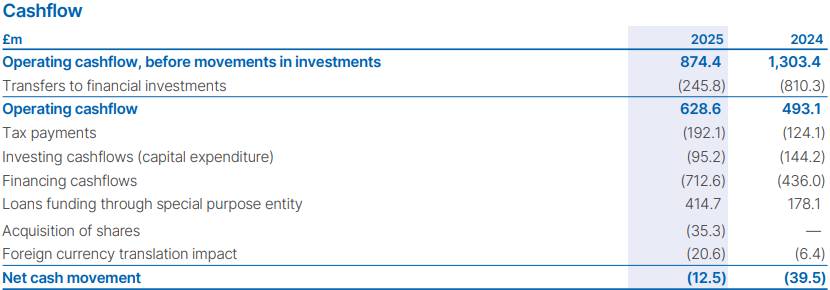
Source: Admiral Group plc Annual Report and Accounts 2025 Group capital structure and financial position included in the Strategic Report (pages 52–53). By comparison, the full IAS 7 Statement of Cash Flows reported in the financial statements can be found on page 209 of the Admiral Group plc Annual Report and Accounts 2025
Questions for ASAF members
- Do similar regulatory regimes, e.g. the Basel framework, apply in your jurisdiction to financial institutions?
- Do you have any comments on the findings and recommendations in the UKEB research paper on financial institutions?
- Do any of the findings and recommendations resonate with ASAF members?
- Are any of the findings contrary to findings in ASAF member jurisdictions?
- Do any of the recommendations raise concerns with ASAF members?
Link to UKEB research: https://www.endorsement-board.uk/statement-of-cash-flows
Appendix: UK Regulatory Regime
UK Regulatory Regime for Banks and Insurers
| Category | Banks | Insurance – general | Insurance – life |
|---|---|---|---|
| Regulator | Bank of England’s Prudential Regulation Authority (PRA) | Bank of England’s Prudential Regulation Authority (PRA) | Bank of England’s Prudential Regulation Authority (PRA) |
| Regime | Basel Committee for Banking Supervision (BCBS) | Solvency UK (Solvency II directive under Basel) | Solvency UK (Solvency II directive under Basel) |
| Liquidity requirements | - Liquidity Cover Ratio (LCR) - Unencumbered High-quality Liquid Assets (HQLA) - Net stable funding ratio (NSFR) |
N/A | N/A |
| Core financial and solvency information – capital management | - Minimum Capital Requirement (MCR) - Risk Weighted assets - Common Equity Tier 1 (CET1) - Minimum requirements for own funds and eligible liabilities (MREL) |
- Minimum Capital Requirement (MCR) - Solvency Capital Requirement (SCR) |
- Minimum Capital Requirement (MCR) - Solvency Capital Requirement (SCR) - UK Solvency II Own Funds |
| Public disclosure | - Pillar III disclosures (unaudited) | - Annual Solvency and Financial Condition Report (SFCR)2 | - Annual Solvency and Financial Condition Report (SFCR)2 |
Contact Info
UK Endorsement Board
1 Harbour Exchange
London
E14 9GE
If you would like to engage with the UKEB on this project, please contact:
Catherine Hollywood or Matthew Tilling by email: [email protected]
Email: [email protected]
Website: www.endorsement-board.uk
Follow us and Subscribe

Follow us on LinkedIn

Subscribe to our news alerts
UKEB Engagement Statistics: - 5 Research papers published - 17 Advisory and working group meetings
Footnotes
-
IFRS 18 introduced disaggregation principles for all primary financial statements including the cash flow statement – see section 2.4 Grouping of Information in IFRS 18 Effects Analysis published by the IASB in April 2024 – changes are effective 1 January 2027. ↩
-
An independent external audit is required of the SFCR, gathering sufficient appropriate evidence to provide an overall reasonable assurance opinion that the public disclosure in scope complies in all material respects with PRA rules and Solvency II Regulations. ↩↩