Cost and Benefits Assessment of Adopting IFRS Accounting Standards in the UK
International Forum of Accounting Standard Setters (IFASS) – 29 April 2026 Seema Jamil-O'Neill – Technical Director
The views expressed in this presentation are those of the presenter and not necessarily those of the Endorsement Board, nor are they necessarily reflective of any official policy or position.
Prevalence of IFRS in the UK
Estimated number of IFRS reporters in the UK
Approx. 11,000 entities1
Of which: approx. 1,400 listed entities 2
Mandatory application
UKEB statutory functions
The diagram illustrates the UKEB's statutory functions. Statutory powers are given to the UKEB by the Department of Business and Trade (DBT). These statutory functions are set out in Statutory Instrument 2019/685. The UKEB has two core functions: to Influence the development of international accounting standards, and to Adopt international accounting standards for use in the UK. The UKEB reports annually to the DBT Secretary of State on technical work.
UKEB adoption criteria
When a standard or amendment is issued by the IASB, to adopt it for use in the UK, the UKEB must assess whether it meets the following criteria:
- Standard is not contrary to the principle that the accounts must give a true and fair view
- Standard meets the technical accounting criteria of understandability, relevance, reliability and comparability
- The use of the standard is likely to be conducive to the long term public good (LTPG) in the UK
LTPG assessment: regulatory requirements
The long term public good assessment is comprised of a further technical analysis and an assessment of economic effects
- Whether use of the standard is likely to improve the quality of financial reporting
- Likely costs and benefits from the use of the standard
- Whether use of the standard is likely to have an adverse effect on the UK economy
Focus of today's presentation
UKEB approach to costs and benefits assessment
Assessment of direct costs : UKEB questionnaire
- The UKEB developed a standardised questionnaire to assess implementation costs
- Survey questions are based on academic literature and industry expertise
- Direct (compliance) costs - preparers are asked about costs incurred as a direct result of meeting the requirements of the standard
- Costs are both monetary and opportunity costs
- The table displays the cost categories investigated through the survey
| Questions focused on... | Incremental one-off | Incremental ongoing |
|---|---|---|
| Familiarisation | ✓ | ✕ |
| Changes to data handling processes and controls | ✓ | ✓ |
| Accounts preparation | ✓ | ✓ |
| Accounting system changes | ✓ | ✓ |
| Communication with third parties | ✓ | ✓ |
| Audit (internal and external) | ✓ | ✓ |
| Legal (internal and external) | ✓ | ✓ |
| Other | ✓ | ✓ |
References: Meeks and Meeks (2002); Schipper (2010); IFAC (2010); HMRC (2022); BIS (2010)
Assessment of direct benefits for users
- Assessing direct benefits for users is more challenging because:
- The impact on users' day-to-day activities and decision-making is difficult to identify and measure
- Users typically would not draw conclusions on benefits before seeing the updated accounts
- Impacts would depend on user type
- Users generally find it more difficult to engage with standard setting
- So far, the UKEB has conducted only qualitative assessments of benefits for users, using a standardised questionnaire
- Future UKEB research may focus on a more systematic assessment of direct benefits to users. This would allow:
- More targeted and better engagement
- A potential quantification of benefits
Cost of capital effects: theory
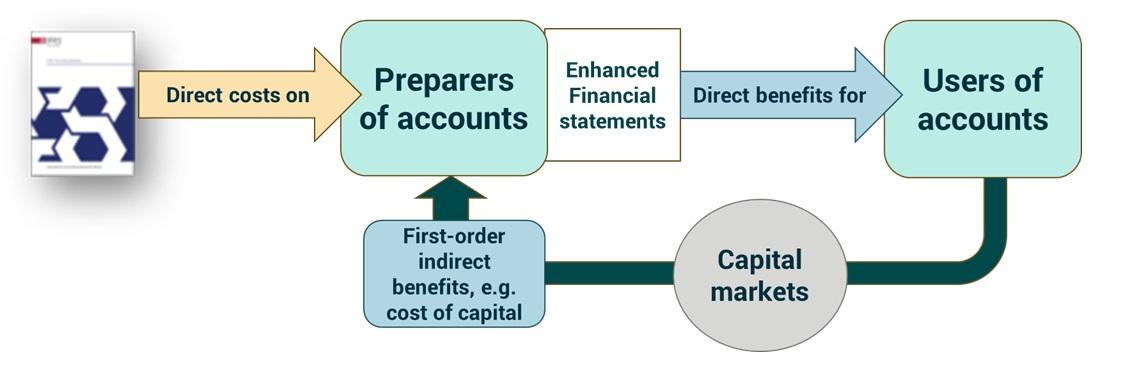
This diagram illustrates the theory behind cost of capital effects. Preparers provide better information in the form of financial reporting to Users. This improved financial reporting leads to improved capital allocation, which in turn results in enhanced liquidity and a reduction of bid/ask spreads. This reduction in liquidity and bid/ask spreads then leads to a reduction in the cost of capital for Preparers.
References: Leuz and Wisocki (2016); Armstrong, Core, Taylor and Verrecchia (2011); Meeks and Meeks (2001)
Estimating cost of capital effects: UKEB approach
- 1Implementation costs: for a given standard, the UKEB would firstly estimate market wide implementation costs
- 2Benefits for users: for a given standard, the UKEB would then assess whether users are likely to find the standard useful
- 3If users find the standard useful then it may be plausible to expect a cost of capital reduction
- 4The approach aims to estimate what cost of capital reduction would allow preparers to recover the estimated implementation costs in the long run
How are the indirect benefits expected to be delivered?
| Equity | Debt | |
|---|---|---|
| Increase in the value of traded securities | Market capitalisation | Market value of outstanding corporate bonds |
| Increase in the present value of future capital flows, discounted at the cost of capital | More projects funded through public equity issuances | More projects funded through publicly traded corporate bonds |
Example: equity flows
4.4 Basis points is the market-wide cost of equity reduction required for the present value of future equity flows to increase by £200,000,000
This bar chart shows CC reduction in Basis points (Y-axis) against Direct implementation costs (scenarios) on the X-axis.
The data points are: * £50,000,000 implementation costs: 1.1 Basis points reduction * £100,000,000 implementation costs: 2.2 Basis points reduction * £200,000,000 implementation costs: 4.4 Basis points reduction * £500,000,000 implementation costs: 10.9 Basis points reduction
There is an arrow from the "4.4 Basis points" bar pointing to the accompanying text box explaining the significance of 4.4 Basis points.
Note: 1Bps = 0.01%. Baseline cost of equity: 11.23% Source: UKEB calculations based on LSEG and Reuters-Eikon data
Application to IFRS 18
Implementation costs: UKEB estimated UK-specific implementation costs for IFRS 18 to be £390m and assessed that the standard would deliver benefits to users
For preparers to recover these costs, split between the four capital market effects described in the previous slide
| Cost Reduction Type | Impact on Capital |
|---|---|
| A cost of equity reduction of: | |
| 0.02 BPs would deliver the required increase in market cap | 3.22 BPs would deliver the required increase in the PV of future equity flows |
| A cost of debt reduction of: | |
| 0.72 BPs would deliver the required increase in value of bonds | 0.64 BPs would deliver the required increase in the PV of future debt flows |
Assuming: 75% through equity markets, 25% through debt markets
Questions for NSS
- Are other NSSs required to consider costs/benefits of adopting a new standard for use in their jurisdictions?
- What approach do other standard setters take to estimate implementation costs? What challenges do they face?
- What approach do other standard setters take to estimate benefits to users? What challenges do they face?
- What benefits to preparers from implementing a new standard are considered?
- As noted, the cost of capital approach is a break-even analysis that estimates the cost of capital reduction needed to recover implementation costs.
- Any thoughts on this type of analysis/narrative?
- Do other standard setters see the benefits of implementing a similar approach in their jurisdictions?
- If so, what challenges would they face?
Questions and answers
An illustration showing three wooden blocks spelling out "Q & A", symbolising a questions and answers session.
Footnotes
-
Source: HMRC estimates based on annual report filings. Estimates as of October 2025 ↩
-
Source: UKEB estimates based on London Stock Exchange Group (LSEG) and LSEG Workspace data, December 2025. This calculation includes companies listed on the LSEG Main Market, the Alternative Investment Market (AIM) and the Aquis Exchange. Estimates as of December 2025 ↩