4 IFRS 19 Subsidiaries without Public Accountability Disclosures
Executive Summary
| Project Stage | IASB | Research / Pipeline | Discussion Paper | Redeliberation | Exposure Draft | Redeliberation | Final Standard | Post Implementation Review |
|---|---|---|---|---|---|---|---|---|
| UKEB | Research / Influencing | Research / Influencing | Monitoring | Influencing | Monitoring | Endorsement | Influencing |
Project Type
Endorsement
Project Scope
Moderate
Purpose of the paper
This paper clarifies the feedback from respondents on the [Draft] Endorsement Criteria Assessment (ECA) for IFRS 19 Subsidiaries without Public Accountability: Disclosures, relating to:
- the reduced disclosure requirements set out under the subheading ‘IFRS 14 Regulatory Deferral Accounts' in which are not included in the scope of the adoption assessment; and
- the reference to IFRS Accounting Standards in paragraph 7(c) of IFRS 19, to assist subsidiaries on assessing their eligibility to use the Standard i.e. whether group accounts prepared in accordance with UK-adopted IAS would meet this criterion.
This paper also requests the Board's approval of the individual documents included in the 'adoption package' for the project to assess IFRS 19 for adoption, for use in the UK.
The documents included in the adoption package are:
[Draft]Endorsement Criteria Assessment (ECA);[Draft]Feedback Statement;[Draft]Due Process Compliance Statement;[Draft]Adoption Statement for IFRS 19; and- Annex to the Adoption Statement: Text of the UK-adopted international accounting standard (IFRS 19 Subsidiaries without Public Accountability: Disclosures).
The ECA and the Feedback Statement reflect the actions agreed at the March 2026 meeting.
This paper also asks Board members to provide a tentative vote on the adoption of IFRS 19.
Summary of the Issue
In November 2025, the UKEB published the [Draft] Endorsement Criteria Assessment of IFRS 19 ([Draft] ECA) that tentatively concluded IFRS 19 meets the adoption criteria set out in legislation.
The consultation on the [Draft] ECA closed on 26 February
- The UKEB received nine formal responses to the consultation. A summary of the feedback received, along with recommended changes to the
[Draft]ECA, was discussed by the Board in March 2026. The[Draft]ECA presented at this meeting has been revised to incorporate responses to the issues raised by the Board at its March 2026 meeting.
The paper includes:
- Clarification of concerns raised on the reduced disclosure requirements set out under the subheading 'IFRS 14 Regulatory Deferral Accounts' in IFRS 19 and the reference to IFRS Accounting Standards in paragraph 7(c) of the Standard for a decision on whether the issue is included in the final ECA.
[Draft]ECA for approval.[Draft]Feedback Statement for approval.[Draft]Due Process Compliance Statement for approval.[Draft]Adoption Statement for IFRS 19 for approval.
A tentative vote on the adoption of IFRS 19 will be held at this meeting.
Voting forms for the formal written vote will be sent to Board members after the April 2026 Board meeting.
The result of that formal vote, when completed, will be updated on the UKEB website, in line with the Board's Terms of Reference.
Decisions for the Board
| 1. | Does the Board agree with the Secretariat's recommendation in paragraph 11? |
| 2. | Does the Board agree with the Secretariat's recommendation in paragraph 29? |
| 3. | Subject to addressing any changes identified at this meeting, does the Board approve the documents in the adoption package? |
| 4. | Does the Board tentatively approve the adoption of IFRS 19 for use in the UK? |
Recommendation
The Secretariat recommends that the Board:
- approves the recommendation to enclose the IFRS 14 reduced disclosures in a box, shade them grey and add a footnote to clarify that they are not applicable, as IFRS 14 has not been adopted for use in the UK;
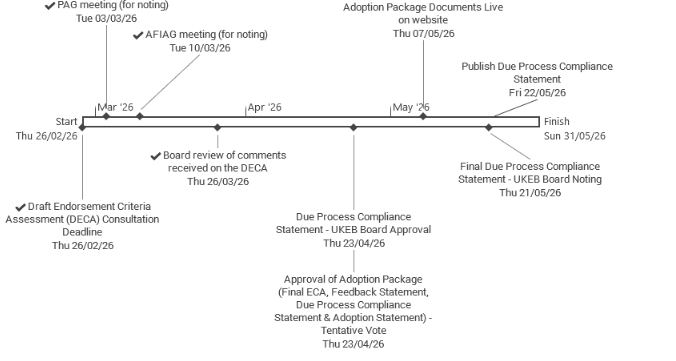
- agrees that no further action is required in relation to clarifying the scope of IFRS 19;
- approves the relevant documents in the adoption package; and
- tentatively approves the adoption of IFRS 19 for use in the UK.
Appendices
- Appendix A
[Draft]Endorsement Criteria Assessment - Appendix B
[Draft]Feedback Statement - Appendix C
[Draft]Due Process Compliance Statement - Appendix D
[Draft]Adoption Statement for IFRS 19 - Appendix E
[Draft]Annex to the Adoption Statement: Text of the UK-adopted international accounting standard (IFRS 19 Subsidiaries without Public Accountability: Disclosures)
Endorsement of IFRS 19
Background
1At its March 2026 meeting, the Board considered the summary of stakeholder feedback received following the UKEB's public consultation on the [Draft] Endorsement Criteria Assessment ([Draft] ECA). Most of the feedback received was supportive of the Board's assessment. The [Draft] ECA included in the adoption package has been revised to incorporate responses to the issues raised by the Board at its March 2026 meeting.
2The Board considered the summary of stakeholder feedback received following the UKEB's public consultation on the [Draft] ECA of whether to adopt IFRS 19 for use in the UK. Specifically, the Board:
- Asked to amend Figure 1, in paragraph 3.29, to avoid indicating there are two reporting frameworks for IAS accounts. The first box was changed from 'UK-adopted IAS' to ‘UK-adopted IAS with full disclosures'.
- After considering all the significant comments received on the Technical Accounting Criteria Assessment (in Section 4 of the
[Draft]ECA):- Agreed that no further work should be undertaken in respect of the suggestion to include, as part of the assessment against the technical accounting criteria, the differences in the disclosure requirements of IFRS 19 and the Financial Reporting Standard 101 Reduced Disclosure Framework (FRS 101).
- Decided not to amend the wording in paragraph 4.8 of the
[Draft]ECA in response to a comment suggesting the removal of the reference to the technical criteria assessment taking an absolute approach. - Amended Table 5 (paragraph 4.10 of the
[Draft]ECA) for IFRS 5 Non-current Assets Held for Sale and Discontinued Operations and IAS 41 Agriculture to indicate that, whilst the reductions are significant, this is unlikely to have a significant impact on the usefulness of financial statements for users of eligible subsidiaries' financial statements.
- Agreed to the following proposed changes in the Long-Term Public Good assessment (in Section 5 of the
[Draft]ECA), subject to the incorporation of the comments raised during the meeting:- Paragraph 5.59(e) added to note that some entities (either groups or subsidiaries) may incur familiarisation costs when considering adopting IFRS 19 but that the costs do not outweigh the benefits.
- Agreed that no changes are warranted in Section 6 (True and fair view), or Section 7 (Whether IFRS 19 is likely to lead to a significant change in accounting practice) of the
[Draft]ECA.
4The [Draft] ECA included in the adoption pack has been revised to incorporate these actions including minor editorial changes. Changes to the text arising from that feedback are marked up in Appendix A.
IFRS 14 Regulatory Deferral Accounts
Summary of concerns raised
5At the March 2026 meeting, the Board noted stakeholder feedback on the disclosure requirements for IFRS 14 included in IFRS 19. An accounting firm suggested that the UK-endorsed version of IFRS 19 should clarify whether the disclosure requirements for IFRS 14 apply. Another respondent (an individual) also observed that excluding IFRS 14 is inappropriate because the [Draft] ECA should assess IFRS 19 in its entirety. This respondent argued that the approach in the [Draft] ECA is tantamount to a carve-out, which is only warranted in exceptional circumstances.
Background
6Paragraphs 98-102 of IFRS 19 set out reduced disclosures for IFRS 14. In particular, the Standard requires the following reduced disclosures:
IFRS 14 Regulatory Deferral Accounts
Explanation of activities subject to rate regulation
98 An entity shall disclose, for each type of rate-regulated activity:
- a brief description of the nature and extent of the rate-regulated activity and the nature of the regulatory rate-setting process; and
- the identity of the rate regulator(s). If the rate regulator is a related party (as defined in IAS 24 Related Party Disclosures), the entity shall disclose that fact, together with an explanation of how it is related.
99 The disclosures required by paragraph 98 shall be given in the financial statements either directly in the notes or incorporated by cross-reference from the financial statements to some other statement, such as a management commentary or risk report, that is available to users of the financial statements on the same terms as the financial statements and at the same time. If the information is not included in the financial statements directly or incorporated by cross-reference, the financial statements are incomplete.
Explanation of recognised amounts
100 An entity shall disclose the basis on which regulatory deferral account balances are recognised and derecognised and how they are measured initially and subsequently, including how regulatory deferral account balances are assessed for recoverability and how any impairment loss is allocated.
101 For each type of rate-regulated activity, an entity shall disclose, for each class of regulatory deferral account balance, a reconciliation of the carrying amount at the beginning and the end of the reporting period in a table, unless another format is more appropriate. The entity shall apply judgement in deciding the level of detail necessary (see paragraphs 28-29 of IFRS 14 Regulatory Deferral Accounts), but these components would usually be relevant:
- the amounts that have been recognised in the current period in the statement of financial position as regulatory deferral account balances;
- the amounts that have been recognised in the statement(s) of profit or loss and other comprehensive income relating to balances that have been recovered (sometimes described as amortised) or reversed in the current period; and
- other amounts, separately identified, that affected the regulatory deferral account balances, such as impairments, items acquired or assumed in a business combination, items disposed of, or the effects of changes in foreign exchange rates or discount rates.
102 When an entity concludes that a regulatory deferral account balance is no longer fully recoverable or reversible, it shall disclose that fact, the reason why it is not recoverable or reversible and the amount by which the regulatory deferral account balance has been reduced.
Secretariat's analysis
7As IFRS 14 was not adopted in the EU, it was not on-shored into UK-adopted international accounting standards, at the point of the UK's exit from the EU.
8The Board agreed that the reduced disclosure requirements for IFRS 14 cannot be considered as part of the UKEB's adoption assessment of IFRS 19, and would not be considered a carve-out, as already explained in the introduction section of the [Draft] ECA (paragraph 2.7(c)) which states:
"IFRS 19 contains reduced disclosure requirements for IFRS 14 Regulatory Deferral Accounts. IFRS 14 is not adopted in the UK. Therefore, the reduced disclosure requirements set out under the subheading 'IFRS 14 Regulatory Deferral Accounts' in the Standard have not been included in the scope of this adoption assessment.”
9Further, footnote 76 to paragraph 4.69 of the [Draft] ECA, relating to the overall conclusion on whether IFRS 19 meets the technical accounting criteria, states that this conclusion excludes the disclosure requirements relating to IFRS 14, as IFRS 14 has not been adopted for use in the UK.
10The Secretariat considered the Board's request to further address the feedback relating to the IFRS 14 reduced disclosures i.e. assessing whether it is feasible to clarify in the UK-adopted version of IFRS 19 that the disclosure requirements for IFRS 14 do not apply.
Secretariat recommendation
11The Secretariat recommends that, in the UK-adopted version of IFRS 19, the IFRS 14 reduced disclosures, set out in paragraphs 98-102, be enclosed in a box and shaded grey (as shown in paragraph 6 above). A footnote would state that those disclosures are not applicable by entities applying the Standard under UK-adopted international accounting standards, as IFRS 14 has not been adopted for use in the UK (see relevant paragraphs in Appendix E).
Decision for the Board
| 1. | Does the Board agree with the Secretariat's recommendation in paragraph 11? |
Clarifying the Scope
Summary of concerns raised
12At the March 2026 meeting, the Secretariat informed the Board about a concern raised by an accounting firm regarding the IFRS 19 application eligibility criterion. The concern relates to the reference to IFRS Accounting Standards in paragraph 7(c) of IFRS 19 and the respondent asked for clarification to assist subsidiaries on assessing their eligibility to use the Standard. In particular, whether group accounts prepared in accordance with UK-adopted IAS would meet this criterion.
Background
13Paragraph 3.12 of the [Draft] ECA explains that IFRS 19 is a voluntary Standard. Paragraph 7 of IFRS 19 sets out the eligibility criteria that an entity is required to satisfy to apply the Standard:
"An entity may elect to apply this Standard in its consolidated, separate or individual financial statements if, and only if, at the end of the reporting period:
- it is a subsidiary;
- it does not have public accountability [....]; and
- it has an ultimate or intermediate parent that produces consolidated financial statements available for public use that comply with IFRS Accounting Standards."
14The criterion in paragraph 7(c) of IFRS 19, above, is not new in IFRS Accounting Standards. This criterion is based on the requirements in paragraph 4(a)(iv) of IFRS 10 Consolidated Financial Statements.1
15The Board agreed that the reference to IFRS Accounting Standards, in paragraph 7(c) of IFRS 19, includes UK-adopted international accounting standards, as set out in s474(1) of the Companies Act 2006.2
16However, the Board asked the Secretariat to consider whether further clarification of this point was needed, in the UK-adopted version of IFRS 19, for UK-registered companies to understand whether they are within the scope of the Standard.
Secretariat's analysis
ECA Scope
17The [Draft] ECA refers to the eligible entities within scope of the Standard (para 3.14), which includes:
- UK-registered subsidiaries of UK group companies; and
- UK-registered subsidiaries of group companies with overseas parents.
18In addition, UK group companies with overseas subsidiaries may also choose to apply IFRS 19 when preparing accounts for their overseas subsidiaries, to the extent that the standard is available for use in the relevant jurisdictions.
19The [Draft] ECA's UK long term public good assessment considered the costs and benefits accruing to subsidiaries and those affecting the group, as a whole, specifically:
- UK-registered subsidiaries of UK group companies;
- UK-registered subsidiaries of group companies with overseas parents; and
- overseas subsidiaries of UK group companies, to the extent that any costs/cost savings would be consolidated into group-level results.
20The determinants of the costs and benefits of applying IFRS 19 included the number of jurisdictions adopting IFRS 19. Stakeholders noted (para 5.46) that for groups to realise significant benefits, from the alignment of reporting requirements offered by IFRS 19, they will need to have a critical mass of eligible subsidiaries using the Standard, which will depend on global adoption of IFRS 19.
IASB's position on IFRS equivalence
21Some respondents in their comment letters to the IASB on the Exposure Draft to develop IFRS 19 suggested permitting subsidiaries without public accountability to apply the Standard if their parent applied a GAAP equivalent to IFRS Accounting Standards3.
22The IASB did not support this suggestion. The IASB further noted that:
"If the IASB were to introduce 'equivalence' into the Standard, it would need to define the meaning of 'equivalent to IFRS Accounting Standards'."
23After considering the feedback the IASB decided to confirm4 that an entity will only be permitted to apply the new IFRS Accounting Standard if:
- it is a subsidiary at the end of the reporting period; and
- it has an ultimate or intermediate parent that produces consolidated financial statements that:
- Comply with IFRS Accounting Standards.
- Are available for public use.
UK equivalent frameworks
24The Companies Act 2006, and other UK legislation, recognises UK-adopted international accounting standards as having equivalence to IFRS as issued by the IASB. The legislation, which includes exemptions from producing group accounts for UK companies included in [non-UK] group accounts of a larger group,5 and FCA exemptions relating to third country issuers,6 specifies third country reporting frameworks that have been granted equivalence to UK-adopted international accounting standards for those specific purposes.7
25However, none of the legislative requirements relating to equivalence are relevant to an entity's consideration of whether it is in scope of IFRS 19. The only exception would be where an intermediate parent entity refers to the equivalence legislation to decide whether it can claim exemption from producing group accounts. Otherwise, the relevant considerations for a standalone entity are set out in the diagram below:
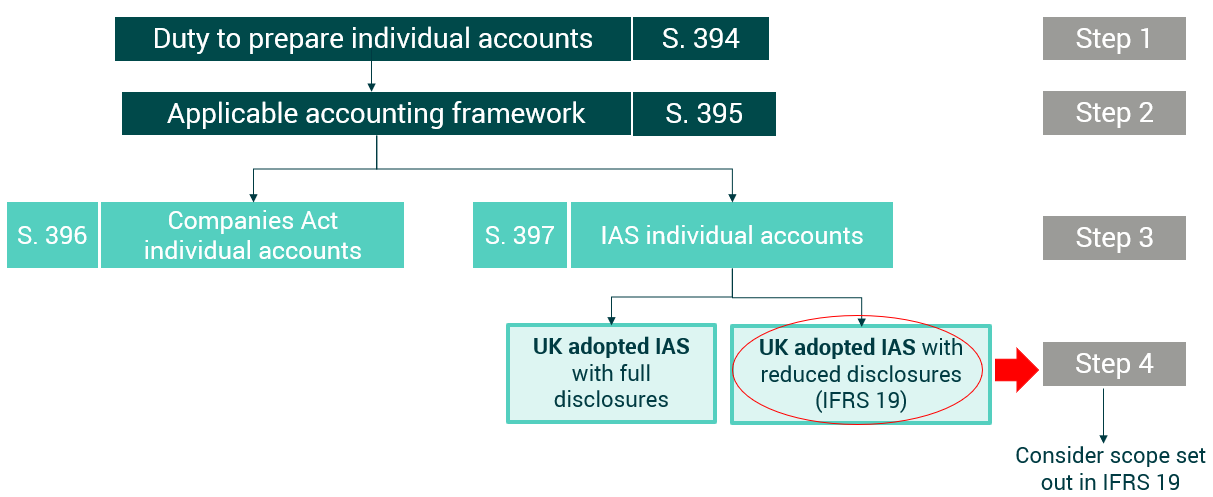
26For consideration of whether the entity is in scope of IFRS 19, the IASB's pronouncement on scope is the most relevant. The IASB has determined that the scope of IFRS 19 should be limited to entities which have an ultimate or intermediate parent that produces consolidated financial statements available for public use that comply with IFRS Accounting Standards, and those consolidated financial statements are available for public use.
27Whether the 'equivalent' financial reporting framework complies with IFRS Accounting Standards is a matter for the subsidiary and its parent to determine.
28In any event, it would not be appropriate for the UKEB to clarify within the adopted standard which frameworks could be classed as equivalent as this determination is outside the UKEB's remit, and these are subject to change.
Secretariat recommendation
29In light of the analysis above, the Secretariat does not recommend any amendments to the [Draft] ECA to further clarify that the reference to IFRS Accounting Standards in this context means UK-adopted IAS.
30Neither should any clarification be made directly to paragraph 7(c) in the UK-adopted version of IFRS 19. Adding clarification, i.e. a footnote, could be viewed as modifying or making additions to the Standard.
31To note, the Adoption Statement (Appendix D) confirms the definition of UK-adopted international accounting standards and references the relevant Statutory Instruments.
32If a UK subsidiary of a group with an overseas parent is uncertain whether its parent entity produces consolidated financial statements which comply with IFRS Accounting Standards, it should refer to the relevant jurisdiction's adoption of IFRS,8 or seek independent advice.
Decision for the Board
| 2. | Does the Board agree with the Secretariat's recommendation in paragraph 29? |
Adoption of IFRS 19
33In accordance with the UKEB's Due Process Handbook, paragraph 6.30, the project closure process for endorsement projects comprises the following steps:
- preparation of an 'adoption package' for the Standard; and
- voting on the adoption of the Standard.
Adoption package
34The Board is asked whether it has any comments on the documents which, in accordance with paragraph 6.31 of the Due Process Handbook, form the adoption package for IFRS 19:
- the Endorsement Criteria Assessment (Appendix A);
- the Feedback Statement (Appendix B);
- the draft Due Process Compliance Statement (Appendix C);
- the Adoption Statement for IFRS 19 (Appendix D); and
- the Annex to the Adoption Statement: the text of the UK-adopted international accounting standard (Appendix E).
Decision for the Board
| 3. | Subject to addressing any changes identified at this meeting, does the Board approve the documents in the adoption package? |
Voting on the adoption of IFRS 19
35Decisions on the adoption of a standard are made at public Board meetings and follow the requirements of paragraphs 5.3-5.5 of the UKEB's Terms of Reference (ToR).
36In line with the ToR and paragraphs 6.42-6.44 of the Due Process Handbook, at this meeting Board members are asked to provide a tentative vote on the adoption of IFRS 19 based on the information included in the adoption package.
Decision for the Board
| 4. | Does the Board tentatively approve the adoption of IFRS 19 for use in the UK? |
Next Steps
37The written forms for the formal vote will be sent to Board members in late April 2026. The result of that formal vote, when completed, will be updated on the UKEB website, in line with the Board's Terms of Reference.
38A final version of the Due Process Compliance Statement will be presented to the Board for noting in May 2026.
Endorsement and adoption timeline of IFRS 19 (effective 1 January 2027) — partial timeline for 2026
Appendix A: [Draft] Endorsement Criteria Assessment
IFRS 19 Subsidiaries without Public Accountability: Disclosures
November May 2026
OFFICIAL - PUBLIC DRAFT
DRAFT FOR DISCUSSION
The UKEB does not accept any liability to any party for any loss, damage or costs howsoever arising, whether directly or indirectly, whether in contract, tort or otherwise from an action or decision taken (or not taken) as a result of any person relying on or otherwise using this document or arising from any omission from it.
©20262025 All Rights Reserved
- Executive Summary
- Endorsement of IFRS 19
- IFRS 14 Regulatory Deferral Accounts
- Clarifying the Scope
- Adoption of IFRS 19
- Voting on the adoption of IFRS 19
- Next Steps
- Endorsement and adoption timeline of IFRS 19 (effective 1 January 2027) — partial timeline for 2026
- Appendix A: [Draft] Endorsement Criteria Assessment
- 1 Executive Summary
- 2 Introduction
- 3 Section 1: Main requirements in IFRS 19 and accounting impact
- Main requirements in IFRS 19
- Statement of compliance
- Comparative information
- Entities in scope of the Standard
- Eligible UK entities in scope of the Standard
- Users of subsidiaries' financial statements and their information needs
- Potential accounting impact of IFRS 19 in the UK
- UK accounting frameworks
- Potential accounting impact of IFRS 19 in the UK
- UK accounting frameworks
- Expected use of reduced disclosure standards in the UK
- Interaction with disclosure requirements in UK legislation
- Potential accounting impact of transition to IFRS 19
- 4 Section 2: Technical accounting criteria assessment
- Introduction
- Approach to the assessment against the technical accounting criteria
- Identification of 'key aspects'
- Assessment of the specific key aspects of reductions in disclosure requirements in IFRS 19 against the technical accounting criteria
- Transition requirements—first-time adoption and comparative information
- Assessment against the endorsement criteria
- Business combinations
- Assessment against the endorsement criteria
- Financial instruments
- Assessment against the endorsement criteria
- Interests in other entities
- Assessment against the endorsement criteria
- Statement of cash flows (presentation requirements)
- Assessment against the endorsement criteria
- Basis of preparation
- Assessment against the endorsement criteria
- Income taxes
- Assessment against the endorsement criteria
- Related party transactions
- Assessment against the endorsement criteria
- Impairment of assets
- Assessment against the endorsement criteria
- Impairment of assets
- Assessment against the endorsement criteria
- [Tentative] overall Overall conclusion on whether IFRS 19 meets the technical accounting criteria
- 5. Section 3: UK long term public good assessment
- Is use of IFRS 19 likely to improve the quality of financial reporting?
- Summary of whether IFRS 19 is likely to improve the quality of financial reporting
- Economic impact assessment
- Analysis of costs and benefits from the use of IFRS 19
- Collection of evidence
- Users
- Costs for users
- Preparers
- Overall impact of IFRS 19
- Benefits for preparers
- Group-level analysis
- Costs for preparers
- Group-level analysis
- Audit costs
- Costs and benefits to regulators
- Summary of costs and benefits analysis
- Costs and benefits to regulators
- Summary of costs and benefits analysis
- Analysis of wider economic effects
- Approach used for this assessment
- Transmission mechanisms
- First-order indirect effects (capital market effects)
- Second-order indirect effects
- Third-order effects
- Summary of the analysis of wider economic effects
- Consideration of the consequences of not adopting IFRS 19 (counterfactual analysis)
- [Tentative] Overall assessment
- 6. Section 4: True and fair view assessment
- 7. Section 5: Is IFRS 19 likely to lead to a significant change in accounting practice?
- Appendix A: Glossary
- Appendix B: UK statutory requirements for adoption and the approach to the endorsement criteria assessment
- Introduction
- UK statutory requirements
- Approach to the endorsement criteria
- Technical accounting criteria: Relevance, Reliability, Understandability and Comparability
- Whether IFRS 19 is likely to be conducive to the long term public good in the UK
- True and fair view assessment
- Does IFRS 19 lead to a significant change in accounting practice?
- Appendix C: Overarching differences between IFRS 19 and FRS 101
- Appendix D: Evidence about the costs and benefits of IFRS 19
- Evidence from qualitative interviews with lenders
- The potential impact of IFRS 19 on preparers: case studies
- Third-party work on the economic assessment of IFRS 19
- IASB Effects Analysis
- Determinants of effects
- Costs
- Benefits
- European Financial Reporting Advisory Group (EFRAG) Draft Endorsement Advice on IFRS 19
- Feedback Statement: IFRS 19 Subsidiaries without Public Accountability: Disclosures
- Purpose of this Feedback Statement
- Description of IFRS 19 – overall
- Description of IFRS 19 – main requirements
- Stakeholder feedback
- UKEB consultation on the Draft [ECA]
- Overall Assessment
- Detailed Assessment – glossary
- Disclaimer
- Contact Us
- Appendix C: [Draft] Due Process Compliance Statement
- Appendix D: Adoption Statement
- Disclaimer
- Contact Us
- Appendix C: [Draft] Due Process Compliance Statement
- Appendix D: Adoption Statement
- Approval by the UK Endorsement Board
- UK-Adopted International Accounting Standards
- Accounting Standards issued at 1 January 2026
- International Financial Reporting Standard 19
- Subsidiaries without Public Accountability: Disclosures
- Objective
- Meeting the objective
- Scope
- Electing or revoking an election to apply this Standard
- Interaction with IFRS 1 First-time Adoption of International Financial Reporting Standards
- Disclosure requirements
- IFRS 2 Share-based Payment
- IFRS 3 Business Combinations
- IFRS 5 Non-current Assets Held for Sale and Discontinued Operations
- IFRS 6 Exploration for and Evaluation of Mineral Resources
- IFRS 7 Financial Instruments: Disclosures
- Interests in unconsolidated structured entities
- IFRS 13 Fair Value Measurement
- IFRS 14 Regulatory Deferral Accounts
- IFRS 15 Revenue from Contracts with Customers
- IFRS 16 Leases
- IFRS 18 Presentation and Disclosure in Financial Statements
- IAS 2 Inventories
- IAS 7 Statement of Cash Flows
- IAS 8 Basis of Preparation of Financial Statements
- IAS 10 Events after the Reporting Period
- IAS 12 Income Taxes
- IAS 16 Property, Plant and Equipment
- IAS 19 Employee Benefits
- IAS 20 Accounting for Government Grants and Disclosure of Government Assistance
- IAS 21 The Effects of Changes in Foreign Exchange Rates
- IAS 23 Borrowing Costs
- IAS 24 Related Party Disclosures
- IAS 27 Separate Financial Statements
- IAS 29 Financial Reporting in Hyperinflationary Economies
- IAS 32 Financial Instruments: Presentation
- IAS 34 Interim Financial Reporting
- IAS 36 Impairment of Assets
- IAS 37 Provisions, Contingent Liabilities and Contingent Assets
- IAS 38 Intangible Assets
- IAS 40 Investment Property
- Cost model
- IAS 41 Agriculture
- Appendix A—Effective date and transition
- Appendix B—Disclosure requirements if an entity applies IFRS 19 before applying IFRS 18
- Fair presentation and compliance with IFRS Accounting Standards
- Change in accounting policy, retrospective restatement or reclassification
- Right to defer settlement of liabilities for at least 12 months
- Information to be presented either in the statement of financial position or in the notes
- Statement of changes in equity
- Disclosure of accounting policy information
- Sources of estimation uncertainty
- Other disclosures
- Disclosure requirements in IAS 1 that remain applicable
- Appendix C—Amendments to other IFRS Accounting Standards
- Appendix D Exemptions from other IFRSs
- Share-based payment transactions
- IFRS 5 Non-current Assets Held for Sale and Discontinued Operations
- IFRS 13 Fair Value Measurement
- IFRS 17 Insurance Contracts
- IFRS 18 Presentation and Disclosure in Financial Statements
- Appendix C
- IAS 32 Financial Instruments: Presentation
- IAS 34 Interim Financial Reporting
- IFRIC 14 IAS 19–The Limit on a Defined Benefit Asset, Minimum Funding Requirements and their Interaction
1 Executive Summary
Background
1.1IFRS 19 Subsidiaries without Public Accountability: Disclosures was issued by the International Accounting Standards Board (IASB) in May 2024. This [Draft] Endorsement Criteria Assessment ([Draft] ECA) presents the UKEB's assessment of whether the Standard, as subsequently amended, meets the UK's statutory requirements for adoption of IFRS.
1.2This assessment addresses the endorsement criteria set out in Regulation 7 of Statutory Instrument (SI) 2019/685 (the Regulations). These endorsement criteria are described in more detail in Appendix B. Section 4, 5 -3 4, 6 and 3 discuss whether these criteria are met.
1.3The [Draft] ECA also addresses, in Section 5, Section 7 Section 7 whether IFRS 19 is likely to lead to a significant change in accounting practice, as set out in Regulation 11 of SI 2019/685.
1.4The UKEB conducted targeted outreach activities to collect evidence to assess whether IFRS 19 meets the technical and the long term public good assessment criteria for endorsement.
IFRS 19 Subsidiaries without Public Accountability: Disclosures
1.5A summary of the requirements of IFRS 19 is presented in Section 3 Section 1 Section 1 of this [Draft] ECA. IFRS 19 is a reduced disclosure IFRS Accounting Standard. It has an effective date of 1 January 2027, with earlier application permitted [(subject to UKEB adoption in the UK)].
Technical accounting criteria
1.6The assessment of IFRS 19 against the technical accounting criteria in Section 4 Section 2 Section 4 of this [Draft] ECA considers the Standard, together with all the amendments, to date. Given that IFRS 19 is a voluntary, disclosure-only standard and taking a proportionate approach, only key aspects of reductions in disclosures were analysed against the technical accounting criteria (an 'exceptions-based approach').
1.7In conducting this overall assessment against the technical accounting criteria, the UKEB is required to adopt an absolute, rather than a relative, approach.
1.8Overall, the UKEB [tentatively] concluded that IFRS 19 meets the technical accounting criteria.
UK long term public good
1.9The UKEB's analysis of whether IFRS 19 is likely to be conducive to the long term public good in the UK is presented in Section 5 Section 3 Section 5 of this [Draft] ECA.
1.10The assessment concludes that IFRS 19 will lead to improvements in the quality of financial reporting in the UK. In particular, it will enable groups using IFRS with eligible subsidiaries to apply consistent accounting policies when preparing financial statements throughout the group.
1.11The cost benefit analysis (CBA) takes a qualitative approach as there will be substantial variation in the nature and extent of the costs and benefits of IFRS 19 for entities, depending on their specific circumstances. However, as IFRS 19 is a voluntary standard, preparers will only apply it if they assess that benefits will outweigh implementation costs.
1.12Engagement with users suggested that the reduced disclosures are tailored towards their needs and carry a limited risk that they will lose decision-useful information.
1.13IFRS 19 is not expected to lead to wider economic effects that are detrimental to the UK economy, including on economic growth. An analysis of a non-adoption counterfactual illustrates that not adopting IFRS 19 for use in the UK would have a potentially detrimental effect on the UK economy.
1.14Overall, the UKEB [tentatively] concluded that the use of IFRS 19 is likely to be conducive to the long term public good in the UK.
True and fair view principle
1.15Section 6 Section 4 Section 6 of the [Draft] ECA addresses whether IFRS 19 is not contrary to the true and fair view principle for both individual and consolidated accounts Regulation 7(1)(a) of SI 2019/685 (namely, the assets, liabilities, financial position and profit or loss) in the context of the preparation of the accounts, as a whole.
1.16The assessment has not identified any IFRS 19 requirement that would prevent individual or consolidated accounts prepared using IFRS 19 from giving a true and fair view of the entity's assets, liabilities, financial position and profit or loss. Consequently, the UKEB [tentatively] concluded that IFRS 19 is not contrary to the true and fair view principle set out in Regulation 7(1)(a) of SI 2019/685.
Is IFRS 19 likely to lead to a significant change in accounting practice?
1.17In Section 7 Section 5 Section 7 of the [Draft] ECA, the UKEB considers that IFRS 19 will not significantly change the way eligible subsidiaries communicate information in the primary financial statements and the notes. The Standard does not change the recognition, measurement and presentation requirements in IFRS Accounting Standards and offers limited reductions in disclosures.
1.18As a result, it [tentatively] concludes that IFRS 19 is not likely to lead to a significant change in accounting practice and does not meet the criteria for a post-implementation review (PIR) under Regulation 11 in SI 2019/685.
Legal Context
1.19IFRS 19 is a reduced disclosure Standard, which is only available to eligible subsidiaries preparing their accounts under IFRS Accounting Standards. The IASB sets out the scope of the Standard9, by reference to its definition of "public accountability”10.
1.20The UK Government sets the scope of reporting requirements for UK-registered entities under the Companies Act 2006 (the Act). Part 16 of the Act defines "public interest entity"11 and “public interest company”12 in relation to Audit requirements. The definitions are not relevant in the context of reporting under UK-adopted international accounting standards.
1.21The Board considered whether the difference, between the definition in the Standard and the definitions in the Act, was of relevance or concern. The Board's view is that a company, which is either required or permitted to apply UK-adopted international accounting standards, would be permitted to apply IFRS 19, if it falls within the scope set out in the Standard. Therefore, this issue is not deemed relevant to the UKEB's endorsement assessment of IFRS 19. The Companies Act public interest considerations would also continue to apply, as relevant.
2 Introduction
Purpose
2.1The UK Endorsement Board (UKEB) is the UK National Standard Setter for IFRS13, responsible for the endorsement and adoption of international accounting standards, for use in the UK.
2.2The purpose of this [Draft] Endorsement Criteria Assessment (ECA) is to determine whether IFRS 19 Subsidiaries without Public Accountability: Disclosures (the Standard) issued by the International Accounting Standards Board (IASB) in May 2024 and as amended subsequently14, meets the UK's statutory requirements for adoption as set out in Regulation 7 of Statutory Instrument 2019/68515 (SI 2019/685).
2.3The Standard has an effective date of 1 January 2027 with earlier application permitted [subject to adoption for use in the UK]. If an entity applies IFRS 19 for an earlier period, it shall disclose that fact in the notes.
2.4The UKEB actively influenced the development of IFRS 19. This included submitting Final Comment Letters on:
- 23 February 202216, in response to the IASB's Exposure Draft ED/2021/7 Subsidiaries without Public Accountability: Disclosures17 (ED); and
- 28 November 202418, in response to the IASB's Exposure Draft ED/2024/5 Amendments to IFRS 19 Subsidiaries without Public Accountability: Disclosures (the 'catch-up' ED)19.
Background to the Standard
2.5Section 3 Section 1 Section 3 of this [Draft] ECA provides a brief description of the main requirements in the Standard, and a high-level analysis of the potential accounting impact in the UK.
Scope of the adoption assessment
2.6IFRS 19 is a voluntary international reduced disclosure standard for the preparation of eligible subsidiaries' financial statements, as part of IFRS Accounting Standards.
2.7For the purposes of this adoption assessment, any reference to IFRS 19 or the Standard means the Standard as issued in May 2024, including the consequential amendments and the Amendments, i.e. the amended Standard. The following are relevant:
- The IASB issued consequential amendments to IFRS 19 when issuing the following amendments to IFRS Accounting Standards:
- Amendments to IFRS 9 and IFRS 7–Amendments to the Classification and Measurement of Financial Instruments, issued in May 2024; and
- Amendments to IFRS 9 and IFRS 7–Contracts Referencing Nature-dependent Electricity, issued in December 2024.
- In addition, in August 2025, the IASB issued Amendments to IFRS 19 Subsidiaries without Public Accountability: Disclosures (the 'Amendments') which included limited reductions to disclosure requirements for new or amended IFRS Accounting Standards issued between 28 February 2021 and May 2024.
- IFRS 19 contains reduced disclosure requirements for IFRS 14 Regulatory Deferral Accounts. IFRS 14 is not adopted in the UK. Therefore, the reduced disclosure requirements set out under the subheading 'IFRS 14 Regulatory Deferral Accounts' in the Standard have not been included in the scope of this adoption assessment.
2.8UK-adopted international accounting standards comprise only the mandatory sections of standards20 The Bases for Conclusions, Implementation Guidance, and Illustrative Examples of the IFRS Accounting Standards are not adopted by the UKEB and amendments to these non-mandatory sections are not considered in this [Draft] ECA.21
Structure of the assessment
2.9The UKEB's analysis is presented in the following sections:
- Appendix B describes UK statutory requirements for the adoption of new or amended international accounting standards and the approach to the endorsement criteria assessment.
Section 3 Section 1Section 3 outlines:- the main requirements in the Standard;
- entities in scope of the Standard;
- users of subsidiaries' financial statements and their information needs; and
- the potential accounting impact of IFRS 19 in the UK.
- Sections 2-4 discuss whether IFRS 19 meets the requirements for adoption described in Appendix B. More specifically:
Section 4Section 2Section 4: addresses whether IFRS 19 meets the technical accounting criteria and explains the approach to the assessment of these criteria;Section 5Section 3Section 5: analyses whether IFRS 19 is likely to be conducive to the long term public good in the UK; and,Section 6Section 4Section 6: considers whether IFRS 19 is not contrary to the true and fair view principle for individual and consolidated accounts.
Section 7 Section 5Section 7 considers whether IFRS 19 is likely to lead to a significant change in accounting practice.
[Draft Adoption decision]
2.10Sections 4, 5 and 62, 3, and 4 Sections 4, 6 and 3 set out how IFRS 19 meets the requirements for adoption described in Appendix B of this document.
2.11[On the basis of these assessments, and subject to any stakeholder feedback received, the UKEB [tentatively] concludes that IFRS 19 meets the statutory endorsement criteria. Therefore, the UKEB is [tentatively] of the view that it will adopt IFRS 19 for use in the UK.]
3 Section 1: Main requirements in IFRS 19 and accounting impact
3.1This section outlines:
- the main requirements in the Standard;
- entities in scope of the Standard;
- users of subsidiaries' financial statements and their information needs; and
- the potential accounting impact of IFRS 19 in the UK.
Main requirements in IFRS 19
Overview of the Standard
3.2IFRS 19 is a reduced disclosure IFRS Accounting Standard. It was developed as part of the IASB's Disclosure Initiative — a set of projects aimed at improving the effectiveness of financial statement disclosures. The IASB developed IFRS 19 in response to demand from stakeholders, particularly preparers, who requested that eligible subsidiaries should be permitted to apply the recognition, measurement and presentation requirements of IFRS Accounting Standards but with reduced disclosure requirements.
3.3IFRS 19 aims to simplify the preparation of financial statements for eligible subsidiaries by reducing the required disclosures in their financial statements, compared with disclosure requirements in full IFRS Accounting Standards.
3.4The objective of IFRS 19 as stated in paragraph 1 of the Standard is as follows:
“IFRS 19 Subsidiaries without Public Accountability: Disclosures specifies the disclosure requirements an entity is permitted to apply instead of the disclosure requirements in other IFRS Accounting Standards."
3.6IFRS 19 does not change the recognition, measurement or presentation requirements in other IFRS Accounting Standards. These must still be followed by entities applying IFRS 19.
3.7To illustrate the approach IFRS 19 takes, in reporting items of inventory, an eligible subsidiary applies:
- the recognition, measurement and presentation requirements in IAS 2 Inventories; and
- the disclosure requirements in IFRS 19, under the subheading 'IAS 2 Inventories'.
3.8Paragraph 6 of IFRS 19 requires entities to provide additional disclosures if they consider that users would not be able to understand a subsidiary's financial position, financial performance and cash flows from the disclosures provided under IFRS 19.
Statement of compliance
3.9IFRS 19 is part of IFRS Accounting Standards. An eligible subsidiary which applies IFRS 19 asserts its compliance with IFRS Accounting Standards and states that it has applied IFRS 19.
Comparative information
3.10IFRS 19 allows eligible subsidiaries that elect to apply the Standard in one reporting period to later revoke that prior election. Furthermore, an entity is not prohibited from electing to apply IFRS 19 again, after a previous revocation of an election to apply the Standard.
3.11Table 1 below summarises the requirements in IFRS 19 for comparative information.
| Comparative information requirements |
|---|
| IFRS 19 applied to current period, full IFRS applied to previous period |
| Comparative information (that is, information for the preceding period) is required for all amounts reported in the current period's financial statements i.e. fewer disclosures in the current period under IFRS 19, unless IFRS 19 or another IFRS Accounting Standard permits or requires otherwise. |
| Full IFRS applied to current period, IFRS 19 was applied to previous period |
| Comparative information is required, in respect of the preceding period, for all amounts reported in the current period's financial statements i.e. more disclosures in the current period under full IFRS Accounting Standards, unless another IFRS Accounting Standard permits or requires otherwise. |
Entities in scope of the Standard
Entities eligible to apply the Standard
3.12IFRS 19 is a voluntary Standard. Paragraph 7 of IFRS 19 sets out the eligibility criteria that an entity is required to satisfy to apply the Standard:
"An entity may elect to apply this Standard in its consolidated, separate or individual financial statements if, and only if, at the end of the reporting period:
- it is a subsidiary;
- it does not have public accountability [....]; and
- it has an ultimate or intermediate parent that produces consolidated financial statements available for public use that comply with IFRS Accounting Standards."
3.13Paragraph 11 of IFRS 19 defines public accountability22:
"An entity has public accountability if:
- its debt or equity instruments are traded in a public market or it is in the process of issuing such instruments for trading in a public market (a domestic or foreign stock exchange or an over-the-counter market, including local and regional markets); or
- it holds assets in a fiduciary capacity for a broad group of outsiders as one of its primary businesses (for example, banks, credit unions, insurance companies, securities brokers/dealers, mutual funds and investment banks often meet this second criterion).”
Eligible UK entities in scope of the Standard
3.14In the UK, IFRS 19 could be adopted by:
- UK-registered subsidiaries of UK group companies; and
- UK group companies with overseas subsidiaries; and
3.15In addition, UK group companies with overseas subsidiaries may also choose to apply IFRS 19 when preparing accounts for their overseas subsidiaries, to the extent that the standard is available for use in the relevant jurisdictions.
3.16Current estimates put the potential number of subsidiaries owned by entities listed on the London Stock Exchange (LSE), as of January 2025, eligible to apply IFRS 19, using the scope and definitions of the Standard23 at approximately 78,000. It includes approximately 21,000 subsidiaries domiciled in the UK and 57,000 subsidiaries domiciled abroad24 25.
3.17UK law permits unlisted UK-registered companies the option to use UK-adopted international accounting standards, and approximately 14,000 such companies take up this option26. It is acknowledged that subsidiaries of unlisted groups (which do not have public accountability) are in the scope of IFRS 19 and may elect to apply the Standard if they satisfy the eligibility criteria in IFRS 1927. However, due to lack of data availability, it was not possible to estimate the number of eligible subsidiaries owned by private or foreign-domiciled groups.
Users of subsidiaries' financial statements and their information needs
3.18Financial statements of subsidiaries without public accountability typically have few users and do not tend to attract a lot of investor interest. Typically, the main users are internal, such as parent entities. The few external users are primarily providers of credit such as bank lending departments. Other external users may include non-controlling shareholders and suppliers28.
3.19Typically, internal users of subsidiaries' financial statements can request additional information directly from management. Therefore, they are unlikely to rely solely on publicly available financial statements to satisfy their information needs. Whilst some external users, e.g. bank lending departments can also request additional information, it is not available to the other external users such as non-controlling shareholders.
3.20Table 2 below summarises non-controlling interests (NCI) data obtained from the 2023 consolidated financial statements of UK listed entities:
| Table 2: Prevalence of non-controlling interests (NCI) in UK listed entities29 | |
|---|---|
| Dimension | Observation |
| Total book value of NCI | £40bn Approx |
| Proportion of aggregate net assets represented by NCI | 2.5% Approx |
| Proportion of UK listed entities reporting NCI in equity | 26% Approx |
Source: UKEB calculations based on Reuters-Eikon data. Figures are consolidated and do not comprise intercompany transactions, meaning that the sum of NCI for individual subsidiaries is likely to be higher.
3.21In addition, the proportion of FTSE 100 listed entities reporting NCI was much higher than that for FTSE 250 listed entities, indicating that NCI are concentrated among larger companies by market capitalisation. More specifically, fewer than 10 entities account for approximately 80% of the total book value of NCI reported by all listed entities. NCI are most commonly reported by entities in the energy and basic materials industry sectors.30
3.22Outreach with preparers suggests that the main external user group of their subsidiaries' financial statements is providers of credit such as bank lending departments. These lenders are particularly interested in the subsidiaries' financial statements when external borrowings are not supported by parent or intra-group guarantees.
3.23Providers of credit to eligible subsidiaries are likely to be focused on information about the liquidity and solvency of the eligible subsidiary, consistent with the principles for reducing disclosures in IFRS 19.31 [Preliminary] Outreach with bank lending departments has confirmed that these principles provide them with useful information that meets their needs in analysing financial statements of subsidiaries without public accountability. Specifically, lenders indicated that information about the cash flows of a subsidiary is useful in assessing repayment capacity i.e. liquidity and solvency.32 Lenders may also be interested in information about assets which could be pledged as security for amounts borrowed by the eligible subsidiary.
Potential accounting impact of IFRS 19 in the UK
3.24The objective of IFRS 19 is to simplify the preparation of eligible subsidiaries' financial statements whilst maintaining the usefulness of the financial statements to their users.
3.25Currently, subsidiaries of groups preparing consolidated financial statements using full IFRS Accounting Standards either use local Generally Accepted Accounting Principles (GAAP) or full IFRS Accounting Standards to prepare their individual financial statements.
- If local GAAP is used, subsidiaries have to prepare financial information on a full IFRS basis for group reporting, as well as preparing financial information on a local GAAP basis for their statutory financial statements. This dual reporting means that, usually, reconciliations between local GAAP and full IFRS Accounting Standards information are needed. If such entities are able to apply IFRS 19 instead, the recognition, measurement and presentation of items would be aligned with full IFRS Accounting Standards, eliminating the need for such dual reporting and reconciliations.
- If full IFRS Accounting Standards are currently used, eligible subsidiaries will continue to have recognition, measurement and presentation of items aligned with group reporting, but will benefit from the reduced disclosure requirements by applying IFRS 19.
UK accounting frameworks
3.26Section 395 of the Companies Act 2006 (the Act) defines the accounting frameworks to be used by an individual UK company when preparing its financial statements. It specifies the use of one of the following two accounting frameworks for the preparation of accounts:33
capacity i.e. liquidity and solvency.34 Lenders may also be interested in information about assets which could be pledged as security for amounts borrowed by the eligible subsidiary.
Potential accounting impact of IFRS 19 in the UK
3.24The objective of IFRS 19 is to simplify the preparation of eligible subsidiaries' financial statements whilst maintaining the usefulness of the financial statements to their users.
3.25Currently, subsidiaries of groups preparing consolidated financial statements using full IFRS Accounting Standards either use local Generally Accepted Accounting Principles (GAAP) or full IFRS Accounting Standards to prepare their individual financial statements.
- If local GAAP is used, subsidiaries have to prepare financial information on a full IFRS basis for group reporting, as well as preparing financial information on a local GAAP basis for their statutory financial statements. This dual reporting means that, usually, reconciliations between local GAAP and full IFRS Accounting Standards information are needed. If such entities are able to apply IFRS 19 instead, the recognition, measurement and presentation of items would be aligned with full IFRS Accounting Standards, eliminating the need for such dual reporting and reconciliations.
- If full IFRS Accounting Standards are currently used, eligible subsidiaries will continue to have recognition, measurement and presentation of items aligned with group reporting, but will benefit from the reduced disclosure requirements by applying IFRS 19.
UK accounting frameworks
3.26Section 395 of the Companies Act 2006 (the Act) defines the accounting frameworks to be used by an individual UK company when preparing its financial statements. It specifies the use of one of the following two accounting frameworks for the preparation of accounts:35
- UK-adopted International Accounting Standards (IAS individual accounts); or
- the framework set out in the Act (Companies Act individual accounts).
3.27UK-registered companies (except for charities) may choose to use either of these two frameworks when preparing their individual accounts.
3.28[IFRS 19 endorsed for use in the UK is part of UK-adopted international accounting standards. Accordingly, eligible subsidiaries electing to use IFRS 19 will be preparing IAS accounts.] 3.29The figure below provides a visual representation of the implications of IFRS 19 for UK accounting frameworks.
Figure 1: Implications of IFRS 19 for UK accounting frameworks
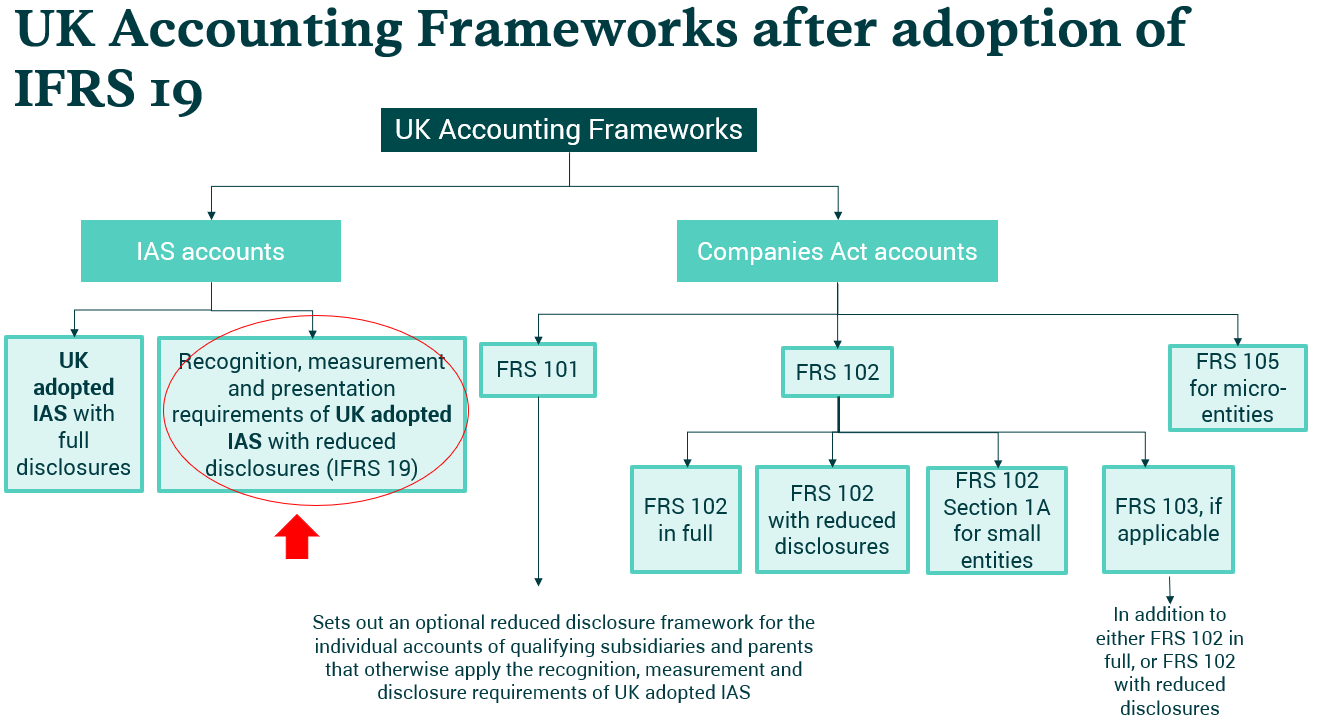
3.30The different financial reporting standards and options under UK GAAP result in various options for the preparation of Companies Act accounts.
3.31If Companies Act accounts are prepared, subsidiaries of UK listed groups may apply:
- Financial Reporting Standard 102 The Financial Reporting Standard applicable in the UK and Republic of Ireland (FRS 102);36 or
- if they are qualifying entities,37 they may elect to apply Financial Reporting Standard 101 Reduced Disclosure Framework (FRS 101).
3.32An entity that applies FRS 102 is required to apply FRS 103 Insurance Contracts to:
- insurance contracts (including reinsurance contracts) that it issues and reinsurance contracts that it holds; and
- financial instruments (other than insurance contracts) that it issues with a discretionary participation feature.
FRS 103 has been included in the figure for completeness.
3.33FRS 105 The Financial Reporting Standard applicable to the Micro-Entities Regime has been included here for completeness but would not be available for use by subsidiaries within a group containing a traded entity or if the subsidiary is consolidated into group accounts.
3.34[IFRS 19 [(if adopted for use in the UK)] does not introduce a new accounting framework, as it is part of the current IAS accounts framework]. 3.35[Preliminary] Feedback from UKEB outreach with users, in particular bank lending departments, indicated that the introduction of IFRS 19 will not introduce significant additional complexity to the UK Accounting Framework. These users regularly deal with multiple existing accounting standards and raised no concerns about the introduction of IFRS 19 as an option for preparing subsidiary financial statements.
Expected use of reduced disclosure standards in the UK
3.36FRS 101, the reduced disclosure Standard under the Companies Act accounts framework, is conceptually similar to IFRS 19. It permits eligible entities to apply recognition, measurement and presentation requirements in UK-adopted international accounting standards, with some amendments in place for compliance with the Act.
3.37The scope and disclosure requirements of FRS 101 and IFRS 19 differ in some respects. Table 3 below compares the scope of the two reduced disclosure standards. Regarding the disclosure requirements, broadly fewer disclosures are required under FRS 101 than under IFRS 19.
| IFRS 19 | FRS 101 | |
|---|---|---|
| Scope | May be applied by subsidiaries that do not have public accountability. | May be applied to the individual financial statements of a qualifying entity. |
| Definition | An eligible subsidiary should have an ultimate or intermediate parent that produces consolidated financial statements available for public use that comply with IFRS Accounting Standards. An entity has public accountability and therefore is not eligible to apply IFRS 19 if:
|
A qualifying entity is a member of a group where the parent of that group prepares publicly available consolidated financial statements which are intended to give a true and fair view (of the assets, liabilities, financial position and profit or loss)38 and that member is included in the consolidation. The following are not qualifying entities:
|
| Entity | ||
| Available to individual financial statements of subsidiaries | ||
| Available to individual financial statements of ultimate parent companies | ||
| Available to consolidated financial statements of intermediate parent companies |
3.38Refer to Appendix C for more detail on the key differences between the two standards.
3.39Desk-based research, and feedback from outreach with preparers, has indicated that FRS 101 is widely used for the preparation of UK-registered subsidiary financial statements. Initial preparer feedback also suggests that most UK groups are likely to continue to use FRS 101 to prepare the financial statements of UK subsidiaries. One reason for this may be that FRS 101 provides an exemption from the requirement to prepare a statement of cash flows. There is no equivalent exemption under IFRS 19.
3.40UK-registered subsidiaries of overseas groups can currently use FRS 101, FRS 102, or full IFRS to prepare their financial statements. Some UK and overseas groups wanting to use a reduced disclosure framework which aligns UK subsidiaries' financial reporting with that of overseas subsidiaries, may choose to apply IFRS 19. Some UK-registered subsidiaries currently using FRS 101 may choose to apply IFRS 19.
Interaction with disclosure requirements in UK legislation
3.41The Companies Act 2006 sets out information to be given in notes to the annual accounts.40 The required information includes, material off-balance sheet arrangements, directors' remuneration, details of directors' advances, credits and guarantees. These disclosure requirements are applicable to Companies Act accounts and some are also applicable to IAS accounts.
3.42However, the Large and Medium-sized Companies and Groups (Accounts and Reports) Regulations 200841 set out a number of requirements relating to, for example, required formats for accounts, accounting principles and rules, historical cost accounting rules, fair value accounting, information supplementing the balance sheet (e.g. share capital, allotted share capital that consists of redeemable shares) that are applicable to Companies Act accounts prepared in accordance with UK GAAP,42 but not to IAS accounts prepared in accordance with UK-adopted IFRS Accounting Standards.
3.43Based on outreach conducted by the UKEB, no concerns were raised by preparers or accounting firms about the possibility that the introduction of IFRS 19 may add complexity to the UK accounting framework.
3.44[Preliminary] UKEB outreach with bank lending departments suggests that the impact of a change from full IFRS Accounting Standards or UK GAAP to IFRS 19 would be modest, with little effect on the models and processes used in their analysis. A UK-based credit ratings agency has also published analysis that is materially aligned with this view.
Potential accounting impact of transition to IFRS 19
3.45The accounting impact for overseas subsidiaries of UK groups transitioning to IFRS 19 will depend on:
- the accounting framework used prior to transition (e.g. full IFRS Accounting Standards or local GAAP); and
- the degree of alignment between local GAAP requirements and IFRS Accounting Standards.
3.46The accounting impact for UK-registered subsidiaries, of both UK groups and overseas groups, transitioning to IFRS 19 will depend on the framework option used to prepare the subsidiary financial statements prior to transition to IFRS 19 (see Figure 1). Table 4 below outlines the accounting implications of switching to IFRS 19 from the most common different UK framework options.
| Accounting impact of transitioning to IFRS 19 | |
|---|---|
| Recognition, measurement and presentation | Disclosure |
| Full IFRS Accounting Standards to IFRS 19 | |
| No impact On transitioning to IFRS 19, entities continue to apply the same recognition, measurement and presentation requirements as in full IFRS Accounting Standards. | Reduction in disclosures Entities do not apply the disclosure requirements in full IFRS Accounting Standards. Instead, the reduced disclosure requirements in IFRS 19 are applied. This will eliminate those disclosures in other IFRS Accounting Standards which are not required by IFRS 19.43 |
| FRS 101 to IFRS Accounting Standards (IFRS 19) | |
| No significant impact—recognition and measurement An entity transitioning from FRS 101 to IFRS Accounting Standards will need to consider transitional requirements applicable for its first financial statements prepared in accordance with IFRS 1 First-time Adoption of International Financial Reporting Standards. Given that the recognition and measurement requirements under FRS 101 are those of IFRS Accounting Standards44, there will be no significant changes when switching to IFRS 19. To note that there are a few amendments in FRS 101 to IFRS Accounting Standards for compliance with the Act and the Regulations. For example, under IFRS Accounting Standards the carrying amount of an item of property, | Overall increase in disclosures Entities will have to analyse the disclosure exemptions under FRS 101 against the disclosure requirements in IFRS 19 to assess how their disclosures need to be amended to comply with IFRS 19. For some IFRS Accounting Standards, transitioning to IFRS 19 will result in more disclosures being required than under FRS 101. For example, FRS 101 provides exemption from the disclosure requirements of IFRS 7 Financial Instruments: Disclosures and IFRS 13 Fair Value Measurement for entities other than financial institutions, provided that the equivalent |
| plant and equipment may be reduced by government grants in accordance with IAS 20 Accounting for Government Grants and Disclosure of Government Assistance45. By contrast, under FRS 101 the carrying amount of an item of property, plant and equipment cannot be reduced by a related government grant i.e., gross amounts must be presented46. | disclosures are included in consolidated financial statements of the group in which the entity is consolidated. By contrast, IFRS 19 includes reduced disclosure requirements for IFRS 7 and IFRS 13 compared to full IFRS Accounting Standards. Therefore, an entity transitioning from FRS 101 to IFRS 19 will have to provide the reduced disclosure requirements in IFRS 19 for IFRS 7 and IFRS 13, resulting in increased disclosures compared with applying FRS 101. |
| Potential impact on presentation of primary financial statements However, there may be some impacts on presentation, for example: • A statement of cash flows, which is not required by FRS 101, will have to be prepared. • If, when applying FRS 101, an entity chooses the option of presenting either or both the balance sheet and profit and loss statement in accordance with one of the Companies Act 2006 formats i.e. statutory formats47, the presentation of these primary statements will have to be amended to comply with the presentation requirements in IFRS Accounting Standards. • If an entity applying FRS 101 chooses to adapt the formats by applying the relevant requirements of UK-adopted IAS, there will be fewer differences in presentation compared to the statutory formats. | For some IFRS Accounting Standards, entities transitioning from FRS 101 to IFRS 19 will no longer have to provide some disclosure requirements that are required under FRS 101. There are few disclosure requirements in full IFRS Accounting Standard that fall in this category. For example: • For IFRS 15 Revenue from Contracts with Customers, in relation to contract balances, an explanation of how the timing of satisfaction of performance obligations relates to the typical timing of payment and the effect that those factors have on the contract asset and the contract liability balances will be not be required on transition and in subsequent reporting periods as this information is required by FRS 101 but not by IFRS 19. |
| FRS 102 to IFRS Accounting Standards (IFRS 19) | |
| Potentially significant impact | Increase in disclosures |
| Recognition and measurement An entity transitioning from FRS 102 to IFRS Accounting Standards will need to consider transitional requirements applicable for its first financial statements prepared in accordance with IFRS 1 First-time Adoption of International Financial Reporting Standards. For those recognition and measurement requirements in FRS 102 that are substantially aligned to IFRS Accounting Standards, transitioning to IFRS 19 will have no impact or a minor impact. For those recognition and measurement requirements that, although based on the principles in IFRS Accounting Standards, are simplified, transitioning to IFRS 19 may lead to changes to recognition and measurement. For example, FRS 102 Section 20 Leases is based on the principles of IFRS 16 Leases with some simplified requirements for:48 • Recognition exemption for leases of low-value assets. • Discount rate. | The disclosure requirements in FRS 102 are fewer compared to full IFRS Accounting Standards. Some IFRS 19 disclosure requirements are more extensive than FRS 102 disclosure requirements. For the purposes of FRS 102, a qualifying entity is defined in the standard as 'a member of a group where the parent of that group prepares publicly available consolidated financial statements which are intended to give a true and fair view (of the assets, liabilities, financial position and profit or loss) and that member is included in the consolidation.' A qualifying entity49 that adopts FRS 102 may take advantage of some reduced disclosures in its individual financial statements.50 For example, qualifying entities are completely exempt from the disclosure requirements in FRS 102 relating to (non-exhaustive examples): • key management compensation; and • certain disclosures for share-based payments and financial instruments, provided the consolidated financial statements |
| Recognition, measurement and presentation | Disclosure |
| • Lease modifications. There are also some recognition and measurement requirements in FRS 102 that are significantly different compared with IFRS Accounting Standards. Transitioning to IFRS 19 may result in significant changes to recognition and measurement in the following areas: • Financial Instruments; • Business Combinations; For example, an entity will no longer be permitted to amortise purchased goodwill and will instead be required to test it for impairment annually as required by IFRS 3 Business Combinations and IAS 36 Impairment. • Joint Arrangements • Investment Property • Intangible Assets; and • Borrowing Costs If an entity takes the option to expense borrowing costs for a qualifying asset when applying FRS 102, these will have to be capitalised when transitioning to IFRS 19 as required by IAS 23 Borrowing Costs. | of the group in which the entity is consolidated include equivalent disclosures. Note that a qualifying entity which is a financial institution may also take advantage in its individual financial statements of these disclosure exemptions, except for the disclosure exemptions from Section 11 Basic Financial Instruments and Section 12 Other Financial Instruments Issues. Given that IFRS 19 requires disclosures, albeit reduced, compared to FRS 102 which provides an exemption from disclosure for these topics, qualifying entities transitioning to IFRS 19 are likely to be required to provide additional disclosures, depending on the size and complexity of transactions undertaken. |
| Presentation of primary financial statements • FRS 102 requires an entity to present its financial statements in accordance with Part 1 of Schedule 1 to SI 2008/410 i.e. statutory formats for presenting the balance sheet and the profit and loss | |
| account. However, Schedule 1 also offers the option of 'adapting' the format of the profit and loss account and/or of the balance sheet i.e. 'adapted formats'51 by applying the requirements of FRS 102. These requirements are currently based on the requirements of IAS 1 Presentation of Financial Statements. • Whether an entity chooses the 'statutory formats' or the 'adapted formats' of the profit and loss account and/or of the balance sheet), the presentation of these primary statements may have to be amended.52 • For qualifying entities, FRS 102 contains an exemption from preparation of a statement of cash flows.53 Under IFRS 19, a statement of cash flows is required by IAS 7. | Disclosure |
4 Section 2: Technical accounting criteria assessment
Introduction
4.1This section addresses whether IFRS 19 meets the technical accounting criteria and explains the approach to the assessment of these criteria.
Approach to the assessment against the technical accounting criteria
4.2SI 2019/685 requires an assessment of whether IFRS 19 meets the following criteria in regulation 7(1)(c):
"...(c) the standard meets the criteria of understandability, relevance, reliability and comparability required of the financial information needed for making economic decisions and assessing the stewardship of management."
4.3These criteria are referred to, collectively, as the 'technical accounting criteria'. An explanation of the basis for, and our interpretation of, the technical accounting criteria is provided in Appendix B. This section sets out the principal aspects of IFRS 19 and assesses those requirements against the technical accounting criteria.
4.4In conducting this overall assessment against the technical accounting criteria, the UKEB is required to adopt an absolute, rather than a relative, approach.
4.5IFRS 19 specifies the disclosures, in existing IFRS Accounting Standards, eligible subsidiaries are required to provide. It does not introduce new disclosure requirements.
Identification of 'key aspects'
4.6The assessment against the technical accounting criteria considers the Standard, together with all the amendments, to date54. The UKEB decided to take a proportionate approach to its assessment against the technical accounting criteria. This approach acknowledges that IFRS 19 is a voluntary, disclosure-only standard, applicable only by eligible subsidiaries of group entities. Therefore, key aspects of reductions in disclosures were analysed against the technical accounting criteria (an 'exceptions-based approach'). In this context 'key aspects' of IFRS 19 have been identified using the following criteria:
- Where the disclosures in the Standard have a potentially significant impact on the usefulness of financial statements for users of eligible subsidiaries' financial statements i.e. includes key disclosures for users.
- Where the Standard has led to a significant reduction in disclosures.
- Where the Standard includes an exception for disclosures i.e. certain credit risk disclosures for financial instruments are applicable to a particular sub-set of eligible subsidiaries.
- Where the requirements in the Standard e.g. on electing or revoking an election to apply the Standard interact with the UK Companies Act requirements.
4.7IFRS 19 is intended to simplify reporting systems and processes for companies, reducing the costs of preparing eligible subsidiaries' financial statements, while maintaining the usefulness of those financial statements for their users.
4.8As such, this assessment focuses on whether the disclosure requirements in IFRS 19 will continue to meet the needs of the users of eligible subsidiaries financial statements.
4.9The IASB issued IFRS 19 after reaching an overall consensus, following extensive consultations with a wide range of constituents, including those from the UK. The main rationale behind the final IASB decisions is described in the Basis for Conclusions of IFRS 19 and has been used as part of the technical accounting criteria assessment.
4.10Table 5 below indicates the key aspects of disclosures which have been assessed against the technical accounting criteria by applying the above identification criteria.
| IFRS Accounting Standard (subheading in IFRS 19) | Identification criteria | Identified as key aspect? | Subheading in this section under which assessed |
|---|---|---|---|
| IFRS 1 First-time Adoption of International Financial Reporting Standards | Potentially significant impact on the usefulness of financial statements for users of eligible subsidiaries' financial statements | Transition requirements—first-time adoption and comparative information | |
| IFRS 2 Share-based Payment | Unlikely to have a significant impact on the usefulness of financial statements for users of eligible subsidiaries' financial statements | ||
| IFRS 3 Business Combinations | Potentially significant impact on the usefulness of financial statements for users of eligible subsidiaries' financial statements | Business combinations | |
| IFRS 5 Non-current Assets Held for Sale and Discontinued Operations | Whilst there are significant reduction in disclosures, |
||
| IFRS 6 Exploration for and Evaluation of Mineral Resources | Unlikely to have a significant impact on the usefulness of financial statements for users of eligible subsidiaries' financial statements | ||
| IFRS 7 Financial Instruments: Disclosures | Potentially significant impact on the usefulness of financial statements for users of eligible subsidiaries' financial statements and includes an exception for disclosures | Financial instruments | |
| IFRS 12 Disclosure of Interests in Other Entities | Significant reduction in disclosures | Interests in other entities | |
| IFRS 13 Fair Value Measurement | No significant reduction in disclosures | ||
| IFRS 14 Regulatory Deferral Accounts | N/A—IFRS 14 is not part of UK-adopted IAS | ||
| IFRS 15 Revenue from Contracts with Customers | No significant reduction in disclosures | ||
| IFRS 16 Leases | No reduction in disclosures, except disclosure objectives | ||
| IFRS 18 Presentation and Disclosure in Financial Statements | No significant reduction in disclosures | ||
| IAS 1 Presentation of Financial Statements (see note below) | No significant reduction in disclosures | ||
| IAS 2 Inventories | |||
| IAS 7 Statement of Cash Flows | Potentially significant impact on the usefulness of financial statements for users of eligible subsidiaries' financial statements | Statement of cash flows (presentation requirements) | |
| IAS 8 Basis of Preparation of Financial Statements | Potentially significant impact on the usefulness of financial statements for users of eligible subsidiaries' financial statements | Basis of preparation | |
| IAS 10 Events after the Reporting Period | No significant reduction in disclosures | ||
| IAS 12 Income Taxes | Potentially significant impact on the usefulness of financial statements for users of eligible subsidiaries' financial statements | Income taxes | |
| IAS 16 Property, Plant and Equipment | No significant reduction in disclosures | ||
| IAS 19 Employee Benefits | |||
| IAS 20 Accounting for Government Grants and Disclosure of Government Assistance | No reduction in disclosures | ||
| IAS 21 The Effects of Changes in Foreign Exchange Rates | No significant reduction in disclosures | ||
| IAS 23 Borrowing Costs | No reduction in disclosures | ||
| IAS 24 Related Party Disclosures | Potentially significant impact on the usefulness of financial statements for users of eligible subsidiaries' financial statements and the requirements interact with the UK Companies Act requirements | Related party transactions | |
| IAS 27 Separate Financial Statements | No significant reduction in disclosures | ||
| IAS 29 Financial Reporting in Hyperinflationary Economies | Unlikely to have significant impact on the usefulness of eligible subsidiaries' financial |
| IAS 29 Financial Reporting in Hyperinflationary Economies | Unlikely to have significant impact on the usefulness of eligible subsidiaries’ financial statements and no reduction in disclosures | | | | IAS 32 Financial Instruments: Presentation | No significant reduction in disclosures | | | | IAS 34 Interim Financial Reporting | Unlikely to have significant impact on the usefulness of eligible subsidiaries’ financial statements | | | | IAS 36 Impairment of Assets | Potentially significant impact on the usefulness of financial statements for users of eligible subsidiaries’ financial statements | ✅ | Impairment | | IAS 37 Provisions, Contingent Liabilities and Contingent Assets | | | | | IAS 38 Intangible Assets | No significant reduction in disclosures | | | | IAS 40 Investment Property | | | | | IAS 41 Agriculture | Whilst there are significant reduction in disclosures, unlikely to have significant impact on the usefulness of eligible subsidiaries’ financial statements | | |
Notes:
- IAS 1 – an entity electing to apply IFRS 19 for a reporting period earlier than the reporting period in which it first applies IFRS 18 is required to apply the IAS 1 disclosures set out in Appendix B of IFRS 19. IFRS 18 is currently subject to UKEB consideration for endorsement as part of UK-adopted IAS; if adopted, it will be effective for annual reporting periods beginning on or after 1 January 2027 i.e. the same effective date as for IFRS 19. 55
- IFRS Accounting Standards which do not contain any disclosure requirements have been excluded from this table. These are: IFRS 9 Financial Instruments; IFRS 10 Consolidated Financial Statements, IFRS 11 Joint Arrangements, IAS 28 Investments in Associates and Joint Ventures and IAS 39 Financial Instruments: Recognition and Measurement.
- IAS 26 Accounting and Reporting by Retirement Benefit Plans is only applicable to entities with public accountability, so has been excluded from this table for that reason. IFRS 19 excludes the disclosures set out in IAS 26.
- If an eligible subsidiary applies IFRS 19 and applies IFRS 8 Operating Segments, IFRS 17 Insurance Contracts or IAS 33 Earnings per Share, it is required to provide all the disclosure requirements in those Standards (i.e. there are no disclosure reductions for eligible subsidiaries applying IFRS 19 and any of these three Standards).
Assessment of the specific key aspects of reductions in disclosure requirements in IFRS 19 against the technical accounting criteria
4.11This section includes an overall assessment of the specific key aspects of reductions in disclosures of IFRS 19 against the technical accounting criteria. For a description of the main requirements in IFRS 19, refer to Section 3 Section 1 of this [Draft] ECA.
4.12Input for this assessment was obtained from:
- engagement with UKEB Advisory Groups;
- interviews with preparers (considering applying IFRS 19);
- interviews with users (principally bank lending departments using subsidiaries’ financial statements); and
- desktop analysis including a review of the disclosure requirements in IFRS 19, the basis for these requirements and its effects analysis.
4.13Overall, the UKEB received positive feedback from outreach with UK stakeholders, who did not highlight any significant issues of concern. For example, users of financial statements, particularly bank lending departments using subsidiary financial statements, did not raise any significant issues. These users said that the disclosure requirements in IFRS 19 lead to financial information that is understandable, relevant, reliable and comparable for their decision-making.
4.14[Our overall conclusion on whether IFRS 19 as a whole meets the technical accounting criteria is set out at the end of this Section].
Transition requirements—first-time adoption and comparative information
IFRS 19 and Companies Act 2006 requirements
4.15An entity is required to apply IFRS 1 when it prepares its first IFRS financial statements. IFRS 19 requires reduced IFRS 1 disclosures when an eligible subsidiary prepares its first IFRS financial statements.
4.16Under the UK accounting framework, eligible subsidiaries electing to use IFRS 19 would be preparing IAS accounts. The Companies Act 2006 (the Act) permits a company to revert to UK GAAP (Companies Act accounts) from UK-adopted IAS (IAS accounts) if it has not reverted to UK GAAP in the previous five years, other than for a “relevant change of circumstance” e.g. a company ceasing to be a subsidiary undertaking within a group that applies UK GAAP 56.
4.17When an eligible subsidiary elects to apply IFRS 19 in the current period, but the Standard was not applied in the immediately preceding period, IFRS 19 requires comparative information to be provided for all amounts reported in the current period’s financial statements. This includes comparative information for narrative and descriptive information if it is necessary for an understanding of the current period’s financial statements 57.
Assessment against the endorsement criteria
4.18These requirements on comparative information in IFRS 19 will provide useful and relevant information to users of subsidiaries’ financial statements and a clear understanding of how its performance in the current period compared to the preceding period. This should enable users to compare the performance of an eligible subsidiary between reporting periods.
4.19In addition, if an eligible subsidiary’s election to apply IFRS 19 means that it is switching from a local GAAP to IFRS for the first time, the disclosure requirements in the Standard 58 are a streamlined version of those in IFRS 1.
4.20IFRS 19 requires the key disclosures in IFRS 1. In particular, the Standard requires:
- An explanation of transition to IFRS Accounting Standards from previous GAAP i.e. how the transition affected the reported financial position, financial performance and cash flows.
- Reconciliations of equity and total comprehensive income from previous GAAP to amounts under IFRS.
4.21These requirements will enable a user to understand the transitional effect of switching from a local GAAP to IFRS. This will result in the provision of relevant information on initial application and comparable information over time for users.
4.22When an eligible subsidiary elects to apply IFRS 19 in one reporting period, the election is subsequently reversible 59. This could lead to a risk that an eligible subsidiary revokes an election to apply IFRS 19 (IAS accounts) and switches to UK GAAP (Companies Act accounts) because of differences in recognition and measurement requirements, potentially impacting relevance, reliability, understandability and comparability.
4.23However, requirements in the Act, relating to switching from IAS accounts (UK-adopted IAS) to Companies Act accounts (UK GAAP) 60, would take precedence over the flexibility of the requirements in IFRS 19 to elect or revoke an election to apply the Standard at any time. As a result, the circumstances in which an eligible subsidiary can switch from IFRS 19 (IAS accounts) to Companies Act accounts (UK GAAP) will be limited. The requirements in the Act relating to reverting back to UK GAAP once IFRS 19 has been applied, ensure the understandability and comparability of the financial statement of eligible subsidiaries for users.
Business combinations
IFRS 19 requirements
4.24IFRS 19 includes reduced disclosures for IFRS 3 61 but retains the key disclosure requirements that apply to all business combinations within the scope of IFRS 3. These include:
- The name and a description of the acquiree.
- The acquisition date.
- Percentage of voting equity interests acquired.
- A qualitative description of the factors that make up the goodwill recognised.
- The acquisition-date fair value of the total consideration transferred and description of the components of that consideration.
- The details of contingent consideration arrangements and indemnification assets e.g. amount recognised as of the acquisition date.
- The amount of any gain recognised in a bargain purchase.
- The amount of non-controlling interest in the acquiree, recognised at the acquisition date for each business combination in which the acquirer holds less than 100 per cent of the equity interests.
Assessment against the endorsement criteria
4.25As noted above, IFRS 19 requires key disclosures in respect of business combinations. Where an eligible subsidiary undertakes a transaction that meets the definition of a business combination in IFRS 3 62, particularly where such a transaction is significant, eligible subsidiaries will be required to provide the key information. Users of their financial statements will obtain relevant and understandable information which will enable them to evaluate the nature and financial effect of the business combination.
4.26In addition, users will obtain reliable information because these business combinations will be accounted for in accordance with the requirements of IFRS 3. The disclosures will also provide useful information to users for inter-period comparability.
4.27Therefore, in aggregate, the accounting treatment together with the disclosures, supports the relevance, reliability, comparability and understandability for business combinations entered into by eligible subsidiaries.
Financial instruments
IFRS 19 requirements
4.28IFRS 19 includes reduced disclosures for IFRS 7 63. The application of the principles 64 the IASB used to determine the reduced disclosure requirements in IFRS 19, resulted in relatively few reductions to the required disclosures of IFRS 7. IFRS 7 disclosures that are not required by IFRS 19 include:
- Certain information when an entity has designated a financial asset (or group of financial assets) at fair value through profit or loss that would otherwise be measured at fair value through other comprehensive income or amortised cost e.g. maximum exposure to credit risk, the amount of change in the fair value of the financial asset (or group of financial assets) that is attributable to changes in the credit risk.
- For a financial liability designated as at fair value through profit or loss: any transfers of the cumulative gain or loss within equity during the period including the reason for such transfers; if a liability is derecognised during the period, the amount (if any) presented in other comprehensive income that was realised at derecognition.
- The detailed disclosures for investments in equity instruments designated at fair value through other comprehensive income e.g. the reasons for using this presentation alternative, the fair value of each such investment at the end of the reporting period, the reasons for disposing of the investments (if derecognised).
- The detailed disclosures for offsetting financial assets and financial liabilities e.g. gross amounts of those recognised financial assets and recognised financial liabilities, description of the rights of set-off associated with the entity’s recognised financial assets and recognised financial liabilities subject to enforceable master netting arrangements and similar agreements.
- The detailed disclosures when an entity holds collateral (of financial or non-financial assets) and is permitted to sell or repledge the collateral in the absence of default by the owner of the collateral e.g. the fair value of the collateral held; the fair value of any such collateral sold or repledged.
- An analysis of the gain or loss recognised in the statement of comprehensive income arising from the derecognition of financial assets measured at amortised cost, showing separately gains and losses arising from derecognition of those financial assets.
- The detailed disclosures for hedge accounting e.g. in relation to the risk management strategy and in situations in which an entity frequently resets (i.e. discontinues and restarts) hedging relationships.
- The detailed disclosures for transfers of financial assets e.g. in relation to transferred financial assets that are not derecognised in their entirety.
4.29IFRS 19 includes the following disclosure requirements that are in IFRS 7, which are only applicable to eligible subsidiaries that provide financing to customers as a main business activity, as described in IFRS 18 65:
- Credit risk management practices and how they relate to the recognition and measurement of expected credit losses (paragraph 69 of IFRS 19).
- Explanation of how significant changes in the gross carrying amount of financial instruments during the period contributed to changes in the loss allowance (paragraph 70 of IFRS 19).
- Credit risk exposure: gross carrying amount of financial assets and the exposure to credit risk on loan commitments and financial guarantee contracts (paragraph 71 of IFRS 19).
4.30Financial instruments of an eligible subsidiary are accounted for under IFRS 9 and IAS 32, if they are within the scope of these standards.
Assessment against the endorsement criteria
4.31IFRS 19 does not change the overall types of disclosures for eligible subsidiaries. Instead, the reduced disclosures will provide a proportionate framework to address the types of transactions and risks for the entities in scope and disclose the information that will be directly relevant and useful for their users. Consequently, the requirements promote a faithful representation of an eligible subsidiary’s financial position and performance, ensuring the reliability and relevance of the financial information.
4.32IFRS 19, while still requiring certain information to be disclosed, eliminates the detailed disclosures for each topic of IFRS 7 disclosures. This is because they are not expected to be required by the users of eligible subsidiaries’ financial statements in their decision-making. For example:
- Users will still be able to understand the effect of investments in equity instruments, designated as measured at fair value through other comprehensive income at initial recognition, on the solvency and liquidity of the subsidiary without the extent of detail specified by the IFRS 7 disclosures.
- The reduced disclosures will still provide users of accounts with relevant and understandable information about financial instruments in an eligible subsidiary’s financial statements. For example, for a transaction where an entity has transferred financial assets in such a way that part, or all, of the transferred financial assets do not qualify for derecognition, IFRS 19 requires disclosure of: the nature of the transferred assets; the nature of the risks and rewards of ownership to which the entity is exposed; and when the entity continues to recognise all of the transferred assets, the carrying amounts of the transferred assets and the associated liabilities.
4.33Consistent with the principles the IASB used to assess the needs of users of financial statements, liquidity is one of the pieces of information likely to be a focus of users of eligible subsidiaries’ financial statements. IFRS 19 requires liquidity risk disclosures. 66 Therefore, these provide relevant and understandable information.
4.34The reduced disclosure requirements relating to credit risk will provide users with these disclosures on credit risk only when eligible subsidiaries provide financing to customers as a main business activity e.g. a subsidiary that is a non-bank lender. This will provide relevant and understandable information to users. Other disclosures on credit risk will be provided by all eligible subsidiaries where relevant (see paragraphs 65–67 of IFRS 19). Therefore, the restriction does not impact the relevance and understandability of financial statements for users for those subsidiaries that do not provide financing to customers.
4.35The overall reduced disclosure requirements for IFRS 7, in IFRS 19, are expected to provide relevant, reliable, comparable and understandable information to users of eligible subsidiaries’ financial statements to evaluate:
- the significance of financial instruments for the eligible subsidiary’s financial position and performance; and
- the nature and extent of risks arising from financial instruments to which the eligible subsidiary is exposed during the period and at the end of the reporting period, and how the eligible subsidiary manages those risks.
Interests in other entities
IFRS 19 and Companies Act 2006 requirements
4.36The Companies Act 2006 (the Act) provides intermediate parent companies with certain exemptions from preparing group accounts. For example, a company is exempt from the requirement to prepare group accounts if it is a subsidiary undertaking wholly owned by a UK-registered immediate parent undertaking 67. An equivalent exemption is available for subsidiaries of a parent undertaking registered outside the UK. 68
4.37In order to apply these exemptions, an eligible intermediate parent must comply with conditions relating to disclosure, audit and filing of the accounts. 69
4.38Where an intermediate parent does not satisfy the conditions set out in the Act, it will be required to prepare group accounts. However, those entities will have the ability to elect to apply IFRS 19 in their consolidated financial statements, which will mean that they will produce a full set of consolidated IFRS financial statements, but with disclosures reduced in accordance with the Standard.
4.39The IFRS 12 disclosures in IFRS 19 will be of particular relevance in such circumstances. 70 The objective of the disclosure requirements of IFRS 12 is to require an entity to disclose information that enables users of its financial statements to evaluate: 71
- the nature of, and risks associated with, its interests in other entities; and
- the effects of those interests on its financial position, financial performance and cash flows.
4.40IFRS 19 reduces the disclosure requirements for IFRS 12 by more than half. 72 However, key information regarding interests in other entities is still required by IFRS 19. In particular, a company applying IFRS 19 is required to provide key information regarding its interests in subsidiaries (i.e. as an intermediate parent), joint ventures, associates and unconsolidated structured entities. This includes where an eligible subsidiary, which is itself a parent, determines that it is an investment entity.
4.41For example, IFRS 19 requires an eligible subsidiary to disclose the following information for interests in subsidiaries: 73
- The date of the end of the reporting period of the financial statements of the subsidiary, if that date is different from the date used in the preparation of the consolidated financial statements.
- Significant restrictions (for example, statutory, contractual and regulatory restrictions) on its ability to access or use the assets and settle the liabilities of the group.
- Terms of any contractual arrangements that could require the parent or its subsidiaries to provide financial support to a consolidated structured entity.
- If financial or other support has been provided to a consolidated structured entity (without having a contractual obligation to do so)—the type and amount of support provided and the reasons for providing the support.
- Current intentions to provide financial or other support to a consolidated structured entity.
- Any gain or loss, where there is loss of control of a subsidiary, including the portion of that gain or loss attributable to measuring any investment retained in the former subsidiary at its fair value at the date when control is lost; and the line item(s) in profit or loss in which the gain or loss is recognised (if not presented separately).
Assessment against the endorsement criteria
4.42Information about an intermediate parent’s interests and involvement in other entities and the composition of that sub-group is likely to be of interest to users of their accounts, as it would provide them with information about the risks arising for that intermediate group, as a whole. For example, information about the subsidiaries’ financial position and performance, the relevant cash flows, and other risks arising from material transactions, may be useful to users of those accounts.
4.43IFRS 19 reduces the IFRS 12 disclosures significantly. However, the reduced disclosure requirements continue to provide information that would allow the users to ascertain the intermediate parent’s obligations, commitments and cash flows in relation to its subsidiaries, thereby providing relevant information.
4.44Therefore, the disclosures, where these are applicable, are likely to provide relevant, useful and understandable information to users.
Statement of cash flows (presentation requirements)
IFRS 19 requirements
4.45IFRS 19 requires an eligible subsidiary to use the same recognition, measurement and presentation requirements in IFRS Accounting Standards but allows it to provide reduced disclosures.
4.46Under IFRS Accounting Standards a complete set of financial statements comprises 74:
- a statement (or statements) of financial performance for the reporting period;
- a statement of financial position as at the end of the reporting period;
- a statement of changes in equity for the reporting period;
- a statement of cash flows for the reporting period;
- notes for the reporting period;
- comparative information in respect of the preceding period; and
- a statement of financial position as at the beginning of the preceding period, if required.
4.47Therefore, a set of financial statements prepared under IFRS 19 will include the same primary statements as under full IFRS Accounting Standards. In particular, eligible subsidiaries will be required to prepare a statement of cash flows.
Assessment against the endorsement criteria
4.48A statement of cash flows tracks the inflow and outflow of cash, providing insights into a company’s financial health and helps users to assess its liquidity and solvency. Evidence indicates that for users and lenders cash flow information is value-relevant and is useful for predicting future cash flows from operating activities 75.
4.49A full set of financial statements, including the statement of cash flows will result in relevant and comparable information to users of eligible subsidiaries’ financial statements, enabling them to make informed decisions. The evidence obtained by the UKEB, from interviews with bank lending departments, suggests that a subsidiary’s cash flow information is useful for the assessment of its repayment capacity.
Basis of preparation
IFRS 19 requirements
4.50IFRS 19 includes all the disclosure requirements in IAS 8 76, except those in paragraph 6B of IAS 8, which requires an explicit and unreserved statement of compliance to be made in the notes, if an entity is claiming its financial statements comply with IFRS Accounting Standards. This paragraph is modified in IFRS 19 to require an eligible subsidiary to state it has applied the Standard in addition to the disclosure requirement in paragraph 6B of IAS 8.
Assessment against the endorsement criteria
4.51IAS 8 includes some key disclosures to enable users to understand important aspects of the financial statements, in particular the requirement to disclose:
- Information as part of fair presentation and compliance with IFRS Accounting Standards i.e. when an entity departs from a requirement of an IFRS, it is required to disclose e.g.:
- That management has concluded that the financial statements present fairly the entity’s financial position, financial performance and cash flows, for each period presented.
- The financial effect of the departure on each item in the financial statements that would have been reported in complying with the requirement.
- Information in relation to going concern e.g. when management is aware, in making its assessment, of material uncertainties related to events or conditions that may cast significant doubt upon the entity’s ability to continue as a going concern, the entity shall disclose those uncertainties.
- Judgements that management has made in the process of applying the entity’s accounting policies and that have the most significant effect on the amounts recognised in the financial statements.
- Assumptions that management has made about the future, and other major sources of estimation uncertainty at the end of the reporting period, that have a significant risk of resulting in a material adjustment to the carrying amounts of assets and liabilities within the next financial year. In respect of those assets and liabilities, the notes shall include details of their nature; and their carrying amount as at the end of the reporting period.
4.52Given that IFRS 19 requires all the disclosures in IAS 8, the disclosure requirements in the Standard will provide users with relevant and reliable information that will help them understand the basis of preparation of eligible subsidiaries’ financial statements. This should enable users to compare the financial statements over time.
Income taxes
IFRS 19 requirements
4.53The disclosure requirements in IAS 12 are designed to provide information to users relating to income taxes.
4.54IFRS 19 requires most of the disclosure requirements in IAS 12 77. A key disclosure in IAS 12 is the requirement to disclose a tax reconciliation i.e. a breakdown of components of tax expense (income) e.g.:
- Current tax expense (income).
- Any adjustments recognised in the period for current tax of prior periods.
- The amount of deferred tax expense (income) relating to the origination and reversal of temporary differences.
- Deferred tax expense arising from the write-down, or reversal of a previous write-down, of a deferred tax asset.
Assessment against the endorsement criteria
4.55The requirement in IFRS 19 to disclose a tax reconciliation will ensure that users obtain relevant and understandable information relating to income taxes.
Related party transactions
IFRS 19 and Companies Act requirements
4.56IAS 24 includes disclosure requirements in relation to related party transactions. The disclosures highlight the possibility that an entity’s financial position and profit or loss may have been affected by the existence of related parties, and by transactions and outstanding balances, including commitments, with such parties 78.
4.57IFRS 19 includes all the disclosure requirements in IAS 24 79, except for the requirement in paragraph 14 of IAS 24:
“To enable users of financial statements to form a view about the effects of related party relationships on an entity, it is appropriate to disclose the related party relationship when control exists, irrespective of whether there have been transactions between the related parties.”
4.58Further, all UK-registered entities (whichever accounting framework they report under) are required to provide certain information, specifically related to related undertakings, in the notes to their accounts under The Large and Medium-sized Companies and Groups (Accounts and Reports) Regulations 2008 (SI 2008/410) 80. Therefore, in any event, a UK-registered subsidiary electing to apply IFRS 19 will be required to provide this information in addition to the disclosure requirements set out in the Standard relating to related party transactions.
Assessment against the endorsement criteria
4.59IFRS 19 includes relatively few reductions to the disclosures in IAS 24. Therefore, the related party transactions disclosures required by IFRS 19 will ensure users are provided with relevant and reliable information and the understandability and comparability of eligible subsidiaries’ financial statements will not be impacted. The additional disclosures required by Schedule 4 of the Regulations will also provide users with useful and relevant information about related undertakings.
4.60The related party transaction disclosures required by IFRS 19, together with those required by company law, should help users adjust their analysis, where necessary, if an eligible subsidiary’s financial position and profit or loss have been affected by the existence of related parties, or by transactions and outstanding balances, including commitments, with such parties.
Impairment of assets
IFRS 19 requirements
4.61IFRS 19 requires most of the key disclosures in IAS 36 81. The disclosures of IAS 36 not included in IFRS 19 are unlikely to be relevant to users of eligible subsidiaries’ financial statements. For example, IAS 36 requires an entity that reports segment information in accordance with IFRS 8 to disclose the following for each reportable segment:
- the amount of impairment losses recognised in profit or loss and in other comprehensive income during the period; and
- the amount of reversals of impairment losses recognised in profit or loss and in other comprehensive income during the period.
4.62This disclosure is not required by IFRS 19. Because of the scope of IFRS 8, a subsidiary permitted to apply IFRS 19 is not required to apply IFRS 8. Further, an eligible subsidiary is unlikely to choose to apply IFRS 8. Therefore, this disclosure is not relevant to eligible subsidiaries.
Assessment against the endorsement criteria
4.63Estimates and judgements used in the measurement of recoverable amounts of cash generating units, containing goodwill or intangible assets with indefinite useful lives, are important information for users of accounts.
4.64IAS 36 includes the requirement to disclose estimates used to measure recoverable amounts of cash generating units containing goodwill or intangible assets with indefinite useful lives.
4.65In particular, if the unit’s (group of units’) recoverable amount is based on value in use, IAS 36 requires certain disclosures to enable users to understand the judgements and assumptions made by management. For example, IAS 36 requires disclosure of 82:
- each key assumption on which management has based its cash flow projections for the period covered by the most recent budgets/forecasts.
- banks and other lending institutions;
- entities that provide financing to customers to enable those customers to buy the entity’s products; and
- lessors that provide financing to customers in finance leases.
- a maturity analysis for non-derivative financial liabilities (including issued financial guarantee contracts) that shows the remaining contractual maturities.
- a maturity analysis for derivative financial liabilities. The maturity analysis shall include the remaining contractual maturities for those derivative financial liabilities for which contractual maturities are essential for an understanding of the timing of the cash flows (see paragraph B11B).
- a description of how it manages the liquidity risk inherent in (a) and (b).
necessary, if an eligible subsidiary's financial position and profit or loss have been affected by the existence of related parties, or by transactions and outstanding balances, including commitments, with such parties.
Impairment of assets
IFRS 19 requirements
4.61 IFRS 19 requires most of the key disclosures in IAS 3671. The disclosures of IAS 36 not included in IFRS 19 are unlikely to be relevant to users of eligible subsidiaries' financial statements. For example, IAS 36 requires an entity that reports segment information in accordance with IFRS 8 to disclose the following for each reportable segment:
- the amount of impairment losses recognised in profit or loss and in other comprehensive income during the period; and
- the amount of reversals of impairment losses recognised in profit or loss and in other comprehensive income during the period.
4.62 This disclosure is not required by IFRS 19. Because of the scope of IFRS 8, a subsidiary permitted to apply IFRS 19 is not required to apply IFRS 8. Further, an eligible subsidiary is unlikely to choose to apply IFRS 8. Therefore, this disclosure is not relevant to eligible subsidiaries.
Assessment against the endorsement criteria
4.63 Estimates and judgements used in the measurement of recoverable amounts of cash generating units, containing goodwill or intangible assets with indefinite useful lives, are important information for users of accounts.
4.64 IAS 36 includes the requirement to disclose estimates used to measure recoverable amounts of cash generating units containing goodwill or intangible assets with indefinite useful lives.
4.65 In particular, if the unit's (group of units') recoverable amount is based on value in use, IAS 36 requires certain disclosures to enable users to understand the judgements and assumptions made by management. For example, IAS 36 requires disclosure of72:
- each key assumption on which management has based its cash flow projections for the period covered by the most recent budgets/forecasts.
Key assumptions are those to which the unit's (group of units') recoverable amount is most sensitive;
- the growth rate used to extrapolate cash flow projections beyond the period covered by the most recent budgets/forecasts, and the justification for using any growth rate that exceeds the long term average growth rate for the products, industries, or country or countries in which the entity operates, or for the market to which the unit (group of units) is dedicated; and,
- the discount rate(s) applied to the cash flow projections.
4.66 Similarly, if the unit's (group of units') recoverable amount is based on fair value less costs of disposal, IAS 36 requires certain disclosures73, e.g.:
- the valuation technique(s) used to measure fair value less costs of disposal; and,
- if fair value less costs of disposal is not measured using a quoted price for an identical unit (group of units)—each key assumption on which management has based its determination of fair value less costs of disposal, the level of the fair value hierarchy within which the fair value measurement is categorised in its entirety (without giving regard to the observability of 'costs of disposal').
4.67 IFRS 19 maintains these disclosure requirements of IAS 36 in relation to value in use74 and fair value less costs of disposal75. This will ensure that users obtain relevant, reliable and understandable information relating to estimates and judgements used to measure recoverable amounts of cash generating units containing— goodwill or intangible assets with indefinite useful lives.
[Tentative] overall Overall conclusion on whether IFRS 19 meets the technical accounting criteria
4.68 In drawing our conclusion as to whether IFRS 19 meets the technical accounting criteria, we have considered the reduced disclosure requirements in IFRS 19 for key aspects.
4.69 The UKEB [tentative] conclusion is that IFRS 19 disclosure requirements will result in relevant, reliable, understandable and comparable information for users of eligible subsidiaries' financial statements 76.
4.70 Entities applying IFRS 19 are required to consider whether to provide additional disclosures when compliance with the specific requirements in the Standard is insufficient83 to achieve the objectives of understandability, relevance, reliability and comparability. We have taken account of such disclosure requirements in our assessment. In coming to our conclusion, we have also taken into account that financial statements prepared in accordance with IFRS 19 this Standard have a different group of users from entities that have public accountability.
4.71 2.71 Overall, therefore, the UKEB [tentatively] concludes that IFRS 19 meets the criteria of understandability, relevance, reliability and comparability required of the financial information needed for making economic decisions and assessing the stewardship of management.
5. Section 3: UK long term public good assessment
5.1 This section analyses whether IFRS 19 is likely to be conducive to the long term public good in the UK. The assessment is based on the following:
- an analysis of whether the use of IFRS 19 is likely to improve the quality of financial reporting; and
- an economic impact assessment.
5.2 Each of the sections above contributes to the Board's overall assessment of whether IFRS 19 is conducive to the long term public good in the UK.
5.3 Appendix D contains information that supplements the analysis in this section.
Is use of IFRS 19 likely to improve the quality of financial reporting?
Approach for this assessment
5.4 Regulation 7(2)(a) of SI 2019/685 requires the UK long term public good assessment to consider whether the use of the IFRS 19 is likely to improve the quality of financial reporting. In conducting this assessment the UKEB adopts a relative approach.
5.5 This assessment also considers whether IFRS 19 is likely to meet the IASB's stated objective for the Standard, of simplifying the preparation of subsidiaries' financial statements whilst maintaining their usefulness for users.
Improvements introduced by IFRS 19 for eligible subsidiaries
5.6 The IASB developed IFRS 19 in response to demand from stakeholders, particularly from preparers of financial statements. They requested that, given the main users of subsidiaries' financial statements (e.g. parent entities, bank lending departments, rating agencies) tend to be in a position to ask for additional information if necessary, such preparers should be permitted to apply IFRS Accounting Standards with reduced disclosure requirements.
5.7 The main areas where IFRS 19 is likely to improve or maintain the quality of financial reporting for subsidiaries in the UK are:
- IFRS 19 will enable groups using IFRS with eligible subsidiaries to apply consistent accounting policies when preparing financial statements throughout the group. This will simplify group reporting and potentially improve the quality of the subsidiary's financial statements. Subsidiaries applying local GAAP that elect to transition to IFRS 19 will align their accounting policies with the parent preparing IFRS consolidated financial statements. This will also improve intra-group comparability, in particular from the perspective of parent entities, as well as any other users interested in group and subsidiaries' financial statements.
- The requirement in IFRS 19 for an eligible subsidiary to use the same recognition, measurement and presentation requirements in IFRS Accounting Standards will provide users with financial statement information that is as reliable as that presented in full IFRS.
- Feedback from UKEB outreach with lenders indicated that the reduced disclosures in IFRS 19 will provide sufficient information to assess subsidiaries' financial statements for lending decisions, thereby providing information that is as relevant and understandable as that presented in full IFRS.
- IFRS 19 aims to remove disclosures that go beyond the needs of relevant users. This will reduce some complexity and improve users' understanding of the financial performance, position and cash flows of eligible subsidiaries. This benefit would apply in particular to those subsidiaries applying full IFRS Accounting Standards which elect to transition to IFRS 19.
- Finally, it should be noted that IFRS 19 maintains the requirements in full IFRS Accounting Standards in relation to primary financial statements including the requirement to prepare a statement of cash flows, which would help users understand the liquidity of the subsidiary. As a result, IFRS 19 is expected to provide these users of subsidiaries' financial statements with decision-useful information to analyse financial statements more efficiently.
Summary of whether IFRS 19 is likely to improve the quality of financial reporting
5.8 Stakeholders, in particular preparers, consulted during the UKEB's outreach, suggested that the use of IFRS 19 will:
- allow groups to simplify the preparation of subsidiaries' financial statements by using IFRS Accounting Standards both for group reporting purposes and for their own financial statements, but with reduced disclosures for the latter. This will eliminate the need for these subsidiaries to maintain additional accounting records from those maintained for group reporting under IFRS; and
- maintain or improve the usefulness of the financial statements for the users of these subsidiaries' financial statements.
5.9 Therefore, the UKEB [tentatively] concludes that IFRS 19 is likely to improve the quality of financial reporting for subsidiaries in the UK.
Economic impact assessment
5.10 The economic impact assessment considers the following:
- Government guidance on costs and benefits analysis.
- An analysis of the costs and benefits likely to result from the use of IFRS 19.
- Whether the use of IFRS 19 is likely to have an adverse effect on the economy of the UK, including on economic growth (wider economic effects).
- The consequences of not adopting IFRS 19 (counterfactual analysis).
Government guidance
5.11 The UK government's Better Regulation Framework (BRF) provides a set of guidelines for UK government departments and public bodies on how to conduct economic impact assessments84.
5.12 The UKEB is not currently required to apply the BRF. However, the UKEB considered and agreed that it should broadly follow the BRF guidance.
5.13 The UKEB followed the principle of proportionality of assessment. This means "ensuring the appropriate level of resources is invested in gathering and analysing evidence on the impacts of a policy". Consistently, the UKEB conducted relatively limited stakeholder engagement to gather evidence for the long term public good assessment for IFRS 19, given that it is a voluntary standard and the expected appetite for use of the Standard among UK-registered subsidiaries (see paragraph 5.43 3.42-b) i))85.
Analysis of costs and benefits from the use of IFRS 19
Objective
5.14 The assessment of the long term public good requires an analysis of costs and benefits associated with the use of IFRS 19.
5.15 The cost benefit analysis (CBA) considers the impact of IFRS 19 in terms of the direct86 costs and benefits (including cost savings) anticipated for preparers, users and other stakeholders (e.g. auditors, regulators). Indirect effects87 are considered in the wider economic effects section.
5.16 The analysis focuses on the incremental costs and benefits of IFRS 19 (i.e. costs and benefits incurred as a direct result of meeting the disclosure requirements of the Standard).
5.17 This CBA takes a qualitative approach. This is due to the following:
- Identifying subsidiaries that will elect to apply IFRS 19 is not feasible due to the voluntary nature of the Standard (see paragraph
5.343.33). - At the time of writing, feedback from some preparers indicated that stakeholders had, generally, not commenced detailed assessments of the costs and benefits of IFRS 19. Therefore, the availability of quantitative evidence is limited.
Consequently, the UKEB considered that the quantification of the expected monetary costs and benefits was not feasible.
5.18 As the assessment of costs and benefits is qualitative, this [Draft] ECA does not analyse in detail how (and where) subsidiary-level costs/benefits accrue or are allocated to group-level ones.
5.19 Given that IFRS 19 is voluntary, preparers are expected to assess whether the anticipated benefits of applying the Standard outweigh implementation costs, prior to deciding whether to apply it. The costs and benefits discussed in paragraphs 5.22-5.55 3.21-3.54 therefore illustrate the potential transition impacts IFRS 19 may have on eligible subsidiaries that elect to apply it and the subsequent implications for users of their financial statements.
5.20 The qualitative evidence on implementation costs describes the expected monetary costs of applying IFRS 19 (e.g. changes to accounting systems) as well as the relevant opportunity costs (e.g. staff reallocation from other activities to IFRS 19 implementation).
Collection of evidence
5.21 This analysis draws upon evidence obtained from:
- desk-based research88;
- engagement with UKEB Advisory Groups;
- interviews with preparers; and
- interviews with bank lending departments using subsidiaries' financial statements89.
Users
Benefits for users
5.22 As noted in Section 3 Section 1 para 3.18, subsidiaries without public accountability generally have few users of their financial statements that are external to the group. The main external users of these financial statements are credit providers (e.g. bank lending departments) and non-controlling interests90.
5.23 During outreach, users were asked to provide information about the anticipated benefits of IFRS 19, and whether the reduced disclosure requirements would reduce the usefulness of subsidiaries' financial statements.
5.24 Users expressed overall support for the use of IFRS 19, as it would remove disclosures that are not usually directly relevant for their analysis. This would ensure subsidiaries' financial statements provide disclosures targeted to their needs.
5.25 As previously noted (see Section 3 Section 1 para 1.173.19 Section 3 Section 1 para 3.19), unlike users that hold, trade or analyse the performance of securities traded on public markets, most users of subsidiaries' financial statements, in particular lenders, can typically request additional information from management.
5.26 Based on desk-based research and outreach with users, the UKEB has identified the following main benefits of IFRS 19 for users:
- The financial statements of subsidiaries would eliminate those disclosures in full IFRS Accounting Standards that go beyond the needs of users of the financial statements of eligible subsidiaries. As a result, the IFRS 19 disclosures would provide these users with decision-useful information to analyse financial statements more efficiently.
- For those subsidiaries switching from local GAAP, users would obtain more internationally comparable information as recognition, measurement and presentation requirements would be aligned with IFRS Accounting Standards. This was highlighted as an advantage by some users.
- The IFRS 19 requirement to prepare a statement of cash flows was confirmed by users as being useful when assessing debt repayment capacity.
5.27 Members of the UKEB Investor Advisory Group (IAG), which include both equity and debt capital providers, expressed support for IFRS 19. They considered that the use of a consistent accounting framework within groups and across jurisdictions could make their analyses easier and help them compare companies. IAG members expressed a preference for the consistency of a single international framework for financial reporting, over the diversity that arises from the use of multiple local GAAP frameworks.
5.28 Stakeholder feedback suggested that non-controlling interests (NCI) may be a user of subsidiaries' financial statements that are potentially affected by IFRS 19. However, engagement with stakeholders also suggested that NCI are unlikely to be negatively affected by the reduced disclosures in IFRS 19.
5.29 Appendix D reports additional evidence obtained through stakeholder engagement with lenders.
Costs for users
5.30 Users are not expected to incur significant costs from the use of IFRS 19. As noted, lenders and other users of subsidiaries' accounts:
- analyse subsidiaries' accounts relatively infrequently; and
- can request additional information directly from management, which mitigates the risk that disclosures provided under IFRS 19 might fail to meet their needs.
5.31 Therefore, the main costs users may incur are minor familiarisation costs with the reduced disclosure requirements in IFRS 19.
5.32 Users are not expected to incur any ongoing costs or cost reductions.
Preparers
5.33 As noted in Section 3Section 1 Section 3 Section 1, IFRS 19 will impact eligible subsidiaries and the groups that control those subsidiaries.
5.34 IFRS 19 is a voluntary Standard that will only be applied if the benefits from its use exceed the costs. Therefore, the considerations below apply to eligible subsidiaries that decide to apply IFRS 1991.
5.35 Stakeholder engagement suggested that the decision to apply IFRS 19 is made at the group level in a majority of cases. However, at times this decision is made by the individual subsidiary, depending on the extent to which decision-making about financial reporting is decentralised at the group level.
5.36 Therefore, this assessment distinguishes between costs and benefits accruing to subsidiaries and those affecting the group as a whole. Specifically, this analysis considers:
- UK-registered subsidiaries of UK group companies;
- overseas subsidiaries of UK group companies, to the extent that any costs/cost savings would be consolidated into group-level results; and
- UK-registered subsidiaries of group companies with overseas parents.
Overall impact of IFRS 19
5.37 The costs and benefits of applying IFRS 19 are expected to vary depending on the factors listed in Table 6 below, as corroborated using feedback from preparer outreach.
| Determinants of the costs and benefits of applying IFRS 19 |
|---|
| The accounting framework applied before transitioning to IFRS 19 |
| Size and complexity of the subsidiary's operations |
| The number of subsidiaries in the group |
| Geographical spread of subsidiaries in the group |
| Existing financial reporting processes in the group |
| The number of jurisdictions adopting IFRS 19 |
| The extent to which group-level reporting is centralised (e.g. shared service centres) |
| Applicable law and regulation, including tax regulation |
5.38 Given the number and complexity of the factors described above, in the absence of a quantitative assessment of monetary costs, it is difficult to generalise how IFRS 19 will produce costs and benefits for preparers. This is likely to vary on a group-by-group basis.
5.39 The UKEB has prepared three case studies to illustrate how IFRS 19 will affect groups with different characteristics. The case studies outline the direct effects of applying IFRS 19 on groups/subsidiaries of different sizes and with different levels of centralisation. The main finding from the case studies is that the extent to which cost savings are reaped at a group, or at a subsidiary level, will depend on those determinants.
5.40 Large groups with shared service centres (SSC) would reap group-level synergies and experience efficiency gains. On the other hand, smaller groups/groups characterised by less centralisation would see costs savings being reaped regionally, or even at individual entity levels. These case studies are presented in Appendix D.
5.41 While it is not possible to generalise the potential impacts, the UKEB considered that:
- The accounting framework that the subsidiaries apply before transitioning to IFRS 19 is one of the most important determinants of the cost and benefit assessment for both groups and individual subsidiaries.
- For groups, the degree of centralisation of financial reporting processes is also important.
Therefore, the remainder of this section mainly discusses how these two determinants affect overall cost and benefit considerations.
Benefits for preparers
5.42 During outreach, preparers were asked to provide information about cost savings and other benefits they expect from the application of IFRS 19.
Subsidiary-level analysis
5.43 The benefits will vary depending on the accounting framework that an eligible subsidiary applied before transitioning to IFRS 1992. In particular:
- For subsidiaries that apply IFRS Accounting Standards, the less burdensome disclosure requirements in IFRS 19, compared with full IFRS Accounting Standards, are expected to reduce the ongoing time, cost and effort involved in preparing financial statements. Cost savings will vary depending on the extent of the disclosure reporting before transitioning to IFRS 19 and the complexity of the transactions.
- For subsidiaries that apply UK GAAP, the expected benefits will depend on whether they applied FRS 101 or FRS 102 93:
- For subsidiaries that apply FRS 101 there is no perceived incentive to elect to apply IFRS 19, as indicated by preparers. This is because FRS 101 provides greater cost relief in terms of preparing their financial statements disclosures than they would obtain from using IFRS 1994. Preparers noted that, unlike IFRS 19, FRS 101 provides an exemption from presenting a statement of cash flows, which was reported to be burdensome to prepare.
- For subsidiaries that apply FRS 102, electing to transition to IFRS 19 would entail higher implementation costs, although they may be able to reap group-level benefits from aligned accounting policies with IFRS Accounting Standards (see
Section 3Section 1 paragraph 1.223.25Section 3 Section 1 paragraph 3.25).
- For overseas subsidiaries of UK groups95 that decide to transition to IFRS 19 from the relevant local GAAP, the benefits in terms of cost savings will vary depending on the extent of the differences between the local GAAP and IFRS Accounting Standards. These entities may also benefit from removing the need to maintain dual accounting records for their own financial statements and for group reporting purposes. Obviously, adoption of IFRS 19 would depend on the application of the Standard in the respective jurisdictions.
Group-level analysis
5.44 IFRS 19 can be particularly beneficial to groups that have a broad international presence. The application of the Standard among subsidiaries located in different jurisdictions would help align accounting policies within the group. Preparers confirmed this, in particular noting that IFRS 19 uses the same recognition, presentation and measurement requirements as full IFRS Accounting Standards used in the consolidated accounts. IFRS 19 would remove the need to maintain multiple accounting records and eliminate the associated costs. Preparers also reported that they expect the consolidation process to be streamlined and subject to a lower risk of errors due to alignment across the group. The need for reconciliation would also be eliminated.
5.45 In particular, groups with SSC preparing multiple subsidiaries' accounts expect efficiency gains because the use of IFRS 19 will reduce the number of local GAAPs being used. IFRS 19 is expected to reduce the costs of preparing eligible subsidiaries' accounts in SSC, reduce the reliance on local GAAP expertise and expedite the audit process. Stakeholder outreach with preparers suggested that groups that use the SSC model, will derive significant benefits from IFRS 19 because of the scale at which the Standard could be applied to generate process efficiencies in financial reporting.
5.46 Finally, stakeholders noted that for groups to realise significant benefits, from the alignment of reporting requirements offered by IFRS 19, they will need to have a critical mass of eligible subsidiaries using the Standard. This will depend on the global adoption of IFRS 19, as well as local law in the jurisdictions where their subsidiaries operate96.
Costs for preparers
5.47 During outreach, preparers were asked to provide information about the costs they expect to incur as a result of applying IFRS 19, both at a subsidiary and at a group level.
Subsidiary-level analysis
5.48 Similar to the benefits, costs incurred by a given subsidiary will depend mainly on the accounting framework it applied prior to transition to IFRS 19.
5.49 For subsidiaries that apply IFRS Accounting Standards97:
- One-off costs are expected to be minimal. These are attributable to minor familiarisation costs and some adjustments to their accounting systems and processes. Adjustments may be necessary to filter out the reduced disclosures for the financial statements of subsidiaries that elect to apply IFRS 19.
- Ongoing costs are not expected to be significant. The main ongoing costs these entities would incur relate to updating their knowledge, templates and systems, as future amendments are made to IFRS 19.
5.50 For subsidiaries that apply local GAAP98:
- One-off costs may be relatively high. These entities would incur familiarisation, accounting system changes and data processing costs since the local GAAP they previously applied may have significant differences in recognition, measurement and presentation requirements compared to IFRS Accounting Standards. These entities could also incur costs related to staff training, recruiting or reallocating staff with IFRS expertise. Preparers also reported that audit costs may increase at the subsidiary level as auditing IFRS accounts is typically costlier than auditing local GAAP financial statements, since IFRS financial statements may contain more information than the local GAAP financial statements. In general, the magnitude of these costs would depend on how closely aligned the local GAAP is with IFRS and the complexity of the subsidiaries' transactions.
- Ongoing costs may potentially be significant. These entities may experience increased costs to prepare, and have audited, financial statements on an ongoing basis. For instance, preparers reported that the IFRS 19 requirement to prepare a cash flow statement and the associated disclosures would have a significant ongoing cost impact on entities that currently use UK GAAP.
Group-level analysis
5.51 Groups are expected to incur minor, mainly one-off costs upon transitioning to IFRS 19. These are mainly attributable to familiarisation and changes to accounting systems (for example, to remove reduced disclosures from the system and processes). On an ongoing basis, groups will incur costs to remain up to date with the reporting requirements of IFRS 19.
5.52 Feedback from preparers suggested that:
- Groups will conduct an internal cost-benefit assessment before transitioning to IFRS 19, which, in itself, will lead to some one-off costs.
- Given that it is a voluntary Standard, there is no mandatory effective date for the application of IFRS 19. Therefore, some groups may set a phased approach for their eligible subsidiaries to transition to IFRS 19. This means that a small number of eligible subsidiaries would transition to the Standard before its application is widened to other eligible subsidiaries in later reporting periods. This would spread the transition costs over several periods and, potentially, reduce them, in comparison to a one-off transition of more eligible subsidiaries at once, by using the early implementation experience to provide efficiencies and education on the effects.
- For groups that will elect to apply IFRS 19, preparers expect a decreased reliance on local GAAP expertise. However, this cost saving would be counterbalanced by higher reliance on IFRS expertise which might incur additional costs.
Audit costs
5.53 Audit costs are discussed as part of preparers' implementation costs, as auditors would pass on some or all of the extra audit costs to their clients via increased audit fees.
5.54 At a subsidiary level, incremental audit costs will depend on the accounting framework applied by a given subsidiary before applying IFRS 19:
- For subsidiaries that apply IFRS Accounting Standards, audit costs may decrease. This is because application of IFRS 19 would result in a reduced volume of information in the notes subject to audit compared with a set of financial statements prepared under full IFRS Accounting Standards. Two large preparers indicated that they expect only a small decrease in audit costs, given the limited reductions in disclosures.
- For subsidiaries that apply local GAAP, audit costs may increase. This is because the auditors may conduct additional work and charge a higher fee to audit IFRS 19 financial statements, compared with local GAAP. However, these considerations will depend on the degree of alignment in recognition, presentation, measurement and disclosure between IFRS and local GAAP, as well as the size and complexity of the underlying transactions.
5.55 At a group-level, preparers indicated that, for groups with subsidiaries in many jurisdictions, the transition to IFRS 19 may be associated with lower audit costs for the group accounts. This is due to a reduction in the number of reconciliation items between the subsidiary local GAAP accounting records and the group reporting records prepared under IFRS.
Costs and benefits to regulators
5.56 IFRS 19 is not expected to create significant incremental costs or benefits for regulators. Some of the potential costs may include familiarisation costs and staff training.
5.57 There is a limited risk that the information disclosed under IFRS 19 might be insufficient to meet the needs of specific regulators. However, as regulators can typically request additional information from management, beyond that included in financial statements, the reduced disclosure requirements are unlikely to pose a significant risk in this regard99.
Summary of costs and benefits analysis
5.58 Users: The financial statements of subsidiaries without public accountability are generally only of interest to a limited number of users external to the group. Feedback received suggested that external users analyse subsidiaries' financial statements infrequently. Therefore, the impact of the reduced disclosures will only materialise under the limited circumstances in which these users analyse subsidiaries' financial statements. Users are expected to benefit from financial statements that contain disclosures which are more tailored to their needs and easier to analyse. User feedback suggested the risk that the reduced disclosures would remove information that is important for their decision-making was very limited. Users are expected to incur negligible one-off costs due to the implementation of IFRS 19.
5.55 At a group-level, preparers indicated that, for groups with subsidiaries in many jurisdictions, the transition to IFRS 19 may be associated with lower audit costs for the group accounts. This is due to a reduction in the number of reconciliation items between the subsidiary local GAAP accounting records and the group reporting records prepared under IFRS.
Costs and benefits to regulators
5.56 IFRS 19 is not expected to create significant incremental costs or benefits for regulators. Some of the potential costs may include familiarisation costs and staff training.
5.57 There is a limited risk that the information disclosed under IFRS 19 might be insufficient to meet the needs of specific regulators. However, as regulators can typically request additional information from management, beyond that included in financial statements, the reduced disclosure requirements are unlikely to pose a significant risk in this regard99.
Summary of costs and benefits analysis
5.58 Users: The financial statements of subsidiaries without public accountability are generally only of interest to a limited number of users external to the group. Feedback received suggested that external users analyse subsidiaries' financial statements infrequently. Therefore, the impact of the reduced disclosures will only materialise under the limited circumstances in which these users analyse subsidiaries' financial statements. Users are expected to benefit from financial statements that contain disclosures which are more tailored to their needs and easier to analyse. User feedback suggested the risk that the reduced disclosures would remove information that is important for their decision-making was very limited. Users are expected to incur negligible one-off costs due to the implementation of IFRS 19.
5.59 Preparers100: Given that IFRS 19 is a voluntary Standard, eligible subsidiaries will only apply it if the anticipated benefits outweigh the costs.
- In the majority of cases, the assessment of whether benefits exceed the costs is likely to be carried out at a group level. Groups are expected to reap benefits associated with applying consistent financial reporting requirements, making group-level reporting more efficient and less prone to error. Large groups with a multinational presence are expected to benefit the most from IFRS 19. At a group level, costs are mainly expected to be one-off and related to familiarisation and changes to their reporting systems.
- Subsidiary-level costs and benefits will largely depend on the accounting framework in use before transition. Subsidiaries that apply IFRS Accounting Standards are expected to incur very minor one-off implementation costs which are likely to be outweighed by ongoing cost savings gained in the long term. Subsidiaries that apply local GAAPs will likely incur more substantial transition costs, though the extent of these costs will depend on alignment between local GAAP and IFRS Accounting Standards.
- In general, the ongoing costs of IFRS 19 are expected to be much lower than the one-off transition costs.
- Importantly, the nature and extent of the costs and benefits of IFRS 19 will vary based on each entity's unique circumstances.
- Some entities (either groups or subsidiaries) may incur familiarisation costs when considering adopting IFRS 19 but ultimately determining that the costs do not outweigh the benefits.
5.60 Regulators are not expected to be adversely affected by the reduced disclosure requirements of IFRS 19.
Analysis of wider economic effects
Approach used for this assessment
5.61 The assessment of the long term public good involves a consideration of whether the use of IFRS 19 is likely to have an adverse effect on the economy of the UK, including on economic growth. These are referred to as “wider economic effects".
5.62 With reference to research published by the UKEB101, IFRS Accounting Standards are generally associated with the following wider economic effects:
- Transmission mechanisms: how the new requirements affect the way information is communicated to internal and external stakeholders. These include effects on management's stewardship, consistent with previous work102.
- First-order indirect effects: capital market effects triggered by the enhanced interaction between users and capital markets.
- Second-order indirect effects (real effects): microeconomic effects that go beyond capital markets (e.g. product & pricing decisions or effects on tax obligations and dividend distribution).
- Third-order indirect effects: micro and macroeconomic effects that go beyond microeconomic agents involved in the accounting systems (e.g. externalities, network effects and macroeconomic effects).
Transmission mechanisms
Preparers
5.63 The UKEB considered the potential impact of IFRS 19 on the following transmission mechanisms:
- Management's stewardship. IFRS 19 is not expected to have a significant impact on the presentation of management's use of economic resources, transparency over management's performance, or management's discretion in presenting the entity's financial performance. This is on the basis that IFRS 19 does not alter recognition and measurement requirements. IFRS 19 also requires subsidiaries to provide additional information to their users, when necessary103. This mitigates the risk that information presented in the financial statements will be insufficient to assess subsidiaries' management's stewardship.
- How information circulates within the organisation. The effect of IFRS 19 on the transmission of information within a group is likely to vary based on the existing set-up of reporting systems within the group:
- For groups comprised of subsidiaries that exclusively use IFRS Accounting Standards, the reduced disclosure requirements are unlikely to have a significant impact.
- For groups comprised of subsidiaries that use various local GAAPs, IFRS 19 could improve the transmission of information within the organisation. If IFRS 19 was applied by all the subsidiaries within these groups, finance teams may benefit from more comparable information as there would be a more widespread use of IFRS among subsidiaries. This may enhance management's decision-making and improve corporate governance.
- Streamlining of internal systems and processes. IFRS 19 may enhance reporting systems and processes by allowing preparers to simplify their accounting templates and allowing them to remove the applicable disclosures from their systems. These changes will expedite the overall financial reporting process. Additionally, IFRS 19 may eliminate the need to maintain accounting records prepared using different accounting frameworks.
First-order indirect effects (capital market effects)
5.64 To the extent that lending to subsidiaries is not centralised, subsidiaries that transition from local GAAP to IFRS Accounting Standards, to apply IFRS 19, may experience modest improvements in access to finance, due to the widespread adoption of IFRS recognition, measurement and presentation principles throughout the group. Feedback from users suggests that the application of IFRS 19 would not affect an entity's ability to raise funds.
Second-order indirect effects
5.65 Since the economic impact of IFRS 19 will be relatively small, second-order indirect effects are generally not expected.
5.66 Some effects on competition may be expected. Stakeholder feedback suggested that IFRS 19 could make corporate acquisitions marginally more attractive as target entities that apply IFRS Accounting Standards may be eligible to apply the reduced disclosure requirements.
Third-order effects
Macroeconomic effects, including economic growth
5.67 IFRS 19 is aligned with the UK Government's position of reducing companies' regulatory burden to promote economic growth104. IFRS 19 is expected to lower compliance costs for businesses, which may have a positive long-term impact on innovation and productivity, thereby supporting economic growth and competitiveness within the UK.
5.68 No significant macroeconomic effects are anticipated as a direct result of IFRS 19 requirements105. However, to the extent that preparers experience a change in the cost of capital or access to finance, IFRS 19 could produce higher order impacts on investment and consumption in the UK economy.
Summary of the analysis of wider economic effects
5.69 Overall, IFRS 19 is not expected to lead to wider economic effects that are detrimental to the UK economy, including on economic growth.
Consideration of the consequences of not adopting IFRS 19 (counterfactual analysis)
5.70 This section considers the consequences of not adopting IFRS 19 for use in the UK (the 'non-adoption scenario'). The analysis assumes that IFRS 19 is widely adopted in other jurisdictions.
5.71 In a non-adoption scenario, UK-registered subsidiaries are not likely to be adversely affected in the short to medium-term. This is because UK GAAP already has a widely used reduced disclosure framework, FRS 101106. As noted, stakeholders' feedback suggested that appetite for adoption of IFRS 19 among UK-registered subsidiaries is limited.
5.72 However, if the Standard is not adopted in the UK, UK subsidiaries would not have the option to apply IFRS 19. This may have negative consequences as:
- UK subsidiaries of overseas groups would not be able to transition to IFRS 19, reducing the overall group-level benefits of applying IFRS 19107.
- Application of IFRS 19 may facilitate direct access to finance by subsidiaries by enhancing international comparability.
5.73 In addition, and as noted by stakeholders, IFRS 19 is likely to deliver greater benefits, the higher the number of jurisdictions that adopting the Standard. As a consequence, individual jurisdictions have an interest in adopting the Standard to guarantee widespread use of IFRS 19 for groups that have subsidiaries with a broad international presence. In a non-adoption scenario, UK groups with overseas subsidiaries are unlikely to be adversely affected if there is widespread adoption of IFRS 19 in other jurisdictions, as the overseas subsidiaries of UK groups would be able to apply IFRS 19.
5.74 These considerations suggest that, while not adopting IFRS 19 for use in the UK is unlikely to have a strong negative impact on UK entities in the short-term, the UK has an interest in applying the Standard to facilitate its widespread adoption, upon which long-term economic benefits for preparers rely. In a non-adoption scenario, UK subsidiaries would not have the option of applying IFRS 19, which would reduce the group-level benefits for overseas group and potentially affect access to finance for UK-registered entities.
[Tentative] Overall assessment
5.75 Overall, based on an holistic assessment of the evidence reported in this section, the UKEB considered that the use of IFRS 19 is likely to be conducive to the long term public good in the UK
6. Section 4: True and fair view assessment
Introduction
6.1 This section considers whether IFRS 19 is not contrary to the true and fair view principle for individual and consolidated accounts.
Legislative basis and our approach to the assessment
6.2 The UKEB is required to consider whether an international accounting standard being assessed for use in the UK meets certain legislative criteria set out in Regulation 7 (1) of SI 2019/685. The first criterion set out in that regulation requires that an international accounting standard can be adopted only if:
"[....] the standard is not contrary to either of the following principles-
- an undertaking's accounts must give a true and fair view of the undertaking's assets, liabilities, financial position and profit or loss;
- consolidated accounts must give a true and fair view of the assets, liabilities, financial position and profit or loss of the undertakings included in the accounts taken as a whole, so far as concerns members of the undertaking; [....]"
6.3 In this section of the [Draft] ECA we consider whether IFRS 19 meets this endorsement criterion. For the sake of brevity, we refer to our assessment against this endorsement criterion as 'the true and fair view assessment' and to the principles set out in Regulation 7(1)(a) as the ‘true and fair view principle'. However, these abbreviated expressions do not imply that our assessment has considered anything other than the full terms of the endorsement criterion set out above.
6.4 The duty of the UKEB under Regulation 7(1)(a) is to determine generically, before a standard is applied to a set of accounts, whether that standard is 'not contrary' to the true and fair view principle. In other words, it is an ex-ante assessment. We have therefore considered whether IFRS 19 contains any requirement that would prevent accounts prepared using the standard from giving a true and fair view.
6.5 Our approach is to determine whether IFRS 19 is not contrary to the true and fair view principle in respect of any of the items identified in Regulation 7(1)(a) (namely, the assets, liabilities, financial position and profit or loss) in the context of the preparation of the accounts as a whole. In carrying out our assessment of the impact of IFRS 19, we have also considered the disclosures required by the Standard and its interaction with other UK-adopted international accounting standards.
Interaction with other UK-adopted international accounting standards
6.6 For the purposes of our assessment, we consider the requirement in paragraph 6A IAS 8 Basis of Preparation of Financial Statements to 'present fairly the financial position, financial performance and cash flows of an entity'108 to be equivalent to the Companies Act 2006 requirement for accounts to give a true and fair view.
6.7 Our assessment is separate from the duty of directors under section 393(1) of the Companies Act 2006, which requires directors to be satisfied that a specific set of accounts gives a true and fair view of an undertaking's or group's assets, liabilities, financial position and profit or loss.
6.8 We have considered whether the application of IFRS 19 would necessarily create distortions in its interaction with other UK-adopted international accounting standards.
6.9 IFRS 19 is a reduced disclosure standard and does not change the recognition, measurement and presentation of the items in the financial statements for those eligible subsidiaries applying full IFRS Accounting Standards that elect to transition to the Standard. Therefore, it is unlikely that IFRS 19 will have a negative impact on other UK-adopted international accounting standards.
6.10 [Tentative] In addition, feedback from stakeholders, and our own assessment in Section 4 Section 2, has not indicated that any distortions arising from the interaction of IFRS 19 with other UK-adopted international accounting standards are a major concern for UK stakeholders.
Reduced disclosures
6.11 Disclosures play a role in ensuring that financial statements are relevant and contribute to a faithful representation of an entity's assets, liabilities, equity, income and expenses.
6.12 IFRS 19 eliminates disclosures required in full IFRS Accounting Standards that have been assessed to be of less relevance to users of eligible subsidiaries' financial statements.
6.13 However, paragraph 6 of the Standard does require eligible subsidiaries to consider whether additional disclosures are needed to meet users' information needs and to provide these disclosures when necessary. This requirement will contribute to maintaining the usefulness of the financial statements for users.
6.14 [Tentative] In addition, feedback from stakeholders, and our own assessment in Section 4 Section 2, indicates that the disclosures under IFRS 19 are likely to be sufficient to provide a complete and reliable depiction of an eligible subsidiary's assets, liabilities, financial position and profit or loss, and that the reduction in disclosures is not a major concern for UK stakeholders.
[Tentative] True and fair view assessment
6.15 [Tentative] [Consultation feedback on the [Draft] ECA indicated that stakeholders generally agreed with the UKEB's tentative conclusion that IFRS 19 was not contrary to the true and fair view principle].
6.16 Section 4 Section 2 of this [Draft] ECA concludes that IFRS 19 as a whole meets the technical accounting criteria. The technical accounting criteria refer to reliability which includes the notion of faithful representation of the economic substance of transactions and events (see Appendix B of the [Draft] ECA). The technical accounting criteria assessment therefore further underpins the overall true and fair view assessment.
6.17 Our assessment has not indicated that the reduced disclosures of IFRS 19 would prevent individual accounts prepared using the Standard from giving a true and fair view of the entity's assets, liabilities, financial position and profit or loss. We are satisfied, therefore, that the circumstances in which the application of IFRS 19 would result in accounts which did not give a true and fair view would be extremely rare.
6.18 SI 2019/685 requires an assessment of whether IFRS 19 is not contrary to the true and fair view principle for both individual and consolidated accounts. We have not identified any reason why the IFRS 19 true and fair view assessment should conclude differently for consolidated accounts109.
[Tentative] Overall conclusion
6.19 [Overall, therefore, we conclude that IFRS 19 is not contrary to the true and fair view principle set out in Regulation 7 (1) (a) of SI 2019/685.]
7. Section 5: Is IFRS 19 likely to lead to a significant change in accounting practice?
Introduction
7.1 This section considers whether IFRS 19 is likely to lead to a significant change in accounting practice for the purposes of the statutory requirements set out below.
UK statutory requirements
7.2 Paragraphs 1-4 of Regulation 11 of SI 2019/685 require a review of the impact of the adoption of an international accounting standard110 when this standard is likely to lead to a significant change in accounting practice. These paragraphs are reproduced below (emphasis added):
"(1) - The Secretary of State must publish a statement setting out the Secretary of State's policy on what amounts to a significant change in accounting practice, and must keep this policy statement under review. (2) - Paragraphs (3) and (4) apply in relation to the adoption of any standard by the Secretary of State under regulation 6 which the Secretary of State considers likely to lead to a significant change in accounting practice. (3) - The Secretary of State must-
- carry out a review of the impact of the adoption of the standard; and
- publish a report setting out the conclusions of the review no later than 5 years after the date on which the standard takes effect (being the first day of the first financial year in respect of which it must be used).
(4) - The Secretary of State may carry out subsequent reviews from time to time, and in the event of doing so the Secretary of State must publish a report setting out the conclusions of any review conducted.”
Due Process Handbook requirements
What constitutes a significant change in accounting practice?
7.3 Paragraph 1 of Regulation 11 of SI 2019/685 does not define the term 'significant change in accounting practice'. However, it does require the UKEB to publish a statement setting out its policy on what amounts to a significant change in accounting practice. This can be found in paragraph 8.6 of the UKEB Due Process Handbook:
Whether or not a standard adopted under Regulation 6 is likely to lead to a 'significant change in accounting practice' will usually depend on the number of entities affected and the impact on those entities and may require judgement. It usually occurs when a new standard is issued by the IASB.
Approach to the assessment
7.4 In this section we consider whether IFRS 19 is likely to lead to a 'significant change in accounting practice'.
7.5 The UKEB has considered for this assessment:
- the number of entities that will be affected by IFRS 19; and
- the potential impact on entities applying the requirements in IFRS 19.
The number of entities that will be affected by IFRS 19
7.6 IFRS 19 is a voluntary standard that is restricted to subsidiaries that do not have public accountability and, as discussed in Section 3 Section 1, is expected to be applicable to:
- UK subsidiaries of UK group companies; and UK group companies with overseas subsidiaries; and
- UK subsidiaries of group companies with overseas parents.
7.7 In addition, UK group companies with overseas subsidiaries may also choose to apply IFRS 19 when preparing accounts for their overseas subsidiaries, to the extent that the standard is available for use in the relevant jurisdictions.
7.8 Feedback from outreach with preparers has indicated that UK groups with only UK-registered subsidiaries are likely to continue to use FRS 101.
7.9 Given the nature of the Standard, and feedback on its attractiveness, the UKEB does not expect a significant uptake in the UK.
Potential impact on entities applying the requirements in IFRS 19
7.10 IFRS 19 is a disclosure-only standard and is not expected to bring a significant change in accounting practice as:
- It does not introduce new disclosure requirements. The disclosure requirements in IFRS 19 are a subset of existing disclosure requirements in other IFRS Accounting Standards.
- It offers relatively few reductions to the required disclosures in full IFRS Accounting Standards.
- It does not include requirements on how entities recognise, measure and present items in the financial statements. This means that those eligible subsidiaries applying full IFRS Accounting Standards, before transitioning to IFRS 19, will continue applying the same recognition, measurement and presentation requirements in preparing financial statements. This means that applying IFRS 19 will impact the disclosures rather than other aspects of how items are accounted for in subsidiary financial statements.
[Tentative] Overall conclusion
7.11 Having considered the above, the UKEB does not consider that IFRS 19 will bring a significant change in the way eligible subsidiaries prepare the primary financial statements and communicate information in the notes. As a result, it [tentatively] concludes that IFRS 19 is not likely to lead to a significant change in accounting practice and does not meet the criteria for a post-implementation review (PIR) under Regulation 11 in SI 2019/685.
Appendix A: Glossary
| Term | Description |
|---|---|
| The Amended Standard or the Standard | IFRS 19, the Amendments and further consequential amendments published by the IASB in 2024 |
| The Amendments | Amendments to IFRS 19 issued in August 2025 |
| BRF | Better Regulation Framework |
| CBA | Cost benefit analysis |
| [Draft] ECA | Draft Endorsement Criteria Assessment |
| ECA | Endorsement Criteria Assessment |
| ED | Exposure Draft |
| EFRAG | European Financial Reporting Advisory Group |
| Eligible subsidiary | An eligible subsidiary is one that is eligible to apply IFRS 19 |
| EU | European Union |
| FCL | Final Comment Letter |
| FRC | Financial Reporting Council |
| FRS | UK Financial Reporting Standard |
| FRS 101 | Reduced Disclosure Framework (a UK GAAP standard) |
| FRS 102 | The Financial Reporting Standard applicable in the UK and Republic of Ireland (a UK GAAP standard) |
| FRS 103 | Insurance Contracts (a UK GAAP standard) |
| FRS 105 | The Financial Reporting Standard applicable to the Micro-entities Regime (a UK GAAP standard) |
| GAAP | Generally Accepted Accounting Principles |
| IAG | UKEB Investor Advisory Group |
| IASB | International Accounting Standards Board |
| IFRS | International Financial Reporting Standard(s) |
| LSE | London Stock Exchange |
| NCI | Non-controlling interest; a minority shareholder |
| Notes | Disclosure notes to the financial statements |
| PIE | Public interest entity |
| PIR | Post-implementation review (of an accounting standard) |
| SMEs | Small and Medium-sized Entities |
| SSC | Shared service centre (used by some groups to centralise subsidiaries' financial reporting) |
| SI 2008/410 | UK Statutory Instrument 2008/410: The Large and Medium-sized Companies and Groups (Accounts and Reports) Regulations 2008 |
| UKEB | UK Endorsement Board |
Appendix B: UK statutory requirements for adoption and the approach to the endorsement criteria assessment
Introduction
B1. This appendix sets out the UK statutory requirements for the adoption of new or amended international accounting standards, and the endorsement criteria assessment approach.
UK statutory requirements
B2. Paragraph 1 of Regulation 7 of SI 2019/685111 requires that an international accounting standard only be adopted if:
- the standard112 is not contrary to either of the following principles-
- an undertaking's accounts must give a true and fair view of the undertaking's assets, liabilities, financial position and profit or loss;
- consolidated accounts must give a true and fair view of the assets, liabilities, financial position and profit or loss of the undertakings included in the accounts taken as a whole, so far as concerns members of the undertaking;
- the use of the standard is likely to be conducive to the long term public good in the United Kingdom; and
- the standard meets the criteria of understandability, relevance, reliability and comparability required of the financial information needed for making economic decisions and assessing the stewardship of management.
Approach to the endorsement criteria
B3. This [Draft] ECA assesses the criteria above, in the following order:
- Whether the Standard meets the criteria of relevance, reliability, understandability and comparability required of the financial information needed for making economic decisions and assessing the stewardship of management (Regulation 7(1)(c)). We refer to these criteria collectively as the 'technical accounting criteria' (refer to Section 4 Section 2).
- Whether use of the Standard is likely to be conducive to the long term public good in the UK (Regulation 7(1)(b)). Regulation 7(2) of SI 2019/685 includes specific areas to consider for this assessment (refer to Section 5 Section 3). They are:
- whether the Standard is likely to improve the quality of financial reporting;
- the costs and benefits that are likely to result from the use of the Standard; and
- whether the Standard is likely to have an adverse effect on the economy of the UK, including on economic growth.
- Whether the Standard is not contrary to the principle that an entity's accounts must give a true and fair view (Regulation 7(1)(a)) (refer to Section 6 Section 4).
B3This [Draft] ECA assesses the criteria above, in the following order:
- Whether the Standard meets the criteria of relevance, reliability, understandability and comparability required of the financial information needed for making economic decisions and assessing the stewardship of management (Regulation 7(1)(c)). We refer to these criteria collectively as the 'technical accounting criteria' (refer to Section 2).
- Whether use of the Standard is likely to be conducive to the long term public good in the UK (Regulation 7(1)(b)). Regulation 7(2) of SI 2019/685 includes specific areas to consider for this assessment (refer to Section 3). They are:
- whether the Standard is likely to improve the quality of financial reporting;
- the costs and benefits that are likely to result from the use of the Standard; and
- whether the Standard is likely to have an adverse effect on the economy of the UK, including on economic growth.
- Whether the Standard is not contrary to the principle that an entity's accounts must give a true and fair view (Regulation 7(1)(a)) (refer to Section 4).
Technical accounting criteria: Relevance, Reliability, Understandability and Comparability 113
B4A description of the technical accounting criteria 114 is provided below:
| Technical criteria assessment | |
|---|---|
| Relevance | Information is relevant if it is capable of making a difference in the decision-making of users or in their assessment of the stewardship of management. The information may aid predictions of the future, confirm or change evaluations of the past, or both. |
| Reliability | Financial information is reliable if, within the bounds of materiality, it: a) can be depended on by users to represent faithfully what it either purports to represent or could reasonably be expected to represent; b) is complete; and c) is free from material error and bias. |
| Understandability | Financial information should be readily understandable by users with a reasonable knowledge of business and economic activities and accounting, and a willingness to study the information with reasonable diligence. |
| Comparability | Information is comparable if it enables users to identify and understand similarities in, and differences among, items. Information about an entity should be comparable with similar information about other entities and with similar information about the same entity for another period. |
B5In conducting the overall assessment against the technical accounting criteria, the UKEB adopts an absolute, rather than a relative, approach. This is an absolute assessment against the criteria (does IFRS 19 provide information that is understandable, relevant, reliable and comparable?) rather than a relative one (does IFRS 19 provide information that is more or less understandable, relevant, reliable and comparable than current, or any other, accounting standard(s) i.e. UK Generally Accepted Accounting Principles (UK GAAP) or full IFRS Accounting Standards?).
B6As explained in Section 2, given the nature of IFRS 19 i.e. a voluntary, disclosure-only standard applicable only by eligible subsidiaries of group entities, the UKEB has conducted a high-level analysis against the technical accounting criteria by considering 'key aspects' of reduction in disclosures (an 'exceptions-based approach'). The objective is to explain that financial statements prepared under IFRS 19 have the potential to ‘enhance’ or ‘maintain’ one or more of the qualitative characteristics.
B7A separate comparative consideration of whether IFRS 19 is likely to enhance or maintain the quality of financial reporting is included within the UK long term public good assessment in Section 3.
Whether IFRS 19 is likely to be conducive to the long term public good in the UK 115
B8Regulation 7(2) of SI 2019/685 sets out certain matters that are required to be considered in the assessment of whether a standard is likely to be conducive to the long term public good in the UK. These are:
"[...] a) whether the use of the standard is likely to improve the quality of financial reporting; b) the costs and benefits that are likely to result from the use of the standard; and c) whether the use of the standard is likely to have an adverse effect on the economy of the United Kingdom, including on economic growth.”
B9When assessing whether the use of IFRS 19 is likely to improve or maintain the quality of financial reporting, the UKEB performs a relative assessment of whether the information required by IFRS 19 is likely more or less understandable, relevant, reliable and comparable than that specified by UK GAAP or full IFRS Accounting Standards respectively.
B10When assessing the costs and benefits that are likely to result from the use of IFRS 19 the UKEB considers both the initial costs/benefits associated with the implementation of IFRS 19, as well as the expected ongoing costs and benefits over future years. This allows an assessment of the economic effects over the longer-term, consistent with the assessment of the long term public good in the UK.
B11When assessing whether the use of a new accounting standard is likely to have an adverse effect on the economy of the United Kingdom, including on economic growth, the UKEB assesses the potential impact of the standard beyond direct costs and benefits, including capital market effects (e.g. cost of capital), microeconomic factors such as products, pricing and competition, and the national economy.
True and fair view assessment 116
The first adoption criterion, set out in Regulation 7(1) of SI 2019/685, states that an international accounting standard can only be adopted if:
"[....] the standard is not contrary to either of the following principles- a) an undertaking's accounts must give a true and fair view of the undertaking's assets, liabilities, financial position and profit or loss; b) consolidated accounts must give a true and fair view of the assets, liabilities, financial position and profit or loss of the undertakings included in the accounts taken as a whole, so far as concerns members of the undertaking; [....]"
B12For the sake of brevity, UKEB refers to the assessment against this endorsement criterion as 'the true and fair view assessment' and to the principles set out in Regulation 7(1)(a) as the 'true and fair principle'. However, these abbreviated expressions do not imply that the assessment has considered anything other than the full terms of the endorsement criterion set out above.
B13The duty of the UKEB under Regulation 7(1)(a) is to determine generically, whether that standard is 'not contrary' to the true and fair principle. In other words, it is an ex-ante assessment. The UKEB has therefore considered whether the IFRS 19 contain any requirements that would prevent accounts prepared using the IFRS 19 from giving a true and fair view.
B14The approach is to determine whether IFRS 19 is not contrary to the true and fair principle in respect of any of the specific items identified in Regulation 7(1)(a) (namely, the assets, liabilities, financial position and profit or loss) in the context of the preparation of the accounts as a whole. An holistic approach has been taken to this assessment, considering the impact of IFRS 19 taken as a whole, including its interaction with other UK-adopted international accounting standards.
B15For the purposes of the assessment, the UKEB considers the requirement in paragraph 6A IAS 8 Basis of Preparation of Financial Statements to 'present fairly the financial position, financial performance and cash flows of an entity' 117 to be equivalent to the Companies Act 2006 requirement for accounts to give a true and fair view.
B16This assessment is separate from the duty of directors under section 393(1) of the Companies Act 2006, which requires directors to be satisfied that a specific set of accounts gives a true and fair view of an undertaking's or group's assets, liabilities, financial position and profit or loss.
Does IFRS 19 lead to a significant change in accounting practice?
B17A standard adopted by the UKEB, under Regulation 6 of SI 2019/685, that it considers is likely to lead to a 'significant change in accounting practice', is subject to the requirements in paragraph 3 of Regulation 11 of SI 2019/685. This requires the UKEB to:
"[...] c) carry out a review of the impact of the adoption of the standard; and d) publish a report setting out the conclusions of the review no later than 5 years after the date on which the standard takes effect (being the first day of the first financial year in respect of which it must be used)".
B18Section 5 discusses whether IFRS 19 leads to a significant change in accounting practice.
Appendix C: Overarching differences between IFRS 19 and FRS 101
C1The table below highlights the overarching differences between the two standards:
| Overarching differences | ||
|---|---|---|
| Topic | IFRS 19 | FRS 101 |
| Accounting framework | Financial statements prepared by an eligible subsidiary in accordance with IFRS 19 are IAS accounts. | Financial statements prepared by a qualifying entity in accordance with FRS 101 are Companies Act individual accounts. |
| Scope | IFRS 19 is restricted to subsidiaries that do not have public accountability. | FRS 101 is not restricted to entities that do not have public accountability. FRS 101 may be applied to the individual financial statements of a qualifying entity 118. |
| IFRS 19 can also be used in consolidated financial statements prepared by an intermediate parent, because it would also be a subsidiary. | FRS 101 is only available for use in individual financial statements. | |
| IFRS 19 can only be applied by eligible subsidiaries i.e. it is not available to ultimate parents. | FRS 101 is available for use in the individual financial statements of ultimate parent companies, as well as subsidiaries. | |
| Eligibility criteria | IFRS 19 requires that the consolidated accounts in which the entity is included are prepared in accordance with IFRS Accounting Standards and are available for public use. | FRS 101 does not require the group accounts into which the entity has been consolidated to be prepared under IFRS only that they are intended to give a true and fair view. It can therefore be adopted by entities which are consolidated into financial statements prepared under certain frameworks other than IFRS, such as US GAAP. |
| Approach | IFRS 19 adopted a 'bottom-up approach' setting out reduced disclosure requirements that are required. | FRS 101 adopted a 'top-down approach' by providing exemptions from specific disclosure requirements of adopted IFRS. |
| Principles for reducing disclosures | Disclosure requirements in IFRS Accounting Standards satisfying the following principles 119 are required by IFRS 19: | The following principles 120 for determining the disclosure requirements in adopted IFRS which should be required for qualifying entities are applied: |
| - Liquidity and solvency: an entity's ability to generate cash flows and continue as a going concern. | - Relevance: Does the disclosure requirement provide information that is capable of making a difference to the decisions made by the users of the financial statements of a qualifying entity? | |
| - Short-term cash flows, obligations, commitments and contingencies: an entity's ability to meet its obligations. | - Cost constraint on useful financial reporting: Does the disclosure requirement impose costs on the preparers of the financial statements of a qualifying entity that are not justified by the benefits to the users of those financial statements? | |
| - Measurement uncertainty: significant judgements and estimates used by management. | - Avoid gold plating: Does the disclosure requirement override an existing exemption provided by company law? | |
| - Disaggregation of amounts: separation of amounts presented in the financial statements. | No requirement to produce a statement of cash flows. | |
| Preparation of statement of cash flows | Requires the presentation of a statement of cash flows. | No automatic exemption from disclosure objectives although FRS 101 does provide some exemptions from the disclosure objectives of IFRS—in particular those in IFRS 7 Financial Instruments: Disclosures and IFRS 13 Fair Value Measurement, as long as equivalent disclosures are present in the consolidated financial statements in which the entity is included. FRS 101 also removes part of the disclosure objectives of IFRS-15 Revenue from Contracts with Customers and IFRS 16 Leases, but unconditionally. |
| Disclosure objectives | IFRS 19 excludes all disclosure objectives because including such objectives in IFRS 19 might result in the perception that entities are required to provide the same disclosures they would otherwise have provided had they not applied IFRS 19. | Certain disclosure exemptions are available in some areas, subject to the condition that equivalent disclosures are included in the consolidated financial statements of the group in which the entity is consolidated, for example, in relation to share-based payments (IFRS 2), acquisitions (IFRS 3), impairment (IAS 36), certain disclosures in respect of International Tax Reform – Pillar Two Model Rules (IAS 12). |
| Exemptions if equivalent disclosures made in group accounts | No 'equivalent disclosures' condition for exemption from disclosure requirements mainly because the financial statements of subsidiaries should be 'stand-alone' i.e. they must provide users with all the information they need without those users having to consult the parent's consolidated financial statements. | A qualifying entity taking advantage of FRS 101 must include in the notes to its financial statements a brief narrative summary of the disclosure exemptions taken. |
| Compliance statement | An eligible subsidiary applying IFRS 19 asserts compliance with IFRS Accounting Standards, including the Standard. | A qualifying entity taking advantage of FRS 101 should include a statement stating: "These financial statements were prepared in accordance with Financial Reporting Standard 101 Reduced Disclosure Framework." |
Appendix D: Evidence about the costs and benefits of IFRS 19
D1This Appendix reports detailed evidence that underpins the costs and benefits analysis conducted as part of the long term public good assessment in Section 3.
Evidence from qualitative interviews with lenders
D2The following paragraphs summarise views that emerged from engagement with lenders, which underpins the analysis reported in the main body of the [Draft] Endorsement Criteria Assessment.
D3Lenders support IFRS 19. Feedback suggested that IFRS 19 would be beneficial to large financial institutions with multinational clients as it would reduce the number of local GAAPs that they potentially have to deal with when conducting their analyses. Additionally, one lender mentioned that by making the consolidation process simpler, IFRS 19 could potentially allow preparers to publish financial statements earlier, therefore benefitting lenders and other users.
D4Lenders agree that applying the principles the IASB used to reduce disclosures would not remove decision-useful information. This is on the basis that the principles preserve information about a subsidiary's ability to generate cash and settle its obligations 121. These considerations are important to lenders as their main concern is entities' ability to service their debt as well as assessing the likelihood of default.
D5Lenders generally focus on subsidiaries' headline financial metrics. Examples include cash flow, profit, EBITDA and other large and material items (e.g. significant off-balance sheet pension liabilities). The reduced disclosures are therefore not expected to adversely affect lenders but allow them to navigate subsidiaries' accounts more efficiently.
D6Lenders analyse subsidiaries' accounts relatively infrequently. This is because in most circumstances entities either borrow at a group level or provide intra-group guarantees. Lenders mainly analyse subsidiaries' accounts to investigate specific issues (e.g. a significant change in the subsidiary's performance or a covenant breach) or when intra-group guarantees are not provided (e.g. to subsidiaries in given jurisdictions or industries).
D7Lenders rely on the cash flow statements for their decisions. Lenders indicated that the requirement to prepare a statement of cash flows under IFRS 19 is welcome, as the cash flows statement provides them with decision-useful information.
The potential impact of IFRS 19 on preparers: case studies
D8The UKEB has prepared three case studies to illustrate how IFRS 19 will affect groups with different characteristics.
D9Table D1 mainly aims to provide information that would help the Board decide on adoption. However, it may also help preparers weigh expected costs and benefits when deciding whether to apply IFRS 19.
D10The case studies are based on interviews conducted with preparers of financial statements.
D11In the three case studies, individual subsidiaries apply either local GAAP (including FRS 101 for UK subsidiaries) or IFRS Accounting Standards.
| Table D1: Case studies – Impact of IFRS 19 | |||
|---|---|---|---|
| Small-sized de-centralised group | Medium-sized group with some centralisation | Large, complex, highly centralised group | |
| Structure of the group | 100 subsidiaries in 20 jurisdictions. | <200 subsidiaries in 40 jurisdictions, most of which are in one region. | >800 subsidiaries in over 100 jurisdictions. |
| Reporting systems and processes within the group | Local statutory accounts are prepared by financial reporting teams within each subsidiary using local GAAP or IFRS (depending on applicable local law). Local accounts are then reconciled with IFRS for the purpose of group reporting. |
Regional shared service centres (SSC) are responsible for subsidiaries' statutory reporting within their region. SSC are relatively decentralised from the ultimate parent company. Subsidiaries prepare their financial information in accordance with IFRS for group reporting. |
Global finance teams in a small number of SSC prepare multiple sets of subsidiary financial statements, following directions from the finance team at group-level. Subsidiary statutory reporting is highly controlled by the group. Subsidiaries prepare their financial information in accordance with IFRS for group reporting. |
| Cost and benefit implications | Subsidiary-level Benefits: Under IFRS 19, subsidiaries would no longer need dual accounting records for local statutory and group reporting. Costs: Because accounts preparation is relatively de-centralised, implementation costs of IFRS 19 will mainly be incurred at the subsidiary level. |
Subsidiary-level Benefits: Subsidiaries will no longer need dual accounting records for local statutory and group reporting, if they are permitted to use IFRS 19 for their statutory accounts. Costs: Little to no costs to be incurred at the subsidiary level. |
Subsidiary-level Benefits: Under IFRS 19, subsidiaries would no longer need dual accounting records for local statutory and group reporting. Costs: Little to no costs to be incurred at the subsidiary level. |
| Group-level Benefits: IFRS 19 could allow the group to align the reporting frameworks used by all subsidiaries. Costs: Little to no costs to be incurred at a group level. |
Group-level Benefits: IFRS 19 could align the reporting frameworks used by subsidiaries within the group. This could result in simplifications to processes at SSC. Costs: The costs of IFRS 19 will primarily be incurred by the regional SSC. They may include familiarisation costs, training and recruiting staff with IFRS expertise. |
Group-level Benefits: IFRS 19 will allow the group to align reporting frameworks used by many or all subsidiaries, reduce the reliance on local GAAP expertise and remove the need for dual reporting. The group will potentially be able to standardise the preparation of financial statements under IFRS 19 for subsidiaries in multiple jurisdictions. Costs: The costs of implementing IFRS 19 will primarily be incurred at the group level. |
D12To summarise, the extent to which the costs and benefits of IFRS 19 materialise at a group or individual subsidiary level, would depend on how centralised the preparation of consolidated financial statements is.
- Decentralised groups are characterised by subsidiaries that prepare their own financial statements and that submit consolidation packages to the parent company. These groups do not have centralised financial reporting processes. In such groups, the cost of implementing IFRS 19 will primarily be incurred at the level of the individual subsidiary. The benefits of IFRS 19 will mainly materialise at the level of the individual subsidiary, in the form of reporting simplifications. Some benefits would be also observed at the group level, through the alignment of accounting requirements.
- In highly centralised groups, SSC prepare the subsidiaries' financial statements. In these groups, the costs and benefits of IFRS 19 will mainly materialise at the group level.
Third-party work on the economic assessment of IFRS 19
D13Desk-based research forms part of the evidence that the UKEB used for the [Draft] ECA. This section summarises the work carried out by other organisations on the costs and benefits of applying IFRS 19 (the Standard). The results of third-party research are broadly in line with those reported by the UKEB in this [Draft] ECA.
IASB Effects Analysis
D14Upon publishing IFRS 19, the IASB published an Effects Analysis to accompany the Standard 122. The Effects Analysis outlines the costs and benefits that the IASB expects the Standard to generate at an international level.
D15The IASB gathered evidence through formal consultation, direct outreach with stakeholders, fieldwork and input received from advisory bodies.
D16The IASB's evaluation of effects was mainly qualitative. The rationale given was that quantifying costs and particularly benefits is subjective and difficult.
D17The main results of the analysis are outlined in paragraphs D18-D22 below.
Determinants of effects
D18The costs and benefits (collectively 'effects') of the Standard will vary depending on factors such as:
- the accounting standards applied by eligible subsidiaries prior to transition;
- the reporting systems and processes within the group;
- the number of subsidiaries within the group that choose to apply IFRS 19;
- the size and complexity of the subsidiaries' operations; and
- local law and regulation.
D19In addition, the IASB notes that the magnitude of both costs and benefits will depend on the number of subsidiaries that apply the Standard globally.
Costs
D20Preparers: Subsidiaries are anticipated to incur some one-off implementation costs, although these costs are not expected to be significant. They are mainly attributable to changes to systems and processes and familiarisation with the requirements of the Standard. In addition, implementation costs may arise for the group as a whole, depending on the set-up of the reporting systems and processes within the group. The IASB anticipates that, in most cases, the implementation costs of the Standard will be outweighed by the ongoing cost savings in subsequent periods. Furthermore, the IASB notes that an entity may choose not to apply IFRS 19 if it concludes that the implementation costs outweigh the benefits, since the Standard will be applied on voluntary basis.
Benefits
D21Preparers: Eligible subsidiaries are anticipated to benefit from reporting simplifications, which reduce the time, cost and effort involved in preparing the accounts. The Standard also allows companies to benefit from aligning accounting policies within the group, thus removing the need for dual accounting records and eliminating the associated costs. Cost reductions may also include potential reductions to subsidiary audit costs if application of IFRS 19 results in a reduced volume of information subject to audit (which will depend on the accounting standards applied by eligible subsidiaries prior to transition).
D22Users: The IASB developed the reduced disclosure requirements of IFRS 19 using a set of principles that were tested with users of accounts via a survey and interviews 123 and are set out in Section 2 and Section 3. The majority of survey respondents were lenders. Most respondents (lenders and others) agreed with the principles developed by the IASB. The development of the Standard using these principles should enable subsidiaries without public accountability to provide proportionate information that meets the needs of users of their accounts. As a result, users of accounts may benefit from simplified accounts that are still relevant for their decision-making.
European Financial Reporting Advisory Group (EFRAG) Draft Endorsement Advice on IFRS 19
D23In May 2025, EFRAG published its Draft Endorsement Advice on IFRS 19 for public consultation 124. The assessment summarises EFRAG's technical and economic analysis of IFRS 19. In its Draft Endorsement Advice, EFRAG confirmed that IFRS 19 satisfies the criteria for endorsement in the EU and is, therefore, tentatively recommended for endorsement 125.
D24In September 2025, EFRAG submitted its final endorsement advice to the European Commission (the Commission) 126, which recommended the endorsement of IFRS 19. At the time of writing, the Commission is expected to make an endorsement decision within the next few months.
D25For its assessment, EFRAG gathered evidence through desk-based research, direct outreach with stakeholders and related research. EFRAG also considered the feedback received from their technical expert groups and working groups. The Commission asked EFRAG to conduct a more in-depth cost-benefit analysis on the Standard through preparer and user surveys, outreach meetings and a public education session 127.
D26This outreach identified that the relevant users of eligible subsidiaries' accounts are typically lenders. However, EFRAG also notes that the user group for these accounts is likely to be 'very limited' because shareholders have access to information they need from other sources, and third-party finance is often guaranteed by the parent. EFRAG notes that some providers of finance, analysts and investors may use eligible subsidiaries' accounts.
D27EFRAG notes that quantification of costs and benefits appeared difficult for most respondents, so its analysis its qualitative in nature and based on stakeholder feedback. EFRAG notes that costs and benefits will differ between entities, and between jurisdictions within the European Union.
D28The findings of EFRAG's Endorsement Advice are, overall, consistent with the findings of the UKEB.
- charities;
- entities that are both required to apply Schedule 3 to the Regulations and have contracts that are within the scope of IFRS 17 Insurance Contracts, and
- entities that are not companies but are both required to apply requirements similar to those in Schedule 3 to the Regulations and have contracts that are within the scope of IFRS 17.
guaranteed by the parent. EFRAG notes that some providers of finance, analysts and investors may use eligible subsidiaries’ accounts.
D27EFRAG notes that quantification of costs and benefits appeared difficult for most respondents, so its analysis its qualitative in nature and based on stakeholder feedback. EFRAG notes that costs and benefits will differ between entities, and between jurisdictions within the European Union.
D28The findings of EFRAG's Endorsement Advice are, overall, consistent with the findings of the UKEB.
Contact Us UK Endorsement Board 1 Harbour Exchange
| London | E14 9GE www.endorsement-board.uk
Feedback Statement: IFRS 19 Subsidiaries without Public Accountability: Disclosures
Endorsement Criteria Assessment (ECA) April 2026
The UK Endorsement Board (UKEB) is the UK National Standard Setter for IFRS, responsible for the endorsement and adoption of international accounting standards, for use in the UK. The UKEB also leads the UK's engagement with the IFRS Foundation on the development of new standards, amendments, and interpretations.
- Executive Summary
- Endorsement of IFRS 19
- IFRS 14 Regulatory Deferral Accounts
- Clarifying the Scope
- Adoption of IFRS 19
- Voting on the adoption of IFRS 19
- Next Steps
- Endorsement and adoption timeline of IFRS 19 (effective 1 January 2027) — partial timeline for 2026
- Appendix A: [Draft] Endorsement Criteria Assessment
- 1 Executive Summary
- 2 Introduction
- 3 Section 1: Main requirements in IFRS 19 and accounting impact
- Main requirements in IFRS 19
- Statement of compliance
- Comparative information
- Entities in scope of the Standard
- Eligible UK entities in scope of the Standard
- Users of subsidiaries' financial statements and their information needs
- Potential accounting impact of IFRS 19 in the UK
- UK accounting frameworks
- Potential accounting impact of IFRS 19 in the UK
- UK accounting frameworks
- Expected use of reduced disclosure standards in the UK
- Interaction with disclosure requirements in UK legislation
- Potential accounting impact of transition to IFRS 19
- 4 Section 2: Technical accounting criteria assessment
- Introduction
- Approach to the assessment against the technical accounting criteria
- Identification of 'key aspects'
- Assessment of the specific key aspects of reductions in disclosure requirements in IFRS 19 against the technical accounting criteria
- Transition requirements—first-time adoption and comparative information
- Assessment against the endorsement criteria
- Business combinations
- Assessment against the endorsement criteria
- Financial instruments
- Assessment against the endorsement criteria
- Interests in other entities
- Assessment against the endorsement criteria
- Statement of cash flows (presentation requirements)
- Assessment against the endorsement criteria
- Basis of preparation
- Assessment against the endorsement criteria
- Income taxes
- Assessment against the endorsement criteria
- Related party transactions
- Assessment against the endorsement criteria
- Impairment of assets
- Assessment against the endorsement criteria
- Impairment of assets
- Assessment against the endorsement criteria
- [Tentative] overall Overall conclusion on whether IFRS 19 meets the technical accounting criteria
- 5. Section 3: UK long term public good assessment
- Is use of IFRS 19 likely to improve the quality of financial reporting?
- Summary of whether IFRS 19 is likely to improve the quality of financial reporting
- Economic impact assessment
- Analysis of costs and benefits from the use of IFRS 19
- Collection of evidence
- Users
- Costs for users
- Preparers
- Overall impact of IFRS 19
- Benefits for preparers
- Group-level analysis
- Costs for preparers
- Group-level analysis
- Audit costs
- Costs and benefits to regulators
- Summary of costs and benefits analysis
- Costs and benefits to regulators
- Summary of costs and benefits analysis
- Analysis of wider economic effects
- Approach used for this assessment
- Transmission mechanisms
- First-order indirect effects (capital market effects)
- Second-order indirect effects
- Third-order effects
- Summary of the analysis of wider economic effects
- Consideration of the consequences of not adopting IFRS 19 (counterfactual analysis)
- [Tentative] Overall assessment
- 6. Section 4: True and fair view assessment
- 7. Section 5: Is IFRS 19 likely to lead to a significant change in accounting practice?
- Appendix A: Glossary
- Appendix B: UK statutory requirements for adoption and the approach to the endorsement criteria assessment
- Introduction
- UK statutory requirements
- Approach to the endorsement criteria
- Technical accounting criteria: Relevance, Reliability, Understandability and Comparability
- Whether IFRS 19 is likely to be conducive to the long term public good in the UK
- True and fair view assessment
- Does IFRS 19 lead to a significant change in accounting practice?
- Appendix C: Overarching differences between IFRS 19 and FRS 101
- Appendix D: Evidence about the costs and benefits of IFRS 19
- Evidence from qualitative interviews with lenders
- The potential impact of IFRS 19 on preparers: case studies
- Third-party work on the economic assessment of IFRS 19
- IASB Effects Analysis
- Determinants of effects
- Costs
- Benefits
- European Financial Reporting Advisory Group (EFRAG) Draft Endorsement Advice on IFRS 19
- Feedback Statement: IFRS 19 Subsidiaries without Public Accountability: Disclosures
- Purpose of this Feedback Statement
- Description of IFRS 19 – overall
- Description of IFRS 19 – main requirements
- Stakeholder feedback
- UKEB consultation on the Draft [ECA]
- Overall Assessment
- Detailed Assessment – glossary
- Disclaimer
- Contact Us
- Appendix C: [Draft] Due Process Compliance Statement
- Appendix D: Adoption Statement
- Disclaimer
- Contact Us
- Appendix C: [Draft] Due Process Compliance Statement
- Appendix D: Adoption Statement
- Approval by the UK Endorsement Board
- UK-Adopted International Accounting Standards
- Accounting Standards issued at 1 January 2026
- International Financial Reporting Standard 19
- Subsidiaries without Public Accountability: Disclosures
- Objective
- Meeting the objective
- Scope
- Electing or revoking an election to apply this Standard
- Interaction with IFRS 1 First-time Adoption of International Financial Reporting Standards
- Disclosure requirements
- IFRS 2 Share-based Payment
- IFRS 3 Business Combinations
- IFRS 5 Non-current Assets Held for Sale and Discontinued Operations
- IFRS 6 Exploration for and Evaluation of Mineral Resources
- IFRS 7 Financial Instruments: Disclosures
- Interests in unconsolidated structured entities
- IFRS 13 Fair Value Measurement
- IFRS 14 Regulatory Deferral Accounts
- IFRS 15 Revenue from Contracts with Customers
- IFRS 16 Leases
- IFRS 18 Presentation and Disclosure in Financial Statements
- IAS 2 Inventories
- IAS 7 Statement of Cash Flows
- IAS 8 Basis of Preparation of Financial Statements
- IAS 10 Events after the Reporting Period
- IAS 12 Income Taxes
- IAS 16 Property, Plant and Equipment
- IAS 19 Employee Benefits
- IAS 20 Accounting for Government Grants and Disclosure of Government Assistance
- IAS 21 The Effects of Changes in Foreign Exchange Rates
- IAS 23 Borrowing Costs
- IAS 24 Related Party Disclosures
- IAS 27 Separate Financial Statements
- IAS 29 Financial Reporting in Hyperinflationary Economies
- IAS 32 Financial Instruments: Presentation
- IAS 34 Interim Financial Reporting
- IAS 36 Impairment of Assets
- IAS 37 Provisions, Contingent Liabilities and Contingent Assets
- IAS 38 Intangible Assets
- IAS 40 Investment Property
- Cost model
- IAS 41 Agriculture
- Appendix A—Effective date and transition
- Appendix B—Disclosure requirements if an entity applies IFRS 19 before applying IFRS 18
- Fair presentation and compliance with IFRS Accounting Standards
- Change in accounting policy, retrospective restatement or reclassification
- Right to defer settlement of liabilities for at least 12 months
- Information to be presented either in the statement of financial position or in the notes
- Statement of changes in equity
- Disclosure of accounting policy information
- Sources of estimation uncertainty
- Other disclosures
- Disclosure requirements in IAS 1 that remain applicable
- Appendix C—Amendments to other IFRS Accounting Standards
- Appendix D Exemptions from other IFRSs
- Share-based payment transactions
- IFRS 5 Non-current Assets Held for Sale and Discontinued Operations
- IFRS 13 Fair Value Measurement
- IFRS 17 Insurance Contracts
- IFRS 18 Presentation and Disclosure in Financial Statements
- Appendix C
- IAS 32 Financial Instruments: Presentation
- IAS 34 Interim Financial Reporting
- IFRIC 14 IAS 19–The Limit on a Defined Benefit Asset, Minimum Funding Requirements and their Interaction
Purpose of this Feedback Statement
This Feedback Statement presents the views of UK stakeholders received during the UKEB's public consultation on the [Draft] Endorsement Criteria Assessment (ECA) of IFRS 19 *Subsidiaries without Public Accountability: Disclosures
- and, where relevant, explains how the UKEB has addressed those views in the final ECA.
Description of IFRS 19 – overall
IFRS 19 *Subsidiaries without Public Accountability: Disclosures
- was issued by the IASB in May 2024. Consequential amendments to IFRS 19 were issued in May 2024 and December 2024, and Amendments to IFRS 19 were issued in August 2025. The amended Standard is effective for annual reporting periods beginning on or after 1 January 2027, with earlier application permitted.
IFRS 19 is a new reduced disclosure IFRS Accounting Standard which aims to simplify the preparation of financial statements for eligible subsidiaries by reducing the required disclosures in their financial statements, compared with disclosure requirements in full IFRS Accounting Standards.
The IASB developed IFRS 19 in response to demand from stakeholders, particularly preparers, who requested that eligible subsidiaries with a parent that applies IFRS Accounting Standards in its consolidated financial statements should be permitted to apply IFRS Accounting Standards with reduced disclosure requirements.
IFRS 19 sets out the reduced disclosure requirements, which are organised by IFRS Accounting Standard.
Description of IFRS 19 – main requirements
| Main requirements | |
|---|---|
| Scope | IFRS 19 is a voluntary standard. A subsidiary is eligible to apply IFRS 19 if: - it does not have public accountability; and - it has an ultimate or intermediate parent that produces consolidated financial statements that comply with IFRS Accounting Standards and are available for public use. |
| Definition of public accountability | An entity has public accountability if: - its debt or equity instruments are traded in a public market; or - it holds assets entrusted to it by its customers i.e. in a fiduciary capacity (for example, banks and insurance companies). |
| Disclosure requirements | IFRS 19 is a disclosure-only standard. An eligible subsidiary that applies the Standard does so by applying the recognition, measurement, and presentation requirements in other IFRS Accounting Standards and the reduced disclosure requirements in IFRS 19. |
| Statement of compliance | IFRS 19 is part of IFRS Accounting Standards. An eligible subsidiary applying IFRS 19 asserts its compliance with IFRS Accounting Standards and states that it has applied IFRS 19. |
Stakeholder feedback
Prior to publishing the [Draft] ECA, the Board gathered stakeholder feedback from all relevant stakeholder categories and incorporated it into the [Draft] ECA. Engagement included:
- UKEB advisory group meetings (the Preparer Advisory Group, the Accounting Firms and Institutes Advisory Group and the Investor Advisory Group).
- Limited targeted engagement (1:1 interviews) with preparers and users (principally bank lending departments).
Following publication of the [Draft] ECA, stakeholder engagement activities included:
- Public consultation on the [Draft] ECA, which was published for consultation for 90 days, between 28 November 2025 and 26 February 2026.
- Promotion of the IFRS 19 [Draft] ECA consultation through News Alerts, LinkedIn posts, the UKEB website and targeted emails to UK stakeholders.
UKEB consultation on the Draft [ECA]
- Nine formal responses from stakeholders were received.
- Stakeholder submissions received were published on the UKEB website.
- All stakeholder comments and views were considered in reaching the UKEB's final assessment of IFRS 19.
| Stakeholder type | Number of formal responses |
|---|---|
| Accounting firms | 5 |
| Professional body | 1 |
| Academic | 1 |
| Not-for-profit organisation | 1 |
| Individual | 1 |
| Total | 9 |
Overall Assessment
Respondents to the [Draft] ECA concurred with the UKEB's assessment based on the adoption criteria in paragraph 1 of Regulation 7 SI 2019/685 and are supportive of the adoption of IFRS 19.
Detailed Assessment – glossary
The remainder of this feedback statement makes use of the following acronyms and abbreviations:
- TAC: Technical Accounting Criteria
- LTPG: Long Term Public Good
- True and Fair: True and Fair View Assessment
- Sig. Change: Significant Change in Accounting Practice
Detailed assessment—TAC(1)
Technical Accounting Criteria Assessment (Section 4)
| UKEB Tentative Assessment | Stakeholder Views | UKEB Final Assessment |
|---|---|---|
| The [Draft] ECA tentatively concluded that IFRS 19 meets the criteria of relevance, reliability, understandability, and comparability required of the financial information needed for making economic decisions and assessing the stewardship of management, as required by Regulation 7(1) of SI 2019/685. | Six respondents (four from accounting firms and a professional body, and one individual) agreed with the UKEB’s tentative conclusion in the [Draft] ECA. One respondent suggested the TAC focus on the differences in the disclosure requirements of IFRS 19 and the Financial Reporting Standard 101 Reduced Disclosure Framework (FRS 101). One respondent observed that paragraph 2.4 of the [Draft] ECA indicates that the overall assessment against the TAC adopts an absolute, rather than a relative, approach whilst paragraph 2.8 of the [Draft] ECA states this assessment focuses on whether the disclosure requirements in IFRS 19 will continue to meet the needs of the users of eligible subsidiaries’ financial statements. This respondent suggested amending the wording in the [Draft] ECA to avoid this inconsistency. | No further action. The TAC section of the [Draft] ECA assesses the requirements of IFRS 19 on their own merit against the TAC set out in the legislation. Therefore, references to differences with FRS 101 are not relevant. The Board considered that no changes were necessary as there is no inconsistency between paragraphs 2.4 and 2.8 of the [Draft] ECA (paragraphs 4.4 and 4.8 of the final ECA). |
Detailed assessment—TAC(2)
Technical Accounting Criteria Assessment (Section 4)
| UKEB Tentative Assessment | Stakeholder Views | UKEB Final Assessment |
|---|---|---|
| The [Draft] ECA tentatively concluded that IFRS 19 meets the criteria of relevance, reliability, understandability, and comparability required of the financial information needed for making economic decisions and assessing the stewardship of management, as required by Regulation 7(1) of Sl 2019/685. | A few respondents commented on the TAC and provided the feedback below: * Questioned whether the UKEB has a mandate under legislation to carry out this assessment. * Suggested moving the references to the Companies Act 2006, in this section of the [Draft] ECA, to a separate section along with other relevant legal issues. * Suggested that companies with intellectual property rights (IPR) holding subsidiaries should be required to expressly disclose their existence in the notes to the accounts or in an appendix. | The International Accounting Standards (Delegation of Functions) (EU Exit) Regulations 2021 (SI 2021/609) conferred statutory powers for the adoption of new or amended international accounting standards to the UKEB. This does not require explicit mention in the ECA. Regarding the comment on references to the Companies Act in this section of the ECA, the UKEB decided against including a separate section in the ECA on company law requirements. Therefore, no changes were made to address the comment. The additional disclosures requested for companies that hold IPR holding subsidiaries are not relevant to IFRS 19, which applies to subsidiaries only. Therefore, no changes were made to address this comment. |
Detailed assessment—TAC(3)
Technical Accounting Criteria Assessment (Section 4)
| UKEB Tentative Assessment | Stakeholder Views | UKEB Final Assessment |
|---|---|---|
| The [Draft] ECA tentatively concluded that IFRS 19 meets the criteria of relevance, reliability, understandability, and comparability required of the financial information needed for making economic decisions and assessing the stewardship of management, as required by Regulation 7(1) of SI 2019/685. | A few respondents commented on Table 5 in paragraph 2.10 of the [Draft] ECA as follows: * Noted that IAS 41 Agriculture and IFRS 5 Non-current Assets Held for Sale and Discontinued Operations meet one of the criteria for identifying 'key aspects' of IFRS 19 i.e. both standards have led to a significant reduction in disclosures but have not been analysed separately against the technical accounting criteria. * Disagreed with the conclusion in Table 5 (paragraph 2.10 in the [Draft] ECA) that IFRS 19 does not lead to significant reduction in the disclosure requirements for IAS 19 Employee Benefits. | Table 5 in the [Draft] ECA noted that the reduction in disclosure requirements for IAS 41 and IFRS 5 are unlikely to have a significant impact on the usefulness of UK entities' financial statements for users and therefore do not meet the criterion in paragraph 4.6(a) of the ECA. The table was slightly amended to further add this explanation. Overall, around half of the disclosures under IAS 19 are not required by IFRS 19. However, the key disclosures remain. This supports the conclusion in Table 5 of the ECA that there is no significant reduction in disclosures. Therefore, no changes were made to address this comment. |
Detailed assessment—LTPG (1)
UK long term public good assessment (Section 5)
| UKEB Tentative Assessment | Stakeholder Views | UKEB Final Assessment |
|---|---|---|
| The [Draft] ECA tentatively concluded that IFRS 19 is likely to be conducive to the long term public good in the UK as required by SI 2019/685 (see Regulation 7(1)(b)), having considered: * the costs and benefits that are likely to result from its use. | Out of the nine formal responses received, one disagreed with the LTPG assessment, and raised the following concerns: * Whether reducing preparers' costs should be a legitimate concern to be considered when adopting a standard for use in the UK. * Whether the UKEB focused narrowly on lenders when conducting their assessment of direct benefits to users. * Whether the loss of information from the reduced disclosures is in the public interest. | The ECA was not amended for these comments because: * As noted in ECA (paragraph 5.44), IFRS 19 has the potential to deliver substantial cost-savings to large UK groups with overseas subsidiaries. This was considered to be conducive to the LTPG in the UK. * The UKEB concluded that "the main external users of these financial statements are credit providers (e.g. bank lending departments) and non-controlling interests" (paragraph 5.22) after conducting extensive and balanced stakeholder engagement. * The UKEB has received no indication from stakeholders that IFRS 19 is likely to provide regulators with insufficient information (paragraph 5.57) or impede users' decision-making (paragraph 5.58). |
Detailed assessment—LTPG (2)
| UKEB Tentative Assessment | Stakeholder Views | UKEB Final Assessment |
|---|---|---|
| The [Draft] ECA tentatively concluded that IFRS 19 is likely to be conducive to the long term public good in the UK as required by SI 2019/685 (see Regulation 7(1)(b)), having considered: * the costs and benefits that are likely to result from its use. | One respondent (an accounting firm), who agreed with the UK LTPG assessment, made the following points: * The [Draft] ECA notes that only entities which considered the benefits of adoption to be greater than the costs would apply the Standard (paragraph 3.18). This respondent observed that UK subsidiaries of international groups may be required by the group to prepare accounts under IFRS 19 on the basis of a cost benefit analysis for the group as a whole, rather than based on a cost benefit analysis for the individual UK subsidiary. * Paragraph 3.49 of the [Draft] ECA refers to familiarisation costs of entities applying IFRS 19. This respondent argued that UK entities considering adopting IFRS 19, but determining that the costs do not outweigh the benefits, would still incur assessment costs. | Paragraph 3.34 of the [Draft] ECA (paragraph 5.35 in the ECA) acknowledges that an international group may require its UK subsidiary to apply IFRS 19. Therefore, no changes were necessary to address this comment. In the ECA paragraph 5.59 (e) was added to clarify that: "Some entities (either groups or subsidiaries) may incur familiarisation costs when considering adopting IFRS 19 but ultimately determining that the costs do not outweigh the benefits.” |
Detailed assessment—True and Fair
| UKEB Tentative Assessment | Stakeholder Views | UKEB Final Assessment |
|---|---|---|
| True and fair view assessment (Section 6) | ||
| The [Draft] ECA tentatively concluded that IFRS 19 is not contrary to the true and fair view principle set out in Regulation 7(1) of SI 2019/685. | Out of the nine formal responses received, a not-for-profit organisation disagreed with the true and fair view assessment. The response observes that * Financial performance is wholly subjective and is viewed from the perspective of an analyst. * True and fair are separate and 'fair' is secondary to “true”. * There is no mechanism to incorporate IFRS 19 into UK law. | These concerns relate to disagreement with the concept of the true and fair view rather than the assessment of IFRS 19 against the statutory criteria. Further, the mechanism for incorporating any new IFRS Accounting Standard into UK law is set out in legislation. Therefore, no changes were made to the "True and Fair View” assessment to address the respondent's comments. |
Detailed assessment—Sig. Change
| UKEB Tentative Assessment | Stakeholder Views | UKEB Final Assessment |
|---|---|---|
| Is IFRS 19 likely to lead to a significant change in accounting practice? (Section 7) | ||
| The [Draft] ECA concluded that IFRS 19 is not likely to lead to a significant change in accounting practice and does not meet the criteria for a post-implementation review under Regulation 11 in Sl 2019/685. | Seven out of nine respondents agreed with the UKEB's tentative conclusion that IFRS 19 is not likely to lead to a significant change in accounting practice for the reasons provided in Section 5 of the (Draft) ECA. Two respondents disagreed with the UKEB's tentative conclusion, arguing that: * Because the UKEB is considering IFRS 19 for endorsement, and subsequent adoption for use in the UK, it indicates that the UKEB expects IFRS 19 to be used by a significant number of UK subsidiaries; * The assessment omits other key impacts of the standard, for example impacts on users of financial statements and benefits to the wider corporate group as well as the subsidiary entities applying IFRS 19; and * The Standard requires changes to the law and an explanation of how public interest would be maintained. | Paragraph 5.8 of the [Draft] ECA (paragraph 7.8 of the ECA) noted that the UKEB does not expect a significant uptake of the Standard in the UK. Further, paragraph 1.32 of the [Draft] ECA addressed the impact of the Standard for users. Therefore, no changes were needed to the "Significant Change" assessment to address these comments. |
Other significant feedback
| Stakeholder feedback | UKEB Final Response |
|---|---|
| IFRS 14 Regulatory Deferral Accounts | |
| An accounting firm suggested that the UK-endorsed version of IFRS 19 should clarify whether the disclosure requirements for IFRS 14 apply. Another respondent (an individual) had also observed that excluding IFRS 14 is inappropriate because the [Draft] ECA should assess IFRS 19 in its entirety. This respondent argued that the approach in the [Draft] ECA is tantamount to a carve-out which is only warranted in exceptional circumstances. | [Subject to the Board's decision] In the UK-adopted version of IFRS 19, the IFRS 14 reduced disclosures, set out in paragraphs 98–102, were enclosed in a box and shaded grey. A footnote was added to state that those disclosures are not applicable by entities applying the Standard under UK-adopted international accounting standards, as IFRS 14 has not been adopted for use in the UK. IFRS 14 does not form part of UK-adopted IAS and so cannot be considered as part of the UKEB's adoption assessment of IFRS 19. This would not be considered a carve-out, as explained in the introduction section of the ECA (paragraph 7(c)). |
| Clarifying the eligibility criterion | |
| One respondent (an accounting firm) raised a concern on the eligibility criterion to apply IFRS 19. The concern relates to the reference to IFRS Accounting Standards in paragraph 7(c) of IFRS 19 and the respondent asked for clarification to assist subsidiaries on assessing their eligibility to use the Standard. | [Subject to the Board's decision] The UKEB decided not to further clarify in the ECA that the reference to IFRS Accounting Standards in this context means UK-adopted IAS. The Adoption Statement confirms the definition of UK-adopted international accounting standards and references the relevant Statutory Instruments. |
Disclaimer
This Feedback Statement has been produced in order to set out the UKEB's response to stakeholder comments received on the UKEB's [Draft] Endorsement Criteria Assessment on the IASB's IFRS 19 *Subsidiaries without Public Accountability: Disclosures
- and should not be relied upon for any other purpose.
The views expressed in this Feedback Statement are those of the UK Endorsement Board at the point of publication.
Any sentiment or opinion expressed within this Feedback Statement will not necessarily bind the conclusions, decisions, endorsement, or adoption of any new or amended IFRS by the UKEB.
Contact Us
UK Endorsement Board 1 Harbour Exchange
| London | E14 9GE www.endorsement-board.uk
Appendix C: [Draft] Due Process Compliance Statement
IFRS 19 Subsidiaries without Public Accountability: Disclosures
Issued
- IFRS 19 Subsidiaries without Public Accountability: Disclosures was issued on 9 May 2024.
- Consequential amendments to IFRS 19:
- Amendments to IFRS 9 and IFRS 7–Amendments to the Classification and Measurement of Financial Instruments, issued in May 2024; and
- Amendments to IFRS 9 and IFRS 7–Contracts Referencing Nature dependent Electricity, issued in December 2024.
- Amendments to IFRS 19 Subsidiaries without Public Accountability: Disclosures (the 'Amendments'), issued in August 2025. The amended IFRS 19 has an effective date of 1 January
- Earlier application is permitted.
Milestone: Project Initiation Plan (PIP) (mandatory) [Due Process Handbook (Handbook) 6.12–6.16, A1–A2]
PIP completed (including objective, timeline, milestones, outreach plan, resources, output and explanations for any change in consultation period or whether an advisory group is necessary) and approved at public meeting
Complete: The PIP was approved at the 15 July 2025 Board meeting subject to further revisions.
Assessment of whether PIP required updating
Complete: The PIP presented at the 15 July 2025 Board meeting was published on the UKEB webpage on 18 July 2025.
Education Session/s (optional) [Handbook 4.10]
Board provided with Education session/s
Complete: The Board was provided with an education session on 11 July 2025. The Board had an opportunity to ask questions to the Secretariat. This was a private session.
Milestone: Desk-based Research (optional) [Handbook 6.17 and A3]
Review of relevant documentation
Complete: the Secretariat has reviewed relevant documentation, including:
- The IASB's work on IFRS 19 (including staff papers, the final Standard and Amendments including supporting materials).
- The Basis for Conclusions to the Standard and the Amendments.
- Comment letters on the EDs received by the IASB from UK stakeholders including from the UKEB Secretariat.
- Publications on IFRS 19 e.g. an accounting firm guide comparing the disclosure requirements in IFRS 19 with those in full IFRS.
- The IASB's IFRS 19 disclosure tracker which lists the disclosure requirements in IFRS 19 and maps them to their equivalents in other IFRS Accounting Standards.
- Other standard setters' views.
- The European Financial Reporting Advisory Group (EFRAG) endorsement advice to the European Commission.
Milestone: Consult with a Representative Range of Stakeholders Prior to Adoption (mandatory) [Handbook 6.18–6.21 and A4-A8]
Evidence of consultation
Complete: As described in paragraph 15 of the PIP and in the [Draft] Endorsement Criteria Assessment of IFRS 19 (paragraph 2.12), consultation activities were focused on:
-
User and preparer interviews conducted in Q3 20251.
-
Discussion with the following Advisory Groups2:
- Preparer Advisory Group (PAG) on 20 October 20253;
- Investor Advisory Group (IAG) on 3 November 20254; and
- Accounting Firms and Institutes Advisory Group (AFIAG) on 11 November 20255.
- Public consultation of the [Draft] Endorsement Criteria Assessment of IFRS 19. The comment letters received were published on the UKEB website.
- Further discussions with UKEB advisory groups in Q1 2026 to provide an update on the endorsement project and to encourage members to submit formal responses.
Milestone: [Draft] ECA (mandatory) [Handbook 6.23–6.29]
The UKEB sets comment period for responses to [Draft] ECA
Complete: The [Draft] ECA of IFRS 19 was published for consultation on 28 November 2025. It was open for comment for 90 days until 26 February 2026.
Review and approval at a UKEB public meeting
Complete: The Board discussed the sections of the [Draft] ECA at its meetings on 25 September 2025 and 30 October 2025. The [Draft] ECA of IFRS 19 was reviewed and approved at the Board meeting on 20 November 2025.
[Draft] ECA published on website for public consultation
Complete: The Secretariat published the approved [Draft] ECA of IFRS 19 on the UKEB website for a 90-day consultation period from 28 November 2025 to 26 February 2026.
Public responses to [Draft] ECA assessed and published on website
Complete: The UKEB received nine comment letters which were published on the UKEB website.
The Board discussed a summary of the feedback received on these at its meeting on 26 March 2026. All responses were assessed, reflected as appropriate in the final ECA and summarised in the Feedback Statement.
Milestone: Project closure (mandatory) [Handbook 6.32–6.40]
Final ECA, Feedback Statement, Adoption Statement and DPCS approved by the UKEB in public meeting
[Complete: draft of the final ECA, [draft] Feedback Statement, [draft] Adoption Statement [draft] DPCS presented for approval to the Board at its 23 April 2026 public meeting. [The Board approved the final ECA, the draft final Feedback Statement subject to suggested amendments, including the Adoption Statement. A final DPCS was presented for noting at the Board's May 2026 meeting.]]
Final ECA, Feedback Statement, Adoption Statement and DPCS published on the website
[Complete: The final ECA, Feedback Statement, Adoption Statement were published on the UKEB website on [XX Month 2026]. A News Alert and a LinkedIn post were published on [XX Month 2026] to alert stakeholders to the endorsement and adoption of IFRS 19. The final DPCS was published on the UKEB website after the [May 2026] Board meeting.]
Milestone: Voting on Adoption of IFRS 19 (mandatory) [Handbook 6.42–6.48]
Tentative vote
[Complete: Tentative vote took place at the April 2026 Board meeting based on the discussion of the Adoption Package, which included the final draft ECA, the Feedback Statement, the DPCS, the draft Adoption Statement for IFRS 19 and the text of the UK-adopted international accounting standard IFRS 19 Subsidiaries without Public Accountability: Disclosures]. The vote was indicative only.]
Evidence of written vote (in paper or electronic form)
[Complete: The Adoption Statement and voting forms were sent to the Board for voting (accompanied by the text of IFRS 19 to be adopted) on [XX Month 2026] (written forms due by [XX Month 2026]). The vote was formalised by Board members signing the formal voting forms for the Standard.]
Outcome of the vote within 3 working days of the formal vote published on website
[Complete: The announcement of the adoption of IFRS 19 was published on the UKEB website on [XX Month 2026].]
Communications (mandatory) [Handbook 4.20–4.25]
Board meeting papers posted and publicly available usually no later than 5 working days before a Board meeting
Complete: The UKEB's meeting papers were published on the UKEB website 5 working days before the public meetings. Meeting minutes and recordings were made publicly available via the UKEB website.
Project webpage contains a project description with up-to-date project information
Complete: The project webpage has been updated regularly on a timely basis.
Subscriber alerts
Complete: Subscribers were alerted via email 5 working days before each Board meeting, with links to the agenda, papers and the option to dial in to observe the discussion.
News Alerts
Complete: Two News Alerts were published on 28 November 2025, and 23 February 2026 calling for comments on the [Draft] ECA. The FRC shared the IFRS 19 [Draft] ECA news alert on 17 December 2025. LinkedIn posts for the [Draft] ECA were published on: 28 November, 8 December, 22 December 2025, 6 January, 19 January, 5 February, 11 February, 18 February, 23 February 2026. [A News Alert announcing publication of the final ECA and the Feedback Statement was published on [XX May 2026].]
Conclusion
This project complies with the applicable due process steps, as set out in the December 2022 Handbook.
Appendix D: Adoption Statement
IFRS 19 Subsidiaries without Public Accountability: Disclosures
1The UK Endorsement Board is designated under regulation 2(1) of The International Accounting Standards (Delegation of Functions) (EU Exit) Regulations 2021 No. 6096(“the Delegating Regulations”) for the purpose of enabling it to exercise functions of the Secretary of State under Chapter 3 of Part 2 of The International Accounting Standards and European Public Limited-Liability Company (Amendment etc.) (EU Exit) Regulations 2019 No. 6857(“the Regulations").
2The UK Endorsement Board, in exercise of the powers conferred by regulation 6(1) of the Regulations, adopts the following international accounting standard published by the International Accounting Standards Board (IASB) for use within the United Kingdom:
- IFRS 19 Subsidiaries without Public Accountability: Disclosures ("the Standard"8").
- Consequential amendments to IFRS 19 in the Amendments to IFRS 9 and IFRS 7–Amendments to the Classification and Measurement of Financial Instruments.
- Consequential amendments to IFRS 19 in the Amendments to IFRS 9 and IFRS 7–Contracts Referencing Nature-dependent Electricity.
- Amendments to IFRS 19 Subsidiaries without Public Accountability: Disclosures (the Amendments).
3The Standard and the Amendments also include subsequent amendments to the following IFRS Accounting Standards:
- IFRS 1 First-time Adoption of International Financial Reporting Standards
- IFRS 5 Non-current Assets Held for Sale and Discontinued Operations
- IFRS 13 Fair Value Measurement
- IFRS 17 Insurance Contracts
- IFRS 18 Presentation and Disclosure in Financial Statements
- IAS 32 Financial Instruments: Presentation
- IAS 34 Interim Financial Reporting
- IFRIC 14 IAS 19– The Limit on a Defined Benefit Asset, Minimum Funding Requirements and their Interaction
4In accordance with regulation 7(1) of the Regulations, the UK Endorsement Board is of the view that:
- the Standard9is not contrary to either of the following principles—
- an undertaking's accounts must give a true and fair view of the undertaking's assets, liabilities, financial position and profit or loss;
- consolidated accounts must give a true and fair view of the assets, liabilities, financial position and profit or loss of the undertakings included in the accounts taken as a whole, so far as concerns members of the undertaking;
- the use of the Standard is likely to be conducive to the long term public good in the United Kingdom; and
- the Standard meets the criteria of understandability, relevance, reliability and comparability required of the financial information needed for making economic decisions and assessing the stewardship of management.
6The adopted Standard referred to in paragraph 2:
- may be used for financial years beginning on or after 1 January 2027;
- may be used for financial years beginning before 1 January 2027. An entity must disclose if it applies the Standard for an earlier period. The initial application date shall be the beginning of a reporting period.
7The text of the Standard is set out in the annex to this statement.
Approval by the UK Endorsement Board
Adoption of IFRS 19 Subsidiaries without Public Accountability: Disclosures
IFRS 19 Subsidiaries without Public Accountability: Disclosures published by the IASB in May 2024, including the consequential amendments and the Amendments, i.e. the amended Standard was approved for adoption by XX members of the UK Endorsement Board.
| The [Draft] ECA concluded that IFRS 19 is likely to be conducive to the LTPG in the UK as required by SI 2019/685, considering the costs and benefits likely to result from its use. | |
| The [Draft] ECA tentatively concluded that IFRS 19 is not contrary to the true and fair view principle set out in Regulation 7(1) of SI 2019/685. | A not-for-profit organisation disagreed with the true and fair view assessment, observing that: (a) financial performance is subjective and analyst-centric; (b) true and fair are separate, with 'fair' secondary to 'true'; and (c) there is no mechanism to incorporate IFRS 19 into UK law. |
| The [Draft] ECA concluded that IFRS 19 is not likely to lead to a significant change in accounting practice and does not meet the criteria for a post-implementation review under Regulation 11 in SI 2019/685. | Seven respondents agreed with the UKEB's tentative conclusion. Two disagreed, arguing that: (a) UKEB's consideration for endorsement implies significant expected use by UK subsidiaries; (b) the assessment omits key impacts on users and wider corporate groups; and (c) the standard requires changes to law and explanation of public interest maintenance. |
| IFRS 14 Regulatory Deferral Accounts An accounting firm suggested that the UK-endorsed version of IFRS 19 should clarify whether the disclosure requirements for IFRS 14 apply. Another respondent observed that excluding IFRS 14 is inappropriate, arguing the [Draft] ECA should assess IFRS 19 in its entirety, and that the approach is a carve-out only warranted in exceptional circumstances. | Clarifying the eligibility criterion One respondent (an accounting firm) raised a concern on the eligibility criterion to apply IFRS 19. The concern relates to the reference to IFRS Accounting Standards in paragraph 7(c) of IFRS 19 and asked for clarification to assist subsidiaries in assessing their eligibility to use the Standard. |
Disclaimer
This Feedback Statement has been produced in order to set out the UKEB's response to stakeholder comments received on the UKEB's [Draft] Endorsement Criteria Assessment on the IASB's IFRS 19 *Subsidiaries without Public Accountability: Disclosures
- and should not be relied upon for any other purpose.
The views expressed in this Feedback Statement are those of the UK Endorsement Board at the point of publication.
Any sentiment or opinion expressed within this Feedback Statement will not necessarily bind the conclusions, decisions, endorsement, or adoption of any new or amended IFRS by the UKEB.
Contact Us
UK Endorsement Board 1 Harbour Exchange
| London | E14 9GE www.endorsement-board.uk
Appendix C: [Draft] Due Process Compliance Statement
IFRS 19 Subsidiaries without Public Accountability: Disclosures
Issued
- IFRS 19 Subsidiaries without Public Accountability: Disclosures was issued on 9 May 2024.
- Consequential amendments to IFRS 19:
- Amendments to IFRS 9 and IFRS 7–Amendments to the Classification and Measurement of Financial Instruments, issued in May 2024; and
- Amendments to IFRS 9 and IFRS 7–Contracts Referencing Nature dependent Electricity, issued in December 2024.
- Amendments to IFRS 19 Subsidiaries without Public Accountability: Disclosures (the 'Amendments'), issued in August 2025. The amended IFRS 19 has an effective date of 1 January
- Earlier application is permitted.
Milestone: Project Initiation Plan (PIP) (mandatory) [Due Process Handbook (Handbook) 6.12–6.16, A1–A2]
PIP completed (including objective, timeline, milestones, outreach plan, resources, output and explanations for any change in consultation period or whether an advisory group is necessary) and approved at public meeting
Complete: The PIP was approved at the 15 July 2025 Board meeting subject to further revisions.
Assessment of whether PIP required updating
Complete: The PIP presented at the 15 July 2025 Board meeting was published on the UKEB webpage on 18 July 2025.
Education Session/s (optional) [Handbook 4.10]
Board provided with Education session/s
Complete: The Board was provided with an education session on 11 July 2025. The Board had an opportunity to ask questions to the Secretariat. This was a private session.
Milestone: Desk-based Research (optional) [Handbook 6.17 and A3]
Review of relevant documentation
Complete: the Secretariat has reviewed relevant documentation, including:
- The IASB's work on IFRS 19 (including staff papers, the final Standard and Amendments including supporting materials).
- The Basis for Conclusions to the Standard and the Amendments.
- Comment letters on the EDs received by the IASB from UK stakeholders including from the UKEB Secretariat.
- Publications on IFRS 19 e.g. an accounting firm guide comparing the disclosure requirements in IFRS 19 with those in full IFRS.
- The IASB's IFRS 19 disclosure tracker which lists the disclosure requirements in IFRS 19 and maps them to their equivalents in other IFRS Accounting Standards.
- Other standard setters' views.
- The European Financial Reporting Advisory Group (EFRAG) endorsement advice to the European Commission.
Milestone: Consult with a Representative Range of Stakeholders Prior to Adoption (mandatory) [Handbook 6.18–6.21 and A4-A8]
Evidence of consultation
Complete: As described in paragraph 15 of the PIP and in the [Draft] Endorsement Criteria Assessment of IFRS 19 (paragraph 2.12), consultation activities were focused on:
-
User and preparer interviews conducted in Q3 20251.
-
Discussion with the following Advisory Groups2:
- Preparer Advisory Group (PAG) on 20 October 20253;
- Investor Advisory Group (IAG) on 3 November 20254; and
- Accounting Firms and Institutes Advisory Group (AFIAG) on 11 November 20255.
- Public consultation of the [Draft] Endorsement Criteria Assessment of IFRS 19. The comment letters received were published on the UKEB website.
- Further discussions with UKEB advisory groups in Q1 2026 to provide an update on the endorsement project and to encourage members to submit formal responses.
Milestone: [Draft] ECA (mandatory) [Handbook 6.23–6.29]
The UKEB sets comment period for responses to [Draft] ECA
Complete: The [Draft] ECA of IFRS 19 was published for consultation on 28 November 2025. It was open for comment for 90 days until 26 February 2026.
Review and approval at a UKEB public meeting
Complete: The Board discussed the sections of the [Draft] ECA at its meetings on 25 September 2025 and 30 October 2025. The [Draft] ECA of IFRS 19 was reviewed and approved at the Board meeting on 20 November 2025.
[Draft] ECA published on website for public consultation
Complete: The Secretariat published the approved [Draft] ECA of IFRS 19 on the UKEB website for a 90-day consultation period from 28 November 2025 to 26 February 2026.
Public responses to [Draft] ECA assessed and published on website
Complete: The UKEB received nine comment letters which were published on the UKEB website.
The Board discussed a summary of the feedback received on these at its meeting on 26 March 2026. All responses were assessed, reflected as appropriate in the final ECA and summarised in the Feedback Statement.
Milestone: Project closure (mandatory) [Handbook 6.32–6.40]
Final ECA, Feedback Statement, Adoption Statement and DPCS approved by the UKEB in public meeting
[Complete: draft of the final ECA, [draft] Feedback Statement, [draft] Adoption Statement [draft] DPCS presented for approval to the Board at its 23 April 2026 public meeting. [The Board approved the final ECA, the draft final Feedback Statement subject to suggested amendments, including the Adoption Statement. A final DPCS was presented for noting at the Board's May 2026 meeting.]]
Final ECA, Feedback Statement, Adoption Statement and DPCS published on the website
[Complete: The final ECA, Feedback Statement, Adoption Statement were published on the UKEB website on [XX Month 2026]. A News Alert and a LinkedIn post were published on [XX Month 2026] to alert stakeholders to the endorsement and adoption of IFRS 19. The final DPCS was published on the UKEB website after the [May 2026] Board meeting.]
Milestone: Voting on Adoption of IFRS 19 (mandatory) [Handbook 6.42–6.48]
Tentative vote
[Complete: Tentative vote took place at the April 2026 Board meeting based on the discussion of the Adoption Package, which included the final draft ECA, the Feedback Statement, the DPCS, the draft Adoption Statement for IFRS 19 and the text of the UK-adopted international accounting standard IFRS 19 Subsidiaries without Public Accountability: Disclosures]. The vote was indicative only.]
Evidence of written vote (in paper or electronic form)
[Complete: The Adoption Statement and voting forms were sent to the Board for voting (accompanied by the text of IFRS 19 to be adopted) on [XX Month 2026] (written forms due by [XX Month 2026]). The vote was formalised by Board members signing the formal voting forms for the Standard.]
Outcome of the vote within 3 working days of the formal vote published on website
[Complete: The announcement of the adoption of IFRS 19 was published on the UKEB website on [XX Month 2026].]
Communications (mandatory) [Handbook 4.20–4.25]
Board meeting papers posted and publicly available usually no later than 5 working days before a Board meeting
Complete: The UKEB's meeting papers were published on the UKEB website 5 working days before the public meetings. Meeting minutes and recordings were made publicly available via the UKEB website.
Project webpage contains a project description with up-to-date project information
Complete: The project webpage has been updated regularly on a timely basis.
Subscriber alerts
Complete: Subscribers were alerted via email 5 working days before each Board meeting, with links to the agenda, papers and the option to dial in to observe the discussion.
News Alerts
Complete: Two News Alerts were published on 28 November 2025, and 23 February 2026 calling for comments on the [Draft] ECA. The FRC shared the IFRS 19 [Draft] ECA news alert on 17 December 2025. LinkedIn posts for the [Draft] ECA were published on: 28 November, 8 December, 22 December 2025, 6 January, 19 January, 5 February, 11 February, 18 February, 23 February 2026. [A News Alert announcing publication of the final ECA and the Feedback Statement was published on [XX May 2026].]
Conclusion
This project complies with the applicable due process steps, as set out in the December 2022 Handbook.
Appendix D: Adoption Statement
IFRS 19 Subsidiaries without Public Accountability: Disclosures
1The UK Endorsement Board is designated under regulation 2(1) of The International Accounting Standards (Delegation of Functions) (EU Exit) Regulations 2021 No. 6096(“the Delegating Regulations”) for the purpose of enabling it to exercise functions of the Secretary of State under Chapter 3 of Part 2 of The International Accounting Standards and European Public Limited-Liability Company (Amendment etc.) (EU Exit) Regulations 2019 No. 6857(“the Regulations").
2The UK Endorsement Board, in exercise of the powers conferred by regulation 6(1) of the Regulations, adopts the following international accounting standard published by the International Accounting Standards Board (IASB) for use within the United Kingdom:
- IFRS 19 Subsidiaries without Public Accountability: Disclosures ("the Standard"8").
- Consequential amendments to IFRS 19 in the Amendments to IFRS 9 and IFRS 7–Amendments to the Classification and Measurement of Financial Instruments.
- Consequential amendments to IFRS 19 in the Amendments to IFRS 9 and IFRS 7–Contracts Referencing Nature-dependent Electricity.
- Amendments to IFRS 19 Subsidiaries without Public Accountability: Disclosures (the Amendments).
3The Standard and the Amendments also include subsequent amendments to the following IFRS Accounting Standards:
- IFRS 1 First-time Adoption of International Financial Reporting Standards
- IFRS 5 Non-current Assets Held for Sale and Discontinued Operations
- IFRS 13 Fair Value Measurement
- IFRS 17 Insurance Contracts
- IFRS 18 Presentation and Disclosure in Financial Statements
- IAS 32 Financial Instruments: Presentation
- IAS 34 Interim Financial Reporting
- IFRIC 14 IAS 19– The Limit on a Defined Benefit Asset, Minimum Funding Requirements and their Interaction
4In accordance with regulation 7(1) of the Regulations, the UK Endorsement Board is of the view that:
- the Standard9is not contrary to either of the following principles—
- an undertaking's accounts must give a true and fair view of the undertaking's assets, liabilities, financial position and profit or loss;
- consolidated accounts must give a true and fair view of the assets, liabilities, financial position and profit or loss of the undertakings included in the accounts taken as a whole, so far as concerns members of the undertaking;
- the use of the Standard is likely to be conducive to the long term public good in the United Kingdom; and
- the Standard meets the criteria of understandability, relevance, reliability and comparability required of the financial information needed for making economic decisions and assessing the stewardship of management.
6The adopted Standard referred to in paragraph 2:
- may be used for financial years beginning on or after 1 January 2027;
- may be used for financial years beginning before 1 January 2027. An entity must disclose if it applies the Standard for an earlier period. The initial application date shall be the beginning of a reporting period.
7The text of the Standard is set out in the annex to this statement.
Approval by the UK Endorsement Board
Adoption of IFRS 19 Subsidiaries without Public Accountability: Disclosures
IFRS 19 Subsidiaries without Public Accountability: Disclosures published by the IASB in May 2024, including the consequential amendments and the Amendments, i.e. the amended Standard was approved for adoption by XX members of the UK Endorsement Board.
| Paul Lee, Chair | |
| Cynthia Alers | |
| Amir Amel-Zadeh | |
| Michael Ashley | |
| Anthony Clifford | |
| Owen Glaysher | |
| Mark Gregory | |
| Sue Harding | |
| Edward Knapp | |
| Michael Metcalf | |
| Rob McPheely | |
| Peter Reilly | |
| Javed Siddiqui | |
| Gail Tucker |
DD Month 2026
Agenda Paper 4: Appendix D
Approval by the UK Endorsement Board
IFRS 19 Subsidiaries without Public Accountability: Disclosures published by the IASB in May 2024, including the consequential amendments and the Amendments, i.e. the amended Standard was approved for adoption by XX members of the UK Endorsement Board.
| Paul Lee, Chair | |
|---|---|
| Cynthia Alers | |
| Amir Amel-Zadeh | |
| Michael Ashley | |
| Anthony Clifford | |
| Owen Glaysher | |
| Mark Gregory | |
| Sue Harding | |
| Edward Knapp | |
| Michael Metcalf | |
| Rob McPheely | |
| Peter Reilly | |
| Javed Siddiqui | |
| Gail Tucker |
UK-Adopted International Accounting Standards
International Financial Reporting Standard 19
Subsidiaries without Public Accountability: Disclosures
UK-adopted international accounting standards International Financial Reporting Standard 19 Subsidiaries without Public Accountability: Disclosures
Accounting Standards issued at 1 January 2026
UK-adopted international accounting standards contain copyright material of the IFRS® Foundation (Foundation) in respect of which all rights are reserved.
Reproduced and distributed by the UK Endorsement Board (“UKEB”), pursuant to the delegation by the Secretary of State in the International Accounting Standards (Delegation of Functions) (EU Exit) Regulations 2021 No. 609, with the permission of the Foundation within the United Kingdom only. No rights granted to third parties other than as permitted by the Terms of Use (see below) without the prior written permission of the UKEB, and the Foundation.
'UK-adopted international accounting standards' are issued by the UKEB in respect of their application in the United Kingdom and have not been prepared or endorsed by the International Accounting Standards Board.
Terms of Use for Users
1The IFRS Foundation and the UK Endorsement Board (“UKEB”) (pursuant to the delegation by the Secretary of State in the International Accounting Standards (Delegation of Functions) (EU Exit) Regulations 2021 No. 609), grant users of the UK-adopted international accounting standards' (Users) the permission to reproduce the ‘UK-adopted international accounting standards' for
- the User's Professional Use, or
- private study and education
Professional Use: means use of ‘UK-adopted international accounting standards' in the User's professional capacity in connection with the business of providing accounting services for the purpose of application of IFRS as adopted by the UK for preparation of financial statements and/or financial statement analysis to the User's clients or to the business in which the User is engaged as an accountant.
For the avoidance of doubt, the abovementioned usage does not include any kind of activities that make (commercial) use of the ‘UK-adopted international accounting standards' other than direct or indirect application of the ‘UK-adopted international accounting standards' such as but not limited to commercial seminars, conferences, commercial training or similar events.
2For any application that falls outside Professional Use, Users shall be obliged to contact the UKEB and the IFRS Foundation for a separate individual licence under terms and conditions to be mutually agreed.
3Except as otherwise expressly permitted in this notice, Users shall not, without prior written permission of the UKEB and the Foundation, have the right to license, sublicense, transmit, transfer, sell, rent, or otherwise distribute any portion of the 'UK-adopted international accounting standards' to third parties in any form or by any means, whether electronic, mechanical or otherwise either currently known or yet to be invented.
4Users are not permitted to modify or make alterations, additions or amendments to or create any derivative works from the ‘UK-adopted international accounting standards' save as otherwise expressly permitted in this notice.
For further details about licensing the IFRS Foundation's intellectual property please contact [email protected].
UK-adopted international accounting standards International Financial Reporting Standard 19 Subsidiaries without Public Accountability: Disclosures
IFRS 19
Subsidiaries without Public Accountability: Disclosures
In May 2024, the International Accounting Standards Board (IASB) issued IFRS 19 Subsidiaries without Public Accountability: Disclosures. IFRS 19 permits some subsidiaries to apply IFRS Accounting Standards with reduced disclosure requirements. These entities apply the requirements in other IFRS Accounting Standards except for the disclosure requirements. Instead, these entities apply the requirements in IFRS 19.
In August 2025, the IASB amended IFRS 19 to provide reduced disclosure requirements for new IFRS Accounting Standards and amendments to IFRS Accounting Standards issued between February 2021 and May 2024.
Other Standards have made minor consequential amendments to IFRS 19, including Amendments to the Classification and Measurement of Financial Instruments (issued May 2024), Contracts Referencing Nature-dependent Electricity (issued December 2024) and Translation to a Hyperinflationary Presentation Currency (issued November 2025).
UK-adopted international accounting standards International Financial Reporting Standard 19 Subsidiaries without Public Accountability: Disclosures
International Financial Reporting Standard 19
Subsidiaries without Public Accountability: Disclosures
Objective
1IFRS 19 Subsidiaries without Public Accountability: Disclosures specifies the disclosure requirements an entity is permitted to apply instead of the disclosure requirements in other IFRS Accounting Standards.
Meeting the objective
2An entity electing to apply this Standard applies the requirements in other IFRS Accounting Standards, except for the disclosure requirements. Instead, the entity applies the requirements in this Standard.
3Therefore, unless specified otherwise (see paragraph 4), an entity applying this Standard need not apply the disclosure requirements in other IFRS Accounting Standards nor apply any statements about, or references to, those disclosure requirements. For example, paragraph 35 of IAS 12 Income Taxes contains requirements about the criteria for recognising a deferred tax asset arising from the carryforward of unused tax losses and tax credits. The paragraph ends with ‘in such circumstances, paragraph 82 requires disclosure of the amount of the deferred tax asset and the nature of the evidence supporting its recognition’. An entity that applies this Standard would not apply paragraph 82 of IAS 12. Such an entity need not apply the statement at the end of paragraph 35 of IAS 12 about paragraph 82.
4Notwithstanding paragraphs 2–3:
- disclosure requirements in other IFRS Accounting Standards that remain applicable to an entity applying this Standard are specified in this Standard.
- if an entity applying this Standard applies IFRS 8 Operating Segments, IFRS 17 Insurance Contracts or IAS 33 Earnings per Share, it shall apply all the disclosure requirements in those Standards.
- a new or amended IFRS Accounting Standard may include disclosure requirements about an entity’s transition to that Standard. Any relief available to an entity applying this Standard from disclosure requirements about the entity’s transition to that new or amended Standard will be set out in the new or amended IFRS Accounting Standard.
UK-adopted international accounting standards International Financial Reporting Standard 19 Subsidiaries without Public Accountability: Disclosures
5In accordance with paragraph 19 of IFRS 18 Presentation and Disclosure in Financial Statements, an entity applying this Standard need not provide a specific disclosure required by this Standard if the information resulting from that disclosure would not be material.
6An entity shall consider whether to provide additional disclosures when compliance with the specific requirements in this Standard is insufficient to enable users of financial statements to understand the effect of transactions and other events and conditions on the entity’s financial position and financial performance.
Scope
7An entity may elect to apply this Standard in its consolidated, separate or individual financial statements if, and only if, at the end of the reporting period:
- it is a subsidiary;
- it does not have public accountability (see paragraphs 11–12); and
- it has an ultimate or intermediate parent that produces consolidated financial statements available for public use that comply with IFRS Accounting Standards.
8A ‘subsidiary’ and a ‘group’ are defined in Appendix A of IFRS 10 Consolidated Financial Statements.
9An intermediate parent assesses its eligibility to apply this Standard in its separate financial statements, regardless of whether other group entities, or the group as a whole, have public accountability.
10An intermediate parent that does not have public accountability and meets the other eligibility conditions in paragraph 7 may apply this Standard in its separate financial statements even if it does not apply this Standard in its consolidated financial statements.
11An entity has public accountability if:
- its debt or equity instruments are traded in a public market or it is in the process of issuing such instruments for trading in a public market (a domestic or foreign stock exchange or an over-the-counter market, including local and regional markets); or
- it holds assets in a fiduciary capacity for a broad group of outsiders as one of its primary businesses (for example, banks, credit unions, insurance companies, securities brokers/dealers, mutual funds and investment banks often meet this second criterion).
UK-adopted international accounting standards International Financial Reporting Standard 19 Subsidiaries without Public Accountability: Disclosures
12Some entities may hold assets in a fiduciary capacity for a broad group of outsiders because they hold and manage financial resources entrusted to them by clients, customers or members not involved in the management of the entity. However, if they do so for reasons incidental to a primary business (as, for example, may be the case for travel or real estate agents, schools, charitable organisations, co-operative enterprises requiring a nominal membership deposit, and sellers that receive payment in advance of delivery of goods or services such as utility companies), that does not make them publicly accountable.
Electing or revoking an election to apply this Standard
13An entity that elects to apply this Standard in one reporting period may later revoke that election. An entity may elect to apply this Standard more than once—for example, an entity that applied this Standard in a prior period but not in the immediately preceding period may elect to apply this Standard in the current period.
14An entity that applies this Standard in the current reporting period but not in the immediately preceding period shall provide comparative information (that is, information for the preceding period) for all amounts reported in the current period’s financial statements, unless this Standard or another IFRS Accounting Standard permits or requires otherwise. The entity shall include comparative information for narrative and descriptive information if it is necessary for an understanding of the current period’s financial statements.
15An entity that applied this Standard in the preceding reporting period—but elects not to (or is no longer eligible to) apply it in the current period and continues applying IFRS Accounting Standards—shall provide comparative information with respect to the preceding period for all amounts reported in the current period’s financial statements, unless another IFRS Accounting Standard permits or requires otherwise. The entity shall include comparative information for narrative and descriptive information if it is necessary for an understanding of the current period’s financial statements. The fact that this Standard did not require the disclosure of amounts in the preceding period for some items that are disclosed in the current period is not a reason to omit comparative information for these items.
16The requirements for changes in accounting policies in IAS 8 Basis of Preparation of Financial Statements do not apply to electing or revoking an election to apply this Standard.
UK-adopted international accounting standards International Financial Reporting Standard 19 Subsidiaries without Public Accountability: Disclosures
Interaction with IFRS 1 First-time Adoption of International Financial Reporting Standards
17An entity applies IFRS 1 First-time Adoption of International Financial Reporting Standards when it prepares its first IFRS financial statements, or when it is permitted to do so applying paragraph 4A of IFRS 1. An entity that applies this Standard when it prepares its first IFRS financial statements shall apply the disclosure requirements in paragraphs 21–30 of this Standard instead of the disclosure requirements in paragraphs 23–33 of IFRS 1.
18Electing or revoking an election to apply this Standard does not, on its own, result in an entity meeting the definition of a first-time adopter of IFRS Accounting Standards in IFRS 1. For example, an entity that applied IFRS Accounting Standards, but not this Standard, in the immediately preceding reporting period and that applies this Standard in the current period is not a first-time adopter of IFRS Accounting Standards and shall not apply IFRS 1 in the current period.
19Similarly, an entity revoking the election to apply this Standard in the current reporting period does not apply IFRS 1 in the current period if, in the immediately preceding period, it provided an explicit and unreserved statement of compliance with IFRS Accounting Standards as required by paragraph 20.
Disclosure requirements
Compliance with IFRS Accounting Standards
20An entity whose financial statements comply with IFRS Accounting Standards and the requirements in this Standard shall make an explicit and unreserved statement of such compliance in the notes. An entity that applies this Standard shall, as part of that unreserved statement, state that it has applied this Standard. An entity applying this Standard shall not describe financial statements as complying with IFRS Accounting Standards unless the entity complies with the requirements in this Standard and all applicable requirements in other IFRS Accounting Standards.
IFRS 1 First-time Adoption of International Financial Reporting Standards
Explanation of transition to IFRS Accounting Standards
21An entity shall explain how the transition from previous GAAP to IFRS Accounting Standards affected its reported financial position, financial performance and cash flows.
UK-adopted international accounting standards International Financial Reporting Standard 19 Subsidiaries without Public Accountability: Disclosures
22An entity that has applied IFRS Accounting Standards in a previous period, as described in paragraph 4A of IFRS 1, shall disclose:
- the reason it stopped applying IFRS Accounting Standards; and
- the reason it is resuming the application of IFRS Accounting Standards.
23When an entity, in accordance with paragraph 4A of IFRS 1, does not elect to apply IFRS 1, the entity shall explain the reasons for electing to apply IFRS Accounting Standards as if it had never stopped applying IFRS Accounting Standards.
Reconciliations
24To comply with paragraph 21, an entity’s first IFRS financial statements shall include:
- reconciliations of its equity reported in accordance with previous GAAP to its equity in accordance with IFRS Accounting Standards for both:
- the date of transition to IFRSs; and
- the end of the latest period presented in the entity’s most recent annual financial statements in accordance with previous GAAP.
- a reconciliation to its total comprehensive income in accordance with IFRS Accounting Standards for the latest period in the entity’s most recent annual financial statements. The starting point for that reconciliation shall be total comprehensive income in accordance with previous GAAP for the same period or, if an entity did not report such a total, profit or loss under previous GAAP.
25If an entity becomes aware of errors made under previous GAAP in the reconciliations required by paragraph 24, it shall distinguish the correction of those errors from changes in accounting policies.
26If, during the period covered by its first IFRS financial statements, an entity changes its accounting policies or its use of the exemptions contained in IFRS 1, it shall explain the changes between its first IFRS interim financial report and its first IFRS financial statements in accordance with paragraph 21, and it shall update the reconciliations required by paragraph 24.
27If an entity did not present financial statements for previous periods, its first IFRS financial statements shall disclose that fact.
UK-adopted international accounting standards International Financial Reporting Standard 19 Subsidiaries without Public Accountability: Disclosures
Interim financial reports
28To comply with paragraph 21, if an entity presents an interim financial report in accordance with IAS 34 Interim Financial Reporting for part of the period covered by its first IFRS financial statements, the entity shall satisfy the requirements of IAS 34, unless stated otherwise, as well as these requirements:
- each such interim financial report shall, if the entity presented an interim financial report for the comparable interim period of the immediately preceding financial year, include:
- a reconciliation of its equity in accordance with previous GAAP at the end of that comparable interim period to its equity under IFRS Accounting Standards at that date; and
- a reconciliation to its total comprehensive income in accordance with IFRS Accounting Standards for that comparable interim period (current and year to date). The starting point for that reconciliation shall be total comprehensive income in accordance with previous GAAP for that period or, if an entity did not report such a total, profit or loss in accordance with previous GAAP;
- in addition to the reconciliations required by (a), an entity’s first interim financial report in accordance with IAS 34 for part of the period covered by its first IFRS financial statements shall include the reconciliations described in paragraph 24 (supplemented by the details required by paragraph 25) or a cross-reference to another published document that includes these reconciliations; and
- if an entity changes its accounting policies or its use of the exemptions contained in IFRS 1, it shall explain the changes in each such interim financial report in accordance with paragraph 21 and update the reconciliations required by (a)–(b).
29If a first-time adopter did not, in its most recent annual financial statements in accordance with previous GAAP, disclose information material to an understanding of the current interim period, its interim financial report shall disclose that information or include a cross-reference to another published document that includes it.
Disclosure requirements in IFRS 1 that remain applicable
30If an entity applies paragraph D2 of IFRS 1, it shall apply the disclosure requirements in that paragraph.
UK-adopted international accounting standards International Financial Reporting Standard 19 Subsidiaries without Public Accountability: Disclosures
IFRS 2 Share-based Payment
31An entity shall disclose:
- a description of each type of share-based payment arrangement that existed at any time during the reporting period, including the general terms and conditions of each arrangement, such as vesting requirements, the maximum term of options granted and the method of settlement (whether in cash or equity). An entity with substantially similar types of share-based payment arrangements may aggregate this information.
- the number and weighted average exercise prices of share options in each of these groups of options:
- outstanding at the beginning of the reporting period;
- granted during the period;
- forfeited during the period;
- exercised during the period;
- expired during the period;
- outstanding at the end of the period; and
- exercisable at the end of the period.
32An entity shall disclose information that enables users of the financial statements to understand how the fair value of the goods or services received, or the fair value of the equity instruments granted, during the reporting period was determined.
33For share-based payment arrangements that were modified during the reporting period, an entity shall explain those modifications.
34An entity shall disclose:
- the total expense recognised for the reporting period arising from share-based payment transactions in which the goods or services received did not qualify for recognition as assets and were therefore recognised immediately as an expense; and
- the total carrying amount at the end of the reporting period for liabilities arising from share-based payment transactions.
UK-adopted international accounting standards International Financial Reporting Standard 19 Subsidiaries without Public Accountability: Disclosures
IFRS 3 Business Combinations
35The acquirer shall disclose, for each business combination that occurs during the reporting period:
- the name and description of the acquiree;
- the acquisition date;
- the percentage of voting equity interests acquired;
- a qualitative description of the factors that make up the goodwill recognised, such as expected synergies from combining operations of the acquiree and the acquirer, intangible assets that do not qualify for separate recognition or other factors;
- the acquisition-date fair value of the total consideration transferred and description of the components of that consideration, such as:
- cash;
- other tangible or intangible assets, including a business or subsidiary of the acquirer;
- liabilities incurred, for example, a liability for contingent consideration; and
- equity interests of the acquirer;
- for contingent consideration arrangements and indemnification assets:
- the amount recognised as of the acquisition date; and
- a description of the arrangement and the basis for determining the amount of the payment;
- the amounts recognised as of the acquisition date for each class of assets acquired and liabilities assumed;
- if a contingent liability is not recognised because its fair value cannot be measured reliably, the information required by paragraph 259;
- in a bargain purchase, the amount of any gain recognised in accordance with paragraph 34 of IFRS 3 Business Combinations and the line item in the statement of comprehensive income in which the gain is recognised; and
UK-adopted international accounting standards International Financial Reporting Standard 19 Subsidiaries without Public Accountability: Disclosures
- for each business combination in which the acquirer holds less than 100 per cent of the equity interests in the acquiree at the acquisition date:
- the amount of non-controlling interest in the acquiree recognised at the acquisition date and the measurement basis for that amount; and
- for each non-controlling interest in an acquiree measured at fair value, the valuation technique(s) and significant inputs used to measure that value.
36The acquirer shall disclose, for each reporting period after the acquisition date until the entity collects, sells or otherwise loses the right to a contingent consideration asset, or until the entity settles a contingent consideration liability or the liability is cancelled or expires:
- any changes in the recognised amounts, including any differences arising upon settlement; and
- the valuation techniques and key model inputs used to measure contingent consideration.
37The acquirer shall disclose a reconciliation (comparative information is not required) of the carrying amount of goodwill at the beginning and end of the reporting period showing separately:
- additional goodwill recognised during the reporting period, except goodwill included in a disposal group that, on acquisition, meets the criteria to be classified as held for sale in accordance with IFRS 5 Non-current Assets Held for Sale and Discontinued Operations,
- goodwill included in a disposal group classified as held for sale in accordance with IFRS 5 and goodwill derecognised during the reporting period without having previously been included in a disposal group classified for held for sale;
- impairment losses recognised during the reporting period in accordance with IAS 36 Impairment of Assets; and
- any other changes in the carrying amount during the reporting period.
UK-adopted international accounting standards International Financial Reporting Standard 19 Subsidiaries without Public Accountability: Disclosures
IFRS 5 Non-current Assets Held for Sale and Discontinued Operations
38An entity shall disclose, in the notes in the reporting period in which a non-current asset (or disposal group) has been either classified as held for sale or sold:
- a description of the non-current asset (or disposal group);
- a description of the facts and circumstances of the sale, or leading to the expected disposal, and the expected manner and timing of that disposal; and
- if applicable, the reportable segment in which the non-current asset (or disposal group) is presented in accordance with IFRS 8.
39If either paragraph 26 of IFRS 5 or paragraph 29 of IFRS 5 applies, an entity shall disclose, in the reporting period of the decision to change the plan to sell the non-current asset (or disposal group), a description of the facts and circumstances leading to the decision and the effect of the decision on the results of operations for the period and any prior periods presented.
Disclosure requirements in IFRS 5 that remain applicable
40An entity shall apply the disclosure requirements in paragraphs 12, 13, 33(a), 33(c) and 34 of IFRS 5. The reference to paragraph 33 in paragraph 13 of IFRS 5 shall be read by the entity as referring to paragraphs 33(a) and 33(c) of IFRS 5.
IFRS 6 Exploration for and Evaluation of Mineral Resources
41An entity shall treat exploration and evaluation assets as a separate class of assets and make the disclosures required by either paragraphs 200–202 (under subheading IAS 16 Property, Plant and Equipment) or paragraphs 263–266 (under subheading IAS 38 Intangible Assets), consistent with how the assets are classified.
IFRS 7 Financial Instruments: Disclosures
42Paragraphs 3–5D of IFRS 7 Financial Instruments: Disclosures set out the scope of IFRS 7, that is, the financial instruments, contracts to buy or sell a non-financial item and rights to which the disclosure requirements in IFRS 7 apply. An entity applying this Standard shall apply paragraphs 3–5D of IFRS 7 to determine the scope of the disclosure requirements in paragraphs 43–73. The references in:
UK-adopted international accounting standards International Financial Reporting Standard 19 Subsidiaries without Public Accountability: Disclosures
- paragraph 3(a) of IFRS 7 to the disclosure requirements in IFRS 13 Fair Value Measurement shall be read by the entity as referring to paragraphs 95–97; and
- paragraph 5A of IFRS 7 to the disclosure requirements in paragraphs 35A–35N of IFRS 7 shall be read by the entity as referring to paragraphs 65–71.
43An entity shall disclose information that enables users of its financial statements to evaluate the significance of financial instruments for its financial position and performance.
Categories of financial assets and financial liabilities
44The carrying amounts of each of the following categories, as specified in IFRS 9 Financial Instruments, shall either be presented in the statement of financial position or disclosed in the notes:
- financial assets measured at fair value through profit or loss;
- financial liabilities at fair value through profit or loss, showing separately:
- those designated as such upon initial recognition in accordance with paragraph 4.2.2 of IFRS 9 or subsequently in accordance with paragraph 6.7.1 of IFRS 9; and
- those that meet the definition of held for trading in IFRS 9;
- financial assets measured at amortised cost;
- financial liabilities measured at amortised cost; and
- financial assets measured at fair value through other comprehensive income, showing separately:
- financial assets that are measured at fair value through other comprehensive income in accordance with paragraph 4.1.2A of IFRS 9; and
- investments in equity instruments designated as such upon initial recognition in accordance with paragraph 5.7.5 of IFRS 9.
Financial liabilities at fair value through profit or loss
45If the entity has designated a financial liability as at fair value through profit or loss in accordance with paragraph 4.2.2 of IFRS 9 and is required to present
the effects of changes in that liability’s credit risk in other comprehensive income (see paragraph 5.7.7 of IFRS 9), it shall disclose:
- the amount of change, cumulatively, in the fair value of the financial liability that is attributable to changes in the credit risk of that liability (see paragraphs B5.7.13–B5.7.20 of IFRS 9 for guidance on determining the effects of changes in a liability’s credit risk); and
- the difference between the financial liability’s carrying amount and the amount the entity would be contractually required to pay at maturity to the holder of the obligation.
46If an entity has designated a financial liability as at fair value through profit or loss in accordance with paragraph 4.2.2 of IFRS 9 and is required to present all changes in the fair value of that liability (including the effects of changes in the credit risk of the liability) in profit or loss (see paragraphs 5.7.7 and 5.7.8 of IFRS 9), it shall disclose:
- the amount of change, during the reporting period and cumulatively, in the fair value of the financial liability that is attributable to changes in the credit risk of that liability (see paragraphs B5.7.13–B5.7.20 of IFRS 9 for guidance on determining the effects of changes in a liability’s credit risk); and
- the difference between the financial liability’s carrying amount and the amount the entity would be contractually required to pay at maturity to the holder of the obligation.
Reclassification
47An entity shall disclose if, in the current or previous reporting periods, it has reclassified any financial assets in accordance with paragraph 4.4.1 of IFRS 9. For each such event, an entity shall disclose:
- the date of reclassification;
- a detailed explanation of the change in business model and a qualitative description of its effect on the entity’s financial statements; and
- the amount reclassified into and out of each category.
48For each reporting period following reclassification until derecognition, an entity shall disclose, for assets reclassified out of the fair value through profit or loss category so that they are measured at amortised cost or fair value through other comprehensive income in accordance with paragraph 4.4.1 of IFRS 9:
- the effective interest rate determined on the date of reclassification; and
- the interest revenue recognised.
Offsetting financial assets and financial liabilities
49An entity shall, at the end of the reporting period, disclose separately the gross amounts of those recognised financial assets and recognised financial liabilities that are set off in accordance with paragraph 42 of IAS 32 Financial Instruments: Presentation.
50Financial instruments disclosed in accordance with paragraph 49 may be subject to different measurement requirements (for example, a payable related to a repurchase agreement may be measured at amortised cost, while a derivative will be measured at fair value). An entity shall include financial instruments at their recognised amounts and describe any resulting measurement differences in the related disclosures.
Collateral
51An entity shall disclose:
- the carrying amount of financial assets it has pledged as collateral for liabilities or contingent liabilities, including amounts that have been reclassified in accordance with paragraph 3.2.23(a) of IFRS 9; and
- the terms and conditions relating to its pledge.
Allowance account for credit losses
52The carrying amount of financial assets measured at fair value through other comprehensive income in accordance with paragraph 4.1.2A of IFRS 9 is not reduced by a loss allowance and an entity shall not present the loss allowance separately in the statement of financial position as a reduction of the carrying amount of the financial asset. However, an entity shall disclose the loss allowance in the notes.
Compound financial instruments with multiple embedded derivatives
53If an entity has issued an instrument that contains both a liability and an equity component (see paragraph 28 of IAS 32) and the instrument has multiple embedded derivatives whose values are interdependent (such as a callable convertible debt instrument), it shall disclose the existence of those features.
Defaults and breaches
54For loans payable recognised at the end of the reporting period, an entity shall disclose:
- details of any defaults during the period of principal, interest, sinking fund or redemption terms of those loans payable;
- the carrying amount of the loans payable in default at the end of the reporting period; and
- whether the default was remedied, or the terms of the loans payable were renegotiated, before the financial statements were authorised for issue.
55If, during the period, there were breaches of loan agreement terms other than those described in paragraph 54, an entity shall disclose the same information as required by paragraph 54 if those breaches permitted the lender to demand accelerated repayment (unless the breaches were remedied, or the terms of the loan were renegotiated, on or before the end of the reporting period).
Items of income, expense, gains or losses
56An entity shall either present, subject to the presentation requirements in IFRS 18, these items of income, expense, gains or losses in the statement of comprehensive income or disclose them in the notes:
- net gains or net losses on:
- financial assets or financial liabilities measured at fair value through profit or loss;
- financial liabilities measured at amortised cost;
- financial assets measured at amortised cost;
- investments in equity instruments designated at fair value through other comprehensive income in accordance with paragraph 5.7.5 of IFRS 9; and
- financial assets measured at fair value through other comprehensive income in accordance with paragraph 4.1.2A of IFRS 9, showing separately the amount of gain or loss recognised in other comprehensive income during the reporting period, and the amount reclassified upon derecognition from accumulated other comprehensive income to profit or loss for the period;
- total interest revenue and total interest expense (calculated using the effective interest method) for financial assets that are measured at amortised cost or that are measured at fair value through other comprehensive income in accordance with paragraph 4.1.2A of IFRS 9, or financial liabilities that are not measured at fair value through profit or loss; and
- fee income and expense (other than amounts included in determining the effective interest rate) arising from:
- financial assets and financial liabilities that are not measured at fair value through profit or loss; and
- trust and other fiduciary activities that result in the holding or investing of assets on behalf of individuals, trusts, retirement benefit plans and other institutions.
56AAn entity shall disclose the information required by paragraph 56B by class of financial assets measured at amortised cost or fair value through other comprehensive income and by class of financial liabilities measured at amortised cost.
56BTo enable users of financial statements to understand the effect of contractual terms that could change the amount of contractual cash flows based on the occurrence (or non-occurrence) of a contingent event that does not relate directly to changes in basic lending risks and costs (such as the time value of money or credit risk), an entity shall disclose:
- a qualitative description of the nature of the contingent event;
- quantitative information about the possible changes to contractual cash flows that could result from those contractual terms (for example, the range of possible changes); and
- the gross carrying amount of financial assets and the amortised cost of financial liabilities subject to those contractual terms.
56C[Deleted]
Accounting policies
57In accordance with paragraph 176, an entity shall disclose material accounting policy information. Information about the measurement basis (or bases) for financial instruments used in preparing the financial statements is expected to be material accounting policy information.
Hedge accounting
58An entity shall disclose separately, for each category of risk exposures that it decides to hedge and for which hedge accounting is applied, a description of:
- the hedging instruments that are used (and how they are used) to hedge risk exposures; and
- how the entity determines the economic relationship between the hedged item and the hedging instrument for the purpose of assessing hedge effectiveness.
59When an entity designates a specific risk component as a hedged item (see paragraph 6.3.7 of IFRS 9), it shall provide qualitative or quantitative information about how the entity determined the risk component that is designated as the hedged item (including a description of the nature of the relationship between the risk component and the item as a whole).
60An entity shall disclose, in a table, these amounts related to items designated as hedging instruments separately by risk category for each type of hedge (fair value hedge, cash flow hedge or hedge of a net investment in a foreign operation):
- the carrying amount of the hedging instruments (financial assets separately from financial liabilities);
- the line item in the statement of financial position that includes the hedging instrument;
- the change in fair value of the hedging instrument used as the basis for recognising hedge ineffectiveness for the period; and
- the nominal amounts (including quantities such as tonnes or cubic metres) of the hedging instruments.
61An entity shall disclose, in a table, these amounts related to hedged items separately by risk category for the types of hedges as follows:
- for fair value hedges:
- the carrying amount of the hedged item recognised in the statement of financial position (presenting assets separately from liabilities);
- the accumulated amount of fair value hedge adjustments on the hedged item included in the carrying amount of the hedged item recognised in the statement of financial position (presenting assets separately from liabilities);
- the line item in the statement of financial position that includes the hedged item; and
- the change in value of the hedged item used as the basis for recognising hedge ineffectiveness for the period.
- for cash flow hedges and hedges of a net investment in a foreign operation: the change in value of the hedged item used as the basis for recognising hedge ineffectiveness for the period (for cash flow hedges, this is the change in value used to determine the recognised hedge ineffectiveness in accordance with paragraph 6.5.11(c) of IFRS 9).
62An entity shall disclose, in a table, these amounts separately by risk category for the types of hedges:
- for fair value hedges: hedge ineffectiveness—the difference between the hedging gains or losses of the hedging instrument and the hedged item—recognised in profit or loss (or other comprehensive income for hedges of an equity instrument for which an entity has elected to present changes in fair value in other comprehensive income in accordance with paragraph 5.7.5 of IFRS 9).
- for cash flow hedges and hedges of a net investment in a foreign operation:
- hedging gains or losses of the reporting period that were recognised in other comprehensive income;
- hedge ineffectiveness recognised in profit or loss; and
- the amount reclassified from the cash flow hedge reserve or the foreign currency translation reserve into profit or loss as a reclassification adjustment (see IFRS 18)—differentiating between amounts for which hedge accounting had previously been used, but for which the hedged future cash flows are no longer expected to occur, and amounts that have been transferred because the hedged item has affected profit or loss.
63For hedging relationships to which an entity applies the exceptions set out in paragraphs 6.8.4–6.8.12 of IFRS 9 or paragraphs 102D–102N of IAS 39 Financial Instruments: Recognition and Measurement, an entity shall disclose:
- the significant interest rate benchmarks to which the entity’s hedging relationships are exposed;
- the extent of the risk exposure the entity manages that is directly affected by the interest rate benchmark reform;
- how the entity is managing the process to transition to alternative benchmark rates;
- a description of significant assumptions or judgements the entity made in applying these paragraphs (for example, assumptions or judgements about when the uncertainty arising from interest rate benchmark reform is no longer present with respect to the timing and the amount of the interest rate benchmark-based cash flows); and
- the nominal amount of the hedging instruments in those hedging relationships.
Fair value
64In some cases, an entity does not recognise a gain or loss on initial recognition of a financial asset or financial liability because the fair value is neither evidenced by a quoted price in an active market for an identical asset or liability (a Level 1 input), nor based on a valuation technique that uses only data from observable markets (see paragraph B5.1.2A of IFRS 9). In such cases, the entity shall disclose by class of financial asset or financial liability:
- its accounting policy for recognising in profit or loss the difference between the fair value at initial recognition and the transaction price to reflect a change in factors (including time) that market participants would take into account when pricing the asset or liability (see paragraph B5.1.2A(b) of IFRS 9);
- the aggregate difference yet to be recognised in profit or loss at the beginning and end of the reporting period and a reconciliation of changes in the balance of this difference; and
- why the entity concluded that the transaction price was not the best evidence of fair value, including a description of the evidence that supports the fair value.
Contracts referencing nature-dependent electricity
64AAn entity shall disclose in a single note in its financial statements information about its contracts referencing nature-dependent electricity that meet the criteria set out in paragraph 5B of IFRS 7. An entity shall disclose:
- information about contractual features that expose the entity to:
- variability in the underlying amount of electricity (see paragraph 2.3A of IFRS 9); and
- risk that the entity would be required to buy electricity during a delivery interval in which the entity cannot use the electricity (see paragraph B2.7 of IFRS 9).
- information about unrecognised commitments arising from the contracts, as at the reporting date, including:
- the estimated future cash flows from buying electricity under these contracts. The entity shall apply its judgement when identifying the appropriate time bands within which to disclose the estimated future cash flows.
- qualitative information about how the entity assesses whether a contract might become onerous (see IAS 37 Provisions, Contingent Liabilities and Contingent Assets), including the assumptions the entity uses in making this assessment.
- qualitative and quantitative information about effects on the entity’s financial performance for the reporting period. The disclosure is based on the information that is applicable to the reporting period the entity used to assess whether it has been a net purchaser of electricity (see paragraph B2.8 of IFRS 9). An entity shall disclose information for the reporting period about:
- the costs arising from purchases of electricity made under the contracts, disclosing separately how much of the purchased electricity was unused at the time of delivery;
- the proceeds arising from sales of unused electricity; and
- the costs arising from purchases of electricity made to offset sales of unused electricity.
64BAn entity shall disaggregate, for its contracts that meet the criteria set out in paragraph 5C of IFRS 7, the amounts the entity discloses, by risk category, related to items designated as hedging instruments in accordance with paragraph 60.
64CIf an entity discloses information about other contracts referencing nature-dependent electricity as described in paragraph 5D of IFRS 7 (including those contracts described in paragraph 64B of this Standard) in other notes in its financial statements, the entity shall include cross-references to those notes in the single note required by paragraph 64A.
Nature and extent of risks arising from financial instruments
Credit risk: all entities
65An entity shall explain the inputs, assumptions and estimation techniques used to apply the requirements in Section 5.5 of IFRS 9. For this purpose an entity shall disclose:
- the basis of inputs and assumptions and the estimation techniques used to:
- measure the 12-month and lifetime expected credit losses;
- determine whether the credit risk of financial instruments has increased significantly since initial recognition; and
- determine whether a financial asset is a credit-impaired financial asset;
- how forward-looking information has been incorporated into the determination of expected credit losses, including the use of macroeconomic information; and
- changes in the estimation techniques or significant assumptions made during the reporting period and the reasons for those changes.
66To explain the changes in the loss allowance and the reasons for those changes, an entity shall provide, in a table, by class of financial instrument, a reconciliation from the opening balance to the closing balance of the loss allowance, showing separately the changes during the reporting period for:
- the loss allowance measured at an amount equal to 12-month expected credit losses.
- the loss allowance measured at an amount equal to lifetime expected credit losses for:
- financial instruments for which credit risk has increased significantly since initial recognition but that are not credit-impaired financial assets;
- financial assets that are credit-impaired at the reporting date (but that are not purchased or originated credit-impaired); and
- trade receivables, contract assets or lease receivables for which the loss allowances are measured in accordance with paragraph 5.5.15 of IFRS 9.
- financial assets that are purchased or originated credit-impaired. In addition to the reconciliation, an entity shall disclose the total amount of undiscounted expected credit losses at initial recognition on financial assets initially recognised during the reporting period.
67For loan commitments and financial guarantee contracts, the loss allowance is recognised as a provision. An entity should disclose information about the changes in the loss allowance for financial assets separately from those for loan commitments and financial guarantee contracts. However, if a financial instrument includes both a loan (financial asset) and an undrawn commitment (loan commitment) component and the entity cannot separately identify the expected credit losses on the loan commitment component from those on the financial asset component, the expected credit losses on the loan commitment should be recognised together with the loss allowance for the financial asset. To the extent that the combined expected credit losses exceed the gross carrying amount of the financial asset, the expected credit losses should be recognised as a provision.
Credit risk: entities that provide financing to customers as a main business activity
68The disclosure requirements in paragraphs 69–71 are applicable only to an entity that provides financing to customers as a main business activity, as described in IFRS 18.
69An entity shall disclose information that enables users of financial statements to understand and evaluate:
- how the entity determined whether the credit risk of financial instruments has increased significantly since initial recognition, including if and how:
- financial instruments are considered to have low credit risk in accordance with paragraph 5.5.10 of IFRS 9, including the classes of financial instruments to which it applies; and
- the presumption in paragraph 5.5.11 of IFRS 9, that there have been significant increases in credit risk since initial recognition when financial assets are more than 30 days past due, has been rebutted; and
- an entity’s definitions of default, including the reasons for selecting those definitions.
70An entity shall provide an explanation of how significant changes in the gross carrying amount of financial instruments during the period contributed to changes in the loss allowance. The information shall be provided separately for financial instruments that represent the loss allowance as listed in paragraph 66(a)–(c) and shall include relevant qualitative and quantitative information. Examples of changes in the gross carrying amount of financial instruments that contributed to the changes in the loss allowance may include:
- changes because of financial instruments originated or acquired during the reporting period;
- the modification of contractual cash flows on financial assets that do not result in a derecognition of those financial assets in accordance with IFRS 9;
- changes because of financial instruments that were derecognised (including those that were written off) during the reporting period; and
- changes arising from whether the loss allowance is measured at an amount equal to 12-month or lifetime expected credit losses.
71An entity shall disclose, by credit risk rating grades, the gross carrying amount of financial assets and the exposure to credit risk on loan commitments and financial guarantee contracts. An entity shall provide this information separately for financial instruments:
- for which the loss allowance is measured at an amount equal to 12-month expected credit losses;
- for which the loss allowance is measured at an amount equal to lifetime expected credit losses and that are:
- financial instruments for which credit risk has increased significantly since initial recognition, but that are not credit-impaired financial assets;
- financial assets that are credit-impaired at the reporting date (but that are not purchased or originated credit-impaired); and
- trade receivables, contract assets or lease receivables for which the loss allowances are measured in accordance with paragraph 5.5.15 of IFRS 9.
- that are purchased or originated credit-impaired financial assets.
Liquidity risk
72An entity shall disclose:
- a maturity analysis for non-derivative financial liabilities (including issued financial guarantee contracts) that shows the remaining contractual maturities.
- a maturity analysis for derivative financial liabilities. The maturity analysis shall include the remaining contractual maturities for those derivative financial liabilities for which contractual maturities are essential for an understanding of the timing of the cash flows (see paragraph B11B of IFRS 7).
- a description of how it manages the liquidity risk inherent in (a) and (b).
Transfers of financial assets
73An entity may have transferred financial assets in such a way that part or all of the transferred financial assets do not qualify for derecognition. The entity shall disclose, at each reporting date, for each class of transferred financial assets that are not derecognised in their entirety:
- the nature of the transferred assets;
- the nature of the risks and rewards of ownership to which the entity is exposed; and
- when the entity continues to recognise all of the transferred assets, the carrying amounts of the transferred assets and the associated liabilities.
IFRS 12 Disclosure of Interests in Other Entities
74Paragraphs 5–6 of IFRS 12 Disclosure of Interests in Other Entities set out the scope of IFRS 12, that is, the interests in other entities to which the disclosure requirements in IFRS 12 apply. An entity applying this Standard shall apply paragraphs 5–6 of IFRS 12 to determine the scope of the disclosure requirements in paragraphs 75–94 of this Standard. However:
- the reference in paragraph 5(b) of IFRS 12 to joint arrangements (that is, joint operations or joint ventures) shall be read by the entity as referring only to joint ventures;
- the phrase ‘except as described in paragraph B17’ in paragraph 5A of IFRS 12 shall be read as ‘except for the disclosures required by paragraph 89 of this Standard’;
- the reference in paragraph 6(b)(i) of IFRS 12 to the disclosure requirements in paragraphs 24–31 of IFRS 12 shall be read as referring to paragraphs 92–94 of this Standard; and
- the reference in paragraph 6(b)(ii) of IFRS 12 to ‘this IFRS’ shall be read as referring to paragraphs 82–94 of this Standard.
75An entity shall disclose information separately for interests in:
- subsidiaries;
- joint ventures;
- associates; and
- unconsolidated structured entities.
Interests in subsidiaries
76When the financial statements of a subsidiary used in the preparation of consolidated financial statements are as of a date or for a period that is different from that of the consolidated financial statements (see paragraphs B92–B93 of IFRS 10), an entity shall disclose the date of the end of the reporting period of the financial statements of that subsidiary.
77An entity shall disclose significant restrictions (for example, statutory, contractual and regulatory restrictions) on its ability to access or use the assets and settle the liabilities of the group, such as:
- those that restrict the ability of a parent or its subsidiaries to transfer cash or other assets to (or from) other entities within the group; and
- guarantees or other requirements that may restrict dividends and other capital distributions being paid, or loans and advances being made or repaid, to (or from) other entities within the group.
78An entity shall disclose the terms of any contractual arrangements that could require the parent or its subsidiaries to provide financial support to a consolidated structured entity, including events or circumstances that could expose the reporting entity to a loss (for example, liquidity arrangements or credit rating triggers associated with obligations to purchase assets of the structured entity or provide financial support).
79If during the reporting period a parent or any of its subsidiaries has, without having a contractual obligation to do so, provided financial or other support to a consolidated structured entity (for example, purchasing assets of or instruments issued by the structured entity), the entity shall disclose:
- the type and amount of support provided, including situations in which the parent or its subsidiaries assisted the structured entity in obtaining financial support; and
- the reasons for providing the support.
80An entity shall disclose any current intentions to provide financial or other support to a consolidated structured entity, including intentions to assist the structured entity in obtaining financial support.
81An entity shall disclose the gain or loss, if any, calculated in accordance with paragraph 25 of IFRS 10, and:
- the portion of that gain or loss attributable to measuring any investment retained in the former subsidiary at its fair value at the date when control is lost; and
- the line item(s) in profit or loss in which the gain or loss is recognised (if not presented separately).
Investment entity status
82When a parent determines that it is an investment entity in accordance with paragraph 27 of IFRS 10 and it does not have one or more of the typical characteristics of an investment entity (see paragraph 28 of IFRS 10), it shall disclose its reasons for concluding that it is nevertheless an investment entity.
83When an entity becomes, or ceases to be, an investment entity, it shall disclose the change of investment entity status and the reasons for the change. In addition, an entity that becomes an investment entity shall disclose the effect of the change of status on the financial statements for the period presented, including:
- the total fair value, as of the date of change of status, of the subsidiaries that cease to be consolidated;
- the total gain or loss, if any, calculated in accordance with paragraph B101 of IFRS 10; and
- the line item(s) in profit or loss in which the gain or loss is recognised (if not presented separately).
Interests in unconsolidated subsidiaries (investment entities)
84An investment entity that, in accordance with IFRS 10, is required to apply the exception to consolidation and instead account for its investment in a subsidiary at fair value through profit or loss shall disclose that fact.
85An investment entity shall disclose:
- the nature and extent of any significant restrictions (for example, resulting from borrowing arrangements, regulatory requirements or contractual arrangements) on the ability of an unconsolidated subsidiary to transfer funds to the investment entity in the form of cash dividends or to repay loans or advances made to the unconsolidated subsidiary by the investment entity; and
- any current commitments or intentions to provide financial or other support to an unconsolidated subsidiary, including commitments or intentions to assist the subsidiary in obtaining financial support.
86If, during the reporting period, an investment entity or any of its subsidiaries has, without having a contractual obligation to do so, provided financial or other support to an unconsolidated subsidiary (for example, purchasing assets of, or instruments issued by, the subsidiary or assisting the subsidiary in obtaining financial support), the entity shall disclose:
- the type and amount of support provided to each unconsolidated subsidiary; and
- the reasons for providing the support.
87An investment entity shall disclose the terms of any contractual arrangements that could require the entity or its unconsolidated subsidiaries to provide financial support to an unconsolidated, controlled, structured entity, including events or circumstances that could expose the reporting entity to a loss (for example, liquidity arrangements or credit rating triggers associated with obligations to purchase assets of the structured entity or to provide financial support).
Interests in joint ventures and associates
88An entity shall disclose, for each joint venture and associate that is material to the reporting entity:
- whether the investment in the joint venture or associate is measured using the equity method or at fair value; and
- if the joint venture or associate is accounted for using the equity method, the fair value of its investment in the joint venture or associate, if there is a quoted market price for the investment.
89An entity shall disclose, in aggregate, the carrying amount of its interests in joint ventures or associates accounted for using the equity method. An entity
shall also disclose separately the aggregate amount of its share of those joint ventures' or associates':
- profit or loss from continuing operations; and
- post-tax profit or loss from discontinued operations.
90An investment entity need not provide the disclosures required by paragraphs 88–89.
91An entity shall disclose the total commitments it has made but not recognised at the reporting date (including its share of commitments made jointly with other investors with joint control of a joint venture) relating to its interests in joint ventures. Commitments may give rise to a future outflow of cash or other resources.
Interests in unconsolidated structured entities
92If during the reporting period an entity has, without having a contractual obligation to do so, provided financial or other support to an unconsolidated structured entity in which it previously had or currently has an interest (for example, purchasing assets of, or instruments issued by, the structured entity), the entity shall disclose:
- the type and amount of support provided, including situations in which the entity assisted the structured entity in obtaining financial support; and
- the reasons for providing the support.
93An entity shall disclose any current intentions to provide financial or other support to an unconsolidated structured entity, including intentions to assist the structured entity in obtaining financial support.
94An investment entity need not provide the disclosures required by paragraphs 92–93 for an unconsolidated structured entity that it controls and for which it presents the disclosures required by paragraphs 84–87.
IFRS 13 Fair Value Measurement
95An entity shall disclose, for each class of assets and liabilities (see paragraph 94 of IFRS 13 for information on determining appropriate classes of assets and liabilities) measured at fair value (including measurements based on fair value within the scope of IFRS 13) in the statement of financial position after initial recognition:
- for recurring and non-recurring fair value measurements, the fair value measurement at the end of the reporting period;
- for recurring and non-recurring fair value measurements, the level of the fair value hierarchy within which the fair value measurements are categorised in their entirety (Level 1, 2 or 3);
- for recurring and non-recurring fair value measurements categorised within Level 2 and Level 3 of the fair value hierarchy, a description of the valuation technique(s) and of the inputs used in the fair value measurement; and
- for recurring fair value measurements categorised within Level 3 of the fair value hierarchy:
- total gains or losses for the period recognised in profit or loss, and the line item(s) in profit or loss in which those gains or losses are recognised; and
- total gains or losses for the period recognised in other comprehensive income, and the line item(s) in other comprehensive income in which those gains or losses are recognised.
96If an entity makes an accounting policy decision to use the exception in paragraph 48 of IFRS 13, it shall disclose that fact.
97An entity shall present the quantitative disclosures required by paragraph 95 in a table unless another format is more appropriate.
IFRS 14 Regulatory Deferral Accounts
Explanation of activities subject to rate regulation
98An entity shall disclose, for each type of rate-regulated activity:
- a brief description of the nature and extent of the rate-regulated activity and the nature of the regulatory rate-setting process; and
- the identity of the rate regulator(s). If the rate regulator is a related party (as defined in IAS 24 Related Party Disclosures), the entity shall disclose that fact, together with an explanation of how it is related.
99The disclosures required by paragraph 98 shall be given in the financial statements either directly in the notes or incorporated by cross-reference from the financial statements to some other statement, such as a management commentary or risk report, that is available to users of the financial statements on the same terms as the financial statements and at the same time. If the information is not included in the financial statements directly or incorporated by cross-reference, the financial statements are incomplete.
Explanation of recognised amounts
100An entity shall disclose the basis on which regulatory deferral account balances are recognised and derecognised and how they are measured initially and subsequently, including how regulatory deferral account balances are assessed for recoverability and how any impairment loss is allocated.
101For each type of rate-regulated activity, an entity shall disclose, for each class of regulatory deferral account balance, a reconciliation of the carrying amount at the beginning and the end of the reporting period in a table, unless another format is more appropriate. The entity shall apply judgement in deciding the level of detail necessary (see paragraphs 28–29 of IFRS 14 Regulatory Deferral Accounts), but these components would usually be relevant:
- the amounts that have been recognised in the current period in the statement of financial position as regulatory deferral account balances;
- the amounts that have been recognised in the statement(s) of profit or loss and other comprehensive income relating to balances that have been recovered (sometimes described as amortised) or reversed in the current period; and
- other amounts, separately identified, that affected the regulatory deferral account balances, such as impairments, items acquired or assumed in a business combination, items disposed of, or the effects of changes in foreign exchange rates or discount rates.
102When an entity concludes that a regulatory deferral account balance is no longer fully recoverable or reversible, it shall disclose that fact, the reason why it is not recoverable or reversible and the amount by which the regulatory deferral account balance has been reduced.
IFRS 15 Revenue from Contracts with Customers
Contracts with customers
Disaggregation of revenue
103An entity shall disaggregate revenue recognised from contracts with customers into categories that depict how the nature, amount, timing and uncertainty of revenue and cash flows are affected by economic factors. Examples of categories that might be appropriate include:
- type of good or service (for example, major product lines);
- geographical region (for example, country or region);
- market or type of customer (for example, government and non-government customers);
- type of contract (for example, fixed-price and time-and-materials contracts);
- contract duration (for example, short-term and long-term contracts);
- timing of transfer of goods or services (for example, revenue from goods or services transferred to customers at a point in time and revenue from goods or services transferred over time); and
- sales channels (for example, goods sold directly to consumers and goods sold through intermediaries).
104In addition, an entity shall disclose sufficient information to enable users of financial statements to understand the relationship between the disclosure of disaggregated revenue (in accordance with paragraph 103) and revenue information that is disclosed for each reportable segment, if the entity applies IFRS 8.
Contract balances
105An entity shall disclose:
- the opening and closing balances of receivables, contract assets and contract liabilities from contracts with customers, if not otherwise separately presented or disclosed;
- revenue recognised in the reporting period that was included in the contract liability balance at the beginning of the period; and
- revenue recognised in the reporting period from performance obligations satisfied (or partially satisfied) in previous periods (for example, changes in transaction price).
Impairment losses
106Unless presented separately in the statement of comprehensive income in accordance with other IFRS Accounting Standards, an entity shall disclose any impairment losses recognised for the reporting period (in accordance with IFRS 9) on any receivables or contract assets arising from an entity’s contracts with customers, which the entity shall disclose separately from impairment losses from other contracts.
Performance obligations
107An entity shall disclose information about its performance obligations in contracts with customers, including a description of:
- when the entity typically satisfies its performance obligations (for example, upon shipment, upon delivery, as services are rendered or upon completion of service), including when performance obligations are satisfied in a bill-and-hold arrangement;
- the significant payment terms (for example, when payment is typically due, whether the contract has a significant financing component, whether the consideration amount is variable and whether the estimate of variable consideration is typically constrained in accordance with paragraphs 56–58 of IFRS 15 Revenue from Contracts with Customers);
- obligations for returns, refunds and other similar obligations; and
- types of warranties and related obligations.
Transaction price allocated to the remaining performance obligations
108An entity shall disclose:
- the aggregate amount of the transaction price allocated to the performance obligations that are unsatisfied (or partially unsatisfied) as of the end of the reporting period; and
- an explanation of when the entity expects to recognise as revenue the amount disclosed in accordance with (a), which the entity shall disclose:
- on a quantitative basis using the time bands that would be most appropriate for the duration of the remaining performance obligations; or
- by using qualitative information.
109As a practical expedient, an entity need not disclose the information in paragraph 108 for a performance obligation if either of the following conditions is met:
- the performance obligation is part of a contract that has an original expected duration of one year or less; or
- the entity recognises revenue from the satisfaction of the performance obligation in accordance with paragraph B16 of IFRS 15.
Significant judgements in the application of IFRS 15
110An entity shall disclose the judgements, and changes in the judgements, made in applying IFRS 15 that significantly affect the determination of the amount and timing of revenue from contracts with customers.
Determining the timing of satisfaction of performance obligations
111For performance obligations that an entity satisfies over time, an entity shall disclose the methods used to recognise revenue (for example, a description of the output methods or input methods used and how those methods are applied).
Determining the transaction price and the amounts allocated to performance obligations
112An entity shall disclose information about the methods, inputs and assumptions used for assessing whether an estimate of variable consideration is constrained.
Assets recognised from the costs to obtain or fulfil a contract with a customer
113An entity shall disclose:
- the closing balances of assets recognised from the costs incurred to obtain or fulfil a contract with a customer (in accordance with paragraph 91 or 95 of IFRS 15), by main category of asset (for example, costs to obtain contracts with customers, pre-contract costs and setup costs); and
- the amount of amortisation and any impairment losses recognised in the reporting period.
Practical expedients
114If an entity elects to use the practical expedient in either paragraph 63 of IFRS 15 (about the existence of a significant financing component) or paragraph 94 of IFRS 15 (about the incremental costs of obtaining a contract), the entity shall disclose that fact.
IFRS 16 Leases
Lessees
115A lessee shall disclose the following amounts for the reporting period:
- depreciation charge for right-of-use assets by class of underlying asset.
- interest expense on lease liabilities.
- the expense relating to short-term leases accounted for applying paragraph 6 of IFRS 16 Leases. This expense need not include the expense relating to leases with a lease term of one month or less.
- the expense relating to leases of low-value assets accounted for applying paragraph 6 of IFRS 16. This expense shall not include the expense relating to short-term leases of low-value assets included in (c).
- the expense relating to variable lease payments not included in the measurement of lease liabilities.
- total cash outflow for leases.
- additions to right-of-use assets.
- gains or losses arising from sale and leaseback transactions.
- the carrying amount of right-of-use assets at the end of the reporting period by class of underlying asset.
116A lessee shall disclose the amount of its lease commitments for short-term leases accounted for applying paragraph 6 of IFRS 16 if the portfolio of short-term leases to which it is committed at the end of the reporting period is dissimilar to the portfolio of short-term leases to which the short-term lease expense disclosed applying paragraph 115(c) relates.
117If right-of-use assets meet the definition of investment property, a lessee shall apply the disclosure requirements in IAS 40 Investment Property. In that case, a lessee is not required to provide the disclosures in paragraph 115(a), 115(g) or 115(i) for those right-of-use assets.
118If a lessee measures right-of-use assets at revalued amounts applying IAS 16, the lessee shall disclose the information required by paragraph 202 for those right-of-use assets.
119A lessee shall disclose a maturity analysis of lease liabilities applying paragraph 72 separately from the maturity analyses of other financial liabilities.
120A lessee shall disclose qualitative or quantitative information about:
- the nature of the lessee’s leasing activities;
- future cash outflows to which the lessee is potentially exposed that are not reflected in the measurement of lease liabilities, including exposure arising from:
- variable lease payments;
- extension options and termination options;
- residual value guarantees; and
- leases not yet commenced to which the lessee is committed;
- restrictions or covenants imposed by leases; and
- sale and leaseback transactions.
Lessors
121A lessor shall disclose qualitative or quantitative information about:
- the nature of the lessor’s leasing activities.
- how the lessor manages the risk associated with any rights it retains in underlying assets. In particular, a lessor shall disclose its risk management strategy for the rights it retains in underlying assets, including any means by which the lessor reduces that risk. Such means may include, for example, buy-back agreements, residual value guarantees or variable lease payments for use in excess of specified limits.
Finance leases
122A lessor shall disclose:
- a maturity analysis of the lease payments receivable, showing the undiscounted lease payments to be received:
- no later than one year from the reporting date;
- later than one year and up to five years from the reporting date; and
- later than five years from the reporting date; and
- a reconciliation between the undiscounted lease payments and the net investment in the lease. The reconciliation shall identify the unearned finance income relating to the lease payments receivable and any discounted unguaranteed residual value.
123A lessor shall disclose income for the reporting period relating to variable lease payments not included in the measurement of the net investment in the lease.
Operating leases
124A lessor shall disclose a maturity analysis of lease payments, showing the undiscounted lease payments to be received:
- no later than one year from the reporting date;
- later than one year and up to five years from the reporting date; and
- later than five years from the reporting date.
125A lessor shall disclose income for the reporting period relating to variable lease payments that do not depend on an index or a rate.
126A lessor shall apply the disclosure requirements in paragraphs 200–202, 250–256 and 263–275 for assets subject to operating leases.
Disclosure requirements in IFRS 16 that remain applicable
127A lessee shall apply the disclosure requirements in paragraph 47 of IFRS 16.
IFRS 18 Presentation and Disclosure in Financial Statements
Identification of the financial statements
128An entity shall clearly identify each primary financial statement and the notes. In addition, an entity shall disclose prominently, and repeat when necessary for the information provided to be understandable:
- the name of the reporting entity or other means of identification, and any change in that information from the end of the preceding reporting period;
- whether the financial statements are of an individual entity or a group of entities;
- the date of the end of the reporting period or the period covered by the financial statements;
- the presentation currency, as defined in IAS 21 The Effects of Changes in Foreign Exchange Rates, and
- the level of rounding used for the amounts in the financial statements (see paragraph B11 of IFRS 18).
Change in accounting policy, retrospective restatement or reclassification
129If an entity changes the presentation, disclosure or classification of items in its financial statements, it shall reclassify comparative amounts unless reclassification is impracticable. When an entity reclassifies comparative amounts, it shall disclose (including as at the beginning of the preceding period):
- the nature of the reclassification;
- the amount of each item or class of items that is reclassified; and
- the reason for the reclassification.
130When it is impracticable to reclassify comparative amounts, an entity shall disclose:
- the reason for not reclassifying the amounts; and
- the nature of the adjustments that would have been made if the amounts had been reclassified.
131When an entity is required to present a third statement of financial position applying paragraph 37 of IFRS 18, it shall disclose the information required by paragraphs 129–130, 178–181 and 186. However, it need not provide the related notes to the statement of financial position as at the beginning of the preceding period.
Statement of profit or loss
Entities with specified main business activities
132If an entity:
- invests in assets as a main business activity, it shall disclose that fact.
- provides financing to customers as a main business activity, it shall disclose that fact.
- identifies a different outcome from its assessment of whether it invests in assets or provides financing to customers as a main business activity (see paragraph B41 of IFRS 18), it shall disclose:
- the fact that the outcome of the assessment has changed and the date of the change.
- the amount and classification of items of income and expense before and after the date of the change in the outcome of the assessment in the current period and the amount and classification in the prior period for the items for which the classification has changed because of the changed outcome of the assessment, unless it is impracticable to do so. If an entity does not disclose the information because it is impracticable to do so, the entity shall disclose that fact.
Presentation and disclosure of expenses classified in the operating category
133An entity that presents one or more line items comprising expenses classified by function in the operating category of the statement of profit or loss shall also disclose in a single note:
- the total for each of:
- depreciation, comprising the amounts required to be disclosed by paragraphs 115(a), 200(e)(vii) and 271(d)(iv);
- amortisation, comprising the amount required to be disclosed by paragraph 263(e)(vi);
- employee benefits, comprising the amount for employee benefits recognised by an entity applying IAS 19 Employee Benefits and the amount for services received from employees recognised by an entity applying IFRS 2 Share-based Payment,
- impairment losses and reversals of impairment losses, comprising the amounts required to be disclosed by paragraph 250(a)–(b); and
- write-downs and reversals of write-downs of inventories, comprising the amounts required to be disclosed by paragraph 164(d)–(e); and
- for each total listed in (a)(i)–(v):
- the amount related to each line item in the operating category (see paragraph 136); and
- a list of any line items outside the operating category that also include amounts relating to the total.
134Paragraph 41 of IFRS 18 requires an entity to disaggregate items to provide material information. However, an entity that applies paragraph 133 is exempt from disclosing:
- in relation to function line items presented in the operating category of the statement of profit or loss—disaggregated information about the amounts of nature expenses included in each line item, beyond the amounts specified in paragraph 133; and
- in relation to nature expenses specifically required by an IFRS Accounting Standard to be disclosed in the notes—disaggregated information about the amounts of the expenses included in each function line item presented in the operating category of the statement of profit or loss, beyond the amounts specified in paragraph 133.
135The exemption in paragraph 134 relates to disaggregation of operating expenses. However, it does not exempt an entity from applying specific disclosure requirements relating to those expenses in this Standard.
Use of characteristics of nature and function
136An entity will either present expenses by nature, or applying paragraph 133, disclose some expenses by nature. The amounts presented or disclosed need not be the amounts recognised as an expense in the period. They could include amounts that have been recognised as part of the carrying amount of an asset. If an entity:
- presents amounts that are not the amounts recognised as an expense in the period, it will also present an additional line item for the change in the carrying amount of the affected assets. For example, applying paragraph 39 of IAS 2 Inventories, an entity might present a line item for changes in inventories of finished goods and work in progress.
- discloses, applying paragraph 133(b), amounts that are not the amounts recognised as an expense in the period, the entity shall give a qualitative explanation of that fact, identifying the assets involved.
Statement of financial position
Right to defer settlement for at least 12 months
137In applying paragraphs 101–102 and B96–B103 of IFRS 18 an entity might classify liabilities arising from loan arrangements as non-current when the entity’s right to defer settlement of those liabilities is subject to the entity complying with covenants within 12 months after the reporting period (see paragraph B100(b) of IFRS 18). In such situations, the entity shall disclose:
- information about the covenants (including the nature of the covenants and when the entity is required to comply with them) and the carrying amount of related liabilities.
- facts and circumstances, if any, that indicate the entity may have difficulty complying with the covenants—for example, the entity having acted during or after the reporting period to avoid or mitigate a potential breach. Such facts and circumstances could also include the fact that the entity would not have complied with the covenants if they were to be assessed for compliance based on the entity’s circumstances at the end of the reporting period.
Statement of changes in equity
138An entity shall either present in the statement of changes in equity or disclose in the notes the amount of dividends recognised as distributions to owners during the reporting period, and the related amount of dividends per share.
Notes
Structure
139An entity shall disclose in the notes:
- information about the basis of preparation of the financial statements (see paragraphs 20 and 173–175) and the specific accounting policies used (see paragraphs 176–177);
- information required by this Standard that is not presented in the primary financial statements; and
- other information that is not presented in the primary financial statements, but is necessary for an understanding of any of them (see paragraph 20 of IFRS 18).
140An entity shall, as far as practicable, present notes in a systematic manner (see paragraph B112 of IFRS 18). In determining a systematic manner, the entity shall consider the effect on the understandability and comparability of its financial statements. An entity shall cross-reference each item in the primary financial statements to any related information in the notes. If amounts disclosed in the notes are included in one or more line items in the primary financial statements, an entity shall disclose in the note the line item(s) in which the amounts are included.
141If not disclosed elsewhere in information published with the financial statements, an entity shall disclose in the notes:
- the domicile and legal form of the entity, its country of incorporation and the address of its registered office (or principal place of business, if different from the registered office); and
- a description of the nature of the entity’s operations and its principal activities.
142-159[Deleted]
Other disclosures
160An entity shall either present in the statement of financial position or the statement of changes in equity or disclose in the notes:
- for each class of share capital:
- the number of shares authorised;
- the number of shares issued and fully paid, and issued but not fully paid;
- par value per share, or a statement that the shares have no par value;
- a reconciliation (comparative information is not required) of the number of shares outstanding at the beginning and at the end of the reporting period;
- the rights, preferences and restrictions attaching to that class, including restrictions on the distribution of dividends and the repayment of capital;
- shares in the entity held by the entity or by its subsidiaries or associates; and
- shares reserved for issue under options and contracts for the sale of shares, including terms and amounts; and
- a description of the nature and purpose of each reserve within equity.
161An entity without share capital, such as a partnership or trust, shall disclose information equivalent to that required by paragraph 160(a), showing changes during the reporting period in each category of equity interest, and the rights, preferences and restrictions attaching to each category of equity interest.
162An entity shall disclose in the notes:
- the amount of dividends proposed or declared before the financial statements were authorised for issue but not recognised as a distribution to owners during the reporting period, and the related amount per share; and
- the amount of any cumulative preference dividends not recognised.
Disclosure requirements in IFRS 18 that remain applicable
163An entity shall apply the disclosure requirements in paragraphs 19, 20, 28, 41, 42, 43, 82, 90, 92, B8, B11, B14, B26(b) and B28 of IFRS 18. If an entity uses management-defined performance measures as identified in paragraphs 117–120 of IFRS 18, it shall also provide the disclosures required by paragraphs 121–125, B132 and B134–B142 of IFRS 18.
IAS 2 Inventories
164An entity shall disclose:
- the accounting policies adopted in measuring inventories, including the cost formula used;
- the total carrying amount of inventories and the carrying amount in classifications appropriate to the entity;
- the amount of inventories recognised as an expense during the reporting period;
- the amount of any write-down of inventories recognised as an expense in the period in accordance with paragraph 34 of IAS 2;
- the amount of any reversal of any write-down that is recognised as a reduction in the amount of inventories recognised as an expense in the period in accordance with paragraph 34 of IAS 2; and
- the carrying amount of inventories pledged as security for liabilities.
IAS 7 Statement of Cash Flows
Non-cash transactions
165Investing and financing transactions that do not require the use of cash or cash equivalents shall be excluded from a statement of cash flows. An entity shall disclose such transactions elsewhere in the financial statements in a way that provides all the relevant information about these investing and financing activities.
Changes in liabilities arising from financing activities
166An entity shall disclose a reconciliation between the opening and closing balances in the statement of financial position for liabilities arising from financing activities, including:
- changes from financing cash flows;
Supplier finance arrangements
167[Deleted]
168An entity shall disclose in aggregate for its supplier finance arrangements:
- the terms and conditions of the arrangements (for example, extended payment terms and security or guarantees provided). However, an entity shall disclose separately the terms and conditions of arrangements that have dissimilar terms and conditions.
- as at the beginning and end of the reporting period:
- the carrying amounts, and associated line items presented in the entity's statement of financial position, of the financial liabilities that are part of a supplier finance arrangement.
- the carrying amounts, and associated line items, of the financial liabilities disclosed under (i) for which suppliers have already received payment from the finance providers.
[deleted]
- the type and effect of non-cash changes in the carrying amounts of the financial liabilities disclosed under (b)(i). Examples of non-cash changes include the effect of business combinations, exchange differences or other transactions that do not require the use of cash or cash equivalents (see paragraph 165).
Components of cash and cash equivalents
169An entity shall disclose the components of cash and cash equivalents and shall present a reconciliation of the amounts in its statement of cash flows with the equivalent items reported in the statement of financial position.
170In view of the variety of cash management practices and banking arrangements around the world and in order to comply with IAS 8, an entity shall disclose the policy which it adopts in determining the composition of cash and cash equivalents.
Other disclosures
171An entity shall disclose, together with a commentary by management, the amount of significant cash and cash equivalent balances held by the entity that are not available for use by the group.
Disclosure requirement in IAS 7 that remains applicable
172An entity shall apply the disclosure requirement in paragraph 36 of IAS 7.
IAS 8 Basis of Preparation of Financial Statements
Accounting policies
Fair presentation and compliance with IFRS Accounting Standards
173When an entity departs from a requirement of an IFRS Accounting Standard in accordance with paragraph 6E of IAS 8, it shall disclose:
- that management has concluded that the financial statements present fairly the entity's financial position, financial performance and cash flows;
- that it has complied with applicable IFRS Accounting Standards, except that it has departed from a particular requirement to achieve a fair presentation;
- the title of the IFRS Accounting Standard from which the entity has departed, the nature of the departure, including the treatment that the IFRS Accounting Standard would require, the reason why that treatment would be so misleading in the circumstances that it would conflict with the objective of financial statements set out in the Conceptual Framework for Financial Reporting (Conceptual Framework), and the treatment adopted; and
- for each period presented, the financial effect of the departure on each item in the financial statements that would have been reported in complying with the requirement.
174When an entity has departed from a requirement of an IFRS Accounting Standard in a prior reporting period, and that departure affects the amounts recognised in the financial statements for the current period, it shall make the disclosures set out in paragraph 173(c)–173(d).
175In the extremely rare circumstances in which management concludes that compliance with a requirement in an IFRS Accounting Standard would be so misleading that it would conflict with the objective of financial statements set out in the Conceptual Framework, but the relevant regulatory framework prohibits departure from the requirement, the entity shall, to the maximum extent possible, reduce the perceived misleading aspects of compliance by disclosing:
- the title of the IFRS Accounting Standard in question, the nature of the requirement, and the reason why management has concluded that complying with that requirement is so misleading in the circumstances that it conflicts with the objective of financial statements set out in the Conceptual Framework, and
- for each period presented, the adjustments to each item in the financial statements that management has concluded would be necessary to achieve a fair presentation.
Disclosure of selection and application of accounting policies
176An entity shall disclose material accounting policy information.
177An entity shall disclose, along with its material accounting policy information or other notes, the judgements, apart from those involving estimations (see paragraph 182), that management has made in the process of applying the entity's accounting policies and that have the most significant effect on the amounts recognised in the financial statements. Examples of judgements that an entity may be required to disclose include how management determines:
- appropriate classes of assets and liabilities for which disclosures about fair value measurements are provided;
- that the entity has control of another entity;
- that the entity has joint control of an arrangement or significant influence over another entity;
- the type of joint arrangement (that is, a joint operation or joint venture) when the arrangement has been structured through a separate vehicle; and
- that the entity is an investment entity.
Disclosure of changes in accounting policies
178When initial application of an IFRS Accounting Standard has an effect on the current period or any prior reporting period, would have such an effect except that it is impracticable to determine the amount of the adjustment, or might have an effect on future periods, an entity shall disclose (financial statements for subsequent periods need not repeat these disclosures):
- the title of the IFRS Accounting Standard;
- when applicable, that the change in accounting policy is made in accordance with its transitional provisions;
- the nature of the change in accounting policy;
- when applicable, a description of the transitional provisions;
- when applicable, the transitional provisions that might have an effect on future periods;
- for the current period and each prior period presented, to the extent practicable, the amount of the adjustment:
- for each financial statement line item affected; and
- if IAS 33 applies to the entity for basic and diluted earnings per share;
- the amount of the adjustment relating to periods before those presented, to the extent practicable; and
- if retrospective application required by paragraph 19(a) or 19(b) of IAS 8 is impracticable for a particular prior period, or for periods before those presented, the circumstances that led to the existence of that condition and a description of how and from when the change in accounting policy has been applied.
- the nature of the change in accounting policy;
- the reasons why applying the new accounting policy provides reliable and more relevant information;
- for the current period and each prior period presented, to the extent practicable, the amount of the adjustment:
- for each financial statement line item affected; and
- if IAS 33 applies to the entity, for basic and diluted earnings per share;
- the amount of the adjustment relating to periods before those presented, to the extent practicable; and
- this fact; and
- known or reasonably estimable information relevant to assessing the possible effect that applying the new IFRS Accounting Standard will have on the entity's financial statements in the period of initial application.
181In complying with paragraph 180, an entity considers disclosing:
- the title of the new IFRS Accounting Standard;
- the nature of the impending change or changes in accounting policy;
- the date by which application of the IFRS Accounting Standard is required;
- the date as at which it plans to apply the IFRS Accounting Standard initially; and
- either:
- a discussion of the impact that initial application of the IFRS Accounting Standard is expected to have on the entity's financial statements; or
- if that impact is not known or reasonably estimable, a statement to that effect.
Disclosure of sources of estimation uncertainty
182An entity shall disclose information about the assumptions it makes about the future, and other major sources of estimation uncertainty at the end of the reporting period, that have a significant risk of resulting in a material adjustment to the carrying amounts of assets and liabilities within the next financial year. In respect of those assets and liabilities, the notes shall include details of:
- their nature; and
- their carrying amount as at the end of the reporting period.
183The disclosures in paragraph 182 are not required for assets and liabilities with a significant risk that their carrying amounts might change materially within the next financial year if, at the end of the reporting period, they are measured at fair value based on a quoted price in an active market for an identical asset or liability. Such fair values might change materially within the next financial year but these changes would not arise from assumptions or other sources of estimation uncertainty at the end of the reporting period.
Changes in accounting estimates
184An entity shall disclose the nature and amount of a change in an accounting estimate that has an effect in the current reporting period or is expected to have an effect in future periods, except for the disclosure of the effect on future periods when it is impracticable to estimate that effect.
185If the amount of the effect in future periods is not disclosed because estimating it is impracticable, an entity shall disclose that fact.
Errors
186In applying paragraph 42 of IAS 8, an entity shall disclose (financial statements for subsequent periods need not repeat these disclosures):
- the nature of the prior period error;
- for each prior period presented, to the extent practicable, the amount of the correction:
- for each financial statement line item affected; and
- if IAS 33 applies to the entity, for basic and diluted earnings per share;
- the amount of the correction at the beginning of the earliest prior period presented; and
- if retrospective restatement is impracticable for a particular prior period, the circumstances that led to the existence of that condition and a description of how and from when the error has been corrected.
Disclosure requirements in IAS 8 that remain applicable
187An entity shall apply the disclosure requirements in paragraphs 6A, 6C(c) and 6K of IAS 8.
IAS 10 Events after the Reporting Period
Date of authorisation for issue
188An entity shall disclose the date when the financial statements were authorised for issue and who gave that authorisation. If the entity's owners or others have the power to amend the financial statements after issue, the entity shall disclose that fact.
Updating disclosure about conditions at the end of the reporting period
189If an entity receives information after the reporting period about conditions that existed at the end of the reporting period, it shall update disclosures that relate to those conditions, in the light of the new information.
Non-adjusting events after the reporting period
190An entity shall disclose, for each material category of non-adjusting event after the reporting period:
- the nature of the event; and
- an estimate of its financial effect, or a statement that such an estimate cannot be made.
191Examples of non-adjusting events after the reporting period that would generally result in disclosure include:
- a major business combination after the reporting period or disposing of a major subsidiary;
- announcing a plan to discontinue an operation;
- major purchases of assets, classification of assets as held for sale in accordance with IFRS 5, other disposals of assets, or expropriation of major assets by government;
- the destruction of a major production plant by a fire after the reporting period;
- announcing, or commencing the implementation of, a major restructuring (see IAS 37 Provisions, Contingent Liabilities and Contingent Assets);
- major ordinary share transactions and potential ordinary share transactions after the reporting period;
- abnormally large changes after the reporting period in asset prices or foreign exchange rates;
- changes in tax rates or tax laws enacted or announced after the reporting period that have a significant effect on current and deferred tax assets and liabilities (see IAS 12);
- entering into significant commitments or contingent liabilities, for example, by issuing significant guarantees; and
- commencement of major litigation arising solely out of events that occurred after the reporting period.
IAS 12 Income Taxes
192An entity shall disclose separately the major components of tax expense (income).
193Components of tax expense (income) may include:
- current tax expense (income);
- any adjustments recognised in the period for current tax of prior periods;
- the amount of deferred tax expense (income) relating to the origination and reversal of temporary differences;
- the amount of deferred tax expense (income) relating to changes in tax rates or the imposition of new taxes;
- the amount of the benefit arising from a previously unrecognised tax loss, tax credit or temporary difference of a prior period that is used to reduce current tax expense;
- the amount of the benefit from a previously unrecognised tax loss, tax credit or temporary difference of a prior period that is used to reduce deferred tax expense;
- deferred tax expense arising from the write-down, or reversal of a previous write-down, of a deferred tax asset in accordance with paragraph 56 of IAS 12; and
- the amount of tax expense (income) relating to those changes in accounting policies and errors that are included in profit or loss in accordance with IAS 8, because they cannot be accounted for retrospectively.
194An entity shall also disclose separately:
- the aggregate current and deferred tax relating to items that are charged or credited directly to equity (see paragraph 62A of IAS 12);
- the aggregate amount of income tax relating to components of other comprehensive income (see paragraph 62 of IAS 12 and paragraph 93 of IFRS 18);
- an explanation of the relationship between tax expense (income) and accounting profit in either or both of these forms:
- a numerical reconciliation between tax expense (income) and the product of accounting profit multiplied by the applicable tax rate(s), disclosing also the basis on which the applicable tax rate(s) is (are) computed; or
- a numerical reconciliation between the average effective tax rate and the applicable tax rate, disclosing also the basis on which the applicable tax rate is computed;
- an explanation of changes in the applicable tax rate(s) compared to the previous reporting period;
- the amount (and expiry date, if any) of deductible temporary differences, unused tax losses and unused tax credits for which no deferred tax asset is recognised in the statement of financial position; and
- in respect of each type of temporary difference, and in respect of each type of unused tax losses and unused tax credits:
- the amount of the deferred tax assets and liabilities recognised in the statement of financial position for each period presented; and
- the amount of the deferred tax income or expense recognised in profit or loss, if this is not apparent from the changes in the amounts recognised in the statement of financial position.
International tax reform—Pillar Two model rules
196An entity shall disclose that it has applied the exception to recognising and disclosing information about deferred tax assets and liabilities related to Pillar Two income taxes (see paragraph 4A of IAS 12).
197An entity shall disclose separately its current tax expense (income) related to Pillar Two income taxes.
198[Deleted]
199In periods in which Pillar Two legislation is enacted or substantively enacted but not yet in effect, an entity shall disclose known or reasonably estimable qualitative and quantitative information about its exposure to Pillar Two income taxes at the end of the reporting period. This information does not have to reflect all the specific requirements of the Pillar Two legislation and can be provided in the form of an indicative range. To the extent information is not known or reasonably estimable, an entity shall instead disclose a statement to that effect and disclose information about the entity's progress in assessing its exposure.
IAS 16 Property, Plant and Equipment
200An entity shall disclose, for each class of property, plant and equipment:
- the measurement bases used for determining the gross carrying amount;
- the depreciation methods used;
- the useful lives or the depreciation rates used;
- the gross carrying amount and the accumulated depreciation (aggregated with accumulated impairment losses) at the beginning and end of the reporting period; and
- a reconciliation (comparative information is not required) of the carrying amount at the beginning and end of the period showing:
- additions;
- assets classified as held for sale or included in a disposal group classified as held for sale in accordance with IFRS 5 and other disposals;
- acquisitions through business combinations;
- increases or decreases resulting from revaluations under paragraphs 31, 39 and 40 of IAS 16, and from impairment losses recognised or reversed in other comprehensive income in accordance with IAS 36;
- impairment losses recognised in profit or loss in accordance with IAS 36;
- impairment losses reversed in profit or loss in accordance with IAS 36;
- depreciation; and
- other changes.
- the existence and amounts of restrictions on title, and property, plant and equipment pledged as security for liabilities; and
- the amount of contractual commitments for the acquisition of property, plant and equipment.
202If items of property, plant and equipment are stated at revalued amounts, an entity shall disclose, in addition to the disclosures required by paragraphs 95–97:
- the effective date of the revaluation;
- whether an independent valuer was involved;
- for each revalued class of property, plant and equipment, the carrying amount that would have been recognised had the assets been carried under the cost model; and
- the revaluation surplus, indicating the change for the period and any restrictions on the distribution of the balance to shareholders.
IAS 19 Employee Benefits
Post-employment benefits: defined contribution plans
203An entity shall disclose the amount recognised as an expense for defined contribution plans.
Post-employment benefits: defined benefit plans
204An entity shall assess whether all or some disclosures required by paragraphs 205–215 should be disaggregated to distinguish plans or groups of plans with materially different risks.
Characteristics of defined benefit plans
205An entity shall disclose information about the characteristics of its defined benefit plans.
Explanation of amounts in the financial statements
206An entity shall provide a reconciliation (comparative information is not required) from the opening balance to the closing balance for each of the following, if applicable:
- the net defined benefit liability (asset), showing separate reconciliations for:
- plan assets; and
- the present value of the defined benefit obligation; and
- any reimbursement rights.
- current service cost;
- interest income or expense;
- remeasurements of the net defined benefit liability (asset), showing separately the return on plan assets, excluding amounts included in interest in (b);
- past service cost;
- contributions to the plan; and
- payments from the plan.
208An entity shall disaggregate the fair value of the plan assets into classes that distinguish the nature and risks of those assets. For example, an entity could distinguish between:
- equity instruments;
- debt instruments;
- real estate; and
- other assets.
209An entity shall disclose the fair value of the entity's own transferable financial instruments held as plan assets, and the fair value of plan assets that are property occupied by, or other assets used by, the entity.
210An entity shall disclose the significant actuarial assumptions used to determine the present value of the defined benefit obligation (see paragraph 76 of IAS 19).
Amount, timing and uncertainty of future cash flows
211An entity shall disclose:
- a description of any funding arrangements and funding policy that affect future contributions; and
- the expected contributions to the plan for the next annual reporting period.
Multi-employer plans
212If an entity participates in a multi-employer defined benefit plan and accounts for that plan as if it were a defined contribution plan in accordance with paragraph 34 of IAS 19, it shall disclose (instead of the information required by paragraphs 205–211):
- the fact that the plan is a defined benefit plan;
- the reason why sufficient information is not available to enable the entity to account for the plan as a defined benefit plan; and
- information about any deficit or surplus in the plan that may affect the amount of future contributions, including the implications, if any, for the entity.
Defined benefit plans that share risks between entities under common control
213If an entity participates in a defined benefit plan that shares risks between entities under common control, it shall disclose:
- the contractual agreement or stated policy for charging the net defined benefit cost or the fact that there is no such policy;
- the policy for determining the contribution to be paid by the entity;
- if the entity accounts for an allocation of the net defined benefit cost as noted in paragraph 41 of IAS 19, all the information about the plan as a whole required by paragraphs 204–211; and
- if the entity accounts for the contribution payable for the period as noted in paragraph 41 of IAS 19, the information about the plan as a whole required by paragraphs 205 and 208–211.
214The information required by paragraph 213(c)–(d) can be disclosed by cross-reference to disclosures in another group entity's financial statements if:
- that group entity's financial statements separately identify and disclose the information required about the plan; and
- that group entity's financial statements are available to users of the financial statements on the same terms as the financial statements of the entity and at the same time as, or earlier than, the financial statements of the entity.
Contingent liabilities arising from post-employment benefit obligations
215Where required by paragraphs 259 and 261–262, an entity shall disclose information about contingent liabilities arising from post-employment benefit obligations.
IAS 20 Accounting for Government Grants and Disclosure of Government Assistance
216An entity shall disclose:
- the accounting policy adopted for government grants, including the methods of presentation adopted in the financial statements;
- the nature and extent of government grants recognised in the financial statements and an indication of other forms of government assistance from which the entity has directly benefited; and
- unfulfilled conditions and other contingencies attaching to government assistance that has been recognised.
Disclosure requirements in IAS 20 that remain applicable
217An entity shall apply the disclosure requirements in paragraphs 21–22, 28 and 31 of IAS 20 Accounting for Government Grants and Disclosure of Government Assistance.
IAS 21 The Effects of Changes in Foreign Exchange Rates
218An entity shall disclose:
- the amount of exchange differences recognised in profit or loss except for those arising on financial instruments measured at fair value through profit or loss in accordance with IFRS 9; and
- net exchange differences recognised in other comprehensive income and accumulated in a separate component of equity, and a reconciliation of the amount of such exchange differences at the beginning and end of the reporting period.
219When the presentation currency is different from the functional currency, an entity shall disclose that fact together with the functional currency and the reason for using a different presentation currency.
219AWhen an entity applies paragraph 41A of IAS 21 to translate its results and financial position or the results and financial position of a foreign operation, the entity shall disclose the fact that all amounts (ie assets, liabilities, equity items, income and expenses and, if not applying paragraph 47A of IAS 21, comparatives) in its financial statements, or the results and financial position of its foreign operations, have been translated at the closing rate at the date of the most recent statement of financial position.
219BWhen an entity's functional currency is that of a hyperinflationary economy, and that entity applies paragraphs 41A and 47A of IAS 21 to translate the results and financial position of its foreign operations, the entity shall disclose summarised financial information about its foreign operations. The entity shall label the comparative summarised financial information about its foreign operations to identify that the entity prepared the information by applying the general price index it applies to corresponding figures for the previous reporting period in accordance with paragraph 34 of IAS 29.
220When there is a change in the functional currency of either the reporting entity or a significant foreign operation, an entity shall disclose that fact and the reason for the change in functional currency.
220AWhen an entity applies paragraph 41B of IAS 21, the entity shall disclose the fact that its presentation currency has ceased to be the currency of a hyperinflationary economy.
Disclosure when a currency is not exchangeable
221When an entity estimates a spot exchange rate because a currency is not exchangeable into another currency (see paragraph 19A of IAS 21), the entity shall disclose the information required by paragraphs 223–224.
222[Deleted]
223An entity shall disclose:
- the currency and a description of the restrictions that result in that currency not being exchangeable into the other currency;
- a description of affected transactions;
- the carrying amount of affected assets and liabilities;
- the spot exchange rates used and whether those rates are:
- observable exchange rates without adjustment (see paragraphs A12–A16 of IAS 21); or
- spot exchange rates estimated using another estimation technique (see paragraph A17 of IAS 21);
- a description of any estimation technique the entity has used, and qualitative and quantitative information about the inputs and assumptions used in that estimation technique; and
- qualitative information about each type of risk to which the entity is exposed because the currency is not exchangeable into the other currency, and the nature and carrying amount of assets and liabilities exposed to each type of risk.
224When a foreign operation’s functional currency is not exchangeable into the presentation currency or, if applicable, the presentation currency is not exchangeable into a foreign operation’s functional currency, an entity shall also disclose:
- the name of the foreign operation; whether the foreign operation is a subsidiary, joint operation, joint venture, associate or branch; and its principal place of business;
- summarised financial information about the foreign operation; and
- the nature and terms of any contractual arrangements that could require the entity to provide financial support to the foreign operation, including events or circumstances that could expose the entity to a loss.
IAS 23 Borrowing Costs
225An entity shall disclose:
- the amount of borrowing costs capitalised during the reporting period; and
- the capitalisation rate used to determine the amount of borrowing costs eligible for capitalisation.
IAS 24 Related Party Disclosures
226Relationships between a parent and its subsidiaries shall be disclosed irrespective of whether there have been transactions between them. An entity shall disclose:
- the name of its parent and, if different, the ultimate controlling party; and
- the name of the ultimate or intermediate parent that produces consolidated financial statements available for public use that comply with IFRS Accounting Standards, as required by paragraph 7(c) and which results in the entity being eligible to apply this Standard.
227An entity shall disclose key management personnel compensation in total.
228If an entity obtains key management personnel services from another entity (the management entity), the entity is not required to apply the requirements in paragraph 227 to the compensation paid or payable by the management entity to the management entity’s employees or directors.
229Amounts incurred by the entity for the provision of key management personnel services that are provided by a separate management entity shall be disclosed.
230If an entity has had related party transactions during the reporting periods covered by the financial statements, it shall disclose the nature of the related party relationship as well as information about those transactions and outstanding balances, including commitments, necessary for users to understand the potential effect of the relationship on the financial statements. These disclosure requirements are in addition to paragraph 227. At a minimum, disclosures shall include:
- the amount of the transactions;
- the amount of outstanding balances, including commitments, and:
- their terms and conditions, including whether they are secured and the nature of the consideration to be provided in settlement; and
- details of any guarantees given or received;
- provisions for doubtful debts related to the amount of outstanding balances; and
- the expense recognised during the period in respect of bad or doubtful debts due from related parties.
231The disclosures required by paragraph 230 shall be made separately for:
- the parent;
- entities with joint control of, or significant influence over, the entity;
- subsidiaries;
- associates;
- joint ventures in which the entity is a joint venturer;
- key management personnel of the entity or its parent; and
- other related parties.
232A reporting entity is exempt from the disclosure requirements in paragraph 230 in relation to related party transactions and outstanding balances, including commitments, with:
- a government that has control or joint control of, or significant influence over, the reporting entity; and
- another entity that is a related party because the same government has control or joint control of, or significant influence over, both the reporting entity and the other entity.
233If an entity applies the exemption in paragraph 232, it shall disclose the following about the transactions and related outstanding balances referred to in paragraph 232:
- the name of the government and the nature of its relationship with the reporting entity (control, joint control or significant influence).
- the following information in sufficient detail to enable users of the entity’s financial statements to understand the effect of related party transactions on its financial statements:
- the nature and amount of each individually significant transaction.
- for other transactions that are collectively, but not individually, significant, a qualitative or quantitative indication of their extent. Types of transactions include those listed in paragraph 234.
234Examples of transactions that are disclosed if they are with a related party include:
- purchases or sales of goods (finished or unfinished);
- purchases or sales of property and other assets;
- the rendering or receiving of services;
- leases;
- transfers of research and development;
- transfers under licence agreements;
- transfers under finance arrangements (including loans and equity contributions in cash or in kind);
- provision of guarantees or collateral; and
- settlement of liabilities on behalf of the entity or by the entity on behalf of that related party.
235Participation by a parent or subsidiary in a defined benefit plan that shares risks between group entities is a transaction between related parties (see paragraph 42 of IAS 19, which requires an entity to disclose the information required by paragraph 213).
236An entity shall disclose that related party transactions were made on terms equivalent to those that prevail in arm’s length transactions only if such terms can be substantiated.
237Items of a similar nature may be disclosed in aggregate except when separate disclosure is necessary for an understanding of the effects of related party transactions on the financial statements of the entity.
IAS 27 Separate Financial Statements
238When a parent, in accordance with paragraph 4(a) of IFRS 10, elects not to prepare consolidated financial statements and instead prepares separate financial statements, it shall disclose in those separate financial statements:
- the fact that the financial statements are separate financial statements; that the exemption from consolidation has been used; the name and principal place of business (and country of incorporation, if different) of the entity whose consolidated financial statements that comply with IFRS Accounting Standards have been produced for public use; and the address where those consolidated financial statements are obtainable; and
- a description of the method used to account for its investments in subsidiaries, joint ventures and associates.
239When an investment entity that is a parent (other than a parent covered by paragraph 238) prepares, in accordance with paragraph 8A of IAS 27 Separate Financial Statements, separate financial statements as its only financial statements, it shall disclose that fact. The investment entity shall also present the disclosures relating to investment entities required by paragraphs 82–94.
240When a parent (other than a parent covered by paragraphs 238–239) or an investor with joint control of, or significant influence over, an investee prepares separate financial statements, the parent or investor shall identify the financial statements prepared in accordance with IFRS 10, IFRS 11 Joint Arrangements or IAS 28 Investments in Associates and Joint Ventures to which they relate. The parent or investor shall also disclose in its separate financial statements:
- the fact that the statements are separate financial statements; and
- a description of the method used to account for its investments in subsidiaries, joint ventures and associates.
IAS 29 Financial Reporting in Hyperinflationary Economies
241An entity shall disclose:
- the fact that the financial statements and the corresponding figures for previous periods have been restated for the changes in the general purchasing power of the functional currency and, as a result, are stated in terms of the measuring unit current at the end of the reporting period; and
- the identity and level of the price index at the end of the reporting period and the movement in the index during the current and the previous reporting period.
IAS 32 Financial Instruments: Presentation
Disclosure requirements in IAS 32 that remain applicable
242An entity shall apply the disclosure requirements in paragraphs 34 and 40 of IAS 32.
IAS 34 Interim Financial Reporting
Content of an interim financial report
Significant events and transactions
243An entity shall include in its interim financial report an explanation of events and transactions significant to an understanding of the changes in financial position and performance of the entity since the end of the last annual reporting period. Information disclosed in relation to those events and transactions shall update the relevant information presented in the most recent annual financial report.
244Events and transactions for which disclosures would be required if they are significant (the list is not exhaustive) include:
- the write-down of inventories to net realisable value and the reversal of such a write-down;
- recognition of a loss from the impairment of financial assets, property, plant and equipment, intangible assets, assets arising from contracts with customers, or other assets, and the reversal of such an impairment loss;
- the reversal of any provisions for the costs of restructuring;
- acquisitions and disposals of items of property, plant and equipment;
- commitments for the purchase of property, plant and equipment;
- litigation settlements;
- corrections of prior period errors;
- changes in the business or economic circumstances that affect the fair value of the entity’s financial assets and financial liabilities, whether those assets or liabilities are recognised at fair value or amortised cost;
- any loan default or breach of a loan agreement that has not been remedied on or before the end of the reporting period;
- related party transactions;
- changes in the classification of financial assets as a result of a change in the purpose or use of those assets; and
- changes in contingent liabilities or contingent assets.
245When an event or transaction is significant to an understanding of the changes in an entity’s financial position or performance since the last annual reporting period, its interim financial report should provide an explanation of and an update to the relevant information included in the financial statements of the last annual reporting period.
Other disclosures
246An entity shall disclose the information specified in (a)–(m) of this paragraph either in the interim financial statements or incorporated by cross-reference from the interim financial statements to some other statement (such as management commentary or risk report) that is available to users of the financial statements on the same terms as the interim financial statements and at the same time. If users of the financial statements do not have access to the information incorporated by cross-reference on the same terms and at the same time, the interim financial report is incomplete. The further information shall normally be reported on a financial year-to-date basis, and consists of:
- a statement that the same accounting policies and methods of computation are followed in the interim financial statements as compared with the most recent annual financial statements or, if those policies or methods have been changed, a description of the nature and effect of the change.
- explanatory comments about the seasonality or cyclicality of interim operations.
- the nature and amount of items affecting assets, liabilities, equity, net income or cash flows that are unusual because of their nature, size or incidence.
- the nature and amount of changes in estimates of amounts reported in prior interim periods of the current financial year or changes in estimates of amounts reported in prior financial years.
- issues, repurchases and repayments of debt and equity securities.
- dividends paid (aggregate or per share) separately for ordinary shares and other shares.
- the basis for preparing and presenting information about segments, if the entity chooses to disclose information about segments. If the entity chooses to disclose information about segments that does not comply with IFRS 8, it shall not describe the information as segment information.
- events after the interim period that have not been reflected in the financial statements for the interim period.
- the effect of changes in the composition of the entity during the interim period, including business combinations, obtaining or losing control of subsidiaries and long-term investments, restructurings and discontinued operations. In the case of business combinations, the entity shall disclose the information required by paragraphs 35–37.
- for financial instruments, the disclosures about fair value required by paragraphs 64 and 95–97.
- for entities becoming, or ceasing to be, investment entities, as defined in IFRS 10, the disclosures required by paragraph 83.
- the disaggregation of revenue from contracts with customers required by paragraphs 103–104.
- the disclosures about management-defined performance measures required by paragraphs 121–125 of IFRS 18, if the entity uses management-defined performance measures as identified in paragraphs 117–120 of IFRS 18.
Disclosure of compliance with IFRS Accounting Standards
247An entity whose interim financial report complies with IAS 34 and the requirements in paragraphs 1–19 and 243–249 shall make an explicit and unreserved statement of such compliance in the notes. An entity that applies this Standard shall, as part of that unreserved statement, state that it has applied IAS 34 and the requirements in paragraphs 1–19 and 243–249. An entity applying this Standard shall not describe an interim financial report as complying with IFRS Accounting Standards unless the entity complies with the requirements in this Standard and all applicable requirements in other IFRS Accounting Standards.
Disclosure in annual financial statements
248If an estimate of an amount reported in an interim period is changed significantly during the final interim period of the financial year but a separate financial report is not published for that final interim period, an entity shall disclose the nature and amount of that change in estimate in a note to the annual financial statements for that financial year.
Disclosure requirements in IAS 34 that remain applicable
249An entity shall apply the disclosure requirements in paragraph 41 of IAS 34.
IAS 36 Impairment of Assets
250An entity shall disclose, for each class of assets:
- the amount of impairment losses recognised in profit or loss during the period and the line item(s) of the statement of comprehensive income in which those impairment losses are included; and
- the amount of reversals of impairment losses recognised in profit or loss during the period and the line item(s) of the statement of comprehensive income in which those impairment losses are reversed.
251A class of assets is a grouping of assets of similar nature and use in an entity’s operations.
252An entity shall disclose, for a cash-generating unit for which an impairment loss has been recognised or reversed during the period:
- a description of the cash-generating unit (such as whether it is a product line, a plant, a business operation, a geographical area, or a reportable segment as defined in IFRS 8); and
- if the aggregation of assets for identifying the cash-generating unit has changed since the previous estimate of the cash-generating unit’s recoverable amount (if any), a description of the current and former way of aggregating assets and the reasons for changing the way the cash-generating unit is identified.
253If, in accordance with paragraph 84 of IAS 36, any portion of the goodwill acquired in a business combination during the period has not been allocated to a cash-generating unit (group of units) at the end of the reporting period, the amount of the unallocated goodwill shall be disclosed together with the reasons why that amount remains unallocated.
Estimates used to measure recoverable amounts of cash-generating units containing goodwill or intangible assets with indefinite useful lives
254An entity shall disclose, for each cash-generating unit (group of units) for which the carrying amount of goodwill or intangible assets with indefinite useful lives allocated to that unit (group of units) is significant in comparison with the entity’s total carrying amount of goodwill or intangible assets with indefinite useful lives:
- the carrying amount of goodwill allocated to the unit (group of units).
- the carrying amount of intangible assets with indefinite useful lives allocated to the unit (group of units).
- the basis on which the unit’s (group of units’) recoverable amount has been determined (that is, value in use or fair value less costs of disposal).
- if the unit’s (group of units’) recoverable amount is based on value in use:
- each key assumption on which management has based its cash flow projections for the period covered by the most recent budgets or forecasts. Key assumptions are those to which the unit’s (group of units’) recoverable amount is most sensitive.
- the growth rate used to extrapolate cash flow projections beyond the period covered by the most recent budgets or forecasts, and the justification for using any growth rate that exceeds the long-term average growth rate for the products, industries, or country or countries in which the entity operates, or for the market to which the unit (group of units) is dedicated.
- the discount rate(s) applied to the cash flow projections.
- if the unit’s (group of units’) recoverable amount is based on fair value less costs of disposal, the valuation technique(s) used to measure fair value less costs of disposal. An entity is not required to provide the disclosures required by paragraphs 95–97. If fair value less costs of disposal is not measured using a quoted price for an identical unit (group of units), an entity shall disclose:
- each key assumption on which management has based its determination of fair value less costs of disposal. Key assumptions are those to which the unit’s (group of units’) recoverable amount is most sensitive.
- the level of the fair value hierarchy (see IFRS 13) within which the fair value measurement is categorised in its entirety (without giving regard to the observability of costs of disposal).
- if fair value less costs of disposal is measured using discounted cash flow projections:
- the growth rate used to extrapolate cash flow projections; and
- the discount rate(s) applied to the cash flow projections.
255If some or all of the carrying amount of goodwill or intangible assets with indefinite useful lives is allocated to multiple cash-generating units (groups of units), and the amount so allocated to each unit (group of units) is not significant in comparison with the entity’s total carrying amount of goodwill or intangible assets with indefinite useful lives, that fact shall be disclosed, together with the aggregate carrying amount of goodwill or intangible assets with indefinite useful lives allocated to those units (groups of units). In addition, if the recoverable amounts of any of those units (groups of units) are based on the same key assumption(s) and the aggregate carrying amount of goodwill or intangible assets with indefinite useful lives allocated to them is significant in comparison with the entity’s total carrying amount of goodwill or intangible assets with indefinite useful lives, an entity shall disclose that fact, together with:
- the aggregate carrying amount of goodwill allocated to those units (groups of units);
- the aggregate carrying amount of intangible assets with indefinite useful lives allocated to those units (groups of units); and
- a description of the key assumption(s).
256The most recent detailed calculation made in a preceding period of the recoverable amount of a cash-generating unit (group of units) may, in accordance with paragraph 24 of IAS 36 or paragraph 99 of IAS 36, be carried forward and used in the impairment test for that unit (group of units) in the current period, provided specified criteria are met. When this is the case, the information for that unit (group of units) that is incorporated into the disclosures required by paragraphs 254–255 relates to the carried forward calculation of recoverable amount.
IAS 37 Provisions, Contingent Liabilities and Contingent Assets
257An entity shall disclose, for each class of provision (comparative information is not required):
- the carrying amount at the beginning and end of the reporting period;
- additional provisions made in the period, including increases to existing provisions;
- amounts used (incurred and charged against the provision) during the period;
- unused amounts reversed during the period; and
- the increase during the period in the discounted amount arising from the passage of time and the effect of any change in the discount rate.
258An entity shall also disclose, for each class of provision (comparative information is not required):
- a brief description of the nature of the obligation and the expected timing of any resulting outflows of economic benefits.
- an indication of the uncertainties about the amount or timing of those outflows. Where necessary to provide adequate information, an entity shall disclose the major assumptions made concerning future events, as addressed in paragraph 48 of IAS 37.
- the amount of any expected reimbursement, stating the amount of any asset that has been recognised for that expected reimbursement.
259Unless the possibility of any outflow in settlement is remote, an entity shall disclose, for each class of contingent liability at the end of the reporting period, a brief description of the nature of the contingent liability and, where practicable:
- an estimate of its financial effect, measured under paragraphs 36–52 of IAS 37;
- an indication of the uncertainties relating to the amount or timing of any outflow; and
- the possibility of any reimbursement.
260Where an inflow of economic benefits is probable, an entity shall disclose a brief description of the nature of the contingent assets at the end of the reporting period and, where practicable, an estimate of their financial effect, measured using the principles set out for provisions in paragraphs 36–52 of IAS 37.
261Where any of the information required by paragraphs 259–260 is not disclosed because it is not practicable to do so, an entity shall state that fact.
262In extremely rare cases, disclosure of some or all of the information required by paragraphs 257–260 can be expected to prejudice seriously the position of the entity in a dispute with other parties on the subject matter of the provision, contingent liability or contingent asset. In such cases, an entity need not disclose the information, but shall disclose the general nature of the dispute, together with the fact that, and reason why, the information has not been disclosed.
IAS 38 Intangible Assets
263An entity shall disclose, for each class of intangible assets, distinguishing between internally generated intangible assets and other intangible assets:
- whether the useful lives are indefinite or finite and, if finite, the useful lives or the amortisation rates used;
- the amortisation methods used for intangible assets with finite useful lives;
- the gross carrying amount and any accumulated amortisation (aggregated with accumulated impairment losses) at the beginning and end of the reporting period;
- the line item(s) of the statement of comprehensive income in which any amortisation of intangible assets is included; and
- a reconciliation (comparative information is not required) of the carrying amount at the beginning and end of the period showing:
- additions, indicating separately those from internal development, those acquired separately, and those acquired through business combinations;
- assets classified as held for sale or included in a disposal group classified as held for sale in accordance with IFRS 5 and other disposals;
- increases or decreases during the period resulting from revaluations under paragraphs 75 and 85–86 of IAS 38 and from impairment losses recognised or reversed in other comprehensive income in accordance with IAS 36 (if any);
- impairment losses recognised in profit or loss during the period in accordance with IAS 36 (if any);
- impairment losses reversed in profit or loss during the period in accordance with IAS 36 (if any);
- any amortisation recognised during the period; and
- other changes in the carrying amount during the period.
264An entity shall also disclose:
- for an intangible asset assessed as having an indefinite useful life, the carrying amount of that asset and the reasons supporting the assessment of an indefinite useful life. In giving these reasons, the entity shall describe the factor(s) that played a significant role in determining that the asset has an indefinite useful life.
- a description, the carrying amount and remaining amortisation period of any individual intangible asset that is material to the entity’s financial statements.
- for intangible assets acquired by way of a government grant and initially recognised at fair value (see paragraph 44 of IAS 38):
- the fair value initially recognised for these assets;
- their carrying amounts; and
- whether they are measured after recognition under the cost model or the revaluation model.
- the existence and carrying amounts of intangible assets whose title is restricted and the carrying amounts of intangible assets pledged as security for liabilities.
- the amount of contractual commitments for the acquisition of intangible assets.
265If intangible assets are accounted for at revalued amounts, an entity shall disclose:
- by class of intangible assets:
- the effective date of the revaluation;
- the carrying amount of revalued intangible assets; and
- the carrying amount that would have been recognised had the revalued class of intangible assets been measured after recognition using the cost model in paragraph 74 of IAS 38; and
- the amount of the revaluation surplus that relates to intangible assets at the beginning and end of the reporting period, indicating the changes during the period and any restrictions on the distribution of the balance to shareholders.
266An entity shall disclose the aggregate amount of research and development expenditure recognised as an expense during the reporting period.
IAS 40 Investment Property
Fair value and cost model
267The disclosures in paragraphs 268–271 apply in addition to those required for leases in paragraphs 115–127. The owner of an investment property provides lessors’ disclosures about leases into which it has entered. A lessee that holds an investment property as a right-of-use asset provides lessees’ disclosures and lessors’ disclosures for any operating leases into which it has entered.
268An entity shall disclose:
- whether it applies the fair value model or the cost model.
- the extent to which the fair value of investment property (as measured or disclosed in the financial statements) is based on a valuation by an independent valuer who holds a recognised and relevant professional qualification and has recent experience in the location and category of the investment property being valued. If there has been no such valuation, that fact shall be disclosed.
- the cumulative change in fair value recognised in profit or loss on a sale of investment property from a pool of assets in which the cost model is used into a pool in which the fair value model is used (see paragraph 32C of IAS 40).
- the existence and amounts of restrictions on the realisability of investment property or the remittance of income and proceeds of disposal.
- contractual obligations to purchase, construct or develop investment property or for repairs, maintenance or enhancements.
Fair value model
269In addition to the disclosures required by paragraph 268, an entity that applies the fair value model in paragraphs 33–55 of IAS 40 shall disclose a reconciliation (comparative information is not required) between the carrying amounts of investment property at the beginning and end of the reporting period, showing:
- additions;
- acquisitions through business combinations;
- assets classified as held for sale or included in a disposal group classified as held for sale in accordance with IFRS 5 and other disposals;
- net gains or losses from fair value adjustments;
- transfers to and from inventories and owner-occupied property; and
- other changes.
270In the exceptional cases referred to in paragraph 53 of IAS 40, when an entity measures investment property using the cost model in IAS 16 or in accordance with IFRS 16, the reconciliation required by paragraph 269 shall disclose amounts relating to that investment property separately from amounts relating to other investment property. In addition, an entity shall disclose:
- a description of the investment property; and
- an explanation of why fair value cannot be measured reliably.
Cost model
271In addition to the disclosures required by paragraph 268, an entity that applies the cost model in paragraph 56 of IAS 40 shall disclose:
- the depreciation methods used;
- the useful lives or the depreciation rates used;
- the gross carrying amount and the accumulated depreciation (aggregated with accumulated impairment losses) at the beginning and end of the reporting period; and
- a reconciliation (comparative information is not required) of the carrying amount of investment property at the beginning and end of the period, showing:
- additions;
- acquisitions through business combinations;
- assets classified as held for sale or included in a disposal group classified as held for sale in accordance with IFRS 5 and other disposals;
- depreciation;
- the amount of impairment losses recognised, and the amount of impairment losses reversed, during the period in accordance with IAS 36;
- transfers to and from inventories and owner-occupied property; and
- other changes.
- the fair value of investment property. In the exceptional cases described in paragraph 53 of IAS 40, when an entity cannot measure the fair value of the investment property reliably, it shall disclose:
- a description of the investment property;
- an explanation of why fair value cannot be measured reliably; and
- if possible, the range of estimates within which fair value is highly likely to lie.
IAS 41 Agriculture
General
272An entity shall provide a description of each group of biological assets.
273An entity shall disclose a reconciliation (comparative information is not required) of changes in the carrying amount of biological assets between the beginning and the end of the current reporting period. The reconciliation shall include:
- the gain or loss arising from changes in fair value less costs to sell;
- increases due to purchases;
- decreases attributable to sales and biological assets classified as held for sale (or included in a disposal group that is classified as held for sale) in accordance with IFRS 5;
- decreases due to harvest;
- increases resulting from business combinations;
- net exchange differences arising on the translation of financial statements into a different presentation currency, and on the translation of a foreign operation into the presentation currency of the reporting entity; and
- other changes.
Additional disclosures for biological assets where fair value cannot be measured reliably
274If an entity measures biological assets at their cost less any accumulated depreciation and any accumulated impairment losses (see paragraph 30 of IAS 41 Agriculture) at the end of the reporting period, the entity shall disclose for such biological assets:
- a description of the biological assets;
- an explanation of why fair value cannot be measured reliably;
- the depreciation method used;
- the useful lives or the depreciation rates used; and
- the gross carrying amount and the accumulated depreciation (aggregated with accumulated impairment losses) at the beginning and end of the period.
Government grants
275An entity shall disclose the following related to agricultural activity covered by IAS 41:
- the nature and extent of government grants recognised in the financial statements; and
- unfulfilled conditions and other contingencies attaching to government grants that have not been recognised in profit or loss.
Other disclosures
276An entity applying this Standard is not required to apply IFRS 8. If an entity applying this Standard chooses to disclose information about segments that does not comply with IFRS 8, it shall not describe the information as segment information. An entity making such disclosures shall describe the basis for preparing and making those disclosures. An entity choosing to apply IFRS 8 shall apply all its disclosure requirements and shall state that it has applied IFRS 8.
Appendix A—Effective date and transition
This Appendix is an integral part of the Standard.
A1An entity may elect to apply this Standard for reporting periods beginning on or after 1 January 2027. Earlier application is permitted. If an entity chooses to apply this Standard earlier, it shall disclose that fact. In accordance with paragraph 14, if an entity applies this Standard in the current reporting period but not in the immediately preceding period, it shall provide comparative information (that is, information for the preceding period) for all amounts reported in the current period's financial statements, unless this Standard or another IFRS Accounting Standard permits or requires otherwise.
IFRS 18 Presentation and Disclosure in Financial Statements
A2IFRS 18 Presentation and Disclosure in Financial Statements, issued in April 2024, supersedes IAS 1 Presentation of Financial Statements. IFRS 18 applies to annual reporting periods beginning 1 January 2027 and earlier application is permitted.
A3An entity that elects to apply this Standard for a reporting period earlier than the reporting period in which it first applies IFRS 18 shall apply paragraphs B2–B19 of Appendix B instead of paragraphs 128–141 and 160–163 (under subheading IFRS 18 Presentation and Disclosure in Financial Statements), 173–177 and 182–183 (under subheading IAS 8 Basis of Preparation of Financial Statements) and 246(m) (under subheading IAS 34 Interim Financial Reporting). If such an entity also applies IAS 33 Earnings per Share, it shall apply paragraphs 73 and 73A of IAS 33 instead of paragraphs 73B and 73C of IAS 33 (as amended by IFRS 18).
Amendments to IAS 21 The Effects of Changes in Foreign Exchange Rates
A4Lack of Exchangeability, issued in August 2023, amended IAS 21 The Effects of Changes in Foreign Exchange Rates, adding new disclosure requirements in paragraphs 57A–57B of IAS 21. The amendments to IAS 21 apply to annual reporting periods beginning on or after 1 January 2025, and earlier application is permitted. If an entity applies this Standard for an annual reporting period that begins before 1 January 2025 and has not applied the amendments to IAS 21, it need not apply paragraphs 221–224.
A4ATranslation to a Hyperinflationary Presentation Currency, issued in November 2025, amended IAS 21 The Effects of Changes in Foreign Exchange Rates and added paragraphs 219A–219B and 220A. The transition requirements for paragraphs 219A–219B and 220A are set out in paragraph 60P of IAS 21. An entity shall apply these amendments when it applies the amendments to IAS 21.
Amendments to IFRS 7 Financial Instruments: Disclosures
A5Amendments to the Classification and Measurement of Financial Instruments, issued in May 2024, added paragraphs 56A–56C. The amendments apply to annual reporting periods beginning on or after 1 January 2026, and earlier application is permitted. If an entity applies this Standard for an annual reporting period that begins before 1 January 2026 and has not applied the amendments to the Application Guidance to Section 4.1 of IFRS 9 Financial Instruments (Classification of financial assets) for that earlier period, it need not apply paragraphs 56A–56C.
Amendments to IFRS 9 Financial Instruments and IFRS 7 Financial Instruments: Disclosures
A6Contracts Referencing Nature-dependent Electricity, issued in December 2024, amended IFRS 9 and IFRS 7, adding new disclosure requirements in paragraphs 30A–30C of IFRS 7. These amendments added paragraphs 64A–64C and amended paragraph 42 of this Standard. In accordance with paragraph 4(c) of this Standard, the transition requirements for paragraphs 64A–64C are set out in paragraphs 44OO–44PP of IFRS 7. An entity shall apply these amendments when it applies the amendments to IFRS 9. The amendments to IFRS 9 and IFRS 7 are effective for annual reporting periods beginning on or after 1 January 2026, and early application is permitted. If an entity applies this Standard for an annual reporting period that begins before 1 January 2026 and has not applied the amendments to IFRS 9 early, it need not apply paragraphs 64A–64C.
Appendix B—Disclosure requirements if an entity applies IFRS 19 before applying IFRS 18
This Appendix is an integral part of the Standard.
B1An entity that elects to apply this Standard for a reporting period earlier than the reporting period in which it first applies IFRS 18 Presentation and Disclosure in Financial Statements shall apply paragraphs B2–B19 instead of paragraphs 128–163 (under subheading IFRS 18 Presentation and Disclosure in Financial Statements), 173–177 and 182–183 (under subheading IAS 8 Basis of Preparation of Financial Statements) and 246(m) (under subheading of IAS 34 Interim Financial Reporting). IFRS 18 supersedes IAS 1 Presentation of Financial Statements for annual reporting periods beginning on or after 1 January 2027. Paragraphs B2–B19 set out disclosure requirements for an entity applying IAS 1 and this Standard.
Fair presentation and compliance with IFRS Accounting Standards
B2When an entity departs from a requirement of an IFRS Accounting Standard in accordance with paragraph 19 of IAS 1, it shall disclose:
- that management has concluded that the financial statements present fairly the entity's financial position, financial performance and cash flows;
- that it has complied with applicable IFRS Accounting Standards, except that it has departed from a particular requirement to achieve a fair presentation;
- the title of the IFRS Accounting Standard from which the entity has departed; the nature of the departure, including the treatment that the IFRS Accounting Standard would require; the reason why that treatment would be so misleading in the circumstances that it would conflict with the objective of financial statements set out in the Conceptual Framework for Financial Reporting (Conceptual Framework) and the treatment adopted; and
- for each period presented, the financial effect of the departure on each item in the financial statements that would have been reported in complying with the requirement.
B3When an entity has departed from a requirement of an IFRS Accounting Standard in a prior reporting period, and that departure affects the amounts recognised in the financial statements for the current period, it shall make the disclosures set out in paragraph B2(c) and B2(d).
B4In the extremely rare circumstances in which management concludes that compliance with a requirement in an IFRS Accounting Standard would be so misleading that it would conflict with the objective of financial statements set out in the Conceptual Framework, but the relevant regulatory framework prohibits departure from the requirement, the entity shall, to the maximum extent possible, reduce the perceived misleading aspects of compliance by disclosing:
- the title of the IFRS Accounting Standard in question, the nature of the requirement and the reason why management has concluded that complying with that requirement is so misleading in the circumstances that it conflicts with the objective of financial statements set out in the Conceptual Framework, and
- for each period presented, the adjustments to each item in the financial statements that management has concluded would be necessary to achieve a fair presentation.
Change in accounting policy, retrospective restatement or reclassification
B5When an entity is required to present an additional statement of financial position in accordance with paragraph 40A of IAS 1, it must disclose the information required by paragraphs B6–B7, 178–181 and 186. However, it need not present the related notes to the opening statement of financial position as at the beginning of the preceding period.
B6If an entity changes the presentation or classification of items in its financial statements, it shall reclassify comparative amounts unless reclassification is impracticable. When an entity reclassifies comparative amounts, it shall disclose (including as at the beginning of the preceding period):
- the nature of the reclassification;
- the amount of each item or class of items that is reclassified; and
- the reason for the reclassification.
B7When it is impracticable to reclassify comparative amounts, an entity shall disclose:
- the reason for not reclassifying the amounts; and
- the nature of the adjustments that would have been made if the amounts had been reclassified.
Right to defer settlement of liabilities for at least 12 months
B8In applying paragraphs 69–75 of IAS 1, an entity might classify liabilities arising from loan arrangements as non-current when the entity's right to defer settlement of those liabilities is subject to the entity complying with covenants within 12 months after the reporting period (see paragraph 72B(b) of IAS 1). In such situations, the entity shall disclose:
- information about the covenants (including the nature of the covenants and when the entity is required to comply with them) and the carrying amount of related liabilities.
- facts and circumstances, if any, that indicate the entity may have difficulty complying with the covenants—for example, the entity having acted during or after the reporting period to avoid or mitigate a potential breach. Such facts and circumstances could also include the fact that the entity would not have complied with the covenants if they were to be assessed for compliance based on the entity's circumstances at the end of the reporting period.
Information to be presented either in the statement of financial position or in the notes
B9An entity shall either present in the statement of financial position or disclose in the notes further subclassifications of these line items:
- items of property, plant and equipment are disaggregated into classes in accordance with IAS 16 Property, Plant and Equipment,
- receivables are disaggregated into amounts receivable from trade customers, receivables from related parties, prepayments and other amounts;
- inventories are disaggregated, in accordance with IAS 2 Inventories, into classifications such as merchandise, production supplies, materials, work in progress and finished goods;
- trade payables are disaggregated, in accordance with IAS 7 Statement of Cash Flows, to provide separately the amounts of those payables that are part of supplier finance arrangements;
- provisions are disaggregated into provisions for employee benefits and other items; and
- equity capital and reserves are disaggregated into various classes, such as paid-in capital, share premium and reserves.
B10An entity shall either present in the statement of financial position or the statement of changes in equity, or disclose in the notes:
- for each class of share capital:
- the number of shares authorised;
- the number of shares issued and fully paid, and issued but not fully paid;
- par value per share, or that the shares have no par value;
- a reconciliation (comparative information is not required) of the number of shares outstanding at the beginning and at the end of the period;
- the rights, preferences and restrictions attaching to that class including restrictions on the distribution of dividends and the repayment of capital;
- shares in the entity held by the entity or by its subsidiaries or associates; and
- shares reserved for issue under options and contracts for the sale of shares, including terms and amounts; and
- a description of the nature and purpose of each reserve within equity.
B11An entity without share capital, such as a partnership or trust, shall disclose information equivalent to that required by paragraph B10(a) showing changes during the period in each category of equity interest, and the rights, preferences and restrictions attaching to each category of equity interest.
Statement of changes in equity
B12An entity shall either present in the statement of changes in equity or in the notes the amount of dividends recognised as distributions to owners during the period (in aggregate or per share), separately for ordinary shares and other shares.
Disclosure of accounting policy information
B13An entity shall disclose material accounting policy information.
B14An entity shall disclose, along with material accounting policy information or other notes, the judgements, apart from those involving estimations (see paragraph B15), that management has made in the process of applying the entity's accounting policies and that have the most significant effect on the amounts recognised in the financial statements. Examples of judgements that an entity may be required to disclose include those determining:
- appropriate classes of assets and liabilities for which disclosures about fair value measurements are provided;
- that the entity has control of another entity;
- that the entity has joint control of an arrangement or significant influence over another entity;
- the type of joint arrangement (that is, a joint operation or joint venture) when the arrangement has been structured through a separate vehicle; and
- that the entity is an investment entity.
Sources of estimation uncertainty
B15An entity shall disclose information about the assumptions it makes about the future, and other major sources of estimation uncertainty at the end of the reporting period, that have a significant risk of resulting in a material adjustment to the carrying amounts of assets and liabilities within the next financial year. In respect of those assets and liabilities, the notes shall include details of:
- their nature; and
- their carrying amount as at the end of the reporting period.
B16The disclosures in paragraph B15 are not required for assets and liabilities with a significant risk that their carrying amounts might change materially within the next financial year if, at the end of the reporting period, they are measured at fair value based on a quoted price in an active market for an identical asset or liability. Such fair values might change materially within the next financial year but these changes would not arise from assumptions or other sources of estimation uncertainty at the end of the reporting period.
Other disclosures
B17An entity shall disclose in the notes:
- the amount of dividends proposed or declared before the financial statements were authorised for issue but not recognised as a distribution to owners during the period, and the related amount per share; and
- the amount of any cumulative preference dividends not recognised.
B18An entity shall disclose, if not disclosed elsewhere in information published with the financial statements:
- the domicile and legal form of the entity, its country of incorporation and the address of its registered office (or principal place of business, if different from the registered office); and
- a description of the nature of the entity's operations and its principal activities.
Disclosure requirements in IAS 1 that remain applicable
B19An entity shall apply the disclosure requirements in paragraphs 15, 17(c), 25, 31, 36, 51, 53, 92, 94, 99, 103, 106(d), 110, 112 and 113 of IAS 1.
Appendix C—Amendments to other IFRS Accounting Standards
This Appendix sets out amendments to other IFRS Accounting Standards. An entity shall apply the amendments when it applies IFRS 19.
IFRS 1 First-time Adoption of International Financial Reporting Standards
Paragraphs 4B and D2 of IFRS 1 are amended. New text is underlined.
Scope
4BWhen an entity does not elect to apply this IFRS in accordance with paragraph 4A, the entity shall nevertheless apply the disclosure requirements in paragraphs 23A–23B of IFRS 1, in addition to the disclosure requirements in IAS 8. An entity applying IFRS 19 Subsidiaries without Public Accountability: Disclosures shall instead apply the disclosure requirements in paragraphs 22–23 and 173–187 of IFRS 19.
Appendix D Exemptions from other IFRSs
Share-based payment transactions
D2A first-time adopter is encouraged, but not required, to apply IFRS 2 Share-based Payment to equity instruments that were granted on or before 7 November 2002. A first-time adopter is also encouraged, but not required, to apply IFRS 2 to equity instruments that were granted after 7 November 2002 and vested before the later of (a) the date of transition to IFRSs and (b) 1 January 2005. However, if a first-time adopter elects to apply IFRS 2 to such equity instruments, it may do so only if the entity has disclosed publicly the fair value of those equity instruments, determined at the measurement date, as defined in IFRS 2. For all grants of equity instruments to which IFRS 2 has not been applied (eg equity instruments granted on or before 7 November 2002), a first-time adopter shall nevertheless disclose the information required by paragraphs 44 and 45 of IFRS 2. An entity applying IFRS 19 Subsidiaries without Public Accountability: Disclosures shall instead disclose the information required by paragraph 31 of IFRS 19. If a first-time adopter modifies the terms or conditions of a grant of equity instruments to which IFRS 2 has not been applied, the entity is not required to apply paragraphs 26–29 of IFRS 2 if the modification occurred before the date of transition to IFRSs.
IFRS 5 Non-current Assets Held for Sale and Discontinued Operations
Paragraphs 5B, 12, 26A and 38 of IFRS 5 are amended. New text is underlined and deleted text is struck through.
Scope
5BThis IFRS specifies the disclosures required in respect of non-current assets (or disposal groups) classified as held for sale or discontinued operations. Disclosures in other IFRSs do not apply to such assets (or disposal groups) unless those IFRSs require:
- specific disclosures in respect of non-current assets (or disposal groups) classified as held for sale or discontinued operations; or
- disclosures about measurement of assets and liabilities within a disposal group that are not within the scope of the measurement requirement of IFRS 5 and such disclosures are not already provided in the other notes to the financial statements.
Additional disclosures about non-current assets (or disposal groups) classified as held for sale or discontinued operations may be necessary to comply with the disclosure requirements of IFRS 18 and the requirements of IAS 8 Basis of Preparation of Financial Statements, in particular paragraphs 6A and 31A of IAS 8. An entity applying IFRS 19 Subsidiaries without Public Accountability: Disclosures shall apply paragraph 182 of IFRS 19 instead of paragraph 31A of IAS 8.
Classification of non-current assets (or disposal groups) as held for sale or as held for distribution to owners
12If the criteria in paragraphs 7 and 8 are met after the reporting period, an entity shall not classify a non-current asset (or disposal group) as held for sale in those financial statements when issued. However, when those criteria are met after the reporting period but before the authorisation of the financial statements for issue, the entity shall disclose the information specified in paragraph 41(a), (b) and (d) in the notes. An entity applying IFRS 19 Subsidiaries without Public Accountability: Disclosures shall instead disclose the information specified in paragraph 38 of IFRS 19.
Measurement of non-current assets (or disposal groups) classified as held for sale
Changes to a plan of sale or to a plan of distribution to owners
26AIf an entity reclassifies an asset (or disposal group) directly from being held for sale to being held for distribution to owners, or directly from being held for owners to being held for sale, then the change in classification is considered a continuation of the original plan of disposal. The entity:
- shall not follow the guidance in paragraphs 27–29 to account for this change. The entity shall apply the classification, presentation and measurement and disclosure requirements in this IFRS that are applicable to the new method of disposal. An entity applying IFRS 19 Subsidiaries without Public Accountability: Disclosures shall apply the disclosure requirements in IFRS 19 instead of the disclosure requirements in this IFRS.
Presentation and disclosure
Non-current Presentation of non-current asset or disposal group classified as held for sale
38An entity shall present a non-current asset classified as held for sale and the assets of a disposal group classified as held for sale separately from other assets in the statement of financial position. The liabilities of a disposal group classified as held for sale shall be presented separately from other liabilities in the statement of financial position. Those assets and liabilities shall not be offset and presented as a single amount. The major classes of assets and liabilities classified as held for sale shall either be presented separately disclosed either in the statement of financial position or disclosed in the notes, except as permitted by paragraph 39 and except when an entity applies IFRS 19 Subsidiaries without Public Accountability: Disclosures. An entity shall present separately any cumulative income or expense recognised in other comprehensive income relating to a non-current asset (or disposal group) classified as held for sale.
IFRS 13 Fair Value Measurement
Paragraphs 7 and 66 of IFRS 13 are amended. New text is underlined.
Scope
7The disclosures required by this IFRS—or, for entities applying IFRS 19 Subsidiaries without Public Accountability: Disclosures, by paragraphs 95–97 of IFRS 19—are not required for the following:
Measurement
Valuation techniques
66Revisions resulting from a change in the valuation technique or its application shall be accounted for as a change in accounting estimate in accordance with IAS 8. However, the disclosures in IAS 8 (or in IFRS 19 Subsidiaries without Public Accountability: Disclosures, for an entity that applies IFRS 19) for a change in accounting estimate are not required for revisions resulting from a change in a valuation technique or its application.
IFRS 17 Insurance Contracts
Paragraph C3(a) of IFRS 17 is amended and a footnote is added. New text is underlined and deleted text is struck through.
Effective date and transition
C3Unless it is impracticable to do so, or paragraph C5A applies, an entity shall apply IFRS 17 retrospectively, except that:
- an entity is not required to present the quantitative information required by paragraph 28(f) of IAS 8
Basis of Preparation of Financial StatementsAccounting Policies, Changes in Accounting Estimates and Errors or, for entities applying IFRS 19 Subsidiaries without Public Accountability: Disclosures, by paragraph 178(f) of IFRS 19; * and
When it issued IFRS 18 Presentation and Disclosure in Financial Statements in April 2024, the IASB changed the title of IAS 8 to Basis of Preparation of Financial Statements.
IFRS 18 Presentation and Disclosure in Financial Statements
Paragraphs C2 and C5 of IFRS 18 are amended. New text is underlined.
Appendix C
Effective date and transition
C2An entity shall apply this Standard retrospectively applying IAS 8. However, an entity is not required to present the quantitative information specified in paragraph 28(f) of IAS 8. An entity applying IFRS 19 Subsidiaries without Public Accountability: Disclosures is not required to present the quantitative information required by paragraph 178(f) of IFRS 19.
C5If an entity applies IAS 34 in preparing interim financial statements in the first year of applying this Standard, the entity shall, as part of the information required by paragraph 16A(a) of IAS 34, disclose reconciliations for each line item presented in the statement of profit or loss for the comparative periods immediately preceding the current and cumulative current periods. The reconciliations are required between:
- the restated amounts presented applying the accounting policies for the comparative period and the cumulative comparative period when the entity applies this Standard; and
- the amounts previously presented applying the accounting policies for the comparative period and cumulative comparative period when the entity applied IAS 1.
An entity applying IFRS 19 Subsidiaries without Public Accountability: Disclosures shall instead disclose such a reconciliation as part of the information required by paragraph 246(a) of IFRS 19.
IAS 32 Financial Instruments: Presentation
Paragraphs 34 and 40 of IAS 32 are amended. New text is underlined.
Presentation
Treasury shares (see also paragraph AG36)
34The amount of treasury shares held is either presented separately in the statement of financial position or the statement of changes in equity or disclosed in the notes, in accordance with IFRS 18 Presentation and Disclosure in Financial Statements. An entity applying IFRS 19 Subsidiaries without Public Accountability: Disclosures shall instead provide such information in accordance with IFRS 19. An entity provides disclosure in accordance with IAS 24 Related Party Disclosures if the entity reacquires its own equity instruments from related parties. An entity applying IFRS 19 shall instead provide such disclosure in accordance with IFRS 19.
Interest, dividends, losses and gains (see also paragraph AG37)
40Dividends classified as an expense may be presented in the statement(s) of profit or loss and other comprehensive income or disclosed in the notes either with interest on other liabilities or as a separate item. In addition to the requirements of this Standard, presentation and disclosure of interest and dividends is subject to the requirements of IFRS 18 and IFRS 7. An entity applying IFRS 19 shall instead disclose interest and dividends subject to the requirements of IFRS 19. In some circumstances, because of the differences between interest and dividends with respect to matters such as tax deductibility, an entity may determine that it will present interest expenses separately from dividend expenses in the statement(s) of profit or loss and other comprehensive income. Disclosures of the tax effects are made in accordance with IAS 12. An entity applying IFRS 19 shall instead make such disclosures in accordance with IFRS 19.
IAS 34 Interim Financial Reporting
Paragraph 10 of IAS 34 is amended. New text is underlined.
Content of an interim financial report
Form and content of interim financial statements
10If an entity publishes a set of condensed financial statements in its interim financial report, those condensed statements shall include, at a minimum, each of the headings and subtotals that were included in its most recent annual financial statements and the selected explanatory notes as required by this Standard. In preparing condensed financial statements, an entity shall apply this Standard and also the requirements in paragraphs 41–45 of IFRS 18 and in paragraphs 6A-6N of IAS 8 Basis of Preparation of Financial Statements or, for entities applying IFRS 19 Subsidiaries without Public Accountability: Disclosures, the requirements in paragraphs 173-175 of IFRS 19 instead of the requirements in paragraphs 6F, 6G and 6I of IAS 8. Additional line items or notes shall be included if their omission would make the condensed interim financial statements misleading.
IFRIC 14 IAS 19–The Limit on a Defined Benefit Asset, Minimum Funding Requirements and their Interaction
Paragraph 10 of IFRIC 14 is amended. New text is underlined.
Consensus
Availability of a refund or reduction in future contributions
10In accordance with IAS 8, the entity shall disclose information about the key sources of estimation uncertainty at the end of the reporting period that have a significant risk of causing a material adjustment to the carrying amount of the net asset or liability recognised in the statement of financial position. This might include disclosure of any restrictions on the current realisability of the surplus or disclosure of the basis used to determine the amount of the economic benefit available. An entity applying IFRS 19 shall instead disclose such information in accordance with IFRS 19.
Footnotes
-
The feedback received was reported back to the Board at its September 2025 meeting. ↩↩↩
-
The meeting summaries were made available on the UKEB website. The feedback received was reported back to the Board at its November 2023 meeting. The outcome of those discussions was reflected as appropriate in the [Draft] ECA. ↩↩↩
-
The feedback received was reported back to the Board at its October 2025 meeting. ↩↩↩
-
The feedback received was reported back to the Board at its November 2025 meeting. ↩↩↩
-
The feedback received was reported back to the Board at its November 2025 meeting. ↩↩↩
-
Accessible here: The International Accounting Standards (Delegation of Functions) (EU Exit) Regulations 2021 ↩↩↩
-
Accessible here: The International Accounting Standards and European Public Limited-Liability Company (Amendment etc.) (EU Exit) Regulations 2019 ↩↩↩
-
In this Adoption Statement the term "Standard" is used to refer to an international accounting standard, in line with the definition of 'international accounting standards' used in the Regulations, which includes 'subsequent amendments to international accounting standards'. ↩↩↩
-
For the purposes of this Adoption Statement, any reference to IFRS 19 or the Standard means the Standard as issued in May 2024, including the consequential amendments and the Amendments, i.e. the amended Standard. ↩↩↩
-
IFRS 19, paras 11-12 ↩
-
Companies Act 2006, s 494A ↩
-
Companies Act 2006, s 519A ↩
-
International Financial Reporting Standards (IFRS), as issued by the International Accounting Standards Board (IASB). ↩
-
IFRS 19 was issued in May 2024 and amended in May 2024, December 2024 and August 2025. ↩
-
Link to SI 2019/685 ↩
-
IASB ED/2021/7 Exposure Draft: Subsidiaries without Public Accountability: Disclosures. ↩
-
IASB ED/2024/5 Exposure Draft: Amendments to IFRS 19 Subsidiaries without Public Accountability: Disclosures. In July 2024, the IASB published the 'catch-up' ED which covered disclosure requirements issued between 28 February 2021 and 1 May 2024 that were included in IFRS 19 without disclosure reductions when IFRS 19 was issued in May 2024. ↩
-
The term 'standard' is used to refer to amendments to international accounting standards, in line with the definition of 'international accounting standards' in SI 2019/685, which includes 'subsequent amendments to international accounting standards'. ↩
-
The introduction to the IASB's yearly bound volumes differentiates between mandatory and non-mandatory sections of the standards. Mandatory pronouncements relate to IFRS Standards, IAS Standards, Interpretations and Mandatory Application Guidance. These are UK-adopted international accounting standards. Non-mandatory guidance includes Bases for Conclusions, Dissenting Opinions, Implementation Guidance and Illustrative Examples, together with the IFRS Practice Statements. These are not adopted by the UKEB as they are not international accounting standards, as defined in SI 2019/685. ↩
-
In May 2025, the IASB published Educational Module 1 IFRS for SMEs Accounting Standard (Third Edition) Small and Medium Sized Entities, which provides further guidance on assessing whether an entity has public accountability. ↩
-
This calculation is based on data obtained from Reuters. Subsidiaries that are likely to have public accountability have been excluded from the analysis. These include Banks, Brokerage Services, Collective Investment Fund Operators, Credit Unions, Hedge Funds, Insurers, Investment Managers and Microfinanciers. ↩
-
These figures were calculated by collating a comprehensive list of subsidiaries from the group structure of each listed entity. ↩
-
Due to the classification methodology within the Reuters database, these figures refer to entities that are classified as subsidiaries based on a quantitative measure of ownership (i.e. ownership of 50% +1 of voting stock) as opposed to the qualitative measure of control defined in IFRS 10 Consolidated Financial Statements. ↩
-
UKEB estimate based on FAME (company information in the UK and Ireland produced by the Bureau Van Dijk, a Moody's analytics company), Company Watch financial analytics and other proprietary data. ↩
-
The IFRS 19 eligibility criteria include that the entity does not have public accountability and has a parent (ultimate or intermediate) that produces consolidated financial statements available for public use that comply with IFRS Accounting Standards. ↩
-
Preparer outreach indicated that suppliers of trading subsidiaries may use their financial statements, but that preparers may provide additional information to suppliers if they request it. ↩
-
Excluding banks, insurance companies, funds and trusts. ↩
-
An analysis of NCI disclosures among the 10 largest entities by book value of NCI suggests that a significant proportion of subsidiaries with NCI are likely to have public accountability, for example because they have securities listed on public capital markets. This suggests that, while NCI among UK-listed entities amounts to approx. £40 billion, the economic relevance of NCI among entities potentially in scope of IFRS 19 is expected to be lower. ↩
-
Paragraph BC 33 in the Basis for Conclusions of IFRS 19 states that 'In assessing the needs of users of financial statements of eligible subsidiaries, the principles focused on the information needs of these users i.e. information about short-term cash flows, liquidity, measurement uncertainties, disaggregation of amounts in the financial statements and accounting policy choices.' ↩
-
Additionally, as part of the second comprehensive review of the IFRS for SMEs Accounting Standard the IASB conducted a survey and interviewed users of financial statements of companies without public accountability. The feedback from respondents indicated the principles used to reduce disclosures satisfy users' information needs. As indicated above, given that eligible subsidiaries are a subset of companies without public accountability these principles satisfy the information needs of users of eligible subsidiaries' financial statements. The feedback from the survey and interviews can be accessed here. ↩
-
A similar provision for consolidated (group) accounts is included in s 403 of the Act. An eligible subsidiary is permitted to apply IFRS 19 in its consolidated financial statements i.e. intermediate parents. ↩
-
Additionally, as part of the second comprehensive review of the IFRS for SMEs Accounting Standard the IASB conducted a survey and interviewed users of financial statements of companies without public accountability. The feedback from respondents indicated the principles used to reduce disclosures satisfy users' information needs. As indicated above, given that eligible subsidiaries are a subset of companies without public accountability these principles satisfy the information needs of users of eligible subsidiaries' financial statements. The feedback from the survey and interviews can be accessed here. ↩
-
A similar provision for consolidated (group) accounts is included in s 403 of the Act. An eligible subsidiary is permitted to apply IFRS 19 in its consolidated financial statements i.e. intermediate parents. ↩
-
There are different regimes within FRS 102, as shown in Figure 1. These are discussed further in Table 4. ↩
-
See Table 3 for the definition of a qualifying entity under FRS 101. ↩
-
i.e. there is no requirement for those consolidated accounts to be prepared in accordance with IFRS Accounting Standards. ↩
-
Schedule 3 Insurance companies: companies act individual accounts ↩
-
Companies Act 2006, ss 410A-413 ↩
-
Link to SI 2008/410 ↩
-
Part 2 of the 2008 Regulations together with the associated Schedules prescribe detailed requirements for accounts, apply to different types of company, i.e. banking companies (Schedule 2), insurance companies (Schedule 3). ↩
-
The IASB published a Disclosure Tracker in December 2024, which maps the disclosure requirements in IFRS 19 to their equivalents in other IFRS Accounting Standards. It is intended that this tracker will be updated on an ongoing basis. The tracker can be accessed here. ↩
-
FRC Impact Assessment FRS 100, 101 and 102 (March 2013) paragraph 5.2 ↩
-
IAS 16, para 28 and IAS 20, para 27 ↩
-
FRS 101, paras AG1(n) and AG1(p) ↩
-
Note that the statutory formats are the same as for an FRS 102 preparer. ↩
-
These requirements in Section 20 of FRS 102 are effective for accounting periods beginning on or after 1 January 2026. These simplified requirements are optional. ↩
-
For the purposes of FRS 102 a qualifying entity is a member of a group where the parent of that group prepares publicly available consolidated financial statements which are intended to give a true and fair view (of the assets, liabilities, financial position and profit or loss) and that member is included in the consolidation. ↩
-
FRS 102, s 1A provides further presentation and disclosure exemptions for small entities, but entities within a group where a company is traded are excluded from the small companies regime (Companies Act 2006, s 384). Therefore, these have not been considered in this table. ↩
-
Banking and insurance companies (for which the requirements are set out in Schedules 2 and 3, respectively, of SI 2008/410) have no option to apply an adapted format and must follow the statutory formats set out in those Schedules. Banks and insurance companies often hold assets in a fiduciary capacity for a broad group of outsiders as one of its primary businesses i.e. have public accountability and are, therefore, not eligible to apply IFRS 19. ↩
-
Link to FRC Factsheet 12 (2025) on Presentation of the financial statements. ↩
-
In the case of FRS 102, paragraph 7.20C Statement of Cash Flows i.e. the disclosures relating to supplier finance arrangements, this exemption is given if equivalent disclosures are made in the consolidated financial statements within which the qualifying entity is included (FRS 102 para 1.12b). ↩
-
As set out in the Introduction, this assessment considers the Standard as a whole: issued in May 2024, the consequential amendments (Amendments to IFRS 9 and IFRS 7–Amendments to the Classification and Measurement of Financial Instruments, issued in May 2024; and Amendments to IFRS 9 and IFRS 7–Contracts Referencing Nature-dependent Electricity, issued in December 2024), and the Amendments to IFRS 19 published in August 2025. ↩
-
The UKEB voted to tentatively approve IFRS 18 for use in the UK at its November 2025 meeting but, at the date of this [Draft] ECA’s publication, the Standard has not been formally adopted for use in the UK. ↩
-
Companies Act 2006, ss 395 and 403 ↩
-
IFRS 19, para 14 ↩
-
IFRS 19, paras 21-30 ↩
-
IFRS 19, para 13 ↩
-
A company may switch from UK GAAP to UK-adopted IAS at any time i.e. there are no restrictions in the Companies Act 2006. ↩
-
The disclosure requirements for business combinations are set out in paragraphs 35-37 of IFRS 19 under the sub-heading ‘IFRS 3 Business Combinations’. ↩
-
IFRS 3 Appendix A Defined terms defines a business combination as ‘a transaction or other event in which an acquirer obtains control of one or more businesses. Transactions sometimes referred to as ‘true mergers’ or ‘mergers of equals’ are also business combinations as that term is used in this IFRS.’ ↩
-
The disclosure requirements are set out in paragraphs 42-73 of IFRS 19 under the sub-heading ‘IFRS 7 Financial Instruments: Disclosures’. They were subsequently amended by the catch-up Amendments and consequential amendments to IFRS 19. ↩
-
Paragraph BC 33 in the Basis for Conclusions of IFRS 19 states that ‘In assessing the needs of users of financial statements of eligible subsidiaries, the principles focused on the information needs of these users i.e. information about short-term cash flows, liquidity, measurement uncertainties, disaggregation of amounts in the financial statements and accounting policy choices.’ ↩
-
Paragraph B32 of IFRS 18 lists the following as examples of entities that might provide financing to customers as a main business activity: ↩
-
Paragraph 72 of IFRS 19 requires an entity to disclose: ↩
-
Companies Act 2006, s 400 ↩
-
Companies Act 2006, s 401 ↩
-
Companies Act 2006, ss 400 and 401 ↩
-
The disclosure requirements for interests in other entities are set out in paragraphs 74-94 of IFRS 19 under the sub-heading ‘IFRS 12 Disclosure of Interests in Other Entities’. ↩
-
The disclosure requirements for impairment of assets are set out in paragraphs 250-256 of IFRS 19 under the sub-heading 'IAS 36 Impairment of Assets'. ↩↩
-
Excluding the disclosure requirements relating to IFRS 14 Regulatory Deferral Accounts, as IFRS 14 has not been adopted for use in the UK. ↩↩
-
The disclosure requirements for income taxes are set out in paragraphs 192-199 of IFRS 19, under the sub-heading ‘IAS 12 Income Taxes’. They were subsequently amended by the catch-up Amendments to IFRS 19. ↩
-
IAS 24, para 1 ↩
-
The disclosure requirements for related party transactions are set out in paragraphs 226 – 237 of IFRS 19 under the sub-heading ‘IAS 24 Related Party Disclosures’. ↩
-
Schedule 4 Information on related undertakings required whether preparing Companies Act or IAS Accounts. ↩
-
The disclosure requirements for impairment of assets are set out in paragraphs 250-256 of IFRS 19 under the sub-heading ‘IAS 36 Impairment of Assets’. ↩
-
IAS 36, para 134(d) ↩
-
IFRS 19, para 6 ↩
-
The BRF applies to "regulatory provisions", defined in paragraph 2.3 of the BRF. Paragraph 2.4 of the BRF clarifies that provisions in scope are made by ministers. ↩
-
The BRF is grounded in the principles of the Green Book, which applies to public entities more broadly (e.g. regulators, arm's length bodies). The Green Book was also consulted to ensure consistency. ↩
-
Direct costs and benefits refer to those are generally immediate and unavoidable (Regulatory Policy Committee: Guidance on direct versus indirect effects). ↩
-
Subsequent effects that occur as a result of the direct impacts, including changes in firm behaviour, are considered indirect effects (Regulatory Policy Committee: Guidance on direct versus indirect effects). ↩
-
Primarily economic assessments conducted by other standard-setters, including the IASB's effects analysis for IFRS 19 and the introduction of FRS 101 in the UK. (See Appendix D) ↩
-
A total of 8 interviews were conducted, including 5 with preparers and 3 with users of financial statements. 10 written responses were received. The UKEB considered that these interviews provided a sufficient evidence base as recurring themes began to emerge from subsequent interviewees. ↩
-
Other users may include regulators and tax authorities. Stakeholder feedback suggested that landlords, customers and suppliers may also use a subsidiary's financial statements, depending on the subsidiary's business model. More specialised users were also noted, including financial modelling professionals and trade credit insurers. ↩
-
Detailed evidence on costs and benefits for entities that decide to apply IFRS 19 is provided to draw conclusions on the potential wider economic effects associated with IFRS 19 and to allow the Board to take an evidence-based decision on the adoption of the Standard, in compliance with SI 2019/685 and in line with the UKEB guiding principles. ↩
-
See Section 3Section 1, paras 3.45-3.46 1.43-1.44-and Table 4 for an explanation of the potential accounting impact of transitioning to IFRS 19. ↩
-
FRS 101 can only be used for individual financial statements, meaning sub-groups within a wider group cannot use FRS 101 for their consolidated financial statements. ↩
-
During outreach with stakeholders, the UKEB collected qualitative evidence on UK preparers' appetite for using IFRS 19. At the time of writing, stakeholder feedback suggested that the appetite for using IFRS 19 among UK subsidiaries was relatively limited. None of the preparers the UKEB engaged with reported that they were planning to use IFRS 19 for their UK-based subsidiaries. ↩
-
Although these entities are not based in the UK, preparer feedback indicated that the cumulative benefit of IFRS 19 would accrue at a group level, and would be proportional to the number of overseas subsidiaries that apply the Standard. It is acknowledged that benefits to the local economies may be considered in the costs and benefits assessments of other national standard-setters. ↩
-
In some jurisdictions, unlisted entities are required to prepare their financial statements in accordance with local GAAP e.g. for tax purposes. ↩
-
The considerations in this paragraph would largely apply to subsidiaries that apply FRS 101 as the standard is substantially aligned with IFRS Accounting Standards. However, these subsidiaries would experience high ongoing costs due to the need to produce a cash flow statement. ↩
-
For UK entities, the considerations in this paragraph would largely apply to subsidiaries that apply FRS 102. ↩
-
The following considerations further mitigate this risk. Firstly, subsidiaries in the scope of IFRS 19 do not have public accountability. As these entities do not manage assets in fiduciary capacity, in most cases these subsidiaries are unlikely to pose threats to financial stability. Secondly, these entities do not have publicly traded equity or debt. This minimises the risk that regulatory oversight may be insufficient to protect security holders. Thirdly, it is unlikely that the reduced disclosures would prevent them from being compliant with their regulatory reporting requirements, as emerged from outreach with a preparer in a regulated industry. ↩↩
-
With reference to preparers, the approach adopted to conduct the costs and benefits analysis, as well as the results reported, were presented to the UKEB Preparer Advisory Group. The group did not object to the approach or the overall results. ↩
-
UKEB, Endorsement of IFRS Accounting Standards: An Approach to Estimating Capital Market Effects (2025); UKEB, IFRS 18 Presentation and Disclosure in Financial Statements, [Draft] Endorsement Criteria Assessment (2025). ↩
-
UKEB [Draft] ECA, IFRS 18 Presentation and Disclosure in Financial Statements, section 4, December July-2025 ↩
-
IFRS 19, para 6 ↩
-
UK Government guidance suggests that regulators should, where possible, aim to reduce the burden of regulatory compliance on businesses to allow them to redirect resources toward productive activities such as innovation, expansion and job creation. "When a regulator runs a quick process with minimal inputs and compliance burdens for a business, that frees up businesses to use the time and money they would otherwise spend with the regulator instead to put to more productive uses, leading to lower operating costs, driving profits and investments. With less time and money spent on regulatory compliance, businesses can redirect resources toward more productive activities such as innovation, expansion and job creation" Growth Duty: Statutory Guidance Statutory Guidance under Section 110(1) of The Deregulation Act 2015. ↩
-
The UKEB investigated captive insurers appetite for applying IFRS 19 as this was a topical policy area at the time of writing (see HM Treasury Consultation). Captives are entities that insure or reinsure the risk of other companies within the same group. Feedback from insurers and industry organisations suggested that captives are not likely to have public accountability and could, therefore, be eligible to apply IFRS 19. This is consistent with the Basis for Conclusions of IFRS 19, paragraph 82. However, at the time of writing, captives are largely overseas-registered companies. In addition, among UK-registered captives, many apply FRS 103 and they showed little appetite to transition to IFRS. For those applying IFRS, the benefits of transitioning to IFRS 19 are limited because IFRS 19 does not contain reduced disclosure requirements for IFRS 17 Insurance Contracts. The UKEB assessment is that, for these reasons, adoption of IFRS 19 is unlikely to drive the onshoring of captives to the UK. ↩
-
Stakeholder engagement with UK preparers confirms that FRS 101 is very commonly used by UK subsidiaries. ↩
-
An extreme scenario could be one in which all the subsidiaries in a group are able to apply IFRS 19 except in the UK. ↩
-
The requirement in paragraph 6A of IAS 8 was moved from paragraph 15 of IAS 1 Presentation of Financial Statements unchanged following the issuance of IFRS 18 Presentation and Disclosure in Financial Statements. The title of IAS 8 was changed from Accounting Policies, Changes in Accounting Estimates and Errors to Basis of Preparation of Financial Statements. This change is effective on 1 January 2027. ↩
-
IFRS 19 can be applied to the consolidated accounts of intermediate parent companies which fall with the scope of the Standard. ↩
-
International accounting standards are adopted in accordance with Regulations, 6-8 of SI 2019/685. ↩
-
Link to SI 2019/685, Regulation 7 ↩
-
The term "standard" includes standards (International Accounting standards (IAS), International Financial Reporting standards (IFRS)), amendments to those standards and related Interpretations (Standing Interpretations Committee / International Financial Reporting Interpretations Committee interpretations) issued or adopted by the IASB. ↩
-
Refer to Section 2 Technical accounting criteria assessment. ↩
-
These descriptions are based on the qualitative characteristics of financial statements in the Framework for the Preparation and Presentation of Financial Statements adopted by the IASB in April 2001. These qualitative characteristics became part of the criteria for endorsement and adoption of IFRS in the EU's IAS Regulation (1606/2002), and, subsequently, in SI 2019/685. ↩
-
The requirement in paragraph 6A of IAS 8 was moved from paragraph 15 of IAS 1 Presentation of Financial Statements unchanged following the issuance of IFRS 18 Presentation and Disclosure in Financial Statements. The title of IAS 8 was changed from Accounting Policies, Changes in Accounting Estimates and Errors to Basis of Preparation of Financial Statements. This change is effective on 1 January 2027. ↩
-
For the purposes of FRS 101, qualifying entity is defined as a member of a group where the parent of that group prepares publicly available consolidated financial statements which are intended to give a true and fair view (of the assets, liabilities, financial position and profit or loss) and that member is included in the consolidation. Thee following are not qualifying entities: ↩
-
IFRS 19 Basis for Conclusions, para BC3 ↩
-
FRS 101 Basis for Conclusions, para 7 ↩
-
Lenders also expressed support for the other principles that were used. They include preserving information about measurement uncertainties, accounting policy choices and the disaggregation of amounts presented in the primary financial statements. ↩
-
IASB Effects Analysis – IFRS 19 Subsidiaries without Public Accountability: Disclosures. ↩
-
The IASB reports interviewing 13 users from 7 jurisdictions, and receiving 54 survey responses, of which 14 were from users. ↩
-
EFRAG's Draft Letter to the European Commission Regarding Endorsement of IFRS 19 Subsidiaries without Public Accountability: Disclosures. ↩
-
To assess the long term public good, EFRAG analyses: (a) whether the Standard improves financial reporting, (b) the costs and benefits associated with the Standard, and (c) whether the Standard might have an adverse effect on the European economy, including financial stability and economic growth. ↩
-
Link to the EFRAG Final Endorsement Advice. ↩
-
IFRS 19 Subsidiaries without Public Accountability: Disclosures, Summary of the EFRAG's Survey and Outreach Results, Paper 09-02, EFRAG FR TEG meeting, April 2025. This paper states that 10 responses to the survey were received, 9 from preparers and 1 from a user. ↩