5 IFRS 19 Subsidiaries without Public Accountability Disclosures
26 March 2026 Agenda Paper 5
Project Type: Endorsement Project Scope: Moderate
Executive Summary
Project Stage
| IASB | Discussion Paper | Redeliberation | Exposure Draft | Redeliberation | Final Standard | Post Implementation Review |
|---|---|---|---|---|---|---|
| Research / Pipeline | ||||||
| Research / Influencing | Monitoring | Influencing | Monitoring | Endorsement | Influencing |
| UKEB | Research / Influencing | Research / Influencing | Monitoring | Influencing | Monitoring | Endorsement | Influencing | UKEB Post Implementation Review |
|---|---|---|---|---|---|---|---|---|
Purpose of the paper
This paper presents a summary of the feedback received from the public consultation on the [Draft] Endorsement Criteria Assessment ([Draft] ECA) for IFRS 19 Subsidiaries without Public Accountability: Disclosures.
The Board is asked to consider whether the feedback received should lead to any changes to the endorsement assessments before finalisation of the Endorsement Criteria Assessment (ECA).
Summary of the Issue
The public consultation on the IFRS 19 [Draft] ECA closed on 26 February 2026. Nine written responses were submitted. All responses were uploaded on the UKEB website.
Six of the responses fully supported the assessments presented in the [Draft] ECA, and the endorsement of IFRS 19.
One respondent agreed with different aspects of the [Draft] ECA without indicating overall support for the endorsement of IFRS 19 for use in the UK. That respondent supported the UKEB “exploring the scope of IFRS 19 as part of the endorsement process" e.g. considering permitting insurance entities to apply IFRS 19.
Two respondents did not explicitly comment on the UKEB's tentative conclusion that IFRS 19 meets the statutory endorsement criteria and on its tentative view that it will adopt IFRS 19 for use in the UK.
One respondent provided information in relation to intangible assets i.e. the use of subsidiaries within corporate groups in connection to material disclosures.
Another respondent expressed disagreement on the different aspects of the assessment in the [Draft] ECA.
Decisions for the Board
Technical accounting criteria assessment
- Does the Board agree with the Secretariat's recommendations in relation to Section 2: Technical accounting criteria of the [Draft] ECA?
Long term public good
- Does the Board agree with the changes proposed to paragraph 3.58 of the draft ECA?
- Does the Board agree with the Secretariat's view that no further changes should be made to Section 3: Long term public good assessment of the draft ECA?
True and fair view
- Does the Board agree with the Secretariat's view that no changes should be made to Section 4: True and fair view assessment of the draft ECA?
Whether IFRS 19 is likely to lead to a significant change in practice
- Does the Board agree with the Secretariat's view that no changes are needed to the assessment in Section 5 of the draft ECA as to whether IFRS 19 is likely to lead to a significant change in practice?
Comments on other questions in the ITC
- Does the Board agree with the recommended actions for comments on the other questions in the ITC, and that no further changes are needed in the [Draft] ECA?
IFRS 14 Regulatory Deferral Accounts
- Does the Board agree the UK-endorsed version of IFRS 19 would not need to clarify that the reduced disclosure requirements set out under the subheading 'IFRS 14 Regulatory Deferral Accounts' in IFRS 19 have not been included in the scope of the adopted standard?
Company law interactions and scope of IFRS 19
- Does the Board agree with the recommended actions in relation to the feedback received on company law interactions and scope of IFRS 19, that no further changes are needed in the [Draft] ECA?
Other feedback received
- Does the Board agree with the recommended actions in Appendix A, in relation to the feedback received, and that no further changes are needed in the [draft] ECA?
Recommendation
1We recommend the Board approves the proposed limited changes to the text of the ECA. The Secretariat recommends:
- Not undertaking further work in respect of the suggestion to include as part of the assessment against the technical accounting criteria the differences in the disclosure requirements between IFRS 19 and FRS 10.
- Amending the wording in paragraph 2.4 of the [Draft] ECA to avoid indicating the technical criteria adopts an absolute approach.
- Amending Table 5 (paragraph 2.10 of the ECA) for IFRS 5 and IAS 41 to indicate whilst the reductions are significant this is unlikely to have a significant impact on the usefulness of financial statements for users of eligible subsidiaries' financial statements.
- Approving the proposed amendments to Section 3 of the [Draft] ECA based on the comments received on the long term public good assessment i.e. familiarisation costs when considering adopting IFRS 19 but ultimately determining that the costs do not outweigh the benefits.
- Not making any additional amendments to Section 3 of the [Draft] ECA (Long term public good assessment), Section 4 of the [Draft] ECA (True and fair view), and Section 5 of the [Draft] ECA (Whether IFRS 19 is likely to lead to a significant change in practice).
2We recommend the Board agrees to the adoption package being brought to the April 2026 meeting, as per the original timeline.
Appendices
Appendix A Summary of Feedback received on the Draft Endorsement Criteria Assessment ([Draft] ECA) – IFRS 19 Subsidiaries without Public Accountability: Disclosures
Background: IFRS 19 Subsidiaries without Public Accountability: Disclosures
In May 2024, the International Accounting Standards Board (IASB) issued IFRS 19 Subsidiaries without Public Accountability: Disclosures.
In August 2025, the IASB issued Amendments to IFRS 19 Subsidiaries without Public Accountability: Disclosures (the Amendments)1 which included limited reductions to disclosure requirements for new or amended IFRS Accounting Standards issued between 28 February 2021 and May 2024.
IFRS 19 is a new reduced disclosure IFRS Accounting Standard. It was developed as part of the IASB's Disclosure Initiative — a set of projects aimed at improving the effectiveness of financial statement disclosures.
The objective of IFRS 19 is to enable eligible subsidiaries to simplify their reporting systems and processes, reducing the costs of preparing their financial statements, whilst maintaining the usefulness of financial information to users.
The UKEB endorsement project is assessing whether to adopt, for use in the UK, as a single package:
- IFRS 19 Subsidiaries without Public Accountability: Disclosures, published in May 2024;
- The Amendments to IFRS 19, published in August 2025; and
- The consequential amendments to IFRS 192, issued up to December 2024.
[Draft] Endorsement Criteria Assessment
1The IFRS 19 Subsidiaries without Public Accountability: Disclosures [Draft] Endorsement Criteria Assessment ([Draft] ECA) was issued for public consultation on 28 November 2025. The consultation period closed on 26 February 2026.
2This paper provides an overview of the feedback received, highlighting comments that may lead to potential amendments to the ECA.
3There are two Appendices to this paper:
- Appendix A– includes a summary of the feedback received on the interaction of company law with IFRS 19 and the scope of the Standard.
- Appendix B– summarises all feedback received (focusing on concerns that in the Secretariat's view do not lead to changes in the ECA) along with recommended actions.
Overview of respondents
4In total nine stakeholders provided responses to the consultation on the IFRS 19 [Draft] ECA. In accordance with the UKEB's policy, responses have been posted to the UKEB website. There were:
- five responses from accounting firms;
- one response from a professional body;
- one response from an academic;
- one response from a not-for-profit organisation; and
- One response from an individual.
Overall adoption decision
5The introduction section (paragraph 11) of the [Draft] ECA presented the UKEB's tentative overall adoption decision. Six respondents (from accounting firms and a professional body) were explicitly supportive of the UKEB's tentative conclusion that IFRS 19 met the statutory endorsement criteria and that the UKEB would adopt IFRS 19 for use in the UK (summarised in Appendix A–Table 1).
6The other three respondents did not comment on the UKEB's tentative conclusion in the [Draft] ECA. However, those respondents went on to express disagreement on specific aspects of the assessment:
- One respondent (an individual) agreed with introducing IFRS 19 into the UK Accounting Framework but disagreed with:
- having two reduced disclosure standards in the UK i.e. IFRS 19 and FRS 101;
- the scope of IFRS 19, and suggested aligning the scope with Financial Reporting Standard 101 Reduced Disclosure Framework (FRS 101) to permit the Standard to be applied to the individual financial statements of an ultimate parent; and
- the assessment in Section 5 (Whether IFRS 19 is likely to lead to a significant change in practice) (refer to paras 21 – 24). In the respondent's view, the consideration of IFRS 19 for endorsement indicates that the Standard is expected to be used by a significant number of UK subsidiaries, and therefore would represent a significant change in accounting practice.
- One respondent (a not-for-profit organisation) disagreed with all aspects of the assessment, and another respondent (an academic) did not comment on specific aspects of the assessment.
Overview of the feedback on individual draft assessments
Comments on Section 2: Technical accounting criteria assessment
8Six respondents (four from accounting firms and a professional body, and one individual) agreed with the UKEB's technical accounting criteria assessment in Section 2 of the [Draft] ECA. A few of these respondents provided additional feedback (summarised in Appendix B–Table 2) that, in the Secretariat's view, does not require further changes to this assessment.
9A few respondents (an individual, an accounting firm and a non-for-profit organisation) raised the following concerns:
| Respondent's comments | Secretariat recommendation for ECA |
|---|---|
| UKEB statutory functions | |
| One respondent questioned whether the UKEB has a mandate under legislation to carry out this assessment. | The International Accounting Standards (Delegation of Functions) (EU Exit) Regulations 2021 (SI 2021/609) conferred powers for the adoption of new or amended international accounting standards to the UKEB. This does not require explicit mention in the ECA. Therefore, this comment would not give raise to changes in the [Draft] ECA. |
| References to UK Companies Act requirements | |
| One respondent suggested moving the references to the Companies Act in this section of the [Draft] ECA to a separate section along with other relevant legal issues. | The Secretariat observes that the references to company law requirements in this section of the [Draft] ECA relate to requirements which are relevant to 'key aspects' of IFRS 19 identified using the criteria set out in the [Draft] ECA. In addition, the decided against including a separate section in the [Draft] ECA on company law requirements. Therefore, this comment would not give raise to changes in the [Draft] ECA. |
| Approach to the assessment against the technical accounting criteria | |
| One respondent suggested: | When drafting the [Draft] ECA, the Board directed the Secretariat to take a proportionate approach. |
| • the technical accounting criteria assessment focus on the differences in the disclosure requirements of IFRS 19 and FRS 101. | Further, Section 3 of the [Draft] ECA assesses the requirements of IFRS 19 on their own merit against the technical accounting criteria set out in the legislation. Therefore, references to differences with FRS 101 are not relevant. The Secretariat remains of the view that an 'exceptions-based approach' is appropriate and the differences in the disclosure requirements between IFRS 19 and FRS 101 should not be assessed as part of the assessment in Section 2 (Technical accounting criteria assessment). |
| • Paragraph 2.4 of the [Draft] ECA indicates that the overall assessment against the technical accounting criteria adopts an absolute, rather than a relative, approach whilst paragraph 2.8 of the [Draft] ECA states this assessment focuses on whether the disclosure requirements in IFRS 19 will continue to meet the needs of the users of eligible subsidiaries financial statements. In the view of one respondent the assessment against the technical accounting criteria adopts an absolute approach and suggested amending the wording in the [Draft] ECA to avoid this inconsistency. | The Secretariat is of the view that paragraph 2.8 of the Draft] ECA should be amended to read: "As such, this assessment focuses on whether the disclosure requirements in IFRS 19 will continue to meet the needs of the users of eligible subsidiaries financial statements.” |
| Identification of 'key aspects' | |
| One respondent: | |
| • noted that IAS 41 Agriculture and IFRS 5 Non-current Assets Held for Sale and Discontinued Operations meet one of the criteria for identifying 'key aspects' of IFRS 19 i.e. both standards have led to a significant reduction in disclosures but have not been analysed separately against the technical accounting criteria. The respondent notes that the disclosure reductions are not particularly 'interesting' and suggested to amend the description of this criterion; and | • In relation to the IFRS Standards which have been identified as 'key aspects' using the criteria set out in paragraph 2.6 of [Draft] ECA, whilst the Secretariat acknowledges that IFRS 19 significantly reduces the disclosure requirements in IFRS 5 and IAS 413, these reductions are unlikely to have a significant impact on the usefulness of financial statements for users of eligible subsidiaries' financial statements. Table 5 (paragraph 2.10 in the [Draft] ECA) should be amended to reflect this point. |
| • disagreed with the conclusion in Table 5 (paragraph 2.10 in the [Draft] ECA) that there is no significant reduction in the disclosure requirements of IAS 19 Employee Benefits in IFRS 19. | • In comparing the disclosure requirements between IAS 19 in full IFRS and under IFRS 19, the Secretariat notes that around half of the disclosures in IAS 19 are not required by IFRS 19. However, IFRS 19 requires the key disclosures for IAS 19 which support the conclusion in Table 5 of the [Draft] ECA that there is no significant reduction in disclosures. Therefore, this comment would not give rise to changes in the [Draft] ECA. |
Question for the Board: Technical accounting criteria assessment (Section 2 of the ECA)
- Does the Board agree with the Secretariat's recommendations in relation to Section 2: Technical accounting criteria of the draft ECA?
Comments on Section 3: UK Long term public good assessment
10Six respondents either explicitly agreed with or did not raise concerns on the UKEB's assessment of the UK long term public good (LTPG). One of these respondents agreed with the LTPG assessment but did not support the coexistence of two IFRS reduced disclosure frameworks in the UK (i.e. IFRS 19 and FRS 101). This issue is analysed in Appendix A.
11One respondent (an accounting firm), who agreed with the UK long term public good assessment, made the following points:
| Respondent's comments | Secretariat recommendation for ECA |
|---|---|
| Cost-benefit analysis | |
| The [Draft] ECA notes that only entities which considered the benefits of adoption to be greater than the costs would apply the Standard (paragraph 3.18). This respondent observed that UK subsidiaries of international groups may be required by the group to prepare accounts under IFRS 19 on the basis of a cost benefit analysis for the group as a whole, rather than based on a cost benefit analysis for the UK subsidiary itself. | Paragraph 3.34 of the [Draft] ECA acknowledges this point. Therefore, no further changes will be made based on that comment. |
| Costs for preparers | |
| Paragraph 3.49 of the [Draft] ECA refers to familiarisation costs of entities applying IFRS 19. This respondent argued that UK entities considering adopting IFRS 19, but determining that the costs do not outweigh the benefits, would still incur assessment costs. | In paragraph 3.58 of the [Draft] ECA, bullet e) can be added: “Some entities (either groups or subsidiaries) are likely to incur familiarisation costs when considering adopting IFRS 19 but ultimately determining that the costs do not outweigh the benefits.” |
12A respondent (an individual) suggested that the conclusion that UK subsidiaries would mostly continue applying FRS 101 is inconsistent with the long term public good assessment test being met (response to Question 17). The Secretariat notes that the respondent's focus on UK entities means that other aspects that are key to that test being met are ignored. These include:
- The group-level benefits that the application of IFRS 19 would bring to UK-listed entities with overseas subsidiaries, which formed an integral part of the long term public good assessment (see paragraphs 3.43-3.45).
- The fact that IFRS 19 is part of IFRS. Therefore, as noted in the counterfactual analysis (paragraph 3.72) "the UK has an interest in applying the Standard to facilitate its widespread adoption, upon which long-term economic benefits for preparers rely."
13Therefore, the Secretariat does not recommend any further changes to the [Draft] ECA to address the above concerns.
14Another respondent (a not-for-profit organisation) raised the following concerns related to the long term public good assessment:
- Whether reducing preparers' costs should be a legitimate concern to be considered when adopting a standard for use in the UK. As noted in the [Draft] ECA (paragraph 3.43), IFRS 19 has the potential to deliver substantial cost-savings to large UK group with overseas subsidiaries. This was considered to be conducive to the long term public good in the UK.
- Whether the UKEB focused narrowly on lenders when conducting their assessment of direct benefits to users. The UKEB concluded that "the main external users of these financial statements are credit providers (e.g. bank lending departments) and non-controlling interests” (paragraph 3.21) after conducting extensive and balanced stakeholder engagement. Other user categories were considered (as noted in footnote 84) and the invitation to comment included a specific question on whether any user categories were potentially neglected. Further feedback on the set of users who may use the financial statements of subsidiaries without public accountability is reported in the [Draft] ECA.
- Whether the loss of information from the reduced disclosures is in the public interest. The UKEB has received no indication from stakeholders that IFRS 19 is likely to provide regulators with insufficient information (paragraph 3.56) or impede users' decision-making (paragraph 3.57).
15The above concerns are more general in nature and do not highlight any new specific issues relating to the UK long term public good assessment for IFRS 19. Accordingly, the Secretariat does not recommend changes to the assessment in Section 3.
Questions for the Board: Long term public good (Section 3 of the ECA)
- Does the Board agree that with the proposed changes to paragraph 3.58 of the draft ECA (see 'Costs for preparers' in the above table)?
- Does the Board agree with the Secretariat's view that no further changes should be made to Section 3: Long term public good assessment of the draft ECA?
Comments on Section 4: True and fair view assessment
16Five respondents agreed with the true and fair view assessment of IFRS 19. Three respondents (two accounting firm and an academic) did not comment on this assessment.
17One respondent (a not-for-profit organisation) disagreed with the UKEB's tentative conclusion that IFRS 19 is not contrary to the true and fair view principle and observed that:
- Financial performance is wholly subjective and is viewed from the perspective of an analyst.
- True and fair are separate and 'fair' is secondary to “true”.
- There is no mechanism to incorporate IFRS 19 into UK law.
18The Secretariat considers the concern relates to disagreement with the concept of the true and fair view rather than the assessment of IFRS 19 against the concept.
19It is also worth noting that the mechanism for incorporating any new IFRS Accounting Standard into UK law is set out in legislation. The legislation onshoring powers to adopt IFRS Accounting Standards for use in the UK4 defines UK-adopted International Accounting Standards (UK-adopted IAS)5. The subsequent delegation of those powers to the UKEB provides for the UKEB to adopt new or amended standards to be incorporated into that consolidated body of UK-adopted international accounting standards. The Companies Act 2006 also clearly sets out the entities required to report under the standards.
20Accordingly, the Secretariat does not recommend changes to the assessment in Section 4.
Question for the Board: True and fair view (Section 4 of the ECA)
- Does the Board agree with the Secretariat's view that no changes should be made to Section 4: True and fair view assessment of the draft ECA?
Comments on Section 5: Whether IFRS 19 is likely to lead to a significant change in practice
21Seven out of nine respondents agreed with the UKEB's tentative conclusion that IFRS 19 is not likely to lead to a significant change in accounting practice for the reasons provided in Section 5 of the [Draft] ECA.
22Two respondents disagreed with the UKEB's tentative conclusion, arguing that:
- Because the UKEB is considering IFRS 19 for endorsement, and subsequent adoption for use in the UK, it indicates that the UKEB expects IFRS 19 to be used by a significant number of UK subsidiaries which would lead to an increase in the number of companies preparing IAS accounts;
- The assessment omits other key impacts of the standard, for example impacts on users of financial statements and benefits to the wider corporate group as well as the subsidiary entities applying IFRS 19; and
- The Standard requires changes to the law and an explanation of how public interest would be maintained.
23The Secretariat notes that the assessment in Section 5 of whether IFRS 19 is likely to lead to a significant change in practice explicitly states in paragraph 5.8 of the [Draft] ECA that the UKEB does not expect a significant uptake of the Standard in the UK. Further, paragraph 1.32 of the [Draft] ECA addressed the impact of the Standard for users. We have not received any evidence to the contrary from the comment letters on the [Draft] ECA. One respondent (an accounting firm) observed that IFRS 19 is a voluntary Standard which will only be available to a subset of UK entities. Their view was that, given the existence of FRS 101, IFRS 19 is not expected to have widespread use in the UK and they, therefore, agreed that it does not meet the criteria of leading to a significant change in accounting practice.
24Accordingly, the Secretariat considers that the respondent's concerns do not warrant changes to Section 5 of the ECA.
Question for the Board: Whether IFRS 19 is likely to lead to a significant change in practice (Section 5 of the ECA)
- Does the Board agree with the Secretariat's view that no changes are needed to the assessment in Section 5 of the draft ECA as to whether IFRS 19 is likely to lead to a significant change in practice?
Other comments
Other questions in the Invitation to Comment (ITC)
25The table below summarises the feedback received on the other questions in the ITC:
| Topic | Respondent's comments | Secretariat recommendation for ECA |
|---|---|---|
| Category of users | ||
| The ITC asked whether respondents agreed with the set of users in the [Draft] ECA who may use the financial statements of subsidiaries without public accountability. | Almost all respondents to this question agreed that the UKEB has not overlooked any user category that could be substantially affected by the reduced disclosure requirements of IFRS 19. One respondent was of the view that employees could be substantially affected, for example, in respect of the reduced disclosures for IFRS 2 and IAS 19 (e.g. members of a defined benefit pension scheme in which the entity is a sponsor) under IFRS 19. Another respondent who disagreed did not specifically identify any user category they considered had been overlooked. | We propose no change in relation to this comment. Whilst the Conceptual Framework for Financial Reporting is not adopted for use in the UK, it does form the basis for development of IFRS by the IASB. Therefore, it is relevant to consider its definition of the primary users of financial information. It states that: "... existing and potential investors, lenders and other creditors are the primary users to whom general purpose financial reports are directed6. Whilst other parties, may also find general purpose financial reports useful, those reports are not primarily directed to these other groups7. Therefore, employees are considered secondary users and their needs are catered for insofar as they overlap with the needs of the primary users of accounts. [Emphasis added] |
| Public Interest Entity | ||
| The ITC asked whether respondents agree with the UKEB's conclusion in paras 19-21 of the [Draft] ECA Executive Summary on the legal context. In particular, that definitions of "public interest entity” and “public interest company” set out in Part 16 of the Companies Act 2006, which relate to audit, are not relevant to the UKEB's endorsement assessment of IFRS 19. | Almost all respondents to this question agreed with the UKEB's conclusion in the [Draft] ECA. One respondent who disagreed was of the view that all companies, without exception, should be publicly accountable. | This comment would not give raise to changes in the [Draft] ECA. |
| Response generation | ||
| The ITC asked whether respondents used a large language model (e.g. Chat GPT, Microsoft Copilot) to create any part of their response. | All respondents to this question indicated they had not used a large language model to create any part of their response. | N/A |
Question for the Board: Other comments
- Does the Board agree with the recommended actions for comments on the other questions in the ITC, and that no further changes are needed in the draft ECA?
IFRS 14 Regulatory Deferral Accounts
Feedback received
26The introduction section (paragraph 7(c)) of the [Draft] ECA explains that IFRS 19 contains reduced disclosure requirements for IFRS 14 Regulatory Deferral Accounts. IFRS 14 is not adopted in the UK. Therefore, the reduced disclosure requirements set out under the subheading ‘IFRS 14 Regulatory Deferral Accounts’ in the Standard have not been included in the scope of the adoption assessment.
27Two respondents (an individual and an accounting firm) observed that:
- Excluding IFRS 14 is inappropriate because the [Draft] ECA should assess IFRS 19 in its entirety. This respondent argued that the approach in the [Draft] ECA is tantamount to a carve-out which is only warranted in exceptional circumstances.
- The UK-endorsed version of IFRS 19 should clarify whether the disclosure requirements for IFRS 14 apply.
Secretariat view
28As IFRS 14 was not adopted in the EU, it was not on-shored at the point of the UK's exit from the EU, into UK-adopted international accounting standards. Therefore, the Secretariat's view is that the reduced disclosure requirements for IFRS 14 cannot be considered as part of the UKEB's adoption assessment of IFRS 19, as already explained the [Draft] ECA. The exclusion of the IFRS reduced disclosure requirements under IFRS 19 is not a carve-out of the Standard.
29The statement in the introduction section (paragraph 7(c)) of the [Draft] ECA advises that IFRS 14 is not adopted in the UK and that the reduced disclosure requirements set out under the subheading ‘IFRS 14 Regulatory Deferral Accounts’ in IFRS 19 have not been included in the scope of the adopted standard. The Secretariat does not think the UK-endorsed version of IFRS 19 would need to clarify this because entities applying UK-adopted IAS should not be applying IFRS 14.
Question for the Board: IFRS 14
- Does the Board agree the UK-endorsed version of IFRS 19 would not need to clarify that the reduced disclosure requirements set out under the subheading 'IFRS 14 Regulatory Deferral Accounts' in IFRS 19 have not been included in the scope of the adopted standard?
Company law interactions
30This issue examines the interaction between IFRS 19 and the requirements in the Companies Act 2006 (CA06).
Consistency of accounting framework within the group
Companies Act
31Section 407 of CA06 requires that:
"The directors of a parent company must secure that the individual accounts of-
- the parent company, and
- each of its subsidiary undertakings, are all prepared using the same financial reporting framework, except to the extent that in their opinion there are good reasons for not doing so.
32Two scenarios illustrating applying the requirements in CA06 s407 are shown below:
Scenario 1: UK Parent with IAS group accounts & IAS individual accounts, leading to UK Subsidiary which can apply IFRS, IFRS 19, FRS 101 or FRS 102. Sec 407(1) does not apply where the directors of a parent company prepare IAS group accounts and IAS individual accounts.
Scenario 2—common in the UK: UK Parent with IAS group accounts & applies FRS 101 (or FRS 102) to individual accounts. This leads to UK Subsidiary which conflicts with section 407 (1) and cannot apply IFRS or IFRS 19 unless there are good reasons for doing so.
Implication for IFRS 19
33Two respondents (an accounting firm and an individual) expressed concern that applying the requirements could restrict the availability of IFRS 19 for UK subsidiaries. In particular, where a UK parent reports under FRS 101 (scenario 2 in the above diagram).
34These respondents suggested:
- Clarifying what constitutes 'good reasons' under CA06, s 407.
- The FRC address this issue by adding an interpretation to FRS 100 to clarify that IFRS 19 can be applied by a UK subsidiary if a UK parent applies FRS 101 because there are good reasons for doing so.
Secretariat view
35The UKEB acknowledges respondents concerns regarding CA06 s407restricting the availability of IFRS 19 in the UK.
36However, the UKEB observes that this issue arises from a requirement in the relevant legislation (CA06). Therefore, it is not an endorsement issue for the UKEB to address. Changes to company law are a matter for government and should be raised with the Department for Business and Trade.
UK accounting framework
37Section 1 of the [Draft] ECA covers the existing UK accounting frameworks for the preparation of accounts and outlines the impact of adopting IFRS 19 on the frameworks.
38Whilst the Invitation to Comment did not specifically consult on this aspect of the [Draft] ECA, a few respondents made the following comments:
| Respondent's comments | Secretariat recommendation for ECA |
|---|---|
| UK Accounting Framework | |
|
|
Co-existence of IFRS 19 and FRS 101 in the UK
There were mixed views on the need for two reduced disclosure standards in the UK.
Two respondents (a professional body and an accounting firm) strongly supported the continued availability of FRS 101 along with IFRS 19 (if adopted for use in the UK). In their view, FRS 101 remains the most proportionate option for many UK-centric groups because it requires fewer disclosures than IFRS 19 and it provides an exemption from the requirement to prepare a statement of cash flows (there is no equivalent exemption under IFRS 19).
However, one respondent (an individual) was strongly against having two reduced disclosure standards in the UK i.e. IFRS 19 and FRS 101.
One respondent (an academic) stated that it is not yet clear how the FRC will amend FRS 101 to address IFRS 19.
- The [Draft] ECA addresses the co-existence of IFRS 19 and FRS 101 in the UK (paragraphs 1.32 and 1.37). The Secretariat is of the view that the concern expressed by one respondent on having two reduced disclosure standards in the UK is not widespread.
- In addition, IFRS 19 is only available to entities preparing their accounts in accordance with international accounting standards (the IAS Accounting Framework). Whereas, FRS 101, as part of UK GAAP, is only applicable by entities preparing their accounts in accordance with Companies Act accounts (the Companies Act Framework). So, this comment would not give rise to changes in the [Draft] ECA.
The Secretariat notes that the FRC issued guidance on amendments to FRS 101 Reduced Disclosure Framework in May 2025 to clarify that a qualifying entity applying FRS 101 to its individual financial statements shall not apply IFRS 198. Therefore, this comment would not give raise to changes in the [Draft] ECA.
Interaction with disclosure requirements in UK legislation
One respondent noted that Paragraph 36(4) of the Large and Medium-sized Companies and Groups (Accounts and Reports) Regulations 20089 requires companies preparing Companies Act accounts that measure certain financial instruments at fair value to provide the disclosures required by UK-adopted international accounting standards.
That respondent further notes that if IFRS 19 is applied, an eligible subsidiary would be required to provide the reduced disclosure requirements for IFRS 7 in IFRS 19 rather than full IFRS Accounting Standards and suggested the [Draft] ECA to clarify this point including considering the impact.
As explained in paragraph 1.25 of the [Draft] ECA, if IFRS 19 is endorsed for use in the UK, the Standard would become part of UK-adopted international accounting standards. Accordingly, eligible subsidiaries electing to use IFRS 19 will be preparing IAS accounts under the Companies Act.
Paragraph 1.40 of the [Draft] ECA further explains the Regulations are applicable to Companies Act accounts prepared in accordance with UK GAAP, but not to IAS accounts prepared in accordance with UK-adopted IFRS Accounting Standards. Therefore, the requirement in the Regulation to provide the disclosures required by UK-adopted international accounting standards for certain financial instruments measured at fair value are not relevant to entities that are already preparing accounts in accordance with UK-adopted IAS and therefore IFRS 19. The Secretariat is of the view that the [Draft] ECA should not address requirements in the Regulations that are not applicable to entities applying IFRS 19. So, this comment would not give raise to changes in the [Draft] ECA.
Question for the Board: company law interactions and scope of IFRS 19
- Does the Board agree with the recommended actions in relation to the feedback received on company law interactions and scope of IFRS 19, that no further changes are needed in the [Draft] ECA?
Scope
39Paragraph 7 of IFRS 19 sets out the scope of the Standard as follows:
"An entity may elect to apply this Standard in its consolidated, separate or individual financial statements if, and only if, at the end of the reporting period:
- it is a subsidiary;
- it does not have public accountability (see paragraphs 11-12); and
- it has an ultimate or intermediate parent that produces consolidated financial statements available for public use that comply with IFRS Accounting Standards.
Feedback
40Three respondents (an individual and two accounting firms) expressed the following concerns on the scope of IFRS 19:
| Respondent's comments | Secretariat recommendation for ECA |
|---|---|
| Clarifying the eligibility criterion | |
| One respondent noted that the reference to IFRS Accounting Standards in paragraph 7(c) of IFRS 19 requires clarification to assist subsidiaries on assessing their eligibility to use the Standard. In particular, it not clear whether group accounts prepared in accordance with UK-adopted IAS would meet this criterion. | The Secretariat notes that the criterion in paragraph 7(c) of IFRS 19 is not new in IFRS. This criterion is based on the requirements in paragraph 4(a)(iv) of IFRS 10 Consolidated Financial Statements. The UK-adopted version of IFRS 10 refers to the same wording as in IFRS 10 issued by the IASB i.e. the ultimate or any intermediate parent produces financial statements in accordance with this IFRS. The Secretariat also notes that Section 3 of SI 2019/685 states that UK-adopted international accounting standards has the meaning given by Section 474(1) of the Companies Act 2006 defined as: "For the purpose of this Regulation, 'international accounting standards' shall mean International Accounting Standards (IAS), International Financial Reporting Standards (IFRS) and related Interpretations (SIC-IFRIC interpretations), subsequent amendments to those standards and related interpretations, future standards and related interpretations issued or adopted by the International Accounting Standards Board (IASB).” Therefore, the reference to IFRS Accounting Standards in paragraph 7(c) of IFRS 19 can be read as UK-adopted IAS in the UK. |
| Expanding the scope of IFRS 19 | |
Three respondents suggested expanding the scope by:
|
|
Summary of feedback received in Appendix A
41Appendix A summarises all feedback received (focusing on concerns that, in the Secretariat's view, do not lead to changes in the ECA) along with recommended actions.
- GAAP of Canada
- GAAP of the People's Republic of China
- GAAP of Japan
- GAAP of the Republic of Korea
- GAAP of the United States of America
- EU-adopted IFRS
- IFRS as issued by the IASB
Question for the Board: Other feedback received
- Does the Board agree with the recommended actions in Appendix A, in relation to the feedback received, and that no further changes are needed in the [Draft] ECA?
Next Steps
42The adoption package comprises the Endorsement Criteria Assessment (ECA), Feedback Statement (FBS), Draft Due Process Compliance Statement (Draft DPCS), the Adoption Statement for IFRS 19 and the proposed text of the UK-adopted International Accounting Standard. Subject to feedback received from the Board, the adoption package will reflect the amendments proposed in this paper.
43The adoption package will be brought to the April 2026 Board meeting for a tentative vote on whether to adopt IFRS 19, for use in the UK.
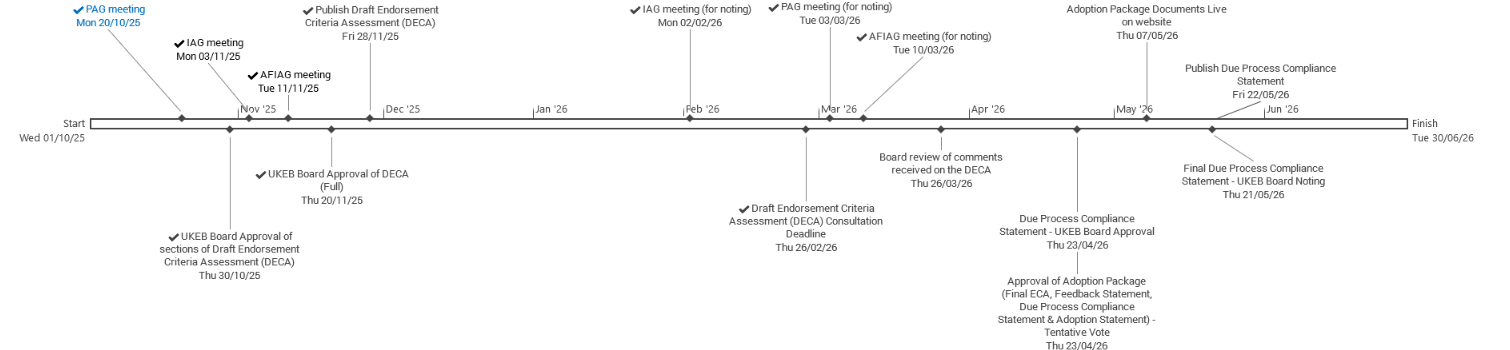
44The high-level project timeline of the next steps is set out below.
| Date | Milestones |
|---|---|
| 26 March 2026 | Board review of feedback received on the [Draft] ECA. |
| 23 April 2026 | • Board: Consideration of Adoption Package • Board Members provide a tentative vote |
| May 2026 | • Voting form sent to Board Members • Publication of voting outcome [and Adoption Package on UKEB website] |
| 21 May 2026 | Board: Due Process Compliance Statement for noting |
Endorsement and adoption of IFRS 19 (effective 1 January 2027)—partial timeline
Appendix A: Summary of feedback received
A1This Appendix summarises the feedback received on the IFRS 19 [Draft] ECA. In the tables below the name of the respondent is hyperlinked to the response published on the UKEB's website.
| Table 1 | Overall feedback |
|---|---|
| Respondent | Feedback summary |
| Response 1, PwC | Strongly supports a single set of global corporate reporting standards without any regional modifications and carve-outs, where possible. Fully supports the endorsement of IFRS 19. |
| Response 2, Grant Thornton UK LLP | Strongly supports a single set of global corporate reporting standards. Fully supports the endorsement of IFRS 19. |
| Response 3 - S. Hansen | Did not explicitly comment on the UKEB's tentative conclusion that IFRS 19 meets the statutory endorsement criteria or on its tentative view that it will adopt IFRS 19 for use in the UK. |
| Response 4, ICAEW | Supports the introduction of IFRS 19 within the UK financial reporting structure but expressed support for a single reduced disclosure framework i.e. IFRS 19 replacing FRS 101. Supports the endorsement of IFRS 19 for use in the UK. Supports permitting eligible subsidiaries in the UK a choice between applying FRS 101 or IFRS 19. |
| Response 5, KPMG | Strongly supports a single set of global corporate reporting standards and fully supports the endorsement of IFRS 19. Requested the UKEB provide guidance on one of the eligibility criteria in IFRS 19 which requires a subsidiary to have an ultimate or intermediate parent that produces consolidated financial statements available for public use that comply with IFRS Accounting Standards. |
| Response 6, RSM UK | Supports the endorsement of IFRS 19 for use in the UK. Supports permitting eligible UK subsidiaries the choice between applying FRS 101 or IFRS 19. |
| Response 7, J. Denoncourt | Did not explicitly comment on the UKEB's tentative conclusion that IFRS 19 meets the statutory endorsement criteria or on its tentative view that it will adopt IFRS 19 for use in the UK. Provided information in relation to intangible assets i.e. the use of subsidiaries within corporate groups in connection to material disclosures. |
| Response 8 - Forvis Mazars | Does not object to the endorsement of IFRS 19 for use in the UK. |
| Response 9 - SME Alliance | Did not explicitly comment on the UKEB's tentative conclusion that IFRS 19 meets the statutory endorsement criteria or on its tentative view that it will adopt IFRS 19 for use in the UK. Expressed disagreement on different aspects of the assessment in the [Draft] ECA. |
| Table 2 | Feedback on the technical accounting criteria assessment (Section 2 of the ECA) |
|---|---|
| Respondent | Feedback summary |
| No comments from: Response 1: PwC, Response 5: KPMG, Response 7: J. Denoncourt | |
| Response 2, Grant Thornton UK LLP | Agrees with this assessment. |
| Response 3 - S. Hansen | Agrees with this assessment. Further suggests amending this section to: |
|
|
| Response 4, ICAEW | Agrees with this assessment. |
| Response 6, RSM UK | Agrees with this assessment. |
| Response 8 - Forvis Mazars | Agrees with this assessment. It further notes that this assessment could have compared the IFRS 19 disclosure requirements with those under FRS 101 and FRS 102. |
| Response 9 - SME Alliance | Disagrees that IFRS 19 would meet criteria of relevance, understandability and comparability and questioned whether the UKEB has a mandate under legislation to carry out this assessment. |
| Table 3 | Feedback on the long term public good (Section 3 of the ECA) |
|---|---|
| Respondent | Feedback summary |
| No comments from: Response 1: PwC, Response 5: KPMG, Response 7: J. Denoncourt | |
| Response 2, Grant Thornton UK LLP | The [Draft] ECA notes that only entities who considered the benefits of adoption to be greater than the costs would apply the Standard (paragraph 3.18). Agrees with this assessment. Further notes that: |
|
|
| Response 3 - S. Hansen | Agrees on the assessment of costs and benefits. However, expressed reservations on the UKEB's conclusion in paragraph 3.73 of the [Draft] ECA that the use of IFRS 19 is likely to be conducive to the long term public good in the UK on the basis that the UK financial reporting framework can support one single reduced disclosure framework. |
| Supports IFRS 19 because: | |
|
|
| Response 4, ICAEW | Agrees with this assessment. |
| Response 6, RSM UK | Agrees with this assessment. Notes that the non-endorsement of IFRS 19 could reduce flexibility for UK subsidiaries of overseas IFRS groups. |
| Response 8 - Forvis Mazars | Agrees with this assessment. |
| Response 9 - SME Alliance | Disagrees on the long term public good assessment, raising the following concerns: |
|
| Table 4 | Feedback on true and fair view (Section 4 of the ECA) |
|---|---|
| Respondent | Feedback summary |
| No comments from Response 1: PwC, Response 5: KPMG, Response 7: J. Denoncourt | |
| Response 2, Grant Thornton UK LLP | Agrees with this assessment. |
| Response 3 - S. Hansen | Agrees with this assessment. |
| Response 4, ICAEW | Agrees with this assessment. |
| Response 6, RSM UK | Agrees with this assessment. |
| Response 8 - Forvis Mazars | Agrees with this assessment. |
| Response 9 - SME Alliance Limited | Disagrees with this assessment. This respondent observes: |
|
| Table 5 | Feedback on whether IFRS 19 is likely to lead to a significant change in practice (Section 5 of the ECA) |Secretariat recommendation for ECA | Secretariat recommendation for ECA | | Secret |Secretariat recommendation (with the amendments proposed to paragraph 3.58 of the draft ECA) and other comments**
Secretariat recommendation for ECA
No changes proposed in the ECA. Refer to paragraphs 10-11 in the cover note and the accompanying table.
No changes proposed in the ECA. Refer to paragraphs 10-11 in the cover note and the accompanying table.
No changes proposed in the ECA.
No changes proposed in the ECA.
No changes proposed in the ECA.
No changes proposed in the ECA. Refer to paragraphs 16-20 in the cover note.
No changes proposed in the ECA.
No changes proposed in the ECA. Refer to paragraphs 21-24 in the cover note.
No changes proposed in the ECA.
No changes proposed in the ECA. Refer to paragraphs 21-24 in the cover note.
Footnotes:
Footnotes
-
Amendments to IFRS 19 Subsidiaries without Public Accountability: Disclosures, August 2025. ↩
-
Following the publication of IFRS 19 on 9 May 2024, the IASB issued consequential amendments to IFRS 19 in two separate amendments to IFRS Accounting Standards: Amendments to the Classification and Measurement of Financial Instruments – Amendments to IFRS 9 and IFRS 7 (issued May 2024) and Contracts Referencing Nature-dependent Electricity – Amendments to IFRS 9 and IFRS 7 (issued December 2024). ↩
-
An analysis of the IASB's IFRS 19 disclosure tracker which lists the disclosure requirements in IFRS 19 and maps them to their equivalents in other IFRS Accounting Standards indicates that IFRS 19 reduces the disclosure requirements in IFRS 5 by approximately 58% and IAS 41 by approximately 70%. The tracker can be accessed here. ↩
-
The International Accounting Standards and European Public Limited-Liability Company (Amendment etc.) (EU Exit) Regulations 2019 ↩
-
"international accounting standards" has the meaning given by Article 2 of Regulation (EC) No 1606/2002 of the European Parliament and of the Council of 19 July 2002 on the application of international accounting standards. SI 2019/685 Regulation 3. The definition is as follows: 'international accounting standards' shall mean International Accounting Standards (IAS), International Financial Reporting Standards (IFRS) and related Interpretations (SIC-IFRIC interpretations), subsequent amendments to those standards and related interpretations, future standards and related interpretations issued or adopted by the International Accounting Standards Board (IASB)." ↩
-
See Conceptual Framework for Financial Reporting paragraph 1.5. ↩
-
See Conceptual Framework for Financial Reporting paragraph 1.10. ↩
-
The FRC has also published an explainer outlining the interaction of FRS 101 with IFRS 19. The explainer can be accessed here. ↩
-
Link to SI 2008/410. ↩
-
The UK government has recognised the equivalence to UK-adopted international accounting standards of the following Generally Accepted Accounting Principles (GAAP), which include those GAAPs previously recognised by the European Commission as equivalent to EU-adopted IFRS (see the Act section 401(2)(b) subparagraph (iv)). ↩