Response 7 - J.Denoncourt
Associate Professor Dr J Denoncourt BA McGill (Canada), LLB (Western Australia), PhD Nottingham (UK), FRSA, SFHEA, GAICD ORCID ID 0000-0003-2176-8935
Chairman Paul Lee UK Endorsement Board Submitted via email: [email protected]
24 February 2026
Dear Paul,
Re: Response to Invitation to Comment on the Draft Endorsement Criteria Assessment of IFRS 19 Subsidiaries without Public Accountability: Disclosures Commercial in Confidence
Thank you for the opportunity to respond to the UK Endorsement Board's invitation to comment on the Draft Endorsement Criteria Assessment of IFRS 19 Subsidiaries without Public Accountability: Disclosures.
I am a former member of the Academic Advisory Group to the UKEB (2023-2025). I completed my LLB at the University of Western Australia before embarking on my corporate legal career at international commercial law firm Freehills (now Herbert Smith Freehills Kramer) of which I am an alumna. I was In-house counsel for a publicly listed Australian mining technology company and Head of Legal for Worlds Apart Ltd, a large private UK company for several years. More recently, I worked as Associate Professor in the Nottingham Law School, Nottingham Trent University between 2008-2025. My research monograph Intellectual Property, Finance and Corporate Governance (2018) published by Routledge was awarded a 4* rating in the UK 2021 Research Assessment Exercise. My work and ideas pursue novel solutions to the issue of corporate disclosure, reporting, transparency of intangibles and intellectual property rights (IPR) assets to support business objectives aligned with sustainable development. I was honoured that my book was selected by the China Intellectual Property Publishing House (IPPH), a subsidiary of the State IP Office (SIPO), the Official legal publisher for Chinese patent literature and patents, for official translation into Chinese. A Chinese edition published in January 2023 (ISBN-10 751308064X, ISBN-13 978-7513080644). According to WorldCat.org, Intellectual Property, Finance and Corporate Governance is held in the collections of over 165 leading university libraries in more than 30 countries across five continents around the world.
My comments relate to intangible assets, in particular, intellectual property rights (IPR) holding companies (IPCo's) which I suggest is relevant to s409 Companies Act 2006 and IFRS 19, the new voluntary reduced disclosure standard effective 1 January 2027. It is not yet clear how the Financial Reporting Council (‘FRC') will amend FRS 101 to address IFRS 19.
The information set out below is aimed at informing the UKEB with regard to its endorsement assessment (and the FRC) by providing additional context and background to the use of subsidiaries within corporate groups in connection to material disclosures. My comments are based on legal research published in a peer-reviewed Chapter that I contributed to an edited collection by the International Association for the Advancement of Teaching and Research in Intellectual Property (ATRIP)1 in 2021:
J. Denoncourt, Part I Chapter 4 'Company classification taxonomy and corporate intellectual property rights owners' in: D. Gervais (ed.), The Future of Intellectual Property in ATRIP Intellectual Property Series (2021) Edward Elgar Publishers, ISBN: 978 1 80088 533 2.2
My comments support the UK's long term public good assessment and interaction with UK company law3 related to parent companies and their subsidiaries. Intangible assets such as IPRs are an intangible version of wealth and if they are held in a separate legal entity, this fact should be regarded as important as the figures in a company's balance sheet in terms of financial reporting and disclosure.4 I suggest that companies with IPR holding subsidiaries should be required to expressly disclose their existence in an identifiable fashion in the notes to the accounts or in an appendix for the reasons as explained below.
Company shareholders, stakeholders and the public have a higher level of IP rights awareness than ever before. The corporate, accounting and IPR law domains are beginning to cross reference each other given the rise of IPR-reliant business models. These developments imply a new approach to accountability and social responsibility for corporate-owned IPRs which create potentially valuable and powerful monopoly competitive advantages, as explored in Intellectual Property, Finance and Corporate Governance (2018).
The UK is an IPR powerhouse, indeed its depth of IPRs is a special economic strength. In 2025 the UK ranked 6th out of the 139 countries analysed and was commended for its strong and sophisticated national IPRs environment. The Global Innovation Index 20255 is published by the World Intellectual Property Organization (WIPO). The rankings are based on various indicators such as patent filings, R&D spend and scientific research. The UK also excels in the global trade mark rankings compiled by the US Chamber of Commerce 13th International IP Index.6 The UK maintained its excellent 100% scores in both the trade mark rights and design rights categories. The top trade mark score, shared only with France and the US, reinforces the UK's position as a leading destination for firms, small and large, seeking strong brand protection. In addition, the UK was ranked 2nd overall in terms of IPRs environment with a score of 93.98%.
With respect to IPRs such as patents, trade marks, copyright, designs and trade secrets etc, where a company holds these intangible assets is often as important as what it owns. Many companies default to keeping IPRs within their operating entities while others set up IP holding companies (IPCo) in the UK or offshore. In my view, it is material and an important factor for stakeholders to know which company within a corporate group legally owns the IPRs. An IPCo has a separate legal personality usually in the form of subsidiary, designed to reduce IPR risk and may also execute the company's IPR strategy for generating revenue e.g. through licensing programmes. Nevertheless, there are potential pitfalls to using IPCos. Shareholders and other stakeholders should have the relevant information regarding where the IPRs are held (e.g. in the UK or outside the UK) to enable them to understand the Board's decisions and make their own informed decisions. Transparency and disclosure in the corporate law context refers to ensuring that accurate, relevant information is accessible, taking reasonable care to ensure that any information disclosed is accurate, not misleading nor is material information omitted. I submit that if key IPRs are held in an IPCo. this is material information that should normally be disclosed by the parent company.
By way of contextual background, the benefits adopting an IPCo subsidiary include reducing legal risk by holding IPRs separately from operating companies so that the IPCo shields the intangible IPRs from operational or product-related litigation. This tends to simplify IPR management across multiple divisions within a corporate group while enabling the parent company to track the costs associated with maintaining an IPR portfolios. Another benefit involves supporting tax efficiency by licensing the IPRs across borders allowing for better tax planning (e.g. transfer pricing, with potential for tax saving by licensing through IPCos). Further, consolidating IPRs facilitates valuation by investors who place high value on the chain of ownership or title of IPR properly documented, appropriate corporate records kept and to ensure these type of intangible assets are free from legal encumbrances (such as disputes, competing claims, or unclear assignments). Thus, a well-structured IPCo with clear assignments, licensing agreements and records (e.g. inventor statements/disclosures, trade mark evidence of use) may increase the overall valuation of the company by showing a strong, well-managed IPR portfolio.
However, the pitfalls of the IPCo structure include legal and administrative costs, the risk of double taxation (if the IPCo is in a different jurisdiction) on royalties or dividends. Note that when patent owners license their patents internationally, their income from royalties is often subject to taxation in both the licensor's country and the licensee's country. There is also the risk if the IPCo is disconnected from the operational side of the corporate group's business. For example, a poorly structured IPCo relationship could negatively impact an operating company's ability to recover lost profits in patent infringement cases.
In relation to IP holding companies held by large corporate groups, I have concerns over the lack of transparency, particularly by companies with IPR-dependent business models. A Board's decision to establish an IPCo (or several) should be disclosed to increase investor confidence and ensure accountability. A large publicly listed parent company sometimes has hundreds of wholly or part owned subsidiaries. Thus, a corporate group is often large and public and small and private at the same time and may count as a single entity for accounting and corporate reporting purposes. IPR holding companies (e.g. subsidiary companies).7 The corporate group may comprise a potentially unlimited number of registered companies with separate legal identities controlled by the parent company.8
To illustrate, GlaxoSmithKline plc (GSK plc), the British pharmaceutical giant, is heavily reliant on IPRs, especially patents and trade marks, to activate its business model. GSK plc is the parent to a large group of companies with circa 99,000 employees across 95 countries with outstanding scientific and technical know-how and deep expertise in regulation, IPRs9 and commercialisation.10 GSK plc has three global businesses that discover, develop and manufacture innovative pharmaceutical medicines, vaccines and consumer healthcare products. In 2019 the company paid a dividend of 80p per share, delivered £5.1 billion of free cash flow and made £33.75 billion in annual revenue in financial year 2019.11 Its operations are conducted and income is earned by legally distinct operating companies within the group. Assets are owned by operating companies and/or holding companies, and employees are employed by a number of companies within the group. In accordance with section 409 CA 2006 as it applied in financial reporting year 2019, the company was required to disclose a full list of its subsidiaries, associates, joint ventures and joint arrangements, the address of the registered office and effective percentage of equity owned.
The GSK 2019 Annual Report contains an 11-page list comprising over 100 subsidiary companies within the GSK plc group.12 Within the corporate group structure, I identified what appeared to be several wholly owned IPR holding companies, an IPR development subsidiary and an IPR management subsidiary as depicted below.
Corporate structure diagram showing GSK plc as the parent company with 100% ownership of six UK-based GSK Intellectual Property subsidiaries: Holdings, No 2, No 3, No 4, Development, and Management Limited.
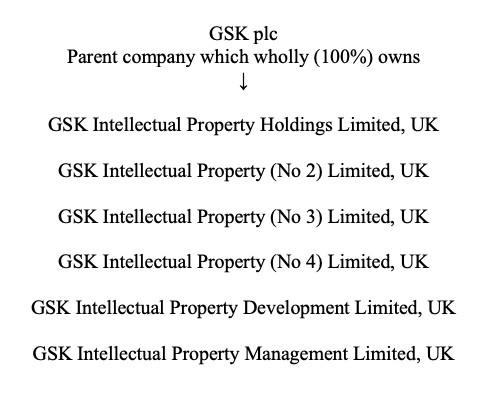
Source: Author created using data from the GSK plc 2019 Annual Report. GSK Corporate Group IPR holding companies and related subsidiaries
Under existing Anglo-American13 and UK company law, the creation of a private IPR holding company or several such companies within a corporate group to concentrate IPR ownership is a common part of the life cycle of an IPR-rich corporation.14 The creation of an IPCo company is also beneficial if the business is sold as it will be easier to transfer of the IPR portfolio to the new owner. The IPR holding company grants a licence to the groups' trading company which uses the IPRs in its day-to-day business operations. The group's trading company usually pays the IPCo an up-front licence fee and ongoing royalty payments for the duration of the licence.15 For example, a UK patent can be enforced against and alleged infringer by either the patentee or an exclusive licensee.16 However, the corporate group legal structure may give rise to unintended consequences in IPR enforcement litigation in relation to the prospects of obtaining an interlocutory injunctions, damages and permanent injunctions, particularly when offshore IPCo's are used. It is common practice for large multinational move the management and exploitation of their IPRs to offshore IPCos in jurisdictions such as the Republic of Ireland, Switzerland and the Netherlands.
In my view large, listed UK-based multinational firms with an IPR dependent business model should emulate GSK plc and clarify to shareholders their use of IPR subsidiary holding company structures given the importance of IPRs for income and revenue generation.17
In relation to IFRS 19, I suggest that the central problem is the lack of transparency when several IPCo's exist regarding the role of each IPCo and the allocation of IPRs owned by each IPCo subsidiary. For example, information concerning the type and extent of IPRs held in each IPCo (e.g., patents, trade marks, designs, copyright and trade secrets etc), whether the subsidiaries hold UK and/or international IPRs is relevant to a variety of decisions involving the parent's core products and services. Each IPCo. in the group is a separate legal entity that may own part or whole of the IPRs assigned to it unless effectively licensed to the parent (see GSK Intellectual Property, No. 2, No. 3 and No. 4). The IPCo may be able to apply for and register new IPRs (see GSK IP Management Limited).18 However, it is not clear which IPRs are held in GSK's various IPR holding company structure as such information does not appear to be publicly available in the company's 2019 Annual Report.
As noted, monopoly patent rights give rise to issues in IPCo's within corporate groups.19 In patent litigation in the UK, an exclusive licensee can sue but the patent owner must be made a party to the proceedings. It is not necessary for an exclusive licensee to be registered in order to bring proceedings, but they will not be awarded their legal costs unless the relevant IP licence is registered within six months.20 21 My understanding is that it is unlikely that an IPCo will be able to recover profits lost by an operating company within the corporate group if the licence between the companies is nonexclusive.22 Under a nonexclusive licence, the IPCo may license the same patent rights to multiple licensees, enabling it to leverage the sales and marketing resources of more than one company.23
Corporate ownership of trade marks by IPCo's can give rise to important trade mark law issues. Trade marks registered in the UK (and most jurisdictions) must be used in commerce in order to maintain their validity and ability to be enforced against third parties.24 Group IPR holding structures need to be mindful of the risk of a non-use cancellation/invalidity action.25 If a UK or EU registered trade mark is not used within five years of being registered or there is a period of non-use for five years, then third parties can apply to the Trade Mark Registrar to cancel it on the grounds of non-use. Thus, for a trade mark to remain valid, the corporate owner must be able to show evidence of use (genuine commercial use and not merely token use) in the territory in which the mark is registered, the UK for example. Proof of use must be in the name of the trade mark owner and if the products are commercialised by another operating company within the corporate group, this may be rejected as proof of use unless a valid and effective trade mark licence agreement exists between the IPCo and the operating company. Intra-corporate group trade mark use needs to be carefully managed. If the registered mark(s) is owned by the IPCo subsidiary and used by the parent company (or another subsidiary in the group) then a trade mark licence agreement provides evidence of control over the use of the mark. If the registered mark is used by a wholly owned subsidiary within the group, this relationship may be sufficient as the owner has voting control over its subsidiary. In other jurisdictions, an effective valid trade mark licence agreement confirming that the use accrues to the benefit of the trade mark owner may be necessary.26
In terms of corporate annual reporting, the rights of stakeholders such as creditors and other financiers when dealing with the parent company should also be taken into account. An important part of the UK government's company law framework is to ensure that creditors, customers and suppliers have the information they need in order to be able to do business with the company with confidence.27 However, if the IPRs are owned by a corporate groups' IPR holding company, they are likely to be beyond the reach of the trading company's creditors.28 Further, if there is a need to unravel an IPR-rich multinational firm that becomes insolvent (bankrupt), this could take years of lengthy, expensive litigation, partially due to the lack of disclosure of the internal corporate group structure.
With regard to taxation, the profits arising from IPRs (e.g., royalties and licensing revenue) are only taxable in the country of incorporation. This usually requires a nexus to the jurisdiction to be established for tax purposes which can be problematic.29 Investors and others may wish to invest in or deal with firms that pay corporate tax in the UK to support the country's social goals, thus the relevant IPR tax policies associated with offshore IPR holding company will be important information.30
In conclusion, the use of IPCo's by IPR-rich companies is not a new trend, it is established practice. As such, transparency and disclosure principles have the potential to play a crucial role in demystifying where intangible IPR assets are owned and located within a corporate group using one or more IPCo subsidiaries. I argue that IPCos should be viewed as a fundamental part of the modern financial and qualitative information architecture31 that reduce IPR information opacity, especially in large corporate groups.32 As a minimum, IFRS should require large, listed companies to disclose and identify any and all intangible IPCo's together with its specific role within the corporate group. Then those IPCo subsidiaries, if eligible to apply IFRS 19, should nevertheless be required to disclose which types of intangibles IPR assets it owns and any other material financial information (e.g. intra-group licences, licensing revenue, litigation and tax costs) in their individual or separate accounts; in the notes to the accounts; or in an appendix together with relevant qualitative disclosures. This approach would enhance understanding for shareholders, diverse stakeholders, institutional investors and financial institutions. While the aim of IFRS 19 is largely to reduce disclosure, I submit that greater transparency is needed with respect of IP holding subsidiaries for the reasons outlined above.
Thank you for considering my submission. I hope my comments provide helpful interdisciplinary context for both the UKEB and the FRC.
Yours sincerely,
Associate Professor Dr Janice Denoncourt University of Greenwich, UK (effective 01/09/2026)
Footnotes
-
See https://atrip.org ↩
-
See https://www.elgaronline.com/edcollbook/edcoll/9781800885332/981800885332.xml ↩
-
Section 409 Information about related undertakings, Companies Act 2006 (UK) ↩
-
From a corporate reporting and financial accounting perspective, the International Accounting Standard 38 Intangibles defines intangibles as intellectual assets lacking in physical presence with an uncertain future value or amount of benefit that benefit an entity over several accounting periods. ↩
-
See https://www.wipo.int/web-publications/global-innovation-index-2025/en/index.html ↩
-
See https://www.uschamber.com/intellectual-property/2025-ip-index ↩
-
Part 38, ss 1159-1162 CA 2006. ↩
-
Under the CA 2006, each company is treated as a separate legal entity with its own rights and responsibilities. ↩
-
The value of GSK plc's intangible assets in 2019 is in excess of $40 billion, see https://www.marketwatch.com/investing/stock/gsk/financials/balance-sheet. ↩
-
See GSK Annual Report 2019 GSK at a Glance at https://www.gsk.com/en-gb/investors/corporate-reporting/annual-report-2019/. ↩
-
Ibid. ↩
-
Ibid, pp.299-310. ↩
-
The life cycle of the corporation encompasses its formation, funding, governance and removal from the register. See John Armour et al 'What is Corporate Law? In: The Anatomy of Corporate Law: A Comparative and Functional Approach (2017) Eds., Reiner, Kraakman et al, Oxford University Press, p1.1 ↩
-
'Utilising Holding Companies for Intellectual Property' (15 October 2014) Pearse Trust ↩
-
In relation to patents, the Bristol-Myers Squibb Company v Apotex Pty Led [2015] FCAFC 2 (23 January 2015) the Full Court of the Federal Court of Australia confirmed that to qualify as an exclusive licensee, a licensee must be conferred a licence to all forms of 'exploitation' of the claimed invention throughout Australia, to the exclusion of the patentee and all other persons. Australian case law is persuasive in England and Wales. ↩
-
Note that ownership of IPRs created by a non-UK resident will generally be governed by the law of the country in which the IPR was created. However, if owned by a company in another jurisdiction, the corporate reporting, disclosure and transparency laws of registered company will also apply. ↩
-
'Impacts IP Holding Companies May Posses in 2020' (15 December 2019) Unimark Legal Solutions. ↩
-
Christopher C. Smith, 'A Spoonful of Licensing Helps The Medicine Go Down: Avoiding Standing Problems Between Related Entities In Patent Cases' (12 May 2015) Associate Corporate Counsel ↩
-
Section 68 Patents Act 1977. ↩
-
In England and Wales, infringement and enforcement of a patent, together with any validity issues, are dealt with in the same proceedings. These proceedings can cover ↩
-
In Poly-America, L.P. v GSE Lining Technology, Inc., the US Federal Circuit held that the plaintiff corporation was not entitled to claim damages for the profits lost by its sister corporation. ↩
-
Mark J. Cowan and Warren Newberry, ‘Re-evaluating the IP Holding Company' (Spring 2013) 13(3) Management Accounting Quarterly. See also the EU Interest and Royalties Directive (IRD) and the Parent Subsidiary Directive (PSD). ↩
-
See The Trade Marks (Proof of Use, etc.) Regulations 2004, SI 2004 No 946. Invoice, data sheets, webpages, catalogues may constitute evidence of trade mark use in a particular territory. A licence agreement is vital. There may be a justifiable reason as to why the mark cannot be used. For example, if a mark is to be used for a medicine and regulatory approval has been applied for in good time but not yet granted, this may be accepted as a valid defence for non-use. ↩
-
Under s 47(3) of the Trade Marks Act 1994 (application for a declaration of invalidity). The same applied to UK and EU designations of International trade mark registrations from the date of registration. ↩
-
'Promoting a flexible', UK Department of Business, Innovation and Skills (January 2012). ↩
-
'Promoting a flexible', UK Department of Business, Innovation and Skills (January 2012). ↩
-
'Utilising Holding Companies for Intellectual Property' (15 October 2014) Pearse Trust ↩
-
Andrew Soubel, 'An IP Holding Company and New Jersey: Facts Creating Nexus' (28 March 2019) Wolters Kluwer Tax and Accounting Blog ↩
-
In the US, the tax position of IP holding companies is being challenged on the issue of economic substance, see Sherwin-Williams Co. v Commissioner of Revenue, 778 N.E. 2d 504 (Mass. 2002) and Syms Corp. v Commissioner of Revenue, 765 Ν.Ε. ↩