4 Regulatory Strategy 2026-27
26 February 2026 Agenda Paper 4
Executive Summary
| Project Type | Regulatory Strategy |
|---|---|
| Project Scope | Significant |
| Purpose of the paper | This paper presents the UKEB's proposed final Regulatory Strategy 2026-2027 and Feedback Statement for the Board's consideration and approval. |
Summary of the Issue
At the October 2025 Board meeting the UKEB approved the publication of the (Draft) Regulatory Strategy 2025-2028 for stakeholder consultation. The research topics proposed for the 2026/27 period, as a component of the (Draft) Regulatory Strategy, were approved for publication at the November 2025 meeting. The consultation ran for eight weeks from 15 December 2025 to 6 February 2026 and was timed to run concurrently with the FRC's consultation on its Plan and Budget, which includes the UKEB budget.
Five comment letters (from PwC, ICAEW, ICAS, SME Alliance Ltd, and a private individual) were received in response to the consultation. The letters were published on the UKEB website.
This paper presents the proposed final UKEB Regulatory Strategy 2026/27 (Appendix A) and a Feedback Statement (Appendix B) summarising the UKEB's proposed response to the stakeholder feedback on its strategy and the research consultation.
Following Board approval, both documents will be finalised and published on the UKEB website.
Strategy
The responses were supportive of the UKEB's strategy and direction, overall, and included some specific feedback.
Given the mainly supportive nature of the stakeholder feedback, the UKEB's Regulatory Strategy 2026/27 remains largely unchanged from the consultation draft, except for adding the UKEB's ‘Other functions', below its ‘Statutory functions'. The UKEB's remit to consider the connectivity between IFRS Accounting Standards and IFRS Sustainability Disclosure Standards, was highlighted as being an important role by stakeholders.
Research Consultation
To acknowledge the stakeholder feedback received, the Secretariat proposes including in the Feedback Statement the Board's intention to consider publishing a research project pipeline on the UKEB website.
Following the Board's consideration of potential research projects, and its assessment of research priorities, resource allocation and proportionality, a pipeline of projects could be published on the UKEB website to give stakeholders clarity and enable them to engage with our work at an early stage.
Decisions for the Board
The Board is asked to approve the following for publication:
- the Regulatory Strategy 2026/27; and
- the consultation Feedback Statement.
Recommendation
The Secretariat recommends that, subject to any comments at the meeting, the Board approves the Regulatory Strategy 2026/27 and Feedback Statement.
Appendices
- Appendix A - Regulatory Strategy 2026/27
- Appendix B - Feedback Statement
The UKEB does not accept any liability to any party for any loss, damage or costs however arising, whether directly or indirectly, whether in contract, tort or otherwise from action or decision taken (or not taken) as a result of any person relying on or otherwise using this document or arising from any omission from it. ©20265 All Rights Reserved
Regulatory Strategy 2025/28: Year 2 (Draft)
Strategic Objectives
Statutory functions
1The statutory functions of the UKEB are to:
- participate in, and contribute to, the development of a single set of international financial reporting standards; and
- adopt international accounting standards when they meet the criteria in The International Accounting Standard and European Public Limited-Liability Company (Amendments etc.) (EU Exit) Regulations 2019 (SI 2019/685).
2The UKEB's other function is to consider the connectivity between UK-adopted international accounting standards and IFRS Sustainability Disclosure Standards or UK Sustainability Reporting Standards.¹
2.3The objectives for adoption of IFRS for use in the UK are to ensure:
- a high degree of transparency and international comparability of financial statements; and
- the efficient allocation of capital, including the smooth functioning of capital markets in the UK.
Strategic objectives 2026/27
3.4The UK's long term public good is central to the work of the UKEB. This includes considering the implications for UK economic growth and competitiveness, the needs of investors and businesses, and supporting effective and efficient capital allocation through comparable and proportionate reporting standards. This is underpinned by the statutory requirement for the UKEB to consider the UK's long term public good as part of its endorsement process.
Two main strategic objectives help the UKEB deliver on its statutory functions:
- influence and provide thought leadership during the development of international financial reporting standards; and
- assess international accounting standards for adoption for use in the UK.
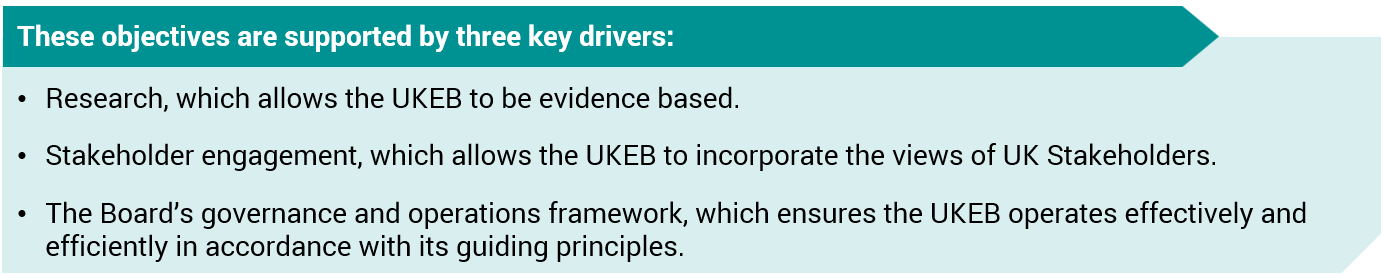
These objectives are supported by three key drivers:
- Research, which allows the UKEB to be evidence based.
- Stakeholder engagement, which allows the UKEB to incorporate the views of UK Stakeholders.
- The Board's governance and operations framework, which ensures the UKEB operates effectively and efficiently in accordance with its guiding principles.
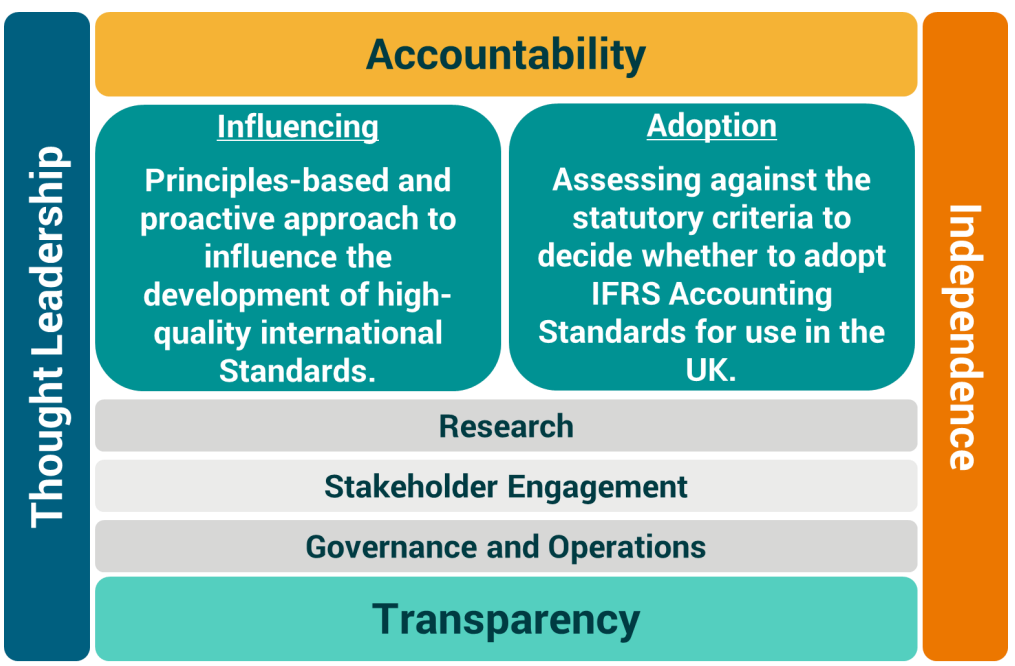
4.5The work is underpinned by the UKEB's guiding principles, as illustrated in the diagram below:

5.6The UKEB's three-year strategy for the period 2025-28 was published in April 2025, following consultation. In this second year, the UKEB's strategic objectives remain unchanged. The Board intends to continue to build on the work of the previous year to achieve its three-year strategy.
UKEB Workplan
6.7The UKEB workplan is developed to ensure timely endorsement of International Accounting Standards and impactful engagement with the International Accounting Standards Board (IASB) as standards are planned and developed. This requires regular review and adjustment to ensure that the UKEB engagement reflects changes in the IASB's own plans.
7.8In 2026/27, the UKEB expects to focus on the following areas:
| Project | Size2 | IASB Type |
|---|---|---|
| ENDORSEMENT3 | ||
| IFRS 20 Regulatory Assets and Regulatory Liabilities | Significant | Standard-Setting |
| IFRS 19 Subsidiaries without Public Accountability: Disclosures | Moderate | Standard-Setting |
| Provisions – Targeted Improvements | Moderate | Maintenance |
| Financial Instruments with Characteristics of Equity | Moderate | Standard-Setting |
| Equity Method | Limited | Standard-Setting |
| Business Combinations – Disclosures, Goodwill and Impairment | Limited | Standard-Setting |
| Hyperinflation | Limited | Maintenance |
| INFLUENCING4 | ||
| Risk Mitigation Accounting | Significant | Standard-Setting |
| Statement of Cash Flows | Significant | Research |
| Intangible Assets | Significant | Research |
| IASB Agenda Consultation | Moderate | Research |
| Amortised Cost Measurement | Moderate | Standard-Setting |
| Post Implementation Review (PIR) of IFRS 9: Hedge Accounting | Moderate | N/A |
| Amendments to the Fair Value Option (IAS 28) | Limited | Standard-Setting |
| UKEB SPECIFIC PROJECTS | ||
| UKEB PIR of IFRS 175 | Significant | N/A |
| Review of UKEB Due Process Handbook6 | Moderate | N/A |
UKEB Proactive Research
8.9The UKEB undertakes proactive research to contribute to the wider discussion on International Accounting Standards and to influence the IASB early in its project development cycle.
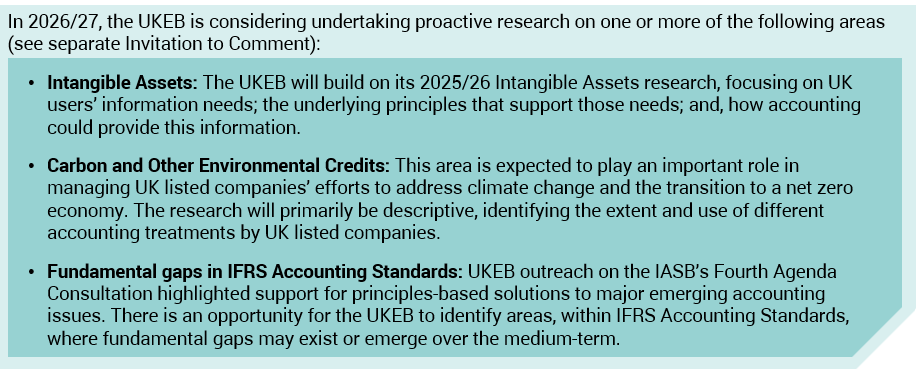
In 2026/27, the UKEB is considering undertaking proactive research on one or more of the following areas (see separate Invitation to Comment):
- Intangible Assets: The UKEB will build on its 2025/26 Intangible Assets research, focusing on UK users' information needs; the underlying principles that support those needs; and, how accounting could provide this information.
- Carbon and Other Environmental Credits: This area is expected to play an important role in managing UK listed companies' efforts to address climate change and the transition to a net zero economy. The research will primarily be descriptive, identifying the extent and use of different accounting treatments by UK listed companies.
- Fundamental gaps in IFRS Accounting Standards: UKEB outreach on the IASB's Fourth Agenda Consultation highlighted support for principles-based solutions to major emerging accounting issues. There is an opportunity for the UKEB to identify areas, within IFRS Accounting Standards, where fundamental gaps may exist or emerge over the medium-term.
9.10This work will contribute to engagement with the IASB's current work plan and, in the longer term, to its upcoming concurrent Agenda Consultation with the International Sustainability Standards Board (ISSB).
10.11In addition, some capacity to support the IASB on ad hoc, UK-specific research is also necessary as it is key to effective, early influencing of projects and to continuing to enhance our working relationships. The number of projects and extent of work will be determined on a case-by-case basis.
Stakeholder Engagement
11.12Stakeholder engagement ensures that the practical implications of proposed International Accounting Standards for UK companies, their investors and other stakeholders are appropriately understood and assessed by the Board.
12.13The UKEB's annual Work Plan allocates time to formal stakeholder engagement. This involves both national and international engagement.
13.14In the UK, this engagement is primarily conducted through the Board's advisory and working groups. In addition, project specific outreach with other UK stakeholders through meetings, round tables and other events is undertaken, as relevant.
14.15Internationally, stakeholder engagement is undertaken through attendance at international meetings, including the UKEB's membership of the IASB's Accounting Standards Advisory Forum (ASAF), to contribute to the international standard-setting debate.
Governance and Operations
15.16In addition, during 2026/27 the UKEB plans to host a one-day conference that will strengthen engagement with key UK and international stakeholders; including investors, preparers, auditors, academics, and regulators. The event will facilitate dialogue on emerging and complex accounting issues (including accounting for intangible assets, statement of cash flows and provisions).
16.17Governance, high quality technical Secretariat and operational support ensure the UKEB works effectively and efficiently in accordance with its guiding principles. This ensures the UKEB can attract the technical talent that helps it delivers its statutory objectives in line with its Terms of Reference and its open and transparent due process.
17.18Governance and operational support also assist the Board and Secretariat in delivering high quality work on a timely basis by embracing a continuous improvement approach.
Contact Us UK Endorsement Board 1 Harbour Exchange | London | E14 9GE www.endorsement-board.uk
Feedback Statement Draft 2026/27 Regulatory Strategy
February 2026
- Executive Summary
- Research Consultation
- Decisions for the Board
- Recommendation
- Appendices
- Regulatory Strategy 2025/28: Year 2 (Draft)
- Feedback Statement Draft 2026/27 Regulatory Strategy
- Foreword
- Our purpose
- Objectives and background
- Summary - Strategy
- Strategy: Feedback and UKEB response
- Summary - Research
- Research: Feedback and UKEB response
- Disclaimer
Foreword

The UK Endorsement Board is pleased to present our response to the thoughtful and welcome comments received from stakeholders on Year 2 of our draft Regulatory Strategy 2025/28, covering the 2026/27 period.
On behalf of the Board, I thank all respondents for their considered feedback.
We expect the next year to be another busy period. The UKEB will continue to focus on the UK long term public good, balancing the needs of investors and businesses, and supporting effective and efficient capital allocation and growth in the economy, through comparable and proportionate reporting standards.
Paul Lee UKEB Chair
Our purpose
The UK Endorsement Board (UKEB) is the UK's National Standard Setter for IFRS, responsible for the endorsement and adoption of IFRS for use in the UK. We also lead the UK's engagement with the IFRS Foundation on the development of new standards, amendments and interpretations.
Statutory functions:
- participate in, and contribute to, the development of a single set of international financial reporting standards; and
- adopt international accounting standards when they meet the criteria in Statutory Instrument 2019/685 'The International Accounting Standard and European Public Limited-Liability Company (Amendments etc.) (EU Exit) Regulations 2019'.
Other functions:
- consider the connectivity between UK-adopted international accounting standards and IFRS Sustainability Disclosure Standards or UK Sustainability Reporting Standards.
Objectives and background
This feedback statement summarises the comments received from respondents during the UKEB's public consultation on the draft 2026/27 Regulatory Strategy and explains the UKEB's position in response to those comments.
The draft 2026/27 Regulatory Strategy was published for consultation on 15 December 2025 and was open for comment for eight weeks, closing on 6 February 2026. During the consultation period, the UKEB promoted awareness of the draft Strategy and Invitation to Comment through various channels including the UKEB website, subscriber news alerts and LinkedIn posts.
The Board received five comment letters, from the following respondents:
- PwC (Auditors and Accounting Firms);
- Mr E Beale (Member of the Public);
- ICAEW (Professional Accountancy Bodies);
- ICAS (Professional Accountancy Bodies); and
- SME Alliance Limited (Membership organisation).
The comment letters were published on the UKEB website, and all feedback was considered when finalising the Strategy.
Summary - Strategy
Respondents broadly supported the UKEB's proposed 2026/27 Regulatory Strategy, both in terms of the overarching strategic objectives and the workplan.
The UKEB's collaborative and open approach was commended, and respondents appreciated the considerable effort it makes to engage with stakeholders.
Stakeholders commented that the UKEB successfully balances its statutory responsibilities of influencing the development of IFRS, and providing thought leadership, and assessing IFRS for endorsement and adoption for use in the UK, contributing to the UK's long term public good.
The UKEB will continue to assess its project prioritisation, its stakeholder engagement activities, and its approach to monitoring and measuring the Board's effectiveness in meeting its statutory objectives. The Board will be seeking to make improvements where possible.
Specific areas of feedback, and the UKEB's responses, are set out on the following pages.
Strategy: Feedback and UKEB response
| Stakeholder feedback | UKEB response |
|---|---|
| 1Respondents noted the considerable efforts made by the UKEB, throughout 2025, to engage with stakeholders and support the proposal to host a one-day conference which will allow the UKEB to engage with a broader range of stakeholders. | Since the UKEB was established five years ago, it has become a globally respected national standard-setter. The conference will provide the UKEB with an opportunity to showcase its research work and to engage with stakeholders in person. |
| 2A stakeholder queried why the IASB's Agenda Consultation project, which is a key opportunity for the UKEB to influence the IASB's work, is not a 'significant' project on the workplan. They also queried why the endorsement of IFRS 19 Subsidiaries without Public Accountability: Disclosures is not a 'limited' scope project as it is expected to be completed in early 2026/27. | In the UKEB Work Plan, the designation as 'moderate' relates to the expected workload for the Board and Secretariat during the financial year 2026/27, not the significance or importance of the project. |
| The Agenda Consultation is expected to be a 'moderate' project as it will not require in depth technical analysis. | |
| The Board set the endorsement of IFRS 19 Subsidiaries without Public Accountability: Disclosures as a 'moderate' project. This tagging is applicable until the project closes. It does not change as the project spans financial years. However, the reallocation of resources is taken into account in the UKEB's forward planning. | |
| 3A respondent asked how the UKEB plans to consider the interplay between IFRS Accounting Standards and IFRS Sustainability Disclosure Standards and whether any capacity is available for this work. | The UKEB considers whether there are any connectivity issues between IFRS Accounting Standards and IFRS Sustainability Disclosure Standards, as part of each project initiation plan. This is kept under review and any issues identified are considered by the Board. |
| 4A respondent noted the draft 2026/27 Strategy does not include any detail on how the UKEB might assess its impact. Acknowledging that it is likely to be challenging for certain aspects of its work, the UKEB was asked to indicate how it might assess its impact given the prominence of this topic in the UKEB's 2025/28 Regulatory Strategy. | The UKEB monitors a range of factors when considering its impact. This includes the Board's active monitoring of the IASB's projects at each Board meeting (papers labelled 'IASB Update'), which gives the opportunity to understand the impact of its work on the decisions made at the international level. |
| In addition, invitations to present UKEB work and research at international standard setting fora such as the IASB's Accounting Standards Advisory Forum (ASAF) and the International Forum of Accounting Standard Setters (IFASS) are clear indicators of the significant impact made by the Board. |
Summary - Research
Respondents commended the UKEB on its research work to date on accounting for intangibles and agreed that this remains a topic in which there is considerable stakeholder interest.
Stakeholders expressed their support for the UKEB to consider conducting further research in relation to the following topics, which will be considered by the Board at a future meeting:
- Cryptoassets, extending to other digital assets, such as stablecoins, tokens, and other digital currencies, as well as a broader consideration of intangible assets arising from blockchain;
- Customer-related intangibles recognised in a business combination;
- Carbon and other environmental credits;
- The impact of Artificial Intelligence;
- Levies and non-reciprocal transactions; and
- Acquisition accounting in the insurance sector.
Specific areas of feedback, and the UKEB's responses, are set out on the following page.
Research: Feedback and UKEB response
| Stakeholder feedback | UKEB response |
|---|---|
| 1Respondents commended the UKEB for its research work to date on accounting for intangible assets and encouraged the UKEB to plan its work in parallel to the IASB's work. However, while they suggested UKEB could continue to build on its 2025/26 case-study based research, clarity on which case studies the UKEB plans to examine was requested. | The UKEB has developed its case studies to complement the work of the IASB. They were presented to the Board at its public meeting in January 2026. |
| 2Stakeholders made helpful suggestions for other projects that could be added to the UKEB's workplan. Most of these align with existing projects on the agenda or in the pipeline. They also requested that the UKEB workplan include resource allocation for potential research projects as this would provide a more holistic picture of the influencing work of the UKEВ. | The UKEB will consider adding a research project pipeline page to its website to allow stakeholders to engage early on potential projects. |
Disclaimer
This feedback statement has been produced to set out the UKEB response to stakeholder comments received on the draft 2026/27 Regulatory Strategy. It should not be relied upon for any other purpose.
The views expressed in this feedback statement are those of the UKEB at the point of publication.
Any sentiment or opinion expressed within this Feedback Statement will not necessarily bind the conclusions, decisions, endorsement or adoption of any new or amended IFRS by the UKEB.
Contact Us UK Endorsement Board 1 Harbour Exchange | London | E14 9GE www.endorsement-board.uk
Footnotes:
Footnotes
-
The Secretary of State for the Department for Business and Trade (DBT) requested that, in addition to its statutory responsibilities, the UKEB consider the interplay between IFRS Accounting Standards and IFRS Sustainability Disclosure Standards. As part of this additional work, a UKEB Board Member sits on the UK Sustainability Disclosure Technical Advisory Committee, which is tasked with assessing the IFRS Sustainability Disclosure Standards from a technical perspective and advising the Secretary of State for DBT on whether their endorsement would be conducive to the long term public good in the UK. Additionally, the UKEB Secretariat is a member of the DBT chaired Policy Implementation Committee which is tasked with coordinating the implementation of UK Sustainability Reporting Standards by the UK Government and under FCA Listing Rules. ↩
-
Size provides an indication of the impact on UKEB resources. It is based on factors including: scope of changes, impact on UK stakeholders, urgency and complexity. ↩
-
Endorsement activities relate to published IFRS Accounting Standards and Amendments. ↩
-
Influencing activities relate to active projects on the IASB's work plan. ↩
-
IFRS 17 Insurance was the first Standard adopted after the formation of the UKEB and was expected to lead to a significant change in accounting practice. Legislation requires the UKEB to conduct a PIR and deliver the report to Parliament within five years of the Standard's adoption for use in the UK. ↩
-
The UKEB reviews the Due Process Handbook at least once every five years (UKEB Due Process Handbook 3.1 (g)) ↩