9 IASB General Update
26 February 2026 Agenda Paper 9
Project Type
Influencing
Project Scope
Various
Purpose of the paper
This paper provides the Board with an update on projects the Secretariat is currently monitoring.
As agreed with the Board, the Secretariat monitors projects being undertaken by the IASB. This is undertaken to inform the Board about the progress and decisions being made by the IASB on active projects. Discussion by the Board may also help inform interactions with international standard setter meetings, including the IASB's Accounting Standards Advisory Forum (ASAF).
Summary of the Issue
Topics addressed in this paper include topics discussed by the IASB at its January 2026 meeting.
Topics for discussion
- Connections between Financial Statements and Sustainability Disclosures.
- Post-implementation Review: IFRS 16 Leases
- Statement of Cash Flows and Related Matters
Topics of noting
- Equity Method
- Post-implementation Review of IFRS 9—Hedge Accounting
- Intangible Assets
- List of IASB projects
Decisions for the Board
Topics for discussion
Connections between Financial Statements and Sustainability Disclosures
1Does the Board have any comments on the EFRAG Discussion Paper 'Connectivity of Financial and Sustainability Reporting'?
Post-implementation Review: IFRS 16 Leases
1Do Board members have any feedback in relation to the UKEB's key messages for ASAF?
Statement of Cash Flows and Related Matters
1Do Board Members support the UKEB Secretariat's preliminary view on the IASB's approach to improving the reporting of information about non-cash transactions in paragraphs C15–C16?
2Do Board Members consider that there is any information missing from each of the two alternative example disclosures?
3Do Board Members support the UKEB Secretariat's preliminary view on the IASB's approach to improving the reporting of information about other non-cash changes in specific assets and liabilities that make up working capital in paragraphs C24–C28?
4Do Board Members consider that the population of non-cash changes (rows in the table) is complete in the example disclosure?
5Do Board Members support the UKEB Secretariat's preliminary view on:
a) The IASB's approach to improving the linkage between changes in liabilities arising from financing activities and line items in the statement of cash flows in paragraphs C31–C32?
b) Extending the existing requirements in IAS 7 paragraphs 44A to 44E to require a company to reconcile its changes in liabilities arising from financing activities to company-specific net debt, as per paragraph C33?
6Do Board Members support the UKEB Secretariat's preliminary view that the combined example is useful, per paragraph C35?
Topics for noting
Do Board members have any comments or questions on the comments for noting?
Recommendation
N/A
Appendices
- Appendix A: Connections between Financial Statements and Sustainability Disclosures.
- Appendix B: Post-implementation Review of IFRS 16 Leases
- Appendix C: Statement of Cash Flows and Related Matters
- Appendix D: Equity Method
- Appendix E: Post-implementation Review of IFRS 9—Hedge Accounting
- Appendix F: Intangible Assets
- Appendix G: List of IASB projects
Appendix A: Connections between financial statements and sustainability disclosures
| Project Stage | |||||||
|---|---|---|---|---|---|---|---|
| IASB | Research / Pipeline | Discussion Paper | Redeliberation | Exposure Draft | Redeliberation | Final Standard | Post Implementation Review |
| UKEB | Research / Influencing | Research / Influencing | Monitoring | Influencing | Monitoring | Endorsement | Influencing |
UKEB project page - n/a
IASB project page
Purpose
A1The purpose of this paper is to seek Board Member views ahead of the IASB's Accounting Standards Advisory Forum (ASAF) meeting, in March 2026 relating to connections between financial statements and sustainability disclosures.
A2The UKEB Secretariat expects that this agenda item will comprise two parts:
a) A joint IASB and ISSB technical team presentation illustrating connectivity, e.g. using developed educational materials1.
b) An EFRAG technical team presentation of its Discussion Paper2 (DP) Connectivity of Financial and Sustainability Reporting.
Context
A3In 2022, the Department for Business and Trade3 (DBT) asked the UKEB to be responsible for providing information on any connectivity matters between IFRS Sustainability Disclosure Standards (issued by the International Sustainability Standards Board (ISSB)) or UK Sustainability Reporting Standards (issued by DBT)
Background
A4The IFRS Foundation has developed a range of education resources regarding how connectivity between financial statements and sustainability disclosures provides decision-useful information for primary users. These include articles explaining connectivity4 and presentations at international conferences5.
A5The IASB issued a set of illustrative examples6 on reporting uncertainties in financial statements which demonstrate how companies can apply IFRS Accounting Standards when reporting the effects of uncertainties in their financial statements. The examples use climate-related scenarios as practical illustrations, but the underlying principles are intended to apply more broadly to all uncertainties. The UKEB provided a Final Comment Letter7 on the Exposure Draft which was at the time was named Climate-related and Other Uncertainties in the Financial Statements (CROUFS).
A6The ISSB Sustainability Disclosure Standards require companies to provide information about the current effects of sustainability-related risks and opportunities on an entities financial position, financial performance and cash flows, and the anticipated financial effects in the short, medium and long term.
A7IFRS S1 General Requirements for Disclosure of Sustainability-related Financial Information (IFRS S1) requires disclosure of information for the same reporting entity as for the related financial statements (paragraph 20) and that information is provided in a connected manner (paragraphs 21–24).
A8To support the application of their standards the ISSB has developed specific educational material regarding the disclosure of anticipated financial effects8. In relation to connected information the ISSB material notes:
a) Information about anticipated financial effects is intended to complement information provided in the company's financial statements.
b) Data and assumptions used to prepare information about anticipated financial effects are required to be consistent, to the extent possible, with those used in the financial statements but without undue cost or effort.
ASAF presentation from IASB and ISSB
A9As the ASAF papers were not available at the time of writing, we expect that the joint technical team will present a range of scenarios and explain, at a high level how the suite of IFRS Standards could be applied to provide useful connected information for users.
A10The UKEB has conducted significant thought leadership9 on connectivity matters between IFRS Sustainability Disclosure Standards, UK Sustainability Reporting Standards and UK-adopted international accounting standards.
A11The Final Comment Letter to the IASB regarding the CROUFS project made several strategic comments for the IASB to consider for future work. These included:
a) Developing further fact patterns which illustrate an impact on entity's financial position, financial performance, and cash flows due to applying the requirements of sustainability disclosures.
b) Considering a joint illustrative example with the ISSB relating to the application of IAS 36 Impairment of Assets showing connectivity between climate-related scenarios and impairment assumptions, the effects on expected cash flows (beyond a five-year period) and how those may affect asset terminal values.
c) Developing walk-through examples which integrate and illustrate scenarios where multiple accounting standards are involved.
ASAF presentation on EFRAG Discussion Paper
A12As the ASAF papers were not available at the time of writing, we expect that the EFRAG technical team will highlight the key points relating to accounting standard setting in its DP.
A13The DP highlights the concepts, types and mechanisms of the connectivity of reported information. It summarises a range of views on these matters but doesn't provide views for us to provide reactions. The DP consultation period ends on 30 June 2026. The key messages in the Discussion Paper (DP) are set out below for information. For further information please refer to the Executive Summary section in the DP pages 6–13.
- Connectivity of reported information is relevant regardless of the underlying reporting requirements/ framework.
- Connectivity concepts are applicable across multiple reports and can be extended beyond sustainability-related matters.
- Connectivity is an evolving concept.
- Connectivity of reported information is improving, although companies are in the early stages of applying this concept.
- Users and other stakeholders underscored connectivity as an aspect of high-quality reporting.
- Addressing information across different reports that some expect to be (but is not) reported and connected.
- Clarification of the border of financial statements with respect to the disclosure of information (including forward-looking information) will enhance connectivity.
- Standard setters may need to explore reasons for the perceived under reporting of sustainability matters in the segment disclosures in the financial statements.
- No specific connectivity-related issues identified on the boundary of the reporting entity/reporting boundary (i.e. the entities, assets and sites/operations reported on).
- Connectivity in organisational processes, including integrated thinking, is an important consideration.
- Full benefits of XBRL-generated structured data for connectivity in the provision and consumption of reported information are yet to be realised.
A14EFRAG intends that stakeholder feedback will be useful for both the IASB and ISSB as they consider their forthcoming concurrent Agenda Consultation. The key messages from the DP Executive Summary are listed in Annex One of this document for information.
UKEB Secretariat preliminary view
A15UK listed companies are currently required to disclose climate-related information in accordance with Taskforce for Climate-related Financial Disclosures (TCFD). The UKEB Secretariat considers that UK companies are in the early stages of applying the connectivity concept.
A16The UK Financial Conduct Authority (FCA) is currently consulting on replacing TCFD with UK SRS S2 Climate-related Disclosures from January 2027. UK SRS is based on ISSB Sustainability Disclosure Standards.
A17At a high-level we agree with the key messages in the DP and consider that the connectivity concept will evolve over time. A couple of aspects that the DP considers are set out below:
a) The DP considers the boarder of financial statements with respect to clarifying the disclosure of unrecognised sustainability-related intangibles, etc. As work on Intangible Assets project develops there may be the ability to test whether it tests the boarder of financial statement and sustainability reporting.
b) The DP also considers the disclosure of forward-looking information in financial statements, e.g. climate-related commitments on future capital expenditure. This has been shown to be problematic in other projects. For example, the Business Combinations—Disclosures, Goodwill and Impairment project where some stakeholders raised concerns relating to disclosure of performance and expected synergy information as they consider this to be forward-looking information. As this project develops, it also might test the border of financial statements.
Question for the Board
1Does the Board have any comments on the EFRAG Discussion Paper 'Connectivity of Financial and Sustainability Reporting'?
Next steps
A18The UKEB Secretariat will observe the March ASAF meeting and provide an update on the discussion to the Board in due course.
Appendix B: Post-implementation Review of IFRS 16 Leases
| Project Stage | |||||||
|---|---|---|---|---|---|---|---|
| IASB | Research / Pipeline | Discussion Paper | Redeliberation | Exposure Draft | Redeliberation | Final Standard | Post Implementation Review |
| UKEB | Research / Influencing | Research / Influencing | Monitoring | Influencing | Monitoring | Endorsement | Influencing |
UKEB project page
UKEB Final Comment Letter (published 16 October 2025)
IASB Next Milestone: Project completion
Purpose
B1The purpose of this paper is:
a) To ask for Board Members' views on the key messages the UKEB plans to raise at the March 2026 Accounting Standards Advisory Forum (ASAF) meeting. At that meeting the IASB will seek ASAF members' views on the IASB's discussions at its January and February 2026 meetings relating to some of the feedback received on the Post-implementation Review (PIR) of IFRS 16 Leases.
b) To provide the Board with an overview of some of the feedback the IASB received to its Request for Information: IFRS 16 Leases (RFI), following the IASB January 2026 meeting.
Background
B2In June 2025, the IASB published its RFI, to seek stakeholders' views on the requirements in IFRS 16, with a comment period ending on 15 October 2025. The UKEB's final comment letter (FCL) to the IASB was submitted on 15 October 2025. The IASB received 122 responses to the RFI and held 35 outreach events.
B3IASB staff have started providing the IASB with their summary of feedback received on the RFI, with some aspects brought to the IASB's meeting on 28 January 2026.
January 2026 IASB meeting10
B4The IASB discussed the following papers at its January 2026 meeting:
a) Feedback summaries on the following aspects of the RFI:
i. Overall assessment of IFRS 16.11
ii. Usefulness of information resulting from lessees' application of judgement.12
iii. Usefulness of information about lessees' lease-related cash flows.13
iv. Ongoing costs for lessees. 14
v. Users of financial statements.15
b) The staff's plan for bringing the remaining topics to the IASB during H1 and Q3 of 2026.
B5The IASB did not make any tentative decisions.
B6Annex A provides a high-level overview of the feedback received by the IASB on its RFI and of the views expressed by the UKEB in its FCL.
IASB members' comments
B7The key points made by IASB members during the meeting were:
a) Most IASB members agreed that the feedback on IFRS 16 overall is in line with expectations.
b) Most IASB members agreed that the high ongoing costs should be a key area of focus, especially the causes of these high ongoing costs.
c) Most IASB members emphasised that any possible changes should be carefully considered to ensure a balance between costs for preparers and benefits for users. These members were also hesitant about adding additional disclosure requirements and adding or amending illustrative examples or guidance proposed by some stakeholders.
d) Most IASB members agreed with the feedback received that lease-related cash flows should be considered in the IASB's Statement of Cash Flows and Related Matters project.
e) Some IASB members had strong views that a PIR should only address fatal flaws and that care should be taken in creating expectations about what changes could be made.
UKEB views
B8The views of the UKEB in its FCL generally align with the feedback the IASB received on those aspects of the RFI brought to the IASB's January 2026 meeting. However, the UKEB FCL, when commenting on the high ongoing costs for preparers, highlighted potential opportunities for mitigating the costs of applying IFRS 16. These are:
a) Simplifying the discount rate requirements. For example, allowing a lessee to use its obtainable borrowing rate as an alternative to the lessee's incremental borrowing rate.
b) Removing or amending the perceived “rule-based” low-value and short-term exemptions to support a more principle-based application of materiality to accounting for lease arrangements
March 2026 ASAF meeting
IASB staff's objective
B9The UKEB Secretariat expect that the IASB plan to seek views from ASAF members on:
a) The IASB's discussions at its January 2026 meeting relating to some of the feedback received on the PIR of IFRS 16.
b) The IASB's discussions at its February 2026 meeting relating to other aspects of feedback received on the PIR of IFRS 16. The Secretariat will bring updates of the IASB's discussions to the Board meeting in March 2026.
UKEB Key messages
B10The Secretariat's preliminary view about key messages to convey at the ASAF meeting is:
a) That IFRS 16 is working as intended and achieving its objectives.
b) Any proposed changes to simplify specific areas to mitigate ongoing costs for preparers should be carefully considered and weighed against the expected changes in benefits to users. Possible simplifications to consider include:
i. Streamlining discount rate requirements, for example by permitting use of a lessee's obtainable borrowing rate instead of the incremental borrowing rate.
ii. Revising the low-value and short-term exemptions to reduce their perceived rule-based nature and enable a more principles-based, materiality-driven approach.
c) That the IASB should address concerns relating to leasing cash flows in its project on Statement of Cash Flows and Related Matters.
Question for the Board
1Do Board members have any feedback in relation to the UKEB's key messages for ASAF?
Next steps
B11The IASB will continue to discuss the remaining RFI topics in future IASB meetings. The IASB expects to publish a project report and feedback statement before the end of 2026
B12The Secretariat will continue to monitor the IASB discussions and update the Board as necessary.
Annex A: Overview of feedback received by IASB against UKEB views in FCL
Question 1: Overall assessment of IFRS 16
Stakeholder feedback to the IASB
Most stakeholders commented on their overall assessment of IFRS 16, with most agreeing that the overall improvements are largely as expected. However, most stakeholders also raised a wide range of concerns about the usefulness of information resulting from the application of judgement in determining discount rates and lease terms.
Many stakeholders commented on the overall ongoing costs of applying the requirements of IFRS 16 and auditing their application. Most stakeholders expressed concerns about high ongoing costs, with many saying they are significantly higher than the IASB expected. The main drivers of high ongoing costs cited were determining the discount rate or revised discount rates, the requirement to reassess the lease liability and lease modifications.
UKEB FCL
The IASB's feedback is consistent with the UKEB's FCL, which included the following views:
a) IFRS 16 is meeting its objective and the core principles are clear.
b) The quality and comparability of the financial information about leases have been improved, and those overall improvements are not significantly lower than the IASB expected.
c) The ongoing costs of applying IFRS 16 remain high although not wholly unexpected considering the IASB's Effects Analysis for IFRS 16. The UKEB proposed ways to mitigate some of the ongoing costs such as including a materiality-based approach to low-value and short-term exemptions.
Question 2: Usefulness of information resulting from lessees' application of judgement
Stakeholder feedback to the IASB
Most stakeholders provided feedback on this question and many of them generally agreed that the usefulness of financial information resulting from lessees' application of judgement is largely as the IASB expected.
However, most stakeholders, including most users, acknowledged that significant judgement is required in determining:
a) the lease term;
b) the incremental borrowing rate; or
c) which variable lease payments to include in the lease liability.
These judgements might lead to inconsistent application and reduce comparability between entities.
UKEB FCL
The UKEB FCL emphasised that the financial information resulting from lessees' application of judgement contributes to enhanced comparability as it allows an entity to present its assessment of the facts and circumstances.
Question 3: Usefulness of information about lessees' lease-related cash flows
Stakeholder feedback to the IASB
Many stakeholders commented on this question and many agreed that the overall improvement to the quality and comparability of financial information about lease-related cash flows presented and disclosed by lessees are largely as the IASB expected. However, many explicitly said the improvements are lower than expected or provided mixed feedback.
Some stakeholders commented specifically on the interaction between this PIR and the IASB's research project on the Statement of Cash Flows and Related Matters saying the IASB should consider their feedback in that research project.
UKEB FCL
The UKEB FCL agreed with the view that lease-related cash flows should be addressed as part of the Statement of Cash Flows and Related Matters project currently being undertaken by the IASB.
Question 4: Ongoing costs for lessees of applying the measurement requirements
Stakeholder feedback to the IASB
Many stakeholders commented on this question with:
d) most stakeholders expressing concerns about high ongoing costs, with many saying the ongoing costs are significantly higher than the IASB expected;
e) many stakeholders finding many aspects of the Standard very complex to apply, especially the areas requiring significant judgement; and
f) a few stakeholders saying ongoing costs are reasonable.
UKEB FCL
This is consistent with the UKEB's FCL which noted the ongoing costs of applying IFRS 16 appear to remain high. There may be opportunities for mitigating some of these ongoing costs by considering simplification of some of the requirements in IFRS 16.
Appendix C: Statement of Cash Flows and Related Matters
| Project Stage | |||||||
|---|---|---|---|---|---|---|---|
| IASB | Research / Pipeline | Discussion Paper | Redeliberation | Exposure Draft | Redeliberation | Final Standard | Post Implementation Review |
| UKEB | Research / Influencing | Research / Influencing | Monitoring | Influencing | Monitoring | Endorsement | Influencing |
UKEB project page
IASB Next Milestone: Exposure Draft (2027)
Purpose
C1The purpose of this paper is:
a) To ask for Board Members' views on the key messages the UKEB plans to raise at the March 2026 Accounting Standards Advisory Forum (ASAF) meeting. At that meeting the IASB will seek feedback on the IASB's approach to developing requirements for information related to non-cash information.
b) To provide the Board with an update16 on the status of the Statement of Cash Flows and Related Matters project, following the IASB January 2026 meeting.
Background
C2At its May 2025 meeting, the IASB decided that its project would address five topics:
a) The transparency of information communicated about cash flow measures not specified in IFRS Accounting Standards.
b) The consistent application of requirements for classification of cash flows i.e. operating, investing or financing.
c) The disaggregation of cash flow information in the financial statements.
d) The reporting of information about non-cash transactions in the financial statements.
e) The consistent application of the definition of 'cash equivalents'.
C3The IASB decided to consider any additional changes to cash flow statement requirements for financial institutions only after concluding discussions on the above topics.
C4The tentative decisions made by the IASB to date on this project can be found in Appendix A of Staff Agenda Paper 20 of the January 2026 IASB meeting.
January 2026 IASB meeting
C5At its January 2026 meeting, the IASB decided17:
a) to move the project to the standard-setting work plan; and.
b) not to set up a consultative group for the project.
C6More detail on the IASB's tentative decisions is presented in Annex 1 of this paper.
March 2026 ASAF meeting: Non-cash transactions
IASB proposal
C7At its October 2025 meeting, IASB discussed how to improve the reporting of information about non-cash transactions and other non-cash changes in specific assets and liabilities18, particularly those balances investor use to understand measures like free cash flow. The IASB tentatively decided to develop potential requirements:
a) that would specify the content and location of information an entity discloses about non-cash transactions that are within the scope of paragraphs 43–44 of IAS 7 Statement of Cash Flows;
b) that would require an entity to disclose information about specified types of non-cash changes other than the non-cash transactions in (a) above, for assets and liabilities that make up the components of working capital; and
c) that would require an entity to disclose cash receipts, cash payments and related line items in the statement of cash flows as part of the reconciliation of changes in liabilities arising from financing activities, to facilitate linking the information to the line items presented in the statement of cash flows.
C8At that meeting, the IASB staff's shared examples of potential ways in which their recommendations19 might be disclosed in financial statements, to demonstrate that there are feasible ways in which the IASB would be able to respond to the information needs of users of financial statements.
C9The IASB staff have since developed further illustrative examples and have undertaken some initial testing with a handful of users and preparers. Further feedback on those examples will be sought at the ASAF meeting in March 2026, and input will be used to further develop the requirements before discussing with the IASB at a future meeting. Details of those disclosure examples are set out below20.
Non-cash transactions: content and location
C10Although paragraph 43 of IAS 7 states that “[non-cash] transactions shall be disclosed elsewhere in the financial statements in a way that provides all the relevant information about these investing and financing activities", the lack of specificity in IAS 7, means entities applying IFRS Accounting Standards might conclude that the disclosure requirements in other IFRS Accounting Standards already result in information that complies with the requirements in IAS 7. Paragraphs 43-44 of IAS 7 do not include additional requirements or application guidance about the contents, structure or location of the required information.
C11Non-cash transactions are investing and financing transactions that do not require the use of cash or cash equivalents and that are excluded from the statement of cash flows. Even though these transactions do not have a direct impact on current cash flows, they do affect the capital and asset structure of an entity. Examples of non-cash transactions are:
a) purchasing an asset by borrowing directly from the seller or by entering into a lease;
b) purchasing an asset by issuing shares to the seller; and
c) the conversion of debt to equity.
C12Non-cash transactions are different from other non-cash changes in assets or liabilities, like changes in value (e.g. impairment) or exchange differences. Other non-cash changes for some specified assets and liabilities are considered later in this paper.
C13The IASB staff have developed two alternative illustrative disclosures, which could be required by companies to specify the content and location of non-cash information throughout their financial statements, and these are presented below. The aim of the disclosures is to enable investors to understand:
a) a company's non-cash transactions that arise from its investing and financing activities; and
b) how these transactions affect the company's balance sheet and income statement.
C14This is achieved by:
a) Disclosing information about non-cash transactions in a single location (Note A in both examples).
b) Including narrative descriptions of these transactions that include cross-references to additional information provided elsewhere in the financial statements.
c) Showing the effect of non-cash transactions either:
i. in a table alongside cash transactions (alternative 1); or
ii. in the context of the notes about the applicable items (alternative 2).
d) Presenting figures that sum the effect of cash and non-cash transactions to reveal how amounts in the statement of cash flows would appear if the non-cash transactions were treated as cash transactions.
e) Assuming a note (or notes) containing the information in the illustrative example for changes in working capital (below paragraph C23 below) also exist.
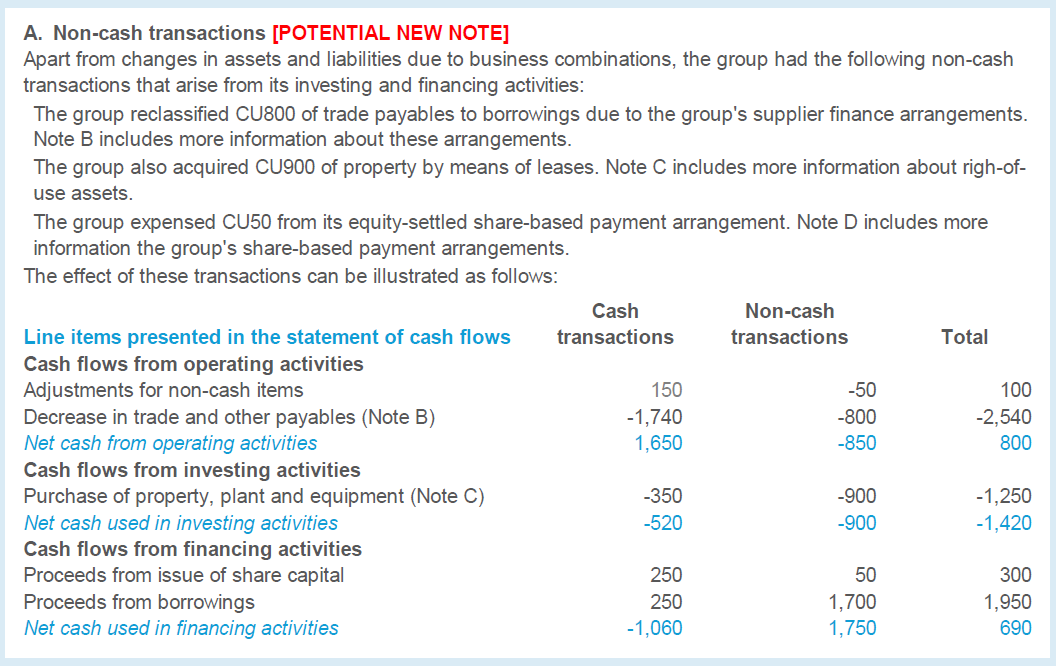
Illustrative example – Alternative 1: Disclosing the effect of non-cash transactions alongside cash transactions
A. Non-cash transactions [POTENTIAL NEW NOTE] Apart from changes in assets and liabilities due to business combinations, the group had the following non-cash transactions that arise from its investing and financing activities: The group reclassified CU800 of trade payables to borrowings due to the group's supplier finance arrangements. Note B includes more information about these arrangements. The group also acquired CU900 of property by means of leases. Note C includes more information about righ-of-use assets. The group expensed CU50 from its equity-settled share-based payment arrangement. Note D includes more information the group's share-based payment arrangements. The effect of these transactions can be illustrated as follows:
Illustrative example – Alternative 2: Disclosing the effect of non-cash transactions with the related information about the balance sheet items
A. Non-cash transactions [POTENTIAL NEW NOTE] Apart from changes in assets and liabilities due to business combinations, the group had the following non-cash transactions that arise from its investing and financing activities: The group reclassified CU800 of trade payables to borrowings due to the group's supplier finance arrangements. Note B includes more information about these arrangements. The group also acquired CU900 of property by means of leases. Note C includes more information about right-of-use assets. The group expensed CU50 from its equity-settled share-based payment arrangement. Note D includes more information about the group's share-based payment arrangements.
B. Changes in...trade and other payables [EXTRACT FROM POTENTIAL NEW NOTE - see slide 15] The group is party to a supplier finance arrangement that... [Paragraph 44H of IAS 7]
C. Property, plant and equipment [Paragraph 73(e) of IAS 16 and paragraph 53(a) of IFRS 16]
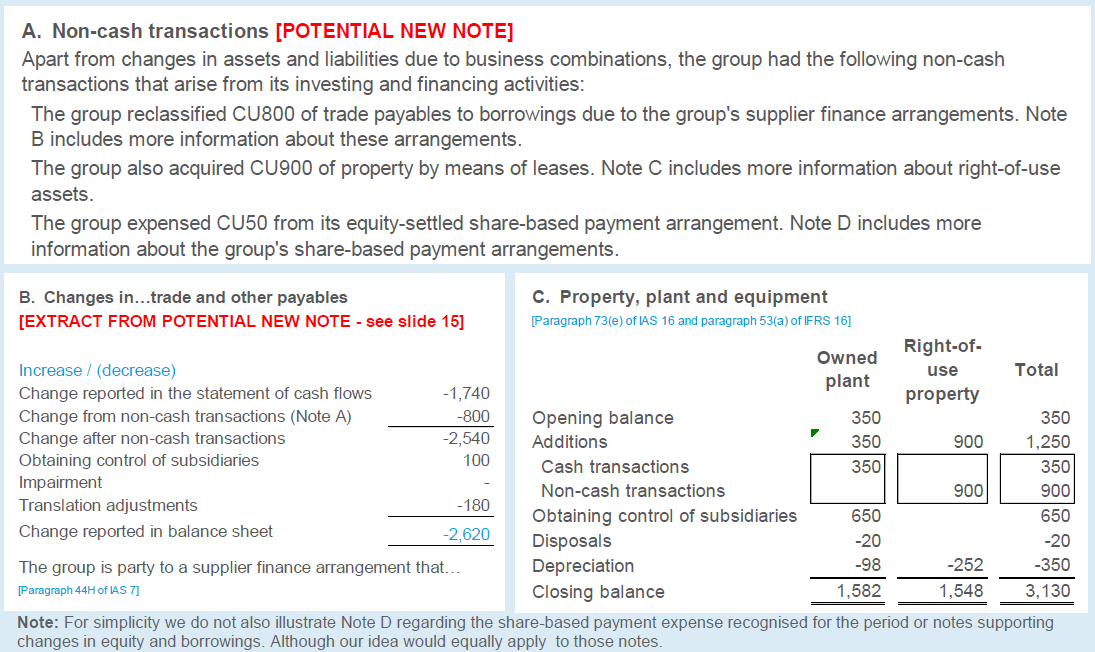
Note: For simplicity we do not also illustrate Note D regarding the share-based payment expense recognised for the period or notes supporting changes in equity and borrowings. Although our idea would equally apply to those notes.
UKEB Secretariat preliminary view
C15The UKEB Secretariat supports the IASB's approach to the content and location of non-cash transactions. Requiring information to be disclosed in a centralised place, so that information in the statement of cash flows can be more readily linked to other notes in the financial statements that contain both cash and non-cash information was recommended in UKEB research.
C16The Secretariat supports alternative 1, as it considers that it is useful to show the effect of non-cash transactions alongside cash transactions in a tabular format with a 'Total' column, as a table would facilitate the user cross-referencing both cash and non-cash transactions to the corresponding Notes B and C, improving the links in the financial statements. This assumes that Notes B and C would be presented as disclosed in alternative 2, since the notes are not replicated in alternative 1.
Questions for Board
1Do Board Members support the UKEB Secretariat's preliminary view on the IASB's approach to improving the reporting of information about non-cash transactions in paragraphs C15–C16?
2Do Board Members consider that there is any information missing from each of the two alternative example disclosures?
Non-cash changes: components of working capital
C17Feedback the IASB received from investors indicates that users are looking for information about some, but not necessarily all, types of other non-cash changes in assets and liabilities that make up the components of working capital, to assist them in better understanding significant, unusual, non-recurring or infrequently occurring changes and reclassifications in asset and liability line items. The typical examples include remeasurements, foreign exchange differences and translation adjustments, changes in balances due to obtaining or losing control of a business, impairments and settlements.
C18IFRS Accounting Standards include specific requirements related to these types of other non-cash changes that, specifically or generally, apply to assets and liabilities that make up the components of working capital. However:
a) the level of aggregation of the information provided to satisfy these requirements might not always enable investors to identify the effect of these changes; and
b) IFRS Accounting Standards do not specifically require a company to provide a link to related information disclosed elsewhere in the financial statements.
C19The requirements in IFRS 18, effective 1 January 2027, include disaggregation principles and the requirement to link information disclosed in the notes with information presented in the primary financial statements, which might lead to better information for users. Similarly requiring cross-references or mandating the level of aggregation of information might improve usefulness. However, information about specific other non-cash changes and their effects on assets and liabilities that make up components of working capital will still be scattered across the financial statements.
C20The IASB staff recommend an approach that focuses on entities providing information about specified types of other non-cash changes, irrespective of the method an entity uses to present cash flows from operating activities (i.e. direct or indirect method).
C21At the joint meeting in June 2025 of the Capital Markets Advisory Committee (CMAC) and Global Preparers Forum (GPF), some CMAC and GPF members agreed that the IASB should try to find a middle ground that balances the information investors can get from full reconciliations and the challenges with preparing them21.
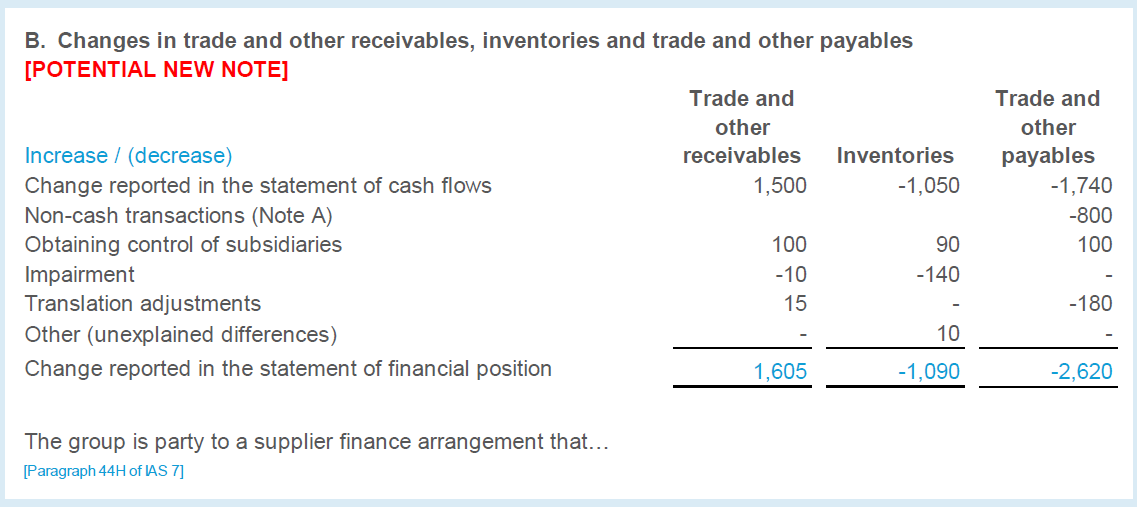
C22The IASB staff have developed an illustrative disclosure which could require companies to show their company-specific changes in working capital reconciled to the statement of cash flows and is presented below. The aim of the disclosure is to enable investors to understand the effect of some, but possibly not all, non-cash changes other than non-cash transactions in the assets and liabilities that make up the following line items in a company's balance sheet:
a) trade and other receivables;
b) inventories; and
c) trade and other payables22.
C23This is achieved by:
a) disclosing a reconciliation from changes reported in the statement of cash flows to the change in the carrying amounts in the balance sheet;
b) listing specific non-cash changes;
c) allowing for an unexplained difference (called 'other' in the example); and
d) assuming a note (or notes) containing the information in alternative 1 (below paragraph C14 above) also exist.
Illustrative example 3: Changes in working capital
B. Changes in trade and other receivables, inventories and trade and other payables [POTENTIAL NEW NOTE]
The group is party to a supplier finance arrangement that... [Paragraph 44H of IAS 7]
UKEB Secretariat preliminary view
C24The Secretariat supports the proposal for a working capital movement note that would more readily enable users to link the movement in working capital shown in the statement of cash flows to the movement shown in the respective components of working capital in the balance sheet.
C25The reconciliation should improve user understanding of the non-cash changes in trade and other receivables, inventories, and trade and other payables. It would also be more easily accessible as a single note.
C26The Secretariat acknowledges that an ‘other' category for non-material items is appropriate, but suggests that where such a category is utilised, a company should be required to explain the nature of the items included.
C27Regarding the columns in the example table, the Secretariat suggests that these should disclose the company-specific components of working capital, and suggests that the IASB requires companies to provide sufficient disaggregation of the major asset/liability categories, which would include factoring and supplier finance arrangements (reverse factoring), to enable users to understand the movements in those components.
C28The Secretariat also suggests requiring a company to explain in an accounting policy note the components of, and rationale for including components in, working capital. This would assist users in comparing companies.
Questions for Board
3Do Board Members support the UKEB Secretariat's preliminary view on the IASB's approach to improving the reporting of information about other non-cash changes in specific assets and liabilities that make up working capital in paragraphs C24–C28?
4Do Board Members consider that the population of non-cash changes (rows in the table) is complete in the example disclosure?
Non-cash changes: changes in liabilities that arise from financing activities
C29The requirement in paragraph 44D of IAS 7 should enable users to reconcile information from changes in the liabilities arising from financing activities in the statement of financial position to the statement of cash flows. However, entities satisfy paragraph 44D in different ways23. This diversity results in investors finding it difficult to understand and compare amounts in the statement of financial position for financing liabilities to the statement of cash flows.
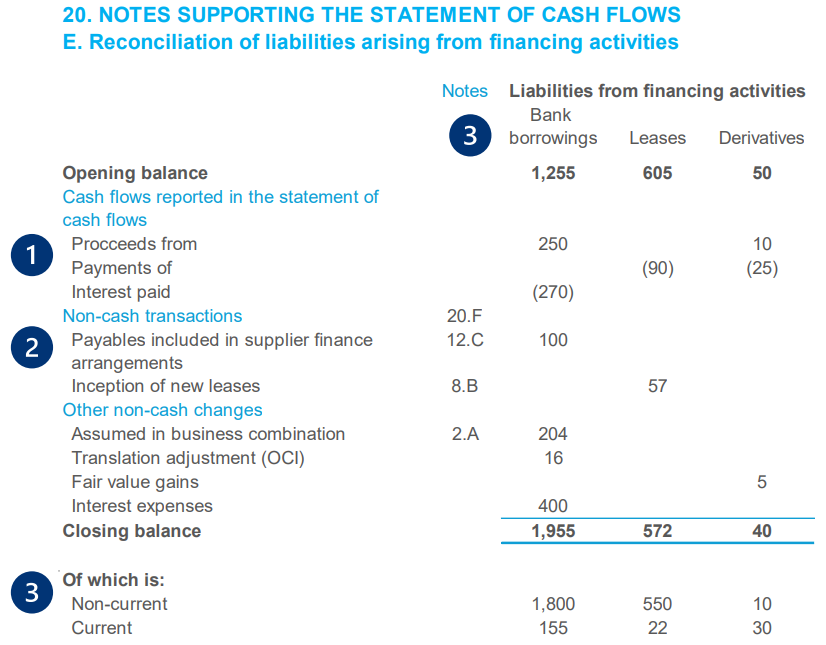
C30The IASB staff have developed an example disclosure which could require companies to disclose changes in liabilities arising from financing activities as a reconciliation of opening and closing balances, showing cash receipts, cash payments and the related line items in the statement of cash flows, for their company-specific components of financing activities. The example is presented below. This example may not be presented at the ASAF meeting in March 2026, but it has been included here for completeness of illustrations developed by the IASB staff to date.
20. NOTES SUPPORTING THE STATEMENT OF CASH FLOWS E. Reconciliation of liabilities arising from financing activities
Notes
UKEB Secretariat preliminary view
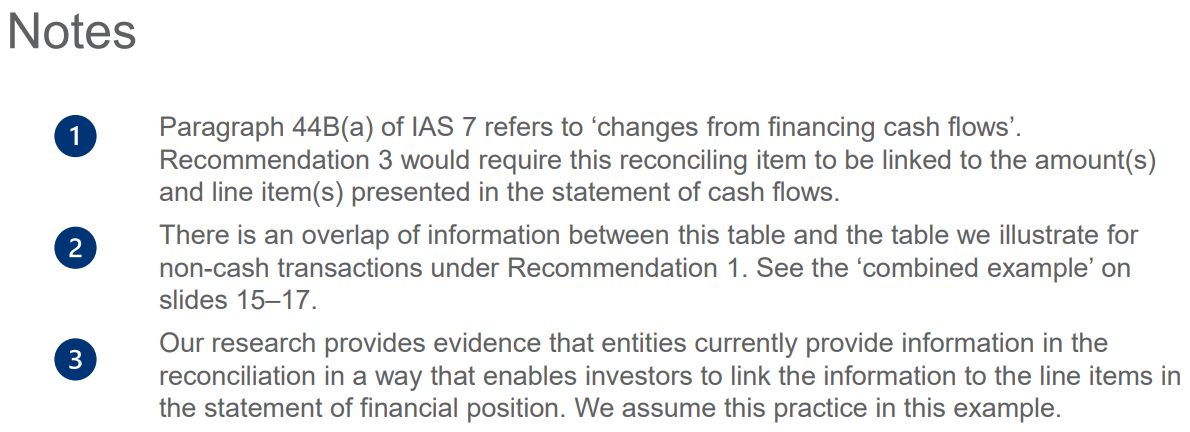
C31The Secretariat supports the IASB's approach to requiring an entity to disclose cash receipts, cash payments and related line items in the statement of cash flows as part of the reconciliation of changes in liabilities arising from financing activities, to facilitate linking the information to the line items presented in the statement of cash flows.
C32The Secretariat suggests mandating a reconciliation to meet the existing requirements in IAS 7 paragraphs 44A to 44E for changes in liabilities arising from financing activities.
C33The Secretariat also suggests that the IASB extends this disclosure to require companies to reconcile the changes in liabilities arising from financing activities to changes in net debt, in instances where the company discloses net debt in its annual report or other external communication with investors as the basis of a key performance metric. This would improve transparency for investors, about the company-specific components of net debt.
Questions for Board
5Do Board Members support the UKEB Secretariat's preliminary view on:
a) The IASB's approach to improving the linkage between changes in liabilities arising from financing activities and line items in the statement of cash flows in paragraphs C31–C32?
b) Extending the existing requirements in IAS 7 paragraphs 44A to 44E to require a company to reconcile its changes in liabilities arising from financing activities to company-specific net debt, as per paragraph C33?
Combined disclosure example
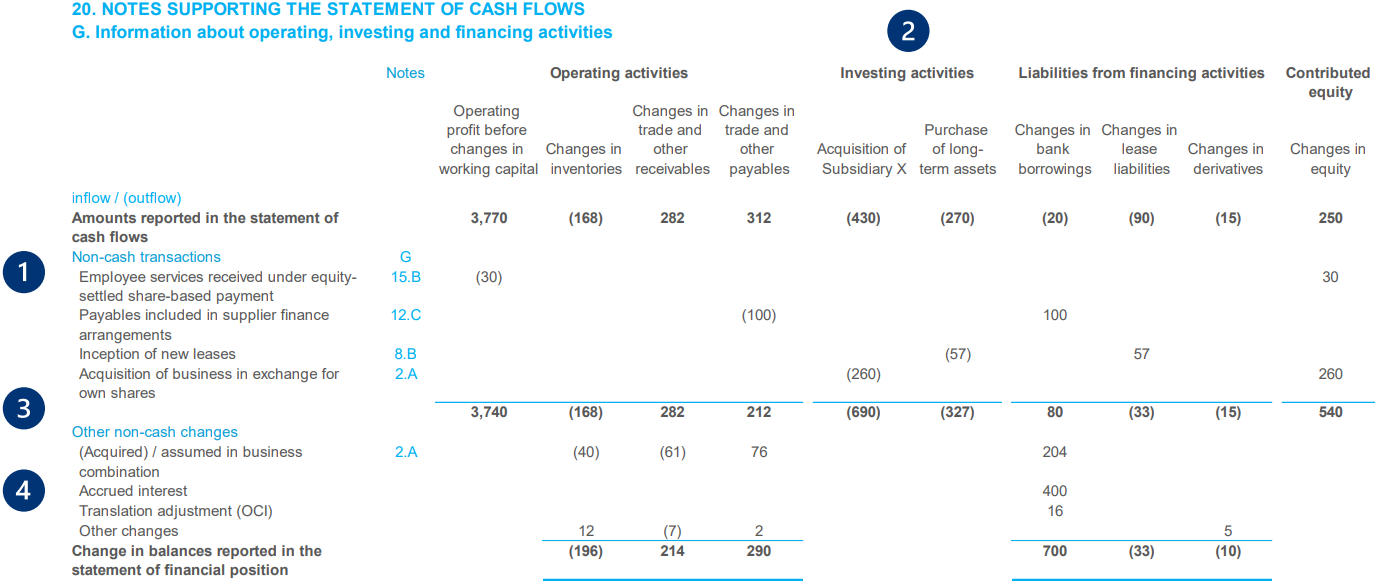
C34The IASB staff have also developed an example of a combined disclosure for all three requirements noted in paragraph C7 above, which is presented below.
20. NOTES SUPPORTING THE STATEMENT OF CASH FLOWS G. Information about operating, investing and financing activities
Notes
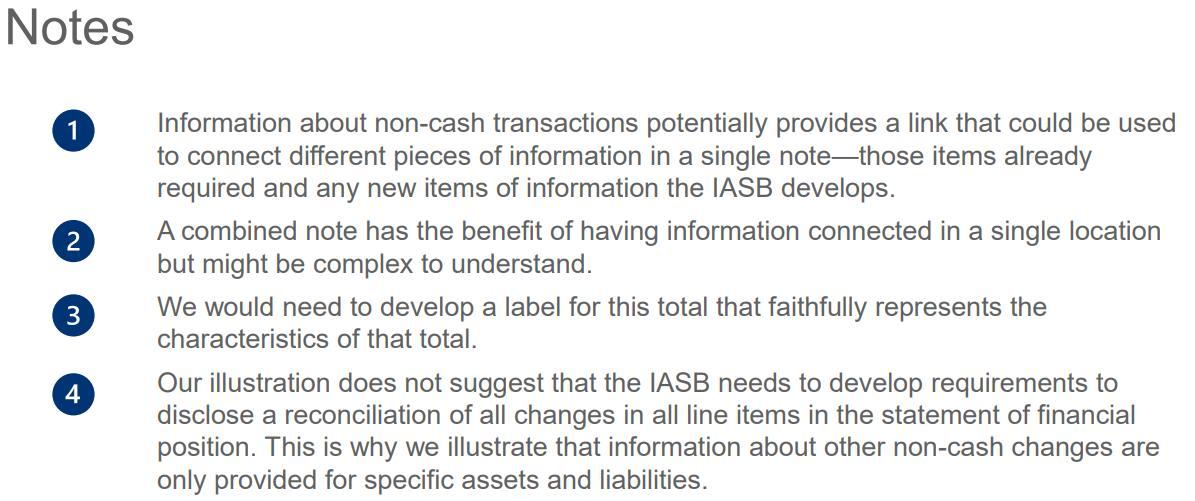
1Information about non-cash transactions potentially provides a link that could be used to connect different pieces of information in a single note—those items already required and any new items of information the IASB develops.
2A combined note has the benefit of having information connected in a single location but might be complex to understand.
3We would need to develop a label for this total that faithfully represents the characteristics of that total.
4Our illustration does not suggest that the IASB needs to develop requirements to disclose a reconciliation of all changes in all line items in the statement of financial position. This is why we illustrate that information about other non-cash changes are only provided for specific assets and liabilities.
UKEB Secretariat preliminary view
C35The Secretariat agrees that a combined example is useful but suggests that any requirements developed will permit companies to decide how best to present the information.
Questions for Board
6Do Board Members support the UKEB Secretariat's preliminary view that the combined example is useful, per paragraph C35?
UKEB advisory groups feedback
C36At the UKEB Investor Advisory Group (IAG) meeting in February 2026, members were presented with examples of potential solutions, as presented at the IASB meeting in October 202524. The examples were similar to those shown above for non-cash transactions and changes in working capital, and the same as those above for changes in liabilities arising from financing activities and the combined example.
C37The IAG members expressed strong overall support for the IASB's direction on improving disclosures of non-cash information, noting benefits for clarity, comparability and investor analysis. Members emphasised the need for transparency around company-specific definitions of working capital, appropriate and sufficient disaggregation, and linkages to the balance sheet. They expressed a general preference for disclosures being presented in one place, assuming usability is maintained.
C38In particular, the following points were noted in the members' discussion:
a) Content and location of non-cash transactions – there was broad endorsement of the example showing how non-cash transactions link to other notes in the financial statements and members found the cross-references useful for understanding where non-cash adjustments appear elsewhere in the financial statements. One member proposed the note could also highlight regulatory capital requirements for financial institutions, providing helpful contextual information without cluttering the primary statement.
b) Reconciliation of working capital movements – given that users struggle today to reconcile working-capital movements shown in the balance sheet with the movement shown in the statement of cash flows, this example was welcomed. However, appropriate disaggregation of components of working capital, accompanied by a working capital accounting policy, will be key to improving comparability between companies.
c) Reconciliation of changes in liabilities arising from financing activities – mandating a reconciliation to meet the existing requirements in IAS 7 paragraphs 44A-44E was considered a positive step to aid comparability and provide a link to the statement of cash flows. It was noted that enhanced disclosures requirements for derivatives are required to provide greater clarity.
d) The combined example was strongly supported and seen as clear, comprehensive and useful. Having the information in one place is seen as helpful. That said, members suggested that the movement in financing liabilities section should be extended to show the balance sheet opening and closing amounts for completeness. Concern was also raised that if reconciling items are extensive, a combined reconciliation may become unwieldy and, in such instances, separate reconciliations may be more user friendly to enable clarity.
C39Further outreach will be conducted on the latest IASB example disclosures at the meetings of the UKEB Preparer Advisory Group (PAG) and the UKEB Accounting Firms and Institutes Advisory Group (AFIAG) in March 2026, prior to the ASAF meeting. Feedback from these meetings will be presented to the Board at its March 2026 meeting.
Next steps
C40The IASB will continue to assess possible approaches to improve financial reporting in relation to each of the topics in its project plan through the first half of 2026 and expects to publish an exposure draft in 2027.
C41The UKEB Secretariat will continue to monitor the IASB's deliberation and tentative decisions and will provide the Board with updates accordingly.
Annex 1: IASB's decisions January 2026
1) Moving the project from the research programme to the standard-setting work plan
IASB decision
The IASB agreed with the IASB staff recommendations to add the project on Statement of Cash flows and Related Matters to its standard-setting work plan, under which any consultative document the IASB might later publish would be an exposure draft.
Criteria for adding a project to the standard-setting work plan
Per the IASB Due Process Handbook, the IASB:
a) is required to evaluate the merits of adding a project to the work plan, primarily on the basis of users' needs, while taking into account the costs of preparing the information in financial reports (Paragraph 5.4);
b) adds a project to the work plan only if it concludes that the benefits of the improvements to financial reporting will outweigh the costs (Paragraph 5.7); and
c) would normally propose to develop a new IFRS Standard, or to make major amendments to a Standard, only after it has published a discussion paper and considered the comments it receives from that consultation, unless the IASB is satisfied that it has sufficient information and understands the solutions, considering the research it has already undertaken (Paragraph 5.5).
UKEB Secretariat views
The Secretariat is supportive of the IASB's decision to move the project from the research programme to the standard-setting work plan, considering the criteria above.
2) Setting up a consultative group for the project
IASB decision
The IASB decided not to establish a dedicated consultative group for the project.
Criteria for setting up a consultative group
The IASB Due Process Handbook requires the IASB to consider whether it should establish a consultative group for each major project that it adds to its standard-setting work plan (Paragraphs 3.59–3.60).
UKEB Secretariat views
The Secretariat is supportive of the IASB's decision not to establish a dedicated consultative group for the project, given the diverse and geographically balanced membership of the IASB and of its existing advisory committees, and that it is not a mandatory requirement to establish a consultative group.
Appendix D: Equity Method
| Project Stage | |||||||
|---|---|---|---|---|---|---|---|
| IASB | Research / Pipeline | Discussion Paper | Redeliberation | Exposure Draft | Redeliberation | Final Standard | Post Implementation Review |
| UKEB | Research / Influencing | Research / Influencing | Monitoring | Influencing | Monitoring | Endorsement | Influencing |
UKEB project page
UKEB Final Comment Letter (published 16 December 2024)
IASB Next Milestone: Decide Project Direction (expected March 2026)
Purpose
D1This paper provides the Board with an update on the topic that will be discussed at the IASB's Accounting Standards Advisory Forum (ASAF) meeting in March 2026, in particular, the proposal in the Exposure Draft (ED) Equity Method of Accounting IAS 28 Investments in Associates and Joint Ventures (revised 202x) to recognise gains and losses in full resulting from transactions with associates and joint ventures.
Background
D2In September 2024, the IASB published its ED, which aimed to:
a) clarify and add to the requirements in IAS 28 to answer application questions about how to apply the equity method of accounting;
b) reorder the requirements in a more logical and consistent way to help companies with the application of the Standard i.e. improve the understandability; and
c) improve the disclosure requirements in IFRS 12 Disclosure of Interests in Other Entities and IAS 27 Separate Financial Statements to complement the proposed amendments to IAS 28.
D3The UKEB undertook a 'light touch' approach in responding to the ED and is not aware of pervasive or material concerns for the UK arising from the proposals. Therefore, the UKEB supports the proposals in the ED, but did not comment on each specific proposal.
D4In May 2025, the IASB discussed feedback to the ED. The Board received an update at its September 2025 meeting25.
D5In September 2025, the IASB commenced its deliberations of the ED proposals. The Board received updates, on tentative decisions made at the IASB meetings in September and October 2025, at its November 2025 meeting26.
D6Further updates were provided to the Board, on tentative decisions made at the IASB meeting in November 2025, at its January 2026 meeting27.
D7According to the IASB's published workplan, the IASB is expected to decide on the project direction in March 2026.
March 2006 ASAF meeting: Transactions with associates and joint ventures
D8At the March 2026 ASAF meeting IASB staff are expected to present the additional information collected on the ED proposal to recognise in full gains or losses from transactions between an investor and its associates and joint ventures. ASAF members will be invited to give input regarding whether stakeholders in their jurisdictions or regions have same views or challenges.
D9The ED proposed changing the current requirements in IAS 28 relating to transactions with associates and joint ventures. A summary of the current requirements in IAS 28 and the ED proposal, is presented in the table below28. Further analysis and preliminary UKEB Secretariat views are presented in the paragraphs that follow the table.
| Current requirements | Exposure Draft proposals |
|---|---|
| Paragraph 28 of IAS 28 requires an investor to recognise gains or losses resulting from transactions with an associate only to the extent of the unrelated investors' interests in the associate. That requirement applies to both downstream transactions (such as a sale or contribution of assets from an investor to an associate) and upstream transactions (such as a sale of assets from an associate to an investor). | The ED proposed requiring an investor: a) to recognise gains and losses in full resulting from all 'upstream' and 'downstream' transactions with its associates, including transactions involving the loss of control of a subsidiary; and b) to disclose information about the gains or losses recognised by the investor from 'downstream' transactions with associates. |
IASB rationale for the ED proposal
D10The IASB tentatively decided in favour of the ED proposal to recognise gains and losses in full, because:
a) It would provide useful information to users, for example, to help estimate future cash flows and analyse the associate's performance.
b) It would be simpler and less costly to apply for preparers, i.e. an entity with an investment in an associate would no longer be required:
i. to gather the information required for elimination entries;
ii. to exercise judgement when allocating the restricted gain or loss if the transaction involves the transfer of a business; or
iii. to track the restricted gain or loss in future periods to determine when it should be recognised in the investor's financial statements.
Stakeholder feedback
D11The IASB received mixed views on the ED proposal. Whilst most stakeholders agreed, some stakeholders in the Asia-Oceania region disagreed because:
a) the proposal may provide an opportunity for earnings management;
b) the current requirements in IAS 28 are consistent with the view that the equity method is one-line consolidation method; and
c) the proposal introduces a significant change to the requirements and goes beyond the project's scope.
D12Many stakeholders agreed with disclosing gains or losses from 'downstream' transactions. Some preparers have raised concerns about commercial sensitivity and argued that existing disclosure requirements in IAS 24 Related Party Disclosures29 already provide sufficient information.
IASB discussion
D13At its meeting in October 2025, the IASB discussed the stakeholder feedback received on the ED's proposal, in particular possible earnings management.
D14Most IASB members questioned the ability for earnings management, given that the investor does not have control over associates and joint ventures. Some IASB members were also sceptical about whether the IASB will be able to require meaningful disclosures that would provide useful information to users to resolve the concerns with the ED proposal. Most IASB members disagreed with the disclosure suggestions30 from respondents, for example disclosing the rationale for transactions and their pricing, because it would lead to the disclosure of commercially sensitive information. A few IASB members pointed to the existing disclosure requirements in IAS 24.
D15The IASB agreed with the staff recommendation to undertake further work:
a) to understand the concerns of respondents who said the proposals could increase opportunities for earnings management; and
b) to understand whether enhancing disclosures or adding guidance might resolve these concerns.
IASB outreach
D16The IASB is currently undertaking outreach on this topic with its consultative groups. So far it has consulted:
a) Global Preparers Forum (GPF)31.
b) Capital Markets Advisory Committee (CMAC)32.
UKEB advisory groups feedback
D17At the UKEB Investor Advisory Group (IAG) meeting in February 2026, the members shared their concerns on the potential for earnings management. Other key points raised were:
a) Comparability and conceptual merits: some sympathy was expressed with the feedback that the requirements in IAS 28 are consistent with the view that the equity method is one-line consolidation method, and the proposal introduces a significant change to the requirements. However, other members saw merit in the IASB's simplification, given that the current partial recognition requirements add “noise” when gains are deferred and reversed over time.
b) Materiality and practical importance: members generally felt that, in many cases, the effects are small and mainly timing differences. Only in industries with large JV portfolios (e.g. extractives) might amounts become significant, but users typically examine JV arrangements closely.
D18Further outreach will be conducted at the meetings of the UKEB Preparer Advisory Group (PAG) and the UKEB Accounting Firms and Institutes Advisory Group (AFIAG) in March 2026, prior to the ASAF meeting. Feedback from these meetings will be presented to the Board at its March 2026 meeting.
UKEB Secretariat preliminary view
D19The UKEB Secretariat acknowledges the merits of the ED proposal i.e. simpler and less costly to apply for preparers. However, feedback received from IAG members is mixed.
D20We will update the Board once we have received further feedback from our other advisory groups.
Next steps
D21The IASB will continue redeliberating the proposals over the next few months, in line with the redeliberation plan outlined in paragraph 27 of Agenda Paper 13 for the IASB's June 2025 meeting.
D22The UKEB Secretariat will continue to monitor the IASB's redeliberation and tentative decisions and will continue to provide the Board with updates.
Appendix E: Post-implementation Review of IFRS 9—Hedge Accounting
| Project Stage | |||||||
|---|---|---|---|---|---|---|---|
| IASB | Research / Workplan | Discussion Paper | Redeliberation | Exposure Draft | Redeliberation | Final Standard | Post Implementation Review |
| UKEB | Research / Influencing | Research / Influencing | Monitoring | Influencing | Monitoring | Endorsement | Influencing |
IASB Next Milestone: Request for Information (expected H2 2026)
Purpose
E1This paper provides the Board with an update on the status of the IASB's Post-implementation Review of IFRS 9—Hedge Accounting (PIR). A Request for Information for this project is expected in H2 2026.
Background
E2In July 2014 the IASB issued IFRS 9 Financial Instruments. The Standard was effective for annual periods commencing on or after 1 January 2018. Insurers could defer the effective date until 1 January 2023 to align with the implementation of IFRS 17 Insurance Contracts if certain conditions were met.
E3The IASB has split its Post-implementation Review of IFRS 9 into three parts. This project is the final part of the review and will cover the hedge accounting requirements of IFRS 9, along with the associated disclosure requirements in IFRS 7 Financial Instruments: Disclosures.
E4Initial feedback on the PIR was sought from the UKEB's Accounting Firms and Institutes Advisory Group (AFIAG) in June 2025 and Financial Instruments Working Group (FIWG) in April 2025.
E5Feedback from the AFIAG indicated that for corporate entities the requirements generally worked well. Compared to the previous requirements of IAS 39 Financial Instruments: Recognition and Measurement the requirements were:
a) Less prohibitive and therefore allowed a greater range of companies to access hedge accounting.
b) Presented no greater cost or challenge to audit.
E6Feedback from the FIWG indicated:
a) Some UK banks and building societies choose to apply, in part or in full, the hedge accounting requirements of IAS 39. So, generally, corporate entities may have more experience with the application of the IFRS 9 requirements.
b) There were no fatal flaws in the hedge accounting requirements of IFRS 9. However, there may be other potentially significant issues such as the hedging of inflation risk and issues related to rebalancing the hedging relationship. The changes to hedge accounting requirements in Amendments to IFRS 9 and IFRS 7 – Contracts Referencing Nature-dependent Electricity would also need to be considered.
IASB December 2025 meeting
E7At its December 2025 meeting the IASB agreed to begin the PIR in Q1 2026. The discussion acknowledged the potential overlap between this project and the Risk Mitigation Accounting (RMA) project. The IASB staff indicated they would discuss matters relevant to the PIR with stakeholders when conducting outreach on the RMA project during H1 2026. They would then issue a Request for Information in H2 2026.
IASB March ASAF meeting
E8At the March ASAF the IASB staff will seek ASAF members' views on the application of the hedge accounting requirements in IFRS 9 in their jurisdiction and which entities apply them, as well as on matters that members think the IASB should consider for the Post-implementation Review of IFRS 9—Hedge Accounting (PIR).
E9The Secretariat is undertaking limited desk-based research to establish the extent to which hedge accounting is prevalent in the UK, and in which industries.
E10The IASB has not yet undertaken extensive outreach to establish matters that would be considered as part of the PIR. We are not aware of significant concerns amongst stakeholders relating to hedge accounting.
Next steps
E11The IASB are expected to start the PIR process in Q1 2026, though a Request for Information is not expected until later in 2026.
E12The UKEB Secretariat will continue to monitor the IASB's discussions and will provide the Board with updates accordingly.
E13The UKEB Secretariat will consult further with the UKEB's advisory and working groups, along with other stakeholders, once the Request for Information is published.
Appendix F: Intangible Assets
| Project Stage | |||||||
|---|---|---|---|---|---|---|---|
| IASB | Research / Pipeline | Discussion Paper | Redeliberation | Exposure Draft | Redeliberation | Final Standard | Post Implementation Review |
| UKEB | Research / Influencing | Research / Influencing | Monitoring | Influencing | Monitoring | Endorsement | Influencing |
IASB Next Milestone: Decide project direction
UKEB project page
Purpose
F1The purpose of this paper is to provide an update to the Board on the IASB's January 2026 discussion on the intangible assets project. At this meeting the IASB discussed:
a) The approach to selecting test cases and identifying principles and topics to explore further.
b) A "cloud computing arrangements” test case.
c) An "agile software” development test case.
d) Other potential test cases including “data resources and artificial intelligence related data and solutions” (AI).
F2The IASB was not asked to make any decisions.
Background
F3Following the Third Agenda Consultation in 2022, the IASB added a project on intangible assets to its research pipeline to “comprehensively review" the requirements in IAS 38 Intangible Assets. The project commenced in April 2024 and has discussed stakeholder feedback and the output of initial research activities at subsequent meetings.
F4In 2025, the IASB decided on the project direction and developed test cases to further explore the fundamental aspects of IAS 38.
IASB discussion January 2026
F5Overall, the IASB supported the approach taken to selecting proposed test cases and agreed that the cloud computing arrangements and agile software development test cases should be the focus of future work.
F6The IASB emphasised that the purpose of the test cases is not to solve application issues. The objective of the project is to conduct a comprehensive review of IAS 38 through using these test cases to gather further insights on intangibles.
F7A few IASB members highlighted the importance of examining whether a business model can be used as a starting point on how the board thinks about the different accounting models related to intangibles.
F8The IASB agreed that the data resources and AI test case should not be explored as many of the issues that stakeholders have raised will be considered when exploring the cloud computing arrangements and agile software development test cases.
Next steps
F9In Q2 of 2026, the IASB are expected to consider an analysis of the findings from the case studies. Towards to the end of 2026, the staff will present to the IASB, reflections on work done and plan next steps for the two workstreams.
F10The UKEB Secretariat will continue to monitor the IASB's discussions and will provide the Board with updates.
Appendix G: List of IASB projects
This Appendix provides a list of all active IASB projects33, including links to the IASB project page and where relevant, to the UKEB project page and any UKEB projects or comment letters. Items highlighted in grey are changed from the last report.
List of IASB projects
| Amendments to the Fair Value Option (IAS 28) | UKEB project page (Influencing) | |
| UKEB Project Type: Influencing | UKEB Project Initiation Plan (Published February 2026) | |
| IASB Next Milestone: Exposure Draft February 2026 | ||
| Amortised Cost Measurement | ||
| UKEB Project Type: Monitoring | ||
| IASB Next Milestone: Exposure Draft H2 2026 | ||
| Business Combinations—Disclosures, Goodwill and Impairment | UKEB project page (Influencing) | |
| UKEB Project type: Monitoring | UKEB Project Initiation Plan (Published March 2024) | |
| IASB Next Milestone: Decide Project Direction H2 2026 | UKEB Draft Comment Letter (Published May 2024) | |
| UKEB Final Comment Letter (Published July 2024 | ||
| UKEB Feedback Statement (Published July 2024) | ||
| UKEB Due Process Compliance Statement (Published September 2024) | ||
| UKEB project page (Discussion Paper) | ||
| UKEB Final comment Letter on the Discussion Paper (Published January 2021) | ||
| UKEB Feedback Statement (Published March 2021) | ||
| UKEB Report: Subsequent Measurement of Goodwill - A Hybrid Model (Published September 2022) | ||
| Equity Method | UKEB project page | |
| UKEB Project Type: Monitoring | UKEB Project Initiation Plan (Published October 2024) | |
| IASB Next Milestone: Decide Project Direction March 2026 | UKEB Draft Comment Letter (Published October 2024) | |
| UKEB Final Comment Letter (Published December 2024) | ||
| UKEB Feedback Statement (Published December 2024) | ||
| UKEB Due Process Compliance Statement (Published January 2025) | ||
| Financial Instruments with Characteristics of Equity | UKEB project page | |
| UKEB Project Type: Monitoring | UKEB Project Initiation Plan (Published October 2023) | |
| IASB Next Milestone: Final Amendments H2 2026 | UKEB Draft Comment Letter (Published February 2024)) | |
| UKEB Final Comment Letter (Published April 2024) | ||
| UKEB Feedback Statement (Published April 2024) | ||
| UKEB Due Process Compliance Statement (Published April 2024) | ||
| Intangible Assets | UKEB project page | |
| UKEB Project Type: Monitoring | Accounting for Intangibles UK Stakeholders' Views' (Published March 2023) | |
| IASB Next Milestone: Decide Project Direction H2 2026 | UKEB Project Initiation Plan Updated (Published June 2023) | |
| Accounting for Intangibles a Quantitative Analysis of UK Financial Reports (Published May 2024) | ||
| Accounting for Intangibles a Survey of Users' Views' (Published May 2024) | ||
| UKEB Project Initiation Plan (2025) (Published November 2025) | ||
| Post-implementation Review of IFRS 16—Leases | UKEB Project page | |
| UKEB Project Type: Monitoring | UKEB Project Initiation Plan (Published June 2025) | |
| IASB Next Milestone: Request for Information Feedback February 2026 | UKEB Draft Comment Letter (Published July 2025) | |
| UKEB Final Comment Letter (Published October 2025) | ||
| Post-implementation Review of IFRS 9 – Hedge Accounting | ||
| UKEB Project Type: Monitoring | ||
| IASB Next Milestone: Request for Information Feedback H2 2026 | ||
| Provisions—Targeted Improvements | UKEB project page | |
| UKEB Project Type: Monitoring | UKEB Project Initiation Plan (Published October 2024) | |
| IASB Next Milestone: Decide Project Direction March 2026 | UKEB Draft Comment Letter (Published December 2024) | |
| UKEB Final Comment Letter (Published March 2025) | ||
| UKEB Feedback Statement (Published March 2025) | ||
| UKEB Due Process Compliance Statement (Published March 2025) | ||
| Rate-regulated Activities | UKEB project page (Pre-endorsement) | |
| UKEB Project Type: Monitoring | UKEB Preliminary Economic Assessment (Published April 2024) | |
| IASB Next Milestone: IFRS Accounting Standard Q2 2026 | UKEB letter to the IASB (Published July 2024) | |
| UKEB Secretariat's top-down approach (Published July 2024) | ||
| UKEB project page (Influencing) | ||
| UKEB Draft Comment Letter (Published July 2021) | ||
| UKEB Final Comment Letter (Published August 2021) | ||
| UKEB Feedback Statement (Published April 2022) | ||
| Risk Mitigation Accounting (formerly Dynamic Risk Management) | UKEB project page | |
| UKEB Project Type: Influencing | ||
| IASB Next Milestone: Exposure Draft Feedback H2 2026 | ||
| Statement of Cash Flows and Related Matters | UKEB project page | |
| UKEB Project Type: Monitoring | UKEB Project Initiation Plan (Published December 2024) | |
| IASB Next Milestone: Exposure Draft 2027 | UKEB updated Project Initiation Plan (Published May 2025) | |
| UKEB Research Paper 1 Statement of Cash Flows: Background and Key Issues (Published December 2024) | ||
| UKEB Research Paper 2 Statement of Cash Flows: Non-mandatory and Voluntary Cash Flow Disclosures Provided by UK Listed Companies (Published February 2025) | ||
| UKEB Research Paper 3 Statement of Cash Flows: UK User and Preparer Perspectives (Published March 2025) | ||
| UKEB Research Paper 4 Statement of Cash Flows: UK Users' views on potential ways forward (Published July 2025) | ||
| UKEB Research Paper 5 Statement of Cash Flows: Further research – Net Debt (Published November 2025) | ||
| Translation to a Hyperinflationary Presentation Currency (IAS 21) | ||
| UKEB Project Type: UKEB Deferred Project | ||
| IASB Next Milestone: Completed |
Footnotes:
Footnotes
-
Connectivity resources (IASB/ISSB) ↩
-
EFRAG Discussion Paper CONNECTIVITY OF FINANCIAL AND SUSTAINABILITY REPORTING (December 2025) ↩
-
UKEB Responsibilities relating to IFRS Sustainability Disclosure Standards or UK Sustainability Reporting Standards. (UKEB website) ↩
-
Connectivity—what is it and what does it deliver? (IASB March 2023) ↩
-
Connectivity between the financial statements and sustainability-related financial disclosures Related information (IASB World Standard-setters Conference 2024) ↩
-
IASB issues illustrative examples on reporting uncertainties in financial statements (IASB November 2025) ↩
-
Exposure Draft Climate-related and Other Uncertainties in the Financial Statements—Proposed illustrative examples Final Comment Letter (UKEB November 2024) ↩
-
Disclosing information about anticipated financial effects applying ISSB Standards (ISSB August 2025) ↩
-
UKEB Publishes Climate-related Matters Research (September 2023) ↩
-
IASB Agenda Paper 7 - January 2026. ↩
-
IASB Agenda Paper 7A - January 2026. ↩
-
IASB Agenda Paper 7B - January 2026. ↩
-
IASB Agenda Paper 7C - January 2026. ↩
-
IASB Agenda Paper 7D - January 2026. ↩
-
IASB Agenda Paper 7E - January 2026. ↩
-
The Board was last provided an update on this research project in January 2026 – see UKEB meeting 29 January 2026 Agenda paper 8 Appendix B. ↩
-
See IASB Staff Agenda Paper 20A for the January 2026 meeting. ↩
-
'Non-cash transactions' are those transactions described in paragraphs 43–44 of IAS 7 Statement of Cash Flows whereas 'other non-cash changes' are all other changes in balances that do not result from the use of cash and cash equivalents. ↩
-
See Agenda Paper 20A Approach to non-cash transactions and other changes in balances and Agenda Paper 20B Examples of potential solutions for the IASB'S October 2025 meeting. ↩
-
The IASB staff shared updated draft potential illustrative disclosures with the UKEB on 16 February 2026, related to the content and location of non-cash transactions, and non-cash changes in relation to movements in working capital, which are included in this paper. The final versions to be included in the March 2026 ASAF pack will be available here, when published: https://www.ifrs.org/news-and-events/calendar/2026/march/accounting-standards-advisory-forum/. ↩
-
Such an approach might involve providing separately information about specified types of changes in working capital assets and liabilities, while allowing for a balancing figure to remain without explanation. ↩
-
Paragraph 103 of IFRS 18 lists these as line items presented in the balance sheet. ↩
-
Paragraphs BC17–BC19 of the Basis for Conclusions on IAS 7 indicate that the decision of the IASB to permit that the disclosure requirements could be satisfied in various ways (and not only by providing a reconciliation) was in response to concerns raised by financial institutions. ↩
-
See Agenda Paper 20A Approach to non-cash transactions and other changes in balances and Agenda Paper 20B Examples of potential solutions for the IASB'S October 2025 meeting. ↩
-
Refer to UKEB Public Board Meeting – 25 September 2025, Agenda Paper 7 IASB General Update (Appendix D). ↩
-
Refer to UKEB Public Board Meeting – 20 November 2025, Agenda Paper 7 IASB General Update (Appendix J). ↩
-
Refer to UKEB Public Board Meeting – 29 January 2026, Agenda Paper 8 IASB General Update (Appendix D). ↩
-
For a numerical example comparing the current requirements with the ED proposals, see IASB October 2025 Agenda Paper AP13C Appendix A. ↩
-
Paragraph 18 of IAS 24 Related Party Disclosures requires that if an entity has had related party transactions during the periods covered by the financial statements, it shall disclose the nature of the related party relationship as well as information about those transactions and outstanding balances, including commitments, necessary for users to understand the potential effect of the relationship on the financial statements. IAS 24 require certain minimum, disclosures e.g. the amount of the transactions, the amount of outstanding balances, including commitments. Note that the definition of related party in IAS 24 includes associates and joint ventures. ↩
-
To mitigate the potential risk of earnings management, respondents made the following suggestions to the IASB: a) introducing a requirement to disclose gains or losses from 'upstream' transactions, as this information is needed for users, similar to the proposal on 'downstream' transactions. b) introducing disclosures to improve transparency for users, for example, by disclosing the rationale for transactions and their pricing. c) introducing guidance on how the proposal applies to transactions that lack commercial substance, or creating an exception to the proposal if transactions lack commercial substance. ↩
-
See IASB Global Preparers Forum meeting summary which can be accessed here. ↩
-
This list does not include projects related to the IFRS Interpretations Committee or IASB's project outside the UKEB's work remit (such as the Second Comprehensive Review of the IFRS for SMEs Accounting Standard and Management Commentary). ↩