Project Initiation Plan - Amendments to the Fair Value Option (IAS 28)
Purpose
1This paper sets out the plan for the influencing and endorsement phases of the project related to the urgent IASB project Amendments to the Fair Value Option (Proposed amendments to IAS 28) (the Amendments). The Exposure Draft (ED) is expected to be published in February 2026 with a 60 day consultation period (shortened from the usual 120 days).
2The project aims to address an issue that has been identified by entities preparing to apply IFRS 18 Presentation and Disclosure in Financial Statements for the first time. IFRS 18 is effective from periods beginning on or after 1 January 2027, hence the need for an urgent project. The amendments would need to be published in 2026 and effective on or before the effective date of IFRS 18.
3Given the urgency of the Amendments and the IASB's accelerated timetable, this PIP addresses both the influencing and the endorsement and adoption stages of the project.
Background
4IAS 28 Investments in Associates and Joint Ventures (IAS 28) requires investments in associates and joint ventures to be accounted for using the equity method, unless a different method is permitted by the standard.
5Paragraph 18 of IAS 28 states the circumstances when the fair value option may be applied:
'When an investment in an associate or a joint venture is held by, or is held indirectly through, an entity that is a venture capital organisation, or a mutual fund, unit trust and similar entities including investment-linked insurance funds, the entity may elect to measure that investment at fair value through profit or loss in accordance with IFRS 9....
6Paragraph 55 of IFRS 18 requires income from all investments accounted for using the equity method to be classified in the investing category in the statement of profit or loss. Income from investments in associates and joint ventures that are not accounted for using the equity method is required to be classified in the operating category.
7The IASB has received feedback that there is diversity in practice in the interpretation of the scope of the fair value option in IAS 28. While this might not have had a material financial reporting impact previously, it is expected that the classification split required between operating and investing in the statement of profit or loss could have a material financial reporting impact under IFRS 18.
Summary of Proposed Changes
8A brief summary of the expected proposed amendments is shown in the table below1.
| Amendments to the Fair Value Option (IAS 28) | |
|---|---|
| Issued for public comment | The Exposure Draft is expected to be issued for public comment in February 2026, with a 60-day comment period. |
| Origin | See Background paragraphs 4–7 above. |
| What is expected to change? | Paragraphs 18 and 19 of IAS 28 permit the use of the fair value option for certain investments in associates or joint ventures. The anticipated changes relate to clarifying the meaning of 'similar entities' in paragraphs 18 and 19 of IAS 28. The ED is expected to propose: |
| - replacing the wording 'similar entities including investment-linked insurance funds’with 'similar entities including those that invest in associates and joint ventures as a main business activity.' | |
| - Making minor consequential editorial changes to paragraphs 18 and 19. The IASB staff papers have not indicated whether there will be any specific transition provisions, or amendments to other standards. Paragraph C7 of IFRS 18 already includes provisions permitting an entity to change its election for the fair value option under paragraph 18 of IAS 28 at the date of initial application of IFRS 18. | |
| Timeline | The ED comment period is expected to close in April 2026. Final amendments are expected to be issued by the IASB in June 2026. |
Project Plan
Proportionality Assessment
Significance and Size
9The Amendments are expected to be narrow in scope, as they aim to clarify the accounting treatment of the fair value option. This clarification is understood to be consistent with existing practice in the UK and expected to be primarily of relevance to insurance entities.
Complexity
10The Amendments are expected to be limited to the minor changes set out above. Therefore, the Amendments are not expected to introduce any new principles or change existing principles in the IFRS Accounting Standards.
Expected Timeline / Urgency
11These amendments are needed urgently. They are aimed at addressing existing diversity of practice internationally in interpretation of paragraph 18 of IAS 28, ahead of first-time adoption of IFRS 18.
Expected Interest / Sensitivity
12Four IASB members indicated their intention to dissent from the proposals expected to be included in the ED. They generally supported widening the scope to permit a broader fair value option for interests in associates and joint ventures. During the IASB discussions there was acknowledgement that a wider change would require a longer consultation. However, this would be difficult to achieve within the required timeframes.
Feedback on the Proposals from Desk-based Research / Initial Outreach
13There is no indication of wider UK concerns in relation to this project. Initial limited outreach indicates that application of these paragraphs of IAS 28 has not historically been an area of significant judgement in the UK.
Connectivity
14No connectivity implications have been identified.
Recommended UKEB Project Scope
15Based on the proportionality assessment above we recommend a 'Limited' project scope. The approach described in this document reflects this scope.
Project: Key Activities
| Key Activities: Influencing | Due Process Handbook |
|---|---|
| Creation of a Project Initiation Plan (this document) | 5.4–5.8 Mandatory |
| Desk-based research to support the proportionality assessment including: Review of accounting firm manuals and UKEB staff papers. Review of IASB papers, presentations, meetings, and education materials. | 5.9 Optional |
| Publication of a Draft Comment Letter (DCL) for public consultation The DCL will be published on the UKEB website. Announcement of the publication of the DCL and Invitation to Comment (ITC) will be made via the UKEB News Alert publication, and LinkedIn posts. The DCL and ITC will be issued for comment for a period which may be shortened to 14 days as necessary due to the urgency of the project. | 5.13–5.17 Generally mandatory |
| Stakeholder outreach We have conducted limited outreach, including with accounting firm representatives and an insurer. We intend to conduct further limited outreach, including with advisory and working group members. | 5.10–5.12 Mandatory |
| Final Comment Letter A final comment letter (FCL) will be created for Board approval, submission to the IASB, and publication on the UKEB website. | 5.18 Mandatory |
| Project Closure A Feedback Statement and Due Process Compliance Statement will be prepared. Once approved by the Board these documents will be published on the UKEB website. | 5.19–5.26 Mandatory |
| Key Activities: Endorsement and adoption (after IASB redeliberates and publishes final Amendments) | Due Process Handbook |
|---|---|
| Desk-based research to support the proportionality assessment including review of: | 6.17 Optional |
| - The IASB's further work on the Amendments. | |
| - Accounting manuals and press releases for guidance and illustrative examples. | |
| - Comment letters on the ED received by the IASB from UK stakeholders. | |
| - Comment letters on the ED received by the UKEB. | |
| Publication of a Draft Endorsement Criteria Assessment (DECA) for public consultation The DECA will be published on the UKEB website. Announcement of the publication of the DECA for consultation will be made via the UKEB News Alert publication for subscribers, and LinkedIn posts. The DECA and ITC will be issued for comment for a shortened period of 80 days, due to the urgency of the project. | 6.23–6.28 Mandatory |
| Stakeholder outreach Publish DECA for stakeholder comment on the UKEB website. Notify UKEB Advisory groups of the DECA publication, as appropriate (ongoing during the DECA comment period). | 6.18–6.22 Mandatory |
| Creation of an adoption package Creation of an adoption package including the Final Endorsement Criteria Assessment (ECA), Adoption Statement, Feedback Statement and Due Process Compliance Statement. Publication of required documents on the UKEB website. | 6.30–6.48 Mandatory |
Resources Allocated
16To undertake the activities described in this project plan, a project team has been assigned consisting of a Project Director, with oversight of a senior project director. Input will be obtained from the economics team for the long term public good assessment.
Setting up an Ad-hoc Advisory Body
17Existing UKEB advisory and working groups have the necessary skills and expertise to support this project and will be consulted, as outlined in the project plan.
Project Timeline
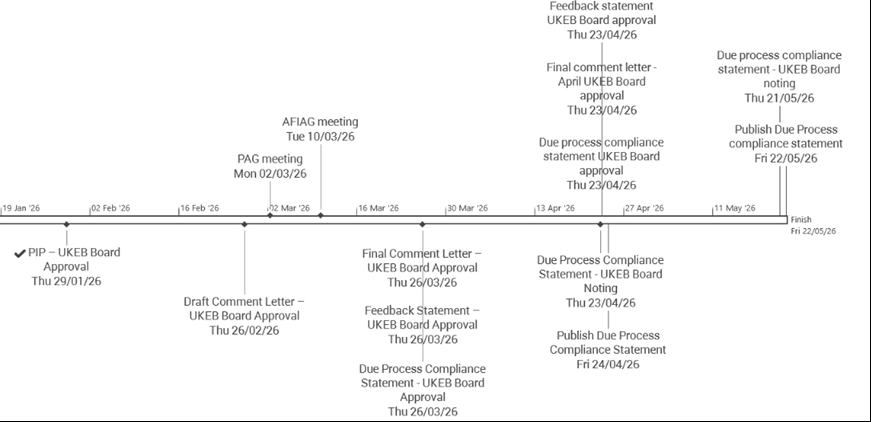
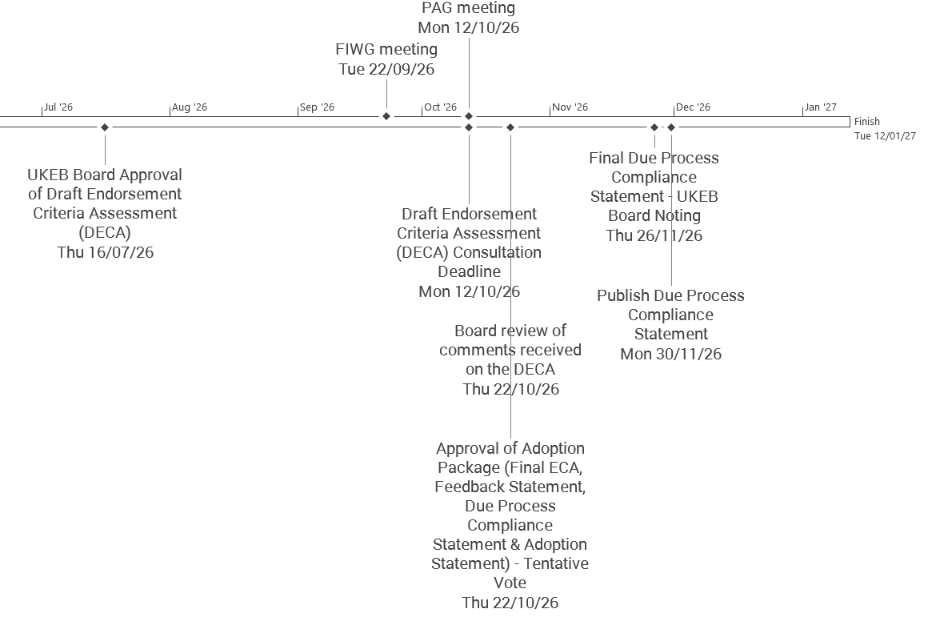
18The proposed high-level project timeline is shown below for both the influencing and endorsement and adoption phases of the project. This provides a best estimate based on information known at this time.
Influencing stage
19The comment period for the DCL will be between 14 days and 30 days, depending on the IASB's publication date for the ED. A shorter period than the standard 30-day comment period may be necessary to allow the Board to consider stakeholder feedback, incorporate relevant matters into its Final Comment Letter and respond to the IASB in time for its comment deadline. A shortened comment period is permitted by the Due Process Handbook in circumstances, such as these, where the IASB has shortened the comment period for the ED to expedite the final publication of the amendment.
20It is expected that the FCL will be submitted to the IASB in April 2026, after consideration at either the March or April 2026 UKEB meeting (depending on the IASB's publication date for the ED).
Endorsement and adoption stage
21Given the urgency attached to the project, the plan proposes an endorsement decision in early November 2026, assuming the IASB publishes the Amendments by the end of June 2026. This timeline should provide certainty to stakeholders prior to the mandatory application date of IFRS 18 of 1 January 2027.
22The comment period for the DECA will be a shortened 80-day consultation period which is shorter than the standard 90-day period. A shortened comment period is permitted by the Due Process Handbook where there is limited time to consult for urgent narrow scope amendments where the period between publication date and effective date is short, and the amendment may be required urgently. This timetable would allow the adoption package and a tentative vote at the October 2025 UKEB meeting, and a formal vote in early November 2025.
23If the IASB does not issue the Amendments by the end of June, the project plan would be reassessed and new proposals brought back to the Board.
| Influencing phase | |
|---|---|
| 29 January 2026 | Project Initiation Plan for Board approval |
| February 2026 | ED expected to be published with 60-day comment period |
| 26 February 2026 | Draft Comment Letter for Board approval |
| Estimated DCL consultation period (14–30 days): March 2026 –March/April 2026 | |
| March/April 2026 | Board review of Final Comment Letter, Feedback Statement, draft Due Process Compliance Statement |
| April 2026 | Final Comment Letter submitted to IASB (deadline expected to be April 2026) |
| April/May 2026 | Due Process Compliance Statement for noting |
| Endorsement phase: | |
| 16 July 2026 | Draft Endorsement Criteria Assessment for Board approval |
| Estimated DECA consultation period (80 days): 24 July 2026–12 October 2026 | |
| 22 October 2026 | Board review comments received on the DECA Consideration of the Adoption Package Board members provide a tentative vote |
| Early-November 2026 | Voting form is sent to Board members |
| Mid-November 2026 | Publication of voting outcome and Adoption Package on the UKEB website |
| 26 November 2026 | Due Process Compliance Statement for noting |
| 1 January 2027 | Effective date of the Amendments (earlier application permitted by the IASB, subject to the UKEB adoption for use in the UK) |
* To be determined once IASB's ED publication date is available
Project Initiation Plan: Amendments to the Fair Value Option (IAS 28) Project Timeline
24The diagrams below show graphical views of the mandatory milestone activities described above. This provides a best estimate based on information known at this time. If necessary, a revised PIP will be presented to the Board, to reflect any major changes, as the project progresses.
Influencing
Endorsement
Footnotes
-
The proposed drafting was included in the December 2025 IASB Board paper 12A and December 2025 IASB update. ↩