7 Intangible Assets
Executive Summary
| Project Stage | IASB | Final Standard | Post Implementation Review | ||||
|---|---|---|---|---|---|---|---|
| Research / Pipeline | Discussion Paper | Redeliberation | Exposure Draft | Redeliberation | |||
| IASB | Research / Influencing | Monitoring | Influencing | Monitoring | Endorsement | Influencing | |
| UKEB | Research / Influencing | Monitoring | Influencing | Monitoring | Endorsement | Influencing |
Project Type
Research Project
Project Scope
Significant
Purpose of the paper
The purpose of this paper is to seek the Board's feedback on:
- Case studies exploring user views on accounting for intangibles and testing future IASB proposals (scope, recognition, measurement, disclosure).
- Planned outreach activities to test these case studies.
Summary of the Issue
Building on its previous research, the UKEB is conducting further research, with the aim of influencing the IASB's project on Intangible Assets. This research will use case studies, developed with the aid of the UKEB's advisory groups, to:
- Explore stakeholder views on accounting for intangibles (including scope, recognition, measurement, and disclosure).
- Help the UKEB identify principles that could guide accounting for intangibles.
Decisions for the Board
1Does the Board agree that the proposed case studies on research and development costs, training costs, and carbon credits, should be explored as they would encourage discussion on aspects of scope, recognition, measurement, and disclosure of intangible assets?
2Are there additional relevant issues that could be explored as part of each case study?
3In respect of the case studies presented in Appendix A of this paper, do Board members:
- Think that the description of the case studies as drafted, together with the proposed 'questions for participants' included at the end of this Appendix, appear relevant and appropriately reflect the issues to explore?
- Have any proposed refinements or suggestions?
4If the IASB does not develop a test case on AI and Data, should the UKEB develop a case study? If so, does the Board have suggestions on a specific scenario the case study should address?
Recommendation
The Secretariat recommends that, subject to any necessary amendments at the meeting, the Board approves the selected case studies for use during interviews with UK stakeholders to collate their views on the accounting for intangibles.
Appendices
- UKEB Case studies
- IASB Test studies
Background: Intangible Assets
The IASB added a project on Intangible Assets to its work plan following feedback on its Request for Information: Third Agenda Consultation. Most respondents recommended adding a project on Intangible Assets, rating it as a high priority.
In anticipation of this, the UKEB undertook a research project beginning in 2022 to understand UK stakeholders' views on the accounting for intangibles and to gather evidence on the UK intangibles landscape.
In May 2025, the IASB tentatively decided to begin work on the Intangible Assets project by:
- Assessing user needs for information about recognised and unrecognised intangible assets, including related expenditure; and
- Exploring whether to update the definition of an intangible asset, associated guidance, and aspects of the recognition criteria. This will initially use application issues related to newer types of intangible assets and new ways of using them as test cases.
The IASB expects to undertake research through the remainder of 2025 and begin discussion on these work streams during 2026.
In October 2025, the UKEB approved a Project Initiation Plan (PIP) to undertake new intangibles research.
UKEB new research
1The UKEB's current research project builds on the previous work on intangibles (which was focused on the qualitative assessment and quantitative analysis of intangible reporting in the UK) and complements the IASB's work by1:
- understanding what information about recognised and unrecognised intangible assets, including expenditure associated with them, users would find useful.
- considering preparer views on that information.
2As described in paragraph A13 of the PIP, this research project will (emphasis added):
- Develop case studies as a means of exploring users' views on accounting for intangibles, and to test future IASB proposals (including scope, recognition, measurement and disclosure).
- Utilising both the UKEB and IASB case studies, undertake interviews with UK stakeholders (including investors and creditors) to better understand their views on the accounting for intangibles.
- Develop a report summarising the UKEB findings.
- In parallel, and supported by stakeholder research, work grounded in the IASB's Conceptual Framework would begin to identify key elements that could support the future development of a more principle-based standard for recognition, measurement and disclosure of intangible items.
UKEB Case studies
3This paper includes three case studies (see Appendix A for a detailed description of each case study) for the Board's consideration:
- Research and development costs. This case study examines the development of a drug through various clinical phases by a pharmaceutical company.
- Training costs. This case study focuses on reimbursable training costs incurred by an entity to fulfil a contract with a customer.
- Carbon credits. This case study focuses on the generation, sale and purchase of carbon credits.
Development
4Possible topics for case studies were identified during the first phase of research, through discussions with stakeholders and a review of relevant IFRS Interpretations Committee discussions2. These were further refined using the feedback from the Board at its meeting in June 20253. The case studies selected address specific challenges associated with intangibles, particularly in relation to scope, recognition, measurement and disclosure.
5During the third and fourth quarter of 2025 the specific case studies presented in Appendix A were developed in consultation with members of the UKEB's advisory groups: the Academics Advisory Group (AAG), the Preparers Advisory Group (PAG), the Accounting Firms and Institutes Advisory Group (AFIAG) and the Investors Advisory Group (IAG)4.
6AG members supported the proposed approach and the case studies selected. Individual members also provided further input in some cases to refine them further to better highlight the relevant accounting issues. Their views are reflected in case studies presented.
Objective
7As discussed in the PIP5, the insight gathered through case studies will help:
- Gather robust evidence on the needs of UK users and on information that users and others find useful about recognised and unrecognised intangible assets, including expenditure associated with them and preparers' views on this.
- Influence and test future IASB proposals on accounting for intangibles, including those related to recognition, measurement, and disclosure.
- Identify the key principles that need to be considered when developing accounting standards for intangible assets that are not limited to the case studies, and that can be applied broadly across a wide range of intangible assets.
8The case studies are intended to stimulate meaningful discussion to gather feedback on stakeholders on accounting issues (e.g. recognition, measurement, and disclosure) that are challenging under the current requirements.
9More specifically, they are aimed at encouraging consideration of questions such as:
- What items should be included within the scope of the intangibles project?
- Should an intangible asset be recognised and if so, what should be the criteria for recognition?
- If an intangible asset is recognised, how should it be measured (initial/subsequent measurement)?
- Whether an intangible asset is recognised or not, what information should be presented or disclosed in relation to the items included in the case studies?
10Appendix A of this paper includes a description of each case study and the questions that we are planning to ask participants.
Examples of potential issues that may arise in the discussion of each case study
11The table below presents specific examples of potential issues that could be explored for each case study. These examples are illustrative and are not intended to be exhaustive.
| Case Study 1: Research and Development | Case Study 2: Training Costs | Case Study 3: Environmental Credits | |
|---|---|---|---|
| Scope | Nature: | Nature: | Nature: |
| * How to distinguish between a research phase and a development phase? | * Could training be considered an intangible asset in certain circumstances? | * What is the impact of the nature and intended use of these assets—such as holding them for sale, for own use, or for retirement? | |
| Unit of Account | * Should the unit of account be an individual project or portfolio of research activities? | * Workforce versus individual? | - |
| Recognition | Timing: | Control: | Timing/Intended use |
| * When should an intangible asset be recognised? | * What constitutes control, and how can it be evidenced? | * Does the nature and intended use of these assets affect their recognition and measurement? | |
| * Is the probability of success during the research phase relevant for recognition and how should it be accounted for? | * What is the role of contracts in supporting asset recognition? | ||
| Measurement | Valuation: | Valuation: | Valuation: |
| * If capitalised, how should development activities be measured? | * If training costs were to be recognised as intangible assets, how would they be measured (initially/subsequently) and how might they be impaired? | * What is the appropriate measurement policy for carbon pricing programmes? | |
| Acquired or Internally Generated | * Should the way in which an intangible item is obtained impact the accounting? | ||
| Disclosure | * What information is relevant for users? Is this information different from what is provided under accrual accounting? |
Questions for the Board
1Does the Board agree that the proposed case studies on research and development costs, training costs, and carbon credits, should be explored as they would encourage discussion on aspects of scope, recognition, measurement, and disclosure of intangible assets?
2Are there additional relevant issues that could be explored as part of each case study?
3In respect of the case studies presented in Appendix A of this paper, do Board members:
- Think that the description of the case studies as drafted, together with the proposed 'questions for participants' included at the end of this Appendix, appear relevant and appropriately reflect the issues to explore?
- Have any proposed refinements or suggestions?
IASB case studies to complement the UKEB discussions
11The IASB is exploring underlying causes of application issues based on its own selected test cases that are related to newer types of intangibles and new ways of using them. The IASB staff had proposed four test cases, two of which were "selected" and two were “potential”:
- The selected test cases are:
- cloud computing arrangements; and
- agile software development.
- The potential test cases are artificial intelligence (AI) and data resources.
13IASB staff papers for the January 2026 IASB meeting appear to recommend that the IASB does not continue with the potential test cases in paragraph 11 b) above7. However, at the time of writing this paper no decision has been made.
14The selected test cases are still being refined, and potential solutions will be explored by the IASB later in 2026. The IASB aims to assess the impact on any potential amendments on a broader population of intangible assets. We intended to include some of the IASB case studies in discussions with stakeholders. Specifically, we:
- Planned to include the test cases on cloud computing (with a focus on Software as a Service or ‘SaaS' arrangements) and AI and data as this will complement the UKEB's case studies.
- Did not plan to include the test case on agile software development, as it would introduce process-specific considerations that may be less suitable for exploring foundational principles.
15However, if the IASB does not develop a test case on AI and Data, the UKEB may wish to consider developing an additional case study on this topic.
Questions for the Board
4If the IASB does not develop a test case on AI and Data, should the UKEB develop a case study? If so, does the Board have suggestions on a specific scenario the case study should address?
Next steps
16The UKEB will engage directly with UK stakeholders, including investors and creditors. The case studies are intended to be discussed in small roundtables, facilitated by one of the UKEB Secretariat. Facilitators are provided with more extensive background information and prompts to encourage discussions.
17The discussions will form the basis of an assessment of stakeholder preferences for the accounting for intangibles. The feedback will also be further analysed to identify potential key principles that participants note either directly or indirectly during their discussions.
18Specific events are currently being arranged but include:
- Workshops in collaboration with professional bodies representing users and accounting professionals.
- A large workshop for interested stakeholders from a variety of backgrounds.
- Sessions with Advisory groups including a joint intangibles PAG/IAG Workshop.
19In parallel with stakeholder outreach, the UKEB will, at future Board meetings, hold discussions to begin identifying the key elements that could support the future development of a more principles-based standard.
Appendix A: UKEB Case studies
Case study 1: Research and development
Contextual information
A1Research and Development (R&D) is a driver of productivity and growth, with innovation making a substantial contribution to the UK's private sector. According to data published by the Office for National Statistics, the total expenditure on research and development (R&D) by UK businesses was £50bn in 2023 (down from £51.5bn in 2022). Pharmaceutical companies made the largest contribution (£8.7 billion) to the total of business R&D performed in 2023 (representing 17.4% of total R&D performed by UK businesses).
Fact pattern
A2Company A is a large pharmaceutical business which undertakes research to identify and develop new medicines. It has 71 projects in its pipeline.
A3One of these relates to Drug A which it is hoped will be able to treat a type of respiratory virus. Company A has sufficient funds to complete the development of Drug A.
A4Once pre-clinical animal studies have taken place, Company A classifies drug development into clinical phases I8, II9 and III – with phase III being a large-scale trial to verify the results achieved in earlier clinical phases.
A5Before the drugs can be sold in the market, regulatory review and approval must be obtained, and such approval requires a positive outcome in the clinical phase III trial.
A6At the end of the current reporting period, Drug A is in clinical phase III. Company A obtains an external valuation based on a discounted cash flow estimate which indicates that the asset under development is expected to generate future economic benefits. Company A is considering how expenditure on Drug A is recognised.
Case study 2: Training costs
Contextual information
H1A skilled workforce benefits both individuals and businesses. Higher skill levels drive greater productivity, enhance task proficiency and improve business performance. As evidence of its importance, data published in the Employer Skills Survey (ESS) reported that total expenditure on employee training by UK companies amounted to £53bn in 2024 (down from £59bn in 2022). According to the same survey, almost half of all employers (48%) provided on-the-job training and two-fifths (40%) provided off-the-job training.
Fact pattern10
H2Entity A enters into a contract that is within the scope of IFRS 15 Revenue from Contracts with Customers to supply outsourced services to Entity B (for example, a call centre where Entity A's staff take calls from Entity B's customers and assist them with electronic products that they have purchased from Entity B).
H3In order for Entity A to be able to provide the services to Entity B, Entity A must incur training costs for its own employees in order that they are able to utilise Entity B's equipment and understand its processes.
H4Entity A determines that the requirement to provide training to its employees does not meet the definition of a performance obligation in IFRS 15. This is because Entity A's act of training its own employees does not transfer a distinct good or service to the customer, Entity B. Instead, the employee training enables Entity A to put itself in a position to be able to provide the outsourced service that it has promised to Entity B.
H5The training requirements are set out in a specific section of the contract between Entity A and Entity B, with a specified recharge (over a three-year period) to cover the training costs. The recharge covers the number of Entity A's employees who require training at the start of the contract, and the training of new employees if Entity B's operations expand and additional staff are required. Costs associated with training replacement employees (for example, because some of the employees leave Entity A's employment) are not covered and must be paid by Entity A.
Case study 3: Carbon credits
Contextual information
A7According to data published by MSCI, the value of global voluntary carbon credit demand (i.e. retirements) was roughly $1.4 billion in 2024. MSCI forecasts that the value of annual global carbon credit demand could be between $7 billion and $35 billion per year by 2030 depending on prevailing market conditions. The significant projected increase is due to a combination of factors, including: (i) many companies setting voluntary carbon-emission targets that they aim to achieve by 2030; (ii) the establishment of legislated carbon-emission programmes, such as the Carbon Offsetting and Reduction Scheme for Internationals Aviation (CORSIA); (iii) increase provision of carbon removals as a proportion of both carbon offsets and removals, which are higher cost; and (iv) increases in the priced emission units/allowances over time. As it may be difficult for companies to achieve their net-emission targets through changes in their operations alone, they are expected to rely increasingly on carbon credits.
A8Based on current legislation, carbon values in the UK are expected to change significantly in the coming years. The UK's Department for Business and Trade has released a projection of how they believe the price of carbon will evolve based on currently legislated policy (e.g. achieving Net-Zero carbon emissions by 2050). Their central scenario is that one tonne of carbon dioxide equivalent (CO2e) could be valued at £78 by 2030 for carbon offsets. This would represent an increase of over 100% from 2024.
Fact pattern11
A9An environmental developer acquires a site comprising degraded forest and peatland, for restoration. Following development, this site is expected to remove CO2 from the atmosphere.
A10The project will be validated and verified annually in accordance with the UK Woodland Carbon Code12 (WCC), allowing the project developer to issue carbon credits annually for sale on the UK Land Carbon Registry as the forest and peatland sequesters CO2e from the atmosphere.
A11Returns on investment will comprise sales of carbon credits and sustainable timber, and appreciation of the land value of the site.
A12These credits may be assigned to buyers such as intermediaries and end users. Once a credit is used to offset an end user's emissions, it is ‘retired' from the registry.
A13The price of a carbon credit on the registry fluctuates over time and has increased over the last five years:
UK carbon prices and volumes
The graph below shows the average price and volume of transactions for woodland and peatland Pending Issuance Units from 2020 to 2023.
For woodlands, while the price has increased steadily from £11.01 in 2020 to £23.30 in 2023, the volume of transactions reported has fallen from over 250,000 in 2020 to over 164,000 in 2023.
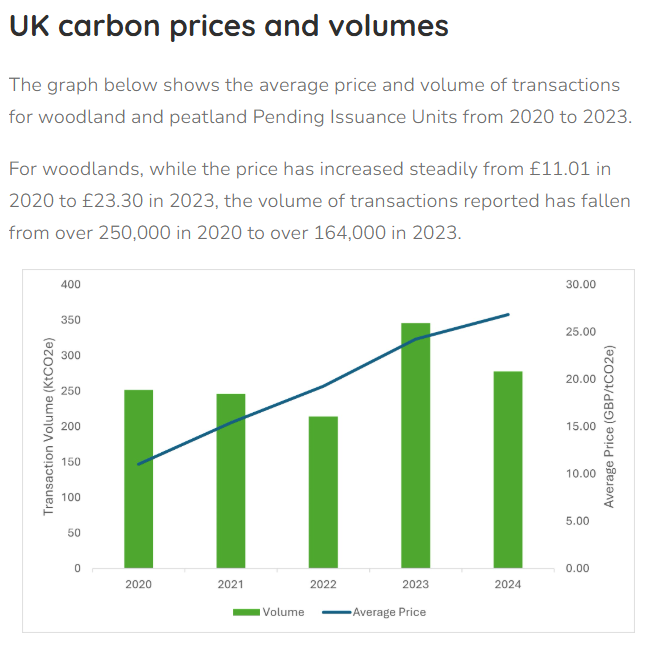
Source: UK carbon prices | Woodland Carbon Code Note: Trees take time to grow and store carbon dioxide, so a Pending Issuance Unit is a promise to deliver a Woodland Carbon Unit (i.e. a carbon credit) in the future, based on predicted carbon dioxide equivalent removal. It is not guaranteed or verified until a later stage, so cannot be used immediately to report against UK-based emissions. Pending Issuance Units help companies plan for compensating future UK-based emissions and make credible statements about their commitments.
A14The questions below should be answered separately for each of the following reporting entities:
- Project developer (as the generator of carbon credits).
- Environmental-credit broker/trader (as the intermediate purchaser of carbon credits).
- Investor holding environmental credits for capital appreciations (as a purchaser of carbon credits for speculation purposes).
- End-user (that uses carbon credits as an offset against its GHG emissions).
Questions for participants
1Without reference to IFRS Accounting Standards, using the Conceptual Framework definitions of the elements of financial position (asset, liability and equity) and financial performance (income and expense), describe the underlying economics of the transactions and events in each of the case studies.
2What information about the intangible item would be useful to primary users of the financial statements to allow them to understand the transactions and events as inputs for them to use in making their own estimates of the entity's future cash flows?
3How could the information best be provided in a cost-beneficial way in the financial statements?
- Recognition (should the item appear on the balance sheet?) What recognition criteria, if any, should be specified?)
- An asset is a present economic resource controlled by the entity as a result of past events.
- An economic resource is a right that has the potential to produce economic benefits.
- Measurement (if recognised as an asset, at what amount should the item be recorded?)
- Initial measurement: Historic Cost, Market Value, and entity specific current value (eg: Value in Use or Net Realisable Value)?
- Subsequent measurement: Historic Cost, Cost model, Fair Value model, Revaluation model, other (please specify)?
- Disclosure (what should be disclosed about the intangible item to enhance relevance and achieve a faithful representation)?
- Is the information relevant and reliable?
- What about materiality?
5Only if time: With reference to the current accounting requirements for this scenario:
- Do you think the current accounting requirements provide useful information?
- Do you think the current accounting requirements are consistent with the Conceptual Framework?
Appendix B: IASB Test cases
B1The following paragraphs provide a summary of the test cases that are currently being considered by the IASB as part of its research on its Intangible Assets project.
Test case 1: Cloud computing arrangements
B2This arrangement involves a customer-provider agreement for on-demand internet-based access to software or infrastructure.
B3Customers typically pay via subscription or usage-based fees.
B4Suppliers operate, maintain, and may update the resources offered.
B5Delivery models include:
- Public cloud (shared resources)
- Private cloud (dedicated resources)
- Hybrid cloud (combination of both)
B6Stakeholder concerns focus on Software as a Service (SaaS).
Test case 2: Agile software development
B7This is a methodology that focuses on iterative and incremental progress, enabling faster software delivery. Prioritises small, frequent updates over releasing a full product at the end of a long cycle.
B8Key characteristics:
- Software built and improved through short cycles (iterations).
- Quicker delivery of working software aligned with user needs.
- Flexibility to adapt to changes.
- Close collaboration with customers and stakeholders to ensure relevance and value.
B9Stakeholder concerns are focused on: the unit of account, when amortisation should start, and impairment.
Test case 3: Artificial Intelligence and data resources13
B10Stakeholder concerns focus on insufficient information about data in the financial statements. Stakeholders also suggest clarifying:
- How the definition of an intangible asset applies to AI and to different pieces of data.
- Who has the right over data.
- How to determine the unit of account and the assessment of useful lives.
B11The IASB staff's view is that concerns on these items can be resolved through the analysis of test cases 1 and 2 (i.e. cloud computing arrangements and agile software development).
Footnotes
-
As described in paragraph A12 of the PIP. ↩
-
See for example the IFRS Interpretations Committee published an agenda decision on Transactions Costs to fulfil a contract (IFRS 15) in March 2020. ↩
-
8 Intangible Assets ↩
-
The Secretariat met with the AAG at is meeting on 19 September 2025; the PAG at its meeting on 20 October 2025; the IAG at its meeting on 3 November 2025; and the AFIAG at its meeting on 11 November 2025. ↩
-
Based on paragraphs A12 and A14-A15 of the Intangibles PIP. ↩
-
Based on the IASB staff presentation to the Global Preparers Forum (GPF) in November 2025. ↩
-
Refer to IASB staff paper 17D (January 2026). ↩
-
Phase I trials involve small groups of healthy human volunteers / patients. ↩
-
Phase II trials involve small- to medium-sized groups of patients. ↩
-
This fact pattern is largely reproduced from a submission which was discussed by the IFRS Interpretations Committee (IFRIC) in September 2019 ↩
-
Website of the Glen Dye Moor project, Foresight Sustainable Forestry Company PLC, PwC In depth: IFRS Financial reporting considerations for entities participating in the voluntary carbon market ↩
-
UK Woodland Carbon Code ↩
-
Libraries of pieces of software and codes that gain value when combined into AI models. ↩