4 Risk Mitigation Accounting
29 January 2026 Agenda Paper 4 OFFICIAL - PUBLIC
Executive Summary
Project Stage
| IASB | Research / Pipeline | Discussion Paper | Redeliberation | Exposure Draft | Redeliberation | Final Standard | Post Implementation Review |
|---|---|---|---|---|---|---|---|
| UKEB | Research / Influencing | Research / Influencing | Monitoring | Influencing | Monitoring | Endorsement | Influencing |
Project Type
Influencing
Project Scope
Significant
Purpose of the Paper
The purpose of this paper is to:
- Obtain the Board's feedback on the proposed Project Initiation Plan (PIP) for the project to influence the IASB's Exposure Draft (ED): Risk Mitigation Accounting (Proposed amendments to IFRS 9 and IFRS 7).
- Request the Board's approval to publish the PIP.
Summary of the Issue
On 3 December 2025, the IASB published the ED Risk Mitigation Accounting, with the consultation period ending on 31 July 2026. The IASB is also conducting field tests of the proposals, with preliminary field test results due on 31 July 2026 and final results by 30 November 2026.
The field test results are expected to provide important insight into the proposals, as the requirements are complex and affect activities across organisations, including finance, risk management and treasury functions.
The Secretariat asks the Board to consider two potential options for the timing of the publication of the UKEB Draft Comment Letter (DCL).
- Publication of the DCL following the March 2026 Board meeting with an extended comment period of 60 days (option one) – the recommended approach; or
- Publication of the DCL following the April 2026 Board meeting with a comment period of at least the minimum required 30 days (option two).
In addition, because the IASB's deadline for the final field tests is four months after the IASB's ED consultation deadline, the Secretariat recommends the following course of action:
- Continuing to engage with relevant UK stakeholders to obtain additional feedback on the outcome of their completed field tests.
- The Board to consider a summary of any additional feedback gathered in early 2027.
- The Board may, at that time, consider whether to take further steps in light of any new information that may have been received.
Decisions for the Board
1Does the Board agree that the DCL should be published following the March 2026 Board meeting with an extended comment period of 60 days (option one) – the recommended approach?
2Does the Board agree that the Secretariat should continue to engage with relevant UK stakeholders, subsequent to the submission of the Final Comment Letter, to obtain further feedback on final UK field test results?
3Subject to the two decisions above, and any other amendments required, does the Board approve the draft PIP for publication?
Recommendation
The Secretariat recommends that the Board:
1Approves option one, that is to publish the DCL following the March 2026 Board meeting for a 60-day comment period.
2Agree that the Secretariat should continue to engage with relevant UK stakeholders, subsequent to the submission of the Final Comment Letter to the IASB, to obtain further feedback on final UK field test results.
3Subject to the two decisions above, and any amendments required, approves the PIP for publication.
Appendices
Appendix A [Draft] Project Initiation Plan: Risk Mitigation Accounting.
Project timeline options to consider for the publication of the Draft Comment Letter
1The UKEB's timeline for this project needs to balance:
- publishing the UKEB Draft Comment Letter (DCL) early to raise awareness about the project and encourage engagement with stakeholders; with
- allowing more time for the UKEB and stakeholders to identify matters which could be included in the DCL.
2The Secretariat asks the Board to consider and decide between two potential options regarding the timing of publishing the DCL before finalisation of the PIP. Both options would meet the minimum UKEB consultation period for a DCL (30 days) and allow the IASB's comment deadline to be met.
| Option | Pros | Cons |
|---|---|---|
| 1 Publication of a DCL following the 26 March 2026 Board meeting for a 60-day consultation period ending early June 2026. Technical paper providing an update on feedback from stakeholders expected to be presented to the Board in the 21 May 2026 Board meeting. Present the draft FCL for discussion and approval at the 16 July 2026 Board meeting and submit FCL by 31 July 2026 (the IASB deadline). | • Provides more time to raise awareness and engage with stakeholders on the published DCL, and for stakeholders to formulate responses. • Allows more time for stakeholders to respond to the DCL consultation. This may include stakeholders of companies that are not banks or insurers, but which may be eligible to apply the proposals in the ED. |
• The FCL may differ significantly from the DCL. • The extent of detailed analysis or availability of any field test results to inform the UKEB DCL is expected to be limited and preliminary in nature. |
| 2 Publication of a DCL following the 23 April 2026 Board meeting for a consultation period of at least 30 days expected to end in early June 2026. Present the draft FCL for discussion and approval at the 16 July 2026 Board meeting and submit FCL by 31 July 2026 (the IASB deadline). | • Allows more time for the Secretariat to engage with Board Members and stakeholders, which would inform the development of the DCL. • Increases the likelihood of some early provisional field test results being available to better inform the feedback in the DCL. • Allows more time for the UKEB to identify and assess the likely importance of issues raised, together with some proposed early solutions. |
• Allows less time for stakeholders to respond to the DCL public consultation. • Reduces time to engage with stakeholders on a published DCL. • Any available field test results are still expected to be on a preliminary basis and therefore the FCL may still differ from the DCL. • Potentially less time for the Secretariat to analyse the responses to the DCL and perform follow up stakeholder outreach where necessary. |
Recommendation
3While neither option is ideal, on balance, the Secretariat recommends option one. Given the nature and complexity of this project, this option allows more time for stakeholders to react to the DCL and would raise awareness amongst potentially affected stakeholders.
Question for the Board
1Does the Board agree that the DCL should be published following the March 2026 Board meeting with an extended comment period of 60 days (option one) – the recommended approach?
Follow up on final UK field test results
4The IASB's deadline for final field test results is 30 November 2026, which is four months after the IASB's ED consultation deadline on 31 July 2026. This means field testing is expected to continue beyond the submission of the UKEB FCL.
5The final UK field test results may identify matters that may provide new or additional perspectives to the submitted FCL. As a result, the Secretariat believes that the Board should review a summary of the additional feedback on the outcome of the completed UK field tests in early 2027.
6The Board may, at that time, consider whether to take further steps in light of any new information that may have been received. Such actions may, for example, include a further letter to the IASB incorporating the feedback received from the field tests.
Recommendation
7The Secretariat recommends the following course of action:
- Continuing to engage with relevant UK stakeholders to obtain additional feedback on the outcome of their completed field tests.
- The Board to consider a summary of any additional feedback gathered in early 2027.
- The Board may, at that time, consider whether to take further steps in light of any new information that may have been received.
8The draft Project Initiation Plan in Appendix A currently reflects the recommended approach.
Question for the Board
2Does the Board agree that the Secretariat should continue to engage with relevant UK stakeholders, subsequent to the submission of the Final Comment Letter, to obtain further feedback on final UK field test results?
Appendix A: Project Initiation Plan Exposure Draft Risk Mitigation Accounting
Purpose
A1.This paper sets out the plan to influence the proposed amendments to IFRS 9 Financial Instruments and IFRS 7 Financial Instruments: Disclosures included in the International Accounting Standards Board's (IASB) Exposure Draft (ED) Risk Mitigation Accounting (Proposed amendments to IFRS 9 and IFRS 7). The ED was published on 3 December 2025 with the consultation period ending on 31 July 2026.
Background
A2.The implementation of IFRS 9 Financial Instruments aimed to introduce improved hedge accounting requirements. However, this did not provide a solution for complex risk management situations where risks are managed dynamically. In such cases entities were permitted to continue applying IAS 39 Financial Instruments: Recognition and Measurement1. The IASB has noted that entities continue to find it challenging to account for their dynamic risk management activities in this manner, as the requirements are not designed for such situations, and the constraints make it difficult for entities to faithfully represent the economic effect of such risk management activities2.
A3.The ED scope is limited to interest rate repricing risk3, in instances where entities meet the criteria to demonstrate that this risk is being managed dynamically. The ED aims to provide a more faithful representation of the entity's economic position for such risk management activities.
A4.Consistent with the existing hedge accounting requirements of IFRS 9, the proposed requirements are voluntary. The IASB proposes to withdraw IAS 39 when the proposed amendments are available for use.
Summary of Proposed Changes
A5.A summary of the proposed changes can be found in the IASB's snapshot document.
Project Plan
Proportionality Assessment
Significance and Size
Entities Affected by the Proposals
A6.The proposals affect entities that manage their interest rate repricing risk dynamically on a net portfolio basis. The scope of the proposals includes all entities that manage risk in this way, and that meet the qualifying criteria. Given the nature of interest rate repricing risk, we expect this will primarily affect the banking sector. However, some insurance entities, non-bank financial services firms and corporates with sophisticated treasury practices may also be within scope of the proposals.
Sector size
A7.In 2022, the UK financial system's assets totalled approximately £27 trillion, of which £14 trillion was held by banks (excluding the Bank of England) and £2 trillion was held by insurance companies. By contrast, in the same year, the UK's gross domestic product was approximately £2.5 trillion4.
A8.The UK is home to three global systemically important banks5, and a further four domestic systemically important banks6. Additionally, the hedging of interest rate repricing risk is widely used across the UK banking sector.
A9.16% of the FTSE 100 market cap is from the banking sector7.
A10.We therefore conclude that this sector is significant to the UK economy.
Complexity
A11.Hedging strategies can be complex, and the associated accounting requirements reflect this. Further, the proposed requirements are not just restricted to the finance function; they will also require significant input from the risk management and treasury functions.
A12.The Secretariat understands that dynamic risk management strategies vary between entities, reflecting the nature of their portfolios and internal procedures. Accordingly, the proposals may affect different entities in different ways. The Secretariat therefore expects this project to have a high degree of complexity.
Expected Timeline / Urgency
A13.The ED was published on 3 December 2025 with the consultation period ending 31 July 2026.
A14.The IASB has also published a request for fieldwork with deadlines for preliminary and final field test results by 31 July 2026 and 30 November 2026, respectively. The field test results are expected to provide important insight into the proposals, as the requirements are complex and affect activities across organisations, including finance, risk management and treasury functions.
Expected Interest / Sensitivity
A15.The Secretariat does not expect wide general interest given the requirements are primarily expected to have a material effect on the financial services sector.
A16.However, there may be significant interest from stakeholders of affected entities. In addition, the primary focus of this ED, the banking industry, is a regulated industry in the UK and therefore, the project is likely to be of interest to the relevant UK regulators.
Feedback on the Proposals from Initial Outreach
A17.Feedback from initial outreach with stakeholders suggests that there are mixed views on a number of conceptual and practical aspects of the proposed amendments. Given the complexity of this project, it is too early to conclude on the effectiveness of the proposals at this stage.
A18.Stakeholders have also noted the importance of effective hedge accounting requirements as this ensures:
- the financial statements closely represent the underlying economic position of the entity;
- volatility is appropriately reflected in the financial statements; and
- stable and predictable capital levels reflecting the underlying economic position can be demonstrated when interest rates move, supporting market confidence and ongoing lending to the UK market.
Connectivity
A19.The Secretariat has not been made aware of any significant connectivity implications for this project.
Recommended UKEB Project Scope
A20.Based on the proportionality assessment above, the Secretariat recommends a 'Significant' project scope and the approach described in this document reflects this.
A21.In addition, given the IASB's deadline for the final field test results is four months after the IASB's ED consultation deadline, the Secretariat also recommends the following additional course of action:
- Continuing to engage with relevant UK stakeholders to obtain additional feedback on the outcome of their completed field tests.
- The Board to consider a summary of any additional feedback gathered in early 2027.
- The Board may, at that time, consider whether to take further steps in light of any new information that may have been received.
Project - Key Activities
| Key Activities | Due Process Handbook |
|---|---|
| Board Education Sessions | 4.10b Optional |
| Creation of a Project Initiation Plan (this document) | 5.4-5.8 Mandatory |
| Desk-based research to support the proportionality assessment including: a) Review of relevant material produced by third parties, including accounting firms and industry bodies. |
5.9 Optional |
| b) Review of IASB papers, presentations, meetings, and education materials. | |
| Publication of a Draft Comment Letter for public consultation a) The DCL will be published on the UKEB website. b) Announcement of the publication of the DCL and Invitation to Comment (ITC) will be made via the UKEB News Alert publication, and LinkedIn posts. c) The DCL and ITC will be issued for comment for a minimum of 30 days. |
5.13-5.17 Generally mandatory |
| Stakeholder outreach a) The Secretariat has engaged with the Financial Instruments Working Group (FIWG) on RMA related topics 29 November 20238, 12 November 20249 and 15 January 2026. The January 2026 FIWG meeting was focussed on this project and included, among others, users as well as risk and treasury specialists. b) The Secretariat has also engaged in informal discussions with relevant UK regulators and other national standard-setters. c) The DCL and ITC will be published for stakeholder comment on the UKEB website. d) The Secretariat aims to undertake targeted stakeholder outreach, including but not limited to, engagement with: i. Industry bodies, for the purpose of raising awareness of the project, particularly with medium or smaller sized preparers who may be affected. ii. Preparers willing to provide feedback or share field test results. |
5.10-5.12 Mandatory |
| e) The Secretariat will continue to engage with the UKEB advisory and working groups, relevant regulators and national standard-setters as appropriate. | |
| Final Comment Letter A final comment letter will be created for Board approval, submission to the IASB, and publication on the UKEB website. |
5.18 Mandatory |
| Project Closure A Feedback Statement and Due Process Compliance Statement will be prepared. Once approved by the Board these documents will be published on the UKEB website. |
5.19-5.26 Mandatory |
Resources Allocated
A22.To undertake the activities described in this project plan, within the specified timelines, a project team consisting of 2 Project Directors (1.2 in total), with oversight from a Senior Project Director, should be sufficient. The required resources are allowed for in the UKEB Regulatory Strategy.
A23.In addition, the project team will consider whether input from the economics team will be needed. Factors considered in assigning this resource may include the need to ascertain the prevalence of transactions, whether the proposed accounting appropriately reflects the underlying economics of transactions for UK stakeholders and consideration of related economic effects.
Setting up an Ad-hoc Advisory Body
A24.Existing UKEB advisory and working groups have the necessary skills and expertise to support this project and will be consulted, as outlined in the project plan.
Project Timeline
A25.The proposed high-level timeline is shown below. This provides a best estimate based on information known at this time. If necessary, a revised PIP will be presented to the Board, to reflect any major changes, as the project progresses.
A26.[The Secretariat has set out below two options for the timeline of publication of the DCL. The Board is asked to decide its preferred timeline. Text pertaining to the two options is in square brackets throughout this document as the PIP will be published with the approved option only.]
Timeline [Option one: DCL published following March 2026 Board meeting for a 60-day comment period]
| Timeline: | |
|---|---|
| 9 December 2025 | Board Education Session 1: Introduction to banks and risk management |
| January 2026 | a) Board Education Session 2: Introduction to the Risk Mitigation Accounting model Part A b) Project Initiation Plan for Board approval |
| 24 February 2026 | Board Education Session 3: Introduction to the Risk Mitigation Accounting model Part B |
| 26 March 2026 | Draft Comment Letter for Board approval |
| Estimated DCL consultation period (60 days): April – June 2026* | |
| 21 May 2026 | Technical Paper: Update on stakeholder feedback* |
| 16 July 2026 | Board review of Final Comment Letter, Feedback Statement, draft Due Process Compliance Statement |
| July 2026 | Final Comment Letter submitted to IASB (deadline 31 July 2026) |
| 17 September 2026 | Due Process Compliance Statement for noting. |
| * To be confirmed |
Timeline [Option two: DCL published following April 2026 Board meeting for a comment period of not less than 30 days]
| Timeline: | |
|---|---|
| 9 December 2025 | Board Education Session 1: Introduction to banks and risk management |
| January 2026 | a) Board Education Session 2: Introduction to the Risk Mitigation Accounting model Part A b) Project Initiation Plan for Board approval |
| 24 February 2026 | Board Education Session 3: Introduction to the Risk Mitigation Accounting model Part B |
| 23 April 2026 | Draft Comment Letter for Board approval |
| Estimated DCL consultation period (at least 30 days): April – June 2026* | |
| 16 July 2026 | Board review of Final Comment Letter, Feedback Statement, draft Due Process Compliance Statement |
| July 2026 | Final Comment Letter submitted to IASB (deadline 31 July 2026) |
| 17 September 2026 | Due Process Compliance Statement for noting. |
| * To be confirmed |
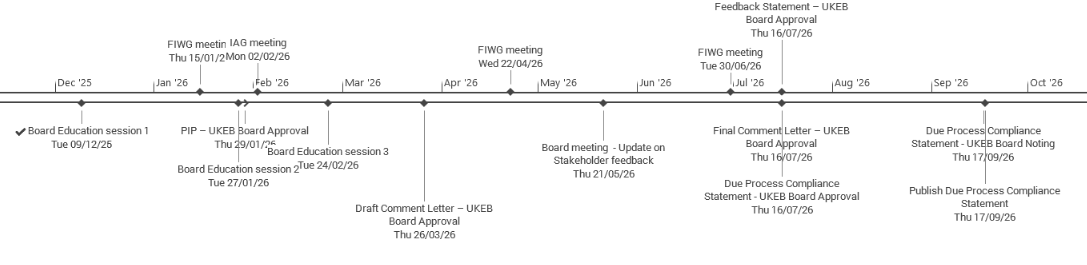
Project Initiation Plan: Exposure Draft Risk Mitigation Accounting - Project Timeline [Option one]
A27.The diagram below is a graphical view of the key milestone activities described above. This provides a best estimate based on information known at this time. If necessary, a revised PIP will be presented to the Board, to reflect any major changes, as the project progresses.
Footnotes
-
See paragraphs 6.1.3 and 7.2.21 of IFRS 9. ↩
-
This is noted by the IASB in paragraph IN7 of the ED. ↩
-
As noted in paragraph IN1 of the ED, "[f]or purposes of risk mitigation accounting, repricing risk is a type of interest rate risk that arises from differences in the timing and amount of financial instruments that reprice to benchmark interest rates". ↩
-
See section 1.2 of the Commons Library's publication in November 2024 Financial Services in the UK. ↩
-
See the 2025 List of Global Systematically Important Banks identified by the Financial Stability Board in consultation with the Basel Committee on Banking Supervision and national authorities. ↩
-
See the List of other systematically important institutions for 2024 identified by the Prudential Regulation Authority. The four additional domestic systematically important banks are Lloyds Banking Group Plc, Nationwide Building Society, NatWest Group Plc and Santander UK Group Holdings Plc. ↩
-
This is calculated from Reuters data as of 30 December 2025 based on entities reporting under IFRS Accounting Standards. ↩
-
This included a presentation on this project from the IASB staff. See the November 2023 FIWG meeting summary for more details. ↩
-
This included presentations on this project from the IASB staff and from UK banking and insurance industry perspectives. See the November 2024 FIWG meeting summary for more details. ↩