UKEB 2026-2027 Regulatory Strategy (Draft)
The UKEB does not accept any liability to any party for any loss, damage or costs however arising, whether directly or indirectly, whether in contract, tort or otherwise from action or decision taken (or not taken) as a result of any person relying on or otherwise using this document or arising from any omission from it.
© 2025 All Rights Reserved
Strategic Objectives
Statutory functions
1The statutory functions of the UKEB are to:
- participate in, and contribute to, the development of a single set of international financial reporting standards; and
- adopt international accounting standards when they meet the criteria in The International Accounting Standard and European Public Limited-Liability Company (Amendments etc.) (EU Exit) Regulations 2019 (SI 2019/685).
2The objectives for adoption of IFRS for use in the UK are to ensure:
- a high degree of transparency and international comparability of financial statements; and
- the efficient allocation of capital, including the smooth functioning of capital markets in the UK.
Strategic objectives 2026/27
3The UK's long term public good is central to the work of the UKEB. This includes considering the implications for UK economic growth and competitiveness, the needs of investors and businesses, and supporting effective and efficient capital allocation through comparable and proportionate reporting standards. This is underpinned by the statutory requirement for the UKEB to consider the UK's long term public good as part of its endorsement process.
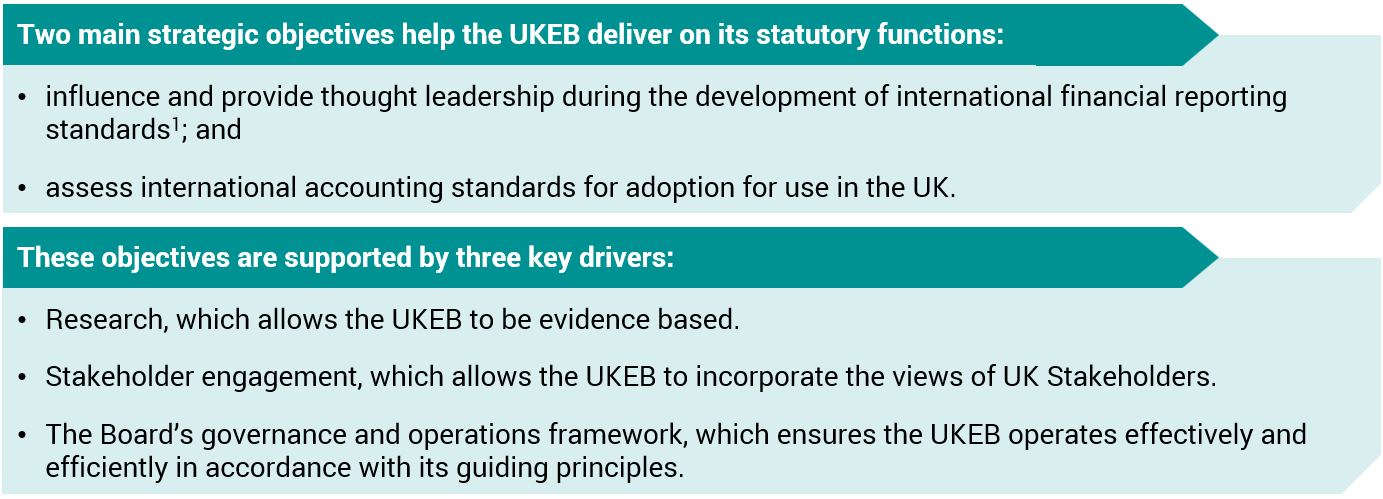
Two main strategic objectives help the UKEB deliver on its statutory functions:
- influence and provide thought leadership during the development of international financial reporting standards1; and
- assess international accounting standards for adoption for use in the UK.
These objectives are supported by three key drivers:
- Research, which allows the UKEB to be evidence based.
- Stakeholder engagement, which allows the UKEB to incorporate the views of UK Stakeholders.
- The Board's governance and operations framework, which ensures the UKEB operates effectively and efficiently in accordance with its guiding principles.
4The work is underpinned by the UKEB's guiding principles, as illustrated in the diagram below:
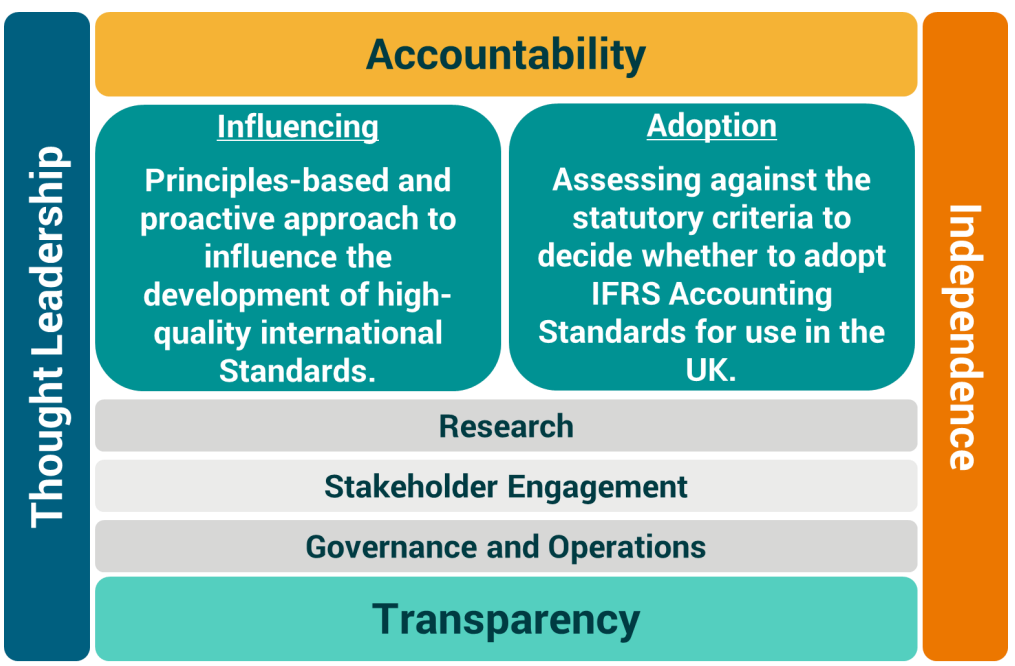
5The UKEB's three-year strategy for the period 2025-28 was published in April 2025, following consultation. In this second year, the UKEB's strategic objectives remain unchanged. The Board intends to continue to build on the work of the previous year to achieve its three-year strategy.
UKEB Workplan
6The UKEB workplan is developed to ensure timely endorsement of International Accounting Standards and impactful engagement with the International Accounting Standards Board (IASB) as standards are planned and developed. This requires regular review and adjustment to ensure that the UKEB engagement reflects changes in the IASB's own plans.
7In 2026/27, the UKEB expects to focus on the following areas:
| Project | Size2 | IASB Type |
|---|---|---|
| ENDORSEMENT3 | ||
| IFRS 20 Regulatory Assets and Regulatory Liabilities | Significant | Standard-Setting |
| IFRS 19 Subsidiaries without Public Accountability: Disclosures | Moderate | Standard-Setting |
| Provisions – Targeted Improvements | Moderate | Maintenance |
| Financial Instruments with Characteristics of Equity | Moderate | Standard-Setting |
| Equity Method | Limited | Standard-Setting |
| Business Combinations – Disclosures, Goodwill and Impairment | Limited | Standard-Setting |
| Hyperinflation | Limited | Maintenance |
| INFLUENCING4 | ||
| Risk Mitigation Accounting | Significant | Standard-Setting |
| Statement of Cash Flows | Significant | Research |
| Intangible Assets | Significant | Research |
| IASB Agenda Consultation | Moderate | Research |
| Amortised Cost Measurement | Moderate | Standard-Setting |
| Post Implementation Review (PIR) of IFRS 9: Hedge Accounting | Moderate | N/A |
| Amendments to the Fair Value Option (IAS 28) | Limited | Standard-Setting |
| UKEB SPECIFIC PROJECTS | ||
| UKEB PIR of IFRS 175 | Significant | N/A |
| Review of UKEB Due Process Handbook6 | Moderate | N/A |
UKEB Proactive Research
8The UKEB undertakes proactive research to contribute to the wider discussion on International Accounting Standards and to influence the IASB early in its project development cycle.
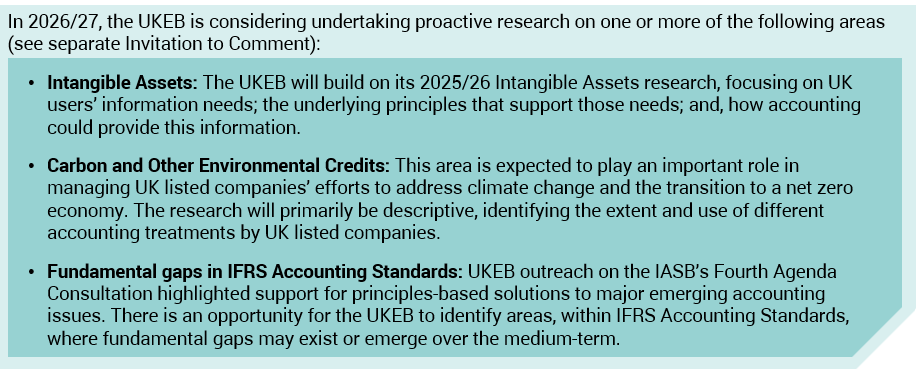
In 2026/27, the UKEB is considering undertaking proactive research on one or more of the following areas (see separate Invitation to Comment):
- Intangible Assets: The UKEB will build on its 2025/26 Intangible Assets research, focusing on UK users' information needs; the underlying principles that support those needs; and, how accounting could provide this information.
- Carbon and Other Environmental Credits: This area is expected to play an important role in managing UK listed companies' efforts to address climate change and the transition to a net zero economy. The research will primarily be descriptive, identifying the extent and use of different accounting treatments by UK listed companies.
- Fundamental gaps in IFRS Accounting Standards: UKEB outreach on the IASB's Fourth Agenda Consultation highlighted support for principles-based solutions to major emerging accounting issues. There is an opportunity for the UKEB to identify areas, within IFRS Accounting Standards, where fundamental gaps may exist or emerge over the medium-term.
9This work will contribute to engagement with the IASB's current work plan and, in the longer term, to its upcoming concurrent Agenda Consultation with the International Sustainability Standards Board (ISSB).
10In addition, some capacity to support the IASB on ad hoc, UK-specific research is also necessary as it is key to effective, early influencing of projects and to continuing to enhance our working relationships. The number of projects and extent of work will be determined on a case-by-case basis.
Stakeholder Engagement
11Stakeholder engagement ensures that the practical implications of proposed International Accounting Standards for UK companies, their investors and other stakeholders are appropriately understood and assessed by the Board.
12The UKEB's annual Work Plan allocates time to formal stakeholder engagement. This involves both national and international engagement.
13In the UK, this engagement is primarily conducted through the Board's advisory and working groups. In addition, project specific outreach with other UK stakeholders through meetings, round tables and other events is undertaken, as relevant.
14Internationally, stakeholder engagement is undertaken through attendance at international meetings, including the UKEB's membership of the IASB's Accounting Standards Advisory Forum (ASAF), to contribute to the international standard-setting debate.
Governance and Operations
15In addition, during 2026/27 the UKEB plans to host a one-day conference that will strengthen engagement with key UK and international stakeholders; including investors, preparers, auditors, academics, and regulators. The event will facilitate dialogue on emerging and complex accounting issues (including accounting for intangible assets, statement of cash flows and provisions).
16Governance, high quality technical Secretariat and operational support ensure the UKEB works effectively and efficiently in accordance with its guiding principles. This ensures the UKEB can attract the technical talent that helps it delivers its statutory objectives in line with its Terms of Reference and its open and transparent due process.
17Governance and operational support also assist the Board and Secretariat in delivering high quality work on a timely basis by embracing a continuous improvement approach.
Contact Us
UK Endorsement Board 1 Harbour Exchange | London | E14 9GE www.endorsement-board.uk
Footnotes
-
The Secretary of State for the Department for Business and Trade (DBT) requested that, in addition to its statutory responsibilities, the UKEB consider the interplay between IFRS Accounting Standards and IFRS Sustainability Disclosure Standards. As part of this additional work, a UKEB Board Member sits on the UK Sustainability Disclosure Technical Advisory Committee, which is tasked with assessing the IFRS Sustainability Disclosure Standards from a technical perspective and advising the Secretary of State for DBT on whether their endorsement would be conducive to the long term public good in the UK. Additionally, the UKEB Secretariat is a member of the DBT chaired Policy Implementation Committee which is tasked with coordinating the implementation of UK Sustainability Reporting Standards by the UK Government and under FCA Listing Rules. ↩
-
Size provides an indication of the impact on UKEB resources. It is based on factors including: scope of changes, impact on UK stakeholders, urgency and complexity. ↩
-
Endorsement activities relate to published IFRS Accounting Standards and Amendments. ↩
-
Influencing activities relate to active projects on the IASB’s work plan. ↩
-
IFRS 17 Insurance was the first Standard adopted after the formation of the UKEB and was expected to lead to a significant change in accounting practice. Legislation requires the UKEB to conduct a PIR and deliver the report to Parliament within five years of the Standard’s adoption for use in the UK. ↩
-
The UKEB reviews the Due Process Handbook at least once every five years (UKEB Due Process Handbook 3.1 (g)) ↩