UKEB Research Paper 4 Statement of Cash Flows UK Users’ views on potential ways forward
July 2025
- Executive Summary
- Introduction
- Key Findings
- Net debt reconciliation
- Cohesiveness principle
- Cross-referencing
- Movements in working capital
- Factoring receivables and payables
- Exceptional and adjusting items
- Other cash flow measures – sub-totals and management performance measures (MPMs)
- Cash flows from discontinuing operating activities
- Concluding observations
- Annex 1: Four alternative formats explored in the research
- Annex 2: Alternative format 1: Net Debt Basis
- Annex 3: Alternative format 2: Realigned Operating Activities
- Annex 4: Alternative format 3: Hybrid P&L and Cash Flow Statement
- Annex 5: Alternative format 4: Receipts and Uses of Cash
- Annex 5: Alternative format 4: Receipts and uses of cash
- Annex 6: Supplementary disclosure examples
- Contact Us
Executive Summary
1In March 2025, the UKEB decided to undertake research to understand how cash flow information could be improved by considering:
- alternative formats for the Statement of Cash Flows; and
- potential supplementary disclosures.
2This research has highlighted supplementary disclosures that users believe, if mandated by the IASB, would provide relevant information that could enhance the usefulness of the statement of cash flows and the financial statements more generally.
3Research into potential alternative formats for the statement of cash flows, including outreach with UK stakeholders, showed that reformatting of the statement of cash flows would not achieve the intended outcome of the project to provide users with more useful information.
User priorities
4The highest priority for most UK users is a mandatory requirement for companies to provide a net debt reconciliation, incorporating information about changes in liabilities arising from financing activities (currently required in IAS 7). Users also highlighted the need for information in such a reconciliation to clearly link to the information reported in the statement of cash flows.
5To further strengthen the connection between IFRS Accounting Standards and to enhance the cohesiveness between the financial statements, one possible solution is for the IASB to consider introducing a "cohesiveness principle". This would require companies to disclose information with sufficient disaggregation that would enable the user to link information disclosed in each of the primary financial statements.
6Supported by application guidance, audit review and regulatory oversight, a "cohesiveness principle” should potentially lead to better disclosures and improve transparency on how the information disclosed in each note relates to the other notes (for example, share-based payments, derivatives, leases, capital expenditure and the impact of mergers and acquisitions (M&A)).
7Another priority for UK users interviewed, is to have access to specific supplementary disclosures that provide more complete and transparent information on key areas, to complete their own analysis of a company's working capital management and its ability to generate future cash flows.
8Having tested, with primary users and preparers, some examples of voluntary disclosures provided by UK listed companies and models of further developed disclosures, there was general support from UK users for the IASB to consider mandating the following disclosures:
- a comprehensive movements in working capital note, including factoring and reverse factoring, that shows an entity-specific breakdown reconciled to balances shown in the statement of financial position, and related notes;
- exceptional and adjusting items, including both the amounts reported in the statement of financial performance and the statement of cash flows;
- cash flow-related management defined performance measures (MPMs), such as free cash flow, supported by IFRS defined sub-totals in the statement of cash flows;
- more transparent non-cash information, such as foreign exchange and fair value movements, that will enable users to link information in the statement of financial position with information in the statement of cash flows, providing comfort to users that they have a complete understanding of the drivers for movements in the balance sheet items; and
- more transparent information on non-cash transactions, not in scope of disclosure requirements for the statement of cash flows, such as share- based payments, which is often scattered throughout the financial statements, if provided.
9With regard to improving the information disclosed in the notes to the financial statements, mapping the links between the requirements in IAS 7 Statement of Cash Flows and the requirements in other IFRS Accounting Standards has highlighted some existing connections, but also opportunities to refine the requirements to strengthen the connections (see Annex 6).
10Whilst disaggregation of cash flows is very important, users are less concerned with classification of cash flows on the face of the statement of cash flows (between operating, investing and financing), or what constitute cash and cash equivalents.
11This paper also highlights other areas where users suggested that disclosure could be improved, such as requiring a company to disclose restricted cash, when providing their breakdown of the components of cash and cash equivalents.
Next Steps
12The net debt reconciliation and other potential supplementary disclosures that might be more useful to users, as highlighted in this paper, will be used to encourage further discussion about the ways forward for this project and provide evidence to the IASB.
13Further research and field-testing are required to ensure that any improvements to disclosure requirements suggested in this research paper balance the costs of providing the additional information and the related benefits.
14The views expressed in this paper are those conveyed by UK stakeholders during the outreach carried out by the UKEB. They do not represent UKEB member views and will not necessarily affect the conclusions in any endorsement and adoption assessment by the UKEB on new, or amended, IFRS Accounting Standards.
Introduction
Purpose and objective of research paper
15At its March 2025 meeting, the Board agreed to undertake further research1 covering two areas of cash flow reporting:
- Alternative formats for the statement of cash flows that the IASB could explore2, taking into account known limitations of the current format and suggestions received from UK users and preparers during earlier phases of the UKEB research.
- Potential supplementary disclosures to improve cash flow-related
requirements, mapping the links between the statement of cash flows and
requirements in other IFRS Accounting Standards, to:
- enhance the interconnectivity of existing cash flow-related reporting requirements contained in IFRS Accounting Standards; and
- introduce overarching principles aimed at enhancing cohesiveness in financial statement information, by requiring links between amounts in the statement of cash flows to other primary statements.
16This paper also explores:
- Other areas of cash flow reporting that UK preparer stakeholders considered a priority (such as cash and cash equivalents); and
- Disclosures encouraged by IAS 7 and whether the IASB should either remove the requirements, make the disclosures mandatory, or find a compromise.
Research process and methodology
17To support interviews with users of financial statements, preliminary proposals were developed after reviewing:
- Publicly available academic literature.
- UKEB Research Paper 1 Statement of Cash Flows: Background and Key Issues (December 2024) – based on desk-based research, exploring perceived issues with the statement of cash flows.
- UKEB Research Paper 2 Statement of Cash Flows: Non-mandatory and Voluntary Cash Flow Disclosures Provided by UK Listed Companies (February 2025) – based on a review of current reporting practices among UK listed companies. This research highlighted an opportunity to leverage the existing UK practice for supplementary disclosures that could enhance statutory reporting of cash flows and related matters. Examples of such voluntary cash flow disclosures were discussed during some of the later interviews conducted with users and preparers (between December 2024 and March 2025 to inform the UKEB third research paper), to determine what voluntary disclosures are most useful, and to understand how the information is used.
- UKEB Research Paper 3 Statement of Cash Flows: UK User and Preparer Perspectives (March 2025) – based on interviews with investors and preparers to better understand their perspectives on the current and potential future reporting requirements.
- A user survey3 conducted by the UKEB in March to April 2025 to gather wider UK user views, which also provided feedback on UK listed company voluntary disclosures observed by the UKEB in its second research paper, and other disclosures suggested by UK stakeholders during the outreach meetings to inform the UKEB third research paper.
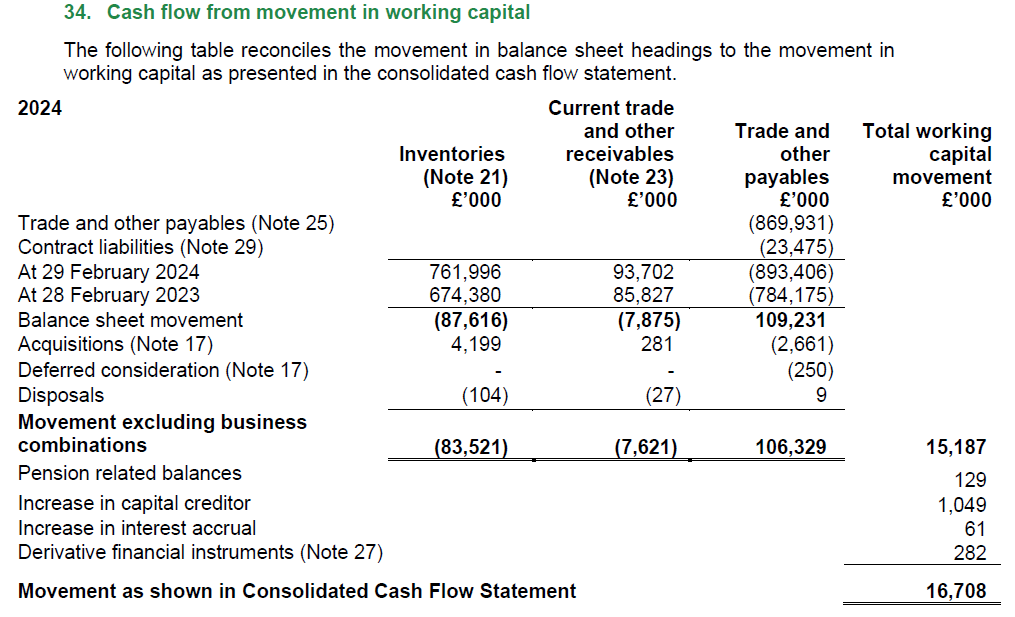
Alternative formats explored in the research
18Four alternative formats for presenting the statement of cash flows were developed for consultation. These formats range from minor modifications to more fundamental redesigns of the existing IAS 7 format:
- Alternative 1: Net Debt Basis
- Alternative 2: Realigned Operating Activities
- Alternative 3: Hybrid P&L and Cash Flow Statement
- Alternative 4: Receipts and Uses of Cash
19Each of the alternatives aimed to address the priorities, issues and concerns identified during earlier research. Annex 1 provides an overview of each alternative, highlighting their main advantages and limitations. Annexes 2 to 5 provide a visual illustration of the four formats.
20To evaluate and refine each of the alternatives, feedback was initially sought from the UKEB Investor Advisory Group (IAG)4.
21Alternative 1: Net Debt Basis received the most positive feedback. IAG members suggested that investors place substantial value on disclosures around companies' net debt. It aligns with how most treasury functions manage liquidity and is seen as a meaningful indicator of financial position. However, some IAG members preferred this disclosure to be introduced as a note to the financial statements rather than a primary statement. Utilising a note would preserve cohesiveness while avoid disrupting the existing structure for the statement of cash flows.
22Alternative 2: Realigned Operating Activities received limited support from IAG members. Although conceptually logical (because it classifies asset-related cash flows to operating activities rather than to investing activities) users and preparers felt it primarily reorganises information that is already clearly identifiable on the face of the statement of cash flows currently prescribed by IAS 7.
23Alternative 3: Hybrid P&L and Cash Flow Statement received some support from IAG members, due to its potential to promote cohesiveness, by linking a company's profit to cash on a line-by-line basis. However, it was viewed as overly detailed and potentially difficult to follow. Concerns were also raised about the practical burden of preparing this statement.
24Alternative 4: Receipts and Uses of Cash was not supported by IAG members, because it largely rearranges existing IAS 7 information, delivering limited incremental value. IAG members felt that the IASB's efforts should focus on supporting users' needs by ensuring that relevant information is transparently available within financial statements and is appropriately disaggregated and cohesively presented.
25Overall, feedback received from the IAG members indicated that, while elements of the four alternatives may be useful, targeted enhancements of cash flow disclosures, rather than a structural overhaul of the IAS 7 format, would be the most appropriate approach to the IASB's project.
26Feedback from the IAG was used to refine the proposals presented to the UKEB Preparer Advisory Group (PAG)5, which consisted of the two alternative presentations formats preferred by the IAG members (Alternative 1: Net Debt basis and Alternative 3: Hybrid P&L and Cash Flow Statement), and other possible supplementary disclosures.
27PAG members were asked whether these disclosures could be reasonably provided, and what, if any, challenges preparers might face in providing them.
28Most PAG members supported requiring a company to provide a net debt reconciliation that reconciles to the statement of cash flows, given that most UK preparers present a net debt reconciliation as an extension to the current disclosure requirement for the change in liabilities arising from financing liabilities.
29Most PAG members were not supportive of Alternative 3, requiring a company to provide a reconciliation between the income statement (statement of financial performance) on a line-by-line basis to the statement of cash flows.
30Regarding potential supplementary disclosures, on the whole PAG members were supportive of:
- A more comprehensive disclosure for movements in working capital.
- Sub-totals - requiring companies to reconcile cash flow related management performance measures (MPMs) to IFRS defined subtotals on the statement of cash flows.
- Single note disclosure for exceptional items.
31There were mixed views around a single note disclosure for non-cash transactions, with concerns that that it would lead to duplication of information which would further lengthen the annual report.
32Incorporating the feedback from IAG and PAG, two alternative presentations, along with a range of additional disclosures, were then selected to field-test with 10 users, through semi-structured interviews in late June
- The table below summarises the profile of the users that participated in the interviews.
| 10 Users interviewed by category | ||
|---|---|---|
| Institutional Investors | 3 | 30% |
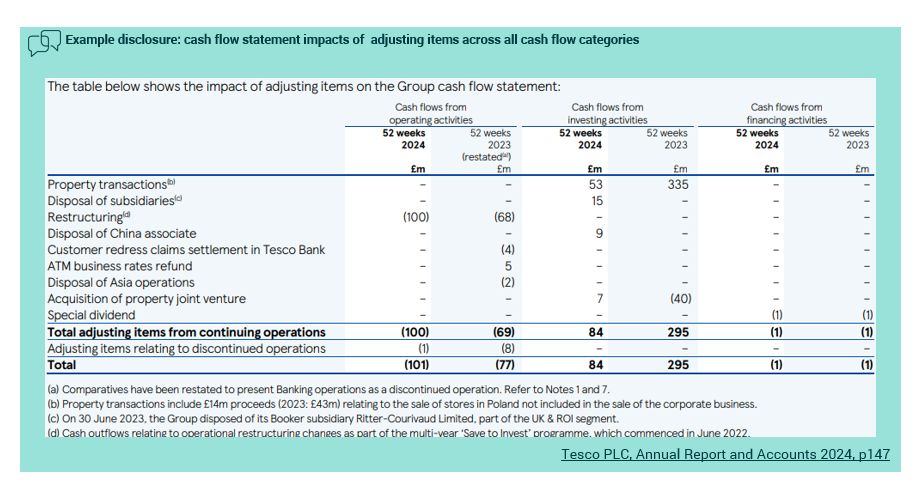
| Professional Body/Representative group members | 3 | 30% |
| Analysts / Researchers (Equity, Fixed Income) | 2 | 20% |
| Credit Rating Agencies | 1 | 10% |
| Creditors/ Lenders | 1 | 10% |
| TOTAL | 10 | 100% |
Key Findings
33The interviews identified the following areas as a priority for UK users:
- Net debt reconciliation.
- Cohesiveness principle to assist cohesiveness between primary financial statements.
34In addition to a “cohesiveness principle", specific disclosures detailed below would provide information that users would find particularly useful for their own analyses:
- Movements in working capital (operating receivables and payables) – a comprehensive disclosure that reconciles working capital items in the statement of financial position and related notes to amounts reported in the statement of cash flows.
- Exceptional and adjusting items - including both the amounts reported in the statement of financial performance and the statement of cash flows;
- Other cash flow measures – sub-totals and management performance
measures – more transparent disclosure, leveraging the IASB's work done
in developing IFRS 18 Presentation and Disclosure in Financial Statements,
by:
- introducing IFRS defined sub-totals on the statement of cash flows, and requiring cash flow related MPMs to be reconciled to the appropriate IFRS defined sub-total; and
- applying the disaggregation principles set out in IFRS 18 that apply to all primary financial statements, including the statement of cash flows.
- Non-cash information, in particular, non-cash transactions with a similar outcome to cash transactions (e.g. share-based payments).
35Utilising voluntary disclosures provided by UK listed companies, and feedback from interviews with UK stakeholders, the following sections illustrate disclosures that the IASB could consider requiring companies to provide.
Net debt reconciliation
36A supplementary net debt reconciliation emerged as the clear priority for both users and preparers. It is regarded as providing relevant information without disrupting the current IAS 7 format. Users value the way it delineates various cash and non-cash movements in net debt. A reconciliation of net debt also provides relevant information investors need in one place, rather than scattered through the financial statements, ensuring completeness of data and minimising the risk of double-counting in users' own analyses.
37The user interviews supported previous research that found such disclosures are important to investors, both for equity valuation purposes and to investigate perceived problems with a company's debt or liquidity. Net debt disclosures give investors the confidence that they have understood issues related to the development of financial obligations that must be met, and issues relating to the capital structure and the enterprise value attributable to net debt versus shares[^6].
38IFRS Accounting Standards currently make no reference to the term 'net debt' and have no requirement to provide a net debt reconciliation. However, a UKEB review of a sample of 30 UK listed annual reports found that most companies disclosed a net debt reconciliation[^7].
39Following discussions at its May 2025 meeting, the IASB indicated that a definition of the term 'net debt' is a topic it does not plan to explore further. However, UK stakeholder feedback noted above, and the prevalence of the measure in UK reporting, provides evidence for the IASB to consider introducing a mandatory requirement for companies to include a net debt reconciliation in their financial statements, building on the existing disclosure requirements in IAS 7 paragraphs 44A to 44E[^8].
40When companies do not provide a net debt reconciliation, analysts generally attempt to create their own. Introducing a requirement for companies to provide a net debt reconciliation, even if the IASB decide to not define the term 'net debt', would assist investors in understanding management's view of net debt and provide transparent information that reconciles to other areas of the financial statements.
41Whether the IASB should define the term 'net debt', or at least define a minimum of what it expects should be included, will be explored further as the project develops.
42During interviews, UK users commented that any suggested net debt disclosure should:
- Clearly show the components that a company includes in their definition of net debt, which might include other liquid investments that do not meet the definition of cash and cash equivalents. Components would need to be shown in the reconciliation with sufficient disaggregation to enable users to link the movement to the corresponding line item in the statement of financial position.
- Require the effects of M&A activity on the components of net debt to be clearly reconcilable to the business combinations note.
- Show separately cash movements and non-cash items, and how they relate to other aspects of the financial statements, such as the statement of financial performance and the statement of financial position.
- Make clear the nature of any derivatives included in net debt and whether the net debt includes accrued interest.
- Clearly explain any fair value hedge adjustments to reported net debt, or debt-related derivatives not included in the company's definition of net debt.
- Separately list movements that are different in nature, such as significant foreign currency movements and fair value changes. Whilst it is considered reasonable for companies to show a category of “other” movements, there should be a requirement for companies to provide confirmation that there are no material offsetting amounts included in that category, and to describe the nature of items included.
43An illustrative example of a possible net debt reconciliation is shown on the next page. Users interviewed had concerns about the transparency of disclosures on factoring and reverse factoring arrangements, so a separate column for any assets or liabilities arising from factoring and reverse factoring arrangements is included in the example.
44As suggested within the example, a reconciliation would be enhanced by cross- referencing amounts to relevant disclosures in other sections of the financial statements. This would address stakeholder expectations, identified during this phase, and earlier phases, of the research (see section on cross-referencing).
45The cash and cash equivalents column would be expected to cross-refer to the statement of cash flows. In that regard, the IASB could consider adding an IFRS defined sub-total for ‘net cash flows from financing activities' and enhance the disclosure requirements for changes in liabilities arising from financing activities (IAS 7 paragraphs 44A–44E) by adding a requirement for disclosure of such changes in the statement of financial position to be reconciled to the IFRS defined sub-total in the statement of cash flows. See later section in this paper on IFRS defined sub-totals.
Illustrative Example of possible Net Debt Reconciliation:
| Cash and cash equivalents | Other liquid investments | Bonds | Bank and other term borrowings | Lease liabilities | Debt factoring | Debt-related derivatives | Total liabilities from financing activities | Net debt | |
|---|---|---|---|---|---|---|---|---|---|
| 2024 £m | 2024 £m | 2024 £m | 2024 £m | 2024 £m | 2024 £m | 2024 £m | 2024 £m | 2024 £m | |
| Balance at start of year | 327.9 | 20.0 | (6,378.9) | (1,985.9) | (58.3) | 0.0 | (105.3) | (8,528.4) | (8,180.5) |
| Cash flows from operating activities | 870.0 | 870.0 | |||||||
| Cash flows from investing activities: | |||||||||
| Cash flows from investing activities [excluding M&A activity] (Note 1) | (679.7) | 1.0 | (678.7) | ||||||
| - M&A activity (Note 1) | (1.0) | (1.0) | |||||||
| Total cash flows from investing activities | (680.7) | 1.0 | (679.7) | ||||||
| Cash flows from financing activities: | |||||||||
| Cash flows from debt related financing activities [excluding interest paid] (Note 1) | 1,361.5 | (1,380.6) | 26.1 | 1.5 | 0.0 | (8.5) | (1,361.5) | 0.0 | |
| - Interest paid | (175.6) | 173.2 | 2.3 | 0.1 | 175.6 | 0.0 | |||
| Cash flows from other financing activities e.g. dividends paid, share issues and share buy-backs (Note 5) | (323.8) | (323.8) | |||||||
| Total cash flows from financing activities (Note 3) | 862.1 | 0.0 | (1,207.4) | 28.4 | 1.6 | 0.0 | (8.5) | (1,185.9) | (323.8) |
| Cash movements | 1,051.4 | 1.0 | (1,207.4) | 28.4 | 1.6 | 0.0 | (8.5) | (1,185.9) | (133.5) |
| Non-cash movements: | |||||||||
| Non-cash impact of M&A (Note 1) | 2.0 | (2.0) | |||||||
| Uplift on index-linked debt | (178.2) | (47.7) | (3.8) | (225.9) | (225.9) | ||||
| Reclassifications (details to be provided) | 0.0 | 0.0 | |||||||
| Other adjustments e.g. FV & FX movements (Note 4) | 11.9 | 1.1 | 0.0 | (46.5) | (33.5) | (33.5) | |||
| Non-cash movements | 0.0 | 2.0 | (167.1) | (35.8) | (2.7) | 0.0 | (46.5) | (252.1) | (250.1) |
| Balance at end of year | 1,379.3 | 23.0 | (7,753.4) | (1,993.3) | (59.4) | 0.0 | (160.3) | (9,966.4) | (8,564.1) |
| Note 1 | Note 1 | Note 1 | Note 1 | Note 1 | Note 1 | Note 1 | Note 2 |
Notes to Illustrative Example:
- Cross-references to relevant sections of the financial statements would ensure cohesiveness. For example, the cash flow column would be expected to cross-refer to the statement of cash flows; the opening and closing balances would be expected to cross-refer to the statement of financial position; and the M&A movements would be expected to cross-refer to the acquisitions and disposals disclosures presented in accordance with IFRS 3.B64(i) and IAS 40(d).
- Separate inclusion of movements relating to factoring and supply chain financing would meet user demands for greater transparency around such arrangements. This would build on the disclosure objectives in IFRS 7 and the disclosure requirements in IAS 7.44A to 44E and IAS 7.44F to 44H.
- The IASB could introduce an IFRS defined sub-total for ‘net cash flows from financing activities' to improve the consistency of companies showing how the 'change in liabilities from financing activities' reconciles to the 'net cash flows from financing activities' in the statement of cash flows.
- It would be reasonable for companies to use a category for "other" items, if companies confirm there are no material offsetting amounts included in that line item and describe the nature of items included.
- Some financing outflows, such as dividends and share based payments, will not affect the financing liabilities included in net debt.
(IAS 7 paragraphs 44A–44E) by adding a requirement for disclosure of such changes in the statement of financial position to be reconciled to the IFRS defined sub-total in the statement of cash flows. See later section in this paper on IFRS defined sub-totals.
Illustrative Example of possible Net Debt Reconciliation:
| Cash and cash equivalents | Other liquid investments | Bonds | Bank and other term borrowings | Lease liabilities | Debt factoring | Debt-related derivatives | Total liabilities from financing activities | Net debt | |
|---|---|---|---|---|---|---|---|---|---|
| 2024 £m | 2024 £m | 2024 £m | 2024 £m | 2024 £m | 2024 £m | 2024 £m | 2024 £m | 2024 £m | |
| Balance at start of year | 327.9 | 20.0 | (6,378.9) | (1,985.9) | (58.3) | 0.0 | (105.3) | (8,528.4) | (8,180.5) |
| Cash flows from operating activities | 870.0 | 870.0 | |||||||
| Cash flows from investing activities: | |||||||||
| Cash flows from investing activities [excluding M&A activity] (Note 1) | (679.7) | 1.0 | (678.7) | ||||||
| - M&A activity (Note 1) | (1.0) | (1.0) | |||||||
| Total cash flows from investing activities | (680.7) | 1.0 | (679.7) | ||||||
| Cash flows from financing activities: | |||||||||
| Cash flows from debt related financing activities [excluding interest paid] | 1,361.5 | (1,380.6) | 26.1 | 1.5 | (8.5) | (1,361.5) | 0.0 | ||
| - Interest paid | (175.6) | 173.2 | 2.3 | 0.1 | 175.6 | 0.0 | |||
| Cash flows from other financing activities e.g. dividends paid, share issues and share buy-backs (Note 5) | (323.8) | (323.8) | |||||||
| Total cash flows from financing activities (Note 3) | 862.1 | 0.0 | (1,207.4) | 28.4 | 1.6 | 0.0 | (8.5) | (1,185.9) | (323.8) |
| Cash movements | 1,051.4 | 1.0 | (1,207.4) | 28.4 | 1.6 | 0.0 | (8.5) | (1,185.9) | (133.5) |
| Non-cash movements: | |||||||||
| Non-cash impact of M&A (Note 1) | 2.0 | (4.3) | (8.1) | (6.1) | |||||
| Uplift on index-linked debt | (178.2) | (47.7) | (3.8) | (225.9) | (225.9) | ||||
| Reclassifications (details to be provided) | 0.0 | 15.4 | 11.9 | ||||||
| Other adjustments e.g. FV & FX movements (Note 4) | (167.1) | (35.8) | (2.7) | (46.5) | (18.1) | (18.1) | |||
| Non-cash movements | 2.0 | (167.1) | (35.8) | (2.7) | 0.0 | (46.5) | (252.1) | (250.1) | |
| Balance at end of year | 1,379.3 | 23.0 | (7,753.4) | (1,993.3) | (59.4) | 0.0 | (160.3) | (9,966.4) | (8,564.1) |
| Note 1 | Note 1 | Note 1 | Note 1 | Note 1 | Note 1 | Note 1 | |||
| Note 2 |
Notes to Illustrative Example:
- Cross-references to relevant sections of the financial statements would ensure cohesiveness. For example, the cash flow column would be expected to cross-refer to the statement of cash flows; the opening and closing balances would be expected to cross-refer to the statement of financial position; and the M&A movements would be expected to cross-refer to the acquisitions and disposals disclosures presented in accordance with IFRS 3.B64(i) and IAS 40(d).
- Separate inclusion of movements relating to factoring and supply chain financing would meet user demands for greater transparency around such arrangements. This would build on the disclosure objectives in IFRS 7 and the disclosure requirements in IAS 7.44A to 44E and IAS 7.44F to 44H.
- The IASB could introduce an IFRS defined sub-total for ‘net cash flows from financing activities' to improve the consistency of companies showing how the 'change in liabilities from financing activities' reconciles to the 'net cash flows from financing activities' in the statement of cash flows.
- It would be reasonable for companies to use a category for "other" items, if companies confirm there are no material offsetting amounts included in that line item and describe the nature of items included.
- Some financing outflows, such as dividends and share based payments, will not affect the financing liabilities included in net debt.
Cohesiveness principle
46Users emphasised that they assess company performance holistically by considering the statement of cash flows alongside other primary financial statements. Therefore, cohesiveness between the primary financial statements is important to them.
47Being able to reconcile between the primary financial statements ensures that the information presented is accurate, reliable and it provides transparency for users. This would be expected to enhance decision-making by users. For example, by comparing the cash generated from operations to operating profit, users can assess the quality of earnings and understand how well the company is managing its working capital.
48Thematic review reports published by the FRC note that reconciliations between the statement of cash flows and other primary financial statements are useful for understanding relationships between the different statements. These reconciliations are especially helpful for understanding the impact of non-cash movements (such as foreign exchange differences, fair value movements and acquisitions or disposals) on changes in working capital.
49IAS 7 currently does not include a principle that amounts shown in the statement of cash flows should be capable of being reconciled by the user to the other primary financial statements. Instead, it includes a few specific requirements as follows:
- IAS 7 paragraph 45 requires a company to present a reconciliation of the cash and cash equivalent amounts in its statement of cash flows with equivalent items reported in the statement of financial position.
- IAS 7 paragraph 44D requires a company, that presents a reconciliation between opening and closing balances in the statement of financial position for liabilities arising from financing activities, to "
provide sufficient information to enable users of the financial statements to link items included in the reconciliation to the statement of financial position and the statement of cash flows". - Where a company uses the indirect method for disclosing cash flows from operating activities, a reconciliation to the statement of financial performance is implicit. However, the information provided depends on the level of disaggregated information the company decides to include.
50One way to address user concerns would be to add an overriding "cohesiveness principle" to IAS 7. For example, the Standard could require that companies "ensure that the financial statements provide sufficient information to enable users to link items included in the statement of cash flows to the other primary financial statements".
51A "cohesiveness principle” would improve the requirements in IAS 7. It would help ensure users are able to access information about changes arising from cash flows and non-cash changes (such as changes deriving from obtaining or losing control of subsidiaries or other businesses, the effect of changes in foreign exchange rates, and changes in fair values).
52Almost all users interviewed were supportive of such a “cohesiveness principle”. Some were concerned that a "cohesiveness principle” alone may not lead to consistent and comparable information, unless auditors and regulators actively work to ensure that companies comply with such a principle. Application guidance would also assist in this regard.
53Annex 6 maps the links between IAS 7 and other IFRS Accounting Standards and includes examples of voluntary disclosures observed in UK listed companies that link information between the primary financial statements and related notes. More companies may be encouraged to provide such disclosures if a "cohesiveness principle" is introduced.
54Another potential advantage of this principle is that fewer specific disclosure requirements should need to be added to other IFRS Accounting Standards. Applying the principle should mean that sufficient information is provided for users to map the links between the primary financial statements and between the relevant notes.
Cross-referencing
55More generally, UKEB research has highlighted that few companies provide cross references from their statement of cash flows to relevant notes in their financial statements. This makes it challenging for users to clearly understand the relationship between the statement of cash flows and other sections of the financial statements.
56The absence of cross referencing in the statement of cash flows to notes in the financial statements is surprising. There is often relevant information in various notes distributed across the financial statements (for example, in the leases note, the reconciliation of changes in liabilities arising from financing activities, and the provisions note). However, few companies provide references to these notes for relevant cash flows.
57Introducing requirements for cross referencing between information included on the face of the statement of cash flows and that presented in the notes provides an opportunity to enhance the cohesiveness of the financial statements and user understanding.
Movements in working capital
58Change in working capital is a cash flow item that reflects the actual cash used to operate the business. It can help explain how a company uses its assets to generate growth, which can allow investors to predict changes in company value 7.
59IAS 7 does not specifically mention the term 'working capital', although paragraph 20 of IAS 7 states that under the indirect method net cash flow from operating activities is adjusted for changes in inventories, receivables, and payables. The Standard does not include additional presentation or disclosure requirements related to these movements, i.e. the level of disaggregation required on the face of the statement of cash flows is not prescribed.
60The UKEB analysis of annual reports for 30 UK listed companies observed that those companies often present these items in the 'operating cash flows' section of the statements of cash flows as single line ‘changes in working capital'. It was also observed that some companies include changes in other current assets and current liabilities within ‘changes in working capital', leading to differing components and levels of disaggregation in the statement of cash flows.
61As noted in the first research paper, the FRC's 2020 thematic report on cash flow and liquidity disclosures raised concerns about inconsistencies between working capital movements and statement of financial position movements 8. This finding was consistent with feedback from users during the UKEB interviews. Those users highlighted the importance of reconciling working capital movements presented in the statement of cash flows to changes in the statement of financial position, especially when there are significant unexplained differences or there is insufficient disaggregation to link the disclosures.
62According to that FRC 2020 thematic, examples of better disclosures include:
- a reconciliation to explain the cash flow impact of working capital movements, where changes in cash flows from working capital are inconsistent with movements in the statement of financial position;
- a logical ordering of items presented, for example, grouping similar items together; and
- cross-references to relevant notes.
63As noted in the UKEB third research paper 9, a few users said they need appropriate disclosure and disaggregation of what comprises a company's working capital and its movements. Such information may be transparent when the movement in working capital is disaggregated on the face of the statement of cash flows (or in a related ‘operating cash flows' analysis note) and cross-referenced to the related notes showing movements in the respective assets and liabilities.
64The current diversity in reporting practice and inability of users to reconcile the movement shown on the face of the statement of cash flows with the movement in the respective asset and liabilities, reinforces that the cohesiveness between the statement of cash flows and the statement of financial position is important and could be improved.
65As noted in paragraph B47 of the UKEB second research paper, some UK listed companies voluntarily provide reconciliations to clarify how working capital movements in the statement of cash flows relate to amounts in the statement of financial position (see two examples below) 10. These examples were discussed during UKEB interviews with users.
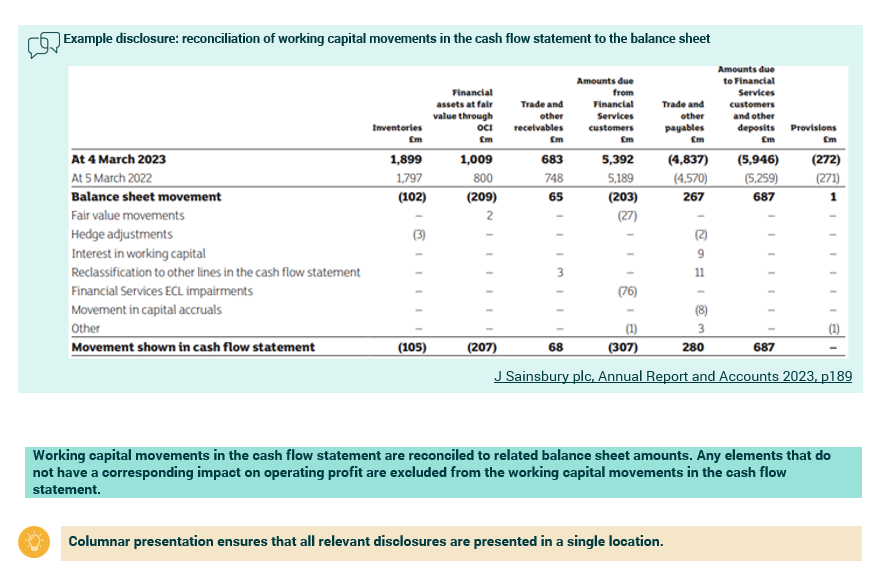
Working capital movements in the cash flow statement are reconciled to related balance sheet amounts. Any elements that do not have a corresponding impact on operating profit are excluded from the working capital movements in the cash flow statement.
Columnar presentation ensures that all relevant disclosures are presented in a single location.
66The second example below (Vertu Motors plc, Annual Report 2024, page 137) shows the impact of business combinations in the year on the movement of working capital shown in the consolidated statement of cash flows:
Vertu Motors plc, Annual Report 2024, page 137
34. Cash flow from movement in working capital
The following table reconciles the movement in balance sheet headings to the movement in working capital as presented in the consolidated cash flow statement.
67Users suggested entity-specific disclosure is preferable to the IASB defining the term 'working capital'. This approach provides a management perspective on what assets and liabilities a company considers to be the components of its working capital and how such working capital is managed. Most users also suggested that separate disclosure of factoring receivables and payables would be useful.
68Most users suggested that it would be useful for the IASB to require, as a minimum, specific line items, such as trade and other payables, trade and other receivables and inventories (if relevant). However, a company should also be permitted to include other entity-specific items. When a company has not included those minimum expected items, the reasons should be explained.
69Most users suggested that they need to be able to understand which components, shown on the statement of financial position, the company is managing as part of its working capital management. Therefore, the disaggregation shown in the working capital movement disclosure should be sufficient to enable users to link that information to the statement of financial position and related notes.
70Most users suggested they need to be able to assess the impact of specific types of changes on each category of working capital, where material, such as:
- M&A activity
- Disposals
- non-cash transactions; and
- other non-cash items, such as foreign exchange and fair value movements.
71This level of disaggregation is similar to the level of disaggregation suggested in IAS 7 for the disclosure of changes in liabilities arising from financing activities 11.
72Some users suggested that segmental information should be required to be disclosed where management monitor the working capital of different business segments separately, and where there are different business models in those segments that can lead to significantly different absorption of working capital.
73PAG members expressed their views on possible concerns regarding providing a working capital movement note, specifically:
- potential difficulty in providing auditable support for reconciling items, due to unavailability of information in accounting systems;
- commercial sensitivity associated with disclosing some movements;
- potential challenge by auditors and request for supporting documentation, where companies provide commentary on, rather than a breakdown of, immaterial reconciling items grouped as "other"; and
- potential increase in audit costs.
74In mitigation, those users interviewed acknowledged that only material information need be disclosed. They also agreed it would be sufficient for companies to categorise immaterial items as "other", as long as companies confirm there are no material offsetting amounts included in that category and describe the nature of items included.
75In the UK, working capital statements are sometimes required in prospectuses by companies trading on the London Stock Exchange's Main Market 12.
76The IASB could prescribe the minimum categories expected in the working capital movement note. A mandatory single line for 'working capital movements' on the face of the statement of cash flows, cross-referenced to a mandatory working capital movements note, would suffice (also see later section on IFRS defined sub-totals).
Factoring receivables and payables
77As noted above, better disclose of the impact of factoring receivables and payables is important to users.
78Factoring can help a company maintain an optimal level of working capital by converting invoices into cash, ensuring it has enough funds to cover expenses, pay suppliers, and invest in growth. By understanding how a company uses factoring, investors can gauge its ability to manage its short-term financial needs.
79Investors analyse the creditworthiness of a company's customers and the terms of its factoring agreement to assess the potential risks involved.
80IFRS 7 Financial Instruments: Disclosures requires entities to disclose the nature and extent of risks arising from financial instruments. This includes qualitative and quantitative information about credit risk, liquidity risk, and market risk, with a focus on how the entity manages these risks.
81There is no specific requirement to disclose cash flow information in relation to factoring arrangements, in either IFRS 7 or IAS 7.
82Users interviewed suggested that, in order to provide transparency about factoring and reverse factoring arrangements, working capital disclosures could be further disaggregated to separately identify components of balances subject to these arrangements that have not met IFRS 9 Financial Instruments derecognition requirements. Please also refer to the net debt reconciliation section above for proposals to improve transparency of liabilities arising from factoring and reverse factoring arrangements.
83An illustrative example of a possible working capital movements note is shown below, which includes factoring receivables and payables. Further field-testing would need to be carried out to ensure that any suggested improvements to working capital disclosure requirements balance the costs of providing the additional information and the related benefits.
Illustrative Example of possible Movement of Working Capital note:
| INVENTORIES | OPERATING RECEIVABLES | OPERATING PAYABLES | NET WORKING CAPITAL | ||||||
|---|---|---|---|---|---|---|---|---|---|
| Stock | Trade and other receivables (excluding those subject to Debt factoring arrangements) | Receivable subject to Debt factoring arrangements with recourse | Held for sale assets | Trade and other payables (excluding those subject to supplier financing arrangements) | Payables subject to Supplier financing arrangements | Provisions | Pension liabilities | ||
| 2024 £m | 2024 £m | 2024 £m | 2024 £m | 2024 £m | 2024 £m | 2024 £m | 2024 £m | 2024 £m | |
| Opening balance at start of year | 130.0 | 200.0 | 78.0 | 2.0 | (150.0) | (150.0) | (12.0) | (49.0) | 49.0 |
| Cash inflows/outflows | 1,650.0 | (2,400.0) | (600.0) | 1,500.0 | 160.0 | 18.0 | 3.0 | 331.0 | |
| Non-cash working capital movements: | |||||||||
| M&A activity (agreed to Business Combinations note) | 14.0 | 5.0 | (3.0) | 16.0 | |||||
| Transfer to Property Plant & Equipment (agreed to Fixed asset note) | (2.0) | (2.0) | |||||||
| Other reclassifications (details to be provided and disclosed in relevant note) | (8.0) | 8.0 | 0.0 | ||||||
| Translation adjustments (not through P&L) | 0.0 | ||||||||
| "Other" adjustments (to be separated where material) | 0.0 | ||||||||
| Non-cash working capital movements | 12.0 | 5.0 | 0.0 | 0.0 | (11.0) | 0.0 | 8.0 | 0.0 | 14.0 |
| Income statement (charge) / release | (1,745.0) | 2,505.0 | 590.0 | (1,400.0) | (150.0) | (20.0) | 2.0 | (218.0) | |
| Closing balance at end of year | 47.0 | 310.0 | 68.0 | 2.0 | (61.0) | (140.0) | (6.0) | (44.0) | 176.0 |
Notes to Illustrative Example:
- Columns should represent the categories included in the statement of financial position and related notes. This working capital movement note should include cross-references to those other relevant notes.
- The nature of the items in "Other" adjustments should be described. It should not include any material offsetting items. Items should be disclosed separately, when material and different in nature.
- For supplier financing arrangements, the cash outflow to the financial institution could be classified as either operating or financing cash flow, depending on whether the liability is considered part of the buyer's working capital or a financing activity. If the liability is considered a trade payable within the normal operating cycle, the cash outflow may be classified as operating cash flow.
Exceptional and adjusting items
84IFRS Accounting Standards, including IAS 7, do not explicitly refer to exceptional or other adjusting items. However, they are frequently included in the statement of profit or loss to communicate information intended to help users better understand the financial statements.
85Users interviewed observed that understanding the cash impact of non-recurring items is important to them to assess a company's financial health and in making more informed investment decisions. Understanding the nature of a non-recurring item and its cash flow impact was also seen as important for financial valuation.
86Those users confirmed that, generally, analysts adjust for non-recurring items, as these one-time events can significantly impact a company's reported performance. If not adequately disclosed, this can lead to difficulty in accurately assessing a company's underlying operating performance and future potential.
87Most UK listed companies use the indirect method for disclosing operating cash flows 13. If the starting point includes exceptional items, the cash impact of those exceptional items is not transparent, unless the full profit or loss impact is added back and then the cash impact separately disclosed, or otherwise explicitly disclosed in supporting commentary 14.
88Per paragraph B36 of the second research paper, the Basis for Conclusions to IFRS 18 paragraph BC93 notes that "an entity might disclose information about an aspect of its operating performance by presenting a management-defined performance measure of operating profit excluding expenses it regards as non-recurring or unusual". No such requirement is set out in IFRS 18 in relation to 'cash flows from operating activities'.
89As noted in paragraph B63 of the second research paper, despite UK regulator, the FRC, specifically identifying information on the cash impact of exceptional or other adjusting items as an area in which it would like to see better disclosure, such information is not widely provided by companies.
90Disclosing the cash impact of exceptional items ensures consistency between cash flow disclosures and the statement of financial performance disclosure requirements.
91Paragraphs B38-B40 of the second UKEB research paper, set out two examples of voluntary disclosures of exceptional items, one on the face of the statement of cash flows, as follows:
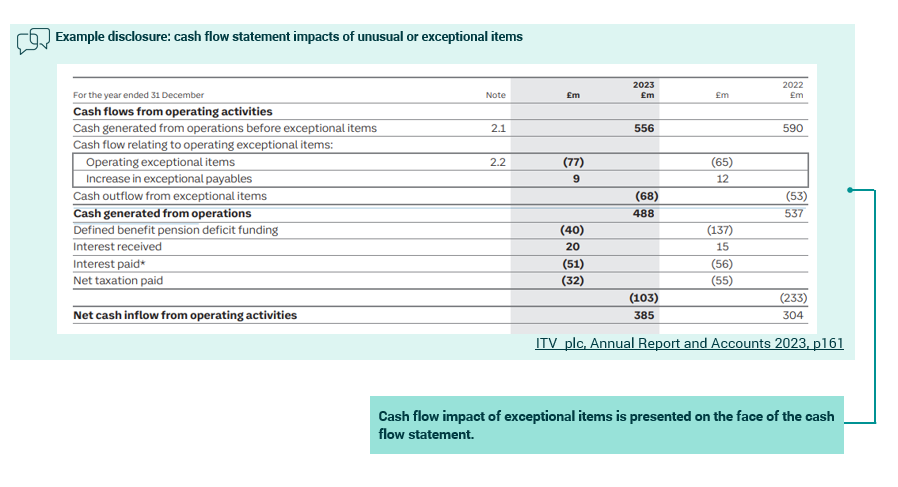
Cash flow impact of exceptional items is presented on the face of the cash flow statement.
92The second example demonstrates how the cash impact of exceptional and other adjusting items is shown in a note and disaggregated by nature and by cash flow classification, clearly showing exceptional cash flows relating to operating, investing and financing activities:
93Whilst some exceptional items will impact both primary statements in the same year, this is not always the case due to timing, and some exceptional items may impact multiple years. Since users adjust for exceptional items in identifying sustainable future cash flows, it would be helpful if disclosures explained such timing differences.
94Below is an example of how a disclosure might be provided for exceptional items. Disaggregation principles introduced by IFRS 18 should apply. The example separately discloses exceptional items related to continuing operations from discontinued operations. It also shows, for both primary financial statements, in which category (operating, investing, financing) the items are included:
CASH FLOW IMPACT OF EXCEPTIONAL AND ADJUSTING ITEMS (Prior year comparatives would be expected)
| INCOME STATEMENT | STATEMENT OF CASH FLOWS | |
|---|---|---|
| Operating activities | Investing activities | |
| 2024 £m | 2024 £m | |
| Operating activities include the impact of the following exceptional items*: | ||
| Restructuring and integration programmes | ||
| Disposal of PP&E and intangibles | ||
| Disposal of subsidiaries and associates | ||
| Acquisition-related expenses | ||
| Other (with details)** | ||
| Total operating profit/cash flow impact of exceptional and adjusting items from continuing operations | 0.0 | 0.0 |
| Restructuring and integration programmes | ||
| Disposal of PP&E and intangibles | ||
| Disposal of subsidiaries and associates | ||
| Acquisition-related expenses | ||
| Other (with details)** | ||
| Total operating profit/cash flow impact of exceptional and adjusting items from discontinuing operations | 0.0 | 0.0 |
| Total operating profit/cash flow impact of exceptional and adjusting items | 0.0 | 0.0 |
* Should be consistent with IFRS 18 disaggregation principles ** "Other" items should not include material offsetting amounts. A footnote explaining the nature of the items included in "other" would be useful to users.
95Although the word 'exceptional' reflects the terminology frequently seen in companies' voluntary disclosures, these might also be described as 'unusual', 'non-recurring' or 'infrequent' adjusting items.
Other cash flow measures – sub-totals and management performance measures (MPMs)
96IFRS 18 introduces MPMs for income and expenses 15. An MPM is a subtotal of income and expenses that:
- is used in public communications outside financial statements 16;
- is used to communicate to investors, management's view of an aspect of the financial performance of the company as a whole; and
- is not listed in IFRS 18 or specifically required by IFRS Accounting Standards.
97IFRS 18 introduced sub-totals required to be disclosed on the face of the income statement 17. A company will disclose information about its MPMs in a single note to the financial statements. The note will include a statement that the MPMs provide management's view of an aspect of the financial performance of the company as a whole and are not necessarily comparable with measures sharing similar labels or descriptions provided by other companies.
IFRS defined sub-totals for cash flow measures and MPMS
98Users interviewed said that to improve transparency and assist them in comparing cash flow measures not defined in IFRS reported by different companies, it would be useful if the IASB introduced new IFRS defined sub-totals in the statement of cash flows. This would facilitate the reporting of cash flow related MPMs and reconciliation back to IFRS define sub-totals.
99A universal example discussed was free cash flow. Users interviewed said that they do not require the IASB to define free cash flow as they use their own measures. These measures vary depending upon the company, the sector, size or a number of other factors. However, when free cash flow measures are provided by companies, they do give users an insight to management's view of performance and liquidity.
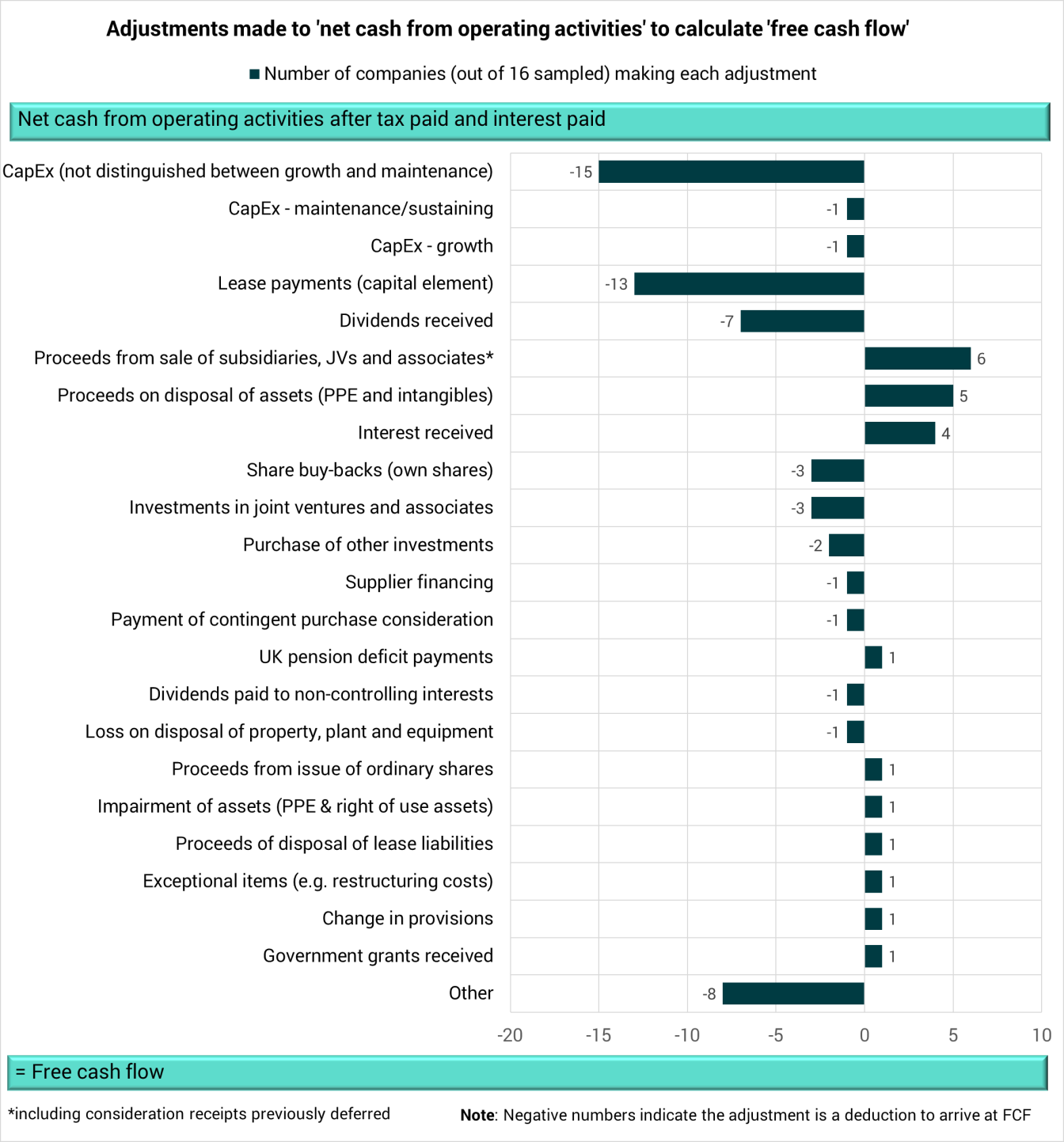
100In the UKEB's review of a sample of annual reports of 30 UK listed companies to inform the second UKEB research paper, 16 of those companies disclosed a free cash flow measure and made various adjustments to net cash from operating activities after tax paid and interest paid, as shown in the chart below:
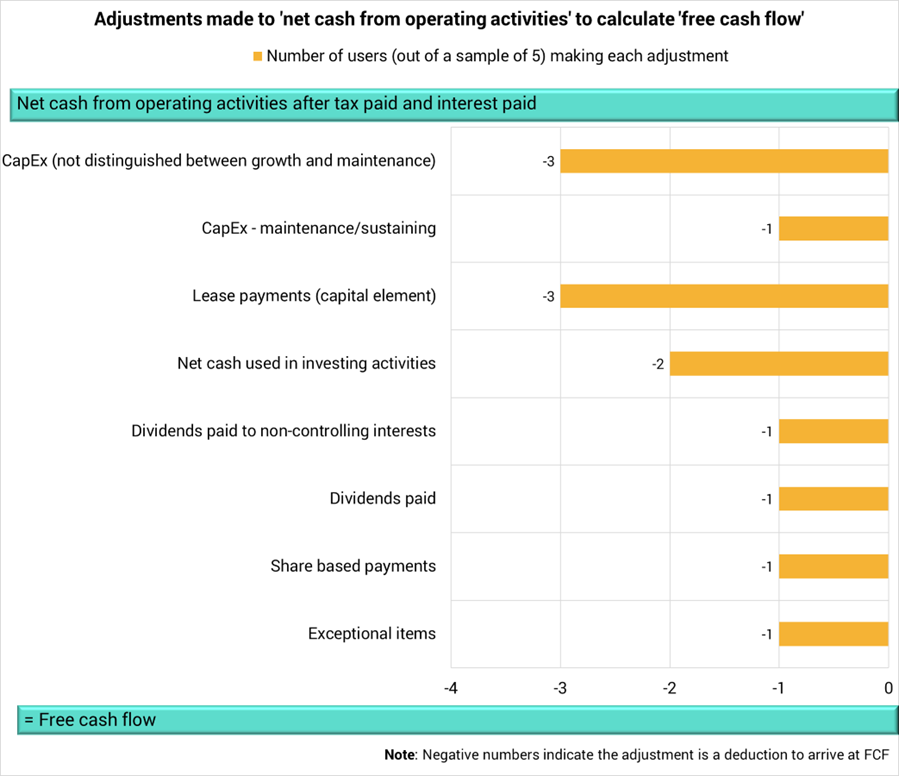
101Some IAG members also shared their approach to calculating free cash flow, as shown in the chart below:
102Despite net cash from operating activities after tax paid and interest paid being a common basis for companies to calculate their free cash flow metric, most users told us that they would prefer tax cash flows to be disclosed separately and not included in operating, investing or financing activities, even where tax payments can be specifically identified. Introducing a separate sub-total for tax cash flows might also assist in enabling a user to link the tax cash flows with the taxation note to the accounts (see Annex 6 Tax payments).
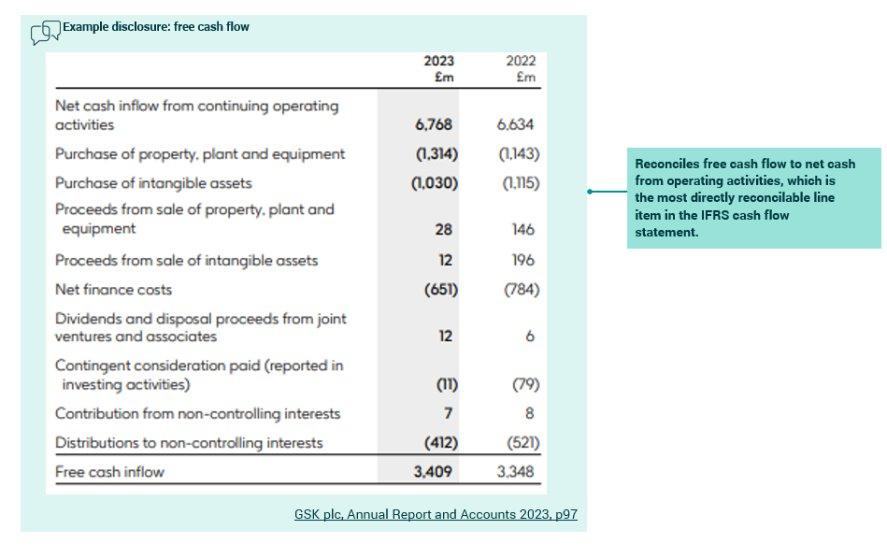
103Through the UKEB consultation with both preparers and users, the sub-total that might be the best starting point for free cash flow is “cash flows from operating activities from continuing operations", as observed in the example below, or "cash flows from continuing operations before financing activities”.
Example disclosure: free cash flow
104Similar to income and expense MPMs, the IASB could require the disclosure of, and reconciliation of, such cash flow MPMs to IFRS defined sub-totals in a single note in the financial statements.
105As noted in the earlier section on movements in working capital, the IASB might also consider including a sub-total for ‘movements in working capital' on the face of the statement of cash flows.
106The IASB might further consider adding a sub-total for 'net cash flows from financing activities', that an entity would be required to reconcile to its 'changes in liabilities arising from financing activities' disclosure (IAS 7 paragraph 44A-44E), as noted in the earlier section on net debt reconciliations.
Cash flows from discontinuing operating activities
107No mention of discontinued operations is made in IAS 7. However, paragraph 33c of IFRS 5 Non-current Assets Held for Sale and Discontinued Operations requires "net cash flows attributable to the operating, investing and financing activities of discontinued operations to be presented separately in the statement of cash flows or the notes" 18.
Reconciles free cash flow to net cash from operating activities, which is the most directly reconcilable line item in the IFRS cash flow statement.
104. Similar to income and expense MPMs, the IASB could require the disclosure of, and reconciliation of, such cash flow MPMs to IFRS defined sub-totals in a single note in the financial statements.
105. As noted in the earlier section on movements in working capital, the IASB might also consider including a sub-total for ‘movements in working capital' on the face of the statement of cash flows.
106. The IASB might further consider adding a sub-total for 'net cash flows from financing activities', that an entity would be required to reconcile to its 'changes in liabilities arising from financing activities' disclosure (IAS 7 paragraph 44A-44E), as noted in the earlier section on net debt reconciliations.
Cash flows from discontinuing operating activities
107. No mention of discontinued operations is made in IAS 7. However, paragraph 33c of IFRS 5 Non-current Assets Held for Sale and Discontinued Operations requires "net cash flows attributable to the operating, investing and financing activities of discontinued operations to be presented separately in the statement of cash flows or the notes" 18.
108. If the IASB introduces separate sub-totals for continuing and discontinuing operations it would need to remove the option described above per paragraph 33c of IFRS 5.
109. During the user interviews, stakeholders asked for better disclosure of cash flows from discontinuing operations. Some suggested that this would be best presented in a note in segmental format (see later section on segmental cash flows) for each line of the statement of cash flows.
110. Given the choice already provided to companies, it might be consistent for the IASB to only introduce a sub-total for 'cash flows from operating activities' and retain the note disclosure for further analysis of continuing and discontinuing activities. The advantage of this approach would be to keep the face of the statement of cash flows simplified, and mandating a supplementary note for disaggregation, if a company has discontinued operations. The level of granularity in the note would be left to the company to decide, whilst considering the disaggregation principles introduced in IFRS 18.
111. Whilst this approach may lead to diversity in the level of disaggregation in the note disclosure, there is already a minimum disclosure requirement in IFRS 5 for a company to provide a total for continuing and discontinuing cash flows for each category of cash flow (operating, investing, financing).
112. One example of a UK listed entity already providing detailed segmental cash flow information in a note, showing continuing and discontinuing operations, is Tesco PLC– see Tesco PLC Annual Report and Financial Statements 2024 (page 143).
Non-cash information
113. As noted in the UKEB first research paper19, there is an argument that excluding all non-cash transactions from the statement of cash flows does not result in comparable information for similar cash and non-cash transactions give rise to a similar outcome.
114. For example, the purchase of an asset (or a business) in exchange for an entity's own shares is similar to first selling its own shares and then purchasing an asset with the cash received. Users might expect that the two transactions should be presented similarly in the statement of cash flows. The same could apply to other non-cash transactions, including, for example, sales in exchange for cryptocurrencies or obtaining a beneficial interest as consideration for transferring financial assets (excluding cash).
115. The increasing prevalence of non-cash changes in debt that are regarded as being economically equivalent to cash flows, is an increasing challenge for investors. Because such changes in debt do not involve cash flows, they are not reflected in the statement of cash flows.
116. Some users interviewed said it is difficult to reconcile the statement of financial position to the statement of cash flows, and there is a need for more information on non-cash effects of some items.
117. The UKEB initial outreach carried out in December 2024–March 2025, and the User poll conducted in March–April 2025, suggested that information about non-cash transactions was one of the highest priorities for users.
118. Over the course of the research and outreach, a number of areas have been highlighted, as listed below, for which users said they needed more information. Disclosure requirements for such items are included in other IFRS Accounting Standards, although there are few requirements in those standards for the disclosure of cash flow information, or a requirement to disaggregate cash and non-cash information:
- Leases - IFRS 16 Leases;
- Capital Expenditure – IAS 16 Property, Plant & Equipment and IAS 38 Intangible Assets;
- Mergers and Acquisitions (M&A) and divestitures – IFRS 12 Disclosure of Interests in Other Entities and IFRS 3 Business Combinations;
- Derivatives – IFRS 9 Financial Instruments;
- Share-based payments – IFRS 2 Share-based payments;
- Provisions - IAS 37 Provisions, Contingent Liabilities and Contingent Assets;
- Factoring receivables – IFRS 7 Financial Instruments: Disclosures, and
- Discontinued operations – IFRS 5 Non-current Assets Held for Sale and Discontinued Operations.
119. During the interviews, users acknowledged that some companies provide the information needed, but it is often voluntary and scattered throughout the financial statements.
120. Initially, the UKEB determined that such information needs might be met if companies were required to disclose non-cash information in a single note in the financial statements, to bridge the information gap for users.
121. Single-note disclosure of non-cash transactions (e.g. property, plant, and equipment (PPE) acquired by means of a lease, pension service costs, factoring of trade receivables, share-based payments, debt to equity conversions and certain M&A where consideration is non-cash), might assist analysts not to double count. For example, it would be important for analysts not to include in free cash flow measures, both the effective capital expenditure (capex) and the lease rental payments in respect of capitalised leases.
122. An example of how non-cash transactions might be disclosed is set out below. As well as the non-cash transactions, this example includes the impact on the statement of cash flows of any related cash flows included in the statement of cash flows in the year that the non-cash transaction occurred (as shown for the acquisition of PP&E by means of a lease in the example):
NON-CASH TRANSACTIONS WITH SIMILAR IMPACT AS CASH TRANSACTIONS **
| Description of transaction: | Note ref | RELATED AMOUNTS INCLUDED IN STATEMENT OF CASH FLOWS | NON-CASH TRANSACTIONS |
|---|---|---|---|
| Operating activities 2024 £m | Investing activities 2024 £m | ||
| Non-cash consideration received from (paid to) customers | Working capital note | ||
| Asset contributions from customers | Capex note | ||
| Equity-settled share-based payment charges | Share-based payments note | ||
| Withholding taxes and fees deducted at source | |||
| Non-monetary Government grants | |||
| Acquisition of property, plant and equipment by means of leases | Leases note | (1.0) | |
| Acquisition of subsidiary by issue of ordinary shares | |||
| Capitalisation of costs (e.g. borrowing costs and staff costs) | Capex note | ||
| Debt-to-equity conversions | |||
| Other (with details) | |||
| Total non-cash transactions with similar economic impact as cash flows | (1.0) | 0.0 |
Note: Sum of all totals offsets to zero
**** The impact on the cash flows in the current year needs to be transparent to ensure no double-counting e.g. lease payments made in the reporting year that a new lease is entered into
123. The interviews identified that the key information that users are missing is information that would allow users to link the information disclosed in the primary financial statements and in the related notes.
124. Users were challenged to find relevant information due to:
- lack of cross-referencing between primary financial statements and related notes; and
- incomplete information disclosed.
125. Examples provided of such challenges include:
- Working capital – reconciling the movement in working capital disclosed on the face of the statement of cash flows (where presented using the indirect method) to the movement in operating assets and operating liabilities considered to be working capital in the statement of financial position and related notes. If a reconciliation between the statement of cash flows and the statement of financial position was mandatory, including separate disclosure of factoring payables and receivables, then users' information needs should be met (see previous section on movements in working capital).
- M&A activity - reconciling the cash and non-cash impact of M&A activity on working capital, leases, capital expenditure, etc. Users' information needs should be met if:
- a working capital movement note was mandatory and required disclosure of the impact of M&A activity that could be linked to the business combinations note; and
- in the leases note and capital expenditure note, the M&A impact was disclosed separately, and could be tied back to the business combinations note.
Other areas of cash flow reporting
127. In areas where companies may need to exercise judgement when determining or disclosing cash flow amounts and related balances, there is a high potential for diverse approaches being adopted by companies.
Cash and cash equivalents
128. Users interviewed understand cash and cash equivalents to be readily available funds for a company's day-to-day operations and therefore provide an indication of its ability to pay short-term debts. In this context, it is important that amounts that companies include in cash equivalents reflect their cash management strategy.
129. IAS 7 paragraph 46 requires companies to disclose their accounting policy for determining the composition of cash and cash equivalents. The FRC's thematic review on cash flow and liquidity disclosures, emphasised the importance of:
- Providing sufficiently detailed accounting policies that clearly define the items included in cash and cash equivalents.
- Providing an analysis of the components of cash and cash equivalents e.g. cash at bank, short term deposits, money market funds.
- A description of the terms of deposits i.e. maturity, break clauses and interest rates.
- Explaining the rationale for including overdrafts within cash and cash equivalents, if applicable, including the term of the arrangements.
- Providing information about restricted cash balances and the nature of the restrictions, and amount.
Restricted balances
130. IAS 7 paragraph 48 sets a high-level disclosure requirement for restricted cash balances, requiring companies to disclose significant restricted balances and provide commentary. As a result, companies have to exercise judgement in determining the level of detail to include in their disclosures.
131. The extract below provides an example of a company which:
- described the nature of the restricted balances and the associated restrictions; and
- explained the accounting implications – in this case, that the restrictions meant that the balances should not be included in cash and cash equivalents (companies generally do not explain their conclusion that the restrictions are not severe enough to impact their inclusion in cash and cash equivalents).
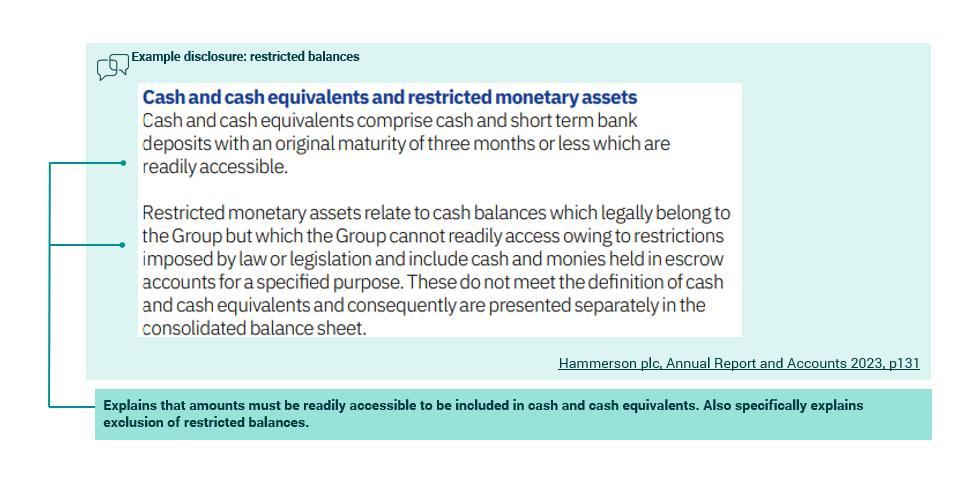
Explains that amounts must be readily accessible to be included in cash and cash equivalents. Also specifically explains exclusion of restricted balances.
132. Users however suggested that restricted cash balances would be more transparently disclosed if the restricted amount was set out in tabular format when a company discloses the components of cash and cash equivalents.
Disclosures encouraged by IAS 7
Growth and maintenance expenditure
133. IAS 7 paragraphs 50–51, state that it may be helpful for companies to disclose aggregate cash flows that represent increases in operating capacity (growth) separately from those cash flows that are required to maintain operating capacity (maintenance).
134. While such information may be useful in enabling the user to determine whether the entity is investing adequately in the maintenance of its operating capacity, there was not a high demand for such information during the UKEB outreach.
135. In the IASB's May 2025 meeting, members discussed the topics they are planning on looking into in the project. The IASB are not currently looking to define growth and maintenance expenditure.
136. Users acknowledged that it makes sense for the IASB not to define growth and maintenance expenditure, as it is very judgmental and would not necessarily increase comparability amongst companies.
137. However, it was suggested by users interviewed that better information might be available to users if the IASB required companies to disclose a disaggregation of growth and maintenance expenditure using their own determination/judgement, where a company provides information on growth or maintenance expenditure:
- in publicly available information; or
- internally for management monitoring purposes.
Segmental cash flows
138. IAS 7 paragraphs 50–51 encourage companies to disclose the amount of cash flows arising from the operating, investing and financing activities of each reportable segment.
139. The disclosure of segmental cash flows enables users to obtain a better understanding of the relationship between the cash flows of the business as a whole and those of its component parts, and the availability and variability of segmental cash flows. For example, different business segments may have differing cash generation and usage profiles or differing working capital absorption.
140. The illustrative example in IAS 7 (Illustrative Example D)20 presents only aggregate operating, investing, and financing cash flows for each operating segment.
141. During the interviews, many users said segmental cash flow information would be useful for cash flows from operating activities and cash flows from investing activities. However, segmental information for cash flows from financing activities was not considered to provide useful information.
142. During the May 2025 IASB meeting, the IASB noted that they are not planning to develop new segmental reporting requirements for cash flows at this time. The IASB suggested that it might look at the requirements for segmental information at a later stage, or as a separate project on segments21.
143. During the interviews, different users had different priorities in relation to segmental information on cash flows. Some users were not concerned with receiving segmental information of cash flows and relied upon disclosures provided by other segmental reporting requirements under IFRS 8 Operating Segments.
144. Some users said that segmental reporting was particularly useful for working capital movements reported under the indirect method on the statement of cash flows, where companies had significantly different business segments that absorbed different amounts of working capital (see earlier section on movements in working capital).
145. If companies have significantly different business segments that lead to different cash flows, it is likely that they are monitoring these cash flows separately in the business.
146. Therefore, rather than retain the 'encouraged' disclosure, the IASB could consider what specific requirements would assist users and introduce mandatory requirements to provide such segmental cash flows in certain circumstances i.e. where companies already have access to this information.
Concluding observations
147. Users indicate that there are opportunities for the IASB to improve reporting by requiring companies to provide specific disclosures, including:
- A Net debt reconciliation, including a reconciliation to the statement of cash flows.
- A comprehensive movements in working capital note reconciled to the statement of cash flows.
- Exceptional and adjusting items showing impact on the statement of cash flows and the statement of financial performance.
- Cash flow related MPMs, leveraging the IASB's work done in developing IFRS 18 by introducing IFRS defined sub-totals and requiring cash flow related MPMs to be reconciled to the appropriate IFRS defined sub-total.
- Non-cash transactions with a similar outcome to similar cash transactions (e.g. stock options paid to employees) in a single note to the accounts; and
- Information about other non-cash items (such as foreign exchange and fair value movements) to enable the user to link information in the statement of cash flows and information in the statement of financial position.
148. To enhance the cohesiveness between primary financial statements that users are looking for, the IASB could introduce a "cohesiveness principle", which should lead companies to provide more complete disclosures, including non-cash information. This principle would also lead to improved cross-referencing between the primary financial statements and notes to the accounts.
149. In particular, there are key areas (such as leases, share-based payments, capital expenditure, derivatives, business combinations and provisions), where users need more information to enable them to link the information provided about these items in each of the primary financial statements. This would set out the impact on cash flows, in addition to the impact on the statement of financial performance and the statement of financial position of the company.
150. There are also opportunities for the IASB to improve other areas of cash flow reporting, such as the information on cash and cash equivalents, by requiring additional disclosures on the cash and cash equivalents reported on the statement of cash flows by component that is restricted.
151. Finally, there are opportunities for the IASB to simplify the disclosures encouraged by IAS 7. An example is the encouragement to disclose disaggregation between growth and maintenance cash flows. This could be amended to be required only when a company already provides this information publicly or uses it for internal monitoring purposes. There are other similar opportunities.
Annex 1: Four alternative formats explored in the research
152. The table below shows provides a high-level description of the four alternative formats for the statement of cashflows explored in the research and outlines their key advantages and limitations.
| Alternative 1: Net Debt Basis | Alternative 2: Realigned Operating Activities | Alternative 3: Hybrid P&L and Cash Flow Statement | Alternative 4: Receipts and Uses of Cash | |
|---|---|---|---|---|
| Overview of each alternative | Reconciles opening and closing net debt rather than cash. | Classifies PP&E and intangible cash flows as operating. | Maps each statement of financial performance line to corresponding cash flows. | Categorises cash flows as sources (core, non-core, and financing) and uses (mandatory and discretionary), rather than operating investing and financing. |
| Key Advantages | Aligns with treasury practices (which manage cash, borrowings, and related derivatives). | Cohesiveness presentation of statement of financial position and statement of cash flows. | Clarifies profit-to-cash conversion. | Highlights internally generated cash surplus or shortfall (transparency around sustainability business's internal cash generation). |
| Elevates the importance of net debt as a key metric. | Aligning operating cash flows with operating profit enhances conceptual cohesiveness. | Transparency about earnings quality. | Visibility of discretionary and non-discretionary payments. | |
| Promotes standardisation of net debt disclosures. | Disaggregation enhances forecasting. | Highlights any reliance on external funding (rather than internal cash generation) to support liquidity. | ||
| Key Limitations | Improves cohesiveness by reducing mismatches with the reconciliation of financing liabilities. | Primarily reorganises existing information. | Volume of information may reduce understandability. | Primarily reorganises existing information. |
| Separating debt and equity flows may impair cohesiveness. | Does disaggregate growth and maintenance expenditure. | Complexity and potentially burdensome to preparers. | Simplistic view of 'growth vs. maintenance' question. | |
| Less relevant in low-leverage or asset-light companies. | Ignores assets acquired through M&A. | Risk of inconsistent application. |
Annex 2: Alternative format 1: Net Debt Basis
| 2024 £m | 2023 £m | |
|---|---|---|
| Cash flows from operating activities | 870.0 | 889.9 |
| Cash generated from operations | 865.4 | 883.1 |
| Operating profit | 480.2 | 440.8 |
| Adjustments for: | ||
| Depreciation of property, plant and equipment | 406.1 | 385.5 |
| Amortisation of intangible assets | 32.7 | 38.1 |
| Loss on disposal of property, plant and equipment | 6.7 | 4.2 |
| Amortisation of deferred grants and contributions | (17.4) | (16.2) |
| Equity-settled share-based payments charge | 2.1 | 5.1 |
| Pension contributions paid less pension expense charged to operating profit | (7.1) | 0.4 |
| Changes in working capital: | ||
| (Increase)/Decrease in inventories | (7.2) | 3.9 |
| (Increase)/Decrease in trade and other receivables | (26.9) | 27.2 |
| (Decrease)/Increase in trade and other payables | (4.2) | (5.5) |
| Increase/(Decrease) in provisions | 0.4 | (0.4) |
| Tax received (paid) | 4.6 | 6.8 |
| Cash flows from investing activities | (680.7) | (577.6) |
| Proceeds on the disposal of property, plant and equipment | 4.8 | 0.0 |
| Purchase of property, plant and equipment | (749.5) | (675.9) |
| Purchase of intangibles | (14.6) | (18.1) |
| Acquisition of subsidiaries and businesses, net of cash acquired | 0.0 | 0.0 |
| Disposal of subsidiaries, net of cash disposed | 0.0 | 90.5 |
| Loans (to) from JVs and associates | 0.0 | 5.0 |
| Interest received | 50.7 | 15.8 |
| Dividends received | 0.0 | 0.0 |
| Grants and contributions received | 27.9 | 5.1 |
| Cash flows from financing activities, excluding repayment of (proceeds from) financing liabilities | (499.4) | (426.2) |
| Proceeds from the issue of share capital | 0.0 | 0.0 |
| Share buyback | 0.0 | 0.0 |
| Repurchase of shares to satisfy exercise of share options | (3.8) | (6.8) |
| Dividends paid | (320.0) | (301.2) |
| Interest paid | (175.6) | (118.2) |
| Other | 0.0 | 0.0 |
| Net increase in net debt | (310.1) | (113.9) |
| Net forex and non-cash adjustments to net debt | (251.8) | (516.6) |
| Net debt at the beginning of the year | (8,200.8) | (7,570.0) |
| Net debt at the end of the year | (8,762.7) | (8,200.5) |
| Net debt comprises: | ||
| Change in Net debt resulting from Cash flows - Cash and cash equivalents | 1,379.3 | 327.9 |
| Cash at bank and in hand | 3.7 | 2.6 |
| Short-term bank deposits | 1,375.6 | 325.3 |
| Liabilities from financing activities | (10,142.0) | (8,528.4) |
| Net Debt at the end of the year | (8,762.7) | (8,200.5) |
In this cash flow reporting concept, the IAS 7 cash flows from operating activities section remains unchanged. Supplementary disclosures are separately suggested to provide users with additional helpful information (e.g. the cash impact of exceptional and other adjusting items, reconciliations of working capital movements to the balance sheet and economically equivalent non-cash transactions).
The IAS 7 cash flows from investing activities section remains unchanged. Supplementary disclosures are separately suggested to provide users with additional helpful information (e.g. the cash impact of exceptional and other adjusting items and economically equivalent non-cash transactions).
As the primary statement reconciles opening and closing net debt, the debt-related cash flows in IAS 7 cash flows from financing activities no longer appear on the face of the primary statement. These can be seen in the net debt reconciliation (supplementary disclosures) which the IASB might also consider elevating to a primary statement as suggested by some stakeholders.
Supplementary disclosures are also separately suggested to provide users with additional helpful.
Annex 3: Alternative format 2: Realigned Operating Activities
| 2024 £m | 2023 £m | |
|---|---|---|
| Cash flows from operating activities | 138.6 | 291.5 |
| Cash generated from (used in) trading and supporting operations | 865.4 | 883.1 |
| Operating profit | 480.2 | 440.8 |
| Adjustments for: | ||
| Depreciation of property, plant and equipment | 406.1 | 385.5 |
| Amortisation of intangible assets | 32.7 | 38.1 |
| Loss on disposal of property, plant and equipment | 6.7 | 4.2 |
| Amortisation of deferred grants and contributions | (17.4) | (16.2) |
| Equity-settled share-based payments charge | 2.1 | 5.1 |
| Pension contributions paid less pension expense charged to operating profit | (7.1) | 0.4 |
| Changes in working capital: | ||
| (Increase)/Decrease in inventories | (7.2) | 3.9 |
| (Increase)/Decrease in trade and other receivables | (26.9) | 27.2 |
| (Decrease)/Increase in trade and other payables | (4.2) | (5.5) |
| Increase/(Decrease) in provisions | 0.4 | (0.4) |
| Cash generated from (used in) purchase or sale of operating assets | (731.4) | (598.4) |
| Proceeds on the disposal of property, plant and equipment | 4.8 | 0.0 |
| Purchase of property, plant and equipment | (749.5) | (675.9) |
| Purchase of intangibles | (14.6) | (18.1) |
| Grants and contributions received | 27.9 | 5.1 |
| Acquisition of subsidiaries and businesses, net of cash acquired | 0.0 | 0.0 |
| Disposal of subsidiaries, net of cash disposed | 0.0 | 90.5 |
| Tax received (paid) | 4.6 | 6.8 |
| Cash flows from other non-core business activities | 50.7 | 20.8 |
| Loans (to) from JVs and associates | 0.0 | 5.0 |
| Interest received | 50.7 | 15.8 |
| Dividends received | 0.0 | 0.0 |
| Cash flows from financing activities | 862.1 | (203.2) |
| Proceeds from borrowings net of issuance costs | 1,610.0 | 501.1 |
| Repayments of borrowings | (248.5) | (278.1) |
| Proceeds from/ (repayments of) short-term loans | 0.0 | 0.0 |
| Interest paid | (175.6) | (118.2) |
| Proceeds from the issue of share capital | 0.0 | 0.0 |
| Share buyback | 0.0 | 0.0 |
| Repurchase of shares to satisfy exercise of share options | (3.8) | (6.8) |
| Dividends paid | (320.0) | (301.2) |
| Other | 0.0 | 0.0 |
| Net increase in cash and cash equivalents | 1,051.4 | 109.1 |
| Net forex adjustment to cash balances | 0.0 | (1.3) |
| Cash and cash equivalents at the beginning of the year | 327.9 | 220.1 |
| Cash and cash equivalents at the end of the year | 1,379.3 | 327.9 |
An alternative title for this section might be 'cash flows from main/ core business activities'. This concept proposes that the cash impact of trading and supporting activities, purchases of PP&E, and purchases of intangible assets should be included in a single section of the cash flow statement
- because the profits generated by these assets, along with their depreciation and amortization, are included in operating profit. Similarly, acquisition-related cash flows should be included in operating activities, as the resulting changes in the nature and scale of the main business directly impact operating profit and cash flows.
Purchases and sales of other assets (not used in the main business activities) remain in the IAS 7 investment activities section. Returns from these assets are also included here.
Annex 4: Alternative format 3: Hybrid P&L and Cash Flow Statement
| INCOME STATEMENT TO OPERATING CASH FLOW RECONCILIATION | Reported profit or loss 2024 £m | Timing differences changes in working capital 2024 £m | Timing differences - other than WC 2024 £m | FX gains or losses 2024 £m | FV gains or losses 2024 £m | Other Non-cash items 2024 £m | Other adjustments 2024 £m | Cash flow before reclassification 2024 £m | Reclassification of interest to investing and financing activities 2024 £m | Reported operating cash flows 2024 £m |
|---|---|---|---|---|---|---|---|---|---|---|
| Revenue | 1,949.5 | (26.9) | 0.0 | 0.0 | 0.0 | (17.4) | (22.0) | 1,883.2 | 0.0 | 1,883.2 |
| Other income | 18.8 | 0.0 | 0.0 | 0.0 | 0.0 | 0.0 | 0.0 | 18.8 | 0.0 | 18.8 |
| Staff costs | (205.1) | 0.0 | (7.1) | 0.0 | 0.0 | 2.1 | 0.0 | (210.1) | 0.0 | (210.1) |
| Other operating costs | (602.4) | (11.0) | 0.0 | 0.0 | 0.0 | 6.7 | 0.0 | (606.7) | 0.0 | (606.7) |
| Allowance for expected credit losses - Trade and other receivables | (22.0) | 0.0 | 0.0 | 0.0 | 0.0 | 0.0 | 22.0 | 0.0 | 0.0 | 0.0 |
| Depreciation of property, plant and equipment | (406.1) | 0.0 | 0.0 | 0.0 | 0.0 | 406.1 | 0.0 | 0.0 | 0.0 | 0.0 |
| Amortisation of intangible assets | (32.7) | 0.0 | 0.0 | 0.0 | 0.0 | 32.7 | 0.0 | 0.0 | 0.0 | 0.0 |
| Infrastructure renewals expenditure | (219.8) | 0.0 | 0.0 | 0.0 | 0.0 | 0.0 | 0.0 | (219.8) | 0.0 | (219.8) |
| Total operating expenses | (1,469.3) | (11.0) | (7.1) | 0.0 | 0.0 | 447.6 | 22.0 | (1,017.8) | 0.0 | (1,017.8) |
| Operating profit | 480.2 | (37.9) | (7.1) | 0.0 | 0.0 | 430.2 | 0.0 | 865.4 | 0.0 | 865.4 |
| Investment income | 85.6 | 0.0 | (6.3) | 0.0 | 0.0 | (28.6) | 0.0 | 50.7 | (50.7) | 0.0 |
| Finance expense | (389.3) | 0.0 | 204.2 | 0.0 | 0.0 | 9.5 | 0.0 | (175.6) | 175.6 | 0.0 |
| Allowance for expected credit losses – loans to joint ventures | (2.4) | 0.0 | 0.0 | 0.0 | 0.0 | 2.4 | 0.0 | 0.0 | 0.0 | 0.0 |
| Net finance expense | (306.1) | 0.0 | 197.9 | 0.0 | 0.0 | (16.7) | 0.0 | (124.9) | 124.9 | 0.0 |
| Disposal of subsidiary | 0 | 0.0 | 0.0 | 0.0 | 0.0 | 0.0 | 0.0 | 0.0 | 0.0 | 0.0 |
| Share of losses of JVs and associates | (4.1) | 0.0 | 0.0 | 0.0 | 0.0 | 4.1 | 0.0 | 0.0 | 0.0 | 0.0 |
| Profit before tax | 170.0 | (37.9) | 190.8 | 0.0 | 0.0 | 417.6 | 0.0 | 740.5 | 124.9 | 865.4 |
| Current tax | 5.8 | 0.0 | (1.2) | 0.0 | 0.0 | 0.0 | 0.0 | 4.6 | 0.0 | 4.6 |
| Deferred tax | (48.9) | 0.0 | 0.0 | 0.0 | 0.0 | 48.9 | 0.0 | 0.0 | 0.0 | 0.0 |
| Total tax | (43.1) | 0.0 | (1.2) | 0.0 | 0.0 | 48.9 | 0.0 | 4.6 | 0.0 | 4.6 |
| Profit for the year | 126.9 | (37.9) | 189.6 | 0.0 | 0.0 | 466.5 | 0.0 | 745.1 | 124.9 | 870.0 |
Annex 5: Alternative format 4: Receipts and Uses of Cash
| 2024 £m | 2023 £m | |
|---|---|---|
| Cash generated internally [from main/ core business activities and other business activities] | 916.1 | 898.9 |
| Cash from main/core business activities [including trading activities and supporting operations] | 865.4 | 883.1 |
| Operating profit | 480.2 | 440.8 |
| Adjustments for: | ||
| Depreciation of property, plant and equipment | 406.1 | 385.5 |
| Amortisation of intangible assets | 32.7 | 38.1 |
| Loss on disposal of property, plant and equipment | 6.7 | 4.2 |
| Amortisation of deferred grants and contributions | (17.4) | (16.2) |
| Equity settled share based payments charge | 2.1 | 5.1 |
| Pension contributions paid less pension expense charged to operating profit | (7.1) | 0.4 |
| Changes in working capital: | 0.0 | 0.0 |
| (Increase)/Decrease in inventories | (7.2) | 3.9 |
| (Increase)/Decrease in trade and other receivables | (26.9) | 27.2 |
| (Decrease)/Increase in trade and other payables | (4.2) | (5.5) |
| Increase/(Decrease) in provisions | 0.4 | (0.4) |
| Cash from other/non-core business activities [from other return-generating assets] | 50.7 | 15.8 |
| Interest received | 50.7 | 15.8 |
| Dividends received | 0.0 | 0.0 |
| Other | 0.0 | 0.0 |
| Mandatory cash flows and ongoing asset purchases and disposals | (1,150.9) | (1,078.4) |
| Mandatory cash flows | (419.5) | (389.5) |
| Interest paid | (175.6) | (118.2) |
| Tax received (paid) | 4.6 | 6.8 |
| Repayments of borrowings (mandatory) | (248.5) | (278.1) |
| Ongoing asset purchases and disposals | (731.4) | (688.9) |
| Proceeds on the disposal of property, plant and equipment (not acquisition-related) | 4.8 | 0.0 |
| Purchase of property, plant and equipment (not acquisition-related) | (749.5) | (675.9) |
| Purchase of intangibles (not acquisition-related) | (14.6) | (18.1) |
| Other (with details) | 27.9 | 5.1 |
| Internally generated cash surplus (shortfall) before discretionary cash flows | (234.8) | (179.5) |
| Discretionary and acquisition-related cash flows | (323.8) | (212.5) |
| Discretionary distributions to shareholders and other non-mandatory payments to providers of finance | (323.8) | (308.0) |
| Dividends paid | (320.0) | (301.2) |
| Repayments of borrowings (discretionary) | 0.0 | 0.0 |
| Share buyback (discretionary) | 0.0 | 0.0 |
| Repurchase of shares to satisfy exercise of share options (discretionary) | (3.8) | (6.8) |
| Other (with details) | 0.0 | 0.0 |
| Other discretionary and acquisition-related cash flows | 0.0 | 95.5 |
| Acquisition of subsidiaries and businesses, net of cash acquired | 0.0 | 0.0 |
| Disposal of subsidiaries, net of cash disposed | 0.0 | 90.5 |
| Loans (to) from JVs and associates | 0.0 | 5.0 |
| Other (with details) | 0.0 | 0.0 |
| Net internally generated cash surplus (shortfall) | (558.6) | (392.0) |
| Cash generated externally | 1,610.0 | 501.1 |
| Proceeds from borrowings net of issuance costs | 1,610.0 | 501.1 |
| Proceeds from/ (repayments of) short-term loans | 0.0 | 0.0 |
| Proceeds from the issue of share capital | 0.0 | 0.0 |
| Other | 0.0 | 0.0 |
| Net increase in cash and cash equivalents | 1,051.4 | 109.1 |
| Net forex adjustment to cash balances | 0.0 | (1.3) |
| Cash and cash equivalents at the beginning of the year | 327.9 | 220.1 |
| Cash and cash equivalents at the end of the year | 1,379.3 | 327.9 |
Separating cash flows from 'main business' and 'other business activities' highlights how much the main business is supported by non-core activities.
Separately distinguishes organic asset growth (through ongoing asset purchases and disposals within the business) and inorganic asset growth (through business combinations). This should be broadly aligned with expenditure to maintain the existing business and expenditure to expand the business.
Separate disclosure of the net internally generated cash surplus (or shortfall) highlights the extent to which the business is self-sustaining from a cash perspective.
Annex 5: Alternative format 4: Receipts and uses of cash
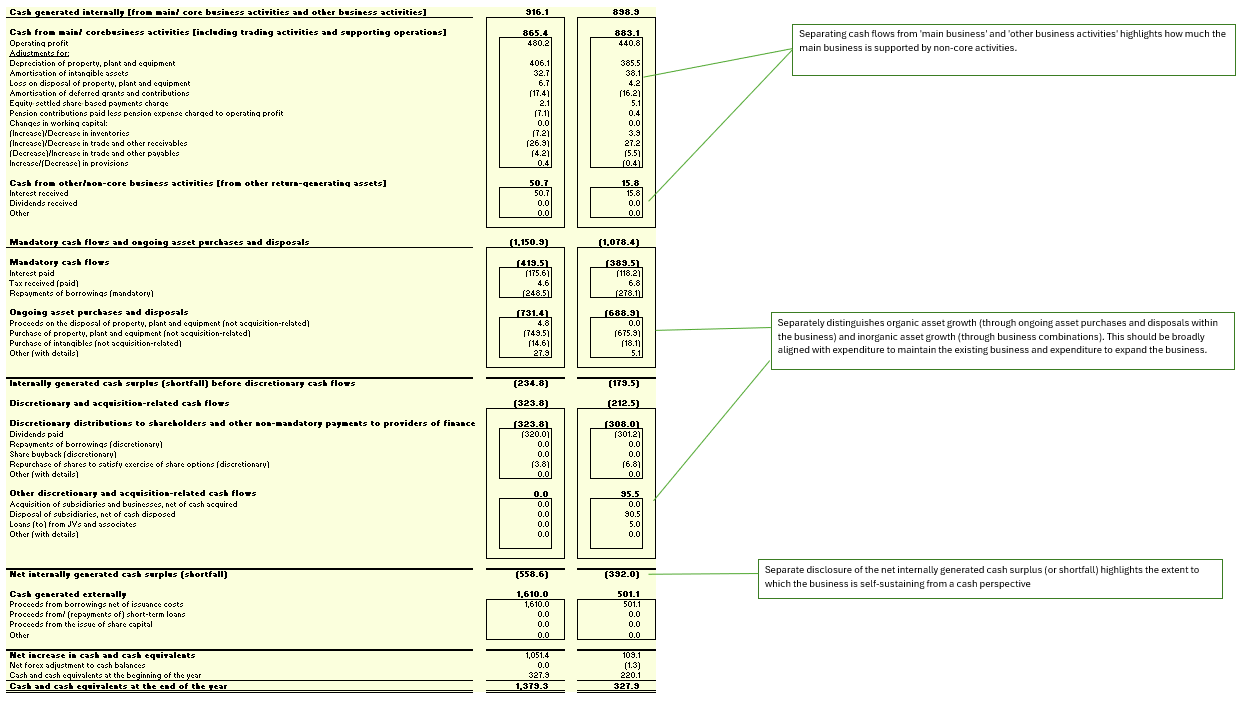
Annex 6: Supplementary disclosure examples
153In this research paper, it was suggested that the IASB might consider introducing a "cohesiveness principle" that might lead to enhanced disclosures in certain notes to the financial statements, improving the cohesiveness between the primary financial statements.
154Information of existing requirements and example disclosures are provided below for:
- Leases
- Share-based payments
- Tax payments
- Capital expenditure
- Derivatives
- Business combinations (M&A transactions)
- Provisions
Leases
155Although companies do not report the 'effective' investing and financing flows arising from finance leases in the actual statement of cash flows, IAS 7 does require that significant non-cash financing and investing transactions are disclosed elsewhere in the financial statements22. Ideally, analysts would like to see these on the same page as the statement of cash flows, or at least the location of this information clearly cross-referenced in that statement23.
156Paragraph 50 of IFRS 16 Leases sets out the presentation requirements (categories) in the statement of cash flows for a lessee24, and paragraphs 51–59 of IFRS 16 set out the disclosure requirements, including amounts for the reporting period (IFRS 16 paragraph 53), which includes total cash outflow for leases.
157Paragraph 52 of IFRS 16 requires a lessee to "disclose information about its leases for which it is a lessee, in a single note or separate section in its financial statements. However, a lessee need not duplicate information that is already presented elsewhere in the financial statements, provided that the information is incorporated by cross-reference in the single note or separate section about leases". It is interesting that IFRS 16 sets out specific requirements for cross-referencing.
158Paragraph B52 of IFRS 18 says that "additional information relating to sale and leaseback transactions that, depending on the circumstances, may be needed to satisfy the disclosure objective in paragraph 51 (of IFRS 18) and could include information that helps users of financial statements to assess ...................(d) the cash flow effect of sale and leaseback transactions in the reporting period".
159During the earlier UKEB outreach and user interviews, users noted that they needed more information on leases.
160As part of its post-implementation review of IFRS 16 Leases25, the IASB is also gathering information in whether improvements to the disclosure requirements for leases (including cash flows disclosures) are needed.
Share-based payments
161Whilst paragraphs 44–52 of IFRS 2 Share-based payments, sets out the disclosure requirements for such transactions, the Standard makes no reference to the statement of cash flows.
162Below is an example of one UK listed company's disclosure (Tesco plc Annual report 2024 p189) for share-based payments, cross-referencing to the statement of financial performance, the statement of cash flows, and the statement of changes in equity:
Note 28 Share-based payments
The table below shows amounts charged to the Group income statement in respect of share-based payments:
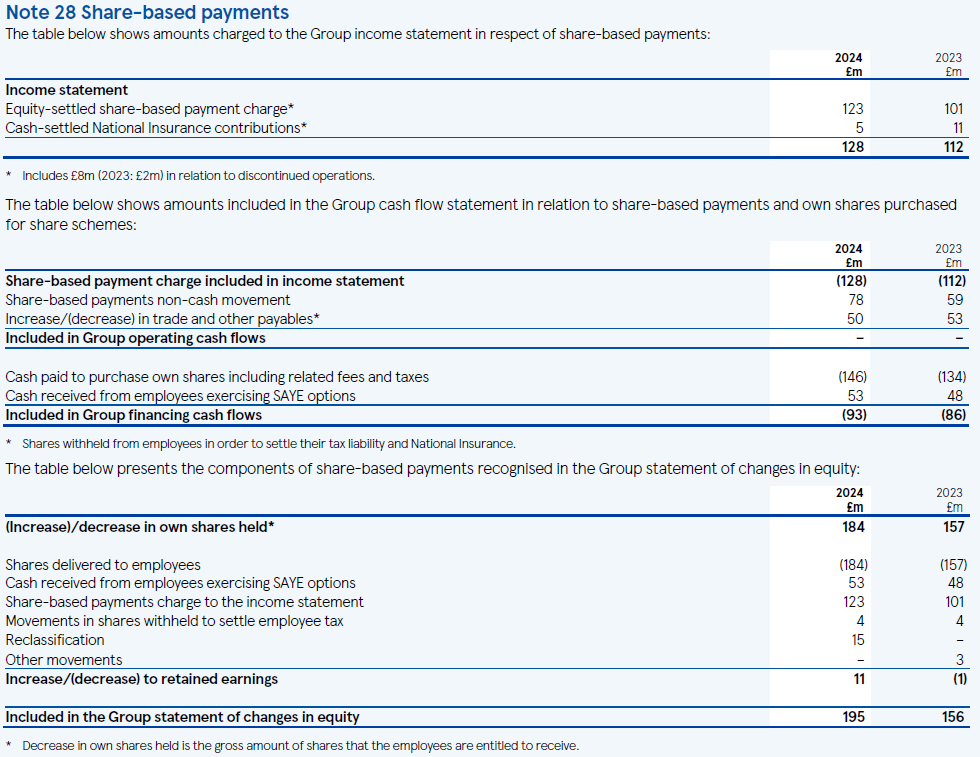
163Some UK companies provide more detail in the front half (Strategic report) of their annual report.
Tax payments
164Paragraph 35 of IAS 7 requires that "cash flows arising from taxes on income shall be separately disclosed and shall be classified as cash flows from operating activities unless they can be specifically identified with financing and investing activities".
165During outreach most users told us that they would prefer tax cash flows to be disclosed separately and not included in operating, investing or financing activities, even where they can be specifically identified.
166Voluntary disclosures relating to tax cash flows include a reconciliation between tax payments in the statement of cash flows and tax charges recognised in the statement of profit or loss and statement of financial position:
Example disclosure: reconciliation of tax payments to other primary statements
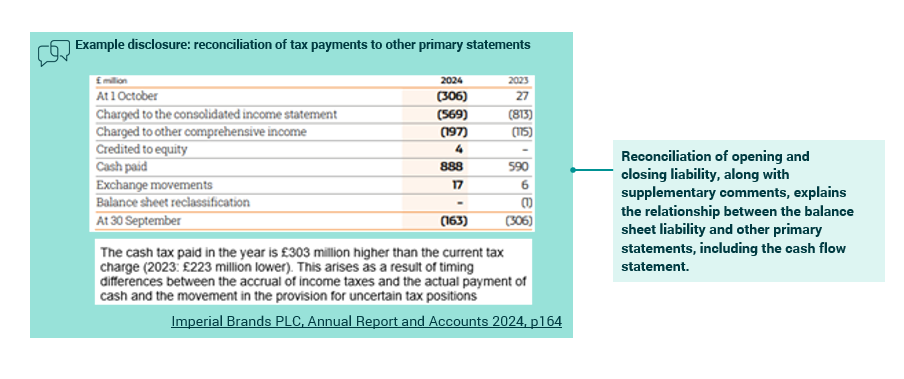
Capital expenditure
167During UKEB outreach, stakeholders suggested that a breakdown of fixed asset additions to separately disclose cash transactions, cash-timing differences (e.g. accrued capex) and non-cash transactions (e.g. leased assets, transfer of assets, etc), would be useful.
168UKEB review of a sample of annual reports of UK listed companies noted voluntary disclosures relating to capital expenditure that some companies provide, include a reconciliation, explaining the differences between capital expenditure payments and additions to property, plant, and equipment:
Example disclosure: reconciliation of capex cash flows to asset additions
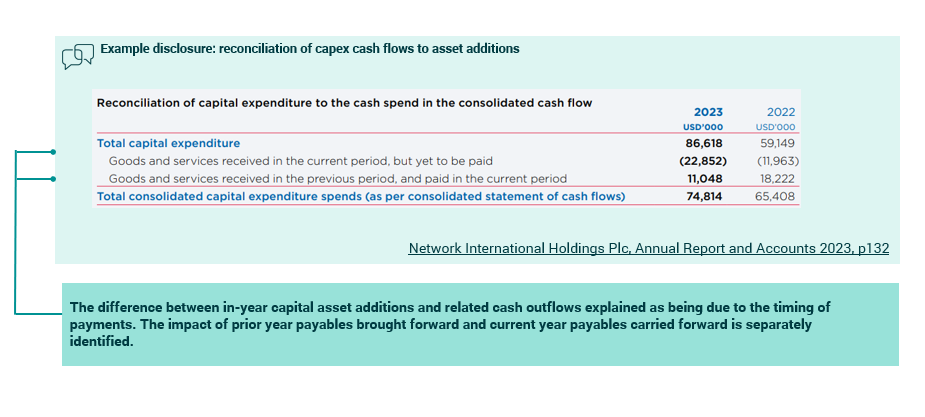
169Another example (see United Utilities plc 2024 Annual report p204) is such a reconciliation is below:
Reconciliation of fixed asset purchases to fixed asset additions
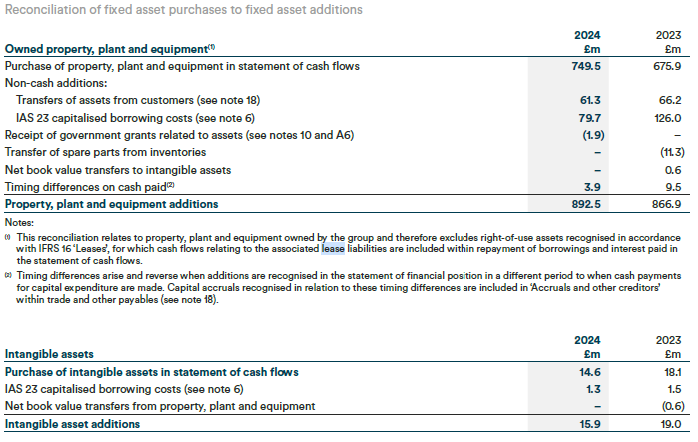
Derivatives cash flows
170IAS 7 paragraph 16 states that "when a contract is accounted for as a hedge of an identifiable position the cash flows of the contract are classified in the same manner as the cash flows of the position being hedged". It does not, however, specify whether such cash flows should be separately identifiable. In addition, the Standard does not provide guidance on economic hedges or derivatives where hedge accounting is not applied.
171Understanding the cash flows from derivatives help users evaluate the potential financial impact of a derivative strategy, considering factors like the timing and amount of future payments, which is crucial for deciding whether to enter into a derivative position. The cash flows may also help users to assess whether there is sufficient liquidity to meet future obligations arising from derivative contracts.
172UKEB research highlighted that UK listed companies typically provide limited information on the cash effects of derivatives in the statement of cash flows.
- Some UK listed companies provide transparency by describing their accounting policies for classification of derivative cash flows – see example below. It would be useful for companies to explain in an accounting policy note, the classification of derivative cash flows in circumstances where hedge accounting is applied, and those circumstance where hedge accounting is not applied.
Example disclosure: accounting policy for derivative cashflows

- Where companies enter into hedges relating to operating activities, it would be useful for companies to disclose the impact of those derivatives in the operating activities section of the statement of cash flows.
- Some companies in the sample disclosed derivative cash flows relating to investing and financing activities on the face of the statement of cash flows, as illustrated in the example below.
Example disclosure: gross derivative cash flows on the face of the statement of cash flows
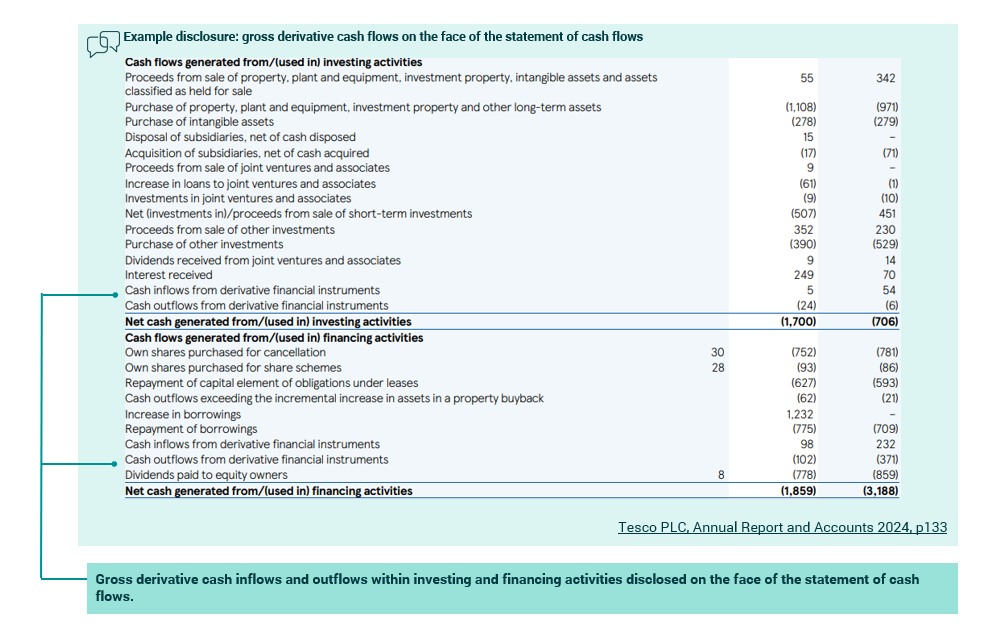
Cash impact of M&A transactions
173Paragraph 39 of IAS 7 states that "the aggregate cash flows arising from obtaining or losing control of subsidiaries or other business should be presented separately and classified as investing activities".
174Reporting the aggregate cash and non-cash impact of merger and acquisition (M&A) activities in a single note in the financial statements is useful as such transactions may be reported in different sections of the statement of cash flows. For example, the cash balance of a new subsidiary is reported as a cash inflow when first consolidated, the acquisition may be paid for in cash or by the issue of equity and there may be a deferred or contingent consideration element. Such cash flows should be disclosed within investing activities (as required by IAS 7 paragraph 39). There may also be cash flows for related acquisition costs which should be disclosed within cash flows from operating activities (as required by IAS 7 paragraph 14).
175Some non-cash transactions, such as a share for share acquisition, may be similar to a transaction comprising a share acquisition paid for in cash where the cash outflow would have appeared in the statement of cash flows. Whether the purchase is a single transaction, or a separate equity issue followed by a cash purchase, does not affect the underlying economics, but does produce very different disclosures in the statement of cash flows.
176This applies to several situations in addition to business combinations, including leasing and supplier finance arrangements. Considering just cash flows reported in the statement of cash flows can lead to analyst metrics, such as free cash flow, which are incomplete and unsuitable for use in equity valuation. On the occasion of a share-for-share acquisition, users would want to adjust free cash flow for a hypothetical cash flow.
177Issues may arise due to inherent tensions between the IFRS Accounting Standard requirements and companies' desire to present the aggregate cash impact of M&A transactions.
178As noted in the UKEB third research paper, a few users noted that non-cash information for M&A activity may be disclosed not only in separate notes to the financial statements, but also in different places in the statement of cash flows, or indeed there may be non-cash elements in the transaction (as noted in the second research paper26).
179One credit rating agency noted that effects of M&A activity or disposals also make it hard for analysts to extract working capital movements from the statement of financial position, when there are insufficient disclosures about such transactions.
180Users also need cash flow information about an acquired entity to accurately assess its ability to generate cash for future operations, and to evaluate the impact of an acquisition on the acquiring company's liquidity.
181Paragraph 1 of IFRS 12 notes that the objective of the standard is "to require an entity to disclose information that enables users of its financial statements to evaluate: ....(b) the effects of those interests on its financial position, financial performance and cash flows", and paragraph 10 of IFRS 12 requires information to be disclosed "that enables users of its consolidated financial statements (a) to understand: ........(ii) the interest that non-controlling interests have in the group's activities and cash flows (paragraph 12)".
182There are also a range of transactions where no specific guidance exists, leading to diversity in practice, including payment of variable consideration in a business combination.
Provisions
183During interviews, users noted that they need more information on provisions. Whilst companies are required to provide details of movements during the year, companies do not generally provide a breakdown of cash flows as part of the utilised amount.
184There are no disclosure requirements in IAS 37 Provisions, Contingent Liabilities and Contingent Assets related to cash flows. The only reference made to provisions in IAS 7 is in paragraph 20, where the standard states that "under the indirect method, the net cash flow from operating activities is determined by adjusting profit or loss for the effects of:
- changes during the period in inventories and operating receivables and payables;
- non-cash items such as depreciation, provisions, deferred taxes, unrealised foreign currency gains and losses, and undistributed profits of associates; and
- all other items for which the cash effects are investing or financing cash flows".
185Paragraph 84 of IAS 37, whilst requiring information necessary for a roll forward for each class of provision, does not require disclosure of cash and non-cash changes.
186The UKEB did not find any examples of provision disclosures in the sample annual reports reviewed in their research, where cash flows relating to provision movements was disclosed.
Contact Us
UK Endorsement Board 13th Floor
| 1 Harbour Exchange | Harbour Exchange Square | London | E14 9GE www.endorsement-board.uk
Footnotes
-
The March 2025 UKEB meeting minutes can be found on the UKEB website via the link shown, and following the meeting, the updated Project Initiation Plan was published on the UKEB project webpage accordingly. The connectivity between the statement of cash flows and other general purposes financial reports has not been investigated, due to resource constraints. ↩
-
The IASB decided (see Page 6 of Staff agenda paper 20A of the IASB meeting on 20 May 2025) that topics it plans to explore will not necessarily include alternatives to a statement of cash flows. However, the IASB will likely consider making changes to the face of the statement of cash flows, such as reordering, or adding sub-totals to assist with requiring cash flow related management performance measures. The alternative presentations considered by the UKEB were for discussion purposes - the information could equally be required on the face of the statement of cash flows or in the notes to the financial statements. ↩
-
Appendix E of 22 May 2025 Agenda paper 5 provides a summary of the responses to 15 questions in the User poll on the Statement of Cash Flows and Related Matters carried out between 25 March and 22 April 2025. ↩
-
The meeting summary of the UKEB IAG meeting held on 2 June 2025 can be found here: https://www.endorsement-board.uk/about-us/structure/advisory-groups/investor-advisory-group/ ↩
-
The meeting summary of the UKEB PAG meeting held on 16 June 2025 can be found here: https://www.endorsement-board.uk/about-us/structure/advisory-groups/preparer-advisory-group/ ↩
-
See section 6 Cash Flow Statements (pages 37–40) of the November 2018 FRC Thematic Review: Reporting by Smaller Listed and AIM Quoted Companies and FRC Thematic Review: Cash flow statements and liquidity (IAS 7, IFRS 7) (page 8). ↩
-
E-Investing for beginners: Changes in Working Capital: An Easy Walk Through by Dave Ahern updated 3 June 2024, which includes examples of calculating changes in working capital. ↩
-
The FRC 2018 thematic, Reporting by Smaller Listed and AIM Quoted Companies, reported the findings of a review of the reports and accounts of 40 smaller listed and AIM quoted companies. ↩
-
The UKEB third research paper Statement of Cash Flows UK User and Preparer Perspectives (March 2025) was based on interviews with investors and preparers to better understand their perspectives on the current and potential future reporting requirements. ↩
-
One of the examples was included in paragraph B47 of the UKEB second research paper Statement of Cash Flows and Related Matters: Non-mandatory and Voluntary Cash Flow Disclosures Provided by UK Listed companies. ↩
-
Paragraph 44B of IAS 7 requires an entity to "disclose the following changes in liabilities arising from financing activities:
- ↩
-
A summary of UK regulation relating to working capital statements can be found in the ICAEW Guidance for Preparers of Prospective Financial Information Part III, A: Statements of sufficiency of working capital in capital markets transactions. A public statement by the directors of an issuer, that in the issuer's opinion, the working capital (broadly, the amount it needs to finance its day-to-day expenses for running the business) available to the issuer and its subsidiary undertakings is sufficient for its present requirements (a clean working capital statement), or, if not, how it is proposed to provide the additional working capital thought by the directors to be necessary (a qualified working capital statement). Present requirements refer to a period of at least 12 months from the date which the statement is made. The working capital statement is generally required by the prospectus or listing regime in either a prospectus, listing particulars or certain shareholder circulars depending on the nature of the transaction. ↩
-
See paragraphs B15–B16 of the UKEB second research paper Statement of Cash Flows and Related Matters: Non-mandatory and Voluntary Cash Flow Disclosures Provided by UK Listed companies. ↩
-
IFRS 18 introduces a requirement for the indirect method to start with operating profit, so the diversity in starting point that is currently seen will no longer exist. ↩
-
See page 20 of IFRS 18 Effects Analysis published April 2024. Other performance measures outside the scope of IFRS 18 include: Free cash flow, Net debt, Return on equity, Number of customers, Customer satisfaction. ↩
-
IFRS 18 presumes that a subtotal of income and expenses used in public communications outside financial statements represents management's view of financial performance. A company is permitted to rebut this presumption if it has reasonable and supportable information demonstrating that such a subtotal does not communicate management's view. This rebuttable presumption is discussed in Section 4.2 (page 52) of IFRS 18 Effects Analysis published April 2024. ↩
-
Sub-totals introduced by IFRS 18 on the face of the income statement are (a). Operating profit and (b). Operating profit before depreciation, amortisation and impairments within the scope of IAS 36 Impairment of Assets. ↩
-
Paragraph 33c of IFRS 5 requires an entity to disclose the net cash flows attributable to the operating, investing and financing activities of discontinued operations. These disclosures may be presented either in the notes or in the financial statements. These disclosures are not required for disposal groups that are newly acquired subsidiaries that meet the criteria to be classified as held for sale on acquisition (see IFRS 5 paragraph 11). ↩↩
-
The UKEB first research paper: Statement of Cash Flows: Background and Key Issues (December 2024) was based on desk-based research, exploring perceived issues with the statement of cash flows. ↩
-
Illustrative Examples (IEs) are part of the Accompanying Guidance to IFRS Accounting Standards. However, the IEs do not form a mandatory part of the Standards. ↩
-
See IASB pipeline projects https://www.ifrs.org/projects/pipeline-projects/#3 ↩
-
IAS 7 paragraph 43. ↩
-
https://www.footnotesanalyst.com/some-cash-flow-measures-should-include-non-cash-flows/ ↩
-
Paragraph 50 of IFRS 16 Leases states that "In the statement of cash flows, a lessee shall classify:
- ↩
-
Information on the IASB Post-implementation review of IFRS 16 Leases can be found on the UKEB project webpage https://www.endorsement-board.uk/projects/post-implementation-review-of-ifrs-16-leases/ and on the IASB website: https://www.ifrs.org/projects/work-plan/post-implementation-review-of-ifrs-16-leases/ ↩
-
See paragraphs B55–B60 of the UKEB second research paper Statement of Cash Flows and Related Matters: Non-mandatory and Voluntary Cash Flow Disclosures provided by UK Companies. ↩
-
-