Project Initiation Plan - Intangibles
Purpose
A1The UKEB delegated functions include responsibility for “participating in and contributing to the development of a single set of international accounting standards." Undertaking proactive thought leadership activities is key to the UKEB's ability to effectively deliver this statutory function.
A2The UKEB's Terms of Reference (ToR) further explain that with regard to thought leadership, the UKEB shall:
- Lead the UK debate on international accounting standards and reporting.
- Represent UK views in international fora with the aim of influencing debate.
- Engage with accounting and reporting and endorsement and adoption bodies in other jurisdictions, in order to improve influence and understand best practice.
- Proactively participate in the development of new global accounting standards, for example by undertaking research.
A3A project on intangible assets, as described below, supports the UKEB meeting these responsibilities. It is also consistent with the 2025-28 Regulatory Strategy as it supports the UKEB's aim of “Maintaining and building on the UKEB's reputation for robust, evidence-based research, designed to feed into the IASB and ISSB's ongoing work and contribute to the international debate on reporting issues" (page 6).
Background
A4The IASB added a project on Intangible Assets to its work plan following feedback on its Request for Information: Third Agenda Consultation.
A5Most respondents to the Request for Information recommended the addition of a potential project on Intangible Assets to the IASB's workplan, rating it as a high priority.
A6In anticipation of an IASB project on intangible assets, the UKEB initiated a research project focused on understanding UK stakeholders' views on the accounting for intangibles and gathering evidence about the UK intangibles landscape. To date, the UKEB has published three reports 1,2,3.
A7The UKEB research concluded:
- IAS 38 appears to be no longer wholly aligned with the current Conceptual Framework for Financial Reporting.
- There are opportunities to enhance the accounting for intangibles. Users need high quality, comparable information and would prefer that to be in the financial statements and notes, rather than relying on other sources.
- Users want more granular information about companies' intangibles, and the expected benefits they can bring. This is particularly true for emerging intangibles.
A8UKEB research has featured in several international meetings, including the IASB's Accounting Standards Advisory Forum (ASAF), and has been referred to in the IASB Board papers and meetings.
A9The IASB's own research findings have been consistent with that of the UKEB, concluding:
- "IAS 38 is out of date and in need of modernisation and futureproofing” 4 to be capable of being applied to new types of assets (such as cryptocurrency) and new modes of operation e.g., cloud computing; and
- "financial statements are not providing users with enough information about intangible assets or expenditure on intangible items" 5.
A10In response, the IASB tentatively decided in May 2025 to begin work on the Intangible Assets project by:
- performing an assessment of user needs for information about recognised and unrecognised intangible assets, including expenditure associated with them; and
- exploring whether to update the definition of an intangible asset, associated guidance and some aspects of the recognition criteria. This will be undertaken initially using, as test cases, application issues related to newer types of intangible assets and new ways of using them.
A11The IASB expects to undertake research through the remainder of 2025 and begin discussion on these work streams during 2026.
Opportunity for the UKEB
A12There is an opportunity for the UKEB to further build on its previous work which was focused on the qualitative assessment and quantitative analysis of intangible reporting in the UK. The research included in this PIP would complement the IASB's current work, focusing on understanding what information about recognised and unrecognised intangible assets, including expenditure associated with them, users would find useful. It would also consider preparer views on that information.
A13Subject to the approval of this Project Initiation Plan (PIP), this project would
- Develop case studies as a means of exploring users' views on accounting for intangibles, and to test future IASB proposals (including recognition, measurement and disclosure).
- Utilising both the UKEB and IASB case studies, undertake interviews with UK stakeholders (including investors and creditors) to better understand their views on the accounting for intangibles. This would include the information about recognised and unrecognised intangible assets, including expenditure associated with them, that is decision useful. This work would also assist the UKEB in identifying principles that should be applied to the accounting for intangibles.
- Develop a report summarising the UKEB findings.
- In parallel, and supported by stakeholder research, work grounded in the IASB's Conceptual Framework would begin to identify key elements that could support the future development of a more principle-based standard for recognition, measurement and disclosure of intangible items.
A14This research will contribute to shaping future engagement with the IASB and other key stakeholders, including National Standard Setters. By providing a robust evidence base, it will support ongoing UKEB discussions aimed at developing principles that could underpin the evolution of an international accounting standard on intangibles. Given the growing significance of intangible assets in modern business models and for future business performance and growth, undertaking research in this area is essential to improving accounting practices. Such improvements are expected to enhance transparency and comparability, ultimately delivering benefits that serve the long-term public good and strengthen the UK economy.
Objectives and desired outcomes
A15The objectives and desired outcomes of the research are the following:
- Identify the key principles that need to be considered when developing accounting standards for intangibles assets.
- Provide clear and specific stakeholder feedback on real examples against which future IASB proposals can be assessed.
- Assess if there are any potential connectivity issues for users from narrative sustainability-related opportunities disclosures and the accounting for intangibles in the financial statements.
Project plan
Proportionality assessment
Significance and size
IASB Project Scope
A16The IASB is currently in the research phase of its project. The intangibles project is expected to be a significant project for the IASB, and to take a number of years to complete.
Entities affected by the proposal
A17As noted in the UKEB's 2024 report "Accounting for Intangibles: A Quantitative Analysis of UK Financial Reports” (page 26) “Most listed entities have some intangible assets recorded in their financial statements. In 2021, about 860 companies (79% of companies in the population) had at least one recognised intangible asset.” However, a significant number of intangibles remain off-balance sheet.
Complexity
A18Users need high quality, comparable information and would prefer that to be in the financial statements and notes, rather than relying on other sources. They would like the accounting to be improved but there are mixed views as to how this can be achieved.
A19This project is likely to be complex, and a thorough exploration of stakeholder views about different alternatives will be important. This includes examining the recognition, measurement and disclosures of intangible expenditure in the financial statements.
Expected timeline/urgency
A20The IASB expects to undertake research to explore users' information needs about intangible assets and related expenditures further throughout H2 2025. In Q1 2026, the IASB staff plan to update the IASB on their findings. This will include their initial analysis of the themes of information needs and whether that information belongs in the financial statements. In Q2 2026, the IASB intends to discuss the findings of its research.
A21In H2 2026 the IASB expects to:
- assess whether there is an opportunity to make discrete meaningful improvements to IAS 38 or whether further work is needed before the IASB would consult on any changes to the Standard; and
- assess how its findings may affect other groups of topics and their prioritisation.
A22The UKEB will have several opportunities to engage with the IASB and influence its work on intangibles. Particularly relevant will be the two planned Accounting Standards Advisory Forum (ASAF) sessions:
- December 2025: Understanding user needs
- June 2026: Potential solutions to the IASB's test cases
Expected interest/sensitivity
A23There has been ongoing significant interest from a variety of stakeholders in this project. This has been evidenced in the research already undertaken by the UKEB and IASB. The accounting for intangibles has the potential to have significant impacts at several levels.
Connectivity
A24There is the potential for significant overlap/connectivity between work undertaken by the IASB and the ISSB, for example with the requirements to disclose sustainability-related opportunities in IFRS S1 General Requirements for Disclosure of Sustainability-related Financial Information.
Recommended UKEB project scope
A25Based on the proportionality assessments above, and the activities outlined in paragraph A13 we recommend a significant scope project, and the approach described in this document reflects this.
A26The primary outputs of the project currently expected are:
- Three to four case studies which will outline specific fact patterns based on real life examples which give rise to intangibles. These case studies would supplement the ones being developed by the IASB.
- A report summarising and evaluating the results of stakeholder outreach. If appropriate, the paper may also include additional financial statement analysis to further examine relevant current reporting practices in the UK.
- Preliminary Board discussions on key elements that could support the future development of a more principle-based standard for recognition, measurement and disclosure of intangible items.
Project - Key activities
A27There is currently no intention to undertake research collectively with other parties for this project. However there may be opportunities to collaborate on workshops, utilising the UKEB case studies.
| Key activities | Due Process Handbook |
|---|---|
| Identification of issues for research (June 2025 UKEB Meeting Agenda Paper 8) | 7.15 |
| Mandatory | |
| Creation of a Project Initiation Plan (this document) | 7.16–7.21 |
| Mandatory | |
| Desk-based research to support the proportionality assessment including: a) Review of IASB papers b) Previous UKEB research | 7.22 |
| Optional | |
| Outreach activities As described above the UKEB would gather views from UK stakeholders, including investors and creditors, to contribute to the development of this research. This could include one-to-one interviews, virtual and in-person workshops, and discussions with UKEB Advisory Groups. | 7.23–7.24 |
| Optional | |
| Publication of a research paper: a) The research paper would be published on the UKEB website. b) An announcement of the publication of the paper would be made via the UKEB News Alert publication and LinkedIn posts. | 7.25 |
| Mandatory |
Resources allocated
A28To undertake the activities described on this project plan a project team has been assigned consisting of approximately 0.4 of an SPD; 1.5 of Project Directors, 0.4 of a Project Manager and overseen by the Technical Director. Some minor support from the economics team may also be required. The required resources are allowed for in the 2025/26 UKEB plan and budget.
Project timeline
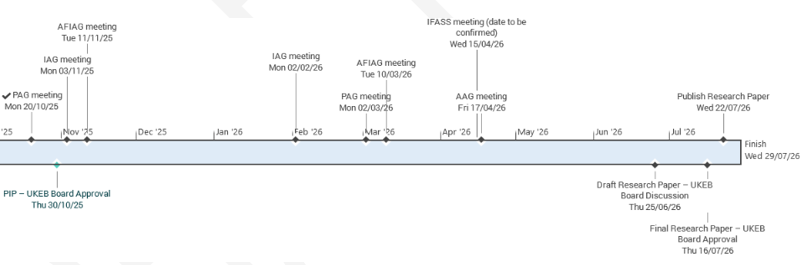
A29The proposed high-level project timeline is shown below. This provides a best estimate based on information known at this time. If necessary, a revised PIP will be presented to the Board, to reflect any major changes, as the project progresses.
| Date | Milestones |
|---|---|
| October 2025 | Project Initiation Plan for board approval |
| Q4 2025 | Develop and Refine Case Studies |
| Q1 2026 | Discuss case studies with the Board |
| Q1 2026 | Stakeholder Engagement |
| April 2026 | IFASS – Presentation of Preliminary Findings |
| Q2 2026 | Report Writing |
| June 2026 | Draft Report to Board |
| July 2026 | Final Report to Board (if required). Publish Report. |
Project Initiation Plan: Intangible Assets project timeline.
A30The diagram below is a graphical view of the mandatory milestone activities described above. This provides a best estimate based on information known at this time. If necessary, a revised PIP will be presented to the Board, to reflect any major changes, as the project progresses.
Footnotes
-
Accounting for Intangibles: UK Stakeholders' Views (March 2023) ↩
-
Accounting for Intangibles: A Quantitative Analysis of UK Financial Reports and a March 2025 update ↩
-
Accounting for Intangibles: A survey of users' views ↩
-
Paragraph 12a of Agenda Paper 17A of the IASB's February 2025 meeting ↩
-
Paragraph 12b of Agenda Paper 17A of the IASB's February 2025 meeting ↩