UKEB Governance & Due Process Annual Report 2024-25
UK Accounting Standards Endorsement Board 5 June 2025
1. Introduction
The UK Accounting Standards Endorsement Board (‘UKEB') was established to perform certain functions relating to the adoption of International Financial Reporting Standards ('IFRS') as developed by the International Accounting Standards Board (‘IASB'), for use in the UK, and to contribute, on behalf of the UK, to the development of a single set of international accounting standards.
Chapter 3 of The International Accounting Standards and European Public Limited Liability Company (Amendment etc.) (EU Exit) Regulations 2019 (SI 2019/685) confers on the Secretary of State for Business, Energy and Industrial Strategy ('BEIS') functions relating to the adoption of IFRS accounting standards for application in the UK. The Secretary of State exercised the power conferred by Chapter 4 of those Regulations to delegate to the UKEB the functions specified in SI 2021/609, (‘the Delegation Regulations') ('the Functions'). This delegation of powers came into force on 22 May 2021.
Underpinning the performance of the functions, UKEB has certain governance and due process duties and responsibilities which are incorporated primarily within the following:
1Memorandum of Understanding (‘MoU') between UKEB, BEIS1 and FRC 2UKEB Terms of Reference (‘ToR') 3UKEB Due Process Handbook ('the Handbook')
The MoU (s4.1) states that the FRC has oversight responsibility in respect of the effective governance of UKEB whilst recognising the fundamental importance of UKEB's independence by confirming (in s4.3) that the FRC does not have the power to direct the UKEB in relation to the determination of its programme of work or the outcome of its technical decision-making.
The MoU (s9.2) requires UKEB to report annually to the FRC Board setting out how it has complied with the procedures in the Handbook. The ToR (s10.3(b)) supports this by requiring that UKEB report, at least annually, to the FRC in relation to its governance and due process.
This report fulfils the above stated annual reporting requirement, covering the period from 1 April 2024 to 31 March 2025.
The UKEB Board is satisfied that it has fulfilled its governance and due process duties and responsibilities throughout the reporting period.
2. Reporting Period 2024/25
The reporting period 1 April 2024 to 31 March 2025 was a period of consolidation for the UKEB. After the initial stage focus, in 2021 to 2023, on setting up and establishing a new organisation with a robust governance framework, the UKEB moved to a more business-as-usual operating environment. The Board's focus shifted from start-up to steady state and continuous improvement across all areas of the UKEB's governance and due process. Planned changes were also made to the make-up of the Board, with two members standing down and, two new members joining in March 2025. Further Board succession related announcements have been made regarding appointment of the new Chair and two new members, with all three appointments starting their Board tenure in September 2025.
2.1 Core Values and Guiding Principles
The UKEB's mission is to serve the UK's long-term public good by leading the development and synthesis of UK views on financial reporting and representing them in the international arena, ensuring that the UK's voice is influential in the development of high-quality international accounting standards that are suitable for adoption in the UK. The UKEB is committed to performing its functions, and acting at all times, in accordance with its four guiding principles and the seven principles of public life. These core values are intrinsic to all of UKEB's governance and due process activities.
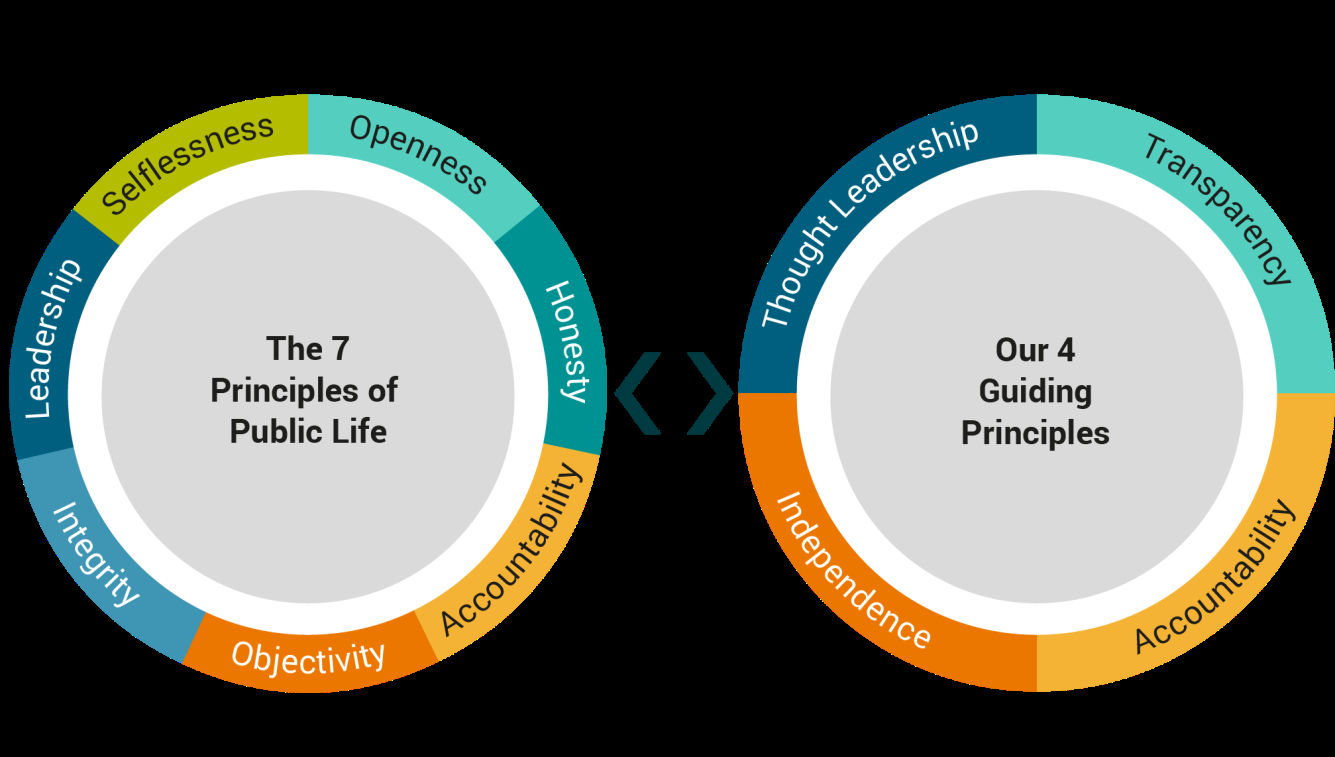
The UKEB's approach to ensuring robust governance and due process, in pursuit of its strategic objectives, includes the following core activities:
2.2 Public Board Meetings
- The Board's technical decision-making is carried out in a fully transparent manner, in accordance with the ToR. Members of the public can choose to register to observe the discussions live online or watch an online recording at a later date.
- The meetings are attended by Official Observers from DBT, Bank of England, FRC, HMRC and FCA, all of whom have speaking rights.
- Meeting agenda and Board papers are published on the UKEB website five working days in advance of the meeting and a summary of decisions and minutes are published afterwards.
- In addition, the agenda and summary minutes of UKEB's private Board meetings are published on the UKEB website.
- UKEB has a Board Meetings Transparency Policy which sets out the key principles the Board considers when deciding which matters it discusses in public Board meetings and which matters are discussed in private.
2.3 Managing Conflicts of Interest
The Board complies with a Conflicts of Interest Policy and a Gifts and Hospitality Policy. A Register of Interests, Transparency Register and Gifts and Hospitality Register are published on the UKEB website and updated as necessary.
2.4 Stakeholder Engagement
- The UKEB has developed a Stakeholder Engagement and Communications Strategy to support the influencing and thought leadership responsibilities which form part of its Regulatory Strategy. It considers the high level of stakeholder engagement activities that UKEB is already performing and those areas where, at this stage in UKEB's maturity, resource should be focused in order to continue enhancing that engagement in the most effective and efficient manner. The Board regularly discusses stakeholder engagement with the Secretariat to ensure that appropriate focus is maintained in the right areas.
- The UKEB has five Advisory Groups, chaired by Board members, as follows: - Academics (AAG) - Accounting Firms and Institutes (AFIAG) - Investors (IAG) - Preparers (PAG) - Rate-regulated Activities (RRA TAG) The membership of each of these groups comes from UKEB's stakeholder community and they meet periodically to discuss relevant topics on which they can advise the Board. They are not decision-making bodies but they do report into and provide advice directly to the Board.
- The UKEB has two Working Groups, chaired by the UKEB Secretariat, as follows: - Financial Instruments (FIWG) - Sustainability (SWG) The membership of these groups comes from UKEB's stakeholder community and meet periodically to provide advice to the Secretariat on current topics of relevance.
- There is proactive Board and Secretariat engagement with stakeholders across various mediums to ensure that their views are heard and the potential impact of IASB proposals is understood.
- Public consultation comment letters received from stakeholders are made available on the UKEB website unless the stakeholder requests otherwise.
- The Handbook (see s2.2 below) sets out the required approach to stakeholder engagement, including public consultations, at the technical project level. This reinforces the Board's focus on the importance of obtaining, and understanding, stakeholder views as part of its decision-making process.
- The UKEB engages with the IASB and other national standard setting bodies around the world to ensure that the UK's voice is heard and the UKEB is able to exert influence on the development of high-quality international accounting standards suitable for adoption in the UK.
2.5 Regulatory Strategy and Budget
- There is a clearly defined and robust process for ensuring that UKEB's Regulatory Strategy and Budget are: - designed to support achievement of its statutory functions; and - subject to timely review and approval, both internally by the Board and by DBT and the UKEB/ FRC Accounting Officer, as necessary. The 2025/28 Regulatory Strategy and 2025/26 Budget were both subject to public consultation and received Board approval during this reporting period. The final UKEB Budget is published on the FRC website, as part of the wider FRC Budget. The Regulatory Strategy and public consultation Feedback Statement were approved by the Board at the 28 March 2025 public meeting and are published on the UKEB website.
- Managing Public Money principles were applied rigorously throughout the reporting period and the financial position and general budget management, was reviewed regularly throughout the year by both UKEB and FRC.
2.6 Risk Management
UKEB has a clearly defined and embedded risk management framework, including a detailed risk register, that is subject to Board monitoring and review. It ensures that UKEB has a clear understanding of its risk environment and a focused approach to the managing, monitoring and recording of its key risks.
2.7 Due Process Framework
A robust due process framework is central to the development of high-quality financial reporting and delivery of accountability and transparency to stakeholders. The core elements of UKEB's due process framework are set out in the Handbook.
Appendix A sets out the projects that UKEB has undertaken during the reporting period and the core due process steps taken. Further detail of UKEB's projects is also published on the UKEB website to ensure transparency and strengthen stakeholder engagement.
2.8 Advisory Groups
Each of the five Advisory Groups has a Terms of Reference (‘AG ToR') which was approved by the Board and is published on the UKEB website. Adherence to the AG ToR is monitored and any breaches reported to the Board. During this 2024/25 reporting period, two breaches occurred and were duly reported and resolved as necessary.
| Advisory Group | AG ToR Section | Breach and Resolution Details |
|---|---|---|
| 1 | RRA TAG | A member selected for appointment was ratified by the Board as being an observer with speaking rights, at their employer's request. Accordingly, the individual's name and biography are not published on the UKEB RRA TAG website page. However, the RRA TAG summary minutes state, incorrectly, that they are a member. Resolution: Future minutes will state that the individual is an observer with speaking rights. |
| 2 | IAG | The IAG met on 4 November 2024. The meeting was not quorate due to a member stepping down two weeks before the meeting. Resolution: At the Board's private Board meeting on 28 November 2024, the AG ToR was updated to remove the requirements for a fixed maximum and minimum number of members. The AG ToR now specifies that an Advisory Group "shall aim to comprise a minimum of [X] and a maximum of [X] members." |
3. Board Effectiveness
3.1 Board Composition and Appointments
As at 31 March 2025, the UKEB Board is comprised of the Chair and twelve members. Collectively they bring together a range of relevant backgrounds and expertise aligned to the required categories as set out in the ToR.
| Name | Role | Category | Term End Date |
|---|---|---|---|
| 1 | Pauline Wallace | Executive Chair | September 2025 |
| 2 | Amir Amel-Zadeh | Non-Executive Member | Academic |
| 3 | Michael Wells | Non-Executive Member | Academic |
| 4 | Tony Clifford | Non-Executive Member | Accounting Firm |
| 5 | Michael Metcalf | Non-Executive Member | Accounting Firm |
| 6 | Robin Cohen | Non-Executive Member | Economist |
| 7 | Edward Knapp | Non-Executive Member | Investor |
| 8 | Paul Lee | Non-Executive Member (and Chair Designate) | Investor |
| 9 | Peter Reilly | Non-Executive Member | Investor |
| 10 | Mike Ashley | Non-Executive Member | Other |
| 11 | Katherine Coates | Non-Executive Member | Other |
| 12 | Phil Aspin | Non-Executive Member | Preparer of Accounts |
| 13 | Owen Glaysher | Non-Executive Member | Preparer of Accounts |
During the reporting period, Sandra Thompson, one of the inaugural Board members, sadly died. The Board would like to acknowledge the significant contribution that she made to the UKEB during her tenure, including as the inaugural chair of AFIAG. In addition, the following other Board membership changes occurred:
- Giles Mullins and Liz Murrall stepped down when their term ended on 14 March.
- Two new members, Michael Metcalf and Peter Reilly, were appointed for a three-year term commencing on 15 March.
The new appointments were made by the Chair, with the approval of the Secretary of State, in accordance with the ToR. The new appointments were made following a fair and open process, with the interview panel being comprised of the Chair, a DBT representative and an FRC Board member.
3.2 Annual Board Effectiveness Review
An Annual Board Effectiveness Review was carried out in 2024. The final report and action plan were approved by the Board in June 2024 and all actions have been completed.
The 2025 review is in progress, with an expected completion date of June 2025.
3.3 Board Succession Planning
The UKEB maintains an ongoing focus on Board succession planning. In addition to the two new members who joined the Board on 15 March, another two new members have been appointed to join the Board on 1 September, to replace two members who will step down on 31 August. A current member, Edward Knapp, has also been reappointed for a second term which will commence on 1 September.
The UKEB's new Chair, Paul Lee, has been announced. His three-year term will commence on 11 September. The handover process has begun with the current Chair, Pauline Wallace, who will step down on 10 September. The UKEB Chair is a public appointment made by the Secretary of State following a fair and open process led by the Department for Business and Trade.
Planning is already in progress for 2026 to ensure that the Board continues to have adequate Board representation across the six categories set out in the ToR. The new Chair is a UKEB Board member and therefore a vacancy will be created when he takes over as Chair. The death of a serving member in March left a vacancy that the UKEB intends to fill at a future date. In addition, three members terms will end in March 2026.
Appendix A: Due Process Documents Published
Set out below is a summary of the UKEB projects undertaken during the reporting period and the core due process steps taken.
| IASB Due Process Stage | Project Initiation Plan | Final Comment Letter | Final Comment Letter Date | Feedback Statement | DPCS | |
|---|---|---|---|---|---|---|
| Influencing Projects | ||||||
| Financial Instruments with Characteristics of Equity (FICE) – Proposed amendments to IAS 32, IFRS 7 and IAS 1 | Exposure Draft | √ | √ | 03/04/2024 | √ | √ |
| Business Combinations – Disclosures, Goodwill and Impairment | Exposure Draft | √ | 19/07/2024 | √ | √ | |
| Regulatory Assets and Regulatory Liabilities | Exposure Draft | N/A | N/A | 30/07/20242 | N/A | N/A |
| Power Purchase Agreements Proposed Amendments to IFRS 9 and IFRS 7 | Exposure Draft | √ | √ | 06/08/2024 | √ | √ |
| Amendments to IFRS 19 Subsidiaries without Public Accountability: Disclosures | Exposure Draft | √ | √ | 28/11/2024 | √ | √ |
| Climate-related and Other Uncertainties in the Financial Statements | Exposure Draft | √ | √ | 29/11/2024 | √ | √ |
| Equity Method of Accounting | Exposure Draft | √ | √ | 16/12/2024 | √ | √ |
| Provisions - Targeted Improvements | Exposure Draft | √ | √ | 12/03/2025 | √ | √ |
| Proposed Amendments to the IFRS Foundation Due Process Handbook | Exposure Draft | √ | √ | 28/03/2025 | √ | √ |
Research Projects
| Project Initiation Plan | Summary of Findings Report | Summary of Findings Report Date | |
|---|---|---|---|
| Intangibles Research Project (Phase 1): | |||
| Accounting for Intangibles: Analysis of Intangible Reporting in the UK | √ | √ | 15/05/2024 |
| Accounting for Intangibles: Investor Outreach | √ | √ | 15/05/2024 |
| Statement of Cashflows and Related Matters | √ | √ | 3 |
Endorsement and Adoption Projects
| Project Initiation Plan | DECA | ECA | Feedback Statement | Publication within 3 working days of final written vote | DPCS | |
|---|---|---|---|---|---|---|
| Narrow Scope Amendments (Effective date: 1 January 2025, with early application permitted) | ||||||
| Lack of Exchangeability (Amendments to IAS 21) | √ | √ | √ | √ | √ | √ |
| Narrow Scope Amendments (Effective date: 1 January 2026, with early application permitted) | ||||||
| Annual Improvements to IFRS Accounting Standards - Volume 11: • IFRS 9 Financial Instrument - Transaction price; • IFRS 9 Financial Instrument - Lessee derecognition of lease liabilities; • IFRS 7 Financial Instruments: Disclosures - Gain or loss on derecognition; • IFRS 1 First-time Adoption of International Financial Reporting Standards - Hedge accounting by a first-time adopter; • IFRS 10 Consolidated Financial Statement - Determination of a 'de facto' agent; • IAS 7 Statement of Cash Flows - Cost method. |
√ | √ | √ | √ | √ | √ |
| Amendments to the Classification and Measurement of Financial Instruments – Amendments to IFRS 9 and IFRS 7 | √ | √ | √ | √ | √ | √ |
| Contracts Referencing Nature-dependent Electricity (Amendments to IFRS 9 and IFRS 7) | √ | √ | 4 | |||
| New Standards (Effective date: 1 January 2027, with early application permitted) | ||||||
| IFRS 18 Presentation and Disclosure in Financial Statements | √ | 5 |
Footnotes
-
Following the changes announced on 7 February 2023, oversight of UKEB's discharge of its statutory functions moved from BEIS to the Department for Business and Trade (DBT). ↩
-
Published a consolidated report on the UKEB Secretariat's top-down approach rather than a Final Comment Letter. ↩
-
The Summary of Findings Report will be published by 30 June 2025. ↩
-
The Endorsement Criteria and Feedback Statement will be presented to the Board for approval later in 2025/26. ↩
-
The Draft Endorsement Criteria, Endorsement Criteria and Feedback Statement will be presented to the Board later in 2025/26. ↩