4 IFRS 18 Presentation and Disclosure in Financial Statements
20 November 2025 Agenda Paper 4
Executive Summary
Project Type: Endorsement Project Scope: Significant
Purpose of the paper
This paper clarifies the concerns raised by a respondent to the [Draft] Endorsement Criteria Assessment (ECA) [Draft] ECA relating to the requirement in IFRS 18 to classify insurance finance income and expenses in the operating category of the income statement. It also describes the potential mitigations for these concerns.
This paper also requests the Board's approval of the individual documents included in the 'adoption package' for the project to assess IFRS 18 Presentation and Disclosure in Financial Statements for use in the UK for adoption.
The documents included in the adoption package are: * [Draft] Endorsement Criteria Assessment (ECA); * [Draft] Feedback Statement; * [Draft] Due Process Compliance Statement; * [Draft] Adoption Statement for IFRS 18; and * Annex to the Adoption Statement: Text of the UK-adopted international accounting standards (IFRS 18 Presentation and Disclosure in Financial Statements).
The ECA and the Feedback Statement reflect the actions agreed at the October 2025 meeting.
This paper also asks Board members to provide a tentative vote on the adoption of IFRS 18.
Summary of the Issue
In July 2025, the UKEB published the [Draft] Endorsement Criteria Assessment of IFRS 18 ([Draft] ECA) that tentatively concluded that IFRS 18 meets the adoption criteria set out in legislation. The consultation on the [Draft] ECA closed on 7 October
- The UKEB received 10 formal responses to the consultation. A summary of the feedback received, along with recommended changes to the [Draf] ECA wording, was discussed by the Board in October 2025. The [Draft] ECA presented at this meeting has been revised to incorporate responses to the issues raised by the Board at its October 2025 meeting.
The paper includes: * Clarification of concerns raised on the classification of insurance finance income and expenses in the operating category for decision on whether the issue is included in the [Draft] ECA. * [Draft] ECA for approval. * [Draft] Feedback Statement for approval. * [Draft] Due Process Compliance Statement for approval * [Draft] Adoption Statement for IFRS 18 for approval.
A tentative vote on the adoption of IFRS 18 will be held at this meeting.
Voting forms for the formal written vote will be sent to Board members after the November 2025 Board meeting.
The result of that formal vote, when completed, will be updated on the UKEB website, in line with the Board's Terms of Reference.
Decisions for the Board
- Does the Board agree that no further work should be undertaken in respect of the concerns raised about the classification of insurance finance income and expenses in the operating category?
- If the Board disagrees with the Secretariat's recommendation above, does the Board have any comments on the provisional assessment included in Appendix A of this paper?
Recommendation
The Secretariat recommends that the Board: * Does not undertake further work in respect of the concerns raised about the classification of insurance finance income and expenses in the operating category; * approves the relevant documents in the adoption package; and * tentatively approves the adoption of IFRS 18 for use in the UK.
Appendices
Appendix A Provisional assessment—Classification of insurance finance income and expenses in the operating category Appendix B [Draft] Endorsement Criteria Assessment Appendix C [Draft] Feedback Statement Appendix D [Draft] Due Process Compliance Statement Appendix E [Draft] Adoption Statement for IFRS 18 Appendix F Annex to the Adoption Statement: Text of the UK-adopted international accounting standard (IFRS 18 Presentation and Disclosure in Financial Statements)
Endorsement of IFRS 18
Background
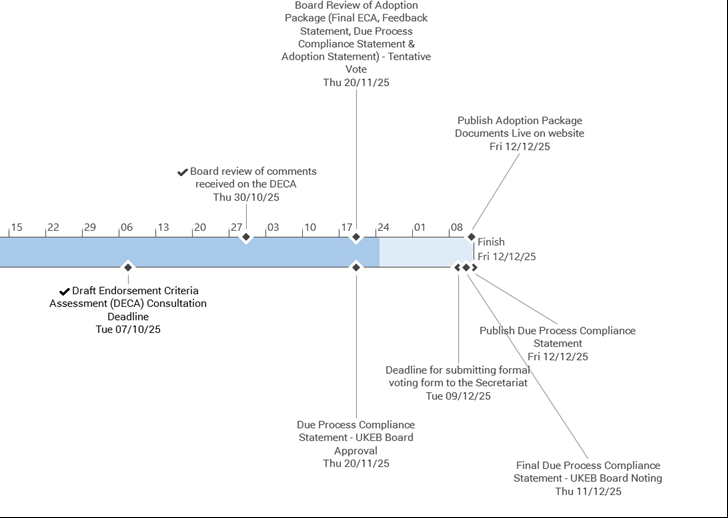
1At its October 2025 meeting, the Board considered the summary of stakeholder feedback received following the UKEB's public consultation on the [Draft] Endorsement Criteria Assessment ([Draft] ECA). Most of the feedback received was supportive of the Board's assessment. The [Draft] ECA included in the adoption pack has been revised to incorporate responses to the issues raised by the Board at its October 2025 meeting.
2The Board considered the summary of stakeholder feedback received following the UKEB's public consultation on the [Draft] ECA of whether to adopt IFRS 18 for use in the UK. Specifically, the Board:
a) After considering all the significant comments received on the Technical Accounting Criteria Assessment (in Section 3 of the ECA): i. Agreed that no further work should be undertaken in respect of the concerns raised about the classification of income and expenses from investments in associates and joint ventures accounted for under the equity method in the investing category. ii. Requested a clearer articulation of the concerns raised relating to the classification of insurance finance income and expenses in the operating category. b) Agreed to the proposed changes in the Long-Term Public Good assessment (in Section 4 of the ECA) subject to the incorporation of the comments raised during the meeting. The main changes made to the [Draft] ECA are: i. Paragraph 2.10 was amended to clarify why the analysis mainly focused on listed entities. ii. Paragraph 4.40(d) was added to note that preparers will only use Management-defined Performance Measures (MPMs) if they perceive benefits to outweigh the associated implementation costs. iii. Paragraph 4.58(c) was added to note that some smaller unlisted entities may face relatively higher staff reallocation costs. iv. Paragraph 4.79 was amended to clarify that users of financial statements look at unlisted entities' financial statements, including those of subsidiaries in some circumstances. c) Asked to note in relation to the true and fair assessment that IFRS 18 has moved the fair presentation requirements of IAS 1 Presentation of Financial Statements to IAS 8 Basis of Preparation of Financial Statements (changed by IFRS 18 and formerly called Accounting Policies, Changes in Accounting Estimates and Errors). Text moved from IAS 1 to IAS 8 relating to the fair presentation requirements was left unchanged. This amendment is shown in paragraph 5.6 of the [Draft] ECA. d) Agreed not to make changes to the assessment of whether IFRS 18 is likely to lead to significant change in practice (in Section 6 of the [Draft] ECA).
3The [draft] ECA included in the adoption pack has been revised to incorporate these actions. Changes to the text arising from that feedback are marked up in Appendix B.
Concern about the classification of insurance finance income and expenses in the operating category
4At the October 2025 meeting the Secretariat informed the Board about a concern raised by a preparer from an insurance entity that the requirement in paragraph 64(b) of IFRS 18 to classify insurance finance income and expenses in the operating category of the income statement does not meet the criteria of comparability, relevance, and understandability. Another respondent (a professional body) had also highlighted concerns from some insurance companies about the lack of comparability derived from these requirements.
5The following paragraphs provide additional clarification of these concerns, based on further engagement with the preparer, and potential mitigations for these concerns.
Summary of concerns raised by the preparer from the insurance industry
6The concern raised by the preparer from the insurance industry was that IFRS 18 does not meet the criteria of relevance and understandability required of the financial information because including insurance finance income and expenses¹ (which includes the change in discount rate of insurance liabilities) as part of the 'operating profit or loss' would not lead to a fair reflection of financial performance for an insurer that:
a) applies the fair value through profit or loss (FVTPL) approach to the measurement of financial assets under IFRS 9 Financial Instruments; and b) chooses not to apply the other comprehensive income option (OCI option) to disaggregate insurance finance income and expenses for the period between profit or loss and OCI under IFRS 17 Insurance Contracts,
as the preparer believes it would experience a significantly more volatile operating profit compared to insurers that measure their financial assets at fair value through OCI (FVOCI) and choose to apply the OCI option under IFRS 17.
7The preparer believes that this would also reduce the comparability of insurers' results depending on each insurer's approach to the measurement of financial assets under IFRS 9 and on whether an insurer chooses to apply the OCI option under IFRS 17.
8The respondent's comments² on this concern are reproduced below:
“In our view, IFRS 18 does not meet the criteria of relevance, understandability and comparability required of the financial information because operating profit is not a fair reflection of performance in the period for insurers that use the fair value through profit or loss (‘FVTPL') approach for valuing financial assets under IFRS 9 and insurance liabilities under IFRS 17. IFRS 18 requires insurance finance income and expenses (which includes the change in discount rate of insurance liabilities) to be presented in operating profit. It leads to reduced comparability of financial information for the insurance industry, as operating profit could differ significantly depending on the insurer's accounting policy choices that they make under IFRS 9 and IFRS 17. For example, an insurer that chooses to apply the fair value through profit or loss approach in the valuation of insurance liabilities under IFRS 17 and financial assets under IFRS 9 would experience a significantly more volatile operating profit than insurers that choose the fair value through other comprehensive income approach." [Aviva comment letter to the IFRS 18 [Draft] ECA page 4].
9To mitigate this situation, the preparer expects to include non-GAAP measures to explain an insurer's underlying profitability as stated below (emphasis added):
"We believe that disaggregating the fair value investment variances and economic assumption changes, which are often large and have no predictive value, is necessary to gain an understanding of the operating performance in the period. Thus, additional non-GAAP measures will be necessary to enable users of the accounts to understand an insurer's underlying profitability." [Aviva comment letter to the IFRS 18 [Draft] ECA page 4].
10Most UK insurers do not apply the OCI option³ in IFRS 17.
Secretariat's analysis
11The preparer further explained that 'operating profit or loss' under IFRS 18 would not be a fair reflection of the underlying performance of these insurers. They believe that reflecting market fluctuations in operating profit, especially in the short term, is not particularly useful for decision making when considering the longer-term nature of their business.
12As a result, it is common for such insurers to present a non-GAAP measure 'Adjusted Operating Profit' which excludes short-term market fluctuations on a non-GAAP basis.
13The preparer believes that the introduction of an 'operating profit' subtotal, as defined by IFRS 18, would affect the understanding of users as to the operating profit measure that fairly reflects how management views its business.
14To mitigate this situation, the preparer expects to continue to present a non-GAAP measure once IFRS 18 becomes effective but is considering changes to its communication and disclosures. The non-GAAP measure is expected to meet the definition of MPMs⁴ under IFRS 18.
15The preparer also clarified that a lack of comparability already exists today due to the different measurement and presentation approaches under IFRS 9 and IFRS 17. The preparer further observed that the introduction of a mandatory subtotal 'operating profit' that requires insurance finance and expenses to be part of this subtotal further highlights this difference.
16The Secretariat notes that mandating an ‘operating profit or loss' subtotal that includes the market movements in an insurer's assets and liabilities does not inherently affect comparability. It simply highlights the limitations to comparability that already exist due to the application of different measurement approaches under IFRS 9 and whether the OCI option is applied under IFRS 17.
17The concern that comparability would be reduced across insurers depending on whether the insurer chooses to apply the OCI option permitted in IFRS 17 has previously been addressed by the UKEB, when assessing IFRS 17 for adoption⁵.
Secretariat's overall recommendation
18IFRS 18 will allow preparers to continue providing their own measures of performance (i.e. MPMs). The disclosure requirements in IFRS 18⁶ (including the disclosures on MPMs⁷) along with the disclosure requirements in IFRS 17 (i.e. general and specific disclosure requirements specifically relating to insurance finance income and expenses⁸) are also likely to improve understandability of these measures.
19Many entities, in different sectors, use APMs to explain underlying performance. It is likely that some of these APMs will become MPMs.
20Based on our analysis, the Secretariat considers that the issue raised does not affect the assessment in Section 3 (Technical Accounting Criteria Assessment) of the ECA.
21However, if the Board considers that this issue should be assessed individually in the ECA, the Secretariat has prepared a provisional assessment against the technical accounting criteria (refer to Appendix A of this paper). The Board is asked to consider whether this assessment should be included in the final ECA.
Decision for the Board
- Does the Board agree that no further work should be undertaken in respect of the concerns raised about the classification of insurance finance income and expenses in the operating category?
- If the Board disagrees with the Secretariat's recommendation above, does the Board have any comments on the provisional assessment included in Appendix A of this paper?
Adoption of IFRS 18
22In accordance with the UKEB's Due Process Handbook paragraph 6.30, the project closure process for endorsement projects comprises the following steps:
a) preparation of an 'adoption package' for the Amendments; and b) voting on the adoption of the amended standard.
Adoption package
23The Board is asked whether it has any comments on the documents which, in accordance with paragraph 6.31 of the Due Process Handbook, form the adoption package for IFRS 18:
a) the ECA (Appendix B); b) the Feedback Statement (Appendix C); c) the draft Due Process Compliance Statement (Appendix D); d) the Adoption Statement for IFRS 18 (Appendix E); and e) the Annex to the Adoption Statement: the text of the UK-adopted international accounting standards (Appendix F).
Decision for the Board
- Subject to addressing any changes identified at this meeting, does the Board approve the documents in the adoption package?
Voting on the adoption of IFRS 18
24Decisions on the adoption of a standard are made at public Board meetings and follow the requirements of paragraphs 5.2–5.5 of the UKEB's Terms of Reference (ToR).
25In line with the ToR and paragraphs 6.42–6.44 of the Due Process Handbook, at this meeting Board members are asked to provide a tentative vote on the adoption of IFRS 18 based on the information included in the adoption package.
Decision for the Board
- Does the Board tentatively approve the adoption of IFRS 18 for use in the UK?
Next steps
26The written forms for the formal vote will be sent to Board members in early December 2025. The result of that formal vote, when completed, will be updated on the UKEB website in line with the Board's Terms of Reference.
27A final version of the Due Process Compliance Statement will be presented to the Board for noting in December 2025.
Endorsement and adoption of IFRS 18 (effective 1 January 2027)—partial timeline for 2025
Appendix A: Provisional assessment – Classification of insurance finance income and expenses in the operating category
Issue 4: Classification of insurance finance income and expenses in the operating category
Presentation and disclosure requirements
IFRS 17 Insurance Contracts
A1IFRS 17 requires the separate presentation of insurance finance income and expenses in the income statement.
A2In accordance with IFRS 17¹, insurance finance income and expenses mainly comprise the change in the carrying amount of the group of insurance contracts arising from the effect of (and changes in) the time value of money and financial risk, including the change in discount rate of insurance liabilities.
A3For insurance finance income and expenses not arising from risk mitigation activities², entities are required to make an accounting policy choice for each portfolio of insurance contracts on how to present insurance finance income and expenses. In accordance with paragraphs 88–90 of IFRS 17, such insurance finance income and expenses can be presented either:
a) in profit or loss; or, b) disaggregated between profit or loss and other comprehensive income (OCI). This is known as the ‘OCI option'. IFRS 17 prescribes three specific approaches or bases of disaggregation of insurance finance income and expenses between profit or loss and OCI, which depend on the method that the entity applies to account for the insurance contract, and whether the insurance finance income and expenses relate to insurance contracts with direct participation features for which the entity holds the underlying items.³
A4IFRS 17 requires an entity to disclose and explain the total amount of insurance finance income and expenses in the reporting period. In particular, an entity is required to explain the relationship between insurance finance income and expenses and the investment return on its assets, to enable users of its financial statements to evaluate the sources of finance income or expenses recognised in profit or loss and OCI.⁴
A5If an entity chooses to disaggregate insurance finance income and expenses into amounts presented in profit or loss and amounts presented in OCI, the entity is required to disclose an explanation of the methods used to determine the insurance finance income and expenses recognised in profit or loss.⁵
IFRS 18
A6Paragraph 47 of IFRS 18 introduces new mandatory categories for the classification of income and expenses (operating, investing or financing). Entities for which investing and/or financing are their main business activities are required to classify income and expenses from those main business activities in the operating category.⁶ Additionally, paragraph 70 of IFRS 18 mandates a new subtotal named 'operating profit or loss'.
A7As explained in paragraph BC89 of IFRS 18, the operating category includes an entity's main business activities as well as other income and expenses from supporting activities which may not generate revenue directly, including income and expenses that are volatile or unusual, to faithfully represent the results of an entity's operations in the period.
A8Paragraph 64(b) of IFRS 18 requires the presentation of “insurance finance income and expenses included in the statement of profit or loss applying IFRS 17 Insurance Contracts” to be in the operating category.
Accounting impact
A9IFRS 18 mandates a new subtotal named 'operating profit or loss'. The use of the OCI option under IFRS 17 together with the different measurement approaches for financial assets backing the insurance contracts under IFRS 9 Financial Instruments may result in differences in the 'operating profit or loss' being presented.
A10For insurers that measure their financial assets at fair value through profit or loss (FVTPL) and do not apply the OCI option, the fair value changes in the financial assets and the effect of changes in the time value of money and financial risk on the insurance contract balances will be included in the ‘operating profit or loss' being presented.
A11Most UK insurers do not apply the OCI option in IFRS 17⁷.
Assessment against the technical accounting criteria
A12Classifying insurance finance income and expenses within the income statement (as part of the operating category) indicates that such income and expenses relate to an insurer's main business activities and provides users with a consistent starting point for their analysis (and therefore with relevant information).
A13A potential consequence of this classification is that the 'operating profit or loss' may appear more volatile for insurers who do not apply the OCI option. This might reduce the perceived relevance and reliability of some financial information (especially when the business is longer-term and the market fluctuations are short-term).
A14However, IFRS 18 will allow preparers to continue providing their own measures of performance (i.e. MPMs), thereby mitigating the risk to relevance and reliability. The disclosure requirements in IFRS 17⁸ and in IFRS 18⁹ (including the disclosures on MPMs) are also likely to improve understandability of these measures.
A15Mandating an 'operating profit or loss' subtotal that includes the market movements in an insurer's assets and liabilities does not inherently affect comparability. It simply highlights the limitations to comparability that already exist due to the application of different measurement approaches under IFRS 9 and whether the OCI option is applied under IFRS 17.
A16The concern that comparability would be reduced across insurers depending on whether the insurer chooses to apply the OCI option permitted in IFRS 17 has previously been addressed by the UKEB when assessing IFRS 17 for adoption¹¹. Relevant paragraphs from the UKEB's IFRS 17 Endorsement Criteria Assessment (ECA) are reproduced below:
"The mechanism for determining the disaggregation between profit or loss and OCI is potentially complex. Entities will need to apply a significant degree of judgement, introducing a risk to the reliability and comparability of financial statements. However, the standard's requirements do not result in a degree of judgement that is inconsistent with that required under other IFRS Standards, and the disclosure requirements referred to above should serve to mitigate these risks.
Any risks to comparability or reliability need to be balanced against the enhanced relevance of the financial information in cases when use of the OCI Option enables entities to reduce or eliminate accounting mismatches. The specific disclosures required by IFRS 17 should also mitigate these risks. Users of insurers' accounts are likely to need to become familiar with new performance measures in any event, as IFRS 17 introduces significant change in a number of areas. [ECA, ‘Other comprehensive income option' page 170].
[Draft] Endorsement Criteria Assessment
IFRS 18 Presentation and Disclosure in Financial Statements
July-November 2025
Footnotes
OFFICIAL - PUBLIC

UK Endorsement Board
July-November 2025
The UKEB does not accept any liability to any party for any loss, damage or costs howsoever arising, whether directly or indirectly, whether in contract, tort or otherwise from any action or decision taken (or not taken) as a result of any person relying on or otherwise using this document or arising from any omission from it.
© 2025 All Rights Reserved
- Executive Summary
- Endorsement of IFRS 18
- Concern about the classification of insurance finance income and expenses in the operating category
- Summary of concerns raised by the preparer from the insurance industry
- Secretariat's analysis
- Adoption of IFRS 18
- Endorsement and adoption of IFRS 18 (effective 1 January 2027)—partial timeline for 2025
- Appendix A: Provisional assessment – Classification of insurance finance income and expenses in the operating category
- [Draft] Endorsement Criteria Assessment
- Executive summary
- Introduction
- I. Section 1: UK statutory requirements for adoption and the approach to the endorsement criteria assessment
- Introduction
- UK statutory requirements
- Approach to the endorsement criteria
- Technical accounting criteria: Relevance, Reliability, Understandability and Comparability
- Whether IFRS 18 is likely to be conducive to the long term public good in the UK
- True and fair view assessment
- [Draft Adoption decision]
- Does IFRS 18 lead to a significant change in accounting practice?
- 2. Section 2: Main requirements in IFRS 18
- Introduction
- Background
- Entities in scope for the assessment of IFRS 18
- Entities with specified main business activities
- Main requirements in IFRS 18
- Overview of the elements imported from IAS 1
- Overview of the main requirements in IFRS 18 (and what has changed)
- Specified categories and required subtotals in the statement of profit or loss
- Requirements for entities with specified main business activities
- Required subtotals, items to be presented in the primary financial statements and presentation of additional line items and subtotals
- Disclosures about management-defined performance measures (MPMs)
- Requirements on aggregation and disaggregation
- Limited changes to the statement of cash flows
- Limited changes to the statement of financial position
- Transition requirements
- 3. Section 3: Technical accounting criteria assessment
- 3. Section 3: Technical accounting criteria assessment
- Introduction
- Approach to the assessment against the technical accounting criteria
- Assessment of main requirements in IFRS 18
- Specified categories and required subtotals in the statement of profit or loss
- Assessment against the endorsement criteria
- Disclosures about management-defined performance measures (MPMs)
- Assessment against the endorsement criteria
- Aggregation and disaggregation
- Assessment against the endorsement criteria
- Limited changes to the statement of cash flows
- Assessment against the endorsement criteria
- Overall [tentative] conclusion on whether IFRS 18 meets the technical accounting criteria
- 4. Section 4: UK long term public good assessment
- Introduction
- Is use of IFRS 18 likely to improve the quality of financial reporting?
- Improvements introduced by IFRS 18
- Categories and subtotals
- Management-defined performance measures
- Aggregation and disaggregation
- Limited changes to IAS 7
- Potential improvement from interaction across the main changes
- Summary of whether IFRS 18 likely to improve the quality of financial reporting
- Economic impact assessment
- Government guidance
- Analysis of costs and benefits likely to result from the use of IFRS 18
- Users
- Costs for users
- Preparers
- Costs and benefits for regulators
- Summary of costs and benefits analysis
- Analysis of wider economic effects
- Transmission mechanisms
- First-order indirect effects - capital market effects
- Effects considered
- Application of the methodology
- Potential impact on new public listings
- Second-order indirect effects
- Other second-order indirect effects
- Third-order indirect effects
- Externalities
- Summary of the analysis of wider economic effects
- Consideration of the consequences of not adopting IFRS 18 (counterfactual analysis)
- [Tentative] Overall assessment of long term public good
- [Tentative] Overall assessment
- 5. Section 5: True and fair view assessment
- 6. Section 6: Is IFRS 18 likely to lead to a significant change in accounting practice?
- Appendix A: Glossary
- Appendix B: Individual assessment of technical issues raised by UK stakeholders
- Introduction
- Issue 1: Classification of income and expenses from associates and joint ventures accounted for using the equity method in the investing category
- Issue 2: Accounting policy choice for the classification of income and expenses for entities that provide financing to customers
- Issue 3: Disclosure of the income tax effect and the effect on non-controlling interests (NCIs) in the MPM reconciliation
- Assessment against the technical accounting criteria
- Appendix C: Evidence about costs and benefits for preparers
- UKEB Webinar poll results
- Results from qualitative interviews
- Third-party work on the economic assessment of IFRS 18
- IASB Effects Analysis
- EFRAG Endorsement Advice on IFRS 18
- Appendix D: Quantitative assessment of implementation costs
- Appendix E: Capital markets effects: additional results
- Contact Us
- Feedback Statement
- Foreword
- Purpose of this Feedback Statement
- Description of IFRS 18 – overall
- Description of IFRS 18 – main requirements
- Appendix E: Capital markets effects: additional results
- Contact Us
- Feedback Statement
- Foreword
- Purpose of this Feedback Statement
- Description of IFRS 18 – overall
- Description of IFRS 18 – main requirements
- Appendix E: Capital markets effects: additional results
- Contact Us
- Feedback Statement
- Foreword
- Purpose of this Feedback Statement
- Description of IFRS 18 – overall
- Description of IFRS 18 – main requirements
- Appendix E: Capital markets effects: additional results
- Contact Us
- Feedback Statement
- Foreword
- Purpose of this Feedback Statement
- Description of IFRS 18 – overall
- Description of IFRS 18 – main requirements
- Appendix E: Capital markets effects: additional results
- Contact Us
- Feedback Statement
- Foreword
- Purpose of this Feedback Statement
- Description of IFRS 18 – overall
- Description of IFRS 18 – main requirements
- Overall Assessment
- Detailed assessment - glossary
- Disclaimer
- Contact Us
- Appendix D: [Draft] Due Process Compliance Statement
- Title of the Standard
- Issue dates
- Project Preparation
- Desk-based Research
- Outreach
- Draft Endorsement Criteria Assessment (DECA)
- Step - DECA [6.23 to 6.29]
- Project Finalisation and Project Closure
- Step - Final Endorsement Criteria Assessment (ECA) [Handbook 6.32 and 6.40 to 6.48]
- Step - Feedback Statement [Handbook 6.33 to 6.36]
- Step - Adoption Statement [Handbook 6.40 to 6.48]
- Step - Voting on Adoption of the Amendments [Handbook 6.42 to 6.48]
- Step - Due Process Compliance Statement (DPCS) [Handbook 6.37 to 6.39]
- Ongoing Communications
- Step - Public Board Meetings [Handbook 4.10]
- Step - Secretariat Papers [Handbook 4.20]
- Step - Project Webpage [Handbook 4.25(b)]
- Step - Subscriber Alerts [Handbook 4.24]
- Step - News Alerts [Handbook 4.24]
- Conclusion
- Adoption Statement
- Approval by the UK Endorsement Board
- Approval by the UK Endorsement Board
- Accounting Standards issued at 1 January 2025
- Terms of Use for Users
- Objective
- Scope
- General requirements for financial statements
- Aggregation and disaggregation
- Statement of profit or loss
- The financing category
- Entities with specified main business activities
- The income taxes category
- The discontinued operations category
- Totals and subtotals to be presented in the statement of profit or loss
- Items to be presented in the statement of profit or loss or disclosed in the notes
- Presentation and disclosure of expenses classified in the operating category
- Statement presenting comprehensive income
- Statement of financial position
- Statement of changes in equity
- Notes
- Appendix A Defined terms
- Appendix B Application guidance
- Statement of profit or loss
- Categories in the statement of profit or loss
- Assessment of specified main business activities
- Operating
- Investing
- Financing
- Classification of gains and losses on derivatives and designated hedging instruments
- Items to be presented in the statement of profit or loss or disclosed in the notes
- Presentation and disclosure of expenses classified in the operating category
- Statement presenting comprehensive income
- Statement of financial position
- Notes
- Appendix C
- Appendix D
- Appendix D
- Appendix E
- IFRS 2 Share-based Payment
- IFRS 3 Business Combinations
- IFRS 5 Non-current Assets Held for Sale and Discontinued Operations
- Scope
- Classification of non-current assets (or disposal groups) as held for sale or as held for distribution to owners
- Measurement of non-current assets (or disposal groups) classified as held for sale
- Changes to a plan of sale or to a plan of distribution to owners
- Presentation and disclosure
- Additional disclosures
- Effective date
- IFRS 6 Exploration for and Evaluation of Mineral Resources
- IFRS 7 Financial Instruments: Disclosures
- IFRS 8 Operating Segments
- IFRS 9 Financial Instruments
- IFRS 10 Consolidated Financial Statements
- IFRS 11 Joint Arrangements
- IFRS 12 Disclosure of Interests in Other Entities
- IFRS 13 Fair Value Measurement
- IFRS 14 Regulatory Deferral Accounts
- IFRS 15 Revenue from Contracts with Customers
- IFRS 16 Leases
- IFRS 17 Insurance Contracts
- IAS 2 Inventories
- IAS 7 Statement of Cash Flows
- IAS 8 Accounting Policies, Changes in Accounting Estimates and Errors
- IAS 10 Events after the Reporting Period
- IAS 12 Income Taxes
- IAS 16 Property, Plant and Equipment
- IAS 19 Employee Benefits
- IAS 29 Financial Reporting in Hyperinflationary Economies
- IAS 32 Financial Instruments: Presentation
- IAS 33 Earnings per Share
- IAS 34 Interim Financial Reporting
- Scope
- Definitions
- Content of an interim financial report
- Minimum components of an interim financial report
- Form and content of interim financial statements
- Other disclosures
- Disclosure of compliance with IFRS Accounting Standards
- Periods for which interim financial statements are required to be presented
- Materiality
- Effective date
- IAS 36 Impairment of Assets
- IAS 37 Provisions, Contingent Liabilities and Contingent Assets
- IAS 38 Intangible Assets
- IAS 40 Investment Property
- IAS 41 Agriculture
- IFRIC 1 Changes in Existing Decommissioning, Restoration and Similar Liabilities
- IFRIC 2 Members’ Shares in Co-operative Entities and Similar Instruments
- IFRIC 5 Rights to Interests arising from Decommissioning, Restoration and Environmental Rehabilitation Funds
- IFRIC 6 Liabilities arising from Participating in a Specific Market—Waste Electrical and Electronic Equipment
- IFRIC 12 Service Concession Arrangements
- IFRIC 14 IAS 19—The Limit on a Defined Benefit Asset, Minimum Funding Requirements and their Interaction
- IFRIC 16 Hedges of a Net Investment in a Foreign Operation
- IFRIC 17 Distributions of Non-cash Assets to Owners
- IFRIC 19 Extinguishing Financial Liabilities with Equity Instruments
- IFRIC 20 Stripping Costs in the Production Phase of a Surface Mine
- IFRIC 21 Levies
- IFRIC 22 Foreign Currency Transactions and Advance Consideration
- IFRIC 23 Uncertainty over Income Tax Treatments
- Appendix A
- Appendix B
- SIC-7 Introduction of the Euro
- SIC-10 Government Assistance—No Specific Relation to Operating Activities
- SIC-25 Income Taxes—Changes in the Tax Status of an Entity or its Shareholders
- SIC-29 Service Concession Arrangements: Disclosures
- SIC-32 Intangible Assets—Web Site Costs
Executive summary
Background
1The UK Endorsement Board (UKEB) is responsible for the endorsement and adoption of international accounting standards (issued by the International Accounting Standards Board (IASB) in the form of International Financial Reporting Standards, or (IFRS) for use in the United Kingdom (UK). The UKEB is therefore the UK's National Standard Setter for IFRS.
2This [Draft] Endorsement Criteria Assessment ([Draft] ECAECA) presents the work conducted by the UKEB to assess whether IFRS 18 Presentation and Disclosure in Financial Statements, issued by the International Accounting Standards Board in April 2024, meets the UK's statutory requirements for adoption of IFRS as set out in Regulation 7 of Statutory Instrument 2019/685 (the Regulations).
3Although the Regulations refer only to ‘adoption’, for the purposes of this [Draft] ECAECA the term endorsement is generally used when referring to the assessment of IFRS 18 against the criteria set out in the Regulations.
4This assessment addresses the three endorsement criteria set out in the Regulations:
- whether IFRS 18 meets the criteria of understandability, relevance, reliability and comparability required of the financial information needed for making economic decisions and assessing the stewardship of management;
- whether IFRS 18 is likely to be conducive to the long-term public good in the UK; and
- whether IFRS 18 is not contrary to the true and fair view principle for individual and consolidated accounts.
5These endorsement criteria are described in more detail in Section 1. Sections 3, 4 and 5 discuss whether these criteria are met.
6The [Draft] ECAECA also addresses, in Section 6, whether IFRS 18 is likely to lead to a significant change in accounting practice as set out in Regulation 11 of Sl 2019/685.
Work to support these assessments
7The work to support these assessments has spanned several months and has been responsive to stakeholder input throughout. The UKEB conducted the following activities to collect evidence to assess whether IFRS 18 meets the technical and the long term public good assessment criteria for endorsement:
- Surveys: During Q3 2024, the UKEB conducted two surveys, one for preparers and one for users (including feedback from listed small- and medium-cap entities).1
- Engagement with UKEB Advisory Groups and with its Financial Instruments Working Group (FIWG).
- Webinar poll: In July 2024, the UKEB held a joint webinar with the IASB to discuss the key requirements of IFRS 18 and its implications. During the webinar, participants were asked to respond to a poll on the costs and benefits of adoption.
- Questionnaire to auditors: During Q3 2024, the UKEB sent a short questionnaire to members of the UKEB Accounting Firms and Institutes Advisory Group (AFIAG) to gather views on the likely costs and benefits of adoption.
- Interviews: During Q4 2024, the UKEB conducted 15 interviews with preparers to gather evidence for the long term public good assessment (including with three preparers from listed small- and medium-cap entities).
- Other engagement: The UKEB engaged bilaterally with UK regulators, professional accounting bodies, industry associations, users and other national and regional standard setters.
- A desktop analysis of the requirements in IFRS 18, the basis for these requirements and its effects analysis, accounting firms’ publications and work by other standard setters.
IFRS 18 Presentation and Disclosure in Financial Statements
8IFRS 18 replaces IAS 1 Presentation of Financial Statements. IFRS 18 sets out general presentation and disclosure requirements that apply across the primary financial statements and the notes. It has an effective date of 1 January 2027, with earlier application permitted (subject to UKEB adoption in the UK). IFRS 18 does not change how entities recognise and measure items in the financial statements.
9Most requirements from IAS 1 have been incorporated into IFRS 18 unchanged or with minor revisions. Section 2 of this [Draft] ECAECA provides a summary of the requirements in IFRS 18 including an analysis of the requirements brought forward from IAS 1.
Technical accounting criteria
10Section 3 of this [Draft] ECAECAECA addresses whether IFRS 18 meets the criteria of understandability, relevance, reliability and comparability required of the financial information needed for users of accounts and investors in making economic decisions and assessing the stewardship of management (referred to in this [Draft] ECAECA as the technical accounting criteria).
11The assessment of IFRS 18 against the technical accounting criteria considers this Standard as a whole, including the requirements transferred from IAS 1. A detailed analysis against the technical accounting criteria is reported only in relation to the specific issues where stakeholders raised some practical challenges (an 'exceptions-based approach') (refer to Appendix B).
12In conducting this overall assessment against the technical accounting criteria, the UKEB is required to adopt an absolute, rather than a relative, approach.
13Overall, the UKEB [tentatively] concluded that IFRS 18 meets the technical accounting criteria.
UK long term public good
14The UKEB’s analysis of whether IFRS 18 is likely to be conducive to the long term public good in the UK is presented in Section 4 of this [Draft] ECAECA. In line with the Regulations, this section:
- presents an overview of the improvements introduced by the Standard and discusses whether IFRS 18 is likely to improve the quality of financial reporting in the UK;
- considers the costs and benefits likely to result from the use of IFRS 18 in the UK; and
- considers whether the use of IFRS 18 is likely to have an adverse effect on the economy of the UK, including on economic growth.
15Considering whether IFRS 18 is likely to improve the quality of financial reporting involved comparing the main new requirements in IFRS 18 with current practice. This means that the approach for this assessment was a relative one.
16The assessment concludes that implementing IFRS 18 will lead to improvements in the quality of financial reporting in the UK by enhancing transparency and comparability of the information presented. It will also improve the disclosure requirements for management performance measures and enhance the requirements for grouping and disaggregating financial information.
17The economic impact assessment of IFRS 18 in this [Draft] ECAECA begins with the assessment of costs and benefits associated with its use.
18Users reported that the implementation of IFRS 18 should result in a more efficient use of time spent analysing financial statements, potentially increasing the quality of analysis and reports. Users indicated that they would be able to better compare entities' performance between each other and over time, enhance their assessment of individual entities’ performance and allocate capital more efficiently between entities. Users also indicated that they anticipated incurring minimal implementation costs. Preparers indicated that they expect to incur relatively small implementation costs (both one-off and ongoing) as a result of applying IFRS 18. Preparers expect one-off monetary costs to be largely associated with extra audit fees, familiarisation and changes to templates (non-monetary staff time reallocation costs). Preparers expect ongoing implementation costs to be much lower than one-off implementation costs, and to be subsumed into business as usual within a few years.
19The UKEB conducted quantitative analysis to obtain a high-level estimate of expected implementation costs for all UK-listed entities. The estimation provides an indicative range for implementation costs across the entire population of entities that would be required to apply IFRS 18 and should not be interpreted as an accurate forecast of implementation costs. The most likely point estimate within the range (reported in Appendix D), across the approximately 1,400 listed entities that are required to apply IFRS is that that total implementation costs would approximate £400 million (one-off and ongoing), of which approximately £100 million are expected to be actual extra monetary costs, while the rest represent opportunity costs associated with staff time reallocation. Total estimated implementation costs amount to approximately 0.02% of listed entities operating expenses as of 2023 year-end.
20The analysis of wider economic effects indicates that IFRS 18 may plausibly lead to wider capital market effects that would on average benefit preparers in the medium- to long-run. A quantitative analysis of such effects shows that small market-wide reductions in the cost of capital would be enough for UK-listed entities applying IFRS to indirectly recover their implementation costs in the medium- to long-term. The UKEB cannot predict with certainty whether any such market-wide effects will materialise and, if so, their magnitude.
21IFRS 18 is not expected to lead to wider economic effects that are detrimental to the UK economy, including on economic growth.
22An analysis of a non-adoption scenario shows that not implementing IFRS 18 for use in the UK would have a potentially detrimental effect on the UK economy (see paragraphs 4.106-4.111).
23Overall, the UKEB [tentatively] concluded that the use of IFRS 18 is likely to be conducive to the long term public good in the UK.
True and fair view principle
24Section 5 of the [Draft] ECAECA addresses whether IFRS 18 is not contrary to the true and fair view principle for both individual and consolidated accounts
25(Regulation 7(1)(a) of SI 2019/685 (namely, the assets, liabilities, financial position and profit or loss)) in the context of the preparation of the accounts as a whole. This assessment also considered the disclosures required by the Standard and its interaction with other UK-adopted international accounting standards. The assessment has not identified any IFRS 18 requirement that would prevent individual or consolidated accounts prepared using IFRS 18 from giving a true and fair view of the entity's assets, liabilities, financial position and profit or loss. Consequently, the UKEB [tentatively] concluded that IFRS 18 is not contrary to the true and fair view principle set out in Regulation 7(1)(a) of Sl 2019/685.
Is IFRS 18 likely to lead to a significant change in accounting practice?
26Section 6 of the [Draft] ECAECA addresses whether IFRS 18 is likely to lead to a significant change in accounting practice. If a standard adopted by the UKEB per Regulation 6 of SI 2019/685 is likely to lead to a ‘significant change in accounting practice’, the requirements in paragraph 3 of Regulation 11 of SI 2019/685 apply. Subject to said requirements, the UKEB is required to:
- carry out a review of the impact of the adoption of the Standard; and
- publish a report setting out the conclusions of the review no later than 5 years after the date on which the standard takes effect (being the first day of the first financial year in respect of which it must be used).
27[The UKEB considers that IFRS 18 is a new standard that will not bring a significant change in the way all entities communicate information in the primary financial statements and the notes. As a result, it [tentatively] concludes that IFRS 18 is not likely to lead to a significant change in accounting practice and does not meet the criteria for a post-implementation review (PIR) under Regulation 11 in SI 2019/685.
Introduction
Purpose
1The UK Endorsement Board (UKEB) is responsible for the endorsement and adoption of international accounting standards (issued by the International Accounting Standards Board (IASB) in the form of International Financial Reporting Standards, or (IFRS) for use in the United Kingdom (UK). The UKEB is therefore the UK's National Standard Setter for IFRS.
2The purpose of this [Draft] Endorsement Criteria Assessment (ECA) is to determine whether IFRS 18 Presentation and Disclosure in Financial Statements (the Standard), issued by the IASB in April 2024, meets the UK's statutory requirements for adoption as set out in Regulation 7 of Statutory Instrument 2019/6852 (SI 2019/685).
3The Standard has an effective date of 1 January 2027 with earlier application permitted (subject to the UKEB adoption in the UK). If an entity applies IFRS 18 for an earlier period, it shall disclose that fact in the notes.
4The UKEB actively influenced the development of IFRS 18. This included the Secretariat submitting a Final Comment Letter on 30 September 20203, prior to the delegation of authority to the UKEB Board, in response to the IASB’s Exposure Draft ED/2019/7 General Presentation and Disclosures4.
Background to the Standard
5Section 2 in this [Draft] ECAECA provides a brief description of the main requirements in IFRS 18, including an analysis of the requirements brought forward from IAS 1.
Scope of the adoption assessment
6IFRS 18 replaces IAS 1 Presentation of Financial Statements and makes changes to the mandatory parts of IFRS Accounting Standards. These changes form part of the UKEB’s adoption assessment.
7UK-adopted international accounting standards comprise only the mandatory sections of standards.5 The Bases for Conclusion, Implementation Guidance, and Illustrative Examples of the IFRS Accounting Standards are not adopted by the UKEB and amendments to these non-mandatory sections are not considered in this [Draft] ECAECA.6
Structure of the assessment
8The UKEB’s analysis is presented in the following sections:
- Section 1 describes UK statutory requirements for adoption of new or amended international accounting standards and the approach to the endorsement criteria assessment;
- Section 2 describes:
- The entities in scope for the assessment of IFRS 18; and
- The main requirements in IFRS 18 and what has changed, including an overview of the elements imported from IAS 1.
- Sections 3–5 discuss whether IFRS 18 meets the requirements for adoption described in Section 1. More specifically:
- Section 3: addresses whether IFRS 18 meets the technical accounting criteria and explains the approach to the assessment of these criteria. Appendix B includes an individual assessment of the specific technical issues raised by UK stakeholders;
- Section 4: analyses whether IFRS 18 is likely to be conducive to the long term public good in the UK. Appendices C, D and E provide extra evidence in support of this assessment; and
- Section 5: considers whether IFRS 18 is not contrary to the true and fair view principle for individual and consolidated accounts.
- Section 6 considers whether IFRS 18 is likely to lead to a significant change in accounting practice.
I. Section 1: UK statutory requirements for adoption and the approach to the endorsement criteria assessment
Introduction
1.1This section describes UK statutory requirements for adoption of new or amended international accounting standards and the approach to the endorsement criteria assessment.
UK statutory requirements
1.2Paragraph 1 of Regulation 7 of SI 2019/6857 requires that an international accounting standard only be adopted if:
- the standard8 is not contrary to either of the following principles—
- an undertaking’s accounts must give a true and fair view of the undertaking’s assets, liabilities, financial position and profit or loss;
- consolidated accounts must give a true and fair view of the assets, liabilities, financial position and profit or loss of the undertakings included in the accounts taken as a whole, so far as concerns members of the undertaking;
- the use of the standard is likely to be conducive to the long term public good in the United Kingdom; and
- the standard meets the criteria of understandability, relevance, reliability and comparability required of the financial information needed for making economic decisions and assessing the stewardship of management.
Approach to the endorsement criteria
1.3This [Draft] ECAECA assesses the criteria above in the following order:
- Whether the Standard meets the criteria of relevance, reliability, understandability and comparability required of the financial information needed for making economic decisions and assessing the stewardship of management (Regulation 7(1)(c)). We refer to these criteria collectively as the ‘technical accounting criteria’ (refer to Section 3).
- Whether use of the Standard is likely to be conducive to the long term public good in the UK (Regulation 7(1)(b)). Regulation 7(2) of SI 2019/685 includes specific areas to consider for this assessment (refer to Section 4). They are:
- whether the Standard is likely to improve the quality of financial reporting;
- the costs and benefits that are likely to result from the use of the Standard; and
- whether the use of the Standard is likely to have an adverse effect on the economy of the UK, including on economic growth.
- Whether the Standard is not contrary to the principle that an entity’s accounts must give a true and fair view (Regulation 7(1)(a)) (refer to Section 5).
Technical accounting criteria: Relevance, Reliability, Understandability and Comparability9
1.4A description of the technical accounting criteria10 is provided below:
| Technical criteria assessment | |
|---|---|
| Relevance | Information is relevant if it is capable of making a difference in the decision-making of users or in their assessment of the stewardship of management. The information may aid predictions of the future, confirm or change evaluations of the past, or both. |
| Reliability | Financial information is reliable if, within the bounds of materiality, it: |
| a) can be depended on by users to represent faithfully what it either purports to represent or could reasonably be expected to represent; | |
| b) is complete; and | |
| c) is free from material error and bias. | |
| Understandability | Financial information should be readily understandable by users with a reasonable knowledge of business and economic activities and accounting, and a willingness to study the information with reasonable diligence. |
| Comparability | Information is comparable if it enables users to identify and understand similarities in, and differences among, items. Information about an entity should be comparable with similar information about other entities and with similar information about the same entity for another period. |
1.5In conducting the overall assessment against the technical accounting criteria, the UKEB adopts an absolute, rather than a relative, approach. This means that this is an absolute assessment against the criteria (does IFRS 18 provide information that is understandable, relevant, reliable and comparable?) rather than a relative one (does IFRS 18 provide information that is more understandable, relevant, reliable and comparable than current, or any other, accounting?).
1.6When the assessment of any individual aspect or requirement of IFRS 18 uses comparative language (e.g. ‘more comparable’), the objective is not to reflect a real comparison in relative terms, but to explain that that individual aspect or requirement has the potential to “enhance” one or more of the qualitative characteristics.
1.7A comparative consideration of whether IFRS 18 is likely to improve the quality of financial reporting is separate from this assessment and is included within the UK long term public good assessment in Section 4.
1.8As explained in Section 3 the assessment of the technical accounting criteria considers all principal aspects of IFRS 18. However, in the interest of efficiency and effectiveness the UKEB has reported a detailed analysis against the technical accounting criteria only in relation to significant issues (an 'exceptions-based approach').
Whether IFRS 18 is likely to be conducive to the long term public good in the UK11
1.9Regulation 7(2) of SI 2019/685 sets out certain matters that are required to be considered in the assessment of whether a standard is likely to be conducive to the long term public good in the UK. These are:
"[...]
- whether the use of the standard is likely to improve the quality of financial reporting;
- the costs and benefits that are likely to result from the use of the standard; and
- whether the use of the standard is likely to have an adverse effect on the economy of the United Kingdom, including on economic growth.”
1.10When assessing whether the use of IFRS 18 is likely to improve the quality of financial reporting, the UKEB performs a relative assessment of whether the information required by IFRS 18 is likely more understandable, relevant, reliable and comparable than that specified by IAS 1 Presentation of Financial Statements.
1.11When assessing the costs and benefits that are likely to result from the use of IFRS 18 the UKEB considers both the initial direct costs/benefits associated with the implementation of IFRS 18 as well as the expected ongoing costs and benefits over future years. This allows an assessment of the economic effects over the longer-term, consistent with the assessment of the long-term public good in the UK.
1.12When assessing whether the use of IFRS 18 is likely to have an adverse effect on the economy of the United Kingdom, including on economic growth, the UKEB assesses the potential impact of the standard beyond direct costs and benefits, including capital market effects (e.g. cost of capital), microeconomic factors such as products, pricing and competition, and the national economy.
True and fair view assessment12
1.13The first adoption criterion set out in Regulation 7(1) of SI 2019/685 requires that an international accounting standard can be adopted only if:
"[....] the standard is not contrary to either of the following principles—
- an undertaking’s accounts must give a true and fair view of the undertaking’s assets, liabilities, financial position and profit or loss;
- consolidated accounts must give a true and fair view of the assets, liabilities, financial position and profit or loss of the undertakings included in the accounts taken as a whole, so far as concerns members of the undertaking; [....]"
1.14For the sake of brevity, the UKEB refers to the assessment against this endorsement criterion as ‘the true and fair view assessment’ and to the principles set out in Regulation 7(1)(a) as the ‘true and fair principle’. However, these abbreviated expressions do not imply that the assessment has considered anything other than the full terms of the endorsement criterion set out above.
1.15The duty of the UKEB under Regulation 7(1)(a) is to determine generically whether that standard is ‘not contrary’ to the true and fair principle before a standard is applied to a set of accounts. In other words, it is an ex-ante assessment. The UKEB has therefore considered whether IFRS 18 contains any requirement that would prevent accounts prepared using IFRS 18 from giving a true and fair view.
1.16The approach is to determine whether IFRS 18 is not contrary to the true and fair principle in respect of any of the specific items identified in Regulation 7(1)(a) (namely, the assets, liabilities, financial position and profit or loss) in the context of the preparation of the accounts as a whole. A holistic approach has been taken to this assessment, considering the impact of IFRS 18 taken as a whole, including its interaction with other UK-adopted international accounting standards.
1.17For the purposes of the assessment, the UKEB considers the requirement in paragraph 15 of IAS 1 for financial statements to ‘present fairly the financial position, financial performance and cash flows of an entity’13 to be equivalent to the Companies Act 2006 requirement for accounts to give a true and fair view.
1.18This assessment is separate from the duty of directors under section 393(1) of the Companies Act 2006, which requires directors to be satisfied that a specific set of accounts gives a true and fair view of an undertaking’s or group’s assets, liabilities, financial position and profit or loss.
[Draft Adoption decision]
1.19Sections 3, 4 and 5 discuss whether IFRS 18 meets the requirements for adoption described in Section 1.
1.20On the basis of these assessments, and subject to any stakeholder feedback, the UKEB [tentatively] concludes that IFRS 18 meets the statutory endorsement criteria. The UKEB is therefore of the view that it will adopt IFRS 18 for use in the UK.]
Does IFRS 18 lead to a significant change in accounting practice?
1.21A standard adopted by the UKEB under Regulation 6 of SI 2019/685 that it considers is likely to lead to a 'significant change in accounting practice', is subject to the requirements in paragraph 3 of Regulation 11 of SI 2019/685 that the UKEB:
"[...]
- carry out a review of the impact of the adoption of the standard; and
- publish a report setting out the conclusions of the review no later than 5 years after the date on which the standard takes effect (being the first day of the first financial year in respect of which it must be used)."
1.22Section 6 of the [Draft] ECAECA discusses whether IFRS 18 leads to a significant change in accounting practice.
“[...] a) carry out a review of the impact of the adoption of the standard; and b) publish a report setting out the conclusions of the review no later than 5 years after the date on which the standard takes effect (being the first day of the first financial year in respect of which it must be used).”
1.22Section 6 of the [Draft] ECAECA discusses whether IFRS 18 leads to a significant change in accounting practice.
2. Section 2: Main requirements in IFRS 18
Introduction
2.1This section describes:
a) Tthe entities in scope for the assessment of IFRS 18. b) Tthe main requirements in IFRS 18 and what has changed, including an overview of the elements imported from IAS 1 *Presentation of Financial Statements
- without change.
Background
2.2IFRS 18 is a new IFRS Accounting Standard aimed at improving how entities communicate their financial performance in their financial statements and replaces IAS 1. The IASB developed IFRS 18 in response to strong demand from stakeholders, particularly from users of financial statements, for improvements to the reporting of financial performance.
2.3The IASB did not reconsider all aspects of IAS 1 when developing IFRS 18 but focused on the statement of profit or loss.
2.4IFRS 18 does not change how entities recognise and measure items in the financial statements.
2.5The objective of IFRS 18 is as follows:
"1 This Standard sets out requirements for the presentation and disclosure of information in general purpose financial statements (financial statements) to help ensure they provide relevant information that faithfully represents an entity's assets, liabilities, equity, income and expenses”.
2.6Paragraphs 10–12 of IFRS 18 define a complete set of financial statements as follows:
"10 A complete set of financial statements comprises: a) a statement (or statements) of financial performance for the reporting period [...]; b) a statement of financial position as at the end of the reporting period; c) a statement of changes in equity for the reporting period; d) a statement of cash flows for the reporting period; e) notes for the reporting period; f) comparative information in respect of the preceding period [...]; g) a statement of financial position as at the beginning of the preceding period [...]."
"11 The statements listed in paragraphs 10(a)-10(d) (and their comparative information) are referred to as the primary financial statements. [...].”
"12 An entity shall present its statement(s) of financial performance as either: a) a single statement of profit or loss and other comprehensive income, with profit or loss and other comprehensive income presented in two sections [...] b) a statement of profit or loss and a separate statement presenting comprehensive income that shall begin with profit or loss [....].”
Entities in scope for the assessment of IFRS 18
2.8All entities that prepare financial statements using UK-adopted international accounting standards are required to apply IFRS 18 retrospectively from 1 January 2027 with earlier application permitted (subject to the UKEB adoption in the UK).
2.9This analysis considers all entities listed on the London Stock Exchange (LSE)14 using IFRS Accounting Standards for 2023 year-ends. The entities considered have the following characteristics (see information below):
| Header 1 | |
|---|---|
| Table 1: Characteristics of entities in scope | |
| Number of listed entities | Approximately 1,400 (including 300 stand-alone funds and trusts) that prepare their financial statements in accordance with UK-adopted international accounting standards. |
| Total assets (FY 2023) | £12.4 trillion |
| Total revenues (FY 2023) | £2.12 trillion |
| Market capitalisation | £2.65 trillion |
Source: Thomson Reuters-Eikon. It is important to note that approximately 14,000 unlisted entities take the option in UK law to use UK-adopted International Accounting Standards (source: UKEB estimates based on FAME, Companies Watch and other proprietary data).
2.10It is acknowledged that unlisted entities that use UK-adopted international accounting standards are in scope of IFRS 18. However, this [Draft] ECAECA does not explicitly consider them in the assessment for the following reasons:
a) Unlisted entities apply IFRS voluntarily.;
b) The number of unlisted entities is an unconsolidated figure, and the exact number of unlisted groups applying UK-adopted international accounting standards is unknown.;
c) Following from the above, the number of unlisted entities would include subsidiaries of listed companies, which would be considered in the analysis of costs and benefits as evidence is collected at a group level.;
d) The UKEB possesses only the total number of unlisted entities applying IFRS. Granular information is not available from data vendors. This makes the estimation of costs for unlisted entities unfeasible.;
e) Unlisted entities will generally they will be subject to the same considerations as listed entities.15
Entities with specified main business activities
2.11IFRS 18 includes specific requirements for entities that have specified main business activities. These are entities that16:
a) Invest in assets as a main business activity (e.g. investment entities as defined by IFRS 10 Consolidated Financial Statements, investment property entities and insurers). b) Provide financing to customers as a main business activity (e.g. banks and other lending institutions, entities that provide financing to customers to enable those customers to buy an entity's products or lessors that provide financing to customers in finance leases).
2.12Entities in the Banking, Insurance, Financial Services and Real Estate sectors are expected to have specified main business activities. In the UK, roughly 30% of UK-listed entities belong to one of these sectors. Table 2 provides further detail.
| Table 2: Industries most likely to have specified main business activities | ||||
|---|---|---|---|---|
| Number of entities | Proportion of listed entities | Market cap (£ billion) | Proportion of market cap | |
| Banks & Financial Services | 328 | 24% | 564 | 21% |
| Life and non-life insurance | 17 | 1% | 77 | 3% |
| Real Estate | 72 | 5% | 63 | 2% |
| Total | 417 | 30% | 704 | 26% |
| All other industries | 983 | 70% | 1,946 | 74% |
| Grand total | 1,400 | 100% | 2,650 | 100% |
Source: UKEB calculations based on Reuters-Eikon data February 2025
2.13The market capitalisation of entities in these sectors was approximately £704 billion, 26% of the total market capitalisation of the LSE.
2.14This analysis does not include entities in other industries that may also undertake specified main business activities, such as entities that provide financing to enable those customers to buy the entity's products or lessors that provide financing to customers in finance leases (paragraphs B32(b)−(c) of IFRS 18)17.
2.15Consequently, the prevalence of entities with specified main business activities is expected to be higher.
2.16IFRS 18 also contains specific requirements for entities that have:
a) Investments in associates and joint ventures accounted for using the equity method ('equity-accounted investments'). b) Non-controlling interests.
2.17The UKEB Secretariat analysed Reuters-Eikon data to ascertain the prevalence of these among UK-listed entities. The prevalence of equity-accounted investments is discussed in paragraphs B13-B14. The prevalence of non-controlling interests is discussed in paragraph B40.
Main requirements in IFRS 18
2.18IFRS 18 includes 282 paragraphs18. As indicated in Table 3 below, some paragraphs were imported from IAS 1 or based on IAS 1.
| Table 3: Paragraphs in IFRS 18 | ||
|---|---|---|
| # of paragraphs in IFRS 18 | % | |
| New paragraphs in IFRS 18 | 159 | 56% |
| Paragraphs brought forward from IAS 1 into IFRS 18 unchanged or with minor revisions [(i) in Table 4] | 91 | 32% |
| Paragraphs based on IAS 1 but substantially changed and replaced by new requirements in IFRS 18 [(iii) in Table 4] | 32 | 12% |
| Standard, Appendix B and C total | 282 | 100% |
Overview of the elements imported from IAS 1
2.19IAS 1 includes 158 paragraphs that were either brought forward unchanged or with minor revisions into IFRS 18, IFRS 7 Financial Instruments: Disclosures or IAS 8 Accounting Policies, Changes in Accounting Estimates and Errors19; or, substantially changed and replaced by new requirements in IFRS 18. This is shown in Table 4 below.
| Table 4: Paragraphs in IAS 1 | ||
|---|---|---|
| # of paragraphs in IAS 1 | % | |
| IAS 1 paragraphs brought forward unchanged or with minor revisions into: | ||
| (i) IFRS 18 | 91 | 58% |
| (ii) IAS 8 or IFRS 7 | 35 | 22% |
| Subtotal | 126 | 80% |
| (iii) IAS 1 paragraphs that were substantially changed and replaced by new requirements in IFRS 18 | 32 | 20% |
| Total | 158 | 100% |
2.20Table 5 below provides an overview of the main topics in IAS 1 that were brought forward into IFRS 18, IFRS 7 or IAS 8.
| Table 5: Main topics in IAS 1 brought forward unchanged into IFRS 18, IFRS 7 or IAS 8 |
|---|
| Main topic |
| General features of the financial statements |
| - Going concern and accrual basis of accounting (moved to IAS 8). |
| - Offsetting. |
| - Frequency of reporting. |
| - Comparative information. |
| - Consistency of presentation. |
| - Identification of the financial statements. |
| Content of the primary financial statements |
| - Information in the statement of financial position: |
| o list of line items (including presentation of tax expenses and a single amount for the total of discontinued operations); and |
| o current/non-current distinction of assets or liabilities. |
| - Information in the statement of financial performance: |
| o list of line items, presentation of the profit or loss and other comprehensive income (OCI) totals; |
| o allocations of profit or loss to non-controlling interests (NCIs) and to owners of the parent; and |
| Content of the notes |
| o information to be presented in the OCI section. |
| - Information in the statement of changes in equity and requirements for share capital and other reserves. |
| - Structure. |
| - Disclosure of accounting policy information (moved to IAS 8). |
| - Sources of estimation uncertainty (moved to IAS 8). |
| - Puttable financial instruments classified as equity (moved to IFRS 7). |
| - Capital disclosures. |
Overview of the main requirements in IFRS 18 (and what has changed)
2.21IFRS 18 introduces new presentation and disclosure requirements and more detailed guidance in the form of application guidance which IAS 1 did not have. The following section discusses the main requirements in IFRS 18 and what has changed (for example, in respect of the requirements in IAS 1).
a) Specified categories and required subtotals in the statement of profit or loss. b) Mandatory disclosures about management-defined performance measures (or 'MPMs') in a single note. c) Enhanced requirements on the aggregation, disaggregation, location and labelling of items across the primary financial statements and the notes.
2.22IFRS 18 also:
a) Makes limited amendments to IAS 7 Statement of Cash Flows20 and to the statement of financial position. b) Includes transition requirements.
Specified categories and required subtotals in the statement of profit or loss
Specified categories
2.23IFRS 18 requires entities to classify income and expenses into five categories, three of which are new (i.e. operating, investing and financing). This is a departure from IAS 1, which does not have a requirement to classify income and expenses into “classes” or “categories”. These categories are discussed below:
a) the operating category (paragraph 52 of IFRS 18) includes income and expenses (i) not classified in the investing, financing, income taxes or discontinued operations categories including income and expenses that are volatile, unusual or non-recurring (i.e. it’s the default category); and (ii) arising from a company's main business activities if they do not meet the requirements to be classified in any of the other categories; b) the investing category (paragraphs 53-58 of IFRS 18) includes income and expenses from: (i) investments in associates, joint ventures and unconsolidated subsidiaries. This classification is irrespective of whether an entity invests in assets as a main business activity; (ii) cash and cash equivalents; and (iii) other assets that generate a return individually and largely independently of the company’s other resources; c) the financing category (paragraphs 59-66 of IFRS 18) includes income and expenses from: i. liabilities arising from transactions that involve only the raising of finance (e.g. interest expenses on debt instruments issued); and ii. liabilities (other than those described in (c)(i) above) arising from transactions that do not involve only the raising of finance. d) income taxes (paragraph 67 of IFRS 18), include tax expense or tax income included in the statement of profit or loss applying IAS 12 Income Taxes, and any related foreign exchange differences; and e) discontinued operations (paragraph 68 of IFRS 18) include income and expenses from discontinued operations required by IFRS 5 Non-current Assets Held for Sale and Discontinued Operations.
2.24IFRS 18 also includes requirements for the classification of certain items of income and expense. In this respect:
a) Foreign exchange differences are classified in the same category as the income and expenses from the items that gave rise to those differences. If an entity cannot allocate these differences to the applicable categories without undue cost or effort the entity can classify the affected differences in the operating category (paragraphs B65–B68 of IFRS 18). b) Gains and losses on derivatives are classified depending on whether the derivatives are used to manage exposure to identified risks and whether they are designated as hedging instruments. IFRS 18 provides undue cost or effort relief for the classification of gains or losses on derivatives used to manage identified risks but not designated as hedging instruments (paragraphs B70–B76 of IFRS 18). c) Income and expenses from hybrid contracts comprising host liabilities and embedded derivatives are classified depending on whether the embedded derivative is separated from the host liability and the nature of the hybrid contract (paragraphs B56–B57 of IFRS 18). d) Income and expenses arising from the derecognition of an asset or a liability are classified in the same category as the entity classified the income and expenses from the asset (or liability) immediately before its derecognition. For example, gains and losses on the disposal of property, plant and equipment will be classified in the operating category (paragraphs B60–B61 of IFRS 18).
Requirements for entities with specified main business activities
2.25An entity is required in accordance with paragraph 49 of IFRS 18 to assess whether it has either (or both21) of the following specified main business activities:
a) investing in particular type of assets; and/or b) providing financing to customers.
2.26As an exception to the general classification requirements, paragraphs 55–58 and 65–66 of IFRS 18 require entities with a specified main business activity to classify in the operating category some of their income and expenses that would otherwise have been included in investing or financing categories. This would allow entities with specified main business activities to present key measures of performance in the operating category.
Required subtotals, items to be presented in the primary financial statements and presentation of additional line items and subtotals
2.27IFRS 18 brings forward from IAS 1 the requirement to present totals for profit or loss and for other comprehensive income. IFRS 18 requires the presentation of two new subtotals—‘operating profit or loss' and 'profit or loss before financing and income taxes' (paragraph 69 of IFRS 18)22.
2.28IFRS 18 brings forward from IAS 1 the requirement to present separately in the primary financial statements specific line items (e.g. paragraphs 75 and 103 of IFRS 18), but only if the line item is necessary to provide a useful structured summary. Otherwise, the line item is disclosed in the notes if it provides material information (paragraphs 23–24, 42 and B8 of IFRS 18).
2.29An entity can present additional line items and subtotals subject to the requirements in paragraph 24 of IFRS 18: for example, if such presentation provides a useful structured summary; or, if the additional line items or subtotals fit the specified structure of the primary financial statements.
Disclosures about management-defined performance measures (MPMs)
2.30UK entities that currently report Alternative Performance Measure or 'APMs' generally use the guidelines issued by the European Securities and Markets Authority's Guidelines on Alternative Performance Measures (ESMA APM guidelines)23, 24. These guidelines are considered best practice25 but do not constitute mandatory requirements.26 The location of these measures varies in the UK but generally entities place their APMs in the annual report outside the financial statements27.
2.31IFRS 18 requires the integration of a subset of APMs (i.e. those that meet the definition of an MPM) as part of an entity's financial statements. An MPM is defined in paragraph 117 of IFRS 18 as a subtotal of income and expense used in public communications outside financial statements that communicates management's view of an aspect of the financial performance of the entity as a whole to users and that is not listed in paragraph 118 of IFRS 18 or specifically required by IFRS Accounting Standards. There is a presumption in paragraph 119 of IFRS 18 that a subtotal of income and expenses, that an entity uses in public communications outside its financial statements, communicates to users of financial statements the management's view of an aspect of the financial performance of the entity as a whole. This presumption can be rebutted with reasonable and supportable information (paragraph 120 of IFRS 18).
2.32Paragraphs 122–123 of IFRS 18 require an entity to disclose information about all its MPMs in a single note to the financial statements, including:
a) a description of the aspect of financial performance that it communicates, including why management believes the MPM provides useful information about the entity's financial performance; b) a description of how the MPM is calculated; c) a reconciliation between the MPM and the most directly comparable subtotal listed in paragraph 118 of IFRS 18 or total or subtotal specifically required to be presented or disclosed by IFRS Accounting Standards. This includes the disclosure of the income tax effect and the effect on non-controlling interests (NCIs) for each item disclosed in the reconciliation; and d) a description of how the company determined the income tax effect.
2.33Furthermore, if an entity changes the calculation of an MPM, introduces a new MPM or ceases to use a previously disclosed MPM, it is required to disclose in accordance with paragraph 124 of IFRS 18 an explanation of the change, the reasons for the change and provide restated comparative information (unless it is impracticable).
Requirements on aggregation and disaggregation
2.34IAS 1 required the presentation or disclosure of material information28. IFRS 18 builds on these requirements by introducing new and defined roles for the primary financial statements and for the notes which an entity considers in providing material information:
a) The role of the primary financial statements is to provide useful structured summaries of an entity's recognised assets, liabilities, equity, income, expenses and cash flows (paragraph 16 of IFRS 18); and b) The role of the notes is to provide material information necessary to enable investors to understand the items in the primary financial statements; and to supplement the primary financial statements with additional information to achieve the objective of the financial statements (paragraph 17 of IFRS 18).
2.35IFRS 18 also:
a) Introduces principles for aggregating and disaggregating information with reference to similar and dissimilar characteristics and provides application guidance to assist entities in making these judgements (paragraph 41 of IFRS 18). b) Requires entities to determine how to label and describe the items presented and disclosed. For example, to consider whether a more informative label exists before labelling items as 'other' (paragraph 43 of IFRS 18). c) Provides enhanced guidance to assess how to present operating expenses in the statement of profit or loss based on either the nature of expenses or the function of the expenses within the entity. An entity can also provide a 'mixed presentation' (i.e. by classifying some expenses by function and others by nature), if this provides the most useful structured summary (paragraph 78 of IFRS 18). d) Requires an entity presenting expenses classified by function in the operating category of the statement of profit or loss to disclose in a single note additional information by nature (paragraph 83 of IFRS 18). This requirement is limited to five specified expenses by nature: depreciation, amortisation, employee benefits, impairment losses (and reversals of impairment losses) and write-downs of inventories (and reversals of write-downs of inventories). The amounts presented or disclosed need not be the amounts recognised as an expense in the period. They could include amounts that have been recognised as part of the carrying amount of an asset (paragraph B84 of IFRS 18)29.
Limited changes to the statement of cash flows
Starting point for the indirect method
2.36Paragraph 20 of IAS 7 requires the use of the 'profit or loss' total as the starting point for the indirect reconciliation of cash flows from operating activities. The Illustrative examples accompanying IAS 7, however, use 'profit before tax' as the starting point for determining net cash flows from operating activities, which has led to diversity of practice.
2.37IFRS 18 amends paragraph 20 of IAS 7 to require all entities to use the operating profit subtotal as the starting point for the indirect method of reporting cash flows from operating activities.
Classification of interest and dividends paid and/or received
2.38Paragraphs 31–34 of IAS 7 allow entities to choose how to present cash flows arising from interest and dividends, leading to significant diversity in practice in the presentation of these line items.
2.39IFRS 18 amends paragraphs 31–34 of IAS 7 to remove the presentation alternatives for cash flows related to interest and dividends paid and received. For all entities IAS 7 (as amended by IFRS 18) requires the classification of dividends paid as cash flows from financing activities. The approach to the classification of interest paid and interest and dividends received depends on whether an entity has a specified main business activity as follows:
a) For an entity without a specified main business activity, IAS 7 requires the classification of interest paid as cash flows from financing activities (including interest capitalised as part of the costs of an asset applying IAS 23 Borrowing Costs). Interest and dividends received are classified as cash flows from investing activities. b) For an entity with a specified main business activity, IAS 7 requires the classification of dividends received, interest paid and interest received in a single category in the statement of cash flows (operating, investing or financing activities). IAS 7 requires that this classification be consistent with the classification of the income and expenses corresponding to such cash flows. If an entity classifies related income and expenses in more than one category of the statement of profit or loss, an entity should make an accounting policy choice to classify the cash flows in one of the corresponding categories of the statement of cash flows.
Limited changes to the statement of financial position
2.40Paragraph 103(d) of IFRS 18 adds a requirement to present goodwill separately.
Transition requirements
2.41Paragraph C2 of IFRS 18 requires an entity to apply IFRS 18 retrospectively applying IAS 8 and to restate comparative information for the prior year presented.
2.42If an entity applies IAS 34 Interim Financial Reporting in preparing condensed interim financial statements in the first year of applying IFRS 18, it is required to present the headings that it expects to use in applying IFRS 18 and subtotals consistent with the requirements in IFRS 18. In addition, an entity is required to disclose reconciliations for each line item presented in the statement of profit or loss for the comparative periods immediately preceding the current and cumulative current periods.
2.43At the date of initial application of IFRS 18, an entity eligible to apply paragraph 18 of IAS 28 Investments in Associates and Joint Ventures is permitted by paragraph C7 of IFRS 18 to change its election for measuring an investment in an associate or joint venture from the equity method to fair value through profit or loss in accordance with IFRS 9 Financial Instruments30. If an entity makes such a change, the entity shall apply the change retrospectively by applying IAS 8. An entity applying paragraph 11 of IAS 27 Separate Financial Statements is required to make the same change in its separate financial statements.
3. Section 3: Technical accounting criteria assessment
Introduction
3.1This section addresses whether IFRS 18 meets the technical accounting criteria and explains the approach to the assessment of these criteria.
Approach to the assessment against the technical accounting criteria
3.2SI 2019/685 requires an assessment of whether IFRS 18 meets the following criteria in regulation 7(1)(c):
"...(c) the standard meets the criteria of understandability, relevance, reliability and comparability required of the financial information needed for making economic decisions and assessing the stewardship of management.”
3.3These criteria are referred collectively as the ‘technical accounting criteria'. An explanation of the basis for and our interpretation of the technical accounting criteria is provided in Section 1. This section sets out the principal aspects of IFRS 18 and assesses those requirements against the technical accounting criteria.
3.4The assessment against the technical accounting criteria considers IFRS 18 as a whole, including the requirements carried over from IAS 1 Presentation of Financial Statements31. However, in the interest of efficiency and effectiveness a detailed analysis against these criteria is reported only in relation to specific technical issues where UK stakeholders raised some practical challenges (an 'exceptions-based approach'). These issues are analysed in Appendix B against the technical accounting criteria and are the:
a) Classification of income and expenses from associates and joint ventures accounted for using the equity method in the investing category. b) Accounting policy choice for the classification of income and expenses for entities that provide financing to customers.
3. Section 3: Technical accounting criteria assessment
Introduction
3.1 This section addresses whether IFRS 18 meets the technical accounting criteria and explains the approach to the assessment of these criteria.
Approach to the assessment against the technical accounting criteria
3.2 SI 2019/685 requires an assessment of whether IFRS 18 meets the following criteria in regulation 7(1)(c):
"...(c) the standard meets the criteria of understandability, relevance, reliability and comparability required of the financial information needed for making economic decisions and assessing the stewardship of management.”
3.3 These criteria are referred collectively as the ‘technical accounting criteria'. An explanation of the basis for and our interpretation of the technical accounting criteria is provided in Section 1. This section sets out the principal aspects of IFRS 18 and assesses those requirements against the technical accounting criteria.
3.4 The assessment against the technical accounting criteria considers IFRS 18 as a whole, including the requirements carried over from IAS 1 Presentation of Financial Statements.31 However, in the interest of efficiency and effectiveness a detailed analysis against these criteria is reported only in relation to specific technical issues where UK stakeholders raised some practical challenges (an 'exceptions-based approach'). These issues are analysed in Appendix B against the technical accounting criteria and are the:
- Classification of income and expenses from associates and joint ventures accounted for using the equity method in the investing category.
- Accounting policy choice for the classification of income and expenses for entities that provide financing to customers.
- Disclosure of the income tax effect and the effect on non-controlling interests (NCI) in the management-defined performance measure reconciliation.
3.5 In conducting this overall assessment against the technical accounting criteria the UKEB is required to adopt an absolute, rather than a relative, approach.
3.6 Outreach [to date] has provided assurance that there are no further issues that UK stakeholders consider need to be addressed in the [Draft] ECAECA.
3.7 The UKEB notes that the IASB issued IFRS 18 after reaching an overall consensus, following extensive consultations with a wide range of constituents, including those from the UK. The main rationale behind the final IASB decisions is described in the Basis for Conclusions of IFRS 18 and has been used as part of the technical criteria assessment. The UKEB recognises that IFRS 18 is intended to define principle-based requirements which could be applied in a consistent manner across entities and industries.
3.8 The UKEB's overall [tentative] conclusion on whether IFRS 18 as a whole meets the technical accounting criteria is set out at the end of this section.
Assessment of main requirements in IFRS 18
3.9 This section includes an assessment of the main requirements of IFRS 18 against the technical accounting criteria. For a detailed description of these requirements refer to Section 2 of this [Draft] ECAECA.
3.10 Input for this assessment was obtained from:
- A review of the survey results from the UKEB Preparer survey and from the UKEB User survey (including feedback from listed small- and medium-cap entities) and from the UKEB's webinar poll.
- Engagement with UKEB Advisory Groups and with its Financial Instruments Working Group.
- Interviews with preparers (including with preparers from listed small- and medium-cap entities) and users.
- A desktop analysis of the requirements in IFRS 18 and the basis for these requirements.
3.11 Overall, the UKEB received positive feedback from stakeholders that IFRS 18 leads to financial information that is understandable, relevant, reliable and comparable.
Specified categories and required subtotals in the statement of profit or loss
Accounting impact
3.12 The requirements for the classification of income and expenses in separate categories (and specific classification rules depending on the entity's main business activities) and for the presentation of specific subtotals are expected to reduce diversity in practice and enhance users' ability to understand and compare information across different companies.[^32]
3.13 IFRS 18 requires all entities to present an 'operating' category which is a residual category. This will have an impact on how entities report their operating results. For example, entities will not be able to exclude from the operating category income and expenses that are volatile, unusual or non-recurring.[^33] Any change in an entity's definition of operating profit may also require investors to make changes to the calculation of their metrics.
3.14 The impact of the new presentation and classification requirements and subtotals will depend on an entity's current reporting practices. If an entity's practices differ from the new classification requirements for income and expenses, an entity may incur higher costs to implement any necessary changes to their current systems. However, some of these costs may be reduced through the application of classification reliefs for 'undue cost or effort' applicable to specific income and expenses.[^34]
3.15 Practical challenges that may arise as IFRS 18 is implemented are as follows:
- The classification of income and expenses in the operating category may differ for entities already presenting an operating profit subtotal. For example, evidence from the Preparer survey showed that some entities currently present the share of the profit or loss of associates and joint ventures accounted for using the equity method in the operating category, which is not permitted in IFRS 18.[^35]
- The new structure of the statement of profit or loss may change the subtotals that are currently used for determining management incentives, income tax or compliance with covenants.
- For conglomerates with diverse business activities, determining the ‘main business activity' may be challenging.
Assessment against the endorsement criteria
3.16 The new requirements for specified categories and required subtotals will provide investors with relevant and reliable information to make informed decisions as the evidence obtained from the UKEB surveys suggests that the new structure in the statement of profit or loss better aligns with how investors analyse the statement of profit or loss.
3.17 Feedback from the UKEB User survey indicated that the introduction of new specified categories and required subtotals such as 'operating profit' will give investors:
- a comparable and consistent starting point for their analyses given that currently IAS 1 does not provide a structure to the statement of profit or loss or require the presentation of an ‘operating profit' subtotal;
- additional useful information about the entity's operating performance and its performance before the effect of financing. This will result in more relevant and reliable information for users' decision making; and
- a better understanding of the drivers of financial performance. This should improve users' ability to compare performance between entities and between reporting periods for the same entity.
3.18 The use of the operating category as the 'default' category, will also ensure that all income and expenses from an entity's main business activities (including any non-recurring, unusual or volatile items), are presented in the same category, which also facilitates comparability between entities.
3.19 IFRS 18 prescribes the classification of certain items of income and expense and exceptions to the general classification requirements for entities with specified main business activities. For example, IFRS 18 allows an accounting policy choice for the classification of income and expenses for entities that provide financing to customers. Having exceptions to the general classification principles may introduce a risk to the comparability of the information presented. However, these requirements were developed to ensure that investors obtain relevant and useful information about an entity's performance.
Disclosures about management-defined performance measures (MPMs)
Accounting impact
3.20 IFRS 18 requires the integration of APMs that meet the definition of MPMs in a single note as part of an entity's financial statements.[^36] Entities already disclosing information about APMs may need to revisit those APMs that are used in public communications as some may meet the definition of MPMs and will need to be disclosed in the financial statements. Feedback received from the UKEB's outreach activities revealed that listed small- and medium-cap entities tend to present a high number of these measures in their annual reports. Therefore, it is expected that these entities will be revisiting their performance measures to comply with the MPM requirements.
3.21 Feedback from the UKEB Preparer survey and from the UKEB User survey (referred to as “UKEB surveys”) supports the MPM requirements as the required disclosures around MPMs and disclosing these measures in a single note will bring discipline, transparency and confidence to those measures.[^37]
3.22 Feedback from the UKEB Preparer survey showed that UK current practices for communicating performance measures are mostly aligned with the requirements for MPMs. However, the introduction of MPM requirements is expected to result in changes to:
- How an entity identifies performance measures. Since MPMs are a subset of APMs, entities will need to carefully consider which of their APMs meet the definition of MPMs in IFRS 18 to subject these measures to the requirements for MPMs.[^38] This may require system changes to capture all the performance measures that meet this definition. This may also prompt entities to revisit the purpose and relevance of their own APMs (including MPMs) used in their external communications.
- The content of what is communicated about each MPM. IFRS 18 requires additional information that some entities may currently not disclose[^39] to enable users understand how a measure is calculated. IFRS 18 permits the use of alternative approaches for calculating the income tax effects for each reconciling item included in the MPM reconciliation to reduce the cost of application.[^40]
- The location of performance measures (i.e. IFRS 18 requires the disclosure of all MPMs in a single note within the financial statements). This will trigger a change in the location of APMs that meet the definition of MPMs and that are currently provided outside the financial statements. MPMs will also be subject to audit.
Assessment against the endorsement criteria
3.23 It is anticipated, based on the results from the UKEB surveys, that the requirements for MPMs will add more discipline, transparency and credibility for these measures, therefore increasing the relevance and reliability of these measures for users.
3.24 Presenting these measures in a single note to the financial statements will help users locate and access information on MPMs more easily. The disclosure requirements to describe each MPM in a clear and understandable manner will improve users' understanding of how entities view their performance.[^41] This will also enhance the reliability of individual measures because with all this information users are expected to be able to make a complete assessment of these measures. The reliability of these measures is also assured via audit.
3.25 MPMs are, by definition, entity-specific measures and are not necessarily comparable across entities. However, the requirement in IFRS 18 to provide comparative information for all MPM disclosures will make it easier for users to track an entity's performance over time.
3.26 The different approaches available to determine the income tax effects of the reconciling items[^42] may introduce a risk to the comparability and reliability of the information presented. However, this could be mitigated by the relevance of the information presented, given that the information required to be disclosed about MPMs is useful for users' analyses (e.g. information on income tax and NCI effects, see paragraph B42).
Aggregation and disaggregation
Accounting impact
3.27 The results from the UKEB surveys reflected that many respondents supported the requirements for aggregating and disaggregating items in the financial statements (including the requirements applicable to the presentation and disclosure of an analysis of operating expenses) as they will bring increased clarity and transparency of the information presented or disclosed. It will also prompt entities to provide more detailed and granular information in their financial statements (for example, about their operating expenses) than they may currently provide.
3.28 The disclosure of information about non-recurring or unusual items is also expected to be improved given the requirements in IFRS 18 for disaggregating items with dissimilar characteristics and the requirement to provide more informative labels.
3.29 The application of the principles of aggregation and disaggregation may involve the exercise of judgement as they may be interpreted differently, leading to inconsistent application and lack of comparability. For example, presenting fewer or more line items in the primary financial statements will depend on an entity considering whether this information provides a useful structured summary.
Assessment against the endorsement criteria
3.30 The relevance of financial information is enhanced with consistent principles for aggregation and disaggregation as it will help entities group or disaggregate material information that users can use in their analysis to make predictions or confirm or change evaluations of the past. The guidance on labelling of items should lead to informative and relevant description of items, enabling users to understand the nature of the items included in the financial statements.
3.31 The application guidance in IFRS 18 will also assist entities in making judgements for grouping or disaggregating items based on similar or dissimilar characteristics and for labelling and describing the items presented and disclosed. This will improve the understandability and relevance of this information as well as its reliability (as it will enhance the faithful representation of the characteristics of each item presented or disclosed).
3.32 The degree of judgement involved in the application of the principles for aggregation and disaggregation, may create a risk to the comparability and reliability of financial statements. However, this is consistent with other requirements in IFRS 18 that require judgement and with other IFRS Accounting Standards that also require the exercise of judgement.
3.33 When entities choose to disclose the amounts that have been recognised as part of the carrying amount of an asset in the disclosure of the five specified operating expenses by nature[^43] this information may be challenging to understand for users (given that an entity will choose to disclose the cost amounts rather than the amounts recognised as an expense in the period). However additional disclosures could mitigate these challenges.[^44]
Limited changes to the statement of cash flows
Accounting impact
3.34 IFRS 18 amends IAS 7 to require operating profit as the starting point for the reconciliation of cash flows under the indirect method. This will remove some of the reconciling items that entities currently present. IFRS 18 also removes the presentation alternatives for cash flows related to interest and dividends paid and received.
Assessment against the endorsement criteria
3.35 The UKEB expects that requiring entities to use the operating profit subtotal as a consistent starting point will make the statement of cash flows more consistent and help investors analyse and compare entities' cash flows. This change will also simplify the presentation of cash flows from operating activities making this information more relevant and understandable.
3.36 The UKEB expects that removing the classification alternatives for cash flows related to interest and dividends paid and received will make the statement of cash flows more consistent and comparable. This would also bring relevant information for users about the role of interest and dividends in an entity's business activities.
Overall [tentative] conclusion on whether IFRS 18 meets the technical accounting criteria
3.37 In drawing the conclusion as to whether IFRS 18 meets the technical accounting criteria the UKEB has considered:
- the main requirements in IFRS 18 (see paragraphs 3.12–3.36 above); and
- specific issues stakeholders have raised, which are set out in Appendix B.
3.38 The UKEB [tentative] conclusion is that IFRS 18 sets out clear principles that can be applied to the financial statements and that will result in understandable, relevant, reliable and comparable information for users of the financial statements.
3.39 In some cases (including for those issues raised by stakeholders which are addressed in Appendix B), it will be particularly important for management to provide appropriate disclosures as required both by IFRS 18 and more generally by IFRS Accounting Standards to achieve the objectives of understandability, relevance, reliability and comparability. We have taken account of such disclosure requirements in our assessment and in coming to our conclusion.
3.40 Overall, therefore, the UKEB [tentatively] concludes that IFRS 18 meets the criteria of understandability, relevance, reliability and comparability required of the financial information needed for making economic decisions and assessing the stewardship of management.
4. Section 4: UK long term public good assessment
Introduction
4.1 This section analyses whether IFRS 18 is likely to be conducive to the long term public good in the UK. The assessment is based on the following:
- An analysis of whether the use of IFRS 18 likely to improve the quality of financial reporting.
- An economic impact assessment, focusing on:
- The costs and benefits of applying IFRS 18.
- The wider economic effects associated with the application of IFRS 18.
- The consequences of not adopting IFRS 18 (counterfactual analysis).
4.2 Each of the sections above contributes to the Board's overall assessment of whether IFRS 18 is conducive to the long-term public good in the UK.
4.3 Appendices C, D and E contain information that supplements the analysis in this section.
Is use of IFRS 18 likely to improve the quality of financial reporting?
Approach for this assessment
4.4 Regulation 7(2)(a) of SI 2019/685 requires the UK long term public good assessment to consider whether the use of the standard is likely to improve the quality of financial reporting. As explained in paragraph 1.10 of this [Draft] ECAECA, in conducting this assessment the UKEB adopts a relative approach. This assessment also considers whether IFRS 18 is likely to meet the IASB's objective of improving how companies communicate in their financial statements in response to investor demands for better information about financial performance.[^45]
Improvements introduced by IFRS 18
4.5 The IASB developed IFRS 18 in response to strong demand from stakeholders, particularly from users of financial statements, for improvements to the reporting of financial performance as IFRS Accounting Standards do not have detailed requirements on:
- the classification of income and expenses in the statement of profit or loss;
- the subtotals to present above 'profit or loss' in the statement of profit or loss; and
- grouping or disaggregation of information in the primary financial statements and in the notes to the financial statements.
4.6 The absence of such requirements has led to diversity in practice, making it difficult for users to analyse and compare companies' performance.
4.7 In addition, there are no mandatory requirements around the use of Alternative Performance Measures or 'APMs'.[^46]
4.8 The following paragraphs highlight the principal areas where IFRS 18 is likely to lead to improvements in the quality of financial reporting for entities in the UK. Relevant feedback from the UKEB surveys[^47] has also been reproduced.
Categories and subtotals
New specified subtotals and new structure for the statement of profit or loss
4.9 The introduction of new specified subtotals and required categories in the statement of profit or loss is expected to provide users with:
- Additional useful information about the entity's operating performance and its performance before financing. This will result in more relevant and reliable information for users' decision making.
- Improved comparability through new required categories (operating, investing and financing) and through a definition of operating profit and a consistent starting point for their analyses. This will also enable users to understand financial information more easily as currently IAS 1 does not provide a structure to the statement of profit or loss.
4.10 The use of the operating category as the 'default' category, will also ensure that all income and expenses from an entity's main business activities are presented in the same category, which will facilitate comparability between entities.
4.11 These views are shared by respondents to the UKEB surveys:
UKEB User survey
Respondents agreed that the new structure and defined subtotals in the income statement will be useful as this will:
- improve users' ability to compare performance:
- between entities (91% of respondents); and
- between reporting periods for the same entity (86% of respondents);
- improve the understanding of the drivers of financial performance (77% of respondents).
UKEB Preparer survey
Respondents who agreed with the requirements on defined categories and subtotals [...] observed a number of benefits derived from these requirements. They think that these requirements will:
- help provide more comparable information [...] that would help users with their analysis;
- enhance the understandability of an entity's business activities.
Management-defined performance measures
Enhanced relevance, understandability and reliability of MPM information
4.12 The integration of a subset of APMs (i.e. those that meet the definition of an MPM in IFRS 18) as part of an entity's financial information will enhance the reliability and transparency for users of these measures and will add discipline in the disclosure of these measures.
4.13 The requirements on MPMs (e.g. the disclosure of tax and NCI effects in the MPM reconciliation) will also provide more relevant and understandable information for users on the entity-specific performance measures that qualify as MPMs and enable users to make any adjustments they consider necessary in their analyses.
4.14 These views are shared by respondents to the UKEB surveys as shown below:
UKEB User survey
86% of respondents observed that auditing MPMs will enhance users' confidence in, and the credibility of, these measures.
77% of respondents were of the view that the requirements on MPMs will help users understand how entities view their performance.
UKEB Preparer survey
56% of respondents considered that the requirements on MPMs will represent an improvement over current practices for communicating financial performance. Some of the reasons provided were that:
- Including these measures in a single location in a note to the financial statements will bring discipline, transparency and confidence on those measures as they will be subject to external audit.
- The MPM requirements will improve understandability and comparability of these measures for users.
Aggregation and disaggregation
Enhanced comparability, understandability and relevance of the information presented or disclosed
4.15 IFRS 18 enhances the requirements in IAS 1 for grouping and disaggregating of financial information. It also introduces new and defined roles for the primary financial statements and the notes to guide the presentation and disclosure of information. These will result in greater disaggregation in the primary financial statements and notes that would allow users to better understand and forecast performance metrics.
4.16 IFRS 18 also enhances the guidance around the presentation and disclosure of an analysis of operating expenses, including new requirements for disclosure of operating expenses by nature.[^48] This will result in more comparable, understandable and relevant information for users.
4.17 The guidance on labelling of items should also lead to more informative and relevant description of items, enabling users to better understand the nature of the items included in the financial statements.
4.18 These views are shared by respondents to the UKEB surveys as shown below:
UKEB User survey
77% of respondents agreed that the guidance on the use of the label 'other' and requiring the disaggregation of large ‘other' items will enhance comparability.
UKEB Preparer survey
61% of respondents supported the requirements on aggregation and disaggregation because they:
- Improve the comparability and consistency of the information presented and/or disclosed across different entities and industries.
- Enhance the understandability, relevance and reliability of the primary financial statements.
Limited changes to IAS 7
Enhanced comparability, understandability and relevance of cash flows information
4.19 Requiring the operating profit subtotal as a consistent starting point for the reconciliation of cash flows under the indirect method will simplify the reconciliation of cash flows from operating activities making this information more relevant and understandable. It will also make the statement of cash flows more consistent and help investors analyse and compare entities' cash flows.
4.20 Removing alternatives for the classification of cash flows related to interest and dividends paid or received, will make the statement of cash flows more consistent and comparable. This will also provide more relevant information for users.
Potential improvement from interaction across the main changes
4.21 The enhanced principles of aggregation and disaggregation, including the concept of a 'useful structured summary', and the requirements of categories and subtotals should result in a more understandable structure of the statement of profit or loss. Most respondents in a global survey[^49] conducted by CFA Institute expected that improvements in the structure of the statement of profit or loss and enhanced disaggregation of statement of profit or loss can also reduce the need for APMs.
Summary of whether IFRS 18 likely to improve the quality of financial reporting
4.22 Stakeholders, and users in particular, suggested that implementing IFRS 18 will lead to:
- improvements to the presentation and disclosure of information in the primary financial statements and the notes; and
- financial information that is more useful and relevant to users.
Therefore, the UKEB [tentatively] concludes that IFRS 18 is likely to improve the quality of financial reporting in the UK.
Economic impact assessment
4.23 The economic impact assessment considers the following:
- Government guidance.
- An analysis of costs and benefits that are likely to result from the use of IFRS 18.
- Whether the use of IFRS 18 is likely to have an adverse effect on the economy of the UK, including on economic growth (wider economic effects).
- The consequences of not adopting IFRS 18 (counterfactual analysis).
Government guidance
4.24 The UK government's Better Regulation Framework (BRF) provides a set of guidelines on how to conduct economic impact assessments for UK government departments.[^50]
4.25 The UKEB currently is not required to apply the BRF. However, the UKEB considered and agreed that it should broadly follow the BRF guidance. Accordingly, the cost and benefits analysis (CBA) for the adoption of IFRS 18 was developed to be broadly consistent with the BRF.[^51]
4.26 In the analysis that follows, the UKEB followed the principle of proportionality of assessment. This means “ensuring the appropriate level of resources is invested in gathering and analysing evidence on the impacts of a policy". In the case of the UKEB the adoption of a new accounting standard is considered “a policy”.[^52]
Analysis of costs and benefits likely to result from the use of IFRS 18
Objective
4.27 The assessment of the long-term public good requires an analysis of costs and benefits associated with the use of IFRS 18.
4.28 The CBA looks at the economic impact in terms of direct compliance costs (one-off and ongoing). It also considers direct benefits for stakeholders affected: preparers, users and other stakeholder categories (i.e. auditors, regulators). As is common with financial reporting regulation, preparers are expected to incur most compliance costs, largely for the direct benefit of users of financial statements. Indirect effects are considered in the wider economic effects section.
4.29 The analysis of costs and benefits associated with the implementation of IFRS 18 focuses on incremental costs and benefits, (i.e. costs and benefits incurred as a direct result of meeting the requirements of the Standard).
4.30 Qualitative and quantitative evidence on costs comprises both expected monetary costs (e.g. external audit) and staff reallocation costs (e.g. because of familiarisation, changes to internal processes).
Collection of evidence
4.31 Evidence was collected using different research tools.
- Surveys: During Q3 2024, the UKEB conducted two surveys, one for preparers and one for users, to collect evidence to assess whether IFRS 18 meets the technical and the long term public good assessment criteria for endorsement.[^53]
- Engagement with UKEB Advisory Groups and with its Financial Instruments Working Group (FIWG).
- Webinar poll: In July 2024, the UKEB held a joint webinar with the IASB to discuss the key requirements of IFRS 18 and its implications. During the webinar, participants were asked to respond to a poll on the costs and benefits of adoption, the results of which are summarised in Appendix C.
- Questionnaire to auditors: During Q3 2024, the UKEB sent a short questionnaire to members of the Accounting Firms and Institutes Advisory Group (AFIAG) to gather views on the likely costs and benefits of adoption.
- Interviews: During Q4 2024, the UKEB conducted a total of 15 interviews with preparers as part of the outreach for the assessment of long term public good (including with three preparers from listed small- and medium-cap entities) and one with a user. The interviews were aimed at gathering additional quantitative information on implementation costs, as well as detailed contextual information.
- Other engagement: The UKEB engaged bilaterally with UK regulators, professional accounting bodies, industry associations, users and other national and regional standard setters to understand their views on the costs and benefits associated with the adoption of IFRS 18.
Users
Benefits for users
4.32 Respondents to the UKEB User survey were asked to provide information about benefits, such as incremental cost reductions, as well as incremental one-off and ongoing costs, associated with the implementation of IFRS 18.
4.33 On direct benefits, users reported that the more consistent structure for the statement of profit or loss should result in more efficient use of time spent analysing financial statements and an increase in the quality of analysis/reports. Nearly half of the respondents also believed that the IFRS 18 will lead to enhanced company assessments. Chart 1 provides a visual representation of the results:
Chart 1: Direct benefits of IFRS 18 to users of financial statements

Note: The chart reports the share of responses over the total number of responses (22).
4.34 The UKEB Preparer survey provided additional evidence on the potential benefits for users of IFRS 18. Specifically, the survey asked preparers to indicate whether they expected IFRS 18 to affect:
- The comparability of the entity's reporting of financial performance: 60% of respondents indicated that they anticipate a mild to strong positive effect.
Preparers anticipate that users will reap ongoing benefits.
4.35 These results are consistent with IFRS 18 enhancing the quality of financial reporting (paragraphs 4.4-4.22).
Costs for users
4.36 On implementation costs, users reported that they:
- Expected one-off costs to be nil in the majority of cases, and lower than 1% of their operating costs in the remaining cases. Feedback from comment boxes suggested that costs are in general anticipated to be negligible (i.e. not close to 1% of operating costs).
- Did not expect to incur any ongoing costs.
- Did not generally expect ongoing cost reductions.
Preparers
Benefits for preparers
4.37 The UKEB Preparer Survey and interviews asked preparers to provide information about benefits, such as incremental cost reductions, as well as incremental one-off and ongoing costs, associated with the implementation of IFRS 18.
4.38 The information from preparers suggests that they do not anticipate IFRS 18 to bring any direct benefits or cost savings to preparers. Some preparers expected indirect benefits to be delivered as a result of the enhanced interaction between users and capital markets (e.g. potential cost of capital reductions).
Costs for preparers
4.39 The majority of stakeholders indicated that they expected incremental one-off costs to be small.
4.40 Comments from interviewees indicated that:
- IFRS 18 implementation is not anticipated to be costly. This is because IFRS 18 changes presentation and disclosure but not the recognition and measurement of the components of financial statements. Interviewees noted that implementation costs would comprise both monetary costs (e.g. external audit) and staff time reallocation costs (e.g. familiarisation).
- Implementation costs are a function of complexity and not just size. Costs associated with the implementation of IFRS 18 are not just a function of an entity's size but are correlated with the complexity of the business (e.g. investments in joint ventures and associates accounted for using the equity method or non-controlling interests) 32. IFRS 18 however includes cost mitigations that are likely to affect the scale of one-off costs 33.
- Approach to compliance will vary. When adopting IFRS 18, some preparers indicated that they would make only the minimum necessary changes to comply with IFRS 18, while others indicated that they would thoroughly re-think their profit or loss presentation as well as their disclosures. Most entities positioned themselves between these two approaches.
- MPMs compliance costs/benefits assessment: it was noted entities indicated that they will include MPMs in the notes only if they perceive benefits to outweigh implementation costs.
Appendix C reports more detailed information (see paragraph C17(a)−(c)).
4.41 Most preparers indicated that one-off costs are anticipated to be much higher than ongoing costs.
- One-off costs: The cost categories most likely to be affected upon implementation are accounts preparation, familiarisation, changes to data handling processes and controls, audit costs. One interviewee indicated that management time dedicated when handling the transition may lead to some one-off costs (i.e. management's time reallocation). Preparers indicated that all cost categories -except for audit costs- would result in a reallocation of finance department staff time in most cases. The costs associated with the reallocation of staff time would represent an opportunity cost 34 as staff will not be able to spend this time on other productive activities. Opportunity costs would not have direct monetary consequences on entities.
- Ongoing costs: Most preparers anticipated incurring some incremental audit costs on an ongoing basis. Preparers expect to incur other costs on an ongoing basis, associated, for example, with accounts preparation and changes to data handling processes and controls. These are expected to be smaller than audit costs and largely attributable to staff time reallocations (i.e. an opportunity cost). On balance, preparers suggested that incremental ongoing costs, including audit fees, will be subsumed into business as usual and therefore would not lead to staff time reallocation or extra monetary costs after a few years. In some instances, preparers indicated that increases in audit fees are expected to be permanent. Results from the Preparer survey suggests that preparers anticipate incurring ongoing costs from implementing IFRS 18 for five years on average.
4.42 Preparers were asked to rank the different topics in IFRS 18 in terms of costliness. The following emerged:
- Categories and subtotals: Preparers listed this as one of the costliest sets of requirements upon implementation, but not an on ongoing basis. This is because these requirements entail a change in the presentation of the statement of profit and loss that will lead to a one-off change in templates. This is most likely to entail a reallocation of finance department staff time (e.g. to adjust templates for the presentation and classification of line items in the statement of profit or loss in line with the requirements in IFRS 18). In addition, preparers anticipate that auditors will dedicate extra time on a one-off basis to audit relevant changes to the presentation of the statement of profit or loss. However, not all preparers expect the structure of the statement of profit and loss to change significantly as a result of IFRS 18. For example, feedback from the UKEB Preparer survey showed that some entities may already be separating investing and financing items in the statement of profit or loss and therefore do not expect the implementation costs for these changes to be significant. When IFRS 18 requirements are not expected to significantly alter presentation (i.e. entities with “low complexity”, see paragraph 4.40(b)), implementation costs are anticipated to be minimal. Some preparers however indicated that classification requirements are perceived to be complex and may require potential system changes.
- Management-defined performance measures: Preparers' views on this aspect were split as follows:
- Requirements on MPMs will cause higher implementation costs: These preparers emphasised that, while MPMs are not individually difficult to prepare, the volume and complexity of the required disclosures and the fact that they are subject to audit would lead to an increase in one-off and ongoing costs.
- Requirements on MPMs will not cause high implementation costs: These preparers indicated that incremental costs would be minimal because either they report APMs by following similar practices to those required for MPMs, or they make limited use of APMs.
- Aggregation and disaggregation: Some preparers listed aggregation and disaggregation as a costly set of requirements on a one-off basis. This was mostly due to changes in the accounting system associated with disclosing items by nature in the notes and audit costs increases associated with considering the new required disaggregation.
- Limited amendments to the statement of cash flows: Preparers associated this set of requirements with low implementation costs because their current practices for reporting cash flows will not be significantly affected by the limited changes made in IFRS 18.
4.44 The UKEB distributed a short questionnaire to AFIAG members to gather auditors' views on costs and benefits associated with the implementation of IFRS 18. Auditors' views on costs are summarised in the preparers' costs section as auditors pass extra costs on to preparers.
4.45 AFIAG members indicated that the magnitude of one-off costs will largely depend on the nature and complexity of the business rather than just its size, confirming preparers' views. Considering IFRS 18 requirements, one-off audit costs may be higher depending on:
- The presence of specified main business activities.
- The number of investments in associates and joint ventures accounted for using the equity method.
- The number and nature of MPMs.
- The presence of non-controlling interests.
- The prevalence of foreign exchange transactions.
- Changes derived from the application of the aggregation or disaggregation requirements.
4.46 AFIAG members indicated that ongoing costs are anticipated to be much smaller than one-off implementation costs.
Quantitative assessment of implementation costs
4.47 The UKEB conducted a quantitative assessment of the cost impact to preparers associated with the implementation of IFRS 18 with the purpose of:
- triangulating the qualitative evidence reported above; and
- obtaining an important input in the analysis of capital market effects developed in paragraphs 4.81-4.96 below.
4.48 The results discussed suggest that the estimation of costs is complex and likely to vary across different types of entities, though costs are expected to be relatively small. Therefore, the quantitative analysis that follows should be interpreted as a high-level estimate. The estimation provides an indicative range for implementation costs across the entire population of approximately 1,400 publicly listed entities that would be required to apply IFRS 18 and should not be interpreted as an accurate forecast of implementation costs.
4.49 The quantitative assessment was based on:
- A regression model of implementation costs on consolidated revenues (source: Reuters-Eikon) using a sample of 18 responses from the UKEB Preparer survey and interviews.
- A subsequent market-wide extrapolation based on the regression results.
Limitations of the analysis
4.50 The following limitations apply:
- Sample size: the assessment is based on a small sample not representative of the population.
- Model specification: the regression model is very simple, including only one variable (revenues).
- No causality: the interpretation of the results is a correlation and should not be interpreted as causal.
4.51 The assessment is based on ex-ante cost estimates provided by finance department staff. The UKEB made all possible efforts to limit bias and imprecision when collecting data. Specifically, when drafting the survey and in the interview questionnaires the UKEB ensured that preparers were invited to carefully consider the composition and size of implementation costs. Questionnaires were thoroughly reviewed internally and by stakeholders (e.g. by the UKEB Academic Advisory Group). Follow-up interviews were conducted to challenge and validate the figures when the cost estimates necessitated further explanations, which led to revised figures in a limited number of cases. Survey responses were triangulated with interview responses. While preparers' assessments were, preliminary and ex-ante, the above precautions ensured that preparers' estimates were the result of a thorough process.
Estimated implementation costs
4.52 As noted, the estimation was based on a regression model. This delivered a point estimate, i.e. the most statistically likely outcome, and a range within which the point estimate lies with a given probability, known as confidence interval 35. The cost estimates reported in the main text below are based on the point estimate, as it is the most statistically likely outcome as per estimation model. However, based on the regression model, implementation costs lie within a range. Appendix D provides further detail on the lower and upper bounds on the estimation.
4.53 The assessment indicated that estimated implementation costs based on the regression point estimate could approximately be in the order of: 36, 37
- £65 million of extra one-off monetary costs, comprised largely of audit fees.
- £200 million of extra one-off costs. These are attributable largely to familiarisation with IFRS 18, changes to templates and data handling processes. Most of these costs are expected to be opportunity costs associated with staff time reallocation.
- £45 million of extra ongoing monetary costs, comprised largely of audit fees (present value over a five-year period).
- £75 million of extra ongoing costs. These are attributable to accounts preparation, data handling processes and accounting systems maintenance (present value over a five-year period). Most of these costs are expected to be opportunity costs associated with staff time reallocation.
4.54 Total implementation costs are the sum of the above figures for the approximately 1,400 publicly listed entities that would be required to apply IFRS 18. These are estimated to be in the order of £400 million. Of these, only approximately £110 million are expected to be actual extra monetary costs, the rest being opportunity costs. Total implementation costs amount to approximately 0.02% of listed entities operating expenses as of the 2023 year-end. This result is consistent with feedback from preparers.
4.55 The following should be considered for added context:
- Preparers who responded to the Preparer survey/interviews responded on behalf of groups required to prepare consolidated accounts. Therefore, estimates of implementation costs are at a group-level and consider any costs to be incurred by subsidiaries 38.
- On average, preparers expect monetary and non-monetary ongoing costs to be subsumed into business as usual within a five-year period (as estimated using survey responses), which is the period used to calculate present values.
- It is possible that preparers exerted caution when responding, and estimates may lie at the higher end of the distribution.
- A similar analysis was not conducted for unlisted entities that use UK-adopted international accounting standards on proportionality grounds.
4.56 The technical details of the analysis, including summary statistics, are described in Appendix D.
Proportionate engagement with listed small- and medium-cap entities
4.57 The UKEB conducted targeted proportionate engagement with entities listed on the Alternative Investment Market (AIM) to conduct an initial assessment of whether IFRS 18 is expected to impose disproportionately large costs on listed small- and medium-cap entities. The proportionate engagement was as follows:
- Five Preparer survey responses from AIM-listed entities.
- Three interviews with AIM-listed entities 39.
- A presentation of preliminary results from the economic assessment of IFRS 18 to the Accounting, Auditing & Financial Reporting Expert Group (AAFREG) of the Quoted Companies Alliance (an industry body representing small- and medium-sized quoted entities in the UK).
4.58 Feedback from the engagement suggested that:
- Listed small- and medium-cap entities have limited resources dedicated to technical accounting and therefore are more likely to start compliance closer to the implementation date of IFRS 18.
- Familiarisation and audit costs are the cost categories most likely to be affected by the implementation of IFRS 18 for these entities.
4.59 This initial feedback suggested that listed small- and medium-cap entities are unlikely to be disproportionately affected by the adoption of IFRS 18. The UKEB therefore did not conduct extra targeted engagement with listed small- and medium-cap entities.
Costs and benefits for regulators
4.60 The UKEB contacted several UK financial and economic regulators to ask whether IFRS 18 is anticipated to create extra costs or benefits to their organisation, and if so, why. For example, the UKEB asked whether IFRS 18 may lead to a revision of regulatory templates, the development of additional procedures to regulate the new requirements, or additional costs to enforce the new requirements.
4.61 Regulators indicated that IFRS 18 is not anticipated to generate any significant extra costs for them. 40
Summary of costs and benefits analysis 41
4.62 Users anticipate significant benefits from the application of IFRS 18. For example, users reported that the implementation of IFRS 18 should result in more efficient use of time spent analysing financial statements and an increase in the quality of analysis/reports. Preparers have also acknowledged that users are likely to reap benefits from the implementation of IFRS 18, for example enhanced comparability on the statement of profit or loss between entities. Users also indicated that they anticipate incurring minimal implementation costs.
4.63 Preparers indicated that they expect to incur both one-off and ongoing incremental costs as a result of applying IFRS 18, though they expect them to be small. Implementation costs will comprise both monetary costs (e.g. extra audit costs) and staff time reallocation (e.g. familiarisation, changes to internal processes). Preparers expect one-off costs associated with extra audit fees, familiarisation and changes to templates to comprise most of the costs. Preparers expect ongoing implementation costs to be much lower that the one-off implementation costs. They also expect these costs to be subsumed into business as usual in a few years' time.
4.64 The UKEB conducted quantitative analysis to obtain a high-level estimate of expected implementation costs for all UK-listed entities. Estimated implementation costs (one-off and ongoing) are approximately £400 million, of which approximately £110 million are expected to be actual extra monetary costs, while the rest represent opportunity costs associated with staff time reallocation. Total implementation costs amount to approximately 0.02% of listed entities operating expenses as of 2023 year-end.
4.65 It is acknowledged that preparers will incur most of the direct compliance costs, with users reaping most of the direct benefits associated with the implementation of IFRS 18.
4.66 However, the fact that users expect to reap benefits from the increased transparency arising from the implementation of IFRS 18 suggests that capital allocation decisions may improve as a result of enhanced analysis/decision-making. Enhanced capital allocation may translate into beneficial capital market effects, such as an appreciation of traded securities or a reduction in the cost of capital for entities. Therefore, based on this initial assessment, it is plausible that preparers are likely to recover their implementation costs in the longer term. The next section will discuss the likelihood of any such effects.
Analysis of wider economic effects
Structure of the analysis
4.67 The assessment of the long-term public good involves a consideration of whether the use of IFRS 18 is likely to have an adverse effect on the economy of the UK, including on economic growth. This [draft] ECA will refer to these as “wider economic effects” in the remainder of this section.
4.68 The analysis of wider economic effects looks at:
- Transmission mechanisms: For example, whether the adoption of a Standard would lead to a change in how information circulates within relevant organisations, different internal processes or a different assessment of competition. Transmission mechanisms include effects on management's stewardship.
- First-order indirect effects (capital market effects): These are indirect effects due to the enhanced interaction between users and capital markets attributable to the change in accounting, such as effects on liquidity or volatility in public equity markets, and cost of capital.
- Second-order indirect effects: Microeconomic effects on preparers, users and other stakeholders that go beyond capital market effects. Examples include any effects on management compensation schemes, covenants, dividend payments and tax obligations that may arise from changes in accounting line items 42. In addition, microeconomic effects such as product or pricing decisions, competition, economic output or productivity and capital investment are considered.
- Third order indirect effects: Micro and macroeconomic effects that go beyond preparers/users, such as:
- Externalities: The impact of a transaction on a third party who is not directly involved in the transaction itself, for instance, financial reporting impacting not just the capital markets ecosystem but other parties (e.g. economic and financial regulators, tax authorities, other stakeholders such as competitors, suppliers or employees).
- Network effects: Economic impacts that increase in magnitude as the number of network users increases, e.g. credit cards, social media.
- Macroeconomic effects: Economic impacts that spread to the national economy.
Chart 2: Direct and wider economic effects associated with the adoption of a new accounting standard
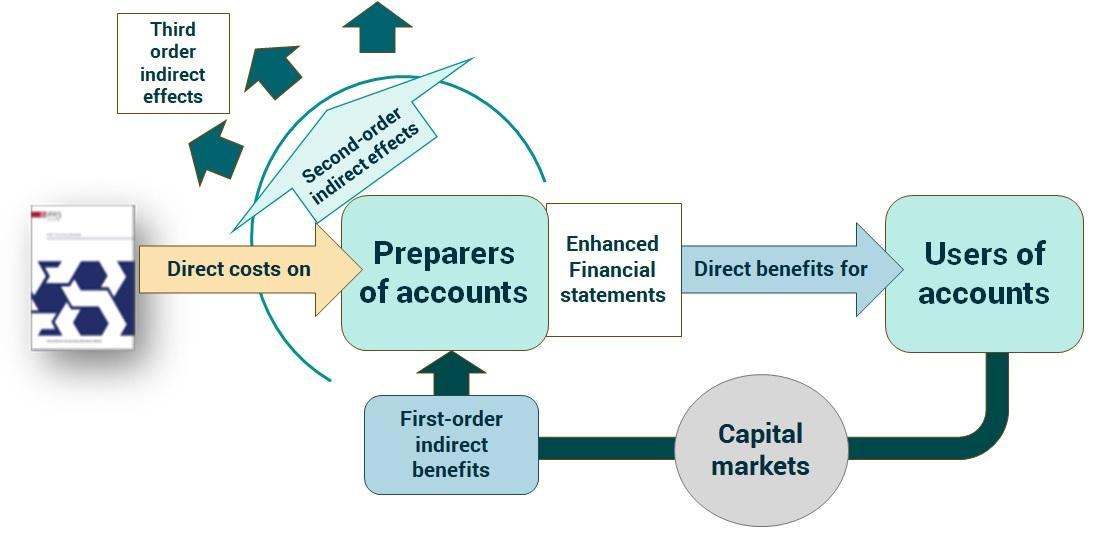
Source: UKEB
Collection of evidence
4.70 To assess wider economic impacts, the UKEB collected evidence using a range of research tools, as follows:
- Surveys: Both UKEB surveys contained questions on transmission mechanisms and indirect economic effects.
- Cost of capital analysis: The UKEB developed a methodology to assess whether, at a market level, capital market effects potentially associated with the application of IFRS 18 may deliver indirect monetary benefits that would allow preparers to indirectly recover implementation costs. The methodology also allows the assessment of the plausibility of the results.
- Qualitative analysis: The UKEB assessed second- and third-order economic effects qualitatively, using desk-based research and economic reasoning 43.
Transmission mechanisms
Preparers
4.71 The UKEB Preparer survey included questions on the wider economic impact of IFRS 18, focusing on transmission mechanisms.
4.72 Preparers were asked to indicate the extent to which they expected the implementation of IFRS 18 to affect management's stewardship and other transmission mechanisms, such as whether IFRS 18 would affect how information circulates within an entity or internal processes.
4.73 Management's stewardship: Respondents were asked to indicate whether they expected IFRS 18 to affect:
- Presentation of management's use of economic resources to users: 61% of respondents indicated that they anticipate no effect.
- Transparency over management's performance in financial reporting: 53% of respondents indicated that they expected no effects.
- Management's discretion in presenting the entity's financial performance: The opinions on this outcome were divided, with 49% of respondents indicating that they anticipate IFRS 18 to lead to less management discretion in presenting entities' financial performance. However, 42% of respondents indicate that they anticipate no effect.
4.74 On balance, preparers' views were that IFRS 18 is unlikely to affect management's stewardship.
4.75 Other transmission mechanisms: Respondents were asked to indicate whether they expected IFRS 18 to affect:
- How information circulates within the organisation.
- Streamlining of internal systems and processes.
- Disclosure of proprietary information, where more disclosures were interpreted to be a negative effect.
- Competitors' assessment of the entity's performance, where a better assessment was interpreted to have a negative effect.
- Internal assessment of competitors' financial performance, where a better assessment was interpreted to have a positive effect.
- Risk of litigation, where lower risk was interpreted to have a positive effect.
4.76 Respondents either clearly indicated that no effect was expected or had split opinions with no clear pattern emerging. On balance, preparers' views were that IFRS 18 is unlikely to affect any of the above outcomes.
Users
4.77 The UKEB User survey asked respondents to indicate whether the Standard would affect a number of transmission mechanisms.
4.78 On the items listed below, users indicated that IFRS 18 will either slightly improve or greatly improve their ability to analyse financial statements: 44
- Compare entities' performance over multiple periods (74%).
- Assess an individual entity's performance (74%).
- Compare entities' performance with other entities (74%).
- Conduct research (68%).
- Understand how entities measure their own performance (58%).
- Allocate time spent analysing financial statements efficiently (58%).
4.79 Only 32% of respondents indicated that IFRS 18 would help users better assess a company's solvency and only 37% of respondents indicated that IFRS 18 would enhance users' ability to conduct credit ratings. These results are not surprising, considering that IFRS 18 mainly deals with the presentation of financial performance (and therefore is not likely to alter balance sheet line items or balance sheet ratios). It is worth noting that unlisted entities include unlisted groups which may access external finance even if they don't rely on public capital markets. Moreover, in some specific circumstances (e.g. absence of intra-group guarantees), lenders also consider subsidiaries' financial statements in detail. Therefore, improvements to the structure of the statement of financial performance, better aggregation and disaggregation criteria, and MPMs, to the extent that they are used by subsidiaries, would help users of these entities assess the financial performance and position of entities and enhance their decision-making.
4.80 There was a suggestion that IFRS 18 could be helpful to lenders, because:
- For some lenders (e.g. leveraged finance specialists) adjusted EBITDA is an important metric. Paragraph 118 of IFRS 18 permits the disclosure of a subtotal (i.e. operating profit or loss before depreciation, amortisation and impairments within the scope of IAS 36 Impairment of Assets, or ‘OPDAI’) 45 that provides similar information to many of the EBITDA measures currently provided. If a company provides an EBITDA subtotal in its public communications that is not calculated in the same way as OPDAI, that subtotal would be an MPM, so the entity will need to provide disclosures about how it is calculated.
- Better principles for disaggregation would give some items greater visibility in the primary financial statements and provide information on the key drivers of cost (i.e. whether cost is part of their operating business).
4.81 It is worth noting that unlisted entities include unlisted groups which may access external finance even if they don't rely on public capital markets. Moreover, in some specific circumstances (e.g. absence of intra-group guarantees), lenders also consider subsidiaries' financial statements in detail 46. Therefore, improvements to the structure of the statement of financial performance, better aggregation and disaggregation criteria, and MPMs, to the extent that they are used by subsidiaries, would help users of these entities assess the financial performance and position of entities and enhance their decision-making.
First-order indirect effects - capital market effects
4.82 This section applies a methodology developed by the UKEB to assess whether, at a market level, capital market effects potentially associated with the application of IFRS 18 may deliver indirect monetary benefits that would allow preparers to indirectly recover implementation costs. The methodology is based on evidence, grounded in research, and makes use of updated market data.
4.83 The analysis that follows shows that small and plausible market-wide reductions in the cost of capital would be enough for UK-listed entities applying IFRS to indirectly recover their implementation costs in the medium- to long-term.
Background information
4.84 Users suggested that they may improve decision-making and enhance their capital allocation decisions on securities markets as a result of IFRS 18.
4.85 In line with economic theory and evidence, improved presentation of accounts resulting from IFRS 18 requirements should lead to enhanced trading activity, more liquidity, and a reduction in bid/ask spreads on securities markets 47. Investors may demand lower returns for holding securities. In the longer term:
- Market-wide cost of capital on public capital markets might go down 48.
- The prices of publicly traded securities might, on average, increase 49.
4.86 Preparers indicated that they expect to incur direct costs associated with the implementation of IFRS 18. However, to the extent that capital market effects materialise (e.g. a market-wide decrease in cost of capital and/or a consequent increase in market capitalisation), preparers would reap indirect benefits in the longer term. These may allow preparers to partly cover, break even on, or even outweigh implementation costs, albeit indirectly.
4.87 The analysis that follows permits us to:
- quantify the magnitude of capital market effects that would allow preparers to recover implementation costs in the medium- to long-term; and
- assess whether these magnitudes are plausible.
4.88 The figures obtained are not predictions of securities prices' trends or cost of capital reductions associated with IFRS 18 and should not be interpreted as such.
Effects considered
4.89 The methodology considers the following concurrent market-wide effects potentially associated with the introduction of an accounting standard:
- An increase in market capitalisation, leading to an increase of shareholders' wealth at a market level 50.
- A decrease in the cost of equity, leading to more projects funded through public equity capital at a market level.
- An increase in the outstanding value of listed bonds, leading to an increase of bondholders' wealth at a market level.
- A decrease in the cost of debt, leading to more projects funded through public debt capital at a market level.
4.90 Table 6 shows the interaction between these market-wide effects:
| Equity | Debt | |
|---|---|---|
| Securities already issued (wealth effects) | Increase in market capitalisation | Increase in the outstanding value of corporate bonds |
| Securities to be issued in the future (investment effects) | Decrease in the cost of equity leading to more projects funded through public equity | Decrease in the cost of debt leading to more projects funded through publicly traded corporate bonds |
Source: UKEB
4.88The figures obtained are not predictions of securities prices' trends or cost of capital reductions associated with IFRS 18 and should not be interpreted as such.
Effects considered
4.89The methodology considers the following concurrent market-wide effects potentially associated with the introduction of an accounting standard:
- An increase in market capitalisation, leading to an increase of shareholders' wealth at a market level.
- A decrease in the cost of equity, leading to more projects funded through public equity capital at a market level.
- An increase in the outstanding value of listed bonds, leading to an increase of bondholders' wealth at a market level.
- A decrease in the cost of debt, leading to more projects funded through public debt capital at a market level.
4.90Table 6 shows the interaction between these market-wide effects:
| Equity | Debt | |
|---|---|---|
| Securities already issued (wealth effects) | Increase in market capitalisation | Increase in the outstanding value of corporate bonds |
| Securities to be issued in the future (investment effects) | Decrease in the cost of equity leading to more projects funded through public equity | Decrease in the cost of debt leading to more projects funded through publicly traded corporate bonds |
Source: UKEB
4.91These effects are likely to be correlated, for example because a reduction in the cost of capital would lead to projects being funded through equity/debt in the future but also to changes in the market value of securities 51. Nonetheless, they should be considered as separate effects as:
- the effect on cost of capital on future capital flows is of interest to entities that plan to raise capital in the future; but
- increases in the value of traded securities affect the market in its entirety.
Application of the methodology
4.92Market-wide implementation costs for preparers are the starting point for the analysis. The UKEB estimated market-wide implementation costs (one-off and ongoing costs) for preparers to be approximately £400 million (see paragraph 4.64).
4.93The UKEB considered a hypothetical scenario where:
- 75% of the costs are recovered through equity markets (equally split between an increase in market capitalisation and an increase in the value of projects funded through equity); and
- 25% of the costs are recovered through bond markets (equally split between an increase in the value of bonds outstanding and an increase in the value of projects funded through fixed income). 52
4.94Table 7 below shows that the following capital effects need to materialise for preparers to recover implementation costs in the medium- to long-term:
| Chosen scenario | Proportion of implementation costs assigned to each potential capital market effect | Potential capital effects associated with the adoption of IFRS 18 in basis points |
|---|---|---|
| Increase in market capitalisation | 37.5% | 0.5 Bps |
| Decrease in the cost of equity leading to more projects funded through public equity | 37.5% | 3.2 Bps |
| Increase in the outstanding value of corporate bonds | 12.5% | 0.6 Bps |
| Decrease in the cost of debt leading to more projects funded through publicly traded corporate bonds | 12.5% | 0.2 Bps |
Note: allocations are arbitrary. Appendix E contains results associated with different allocations. Source: UKEB calculations based on LSE and Reuters-Eikon data. A basis point is a hundredth of a percentage point. Increases in the market value of securities would affect the market in its entirety. Increases in the value of projects funded through equity/debt would affect only companies that plan on raising funds through capital markets in the future. It is acknowledged that these concurrent effects are likely to be correlated.
4.95The analysis suggests that to allow preparers to recover implementation costs of approximately £400 million (see paragraph 4.64) the following effects should happen concurrently:
- Increase in market capitalisation: Market capitalisation for the UK listed market should increase by £146 million, or 0.5 Bps (basis points) using its value as of October 2024 (£2.69 trillion) 53.
- Decrease in the cost of equity leading to more projects funded through public equity: Cost of equity should decrease by 3.2 Bps for the present value (PV) of projects funded through equity to increase by £146 million (the present value of equity issuances over a ten-year forecast is equal to £143 billion; baseline cost of equity: 11.23%).
- Increase in the outstanding value of corporate bonds: The outstanding value of corporate bonds issued by UK companies on public bond markets should increase by £49 million, or by 0.6 Bps using its value as of October 2024 (£759 billion).
- Decrease in the cost of debt leading to more projects funded through publicly traded corporate bonds: Cost of debt should decrease by 0.2 Bps for the PV of projects funded through debt to increase by £49 million (present value of public corporate bond issuances over a ten-year forecast is equal to £491.75 billion; baseline cost of debt: 5.03%).
4.96The UKEB considered that the figures obtained are plausible 54. A plausibility assessment is reported in Appendix E. It is caveated that the results cannot be used to conclude or predict what capital market effects will materialise, if any, as a result of IFRS 18.
4.97The analysis shows that small and plausible reductions in market-wide cost of capital would be enough for UK-listed entities applying IFRS to indirectly recover their implementation costs in the medium- to long-term.
Potential impact on new public listings
4.98It is possible that:
- presenting additional subtotals such as OPDAI; and
- reconciling MPMs with the most directly comparable subtotal,
may help users of financial statements involved in public equity listings (e.g. underwriters, nominated advisors) better contextualise entities' financial performance. To the extent that reporting requirements in IFRS 18 convey better information that can facilitate public equity listings, this may represent a small incentive for entities to list on UK public equity markets.
Second-order indirect effects
Effects on management compensation schemes, covenants, dividend payments and tax obligations
4.99The UKEB Preparer survey asked respondents to indicate whether IFRS 18 is anticipated to affect the following items:
- Management compensation schemes.
- Covenants.
- Dividend payments.
- Tax obligations that may arise from changes in accounting line items.
4.100Most preparers expected no effect on any of these items. A preparer commented that “the new standard won't have impact on measurement. Presentational differences from a statutory perspective will not impact any of the above measures".
Other second-order indirect effects
4.101The following second-order microeconomic effects on preparers are discussed:
- Effects on product or pricing decisions: The requirements of IFRS 18 are not expected to affect the underlying economics that determines the prices charged or the nature of products supplied by entities. Therefore, no effects on product and pricing decisions are expected.
- Effects on competition: IFRS 18 is not anticipated to affect the determinants of competition between entities (e.g. product or pricing decisions or barriers to entry or exit). IFRS 18 is anticipated to provide more comparable information about preparers, thus potentially enhancing preparers' ability to benchmark or assess their competitors. This suggests that IFRS 18 may have a minor role in fostering a competitive economic environment between entities.
- An increase/reduction in preparers' economic output or productivity: The changes in presentation and disclosure requirements in IFRS 18 are not expected to affect the preparers' output, or their productivity. However, a reduction in the cost of capital that may materialise as a result of implementing IFRS 18 may lead to an increase in capital investment.
- An increase/reduction in capital investments: IFRS 18 is not anticipated to directly alter preparers' output outlook or their strategic vision for the future and therefore is not likely to affect the entity's long-term capital needs. However, it is noted that a potential reduction in the cost of capital associated with IFRS 18 may lead preparers to fund more projects through public equity or debt, resulting in higher investment and/or a different capital structure.
Third-order indirect effects
Network effects
4.102IFRS 18 is not expected to be associated with network effects. Industries where network externalities are present (e.g. tech) are not likely to be more or less affected than other industries by IFRS 18. The requirements are not anticipated to affect the number of people accessing the platforms or services provided by such entities.
Externalities
4.103Economists view the provision of publicly available financial reporting as a positive externality, affecting parties that are beyond the capital markets ecosystem (such as regulators, tax agencies, other stakeholders) 55. Therefore, enhancements to financial reporting brought by IFRS 18 are expected to improve the quality of the "public good” provided by preparers. This is a small, positive economic effect. It should be noted that the requirements of IFRS 18 are not anticipated to generate negative externalities.
Macroeconomic effects, including economic growth
4.104No significant macroeconomic effects are anticipated as a direct result of IFRS 18 requirements. However, as noted in the First-order indirect effects - capital market effects section, IFRS 18 could:
- Positively affect the prices of traded securities. This would translate into higher shareholders' and bondholders' wealth.
- Reduce cost of capital. If actualised, this would translate into enhanced investment opportunities for entities applying IFRS 18.
4.105To the extent that capital market effects materialise, they could have a small positive effect on the consumption and investment components of GDP. The UKEB assessment is that IFRS 18 is not anticipated to have negative effects on economic growth.
Summary of the analysis of wider economic effects
4.106The analysis of wider economic effects suggests that:
- IFRS 18 may plausibly lead to market-wide capital market effects that would benefit preparers in the medium- to long-run. A quantitative analysis of such effects conducted using an in-house methodology suggests that preparers may indirectly recover their implementation costs. The UKEB cannot predict, however, whether any such effects will materialise and, if so, of what magnitude.
- Capital market effects, to the extent that they materialise, could have a small positive effect on the consumption and investment components of GDP.
- IFRS 18 is not expected to lead to wider economic effects that are detrimental to the UK economy, including on economic growth.
Consideration of the consequences of not adopting IFRS 18 (counterfactual analysis)
4.107This section considers the consequences of not adopting IFRS 18 for use in the UK (the 'non-adoption scenario'). The analysis assumes that IFRS 18 is widely adopted in other jurisdictions.
4.108In a non-adoption scenario, UK entities applying UK-adopted international accounting standards would not incur incremental costs associated with the adoption of the standard (see paragraph 4.64 for a market-wide estimate of implementation costs).
4.109However, in a non-adoption scenario, benefits for users associated with the adoption of IFRS 18 would not materialise. UK and overseas investors may redirect funds to jurisdictions that apply IFRS 18. In the long-term, non-adoption of IFRS 18 would be likely to have an adverse effect on UK capital markets, potentially leading to an increase in the cost of capital or reductions in the price of their traded securities for UK entities. The size and importance of UK capital markets are likely to play a key role in retaining investor interest and capital, which is a mitigating factor. However, in line with the analysis shown in paragraphs 4.81–4.96, even small adverse capital market effects (such as cost of capital increases) may lead to indirect adverse effects to companies in the medium- to long-term. These would likely outweigh implementation costs associated with the adoption of the standard itself 56.
4.110In addition, non-adoption may lead to some other adverse wider economic effects, for example:
- Entities in other jurisdictions using IFRS 18 may be able to attract additional sources of capital and potentially benefit from a lower cost of capital, which could provide them with a competitive advantage over UK companies.
- UK unlisted entities that apply UK-adopted international accounting standards may choose to list in jurisdictions that apply full IFRS.
4.111Finally, feedback from preparers suggested that UK listed entities cross-listed abroad could incur extra costs if UK-adopted international accounting standards were to deviate from IFRS Accounting Standards as issued by the IASB. However, cross-listed entities may still have to apply IFRS 18 to their financial statements. For example, entities cross-listed in the US filing a Form 20-F can prepare their financial statements using IFRS Accounting Standards as issued by the IASB. That would limit potential negative capital market effects for these entities.
4.112These considerations suggest that, on balance, not adopting IFRS 18 for use in the UK would have a potentially detrimental effect on the UK economy.
[Tentative] Overall assessment of long term public good
4.113There are three aspects to consider when assessing whether the use of IFRS 18 is likely to be conducive to the long term public good in the UK. These are:
- Whether IFRS 18 is likely to improve the quality of financial reporting.
- The costs and benefits that are likely to result from the use of IFRS 18.
- Whether the use of IFRS 18 is likely to have an adverse effect on the economy of the UK, including on economic growth.
4.114The conclusions drawn on each of these aspects as summarised below.
Quality of financial reporting
4.115Implementation of IFRS 18 is likely to improve the quality of financial reporting by specifying enhanced presentation and disclosure requirements for the financial statements. This will lead to financial reporting that is more useful to investors and other users of accounts, providing information that is more relevant, reliable and transparent. The new requirements in IFRS 18 are also likely to facilitate comparability and lead to clearer presentation and disclosure of information in the financial statements.
Costs and benefits
4.116Users anticipate significant benefits from the application of IFRS 18. For example, users reported that the enhanced presentation of financial performance brought by IFRS 18 should result in more efficient use of time spent analysing financial statements and an increase in the quality of analysis/reports. Users also indicated that they anticipate incurring minimal implementation costs.
4.117Preparers indicated that they will incur both one-off and ongoing incremental costs as a result of applying IFRS 18, though they expect them to be small. Preparers expect one-off costs to be largely associated with extra audit fees, familiarisation and changes to templates. Preparers expect ongoing implementation costs to be much lower that one-off implementation costs, and to be subsumed into business as usual in a few years' time.
Effect on the economy of the UK
4.118While it is acknowledged that preparers will incur most of the direct compliance costs, the fact that users expect to reap benefits from the increased transparency arising from the implementation of IFRS 18 suggests that their capital allocation decisions may improve. Enhanced capital allocation may translate into beneficial capital market effects, such as an appreciation of traded securities or a reduction in the cost of capital for entities.
4.119The analysis of wider economic effects suggests that IFRS 18 may plausibly lead to wider capital market effects that would benefit preparers in the medium- to long-run. A quantitative analysis of such effects conducted using an in-house methodology suggests that small and plausible market-wide reductions in the cost of capital would be enough for UK-listed entities applying IFRS to indirectly recover their implementation costs in the medium- to long-term. The UKEB cannot predict however whether any such effects will materialise and, if so, of what magnitude.
4.120Any capital market effects associated with the application of IFRS 18, to the extent that they materialise, could have a small positive effect on the consumption and investment components of GDP.
4.121IFRS 18 is not expected to lead to wider economic effects that are detrimental to the UK economy, including on economic growth.
Counterfactual analysis
4.122Overall, not implementing IFRS 18 for use in the UK would have a potentially negative outcome from the perspective of the UK long term public good.
[Tentative] Overall assessment
4.123The tentative assessment is based on the joint consideration of the evidence reported above.
4.124Overall, based on a holistic assessment of the evidence reported in this section, the UKEB considered that the use of IFRS 18 is likely to be conducive to the long term public good in the UK.
5. Section 5: True and fair view assessment
Introduction
5.1This section considers whether IFRS 18 is not contrary to the true and fair view principle for individual and consolidated accounts.
Legislative basis and our approach to the assessment
5.2The UKEB is required to consider whether an international accounting standard being assessed for use in the UK meets certain legislative criteria set out in Regulation 7 (1) of SI 2019/685. The first criterion set out in that regulation requires that an international accounting standard can be adopted only if:
"[....] the standard is not contrary to either of the following principles-
- an undertaking's accounts must give a true and fair view of the undertaking's assets, liabilities, financial position and profit or loss;
- consolidated accounts must give a true and fair view of the assets, liabilities, financial position and profit or loss of the undertakings included in the accounts taken as a whole, so far as concerns members of the undertaking; [....]”
5.3In this section of the [Draft] ECAECA we consider whether IFRS 18 meets this endorsement criterion. For the sake of brevity, we refer to our assessment against this endorsement criterion as 'the true and fair view assessment' and to the principles set out in Regulation 7(1)(a) as the ‘true and fair view principle'. However, these abbreviated expressions do not imply that our assessment has considered anything other than the full terms of the endorsement criterion set out above.
5.4The duty of the UKEB under Regulation 7(1)(a) is to determine generically, before a standard is applied to a set of accounts, whether that standard is 'not contrary' to the true and fair view principle. In other words, it is an ex-ante assessment. We have therefore considered whether IFRS 18 contains any requirement that would prevent accounts prepared using the standard from giving a true and fair view.
5.5Our approach is to determine whether IFRS 18 is not contrary to the true and fair view principle in respect of any of the items identified in Regulation 7(1)(a) (namely, the assets, liabilities, financial position and profit or loss) in the context of the preparation of the accounts as a whole. In carrying out our assessment of the impact of IFRS 18, we have also considered the disclosures required by the Standard and its interaction with other UK-adopted international accounting standards.
5.6For the purposes of our assessment, we consider the requirement in paragraph 15 of IAS 1 for financial statements to “present fairly the financial position, financial performance and cash flows of an entity" 57 to be equivalent to the Companies Act 2006 requirement for accounts to give a true and fair view. IFRS 18 has moved paragraphs 15–24 of IAS 1 relating to fair presentation to IAS 8 (as paragraphs 6A-6J). Text moved to IAS 8 was left unchanged. This change is effective on 1 January 2027.
5.7Our assessment is separate from the duty of directors under section 393(1) of the Companies Act 2006, which requires directors to be satisfied that a specific set of accounts gives a true and fair view of an undertaking's or group's assets, liabilities, financial position and profit or loss.
Interaction with other UK-adopted international accounting standards
5.8We have considered whether any requirement of IFRS 18 would necessarily create distortions in its interaction with other UK-adopted international accounting standards. IFRS 18 introduces presentation and disclosure requirements that improve the relevance of financial information and do not change the recognition and measurement of the items in the financial statements. Therefore, it is unlikely that IFRS 18 will have a negative impact on other UK-adopted international accounting standards.
5.9[Tentative] In addition, feedback from stakeholders and our own assessments of significant technical accounting issues in Section 3 and in Appendix B have not indicated that any distortions arising from the interaction of IFRS 18 with other UK-adopted international accounting standards are a major concern for UK stakeholders.
[Tentative] assessment True and fair view assessment
5.10[Tentative] [Consultation feedback on the [Draft] ECAECA indicated that stakeholders generally agreed with the UKEB's tentative conclusion that IFRS 18 was not contrary to the true and fair view principle].
5.11Section 3 of this [Draft] ECAECA concludes that IFRS 18 as a whole meets the technical accounting criteria. The technical accounting criteria refer to reliability which includes the notion of faithful representation of the economic substance of transactions and events (see Section 1 of the [Draft] ECAECA). The technical accounting criteria assessment therefore further underpins the overall true and fair view assessment.
5.12Our assessment has not identified any requirement of IFRS 18 that would prevent individual accounts prepared using the Standard from giving a true and fair view of the entity's assets, liabilities, financial position and profit or loss. We are satisfied, therefore, that the circumstances in which the application of IFRS 18 would result in accounts which did not give a true and fair view would be extremely rare.
5.13SI 2019/685 requires an assessment of whether IFRS 18 is not contrary to the true and fair view principle for both individual and consolidated accounts. We have not identified any reason why the IFRS 18 true and fair view assessment should conclude differently for consolidated accounts.
[Tentative] Overall conclusion
5.14[Overall, therefore, we conclude that IFRS 18 is not contrary to the true and fair view principle set out in Regulation 7 (1) (a) of SI 2019/685.]
6. Section 6: Is IFRS 18 likely to lead to a significant change in accounting practice?
Introduction
6.1This section considers whether IFRS 18 is likely to lead to a significant change in accounting practice.
UK statutory requirements
6.2Paragraphs 1-4 of Regulation 11 of SI 2019/685 require a review of the impact of the adoption of an international accounting standard 58 when this standard is likely to lead to a significant change in accounting practice. These paragraphs are reproduced below (emphasis added):
"(1) The Secretary of State must publish a statement setting out the Secretary of State's policy on what amounts to a significant change in accounting practice, and must keep this policy statement under review.
(2) Paragraphs (3) and (4) apply in relation to the adoption of any standard by the Secretary of State under regulation 6 which the Secretary of State considers likely to lead to a significant change in accounting practice.
(3) The Secretary of State must-
- carry out a review of the impact of the adoption of the standard; and
- publish a report setting out the conclusions of the review no later than 5 years after the date on which the standard takes effect (being the first day of the first financial year in respect of which it must be used).
(4) The Secretary of State may carry out subsequent reviews from time to time, and in the event of doing so the Secretary of State must publish a report setting out the conclusions of any review conducted."
Due Process Handbook requirements
What constitutes a significant change in accounting practice?
6.3Paragraph 1 of Regulation 11 of SI 2019/685 does not define the term 'significant change in accounting practice'. However, it does require the UKEB to publish a statement setting out its policy on what amounts to a significant change in accounting practice. This can be found in paragraph 8.6 of the UKEB Due Process Handbook:
Whether or not a standard adopted under Regulation 6 is likely to lead to a 'significant change in accounting practice' will usually depend on the number of entities affected and the impact on those entities and may require judgement. It usually occurs when a new standard is issued by the IASB.
Approach to the assessment
6.4In this section we consider whether IFRS 18 is likely to lead to a 'significant change in accounting practice'.
6.5The UKEB has considered for this assessment:
- the number of entities that will be affected by IFRS 18; and
- the potential impact on entities applying the requirements in IFRS 18.
The number of entities that will be affected by IFRS 18
6.6As discussed in Section 2 (paragraphs 2.7–2.10) IFRS 18 will impact all entities across all sectors that prepare financial statements using UK-adopted international accounting standards. In other words, all entities listed on the London Stock Exchange will be required to apply it. Additionally, approximately 14,000 unlisted entities that use the option in UK law to use UK-adopted international accounting standards will also be required to adopt it. These entities will be required to apply IFRS 18 retrospectively from 1 January 2027, with earlier application permitted (subject to the UKEB adoption in the UK).
Potential impact on entities applying the requirements in IFRS 18
6.7IFRS 18 is a new general standard on presentation and disclosure in financial statements that will replace IAS 1.
6.8IFRS 18 is not expected to bring a significant change in accounting practice as:
- Approximately 80% of the requirements in IAS 1 have been carried forward into IFRS 18 (or into IAS 8 or IFRS 7) with limited or no changes. Likewise, a few of the new requirements in IFRS 18 are based on previous requirements in IAS 1 (see Tables 3–5 in Section 2, paragraphs 2.18–2.20).
- It does not include requirements on how entities recognise and measure items in the financial statements. This means that entities will continue applying the same recognition and measurement principles in measuring financial performance (i.e. it will not affect net profit after interest and tax). This means that IFRS 18 is not fundamentally changing the way financial information is generated.
- It introduces new presentation and disclosure requirements mainly aimed at improving the relevance (e.g. aggregation requirements), reliability (e.g. requirements on MPMs) and comparability of the financial statements. It also enhances how information about financial performance is communicated in the financial statements.
- The current practices for reporting financial information in the UK may already be consistent with some of the new requirements in IFRS 18. For example, the results from the UKEB Preparer survey indicated that some respondents may already be:
- Presenting the results from equity-accounted investments outside their main business operations.
- Presenting their adjusted performance measures in the financial statements and/or providing information about the tax for each reconciling item and about the effects of non-controlling interests for each reconciling item.
- Disclosing information on the five specified operating expenses by nature.
- The implementation of IFRS 18 may help entities reconsider their presentation and disclosure practices to consider whether improvements to those practices can be made (in terms of changes to its systems, charts of accounts or mappings). However, as discussed in Section 4 these changes are not expected to be costly or significant.
[Tentative] Overall conclusion
6.9Having considered the above and acknowledging that IFRS 18 will impact all entities across all sectors that prepare financial statements using UK-adopted international accounting standards, the UKEB does not consider that IFRS 18 will bring a significant change in the way all entities communicate information in the primary financial statements and the notes. As a result, it [tentatively] concludes that IFRS 18 is not likely to lead to a significant change in accounting practice and does not meet the criteria for a post-implementation review (PIR) under Regulation 11 in SI 2019/685.
Footnotes
Appendix A: Glossary
| Term | Description |
|---|---|
| AAG | Academic Advisory Group – provided feedback on the survey design and on the impact of the requirements in IFRS 18. AAG is an advisory group that reports to the UKEB Board. |
| AFIAG | Accounting Firms & Institutes Advisory Group (AFIAG) – provided feedback on the impact of the requirements in IFRS 18. AFIAG is an advisory group that reports to the UKEB Board. |
| AIM | Alternative Investment Market. A sub-market of the London Stock Exchange that is not a 'regulated market' |
| APMs | Alternative Performance Measures |
| The Standard | IFRS 18 Presentation and Disclosure in Financial Statements |
| DBT | Department for Business and Trade (formerly 'Department for Business, Energy and Industrial Strategy' (BEIS)) |
| [Draft] ECA | Draft Endorsement Criteria Assessment |
| ECA | Endorsement Criteria Assessment |
| ED | Exposure Draft |
| EFRAG | European Financial Reporting Advisory Group |
| ESMA | European Securities and Markets Authority |
| EU | European Union |
| Term | Description |
|---|---|
| FCA | The Financial Conduct Authority |
| FCL | Final Comment Letter |
| FIWG | Financial Instruments Working Group (FIWG) provided feedback on the impact of the requirements in IFRS 18. FIWG is a working group that reports to the UKEB Secretariat. |
| FRC | Financial Reporting Council |
| IAG | Investor Advisory Group (IAG) provided feedback on the impact of the requirements in IFRS 18. IAG is an advisory group that reports to the UKEB Board. |
| IAS 1 | IAS 1 Presentation of Financial Statements |
| IAS 2 | IAS 2 Inventories |
| IAS 7 | IAS 7 Statement of Cash Flows |
| IAS 8 | IAS 8 Accounting Policies, Changes in Accounting Estimates and Errors (IFRS 18 changed the title of IAS 8 to Basis of Preparation of Financial Statements) |
| IAS 27 | IAS 27 Separate Financial Statements |
| IAS 28 | IAS 28 Investments in Associates and Joint Ventures |
| IAS 34 | IAS 34 Interim Financial Reporting |
| IAS 36 | IAS 36 Impairment of Assets |
| IASB | International Accounting Standards Board |
| IASB Effects Analysis | The IFRS Accounting Standards Effects Analysis for IFRS 18, issued by the IASB in April 2024 |
| Term | Description |
|---|---|
| IFRS | International Financial Reporting Standard(s) |
| IFRS 10 | IFRS 10 Consolidated Financial Statements |
| IFRS 15 | IFRS 15 Revenue from Contracts with Customers |
| IFRS 16 | IFRS 16 Leases |
| IFRS 17 | IFRS 17 Insurance Contracts |
| IFRS 18 | IFRS 18 Presentation and Disclosure in Financial Statements |
| LSE | London Stock Exchange |
| NCI(s) | Non-controlling interest(s) |
| PAG | Preparer Advisory Group (PAG) – provided feedback on the impact of the requirements in IFRS 18. PAG is an advisory group that reports to the UKEB Board. |
| Primary financial statements | The following statements and their comparative information are referred to as 'primary financial statements'. They include:
|
| SI 2019/685 | UK Statutory Instrument 2019/685: The International Accounting Standards and European Public Limited-Liability Company (Amendment etc.) (EU Exit) Regulations 2019 (SI 2019/685). |
| Term | Description |
|---|---|
| Listed small- and medium-cap entities | Listed small- and medium-cap entities refer to entities with relatively lower market capitalisations compared to large-cap (blue-chip) corporations. Market capitalisation (market cap) is the total value of an entity's outstanding shares, calculated by multiplying the share price by the number of shares available. |
| UKEB | UK Endorsement Board |
| UKEB Preparer survey | The on-line survey conducted with preparers of financial information by the UKEB from July–September 2024 |
| UKEB User survey | The on-line survey conducted with users of financial information by the UKEB from July–September 2024 |
| UKEB surveys | The on-line surveys conducted with preparers and users of financial information by the UKEB from July–September 2024 |
Appendix B: Individual assessment of technical issues raised by UK stakeholders
Introduction
B1The approach to the assessment of IFRS 18 against the technical accounting criteria (that is specified in SI 2019/685 Regulation 7(1)(c)) is set out in Section 3 of this [Draft] ECAECA. This Appendix includes an individual assessment against the technical accounting criteria of specific technical issues where UK stakeholders raised some practical challenges.
B2The technical accounting issues assessed in this Appendix are:
- Issue 1: Classification of income and expenses from associates and joint ventures accounted for using the equity method in the investing category.
- Issue 2: Accounting policy choice for the classification of income and expenses for entities that provide financing to customers.
- Issue 3: Disclosure of the income tax effect and the effect on non-controlling interests (NCIs) in the management-defined performance measures (MPM) reconciliation.
Issue 1: Classification of income and expenses from associates and joint ventures accounted for using the equity method in the investing category
IFRS 18 requirements
B3IFRS 18 requires entities to classify all income and expenses from investments in associates and joint ventures accounted for using the equity method ('equity-accounted investments') in the investing category of the statement of profit or loss. This includes (a) the entity's share of profit or loss from associates, joint ventures and unconsolidated subsidiaries; and (b) other income and expenses from those investments (e.g. impairment losses). This approach reflects that investments in associates and joint ventures generate returns individually and largely independent of the entity's other resources.
B4This is consistent with other income and expenses classified in the investing category. The same presentation requirement applies to income and expenses
B5from subsidiaries in separate financial statements accounted for using the equity method in accordance with paragraph 10(c) of IAS 27 Separate Financial Statements.
B6In addition, the transitional provisions in paragraph C7 of IFRS 18 allow an eligible entity to apply paragraph 18 of IAS 28 Investments in Associates and Joint Ventures59 to change its election for measuring an investment in an associate or joint venture from the equity method to fair value through profit or loss (FVTPL) in accordance with IFRS 9 Financial Instruments at the date of initial application of IFRS 18 and to classify the income and expenses from such investments in the operating category when they are investments as a main business activity.
Accounting impact
B7IAS 160 requires the separate presentation of the share of the profit or loss of associates and joint ventures accounted for using the equity method without specifying where this line item should appear in the statement of profit or loss. The requirements in IFRS 18 will change the presentation of this item, where an entity considers that its associates and joint ventures are ‘integral' to its main business activities.
B8The results from the UKEB Preparer survey revealed that some entities in the insurance, utilities or banking sectors in the UK have 'integral' investments in associates and joint ventures. Respondents to this survey were of the view that entities should have flexibility to classify equity-accounted investments in the operating category when these investments are considered:
- part of the entity's main business operations; or
- strategic partnerships. For example, joint ventures are commonly used in large-scale infrastructure projects that require substantial capital to develop and structure large-scale infrastructure projects.
B9In their view requiring the classification of the results from 'integral' investments in 'investing' (i.e. outside the operating category) may not allow users to understand the true nature and strategic value of these investments within the entity's main business operation.
B10Another example is entities with specified main business activities such as insurance entities investing in assets. Respondents to the UKEB Preparer survey emphasised the importance of presenting income and expenses from investments in associates and joint ventures that are linked to insurance contracts (e.g. that are backing up liabilities) within the operating category. This is because it is common practice to include those results as part of 'net financial result' (investment income minus insurance finance income and expenses) which is an important indicator of an insurer's operating performance. IFRS 18 in their view would generate a mismatch as the operating category would contain insurance finance income and expenses from insurance contract liabilities but might not contain all the associated investment income from the assets held to service those liabilities. Some insurance entities consider that this may prevent users from understanding and correctly evaluating their performance.
B11These concerns have been acknowledged by the IASB (for example, in paragraphs BC114-BC115 of IFRS 18's Basis for Conclusions). The IASB concluded that specifying the location of income and expenses from equity-accounted investments in associates and joint ventures in a single category (i.e. the investing category) for all entities (including those that invest in assets as a specified main business activity):
- Provides users with a consistent starting point for their analysis.
- Is consistent with the way users of financial statements use information to analyse investments in associates and joint ventures. In this respect, users typically consider the results of equity-accounted investments to be different from other results, for instance because they are a blend of different amounts (i.e. operating, investing, financing and tax amounts of the investee). In addition, the investing entity does not control these results as it exercises only significant influence over an associate or joint control over a joint venture.
- Avoids making an artificial identification of investments that are considered part of the entity's main business activities which in the IASB's view would have led to:
- complexity and diversity in practice (given that the nature and purpose of investments in associates and joint ventures differ); or
- an opportunistic application of such a requirement.
- Would be entity-specific and it would depend on whether the insurer accounts for these investments using the equity method or measures them at fair value through profit or loss, in which case no mismatch would arise as the insurer would be able to classify those income and expenses within the operating category.
- May be material for some insurers but it did not appear to be pervasive in the insurance industry.
B13This new presentation requirement in IFRS 18 will only impact the entities that have equity-accounted investments. The UKEB Secretariat conducted an analysis of Reuters-Eikon data to ascertain the prevalence of associates and joint ventures accounted for using the equity method among UK listed entities. This requirement may be significant to only a small number of UK entities given that, for 2023 year-ends:
- only 22% of entities in the UK have this type of investment and holdings in associates and joint ventures. The total balance sheet value of these investments was approximately £124 billion as of 2023 year-ends, accounting for 1% of total assets of all listed entities; and
- equity-accounted investments in associates and joint ventures were highly concentrated among few large companies. For instance, the five entities with the largest holdings in joint ventures and associates accounted for nearly 60% of all holdings.
B14This analysis also revealed that equity-accounted investments in joint ventures and associates in the insurance sector were held by about 47% of listed insurers. However, these investments made up a small proportion (0.3%) of the total assets of listed insurers (adding up to £4 billion).
B15The UKEB observes that requirements in IFRS 18 will permit entities to inform users that their equity-accounted investments are closely related to their main business activities. For example, by:
- presenting a line item for income and expenses from investments in associates and joint ventures accounted for using the equity method (if this provides a useful structured summary)61 immediately below its operating profit so that users could consider this line item as part of its analysis;
- presenting an additional subtotal that would add together operating profit and income and expenses from investments in associates and joint ventures accounted for using the equity method. This may be when an entity disaggregates into one or more line items income and expenses from associates and joint ventures with dissimilar characteristics62;
- providing additional information in the notes disclosing any impact on the operating result63;
- disclosing an MPM that adjusts 'operating profit'; and/or
- changing the measurement of an investment in an associate or joint venture from the equity method to FVTPL on transition to IFRS 1864. This change would enable an entity to present the results of those investments as part of the 'operating' category. The results from the UKEB Preparer survey indicated, however, that some respondents did not support the election offered on transition to IFRS 18 because:
- introducing an election would impair comparability across entities in the same sector/industry;
- the election offered on transition is limited to eligible entities;
- using fair value to measure an investment in an associate or joint venture would:
- increase earnings volatility in profit and loss, which may lead to the presentation of additional performance measures;
- add a layer of complexity and subjectivity in the measurement of these investments, for example, in determining the fair value of unlisted investees; and
- be onerous as entities will be required to prepare disclosures under other IFRS Accounting Standards.
Assessment against the technical accounting criteria
B16The UKEB acknowledges the concerns from preparers resulting from classifying the results from all equity-accounted investments in the investing category. In the view of some stakeholders this could lead to the presentation of information that is not relevant or understandable. Some preparers also consider that presenting the results from those investments outside ‘operating' will not provide reliable information of their operating performance.
B17In contrast, users consider that this information will be relevant, reliable and understandable, because requiring a single classification in the investing category better aligns with the way users of financial statements use information to analyse investments in associates and joint ventures and avoids disrupting their analyses of operating margins. Users are also of the view that prescribing a consistent classification for income and expenses of equity-accounted investments will reduce diversity in practice and bring comparability as it will provide a consistent 'anchor' for users for their analysis.
B18The concern expressed by preparers during our outreach activities about the potential lack of understandability of the nature of investments that are integral to an entity's main business activities being excluded from the operating category, can be mitigated by preparers by using other aspects of IFRS 18. Paragraphs B15(a)-(e) above give examples of some different presentations that could help.
Issue 2: Accounting policy choice for the classification of income and expenses for entities that provide financing to customers
IFRS 18 requirements
B19Paragraphs 65–66 of IFRS 18 require an entity that provides financing to customers to sub-categorise the income and expenses derived from liabilities that arise from transactions that involve only the raising of finance into the following:
- If the income and expenses are from liabilities that relate to the provision of finance to customers, these are classified in the ‘operating' category.
- If the income and expenses are from liabilities that do not relate to providing financing to customers, an entity has an 'accounting policy choice' to classify these income and expenses in:
- the financing category; or
- the operating category, when an entity cannot distinguish between liabilities that relate to providing financing to customers and those that do not. The outcome will be that the operating category will include all income and expenses derived from transactions that involve only the raising of finance.
Accounting impact
B20IFRS 18 replaces the requirement in IAS 1 to present ‘finance costs' as a separate line item (paragraph 82(b) of IAS 1) by introducing a separate 'financing' category. An entity that provides financing to customers is also required to follow specific classification requirements for specific types of liabilities (see paragraph B19 above). IFRS 18 also requires the exercise of judgement in determining which line items of income and expense an entity presents to provide a useful structured summary65).
B21As described in paragraph 2.12 approximately 30% of UK-listed entities is expected to have specified main business activities. Entities that provide financing to customers will be able to use the accounting policy choice to present income and expenses that are not related to the provision of financing to customers either in the operating category or in the financing category.
B22The UKEB Secretariat response to the IASB's Exposure Draft General Presentation and Disclosures66 indicated that there is currently diversity of practice in the UK amongst entities that provide finance to customers as a main business activity. For example, it was observed that:
- Entities in the financial sector typically present the income and expenses derived from the provision of finance to customers within the operating category.
- Other (non-financial) entities that provide financing to customers as a main business activity (e.g. entities that manufacture or retail goods as well as providing financing to customers as a main business activity) present the results of the provision of financing to customers either in the operating category or in the financing category.
B23Feedback on the UKEB Preparer survey, revealed that a majority of respondents agreed with the requirements in IFRS 18 for entities with specified main business activities and observed that these requirements will have the following benefits:
- bring more comparability and consistency for investor's analysis;
- provide a more faithful representation of the nature of an entity's main business activities (for example, by excluding from operating profit income and expenses not directly related to an entity's main business activities); and
- allow these entities to portray their operations in a better way by giving them a choice in the presentation of certain income and expenses.
B24Some members of UKEB advisory groups and UKEB working group noted that the application of the accounting policy choice that is permitted for entities that provide financing to customers as a main business activity would reduce comparability. This view was shared by a couple of preparers who responded to the UKEB Preparer survey. Users however have not commented on this topic. Feedback from an IASB's fieldwork exercise67 shows that entities may apply this accounting policy choice in different ways which could lead to diversity in practice.
Assessment against the technical accounting criteria
B25This section assesses:
- the requirement to classify income and expenses that relate to the provision of finance to customers as part of the operating category; and
- the accounting policy choice to present income and expenses that are not related to the provision of financing to customers either in the financing category or in the operating category.
Classification of income and expenses related to the provision of finance to customers
B26The requirement to classify income and expenses that relate to the provision of finance to customers as part of the operating category will lead to:
- relevant financial information for users' decision-making process as it will enable entities to present in 'operating' the income and expenses that are related to an entity's main business activities and present key measures of operating performance. For example, as acknowledged by the IASB in paragraph BC180 of IFRS 18, it will enable an entity to present the difference between the interest revenue from that main business activity and the related interest expense incurred to obtain the financing needed for that main business activity.
- reliable information as entities will be able to provide a faithful representation of the results for an entity's operations for the period.
- comparable information for users, as well as allowing users to have a better understanding of an entity's operating performance.
The accounting policy choice to present income and expenses that are not related to the provision of financing to customers
B27The UKEB acknowledges that having an accounting policy choice to present income and expenses that are not related to the provision of financing to customers either in the financing category or in the operating category may pose some risks to the comparability of the information presented in the statement of profit or loss and lead to diversity in practice.
B28As acknowledged by the IASB (refer for example to paragraphs BC182 and BC185 of the Basis for Conclusions in IFRS 18), this accounting policy choice arises because it might not be possible for certain entities, for example those with a central treasury function, to easily distinguish the income and expenses from liabilities that relate to providing financing to customers in a non-arbitrary way and without undue cost or effort. Therefore, any risks to comparability need to be balanced against other criteria or mitigating factors depending on the choice an entity makes. For instance, a choice to:
- Classify income and expenses that are unrelated to the provision of in the financing category will lead to enhanced relevance and reliability of the information presented as it would provide users with a fair representation of an entity's business performance (i.e. by classifying income and expenses that are unrelated to the provision of finance to customers outside an entity's operations).
- Classify all income and expenses that arise from transactions that involve only the raising of finance in operating (including the portion that is unrelated to the provision of finance), could potentially reduce the relevance and reliability of the information presented as the operating category will include income and expenses that are unrelated to the entity's main business operations. However, avoiding arbitrary allocations may also enhance the relevance and reliability of the information presented. In addition, the potential loss of comparability would be mitigated by the benefits of providing preparers with a practical option that would reduce their costs of application when they are unable to easily distinguish between income and expenses that relate to the provision of finance to customers.
B29The reduced comparability can also be mitigated by separate disclosures68 so that users are able to understand the choice made by the entity as well as the nature and significance of the income and expenses recognised within and outside the operating category. This could help users analyse and compare the information presented.
Issue 3: Disclosure of the income tax effect and the effect on non-controlling interests (NCIs) in the MPM reconciliation
IFRS 18 requirements
B30IFRS 18 requires an entity to disclose information about its MPMs in a single note to the financial statements, including the disclosure of the income tax effect and the effect on NCIs for each item disclosed in the MPM reconciliation (in line with paragraph 123(d) of IFRS 18).
B31Paragraph B141 of IFRS 18 requires an entity to determine the income tax effects of the underlying transactions using the following approaches:
- At the statutory tax rate applicable to the transaction.69
- Based on a reasonable pro-rata allocation of the current and deferred tax of the entity.
- By using another method that achieves a more appropriate allocation.
B32This section will focus on the disclosure of the income tax effect and the effect on NCIs for each reconciling item in the MPM reconciliation.
Accounting impact
B33As mentioned in paragraph 2.30, most UK entities currently use ESMA's guidelines to report Alternative Performance Measures (APMs). These guidelines do not require an entity to disclose the income tax effect and the effect on NCIs for each reconciling item in the reconciliation of APMs.
B34Entities may already disclose information about APMs in the financial statements by providing a reconciliation of the APM to the most directly reconcilable line item, subtotal or total presented in the financial statements. However, entities may need to change this disclosure to comply with the requirement in IFRS 18 to disclose within the MPM reconciliation the income tax effect and the effect on NCIs for each reconciling item.
Impact of the disclosure of the income tax effect
B35The impact of disclosing the income tax effect for each reconciling item in the MPM reconciliation would depend on the entities' current practices in disclosing information about performance measures.
B36Desk-based research indicates that most entities currently disclose the aggregated tax effect for the combined reconciling items (and not for each individual reconciling item)70 and that only some preparers include the tax effect for each reconciling item71.
B37The results from the UKEB Preparer survey indicated that just over half of the respondents do not include the tax effect for each reconciling item. The reasons are that:
- their reconciliation is to operating profit so adding the tax effects is viewed as unnecessary;
- the tax effects would be immaterial;
- the tax effects would be of little value, as users in other jurisdictions do not normally request this information; and
- the tax effects are normally provided aggregated for the combined reconciling items and not for each individual reconciling item.
B38Entities that currently disclose aggregated tax effects or no tax effects in their reconciliations of performance measures are expected to incur additional costs to prepare this disclosure. The amount of costs would depend on whether the information is readily available internally. Nonetheless, all entities may incur additional costs in having the reconciliation of MPMs audited, as entities may need to develop or revise the internal processes and/or prepare documentation for preparing the reconciliation. The details of the cost implication on auditing these performance measures are in Section 4 and Appendix C.
B39One member from AFIAG noted that the requirements on the effects of tax and NCIs in the MPM reconciliations could lead to additional work, but not necessarily useful information72. Another member welcomed more guidance around these requirements.
B40The UKEB Secretariat conducted an analysis of Reuters-Eikon data's analysis of the prevalence of NCI amounts among UK listed entities. This analysis showed that at a market level, NCI amounts are immaterial as they account for roughly 2.5% of total net assets for 2023 year-ends. For a limited number of UK-listed entities (less than 50), non-controlling interests made up greater than 10% of net assets.
Assessment against the technical accounting criteria
B41Feedback from users indicates that information on tax and NCI effects is useful for making necessary adjustments for their analysis. As mentioned in paragraphs BC384-BC385 of IFRS 18, users need information about the amounts of the adjustments attributable to owners of the parent and the tax effects of those adjustments to be able to adjust management's adjusted earnings per share (EPS) figure to calculate their own EPS measure (which will be based only on the adjustments they want to consider in their analysis). Therefore, having the required information for each reconciling item and within the financial statements would improve both the confirmatory and predictive value of this information. This will provide users with relevant information.
B42In addition, feedback received by the IASB from users indicates that having high-level information about the tax effects (by applying the different approaches in
iv. the tax effects are normally provided aggregated for the combined reconciling items and not for each individual reconciling item.
B38Entities that currently disclose aggregated tax effects or no tax effects in their reconciliations of performance measures are expected to incur additional costs to prepare this disclosure. The amount of costs would depend on whether the information is readily available internally. Nonetheless, all entities may incur additional costs in having the reconciliation of MPMs audited, as entities may need to develop or revise the internal processes and/or prepare documentation for preparing the reconciliation. The details of the cost implication on auditing these performance measures are in Section 4 and Appendix C.
B39One member from AFIAG noted that the requirements on the effects of tax and NCIs in the MPM reconciliations could lead to additional work, but not necessarily useful information72. Another member welcomed more guidance around these requirements.
B40The UKEB Secretariat conducted an analysis of Reuters-Eikon data's analysis of the prevalence of NCI amounts among UK listed entities. This analysis showed that at a market level, NCI amounts are immaterial as they account for roughly 2.5% of total net assets for 2023 year-ends. For a limited number of UK-listed entities (less than 50), non-controlling interests made up greater than 10% of net assets.
Assessment against the technical accounting criteria
B41Feedback from users indicates that information on tax and NCI effects is useful for making necessary adjustments for their analysis. As mentioned in paragraphs BC384–BC385 of IFRS 18, users need information about the amounts of the adjustments attributable to owners of the parent and the tax effects of those adjustments to be able to adjust management's adjusted earnings per share (EPS) figure to calculate their own EPS measure (which will be based only on the adjustments they want to consider in their analysis). Therefore, having the required information for each reconciling item and within the financial statements would improve both the confirmatory and predictive value of this information. This will provide users with relevant information.
B42In addition, feedback received by the IASB from users indicates that having high-level information about the tax effects (by applying the different approaches in paragraph B141 of IFRS 18) would meet user needs (refer to paragraph BC386 of IFRS 18). Some PAG members noted that the three approaches available to calculate the income tax effects for each item disclosed in the MPM reconciliation should allow entities to obtain reasonable estimates of the tax effects for each reconciling item. This could potentially reduce the complexity and potential costs of preparation of this information. Although input from one member suggests that these options may be more difficult to apply for circumstances where an entity has for example, the Pillar 2 top-up tax73.
B43The requirement in IFRS 18 to disclose how the income tax effects are calculated74 along with the assurance from the auditing of this information is also expected to provide users with reliable MPM information.
B44The requirement to disclose the tax and NCI effects and how tax effects are calculated has also been welcomed by the user community as it is expected to improve transparency on the calculation of MPMs and enable users to understand the underlying calculation of these performance measures.
B45Likewise, the requirements in IFRS 18 to disclose any changes on how an entity determines the income tax effects of reconciling items as well as restated comparative information75 will enable users to compare the financial performance both from one financial period to another and across different entities.
Appendix C: Evidence about costs and benefits for preparers
C1This Appendix reports detailed evidence that underpins the costs and benefits analysis conducted as part of the long-term public good assessment in Section 4.
Survey results
C2The UKEB Preparer survey gathered information about incremental one-off and ongoing costs, with preparers having the option to express them as either:
- a percentage of the costs of preparing accounts as of previous year-end (referred to as baseline costs in the remainder of Appendix C)76; or
- a percentage of operating costs.
C3Questions on direct implementation costs focused on the following categories:
- Familiarisation.
- Accounting system changes.
- Changes to data handling processes and controls.
- Accounts preparation.
- Communication with third parties.
- Audit costs.
- Legal costs.
C4In summary, respondents indicated the following:
- Incremental one-off costs expressed as a share of baseline costs. Preparers anticipated incurring some one-off costs as a result of IFRS 18. In particular, entities expected to incur extra audit costs (approximately 30% of the respondents expected these to be 5% of their baseline costs or above), accounts preparation costs (25% of the respondents expected these to be 5% of their baseline costs or above) and familiarisation costs (9% of the respondents expected these to be 5% of their baseline costs or above). Overall, however, preparers expected one-off costs to be relatively small, with the majority of respondents indicating that they expected them to be lower than 5% of baseline costs for all cost categories.
- Incremental ongoing costs expressed as a share of baseline costs. Preparers anticipated incurring some ongoing costs as a result of adopting IFRS 18. These were expected to be much smaller than one-off costs. Preparers expected to incur extra audit costs on an ongoing basis, but also some accounts preparation and accounting system maintenance costs. For all cost categories, the majority of respondents expected incremental ongoing costs to be nil or less than 1% of baseline costs.
- Incremental one-off costs expressed as a share of operating costs. Consistent with the rest of the results, preparers anticipated incurring some one-off costs as a result of IFRS 18, particularly related to external audit, accounting system changes, accounts preparation and familiarisation. However, when expressed as a shared of operating costs, preparers considered these to be minimal: for all cost categories, most respondents expected incremental one-off costs to be negligible or less than 1% of operating costs.
- Incremental ongoing costs expressed as a share of operating costs. Consistent with the rest of the results, preparers anticipated incurring some ongoing costs as a result of IFRS 18, though they expected these to be smaller than one-off costs. Preparers expected to incur extra audit costs on an ongoing basis, but also some accounts preparation and accounting system maintenance costs. For all cost categories, most respondents expected incremental ongoing costs to be negligible or less than 1% of operating cost.
C5On balance, preparers suggested that they expect to incur ongoing costs for a few years till they are subsumed into business as usual. Views varied:
- At one extreme, some preparers anticipated incurring extra ongoing costs permanently.
- At the other extreme, some preparers suggested that they would incur no ongoing costs at all.
On average, preparers expected to incur extra costs for a period of five years before they were subsumed into business as usual.
C6The survey results are broadly consistent with the results of third-party research discussed later in this Appendix.
C7The UKEB survey results are also broadly consistent with the those of a poll conducted by ICAEW during a webinar on IFRS 18 held in October 2024, which aimed to gather audience feedback on the expected challenges of the Standard’s implementation77.
C8The poll provided four categories of expected implementation challenges:
- Accounts preparation.
- Accounting system changes.
- Familiarisation with IFRS 18 requirements.
- Changes to data handling processes and controls.
C9Respondents could also choose “All of the above” and “No challenge” options.
C10Chart 3 provides a visual representation of these results as follows:
Chart 3: Expected implementation challenges (ICAEW survey results)
(Visual representation of survey results: 37% All challenges expected, 20% Familiarisation with IFRS 18 requirements, 19% Accounts preparation costs, 11% Accounting system changes, 9% Changes to data handling processes and controls, 4% No challenges expected.)
Source: UKEB analysis of ICAEW data.
Engagement with advisory groups
C11Advisory groups provided the following feedback on preparers' costs and benefits associated with IFRS 18:
- PAG: Members observed that applying IFRS 18 would lead to limited implementation costs (as compared to the size of an entity’s operations) and would generally not require significant changes to the general ledger of accounts. It was observed that, at the time of stakeholder engagement, many preparers were likely to be at an early implementation stage, which would limit the availability of cost estimates. Paragraph D3 provides detail on how the UKEB tackled this limitation.
- IAG: A member of the IAG commented that the IFRS 18 requirements may lead to more transparent financial information and allow entities to present financial information in a way that is consistent with their business model.
- AFIAG: Members observed that the approach taken by entities in implementing IFRS 18 will influence the level of costs that they will incur on adoption. For example, some entities may take a simple ‘compliance approach’ whereas others may take a ‘wider compliance approach’ in their implementation of IFRS 18 and look for additional areas of improvement in the presentation and disclosure of their financial information. These entities are likely to incur higher implementation costs.
UKEB Webinar poll results
C12Webinar participants were asked about the costs they expected to incur to implement IFRS 18 on transition and in the first year of adoption. Out of 43 responses:
- 12% said IFRS 18 would involve very low implementation costs as their practices were mostly aligned with the requirements in IFRS 18;
- 53% said IFRS 18 would involve some changes to systems, procedures and/or current practices;
- 23% said IFRS 18 would involve significant and costly changes to systems, procedures and/or current practices; and
- the rest (12%) did not know.
C13The categories utilised in the webinar poll are not directly comparable to those utilised in the UKEB Preparer Survey. However, approximately 65% of the respondents indicated that IFRS 18 is expected to lead to “some” or “very low" implementation costs. The UKEB considered this evidence to be in line with that of the UKEB Preparer survey and the interviews.
Results from qualitative interviews
C14A total of 15 interviews were conducted between Q4 2024 and Q1 2025.
C15Interview questions were based on the survey questions, and focused on implementation costs78, 79.
C16Interviewees were asked to discuss incremental costs of IFRS 18 implementation, either as a share of baseline costs or as a share of operating costs. The results were broadly in line with the UKEB survey results.
- One-off costs as a share of baseline costs: Interviewees considered familiarisation and audit to be the cost categories that would experience the highest percentage increase. Legal costs and communication with third parties were the cost categories that were expected to experience the least percentage increase.
- Ongoing as a share of baseline costs: Audit was the cost category expected to face the highest percentage increase, while legal costs and accounting system maintenance were the cost categories associated with the lowest percentage increase.
- Implementation costs as a share of operating costs: Interviewees indicated that expected implementation costs would be minimal as compared to operating costs.
C17The following overarching themes emerged from the interviews:
- IFRS 18 implementation is not anticipated to be particularly costly: Interviewees suggested that implementation of IFRS 18 is not going to be particularly burdensome, especially as compared to other recent standards, such as IFRS 15 Revenues from Contracts with Customers, IFRS 16 Leases and IFRS 17 Insurance Contracts. The main reason is that IFRS 18 does not change the recognition and measurement of the components of financial statements. Preparers expected the additional disclosures, in particular around MPMs, to be not too burdensome to prepare or audit, as most preparers already disclose Alternative Performance Measures (APMs). Implementation costs would comprise both monetary costs (e.g. external audit) and staff reallocation costs (e.g. familiarisation). Some preparers indicated that they already present their statement of profit or loss in a way that is consistent with IFRS 18 requirements and therefore do not anticipate incurring any major implementation costs.
- Implementation costs are a function of complexity, and not just size: Preparers indicated that implementation costs associated with IFRS 18 are not just a function of company size but also of the complexity of the business. More specifically, the size of implementation costs would depend on whether the business has: specified main business activities; investments in joint ventures and associates accounted for using the equity method; non-controlling interests; foreign exchange transactions. Preparers suggested that two companies of similar size may face very different implementation costs depending on the complexity of their businesses. These features are more likely to affect one-off costs rather than ongoing costs. IFRS 18 includes cost mitigations that are likely to affect the scale of one-off costs. Estimates provided by preparers were consistent with this assertion.
- Approach to compliance will vary: Preparers indicated that they expect to approach the implementation of IFRS 18 differently. Some would make only the minimum necessary changes to comply with IFRS 18, whereas others would use the implementation of IFRS 18 as an opportunity to thoroughly re-think their profit or loss presentation as well as their disclosures. Most entities positioned themselves between these two approaches, with more complex businesses more likely to reconsider their approach to presentation.
C18On the individual items that comprise implementation costs, interviewees provided the following feedback:
- Familiarisation: respondents noted that familiarisation would entail reallocation of existing staff’s time to tasks such as reading IFRS 18, preparing and disseminating accounting papers and organising internal seminars. Most respondents indicated that no extra monetary costs will be incurred (e.g. external training). Some respondents considered meetings with auditors to discuss the new requirements as part of their familiarisation costs.
- Changes to accounting systems: preparers generally agreed that they were not anticipating undergoing major accounting system changes as a result of applying IFRS 18 requirements. Some preparers indicated that changes can be performed in-house (i.e. staff time re-allocation) and would require relatively simple re-mapping to relabel the income and cash flow statements, and to move items to different categories (e.g. from the operating to the investing category).
- Changes to data handling processes and controls: preparers noted that most internal accounting changes would affect templates (i.e. accounts preparation) but not the underlying data processes and controls because IFRS 18 does not affect recognition and measurement.
- Accounts preparation: Most preparers indicated that IFRS 18 will lead to some incremental costs associated with the adjustment of templates (one preparer commented: “everything has to be mapped”). How the adjustment of templates will be tackled will largely depend on internal processes. Some preparers indicated that the process will be done manually and in-house and involving staff time reallocation without extra monetary costs. Preparers noted that while the amendment of templates was anticipated to be a significant one-off change, associated ongoing cost would be much smaller. Some preparers said that incremental costs for them would be minimal as they already present information in line with IFRS 18 requirements.
- Communication with third parties: preparers anticipated incremental costs associated with communication with third parties to be minimal. In some cases, communication to investors, banks and shareholders would be done through an agency (thus leading to extra monetary costs) while in some other cases it would be done internally, leading to staff time reallocation.
- Legal costs: preparers anticipated incremental legal costs to be minimal or nil. A preparer said that they would incur extra legal costs to re-assess their covenants.
- Audit costs: consistent with the UKEB survey results, most interviewees anticipated audit costs to increase as a result of the implementation of IFRS 18. The size of the increase varied between preparers. Preparers with relatively less complex operations anticipate smaller extra audit costs. A preparer stated: “Once [the] auditors believe [we] have an acceptable interpretation of IFRS 18, there may be some work to do, but not big". Another preparer said that audit fees would be “more in the first year" but going forward would be less than 1% of baseline costs. A preparer stated that once IFRS 18 is implemented, the ongoing audit costs will be part of their day-to-day responsibilities. Another preparer said IFRS 18 adds no extra hours to their audit.
- Other costs: Some preparers noted that there would be some management time reallocation to support the process changes associated with the implementation of IFRS 18.
C19Interviewees' views on the length of ongoing costs were consistent with those from the UKEB Preparer Survey.
Third-party work on the economic assessment of IFRS 18
C20Desk-based research formed part of the evidence that the UKEB used for the [Draft] ECAECA. This section summarises the work carried out by other organisations on the costs and benefits of applying IFRS 18. The results of third-party research are broadly in line with those reported by the UKEB in this [Draft] ECAECA.
IASB Effects Analysis
C21When the IASB published IFRS 18, the Effects Analysis alongside the Standard reports on the likely costs and benefits associated with the new requirements at an international level.
C22The IASB gathered evidence on the topic largely through consultation, outreach with stakeholders (users, preparers, regulators, standard-setters, accounting firms and academics) and fieldwork.
C23The main results are as follows.
Implementation costs
C24Preparers: Preparers are expected to incur some implementation costs, attributable mainly to: changes in internal processes and controls; changes to information systems; training for staff and management; and communication (internally and to third parties). Most implementation costs are anticipated to be one-off. The size of ongoing costs will largely depend on how IFRS 18 is applied. For example, companies might incur ongoing costs if application of the requirements leads to a change in how they communicate performance. The Standard may also result in ongoing costs if a company’s processes require the manual collection of data. Ongoing costs are nonetheless expected to gradually reduce and be subsumed into business as usual.
C25Users: Users will likely incur some minor costs to adjust models and methods of analysis to the new requirements.
C26Regulators: Regulators may face some costs to revise regulatory templates and possibly develop procedures to regulate the new requirements (e.g. the enforcement of the new requirements for MPMs).
C27Auditors: Auditors are likely to incur higher costs to evaluate the judgements entities will make to apply the new requirements (e.g. on presentation and disaggregation) and to audit the new requirements.
Benefits for users
C28Comparability: IFRS 18 is expected to enhance comparability of financial statements by standardising the structure of the statement of profit or loss and requiring preparers to report consistent subtotals, particularly operating profit. As a result, users are expected to use time more efficiently when analysing financial statements. Users will also benefit from the use of the operating profit subtotal as a starting point for the indirect method of reporting cash flows from operating activities.
C29Transparency: The new aggregation and disaggregation requirements may lead to decision-useful items that were aggregated in the past to be presented separately in the financial statements. As a result, users would benefit from additional (audited) decision-useful information. In addition, requirements on MPMs will improve the transparency of APMs that meet IFRS 18 criteria.
EFRAG Endorsement Advice on IFRS 18
C30In May 2025, EFRAG submitted its Final Endorsement Advice on IFRS 18 to the European Commission80. This assessment summarises EFRAG’s technical and economic analysis on IFRS 18. In its Endorsement Advice, EFRAG confirmed the initial assessment that IFRS 18 satisfies the criteria for endorsement in the EU and therefore is recommended for endorsement 81.
C31For its assessment, EFRAG gathered evidence through desk-based research, an analysis of 2023 annual reports and associated press releases of 45 European listed entities82. EFRAG also considered the feedback received during its field testing, targeted stakeholder outreach and from EFRAG’s technical expert groups and working groups.
C32A summary of EFRAG’s main observations derived from its economic analysis is presented below. Their results are broadly in line with those reported in this [Draft] ECAECA.
Implementation costs
C33Preparers: Reporting entities will incur some initial one-off costs, but ongoing costs to comply with the new requirements should be relatively low. These results are in line with those reported in this [Draft] ECAECA (see paragraph 4.41).
C34Users: EFRAG does not anticipate any significant costs. While users will need to become familiar with the new requirements, the costs involved are anticipated to be minimal. These results are in line with those reported in this [Draft] ECAECA (see paragraph 4.34).
Benefits
C35Users: Users provided positive feedback, indicating that:
- The new structure for the statement of profit or loss will allow for better analysis and improved comparability. These results are in line with those reported in this [Draft] ECAECA (see paragraphs 3.16–3.18).
- The disclosure of MPMs in a single note and the reconciliation requirements will improve the reliability of such information. These results are in line with those reported in this [Draft] ECAECA (see paragraphs 3.24–3.25).
- The enhanced aggregation and disaggregation requirements will lead to better understandability of the information presented. These results are in line with those reported in this [Draft] ECAECA (see paragraphs 3.30–3.31).
C36Preparers: IFRS 18 will lead to a better presentation of preparers’ performance, which may be associated with a more efficient capital allocation. These results are in line with those reported in this [Draft] ECAECA (see paragraphs 4.81–4.96).
Appendix D: Quantitative assessment of implementation costs
Method and limitations
D1The UKEB conducted an indicative monetary estimate of implementation costs to entities that will be required to implement IFRS 18.
D2This assessment provides an indicative range for implementation costs. It should not be interpreted as an accurate forecast of implementation costs.
D3To assess implementation costs, the UKEB used the following approach:
- Sample collection: The UKEB surveyed/interviewed a sample of preparers asking them to report monetary estimates of anticipated implementation costs83.
- Regression model estimation: For the entities sampled, implementation costs were regressed against revenues, as revenues are expected to be highly correlated.
- Extraction of market-wide estimates: The regression estimates were used to predict implementation costs for the UK-listed entities that did not provide information during stakeholder engagement. Market-wide estimates were then obtained by totalling all entity-level estimates.
D4Sample data points on implementation costs were retained only from survey respondents/interviewees who reported absolute monetary cost estimates84. Cost data points were generally utilised as reported.
D5The following limitations apply:
- Sample size: the assessment is based on a small sample not representative of the population.
- Model specification: the regression model is very simple, including only one variable (revenues).
Analysis of sample responses
D6The UKEB collected 18 observations from survey responses and interviews85.
D7The UKEB also collected consolidated revenue amounts (source: Reuters-Eikon) as implementation costs are typically correlated with the size of an entity86.
D8Summary statistics for these respondents are as follows:
| Indicator | Minimum | Maximum | Average | Median |
|---|---|---|---|---|
| Revenues | £1.5 million | Approx. £15 billion | £3.2 billion | £1.6 billion |
| One-off costs | £0 | £3 million | £312,000 | £100,000 |
| Ongoing costs (per annum) | £0 | £150,000 | £29,000 | £10,000 |
Source: UKEB estimates using Reuters-Eikon and proprietary data. Sample comprised of 18 companies. Data collected through the UKEB Preparer Survey and 1-2-1 interviews.
D9Entities in the sample ranged from relatively young businesses listed on AIM to established businesses included in the FTSE100. This is reflected in the range of revenues, spanning from as little as £1.5 million to as much as and over £10 billion. Entities belonged to a variety of industries, including technology, asset managers, manufacturers and utilities.
D10Implementation costs estimates are comprised of both external monetary costs (e.g. audit fees, legal costs) and staff time reallocation. This ensured the inclusion of opportunity costs in the estimates.
D11One-off costs spanned from as little as zero to a maximum of £3 million. The maximum is attributable to a large entity with operations in the range of tens of billions of pounds. Median implementation costs equal £100,000, meaning that half of the respondents in the sample anticipated spending £100,000 or less on a one-off basis. Average implementation costs were equal to £312,000. The average higher than the median reflects the presence of large entities in the sample.
D12Ongoing costs spanned from as little as zero to a maximum of £150,000. The maximum is attributable to a large entity with operations in the range of tens of billions of pounds. Median implementation costs equal £10,000, meaning that half of the respondents in the sample anticipated spending £10,000 or less per year on an ongoing basis. Average implementation costs were equal to £29,000. The average higher than the median reflects the presence of large entities in the sample.
D13Both the average and median ongoing costs are approximately 10% of one-off costs.
Regression model estimation
D14The UKEB estimated the following regression model:
One – off implementation Costsi = β0 + β1Revenuesi + ui(1)
D15Where one-off implementation costs are the cost figures collected through stakeholder engagement, revenues are an indicator of company size, and ui is an error term.
D16The model delivered the following estimates87:
| Dependent variable | One-off implementation costs |
|---|---|
| Revenues - β |
0.000128*** |
| (5.03) | |
| Constant - β |
-95,404.3 |
| (0.09) |
Source: UKEB estimates using Reuters-Eikon and proprietary data. t statistics in parentheses. * p<0.05, ** p<0.01, *** p<0.001. R-squared: 61%. Number of observations: 18.
D17The estimates have the following interpretation:
- Revenues: β
1: The estimate indicates that a company whose revenues are £1 billion or larger is anticipated to spend an additional £128,000 in one-off costs. There is a statistically strong relationship between revenues on one-off costs: the null that the coefficient is equal to zero is rejected with 99% probability. The estimate lies between 0.00007 and 0.00018 with 95% probability. - Constant: β
0: The negative coefficient does not have a meaningful economic interpretation. This coefficient is statistically not distinguishable from zero, suggesting that implementation costs are scalable. This result is consistent with feedback from interviewees and data points collected from survey respondents and interviewees.
D18Based on the estimates obtained, a company with revenues equal to £3.2 billion (the average in the sample) would spend approximately £410,000 on a one-off basis.
Extraction of market-wide estimates
D19The regression coefficients are used to extrapolate implementation costs for entities for which cost information was not obtained.
D20Extrapolation on the population of entities that would be required to apply IFRS 18 delivers market-wide one-off approximate estimates as below:
| Lower bound estimate | Mid-point estimate | Upper bound estimate | |
|---|---|---|---|
| β |
0.000073 | 0.000128 | 0.00018 |
| £155 million | £265 million | £380 million |
Source: UKEB estimates using Reuters-Eikon and proprietary data. The estimates are normally distributed, which means that lower and upper bounds are not as likely as the mid-point estimate.
D21The estimates are comprised of incremental external monetary costs, such as audit fees and legal costs, as well as opportunity costs associated with staff time reallocation (such as familiarisation, changes to templates and data handling processes). With reference to the mid-point estimate of £270 million, an approximate allocation of costs based on an analysis of survey results indicates that approximately £65 million could be attributed to incremental audit fees, with the remaining costs attributable to staff-time reallocation.
D22In the sample, ongoing costs per annum are on average 10% of one-off costs (see Table 8 and paragraph D13). The UKEB used this rule of thumb to estimate market-wide implementation costs using the formula below.
D23Ongoing costs: Ongoing costs per entity are calculated as the present value (PV) of annual ongoing costs. These were calculated using the following formula:
Total ongoing costs = $\sum_{i=1}^{5}$ Annual ongoing costs * (1 + 3.5%)$^{-i}$ (2)
- off costs: the null that the coefficient is equal to zero is rejected with 99% probability. The estimate lies between 0.00007 and 0.00018 with 95% probability.
Constant: B
0: The negative coefficient does not have a meaningful economic interpretation. This coefficient is statistically not distinguishable from zero, suggesting that implementation costs are scalable. This result is consistent with feedback from interviewees and data points collected from survey respondents and interviewees.
D18Based on the estimates obtained, a company with revenues equal to £3.2 billion (the average in the sample) would spend approximately £410,000 on a one-off basis.
Extraction of market-wide estimates
D19The regression coefficients are used to extrapolate implementation costs for entities for which cost information was not obtained.
D20Extrapolation on the population of entities that would be required to apply IFRS 18 delivers market-wide one-off approximate estimates as below:
| Lower bound estimate | Mid-point estimate | Upper bound estimate | |
|---|---|---|---|
| Table 10: Market-wide one-off implementation costs estimates | |||
| β |
0.000073 | 0.000128 | 0.00018 |
| £155 million | £265 million | £380 million |
Source: UKEB estimates using Reuters-Eikon and proprietary data. The estimates are normally distributed, which means that lower and upper bounds are not as likely as the mid-point estimate.
D21The estimates are comprised of incremental external monetary costs, such as audit fees and legal costs, as well as opportunity costs associated with staff time reallocation (such as familiarisation, changes to templates and data handling processes). With reference to the mid-point estimate of £270 million, an approximate allocation of costs based on an analysis of survey results indicates that approximately £65 million could be attributed to incremental audit fees, with the remaining costs attributable to staff-time reallocation.
D22In the sample, ongoing costs per annum are on average 10% of one-off costs (see Table 8 and paragraph D13). The UKEB used this rule of thumb to estimate market-wide implementation costs using the formula below.
D23Ongoing costs: Ongoing costs per entity are calculated as the present value (PV) of annual ongoing costs. These were calculated using the following formula:
Total ongoing costs = $\sum_{i=1}^{5} \text{Annual ongoing costs} * (1 + 3.5\%)^{-i}$ (2)
D243.5% is the rate typically used to discount costs and benefits in the BRF. The appraisal period is 5 years based on survey and interview results88.
D25Applying equation (2) delivers the following PV estimates for ongoing implementation costs:
| Lower bound estimate | Mid-point estimate | Upper bound estimate | |
|---|---|---|---|
| Table 11: Market-wide ongoing implementation costs estimates | |||
| £71 million | £120 million | £175 million |
Source: UKEB estimates using Reuters-Eikon and proprietary data. PV value calculation based on a 10-year appraisal period, using a 3.5% discount rate.
D26The estimates are comprised of incremental external monetary costs, such as audit fees and legal costs, as well as opportunity costs associated with staff time reallocation (such as familiarisation, changes to templates and data handling processes). With reference to the mid-point estimate of £120 million, an approximate allocation of costs based on an analysis of survey results indicates that approximately 40% of these costs, or £45 million, could be attributed to incremental audit fees, with the remaining costs due to staff-time reallocation.
Appendix E: Capital markets effects: additional results
E1This Appendix reports the results of an analysis of capital markets effects to the assessment of IFRS 18, using five scenarios.
Inputs to the analysis
E2The UKEB estimated market-wide implementation costs (one-off and ongoing costs) for preparers to be approximately £400 million (see paragraph 4.64).
E3Due to the fact that exact monetary effects are impossible to predict with accuracy, the estimated market-wide implementation costs are allocated to market-wide effects on cost of capital using five scenarios.
| Scenario | (1) | (2) | (3) | (4) | (5) |
|---|---|---|---|---|---|
| Table 12: Proportion of estimated market-wide implementation costs assigned to each potential market-wide effect | |||||
| Increase in market capitalisation | 25% | 50% | 75% | 37.5% | 45% |
| Decrease in the cost of equity leading to more projects funded through public equity | 75% | 50% | 25% | 37.5% | 45% |
| Increase in the outstanding value of corporate bonds | 0% | 0% | 0% | 12.5% | 5% |
| Decrease in the cost of debt leading to more projects funded through publicly traded corporate bonds | 0% | 0% | 0% | 12.5% | 5% |
Source: UKEB
E4Another important input of the analysis is whether IFRS 18 is expected to deliver direct benefits for users, enhancing their decision-making. This is because users' confidence that the accounting changes brought by IFRS 18 will deliver direct benefits is interpreted as supportive evidence that the new Standard would deliver a cost of capital reduction, in line with the evidence on the topic.
Results
E5The cost of capital analysis for IFRS 18 implementation delivered the following results.
| Scenario as per Table 7: | (1) | (2) | (3) | (4) | (5) |
|---|---|---|---|---|---|
| Table 13: Potential capital effects associated with the adoption of IFRS 18 (basis points) | |||||
| Increase in market capitalisation | 0.36 | 0.71 | 1.07 | 0.54 | 0.64 |
| Decrease in the cost of equity leading to more projects funded through public equity | 6.44 | 4.29 | 2.15 | 3.22 | 3.86 |
| Increase in the outstanding value of corporate bonds | 0.00 | 0.00 | 0.00 | 0.64 | 0.07 |
| Decrease in the cost of debt leading to more projects funded through publicly traded corporate bonds | 0.00 | 0.00 | 0.00 | 0.24 | 0.10 |
Source: UKEB calculations based on LSE and Reuters-Eikon data. A basis point is a hundredth of a percentage point.
Are the figures plausible?
E6Stakeholder engagement shows that users have confidence that IFRS 18 requirements will deliver direct benefits, thereby enhancing their decision-making.
E7This is supportive of IFRS 18 potentially delivering a cost of capital reduction and being associated with an increase in the price of traded securities. Therefore, it is plausible to expect that preparers will reap indirect benefits that will materialise through capital markets in the longer term. This would allow them to recover the implementation costs they will have incurred upon implementing IFRS 18. As for the magnitudes, this analysis suggests that capital markets might plausibly deliver effects that would allow preparers to recover implementation costs in Scenario 4, as noted below:
- A decrease in the cost of equity of 3.2 Bps is credible considering that:
- The adoption of IFRS in the UK in 2005 was associated with a likely cost of equity reduction of approximately 100 Bps89.
- Recent research commissioned by the AASB shows that adoption of IFRS 15 and IFRS 16 in Australia was associated with a 100-190 Bps reduction in cost of capital90.
- As compared to the baseline cost of capital (11.23%), the required change is small, amounting to 0.3% of baseline cost of capital.
- The required change is also small as compared to the year-on-year volatility of comparable cost of equity measures as reported in academic research.
- A decrease in the cost of debt of 0.2 Bps is credible considering that the adoption of IFRS in 2005 was associated with a likely cost of debt reduction of approximately 30 Bps91. As compared to the baseline cost of capital (4.05%), the required change is small, amounting to 0.01% of baseline cost of capital
- The associated increases in the value of traded securities (increase in market capitalisation and in the outstanding value of corporate bonds) are small as compared to the size of the market and well within the range of day-to-day price volatility of securities listed92.
E8The analysis does not allow the isolation of effects that may be triggered as a direct result of the implementation of IFRS 18.
Contact Us
UK Endorsement Board 6th Floor
| 10 South Colonnade | London | E14 4PU www.endorsement-board.uk
Feedback Statement
IFRS 18 Presentation and Disclosure in Financial Statements
Endorsement Criteria Assessment (ECA) November 2025
The UK Endorsement Board (UKEB) is responsible for endorsement and adoption of IFRS for use in the UK and therefore is the UK's National Standard Setter for IFRS. The UKEB also leads the UK's engagement with the IFRS Foundation on the development of new standards, amendments and interpretations.
- Executive Summary
- Endorsement of IFRS 18
- Concern about the classification of insurance finance income and expenses in the operating category
- Summary of concerns raised by the preparer from the insurance industry
- Secretariat's analysis
- Adoption of IFRS 18
- Endorsement and adoption of IFRS 18 (effective 1 January 2027)—partial timeline for 2025
- Appendix A: Provisional assessment – Classification of insurance finance income and expenses in the operating category
- [Draft] Endorsement Criteria Assessment
- Executive summary
- Introduction
- I. Section 1: UK statutory requirements for adoption and the approach to the endorsement criteria assessment
- Introduction
- UK statutory requirements
- Approach to the endorsement criteria
- Technical accounting criteria: Relevance, Reliability, Understandability and Comparability
- Whether IFRS 18 is likely to be conducive to the long term public good in the UK
- True and fair view assessment
- [Draft Adoption decision]
- Does IFRS 18 lead to a significant change in accounting practice?
- 2. Section 2: Main requirements in IFRS 18
- Introduction
- Background
- Entities in scope for the assessment of IFRS 18
- Entities with specified main business activities
- Main requirements in IFRS 18
- Overview of the elements imported from IAS 1
- Overview of the main requirements in IFRS 18 (and what has changed)
- Specified categories and required subtotals in the statement of profit or loss
- Requirements for entities with specified main business activities
- Required subtotals, items to be presented in the primary financial statements and presentation of additional line items and subtotals
- Disclosures about management-defined performance measures (MPMs)
- Requirements on aggregation and disaggregation
- Limited changes to the statement of cash flows
- Limited changes to the statement of financial position
- Transition requirements
- 3. Section 3: Technical accounting criteria assessment
- 3. Section 3: Technical accounting criteria assessment
- Introduction
- Approach to the assessment against the technical accounting criteria
- Assessment of main requirements in IFRS 18
- Specified categories and required subtotals in the statement of profit or loss
- Assessment against the endorsement criteria
- Disclosures about management-defined performance measures (MPMs)
- Assessment against the endorsement criteria
- Aggregation and disaggregation
- Assessment against the endorsement criteria
- Limited changes to the statement of cash flows
- Assessment against the endorsement criteria
- Overall [tentative] conclusion on whether IFRS 18 meets the technical accounting criteria
- 4. Section 4: UK long term public good assessment
- Introduction
- Is use of IFRS 18 likely to improve the quality of financial reporting?
- Improvements introduced by IFRS 18
- Categories and subtotals
- Management-defined performance measures
- Aggregation and disaggregation
- Limited changes to IAS 7
- Potential improvement from interaction across the main changes
- Summary of whether IFRS 18 likely to improve the quality of financial reporting
- Economic impact assessment
- Government guidance
- Analysis of costs and benefits likely to result from the use of IFRS 18
- Users
- Costs for users
- Preparers
- Costs and benefits for regulators
- Summary of costs and benefits analysis
- Analysis of wider economic effects
- Transmission mechanisms
- First-order indirect effects - capital market effects
- Effects considered
- Application of the methodology
- Potential impact on new public listings
- Second-order indirect effects
- Other second-order indirect effects
- Third-order indirect effects
- Externalities
- Summary of the analysis of wider economic effects
- Consideration of the consequences of not adopting IFRS 18 (counterfactual analysis)
- [Tentative] Overall assessment of long term public good
- [Tentative] Overall assessment
- 5. Section 5: True and fair view assessment
- 6. Section 6: Is IFRS 18 likely to lead to a significant change in accounting practice?
- Appendix A: Glossary
- Appendix B: Individual assessment of technical issues raised by UK stakeholders
- Introduction
- Issue 1: Classification of income and expenses from associates and joint ventures accounted for using the equity method in the investing category
- Issue 2: Accounting policy choice for the classification of income and expenses for entities that provide financing to customers
- Issue 3: Disclosure of the income tax effect and the effect on non-controlling interests (NCIs) in the MPM reconciliation
- Assessment against the technical accounting criteria
- Appendix C: Evidence about costs and benefits for preparers
- UKEB Webinar poll results
- Results from qualitative interviews
- Third-party work on the economic assessment of IFRS 18
- IASB Effects Analysis
- EFRAG Endorsement Advice on IFRS 18
- Appendix D: Quantitative assessment of implementation costs
- Appendix E: Capital markets effects: additional results
- Contact Us
- Feedback Statement
- Foreword
- Purpose of this Feedback Statement
- Description of IFRS 18 – overall
- Description of IFRS 18 – main requirements
- Appendix E: Capital markets effects: additional results
- Contact Us
- Feedback Statement
- Foreword
- Purpose of this Feedback Statement
- Description of IFRS 18 – overall
- Description of IFRS 18 – main requirements
- Appendix E: Capital markets effects: additional results
- Contact Us
- Feedback Statement
- Foreword
- Purpose of this Feedback Statement
- Description of IFRS 18 – overall
- Description of IFRS 18 – main requirements
- Appendix E: Capital markets effects: additional results
- Contact Us
- Feedback Statement
- Foreword
- Purpose of this Feedback Statement
- Description of IFRS 18 – overall
- Description of IFRS 18 – main requirements
- Appendix E: Capital markets effects: additional results
- Contact Us
- Feedback Statement
- Foreword
- Purpose of this Feedback Statement
- Description of IFRS 18 – overall
- Description of IFRS 18 – main requirements
- Overall Assessment
- Detailed assessment - glossary
- Disclaimer
- Contact Us
- Appendix D: [Draft] Due Process Compliance Statement
- Title of the Standard
- Issue dates
- Project Preparation
- Desk-based Research
- Outreach
- Draft Endorsement Criteria Assessment (DECA)
- Step - DECA [6.23 to 6.29]
- Project Finalisation and Project Closure
- Step - Final Endorsement Criteria Assessment (ECA) [Handbook 6.32 and 6.40 to 6.48]
- Step - Feedback Statement [Handbook 6.33 to 6.36]
- Step - Adoption Statement [Handbook 6.40 to 6.48]
- Step - Voting on Adoption of the Amendments [Handbook 6.42 to 6.48]
- Step - Due Process Compliance Statement (DPCS) [Handbook 6.37 to 6.39]
- Ongoing Communications
- Step - Public Board Meetings [Handbook 4.10]
- Step - Secretariat Papers [Handbook 4.20]
- Step - Project Webpage [Handbook 4.25(b)]
- Step - Subscriber Alerts [Handbook 4.24]
- Step - News Alerts [Handbook 4.24]
- Conclusion
- Adoption Statement
- Approval by the UK Endorsement Board
- Approval by the UK Endorsement Board
- Accounting Standards issued at 1 January 2025
- Terms of Use for Users
- Objective
- Scope
- General requirements for financial statements
- Aggregation and disaggregation
- Statement of profit or loss
- The financing category
- Entities with specified main business activities
- The income taxes category
- The discontinued operations category
- Totals and subtotals to be presented in the statement of profit or loss
- Items to be presented in the statement of profit or loss or disclosed in the notes
- Presentation and disclosure of expenses classified in the operating category
- Statement presenting comprehensive income
- Statement of financial position
- Statement of changes in equity
- Notes
- Appendix A Defined terms
- Appendix B Application guidance
- Statement of profit or loss
- Categories in the statement of profit or loss
- Assessment of specified main business activities
- Operating
- Investing
- Financing
- Classification of gains and losses on derivatives and designated hedging instruments
- Items to be presented in the statement of profit or loss or disclosed in the notes
- Presentation and disclosure of expenses classified in the operating category
- Statement presenting comprehensive income
- Statement of financial position
- Notes
- Appendix C
- Appendix D
- Appendix D
- Appendix E
- IFRS 2 Share-based Payment
- IFRS 3 Business Combinations
- IFRS 5 Non-current Assets Held for Sale and Discontinued Operations
- Scope
- Classification of non-current assets (or disposal groups) as held for sale or as held for distribution to owners
- Measurement of non-current assets (or disposal groups) classified as held for sale
- Changes to a plan of sale or to a plan of distribution to owners
- Presentation and disclosure
- Additional disclosures
- Effective date
- IFRS 6 Exploration for and Evaluation of Mineral Resources
- IFRS 7 Financial Instruments: Disclosures
- IFRS 8 Operating Segments
- IFRS 9 Financial Instruments
- IFRS 10 Consolidated Financial Statements
- IFRS 11 Joint Arrangements
- IFRS 12 Disclosure of Interests in Other Entities
- IFRS 13 Fair Value Measurement
- IFRS 14 Regulatory Deferral Accounts
- IFRS 15 Revenue from Contracts with Customers
- IFRS 16 Leases
- IFRS 17 Insurance Contracts
- IAS 2 Inventories
- IAS 7 Statement of Cash Flows
- IAS 8 Accounting Policies, Changes in Accounting Estimates and Errors
- IAS 10 Events after the Reporting Period
- IAS 12 Income Taxes
- IAS 16 Property, Plant and Equipment
- IAS 19 Employee Benefits
- IAS 29 Financial Reporting in Hyperinflationary Economies
- IAS 32 Financial Instruments: Presentation
- IAS 33 Earnings per Share
- IAS 34 Interim Financial Reporting
- Scope
- Definitions
- Content of an interim financial report
- Minimum components of an interim financial report
- Form and content of interim financial statements
- Other disclosures
- Disclosure of compliance with IFRS Accounting Standards
- Periods for which interim financial statements are required to be presented
- Materiality
- Effective date
- IAS 36 Impairment of Assets
- IAS 37 Provisions, Contingent Liabilities and Contingent Assets
- IAS 38 Intangible Assets
- IAS 40 Investment Property
- IAS 41 Agriculture
- IFRIC 1 Changes in Existing Decommissioning, Restoration and Similar Liabilities
- IFRIC 2 Members’ Shares in Co-operative Entities and Similar Instruments
- IFRIC 5 Rights to Interests arising from Decommissioning, Restoration and Environmental Rehabilitation Funds
- IFRIC 6 Liabilities arising from Participating in a Specific Market—Waste Electrical and Electronic Equipment
- IFRIC 12 Service Concession Arrangements
- IFRIC 14 IAS 19—The Limit on a Defined Benefit Asset, Minimum Funding Requirements and their Interaction
- IFRIC 16 Hedges of a Net Investment in a Foreign Operation
- IFRIC 17 Distributions of Non-cash Assets to Owners
- IFRIC 19 Extinguishing Financial Liabilities with Equity Instruments
- IFRIC 20 Stripping Costs in the Production Phase of a Surface Mine
- IFRIC 21 Levies
- IFRIC 22 Foreign Currency Transactions and Advance Consideration
- IFRIC 23 Uncertainty over Income Tax Treatments
- Appendix A
- Appendix B
- SIC-7 Introduction of the Euro
- SIC-10 Government Assistance—No Specific Relation to Operating Activities
- SIC-25 Income Taxes—Changes in the Tax Status of an Entity or its Shareholders
- SIC-29 Service Concession Arrangements: Disclosures
- SIC-32 Intangible Assets—Web Site Costs
Foreword

“The UK Endorsement Board is grateful for our ongoing dialogue with stakeholders, and we have welcomed their input to our deliberations regarding IFRS 18.
That input has helped test our thinking and our confidence that we have considered appropriately all relevant issues in the context of our statutory duties. It has thus played an important role in our final adoption decision."
Paul Lee, Chair, UK Endorsement Board
Purpose of this Feedback Statement
This Feedback Statement presents the views of UK stakeholders received during the UKEB's public consultation on the [Draft] Endorsement Criteria Assessment (ECA) of IFRS 18 *Presentation and Disclosure in Financial Statements
- and, where relevant, explains how the UKEB has addressed those views in the final ECA.
Description of IFRS 18 – overall
IFRS 18 *Presentation and Disclosure in Financial Statements
- was issued by the IASB in April 2024. IFRS 18 is effective for annual reporting periods beginning on or after 1 January 2027, with earlier application permitted.
IFRS 18 is a new IFRS Accounting Standard aimed at improving how entities communicate their financial performance in their financial statements and replaces IAS 1 Presentation of Financial Statements.
The IASB developed IFRS 18 in response to strong demand from stakeholders, particularly from users of financial statements, for improvements to the reporting of financial performance. Many requirements from IAS 1 were incorporated into IFRS 18 unchanged or with minor revisions.
IFRS 18 sets out general presentation and disclosure requirements that apply across the primary financial statements and the notes. IFRS 18 also makes consequential amendments to other IFRS Accounting Standards.
Description of IFRS 18 – main requirements
| Main requirements | |
|---|---|
| D18Based on the estimates obtained, a company with revenues equal to £3.2 billion (the average in the sample) would spend approximately £410,000 on a one-off basis. |
Extraction of market-wide estimates
D19The regression coefficients are used to extrapolate implementation costs for entities for which cost information was not obtained.
D20Extrapolation on the population of entities that would be required to apply IFRS 18 delivers market-wide one-off approximate estimates as below:
| Lower bound estimate | Mid-point estimate | Upper bound estimate | |
|---|---|---|---|
| Table 10: Market-wide one-off implementation costs estimates | |||
| β |
0.000073 | 0.000128 | 0.00018 |
| £155 million | £265 million | £380 million |
Source: UKEB estimates using Reuters-Eikon and proprietary data. The estimates are normally distributed, which means that lower and upper bounds are not as likely as the mid-point estimate.
D21The estimates are comprised of incremental external monetary costs, such as audit fees and legal costs, as well as opportunity costs associated with staff time reallocation (such as familiarisation, changes to templates and data handling processes). With reference to the mid-point estimate of £270 million, an approximate allocation of costs based on an analysis of survey results indicates that approximately £65 million could be attributed to incremental audit fees, with the remaining costs attributable to staff-time reallocation.
D22In the sample, ongoing costs per annum are on average 10% of one-off costs (see Table 8 and paragraph D13). The UKEB used this rule of thumb to estimate market-wide implementation costs using the formula below.
D23Ongoing costs: Ongoing costs per entity are calculated as the present value (PV) of annual ongoing costs. These were calculated using the following formula:
Total ongoing costs = $\sum_{i=1}^{5} \text{Annual ongoing costs} * (1 + 3.5\%)^{-i}$ (2)
D243.5% is the rate typically used to discount costs and benefits in the BRF. The appraisal period is 5 years based on survey and interview results88.
D25Applying equation (2) delivers the following PV estimates for ongoing implementation costs:
| Lower bound estimate | Mid-point estimate | Upper bound estimate | |
|---|---|---|---|
| Table 11: Market-wide ongoing implementation costs estimates | |||
| £71 million | £120 million | £175 million |
Source: UKEB estimates using Reuters-Eikon and proprietary data. PV value calculation based on a 10-year appraisal period, using a 3.5% discount rate.
D26The estimates are comprised of incremental external monetary costs, such as audit fees and legal costs, as well as opportunity costs associated with staff time reallocation (such as familiarisation, changes to templates and data handling processes). With reference to the mid-point estimate of £120 million, an approximate allocation of costs based on an analysis of survey results indicates that approximately 40% of these costs, or £45 million, could be attributed to incremental audit fees, with the remaining costs due to staff-time reallocation.
Appendix E: Capital markets effects: additional results
E1This Appendix reports the results of an analysis of capital markets effects to the assessment of IFRS 18, using five scenarios.
Inputs to the analysis
E2The UKEB estimated market-wide implementation costs (one-off and ongoing costs) for preparers to be approximately £400 million (see paragraph 4.64).
E3Due to the fact that exact monetary effects are impossible to predict with accuracy, the estimated market-wide implementation costs are allocated to market-wide effects on cost of capital using five scenarios.
| Scenario | (1) | (2) | (3) | (4) | (5) |
|---|---|---|---|---|---|
| Table 12: Proportion of estimated market-wide implementation costs assigned to each potential market-wide effect | |||||
| Increase in market capitalisation | 25% | 50% | 75% | 37.5% | 45% |
| Decrease in the cost of equity leading to more projects funded through public equity | 75% | 50% | 25% | 37.5% | 45% |
| Increase in the outstanding value of corporate bonds | 0% | 0% | 0% | 12.5% | 5% |
| Decrease in the cost of debt leading to more projects funded through publicly traded corporate bonds | 0% | 0% | 0% | 12.5% | 5% |
Source: UKEB
E4Another important input of the analysis is whether IFRS 18 is expected to deliver direct benefits for users, enhancing their decision-making. This is because users' confidence that the accounting changes brought by IFRS 18 will deliver direct benefits is interpreted as supportive evidence that the new Standard would deliver a cost of capital reduction, in line with the evidence on the topic.
Results
E5The cost of capital analysis for IFRS 18 implementation delivered the following results.
| Scenario as per Table 7: | (1) | (2) | (3) | (4) | (5) |
|---|---|---|---|---|---|
| Table 13: Potential capital effects associated with the adoption of IFRS 18 (basis points) | |||||
| Increase in market capitalisation | 0.36 | 0.71 | 1.07 | 0.54 | 0.64 |
| Decrease in the cost of equity leading to more projects funded through public equity | 6.44 | 4.29 | 2.15 | 3.22 | 3.86 |
| Increase in the outstanding value of corporate bonds | 0.00 | 0.00 | 0.00 | 0.64 | 0.07 |
| Decrease in the cost of debt leading to more projects funded through publicly traded corporate bonds | 0.00 | 0.00 | 0.00 | 0.24 | 0.10 |
Source: UKEB calculations based on LSE and Reuters-Eikon data. A basis point is a hundredth of a percentage point.
Are the figures plausible?
E6Stakeholder engagement shows that users have confidence that IFRS 18 requirements will deliver direct benefits, thereby enhancing their decision-making.
E7This is supportive of IFRS 18 potentially delivering a cost of capital reduction and being associated with an increase in the price of traded securities. Therefore, it is plausible to expect that preparers will reap indirect benefits that will materialise through capital markets in the longer term. This would allow them to recover the implementation costs they will have incurred upon implementing IFRS 18. As for the magnitudes, this analysis suggests that capital markets might plausibly deliver effects that would allow preparers to recover implementation costs in Scenario 4, as noted below:
- A decrease in the cost of equity of 3.2 Bps is credible considering that:
- The adoption of IFRS in the UK in 2005 was associated with a likely cost of equity reduction of approximately 100 Bps89.
- Recent research commissioned by the AASB shows that adoption of IFRS 15 and IFRS 16 in Australia was associated with a 100-190 Bps reduction in cost of capital90.
- As compared to the baseline cost of capital (11.23%), the required change is small, amounting to 0.3% of baseline cost of capital.
- The required change is also small as compared to the year-on-year volatility of comparable cost of equity measures as reported in academic research.
- A decrease in the cost of debt of 0.2 Bps is credible considering that the adoption of IFRS in 2005 was associated with a likely cost of debt reduction of approximately 30 Bps91. As compared to the baseline cost of capital (4.05%), the required change is small, amounting to 0.01% of baseline cost of capital
- The associated increases in the value of traded securities (increase in market capitalisation and in the outstanding value of corporate bonds) are small as compared to the size of the market and well within the range of day-to-day price volatility of securities listed92.
E8The analysis does not allow the isolation of effects that may be triggered as a direct result of the implementation of IFRS 18.
Contact Us
UK Endorsement Board 6th Floor
| 10 South Colonnade | London | E14 4PU www.endorsement-board.uk
Feedback Statement
IFRS 18 Presentation and Disclosure in Financial Statements
Endorsement Criteria Assessment (ECA) November 2025
The UK Endorsement Board (UKEB) is responsible for endorsement and adoption of IFRS for use in the UK and therefore is the UK's National Standard Setter for IFRS. The UKEB also leads the UK's engagement with the IFRS Foundation on the development of new standards, amendments and interpretations.
- Executive Summary
- Endorsement of IFRS 18
- Concern about the classification of insurance finance income and expenses in the operating category
- Summary of concerns raised by the preparer from the insurance industry
- Secretariat's analysis
- Adoption of IFRS 18
- Endorsement and adoption of IFRS 18 (effective 1 January 2027)—partial timeline for 2025
- Appendix A: Provisional assessment – Classification of insurance finance income and expenses in the operating category
- [Draft] Endorsement Criteria Assessment
- Executive summary
- Introduction
- I. Section 1: UK statutory requirements for adoption and the approach to the endorsement criteria assessment
- Introduction
- UK statutory requirements
- Approach to the endorsement criteria
- Technical accounting criteria: Relevance, Reliability, Understandability and Comparability
- Whether IFRS 18 is likely to be conducive to the long term public good in the UK
- True and fair view assessment
- [Draft Adoption decision]
- Does IFRS 18 lead to a significant change in accounting practice?
- 2. Section 2: Main requirements in IFRS 18
- Introduction
- Background
- Entities in scope for the assessment of IFRS 18
- Entities with specified main business activities
- Main requirements in IFRS 18
- Overview of the elements imported from IAS 1
- Overview of the main requirements in IFRS 18 (and what has changed)
- Specified categories and required subtotals in the statement of profit or loss
- Requirements for entities with specified main business activities
- Required subtotals, items to be presented in the primary financial statements and presentation of additional line items and subtotals
- Disclosures about management-defined performance measures (MPMs)
- Requirements on aggregation and disaggregation
- Limited changes to the statement of cash flows
- Limited changes to the statement of financial position
- Transition requirements
- 3. Section 3: Technical accounting criteria assessment
- 3. Section 3: Technical accounting criteria assessment
- Introduction
- Approach to the assessment against the technical accounting criteria
- Assessment of main requirements in IFRS 18
- Specified categories and required subtotals in the statement of profit or loss
- Assessment against the endorsement criteria
- Disclosures about management-defined performance measures (MPMs)
- Assessment against the endorsement criteria
- Aggregation and disaggregation
- Assessment against the endorsement criteria
- Limited changes to the statement of cash flows
- Assessment against the endorsement criteria
- Overall [tentative] conclusion on whether IFRS 18 meets the technical accounting criteria
- 4. Section 4: UK long term public good assessment
- Introduction
- Is use of IFRS 18 likely to improve the quality of financial reporting?
- Improvements introduced by IFRS 18
- Categories and subtotals
- Management-defined performance measures
- Aggregation and disaggregation
- Limited changes to IAS 7
- Potential improvement from interaction across the main changes
- Summary of whether IFRS 18 likely to improve the quality of financial reporting
- Economic impact assessment
- Government guidance
- Analysis of costs and benefits likely to result from the use of IFRS 18
- Users
- Costs for users
- Preparers
- Costs and benefits for regulators
- Summary of costs and benefits analysis
- Analysis of wider economic effects
- Transmission mechanisms
- First-order indirect effects - capital market effects
- Effects considered
- Application of the methodology
- Potential impact on new public listings
- Second-order indirect effects
- Other second-order indirect effects
- Third-order indirect effects
- Externalities
- Summary of the analysis of wider economic effects
- Consideration of the consequences of not adopting IFRS 18 (counterfactual analysis)
- [Tentative] Overall assessment of long term public good
- [Tentative] Overall assessment
- 5. Section 5: True and fair view assessment
- 6. Section 6: Is IFRS 18 likely to lead to a significant change in accounting practice?
- Appendix A: Glossary
- Appendix B: Individual assessment of technical issues raised by UK stakeholders
- Introduction
- Issue 1: Classification of income and expenses from associates and joint ventures accounted for using the equity method in the investing category
- Issue 2: Accounting policy choice for the classification of income and expenses for entities that provide financing to customers
- Issue 3: Disclosure of the income tax effect and the effect on non-controlling interests (NCIs) in the MPM reconciliation
- Assessment against the technical accounting criteria
- Appendix C: Evidence about costs and benefits for preparers
- UKEB Webinar poll results
- Results from qualitative interviews
- Third-party work on the economic assessment of IFRS 18
- IASB Effects Analysis
- EFRAG Endorsement Advice on IFRS 18
- Appendix D: Quantitative assessment of implementation costs
- Appendix E: Capital markets effects: additional results
- Contact Us
- Feedback Statement
- Foreword
- Purpose of this Feedback Statement
- Description of IFRS 18 – overall
- Description of IFRS 18 – main requirements
- Appendix E: Capital markets effects: additional results
- Contact Us
- Feedback Statement
- Foreword
- Purpose of this Feedback Statement
- Description of IFRS 18 – overall
- Description of IFRS 18 – main requirements
- Appendix E: Capital markets effects: additional results
- Contact Us
- Feedback Statement
- Foreword
- Purpose of this Feedback Statement
- Description of IFRS 18 – overall
- Description of IFRS 18 – main requirements
- Appendix E: Capital markets effects: additional results
- Contact Us
- Feedback Statement
- Foreword
- Purpose of this Feedback Statement
- Description of IFRS 18 – overall
- Description of IFRS 18 – main requirements
- Appendix E: Capital markets effects: additional results
- Contact Us
- Feedback Statement
- Foreword
- Purpose of this Feedback Statement
- Description of IFRS 18 – overall
- Description of IFRS 18 – main requirements
- Overall Assessment
- Detailed assessment - glossary
- Disclaimer
- Contact Us
- Appendix D: [Draft] Due Process Compliance Statement
- Title of the Standard
- Issue dates
- Project Preparation
- Desk-based Research
- Outreach
- Draft Endorsement Criteria Assessment (DECA)
- Step - DECA [6.23 to 6.29]
- Project Finalisation and Project Closure
- Step - Final Endorsement Criteria Assessment (ECA) [Handbook 6.32 and 6.40 to 6.48]
- Step - Feedback Statement [Handbook 6.33 to 6.36]
- Step - Adoption Statement [Handbook 6.40 to 6.48]
- Step - Voting on Adoption of the Amendments [Handbook 6.42 to 6.48]
- Step - Due Process Compliance Statement (DPCS) [Handbook 6.37 to 6.39]
- Ongoing Communications
- Step - Public Board Meetings [Handbook 4.10]
- Step - Secretariat Papers [Handbook 4.20]
- Step - Project Webpage [Handbook 4.25(b)]
- Step - Subscriber Alerts [Handbook 4.24]
- Step - News Alerts [Handbook 4.24]
- Conclusion
- Adoption Statement
- Approval by the UK Endorsement Board
- Approval by the UK Endorsement Board
- Accounting Standards issued at 1 January 2025
- Terms of Use for Users
- Objective
- Scope
- General requirements for financial statements
- Aggregation and disaggregation
- Statement of profit or loss
- The financing category
- Entities with specified main business activities
- The income taxes category
- The discontinued operations category
- Totals and subtotals to be presented in the statement of profit or loss
- Items to be presented in the statement of profit or loss or disclosed in the notes
- Presentation and disclosure of expenses classified in the operating category
- Statement presenting comprehensive income
- Statement of financial position
- Statement of changes in equity
- Notes
- Appendix A Defined terms
- Appendix B Application guidance
- Statement of profit or loss
- Categories in the statement of profit or loss
- Assessment of specified main business activities
- Operating
- Investing
- Financing
- Classification of gains and losses on derivatives and designated hedging instruments
- Items to be presented in the statement of profit or loss or disclosed in the notes
- Presentation and disclosure of expenses classified in the operating category
- Statement presenting comprehensive income
- Statement of financial position
- Notes
- Appendix C
- Appendix D
- Appendix D
- Appendix E
- IFRS 2 Share-based Payment
- IFRS 3 Business Combinations
- IFRS 5 Non-current Assets Held for Sale and Discontinued Operations
- Scope
- Classification of non-current assets (or disposal groups) as held for sale or as held for distribution to owners
- Measurement of non-current assets (or disposal groups) classified as held for sale
- Changes to a plan of sale or to a plan of distribution to owners
- Presentation and disclosure
- Additional disclosures
- Effective date
- IFRS 6 Exploration for and Evaluation of Mineral Resources
- IFRS 7 Financial Instruments: Disclosures
- IFRS 8 Operating Segments
- IFRS 9 Financial Instruments
- IFRS 10 Consolidated Financial Statements
- IFRS 11 Joint Arrangements
- IFRS 12 Disclosure of Interests in Other Entities
- IFRS 13 Fair Value Measurement
- IFRS 14 Regulatory Deferral Accounts
- IFRS 15 Revenue from Contracts with Customers
- IFRS 16 Leases
- IFRS 17 Insurance Contracts
- IAS 2 Inventories
- IAS 7 Statement of Cash Flows
- IAS 8 Accounting Policies, Changes in Accounting Estimates and Errors
- IAS 10 Events after the Reporting Period
- IAS 12 Income Taxes
- IAS 16 Property, Plant and Equipment
- IAS 19 Employee Benefits
- IAS 29 Financial Reporting in Hyperinflationary Economies
- IAS 32 Financial Instruments: Presentation
- IAS 33 Earnings per Share
- IAS 34 Interim Financial Reporting
- Scope
- Definitions
- Content of an interim financial report
- Minimum components of an interim financial report
- Form and content of interim financial statements
- Other disclosures
- Disclosure of compliance with IFRS Accounting Standards
- Periods for which interim financial statements are required to be presented
- Materiality
- Effective date
- IAS 36 Impairment of Assets
- IAS 37 Provisions, Contingent Liabilities and Contingent Assets
- IAS 38 Intangible Assets
- IAS 40 Investment Property
- IAS 41 Agriculture
- IFRIC 1 Changes in Existing Decommissioning, Restoration and Similar Liabilities
- IFRIC 2 Members’ Shares in Co-operative Entities and Similar Instruments
- IFRIC 5 Rights to Interests arising from Decommissioning, Restoration and Environmental Rehabilitation Funds
- IFRIC 6 Liabilities arising from Participating in a Specific Market—Waste Electrical and Electronic Equipment
- IFRIC 12 Service Concession Arrangements
- IFRIC 14 IAS 19—The Limit on a Defined Benefit Asset, Minimum Funding Requirements and their Interaction
- IFRIC 16 Hedges of a Net Investment in a Foreign Operation
- IFRIC 17 Distributions of Non-cash Assets to Owners
- IFRIC 19 Extinguishing Financial Liabilities with Equity Instruments
- IFRIC 20 Stripping Costs in the Production Phase of a Surface Mine
- IFRIC 21 Levies
- IFRIC 22 Foreign Currency Transactions and Advance Consideration
- IFRIC 23 Uncertainty over Income Tax Treatments
- Appendix A
- Appendix B
- SIC-7 Introduction of the Euro
- SIC-10 Government Assistance—No Specific Relation to Operating Activities
- SIC-25 Income Taxes—Changes in the Tax Status of an Entity or its Shareholders
- SIC-29 Service Concession Arrangements: Disclosures
- SIC-32 Intangible Assets—Web Site Costs
Foreword
“The UK Endorsement Board is grateful for our ongoing dialogue with stakeholders, and we have welcomed their input to our deliberations regarding IFRS 18.
That input has helped test our thinking and our confidence that we have considered appropriately all relevant issues in the context of our statutory duties. It has thus played an important role in our final adoption decision."
Paul Lee, Chair, UK Endorsement Board
Purpose of this Feedback Statement
This Feedback Statement presents the views of UK stakeholders received during the UKEB's public consultation on the [Draft] Endorsement Criteria Assessment (ECA) of IFRS 18 *Presentation and Disclosure in Financial Statements
- and, where relevant, explains how the UKEB has addressed those views in the final ECA.
Description of IFRS 18 – overall
IFRS 18 *Presentation and Disclosure in Financial Statements
- was issued by the IASB in April 2024. IFRS 18 is effective for annual reporting periods beginning on or after 1 January 2027, with earlier application permitted.
IFRS 18 is a new IFRS Accounting Standard aimed at improving how entities communicate their financial performance in their financial statements and replaces IAS 1 Presentation of Financial Statements.
The IASB developed IFRS 18 in response to strong demand from stakeholders, particularly from users of financial statements, for improvements to the reporting of financial performance. Many requirements from IAS 1 were incorporated into IFRS 18 unchanged or with minor revisions.
IFRS 18 sets out general presentation and disclosure requirements that apply across the primary financial statements and the notes. IFRS 18 also makes consequential amendments to other IFRS Accounting Standards.
Description of IFRS 18 – main requirements
| Main requirements | |
|---|---|
| b) | |
| off costs: the null that the coefficient is equal to zero is rejected with 99% probability. The estimate lies between 0.00007 and 0.00018 with 95% probability. | |
| Constant: B |
|
| D18Based on the estimates obtained, a company with revenues equal to £3.2 billion (the average in the sample) would spend approximately £410,000 on a one-off basis. |
Extraction of market-wide estimates
D19The regression coefficients are used to extrapolate implementation costs for entities for which cost information was not obtained.
D20Extrapolation on the population of entities that would be required to apply IFRS 18 delivers market-wide one-off approximate estimates as below:
| Lower bound estimate | Mid-point estimate | Upper bound estimate | |
|---|---|---|---|
| Table 10: Market-wide one-off implementation costs estimates | |||
| β |
0.000073 | 0.000128 | 0.00018 |
| £155 million | £265 million | £380 million |
Source: UKEB estimates using Reuters-Eikon and proprietary data. The estimates are normally distributed, which means that lower and upper bounds are not as likely as the mid-point estimate.
D21The estimates are comprised of incremental external monetary costs, such as audit fees and legal costs, as well as opportunity costs associated with staff time reallocation (such as familiarisation, changes to templates and data handling processes). With reference to the mid-point estimate of £270 million, an approximate allocation of costs based on an analysis of survey results indicates that approximately £65 million could be attributed to incremental audit fees, with the remaining costs attributable to staff-time reallocation.
D22In the sample, ongoing costs per annum are on average 10% of one-off costs (see Table 8 and paragraph D13). The UKEB used this rule of thumb to estimate market-wide implementation costs using the formula below.
D23Ongoing costs: Ongoing costs per entity are calculated as the present value (PV) of annual ongoing costs. These were calculated using the following formula:
Total ongoing costs = $\sum_{i=1}^{5} \text{Annual ongoing costs} * (1 + 3.5\%)^{-i}$ (2)
D243.5% is the rate typically used to discount costs and benefits in the BRF. The appraisal period is 5 years based on survey and interview results88.
D25Applying equation (2) delivers the following PV estimates for ongoing implementation costs:
| Lower bound estimate | Mid-point estimate | Upper bound estimate | |
|---|---|---|---|
| Table 11: Market-wide ongoing implementation costs estimates | |||
| £71 million | £120 million | £175 million |
Source: UKEB estimates using Reuters-Eikon and proprietary data. PV value calculation based on a 10-year appraisal period, using a 3.5% discount rate.
D26The estimates are comprised of incremental external monetary costs, such as audit fees and legal costs, as well as opportunity costs associated with staff time reallocation (such as familiarisation, changes to templates and data handling processes). With reference to the mid-point estimate of £120 million, an approximate allocation of costs based on an analysis of survey results indicates that approximately 40% of these costs, or £45 million, could be attributed to incremental audit fees, with the remaining costs due to staff-time reallocation.
Appendix E: Capital markets effects: additional results
E1This Appendix reports the results of an analysis of capital markets effects to the assessment of IFRS 18, using five scenarios.
Inputs to the analysis
E2The UKEB estimated market-wide implementation costs (one-off and ongoing costs) for preparers to be approximately £400 million (see paragraph 4.64).
E3Due to the fact that exact monetary effects are impossible to predict with accuracy, the estimated market-wide implementation costs are allocated to market-wide effects on cost of capital using five scenarios.
| Scenario | (1) | (2) | (3) | (4) | (5) |
|---|---|---|---|---|---|
| Table 12: Proportion of estimated market-wide implementation costs assigned to each potential market-wide effect | |||||
| Increase in market capitalisation | 25% | 50% | 75% | 37.5% | 45% |
| Decrease in the cost of equity leading to more projects funded through public equity | 75% | 50% | 25% | 37.5% | 45% |
| Increase in the outstanding value of corporate bonds | 0% | 0% | 0% | 12.5% | 5% |
| Decrease in the cost of debt leading to more projects funded through publicly traded corporate bonds | 0% | 0% | 0% | 12.5% | 5% |
Source: UKEB
E4Another important input of the analysis is whether IFRS 18 is expected to deliver direct benefits for users, enhancing their decision-making. This is because users' confidence that the accounting changes brought by IFRS 18 will deliver direct benefits is interpreted as supportive evidence that the new Standard would deliver a cost of capital reduction, in line with the evidence on the topic.
Results
E5The cost of capital analysis for IFRS 18 implementation delivered the following results.
| Scenario as per Table 7: | (1) | (2) | (3) | (4) | (5) |
|---|---|---|---|---|---|
| Table 13: Potential capital effects associated with the adoption of IFRS 18 (basis points) | |||||
| Increase in market capitalisation | 0.36 | 0.71 | 1.07 | 0.54 | 0.64 |
| Decrease in the cost of equity leading to more projects funded through public equity | 6.44 | 4.29 | 2.15 | 3.22 | 3.86 |
| Increase in the outstanding value of corporate bonds | 0.00 | 0.00 | 0.00 | 0.64 | 0.07 |
| Decrease in the cost of debt leading to more projects funded through publicly traded corporate bonds | 0.00 | 0.00 | 0.00 | 0.24 | 0.10 |
Source: UKEB calculations based on LSE and Reuters-Eikon data. A basis point is a hundredth of a percentage point.
Are the figures plausible?
E6Stakeholder engagement shows that users have confidence that IFRS 18 requirements will deliver direct benefits, thereby enhancing their decision-making.
E7This is supportive of IFRS 18 potentially delivering a cost of capital reduction and being associated with an increase in the price of traded securities. Therefore, it is plausible to expect that preparers will reap indirect benefits that will materialise through capital markets in the longer term. This would allow them to recover the implementation costs they will have incurred upon implementing IFRS 18. As for the magnitudes, this analysis suggests that capital markets might plausibly deliver effects that would allow preparers to recover implementation costs in Scenario 4, as noted below:
- A decrease in the cost of equity of 3.2 Bps is credible considering that:
- The adoption of IFRS in the UK in 2005 was associated with a likely cost of equity reduction of approximately 100 Bps89.
- Recent research commissioned by the AASB shows that adoption of IFRS 15 and IFRS 16 in Australia was associated with a 100-190 Bps reduction in cost of capital90.
- As compared to the baseline cost of capital (11.23%), the required change is small, amounting to 0.3% of baseline cost of capital.
- The required change is also small as compared to the year-on-year volatility of comparable cost of equity measures as reported in academic research.
- A decrease in the cost of debt of 0.2 Bps is credible considering that the adoption of IFRS in 2005 was associated with a likely cost of debt reduction of approximately 30 Bps91. As compared to the baseline cost of capital (4.05%), the required change is small, amounting to 0.01% of baseline cost of capital
- The associated increases in the value of traded securities (increase in market capitalisation and in the outstanding value of corporate bonds) are small as compared to the size of the market and well within the range of day-to-day price volatility of securities listed92.
E8The analysis does not allow the isolation of effects that may be triggered as a direct result of the implementation of IFRS 18.
Contact Us
UK Endorsement Board 6th Floor
| 10 South Colonnade | London | E14 4PU www.endorsement-board.uk
Feedback Statement
IFRS 18 Presentation and Disclosure in Financial Statements
Endorsement Criteria Assessment (ECA) November 2025
The UK Endorsement Board (UKEB) is responsible for endorsement and adoption of IFRS for use in the UK and therefore is the UK's National Standard Setter for IFRS. The UKEB also leads the UK's engagement with the IFRS Foundation on the development of new standards, amendments and interpretations.
- Executive Summary
- Endorsement of IFRS 18
- Concern about the classification of insurance finance income and expenses in the operating category
- Summary of concerns raised by the preparer from the insurance industry
- Secretariat's analysis
- Adoption of IFRS 18
- Endorsement and adoption of IFRS 18 (effective 1 January 2027)—partial timeline for 2025
- Appendix A: Provisional assessment – Classification of insurance finance income and expenses in the operating category
- [Draft] Endorsement Criteria Assessment
- Executive summary
- Introduction
- I. Section 1: UK statutory requirements for adoption and the approach to the endorsement criteria assessment
- Introduction
- UK statutory requirements
- Approach to the endorsement criteria
- Technical accounting criteria: Relevance, Reliability, Understandability and Comparability
- Whether IFRS 18 is likely to be conducive to the long term public good in the UK
- True and fair view assessment
- [Draft Adoption decision]
- Does IFRS 18 lead to a significant change in accounting practice?
- 2. Section 2: Main requirements in IFRS 18
- Introduction
- Background
- Entities in scope for the assessment of IFRS 18
- Entities with specified main business activities
- Main requirements in IFRS 18
- Overview of the elements imported from IAS 1
- Overview of the main requirements in IFRS 18 (and what has changed)
- Specified categories and required subtotals in the statement of profit or loss
- Requirements for entities with specified main business activities
- Required subtotals, items to be presented in the primary financial statements and presentation of additional line items and subtotals
- Disclosures about management-defined performance measures (MPMs)
- Requirements on aggregation and disaggregation
- Limited changes to the statement of cash flows
- Limited changes to the statement of financial position
- Transition requirements
- 3. Section 3: Technical accounting criteria assessment
- 3. Section 3: Technical accounting criteria assessment
- Introduction
- Approach to the assessment against the technical accounting criteria
- Assessment of main requirements in IFRS 18
- Specified categories and required subtotals in the statement of profit or loss
- Assessment against the endorsement criteria
- Disclosures about management-defined performance measures (MPMs)
- Assessment against the endorsement criteria
- Aggregation and disaggregation
- Assessment against the endorsement criteria
- Limited changes to the statement of cash flows
- Assessment against the endorsement criteria
- Overall [tentative] conclusion on whether IFRS 18 meets the technical accounting criteria
- 4. Section 4: UK long term public good assessment
- Introduction
- Is use of IFRS 18 likely to improve the quality of financial reporting?
- Improvements introduced by IFRS 18
- Categories and subtotals
- Management-defined performance measures
- Aggregation and disaggregation
- Limited changes to IAS 7
- Potential improvement from interaction across the main changes
- Summary of whether IFRS 18 likely to improve the quality of financial reporting
- Economic impact assessment
- Government guidance
- Analysis of costs and benefits likely to result from the use of IFRS 18
- Users
- Costs for users
- Preparers
- Costs and benefits for regulators
- Summary of costs and benefits analysis
- Analysis of wider economic effects
- Transmission mechanisms
- First-order indirect effects - capital market effects
- Effects considered
- Application of the methodology
- Potential impact on new public listings
- Second-order indirect effects
- Other second-order indirect effects
- Third-order indirect effects
- Externalities
- Summary of the analysis of wider economic effects
- Consideration of the consequences of not adopting IFRS 18 (counterfactual analysis)
- [Tentative] Overall assessment of long term public good
- [Tentative] Overall assessment
- 5. Section 5: True and fair view assessment
- 6. Section 6: Is IFRS 18 likely to lead to a significant change in accounting practice?
- Appendix A: Glossary
- Appendix B: Individual assessment of technical issues raised by UK stakeholders
- Introduction
- Issue 1: Classification of income and expenses from associates and joint ventures accounted for using the equity method in the investing category
- Issue 2: Accounting policy choice for the classification of income and expenses for entities that provide financing to customers
- Issue 3: Disclosure of the income tax effect and the effect on non-controlling interests (NCIs) in the MPM reconciliation
- Assessment against the technical accounting criteria
- Appendix C: Evidence about costs and benefits for preparers
- UKEB Webinar poll results
- Results from qualitative interviews
- Third-party work on the economic assessment of IFRS 18
- IASB Effects Analysis
- EFRAG Endorsement Advice on IFRS 18
- Appendix D: Quantitative assessment of implementation costs
- Appendix E: Capital markets effects: additional results
- Contact Us
- Feedback Statement
- Foreword
- Purpose of this Feedback Statement
- Description of IFRS 18 – overall
- Description of IFRS 18 – main requirements
- Appendix E: Capital markets effects: additional results
- Contact Us
- Feedback Statement
- Foreword
- Purpose of this Feedback Statement
- Description of IFRS 18 – overall
- Description of IFRS 18 – main requirements
- Appendix E: Capital markets effects: additional results
- Contact Us
- Feedback Statement
- Foreword
- Purpose of this Feedback Statement
- Description of IFRS 18 – overall
- Description of IFRS 18 – main requirements
- Appendix E: Capital markets effects: additional results
- Contact Us
- Feedback Statement
- Foreword
- Purpose of this Feedback Statement
- Description of IFRS 18 – overall
- Description of IFRS 18 – main requirements
- Appendix E: Capital markets effects: additional results
- Contact Us
- Feedback Statement
- Foreword
- Purpose of this Feedback Statement
- Description of IFRS 18 – overall
- Description of IFRS 18 – main requirements
- Overall Assessment
- Detailed assessment - glossary
- Disclaimer
- Contact Us
- Appendix D: [Draft] Due Process Compliance Statement
- Title of the Standard
- Issue dates
- Project Preparation
- Desk-based Research
- Outreach
- Draft Endorsement Criteria Assessment (DECA)
- Step - DECA [6.23 to 6.29]
- Project Finalisation and Project Closure
- Step - Final Endorsement Criteria Assessment (ECA) [Handbook 6.32 and 6.40 to 6.48]
- Step - Feedback Statement [Handbook 6.33 to 6.36]
- Step - Adoption Statement [Handbook 6.40 to 6.48]
- Step - Voting on Adoption of the Amendments [Handbook 6.42 to 6.48]
- Step - Due Process Compliance Statement (DPCS) [Handbook 6.37 to 6.39]
- Ongoing Communications
- Step - Public Board Meetings [Handbook 4.10]
- Step - Secretariat Papers [Handbook 4.20]
- Step - Project Webpage [Handbook 4.25(b)]
- Step - Subscriber Alerts [Handbook 4.24]
- Step - News Alerts [Handbook 4.24]
- Conclusion
- Adoption Statement
- Approval by the UK Endorsement Board
- Approval by the UK Endorsement Board
- Accounting Standards issued at 1 January 2025
- Terms of Use for Users
- Objective
- Scope
- General requirements for financial statements
- Aggregation and disaggregation
- Statement of profit or loss
- The financing category
- Entities with specified main business activities
- The income taxes category
- The discontinued operations category
- Totals and subtotals to be presented in the statement of profit or loss
- Items to be presented in the statement of profit or loss or disclosed in the notes
- Presentation and disclosure of expenses classified in the operating category
- Statement presenting comprehensive income
- Statement of financial position
- Statement of changes in equity
- Notes
- Appendix A Defined terms
- Appendix B Application guidance
- Statement of profit or loss
- Categories in the statement of profit or loss
- Assessment of specified main business activities
- Operating
- Investing
- Financing
- Classification of gains and losses on derivatives and designated hedging instruments
- Items to be presented in the statement of profit or loss or disclosed in the notes
- Presentation and disclosure of expenses classified in the operating category
- Statement presenting comprehensive income
- Statement of financial position
- Notes
- Appendix C
- Appendix D
- Appendix D
- Appendix E
- IFRS 2 Share-based Payment
- IFRS 3 Business Combinations
- IFRS 5 Non-current Assets Held for Sale and Discontinued Operations
- Scope
- Classification of non-current assets (or disposal groups) as held for sale or as held for distribution to owners
- Measurement of non-current assets (or disposal groups) classified as held for sale
- Changes to a plan of sale or to a plan of distribution to owners
- Presentation and disclosure
- Additional disclosures
- Effective date
- IFRS 6 Exploration for and Evaluation of Mineral Resources
- IFRS 7 Financial Instruments: Disclosures
- IFRS 8 Operating Segments
- IFRS 9 Financial Instruments
- IFRS 10 Consolidated Financial Statements
- IFRS 11 Joint Arrangements
- IFRS 12 Disclosure of Interests in Other Entities
- IFRS 13 Fair Value Measurement
- IFRS 14 Regulatory Deferral Accounts
- IFRS 15 Revenue from Contracts with Customers
- IFRS 16 Leases
- IFRS 17 Insurance Contracts
- IAS 2 Inventories
- IAS 7 Statement of Cash Flows
- IAS 8 Accounting Policies, Changes in Accounting Estimates and Errors
- IAS 10 Events after the Reporting Period
- IAS 12 Income Taxes
- IAS 16 Property, Plant and Equipment
- IAS 19 Employee Benefits
- IAS 29 Financial Reporting in Hyperinflationary Economies
- IAS 32 Financial Instruments: Presentation
- IAS 33 Earnings per Share
- IAS 34 Interim Financial Reporting
- Scope
- Definitions
- Content of an interim financial report
- Minimum components of an interim financial report
- Form and content of interim financial statements
- Other disclosures
- Disclosure of compliance with IFRS Accounting Standards
- Periods for which interim financial statements are required to be presented
- Materiality
- Effective date
- IAS 36 Impairment of Assets
- IAS 37 Provisions, Contingent Liabilities and Contingent Assets
- IAS 38 Intangible Assets
- IAS 40 Investment Property
- IAS 41 Agriculture
- IFRIC 1 Changes in Existing Decommissioning, Restoration and Similar Liabilities
- IFRIC 2 Members’ Shares in Co-operative Entities and Similar Instruments
- IFRIC 5 Rights to Interests arising from Decommissioning, Restoration and Environmental Rehabilitation Funds
- IFRIC 6 Liabilities arising from Participating in a Specific Market—Waste Electrical and Electronic Equipment
- IFRIC 12 Service Concession Arrangements
- IFRIC 14 IAS 19—The Limit on a Defined Benefit Asset, Minimum Funding Requirements and their Interaction
- IFRIC 16 Hedges of a Net Investment in a Foreign Operation
- IFRIC 17 Distributions of Non-cash Assets to Owners
- IFRIC 19 Extinguishing Financial Liabilities with Equity Instruments
- IFRIC 20 Stripping Costs in the Production Phase of a Surface Mine
- IFRIC 21 Levies
- IFRIC 22 Foreign Currency Transactions and Advance Consideration
- IFRIC 23 Uncertainty over Income Tax Treatments
- Appendix A
- Appendix B
- SIC-7 Introduction of the Euro
- SIC-10 Government Assistance—No Specific Relation to Operating Activities
- SIC-25 Income Taxes—Changes in the Tax Status of an Entity or its Shareholders
- SIC-29 Service Concession Arrangements: Disclosures
- SIC-32 Intangible Assets—Web Site Costs
Foreword
“The UK Endorsement Board is grateful for our ongoing dialogue with stakeholders, and we have welcomed their input to our deliberations regarding IFRS 18.
That input has helped test our thinking and our confidence that we have considered appropriately all relevant issues in the context of our statutory duties. It has thus played an important role in our final adoption decision."
Paul Lee, Chair, UK Endorsement Board
Purpose of this Feedback Statement
This Feedback Statement presents the views of UK stakeholders received during the UKEB's public consultation on the [Draft] Endorsement Criteria Assessment (ECA) of IFRS 18 *Presentation and Disclosure in Financial Statements
- and, where relevant, explains how the UKEB has addressed those views in the final ECA.
Description of IFRS 18 – overall
IFRS 18 *Presentation and Disclosure in Financial Statements
- was issued by the IASB in April 2024. IFRS 18 is effective for annual reporting periods beginning on or after 1 January 2027, with earlier application permitted.
IFRS 18 is a new IFRS Accounting Standard aimed at improving how entities communicate their financial performance in their financial statements and replaces IAS 1 Presentation of Financial Statements.
The IASB developed IFRS 18 in response to strong demand from stakeholders, particularly from users of financial statements, for improvements to the reporting of financial performance. Many requirements from IAS 1 were incorporated into IFRS 18 unchanged or with minor revisions.
IFRS 18 sets out general presentation and disclosure requirements that apply across the primary financial statements and the notes. IFRS 18 also makes consequential amendments to other IFRS Accounting Standards.
Description of IFRS 18 – main requirements
| Main requirements | |
|---|---|
| The previous section was very long, so it's good to double check everything. The previous chunk ended with footnote |
- This chunk correctly starts with a continuation of what appears to be an ordered list, given the
b)label. It starts atb), implyinga)was on the previous page. I've correctly used<ol markdown="1" start="2" type="a"><li markdown="1">...</li></ol>.
Paragraphs D18, D19, D20, D21, D22, D23 were correctly formatted with a id="paragraph-Dx".
Tables 10 and 11 were correctly wrapped in <div class="table-container" markdown="1">.
The formula was correctly rendered.
Footnote 110 was included.
Then Appendix E started, correctly as an H2 with a custom ID.
Paragraphs E1, E2, E3, E4, E5, E6, E7, E8 were correctly formatted.
Tables 12 and 13 were correctly wrapped.
Footnotes 111-114 were included.
Then there was a significant shift in the document structure, moving from "Draft Endorsement Criteria Assessment" (Appendices D & E) to a "Feedback Statement".
I correctly interpreted this as a new major section within the overall PDF, starting with ## Contact Us, followed by ## Feedback Statement.
The "Contact Us" section included the address and URL, and the UKEB logo.
The "Feedback Statement" section included its title, subtitle, date, and another UKEB logo, followed by an introductory paragraph.
Crucially, the "Contents" page for the Feedback Statement was replaced with [TOC].
Subsequent sections within the Feedback Statement (Foreword, Purpose of this Feedback Statement, Description of IFRS 18 – overall, Description of IFRS 18 – main requirements, Stakeholder feedback, UKEB consultation on the [Draft] ECA, Overall Assessment) were correctly identified as ## headings.
The image in the Foreword was correctly linked.
The blockquote was correctly formatted.
Tables within the Feedback Statement were correctly formatted.
Bullet lists were correctly formatted.
Overall, the conversion looks accurate and follows all specified requirements.
- off costs: the null that the coefficient is equal to zero is rejected with 99% probability. The estimate lies between 0.00007 and 0.00018 with 95% probability.
Constant: B
0: The negative coefficient does not have a meaningful economic interpretation. This coefficient is statistically not distinguishable from zero, suggesting that implementation costs are scalable. This result is consistent with feedback from interviewees and data points collected from survey respondents and interviewees.
Extraction of market-wide estimates
D19The regression coefficients are used to extrapolate implementation costs for entities for which cost information was not obtained.
D20Extrapolation on the population of entities that would be required to apply IFRS 18 delivers market-wide one-off approximate estimates as below:
| Lower bound estimate | Mid-point estimate | Upper bound estimate | |
|---|---|---|---|
| Table 10: Market-wide one-off implementation costs estimates | |||
| β |
0.000073 | 0.000128 | 0.00018 |
| £155 million | £265 million | £380 million |
Source: UKEB estimates using Reuters-Eikon and proprietary data. The estimates are normally distributed, which means that lower and upper bounds are not as likely as the mid-point estimate.
D21The estimates are comprised of incremental external monetary costs, such as audit fees and legal costs, as well as opportunity costs associated with staff time reallocation (such as familiarisation, changes to templates and data handling processes). With reference to the mid-point estimate of £270 million, an approximate allocation of costs based on an analysis of survey results indicates that approximately £65 million could be attributed to incremental audit fees, with the remaining costs attributable to staff-time reallocation.
D22In the sample, ongoing costs per annum are on average 10% of one-off costs (see Table 8 and paragraph D13). The UKEB used this rule of thumb to estimate market-wide implementation costs using the formula below.
D23Ongoing costs: Ongoing costs per entity are calculated as the present value (PV) of annual ongoing costs. These were calculated using the following formula:
Total ongoing costs = $\sum_{i=1}^{5} \text{Annual ongoing costs} * (1 + 3.5\%)^{-i}$ (2)
D243.5% is the rate typically used to discount costs and benefits in the BRF. The appraisal period is 5 years based on survey and interview results88.
D25Applying equation (2) delivers the following PV estimates for ongoing implementation costs:
| Lower bound estimate | Mid-point estimate | Upper bound estimate | |
|---|---|---|---|
| Table 11: Market-wide ongoing implementation costs estimates | |||
| £71 million | £120 million | £175 million |
Source: UKEB estimates using Reuters-Eikon and proprietary data. PV value calculation based on a 10-year appraisal period, using a 3.5% discount rate.
D26The estimates are comprised of incremental external monetary costs, such as audit fees and legal costs, as well as opportunity costs associated with staff time reallocation (such as familiarisation, changes to templates and data handling processes). With reference to the mid-point estimate of £120 million, an approximate allocation of costs based on an analysis of survey results indicates that approximately 40% of these costs, or £45 million, could be attributed to incremental audit fees, with the remaining costs due to staff-time reallocation.
Appendix E: Capital markets effects: additional results
E1This Appendix reports the results of an analysis of capital markets effects to the assessment of IFRS 18, using five scenarios.
Inputs to the analysis
E2The UKEB estimated market-wide implementation costs (one-off and ongoing costs) for preparers to be approximately £400 million (see paragraph 4.64).
E3Due to the fact that exact monetary effects are impossible to predict with accuracy, the estimated market-wide implementation costs are allocated to market-wide effects on cost of capital using five scenarios.
| Scenario | (1) | (2) | (3) | (4) | (5) |
|---|---|---|---|---|---|
| Table 12: Proportion of estimated market-wide implementation costs assigned to each potential market-wide effect | |||||
| Increase in market capitalisation | 25% | 50% | 75% | 37.5% | 45% |
| Decrease in the cost of equity leading to more projects funded through public equity | 75% | 50% | 25% | 37.5% | 45% |
| Increase in the outstanding value of corporate bonds | 0% | 0% | 0% | 12.5% | 5% |
| Decrease in the cost of debt leading to more projects funded through publicly traded corporate bonds | 0% | 0% | 0% | 12.5% | 5% |
Source: UKEB
E4Another important input of the analysis is whether IFRS 18 is expected to deliver direct benefits for users, enhancing their decision-making. This is because users' confidence that the accounting changes brought by IFRS 18 will deliver direct benefits is interpreted as supportive evidence that the new Standard would deliver a cost of capital reduction, in line with the evidence on the topic.
Results
E5The cost of capital analysis for IFRS 18 implementation delivered the following results.
| Scenario as per Table 7: | (1) | (2) | (3) | (4) | (5) |
|---|---|---|---|---|---|
| Table 13: Potential capital effects associated with the adoption of IFRS 18 (basis points) | |||||
| Increase in market capitalisation | 0.36 | 0.71 | 1.07 | 0.54 | 0.64 |
| Decrease in the cost of equity leading to more projects funded through public equity | 6.44 | 4.29 | 2.15 | 3.22 | 3.86 |
| Increase in the outstanding value of corporate bonds | 0.00 | 0.00 | 0.00 | 0.64 | 0.07 |
| Decrease in the cost of debt leading to more projects funded through publicly traded corporate bonds | 0.00 | 0.00 | 0.00 | 0.24 | 0.10 |
Source: UKEB calculations based on LSE and Reuters-Eikon data. A basis point is a hundredth of a percentage point.
Are the figures plausible?
E6Stakeholder engagement shows that users have confidence that IFRS 18 requirements will deliver direct benefits, thereby enhancing their decision-making.
E7This is supportive of IFRS 18 potentially delivering a cost of capital reduction and being associated with an increase in the price of traded securities. Therefore, it is plausible to expect that preparers will reap indirect benefits that will materialise through capital markets in the longer term. This would allow them to recover the implementation costs they will have incurred upon implementing IFRS 18. As for the magnitudes, this analysis suggests that capital markets might plausibly deliver effects that would allow preparers to recover implementation costs in Scenario 4, as noted below:
- A decrease in the cost of equity of 3.2 Bps is credible considering that:
- The adoption of IFRS in the UK in 2005 was associated with a likely cost of equity reduction of approximately 100 Bps89.
- Recent research commissioned by the AASB shows that adoption of IFRS 15 and IFRS 16 in Australia was associated with a 100-190 Bps reduction in cost of capital90.
- As compared to the baseline cost of capital (11.23%), the required change is small, amounting to 0.3% of baseline cost of capital.
- The required change is also small as compared to the year-on-year volatility of comparable cost of equity measures as reported in academic research.
- A decrease in the cost of debt of 0.2 Bps is credible considering that the adoption of IFRS in 2005 was associated with a likely cost of debt reduction of approximately 30 Bps91. As compared to the baseline cost of capital (4.05%), the required change is small, amounting to 0.01% of baseline cost of capital
- The associated increases in the value of traded securities (increase in market capitalisation and in the outstanding value of corporate bonds) are small as compared to the size of the market and well within the range of day-to-day price volatility of securities listed92.
E8The analysis does not allow the isolation of effects that may be triggered as a direct result of the implementation of IFRS 18.
Contact Us
UK Endorsement Board 6th Floor
| 10 South Colonnade | London | E14 4PU www.endorsement-board.uk
Feedback Statement
IFRS 18 Presentation and Disclosure in Financial Statements
Endorsement Criteria Assessment (ECA) November 2025
The UK Endorsement Board (UKEB) is responsible for endorsement and adoption of IFRS for use in the UK and therefore is the UK's National Standard Setter for IFRS. The UKEB also leads the UK's engagement with the IFRS Foundation on the development of new standards, amendments and interpretations.
- Executive Summary
- Endorsement of IFRS 18
- Concern about the classification of insurance finance income and expenses in the operating category
- Summary of concerns raised by the preparer from the insurance industry
- Secretariat's analysis
- Adoption of IFRS 18
- Endorsement and adoption of IFRS 18 (effective 1 January 2027)—partial timeline for 2025
- Appendix A: Provisional assessment – Classification of insurance finance income and expenses in the operating category
- [Draft] Endorsement Criteria Assessment
- Executive summary
- Introduction
- I. Section 1: UK statutory requirements for adoption and the approach to the endorsement criteria assessment
- Introduction
- UK statutory requirements
- Approach to the endorsement criteria
- Technical accounting criteria: Relevance, Reliability, Understandability and Comparability
- Whether IFRS 18 is likely to be conducive to the long term public good in the UK
- True and fair view assessment
- [Draft Adoption decision]
- Does IFRS 18 lead to a significant change in accounting practice?
- 2. Section 2: Main requirements in IFRS 18
- Introduction
- Background
- Entities in scope for the assessment of IFRS 18
- Entities with specified main business activities
- Main requirements in IFRS 18
- Overview of the elements imported from IAS 1
- Overview of the main requirements in IFRS 18 (and what has changed)
- Specified categories and required subtotals in the statement of profit or loss
- Requirements for entities with specified main business activities
- Required subtotals, items to be presented in the primary financial statements and presentation of additional line items and subtotals
- Disclosures about management-defined performance measures (MPMs)
- Requirements on aggregation and disaggregation
- Limited changes to the statement of cash flows
- Limited changes to the statement of financial position
- Transition requirements
- 3. Section 3: Technical accounting criteria assessment
- 3. Section 3: Technical accounting criteria assessment
- Introduction
- Approach to the assessment against the technical accounting criteria
- Assessment of main requirements in IFRS 18
- Specified categories and required subtotals in the statement of profit or loss
- Assessment against the endorsement criteria
- Disclosures about management-defined performance measures (MPMs)
- Assessment against the endorsement criteria
- Aggregation and disaggregation
- Assessment against the endorsement criteria
- Limited changes to the statement of cash flows
- Assessment against the endorsement criteria
- Overall [tentative] conclusion on whether IFRS 18 meets the technical accounting criteria
- 4. Section 4: UK long term public good assessment
- Introduction
- Is use of IFRS 18 likely to improve the quality of financial reporting?
- Improvements introduced by IFRS 18
- Categories and subtotals
- Management-defined performance measures
- Aggregation and disaggregation
- Limited changes to IAS 7
- Potential improvement from interaction across the main changes
- Summary of whether IFRS 18 likely to improve the quality of financial reporting
- Economic impact assessment
- Government guidance
- Analysis of costs and benefits likely to result from the use of IFRS 18
- Users
- Costs for users
- Preparers
- Costs and benefits for regulators
- Summary of costs and benefits analysis
- Analysis of wider economic effects
- Transmission mechanisms
- First-order indirect effects - capital market effects
- Effects considered
- Application of the methodology
- Potential impact on new public listings
- Second-order indirect effects
- Other second-order indirect effects
- Third-order indirect effects
- Externalities
- Summary of the analysis of wider economic effects
- Consideration of the consequences of not adopting IFRS 18 (counterfactual analysis)
- [Tentative] Overall assessment of long term public good
- [Tentative] Overall assessment
- 5. Section 5: True and fair view assessment
- 6. Section 6: Is IFRS 18 likely to lead to a significant change in accounting practice?
- Appendix A: Glossary
- Appendix B: Individual assessment of technical issues raised by UK stakeholders
- Introduction
- Issue 1: Classification of income and expenses from associates and joint ventures accounted for using the equity method in the investing category
- Issue 2: Accounting policy choice for the classification of income and expenses for entities that provide financing to customers
- Issue 3: Disclosure of the income tax effect and the effect on non-controlling interests (NCIs) in the MPM reconciliation
- Assessment against the technical accounting criteria
- Appendix C: Evidence about costs and benefits for preparers
- UKEB Webinar poll results
- Results from qualitative interviews
- Third-party work on the economic assessment of IFRS 18
- IASB Effects Analysis
- EFRAG Endorsement Advice on IFRS 18
- Appendix D: Quantitative assessment of implementation costs
- Appendix E: Capital markets effects: additional results
- Contact Us
- Feedback Statement
- Foreword
- Purpose of this Feedback Statement
- Description of IFRS 18 – overall
- Description of IFRS 18 – main requirements
- Appendix E: Capital markets effects: additional results
- Contact Us
- Feedback Statement
- Foreword
- Purpose of this Feedback Statement
- Description of IFRS 18 – overall
- Description of IFRS 18 – main requirements
- Appendix E: Capital markets effects: additional results
- Contact Us
- Feedback Statement
- Foreword
- Purpose of this Feedback Statement
- Description of IFRS 18 – overall
- Description of IFRS 18 – main requirements
- Appendix E: Capital markets effects: additional results
- Contact Us
- Feedback Statement
- Foreword
- Purpose of this Feedback Statement
- Description of IFRS 18 – overall
- Description of IFRS 18 – main requirements
- Appendix E: Capital markets effects: additional results
- Contact Us
- Feedback Statement
- Foreword
- Purpose of this Feedback Statement
- Description of IFRS 18 – overall
- Description of IFRS 18 – main requirements
- Overall Assessment
- Detailed assessment - glossary
- Disclaimer
- Contact Us
- Appendix D: [Draft] Due Process Compliance Statement
- Title of the Standard
- Issue dates
- Project Preparation
- Desk-based Research
- Outreach
- Draft Endorsement Criteria Assessment (DECA)
- Step - DECA [6.23 to 6.29]
- Project Finalisation and Project Closure
- Step - Final Endorsement Criteria Assessment (ECA) [Handbook 6.32 and 6.40 to 6.48]
- Step - Feedback Statement [Handbook 6.33 to 6.36]
- Step - Adoption Statement [Handbook 6.40 to 6.48]
- Step - Voting on Adoption of the Amendments [Handbook 6.42 to 6.48]
- Step - Due Process Compliance Statement (DPCS) [Handbook 6.37 to 6.39]
- Ongoing Communications
- Step - Public Board Meetings [Handbook 4.10]
- Step - Secretariat Papers [Handbook 4.20]
- Step - Project Webpage [Handbook 4.25(b)]
- Step - Subscriber Alerts [Handbook 4.24]
- Step - News Alerts [Handbook 4.24]
- Conclusion
- Adoption Statement
- Approval by the UK Endorsement Board
- Approval by the UK Endorsement Board
- Accounting Standards issued at 1 January 2025
- Terms of Use for Users
- Objective
- Scope
- General requirements for financial statements
- Aggregation and disaggregation
- Statement of profit or loss
- The financing category
- Entities with specified main business activities
- The income taxes category
- The discontinued operations category
- Totals and subtotals to be presented in the statement of profit or loss
- Items to be presented in the statement of profit or loss or disclosed in the notes
- Presentation and disclosure of expenses classified in the operating category
- Statement presenting comprehensive income
- Statement of financial position
- Statement of changes in equity
- Notes
- Appendix A Defined terms
- Appendix B Application guidance
- Statement of profit or loss
- Categories in the statement of profit or loss
- Assessment of specified main business activities
- Operating
- Investing
- Financing
- Classification of gains and losses on derivatives and designated hedging instruments
- Items to be presented in the statement of profit or loss or disclosed in the notes
- Presentation and disclosure of expenses classified in the operating category
- Statement presenting comprehensive income
- Statement of financial position
- Notes
- Appendix C
- Appendix D
- Appendix D
- Appendix E
- IFRS 2 Share-based Payment
- IFRS 3 Business Combinations
- IFRS 5 Non-current Assets Held for Sale and Discontinued Operations
- Scope
- Classification of non-current assets (or disposal groups) as held for sale or as held for distribution to owners
- Measurement of non-current assets (or disposal groups) classified as held for sale
- Changes to a plan of sale or to a plan of distribution to owners
- Presentation and disclosure
- Additional disclosures
- Effective date
- IFRS 6 Exploration for and Evaluation of Mineral Resources
- IFRS 7 Financial Instruments: Disclosures
- IFRS 8 Operating Segments
- IFRS 9 Financial Instruments
- IFRS 10 Consolidated Financial Statements
- IFRS 11 Joint Arrangements
- IFRS 12 Disclosure of Interests in Other Entities
- IFRS 13 Fair Value Measurement
- IFRS 14 Regulatory Deferral Accounts
- IFRS 15 Revenue from Contracts with Customers
- IFRS 16 Leases
- IFRS 17 Insurance Contracts
- IAS 2 Inventories
- IAS 7 Statement of Cash Flows
- IAS 8 Accounting Policies, Changes in Accounting Estimates and Errors
- IAS 10 Events after the Reporting Period
- IAS 12 Income Taxes
- IAS 16 Property, Plant and Equipment
- IAS 19 Employee Benefits
- IAS 29 Financial Reporting in Hyperinflationary Economies
- IAS 32 Financial Instruments: Presentation
- IAS 33 Earnings per Share
- IAS 34 Interim Financial Reporting
- Scope
- Definitions
- Content of an interim financial report
- Minimum components of an interim financial report
- Form and content of interim financial statements
- Other disclosures
- Disclosure of compliance with IFRS Accounting Standards
- Periods for which interim financial statements are required to be presented
- Materiality
- Effective date
- IAS 36 Impairment of Assets
- IAS 37 Provisions, Contingent Liabilities and Contingent Assets
- IAS 38 Intangible Assets
- IAS 40 Investment Property
- IAS 41 Agriculture
- IFRIC 1 Changes in Existing Decommissioning, Restoration and Similar Liabilities
- IFRIC 2 Members’ Shares in Co-operative Entities and Similar Instruments
- IFRIC 5 Rights to Interests arising from Decommissioning, Restoration and Environmental Rehabilitation Funds
- IFRIC 6 Liabilities arising from Participating in a Specific Market—Waste Electrical and Electronic Equipment
- IFRIC 12 Service Concession Arrangements
- IFRIC 14 IAS 19—The Limit on a Defined Benefit Asset, Minimum Funding Requirements and their Interaction
- IFRIC 16 Hedges of a Net Investment in a Foreign Operation
- IFRIC 17 Distributions of Non-cash Assets to Owners
- IFRIC 19 Extinguishing Financial Liabilities with Equity Instruments
- IFRIC 20 Stripping Costs in the Production Phase of a Surface Mine
- IFRIC 21 Levies
- IFRIC 22 Foreign Currency Transactions and Advance Consideration
- IFRIC 23 Uncertainty over Income Tax Treatments
- Appendix A
- Appendix B
- SIC-7 Introduction of the Euro
- SIC-10 Government Assistance—No Specific Relation to Operating Activities
- SIC-25 Income Taxes—Changes in the Tax Status of an Entity or its Shareholders
- SIC-29 Service Concession Arrangements: Disclosures
- SIC-32 Intangible Assets—Web Site Costs
Foreword
“The UK Endorsement Board is grateful for our ongoing dialogue with stakeholders, and we have welcomed their input to our deliberations regarding IFRS 18.
That input has helped test our thinking and our confidence that we have considered appropriately all relevant issues in the context of our statutory duties. It has thus played an important role in our final adoption decision."
Paul Lee, Chair, UK Endorsement Board
Purpose of this Feedback Statement
This Feedback Statement presents the views of UK stakeholders received during the UKEB's public consultation on the [Draft] Endorsement Criteria Assessment (ECA) of IFRS 18 *Presentation and Disclosure in Financial Statements
- and, where relevant, explains how the UKEB has addressed those views in the final ECA.
Description of IFRS 18 – overall
IFRS 18 *Presentation and Disclosure in Financial Statements
- was issued by the IASB in April 2024. IFRS 18 is effective for annual reporting periods beginning on or after 1 January 2027, with earlier application permitted.
IFRS 18 is a new IFRS Accounting Standard aimed at improving how entities communicate their financial performance in their financial statements and replaces IAS 1 Presentation of Financial Statements.
The IASB developed IFRS 18 in response to strong demand from stakeholders, particularly from users of financial statements, for improvements to the reporting of financial performance. Many requirements from IAS 1 were incorporated into IFRS 18 unchanged or with minor revisions.
IFRS 18 sets out general presentation and disclosure requirements that apply across the primary financial statements and the notes. IFRS 18 also makes consequential amendments to other IFRS Accounting Standards.
Description of IFRS 18 – main requirements
| Main requirements | |
|---|---|
| Footnotes: |
Overall Assessment
Respondents to the [Draft] ECA generally concurred with the UKEB's assessment based on the adoption criteria in paragraph 1 of Regulation 7 SI 2019/685 and are supportive of the adoption of IFRS 18.
Detailed assessment - glossary
The remainder of this feedback statement makes use of the following acronyms and abbreviations:
- TAC: Technical Accounting Criteria
- LTPG: Long Term Public Good
- True and Fair: True and Fair View Assessment
- Sig. Change: Significant Change in Accounting Practice
Detailed assessment – TAC (1)
| UKEB Tentative Assessment | Stakeholder Views | UKEB Final Assessment |
|---|---|---|
| Technical Accounting Criteria Assessment (Section 3) | ||
| The [Draft ECA] tentatively concluded that IFRS 18 meets the criteria of relevance, reliability, understandability and comparability required of the financial information needed for making economic decisions and assessing the stewardship of management, as required by Regulation 7(1) of SI 2019/685. | Nine respondents (six from accounting firms and a professional body, one preparer, one user and one individual) agreed with the UKEB's tentative conclusion in the [Draft] ECA. A preparer from an insurance entity raised concerns that the requirement to classify income and expenses from investments in associates and joint ventures accounted for under the equity method in the investing category will not meet the criteria of relevance. | No further work was undertaken as this concern has already been covered as part of the assessments in the ECA (paragraphs B3-B18). |
Detailed assessment – TAC (2)
| UKEB Tentative Assessment | Stakeholder Views | UKEB Final Assessment |
|---|---|---|
| Technical Accounting Criteria Assessment (Section 3) | ||
| The [Draft ECA] tentatively concluded that IFRS 18 meets the criteria of relevance, reliability, understandability and comparability required of the financial information needed for making economic decisions and assessing the stewardship of management, as required by Regulation 7(1) of SI 2019/685. | (Continued from previous slide) A preparer from the insurance industry raised a concern that IFRS 18 does not meet the criteria of relevance and understandability required of the financial information because including insurance finance income and expenses in operating profit (paragraph 64(b) of IFRS 18) would not lead to a fair reflection of financial performance for certain insurers. The preparer believes this would also reduce the comparability of insurers' results depending on each insurer's approach to the measurement of financial assets under IFRS 9 Financial Instruments) and on whether the insurer chooses to apply the OCI option under IFRS 17 Insurance Contracts. As a result, the preparer expects to continue presenting a non-GAAP measure once IFRS 18 becomes effective. A professional body also expressed concern around the lack of comparability between insurers relating to insurance finance income and expenses. | The UKEB decided not to change the ECA. Mandating an operating profit subtotal that includes the market movements in an insurer's assets and liabilities highlights the limitations to comparability that already exist due to the application of different options under IFRS 9 and IFRS 17. In addition: * The new classification in IFRS 18 provides users with a consistent starting point for their analysis (and therefore with relevant information). * IFRS 18 will allow preparers to continue providing their own measures of performance (i.e. MPMs). * The disclosure requirements in IFRS 18 (including the disclosures on MPMs), along with disclosure requirements in IFRS 17, are expected to improve understandability. |
Detailed assessment – LTPG (1)
| UKEB Tentative Assessment | Stakeholder Views | UKEB Final Assessment |
|---|---|---|
| UK long term public good (Section 4) | ||
| The [Draft] ECA concluded that IFRS 18 is likely to be conducive to the long term public good in the UK as required by SI 2019/685 (see Regulation 7(1)(b)), having considered: * the costs and benefits that are likely to result from their use. | Out of the ten formal responses received, one disagreed on the long term public good assessment, suggesting that: * The [Draft] ECA does not consider "smaller, unlisted entities" in the outreach and monetary assessment of costs. * The assessment that compliance costs are scalable is incorrect, for example because on requirements on MPMs. * The assessment of benefits focuses on access to capital markets and does not appropriately consider unlisted entities. | The ECA was amended as follows: * Paragraph 2.10 now clarifies why the analysis mainly focused on listed entities. * Paragraph 4.40 (d) was added to clarify use of MPMs. * Paragraph 4.58 (c) was added to note that some smaller unlisted entities may face relatively higher staff reallocation costs. * Paragraph 4.79 now clarifies that users of financial statements look at unlisted entities' financial statements |
Detailed assessment – LTPG (2)
| UKEB Tentative Assessment | Stakeholder Views | UKEB Final Assessment |
|---|---|---|
| UK long term public good (Section 4) | ||
| The [Draft] ECA concluded that IFRS 18 is likely to be conducive to the long term public good in the UK as required by SI 2019/685 (see Regulation 7(1)(b)), having considered: * the costs and benefits that are likely to result from their use. | Out of the ten formal responses received, eight agreed on the long term public good assessment and one partially agreed. They provided the feedback below: * Estimated cost figures may be at the high-end of the spectrum as companies' assessments were at early stages. * Cost implications for the insurance sector and for unlisted entities should be more carefully considered, especially in relation to MPMs. * In insurance groups, intra-group, “legal entities” will incur most of the costs but won't reap benefits from improved interaction between users and financial statements. * The insurance sector would not benefit from improved interaction between users and financial statements. | The ECA was not amended as either: * The [Draft] ECA already addresses concerns about estimated costs. * The Technical Accounting Criteria Assessment in the [Draft] ECA already addresses some of the concerns raised by insurance companies. * The amendments made to the [Draft] ECA address the concern on cost implications for unlisted entities. |
Detailed assessment – True and Fair
| UKEB Tentative Assessment | Stakeholder Views | UKEB Final Assessment |
|---|---|---|
| True and fair view assessment (Section 5) | ||
| The [Draft] ECA tentatively concluded that the Amendments are not contrary to the true and fair view principle set out in Regulation 7(1) of SI 2019/685. | Out of the ten formal responses received, one preparer from an insurance entity disagreed with the true and fair view assessment. The response observes that presenting insurance finance income and expenses in the operating category would not lead to a fair reflection of financial performance for an insurer that applies FVTPL for measuring its financial assets and chooses not to apply the OCI option in IFRS 17, since insurers believe that reflecting in operating profit market fluctuations, especially in the short term, is not particularly useful for decision making when considering the longer-term nature of their business. | This concern was considered as part of TAC 2 (see slide 13). No further work was undertaken in respect of these comments. |
Detailed assessment – Sig. Change (1)
| UKEB Tentative Assessment | Stakeholder Views | UKEB Final Assessment |
|---|---|---|
| Significant change in practice (Section 6) | ||
| The [Draft] ECA concluded that IFRS 18 is not likely to lead to a significant change in accounting practice and does not meet the criteria for a post-implementation review under Regulation 11 in SI 2019/685. | Nine out of ten respondents agreed with the UKEB's tentative conclusion that IFRS 18 is not likely to lead to a significant change in accounting practice for the reasons provided in Section 6 of the [Draft] ECA. Some of these respondents advised that the UKEB should continue to monitor the situation as more information becomes available regarding the impact of IFRS 18. One respondent considered that IFRS 18 is likely to lead to a significant change in accounting practice, suggesting that the assessment: * Is biased towards the circumstances of large listed companies. * Fails to properly consider the position of the approximately 14,000 unlisted UK entities that apply IFRS voluntarily. * Overlooks the disproportionate costs and operational burdens incurred by private companies. | The amendments to the ECA as part of LTPG 1 (see slide 14) address the concerns of the respondent who disagreed with the Board's position in the [Draft] ECA. |
Disclaimer
This Feedback Statement has been produced in order to set out the UKEB's response to stakeholder comments received on the UKEB's [Draft] Endorsement Criteria Assessment on the IASB's IFRS 18 *Presentation and Disclosure in Financial Statements
- and should not be relied upon for any other purpose.
The views expressed in this Feedback Statement are those of the UK Endorsement Board at the point of publication.
Any sentiment or opinion expressed within this Feedback Statement will not necessarily bind the conclusions, decisions, endorsement or adoption of any new or amended IFRS by the UKEB.
Contact Us
UK Endorsement Board 1 Harbour Exchange
| London | E14 9GE www.endorsement-board.uk
20 November 2025 Agenda Paper 4: Appendix D
Appendix D: [Draft] Due Process Compliance Statement
Title of the Standard
The International Accounting Standards Board (IASB) published IFRS 18 Presentation and Disclosure in Financial Statements.
Issue dates
- IFRS 18 Presentation and Disclosure in Financial Statements was issued on 9 April 2024.
- IFRS 18 has an effective date of 1 January 2027. Earlier application is permitted.
Project Preparation
Step - Added to the UKEB Technical Work Plan [Due Process Handbook (Handbook) [4.30] Project Initiation Plan (PIP) [Handbook 6.12 to 6.16, A1 to A2 and A12 to A14]
| Mandatory / Optional 1 | Metrics or Evidence | UKEB Secretariat Comments |
|---|---|---|
| Mandatory | Project is included in the UKEB published technical work plan. | Complete: The UKEB workplan dated 23 February 2024 indicated that the PIP for the project to endorse IFRS 18 Presentation and Disclosure in Financial Statements was proposed for February 2024. IFRS 18 as an endorsement project was included in the UKEB technical work plan published dated 28 March 2024. |
| Mandatory | PIP draft with project outline (background, scope, project objective) and approach for endorsement (key milestones and timing) | Complete: The Secretariat included mandatory milestones for the project and considered, as appropriate, other milestones and activities. The PIP approved was approved at the 23 February 2024 Board meeting subject to further revisions. An updated PIP was presented for noting at the 28 March 2024 Board meeting and published on the UKEB webpage on 3 April 2024. |
| Mandatory | Outreach plan for stakeholders and communication approach outlined | Complete: The PIP included the outreach plan and approach (refer for example to paragraphs 14-15). |
| Mandatory | Resources allocated | Complete: The PIP explained in paragraphs 62-63 that one Project Director, one Project Manager and an economist, on a part-time basis were allocated to the project; that an additional project manager had been allocated to the project and expected to be available part-time from Q2-Q3 2024. The PIP also included the plan to hire a fixed-term contract researcher with background in economics for the duration of six months to assist with this (and other) projects. |
| Mandatory | Assessment of whether to set up an ad-hoc advisory group | Complete: Assessed. Taking a proportionate approach, an ad hoc advisory group was considered unnecessary (refer to paragraph 64 of the PIP). |
| Mandatory | Assessment of whether PIP required updating | Complete: An updated PIP was presented for noting at the 28 March 2024 Board meeting and published on the UKEB webpage on 3 April 2024. The updated PIP addressed the comments made by the Board at its 23 February 2024 meeting and included a revised timeline for the adoption of IFRS 182. |
| Mandatory | UKEB Board public meeting held to approve PIP | Complete: The PIP was approved at the 23 February 2024 Board meeting subject to further revisions. An updated PIP was presented for noting at the 28 March 2024 Board meeting and published on the UKEB webpage on 3 April 2024. |
Step - Education Sessions [Handbook 4.10]
| Mandatory / Optional 1 | Metrics or Evidence | UKEB Secretariat Comments |
|---|---|---|
| Optional | Board provided with Education sessions | Complete: The Board was provided with an education session with the participation of IASB staff on 18 July 2024. To facilitate this discussion, the Board were provided technical papers with an overview of the main requirements in IFRS 18. The Board also had an opportunity to ask questions to the IASB staff. This was a private session. |
Desk-based Research
Step - Desk-based Research [Handbook 6.17 and A3]
| Mandatory / Optional | Metrics or Evidence | UKEB Secretariat Comments |
|---|---|---|
| Optional | Review of relevant documentation | Complete: the Secretariat has reviewed relevant documentation, including: * The IASB's work on IFRS 18 (including staff papers, the final Standard and supporting materials). * The Basis for Conclusions to the Standard. * Comment letters on the ED received by the IASB from UK stakeholders including from the UKEB Secretariat. * Publications on IFRS 18, regulatory publications including FRC thematics on subjects related to IFRS 18. * Other standard-setters' views. * In-house research on long term public good. * Accounting manuals with guidance and illustrative examples. * The European Financial Reporting Advisory Group (EFRAG) endorsement advice to the European Commission. |
Outreach
Step - Consult with a Representative Range of Stakeholders Prior to Adoption [Handbook 6.18 to 6.21 and A4 to A8]
| Mandatory / Optional 1 | Metrics or Evidence | UKEB Secretariat Comments |
|---|---|---|
| Mandatory | Evidence of consultation | As described in paragraph 9 of the PIP and in the [Draft] Endorsement Criteria Assessment of IFRS 18 (paragraph 7), consultation activities were focused on: 2023 In October and November 2023, the Secretariat held education sessions with the UKEB's Advisory Groups with the support of the IASB staff3. The purpose was to obtain feedback on key aspects of IFRS 18 to help identify any significant endorsement concerns and start identifying any likely costs and benefits resulting from the application of the new requirements. 2024 * Discussion at the Financial Instruments Working Group (FIWG) on 23 April 2024 to ask for feedback on the identification of significant endorsement issues. * Further discussions with UKEB advisory groups throughout 2024 These focused on the design, piloting and distribution of the surveys, and on the preliminary survey feedback received.4 |
2024; Preparer Advisory Group (PAG): 5 March 2024, 17 June 2024, 28 October 2024; Accounting Firms & Institutes Advisory Group (AFIAG): 14 March 2024, 1 July 2024 and 7 November 2024. The outcome of those discussions were reflected as appropriate in the [Draft] ECA.
| Mandatory / Optional 1 | Metrics or Evidence | UKEB Secretariat Comments |
|---|---|---|
| - Preparer and User surveys and an auditor questionnaire in Q3 2024. These focused on gathering evidence on whether IFRS 18 meets the technical accounting criteria and whether it is likely to be conducive to the long term public good in the UK. The survey results were presented to the Board in December 2024. | ||
| - Educational activities (a webcast 6 in May 2024) and a webinar 7 in July 2024. | ||
| - Preparer interviews conducted in Q4 2024 focusing on the likely costs and benefits associated with the implementation of IFRS 18. | ||
| - A presentation to the QCA Accounting, Auditing and Financial Reporting Expert Group in February 2025 as a targeted outreach to small and medium-sized listed entities. This outreach replaces the planned webinar with the QCA membership, as set out in the PIP. | ||
| - Bilateral engagement with UK regulators, accounting professional bodies, and users. | ||
| 2025 | ||
| - Further discussions with UKEB advisory groups throughout 2025 to provide an update on the endorsement project and to encourage members to submit formal responses 8. | ||
| - Public consultation of the [Draft] Endorsement Criteria Assessment of IFRS 18. The comment letters received were published on the UKEB website. |
Draft Endorsement Criteria Assessment (DECA)
Step - DECA [6.23 to 6.29]
| Mandatory / Optional 1 | Metrics or Evidence | UKEB Secretariat Comments |
|---|---|---|
| Mandatory | The UKEB sets comment period for responses to DECA | Complete: The [Draft] ECA of IFRS 18 was published for consultation on 9 July 2025. It was open for comment for 90 days until 7 October 2025. |
| Mandatory | Review and approval at a UKEB public meeting | Complete: The [Draft] ECA of IFRS 18 was reviewed and approved at the Board meeting on 26 June 2025. |
| Mandatory | DECA published on website for public consultation | Complete: The Secretariat published the approved [Draft] ECA of IFRS 18 on the UKEB website for a 90-day consultation period from 9 July 2025 to 7 October 2025. |
| Mandatory | Public responses to DECA assessed and published on website | Complete: The UKEB received 10 comment letters which were published on the UKEB website. All responses were assessed, reflected as appropriate in the final ECA and summarised in the Feedback Statement. |
Project Finalisation and Project Closure
Step - Final Endorsement Criteria Assessment (ECA) [Handbook 6.32 and 6.40 to 6.48]
| Mandatory / Optional 1 | Metrics or Evidence | UKEB Secretariat Comments |
|---|---|---|
| Mandatory | Final ECA approved by the UKEB in public meeting | [Complete: A draft of the final ECA was presented for approval to the Board at its 20 November 2025 public meeting. [The Board approved the final ECA [subject to suggested amendments]. |
| Mandatory | Final ECA published on the website | [Complete: The final ECA was published on the UKEB website on XX [Month YYYY].] A News Alert and a LinkedIn post were published on xx XXXX xxxx to alert stakeholders to the endorsement and adoption of IFRS 18. |
Step - Feedback Statement [Handbook 6.33 to 6.36]
| Mandatory / Optional 1 | Metrics or Evidence | UKEB Secretariat Comments |
|---|---|---|
| Mandatory | Feedback Statement approved by the UKEB in a public meeting | Complete: A draft of the Feedback Statement was presented for approval to the Board at its 20 November 2025 public meeting. [The Board approved the draft final Feedback Statement, subject to editorial changes]. |
| Mandatory | Feedback Statement published on the website | [Complete: The final Feedback Statement was published on the UKEB website on XX [Month YYYY].] |
Step - Adoption Statement [Handbook 6.40 to 6.48]
| Mandatory / Optional 12 | Metrics or Evidence | UKEB Secretariat Comments |
|---|---|---|
| Mandatory | Adoption Statement approved by the UKEB in public meeting | [Complete: The Adoption Statement for the Amendments was approved by the Board at its [DD Month YYYY] public meeting.] |
| Mandatory | Adoption Statement published on the website | [Complete: The final Adoption Statement for the Amendments was published on XX [Month YYYY].] |
Step - Voting on Adoption of the Amendments [Handbook 6.42 to 6.48]
| Mandatory / Optional 1 | Metrics or Evidence | UKEB Secretariat Comments |
|---|---|---|
| Mandatory | Tentative vote | [Complete: Tentative vote took place at the [DD Month] Board meeting based on the discussion of the Adoption Package, which included the final draft ECA, the Feedback Statement, the DPCS, the draft Adoption Statement for the Amendments and the text of the UK-adopted international accounting standard IFRS 18 Presentation and Disclosure in Financial Statements]. The vote was indicative only.] |
| Mandatory | Evidence of written vote (in paper or electronic form) | [Complete: The Adoption Statement and voting forms were sent to the Board for voting (accompanied by the text of the Amendments to be adopted) on XX [Month YYYY] (written forms due by XX [Month YYYY]). The vote was formalised by Board members signing the formal voting forms for the Amendments.] |
| Mandatory | Outcome of the vote within 3 working days of the formal vote published on website | [Complete: The announcement of the adoption of the Amendments was published on the UKEB website on XX [Month YYYY].] |
Step - Due Process Compliance Statement (DPCS) [Handbook 6.37 to 6.39]
| Mandatory / Optional 1 | Metrics or Evidence | UKEB Secretariat Comments |
|---|---|---|
| Mandatory | DPCS approved by the UKEB in public meeting | [Complete: A [draft] DPCS was presented for approval to the Board at its 20 November 2025 public meeting. A final DPCS was presented for noting at the Board's xx December 2025 meeting.] |
| Mandatory | DPCS published on the website | [Complete: The final DPCS was published on the UKEB website after the [Month YYYY] Board meeting.] |
Ongoing Communications
Step - Public Board Meetings [Handbook 4.10]
| Mandatory / Optional 1 | Metrics or Evidence | UKEB Secretariat Comments |
|---|---|---|
| Mandatory | UKEB public meetings held to discuss technical project | Complete: - The Board approved the PIP at its meeting on 23 February 2024. An updated PIP was presented for noting at its meeting on 28 March 2024. - The Board was provided with an education session with the participation of IASB staff on 18 July 2024 (private session). - The Board discussed the results of the surveys on IFRS 18 at its meeting on 12 December 2024. - The Board discussed the sections of the [Draft] ECA at its meetings on 28 March 2025 and 22 May 2025. |
| - The Board reviewed and approved the [Draft] ECA at its meeting on 26 June 2025. - The Board discussed a summary of the feedback received on the 10 comment letters received on the [Draft] ECA at its meeting on 30 October 2025. - [The Board reviewed and approved the draft Adoption Package on 20 November 2025]. |
Step - Secretariat Papers [Handbook 4.20]
| Mandatory / Optional 1 | Metrics or Evidence | UKEB Secretariat Comments |
|---|---|---|
| Mandatory | Board meeting papers posted and publicly available usually no later than 5 working days before a Board meeting. | Complete: The UKEB's meeting papers were published on the UKEB website 5 working days before the public meetings. Meeting minutes and recordings were made publicly available via the UKEB website. |
Step - Project Webpage [Handbook 4.25(b)]
| Mandatory / Optional 1 | Metrics or Evidence | UKEB Secretariat Comments |
|---|---|---|
| Mandatory | Project webpage contains a project description with up-to-date information on the project. | Complete: The project webpage has been updated regularly on a timely basis. |
Step - Subscriber Alerts [Handbook 4.24]
| Mandatory / Optional 1 | Metrics or Evidence | UKEB Secretariat Comments |
|---|---|---|
| Optional | Evidence that subscriber alerts have occurred | Complete: Subscribers were alerted via email 5 working days before each Board meeting, with links to the agenda, papers and the option to dial in to observe the discussion. |
Step - News Alerts [Handbook 4.24]
| Mandatory / Optional 1 | Metrics or Evidence | UKEB Secretariat Comments |
|---|---|---|
| Optional | News Alert to announce publication of key documents | Complete: Three News Alerts were published on 9 July 2025, 3 September 2025 and 1 October 2025 calling for comments on the [Draft] ECA. The FRC shared the IFRS 18 [Draft] ECA news alert on 12 September. LinkedIn posts for the [Draft] ECA were published during 2025: on July 10 and 23; on August 6 and 20; on September 4, 17 and 30; and on October 6. LinkedIn posts on the IFRS 18 educational webcast/webinar were published during 2025: on July 9, 16 and 30; on August 13 and 27; and on September 11 and 24. [A News Alert announcing publication of the final ECA and the Feedback Statement was published on DD [Month YYYY].] |
Conclusion
This project complies with the applicable due process steps, as set out in the December 2022 Handbook.
Adoption Statement
IFRS 18 Presentation and Disclosure in Financial Statements
1The UK Endorsement Board is designated under regulation 2(1) of The International Accounting Standards (Delegation of Functions) (EU Exit) Regulations 2021 No. 609 9 (“the Delegating Regulations”) for the purpose of enabling it to exercise functions of the Secretary of State under Chapter 3 of Part 2 of The International Accounting Standards and European Public Limited-Liability Company (Amendment etc.) (EU Exit) Regulations 2019 No. 685 10 (“the Regulations").
2The UK Endorsement Board, in exercise of the powers conferred by regulation 6(1) of the Regulations, adopts the following international accounting standard published by the International Accounting Standards Board (IASB) for use within the United Kingdom:
3This Standard also includes subsequent amendments to the following IFRS Accounting Standards: - IFRS 1 First-time Adoption of International Financial Reporting Standards - IFRS 2 Share-based Payment - IFRS 3 Business Combinations - IFRS 5 Non-current Assets Held for Sale and Discontinued Operations - IFRS 6 Exploration for and Evaluation of Mineral Resources - IFRS 7 Financial Instruments: Disclosures - IFRS 8 Operating Segments - IFRS 9 Financial Instruments - IFRS 10 Consolidated Financial Statements - IFRS 11 Joint Arrangements - IFRS 12 Disclosure of Interests in Other Entities - IFRS 13 Fair Value Measurement - IFRS 14 Regulatory Deferral Accounts - IFRS 15 Revenue from Contracts with Customers - IFRS 16 Leases - IFRS 17 Insurance Contracts - IAS 2 Inventories - IAS 7 Statement of Cash Flows - IAS 8 Accounting Policies, Changes in Accounting Estimates and Errors - IAS 10 Events after the Reporting Period - IAS 12 Income Taxes - IAS 16 Property, Plant and Equipment - IAS 19 Employee Benefits - IAS 20 Accounting for Government Grants and Disclosure of Government Assistance - IAS 21 The Effects of Changes in Foreign Exchange Rates - IAS 24 Related Party Disclosures - IAS 26 Accounting and Reporting by Retirement Benefit Plans - IAS 27 Separate Financial Statements - IAS 28 Investments in Associates and Joint Ventures - IAS 29 Financial Reporting in Hyperinflationary Economies - IAS 32 Financial Instruments: Presentation - IAS 33 Earnings per Share - IAS 34 Interim Financial Reporting - IAS 36 Impairment of Assets - IAS 37 Provisions, Contingent Liabilities and Contingent Assets - IAS 38 Intangible Assets - IAS 40 Investment Property - IAS 41 Agriculture - IFRIC 1 Changes in Existing Decommissioning, Restoration and Similar Liabilities - IFRIC 2 Members' Shares in Co-operative Entities and Similar Instruments - IFRIC 5 Rights to Interests arising from Decommissioning, Restoration and Environmental Rehabilitation Funds - IFRIC 6 Liabilities arising from Participating in a Specific Market—Waste Electrical and Electronic Equipment - IFRIC 12 Service Concession Arrangements - IFRIC 14 IAS 19– The Limit on a Defined Benefit Asset, Minimum Funding Requirements and their Interaction - IFRIC 16 Hedges of a Net Investment in a Foreign Operation - IFRIC 17 Distributions of Non-cash Assets to Owners - IFRIC 19 Extinguishing Financial Liabilities with Equity Instruments - IFRIC 20 Stripping Costs in the Production Phase of a Surface Mine - IFRIC 21 Levies - IFRIC 22 Foreign Currency Transactions and Advance Consideration - IFRIC 23 Uncertainty over Income Tax Treatments - SIC-7 Introduction of the Euro - SIC-10 Government Assistance—No Specific Relation to Operating Activities - SIC-25 Income Taxes—Changes in the Tax Status of an Entity or its Shareholders - SIC-29 Service Concession Arrangements: Disclosures - SIC-32 Intangible Assets—Web Site Costs
4In accordance with regulation 7(1) of the Regulations, the UK Endorsement Board is of the view that:
- the Standard is not contrary to either of the following principles—
- an undertaking's accounts must give a true and fair view of the undertaking's assets, liabilities, financial position and profit or loss;
- consolidated accounts must give a true and fair view of the assets, liabilities, financial position and profit or loss of the undertakings included in the accounts taken as a whole, so far as concerns members of the undertaking;
- the use of the Standard is likely to be conducive to the long term public good in the United Kingdom; and
- the Standard meets the criteria of understandability, relevance, reliability and comparability required of the financial information needed for making economic decisions and assessing the stewardship of management.
6The adopted Standard referred to in paragraph 3:
- must be used for financial years beginning on or after 1 January 2027;
- may be used for financial years beginning before 1 January 2027. An entity must disclose if it applies these amendments for an earlier period. The initial application date shall be the beginning of a reporting period.
7The text of the Standard is set out in the annex to this statement.
Approval by the UK Endorsement Board
Adoption of IFRS 18 Presentation and Disclosure in Financial Statements
IFRS 18 Presentation and Disclosure in Financial Statements published by the IASB in April 2024 was approved for adoption by XX members of the UK Endorsement Board.
- Paul Lee, Chair
- Cynthia Alers
- Amir Amel-Zadeh
- Michael Ashley
- Philip Aspin
- Anthony Clifford
- Owen Glaysher
- Mark Gregory
- Edward Knapp
- Michael Metcalf
- Peter Reilly
- Michael Wells
XX XX 2025
Agenda Paper 4: Appendix E
Approval by the UK Endorsement Board
Adoption of IFRS 18 Presentation and Disclosure in Financial Statements published by the IASB in April 2024 was approved for adoption by XX members of the UK Endorsement Board.
- Paul Lee, Chair
- Cynthia Alers
- Amir Amel-Zadeh
- Michael Ashley
- Philip Aspin
- Anthony Clifford
- Owen Glaysher
- Mark Gregory
- Edward Knapp
- Michael Metcalf
- Peter Reilly
- Michael Wells
XX XX 2025
Accounting Standards issued at 1 January 2025
UK-adopted international accounting standards contain copyright material of the IFRS® Foundation (Foundation) in respect of which all rights are reserved.
Reproduced and distributed by the UK Endorsement Board (“UKEB”), pursuant to the delegation by the Secretary of State in the International Accounting Standards (Delegation of Functions) (EU Exit) Regulations 2021 No. 609, with the permission of the Foundation within the United Kingdom only. No rights granted to third parties other than as permitted by the Terms of Use (see below) without the prior written permission of the UKEB, and the Foundation.
'UK-adopted international accounting standards' are issued by the UKEB in respect of their application in the United Kingdom and have not been prepared or endorsed by the International Accounting Standards Board.
Terms of Use for Users
1The IFRS Foundation and the UK Endorsement Board (“UKEB”) (pursuant to the delegation by the Secretary of State in the International Accounting Standards (Delegation of Functions) (EU Exit) Regulations 2021 No. 609), grant users of the UK-adopted international accounting standards' (Users) the permission to reproduce the 'UK-adopted international accounting standards' for
- the User's Professional Use, or
- private study and education
Professional Use: means use of ‘UK-adopted international accounting standards' in the User's professional capacity in connection with the business of providing accounting services for the purpose of application of IFRS as adopted by the UK for preparation of financial statements and/or financial statement analysis to the User's clients or to the business in which the User is engaged as an accountant.
For the avoidance of doubt, the abovementioned usage does not include any kind of activities that make (commercial) use of the 'UK-adopted international accounting standards' other than direct or indirect application of the 'UK-adopted international accounting standards' such as but not limited to commercial seminars, conferences, commercial training or similar events.
2For any application that falls outside Professional Use, Users shall be obliged to contact the UKEB and the IFRS Foundation for a separate individual licence under terms and conditions to be mutually agreed.
3Except as otherwise expressly permitted in this notice, Users shall not, without prior written permission of the UKEB and the Foundation, have the right to license, sublicense, transmit, transfer, sell, rent, or otherwise distribute any portion of the 'UK-adopted international accounting standards' to third parties in any form or by any means, whether electronic, mechanical or otherwise either currently known or yet to be invented.
4Users are not permitted to modify or make alterations, additions or amendments to or create any derivative works from the ‘UK-adopted international accounting standards' save as otherwise expressly permitted in this notice.
For further details about licensing the IFRS Foundation's intellectual property please contact [email protected].
Objective
1This Standard sets out requirements for the presentation and disclosure of information in general purpose financial statements (financial statements) to help ensure they provide relevant information that faithfully represents an entity's assets, liabilities, equity, income and expenses.
Scope
2An entity shall apply this Standard in presenting and disclosing information in financial statements prepared in accordance with IFRS Accounting Standards.
3This Standard sets out general and specific requirements for the presentation of information in the statement(s) of financial performance, the statement of financial position and the statement of changes in equity. This Standard also sets out requirements for the disclosure of information in the notes. IAS 7 Statement of Cash Flows sets out requirements for the presentation and disclosure of cash flow information. However, the general requirements for financial statements in paragraphs 9–43 and 113–114 apply to the statement of cash flows.
4Other IFRS Accounting Standards set out the recognition, measurement, presentation and disclosure requirements for specific transactions and other events.
5This Standard does not apply to the presentation and disclosure of information in condensed interim financial statements prepared applying IAS 34 Interim Financial Reporting. However, paragraphs 41–45 and 117–125 apply to such financial statements.
6This Standard uses terminology that is suitable for profit-oriented entities, including public sector business entities. If entities with not-for-profit activities in the private sector or the public sector apply this Standard, they may need to amend the descriptions used for particular line items, categories, subtotals or totals in the financial statements and for the financial statements themselves.
7Similarly, entities that do not have equity as defined in IAS 32 Financial Instruments: Presentation (for example, some mutual funds) and entities whose share capital is not equity (for example, some co-operative entities) may need to adapt the financial statement presentation of members' or unitholders' interests.
8Many entities provide a financial review by management, which is separate from the financial statements (see paragraph 10), that describes and explains the main features of the entity's financial performance and financial position, as well as the principal uncertainties it faces. Such a review is outside the scope of IFRS Accounting Standards.
General requirements for financial statements
Objective of financial statements
9The objective of financial statements is to provide financial information about a reporting entity's assets, liabilities, equity, income and expenses that is useful to users of financial statements in assessing the prospects for future net cash inflows to the entity and in assessing management's stewardship of the entity's economic resources.
A complete set of financial statements
10A complete set of financial statements comprises:
- a statement (or statements) of financial performance for the reporting period (see paragraph 12);
- a statement of financial position as at the end of the reporting period;
- a statement of changes in equity for the reporting period;
- a statement of cash flows for the reporting period;
- notes for the reporting period;
- comparative information in respect of the preceding period as specified in paragraphs 31–32; and
- a statement of financial position as at the beginning of the preceding period if required by paragraph 37.
11The statements listed in paragraphs 10(a)–10(d) (and their comparative information) are referred to as the primary financial statements. An entity may use titles for the statements other than those used in this Standard. For example, an entity may use the title 'balance sheet' instead of 'statement of financial position'. In addition, although this Standard uses terms such as 'other comprehensive income', 'profit or loss' and 'total comprehensive income', an entity may use other terms to label the totals, subtotals and line items required by this Standard as long as they are labelled in a way that faithfully represents the characteristics of the items, as required by paragraph 43. For example, an entity may use the term 'net income' to label 'profit or loss'.
12An entity shall present its statement(s) of financial performance as either:
- a single statement of profit or loss and other comprehensive income, with profit or loss and other comprehensive income presented in two sections—if this option is chosen, an entity shall present the profit or loss section first followed directly by the other comprehensive income section; or
- a statement of profit or loss and a separate statement presenting comprehensive income that shall begin with profit or loss—if this option is chosen, the statement of profit or loss shall immediately precede the statement presenting comprehensive income.
13In this Standard:
- the profit or loss section described in paragraph 12(a) and the statement of profit or loss described in paragraph 12(b) are referred to as the statement of profit or loss; and
- the other comprehensive income section described in paragraph 12(a) and the statement presenting comprehensive income described in paragraph 12(b) are referred to as the statement presenting comprehensive income.
14An entity shall present each of the primary financial statements with equal prominence in a complete set of financial statements.
The roles of the primary financial statements and the notes
15To achieve the objective of financial statements (see paragraph 9), an entity presents information in the primary financial statements and discloses information in the notes. An entity need only present or disclose material information (see paragraphs 19 and B1–B5).
16The role of the primary financial statements is to provide structured summaries of a reporting entity's recognised assets, liabilities, equity, income, expenses and cash flows, that are useful to users of financial statements for:
- obtaining an understandable overview of the entity's recognised assets, liabilities, equity, income, expenses and cash flows;
- making comparisons between entities, and between reporting periods for the same entity; and
- identifying items or areas about which users of financial statements may wish to seek additional information in the notes.
17The role of the notes is to provide material information necessary:
- to enable users of financial statements to understand the line items presented in the primary financial statements (see paragraph B6); and
- to supplement the primary financial statements with additional information to achieve the objective of financial statements (see paragraph B7).
18An entity shall use the roles of the primary financial statements and the notes, described in paragraphs 16–17, to determine whether to include information in the primary financial statements or in the notes. The different roles of the primary financial statements and the notes mean that the extent of the information required in the notes differs from that in the primary financial statements. The differences mean that:
- to provide the structured summaries described in paragraph 16, information provided in the primary financial statements is more aggregated than information provided in the notes; and
- to provide the information described in paragraph 17, more detailed information about the entity's assets, liabilities, equity, income, expenses and cash flows, including the disaggregation of information presented in the primary financial statements, is provided in the notes.
Information presented in the primary financial statements or disclosed in the notes
19Some IFRS Accounting Standards specify information that is required to be presented in the primary financial statements or disclosed in the notes. An entity need not provide a specific presentation or disclosure required by IFRS Accounting Standards if the information resulting from that presentation or disclosure is not material. This is the case even if IFRS Accounting Standards contain a list of specific requirements or describe them as minimum requirements.
20An entity shall consider whether to provide additional disclosures when compliance with the specific requirements in IFRS Accounting Standards is insufficient to enable users of financial statements to understand the effect of transactions and other events and conditions on the entity's financial position and financial performance.
Information presented in the primary financial statements
21Paragraph 16 establishes that the role of the primary financial statements is to provide structured summaries that are useful for the purposes specified in that paragraph (referred to hereafter as a useful structured summary). An entity shall use the role of the primary financial statements to determine what material information to present in those statements, as set out in paragraphs 22–24.
22To provide a useful structured summary in a primary financial statement, an entity shall comply with specific requirements that determine the structure of the statement. The specific requirements are:
- for the statement of profit or loss—the requirements in paragraphs 47, 69, 76 and 78;
- for the statement presenting comprehensive income—the requirements in paragraphs 86–88;
- for the statement of financial position—the requirements in paragraphs 96 and 104;
- for the statement of changes in equity—the requirements in paragraph 107; and
- for the statement of cash flows—the requirements in paragraph 10 of IAS 7.
23Some IFRS Accounting Standards require specific line items to be presented separately in the primary financial statements (for example paragraphs 75 and 103 of this Standard). An entity need not present separately a line item in a primary financial statement if doing so is not necessary for the statement to provide a useful structured summary. This is the case even if IFRS Accounting Standards contain a list of specific required line items or describe the line items as minimum requirements (see paragraph B8).
24An entity shall present additional line items and subtotals if such presentations are necessary for a primary financial statement to provide a useful structured summary. When an entity presents additional line items or subtotals, those line items or subtotals shall (see paragraph B9):
- comprise amounts recognised and measured in accordance with IFRS Accounting Standards;
- be compatible with the statement structure created by the requirements listed in paragraph 22;
- be consistent from period to period, in accordance with paragraph 30; and
- be displayed no more prominently than the totals and subtotals required by IFRS Accounting Standards.
Identification of the financial statements
25An entity shall clearly identify the financial statements and distinguish them from other information in the same published document (see paragraph B10).
26IFRS Accounting Standards apply only to financial statements, and not necessarily to other information provided in an annual report, a regulatory filing or another document. Therefore, it is important that users of financial statements can distinguish information that is prepared using IFRS Accounting Standards from other information that may be useful to users but is not the subject of those requirements.
27An entity shall clearly identify each primary financial statement and the notes. In addition, an entity shall disclose prominently, and repeat when necessary for the information provided to be understandable:
- the name of the reporting entity or other means of identification, and any change in that information from the end of the preceding reporting period;
- whether the financial statements are of an individual entity or a group of entities;
- the date of the end of the reporting period or the period covered by the financial statements;
- the presentation currency, as defined in IAS 21 The Effects of Changes in Foreign Exchange Rates, and
- the level of rounding used for the amounts in the financial statements (see paragraph B11).
Frequency of reporting
28An entity shall provide a complete set of financial statements at least annually. When an entity changes the end of its reporting period and provides financial statements for a period longer or shorter than one year, the entity shall disclose, in addition to the period covered by the financial statements:
- the reason for using a longer or shorter period; and
- the fact that amounts included in the financial statements are not entirely comparable.
29Normally, an entity consistently prepares financial statements for a one-year period. However, for practical reasons, some entities prefer to report, for example, for a 52-week period. This Standard does not preclude this practice.
Consistency of presentation, disclosure and classification
30An entity shall retain the presentation, disclosure and classification of items in the financial statements from one reporting period to the next unless:
- it is apparent, following a significant change in the nature of the entity's operations or a review of its financial statements, that another presentation, disclosure or classification would be more appropriate having regard to the criteria for selecting and applying accounting policies in IAS 8 Basis of Preparation of Financial Statements (see paragraph B12); or
- an IFRS Accounting Standard requires a change in presentation, disclosure or classification.
Comparative information
31Except when IFRS Accounting Standards permit or require otherwise, an entity shall provide comparative information (that is, information for the preceding reporting period) for all amounts reported in the current period's financial statements. An entity shall include comparative information for narrative and descriptive information if it is necessary for an understanding of the current period's financial statements (see paragraph B13).
32An entity shall present a current reporting period and preceding period in each of its primary financial statements and in the notes. Paragraphs B14–B15 set out requirements relating to additional comparative information.
Change in accounting policy, retrospective restatement or reclassification
33If an entity changes the presentation, disclosure or classification of items in its financial statements, it shall reclassify comparative amounts unless reclassification is impracticable. When an entity reclassifies comparative amounts, it shall disclose (including as at the beginning of the preceding period):
- the nature of the reclassification;
- the amount of each item or class of items that is reclassified; and
- the reason for the reclassification.
34When it is impracticable to reclassify comparative amounts, an entity shall disclose:
- the reason for not reclassifying the amounts; and
- the nature of the adjustments that would have been made if the amounts had been reclassified.
35Enhancing the inter-period comparability of information assists users of financial statements in making economic decisions, especially by allowing the assessment of trends in information for predictive purposes. In some circumstances, it is impracticable to reclassify comparative information for a particular prior reporting period to achieve consistency with the current period. For example, an entity may not have collected data in the prior period(s) in a way that allows reclassification, and it may be impracticable to recreate the information.
36IAS 8 sets out the adjustments to comparative information required when an entity changes an accounting policy or corrects an error.
37An entity shall present a third statement of financial position as at the beginning of the preceding period in addition to the comparative information required in paragraphs 31–32 if:
- it applies an accounting policy retrospectively, makes a retrospective restatement of items in its financial statements or reclassifies items in its financial statements; and
- the retrospective application, retrospective restatement or reclassification has a material effect on the information in the statement of financial position as at the beginning of the preceding period.
38In the circumstances described in paragraph 37 an entity shall present three statements of financial position—a statement of financial position as at:
- the end of the current reporting period;
- the end of the preceding period; and
- the beginning of the preceding period.
39When an entity is required to present a third statement of financial position applying paragraph 37, it shall disclose the information required by paragraphs 33–36 and IAS 8. However, it need not provide the related notes to the statement of financial position as at the beginning of the preceding period.
40The date of that third statement of financial position shall be as at the beginning of the preceding period regardless of whether an entity's financial statements provide comparative information for earlier periods (as permitted by paragraphs B14–B15).
Aggregation and disaggregation
Principles of aggregation and disaggregation
41For the purposes of this Standard, an item is an asset, liability, equity instrument or reserve, income, expense or cash flow or any aggregation or disaggregation of such assets, liabilities, equity, income, expenses or cash flows. A line item is an item that is presented separately in the primary financial statements. Other material information about items is disclosed in the notes. Unless doing so would override specific aggregation or disaggregation requirements in IFRS Accounting Standards, an entity shall (see paragraphs B16–B23):
- classify and aggregate assets, liabilities, equity, income, expenses or cash flows into items based on shared characteristics;
- disaggregate items based on characteristics that are not shared;
- aggregate or disaggregate items to present line items in the primary financial statements that fulfil the role of the primary financial statements in providing useful structured summaries (see paragraph 16);
- aggregate or disaggregate items to disclose information in the notes that fulfils the role of the notes in providing material information (see paragraph 17); and
- ensure that aggregation and disaggregation in the financial statements do not obscure material information (see paragraph B3).
42Applying the principles in paragraph 41, an entity shall disaggregate items whenever the resulting information is material. If, applying paragraph 41(c), an entity does not present material information in the primary financial statements, it shall disclose the information in the notes. Paragraphs B79 and B111 set out examples of income, expenses, assets, liabilities and items of equity that might have sufficiently dissimilar characteristics that presentation in the statement of profit or loss or statement of financial position or disclosure in the notes is necessary to provide material information.
43An entity shall label and describe items presented in the primary financial statements (that is, totals, subtotals and line items) or items disclosed in the notes in a way that faithfully represents the characteristics of the item (see paragraphs B24–B26). To faithfully represent an item, an entity shall provide all descriptions and explanations necessary for a user of financial statements to understand the item. In some cases, an entity might need to include in the descriptions and explanations the meaning of the terms the entity uses and information about how it has aggregated or disaggregated assets, liabilities, equity, income, expenses and cash flows.
Offsetting
44An entity shall not offset assets and liabilities or income and expenses, unless required or permitted by an IFRS Accounting Standard (see paragraphs B27–B28).
45An entity reports separately both assets and liabilities, and income and expenses. Offsetting in the statement(s) of financial performance or the statement of financial position, except when offsetting reflects the substance of the transaction or other event, reduces users' ability to understand the transactions and other events and conditions that have occurred and to assess the entity's future cash flows. Measuring assets net of valuation allowances—for example, obsolescence allowances on inventories and allowances for expected credit losses on financial assets—is not offsetting.
Statement of profit or loss
46An entity shall include all items of income and expense in a reporting period in the statement of profit or loss unless an IFRS Accounting Standard requires or permits otherwise (see paragraphs 88–95 and B86).
Categories in the statement of profit or loss
47An entity shall classify income and expenses included in the statement of profit or loss in one of five categories (see paragraph B29):
- the operating category (see paragraph 52);
- the investing category (see paragraphs 53–58);
- the financing category (see paragraphs 59–66);
- the income taxes category (see paragraph 67); and
- the discontinued operations category (see paragraph 68).
48Paragraphs 52–68 set out requirements for classifying income and expenses in the operating, investing, financing, income taxes and discontinued operations categories. In addition, paragraphs B65–B76 set out requirements on how foreign exchange differences, the gain or loss on the net monetary position, and gains and losses on derivatives and designated hedging instruments are classified in the categories.
Entities with specified main business activities
49To classify income and expenses in the operating, investing and financing categories, an entity shall assess whether it has a specified main business activity—that is a main business activity of (see paragraphs B30–B41):
- investing in particular types of assets, referred to hereafter as investing in assets (see paragraph 53); or
- providing financing to customers.
50Applying paragraphs 55–58 and 65–66, an entity with a specified main business activity classifies in the operating category some income and expenses that would have been classified in the investing or financing category if the activity were not a main business activity.
51If an entity:
- invests in assets as a main business activity, it shall disclose that fact.
- provides financing to customers as a main business activity, it shall disclose that fact.
- identifies a different outcome from its assessment of whether it invests in assets or provides financing to customers as a main business activity (see paragraph B41), it shall disclose:
- the fact the outcome of the assessment has changed and the date of the change.
- the amount and classification of items of income and expense before and after the date of the change in the outcome of the assessment in the current period and the amount and classification in the prior period for the items for which the classification has changed because of the changed outcome of the assessment, unless it is impracticable to do so. If an entity does not disclose the information because it is impracticable to do so, the entity shall disclose that fact.
The operating category
52An entity shall classify in the operating category all income and expenses included in the statement of profit or loss that are not classified in (see paragraph B42):
- the investing category;
- the financing category;
- the income taxes category; or
- the discontinued operations category.
The investing category
53Except as required by paragraphs 55–58 for an entity that has a specified main business activity, an entity shall classify in the investing category income and expenses specified in paragraph 54 from:
- investments in associates, joint ventures and unconsolidated subsidiaries (see paragraphs B43–B44);
- cash and cash equivalents; and
- other assets if they generate a return individually and largely independently of the entity's other resources (see paragraphs B45–B49).
54The income and expenses from the assets identified in paragraph 53 that an entity shall classify in the investing category comprise the amounts included in the statement of profit or loss for (see paragraph B47):
- the income generated by the assets;
- the income and expenses that arise from the initial and subsequent measurement of the assets, including on derecognition of the assets; and
- the incremental expenses directly attributable to the acquisition and disposal of the assets—for example, transaction costs and costs to sell the assets.
55For the assets specified in paragraph 53(a) (that is, investments in associates, joint ventures and unconsolidated subsidiaries) that an entity invests in as a main business activity (see paragraph B38), the entity shall classify the income and expenses specified in paragraph 54:
- in the investing category if the assets are accounted for applying the equity method (see paragraphs B43(a) and B44(a)); or
- in the operating category if the assets are not accounted for applying the equity method (see paragraphs B43(b)–(c) and B44(b)–(c)).
56For the assets specified in paragraph 53(b) (that is, cash and cash equivalents), an entity shall classify the income and expenses specified in paragraph 54 in the investing category unless:
- it invests as a main business activity in financial assets within the scope of paragraph 53(c)—in which case it shall classify the income and expenses in the operating category.
- it does not meet the requirements in (a) but provides financing to customers as a main business activity—in which case it shall classify:
- the income and expenses from cash and cash equivalents that relate to providing financing to customers, for example cash and cash equivalents held for related regulatory requirements—in the operating category.
- the income and expenses from cash and cash equivalents that do not relate to providing financing to customers—by applying an accounting policy choice to classify the income and expenses specified in paragraph 54 in the operating category or the investing category. The choice of accounting policy shall be consistent with that made by the entity for the purpose of the related accounting policy for income and expenses from liabilities in paragraph 65(a)(ii).
58For the assets specified in paragraph 53(c) (that is, other assets if they generate a return individually and largely independently of the entity’s other resources) that an entity invests in as a main business activity (see paragraph B40), the entity shall classify the income and expenses specified in paragraph 54 in the operating category.
The financing category
59To determine what income and expenses to classify in the financing category, an entity shall distinguish between:
- liabilities that arise from transactions that involve only the raising of finance (see paragraphs B50–B51); and
- liabilities other than those described in (a)—that is, liabilities that arise from transactions that do not involve only the raising of finance (see paragraph B53).
60For the liabilities specified in paragraph 59(a) (that is, liabilities that arise from transactions that involve only the raising of finance), except as set out in paragraphs 63–66, an entity shall classify in the financing category the amounts included in the statement of profit or loss for:
- income and expenses that arise from the initial and subsequent measurement of the liabilities, including on derecognition of the liabilities (see paragraph B52); and
- the incremental expenses directly attributable to the issue and extinguishment of the liabilities—for example, transaction costs.
61For the liabilities specified in paragraph 59(b) (that is, liabilities that arise from transactions that do not involve only the raising of finance), except as set out in paragraphs 63–64, an entity shall classify in the financing category:
- interest income and expenses, but only if the entity identifies such income and expenses for the purpose of applying other requirements in IFRS Accounting Standards; and
- income and expenses arising from changes in interest rates, but only if the entity identifies such income and expenses for the purpose of applying other requirements in IFRS Accounting Standards.
62Paragraphs B56–B57 set out how an entity shall apply the requirements in paragraphs 59–61 to hybrid contracts that contain a host that is a liability.
63The requirements in paragraphs 60–61 do not apply to gains and losses on derivatives and designated hedging instruments. An entity shall apply paragraphs B70–B76 to classify such gains and losses.
64An entity shall exclude from the financing category and classify in the operating category:
- income and expenses from issued investment contracts with participation features recognised applying IFRS 9 Financial Instruments (see paragraph B58); and
- insurance finance income and expenses included in the statement of profit or loss applying IFRS 17 Insurance Contracts.
Entities with specified main business activities
65If an entity provides financing to customers as a main business activity, it shall classify income and expenses (see paragraph B59):
- from the liabilities specified in paragraph 59(a) (that is, liabilities that arise from transactions that involve only the raising of finance):
- if the liabilities relate to providing financing to customers—in the operating category.
- if the liabilities do not relate to providing financing to customers—by applying an accounting policy choice to classify the income and expenses specified in paragraph 60 in the operating category or the financing category. The choice of accounting policy shall be consistent with that made by the entity for the purpose of the related accounting policy for income and expenses from cash and cash equivalents in paragraph 56(b)(ii).
- from the liabilities specified in paragraph 59(b) (that is, liabilities that arise from transactions that do not involve only the raising of finance):
- if the income and expenses are specified in paragraph 61—in the financing category; or
- if the income and expenses are not specified in paragraph 61—in the operating category.
The income taxes category
67An entity shall classify in the income taxes category tax expense or tax income that is included in the statement of profit or loss applying IAS 12 Income Taxes, and any related foreign exchange differences (see paragraphs B65–B68).
The discontinued operations category
68An entity shall classify in the discontinued operations category income and expenses from discontinued operations as required by IFRS 5 Non-current Assets Held for Sale and Discontinued Operations.
Totals and subtotals to be presented in the statement of profit or loss
69An entity shall present totals and subtotals in the statement of profit or loss for:
- operating profit or loss (see paragraph 70);
- profit or loss before financing and income taxes (see paragraph 71), subject to paragraph 73; and
- profit or loss (see paragraph 72).
70Operating profit or loss comprises all income and expenses classified in the operating category.
71Profit or loss before financing and income taxes comprises:
- operating profit or loss; and
- all income and expenses classified in the investing category.
72Profit or loss is the total of income less expenses included in the statement of profit or loss. Accordingly, it comprises all income and expenses classified in all categories in the statement of profit or loss (see paragraph 47).
73An entity shall not apply paragraph 69(b) if it applies the accounting policy set out in paragraph 65(a)(ii) of classifying in the operating category income and expenses from liabilities that do not relate to the provision of financing to customers. However, such an entity shall apply paragraph 24 to determine whether to present an additional subtotal after operating profit and before the financing category. For example, the entity would present a subtotal for operating profit or loss and income and expenses from investments accounted for using the equity method if the entity determines doing so is necessary to provide a useful structured summary of its income and expenses.
74If an entity described in paragraph 73 presents an additional subtotal comprising operating profit or loss and all income and expenses classified in the investing category, it shall not label the subtotal in a way that implies the subtotal excludes financing amounts, such as 'profit before financing'. Applying paragraph 43, the entity shall label the subtotal in a way that faithfully represents the amounts included in the subtotal.
Items to be presented in the statement of profit or loss or disclosed in the notes
75An entity shall present in the statement of profit or loss line items for (see paragraph B77):
- amounts required by this Standard, namely:
- revenue, presenting separately the line items described in (b)(i) and (c)(i);
- operating expenses, presenting separately line items as required by paragraphs 78 and 82(a);
- share of the profit or loss of associates and joint ventures accounted for using the equity method;
- income tax expense or income; and
- a single amount for the total of discontinued operations (see IFRS 5);
- amounts required by IFRS 9, namely:
- interest revenue calculated using the effective interest method;
- impairment losses (including reversals of impairment losses or impairment gains) determined in accordance with Section 5.5 of IFRS 9;
- gains and losses arising from the derecognition of financial assets measured at amortised cost;
- any gain or loss arising from the difference between the fair value of a financial asset and its previous amortised cost at the date of reclassification from amortised cost measurement to measurement at fair value through profit or loss; and
- any cumulative gain or loss previously recognised in other comprehensive income that is reclassified to profit or loss at the date of reclassification of a financial asset from measurement at fair value through other comprehensive income to measurement at fair value through profit or loss; and
- amounts required by IFRS 17, namely:
- insurance revenue;
- insurance service expenses from contracts issued within the scope of IFRS 17;
- income or expenses from reinsurance contracts held;
- insurance finance income or expenses from contracts issued within the scope of IFRS 17; and
- finance income or expenses from reinsurance contracts held.
- non-controlling interests; and
- owners of the parent.
77Paragraphs B78–B79 set out requirements on how an entity uses its judgement to determine whether to present additional line items in the statement of profit or loss or disclose items in the notes.
Presentation and disclosure of expenses classified in the operating category
78In the operating category of the statement of profit or loss, an entity shall classify and present expenses in line items in a way that provides the most useful structured summary of its expenses, using one or both of these characteristics (see paragraphs B80–B85):
- the nature of expenses; or
- the function of the expenses within the entity.
79Any individual line item shall comprise operating expenses aggregated on the basis of only one of these characteristics, but the same characteristic does not have to be used as the aggregation basis for all line items (see paragraph B81).
80In classifying expenses by nature (‘nature expenses’), an entity provides information about operating expenses related to the nature of the economic resources consumed to accomplish the entity’s activities without reference to the activities in relation to which those economic resources were consumed. Such information includes information about raw material expense, employee benefit expense, depreciation and amortisation.
81In classifying expenses by function within the entity, an entity allocates and aggregates operating expenses according to the activity to which the consumed resource relates. For example, cost of sales is a function line item that combines expenses relating to an entity’s production or other revenue-generating activities such as: raw material expense, employee benefit expense, depreciation and amortisation. Therefore, when classifying expenses by function, an entity might:
- allocate to several function line items (such as cost of sales and research and development) expenses relating to economic resources of the same nature (such as employee benefit expense); and
- include in a single function line item an allocation of expenses relating to economic resources of several natures (such as raw material expense, employee benefit expense, depreciation and amortisation).
82If an entity presents one or more line items comprising expenses classified by function in the operating category of the statement of profit or loss, it shall:
- present a separate line item for its cost of sales, if the entity classifies operating expenses in functions that include a cost of sales function. That line item shall include the total of inventory expense described in paragraph 38 of IAS 2 Inventories.
- disclose a qualitative description of the nature of expenses included in each function line item.
83An entity that presents one or more line items comprising expenses classified by function in the operating category of the statement of profit or loss shall also disclose in a single note:
- the total for each of:
- depreciation, comprising the amounts required to be disclosed by paragraph 73(e)(vii) of IAS 16 Property, Plant and Equipment, paragraph 79(d)(iv) of IAS 40 Investment Property and paragraph 53(a) of IFRS 16 Leases;
- amortisation, comprising the amount required to be disclosed by paragraph 118(e)(vi) of IAS 38 Intangible Assets;
- employee benefits, comprising the amount for employee benefits recognised by an entity applying IAS 19 Employee Benefits and the amount for services received from employees recognised by an entity applying IFRS 2 Share-based Payment;
- impairment losses and reversals of impairment losses, comprising the amounts required to be disclosed by paragraphs 126(a) and 126(b) of IAS 36 Impairment of Assets, and
- write-downs and reversals of write-downs of inventories, comprising the amounts required to be disclosed by paragraphs 36(e) and 36(f) of IAS 2; and
- for each total listed in (a)(i)–(v):
- the amount related to each line item in the operating category (see paragraph B84); and
- a list of any line items outside the operating category that also include amounts relating to the total.
- in relation to function line items presented in the operating category of the statement of profit or loss—disaggregated information about the amounts of nature expenses included in each line item, beyond the amounts specified in paragraph 83; and
- in relation to nature expenses specifically required by an IFRS Accounting Standard to be disclosed in the notes—disaggregated information about the amounts of the expenses included in each function line item presented in the operating category of the statement of profit or loss, beyond the amounts specified in paragraph 83.
85The exemption in paragraph 84 relates to disaggregation of operating expenses. However, it does not exempt an entity from applying specific disclosure requirements relating to those expenses in IFRS Accounting Standards.
Statement presenting comprehensive income
86An entity shall present in the statement presenting comprehensive income totals for:
- profit or loss;
- other comprehensive income (see paragraphs B86–B87); and
- comprehensive income, being the total of profit or loss and other comprehensive income.
87An entity shall present an allocation of comprehensive income for the reporting period attributable to:
- non-controlling interests; and
- owners of the parent.
Other comprehensive income
88An entity shall classify income and expenses included in the statement presenting comprehensive income in one of two categories:
- income and expenses that will be reclassified to profit or loss when specific conditions are met; and
- income and expenses that will not be reclassified to profit or loss.
89An entity shall present, in each of the categories of the statement presenting comprehensive income, line items for:
- the share of other comprehensive income of associates and joint ventures accounted for using the equity method; and
- other items of other comprehensive income.
90An entity shall present in the statement presenting comprehensive income or disclose in the notes reclassification adjustments relating to components of other comprehensive income (see paragraphs B88–B89).
91Other IFRS Accounting Standards specify whether and when amounts previously included in other comprehensive income are reclassified to profit or loss. Such reclassifications are referred to in this Standard as reclassification adjustments. An entity includes a reclassification adjustment with the related component of other comprehensive income in the period that the adjustment is reclassified to profit or loss. An entity might have included these amounts in other comprehensive income as unrealised gains in the current or prior periods. An entity shall deduct them from other comprehensive income in the period in which the realised gains are reclassified to profit or loss to avoid including them in total comprehensive income twice.
92An entity disclosing reclassification adjustments in the notes shall present in the statement presenting comprehensive income the items of other comprehensive income after any related reclassification adjustments.
93An entity shall either present in the statement presenting comprehensive income or disclose in the notes the amount of income taxes relating to each item of other comprehensive income, including reclassification adjustments (see paragraphs 61A and 63 of IAS 12).
94An entity may present items of other comprehensive income either:
- net of related tax effects; or
- before related tax effects, with one amount shown for the aggregate amount of income taxes relating to those items.
95If an entity selects the alternative in paragraph 94(b), it shall allocate the tax between the categories set out in paragraph 88.
Statement of financial position
Classification of assets and liabilities as current or non-current
96An entity shall present current and non-current assets, and current and non-current liabilities, as separate classifications in its statement of financial position in accordance with paragraphs 99–102 except when a presentation based on liquidity provides a more useful structured summary. When that exception applies, an entity shall present all assets and liabilities in order of liquidity (see paragraphs B90–B93).
97Whichever method of presentation is adopted, an entity shall disclose the amount expected to be recovered or settled after more than 12 months for each asset and liability line item that combines amounts expected to be recovered or settled:
- no more than 12 months after the reporting period; and
- more than 12 months after the reporting period.
98When an entity presents current and non-current assets, and current and non-current liabilities, as separate classifications in its statement of financial position, it shall not classify deferred tax assets (liabilities) as current assets (liabilities).
Current assets
99An entity shall classify an asset as current when (see paragraphs B94–B95):
- it expects to realise the asset, or intends to sell or consume it, in its normal operating cycle;
- it holds the asset primarily for the purpose of trading;
- it expects to realise the asset within 12 months after the reporting period; or
- the asset is cash or a cash equivalent (as defined in IAS 7), unless the asset is restricted from being exchanged or used to settle a liability for at least 12 months after the reporting period.
100An entity shall classify all assets other than those specified in paragraph 99 as non-current.
Current liabilities
101An entity shall classify a liability as current when:
- it expects to settle the liability in its normal operating cycle (see paragraphs B96 and B107–B108);
- it holds the liability primarily for the purpose of trading (see paragraph B97);
- the liability is due to be settled within 12 months after the reporting period (see paragraphs B97–B98 and B107–B108); or
- it does not have the right at the end of the reporting period to defer settlement of the liability for at least 12 months after the reporting period (see paragraphs B99–B108).
102An entity shall classify all liabilities other than those specified in paragraph 101 as non-current.
Items to be presented in the statement of financial position or disclosed in the notes
103An entity shall present in the statement of financial position line items for:
- property, plant and equipment;
- investment property;
- intangible assets;
- goodwill;
- financial assets (excluding amounts shown under (g), (j) and (k));
- portfolios of contracts within the scope of IFRS 17 that are assets, disaggregated as required by paragraph 78 of IFRS 17;
- investments accounted for using the equity method;
- biological assets within the scope of IAS 41 Agriculture;
- inventories;
- trade and other receivables;
- cash and cash equivalents;
- the total of assets classified as held for sale and assets included in disposal groups classified as held for sale in accordance with IFRS 5;
- trade and other payables;
- provisions;
- financial liabilities (excluding amounts shown under (m) and (n));
- portfolios of contracts within the scope of IFRS 17 that are liabilities, disaggregated as required by paragraph 78 of IFRS 17;
- liabilities and assets for current tax, as defined in IAS 12;
- deferred tax liabilities and deferred tax assets, as defined in IAS 12; and
- liabilities included in disposal groups classified as held for sale in accordance with IFRS 5.
104An entity shall present in the statement of financial position:
- non-controlling interests; and
- issued capital and reserves attributable to owners of the parent.
105Paragraphs B109–B111 set out requirements on how an entity uses its judgement to determine whether to present additional line items in the statement of financial position or disclose items in the notes.
106Subject to paragraph 96, this Standard does not prescribe the order or format in which an entity presents items in the statement of financial position. In addition, the descriptions used and the ordering of items or aggregation of similar items may be amended according to the nature of the entity and its transactions, to provide a useful structured summary of the entity’s assets, liabilities and equity. For example, a financial institution may amend the descriptions in paragraph 103 to provide a useful structured summary of the assets, liabilities and equity of a financial institution.
Statement of changes in equity
Information to be presented in the statement of changes in equity
107An entity shall present a statement of changes in equity as required by paragraph 10. The statement of changes in equity shall include:
- total comprehensive income for the reporting period, showing separately the total amounts attributable to owners of the parent and to non-controlling interests;
- for each component of equity, the effects of retrospective application or retrospective restatement recognised in accordance with IAS 8; and
- for each component of equity, a reconciliation between the carrying amount at the beginning and the end of the period, separately (as a minimum) presenting changes resulting from:
- profit or loss;
- other comprehensive income; and
- transactions with owners in their capacity as owners, showing separately contributions by and distributions to owners and changes in ownership interests in subsidiaries that do not result in a loss of control.
Information to be presented in the statement of changes in equity or disclosed in the notes
109For each component of equity an entity shall either present in the statement of changes in equity or disclose in the notes an analysis of other comprehensive income by item (see paragraph 107(c)(ii)).
110An entity shall either present in the statement of changes in equity or disclose in the notes the amount of dividends recognised as distributions to owners during the reporting period, and the related amount of dividends per share.
111In paragraph 107, the components of equity include, for example, each class of contributed equity, the accumulated balance of each class of other comprehensive income and retained earnings.
112Changes in an entity’s equity between the beginning and the end of the reporting period reflect the increase or decrease in its net assets during the period. Except for changes resulting from transactions with owners in their capacity as owners (such as equity contributions, reacquisitions of the entity’s own equity instruments and dividends) and transaction costs directly related to such transactions, the overall change in equity during a period represents the total amount of income and expenses, including gains and losses, generated by the entity’s activities during that period.
Notes
Structure
113An entity shall disclose in the notes:
- information about the basis of preparation of the financial statements (see paragraphs 6A–6N of IAS 8) and the specific accounting policies used (see paragraphs 27A–27I of IAS 8);
- information required by IFRS Accounting Standards that is not presented in the primary financial statements; and
- other information that is not presented in the primary financial statements, but is necessary for an understanding of any of them (see paragraph 20).
114An entity shall, as far as practicable, present notes in a systematic manner (see paragraph B112). In determining a systematic manner, the entity shall consider the effect on the understandability and comparability of its financial statements. An entity shall cross-reference each item in the primary financial statements to any related information in the notes. If amounts disclosed in the notes are included in one or more line items in the primary financial statements, an entity shall disclose in the note the line item(s) in which the amounts are included.
115An entity may disclose notes providing information about the basis of preparation of the financial statements and specific accounting policies used in a separate section of the financial statements.
116If not disclosed elsewhere in information published with the financial statements, an entity shall disclose in the notes:
- the domicile and legal form of the entity, its country of incorporation and the address of its registered office (or principal place of business, if different from the registered office);
- a description of the nature of the entity’s operations and its principal activities;
- the name of the parent and the ultimate parent of the group; and
- if it is a limited-life entity, information regarding the length of its life.
Management-defined performance measures
Identification of management-defined performance measures
117A management-defined performance measure is a subtotal of income and expenses that (see paragraphs B113–B122):
- an entity uses in public communications outside financial statements;
- an entity uses to communicate to users of financial statements management’s view of an aspect of the financial performance of the entity as a whole; and
- is not listed in paragraph 118, or specifically required to be presented or disclosed by IFRS Accounting Standards.
118Subtotals of income and expenses that are not management-defined performance measures are:
- gross profit or loss (revenue minus cost of sales) and similar subtotals (see paragraph B123);
- operating profit or loss before depreciation, amortisation and impairments within the scope of IAS 36;
- operating profit or loss and income and expenses from all investments accounted for using the equity method;
- for an entity that applies paragraph 73, a subtotal comprising operating profit or loss and all income and expenses classified in the investing category;
- profit or loss before income taxes; and
- profit or loss from continuing operations.
119An entity shall presume that a subtotal of income and expenses that it uses in public communications outside its financial statements communicates to users of financial statements management’s view of an aspect of the financial performance of the entity as a whole, unless, applying paragraph 120, the entity rebuts the presumption.
120An entity is permitted to rebut the presumption described in paragraph 119 and assert that a subtotal does not communicate management’s view of an aspect of the financial performance of the entity as a whole, but only if it has reasonable and supportable information available that demonstrates the basis for the assertion (see paragraphs B124–B131).
Disclosure of management-defined performance measures
121The objective of the disclosures for management-defined performance measures is for an entity to provide information to help a user of financial statements understand:
- the aspect of financial performance that, in management’s view, is communicated by a management-defined performance measure; and
- how the management-defined performance measure compares with the measures defined by IFRS Accounting Standards.
122An entity shall disclose information about all measures that meet the definition of management-defined performance measures in paragraph 117 in a single note (see paragraphs B132–B133). This note shall include a statement that the management-defined performance measures provide management’s view of an aspect of the financial performance of the entity as a whole and are not necessarily comparable with measures sharing similar labels or descriptions provided by other entities.
123An entity shall label and describe each management-defined performance measure in a clear and understandable manner that does not mislead users of financial statements (see paragraphs B134–B135). For each management-defined performance measure, the entity shall disclose:
- a description of the aspect of financial performance that, in management’s view, is communicated by the management-defined performance measure. This description shall include explanations of why, in management’s view, the management-defined performance measure provides useful information about the entity’s financial performance.
- how the management-defined performance measure is calculated.
- a reconciliation between the management-defined performance measure and the most directly comparable subtotal listed in paragraph 118 or total or subtotal specifically required to be presented or disclosed by IFRS Accounting Standards (see paragraphs B136–B140).
- the income tax effect (determined by applying paragraph B141) and the effect on non-controlling interests for each item disclosed in the reconciliation required by (c).
- a description of how the entity applies paragraph B141 to determine the income tax effect required by (d).
124If an entity changes how it calculates a management-defined performance measure, adds a new management-defined performance measure, ceases using a previously disclosed management-defined performance measure or changes how it determines the income tax effects of the reconciling items required by paragraph 123(d), it shall disclose:
- an explanation that enables users of financial statements to understand the change, addition or cessation and its effects.
- the reasons for the change, addition or cessation.
- restated comparative information to reflect the change, addition or cessation unless it is impracticable to do so. An entity’s selection of a management-defined performance measure is not an accounting policy choice. Nonetheless, in assessing whether restating the comparative information is impracticable, an entity shall apply the requirements in paragraphs 50–53 of IAS 8.
125If an entity does not disclose the restated comparative information required by paragraph 124(c) because it is impracticable to do so, it shall disclose that fact.
Capital
126An entity shall disclose in the notes information that enables users of financial statements to evaluate the entity’s objectives, policies and processes for managing capital.
127To comply with paragraph 126 an entity shall disclose in the notes:
- qualitative information about its objectives, policies and processes for managing capital, including:
- a description of what it manages as capital;
- when an entity is subject to externally imposed capital requirements, the nature of those requirements and how those requirements are incorporated into the management of capital; and
- how it is meeting its objectives for managing capital.
- summary quantitative data about what it manages as capital. Some entities regard some financial liabilities (for example, some forms of subordinated debt) as part of capital. Other entities regard capital as excluding some components of equity (for example, components arising from cash flow hedges).
- any changes in (a) and (b) from the preceding reporting period.
- whether during the reporting period it complied with any externally imposed capital requirements to which it is subject.
- when it has not complied with such externally imposed capital requirements, the consequences of such non-compliance.
128An entity shall base the note disclosures in paragraph 127 on the information provided internally to key management personnel.
129An entity may manage capital in a number of ways and be subject to a number of different capital requirements. For example, a conglomerate may include entities that undertake insurance activities and banking activities and those entities may operate in several jurisdictions. When an aggregate disclosure of capital requirements and how capital is managed would not provide useful information or would distort a financial statement user’s understanding of an entity’s capital resources, the entity shall disclose separate information for each capital requirement to which the entity is subject.
Other disclosures
130An entity shall either present in the statement of financial position or the statement of changes in equity or disclose in the notes:
- for each class of share capital:
- the number of shares authorised;
- the number of shares issued and fully paid, and issued but not fully paid;
- par value per share, or a statement that the shares have no par value;
- a reconciliation of the number of shares outstanding at the beginning and at the end of the reporting period;
- the rights, preferences and restrictions attaching to that class, including restrictions on the distribution of dividends and the repayment of capital;
- shares in the entity held by the entity or by its subsidiaries or associates; and
- shares reserved for issue under options and contracts for the sale of shares, including terms and amounts; and
- a description of the nature and purpose of each reserve within equity.
131An entity without share capital, such as a partnership or trust, shall disclose information equivalent to that required by paragraph 130(a), showing changes during the reporting period in each category of equity interest, and the rights, preferences and restrictions attaching to each category of equity interest.
132An entity shall disclose in the notes:
- the amount of dividends proposed or declared before the financial statements were authorised for issue but not recognised as a distribution to owners during the reporting period, and the related amount per share; and
- the amount of any cumulative preference dividends not recognised.
Appendix A Defined terms
This appendix is an integral part of the IFRS Accounting Standard. It describes the application of paragraphs 1–132 and has the same authority as the other parts of the IFRS Accounting Standard.
aggregation The adding together of assets, liabilities, equity, income, expenses or cash flows that share characteristics and are included in the same classification.
classification The sorting of assets, liabilities, equity, income, expenses and cash flows based on shared characteristics.
disaggregation The separation of an item into component parts that have characteristics that are not shared.
general purpose financial reports Reports that provide financial information about a reporting entity that is useful to primary users in making decisions relating to providing resources to the entity. Those decisions involve decisions about:
- buying, selling or holding equity and debt instruments;
- providing or settling loans and other forms of credit; or
- exercising rights to vote on, or otherwise influence, the entity’s management’s actions that affect the use of the entity’s economic resources.
general purpose financial statements General purpose financial reports include—but are not restricted to—an entity’s general purpose financial statements and sustainability-related financial disclosures.
IFRS Accounting Standards A particular form of general purpose financial reports that provide information about the reporting entity’s assets, liabilities, equity, income and expenses.
Accounting standards issued by the International Accounting Standards Board. They comprise:
- International Financial Reporting Standards;
- International Accounting Standards;
- IFRIC Interpretations; and
- SIC Interpretations.
management-defined performance measure A subtotal of income and expenses that:
- an entity uses in public communications outside financial statements;
- an entity uses to communicate to users of financial statements management’s view of an aspect of the financial performance of the entity as a whole; and
- is not listed in paragraph 118 of IFRS 18, or specifically required to be presented or disclosed by IFRS Accounting Standards.
material information Information is material if omitting, misstating or obscuring it could reasonably be expected to influence decisions that the primary users of general purpose financial statements make on the basis of those financial statements, which provide financial information about a specific reporting entity.
notes Information in financial statements provided in addition to that presented in the primary financial statements.
operating profit or loss The total of all income and expenses classified in the operating category.
other comprehensive income Items of income and expense (including reclassification adjustments) that are recognised outside profit or loss as required or permitted by other IFRS Accounting Standards.
owners Holders of claims classified as equity.
primary financial statements The statement(s) of financial performance, the statement of financial position, the statement of changes in equity and the statement of cash flows.
profit or loss The total of income less expenses included in the statement of profit or loss.
profit or loss before financing and income taxes The total of operating profit or loss and all income and expenses classified in the investing category.
reclassification adjustments Amounts reclassified to profit or loss in the current reporting period that were included in other comprehensive income in the current or prior periods.
total comprehensive income The change in equity during a reporting period resulting from transactions and other events, other than those changes resulting from transactions with owners in their capacity as owners.
useful structured summary A structured summary provided in a primary financial statement of a reporting entity’s recognised assets, liabilities, equity, income, expenses and cash flows that is useful for:
- obtaining an understandable overview of the entity’s recognised assets, liabilities, equity, income, expenses and cash flows;
- making comparisons between entities, and between reporting periods for the same entity; and
- identifying items or areas about which users of financial statements may wish to seek additional information in the notes.
Appendix B Application guidance
This appendix is an integral part of the IFRS Accounting Standard. It describes the application of paragraphs 1–132 and has the same authority as the other parts of the IFRS Accounting Standard.
General requirements for financial statements
Materiality
B1Information is material if omitting, misstating or obscuring it could reasonably be expected to influence decisions that the primary users of general purpose financial statements make on the basis of those financial statements, which provide financial information about a specific reporting entity.
B2Materiality depends on the nature or magnitude of information, or both. An entity assesses whether information, either individually or in combination with other information, is material in the context of its financial statements taken as a whole.
B3Information is obscured if it is communicated in a way that would have a similar effect for primary users of financial statements to omitting or misstating that information. The following are examples of circumstances that may result in material information being obscured:
- material information about an item, transaction or other event is disclosed in the financial statements but the language used is vague or unclear;
- material information about an item, transaction or other event is scattered throughout the financial statements;
- dissimilar items, transactions or other events are inappropriately aggregated;
- similar items, transactions or other events are inappropriately disaggregated; and
- the understandability of the financial statements is reduced as a result of material information being hidden by immaterial information to the extent that a primary user is unable to determine what information is material.
B4Assessing whether information could reasonably be expected to influence decisions made by the primary users of a specific reporting entity’s general purpose financial statements requires an entity to consider the characteristics of those users while also considering the entity’s own circumstances.
B5Many existing and potential investors, lenders and other creditors cannot require reporting entities to provide information directly to them and must rely on general purpose financial statements for much of the financial information they need. Consequently, they are the primary users to whom general purpose financial statements are directed. Financial statements are prepared for users who have a reasonable knowledge of business and economic activities and who review and analyse the information diligently. At times, even well-informed and diligent users may need to seek the aid of an adviser to understand information about complex economic phenomena.
The roles of the primary financial statements and the notes
B6Applying paragraph 17(a), an entity provides in the notes information necessary for users of financial statements to understand the line items presented in the primary financial statements. Examples of such information include:
- disaggregation of the line items presented in the primary financial statements;
- descriptions of the characteristics of the line items presented in the primary financial statements; and
- information about the methods, assumptions and judgements used in recognising, measuring and presenting the items included in the primary financial statements.
B7Applying paragraph 17(b), an entity supplements the primary financial statements with additional information necessary to achieve the objective of financial statements—that is
- information specifically required by IFRS Accounting Standards (see paragraph 19)—for example:
- information required by IAS 37 Provisions, Contingent Liabilities and Contingent Assets about an entity’s unrecognised contingent assets and contingent liabilities; and
- information required by IFRS 7 Financial Instruments: Disclosures about an entity’s exposure to various types of risks, such as credit risk, liquidity risk and market risk; and
- information additional to that specifically required by IFRS Accounting Standards (see paragraph 20).
Information presented in the primary financial statements
B8Paragraph 23 explains that an entity need not present separately a line item in a primary financial statement if doing so is not necessary for the statement to provide a useful structured summary, even if the line item is required by IFRS Accounting Standards. For example, an entity need not present a line item listed in paragraph 75 if doing so is not necessary for the statement of profit or loss to provide a useful structured summary of income and expenses, or a line item listed in paragraph 103 if doing so is not necessary for the statement of financial position to provide a useful structured summary of assets, liabilities and equity. If an entity does not present the line items listed in paragraphs 75 and 103, it shall disclose the items in the notes if the resulting information is material (see paragraph 42).
B9Conversely, applying paragraph 24, an entity shall present additional line items to those listed in paragraphs 75 and 103 if such presentations are necessary for the statement of profit or loss to provide a useful structured summary of income and expenses or for the statement of financial position to provide a useful structured summary of assets, liabilities and equity (see paragraphs B78–B79 and B109–B111).
Identification of the financial statements
B10Paragraph 25 requires an entity to clearly identify the financial statements and distinguish them from other information in the same published document. An entity meets these requirements by providing appropriate headings for pages, statements, notes, columns and the like. Judgement is required in determining the best way of providing such information. For example, if an entity provides the financial statements electronically, an entity considers other ways to meet the requirements—for example, by appropriate digital tagging of information provided in the financial statements.
B11An entity often makes financial statements more understandable by providing information in thousands or millions of units of the presentation currency. This practice is acceptable as long as the entity discloses the level of rounding and does not omit material information.
Consistency of presentation, disclosure and classification
B12Paragraph 30(a) requires an entity to change the presentation, disclosure or classification of items in the financial statements if it is apparent that another presentation, disclosure or classification would be more appropriate. For example, a significant acquisition or disposal, or a review of the financial statements, might suggest that the financial statements need to be changed. An entity is permitted to change the presentation, disclosure or classification of items in its financial statements only if the change provides information that is more useful to users of financial statements and if the entity is likely to continue using the revised presentation, disclosure or classification, so that inter-period comparability is not impaired. When making such changes, an entity reclassifies its comparative information in accordance with paragraphs 33–34.
Comparative information
Required comparative information
B13In some cases, narrative information provided in the financial statements for the preceding reporting period(s) continues to be relevant in the current period. For example, an entity discloses in the current period details of a legal dispute, the outcome of which was uncertain at the end of the preceding period and is yet to be resolved. Users of financial statements might benefit from the disclosure of information that the uncertainty existed at the end of the preceding period and from the disclosure of information about the steps that have been taken during the period to resolve the uncertainty.
Additional comparative information
B14An entity may provide comparative information in addition to the comparative information required by IFRS Accounting Standards, as long as that information is prepared in accordance with IFRS Accounting Standards. This additional comparative information may consist of one or more of the primary financial statements referred to in paragraph 10, but need not comprise a complete set of financial statements. When this is the case, the entity shall disclose in the notes information for those additional primary financial statements.
B15For example, an entity may present a third statement (or statements) of financial performance (thereby presenting the current reporting period, the preceding period and one additional comparative period). However, the entity is not required to present a third statement of financial position, a third statement of cash flows or a third statement of changes in equity (that is, an additional primary financial statement comparative). The entity is required to disclose in the notes the comparative information related to that additional statement(s) of financial performance.
Aggregation and disaggregation
Principles of aggregation and disaggregation
Process of aggregation and disaggregation
B16Financial statements result from entities processing large numbers of transactions and other events. These transactions and other events give rise to assets, liabilities, equity, income, expenses and cash flows.
B17To apply the requirements in paragraph 41, an entity shall aggregate items based on shared characteristics (that is, aggregate items that have similar characteristics) and disaggregate items based on characteristics that are not shared (that is, disaggregate items that have dissimilar characteristics). In doing so, an entity shall:
- identify the assets, liabilities, equity, income, expenses and cash flows that arise from individual transactions or other events;
- classify and aggregate assets, liabilities, equity, income, expenses and cash flows into items based on their characteristics (for example, their nature, their function, their measurement basis or another characteristic) so as to result in the presentation in the primary financial statements of line items and disclosure in the notes of items that have at least one similar characteristic; and
- disaggregate items based on dissimilar characteristics:
- in the primary financial statements, as necessary to provide useful structured summaries (as described in paragraph 16); and
- in the notes, as necessary to provide material information (as described in paragraph 17).
B18An entity may apply the steps in paragraphs B17(a)–B17(c) in varying order to apply the principles of aggregation and disaggregation in paragraph 41.
Basis of aggregation and disaggregation
B19Paragraphs B16–B18 explain that an entity uses its judgement to aggregate and disaggregate assets, liabilities, equity, income, expenses and cash flows from individual transactions and other events based on similar and dissimilar characteristics. Paragraphs B78 and B110 set out examples of characteristics an entity considers in making its judgements.
B20The more similar the characteristics of assets, liabilities, equity, income, expenses and cash flows are, the more likely it is that aggregating them will fulfil the role of the primary financial statements (that is, to provide useful structured summaries as described in paragraph 16) or the notes (that is, to provide material information as described in paragraph 17). The more dissimilar the characteristics of assets, liabilities, equity, income, expenses and cash flows are, the more likely it is that disaggregating the items will fulfil the roles of the primary financial statements or the notes.
B21The items aggregated and presented as line items in the primary financial statements shall have at least one similar characteristic other than meeting the definition of assets, liabilities, equity, income, expenses or cash flows. However, because the role of the primary financial statements is to provide useful structured summaries, the line items in the primary financial statements are also likely to aggregate items that have sufficiently dissimilar characteristics that information about the disaggregated items is material.
B22Applying paragraph 41, an entity shall disaggregate items that have dissimilar characteristics when the resulting information is material. A single dissimilar characteristic could result in information about disaggregated items being material.
B23For example, an entity might present in the statement of financial position financial assets that comprise equity investments and debt investments separately from non-financial assets. The financial assets have dissimilar characteristics because they have different measurement bases—some are measured at fair value through profit or loss and others at amortised cost. The entity might therefore determine that to provide a useful structured summary it is necessary to present line items that disaggregate the financial assets based on those measurement bases. That disaggregation results in a line item comprising equity investments and debt investments measured at fair value through profit or loss and a line item comprising debt investments measured at amortised cost. Because equity investments are dissimilar to debt investments in that each exposes the entity to different risks, the entity would assess whether further disaggregation in the statement of financial position of financial assets measured at fair value through profit or loss into equity investments and debt investments is needed to provide a useful structured summary. If not, and if the resulting information were material, the entity would need to disclose in the notes the equity investments separately from the debt investments. In addition if, for example, the equity investments had other dissimilar characteristics, the entity would be required to disaggregate further those equity investments in the notes if the resulting information were material.
Description of items
B24Paragraph 43 requires an entity to label and describe items presented or disclosed in a way that faithfully represents the characteristics of the item. Such items will often be aggregations of items arising from individual transactions or other events and could vary in whether they are aggregations of items for which information is material and items for which information is immaterial. Specifically, in either the primary financial statements or in the notes:
- an item for which information is material could be aggregated with other items for which information is also material—an entity might provide such an aggregation to summarise information but would also be required to disclose information about each item;
- an item for which information is material could be aggregated with items for which information is not material—an entity would be required to provide information about disaggregated items only if immaterial information obscured the material information; or
- an item for which information is not material could be aggregated with other items for which information is not material—an entity might provide such an an aggregation to complete a list of items and would not be required to disclose information about disaggregated items, subject to paragraph B26(b).
B25An entity shall label items presented or disclosed as ‘other’ only if it cannot find a more informative label. Examples of how an entity might find a more informative label are:
- if an item for which information is material is aggregated with items for which information is not material, finding a label that describes the item for which information is material; and
- if items for which information is not material are aggregated:
- aggregating items that share similar characteristics and describing them in a way that faithfully represents the similar characteristics; or
- aggregating items with other items that do not share similar characteristics and describing them in a way that faithfully represents the dissimilar characteristics of the items.
B26If an entity cannot find a more informative label than ‘other’:
- for any aggregation—the entity shall use a label that describes the aggregated item as precisely as possible, for example, ‘other operating expenses’ or ‘other finance expenses’.
- for an aggregation comprising only items for which information is not material—the entity shall consider whether the aggregated amount is sufficiently large that users of financial statements might reasonably question whether it includes items for which information could be material. If so, information to resolve that question is material information. Accordingly, in such cases, the entity shall disclose further information about the amount—for example:
- an explanation that no items for which information would be material are included in the amount; or
- an explanation that the amount comprises several items for which information would not be material, with an indication of the nature and amount of the largest item.
Offsetting
B27Paragraph 44 prohibits an entity from offsetting assets and liabilities or income and expenses unless required or permitted by an IFRS Accounting Standard. For example, IFRS 15 Revenue from Contracts with Customers requires an entity to measure revenue from contracts with customers at the amount of consideration to which the entity expects to be entitled in exchange for transferring promised goods or services. The amount of revenue recognised reflects any trade discounts and volume rebates the entity allows. In contrast, an entity might undertake, in the course of its ordinary activities, other transactions that do not generate revenue but are incidental to the main revenue-generating activities. The entity would present in the primary financial statements or disclose in the notes the results of such transactions, when this presentation or disclosure reflects the substance of the transaction or other event, by netting any income with related expenses arising on the same transaction. For example:
- an entity presents in the primary financial statements or discloses in the notes gains and losses on the disposal of non-current assets by deducting from the amount of consideration on disposal the carrying amount of the asset and related selling expenses; and
- an entity may net expenditure related to a provision that is recognised in accordance with IAS 37 and reimbursed under a contractual arrangement with a third party (for example, a supplier’s warranty agreement) against the related reimbursement.
B28In addition, an entity presents on a net basis gains and losses arising from a group of similar transactions—for example, foreign exchange gains and losses or gains and losses arising on financial instruments held for trading that are included in the same category of the statement(s) of financial performance applying paragraphs 47–68. However, an entity shall disclose such gains and losses separately in the notes if doing so provides material information.
Statement of profit or loss
Categories in the statement of profit or loss
B29Paragraph 47 requires an entity to classify income and expenses included in the statement of profit or loss in one of five categories. The operating category comprises all income and expenses included in the statement of profit or loss that are not classified in the other categories (see paragraph 52). Income and expenses classified in the discontinued operations category applying paragraph 68 are not subject to the requirements for classifying items of income and expense in the categories listed in paragraphs 47(a)–(d). Income and expenses classified in the income taxes category applying paragraph 67 are not subject to the requirements for classifying items of income and expense in the categories listed in paragraphs 47(a)–(c).
Assessment of specified main business activities
B30Paragraph 49 requires an entity to assess whether it invests in assets or provides financing to customers as a main business activity. An entity may have more than one main business activity. For example, an entity that manufactures a product and also provides financing to customers may determine that both its manufacturing activity and customer-finance activity are main business activities. To classify income and expenses into the categories of operating, investing and financing as required by this Standard, an entity need only determine whether either of, or both, investing in assets and providing financing to customers are main business activities.
B31Examples of entities that might invest in assets as a main business activity include:
- investment entities as defined by IFRS 10 Consolidated Financial Statements;
- investment property companies; and
- insurers.
B32Examples of entities that might provide financing to customers as a main business activity include:
- banks and other lending institutions;
- entities that provide financing to customers to enable those customers to buy the entity’s products; and
- lessors that provide financing to customers in finance leases.
B33Whether investing in assets or providing financing to customers is a main business activity of the entity is a matter of fact and not merely an assertion. An entity shall use its judgement to assess whether investing in assets or providing financing to customers is a main business activity and that assessment shall be based on evidence.
B34In general, investing in assets or providing financing to customers is likely to be a main business activity of an entity if the entity uses a particular type of subtotal as an important indicator of operating performance. The particular type of subtotal is a subtotal similar to gross profit (see paragraph B123) that includes income and expenses that would be classified in the investing or financing categories if investing in assets or providing financing to customers were not main business activities.
B35Evidence that subtotals similar to gross profit described in paragraph B123 are important indicators of operating performance includes using such subtotals to:
- explain operating performance externally; or
- assess or monitor operating performance internally.
B36Information about segments may provide evidence that investing in assets or providing financing to customers is a main business activity if an entity applies IFRS 8 Operating Segments. Specifically:
- if a reportable segment comprises a single business activity, this indicates that the performance of the reportable segment is an important indicator of the entity’s operating performance and that the business activity of the reportable segment is a main business activity of the entity; and
- if an operating segment comprises a single business activity, this indicates that the business activity might be a main business activity of the entity if the performance of the operating segment is an important indicator of the entity’s operating performance as described in paragraph B34.
B37An entity shall assess whether investing in assets or providing financing to customers is a main business activity for the reporting entity as a whole. Accordingly, the assessment of whether investing in assets or providing financing to customers is a main business activity by a reporting entity that is a consolidated group and a reporting entity that is one of the subsidiaries in the consolidated group could have different outcomes.
B38An entity shall assess whether it invests as a main business activity in associates, joint ventures and unconsolidated subsidiaries not accounted for using the equity method (see paragraphs B43(b)–(c) and B44(b)–(c)) by individual asset or using groups of assets with shared characteristics. If an entity prepares separate financial statements as specified in IAS 27 Separate Financial Statements and performs the assessment for groups of assets, the entity shall use groups of assets that are consistent with the categories used to determine their measurement basis applying paragraph 10 of IAS 27. An entity need not assess whether it invests as a main business activity in associates, joint ventures and non-consolidated subsidiaries accounted for using the equity method (see paragraphs B43(a) and B44(a)) because it is required to classify the income and expenses from those investments in the investing category (see paragraph 55(a)).
B39An entity need not assess whether it invests as a main business activity in cash and cash equivalents (see paragraph 53(b)). An entity is required to classify income and expenses from cash and cash equivalents in the investing category unless paragraphs 56(a) or 56(b) apply.
B40An entity shall assess whether it invests as a main business activity in other assets that generate a return individually and largely independently of the entity’s other resources (see paragraph 53(c)) by assessing an individual asset or groups of assets with shared characteristics. When performing the assessment for groups of financial assets an entity shall use groups of financial assets that are consistent with the classes of financial assets identified by the entity in applying paragraph 6 of IFRS 7.
B41An entity shall assess whether investing in assets or providing financing to customers is a main business activity based on the facts at the time, so a change in the outcome of the assessment does not change the outcome of the previous assessments. Accordingly, an entity classifies and presents income and expenses applying the change in the outcome of the assessment prospectively from the date of the change and does not reclassify amounts presented before the date of the change. Unless it is impracticable to do so, paragraph 51(c)(ii) requires an entity to disclose the amount and classification of items of income and expense before and after the date of the change in the outcome of the assessment in the current period and the amount and classification in the prior period for items for which the classification has changed because of the change in the outcome of the assessment.
Operating
B42The requirements in paragraphs 47–66 result in an entity classifying income and expenses from its main business activities in the operating category of the statement of profit or loss, except for any such income and expenses from investments accounted for using the equity method. Furthermore, the operating category is not limited to income and expenses from an entity’s main business activities. It includes all income and expenses that are not classified by an entity in the other categories applying paragraphs 53–68, including such income or expenses that are volatile or non-recurring.
Investing
Investments in associates, joint ventures and unconsolidated subsidiaries
B43Paragraphs 53 and 55 set out requirements for the classification of income and expenses from investments in associates and joint ventures. These investments comprise:
- investments in associates and joint ventures accounted for using the equity method in accordance with paragraph 16 of IAS 28 Investments in Associates and Joint Ventures and paragraph 10(c) of IAS 27;
- investments in associates and joint ventures (or a portion thereof) that an entity elects to measure at fair value through profit or loss in accordance with IFRS 9 applying paragraphs 18–19 of IAS 28 and paragraph 11 of IAS 27; and
- investments in associates and joint ventures in separate financial statements that are accounted for at cost applying paragraph 10(a) of IAS 27 or in accordance with IFRS 9 applying paragraph 10(b) of IAS 27.
B44Paragraphs 53 and 55 also set out requirements for the classification of income and expenses from unconsolidated subsidiaries. Investments in unconsolidated subsidiaries comprise:
- investments in subsidiaries in separate financial statements accounted for using the equity method in accordance with paragraph 10(c) of IAS 27;
- investments in subsidiaries held by an investment entity that are measured at fair value through profit or loss in accordance with paragraph 31 of IFRS 10 and paragraph 11A of IAS 27; and
- investments in subsidiaries in separate financial statements that are accounted for at cost applying paragraph 10(a) of IAS 27 or in accordance with IFRS 9 applying paragraph 10(b) of IAS 27.
Assets that generate a return individually and largely independently of the entity’s other resources
B45Paragraph 53(c) requires an entity to identify assets that generate a return individually and largely independently of the entity’s other resources. The return could be positive or negative.
B46Assets that generate a return individually and largely independently of the entity’s other resources in paragraph 53(c) typically include:
- debt or equity investments; and
- investment properties, and receivables for rent generated by those properties.
B47Income and expenses specified in paragraph 54 from such assets typically include:
- interest;
- dividends;
- rental income;
- depreciation;
- impairment losses and reversals of impairment losses;
- fair value gains and losses; and
- income and expenses from the derecognition of the asset, or its classification and remeasurement as held for sale (see paragraphs B60–B64).
Assets that do not generate a return individually and largely independently of the entity’s other resources
B48Assets that an entity uses in combination to produce or supply goods or services do not generate a return individually and largely independently of the entity’s other resources. Such assets typically include:
- property, plant and equipment;
- assets that arise from the production or supply of goods and services for which the income and expenses are classified in the operating category (for example, receivables for such goods and services); and
- if the entity provides financing to customers as a main business activity, any loans to a customer.
B49Income and expenses from the assets described in paragraph B48 are classified in the operating category—for example:
- revenue for goods or services produced or supplied by the entity using a combination of assets;
- interest income;
- depreciation and amortisation;
- impairment losses and reversals of impairment losses;
- income and expenses from the derecognition of the asset, or its classification and remeasurement as held for sale (see paragraphs B60–B64); and
- income and expenses arising on a business combination that includes assets that will give rise to income and expenses that will be classified in the operating category, such as a gain on a bargain purchase and remeasurements of contingent consideration.
Financing
Liabilities arising from transactions that involve only the raising of finance
B50Paragraph 59(a) requires an entity to identify liabilities that arise from transactions that involve only the raising of finance. In such transactions, an entity:
- receives finance in the form of cash, or an extinguishment of a financial liability, or receipt of the entity’s own equity instruments; and
- at a later date, will return in exchange cash or its own equity instruments.
B51Liabilities arising from transactions that involve only the raising of finance include:
- a debt instrument that will be settled in cash, such as debentures, loans, notes, bonds and mortgages—an entity receives cash and will return cash in exchange;
- a liability under a supplier finance arrangement when the payable for goods or services is derecognised—an entity is discharged of the financial liability for the goods or services and will return cash in exchange;
- a bond that will be settled through delivery of an entity’s shares—an entity receives cash and will return its own equity instruments in exchange; and
- an obligation for an entity to purchase its own equity instruments—an entity receives its own equity instruments and will return cash in exchange.
B52Examples of income and expenses from such liabilities that paragraph 60 requires an entity to classify in the financing category include:
- interest expenses (for example, on debt instruments issued);
- fair value gains and losses (for example, on a liability designated at fair value through profit or loss);
- dividends on issued shares classified as liabilities; and
- income and expenses from the derecognition of the liability (see paragraph B61).
Liabilities arising from transactions that do not involve only the raising of finance
B53Paragraph 59(b) requires an entity to identify liabilities that arise from transactions that do not involve only the raising of finance. Such liabilities include:
- payables for goods or services that will be settled in cash—an entity receives goods or services, not finance in the form described in paragraph B50(a);
- contract liabilities—an entity will return goods and services, not cash or its own equity instruments as described in paragraph B50(b);
- lease liabilities—an entity receives a right-of-use asset, not finance in the form described in paragraph B50(a);
- defined benefit pension liabilities—an entity receives employee services, not finance in the form described in paragraph B50(a);
- decommissioning or asset restoration provisions—an entity receives an asset that is not finance in the form described in paragraph B50(a); and
- a litigation provision—an entity does not receive finance as described in paragraph B50(a).
B54Examples of income and expenses from such liabilities that paragraph 61 requires an entity to classify in the financing category include:
- interest expenses on payables arising from the purchase of goods or services, applying IFRS 9;
- interest expenses on a contract liability with a significant financing component as specified by IFRS 15;
- interest expenses on a lease liability, applying IFRS 16;
- net interest expense (income) on a net defined benefit liability (asset), applying IAS 19; and
- the increase in the discounted amount of a provision arising from the passage of time and the effect of any change in the discount rate on provisions, applying IAS 37.
B55Examples of income and expenses that arise from transactions that do not involve only the raising of finance but that are not in the scope of paragraph 61, and accordingly are classified in the operating category, include:
- expenses recognised for consumption of the purchased goods or services described in paragraph B54(a);
- current and past service cost arising from a defined benefit plan, applying IAS 19; and
- remeasurements of the fair value of a liability for contingent consideration in a business combination recognised applying IFRS 3 Business Combinations.
Classification of income and expenses from hybrid contracts containing a host that is a liability
B56How an entity classifies income and expenses from a hybrid contract with a host that is a liability depends on whether the embedded derivative is separated from the host contract. If the embedded derivative:
- is separated from the host liability:
- for the separated host liability—an entity applies the requirements for income and expenses from liabilities, as specified in paragraphs 52, 59–61, 64(b) and 65–66; and
- for the separated embedded derivative—an entity applies the requirements for income and expenses from derivatives, as specified in paragraphs B70–B76;
- is not separated from the host liability and if the hybrid contract arises from a transaction that involves only the raising of finance—an entity applies the requirements for liabilities that arise from such transactions, as specified in paragraphs 52, 60 and 65–66;
- is not separated from the host liability and if the hybrid contract does not arise from a transaction that involves only the raising of finance:
- if the host liability is a financial liability within the scope of IFRS 9 that is measured at amortised cost—an entity classifies in the financing category income and expenses specified in paragraph 60 from the contract after initial recognition (instead of the income and expenses specified in paragraph 61) (see paragraph B59);
- if the hybrid contract is an insurance contract within the scope of IFRS 17—an entity applies the requirements in paragraphs 52 and 64(b); and
- otherwise—an entity applies the requirements for income and expenses from liabilities that arise from such transactions, as specified in paragraphs 52 and 61.
B57An entity shall apply paragraphs B56(b) and B56(c) to all hybrid contracts containing a host liability for which the embedded derivative is not separated, regardless of whether the embedded derivative is not separated by the entity applying paragraph 4.3.3 of IFRS 9 or applying paragraph 4.3.5 of IFRS 9.
Liabilities arising from issued investment contracts with participation features
B58Paragraph 64(a) sets out requirements for income and expenses from liabilities arising from issued investment contracts with participation features recognised applying IFRS 9. Examples of such investment contracts are:
- an investment contract with participation features issued by an insurer that does not meet the definition in IFRS 17 of an investment contract with discretionary participation features; and
- an investment contract with participation features issued by an investment entity.
Income and expenses classified in the operating category by an entity that provides financing to customers as a main business activity
B59Paragraph 65 requires an entity that provides financing to customers as a main business activity to classify in the operating category income and expenses from some or all liabilities that arise from transactions that involve only the raising of finance. An entity shall also apply the requirements in that paragraph to income and expenses from a derivative relating to a transaction that involves only the raising of finance specified in paragraph B73(a), but not to the income and expenses from a hybrid contract specified in paragraph B56(c)(i).
Derecognition and changes in classification
Derecognition of an asset or liability, or classification and remeasurement of an asset as held for sale
B60Paragraphs B47(g) and B49(e) refer to income and expenses from the derecognition of an asset, or its classification as held for sale. An entity shall classify income and expenses on the derecognition of an asset, or its classification as held for sale and any subsequent measurement while held for sale, in the same category as it classified the income and expenses from the asset immediately before its derecognition. For example, an entity shall classify gains and losses:
- on the disposal of property, plant and equipment—in the operating category;
- on the disposal of an investment property that an entity does not invest in as a main business activity—in the investing category; and
- from the remeasurement of an investment in an associate previously accounted for using the equity method on the step acquisition of a subsidiary—in the investing category.
B61An entity shall classify income and expenses from the derecognition of a liability by applying the requirements in paragraphs 52 and 59–60. For example, the entity classifies income and expenses from the derecognition of a liability:
- in the financing category—if the liability arises from a transaction that involves only the raising of finance by an entity that does not provide financing to customers as a main business activity; and
- in the operating category—if as part of a supplier finance arrangement an entity derecognises a payable to a supplier and recognises a liability under that arrangement.
Change in use of an asset
B62A transaction or other event might change the category in the statement of profit or loss in which an entity classifies income and expenses from an asset, without the asset being derecognised. In such cases, an entity shall classify the income and expenses from the transaction or other event in the category in which it classified income and expenses from the asset immediately before the transaction or event. For example, an entity shall classify in the operating category any income or expenses recognised in the statement of profit or loss on the transfer of property from the scope of IAS 16 to investment property in the scope of IAS 40.
Groups of assets and liabilities
B63Paragraphs B60–B62 set out requirements for income and expenses from an asset or liability from its derecognition, classification and subsequent measurement while held for sale, or from its change in use. A transaction or other event might result in these outcomes for a group of assets (or a group of assets and liabilities) that generated income and expenses that an entity classified in different categories immediately before the transaction or other event. An entity shall classify income or expenses from such a transaction or other event:
- in the investing category if, other than any income tax assets, all the assets in the group generated income and expenses that the entity classified in the investing category immediately before the transaction or other event; and
- in the operating category otherwise.
B64For example, an entity classifies:
- in the operating category—gains and losses on the disposal of a consolidated subsidiary, if the subsidiary included assets that generated income and expenses that the entity classified in the operating category immediately before the disposal. The gains and losses include the reclassification from equity to profit or loss of foreign exchange differences required by paragraph 48 of IAS 21.
- in the operating category—an impairment loss arising on the classification of a disposal group as held for sale by the entity applying IFRS 5, if the disposal group included assets that generated income and expenses that the entity classified in the operating category immediately before its classification as held for sale.
- in the investing category—gains and losses on disposal of a consolidated subsidiary, if the only assets of the subsidiary were investment property that the consolidated reporting entity did not invest in as a main business activity and related income tax assets. The gains and losses include the reclassification from equity to profit or loss of foreign exchange differences required by paragraph 48 of IAS 21.
Classification of foreign exchange differences and the gain or loss on the net monetary position
B65To apply paragraph 47, an entity shall classify foreign exchange differences included in the statement of profit or loss applying IAS 21 in the same category as the income and expenses from the items that gave rise to the foreign exchange differences, unless doing so would involve undue cost or effort (see paragraph B68).
B66For example, an entity classifies foreign exchange differences on:
- a receivable described in paragraph B48(b) denominated in a foreign currency, in the same category as the income and expenses from that asset—that is, in the operating category; and
- a debt instrument that is a liability described in paragraph B51(a) denominated in a foreign currency, in the same category as the income and expenses on that liability—that is, in the financing category (unless the entity provides financing to customers as a main business activity and classifies the income and expenses from the liability in the operating category applying paragraph 65).
B67An entity might classify in more than one category income and expenses from a transaction that does not involve only the raising of finance. For example, the purchase of services in a transaction denominated in a foreign currency and negotiated on extended credit terms could give rise to an expense for the purchase of the services classified in the operating category (see paragraph B55(a)) and interest expenses classified in the financing category (see paragraph B54(a)). In such cases, subject to paragraph B68, an entity shall use its judgement to determine whether the foreign exchange difference relates to the amount classified in the financing category—and classify it in that category—or whether it relates to the amount classified in another category—and classify it in that category. An entity shall not allocate between categories a foreign exchange difference arising on a liability from a transaction that does not involve only the raising of finance. In making its judgements about how to classify the foreign exchange differences, an entity need not classify in the same category the foreign exchange differences on all such liabilities. However, an entity shall classify in the same category foreign exchange differences on similar liabilities.
B68If applying the requirements in paragraphs B65 and B67 would involve undue cost or effort, an entity shall instead classify the affected foreign exchange differences in the operating category. An entity shall assess whether classifying foreign exchange differences as described in paragraphs B65 and B67 involves undue cost or effort for each item that gives rise to foreign exchange differences. The assessment is specific to the facts and circumstances related to each item. If the same facts and circumstances relate to a number of items, an entity could apply the same assessment to each of the items.
B69Applying paragraph 28 of IAS 29 Financial Reporting in Hyperinflationary Economies, an entity might present the gain or loss on the net monetary position with other income and expense items associated with the net monetary position, such as interest income and expenses and foreign exchange differences. If the entity does not present the gain or loss on the net monetary position with the associated income and expenses, it shall classify the gain or loss in the operating category.
Classification of gains and losses on derivatives and designated hedging instruments
B70Paragraph 47 requires an entity to classify income and expenses in categories in the statement of profit or loss. To apply paragraph 47, an entity shall classify gains and losses included in the statement of profit or loss on a financial instrument designated as a hedging instrument applying IFRS 9 in the same category as the income and expenses affected by the risks the financial instrument is used to manage. However, if doing so would require the grossing up of gains and losses, an entity shall classify all such gains and losses in the operating category (see paragraphs B74–B75).
B71An entity shall classify gains and losses on an undesignated component of a designated hedging instrument in the same category as gains and losses on the designated component. An entity shall classify ineffective portions of a gain or loss in the same category as the effective portions.
B72An entity shall also apply the requirements in paragraph B70 to gains and losses on a derivative that is not designated as a hedging instrument applying IFRS 9, but is used to manage identified risks. However, if doing so would require the grossing up of gains or losses (see paragraphs B74–B75) or involve undue cost or effort, the entity shall instead classify all gains and losses on the derivative in the operating category.
B73An entity shall classify gains and losses on a derivative that is not used to manage identified risks:
- in the financing category, if the derivative relates to a transaction that involves only the raising of finance (for example, a purchased call option that allows the issuing entity to exchange a fixed amount of a foreign currency for a fixed number of the entity’s equity instruments), unless the entity that provides financing to customers as a main business activity classifies the gains and losses in the operating category applying paragraph B59; and
- in the operating category, if the conditions in (a) are not met.
B74Paragraphs B70 and B72 prohibit the grossing up of gains and losses on financial instruments designated as hedging instruments and derivatives not designated as hedging instruments. The grossing up of gains and losses might arise from situations in which:
B75For example, an entity may use a derivative to manage both the net foreign currency risk on revenue (classified in the operating category) and interest expenses (classified in the financing category). In such cases, the foreign exchange differences on the revenue are offset by the foreign exchange differences on the interest expenses and the gains or losses on the derivative. However, the entity classifies the foreign exchange differences on the revenue in a different category from the foreign exchange differences on the interest expenses. To present the gain or loss on the derivative in each category, an entity would need to present in each category a larger gain or loss than occurred on the derivative. Applying the requirements in paragraphs B70–B73, an entity shall not gross up the gains or losses in this manner and instead shall classify any gain or loss on the derivative in the operating category. B76The requirements in paragraphs B70–B75 specify only how to classify income and expenses into categories of the statement of profit or loss. They do not prescribe the line item (or line items) in which to include such income and expenses, nor do they override the requirements in other IFRS Accounting Standards.
Items to be presented in the statement of profit or loss or disclosed in the notes
B77An entity may be required to present a line item listed in paragraph 75, or specified in another IFRS Accounting Standard, in more than one of the categories listed in paragraph 47. For example, an entity that does not invest in assets or provide financing to customers as a main business activity may be required to present the line item specified in paragraph 75(b)(ii) of impairment losses determined in accordance with Section 5.5 of IFRS 9 in:
- the operating category – if it relates to receivables for goods and services as described in paragraph B48(b); and
- the investing category – if it relates to financial assets that generate a return individually and largely independently of the entity’s other resources as described in paragraph B46.
B78Paragraphs 24 and 41(c) require an entity to present additional line items in the statement of profit or loss if doing so is necessary to provide a useful structured summary of the entity’s income and expenses. An entity uses its judgement to make this determination (including whether it is necessary to disaggregate the line items listed in paragraph 75). Paragraphs 20 and 41(d) require an entity to disaggregate items to disclose material information in the notes. An entity also uses its judgement to make this determination. Paragraph 41 requires the entity to base its judgements on an assessment of whether the items have characteristics that are shared (similar characteristics) or characteristics that are not shared (dissimilar characteristics). Such characteristics include:
- nature (see paragraph 80);
- function (role) within the entity’s business activities (see paragraph 81);
- persistence (including the frequency of the item of income or expense or whether it is recurring or non-recurring);
- measurement basis;
- measurement uncertainty or outcome uncertainty (or other risks associated with an item);
- size;
- geographical location or regulatory environment;
- tax effects (for example, if different tax rates apply to items of income or expense); and
- whether the income or expenses arise on initial recognition of a transaction or event or from a subsequent change in estimate relating to the transaction or event.
B79Income and expenses that might have sufficiently dissimilar characteristics that presentation in the statement of profit or loss is necessary to provide a useful structured summary or disclosure in the notes is necessary to provide material information include:
- write-downs of inventories, as well as reversals of such write-downs;
- impairment losses for property, plant and equipment, as well as reversals of such impairment losses;
- income and expenses from restructurings of an entity’s activities and reversals of any provisions for restructuring;
- income and expenses from disposals of property, plant and equipment;
- income and expenses from disposals of investments;
- income and expenses from litigation settlements;
- reversals of provisions; and
- non-recurring income and expenses not included in (a)–(g).
Presentation and disclosure of expenses classified in the operating category
Use of characteristics of nature and function
B80In determining how to use the characteristics of nature and function to provide the most useful structured summary as required by paragraph 78, an entity shall consider:
- what line items provide the most useful information about the main components or drivers of the entity’s profitability. For example, for a retail entity a main component or driver of profitability might be cost of sales. Presenting a cost of sales line item might provide relevant information about whether the revenue generated from the sale of goods covers what, for retailers, are mainly direct costs, and by what margin. However, cost of sales is unlikely to provide relevant information about the important components or drivers of profitability if the link between revenue and costs is less direct. For example, for some service entities, information about operating expenses classified by nature, such as employee benefits, might be more relevant to users of financial statements because these expenses are the main drivers of profitability.
- what line items most closely represent the way the business is managed and how management reports internally. For example, a manufacturing entity managed on the basis of major functions might classify expenses by function for internal reporting purposes. In contrast, an entity that has a single predominant function, such as providing financing to customers, might determine that line items comprising expenses classified by nature provide the most useful information for internal reporting purposes.
- what standard industry practice entails. If expenses are classified in the same way by entities in an industry, users of financial statements can more easily compare expenses between entities in the same industry.
- whether the allocation of particular expenses to functions would be arbitrary to the extent that the line items presented would not provide a faithful representation of the functions. In such cases, an entity shall classify these expenses by nature.
B81In some cases, an entity considering the factors set out in paragraph B80 could determine that classifying and presenting some expenses by nature and other expenses by function provides the most useful structured summary. For example:
- the factors in paragraphs B80(a)–(b) might indicate that classifying and presenting expenses by function provides the most useful structured summary, except for particular expenses for which the allocation to functions would be arbitrary (see paragraph B80(d)); and
- an entity having two different types of main business activities might classify and present some expenses by function and other expenses by nature to provide information about the main drivers of its profitability.
B82If an entity classifies and presents some expenses by nature and other expenses by function in the statement of profit or loss, it shall label the resulting line items in a way that clearly identifies what expenses are included in each line item. For example, if an entity includes some employee benefits in a function line item and other employee benefits in a nature line item, the label for the nature line item would clearly identify that it does not include all employee benefits (for example, ‘employee benefits other than those included in cost of sales’). B83Applying paragraph 30, an entity shall classify and present expenses consistently from one reporting period to the next unless paragraphs 30(a) or 30(b) apply. For example, if an entity presents impairment of goodwill as a nature line item in one reporting period, it shall also present any similar impairment of goodwill as a nature line item in subsequent reporting periods unless paragraphs 30(a) or 30(b) apply. If there is no similar impairment of goodwill in a subsequent period, the fact that there is an expense of nil in that subsequent period does not constitute a change in classification and presentation. B84An entity will either present expenses by nature, or applying paragraph 83, disclose some expenses by nature. The amounts presented or disclosed need not be the amounts recognised as an expense in the period. They could include amounts that have been recognised as part of the carrying amount of an asset. If an entity:
- presents amounts that are not the amounts recognised as an expense in the period, it will also present an additional line item for the change in the carrying amount of the affected assets. For example, applying paragraph 39 of IAS 2, an entity might present a line item for changes in inventories of finished goods and work in progress.
- discloses, applying paragraph 83(b), amounts that are not the amounts recognised as an expense in the period, the entity shall give a qualitative explanation of that fact, identifying the assets involved.
Aggregation of operating expenses
B85To apply paragraph 78, an entity shall consider what level of aggregation for operating expenses provides the most useful structured summary. For example, an entity might have various administrative activities (such as human resources, information technology, legal and accounting). To provide a useful structured summary, the entity might aggregate operating expenses relating to those activities based on their shared characteristic—all are expenses for resources consumed in administrative activities. Accordingly the entity might present them in a line item labelled as ‘administrative expenses’. The entity might also have expenses for resources consumed in selling activities. These expenses have a dissimilar characteristic from the administrative expenses—selling expenses arise from resources consumed in selling activities and administrative expenses arise from resources consumed in administrative activities. These characteristics are sufficiently dissimilar that disaggregation—presentation in separate line items for selling expenses and administrative expenses—might be necessary to provide a useful structured summary of the entity’s expenses.
Statement presenting comprehensive income
Other comprehensive income
B86Some IFRS Accounting Standards specify circumstances when an entity includes particular items outside the statement of profit or loss in the current reporting period. IAS 8 specifies two such circumstances: the correction of errors and the effect of changes in accounting policies. Other IFRS Accounting Standards require or permit an entity to exclude from profit or loss components of other comprehensive income that meet the Conceptual Framework for Financial Reporting’s definition of income or expenses (see paragraph B87). B87Appendix A defines ‘other comprehensive income’. The components of other comprehensive income include:
- changes in revaluation surplus (see IAS 16 and IAS 38);
- remeasurements of defined benefit plans (see IAS 19);
- gains and losses arising from translating the financial statements of a foreign operation (see IAS 21);
- gains and losses from investments in equity instruments designated at fair value through other comprehensive income in accordance with paragraph 5.7.5 of IFRS 9;
- gains and losses on financial assets measured at fair value through other comprehensive income in accordance with paragraph 4.1.2A of IFRS 9;
- the effective portion of gains and losses on hedging instruments in a cash flow hedge and the gains and losses on hedging instruments that hedge investments in equity instruments designated at fair value through other comprehensive income in accordance with paragraph 5.7.5 of IFRS 9 (see Chapter 6 of IFRS 9);
- for particular liabilities designated as at fair value through profit or loss, the amount of the change in fair value that is attributable to changes in the liability’s credit risk (see paragraph 5.7.7 of IFRS 9);
- changes in the value of the time value of options when separating the intrinsic value and time value of an option contract and designating as the hedging instrument only the changes in the intrinsic value (see Chapter 6 of IFRS 9);
- changes in the value of the forward elements of forward contracts when separating the forward element and spot element of a forward contract and designating as the hedging instrument only the changes in the spot element, and changes in the value of the foreign currency basis spread of a financial instrument when excluding it from the designation of that financial instrument as the hedging instrument (see Chapter 6 of IFRS 9);
- insurance finance income and expenses from contracts issued within the scope of IFRS 17 excluded from profit or loss when total insurance finance income or expenses is disaggregated to include in profit or loss an amount determined by a systematic allocation applying paragraph 88(b) of IFRS 17, or by an amount that eliminates accounting mismatches with the finance income or expenses arising on the underlying items, applying paragraph 89(b) of IFRS 17; and
- finance income and expenses from reinsurance contracts held excluded from profit or loss when total reinsurance finance income or expenses is disaggregated to include in profit or loss an amount determined by a systematic allocation, applying paragraph 88(b) of IFRS 17.
B88Reclassification adjustments arise, for example, on disposal of a foreign operation (see IAS 21) and when some hedged forecast cash flows affect profit or loss (see paragraph 6.5.11(d) of IFRS 9 in relation to cash flow hedges). B89Paragraph 90 requires an entity to present in the statement presenting comprehensive income or disclose in the notes reclassification adjustments relating to components of other comprehensive income. Reclassification adjustments do not arise on changes in revaluation surplus recognised in accordance with IAS 16 or IAS 38 or on remeasurements of defined benefit plans recognised in accordance with IAS 19. An entity recognises these components in other comprehensive income and does not reclassify them to profit or loss in subsequent reporting periods. An entity may transfer changes in revaluation surplus to retained earnings in subsequent periods as the asset is used or when it is derecognised (see IAS 16 and IAS 38). In accordance with IFRS 9, reclassification adjustments do not arise if a cash flow hedge or the accounting for the time value of an option (or the forward element of a forward contract or the foreign currency basis spread of a financial instrument) results in amounts that an entity removes from the cash flow hedge reserve or a separate component of equity, respectively, and includes directly in the initial cost or other carrying amount of an asset or a liability. An entity transfers these amounts directly to assets or liabilities.
Statement of financial position
Classification of assets and liabilities as current or non-current
B90In applying paragraph 96, when an entity supplies goods or services within a clearly identifiable operating cycle, separate classification of current and non-current assets and liabilities in the statement of financial position provides useful information by distinguishing the net assets that are continuously circulating as working capital from those used in the entity’s long-term operations. Such separate classification also highlights assets that an entity expects to realise within the current operating cycle and liabilities that are due for settlement within the same period. B91For some entities, such as financial institutions, a presentation of assets and liabilities in increasing or decreasing order of liquidity provides a more useful structured summary than a current/non-current presentation because the entity does not supply goods or services within a clearly identifiable operating cycle. B92In applying paragraph 96, an entity is permitted to present some of its assets and liabilities using a current/non-current classification and others in order of liquidity when doing so provides a more useful structured summary. The need for a mixed basis of presentation might arise when an entity has diverse operations. B93Information about expected dates of realisation of assets and liabilities is useful in assessing the liquidity and solvency of an entity. IFRS 7 requires disclosure of the maturity analysis of financial assets and financial liabilities. Financial assets include trade and other receivables, and financial liabilities include trade and other payables. Information on the expected date of recovery of non-monetary assets, such as inventories, and the expected date of settlement for liabilities, such as provisions, is also useful, whether assets and liabilities are classified as current or as non-current. For example, an entity discloses in the notes the amount of inventories that it expects to recover more than 12 months after the reporting period.
Current assets
B94Paragraph 100 requires an entity to classify as non-current all assets not classified as current. This Standard uses the term ‘non-current’ to include tangible, intangible and financial assets of a long-term nature. It does not prohibit the use of alternative descriptions as long as the meaning is clear. B95The operating cycle of an entity is the time between the acquisition of assets for processing and their realisation in cash or cash equivalents. When an entity’s normal operating cycle is not clearly identifiable, it is assumed to be 12 months. Current assets include assets (such as inventories and trade receivables) that are sold, consumed or realised as part of the normal operating cycle even when they are not expected to be realised within 12 months after the reporting period. Current assets also include assets held primarily for the purpose of trading (examples include some financial assets that meet the definition of held for trading in IFRS 9) and the current portion of non-current financial assets.
Current liabilities
Normal operating cycle (see paragraph 101(a))
B96Some current liabilities, such as trade payables and some accruals for employee and other operating costs, are part of the working capital used in an entity’s normal operating cycle. An entity classifies such items as current liabilities even if they are due to be settled more than 12 months after the reporting period. The same normal operating cycle applies to the classification of the entity’s assets and liabilities. When the entity’s normal operating cycle is not clearly identifiable, it is assumed to be 12 months.
Held primarily for the purpose of trading (see paragraph 101(b)) or due to be settled within 12 months (see paragraph 101(c))
B97Other current liabilities are not settled as part of the normal operating cycle, but are due for settlement within 12 months after the reporting period or held primarily for the purpose of trading. Examples are some financial liabilities that meet the definition of held for trading in IFRS 9, bank overdrafts, and the current portion of non-current financial liabilities, dividends payable, income taxes and other non-trade payables. Financial liabilities that provide financing on a long-term basis (that is, are not part of the working capital used in the entity’s normal operating cycle) and are not due for settlement within 12 months after the reporting period are non-current liabilities, subject to paragraphs B99–B103. B98An entity classifies its financial liabilities as current when they are due to be settled within 12 months after the reporting period, even if:
- the original term was for a period longer than 12 months; and
- an agreement to refinance, or to reschedule payments, on a long-term basis is completed after the reporting period and before the financial statements are authorised for issue.
Right to defer settlement for at least 12 months (paragraph 101(d))
B99An entity’s right to defer settlement of a liability for at least 12 months after the reporting period must have substance and, as illustrated in paragraphs B100–B103, must exist at the end of the reporting period. B100An entity’s right to defer settlement of a liability arising from a loan arrangement for at least 12 months after the reporting period may be subject to the entity complying with conditions specified in that loan arrangement (hereafter referred to as ‘covenants’). For the purposes of applying paragraph 101(d), such covenants:
- affect whether that right exists at the end of the reporting period—as illustrated in paragraphs B102–B103—if an entity is required to comply with the covenant on or before the end of the reporting period. Such a covenant affects whether the right exists at the end of the reporting period even if compliance with the covenant is assessed only after the reporting period (for example, a covenant based on the entity’s financial position at the end of the reporting period but assessed for compliance only after the reporting period).
- do not affect whether that right exists at the end of the reporting period if an entity is required to comply with the covenant only after the reporting period (for example, a covenant based on the entity’s financial position six months after the end of the reporting period).
B101If an entity has the right, at the end of the reporting period, to roll over an obligation for at least 12 months after the reporting period under an existing loan facility, it classifies the obligation as non-current, even if it would otherwise be due within a shorter period. If the entity has no such right, the entity does not consider the potential to refinance the obligation and classifies the obligation as current. B102When an entity breaches a covenant of a long-term loan arrangement on or before the end of the reporting period with the effect that the liability becomes payable on demand, it classifies the liability as current, even if the lender agreed, after the reporting period and before the authorisation of the financial statements for issue, not to demand payment as a consequence of the breach. The entity classifies the liability as current because, at the end of the reporting period, it does not have the right to defer its settlement for at least 12 months after that date. B103However, an entity classifies the liability as non-current if the lender agreed by the end of the reporting period to provide a period of grace ending at least 12 months after the reporting period, within which the entity can rectify the breach and during which the lender cannot demand immediate repayment. B104Classification of a liability is unaffected by the likelihood that the entity will exercise its right to defer settlement of the liability for at least 12 months after the reporting period. If a liability meets the criteria in paragraphs 101–102 for classification as non-current, it is classified as non-current even if management intends or expects the entity to settle the liability within 12 months after the reporting period, or even if the entity settles the liability between the end of the reporting period and the date the financial statements are authorised for issue. However, in either of those circumstances, the entity may need to disclose information about the timing of settlement to enable users of financial statements to understand the impact of the liability on the entity’s financial position (see paragraphs 6C(c) of IAS 8 and B105(d)). B105If the following events occur between the end of the reporting period and the date the financial statements are authorised for issue, those events are disclosed as non-adjusting events in accordance with IAS 10 Events after the Reporting Period:
- refinancing on a long-term basis of a liability classified as current (see paragraph B98);
- rectification of a breach of a long-term loan arrangement classified as current (see paragraph B102);
- the granting by the lender of a period of grace to rectify a breach of a long-term loan arrangement classified as current (see paragraph B103); and
- settlement of a liability classified as non-current (see paragraph B104).
B106In applying paragraphs 101–102 and B96–B103 an entity might classify liabilities arising from loan arrangements as non-current when the entity’s right to defer settlement of those liabilities is subject to the entity complying with covenants within 12 months after the reporting period (see paragraph B100(b)). In such situations, the entity shall disclose information in the notes that enables users of financial statements to understand the risk that the liabilities could become repayable within 12 months after the reporting period, including:
- information about the covenants (including the nature of the covenants and when the entity is required to comply with them) and the carrying amount of related liabilities.
- facts and circumstances, if any, that indicate the entity may have difficulty complying with the covenants—for example, the entity having acted during or after the reporting period to avoid or mitigate a potential breach. Such facts and circumstances could also include the fact that the entity would not have complied with the covenants if they were to be assessed for compliance based on the entity’s circumstances at the end of the reporting period.
Settlement (paragraphs 101(a), 101(c) and 101(d))
B107For the purpose of classifying a liability as current or non-current, settlement refers to a transfer to the counterparty that results in the extinguishment of the liability. The transfer could be of:
- cash or other economic resources—for example, goods or services; or
- the entity’s own equity instruments, unless paragraph B108 applies.
B108Terms of a liability that could, at the option of the counterparty, result in its settlement by the transfer of the entity’s own equity instruments do not affect its classification as current or non-current if, applying IAS 32, the entity classifies the option as an equity instrument, recognising it separately from the liability as an equity component of a compound financial instrument.
Items to be presented in the statement of financial position or disclosed in the notes
B109Paragraphs 24 and 41(c) require an entity to present additional line items in the statement of financial position if doing so is necessary to provide a useful structured summary of the entity’s assets, liabilities and equity. An entity uses its judgement to make this determination (including whether it is necessary to disaggregate the line items listed in paragraph 103). Paragraph 41 requires the entity to base its judgements on an assessment of whether the items have characteristics that are shared (similar characteristics) or characteristics that are not shared (dissimilar characteristics). For additional line items for assets and liabilities, an entity bases its judgements on an assessment of the nature or function of the assets or liabilities. The characteristics listed in paragraphs B110(c)–(k) might assist an entity in identifying the nature or function of assets and liabilities. B110Paragraphs 20 and 41(d) require an entity to disaggregate items to disclose material information in the notes. An entity uses its judgement to do this based on an assessment of whether the items have characteristics that are shared (similar characteristics) or characteristics that are not shared (dissimilar characteristics). Such characteristics include:
- nature;
- function (role) in the entity’s business activities;
- duration and timing of recovery or settlement (including whether an asset or liability is classified as current or non-current or whether its recovery or settlement forms part of the entity’s operating cycle);
- liquidity;
- measurement basis;
- measurement uncertainty or outcome uncertainty (or other risks associated with an item);
- size;
- geographical location or regulatory environment;
- type, for example, the type of good, service or customer;
- tax effects—for example, if assets or liabilities have different tax bases; and
- restrictions on the use of an asset or on the transferability of a liability.
B111Assets, liabilities and items of equity that might have sufficiently dissimilar characteristics that presentation in the statement of financial position is necessary to provide a useful structured summary or disclosure in the notes is necessary to provide material information include:
- property, plant and equipment disaggregated into classes in accordance with IAS 16;
- receivables disaggregated into amounts receivable from trade customers, amounts receivable from related parties, prepayments and other amounts;
- inventories disaggregated, applying IAS 2, into items such as merchandise, production supplies, materials, work in progress and finished goods;
- trade payables disaggregated, applying IAS 7, to provide separately the amounts of those payables that are part of supplier finance arrangements;
- provisions disaggregated according to their nature, such as, provisions for employee benefits, decommissioning liabilities, or other items; and
- equity capital and reserves disaggregated into various classes, such as paid-in capital, share premium and reserves.
Notes
Structure
B112Paragraph 114 requires an entity to present notes in a systematic manner, so far as is practicable. Examples of systematic ordering or grouping of the notes include:
- giving prominence to the areas of its activities that an entity considers to be most important to an understanding of its financial performance and financial position, such as grouping together information about particular business activities;
- grouping together information about items measured similarly such as assets measured at fair value; or
- following the order of the line items in the statement(s) of financial performance and the statement of financial position, such as:
- statement of compliance with IFRS Accounting Standards (see paragraph 6B of IAS 8);
- material accounting policy information (see paragraph 27A of IAS 8);
- supporting information for items presented in the statement of financial position, the statement(s) of financial performance, the statement of changes in equity and the statement of cash flows, in the order in which each statement is provided and each line item is presented; and
- other disclosures, including:
- contingent liabilities (see IAS 37) and unrecognised contractual commitments; and
- non-financial disclosures—for example an entity’s financial risk management objectives and policies (see IFRS 7).
Management-defined performance measures
Identification of management-defined performance measures
B113Paragraph 117 defines management-defined performance measures. An entity might have no management-defined performance measures, one management-defined performance measure or more than one. For example, an entity that publicly communicates its financial performance to users of financial statements using only totals and subtotals required to be presented or disclosed by IFRS Accounting Standards does not have a management-defined performance measure. B114To meet the definition of a management-defined performance measure, the measure must communicate to users of financial statements management’s view of an aspect of the financial performance of the entity as a whole. For example, if a subtotal of income and expenses that relates to a reportable segment disclosed in accordance with IFRS 8 does not provide information about an aspect of the financial performance of the entity as a whole, that subtotal cannot meet the definition of a management-defined performance measure. B115However, sometimes a subtotal of income and expenses that relates to a reportable segment could provide information about an aspect of the financial performance of the entity as a whole. For example, if a reportable segment contains a single main business activity of the entity and a subtotal of income and expenses relating to that segment is presented in the statement of profit or loss, that would indicate that the subtotal provides information about an aspect of the financial performance of the entity as a whole. In such cases, a subtotal of income and expenses related to that reportable segment would meet the definition of a management-defined performance measure if it met the other parts of the definition of a management-defined performance measure.
Subtotals of income and expenses
B116A management-defined performance measure is a subtotal of income and expenses. Examples of measures that are not management-defined performance measures because they are not subtotals of income and expenses include:
- subtotals of only income or only expenses (for example, a stand-alone measure of adjusted revenue that is not part of a subtotal that also includes expenses);
- assets, liabilities, equity or combinations of these elements;
- financial ratios (for example, return on assets) (see paragraph B117);
- measures of liquidity or cash flows (for example, free cash flow); or
- non-financial performance measures.
B117A financial ratio is not a management-defined performance measure because it is not a subtotal of income and expenses. However, a subtotal that is the numerator or denominator in a financial ratio is a management-defined performance measure if the subtotal would meet the definition of a management-defined performance measure if it were not part of a ratio. Accordingly, an entity shall apply the disclosure requirements in paragraphs 121–125 to such a numerator or denominator.
B118A subtotal of income and expenses that meets the definition of a management-defined performance measure in paragraph 117 is a management-defined performance measure whether or not it is presented in the statement of profit or loss.
Public communications
B119A subtotal meets the definition of a management-defined performance measure only if an entity uses it in public communications outside its financial statements. Public communications include management commentary, press releases and investor presentations. For the purpose of defining management-defined performance measures, public communications exclude oral communications, written transcripts of oral communications and social media posts.
B120Management-defined performance measures relate to the same reporting period as the financial statements. Specifically, a subtotal:
- relating to interim financial statements but not to the annual financial statements can only be a management-defined performance measure in the interim financial statements; and
- relating to annual financial statements but not to interim financial statements can only be a management-defined performance measure in the annual financial statements.
B121An entity shall consider only public communications related to the reporting period to identify management-defined performance measures for the reporting period, unless as part of its financial reporting process it routinely issues such public communications after the date of issue of its financial statements. If that is the case, an entity shall consider public communications related to the previous reporting period to identify management-defined performance measures for the current reporting period.
B122However, a measure used in the public communications related to the previous reporting period is not required to be identified as a management-defined performance measure for the current reporting period if there is evidence that indicates it will not be included in the public communications to be issued relating to the current reporting period. If such a measure had been disclosed as a management-defined performance measure in the previous reporting period and is not identified as such for the current reporting period, that would be a change to, or a cessation of, a management-defined performance measure to which the disclosure requirements in paragraph 124 apply.
Subtotals similar to gross profit
B123In accordance with paragraph 118(a), subtotals similar to gross profit are not management-defined performance measures. A subtotal is similar to gross profit when it depicts the difference between a type of revenue and directly related expenses incurred in generating that revenue. Examples include:
- net interest income;
- net fee and commission income;
- insurance service result;
- net financial result (investment income minus insurance finance income and expenses); and
- net rental income.
Presumption about communicating management's view
B124Paragraph 119 states that a subtotal of income and expenses used in public communications outside its financial statements is presumed to communicate to users of financial statements management's view of an aspect of the financial performance of the entity as a whole. Applying paragraph 120, an entity is permitted to rebut that presumption if it has reasonable and supportable information available that demonstrates that:
- the subtotal does not communicate to users of financial statements management's view of an aspect of the financial performance of the entity as a whole (see paragraphs B125–B128); and
- the entity has a reason for using the subtotal in its public communications other than communicating management's view of an aspect of the financial performance of the entity as a whole (see paragraph B129).
B125Examples of reasonable and supportable information that demonstrate that a subtotal does not communicate to users of financial statements management's view of an aspect of the financial performance of an entity as a whole are:
- an entity communicating the subtotal without prominence (see paragraph B126); and
- management not using the subtotal internally to assess or monitor the entity's financial performance (see paragraphs B127–B128).
B126Whether an entity communicates a subtotal without prominence is a matter of judgement based on a number of factors, for example:
- the extent of references to the subtotal—few references indicate a lack of prominence, numerous references indicate prominence; and
- the content of commentary or analysis about or relying on the subtotal, for example:
- a description of the subtotal as information that does not communicate management's view and that is provided only in response to frequent requests from some users of financial statements indicates a lack of prominence;
- use of the subtotal to support management analysis and commentary on the entity's financial performance and to provide explanations of the reasons for changes in the subtotal from period to period indicates prominence; and
- a comparison of the subtotal to competitors' subtotals or industry benchmarks indicates prominence.
B127Management's use of a subtotal to assess or monitor an aspect of the financial performance of the entity as a whole demonstrates that the subtotal communicates management's view of an aspect of the financial performance of the entity as a whole. However, if management uses a subtotal internally but not in an entity's public communications, the subtotal does not meet the definition of a management-defined performance measure.
B128An entity might adjust a subtotal communicated in its public communications for use internally by management to assess or monitor the entity's financial performance. In such cases, the entity shall use its judgement to assess whether the subtotal it uses internally is sufficiently similar to the subtotal it uses in its public communications so that paragraph B127 applies. The more similar the subtotals are, the more likely it is that the subtotal used in the entity's public communications communicates to users of financial statements management's view of an aspect of the financial performance of the entity as a whole.
B129Examples of reasonable and supportable information that demonstrates an entity has a reason for using a subtotal in its public communications other than to communicate to users of its financial statements management's view of an aspect of the financial performance of the entity as a whole are that the subtotal:
- is required in a public communication by law or regulation;
- communicates performance related to financial statements prepared in accordance with an accounting framework other than IFRS Accounting Standards;
- is used in a public communication to satisfy a request from an external party; or
- is used in a public communication for the purpose of communicating information other than financial performance.
B130Paragraph 120 applies to a subtotal and not to individual items of income and expense that comprise the subtotal. Accordingly, an entity cannot assert that a subtotal does not communicate management's view of an aspect of the financial performance of the entity as a whole based on information that demonstrates that an individual item (or items) of income or expense within the subtotal does not represent such a view.
B131An entity might change its use of a subtotal to communicate to users of its financial statements management's view of an aspect of the financial performance of the entity as a whole. As a result a subtotal might become, or cease to be, a management-defined performance measure. Judgement is required to identify whether a measure not originally identified as a management-defined performance measure has become one, or whether a measure previously identified as a management-defined performance measure has ceased to be one. For example, an entity might be required by a regulator to report a particular subtotal that, when first used, does not communicate management's view of an aspect of the financial performance of the entity as a whole. Over time the process of producing the subtotal might lead to management using the measure internally to assess and monitor the entity's financial performance or expanding the commentary and explanations in public communications beyond the regulatory requirements, with the result that the measure meets the definition of a management-defined performance measure.
Disclosure of management-defined performance measures
Single note for information about management-defined performance measures
B132Paragraph 122 requires an entity to include in a single note all information about management-defined performance measures required by paragraphs 121–125. If an entity also discloses other information in that note, the information in the note shall be labelled in a way that clearly distinguishes the information required by paragraphs 121–125 from the other information.
B133For example, if an entity applies IFRS 8 and the reportable segment information includes a management-defined performance measure, the entity may disclose the required information about the management-defined performance measure in the same note as other reportable segment information, provided the entity either:
- includes in that note the information required by paragraphs 121–125 for all its management-defined performance measures and, to fulfil the requirements in paragraph B132, labels the information in the note in a way that clearly distinguishes the information required by paragraphs 121–125 from the information required by IFRS 8; or
- provides a separate note that includes the information required for all its management-defined performance measures, including those for which the entity includes information in the reportable segment information.
A clear and understandable manner
B134Paragraph 123 requires an entity to label and describe its management-defined performance measures in a clear and understandable manner that does not mislead users of financial statements. To provide such a description, an entity shall disclose information that enables a user of financial statements to understand the items of income or expense included and excluded from the subtotal. Therefore, an entity shall:
- label and describe the measure in a way that faithfully represents its characteristics in accordance with paragraph 43 (see paragraph B135); and
- provide information specific to management-defined performance measures—that is:
- if the entity has calculated the measure other than by using the accounting policies it used for items in the statement(s) of financial performance, the entity shall state that fact and the calculations it has used for the measure; and
- if, in addition, the calculation of the measure differs from accounting policies required or permitted by IFRS Accounting Standards, the entity shall state that additional fact and, if necessary, an explanation of the meaning of terms it uses (see paragraph B135(b)).
B135To label and describe the measure in a way that faithfully represents its characteristics, an entity shall:
- label the measure in a way that represents the characteristics of the subtotal (for example, using the label 'operating profit before non-recurring expenses' only for a subtotal that excludes from operating profit all expenses identified by the entity as non-recurring); and
- explain the meaning of terms it uses in its descriptions that are necessary to understand the aspect of financial performance being communicated (for example, explaining how the entity defines 'non-recurring expenses').
Reconciliation to the most directly comparable total or subtotal
B136Paragraph 123(c) requires an entity to reconcile each management-defined performance measure to the most directly comparable subtotal listed in paragraph 118 or total or subtotal specifically required to be presented or disclosed by IFRS Accounting Standards. For example, an entity that discloses in the notes a management-defined performance measure of adjusted operating profit or loss shall reconcile that measure to operating profit or loss. In aggregating or disaggregating the reconciling items disclosed, an entity shall apply the requirements in paragraphs 41–43.
B137For each reconciling item, an entity shall disclose:
- the amount(s) related to each line item in the statement(s) of financial performance; and
- a description of how the item is calculated and contributes to the management-defined performance measure providing useful information (see paragraphs B138–B140), if necessary to provide the information required by paragraphs 123(a) and 123(b).
B138The description required in paragraph B137(b) is required if there is more than one reconciling item and each item is calculated using a different method or contributes to providing useful information in a different way. For example, an entity might exclude from a management-defined performance measure several items of expense, some because they were identified as outside management's control and others because they were identified as non-recurring. In such cases, disclosure of which items contributed to which type of adjustment would be required to explain how the management-defined performance measure provides useful information.
B139A single explanation might apply to more than one item or might apply to all reconciling items collectively. For example, an entity might exclude several items of income or expense in calculating a management-defined performance measure based on an entity-specific application of 'non-recurring'. In such a case, a single explanation that includes the entity's definition of 'non-recurring' that applies to all reconciling items might satisfy the requirement in paragraph B137(b).
B140Applying paragraph 123(c), an entity is permitted to reconcile a management-defined performance measure to a total or subtotal that is not presented in the statement(s) of financial performance. In such cases, an entity:
- shall reconcile that total or subtotal to the most directly comparable total or subtotal presented in the statement(s) of financial performance; and
- is not required to disclose the information required by paragraphs 123(d) and 123(e) for the reconciliation in (a).
Income tax effect for each item disclosed in the reconciliation
B141An entity is required by paragraph 123(d) to disclose the income tax effect for each item disclosed in the reconciliation between a management-defined performance measure and the most directly comparable subtotal listed in paragraph 118 or total or subtotal specifically required to be presented or disclosed by IFRS Accounting Standards. An entity shall determine the income tax effect required by paragraph 123(d) by calculating the income tax effects of the underlying transaction(s):
- at the statutory tax rate(s) applicable to the transaction(s) in the tax jurisdiction(s) concerned;
- based on a reasonable pro rata allocation of the current and deferred tax of the entity in the tax jurisdiction(s) concerned; or
- by using another method that achieves a more appropriate allocation in the circumstances.
B142If, applying paragraph B141, an entity uses more than one method to calculate the income tax effects of reconciling items, it shall disclose how it determined the tax effects for each reconciling item.
Appendix C
Effective date and transition
Effective date
C1An entity shall apply this Standard for annual reporting periods beginning on or after 1 January 2027. Earlier application is permitted. If an entity applies this Standard for an earlier period, it shall disclose that fact in the notes.
Transition
C2An entity shall apply this Standard retrospectively applying IAS 8. However, an entity is not required to present the quantitative information specified in paragraph 28(f) of IAS 8.
C3In its annual financial statements an entity shall disclose, for the comparative period immediately preceding the period in which this Standard is first applied, a reconciliation for each line item in the statement of profit or loss between:
- the restated amounts presented applying this Standard; and
- the amounts previously presented applying IAS 1 Presentation of Financial Statements.
C4If an entity applies IAS 34 in preparing condensed interim financial statements in the first year of applying this Standard, the entity shall present in the condensed interim financial statements each heading it expects to use in applying the Standard and the subtotals required by paragraphs 69–74 of this Standard, despite the requirements in paragraph 10 of IAS 34. An entity shall not apply the requirements in paragraph 10 of IAS 34 for headings and subtotals in condensed interim financial statements until it has issued its first set of annual financial statements prepared in accordance with this Standard.
C5If an entity applies IAS 34 in preparing interim financial statements in the first year of applying this Standard, the entity shall, as part of the information required by paragraph 16A(a) of IAS 34, disclose reconciliations for each line item presented in the statement of profit or loss for the comparative periods immediately preceding the current and cumulative current periods. The reconciliations are required between:
- the restated amounts presented applying the accounting policies for the comparative period and the cumulative comparative period when the entity applies this Standard; and
- the amounts previously presented applying the accounting policies for the comparative period and cumulative comparative period when the entity applied IAS 1.
C6An entity is permitted, but not required, to disclose the reconciliations described in paragraphs C3 and C5 for the current period or earlier comparative periods.
C7At the date of initial application of this Standard, an entity eligible to apply paragraph 18 of IAS 28 is permitted to change its election for measuring an investment in an associate or joint venture from the equity method to fair value through profit or loss in accordance with IFRS 9. If an entity makes such a change, the entity shall apply the change retrospectively applying IAS 8. An entity applying paragraph 11 of IAS 27 shall make the same change in its separate financial statements.
Withdrawal of IAS 1
C8This Standard supersedes IAS 1.
Appendix D
Amendments to other IFRS Accounting Standards
IFRS 1 First-time Adoption of International Financial Reporting Standards
Paragraphs 1, 3, 4, 4A, 5, 22, 32, D30 and E2 and Appendix A are amended. Paragraphs 32(za) and 39AJ are added. New text is underlined and deleted text is struck through.
Objective
1The objective of this IFRS is to ensure that an entity's first IFRS financial statements, and its interim financial reports for part of the period covered by those financial statements, contain high quality information that:
- is transparent for users and comparable over all periods presented;
- provides a suitable starting point for accounting in accordance with IFRS Accounting Standards
International Financial Reporting Standards (IFRSs); and - can be generated at a cost that does not exceed the benefits.
Scope
3An entity's first IFRS financial statements are the first annual financial statements in which the entity adopts IFRSs, by an explicit and unreserved statement in those financial statements of compliance with IFRS Accounting StandardsIFRSs. Financial statements in accordance with IFRSs are an entity's first IFRS financial statements if, for example, the entity:
- presented its most recent previous financial statements:
- in conformity with IFRSs in all respects, except that the financial statements did not contain an explicit and unreserved statement that they complied with IFRS Accounting Standards
IFRSs; - containing an explicit statement of compliance with some, but not all, IFRS Accounting Standards
IFRSs;
- in conformity with IFRSs in all respects, except that the financial statements did not contain an explicit and unreserved statement that they complied with IFRS Accounting Standards
- prepared a reporting package in accordance with IFRSs for consolidation purposes without preparing a complete set of financial statements as defined in IFRS 18 Presentation and Disclosure in Financial Statements
IAS 1 Presentation of Financial Statements (as revised in 2007); or
4This IFRS applies when an entity first adopts IFRSs. It does not apply when, for example, an entity:
- stops presenting financial statements in accordance with national requirements, having previously presented them as well as another set of financial statements that contained an explicit and unreserved statement of compliance with IFRS Accounting Standards
IFRSs; - presented financial statements in the previous year in accordance with national requirements and those financial statements contained an explicit and unreserved statement of compliance with IFRS Accounting Standards
IFRSs; or - presented financial statements in the previous year that contained an explicit and unreserved statement of compliance with IFRS Accounting Standards
IFRSs, even if the auditors qualified their audit report on those financial statements.
4ANotwithstanding the requirements in paragraphs 2 and 3, an entity that has applied IFRSs in a previous reporting period, but whose most recent previous annual financial statements did not contain an explicit and unreserved statement of compliance with IFRS Accounting StandardsIFRSs, must either apply this IFRS or else apply IFRSs retrospectively in accordance with IAS 8 Basis of Preparation of Financial StatementsAccounting Policies, Changes in Accounting Estimates and Errors as if the entity had never stopped applying IFRSs.
5This IFRS does not apply to changes in accounting policies made by an entity that already applies IFRSs. Such changes are the subject of:
- requirements on changes in accounting policies in IAS 8
Accounting Policies, Changes in Accounting Estimates and Errors, and
Presentation and disclosure
Comparative information
Non-IFRS comparative information and historical summaries
22Some entities present historical summaries of selected data for periods before the first period for which they present full comparative information in accordance with IFRSs. This IFRS does not require such summaries to comply with the recognition and measurement requirements of IFRSs. Furthermore, some entities present comparative information in accordance with previous GAAP as well as the comparative information required by IFRS 18IAS 1. In any financial statements containing historical summaries or comparative information in accordance with previous GAAP, an entity shall:
Explanation of transition to IFRSs
Interim financial reports
32To comply with paragraph 23, if an entity presents an interim financial report in accordance with IAS 34 for part of the period covered by its first IFRS financial statements, the entity shall satisfy the requirements of IAS 34, unless stated otherwise, as well as the following requirements in addition to the requirements of IAS 34:
- An entity shall present each heading it expects to use in applying IFRS 18 and the subtotals required by paragraphs 69–74 of that Standard, notwithstanding the requirements in paragraph 10 of IAS 34. An entity shall apply the requirements in paragraph 10 of IAS 34 for headings and subtotals in condensed financial statements after it has issued its first IFRS financial statements prepared in accordance with IFRS 18.
39AJIFRS 18 issued in April 2024 amended paragraphs 1, 3, 4, 4А, 5, 22, 32, D30 and E2, amended Appendix A and added paragraph 32(za). An entity shall apply those amendments when it applies IFRS 18.
Appendix A
Defined terms
first IFRS financial statements The first annual financial statements in which an entity adopts IFRS Accounting StandardsInternational Financial Reporting Standards (IFRSs), by an explicit and unreserved statement of compliance with IFRS Accounting StandardsIFRSs.
IFRS Accounting Standards IFRS Accounting Standards are accounting standards Standards and Interpretations issued by the International Accounting Standards Board (IASB). They comprise:
- International Financial Reporting Standards;
- International Accounting Standards;
- IFRIC Interpretations; and
- SIC Interpretations.
IFRS Accounting Standards were previously known as International Financial Reporting Standards, IFRS, IFRSs and IFRS Standards.
Appendix D
Exemptions from other IFRSs
Severe hyperinflation
D30When the functional currency normalisation date falls within a 12-month comparative period, the comparative period may be less than 12 months, provided that a complete set of financial statements (as required by paragraph 10 of IFRS 18IAS 1) is provided for that shorter period.
Appendix E
Short-term exemptions from IFRSs
Exemption from the requirement to restate comparative information for IFRS 9
E2An entity that chooses to present comparative information that does not comply with IFRS 7 and the completed version of IFRS 9 (issued in 2014) in its first year of transition shall:
- apply paragraph 6C(c)
17(c) of IAS 1of IAS 8 to provide additional disclosures when compliance with the specific requirements in IFRSs is insufficient to enable users to understand the impact of particular transactions, other events and conditions on the entity's financial position and financial performance.
A footnote is added to the end of paragraph 39K. New text is underlined.
- In April 2024 the IASB issued IFRS 18 Presentation and Disclosure in Financial Statements and carried over these requirements in IAS 1 Presentation of Financial Statements to IFRS 18.
A footnote is added to ‘IAS 8 Accounting Policies, Changes in Accounting Estimates and Errors’ in paragraph 39P. New text is underlined.
- When it issued IFRS 18, the IASB changed the title of IAS 8 to Basis of Preparation of Financial Statements.
A footnote is added to 'IAS 8 Accounting Policies, Changes in Accounting Estimates and Errors' in paragraphs 39Q and 39R. New text is underlined.
- When it issued IFRS 18, the IASB changed the title of IAS 8.
The footnote to the definition of IFRS Accounting Standards in Appendix A is deleted. Deleted text is struck through.
- Definition of IFRSs amended after the name changes introduced by the revised Constitution of the IFRS Foundation in 2010.
IFRS 2 Share-based Payment
A footnote is added to ‘IAS 8 Accounting Policies, Changes in Accounting Estimates and Errors’ in paragraph 59B. New text is underlined.
- When it issued IFRS 18 Presentation and Disclosure in Financial Statements in April 2024, the IASB changed the title of IAS 8 to Basis of Preparation of Financial Statements.
A footnote is added to 'IAS 8 Accounting Policies, Changes in Accounting Estimates and Errors.' in paragraph 63E. New text is underlined.
- When it issued IFRS 18, the IASB changed the title of IAS 8.
IFRS 3 Business Combinations
Paragraphs 50 and B64 are amended. Paragraph 64R is added. New text is underlined and deleted text is struck through.
The acquisition method
Measurement period
50After the measurement period ends, the acquirer shall revise the accounting for a business combination only to correct an error in accordance with IAS 8 Basis of Preparation of Financial StatementsAccounting Policies, Changes in Accounting Estimates and Errors.
Effective date and transition
Effective date
64RIFRS 18 Presentation and Disclosure in Financial Statements issued in April 2024 amended paragraphs 50 and B64. An entity shall apply those amendments when it applies IFRS 18.
Appendix B
Application guidance
Disclosures (application of paragraphs 59 and 61)
B64To meet the objective in paragraph 59, the acquirer shall disclose the following information for each business combination that occurs during the reporting period:
- the following information:
If disclosure of any of the information required by this subparagraph is impracticable, the acquirer shall disclose that fact and explain why the disclosure is impracticable. This IFRS uses the term 'impracticable' with the same meaning as in IAS 8 Basis of Preparation of Financial Statements
Accounting Policies, Changes in Accounting Estimates and Errors.
IFRS 5 Non-current Assets Held for Sale and Discontinued Operations
Paragraphs 2, 3, 5A, 5B, 13, 17, 26A, 28, 33–36A, 38, 39 and 41, and the headings before paragraphs 31 and 38, are amended. Paragraph 31 is not amended but included for ease of reference. Paragraph 44N is added. New text is underlined and deleted text is struck through.
Scope
2The classification, and presentation and disclosure requirements of this IFRS apply to all recognised non-current assets and to all disposal groups of an entity. The measurement requirements of this IFRS apply to all recognised non-current assets and disposal groups (as set out in paragraph 4), except for those assets listed in paragraph 5 which shall continue to be measured in accordance with the Standard noted.
3Assets classified as non-current in accordance with IFRS 18 Presentation and Disclosure in Financial Statements IAS 1 Presentation of Financial Statements shall not be reclassified as current assets until they meet the criteria to be classified as held for sale in accordance with this IFRS. Assets of a class that an entity would normally regard as non-current that are acquired exclusively with a view to resale shall not be classified as current unless they meet the criteria to be classified as held for sale in accordance with this IFRS.
5AThe classification, presentation, and measurement and disclosure requirements in this IFRS applicable to a non-current asset (or disposal group) that is classified as held for sale apply also to a non-current asset (or disposal group) that is classified as held for distribution to owners acting in their capacity as owners (held for distribution to owners).
5BThis IFRS specifies the disclosures required in respect of non-current assets (or disposal groups) classified as held for sale or discontinued operations. Disclosures in other IFRSs do not apply to such assets (or disposal groups) unless those IFRSs require:
- specific disclosures in respect of non-current assets (or disposal groups) classified as held for sale or discontinued operations; or
- disclosures about measurement of assets and liabilities within a disposal group that are not within the scope of the measurement requirement of IFRS 5 and such disclosures are not already provided in the other notes to the financial statements.
Additional disclosures about non-current assets (or disposal groups) classified as held for sale or discontinued operations may be necessary to comply with the disclosure_general_requirements of IFRS 18 and the requirements of IAS 8 Basis of Preparation of Financial StatementsIAS 1, in particular paragraphs 6A and 31A of IAS 815 and 125 of that Standard.
Classification of non-current assets (or disposal groups) as held for sale or as held for distribution to owners
Non-current assets that are to be abandoned
13An entity shall not classify as held for sale a non-current asset (or disposal group) that is to be abandoned. This is because its carrying amount will be recovered principally through continuing use. However, if the disposal group to be abandoned meets the criteria in paragraph 32(a)−(c), the entity shall present or disclose the results and cash flows of the disposal group as discontinued operations in accordance with paragraphs 33 and 34 at the date on which it ceases to be used. Non-current assets (or disposal groups) to be abandoned include non-current assets (or disposal groups) that are to be used to the end of their economic life and non-current assets (or disposal groups) that are to be closed rather than sold.
Measurement of non-current assets (or disposal groups) classified as held for sale
Measurement of a non-current asset (or disposal group)
17When the sale is expected to occur beyond one year, the entity shall measure the costs to sell at their present value. Any increase in the present value of the costs to sell that arises from the passage of time shall be classified presented in profit or loss applying the requirements in IFRS 18 relating to income and expenses arising from the remeasurement of a non-current asset (or disposal group) classified as held for saleas a financing cost.
Changes to a plan of sale or to a plan of distribution to owners
26AIf an entity reclassifies an asset (or disposal group) directly from being held for sale to being held for distribution to owners, or directly from being held for distribution to owners to being held for sale, then the change in classification is considered a continuation of the original plan of disposal. The entity:
- shall not follow the guidance in paragraphs 27–29 to account for this change. The entity shall apply the classification, presentation, and measurement and disclosure requirements in this IFRS that are applicable to the new method of disposal.
28The entity shall include any required adjustment to the carrying amount of a non-current asset that ceases to be classified as held for sale or as held for distribution to owners in profit or loss from continuing operations in the period in which the criteria in paragraphs 7–9 or 12A, respectively, are no longer met. Financial statements for the periods since classification as held for sale or as held for distribution to owners shall be amended accordingly if the disposal group or non-current asset that ceases to be classified as held for sale or as held for distribution to owners is a subsidiary, joint operation, joint venture, associate, or a portion of an interest in a joint venture or an associate. The entity shall present that adjustment in the same line item_caption in the statement of comprehensive income used to present a gain or loss, if any, recognised in accordance with paragraph 37.
Presentation and disclosure
Discontinued Presenting discontinued operations
31A component of an entity comprises operations and cash flows that can be clearly distinguished, operationally and for financial reporting purposes, from the rest of the entity. In other words, a component of an entity will have been a cash-generating unit or a group of cash-generating units while being held for use.
33An entity shall present or disclose:
- an analysis of the single amount in (a) into:
- the revenue, expenses and pre-tax profit or loss of discontinued operations;
- the related income tax expense as required by paragraph 81(h) of IAS 12.
- the gain or loss recognised on the measurement to fair value less costs to sell or on the disposal of the assets or disposal group(s) constituting the discontinued operation; and
- the related income tax expense as required by paragraph 81(h) of IAS 12.
The analysis may be presented in the statement of comprehensive income or disclosed in the notes or in the statement of comprehensive income. If it is presented in the statement of comprehensive income it shall be classified presented in the discontinued operations category
a section identified as relating to discontinued operations, ie separately from continuing operations. The analysis is not required for disposal groups that are newly acquired subsidiaries that meet the criteria to be classified as held for sale on acquisition (see paragraph 11). - the net cash flows attributable to the operating, investing and financing activities of discontinued operations. This information
These disclosuresmay either be presenteddisclosed eitherin the statement of cash flows or disclosedeitherin the notes or in the financial statements. These disclosures are not required for disposal groups that are newly acquired subsidiaries that meet the criteria to be classified as held for sale on acquisition (see paragraph 11). - the amount of income from continuing operations and from discontinued operations attributable to owners of the parent. This information
These disclosuresmay either be presenteddisclosed be presented eitherin the statement of comprehensive income or disclosed in the notes or in the statement of comprehensive income.
34An entity shall re-present the presentations and disclosures in paragraph 33 for prior periods presented in the financial statements so that the presentations and disclosures relate to all operations that have been discontinued by the end of the reporting period for the latest period presented.
35Adjustments in the current period to amounts previously classified presented in the discontinued operations category _discontinued operations that are directly related to the disposal of a discontinued operation in a prior period shall also_be classified separately in the discontinued operations categorydiscontinued operations. The nature and amount of such adjustments shall be disclosed. Examples of circumstances in which these adjustments may arise include the following:
36If an entity ceases to classify a component of an entity as held for sale, the results of operations of the component previously classified presented in the discontinued operations category discontinued operations in accordance with paragraphs 33–35 shall be reclassified and included in income from continuing operations for all periods presented. The amounts for prior periods shall be described as having been re-presented.
36AAn entity that is committed to a sale plan involving loss of control of a subsidiary shall present or disclose the information required in paragraphs 33–36 when the subsidiary is a disposal group that meets the definition of a discontinued operation in accordance with paragraph 32.
Presentation of a Non-current asset or disposal group classified as held for sale
38An entity shall present a non-current asset classified as held for sale and the assets of a disposal group classified as held for sale separately from other assets in the statement of financial position. The liabilities of a disposal group classified as held for sale shall be presented separately from other liabilities in the statement of financial position. Those assets and liabilities shall not be offset and presented as a single amount. The major classes of assets and liabilities classified as held for sale shall either be presented_separately disclosed either in the statement of financial position or disclosed in the notes, except as permitted by paragraph 39. An entity shall present separately any cumulative income or expense recognised in other comprehensive income relating to a non-current asset (or disposal group) classified as held for sale.
39If the disposal group is a newly acquired subsidiary that meets the criteria to be classified as held for sale on acquisition (see paragraph 11), presentation or disclosure of the major classes of assets and liabilities is not required.
Additional disclosures
41An entity shall disclose the following information in the notes in the period in which a non-current asset (or disposal group) has been either classified as held for sale or sold:
- the gain or loss recognised in accordance with paragraphs 20–22 and, if not separately presented in the statement of comprehensive income, the line item caption in the statement of comprehensive income that includes that gain or loss;
Effective date
44NIFRS 18 issued in April 2024 amended paragraphs 2, 3, 5A, 5B, 13, 17, 26A, 28, 33–36A, 38, 39 and 41, and the headings before paragraphs 31 and 38. An entity shall apply those amendments when it applies IFRS 18.
A footnote is added to the end of paragraph 44A. New text is underlined.
- In April 2024 the IASB issued IFRS 18 Presentation and Disclosure in Financial Statements and carried over these requirements in
IAS 1 Presentation of Financial Statementsto IFRS 18.
A footnote is added to the end of paragraph 44I. New text is underlined.
- When it issued IFRS 18, the IASB carried over these requirements in IAS 1 to IFRS 18.
A footnote is added to ‘IAS 8 Accounting Policies, Changes in Accounting Estimates and Errors’ in paragraph 44L. New text is underlined.
- When it issued IFRS 18, the IASB changed the title of IAS 8 to Basis of Preparation of Financial Statements.
IFRS 6 Exploration for and Evaluation of Mineral Resources
Paragraph 6 is amended. Paragraph 26B is added. New text is underlined and deleted text is struck through.
Recognition of exploration and evaluation assets
Temporary exemption from IAS 8 paragraphs 11 and 12
6When developing its accounting policies, an entity recognising exploration and evaluation assets shall apply paragraph 10 of IAS 8 Basis of Preparation of Financial StatementsAccounting Policies, Changes in Accounting Estimates and Errors.
Effective date
26BIFRS 18 Presentation and Disclosure in Financial Statements issued in April 2024 amended paragraph 6. An entity shall apply those amendments when it applies IFRS 18.
A footnote is added to ‘IAS 8 Accounting Policies, Changes in Accounting Estimates and Errors.’ in paragraph 26A. New text is underlined.
- When it issued IFRS 18 Presentation and Disclosure in Financial Statements in April 2024, the IASB changed the title of IAS 8 to Basis of Preparation of Financial Statements.
IFRS 7 Financial Instruments: Disclosures
Paragraphs 3, 8, 20, 21, 24C, 24E, 24F, 24G, B5, B7 and B46 are amended. Paragraphs 19A–19B and their related subheading, and paragraph 44KK are added. New text is underlined and deleted text is struck through.
Scope
3This IFRS shall be applied by all entities to all types of financial instruments, except:
- instruments that are required to be classified as equity instruments in accordance with paragraphs 16A and 16B or paragraphs 16C and 16D of IAS 32. However, the disclosures required by paragraphs 19A–19B are required for such instruments.
Significance of financial instruments for financial position and performance
Statement of financial position
Categories of financial assets and financial liabilities
8The carrying amounts of each of the following categories, as specified in IFRS 9, shall either be presented_disclosed either in the statement of financial position or disclosed in the notes:
Financial instruments classified as equity in accordance with paragraphs 16A–16B or paragraphs 16C–16D of IAS 32
19AFor puttable financial instruments classified as equity instruments in accordance with paragraphs 16A–16B of IAS 32, an entity shall disclose (to the extent not disclosed elsewhere):
- summary quantitative data about the amount classified as equity;
- its objectives, policies and processes for managing its obligation to repurchase or redeem the instruments when required to do so by the instrument holders, including any changes from the previous period;
- the expected cash outflow on redemption or repurchase of that class of financial instruments; and
- information about how the expected cash outflow on redemption or repurchase was determined.
19BIf an entity has reclassified any of the following financial instruments between financial liabilities and equity, it shall disclose the amount reclassified into and out of each category (financial liabilities or equity), and the timing and reason for that reclassification:
- a puttable financial instrument classified as an equity instrument applying paragraphs 16A–16B of IAS 32; or
- an instrument that imposes on the entity an obligation to deliver to another party a pro rata share of the net assets of the entity only on liquidation and is classified as an equity instrument applying paragraphs 16C–16D of IAS 32.
Statement of comprehensive income
Items of income, expense, gains or losses
20An entity shall either present, subject to the presentation requirements in IFRS 18 Presentation and Disclosure in Financial Statements, disclose the following items of income, expense, gains or losses either in the statement of comprehensive income or disclose them in the notes:
Other disclosures
Accounting policies
21In accordance with paragraph 27A of IAS 8 Basis of Preparation of Financial Statements117 of IAS 1 Presentation of Financial Statements (as revised in 2007), an entity discloses material accounting policy information. Information about the measurement basis (or bases) for financial instruments used in preparing the financial statements is expected to be material accounting policy information.
Hedge accounting
The effects of hedge accounting on financial position and performance
24CAn entity shall disclose, in a tabular format, the following amounts separately by risk category for the types of hedges as follows:
- for cash flow hedges and hedges of a net investment in a foreign operation:
- the amount reclassified from the cash flow hedge reserve or the foreign currency translation reserve into profit or loss as a reclassification adjustment (see IFRS 18
IAS 1) (differentiating between amounts for which hedge accounting had previously been used, but for which the hedged future cash flows are no longer expected to occur, and amounts that have been transferred because the hedged item has affected profit or loss); - the line item in the statement of comprehensive income that includes the reclassification adjustment (see IFRS 18
IAS 1); and
- the amount reclassified from the cash flow hedge reserve or the foreign currency translation reserve into profit or loss as a reclassification adjustment (see IFRS 18
24FAn entity shall provide disclose the information required in paragraph 24E separately by risk category. This disaggregation by risk may be disclosed provided in the notes to the financial statements.
Option to designate a credit exposure as measured at fair value through profit or loss
24GIf an entity designated a financial instrument, or a proportion of it, as measured at fair value through profit or loss because it uses a credit derivative to manage the credit risk of that financial instrument it shall disclose:
- on discontinuation of measuring a financial instrument, or a proportion of it, at fair value through profit or loss, that financial instrument's fair value that has become the new carrying amount in accordance with paragraph 6.7.4 of IFRS 9 and the related nominal or principal amount (except for providing comparative information in accordance with IFRS 18
IAS 1, an entity does not need to continue this disclosure in subsequent periods).
Effective date and transition
44KKIFRS 18 issued in April 2024 amended paragraphs 3, 8, 20, 21, 24C, 24E, 24F, 24G, B5, B7 and B46, and added paragraphs 19A–19B and a related subheading. An entity shall apply those amendments when it applies IFRS 18.
Appendix B
Application guidance
Classes of financial instruments and level of disclosure (paragraph 6)
Other disclosure – accounting policies (paragraph 21)
B5Paragraph 21 requires disclosure of material accounting policy information, which is expected to include information about the measurement basis (or bases) for financial instruments used in preparing the financial statements. For financial instruments, such disclosure may include:
Paragraph 27G of IAS 8 Basis of Preparation of Financial Statements 122 of IAS 1 (as revised in 2007) also requires entities to disclose, along with material accounting policy information or other notes, the judgements, apart from those involving estimations, that management has made in the process of applying the entity's accounting policies and that have the most significant effect on the amounts recognised in the financial statements.
Nature and extent of risks arising from financial instruments (paragraphs 31–42)
Quantitative disclosures (paragraph 34)
B7Paragraph 34(a) requires disclosures of summary quantitative data about an entity's exposure to risks based on the information provided internally to key management personnel of the entity. When an entity uses several methods to manage a risk exposure, the entity shall disclose information using the method or methods that provide the most relevant and reliable information. IAS 8 Accounting Policies, Changes in Accounting Estimates and Errors discusses relevance and reliability.
Derecognition (paragraphs 42C–42H)
Offsetting financial assets and financial liabilities (paragraphs 13A–13F)
Disclosure of the net amounts presented in the statement of financial position (paragraph 13C(c))
B46The amounts required to be disclosed by paragraph 13C(c) must be reconciled to the individual line item amounts presented in the statement of financial position. For example, if an entity applying the requirements of IFRS 18 aggregates or disaggregates amounts presented in determines that the aggregation or disaggregation of individual financial statement line items amountswhen the entity provides the amounts required by paragraph 13C(c)provides more relevant information, it must reconcile thosethe aggregated or disaggregated amounts disclosed in paragraph 13C(c) back to the individual line item amounts presented in the statement of financial position.
A footnote is added to the end of paragraph 44A. New text is underlined.
- In April 2024 the IASB issued IFRS 18 Presentation and Disclosure in Financial Statements and carried over these requirements in IAS 1 Presentation of Financial Statements to IFRS 18.
A footnote is added to the end of paragraph 44C. New text is underlined.
- When it issued IFRS 18, the IASB carried over these requirements in IAS 1 to IFRS 7 Financial Instruments: Disclosures.
A footnote is added to the end of paragraph 44Q. New text is underlined.
- When it issued IFRS 18, the IASB carried over these requirements in IAS 1 to IFRS 18.
A footnote is added to 'IAS 8 Accounting Policies, Changes in Accounting Estimates and Errors' in paragraph 44AA. New text is underlined.
- When it issued IFRS 18, the IASB changed the title of IAS 8 to Basis of Preparation of Financial Statements.
A footnote is added to 'IAS 8 Accounting Policies, Changes in Accounting Estimates and Errors.' in paragraph 44FF. New text is underlined.
- When it issued IFRS 18, the IASB changed the title of IAS 8.
A footnote is added to the end of paragraph 44II. New text is underlined.
- When it issued IFRS 18, the IASB carried over the requirements to disclose material accounting policy information in IAS 1 to IAS 8.
IFRS 8 Operating Segments
Paragraph 23 is amended and paragraph 36D is added. New text is underlined and deleted text is struck through.
Disclosure
Information about profit or loss, assets and liabilities
23An entity shall report a measure of profit or loss for each reportable segment. An entity shall report a measure of total assets and liabilities for each reportable segment if such amounts are regularly provided to the chief operating decision maker. An entity shall also disclose the following about each reportable segment if the specified amounts are included in the measure of segment profit or loss reviewed by the chief operating decision maker, or are otherwise regularly provided to the chief operating decision maker, even if not included in that measure of segment profit or loss:
- (f) material items of income and expense disclosed in accordance with paragraph 42 of IFRS 18 Presentation and Disclosure in Financial Statements
paragraph 97 of IAS 1 Presentation of Financial Statements (as revised in 2007);
Transition and effective date
36DIFRS 18 issued in April 2024 amended paragraph 23. An entity shall apply those amendments when it applies IFRS 18.
A footnote is added to the end of paragraph 36A. New text is underlined.
- In April 2024 the IASB issued IFRS 18 Presentation and Disclosure in Financial Statements and carried over these requirements in IAS 1 Presentation of Financial Statements to IFRS 18.
IFRS 9 Financial Instruments
Paragraphs 5.6.5, 5.6.7, 5.7.10, 6.5.11, 6.5.12, 6.5.14, 6.5.15, 6.7.2 and B4.1.2A are amended and paragraph 7.1.11 is added. New text is underlined and deleted text is struck through.
Chapter 5 Measurement
5.6 Reclassification of financial assets
5.6.5If an entity reclassifies a financial asset out of the fair value through other comprehensive income measurement category and into the amortised cost measurement category, the financial asset is reclassified at its fair value at the reclassification date. However, the cumulative gain or loss previously recognised in other comprehensive income is removed from equity and adjusted against the fair value of the financial asset at the reclassification date. As a result, the financial asset is measured at the reclassification date as if it had always been measured at amortised cost. This adjustment affects other comprehensive income but does not affect profit or loss and therefore is not a reclassification adjustment (see IFRS 18 Presentation and Disclosure in Financial StatementsIAS 1 Presentation of Financial Statements). The effective interest rate and the measurement of expected credit losses are not adjusted as a result of the reclassification. (See paragraph B5.6.1.)
5.6.7If an entity reclassifies a financial asset out of the fair value through other comprehensive income measurement category and into the fair value through profit or loss measurement category, the financial asset continues to be measured at fair value. The cumulative gain or loss previously recognised in other comprehensive income is reclassified from equity to profit or loss as a reclassification adjustment (see IFRS 18IAS 1) at the reclassification date.
5.7 Gains and losses
Assets measured at fair value through other comprehensive income
5.7.10A gain or loss on a financial asset measured at fair value through other comprehensive income in accordance with paragraph 4.1.2A shall be recognised in other comprehensive income, except for impairment gains or losses (see Section 5.5) and foreign exchange gains and losses (see paragraphs B5.7.2–B5.7.2A), until the financial asset is derecognised or reclassified. When the financial asset is derecognised the cumulative gain or loss previously recognised in other comprehensive income is reclassified from equity to profit or loss as a reclassification adjustment (see IFRS 18IAS 1). If the financial asset is reclassified out of the fair value through other comprehensive income measurement category, the entity shall account for the cumulative gain or loss that was previously recognised in other comprehensive income in accordance with paragraphs 5.6.5 and 5.6.7. Interest calculated using the effective interest method is recognised in profit or loss.
Chapter 6 Hedge accounting
6.5 Accounting for qualifying hedging relationships
Cash flow hedges
6.5.11As long as a cash flow hedge meets the qualifying criteria in paragraph 6.4.1, the hedging relationship shall be accounted for as follows:
- (d) the amount that has been accumulated in the cash flow hedge reserve in accordance with (a) shall be accounted for as follows:
- (i) if a hedged forecast transaction subsequently results in the recognition of a non-financial asset or non-financial liability, or a hedged forecast transaction for a non-financial asset or a non-financial liability becomes a firm commitment for which fair value hedge accounting is applied, the entity shall remove that amount from the cash flow hedge reserve and include it directly in the initial cost or other carrying amount of the asset or the liability. This is not a reclassification adjustment (see IFRS 18
IAS 1) and hence does not affect other comprehensive income. - (ii) for cash flow hedges other than those covered by (i), that amount shall be reclassified from the cash flow hedge reserve to profit or loss as a reclassification adjustment (see IFRS 18
IAS 1) in the same period or periods during which the hedged expected future cash flows affect profit or loss (for example, in the periods that interest income or interest expense is recognised or when a forecast sale occurs). - (iii) however, if that amount is a loss and an entity expects that all or a portion of that loss will not be recovered in one or more future periods, it shall immediately reclassify the amount that is not expected to be recovered into profit or loss as a reclassification adjustment (see IFRS 18
IAS 1).
- (i) if a hedged forecast transaction subsequently results in the recognition of a non-financial asset or non-financial liability, or a hedged forecast transaction for a non-financial asset or a non-financial liability becomes a firm commitment for which fair value hedge accounting is applied, the entity shall remove that amount from the cash flow hedge reserve and include it directly in the initial cost or other carrying amount of the asset or the liability. This is not a reclassification adjustment (see IFRS 18
6.5.12When an entity discontinues hedge accounting for a cash flow hedge (see paragraphs 6.5.6 and 6.5.7(b)) it shall account for the amount that has been accumulated in the cash flow hedge reserve in accordance with paragraph 6.5.11(a) as follows:
- (b) if the hedged future cash flows are no longer expected to occur, that amount shall be immediately reclassified from the cash flow hedge reserve to profit or loss as a reclassification adjustment (see IFRS 18
IAS 1). A hedged future cash flow that is no longer highly probable to occur may still be expected to occur.
Hedges of a net investment in a foreign operation
6.5.14The cumulative gain or loss on the hedging instrument relating to the effective portion of the hedge that has been accumulated in the foreign currency translation reserve shall be reclassified from equity to profit or loss as a reclassification adjustment (see IFRS 18IAS 1) in accordance with paragraphs 48–49 of IAS 21 on the disposal or partial disposal of the foreign operation.
Accounting for the time value of options
6.5.15When an entity separates the intrinsic value and time value of an option contract and designates as the hedging instrument only the change in intrinsic value of the option (see paragraph 6.2.4(a)), it shall account for the time value of the option as follows (see paragraphs B6.5.29–B6.5.33):
- (b) the change in fair value of the time value of an option that hedges a transaction related hedged item shall be recognised in other comprehensive income to the extent that it relates to the hedged item and shall be accumulated in a separate component of equity. The cumulative change in fair value arising from the time value of the option that has been accumulated in a separate component of equity (the 'amount') shall be accounted for as follows:
- (i) if the hedged item subsequently results in the recognition of a non-financial asset or a non-financial liability, or a firm commitment for a non-financial asset or a non-financial liability for which fair value hedge accounting is applied, the entity shall remove the amount from the separate component of equity and include it directly in the initial cost or other carrying amount of the asset or the liability. This is not a reclassification adjustment (see IFRS 18
IAS 1) and hence does not affect other comprehensive income. - (ii) for hedging relationships other than those covered by (i), the amount shall be reclassified from the separate component of equity to profit or loss as a reclassification adjustment (see IFRS 18
IAS 1) in the same period or periods during which the hedged expected future cash flows affect profit or loss (for example, when a forecast sale occurs). - (iii) however, if all or a portion of that amount is not expected to be recovered in one or more future periods, the amount that is not expected to be recovered shall be immediately reclassified into profit or loss as a reclassification adjustment (see IFRS 18
IAS 4).
- (i) if the hedged item subsequently results in the recognition of a non-financial asset or a non-financial liability, or a firm commitment for a non-financial asset or a non-financial liability for which fair value hedge accounting is applied, the entity shall remove the amount from the separate component of equity and include it directly in the initial cost or other carrying amount of the asset or the liability. This is not a reclassification adjustment (see IFRS 18
- (c) the change in fair value of the time value of an option that hedges a time-period related hedged item shall be recognised in other comprehensive income to the extent that it relates to the hedged item and shall be accumulated in a separate component of equity. The time value at the date of designation of the option as a hedging instrument, to the extent that it relates to the hedged item, shall be amortised on a systematic and rational basis over the period during which the hedge adjustment for the option's intrinsic value could affect profit or loss (or other comprehensive income, if the hedged item is an equity instrument for which an entity has elected to present changes in fair value in other comprehensive income in accordance with paragraph 5.7.5). Hence, in each reporting period, the amortisation amount shall be reclassified from the separate component of equity to profit or loss as a reclassification adjustment (see IFRS 18
IAS 1). However, if hedge accounting is discontinued for the hedging relationship that includes the change in intrinsic value of the option as the hedging instrument, the net amount (ie including cumulative amortisation) that has been accumulated in the separate component of equity shall be immediately reclassified into profit or loss as a reclassification adjustment (see IFRS 18IAS 1).
6.7 Option to designate a credit exposure as measured at fair value through profit or loss
Accounting for credit exposures designated at fair value through profit or loss
6.7.2If a financial instrument is designated in accordance with paragraph 6.7.1 as measured at fair value through profit or loss after its initial recognition, or was previously not recognised, the difference at the time of designation between the carrying amount, if any, and the fair value shall immediately be recognised in profit or loss. For financial assets measured at fair value through other comprehensive income in accordance with paragraph 4.1.2A, the cumulative gain or loss previously recognised in other comprehensive income shall immediately be reclassified from equity to profit or loss as a reclassification adjustment (see IFRS 18IAS 1).
Chapter 7 Effective date and transition
7.1 Effective date
7.1.11IFRS 18 issued in April 2024 amended paragraphs 5.6.5, 5.6.7, 5.7.10, 6.5.11, 6.5.12, 6.5.14, 6.5.15, 6.7.2 and B4.1.2A. An entity shall apply those amendments when it applies IFRS 18.
Classification (Chapter 4)
Classification of financial assets (Section 4.1)
# The entity's business model for managing financial assets
B4.1.2AAn entity's business model refers to how an entity manages its financial assets in order to generate cash flows. That is, the entity's business model determines whether cash flows will result from collecting contractual cash flows, selling financial assets or both. Consequently, this assessment is not performed on the basis of scenarios that the entity does not reasonably expect to occur, such as so-called 'worst case' or 'stress case' scenarios. For example, if an entity expects that it will sell a particular portfolio of financial assets only in a stress case scenario, that scenario would not affect the entity's assessment of the business model for those assets if the entity reasonably expects that such a scenario will not occur. If cash flows are realised in a way that is different from the entity's expectations at the date that the entity assessed the business model (for example, if the entity sells more or fewer financial assets than it expected when it classified the assets), that does not give rise to a prior period error in the entity's financial statements (see IAS 8 Basis of Preparation of Financial StatementsAccounting Policies, Changes in Accounting Estimates and Errors) nor does it change the classification of the remaining financial assets held in that business model (ie those assets that the entity recognised in prior periods and still holds) as long as the entity considered all relevant information that was available at the time that it made the business model assessment. However, when an entity assesses the business model for newly originated or newly purchased financial assets, it must consider information about how cash flows were realised in the past, along with all other relevant information.
A footnote is added to 'IAS 8 Accounting Policies, Changes in Accounting Estimates and Errors,' in paragraph 7.2.1. New text is underlined.
- When it issued IFRS 18 Presentation and Disclosure in Financial Statements in April 2024, the IASB changed the title of IAS 8 to Basis of Preparation of Financial Statements.
IFRS 10 Consolidated Financial Statements
A footnote is added to 'IAS 8 Accounting Policies, Changes in Accounting Estimates and Errors,' in paragraph C2. New text is underlined.
- When it issued IFRS 18 Presentation and Disclosure in Financial Statements in April 2024, the IASB changed the title of IAS 8 to Basis of Preparation of Financial Statements.
IFRS 11 Joint Arrangements
A footnote is added to 'IAS 8 Accounting Policies, Changes in Accounting Estimates and Errors,' in paragraph C1B. New text is underlined.
- When it issued IFRS 18 Presentation and Disclosure in Financial Statements in April 2024, the IASB changed the title of IAS 8 to Basis of Preparation of Financial Statements.
IFRS 12 Disclosure of Interests in Other Entities
Paragraph B14 is amended and paragraph C1E is added. New text is underlined and deleted text is struck through.
Summarised financial information for subsidiaries, joint ventures and associates (paragraphs 12 and 21)
B14The summarised financial information disclosed presentedpresented in accordance with paragraphs B12 and B13 shall be the amounts included in the IFRS financial statements of the joint venture or associate (and not the entity's share of those amounts). If the entity accounts for its interest in the joint venture or associate using the equity method:
- (a) the amounts included in the IFRS financial statements of the joint venture or associate shall be adjusted to reflect adjustments made by the entity when using the equity method, such as fair value adjustments made at the time of acquisition and adjustments for differences in accounting policies.
- (b) the entity shall provide a reconciliation of the summarised financial information disclosed presented
presentedto the carrying amount of its interest in the joint venture or associate.
Appendix C
Effective date and transition
C1EIFRS 18 Presentation and Disclosure in Financial Statements issued in April 2024 amended paragraph B14. An entity shall apply those amendments when it applies IFRS 18.
A footnote is added to 'IAS 8 Accounting Policies, Changes in Accounting Estimates and Errors' in paragraph C1D. New text is underlined.
- When it issued IFRS 18 Presentation and Disclosure in Financial Statements in April 2024, the IASB changed the title of IAS 8 to Basis of Preparation of Financial Statements.
IFRS 13 Fair Value Measurement
Paragraph 51 is amended and paragraph C7 is added. New text is underlined and deleted text is struck through.
Measurement
Application to financial assets and financial liabilities with offsetting positions in market risks or counterparty credit risk
51An entity shall make an accounting policy decision in accordance with IAS 8 Basis of Preparation of Financial StatementsAccounting Policies, Changes in Accounting Estimates and Errors to use the exception in paragraph 48. An entity that uses the exception shall apply that accounting policy, including its policy for allocating bid-ask adjustments (see paragraphs 53–55) and credit adjustments (see paragraph 56), if applicable, consistently from period to period for a particular portfolio.
C7IFRS 18 Presentation and Disclosure in Financial Statements issued in April 2024 amended paragraph 51. An entity shall apply those amendments when it applies IFRS 18.
Effective date and transition
IFRS 14 Regulatory Deferral Accounts
Paragraphs 19, B13 and B14 are amended and paragraph C2 is added. The subheading before paragraph 9 is also amended. Paragraph 9 is not amended but is included for ease of reference. New text is underlined and deleted text is struck through.
Recognition, measurement, impairment and derecognition
Temporary exemption from paragraph 11 of IAS 8 Basis of Preparation of Financial StatementsAccounting Policies, Changes in Accounting Estimates and Errors
9An entity that has rate-regulated activities and that is within the scope of, and elects to apply, this Standard shall apply paragraphs 10 and 12 of IAS 8 when developing its accounting policies for the recognition, measurement, impairment and derecognition of regulatory deferral account balances.
Presentation
Changes in presentation
19Notwithstanding the requirements in IFRS 18 Presentation and Disclosure in Financial StatementsIn addition to the items that are required to be presented in the statement of financial position and in the statement(s) of profit or loss and other comprehensive income in accordance with IAS 1 Presentation of Financial Statements, an entity applying this Standard shall present all regulatory deferral account balances and the movements in those balances in accordance with paragraphs 20–26.
Appendix B
Application Guidance
Appendix C
Effective date and transition
C2IFRS 18 Presentation and Disclosure in Financial Statements issued in April 2024 amended paragraphs 19, B13 and B14 and the subheading before paragraph 9. An entity shall apply those amendments when it applies IFRS 18.
IFRS 15 Revenue from Contracts with Customers
Paragraph 43 is amended and paragraph C1D is added. New text is underlined and deleted text is struck through.
Recognition
Satisfaction of performance obligations
Measuring progress towards complete satisfaction of a performance obligation
Methods for measuring progress
43As circumstances change over time, an entity shall update its measure of progress to reflect any changes in the outcome of the performance obligation. Such changes to an entity’s measure of progress shall be accounted for as a change in accounting estimate in accordance with IAS 8 Basis of Preparation of Financial StatementsAccounting Policies, Changes in Accounting Estimates and Errors.
Appendix C
Effective date and transition
C1DIFRS 18 Presentation and Disclosure in Financial Statements issued in April 2024 amended paragraph 43. An entity shall apply those amendments when it applies IFRS 18.
A footnote is added to ‘IAS 8 Accounting Policies, Changes in Accounting Estimates and Errors,’ in paragraph C3(a). New text is underlined.
IFRS 16 Leases
Paragraph 49 is amended and paragraph C1E is added. New text is underlined and deleted text is struck through.
Lessee
Presentation
49In the statement of profit or loss and other comprehensive income, a lessee shall present interest expense on the lease liability separately from the depreciation charge for the right-of-use asset. Paragraph 61 of IFRS 18 Presentation and Disclosure in Financial Statements requires an entity to classify in the financing category of the statement of profit or loss interest Interest expense on the lease liability, identified by the entity applying paragraph 36(a) is a component of finance costs, which paragraph 82(b) of IAS 1 Presentation of Financial Statements requires to be presented separately in the statement of profit or loss and other comprehensive income.
Appendix C
Effective date and transition
C1EIFRS 18 issued in April 2024 amended paragraph 49. An entity shall apply those amendments when it applies IFRS 18.
A footnote is added to ‘IAS 8 Accounting Policies, Changes in Accounting Estimates and Errors;’ in paragraph C5(a). New text is underlined.
When it issued IFRS 18 Presentation and Disclosure in Financial Statements in April 2024, the IASB changed the title of IAS 8 to Basis of Preparation of Financial Statements.
IFRS 17 Insurance Contracts
Paragraphs 91, 96, 103 and B129 are amended and paragraph C2B is added. New text is underlined and deleted text is struck through.
Recognition and presentation in the statement(s) of financial performance (paragraphs B120–B136)
Insurance finance income or expenses (see paragraphs B128–B136)
91If an entity transfers a group of insurance contracts or derecognises an insurance contract applying paragraph 77:
- it shall reclassify to profit or loss as a reclassification adjustment (see IFRS 18 Presentation and Disclosure in Financial Statements
IAS 1 Presentation of Financial Statements) any remaining amounts for the group (or contract) that were previously recognised in other comprehensive income because the entity chose the accounting policy set out in paragraph 88(b). - it shall not reclassify to profit or loss as a reclassification adjustment (see IFRS 18
IAS 1) any remaining amounts for the group (or contract) that were previously recognised in other comprehensive income because the entity chose the accounting policy set out in paragraph 89(b).
Disclosure
96Paragraphs 41–43 of IFRS 18 29–31 of IAS 1 set out requirements relating to materiality and aggregation and disaggregation of information. Examples of characteristics aggregation bases that might be appropriate as a basis to disaggregate for information disclosed about insurance contracts are:
- type of contract (for example, major product lines);
- geographical area (for example, country or region); or
- reportable segment, as defined in IFRS 8 Operating Segments.
Explanation of recognised amounts
103An entity shall separately disclose in the reconciliations required in paragraph 100 each of the following amounts related to services, if applicable:
- investment components excluded from insurance revenue and insurance service expenses (combined with refunds of premiums unless refunds of premiums are disclosed
_presentedas part of the cash flows in the period described in paragraph 105(a)(i)).
Appendix B
Application guidance
Insurance finance income or expenses (paragraphs 87–92)
B129Paragraphs 88–89 require an entity to make an accounting policy choice as to whether to disaggregate insurance finance income or expenses for the period between profit or loss and other comprehensive income. An entity shall apply its choice of accounting policy to portfolios of insurance contracts. In assessing the appropriate accounting policy for a portfolio of insurance contracts, applying paragraph 13 of IAS 8 Basis of Preparation of Financial StatementsAccounting Policies, Changes in Accounting Estimates and Errors, the entity shall consider for each portfolio the assets that the entity holds and how it accounts for those assets.
Appendix C
Effective date and transition
C2BIFRS 18 Presentation and Disclosure in Financial Statements issued in April 2024 amended paragraphs 91, 96, 103 and B129. An entity shall apply those amendments when it applies IFRS 18.
A footnote is added to ‘IAS 8 Accounting Policies, Changes in Accounting Estimates and Errors;’ in paragraph C3(a). New text is underlined.
When it issued IFRS 18 Presentation and Disclosure in Financial Statements in April 2024, the IASB changed the title of IAS 8 to Basis of Preparation of Financial Statements.
IAS 2 Inventories
Paragraph 39 is amended and paragraph 40H is added. New text is underlined and deleted text is struck through.
Disclosure
39Some entities classify expenses by nature in the operating category of the statement of adopt a format for profit or loss in a way that results in amounts being presented disclosed other than the cost of inventories recognised as an expense during the period. Under this format, an entity presents an analysis of expenses using a classification based on the nature of expenses. In this case, the entity presents discloses the costs recognised as an expense for raw materials and consumables, employee benefits labour costs and other costs together with the amount of the net change in inventories for the period.
Effective date
40HIFRS 18 Presentation and Disclosure in Financial Statements issued in April 2024 amended paragraph 39. An entity shall apply those amendments when it applies IFRS 18.
IAS 7 Statement of Cash Flows
Paragraphs 6, 10, 12, 14, 16–18, 20, 31, 32, 35, 46 and 47 are amended. Paragraphs 33A, 34A–34D, and 64 are added. Paragraphs 33 and 34 are deleted. New text is underlined and deleted text is struck through.
Definitions
6The following terms are used in this Standard with the meanings specified:
Investing activities are the acquisition and disposal of long-term assets and other investments not included in cash equivalents and the receipt of interest and dividends as described in paragraphs 34A–34D.
Presentation of a statement of cash flows
10The statement of cash flows shall report cash flows during the period classified by operating, investing and financing activities. In preparing the statement of cash flows, an entity shall apply this Standard and also apply the general requirements for financial statements in paragraphs 9–43 and 113–114 of IFRS 18 Presentation and Disclosure in Financial Statements.
12A single transaction may include cash flows that are classified differently. For example, when the cash repayment of a loan includes both interest and capital, the interest element may be classified as an operating activity and the capital element is classified as a financing activity.
Operating activities
14Cash flows from operating activities are primarily derived from the principal revenue-producing activities of the entity. Therefore, they generally result from the transactions and other events that enter into the determination of profit or loss. Examples of cash flows from operating activities are:
- cash receipts from the sale of goods and the rendering of services;
- cash receipts from royalties, fees, commissions and other revenue;
- cash payments to suppliers for goods and services;
- cash payments to and on behalf of employees;
- [deleted]
- cash payments or refunds of income taxes unless they can be specifically identified with financing and investing activities; and
- cash receipts and payments from contracts held for dealing or trading purposes
; and - cash receipts of dividends and cash receipts and payments of interest as described in paragraphs 34B–34D.
Some transactions, such as the sale of an item of plant, may give rise to a gain or loss that is included in recognised profit or loss. The cash flows relating to such transactions are cash flows from investing activities. However, cash payments to manufacture or acquire assets held for rental to others and subsequently held for sale as described in paragraph 68A of IAS 16 Property, Plant and Equipment are cash flows from operating activities. The cash receipts from rents and subsequent sales of such assets are also cash flows from operating activities.
Investing activities
16The separate presentation disclosure of cash flows arising from investing activities is important because the cash flows represent the extent to which expenditures have been made for resources intended to generate future income and cash flows. Only expenditures that result in a recognised asset in the statement of financial position are eligible for classification as investing activities. Examples of cash flows arising from investing activities are:
- cash payments to acquire property, plant and equipment, intangibles and other long-term assets. These payments include those relating to capitalised development costs and self-constructed property, plant and equipment;
- cash receipts from sales of property, plant and equipment, intangibles and other long-term assets
.; - cash payments to acquire equity or debt instruments of other entities
includingand interests in associates and joint ventures (other than payments for those instruments considered to be cash equivalents or those held for dealing or trading purposes); - cash receipts from sales of equity or debt instruments of other entities
includingand interests in associates and joint ventures (other than receipts for those instruments considered to be cash equivalents and those held for dealing or trading purposes); - cash advances and loans made to other parties (other than advances and loans made by a financial institution);
- cash receipts from the repayment of advances and loans made to other parties (other than advances and loans of a financial institution)
; - cash payments for futures contracts, forward contracts, option contracts and swap contracts except when the contracts are held for dealing or trading purposes, or the payments are classified as financing activities
; and - cash receipts from futures contracts, forward contracts, option contracts and swap contracts except when the contracts are held for dealing or trading purposes, or the receipts are classified as financing activities.
- cash receipts of interest and dividends as described in paragraphs 34A–34D.
When a contract is accounted for as a hedge of an identifiable position the cash flows of the contract are classified in the same manner as the cash flows of the position being hedged.
Financing activities
17The separate presentation disclosure of cash flows arising from financing activities is important because it is useful in predicting claims on future cash flows by providers of capital to the entity. Examples of cash flows arising from financing activities are:
- cash proceeds from issuing shares or other equity instruments;
- cash payments to owners to acquire or redeem the entity’s shares;
- cash proceeds from issuing debentures, loans, notes, bonds, mortgages and other short-term or long-term borrowings;
- cash repayments of amounts borrowed
; and - cash payments by a lessee for the reduction of the outstanding liability relating to a lease
;. - cash payments of dividends as described in paragraph 33A; and
- cash payments of interest as described in paragraphs 34A–34D.
Reporting cash flows from operating activities
18An entity shall report cash flows from operating activities using either:
- the direct method, whereby major classes of gross cash receipts and gross cash payments are disclosed; or
- the indirect method, whereby operating profit or loss is adjusted for:
- the effects of transactions of a non-cash nature
, - any deferrals or accruals of past or future operating cash receipts or payments
- income or expenses classified in the operating category in the statement of profit or loss for which the associated cash flows are classified as cash flows from either investing or financing activities; and
- cash flows from operating activities for which the associated income or expenses are not classified in the operating category of the statement of profit or loss
and items of income or expense associated with investing or financing cash flows.
- the effects of transactions of a non-cash nature
- changes during the period in inventories and operating receivables and payables;
- non-cash items such as depreciation, provisions and
,deferred taxes, unrealised foreign currency gains and losses classified in the operating category, and undistributed profits of associates; and - income or expenses classified in the operating category in the statement of profit or loss
all other itemsfor which the cash effects are investing or financing cash flows; and - operating cash flows, such as income tax (in accordance with paragraph 35), for which the corresponding income or expenses are not classified in the operating category in the statement of profit or loss.
Alternatively, the net cash flow from operating activities may be presented under the indirect method by showing the revenues and expenses classified in the operating category in the statement of profit or loss, disclosed in the statement of comprehensive income and the changes during the period in inventories and operating receivables and payables and any other operating cash flows for which the corresponding income or expenses are not classified in the operating category.
Interest and dividends
31Cash flows from interest and dividends received and paid shall each be presented disclosed separately. Each shall be classified in a consistent manner from period to period applying paragraphs 32, 33A and 34A–34D32 as either operating, investing or financing activities.
32The total amount of interest paid during a period is included disclosed in the statement of cash flows whether it has been recognised as an expense in profit or loss or capitalised in accordance with IAS 23 Borrowing Costs.
33[Deleted]Interest paid and interest and dividends received are usually classified as operating cash flows for a financial institution. However, there is no consensus on the classification of these cash flows for other entities. Interest paid and interest and dividends received may be classified as operating cash flows because they enter into the determination of profit or loss. Alternatively, interest paid and interest and dividends received may be classified as financing cash flows and investing cash flows respectively, because they are costs of obtaining financial resources or returns on investments.
33AAn entity shall classify dividends paid as cash flows from financing activities.
34[Deleted]Dividends paid may be classified as a financing cash flow because they are a cost of obtaining financial resources. Alternatively, dividends paid may be classified as a component of cash flows from operating activities in order to assist users to determine the ability of an entity to pay dividends out of operating cash flows.
34AAn entity, other than those entities described in paragraph 34B, shall classify:
- interest paid (as described in paragraph 32) as cash flows from financing activities.
- interest and dividends received as cash flows from investing activities.
34BAn entity that invests in assets or provides financing to customers as a main business activity (as determined applying paragraphs B30–B41 of IFRS 18) shall determine how to classify dividends received, interest received and interest paid in the statement of cash flows by referring to how applying IFRS 18 it classifies dividend income, interest income and interest expenses in the statement of profit or loss. An entity shall classify the total of each of these cash flows in a single category in the statement of cash flows (that is, either as operating, investing or financing activities).
34CIn applying paragraph 34B, if an entity classifies the total of each of dividend income, interest income and interest expenses in a single category of the statement of profit or loss, the entity shall classify the total of each of dividends received, interest received and interest paid as cash flows arising from the associated activity in the statement of cash flows. For example, if an entity classifies all its interest expenses in the financing category of the statement of profit or loss, the entity would classify all its interest paid as cash flows from financing activities.
34DIn applying IFRS 18, an entity may be required to classify each of dividend income, interest income and interest expenses in more than one category of the statement of profit or loss. In such a case, in applying paragraph 34B the entity shall make an accounting policy choice to classify the related cash flows in one of the associated activities in the statement of cash flows. For example, if an entity classifies interest expenses in the operating category and the financing category of the statement of profit or loss, the entity would classify all its interest paid in accordance with its accounting policy as either cash flows from operating activities or cash flows from financing activities.
Taxes on income
35Cash flows arising from taxes on income shall be separately presented disclosed and shall be classified as cash flows from operating activities unless they can be specifically identified with financing and investing activities.
Components of cash and cash equivalents
46In view of the variety of cash management practices and banking arrangements around the world and in order to comply with IAS 8 Basis of Preparation of Financial StatementsIAS 1 Presentation of Financial Statements, an entity discloses the policy which it adopts in determining the composition of cash and cash equivalents.
47The effect of any change in the policy for determining components of cash and cash equivalents, for example, a change in the classification of financial instruments previously considered to be part of an entity's investment portfolio, is reported in accordance with IAS 8Accounting Policies, Changes in Accounting Estimates and Errors.
Effective date
64IFRS 18 issued in April 2024 amended paragraphs 6, 10, 12, 14, 16–18, 20, 31, 32, 35, 46 and 47, added paragraphs 33A and 34A–34D, and deleted paragraphs 33 and 34. An entity shall apply those amendments when it applies IFRS 18.
The footnote to the title of IAS 7 is amended. New text is underlined.
In September 2007 the IASB amended the title of IAS 7 from Cash Flow Statements to Statement of Cash Flows as a consequence of the revision of IAS 1 Presentation of Financial Statements in 2007. In April 2024 the IASB issued IFRS 18 Presentation and Disclosure in Financial Statements* and carried over these requirements in IAS 1 to IFRS 18.
IAS 8 Accounting Policies, Changes in Accounting Estimates and Errors
The title of IAS 8 is amended. New text is underlined and deleted text is struck through.
IAS 8 Basis of Preparation of Financial StatementsAccounting Policies, Changes in Accounting Estimates and Errors
Paragraphs 1, 3, 5, 11 and 32 are amended and paragraph 2 is deleted. Paragraph 3A, paragraphs 6A–6J, 6K–6L, 6M–6N, 27A–27I and 31A–31I, each with a related heading or subheading, and paragraph 54J are added. A subheading is also added before paragraph
- Paragraph 28 has not been amended but included for ease of reference. New text is underlined and deleted text is struck through.
Objective
1The objective of this Standard is to prescribe enhance the relevance and reliability of an entity’s financial statements, and the comparability of those financial statements over time and with financial statements of other entities, by prescribing the basis of preparation of financial statements which includes:
- general matters;
- the criteria for selecting
and changing and disclosingaccounting policies; and, - together with the accounting treatment and disclosure of changes in accounting policies, changes in accounting estimates and corrections of errors.
The Standard is intended to enhance the relevance and reliability of an entity’s financial statements, and the comparability of those financial statements over time and with the financial statements of other entities.
2[Deleted] Disclosure requirements for accounting policies, except those for changes in accounting policies, are set out in IAS 1 Presentation of Financial Statements.
Scope
3This Standard shall be applied in determining the basis of preparation of financial statements, including selecting and applying accounting policies, and accounting for changes in accounting policies, changes in accounting estimates and corrections of prior period errors.
3AIAS 34 Interim Financial Reporting sets out the requirements for the presentation and disclosure of condensed interim financial statements. Paragraphs 6A–6N of this Standard also apply to such interim financial statements.
Definitions
5The following terms are used in this Standard with the meanings specified:
IFRS Accounting StandardsInternational Financial Reporting Standards (IFRSs) are accounting standards Standards and Interpretations issued by the International Accounting Standards Board (IASB). They comprise:
- International Financial Reporting Standards;
- International Accounting Standards;
- IFRIC Interpretations; and
- SIC Interpretations.
IFRS Accounting Standards were previously known as International Financial Reporting Standards, IFRS, IFRSs and IFRS Standards.
Material information is defined in Appendix A of IFRS 18 Presentation and Disclosure in Financial Statementsparagraph 7 of IAS 1 and. Material is used in this Standard with the same meaning.
Basis of preparation—general matters
Fair presentation and compliance with IFRS Accounting Standards
6AFinancial statements shall present fairly the financial position, financial performance and cash flows of an entity. Fair presentation requires the faithful representation of the effects of transactions, other events and conditions in accordance with the definitions and recognition criteria for assets, liabilities, income and expenses set out in the Conceptual Framework for Financial Reporting (Conceptual Framework). The application of IFRSs, with additional disclosure when necessary, is presumed to result in financial statements that achieve a fair presentation. 6BAn entity whose financial statements comply with IFRS Accounting Standards shall make an explicit and unreserved statement of such compliance in the notes. An entity shall not describe financial statements as complying with IFRS Accounting Standards unless they comply with all the requirements of IFRS Accounting Standards. 6CIn virtually all circumstances, an entity achieves a fair presentation by compliance with applicable IFRSs. A fair presentation also requires an entity:
- to select and apply accounting policies in accordance with this Standard. This Standard sets out a hierarchy of authoritative guidance that management considers in the absence of an IFRS that specifically applies to an item.
- to present information, including accounting policies, in a manner that provides relevant, reliable, comparable and understandable information.
- to provide additional disclosures when compliance with the specific requirements in IFRSs is insufficient to enable users to understand the impact of particular transactions, other events and conditions on the entity’s financial position and financial performance.
6DAn entity cannot rectify inappropriate accounting policies either by disclosure of the accounting policies used or by notes or explanatory material. 6EIn the extremely rare circumstances in which management concludes that compliance with a requirement in an IFRS would be so misleading that it would conflict with the objective of financial statements set out in the Conceptual Framework, the entity shall depart from that requirement in the manner set out in paragraph 6F if the relevant regulatory framework requires, or otherwise does not prohibit, such a departure. 6FWhen an entity departs from a requirement of an IFRS in accordance with paragraph 6E, it shall disclose:
- that management has concluded that the financial statements present fairly the entity’s financial position, financial performance and cash flows;
- that it has complied with applicable IFRSs, except that it has departed from a particular requirement to achieve a fair presentation;
- the title of the IFRS from which the entity has departed, the nature of the departure, including the treatment that the IFRS would require, the reason why that treatment would be so misleading in the circumstances that it would conflict with the objective of financial statements set out in the Conceptual Framework, and the treatment adopted; and
- for each period presented, the financial effect of the departure on each item in the financial statements that would have been reported in complying with the requirement.
6GWhen an entity has departed from a requirement of an IFRS in a prior period, and that departure affects the amounts recognised in the financial statements for the current period, it shall make the disclosures set out in paragraphs 6F(c)–6F(d). 6HParagraph 6G applies, for example, when an entity departed in a prior period from a requirement in an IFRS for the measurement of assets or liabilities and that departure affects the measurement of changes in assets and liabilities recognised in the current period’s financial statements. 6IIn the extremely rare circumstances in which management concludes that compliance with a requirement in an IFRS would be so misleading that it would conflict with the objective of financial statements set out in the Conceptual Framework, but the relevant regulatory framework prohibits departure from the requirement, the entity shall, to the maximum extent possible, reduce the perceived misleading aspects of compliance by disclosing:
- the title of the IFRS in question, the nature of the requirement, and the reason why management has concluded that complying with that requirement is so misleading in the circumstances that it conflicts with the objective of financial statements set out in the Conceptual Framework, and
- for each period presented, the adjustments to each item in the financial statements that management has concluded would be necessary to achieve a fair presentation.
6JFor the purpose of paragraphs 6E–6I, an item of information would conflict with the objective of financial statements when it does not represent faithfully the transactions, other events and conditions that it either purports to represent or could reasonably be expected to represent and, consequently, it would be likely to influence economic decisions made by users of financial statements. When assessing whether complying with a specific requirement in an IFRS would be so misleading that it would conflict with the objective of financial statements set out in the Conceptual Framework, management considers:
- why the objective of financial statements is not achieved in the particular circumstances; and
- how the entity’s circumstances differ from those of other entities that comply with the requirement. If other entities in similar circumstances comply with the requirement, there is a rebuttable presumption that the entity’s compliance with the requirement would not be so misleading that it would conflict with the objective of financial statements set out in the Conceptual Framework.
Going concern
6KWhen preparing financial statements, management shall make an assessment of an entity’s ability to continue as a going concern. An entity shall prepare financial statements on a going concern basis unless management either intends to liquidate the entity or to cease trading, or has no realistic alternative but to do so. When management is aware, in making its assessment, of material uncertainties related to events or conditions that may cast significant doubt upon the entity’s ability to continue as a going concern, the entity shall disclose those uncertainties. When an entity does not prepare financial statements on a going concern basis, it shall disclose that fact, together with the basis on which it prepared the financial statements and the reason why the entity is not regarded as a going concern. 6LIn assessing whether the going concern assumption is appropriate, management takes into account all available information about the future, which is at least, but is not limited to, twelve months from the end of the reporting period. The degree of consideration depends on the facts in each case. When an entity has a history of profitable operations and ready access to financial resources, the entity may reach a conclusion that the going concern basis of accounting is appropriate without detailed analysis. In other cases, management may need to consider a wide range of factors relating to current and expected profitability, debt repayment schedules and potential sources of replacement financing before it can satisfy itself that the going concern basis is appropriate.
Accrual basis of accounting
6MAn entity shall prepare its financial statements, except for cash flow information, using the accrual basis of accounting. 6NWhen the accrual basis of accounting is used, an entity recognises items as assets, liabilities, equity, income and expenses (the elements of financial statements) when they satisfy the definitions and recognition criteria for those elements in the Conceptual Framework.
Accounting policies
Selection and application of accounting policies
11In making the judgement described in paragraph 10, management shall refer to, and consider the applicability of, the following sources in descending order:
- the definitions, recognition criteria and measurement concepts for assets, liabilities, income and expenses in the Conceptual Framework for Financial Reporting
(Conceptual Framework).
Disclosure
Disclosure of selection and application of accounting policies
27AAn entity shall disclose material accounting policy information (see paragraph 5). Accounting policy information is material if, when considered together with other information included in an entity’s financial statements, it can reasonably be expected to influence decisions that the primary users of general purpose financial statements make on the basis of those financial statements. 27BAccounting policy information that relates to immaterial transactions, other events or conditions is immaterial and need not be disclosed. Accounting policy information may nevertheless be material because of the nature of the related transactions, other events or conditions, even if the amounts are immaterial. However, not all accounting policy information relating to material transactions, other events or conditions is itself material. 27CAccounting policy information is expected to be material if users of an entity’s financial statements would need it to understand other material information in the financial statements. For example, an entity is likely to consider accounting policy information material to its financial statements if that information relates to material transactions, other events or conditions and:
- the entity changed its accounting policy during the reporting period and this change resulted in a material change to the information in the financial statements;
- the entity chose the accounting policy from one or more options permitted by IFRSs
such a situation could arise if the entity chose to measure investment property at historical cost rather than fair value; - the accounting policy was developed in accordance with this Standard in the absence of an IFRS that specifically applies;
- the accounting policy relates to an area for which an entity is required to make significant judgements or assumptions in applying an accounting policy, and the entity discloses those judgements or assumptions in accordance with paragraphs 27G and 31A; or
- the accounting required for them is complex and users of the entity’s financial statements would otherwise not understand those material transactions, other events or conditions
such a situation could arise if an entity applies more than one IFRS to a class of material transactions.
27DAccounting policy information that focuses on how an entity has applied the requirements in the IFRSs to its own circumstances provides entity-specific information that is more useful to users of financial statements than standardised information, or information that only duplicates or summarises the requirements of the IFRSs. 27EIf an entity discloses immaterial accounting policy information, such information shall not obscure material accounting policy information. 27FAn entity’s conclusion that accounting policy information is immaterial does not affect the related disclosure requirements set out in other IFRSs. 27GAn entity shall disclose, along with its material accounting policy information or other notes, the judgements, apart from those involving estimations (see paragraph 31A), that management has made in the process of applying the entity’s accounting policies and that have the most significant effect on the amounts recognised in the financial statements. 27HIn the process of applying the entity’s accounting policies, management makes various judgements, apart from those involving estimations, that can significantly affect the amounts it recognises in the financial statements. For example, management makes judgements in determining:
- when substantially all the significant risks and rewards of ownership of financial assets and, for lessors, assets subject to leases are transferred to other entities;
- whether, in substance, particular sales of goods are financing arrangements and therefore do not give rise to revenue; and
- whether the contractual terms of a financial asset give rise on specified dates to cash flows that are solely payments of principal and interest on the principal amount outstanding.
27ISome of the disclosures made in accordance with paragraph 27G are required by other IFRSs. For example, IFRS 12 Disclosure of Interests in Other Entities requires an entity to disclose the judgements it has made in determining whether it controls another entity. IAS 40 Investment Property requires disclosure of the criteria developed by the entity to distinguish investment property from owner-occupied property and from property held for sale in the ordinary course of business, when classification of the property is difficult.
Disclosure of changes in accounting policies
28When initial application of an IFRS has an effect on the current period or any prior period, would have such an effect except that it is impracticable to determine the amount of the adjustment, or might have an effect on future periods, an entity shall disclose:
Disclosure of sources of estimation uncertainty
31AAn entity shall disclose information about the assumptions it makes about the future, and other major sources of estimation uncertainty at the end of the reporting period, that have a significant risk of resulting in a material adjustment to the carrying amounts of assets and liabilities within the next financial year. In respect of those assets and liabilities, the notes shall include details of:
- their nature; and
- their carrying amount as at the end of the reporting period.
31BDetermining the carrying amounts of some assets and liabilities requires estimation of the effects of uncertain future events on those assets and liabilities at the end of the reporting period. For example, in the absence of recently observed market prices, future-oriented estimates are necessary to measure the recoverable amount of classes of property, plant and equipment, the effect of technological obsolescence on inventories, provisions subject to the future outcome of litigation in progress, and long-term employee benefit liabilities such as pension obligations. These estimates involve assumptions about such items as the risk adjustment to cash flows or discount rates, future changes in salaries and future changes in prices affecting other costs. 31CThe assumptions and other sources of estimation uncertainty disclosed in accordance with paragraph 31A relate to the estimates that require management’s most difficult, subjective or complex judgements. As the number of variables and assumptions affecting the possible future resolution of the uncertainties increases, those judgements become more subjective and complex, and the potential for a consequential material adjustment to the carrying amounts of assets and liabilities normally increases accordingly. 31DThe disclosures in paragraph 31A are not required for assets and liabilities with a significant risk that their carrying amounts might change materially within the next financial year if, at the end of the reporting period, they are measured at fair value based on a quoted price in an active market for an identical asset or liability. Such fair values might change materially within the next financial year but these changes would not arise from assumptions or other sources of estimation uncertainty at the end of the reporting period. 31EAn entity provides the disclosures in paragraph 31A in a manner that helps users of financial statements to understand the judgements that management makes about the future and about other sources of estimation uncertainty. The nature and extent of the information provided vary according to the nature of the assumption and other circumstances. Examples of the types of disclosures an entity makes are:
- the nature of the assumption or other estimation uncertainty;
- the sensitivity of carrying amounts to the methods, assumptions and estimates underlying their calculation, including the reasons for the sensitivity;
- the expected resolution of an uncertainty and the range of reasonably possible outcomes within the next financial year in respect of the carrying amounts of the assets and liabilities affected; and
- an explanation of changes made to past assumptions concerning those assets and liabilities, if the uncertainty remains unresolved.
31FThis Standard does not require an entity to disclose budget information or forecasts in making the disclosures in paragraph 31A. 31GSometimes it is impracticable to disclose the extent of the possible effects of an assumption or another source of estimation uncertainty at the end of the reporting period. In such cases, the entity discloses that it is reasonably possible, on the basis of existing knowledge, that outcomes within the next financial year that are different from the assumption could require a material adjustment to the carrying amount of the asset or liability affected. In all cases, the entity discloses the nature and carrying amount of the specific asset or liability (or class of assets or liabilities) affected by the assumption. 31HThe disclosures in paragraph 27G of particular judgements that management made in the process of applying the entity’s accounting policies do not relate to the disclosures of sources of estimation uncertainty in paragraph 31A. 31IOther IFRSs require the disclosure of some of the assumptions that would otherwise be required in accordance with paragraph 31A. For example, IAS 37 Provisions, Contingent Liabilities and Contingent Assets requires disclosure, in specified circumstances, of major assumptions concerning future events affecting classes of provisions. IFRS 13 Fair Value Measurement requires disclosure of significant assumptions (including the valuation technique(s) and inputs) the entity uses when measuring the fair values of assets and liabilities that are carried at fair value.
Accounting estimates
32An accounting policy may require items in financial statements to be measured in a way that involves measurement uncertainty—that is, the accounting policy may require such items to be measured at monetary amounts that cannot be observed directly and must instead be estimated. In such a case, an entity develops an accounting estimate to achieve the objective set out by the accounting policy. Developing accounting estimates involves the use of judgements or assumptions based on the latest available, reliable information. Examples of accounting estimates include:
the fair value of an asset or liability, applying IFRS 13—Fair Value Measurement,
- a provision for warranty obligations, applying IAS 37—
Provisions, Contingent Liabilities and Contingent Assets.
Effective date and transition
54JIFRS 18 issued in April 2024 amended paragraphs 1, 3, 5, 11 and 32, added paragraphs 3A, 6A–6N, 27A–27I and 31A–31I and related headings and subheadings, added a subheading above paragraph 28 and deleted paragraph 2. An entity shall apply those amendments when it applies IFRS 18.
The footnote to the definition of IFRS Accounting Standards in paragraph 5 is deleted. Deleted text is struck through.
- Definition of IFRSs amended after the name changes introduced by the revised Constitution of the IFRS Foundation in 2010.
A footnote is added to the end of paragraph 54H. New text is underlined.
- In April 2024 the IASB issued IFRS 18 Presentation and Disclosure in Financial Statements and carried over the definition of ‘material’ in IAS 1 Presentation of Financial Statements to IFRS 18.
IAS 10 Events after the Reporting Period
Paragraphs 13 and 16 are amended and paragraph 23D is added. New text is underlined and deleted text is struck through.
Recognition and measurement
Dividends
13If dividends are declared after the reporting period but before the financial statements are authorised for issue, the dividends are not recognised as a liability at the end of the reporting period because no obligation exists at that time. Such dividends are disclosed in the notes in accordance with IFRS 18 Presentation and Disclosure in Financial StatementsIAS 1 Presentation of Financial Statements.
Going concern
16IAS 8 Basis of Preparation of Financial Statements IAS 1 specifies required disclosures if:
- the financial statements are not prepared on a going concern basis; or
- management is aware of material uncertainties related to events or conditions that may cast significant doubt upon the entity’s ability to continue as a going concern. The events or conditions requiring disclosure may arise after the reporting period.
Effective date
23DIFRS 18 issued in April 2024 amended paragraphs 13 and 16. An entity shall apply those amendments when it applies IFRS 18.
A footnote is added to ‘definition of material in paragraph 7 of IAS 1’ in paragraph 23C. New text is underlined.
- In April 2024 the IASB issued IFRS 18 Presentation and Disclosure in Financial Statements and carried over the definition of ‘material’ in IAS 1 Presentation and Financial Statements to IFRS 18.
IAS 12 Income Taxes
Paragraphs 62A, 77 (and its related subheading) and 78 (and its related subheading) and paragraph 81 are amended. Paragraph 98N is added. New text is underlined and deleted text is struck through.
Recognition of current and deferred tax
Items recognised outside profit or loss
62AInternational Financial Reporting Standards require or permit particular items to be credited or charged directly to equity. Examples of such items are:
- an adjustment to the opening balance of retained earnings resulting from either a change in accounting policy that is applied retrospectively or the correction of an error (see IAS 8 Basis of Preparation of Financial Statements
Accounting Policies, Changes in Accounting Estimates and Errors); and - amounts arising on initial recognition of the equity component of a compound financial instrument (see paragraph 23).
Presentation
Tax expense
Tax expense (income) related to items recognised in profit or loss—from ordinary activities
77The tax expense (income) related to items recognised in profit or lossfrom continuing operations ordinary activities shall be presented in the income tax category in as part of profit or loss in the statement statement(s) of profit or loss and other comprehensive income.
Exchange differences on foreign currency denominated assets and liabilities arising from income taxesdeferred foreign tax liabilities or assets
78IAS 21 requires certain exchange differences to be recognised as income or expense but does not specify where such differences should be presented in the statement of comprehensive income. Accordingly, where Ifexchange differences on foreign currency denominated assets and liabilities arising from income taxesdeferred foreign tax liabilities or assets are recognised in profit or loss in accordance with IAS 21the statement of comprehensive income, such differences shallmay be classified applying the requirements in paragraph 67 of IFRS 18 Presentation and Disclosure in Financial Statementsas deferred tax expense (income) if that presentation is considered to be the most useful to financial statement users.
Disclosure
81The following shall also be disclosed separately:
- (ab) the amount of income tax relating to each component of other comprehensive income (see paragraph 62 and paragraph 93 of IFRS 18
IAS 1 (as revised in 2007)); - (h) in respect of discontinued operations, the tax expense relating to:
Effective date
98NIFRS 18 issued in April 2024 amended paragraphs 62A, 77 (and its related subheading) and 78 (and its related subheading) and paragraph 81. An entity shall apply those amendments when it applies IFRS 18.
A footnote is added to the end of paragraph 92. New text is underlined.
- In April 2024 the IASB issued IFRS 18 Presentation and Disclosure in Financial Statements and carried over these requirements in IAS 1 Presentation of Financial Statements to IFRS 18.
A footnote is added to the end of paragraph 98B. New text is underlined.
- When it issued IFRS 18, the IASB carried over these requirements in IAS 1 to IFRS 18.
A footnote is added to ‘IAS 8 Accounting Policies, Changes in Accounting Estimates and Errors.' in paragraph 98H. New text is underlined.
- When it issued IFRS 18, the IASB changed the title of IAS 8 to Basis of Preparation of Financial Statements.
IAS 16 Property, Plant and Equipment
Paragraph 51 is amended. Paragraph 81O is added. New text is underlined and deleted text is struck through.
Measurement after recognition
Depreciation
Depreciable amount and depreciation period
51The residual value and the useful life of an asset shall be reviewed at least at each financial year-end and, if expectations differ from previous estimates, the change(s) shall be accounted for as a change in an accounting estimate in accordance with IAS 8 Basis of Preparation of Financial StatementsAccounting Policies, Changes in Accounting Estimates and Errors.
Effective date
81OIFRS 18 Presentation and Disclosure in Financial Statements issued in April 2024 amended paragraph 51. An entity shall apply those amendments when it applies IFRS 18.
A footnote is added to the end of paragraph 81B. New text is underlined.
- In April 2024 the IASB issued IFRS 18 Presentation and Disclosure in Financial Statements and carried over these requirements in IAS 1 Presentation of Financial Statements to IFRS 18.
A footnote is added to ‘IAS 8 Accounting Policies, Changes in Accounting Estimates and Errors in paragraph 81G. New text is underlined.
- When it issued IFRS 18, the IASB changed the title of IAS 8 to Basis of Preparation of Financial Statements.
IAS 19 Employee Benefits
Paragraphs 25, 134, 158 and 171 are amended. Paragraph 180 is added. New text is underlined and deleted text is struck through.
Short-term employee benefits
Disclosure
25Although this Standard does not require specific disclosures about short-term employee benefits, other IFRSs may require disclosures. For example, IAS 24 requires disclosures about employee benefits for key management personnel. IFRS 18 Presentation and Disclosure in Financial StatementsIAS 1 Presentation of Financial Statements requires disclosure of employee benefits expense.
Post-employment benefits: defined benefit plans
Presentation
Components of defined benefit cost
134Paragraph 120 requires an entity to recognise service cost and net interest on the net defined benefit liability (asset) in profit or loss. This Standard does not specify how an entity should present service cost and net interest on the net defined benefit liability (asset). An entity presents those components in accordance with IFRS 18IAS 1.
Other long-term employee benefits
Disclosure
158Although this Standard does not require specific disclosures about other long-term employee benefits, other IFRSs may require disclosures. For example, IAS 24
Related Party Disclosures requires disclosure of key management personnel employee benefits.
IAS 29 Financial Reporting in Hyperinflationary Economies
Paragraphs 8 and 25 are amended and paragraph 42 is added. New text is underlined and deleted text is struck through.
The restatement of financial statements
8The financial statements of an entity whose functional currency is the currency of a hyperinflationary economy, whether they are based on a historical cost approach or a current cost approach, shall be stated in terms of the measuring unit current at the end of the reporting period. The corresponding figures for the previous period required by IFRS 18 Presentation and Disclosure in Financial StatementsIAS 1 Presentation of Financial Statements (as revised in 2007) and any information in respect of earlier periods shall also be stated in terms of the measuring unit current at the end of the reporting period. For the purpose of presenting comparative amounts in a different presentation currency, paragraphs 42(b) and 43 of IAS 21 The Effects of Changes in Foreign Exchange Rates apply.
Historical cost financial statements
Statement of financial position
25At the end of the first period and in subsequent periods, all components of owners' equity are restated by applying a general price index from the beginning of the period or the date of contribution, if later. The movements for the period in owners' equity are disclosed in accordance with IFRS 18IAS 1.
Effective date
42IFRS 18 issued in April 2024 amended paragraphs 8 and 25. An entity shall apply those amendments when it applies IFRS 18.
IAS 32 Financial Instruments: Presentation
Paragraphs 34, 39–41 and AG29 are amended and paragraph 97U is added. New text is underlined and deleted text is struck through.
Presentation
Treasury shares (see also paragraph AG36)
34The amount of treasury shares held is either presented disclosed separately either in the statement of financial position or the statement of changes in equity or disclosed in the notes, in accordance with IFRS 18 Presentation and Disclosure in Financial StatementsIAS 1 Presentation of Financial Statements. An entity provides disclosure in accordance with IAS 24 Related Party Disclosures if the entity reacquires its own equity instruments from related parties.
Interest, dividends, losses and gains (see also paragraph AG37)
39The amount of transaction costs accounted for as a deduction from equity in the period is presented in the statement of changes in equity or disclosed in the notes separately in accordance with IFRS 18IAS 1.
40Dividends classified as an expense may be presented in the statement(s) of profit or loss and other comprehensive income or disclosed in the notes either with interest on other liabilities or as a separate item. In addition to the requirements of this Standard, presentation and disclosure of interest and dividends is subject to the requirements of IFRS 18 IAS 1 and IFRS 7. In some circumstances, because of the differences between interest and dividends with respect to matters such as tax deductibility, an entity may determine that it will present interest expenses separately from dividend expenses in the statement(s) of profit or loss and other comprehensive incomeit is desirable to disclose them separately in the statement(s) of profit or loss and other comprehensive income. Disclosures of the tax effects are made in accordance with IAS 12.
41Gains and losses related to changes in the carrying amount of a financial liability are recognised as income or expense in profit or loss even when they relate to an instrument that includes a right to the residual interest in the assets of the entity in exchange for cash or another financial asset (see paragraph 18(b)). Under IFRS 18IAS 1 the entity presents any gain or loss arising from remeasurement of such an instrument separately in the statement of comprehensive income if such presentation is necessary to provide a useful structured summary of the entity’s income and expenseswhen it is relevant in explaining the entity’s performance.
Effective date and transition
97UIFRS 18 issued in April 2024 amended paragraphs 34, 39–41 and AG29. An entity shall apply those amendments when it applies IFRS 18.
Appendix Application Guidance IAS 32 Financial Instruments: Presentation
Liabilities and equity (paragraphs 15–27)
Treatment in consolidated financial statements
AG29In consolidated financial statements, an entity presents non-controlling interests—ie the interests of other parties in the equity and income of its subsidiaries—in accordance with IFRS 18 IAS 1 and IFRS 10. When classifying a financial instrument (or a component of it) in consolidated financial statements, an entity considers all terms and conditions agreed between members of the group and the holders of the instrument in determining whether the group as a whole has an obligation to deliver cash or another financial asset in respect of the instrument or to settle it in a manner that results in liability classification. When a subsidiary in a group issues a financial instrument and a parent or other group entity agrees additional terms directly with the holders of the instrument (eg a guarantee), the group may not have discretion over distributions or redemption. Although the subsidiary may appropriately classify the instrument without regard to these additional terms in its individual financial statements, the effect of other agreements between members of the group and the holders of the instrument is considered in order to ensure that consolidated financial statements reflect the contracts and transactions entered into by the group as a whole. To the extent that there is such an obligation or settlement provision, the instrument (or the component of it that is subject to the obligation) is classified as a financial liability in consolidated financial statements.
A footnote is added to the end of paragraph 96A. New text is underlined.
- In April 2024 the IASB issued IFRS 18 Presentation and Disclosure in Financial Statements and carried over these requirements in IAS 1 Presentation of Financial Statements to IFRS 7 Financial Instruments: Disclosures.
A footnote is added to the end of paragraph 96C. New text is underlined.
- When it issued IFRS 18, the IASB carried over these requirements in IAS 1 to IFRS 7.
A footnote is added to the end of paragraphs 97A and 97K. New text is underlined.
- When it issued IFRS 18, the IASB carried over these requirements in IAS 1 to IFRS 18.
A footnote is added to ‘IAS 8 Accounting Policies, Changes in Accounting Estimates and Errors’ in paragraph 97N. New text is underlined.
- When it issued IFRS 18, the IASB changed the title of IAS 8 to Basis of Preparation of Financial Statements.
In paragraph 98 the footnote to the end of the sentence is amended. Deleted text is struck through.
- In August 2005 the IASB relocated all disclosures relating to financial instruments to IFRS 7 Financial Instruments: Disclosures.
IAS 33 Earnings per Share
Paragraphs 4A, 13 and 67A–68A are amended, paragraphs 73–73A are deleted and paragraphs 73B–73C and 74F are added. New text is underlined and deleted text is struck through.
Scope
4AIf an entity presents items of profit or loss in a separate statement of profit or loss separate from a statement presenting comprehensive income as described in paragraph 12(b) of IFRS 18 Presentation and Disclosure in Financial Statements10A of IAS 1 Presentation of Financial Statements (as amended in 2011), it presents earnings per share only in the that separate statement of profit or loss.
Measurement
Basic earnings per share
Earnings
13All items of income and expense attributable to ordinary equity holders of the parent entity that are recognised in a period, including tax expense and dividends on preference shares classified as liabilities are included in the determination of profit or loss for the period attributable to ordinary equity holders of the parent entity (see IFRS 18IAS 1).
Presentation
67AIf an entity presents items of profit or loss in a separate statement of profit or loss separate from a statement presenting comprehensive income as described in paragraph 12(b) of IFRS 1810A of IAS 1 (as amended in 2011), it presents basic and diluted earnings per share, as required in paragraphs 66 and 67, in the that separate statement of profit or loss.
68An entity that reports a discontinued operation shall either present disclose the basic and diluted amounts per share for the discontinued operation either in the statement of comprehensive income or disclose that information in the notes.
68AIf an entity presents items of profit or loss in a separate statement of profit or loss separate from a statement presenting comprehensive income as described in paragraph 12(b) of IFRS 1810A of IAS 1 (as amended in 2011), it presents basic and diluted earnings per share for the discontinued operation, as required in paragraph 68, in the that separate statement of profit or loss or discloses that information in the notes.
Disclosure
73[Deleted]If an entity discloses, in addition to basic and diluted earnings per share, amounts per share using a reported component of the statement of comprehensive income other than one required by this Standard, such amounts shall be calculated using the weighted average number of ordinary shares determined in accordance with this Standard. Basic and diluted amounts per share relating to such a component shall be disclosed with equal prominence and presented in the notes. An entity shall indicate the basis on which the numerator(s) is (are) determined, including whether amounts per share are before tax or after tax. If a component of the statement of comprehensive income is used that is not reported as a line item in the statement of comprehensive income, a reconciliation shall be provided between the component used and a line item that is reported in the statement of comprehensive income.
73A[Deleted]Paragraph 73 applies also to an entity that discloses, in addition to basic and diluted earnings per share, amounts per share using a reported item of profit or loss, other than one required by this Standard.
73BIn addition to presenting basic and diluted earnings per share required by this Standard, an entity is permitted to disclose in the notes additional amounts per share using a measure of performance as a numerator different from that required by paragraphs 12–18 and 33–35. However, such numerator(s) shall be the amount(s) attributable to ordinary equity holders of the parent entity of:
- a total or subtotal in paragraphs 69, 86 and 118 of IFRS 18; or
- a management-defined performance measure as defined in paragraph 117 of IFRS 18.
73CIf, applying paragraph 73B, an entity discloses an additional amount per share, the entity shall:
- disclose the additional basic and diluted amounts per share with equal prominence.
- calculate the additional amount per share using the weighted average number of ordinary shares determined in accordance with this Standard.
- disclose the additional amount per share in the notes. That information cannot be presented in the primary financial statements.
- disclose the information required by paragraphs 121–125 of IFRS 18 for the numerators that are management-defined performance measures.
Effective date
74FIFRS 18 issued in April 2024 amended paragraphs 4A, 13 and 67A–68A, added paragraphs 73B–73C and deleted paragraphs 73–73A. An entity shall apply those amendments when it applies IFRS 18.
A footnote is added to the end of paragraph 74A. New text is underlined.
- In April 2024 the IASB issued IFRS 18 Presentation and Disclosure in Financial Statements and carried over these requirements in IAS 1 Presentation of Financial Statements to IFRS 18.
A footnote is added to the end of paragraph 74D. New text is underlined.
- When it issued IFRS 18, the IASB carried over these requirements in IAS 1 to IFRS 18.
IAS 34 Interim Financial Reporting
Paragraphs 1–5, 7–10, 11A–12, 19 (and its related heading), 20 and 24 are amended and paragraphs 16A(m) and 61 are added. New text is underlined and deleted text is struck through.
Scope
1This Standard does not mandate which entities should be required to publish interim financial reports, how frequently, or how soon after the end of an interim period. However, governments, securities regulators, stock exchanges, and accountancy bodies often require entities whose debt or equity securities are publicly traded to publish interim financial reports. This Standard applies if an entity is required or elects to publish an interim financial report in accordance with IFRS Accounting StandardsInternational Financial Reporting Standards (IFRSs). The International Accounting Standards Committee encourages publicly traded entities to provide interim financial reports that conform to the recognition, measurement, and disclosure principles set out in this Standard. Specifically, publicly traded entities are encouraged:
- to provide interim financial reports at least as of the end of the first half of their financial year; and
- to make their interim financial reports available not later than 60 days after the end of the interim period.
2Each financial report, annual or interim, is evaluated on its own for conformity to IFRS Accounting StandardsIFRSs. The fact that an entity may not have provided interim financial reports during a particular financial year or may have provided interim financial reports that do not comply with this Standard does not prevent the entity's annual financial statements from conforming to IFRS Accounting StandardsIFRSs if they otherwise do so.
3If an entity's interim financial report is described as complying with IFRS Accounting StandardsIFRSs, it must comply with all of the requirements of this Standard. Paragraph 19 requires certain disclosures in that regard.
Definitions
4The following terms are used in this Standard with the meanings specified:
Interim financial report means a financial report containing either a complete set of financial statements (as described in IFRS 18 Presentation and Disclosure in Financial StatementsIAS 1 Presentation of Financial Statements (as revised in 2007)) or a set of condensed financial statements (as described in this Standard) for an interim period.
Content of an interim financial report
5IFRS 18IAS 1 defines a complete set of financial statements as including the following components:
- a statement (or statements) of financial performance
for the reporting perioda statement of financial position as at the end of the period; - a statement of financial position
as at the end of the reporting perioda statement of profit or loss and other comprehensive income for the period; - a statement of changes in equity for the reporting period;
- a statement of cash flows for the reporting period;
- notes
for the reporting period, material accounting policy information and other explanatory information; - comparative information in respect of the preceding period as specified in paragraphs 31–32 of IFRS 18
38 and 38A of IAS 1; and - a statement of financial position as at the beginning of the preceding period if required by paragraph 37 of IFRS 18
when an entity applies an accounting policy retrospectively or makes a retrospective restatement of items in its financial statements, or when it reclassifies items in its financial statements in accordance with paragraphs 40A–40D of IAS 1.
An entity may use titles for the statements other than those used in this Standard. For example, an entity may use the title ‘balance sheet’ instead of ‘statement of financial position’. For example, an entity may use the title 'statement of comprehensive income' instead of 'statement of profit or loss and other comprehensive income'.
7Nothing in this Standard is intended to prohibit or discourage an entity from publishing a complete set of financial statements (as described in IFRS 18IAS 1) in its interim financial report, rather than condensed financial statements and selected explanatory notes. Nor does this Standard prohibit or discourage an entity from including in condensed interim financial statements more than the minimum line items or selected explanatory notes as set out in this Standard. The recognition and measurement guidance in this Standard applies also to complete financial statements for an interim period, and such statements would include all of the disclosures required by this Standard (particularly the selected note disclosures in paragraph 16A) as well as those required by other IFRSs.
Minimum components of an interim financial report
8An interim financial report shall include, at a minimum, the following components:
- a condensed statement (or condensed statements) of financial performance
financial position; - a condensed statement of financial position
or condensed statements of profit or loss and other comprehensive income; - a condensed statement of changes in equity;
- a condensed statement of cash flows; and
- selected explanatory notes.
8AIf an entity presents items of profit or loss in a separate statement of profit or loss separate from a statement presenting comprehensive income as described in paragraph 12(b) of IFRS 1810A of IAS 1 (as amended in 2011), it presents interim condensed information from the that statement of profit or loss.
Form and content of interim financial statements
9If an entity publishes a complete set of financial statements in its interim financial report, the form and content of those statements shall conform to the requirements of IFRS 18IAS 1 for a complete set of financial statements.
10If an entity publishes a set of condensed financial statements in its interim financial report, those condensed statements shall include, at a minimum, each of the headings and subtotals that were included in its most recent annual financial statements and the selected explanatory notes as required by this Standard. In preparing condensed financial statements, an entity shall apply this Standard and also the requirements in paragraphs 41–45 of IFRS 18and in paragraphs 6A–6N of IAS 8 Basis of Preparation of Financial Statements. Additional line items or notes shall be included if their omission would make the condensed interim financial statements misleading.
11AIf an entity presents items of profit or loss in a separate statement of profit or loss separate from a statement presenting comprehensive income as described in paragraph 12(b) of IFRS 1810A of IAS 1 (as amended in 2011), it presents basic and diluted earnings per share in the that statement of profit or loss.
12IFRS 18IAS 1 (as revised in 2007) provides guidance on the structure of financial statements. The Illustrative Examples that accompany IFRS 18 illustrateImplementation Guidance for IAS 1 illustrates ways in which the statement of financial position, statement(s) of financial performance comprehensive income and statement of changes in equity may be presented.
Other disclosures
16AIn addition to disclosing significant events and transactions in accordance with paragraphs 15–15C, an entity shall include the following information, in the notes to its interim financial statements or elsewhere in the interim financial report. The following disclosures shall be given either in the interim financial statements or incorporated by cross-reference from the interim financial statements to some other statement (such as management commentary or risk report) that is available to users of the financial statements on the same terms as the interim financial statements and at the same time. If users of the financial statements do not have access to the information incorporated by cross-reference on the same terms and at the same time, the interim financial report is incomplete. The information shall normally be reported on a financial year-to-date basis.
- the disclosures about management-defined performance measures required by paragraphs 121–125 of IFRS 18.
Disclosure of compliance with IFRS Accounting Standards
19If an entity's interim financial report is in compliance with this Standard, that fact shall be disclosed. An interim financial report shall not be described as complying with IFRS Accounting StandardsIFRSs unless it complies with all the requirements of IFRS Accounting StandardsIFRSs.
Periods for which interim financial statements are required to be presented
20Interim reports shall include interim financial statements (condensed or complete) for periods as follows:
- statement(s) of financial performance
statements of profit or loss and other comprehensive incomefor the current interim period and cumulatively for the current financial year to date, with comparative statement(s) of financial performancestatements of profit or loss and other comprehensive incomefor the comparable interim periods (current and year-to-date) of the immediately preceding financial year. As permitted by IFRS 18IAS 1 (as amended in 2011), an interim report may present for each period a statement (or statements) or statements of financial performanceprofit or loss and other comprehensive income.
Materiality
24IFRS 18IAS 1 defines material information and requires separate disclosure of material items, including (for example) discontinued operations, and IAS 8 Accounting Policies, Changes in Accounting Estimates and Errors requires disclosure of changes in accounting estimates, errors, and changes in accounting policies. The two Standards do not contain quantified guidance as to materiality.
Effective date
61IFRS 18 issued in April 2024 amended paragraphs 1–5, 7–10, 11A–12, 19 (and its related heading), 20 and 24 and added paragraph 16A(m). An entity shall apply those amendments when it applies IFRS 18. In interim financial statements in the first year of applying IFRS 18, an entity shall apply paragraphs C4–C6 of Appendix C of IFRS 18. A footnote is added to the end of paragraph
- New text is underlined.
- In April 2024 the IASB issued IFRS 18 Presentation and Disclosure in Financial Statements and carried over these requirements in IAS 1 Presentation of Financial Statements to IFRS 18. A footnote is added to the end of paragraphs 51 and
- New text is underlined.
- When it issued IFRS 18, the IASB carried over these requirements in IAS 1 to IFRS 18. A footnote is added to ‘IAS 8 Accounting Policies, Changes in Accounting Estimates and Errors’ in paragraph
- New text is underlined.
- When it issued IFRS 18 the IASB changed the title of IAS 8 to Basis of Preparation of Financial Statements. A footnote is added to ‘IAS 8 Accounting Policies, Changes in Accounting Estimates and Errors’ in paragraphs 53, 56 and
- New text is underlined.
- When it issued IFRS 18, the IASB changed the title of IAS 8. A footnote is added to the end of paragraph
- New text is underlined.
- When it issued IFRS 18, the IASB carried over the definition of ‘material’ in IAS 1 to IFRS 18. A footnote is added to the end of paragraph
- New text is underlined.
- When it issued IFRS 18, the IASB carried over the requirements to disclose material accounting policy information in IAS 1 to IAS 8.
IAS 36 Impairment of Assets
A footnote is added to the end of paragraph 140A. New text is underlined.
- In April 2024 the IASB issued IFRS 18 Presentation and Disclosure in Financial Statements and carried over these requirements in IAS 1 Presentation of Financial Statements to IFRS 18.
IAS 37 Provisions, Contingent Liabilities and Contingent Assets
A footnote is added to the end of paragraph
- New text is underlined.
- In April 2024 the IASB issued IFRS 18 Presentation and Disclosure in Financial Statements and carried over the definition of 'material' in IAS 1 Presentation of Financial Statements to IFRS 18.
IAS 38 Intangible Assets
Paragraph 102 is amended and paragraph 130N is added. New text is underlined and deleted text is struck through.
Intangible assets with finite useful lives
Residual value
102An estimate of an asset's residual value is based on the amount recoverable from disposal using prices prevailing at the date of the estimate for the sale of a similar asset that has reached the end of its useful life and has operated under conditions similar to those in which the asset will be used. The residual value is reviewed at least at each financial year-end. A change in the asset's residual value is accounted for as a change in an accounting estimate in accordance with IAS 8 Basis of Preparation of Financial StatementsAccounting Policies, Changes in Accounting Estimates and Errors.
Transitional provisions and effective date
130NIFRS 18 Presentation and Disclosure in Financial Statements issued in April 2024 amended paragraph 102. An entity shall apply those amendments when it applies IFRS 18.
A footnote is added to the end of paragraph 130B. New text is underlined.
- In April 2024 the IASB issued IFRS 18 Presentation and Disclosure in Financial Statements and carried over these requirements in IAS 1 Presentation of Financial Statements to IFRS 18.
IAS 40 Investment Property
Paragraph 31 is amended and paragraph 85I is added. New text is underlined and deleted text is struck through.
Measurement after recognition
Accounting policy
31 IAS 8 Basis of Preparation of Financial StatementsAccounting Policies, Changes in Accounting Estimates and Errors states that a voluntary change in accounting policy shall be made only if the change results in the financial statements providing reliable and more relevant information about the effects of transactions, other events or conditions on the entity's financial position, financial performance or cash flows. It is highly unlikely that a change from the fair value model to the cost model will result in a more relevant presentation.
Effective date
85I IFRS 18 Presentation and Disclosure in Financial Statements issued in April 2024 amended paragraph 31. An entity shall apply those amendments when it applies IFRS 18.
A footnote is added to the end of paragraph 85A. New text is underlined.
- In April 2024 the IASB issued IFRS 18 Presentation and Disclosure in Financial Statements and carried over these requirements in IAS 1 Presentation of Financial Statements to IFRS 18.
IAS 41 Agriculture
Paragraphs 50 and 53 are amended and paragraph 66 is added. New text is underlined and deleted text is struck through.
Disclosure
General
50 An entity shall disclose present a reconciliation of changes in the carrying amount of biological assets between the beginning and the end of the current period. The reconciliation shall include:
53 Agricultural activity is often exposed to climatic, disease and other natural risks. If an event occurs that gives rise to a material item of income or expense, the nature and amount of that item are disclosed in accordance with IFRS 18 Presentation and Disclosure in Financial StatementsIAS 1 Presentation of Financial Statements. Examples of such an event include an outbreak of a virulent disease, a flood, a severe drought or frost, and a plague of insects.
Effective date and transition
66 IFRS 18 issued in April 2024 amended paragraphs 50 and 53. An entity shall apply those amendments when it applies IFRS 18. A footnote is added to ‘IAS 8 Accounting Policies, Changes in Accounting Estimates and Errors.' in paragraph
- New text is underlined.
- When it issued IFRS 18 Presentation and Disclosure in Financial Statements in April 2024, the IASB changed the title of IAS 8 to Basis of Preparation of Financial Statements.
IFRIC 1 Changes in Existing Decommissioning, Restoration and Similar Liabilities
Below the heading ‘References', the references to IAS 1 and IAS 8 are amended. Paragraphs 6 and 8 are amended and paragraph 9C is added. New text is underlined and deleted text is struck through.
References
- IFRS 16 Leases
- IFRS 18 Presentation and Disclosure in Financial Statements
IAS 1 Presentation of Financial Statements (as revised in 2007) - IAS 8 Basis of Preparation of Financial Statements
Accounting Policies, Changes in Accounting Estimates and Errors - IAS 16 Property, Plant and Equipment (as revised in 2003)
- IAS 23 Borrowing Costs
- IAS 36 Impairment of Assets (as revised in 2004)
- IAS 37 Provisions, Contingent Liabilities and Contingent Assets
Consensus
6 If the related asset is measured using the revaluation model:
- IFRS 18
IAS 1–requires items of other comprehensive income to be presented as line items in the statement presenting comprehensive incomedisclosure in the statement of comprehensive incomeof each component of other comprehensive income or expense. In complying with this requirement, the change in the revaluation surplus arising from a change in the liability shall be separately identified and presenteddisclosedas such.
8 The periodic unwinding of the discount shall be recognised in profit or loss as interest expense from liabilities other than those that arise from transactions that involve only the raising of finance a finance cost as it occurs and classified—applying paragraph 61 of IFRS 18—in the financing category of the statement of profit or loss. Capitalisation under IAS 23 is not permitted.
Effective date
9C IFRS 18 issued in April 2024 amended paragraphs 6 and 8. An entity shall apply those amendments when it applies IFRS 18.
A footnote is added to the end of paragraph 9A. New text is underlined.
- In April 2024 the IASB issued IFRS 18 Presentation and Disclosure in Financial Statements and carried over these requirements in IAS 1 Presentation of Financial Statements to IFRS 18.
The footnote at the end of paragraph 10 is amended. New text is underlined and deleted text is struck through.
- When it issued IFRS 18, the IASB changed the title of IAS 8 to Basis of Preparation of Financial Statements.
if an entity applies this Interpretation for a period beginning before 1 January 2005, the entity shall follow the requirements of the previous version of IAS 8, which was entitled Net Profit or Loss for the Period, Fundamental Errors and Changes in Accounting Policies, unless the entity is applying the revised version of that Standard for that earlier period.
IFRIC 2 Members’ Shares in Co-operative Entities and Similar Instruments
A footnote is added to ‘IAS 8 Accounting Policies, Changes in Accounting Estimates and Errors in paragraph
- New text is underlined.
- When it issued IFRS 18 Presentation and Disclosure in Financial Statements in April 2024, the IASB changed the title of IAS 8 to Basis of Preparation of Financial Statements.
IFRIC 5 Rights to Interests arising from Decommissioning, Restoration and Environmental Rehabilitation Funds
Below the heading ‘References', the reference to IAS 8 is amended. New text is underlined and deleted text is struck through.
References
- IFRS 9 Financial Instruments
- IFRS 10 Consolidated Financial Statements
- IFRS 11 Joint Arrangements
- IAS 8 Basis of Preparation of Financial Statements
Accounting Policies, Changes in Accounting Estimates and Errors - IAS 28 Investments in Associates and Joint Ventures
- IAS 37 Provisions, Contingent Liabilities and Contingent Assets.
IFRIC 6 Liabilities arising from Participating in a Specific Market—Waste Electrical and Electronic Equipment
Below the heading ‘References', the reference to IAS 8 is amended. New text is underlined and deleted text is struck through.
References
- IAS 8 Basis of Preparation of Financial Statements
Accounting Policies, Changes in Accounting Estimates and Errors - IAS 37 Provisions, Contingent Liabilities and Contingent Assets.
IFRIC 12 Service Concession Arrangements
Below the heading ‘References', the reference to IAS 8 is amended. New text is underlined and deleted text is struck through.
References
- Framework for the Preparation and Presentation of Financial Statements
- IFRS 1 First-time Adoption of International Financial Reporting Standards
- IFRS 7 Financial Instruments: Disclosures
- IFRS 9 Financial Instruments
- IFRS 15 Revenue from Contracts with Customers
- IFRS 16 Leases
- IAS 8 Basis of Preparation of Financial Statements
Accounting Policies, Changes in Accounting Estimates and Errors - IAS 16 Property, Plant and Equipment
- IAS 20 Accounting for Government Grants and Disclosure of Government Assistance
- IAS 23 Borrowing Costs
- IAS 32 Financial Instruments: Presentation
- IAS 36 Impairment of Assets
- IAS 37 Provisions, Contingent Liabilities and Contingent Assets
- IAS 38 Intangible Assets
- SIC-29 Service Concession Arrangements: Disclosures
IFRIC 14 IAS 19—The Limit on a Defined Benefit Asset, Minimum Funding Requirements and their Interaction
Below the heading ‘References', the references to IAS I and IAS 8 are amended. Paragraph 10 is amended and paragraph 27D is added. New text is underlined and deleted text is struck through.
References
- IFRS 18 Presentation and Disclosure in Financial Statements
IAS 1 Presentation of Financial Statements - IAS 8 Basis of Preparation of Financial Statements
Accounting Policies, Changes in Accounting Estimates and Errors - IAS 19 Employee Benefits (as amended in 2011)
- IAS 37 Provisions, Contingent Liabilities and Contingent Assets
Consensus
Availability of a refund or reduction in future contributions
10 In accordance with IAS 8IAS 1, the entity shall disclose information about the key sources of estimation uncertainty at the end of the reporting period that have a significant risk of causing a material adjustment to the carrying amount of the net asset or liability recognised in the statement of financial position. This might include disclosure of any restrictions on the current realisability of the surplus or disclosure of the basis used to determine the amount of the economic benefit available.
Effective date
27D IFRS 18 issued in April 2024 amended paragraph 10. An entity shall apply those amendments when it applies IFRS 18.
A footnote is added to the end of paragraph 27A. New text is underlined.
- In April 2024 the IASB issued IFRS 18 Presentation and Disclosure in Financial Statements and carried over these requirements in IAS 1 Presentation of Financial Statements to IFRS 18.
IFRIC 16 Hedges of a Net Investment in a Foreign Operation
Below the heading ‘References', the reference to IAS 8 is amended. New text is underlined and deleted text is struck through.
References
- IFRS 9 Financial Instruments
- IAS 8 Basis of Preparation of Financial Statements
Accounting Policies, Changes in Accounting Estimates and Errors - IAS 21 The Effects of Changes in Foreign Exchange Rates.
IFRIC 17 Distributions of Non-cash Assets to Owners
Below the heading ‘References', the reference to IAS I is amended. Paragraph 2 is amended and paragraph 21 is added. New text is underlined and deleted text is struck through.
References
- IFRS 3 Business Combinations (as revised in 2008)
- IFRS 5 Non-current Assets Held for Sale and Discontinued Operations
- IFRS 7 Financial Instruments: Disclosures
- IFRS 10 Consolidated Financial Statements
- IFRS 13 Fair Value Measurement
- IFRS 18 Presentation and Disclosure in Financial Statements
IAS 1 Presentation of Financial Statements (as revised in 2007) - IAS 10 Events after the Reporting Period
Background
2 International Financial Reporting Standards (IFRSs) do not provide guidance on how an entity should measure distributions to its owners (commonly referred to as dividends). IFRS 18IAS 1—requires an entity to present details of dividends recognised as distributions to owners either in the statement of changes in equity or to disclose them in the notes to the financial statements.
Effective date
21 IFRS 18 issued in April 2024 amended paragraph 2. An entity shall apply those amendments when it applies IFRS 18.
The footnote to ‘owners' in paragraph 1 is deleted. Deleted text is struck through.
Paragraph 7 of IAS 1 defines owners as holders of instruments classified as equity.
IFRIC 19 Extinguishing Financial Liabilities with Equity Instruments
Below the heading ‘References', the references to IAS 1 and IAS 8 are amended. Paragraph 11 is amended and paragraph 18 is added. New text is underlined and deleted text is struck through.
References
- Framework for the Preparation and Presentation of Financial Statements
- IFRS 2 Share-based Payment
- IFRS 3 Business Combinations
- IFRS 9 Financial Instruments
- IFRS 13 Fair Value Measurement
- IFRS 18 Presentation and Disclosure in Financial Statements
IAS 1 Presentation of Financial Statements - IAS 8 Basis of Preparation of Financial Statements
Accounting Policies, Changes in Accounting Estimates and Errors - IAS 32 Financial Instruments: Presentation
Consensus
11 An entity shall present disclose a gain or loss recognised in accordance with paragraphs 9 and 10 as a separate line item in the statement of profit or loss or disclose it in the notes.
Effective date and transition
18 IFRS 18 Presentation and Disclosure in Financial Statements issued in April 2024 amended paragraph 11. An entity shall apply those amendments when it applies IFRS 18.
IFRIC 20 Stripping Costs in the Production Phase of a Surface Mine
Below the heading ‘References', the reference to IAS I is amended. New text is underlined and deleted text is struck through.
References
- Conceptual Framework for Financial Reporting
- IFRS 18 Presentation and Disclosure in Financial Statements
IAS 1 Presentation of Financial Statements - IAS 2 Inventories
- IAS 16 Property, Plant and Equipment
- IAS 38 Intangible Assets
IFRIC 21 Levies
Below the heading ‘References', the references to IAS 1 and IAS 8 are amended. New text is underlined and deleted text is struck through.
References
- IFRS 18 Presentation and Disclosure in Financial Statements
IAS 1 Presentation of Financial Statements - IAS 8 Basis of Preparation of Financial Statements
Accounting Policies, Changes in Accounting Estimates and Errors - IAS 12 Income Taxes
- IAS 20 Accounting for Governments Grants and Disclosures of Government Assistance
- IAS 24 Related Party Disclosures
- IAS 34 Interim Financial Reporting
- IAS 37 Provisions, Contingent Liabilities and Contingent Assets
- IFRIC 6 Liabilities arising from Participating in a Specific Market—Waste Electrical and Electronic Equipment
A footnote is added to ‘IAS 8 Accounting Policies, Changes in Accounting Estimates and Errors.' in paragraph A2. New text is underlined.
- When it issued IFRS 18 Presentation and Disclosure in Financial Statements in April 2024, the IASB changed the title of IAS 8 to Basis of Preparation of Financial Statements.
IFRIC 22 Foreign Currency Transactions and Advance Consideration
Below the heading ‘References', the reference to IAS 8 is amended. New text is underlined and deleted text is struck through.
References
- The Conceptual Framework for Financial Reporting
- IAS 8 Basis of Preparation of Financial Statements
Accounting Policies, Changes in Accounting Estimates and Errors - IAS 21 The Effects of Changes in Foreign Exchange Rates
A footnote is added to ‘IAS 8 Accounting Policies, Changes in Accounting Estimates and Errors,' in paragraph A2. New text is underlined.
- When it issued IFRS 18 Presentation and Disclosure in Financial Statements in April 2024, the IASB changed the title of IAS 8 to Basis of Preparation of Financial Statements.
IFRIC 23 Uncertainty over Income Tax Treatments
Below the heading ‘References', the references to IAS 1 and IAS 8 are amended. Paragraphs 14 and A4 are amended and paragraph B1A is added. New text is underlined and deleted text is struck through.
References
- IFRS 18 Presentation and Disclosure in Financial Statements
IAS 1 Presentation of Financial Statements - IAS 8 Basis of Preparation of Financial Statements
Accounting Policies, Changes in Accounting Estimates and Errors - IAS 10 Events after the Reporting Period
- IAS 12 Income Taxes
Consensus
Changes in facts and circumstances
14 An entity shall reflect the effect of a change in facts and circumstances or of new information as a change in accounting estimate applying IAS 8 Basis of Preparation of Financial StatementsAccounting Policies, Changes in Accounting Estimates and Errors. An entity shall apply IAS 10 Events after the Reporting Period to determine whether a change that occurs after the reporting period is an adjusting or non-adjusting event.
Appendix A
Application Guidance
Disclosure
A4 When there is uncertainty over income tax treatments, an entity shall determine whether to disclose:
- judgements made in determining taxable profit (tax loss), tax bases, unused tax losses, unused tax credits and tax rates applying paragraph 27G of IFRS 18
IAS 122 of IAS 1 Presentation of Financial Statements, and - information about the assumptions and estimates made in determining taxable profit (tax loss), tax bases, unused tax losses, unused tax credits and tax rates applying paragraphs 31A–31E of IFRS 18
IAS 125–129 of IAS 1.
Appendix B
Effective date and transition
Effective date
B1A IFRS 18 Presentation and Disclosure in Financial Statements issued in April 2024 amended paragraphs 14 and A4. An entity shall apply those amendments when it applies IFRS 18.
SIC-7 Introduction of the Euro
Below the heading ‘References', the references to IAS 1 and IAS 8 are amended. New text is underlined and deleted text is struck through.
References
- IFRS 18 Presentation and Disclosure in Financial Statements
IAS 1 Presentation of Financial Statements (as revised in 2007) - IAS 8 Basis of Preparation of Financial Statements
Accounting Policies, Changes in Accounting Estimates and Errors - IAS 10 Events after the Reporting Period
- IAS 21 The Effects of Changes in Foreign Exchange Rates (as revised in 2003)
- IAS 27 Consolidated and Separate Financial Statements (as amended in 2008)
Under the heading 'Effective date', a footnote is added to the end of the second paragraph. New text is underlined.
- In April 2024 the IASB issued IFRS 18 Presentation and Disclosure in Financial Statements and carried over these requirements in IAS 1 Presentation of Financial Statements to IFRS 18.
SIC-10 Government Assistance—No Specific Relation to Operating Activities
Below the heading ‘References', the reference to IAS 8 is amended. New text is underlined and deleted text is struck through.
References
- IAS 8 Basis of Preparation of Financial Statements
Accounting Policies, Changes in Accounting Estimates and Errors - IAS 20 Accounting for Government Grants and Disclosure of Government Assistance
SIC-25 Income Taxes—Changes in the Tax Status of an Entity or its Shareholders
Below the heading ‘References', the references to IAS 1 and IAS 8 are amended. New text is underlined and deleted text is struck through.
References
- IFRS 18 Presentation and Disclosure in Financial Statements
IAS 1 Presentation of Financial Statements (as revised in 2007) - IAS 8 Basis of Preparation of Financial Statements
Accounting Policies, Changes in Accounting Estimates and Errors - IAS 12 Income Taxes
Under the heading 'Effective date', a footnote is added to the end of the second paragraph. New text is underlined.
- In April 2024 the IASB issued IFRS 18 Presentation and Disclosure in Financial Statements and carried over these requirements in IAS 1 Presentation of Financial Statements to IFRS 18.
SIC-29 Service Concession Arrangements: Disclosures
Below the heading ‘References', the reference to IAS 1 is amended. New text is underlined and deleted text is struck through.
References
- IFRS 16 Leases
- IFRS 18 Presentation and Disclosure in Financial Statements
IAS 1 Presentation of Financial Statements (as revised in 2007) - IAS 16 Property, Plant and Equipment (as revised in 2003)
- IAS 37 Provisions, Contingent Liabilities and Contingent Assets
- IAS 38 Intangible Assets (as revised in 2004)
- IFRIC 12 Service Concession Arrangements
SIC-32 Intangible Assets—Web Site Costs
Below the heading ‘References', the reference to IAS 1 is amended. Paragraph 5 is amended. An unnumbered paragraph is added after the last paragraph under the heading 'Effective date'. New text is underlined and deleted text is struck through.
References
- IFRS 3 Business Combinations
- IFRS 15 Revenue from Contracts with Customers
- IFRS 16 Leases
- IFRS 18 Presentation and Disclosure in Financial Statements
IAS 1 Presentation of Financial Statements (as revised in 2007) - IAS 2 Inventories (as revised in 2003)
- IAS 16 Property, Plant and Equipment (as revised in 2003)
- IAS 36 Impairment of Assets (as revised in 2004)
- IAS 38 Intangible Assets (as revised in 2004)
Issue
5 This Interpretation does not apply to expenditure on purchasing, developing, and operating hardware (eg web servers, staging servers, production servers and Internet connections) of a web site. Such expenditure is accounted for under IAS 16. Additionally, when an entity incurs expenditure on an Internet service provider hosting the entity's web site, the expenditure is recognised as an expense under paragraph 46 of IFRS 18IAS 1.88 and the Conceptual Framework for Financial Reporting when the services are received.
Effective date
Amendments to References to the Conceptual Framework in IFRS Standards, issued in 2018, amended paragraph
- An entity shall apply that amendment for annual periods beginning on or after 1 January 2020. Earlier application is permitted if at the same time an entity also applies all other amendments made by Amendments to References to the Conceptual Framework in IFRS Standards. An entity shall apply the amendment to SIC-32 retrospectively in accordance with IAS 8 Accounting Policies, Changes in Accounting Estimates and Errors. However, if an entity determines that retrospective application would be impracticable or would involve undue cost or effort, it shall apply the amendment to SIC-32 by reference to paragraphs 23–28, 50–53 and 54F of IAS 8.
IFRS 18 Presentation and Disclosure in Financial Statements issued in April 2024 amended paragraph 5. An entity shall apply those amendments when it applies IFRS 18.
Under the heading ‘Effective date', a footnote is added to the end of the second paragraph. New text is underlined.
- In April 2024 the IASB issued IFRS 18 Presentation and Disclosure in Financial Statements and carried over these requirements in IAS 1 Presentation of Financial Statements to IFRS 18.
Under the heading 'Effective date', a footnote is added to ‘IAS 8 Accounting Policies, Changes in Accounting Estimates and Errors.' in the fifth paragraph. New text is underlined.
- When it issued IFRS 18, the IASB changed the title of IAS 8 to Basis of Preparation of Financial Statements.
Footnotes
-
In accordance with the Due Process Handbook. ↩↩↩↩↩↩↩↩↩↩↩↩↩↩↩↩
-
The main changes made to the PIP are explained in agenda paper 13A (28 March 2024). ↩↩↩
-
The Secretariat met with the IAG on 27 November 2023; with the PAG on 31 October 2023; and with the AFIAG on 2 November 2023. The feedback received was reported back to the Board at its November 2023 meeting. ↩↩
-
The meeting summaries were made available on the UKEB website. The Secretariat met with: Academic Advisory Group (AAG): on 12 April 2024; Investor Advisory Group (IAG): 26 February 2024, 10 June 2024, and 4 November ↩↩
-
Agenda paper 4 of the UKEB 12 December 2024 meeting. ↩
-
A total of 202 attendees registered to this event. See the webinar recording. ↩↩
-
The meeting summaries were made available on the UKEB website. The Secretariat met with IAG on 2 June 2025; with PAG on 16 June 2025 and with AFIAG on 10 June 2025. The outcome of those discussions were reflected as appropriate in the [Draft] ECA. ↩↩
-
Accessible here: The International Accounting Standards (Delegation of Functions) (EU Exit) Regulations 2021 ↩↩
-
Accessible here: The International Accounting Standards and European Public Limited-Liability Company (Amendment etc.) (EU Exit) Regulations 2019 ↩↩
-
In this Adoption Statement the term "Standard" is used to refer to an international accounting standard, in line with the definition of 'international accounting standards' used in the Regulations, which includes 'subsequent amendments to international accounting standards'. ↩
-
Refer to Section 5 True and fair view assessment. ↩
-
IFRS 18 moved paragraph 15 of IAS 1 to IAS 8 (as paragraph 6A) and changed the title of IAS 8 from Accounting Policies, Changes in Accounting Estimates and Errors to Basis of Preparation of Financial Statements. Text moved to IAS 8 was left unchanged. This change is effective on 1 January 2027. ↩
-
UK law and the Financial Conduct Authority's Disclosure Guidance and Transparency Rules require the application of UK-adopted international accounting standards in the consolidated financial statements of UK companies whose securities are admitted to trading on a UK-regulated market. UK companies with equity listed on the Alternative Investment Market (AIM) need to produce consolidated financial statements in accordance with UK-adopted international accounting standards even if AIM is not a regulated market as per AIM rules (AIM Rule 19). See information on the IASB website and Deloitte IAS Plus and FCA Listing Rules. ↩
-
Approximately 14,000 unlisted entities take the option in UK law to use UK-adopted international accounting standards (source: UKEB estimates based on FAME, Companies Watch and other proprietary data). It is acknowledged that unlisted entities are in scope of IFRS 18. However, this is an unconsolidated figure, and the exact number of unlisted groups applying UK-adopted international accounting standards is unknown. Unlisted entities will normally be subject to the same considerations as listed entities. ↩
-
The examples below are based on paragraphs B31–B32 of IFRS 18. ↩
-
For example, an entity that sells heavy machinery may lease equipment to customers under a lease. ↩
-
This is considering the main body of the Standard and Appendices B (application guidance) and C (Effective date and transition). ↩
-
IFRS 18 changed the title of IAS 8 from Accounting Policies, Changes in Accounting Estimates and Errors to Basis of Preparation of Financial Statements. Text moved from IAS 1 to IAS 8 was left unchanged. This change is effective on 1 January 2027. ↩
-
IFRS 18 also made some minor consequential amendments to other IFRS Accounting Standards (i.e. IAS 33 Earnings per Share and IAS 34 Interim Financial Statements), but these amendments are not specifically addressed in this [Draft]-ECA. ↩
-
Some entities, for example investment and retail banks, may have both specified main business activities (i.e. investing in assets and providing financing to customers). ↩
-
An entity that provides financing to customers as a main business activity and that makes an accounting policy choice to classify in the operating category income and expenses from all liabilities that arise from transactions that involve only the raising of finance cannot present this subtotal. ↩
-
ESMA APM guidelines, 5th October 2015 ↩
-
As mentioned in FRC's Thematic Review: Alternative Performance Measures (APMs) (October 2021), the ESMA APM guidelines are considered to provide helpful guidance and reflect best practice. ↩
-
Section 2 of Financial Reporting Council (FRC)'s Thematic Review: Alternative Performance Measures (APMs), (October 2021). ↩
-
Paragraph 9 of Financial Conduct Authority's publication Brexit: our approach to EU non-legislative materials (October 2020) states that "...we consider that the EU non-legislative material will remain relevant post-IPCD". ↩
-
Refer to: An alternative picture of performance, PwC (January 2016). ↩
-
For example, paragraphs 29–31 of IAS 1 include general requirements for the aggregation and disaggregation of information in the primary financial statements and the notes, including a requirement for an entity to present separately each 'material class of similar items'. ↩
-
This is done for simplification purposes. For example, applying paragraph 39 of IAS 2 Inventories, an entity might present a line item for changes in inventories of finished goods and work in progress. ↩
-
Paragraph 18 of IAS 28 permits an entity which has an investment in an associate or a joint venture that is held by or indirectly through, a venture capital organisation, mutual fund, unit trust and similar entities to measure this investment at fair value through profit or loss in accordance with IFRS 9. ↩
-
IAS 1 was originally adopted in the European Union (of which we were part before 2021) on 29 September 2003 Refer to: Commission Regulation (EC) No 1725/2003 of 29 September 2003 adopting certain international accounting standards in accordance with Regulation (EC) No 1606/2002 of the European Parliament and of the Council (Text with EEA relevance). ↩↩
-
As noted throughout the [Draft]-ECA, implementation costs associated with IFRS 18 are anticipated to be limited. Although entities with greater complexity are expected to face relatively higher implementation costs, because of anticipated changes to templates, communication costs and one-off audit costs. However, that does not imply that costs are anticipated to be high in absolute terms. ↩
-
For example, IFRS 18 provides relief from some classification requirements if those requirements would result in undue cost or effort (see paragraph 2.24). Preparers generally did not know whether they will be using these relief options at the time of the engagement. ↩
-
An opportunity cost is the value of the next best next alternative foregone when making a choice. ↩
-
As the regression estimate is normally distributed, the lower and upper bound estimates are not as likely to happen. ↩
-
These are based on the most likely estimates within a range of outcomes as per estimation model. The reader should interpret the allocation between monetary and non-monetary costs as indicative and approximate. The reader should refer to Appendix D for further details. ↩
-
At the March 2025 Board meeting, the UKEB presented a larger estimate for ongoing costs. This was due to the application of a 10-year appraisal period. The appraisal period was revised as a further investigation of data from the Preparer survey and 1-2-1 interviews suggested that five years is a more realistic appraisal period. ↩
-
The number of subsidiaries of UK-listed groups is estimated to be approximately 78,000 (UKEB calculation based on data obtained from Reuters-Eikon). This figure includes both UK domestic (21,000 entities) and international overseas (57,000 entities) subsidiaries. The number of subsidiaries that apply UK-adopted IAS is not known. ↩
-
AIM-listed companies vary in size, featuring some large entities. The average (total) market capitalisation of the eight companies the UKEB engaged with for this [Draf-ECA was approximately £240 million (£1.6 billion) as of June 2025. The total market capitalisation of these companies was 0.06% of the market capitalisation on the LSEG (Source: Reuters-Eikon). ↩
-
Feedback from a regulator suggested that, to the extent that regulators utilise financial statements, the benefits for them would be similar to the benefits that accrue to investors, e.g. ability to better compare companies or contextualise their financial performance. ↩
-
The results reported in this [Draft] ECA are broadly in line with those reported by third-party research. See Appendix C for further detail. ↩
-
These effects are considered indirect as they are post-implementation. ↩
-
The Preparer survey included questions on direct effects other than costs as well as some second-order effects. Because the results indicated that preparers consider there will be minimal or no wider economic effects, further quantitative analysis or stakeholder engagement was not considered proportionate. ↩
-
The options assessed are considered transmission mechanisms as they refer to specific tasks/actions that users could conduct differently as a result of the standard, thus enhancing their interaction with capital markets. This [Draft] ECA notes that the difference between direct benefits and transmission mechanisms is subtle and subject to interpretation. ↩
-
An entity can label the subtotal OPDAI as 'EBITDA' if an entity has no income and expenses in the investing category, such that all its earnings are included in operating profit (see paragraph BC365 in the Basis for Conclusions of IFRS 18). ↩
-
See UKEB-IFRS 19 Subsidiaries without Public Accountability: Disclosures -Sections of Draft Endorsement Criteria Assessment - Paper 5A – October Board meeting, paragraphs D2-D7. ↩
-
The chain of events that leads to a reduction in the cost of capital in equity markets is well-understood from a theoretical perspective. Enhanced financial reporting provides investors with additional information, attracting more capital from less informed investors and lowering the risk of holding a given stock. This leads to enhanced trading activity and a reduction in bid/ask spreads, i.e. an increase in liquidity. See Hanlon and Truong (2025). ↩
-
Individual companies may experience cost of capital reductions or increases. ↩
-
Consistent with the dividend discount model, the price of traded securities would increase as a result of cost of capital reduction. ↩
-
While increases in stock valuations do not accrue any direct monetary value to companies, management and shareholders look closely at the company's stock price because: * Increases in market valuations represent an increase in shareholders' wealth and are a sign that managers (the agents) are working in shareholders' (the principals) best interests. * Management's remuneration is often based on stock price performance, either through bonuses or because they are remunerated with stocks/stock options. * Increases in market valuation demonstrate investor confidence in the company's business and management.
In addition, an increase in market capitalisation may lead to small positive economic effects at a macroeconomic level. ↩
-
The UKEB considered that estimating the degree of correlation would be neither feasible nor proportionate. ↩
-
The UKEB utilised a scenario-based approach as the methodology cannot be used to conduct predictions. The splits are arbitrary and indicative. The UKEB chose a 75% equity/25% debt scenario because feedback from stakeholders suggested that equity investors are the ones who would benefit the most from use of IFRS 18. Therefore, equity markets are expected to deliver most capital market effects that might materialise after the implementation of IFRS 18. However, feedback from stakeholders suggested that lenders could still reap value from the changes brought by IFRS 18. Consequently, it is plausible to anticipate that part of the indirect benefits for preparers could materialise through public bond markets. Appendix E contains results relating to other scenarios. ↩
-
An application of the Gordon Growth Model, a popular model used to determine the value of a stock assuming that dividends that grow at a constant rate, suggests that cost of equity should decrease by 0.02 Bps to achieve this increase (source: UKEB calculations based on Reuters-Eikon data). ↩
-
Specifically, when considering reductions in the cost of equity, it should be noted that the adoption of IFRS in the European Union in 2005 was associated with a likely cost of equity reduction of approximately 100 Bps in the UK. Moreover, recent research commissioned by the AASB shows that adoption of IFRS 15 and IFRS 16 in Australia was associated with a 100-190 Bps reduction in cost of capital. It must be caveated that results from the aforementioned research were drawn from research that does not implement causal inference, and therefore it is possible that the reported correlations are more sizable than actual effects. ↩
-
Meeks and Meeks (2002): "it is held that accounting information possesses some of the characteristics of a 'public good': once the information has been released to one customer, it becomes available to all (i.e. non excludability); and one person's consumption of the good does not diminish the amount left for others.” ↩
-
This assertion was made by simply interpreting the results shown in paragraphs 4.93-4.94 and Table 7 with a "negative sign", e.g. reduction in the present value of projects funded through equity associated with an increase in the cost of capital. ↩
-
IFRS 18 moved paragraph 15-24 of IAS 1 to IAS 8 (as paragraphs 6A-6J) and changed the title of IAS 8 from Accounting Policies, Changes in Accounting Estimates and Errors to Basis of Preparation of Financial Statements. Text moved to IAS 8 was left unchanged. This change is effective on 1 January 2027. ↩
-
International accounting standards are adopted in accordance with Regulations, 6-8 of SI 2019/685. ↩
-
This is when, in accordance with paragraph 18 of IAS 28, such an investment is held by, or is held indirectly through, an entity that is a venture capital organisation, or a mutual fund, unit trust and similar entities including investment-linked insurance funds. ↩
-
Paragraph 82(c) of IAS 1. ↩
-
In line with paragraph 73 of IFRS 18. ↩
-
See paragraph BC120 of IFRS 18. ↩
-
For example, in line with paragraph 20 of IFRS 18 which allows entities to provide additional disclosures to enable users to understand the effect of transactions in the entity's financial performance. ↩
-
In line with the election available in paragraph C7 of IFRS 18. ↩
-
See paragraph 24 of IFRS 18. ↩
-
See paragraph A18 in the UKEB Secretariat response to the IASB's Exposure Draft on General Presentation and Disclosures. ↩
-
See paragraphs 21-22 of IASB July 2022 meeting agenda paper 21B. ↩
-
In line for example with paragraph 117 of IAS 1 which requires an entity to disclose material accounting policy information. Note: IFRS 18 moved this paragraph to IAS 8 (as paragraph 27A). ↩
-
This 'simplified' approach was developed by the IASB to alleviate the costs of preparing disclosures about the tax effects (Paragraph BC386 of IFRS 18). ↩
-
Section 15 of FRC Thematic Review: Alternative Performance Measures (APMs), October 2021. ↩
-
Section 1 of Financial Reporting Council (FRC)'s Thematic Review: Alternative Performance Measures (APMs), (October 2021) states that "Disclosures about tax relating to individual categories of adjusting items were not always provided, and APM accounting policies rarely explained tax matters, including companies' policies for classifying unusual tax items as adjusting items." ↩
-
This may be that a simplified approach for calculating income tax effects may exclude some tax effects. ↩↩
-
However, PAG members did not consider the effect of the Pillar 2 top-up tax to be significant, as the effect will be limited to operations in the jurisdictions that have a corporate tax rate of less than 15%. ↩
-
In paragraph 123(d) of IFRS 18. ↩
-
In line with paragraph 124 of IFRS 18. ↩
-
Baseline costs were defined in the survey as costs a company incurred to prepare their most recent set of annual financial statements. The following instructions were included in the survey: the cost figure is at group level (consolidated), if possible; comprised of: ongoing accounting system maintenance, staff costs; audit and legal costs; inclusive of any costs incurred to prepare interim reporting; exclusive of, to the extent possible, costs of producing non-financial statements information, such as the first half of the annual report or investors' presentations. ↩
-
ICAEW "Introducing IFRS 18: the new standard on presentation and disclosure in financial statements". ↩
-
Specifically, the interviews sought to get information on: demographics; the structure and composition of their baseline costs; the structure and composition of the incremental costs associated with the implementation of the standard; any cost savings or other direct benefits associated with the standard; qualitative information the costs associated with implementing specific requirements; whether they would like to state a revised/second opinion on the cost estimates or aggregate costs. ↩
-
Interview questions available at: Implementation Costs Questions.pdf ↩
-
On 15 November 2024, EFRAG published its Draft Endorsement Advice (DEA) on IFRS 18 and invited stakeholders to submit comments by 26 March 2025. After considering the feedback received to its public consultation, EFRAG submitted its Final Endorsement Advice to the European Commission on 5 May 2025. ↩
-
To assess the long term public good, EFRAG analyses: (a) whether the standard improves financial reporting, (b) the costs and benefits associated with the standard, and (c) whether the standard might have an adverse effect on the European economy, including financial stability and economic growth. ↩
-
The sample of 45 European listed entities was taken from S&P Europe 350 Index and STOXX 600 constituents, which apply IFRS Accounting Standards. The entities included in the sample are drawn from a number of countries (15), industries (15) and sizes (market capitalisation:<£20 Billion, 20-50, 50-90, 90-150, >£150 Billion). ↩
-
Both the survey and the interview questionnaires invited preparers to carefully ponder the composition and the size of implementation costs. This limits the risk that the data collected was based on approximate assessments. Follow-up interviews were conducted to validate the figures when the cost estimates necessitated further explanations, which led to revised figures in a limited number of cases. ↩
-
Many respondents only reported relative costs estimates as a share of baseline/operating costs. No further calculations were conducted as relative figures were considered too broad to infer precise estimates. ↩
-
Two outliers were removed from the analysis. ↩
-
It is acknowledged that, for the implementation of IFRS 18, implementation costs are related to both size and complexity, however complexity cannot be easily measured, so for the purpose of this calculation only size is used. ↩
-
In terms of economic interpretation, the intercept, ẞ
0, is a fixed cost component that would be incurred by any company no matter their features. The respective coefficients, ẞ1and ẞ2, relate to the variable cost component relating different indicators. For example, coefficient ẞ1 would indicate by how much implementation costs would increase subject to a unit increase in the size indicator. ↩ -
At the March 2025 Board meeting, the UKEB presented a larger estimate for ongoing costs. This was due to the application of the standard 10-year appraisal period suggested by the BRF. The appraisal period was revised as a further investigation of data from the Preparer survey and 1-2-1 interviews suggested that five years is a more realistic appraisal period. ↩↩↩↩↩
-
Source: UKEB analysis based on desktop research and econometric models using Reuters-Eikon data. ↩↩↩↩↩
-
Hanlon and Truong (2025). The cited paper does not rely on causal inference, therefore the results reported must be interpreted as correlations. It is plausible that actual effects could be of a lower magnitude. The UKEB acknowledges that the paper focuses on the adoption of different accounting standards in a different jurisdiction. ↩↩↩↩↩
-
Florou and Kosi (2015) find that the cost of public debt decreased, on average, by 36 basis points for companies that mandatorily adopted IFRS. The research is a cross-country study that includes the UK. The UK is the largest individual jurisdiction in the sample by number of companies. ↩↩↩↩↩
-
The UKEB considered that market volatility may be attributed to a variety of causes that have nothing to do with IFRS. The comparison with market volatility is to sense-check that the expected change is small as compared with (and surely not larger than) the physiological fluctuations in market prices. ↩↩↩↩↩