5 IFRS 19 Subsidiaries without Public Accountability Disclosures
30 October 2025 Agenda Paper 5 OFFICIAL - PUBLIC UKEB UK Endorsement Board
Executive Summary
Project Stage
| IASB | Research / Pipeline | Discussion Paper | Redeliberation | Exposure Draft | Redeliberation | Final Standard | Post Implementation Review |
|---|---|---|---|---|---|---|---|
| UKEB | Research / Influencing | Research / Influencing | Monitoring | Influencing | Monitoring | Endorsement | Influencing |
Project Scope
Moderate
Purpose of the paper
The purpose of this paper is to obtain Board members' feedback on (draft) Sections of the [Draft] Endorsement Criteria Assessment ([Draft] ECA) for IFRS 19 Subsidiaries without Public Accountability: Disclosures.
Summary of the Issue
The [Draft] ECA sets out the UKEB's assessment of whether the Standard meets the statutory criteria for adoption set out in SI 2019/685.
At the September 2025 meeting, the Board considered:
- Section 1 a description of the UK statutory requirements for adoption of new and amended international standards (now Appendix B to the [Draft] ECA)
- Section 2 a description of the main requirements in IFRS 19, entities in scope for the assessment of IFRS 19, and accounting impact (now Section 1 of the [Draft] ECA).
- An overview of the suggested content of Section 3 Technical accounting criteria assessment (now Section 2).
As indicated above, the Board directed that the content of Section 1 be moved to an Appendix to the [Draft] ECA. Therefore, the Section numbers have changed.
Sections 2 and 3 of the [Draft] ECA are being presented at this meeting.
The full [Draft] ECA is scheduled to be presented at the November 2025 Board meeting.
Questions and decision for the Board
1Does the Board have any comments on Section 2 (technical accounting criteria assessment). Specifically:
- Is the Board content with the list of key aspects against which the technical accounting criteria have been assessed?
- Does the Board have any comments on the assessment of whether the key aspects meet the technical accounting criteria? Comments relating to business combinations, IFRS 12 and financial instruments disclosures would be particularly welcome.
2Does the Board have any comments on Section 3 (long term public good assessment). Specifically, does the Board have any comments on:
- The approach used to assess economic effects?
- The reported evidence on the LTPG?
- Any economic effects potentially overlooked in the analysis?
3Does the Board agree that a Legal Appendix be included to accompany the UK-adopted Standard in the event of its adoption for use in the UK? Does the Board agree that the text of the Appendix should be included in the consultation on the DECA?
Recommendation
We recommend the Board:
- Provides comments on the two draft sections of the [Draft] ECA, in line with the questions above.
- Agrees to consult on including a Legal Appendix to the Standard, in the event of its adoption for use in the UK.
Appendices
Appendix A IFRS 19 Subsidiaries without Public Accountability: Disclosures
- Draft Endorsement Criteria Assessment Sections 2 and 3, and relevant [Draft] ECA appendices (D and E)
Background: IFRS 19 Subsidiaries without Public Accountability: Disclosures
In May 2024, the International Accounting Standards Board (IASB) issued IFRS 19 Subsidiaries without Public Accountability: Disclosures.
In August 2025, the IASB issued Amendments to IFRS 19 Subsidiaries without Public Accountability: Disclosures (the Amendments)1 which included limited reductions to disclosure requirements for new or amended IFRS Accounting Standards issued between 28 February 2021 and May 2024.
IFRS 19 is a new reduced disclosure IFRS Accounting Standard. It was developed as part of the IASB's Disclosure Initiative — a set of projects aimed at improving the effectiveness of financial statement disclosures.
The objective of IFRS 19 is to enable eligible subsidiaries to simplify their reporting systems and processes, reducing the costs of preparing their financial statements, whilst maintaining the usefulness of financial information to users.
The UKEB endorsement project will assess whether to adopt, for use in the UK, as a single package:
- IFRS 19 Subsidiaries without Public Accountability: Disclosures, published in May 2024;
- The amendments to IFRS 19, published in August 2025; and
- The consequential amendments to IFRS 192, issued up to December 2024.
[Draft] Endorsement Criteria Assessment
1At the September 2025 meeting, the Board considered sections of the [Draft] Endorsement Criteria Assessment ([Draft] ECA) for the endorsement assessment of IFRS 19 Subsidiaries without Public Accountability: Disclosures.
2The Board agreed with the proposal, as part of streamlining the [Draft] ECA, to move the section on ‘UK statutory requirements for adoption and the approach to the endorsement criteria assessment' to an Appendix.
3The Board also provided feedback on Section 1 (a description of the main requirements in IFRS 19 entities in scope for the assessment of IFRS 19, and accounting impact) and directions about the approach to the technical accounting criteria assessment'. The revised Appendix and Section 1 will be brought to the next meeting.
4The further draft sections for discussion at this meeting are set out below.
5The Board's feedback from this meeting will be reflected in the draft of the full [Draft] ECA to be presented at the November 2025 Board meeting.
Section 2: Technical accounting criteria assessment
6At the September 2025 meeting, the Board agreed to take a proportionate, 'by exception' approach to the technical accounting criteria assessment.
7At the Preparer Advisory Group (PAG) meeting in October 2025, the Secretariat sought members' feedback on the approach to, and content of, the technical accounting criteria assessment.
8PAG members did not suggest any further aspects for consideration in the technical accounting criteria assessment. However, members were keen to ensure that the qualitative assessment of IFRS 19 in the [Draft] ECA is focused on the requirements in the Standard itself, rather than on comparisons with FRS 101 Reduced Disclosure Framework.
9The technical accounting criteria assessment has been drafted accordingly and is included at Section 2 in Appendix A. The assessment focuses on those key areas of disclosure reductions, which are considered to be of most relevance to UK preparers and the users of their financial statements. They include those:
- That have a potentially significant impact on the usefulness of financial statements for users e.g. the statement of cash flows, related party transactions and business combinations disclosures.
- With significant reductions in disclosures e.g. IFRS 12 Disclosure of Interests in Other Entities.
- Where the Standard includes an exception on which eligible subsidiaries are required to provide disclosures i.e. certain credit risk disclosures for financial instruments.
- Where the requirements in the Standard e.g. on electing or revoking an election to apply the Standard interact with UK Companies Act requirements.
Questions for the Board
1Does the Board have any comments on Section 2 (technical accounting criteria assessment). Specifically:
- Is the Board content with the list of key aspects against which the technical accounting criteria have been assessed?
- Does the Board have any comments on the assessment of whether the key aspects meet the technical accounting criteria? Comments relating to business combinations, IFRS 12 and financial instruments disclosures would be particularly welcome.
Section 3: Long term public good assessment
User outreach
10The Board requested additional outreach with users, in particular bank lending departments. Accordingly, since the September 2025 meeting, the Secretariat has conducted one additional interview with a bank lending department.
11The feedback provided in the interview with the bank lending department was consistent with the themes heard in the initial lender interviews, held prior to the September 2025 meeting. The feedback is summarised in Appendix D of the [Draft] ECA, included in Appendix A to this paper.
Advisory Group feedback
12At the Preparer Advisory Group (PAG) meeting in October 2025, the members were supportive of the approach to the UK long term public good assessment. It was suggested that local tax regulation would be an important determinant of the application of IFRS 19. For example, some local tax authorities require unlisted entities to use local GAAP, which would prevent subsidiaries listed in those jurisdictions from transitioning to IFRS 19. This point has been incorporated in the draft UK long term public good assessment.
Main findings
13Further outreach will be conducted at the meetings of the Investor Advisory Group (IAG) and the Accounting Firms and Institutes Advisory Group (AFIAG) in November 2025. The Board will be updated on any feedback received from these groups at the next meeting.
14The findings of the UK long term public good assessment (Section 3 in Appendix A of this paper) are summarised below:
- IFRS 19 will lead to an improvement in financial reporting.
- As IFRS 19 is a voluntary standard, preparers will only apply it if they assess that benefits will outweigh implementation costs.
- There will be substantial variations in the nature and extent of the costs and benefits of IFRS 19 for each entity, depending on their specific circumstances.
- The assessment suggests that large entities with international operations are most likely to reap the benefits of the IFRS 19 reduced disclosure framework, by reducing or eliminating reliance on local generally accepted accounting principles (GAAPs), and improving group-level efficiencies.
- There is little appetite among UK subsidiaries to transition to IFRS 19 from FRS 101, the UK GAAP reduced disclosure framework.
- Engagement with users suggested that the reduced disclosures are tailored towards their needs and carry a limited risk that users will lose decision-useful information.
- IFRS 19 is not expected to lead to wider economic effects that are detrimental to the UK economy, including on economic growth.
15Based on the analysis conducted, the assessment suggests that endorsing IFRS 19 would be conducive to the long-term public good in the UK.
Question for the Board
2Does the Board have any comments on Section 3. Specifically does the Board have any comments on:
- The approach used to assess economic effects?
- The reported evidence on the LTPG?
- Any economic effects potentially overlooked in the analysis?
Legal Appendix
16As IFRS 19 is a reduced disclosure Standard, which is only available to a subset of companies preparing their accounts under IFRS, the IASB sets out the scope of the Standard3, by reference to its definition of 'public accountability'4.
17As discussed at the Board's September 2025 meeting, the UK Government sets the scope of reporting requirements for UK registered entities under the Companies Act 2006 (the Act). The Act also sets out entities that are specified to have “public interest". The Companies Act definition differs from the definition provided by the IASB in the Standard.
18If the Board endorses IFRS 19 for use in the UK, the Secretariat proposes including a Legal Appendix to the published text of the UK-adopted Standard stating that the Companies Act definition of “public interest” override those of the Standard.
19In order to future-proof this proposed approach, the Appendix would not reference the definition or the relevant section of the Act. This would ensure that if the Government amends the definition in law, the UK-adopted Standard would remain applicable. Preparers unsure of their eligibility to apply IFRS 19 would need to seek independent legal advice.
20As a comparator, the FRC includes a 'Note on legal requirements' as an Appendix to FRS 101. The Appendix provides an overview of how the requirements in FRS 101 address UK company law requirements. We do not propose including a similarly detailed appendix as we are not providing guidance to companies on whether or not they have “public interest”. We propose the Appendix would only be confirming that the UK Companies Act definition sets the scope for the Standard.
21Subsequent to discussion at the September 2025 Board meeting, initial discussion suggests that the Department for Business and Trade (DBT), which is responsible for company law, is content with this approach being consulted on as part of the Invitation to Comment, accompanying the [Draft] ECA.
22If the Board is content with the proposed approach, we will consider appropriate draft wording for the Legal Appendix and present it to the Board at the November 2025 meeting.
Question for the Board
3Does the Board agree that a Legal Appendix be included to accompany the UK-adopted Standard in the event of its adoption for use in the UK? Does the Board agree that the text of the Appendix should be included in the consultation on the DECA?
Further updates
Endorsement in the EU
23Given that a number of UK groups have subsidiaries in the EU, the Standard's adoption there is an important consideration for those companies' use of IFRS 19.
24During September 2025, the European Financial Reporting Advisory Group (EFRAG) submitted its final endorsement advice to the European Commission5, which recommended the endorsement of IFRS 19. The European Commission is expected to make an endorsement decision within the next few months.
25EFRAG is concurrently consulting on separate draft endorsement advice6 regarding the catch-up Amendments to IFRS 19. The consultation period closes on 28 November 2025. EFRAG's overall preliminary assessment is that Amendments to IFRS 19 satisfy the criteria for endorsement for use in the EU. It, therefore, recommends endorsement.
26Endorsement of IFRS 19 in the EU will require certain Member States (e.g. Germany and Spain) to amend local legislation to allow for the Standard's adoption in those jurisdictions.
Next steps and timeline
27The complete [Draft] ECA will be presented to the Board for approval at its November 2025 meeting.
28Subject to amendments required by the Board, the [Draft] ECA will be published for a 90-day stakeholder consultation.
29In accordance with the project initiation plan (PIP) for this project7, the proposed timeline aims for the Board to consider its adoption decision in April 2026. The project remains on target to achieve that deadline.
30The proposed timeline is set out below.
Endorsement and adoption timeline
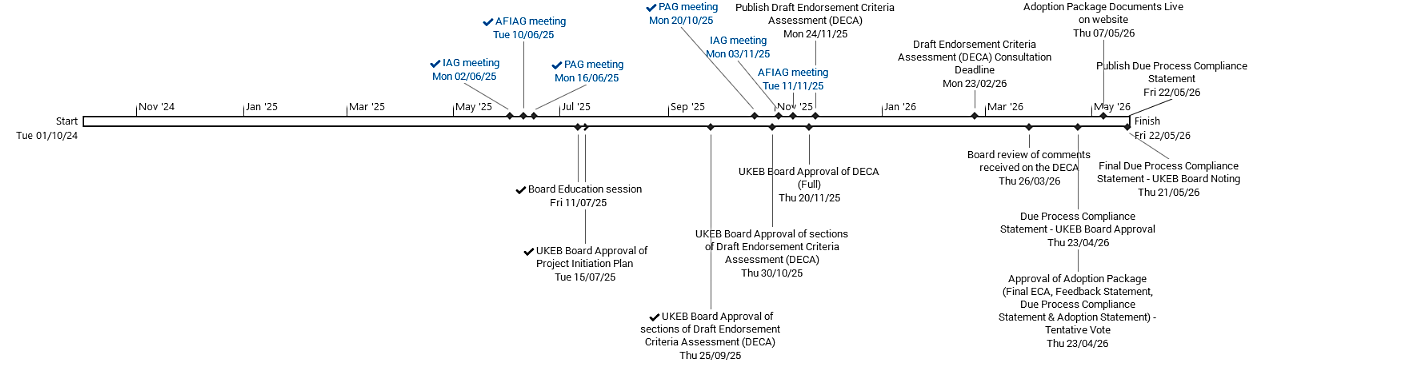
| Date | Milestone |
|---|---|
| 15 July 2025 | Presentation of PIP |
| 21 August 2025 | IASB published Amendments to IFRS 19 |
| 25 September 2025 | Board: review sections of the [Draft] ECA |
| 30 October 2025 | Board: review sections of the [Draft] ECA |
| 20 November 2025 | Board: Approval of the full [Draft] ECA for stakeholder consultation |
| Estimated [Draft] ECA consultation period (90 days): 24 Nov 2025 – 22 Feb 2026 | |
| Q3 and Q4 2025 | UKEB advisory groups discussions (AAG, AFIAG, IAG and PAG) |
| Q3 2025 | Limited targeted outreach with UK preparers and users |
| Q4 2025 and Q1 2026 | Targeted interviews with users and preparers |
| 26 March 2026 | Board: review of comments received on the [Draft] ECA Secretariat: preparation of ECA |
| 23 April 2026 | Board: Consideration of Adoption Package8 Board Members provide a tentative vote |
| First half of May 2026 | Voting form sent to Board Members Publication of voting outcome and Adoption Package on UKEB website |
| 21 May 2026 | Board: Due Process Compliance Statement for noting |
Agenda Paper 5 Appendix A OFFICIAL - PUBLIC UKEB UK Endorsement Board
Sections 2 & 3: Draft Endorsement Criteria Assessment
IFRS 19 Subsidiaries without Public Accountability: Disclosures
October 2025
The UKEB does not accept any liability to any party for any loss, damage or costs howsoever arising, whether directly or indirectly, whether in contract, tort or otherwise from any action or decision taken (or not taken) as a result of any person relying on or otherwise using this document or arising from any omission from it.
© (2025) All Rights Reserved
2. Section 2: Technical accounting criteria assessment
Introduction
2.1This section addresses whether IFRS 19 meets the technical accounting criteria and explains the approach to the assessment of these criteria.
Approach to the assessment against the technical accounting criteria
2.2SI 2019/685 requires an assessment of whether IFRS 19 meets the following criteria in regulation 7(1)(c):
"...(c) the standard meets the criteria of understandability, relevance, reliability and comparability required of the financial information needed for making economic decisions and assessing the stewardship of management.”
2.3These criteria are referred to, collectively, as the ‘technical accounting criteria'. An explanation of the basis for, and our interpretation of, the technical accounting criteria is provided in Appendix B. This section sets out the principal aspects of IFRS 19 and assesses those requirements against the technical accounting criteria.
2.4In conducting this overall assessment against the technical accounting criteria, the UKEB is required to adopt an absolute, rather than a relative, approach.
2.5IFRS 19 specifies the disclosures, in existing IFRS Accounting Standards, eligible subsidiaries are required to provide. It does not introduce new disclosure requirements.
Identification of 'key aspects'
2.6The assessment against the technical accounting criteria considers the Standard, together with all the amendments, to date9. The UKEB decided to take a proportionate approach to its assessment against the technical accounting criteria.
This approach acknowledges that IFRS 19 is a voluntary, disclosure-only standard, applicable only by eligible subsidiaries of group entities. Therefore, key aspects of reductions in disclosures were analysed against the technical accounting criteria (an 'exceptions-based approach'). In this context 'key aspects' means areas of IFRS 19:
- Which have a potentially significant impact on the usefulness of financial statements for users of eligible subsidiaries financial statements e.g. the statement of cash flows, related party transactions and business combinations disclosures.
- Where the Standard has led to a significant reduction in disclosures e.g. IFRS 12 Disclosure of Interests in Other Entities. This is particularly relevant when an intermediate parent applies IFRS 19 to its consolidated financial statements.
- Where the Standard includes an exception for disclosures i.e. certain credit risk disclosures for financial instruments are applicable to a particular sub-set of eligible subsidiaries.
- Where the requirements in the Standard e.g. on electing or revoking an election to apply the Standard interact with UK Companies Act requirements.
2.7IFRS 19 is intended to simplify reporting systems and processes for companies, reducing the costs of preparing eligible subsidiaries' financial statements, while maintaining the usefulness of those financial statements for their users.
2.8As such, this assessment focuses on whether the disclosure requirements in IFRS 19 will continue to meet the needs of the users of eligible subsidiaries financial statements, in the following key areas:
- statement of cash flows (presentation requirements);
- related party transactions;
- business combinations;
- financial instruments;
- interests in other entities: and
- electing or revoking an election to apply IFRS 19 (transition requirements).
2.9The IASB issued IFRS 19 after reaching an overall consensus, following extensive consultations with a wide range of constituents, including those from the UK. The main rationale behind the final IASB decisions is described in the Basis for Conclusions of IFRS 19 and has been used as part of the technical accounting criteria assessment.
Assessment of the specific key aspects of reductions in disclosure requirements in IFRS 19 against the technical accounting criteria
2.10UKEB outreach [to date] has indicated that UK stakeholders have no significant concerns with the disclosure requirements of IFRS 19 that need to be addressed in the [Draft] ECA.
2.11The UKEB’s overall [tentative] conclusion on whether IFRS 19 meets the technical accounting criteria is set out at the end of this section.
2.12This section includes an overall assessment of the specific key aspects of reductions in disclosures of IFRS 19 against the technical accounting criteria. For a description of the main requirements in IFRS 19, refer to Section 1 of this [Draft] ECA.
2.13Input for this assessment was obtained from:
- engagement with UKEB Advisory Groups;
- interviews with preparers (considering applying IFRS 19);
- interviews with users (principally bank lending departments using subsidiaries' financial statements); and
- desktop analysis of the disclosure requirements in IFRS 19 and the basis for these requirements.
2.14Overall, the UKEB received positive feedback from outreach with UK stakeholders, who did not highlight any significant issues of concern. For example, users of financial statements, particularly bank lending departments using subsidiary financial statements, did not raise any significant issues. These users said that the disclosure requirements in IFRS 19 lead to financial information that is understandable, relevant, reliable and comparable for their decision making.
2.15[Our overall conclusion on whether IFRS 19 as a whole meets the technical accounting criteria is set out at the end of this Section 2.]
Statement of cash flows (presentation requirements)
IFRS 19 requirements
2.16IFRS 19 requires an eligible subsidiary to use the same recognition, measurement and presentation requirements in IFRS Accounting Standards but allows it to provide reduced disclosures.
Assessment of the specific key aspects of reductions in disclosure requirements in IFRS 19 against the technical accounting criteria
2.12This section includes an overall assessment of the specific key aspects of reductions in disclosures of IFRS 19 against the technical accounting criteria. For a description of the main requirements in IFRS 19, refer to Section 1 of this [Draft] ECA.
2.13Input for this assessment was obtained from:
- engagement with UKEB Advisory Groups;
- interviews with preparers (considering applying IFRS 19);
- interviews with users (principally bank lending departments using subsidiaries' financial statements); and
- desktop analysis of the disclosure requirements in IFRS 19 and the basis for these requirements.
2.14Overall, the UKEB received positive feedback from outreach with UK stakeholders, who did not highlight any significant issues of concern. For example, users of financial statements, particularly bank lending departments using subsidiary financial statements, did not raise any significant issues. These users said that the disclosure requirements in IFRS 19 lead to financial information that is understandable, relevant, reliable and comparable for their decision making.
2.15[Our overall conclusion on whether IFRS 19 as a whole meets the technical accounting criteria is set out at the end of this Section 2.]
Statement of cash flows (presentation requirements)
IFRS 19 requirements
2.16IFRS 19 requires an eligible subsidiary to use the same recognition, measurement and presentation requirements in IFRS Accounting Standards but allows it to provide reduced disclosures.
2.17Under IFRS Accounting Standards a complete set of financial statements comprises2:
- a statement (or statements) of financial performance for the reporting period;
- a statement of financial position as at the end of the reporting period;
- a statement of changes in equity for the reporting period;
- a statement of cash flows for the reporting period;
- notes for the reporting period;
- comparative information in respect of the preceding period; and
- a statement of financial position as at the beginning of the preceding period, if required.
2.18Therefore, a set of financial statements prepared under IFRS 19 will include the same primary statements as under full IFRS Accounting Standards. In particular, eligible subsidiaries will be required to prepare a statement of cash flows.
Assessment against the endorsement criteria
2.19A statement of cash flows tracks the inflow and outflow of cash, providing insights into a company's financial health and helps users to assess its liquidity and solvency. Evidence indicates that for users and lenders cash flow information is value relevant and is useful for predicting future cash flows from operating activities3.
2.20A full set of financial statements, including the statement of cash flows will result in relevant and comparable information to users of eligible subsidiaries' financial statements, enabling them to make informed decisions. The evidence obtained by the UKEB, from interviews with bank lending departments, suggests that a subsidiary's cash flow information is useful for the assessment of its repayment capacity.
Related party transactions
IFRS 19 and Companies Act requirements
2.21IAS 24 Related Party Disclosures includes disclosure requirements in relation to related party transactions. The disclosures highlight the possibility that an entity's financial position and profit or loss may have been affected by the existence of related parties, and by transactions and outstanding balances, including commitments, with such parties4.
2.22IFRS 19 includes all the disclosures requirements in IAS 245, except for the requirement in paragraph 14 of IAS 24:
"To enable users of financial statements to form a view about the effects of related party relationships on an entity, it is appropriate to disclose the related party relationship when control exists, irrespective of whether there have been transactions between the related parties."
2.23Further, all UK registered entities (whichever accounting framework they report under) are required to provide certain information, specifically related to related undertakings and directors' remuneration, in the notes to their accounts under The Large and Medium-sized Companies and Groups (Accounts and Reports) Regulations 2008 (SI 2008/410)6. Therefore, in any event, a UK registered subsidiary electing to apply IFRS 19 will be required to provide this information.
Assessment against the endorsement criteria
2.24IFRS 19 includes relatively few reductions to the disclosures in IAS 24. Therefore, the related party transactions disclosures required by IFRS 19 will ensure users are provided with relevant and reliable information and the understandability and comparability of eligible subsidiaries' financial statements will not be impacted. The additional disclosures required by Schedule 4 of the Regulations will also provide users with useful and relevant information about related undertakings.
2.25The related party transaction disclosures required by IFRS 19, together with those required by company law, should help users adjust their analysis, where necessary, if an eligible subsidiary's financial position and profit or loss have been affected by the existence of related parties, or by transactions and outstanding balances, including commitments, with such parties.
Business combinations
IFRS 19 requirements
2.26IFRS 19 includes reduced disclosures for IFRS 3 Business Combinations7 but retains the key disclosure requirements that apply to all business combinations within the scope of IFRS 3. These include:
- the name and a description of the acquiree;
- the acquisition date;
- percentage of voting equity interests acquired;
- a qualitative description of the factors that make up the goodwill recognised;
- the acquisition-date fair value of the total consideration transferred and description of the components of that consideration;
- the details of contingent consideration arrangements and indemnification assets e.g. amount recognised as of the acquisition date;
- the amount of any gain recognised in a bargain purchase; and
- the amount of non-controlling interest in the acquiree, recognised at the acquisition date for each business combination in which the acquirer holds less than 100 per cent of the equity interests.
Assessment against the endorsement criteria
2.27As noted above, IFRS 19 requires key disclosures in respect of business combinations. Where an eligible subsidiary undertakes a transaction that meets the definition of a business combination in IFRS 38, particularly where such a transaction is significant, eligible subsidiaries will be required to provide the key information. Users of their financial statements will obtain relevant and understandable information which will enable them to evaluate the nature and financial effect of the business combination.
2.28In addition, users will obtain reliable information because these business combinations will be accounted for in accordance with the requirements of IFRS 3. The disclosures will also provide useful information to users for inter-period comparability.
2.29The 'step-back' requirement in IFRS 19 mitigates against the risk that material information may be missing from the notes, impairing the relevance, reliability, comparability or understandability. In particular, IFRS 19 paragraph 6 requires that, if the specific disclosures in the Standard are insufficient to meet the overall objective of enabling users of the accounts to understand the effect of transactions and other events and conditions on the entity's financial position and financial performance, an entity shall consider whether to provide additional disclosures to meet this objective.
2.30In addition, most users of eligible subsidiaries' financial statements, both internal and certain external users (e.g. bank lending departments) can also request additional information. These users are unlikely to rely solely on publicly available financial statements to satisfy their information needs.
2.31Therefore, in aggregate, the accounting treatment together with the disclosures, supports the relevance, reliability, comparability and understandability for business combinations entered into by eligible subsidiaries.
Financial Instruments
IFRS 19 requirements
2.32IFRS 19 includes reduced disclosures for IFRS 7 Financial Instruments: Disclosures. The application of the principles9 the IASB used to determine the reduced disclosure requirements in IFRS 19, resulted in relatively few reductions to the required disclosures of IFRS 7. IFRS 7 disclosures that are not required by IFRS 19 include:
- Certain information when an entity has designated a financial asset (or group of financial assets) at fair value through profit or loss that would otherwise be measured at fair value through other comprehensive income or amortised cost e.g. maximum exposure to credit risk, the amount of change in the fair value of the financial asset (or group of financial assets) that is attributable to changes in the credit risk.
- Financial liability designated as at fair value through profit or loss: any transfers of the cumulative gain or loss within equity during the period including the reason for such transfers; if a liability is derecognised during the period, the amount (if any) presented in other comprehensive income that was realised at derecognition.
- The detailed disclosures for investments in equity instruments designated at fair value through other comprehensive income e.g. the reasons for using this presentation alternative, the fair value of each such investment at the end of the reporting period, the reasons for disposing of the investments (if derecognised).
- The detailed disclosures for offsetting financial assets and financial liabilities e.g. gross amounts of those recognised financial assets and recognised financial liabilities, description of the rights of set-off associated with the entity's recognised financial assets and recognised financial liabilities subject to enforceable master netting arrangements and similar agreements.
- The detailed disclosures when an entity holds collateral (of financial or non-financial assets) and is permitted to sell or repledge the collateral in the absence of default by the owner of the collateral e.g. the fair value of the collateral held; the fair value of any such collateral sold or repledged.
- An analysis of the gain or loss recognised in the statement of comprehensive income arising from the derecognition of financial assets measured at amortised cost, showing separately gains and losses arising from derecognition of those financial assets.
- The detailed disclosures for hedge accounting e.g. in relation to the risk management strategy and in situations in which an entity frequently resets (i.e. discontinues and restarts) hedging relationships.
- The detailed disclosures for transfers of financial assets e.g. in relation to transferred financial assets that are not derecognised in their entirety.
2.33IFRS 19 includes the following disclosure requirements which are only applicable to eligible subsidiaries that provide financing to customers as a main business activity, as described in IFRS 1810:
- Credit risk management practices and how they relate to the recognition and measurement of expected credit losses (paragraph 69).
- Explanation of how significant changes in the gross carrying amount of financial instruments during the period contributed to changes in the loss allowance (paragraph 70).
- Credit risk exposure: gross carrying amount of financial assets and the exposure to credit risk on loan commitments and financial guarantee contracts (paragraph 71).
2.34Financial instruments of an eligible subsidiary are accounted for under IFRS 9 Financial Instruments and IAS 32 Financial Instruments: Presentation, if they are within the scope of these standards.
Assessment against the endorsement criteria
2.35IFRS 19 does not change the overall types of disclosures for eligible subsidiaries. Instead, the reduced disclosures will provide a proportionate framework to address the types of transactions and risks for the entities in scope and the information that will be directly relevant and useful for their users. Consequently, the requirements promote a faithful representation of an eligible subsidiary's financial position and performance, ensuring the reliability and relevance of the financial information.
2.36IFRS 19, while still requiring certain information to be disclosed, eliminates the detailed disclosures for each topic of IFRS 7 disclosures. This is because they are not expected to be required by the users of eligible subsidiaries' financial statements in their decision making. For example:
- Users will still able to understand the effect of investments in equity instruments, designated as measured at fair value through other comprehensive income at initial recognition, on the solvency and liquidity of the subsidiary without the extent of details specified by the IFRS 7 disclosures.
- The reduced disclosures will still provide users of accounts with relevant and understandable information about financial instruments in an eligible subsidiary's financial statements. For example, for a transaction where an entity has transferred financial assets in such a way that part, or all, of the transferred financial assets do not qualify for derecognition, IFRS 19 requires disclosure of: the nature of the transferred assets; the nature of the risks and rewards of ownership to which the entity is exposed; and when the entity continues to recognise all of the transferred assets, the carrying amounts of the transferred assets and the associated liabilities.
2.37Consistent with the principles the IASB used to assess the needs of users of financial statements, liquidity is one of the pieces of information likely to be a focus of users of eligible subsidiaries' financial statements. IFRS 19 liquidity risk disclosures11. Therefore, provides relevant and understandable information.
2.38The reduced disclosure requirements relating to credit risk will provide users with these disclosures on credit risk only when eligible subsidiaries provide financing to customers as a main business activity e.g. a subsidiary that is a non-bank lender. This will provide relevant and understandable information to users. Other disclosures on credit risk will be provided by all eligible subsidiaries where relevant (see paragraph 65–67 of IFRS 19). Therefore, the restriction does not impact the relevance and understandability of financial statements for users for those subsidiaries that do not provide financing to customers.
2.39The overall reduced disclosure requirements for IFRS 7, in IFRS 19, are expected to provide relevant, reliable, comparable and understandable information to users of eligible subsidiaries' financial statements to evaluate:
- the significance of financial instruments for the eligible subsidiary's financial position and performance; and
- the nature and extent of risks arising from financial instruments to which the eligible subsidiary is exposed during the period and at the end of the reporting period, and how the eligible subsidiary manages those risks.
Interests in other entities
IFRS 19 and Companies Act 2006 requirements
2.40The Companies Act 2006 provides intermediate parents with certain exemptions from preparing group accounts. For example, a company is exempt from the requirement to prepare group accounts if it is a subsidiary undertaking wholly owned by a UK registered immediate parent undertaking12. An equivalent exemption is available for subsidiaries of a parent undertaking registered outside the UK13.
2.41In order to apply these exemptions, an eligible intermediate parent must comply with conditions relating to disclosure, audit and filing of the accounts14.
2.42Where an intermediate parent does not satisfy the conditions set out in the Companies Act 2006, it will be required to prepare group accounts. However, those entities will have the ability to elect to apply IFRS 19 in their consolidated financial statements, which will mean that they will produce a full set of consolidated IFRS financial statements, but with disclosures reduced in accordance with the Standard.
2.43The IFRS 12 Disclosure of Interests in Other Entities disclosures in IFRS 19 will be of particular relevance in such circumstances. The objective of the disclosure requirements of IFRS 12 is to require an entity to disclose information that enables users of its financial statements to evaluate 15:
- the nature of, and risks associated with, its interests in other entities; and
- the effects of those interests on its financial position, financial performance and cash flows.
2.44IFRS 19 reduces the disclosure requirements for IFRS 12 by more than half16. However, key information regarding interests in other entities is still required by IFRS 19. In particular, a company applying IFRS 19 is required to provide key information regarding its interests in subsidiaries (i.e. as an intermediate parent), joint ventures, associates and unconsolidated structured entities. This includes where an eligible subsidiary, which is itself a parent, determines that it is an investment entity.
2.45For example, IFRS 19 requires an eligible subsidiary to disclose the following information for interests in subsidiaries17:
- The date of the end of the reporting period of the financial statements of the subsidiary, if that date is different from the date used in the preparation of the consolidated financial statements.
- Significant restrictions (for example, statutory, contractual and regulatory restrictions) on its ability to access or use the assets and settle the liabilities of the group.
- Terms of any contractual arrangements that could require the parent or its subsidiaries to provide financial support to a consolidated structured entity.
- If financial or other support has been provided to a consolidated structured entity (without having a contractual obligation to do so)—the type and amount of support provided and the reasons for providing the support.
- Current intentions to provide financial or other support to a consolidated structured entity.
- Any gain or loss, where there is loss of control of a subsidiary, including the portion of that gain or loss attributable to measuring any investment retained in the former subsidiary at its fair value at the date when control is lost; and the line item(s) in profit or loss in which the gain or loss is recognised (if not presented separately).
Assessment against the endorsement criteria
2.46Information about an intermediate parent's interests and involvement in other entities and the composition of that sub group is likely to be of interest to users of their accounts as it would provide them with information about the risks arising for that intermediate group as a whole. For example, summarised information about the subsidiaries' financial position and performance, the relevant cash flows, and other risks arising from material transactions may be of use to the users of those accounts.
2.47While IFRS 19 reduces the IFRS 12 disclosures significantly, the reduced disclosure requirements continue to provide information that would allow the users to ascertain the intermediate parent's obligations, commitments and cash flows in relation to its subsidiaries.
2.48Any concerns about the extent of reductions in disclosures leading to a potential loss of useful information for users of eligible subsidiaries' financial statements may be addressed by the 'step-back' requirement in IFRS 19 (see paragraph 2.29 above).
2.49Therefore, the disclosures are likely to provide relevant, useful and understandable information to users where these are applicable.
Transition requirements—comparative information
IFRS 19 and Companies Act 2006 requirements
2.50Under the UK financial reporting framework, eligible subsidiaries electing to use IFRS 19 would be preparing IAS accounts. The Companies Act permits a company to revert to UK GAAP (Companies Act accounts) from UK-adopted IAS (IAS accounts) if it has not reverted to UK GAAP in the previous five years, other than for a "relevant change of circumstance” e.g. a company ceasing to be a subsidiary undertaking within a group that applies UK18.
2.51When an eligible subsidiary elects to apply IFRS 19 in the current period, but the Standard was not applied in the immediately preceding period, IFRS 19 requires comparative information to be provided for all amounts reported in the current period's financial statements. This includes comparative information for narrative and descriptive information if it is necessary for an understanding of the current period's financial statements19.
Assessment against the endorsement criteria
2.52These requirements on comparative information in IFRS 19 will provide useful and relevant information to users of subsidiaries' financial statements and a clear understanding of how its performance in the current period compared to the preceding period. This should enable users to compare the performance of an eligible subsidiary between reporting periods.
2.53In addition, if an eligible subsidiary's election to apply IFRS 19 means that it is switching from a local GAAP to IFRS for the first time, the disclosure requirements in the Standard20 are a streamlined version of those in IFRS 1 First-Time Adoption of International Financial Reporting Standards. These requirements will result in the provision of relevant information on initial application and comparable information over time for users.
2.54When an eligible subsidiary elects to apply IFRS 19 in one reporting period, the election is subsequently reversible21. This could lead to a risk that an eligible subsidiary revokes an election to apply IFRS 19 (IAS accounts) and switches to UK GAAP (Companies Act accounts) because of differences in recognition and measurement requirements, potentially impairing relevance, reliability, understandability and comparability.
2.55However, the Companies Act 2006 requirements, relating to switching from IAS accounts (UK-adopted IAS) to Companies Act accounts (UK GAAP)22, would take precedence over the flexibility of the requirements in IFRS 19 to elect or revoke an election to apply the Standard at any time. As a result, the Companies Act requirement will limit the circumstances in which an eligible subsidiary can switch from IFRS 19 (IAS accounts) to Companies Act accounts (UK GAAP). The Companies Act 2006 requirements relating to reverting back to UK GAAP once IFRS 19 has been applied, ensures the understandability and comparability of the financial statement of eligible subsidiaries for users.
[Tentative] overall conclusion on whether IFRS 19 meets the technical accounting criteria
2.56In drawing our conclusion as to whether IFRS 19 meets the technical accounting criteria, we have considered the reduced disclosure requirements in IFRS 19 for key areas.
2.57The UKEB [tentative] conclusion is that IFRS 19 disclosure requirements will result in relevant, reliable, understandable and comparable information for users of eligible subsidiaries' financial statements23.
2.58Entities applying IFRS 19 are required to consider whether to provide additional disclosures when compliance with the specific requirements in the Standard is insufficient24 to achieve the objectives of understandability, relevance, reliability and comparability. We have taken account of such disclosure requirements in our assessment. In coming to our conclusion, we have also taken into account that financial statements prepared in accordance with this Standard have a different group of users to entities that have public accountability.
2.59Overall, therefore, the UKEB [tentatively] concludes that IFRS 19 meets the criteria of understandability, relevance, reliability and comparability required of the financial information needed for making economic decisions and assessing the stewardship of management.
3. Section 3 UK long term public good assessment
Introduction
3.1This section analyses whether IFRS 19 is likely to be conducive to the long term public good in the UK. The assessment is based on the following:
- An analysis of whether the use of IFRS 19 likely to improve the quality of financial reporting.
- An economic impact assessment.
- An analysis of the interaction of IFRS 19 with UK company law/regulation.
3.2Each of the sections above contributes to the Board's overall assessment of whether IFRS 19 is conducive to the long term public good in the UK.
3.3Appendix D contains information that supplements the analysis in this section.
Is use of IFRS 19 likely to improve the quality of financial reporting?
Approach for this assessment
3.4Regulation 7(2)(a) of SI 2019/685 requires the UK long term public good assessment to consider whether the use of the IFRS 19 is likely to improve the quality of financial reporting. This assessment takes a relative approach, i.e. does IFRS 19 provide information that is more or less understandable, relevant, reliable and comparable than that provided by applying full IFRS Accounting Standards?
3.5This assessment also considers whether IFRS 19 is likely to meet the IASB's stated objective for the Standard, of simplifying the preparation of subsidiaries' financial statements whilst maintaining their usefulness for users.
Improvements introduced by IFRS 19 for eligible subsidiaries
3.6The IASB developed IFRS 19 in response to demand from stakeholders, particularly from preparers of financial statements. They requested that, given the main users of subsidiaries' financial statements (e.g. parent entities, bank lending departments, rating agencies) tend to be in a position to ask for additional information if necessary, such users should be permitted to apply IFRS Accounting Standards with reduced disclosure requirements.
3.7The main areas where IFRS 19 is likely to lead to improvements in the quality of financial reporting for subsidiaries in the UK are:
- IFRS 19 will enable IFRS groups with qualifying subsidiaries to apply consistent accounting policies when preparing financial statements throughout the group. This will simplify group reporting and potentially improve the quality of the subsidiary's financial statements. Subsidiaries, applying local GAAPs, electing to transition to IFRS 19 will align their accounting policies with the parent preparing IFRS consolidated financial statements. This will eliminate the need to maintain dual accounting records and could enable system simplifications. This will also improve intra-group comparability, in particular from the perspective of parent entities, as well as any other users interested in group and subsidiaries' financial statements.
- The requirement in IFRS 19 for an eligible subsidiary to use the same recognition, measurement and presentation requirements in IFRS Accounting Standards will provide users with financial statement information that is as reliable as that presented in full IFRS.
- Feedback from UKEB outreach with lenders indicated that the reduced disclosures in IFRS 19 will provide sufficient information to assess subsidiaries' financial statements for lending decisions, thereby providing information that is as relevant and understandable as that presented in full IFRS.
- IFRS 19 aims to remove ‘clutter' from the financial statements by eliminating disclosures in full IFRS Accounting Standards that are more relevant to investment decisions in public capital markets. Removing this less relevant information from the financial statements will remove some complexity and improve users' understanding of the financial performance, position and cash flows of eligible subsidiaries. This benefit would apply in particular to those subsidiaries applying full IFRS Accounting Standards which elect to transition to IFRS 19.
- IFRS 19 requirements to prepare a statement of cash flows will ensure that users will retain the ability to understand the liquidity of the subsidiary. This contrasts with the UK's reduced disclosure framework (i.e. FRS 101), which permits qualifying entities to omit a statement of cash flows, the requirement under IFRS 19 for eligible subsidiaries to prepare a statement of cash flows will provide more relevant information to users.
Summary of whether IFRS 19 is likely to improve the quality of financial reporting
3.8Stakeholders, in particular preparers, consulted during the UKEB's outreach, suggested that the use of IFRS 19 will:
- allow groups to simplify the preparation of subsidiaries' financial statements by using IFRS Accounting Standards both for group reporting purposes and for their own financial statements, but with reduced disclosures for the latter. This will eliminate the need for these subsidiaries to maintain additional accounting records from those maintained for group reporting under IFRS; and
- maintain or improve the usefulness of the financial statements for the users of these subsidiaries' financial statements.
Therefore, the UKEB [tentatively] concludes that IFRS 19 is likely to improve the quality of financial reporting for subsidiaries in the UK.
Economic impact assessment
3.9The economic impact assessment considers the following:
- Government guidance on costs and benefits analysis.
- An analysis of the costs and benefits likely to result from the use of IFRS 19.
- Whether the use of IFRS 19 is likely to have an adverse effect on the economy of the UK, including on economic growth (wider economic effects).
- The consequences of not adopting IFRS 19 (counterfactual analysis).
Government guidance
3.10The UK government's Better Regulation Framework (BRF) provides a set of guidelines for UK government departments and public bodies on how to conduct economic impact assessments25.
3.11The UKEB is not currently required to apply the BRF. However, the UKEB considered and agreed that it should broadly follow the BRF guidance. Accordingly, the cost benefit analysis (CBA) of IFRS 19 was developed broadly considering the BRF26.
3.12The UKEB followed the principle of proportionality of assessment. This means "ensuring the appropriate level of resources is invested in gathering and analysing evidence on the impacts of a policy"27. Consistently, the UKEB conducted relatively limited stakeholder engagement to gather evidence for the long-term public good assessment for IFRS 19, given that it is an elective standard and the expected low appetite for use of the Standard among UK subsidiaries (see para 3.42 b) i)%20i)). The UKEB consulted with stakeholders to make sure that the analysis conducted would appropriately consider the anticipated economic impact of the standard (see para 3.58).
Analysis of costs and benefits from the use of IFRS 19
Objective
3.13The assessment of the long term public good requires an analysis of costs and benefits associated with the use of IFRS 19.
3.14The cost benefit analysis (CBA) considers the impact of IFRS 19 in terms of the direct28 costs and benefits (including cost savings) anticipated for preparers, users and other stakeholders (e.g. auditors, regulators). Indirect effects29 are considered in the wider economic effects section.
3.15The analysis focuses on the incremental costs and benefits of IFRS 19 (i.e. costs and benefits incurred as a direct result of meeting the disclosure requirements of the Standard).
3.16This CBA takes a qualitative approach. This is due to the following:
- Identifying subsidiaries that will elect to apply IFRS 19 is not feasible due to the voluntary nature of the Standard (see para 3.33).
- At the time of writing, feedback from some preparers indicated that stakeholders had, generally, not commenced detailed assessments of the costs and benefits of IFRS 19. Therefore, the availability of quantitative evidence is limited.
Consequently, the UKEB considered that the quantification of the expected monetary costs and benefits was not feasible.
OFFICIAL - PUBLIC 3.12 The UKEB followed the principle of proportionality of assessment. This means "ensuring the appropriate level of resources is invested in gathering and analysing evidence on the impacts of a policy"27. Consistently, the UKEB conducted relatively limited stakeholder engagement to gather evidence for the long-term public good assessment for IFRS 19, given that it is an elective standard and the expected low appetite for use of the Standard among UK subsidiaries (see para 3.42 b) i). The UKEB consulted with stakeholders to make sure that the analysis conducted would appropriately consider the anticipated economic impact of the standard (see para 3.58).
Analysis of costs and benefits from the use of IFRS 19
Objective
3.13 The assessment of the long term public good requires an analysis of costs and benefits associated with the use of IFRS 19.
3.14 The cost benefit analysis (CBA) considers the impact of IFRS 19 in terms of the direct28 costs and benefits (including cost savings) anticipated for preparers, users and other stakeholders (e.g. auditors, regulators). Indirect effects29 are considered in the wider economic effects section.
3.15 The analysis focuses on the incremental costs and benefits of IFRS 19 (i.e. costs and benefits incurred as a direct result of meeting the disclosure requirements of the Standard).
3.16 This CBA takes a qualitative approach. This is due to the following:
- Identifying subsidiaries that will elect to apply IFRS 19 is not feasible due to the voluntary nature of the Standard (see para 3.33).
- At the time of writing, feedback from some preparers indicated that stakeholders had, generally, not commenced detailed assessments of the costs and benefits of IFRS 19. Therefore, the availability of quantitative evidence is limited.
Consequently, the UKEB considered that the quantification of the expected monetary costs and benefits was not feasible.
3.17 Given that IFRS 19 is voluntary, preparers are expected to assess whether the anticipated benefits of applying the Standard outweigh implementation costs, prior to deciding whether to apply it. The costs and benefits discussed in paragraphs 3.32-3.40 therefore illustrate the potential transition impacts IFRS 19 may have on eligible subsidiaries that elect to apply it and the subsequent implications for users of their financial statements.
3.18 The qualitative evidence on implementation costs describes the expected monetary costs of applying IFRS 19 (e.g. changes to accounting systems) as well as the relevant opportunity costs (e.g. staff reallocation from other activities to IFRS 19 implementation).
Collection of evidence
3.19 This analysis draws upon evidence obtained from:
- Desk-based research30;
- Engagement with UKEB Advisory Groups;
- Interviews with preparers; and
- Interviews with bank lending departments using subsidiaries' financial statements31.
Users
Benefits for users
3.20 As noted in Section 1, subsidiaries without public accountability generally have few users of their financial statements that are external to the group. The main external users of these financial statements are credit providers (e.g. bank lending departments) and non-controlling interests32.
3.21 During outreach, users were asked to provide information about the anticipated benefits of IFRS 19, and whether the reduced disclosure requirements would reduce the usefulness of subsidiaries' financial statements.
3.22 Users expressed overall support for the use of IFRS 19, as it would remove disclosures that are not usually directly relevant for their analysis. This would ensure subsidiaries' financial statements provide disclosures targeted to their needs.
3.23 As previously noted (see section 2 para X), most users of subsidiaries' financial statements can typically request additional information from management.
3.24 Based on desk-based research and outreach with users, the UKEB has identified the following main benefits of IFRS 19 for users:
- the financial statements of subsidiaries would include fewer but more relevant disclosures, compared to full IFRS Accounting Standards; and the resulting disclosures would be tailored for users' needs, without removing decision-useful information.
- For those subsidiaries switching from UK GAAP, in particular FRS 102 to IFRS 19, users would obtain better information as recognition, measurement and presentation requirements would be aligned with IFRS Accounting Standards.
- IFRS 19 requirements to prepare a statement of cash flows was confirmed by users as being useful when assessing debt repayment capacity. There is an exemption from preparing a statement of cash flows under the UK GAAP FRS 101 reduced disclosure framework.
- Overall, IFRS 19 requires more disclosures than FRS 101. As a result, if UK subsidiaries transition from FRS 101 to IFRS 19, users will be able to access more notes disclosure information.
3.25 Stakeholder feedback suggested that non-controlling interests (NCIs) may be a user of subsidiaries' financial statements potentially affected by IFRS 19. However, engagement with stakeholders suggested that:
3.26 NCIs invested in the group would typically not look at subsidiaries' financial statements.
3.27 Subsidiaries typically do not have NCIs, and in cases in which they do, governance arrangements would ensure that their interests are considered. Therefore, disclosure reductions would not affect them negatively.
3.28 Appendix D reports additional evidence obtained through stakeholder engagement with lenders.
Costs for users
3.29 Users are not expected to incur significant costs from the use of IFRS 19. As noted, lenders and other users of subsidiaries' accounts:
- analyse subsidiaries' accounts relatively infrequently; and
- request additional information directly from management which mitigates the risk that disclosures provided under IFRS 19 might fail to meet their needs.
3.30 Therefore, the main costs users may incur are minor familiarisation costs with the reduced disclosure requirements in IFRS 19.
3.31 Users are not expected to incur any ongoing costs or cost reductions.
Preparers
3.32 As noted in Section 2, IFRS 19 will impact eligible subsidiaries and the groups that control those subsidiaries.
3.33 IFRS 19 is a voluntary Standard that will only be applied if the benefits from its use exceed the costs. Therefore, the considerations below apply to eligible subsidiaries that decide to apply IFRS 19.
3.34 Stakeholder engagement suggested that the decision to apply IFRS 19 is made at the group level in a majority of cases. However, at times it is by the individual subsidiary, depending on the extent to which decision-making about financial reporting is decentralised at the group level.
3.35 Therefore, this assessment distinguishes between costs and benefits accruing to subsidiaries and those affecting the group as a whole.
Overall impact of IFRS 19
3.36 The costs and benefits of applying IFRS 19 are expected to vary depending on the factors listed in the table below, as corroborated using feedback from preparer outreach.
| Table 1: determinants of costs and benefits of IFRS 19 |
|---|
| The accounting framework applied before transitioning to IFRS 19 |
| Size and Complexity of the subsidiary's operations |
| The number of subsidiaries in the group |
| Geographical spread of subsidiaries in the group |
| Existing financial reporting processes in the group |
| The number of jurisdictions adopting IFRS 19 |
| The extent to which group-level reporting is centralised (e.g. shares service |
| centres) |
| Applicable law and regulation, including tax regulation |
3.37 Given the number and complexity of the factors described above, in the absence of a quantitative assessment of monetary costs, it is difficult to generalise how IFRS 19 will produce costs and benefits for preparers. This is likely to vary on a group-by-group basis.
3.38 The UKEB has prepared three case studies to illustrate how IFRS 19 will affect groups with different characteristics. The case studies outline the direct effects of applying IFRS 19 to entities, with different sizes and level of centralisation, producing consolidated accounts. The main finding from the case studies is that the extent to which cost savings are reaped at a group, or at a subsidiary level, will depend on those determinants.
3.39 Large groups with shared service centres would reap group-level synergies and efficiency gains. On the other hand, smaller groups/groups, characterised by less centralisation, would see costs savings being reaped regionally, or even at individual entity levels. These case studies are presented in Appendix D.
3.40 While not possible to generalise potential impacts, the UKEB considered that:
- The accounting framework that the subsidiaries apply before transitioning to IFRS 19 is one of the most important determinants of the cost and benefit assessment for both groups and individual subsidiaries.
- For groups, the degree of centralisation of financial reporting processes is also important.
Therefore, the remainder of this section mainly discusses how these two determinants affect overall cost and benefit considerations.
Benefits for preparers
3.41 During outreach, preparers were asked to provide information about cost savings and other benefits they expect from application of IFRS 19.
Subsidiary-level analysis
3.42 The benefits will vary depending on the accounting framework that an eligible subsidiary applied before transitioning to IFRS 19 33. In particular:
- For subsidiaries that apply IFRS Accounting Standards, the less burdensome disclosure requirements in IFRS 19, compared with full IFRS Accounting Standards, are expected to reduce the ongoing time, cost and effort involved in preparing financial statements. Cost savings will vary depending on the extent of the current disclosure reporting and the complexity of their transactions.
- For subsidiaries that apply UK GAAP, the expected benefits will depend on whether it applied FRS 101 or FRS 10234:
- For subsidiaries that apply FRS 101 there is no perceived incentive to elect to apply IFRS 19, as indicated by preparers. This is because FRS 101 provides greater cost relief in terms of preparing their financial statements disclosures than they would from using IFRS 1935. Preparers noted that, unlike IFRS 19, FRS 101 provides an exemption from presenting a statement of cash flows, which was reported to be burdensome to prepare.
- For subsidiaries that apply FRS 102, electing to transition to IFRS 19 would entail transition costs, although they would reap group-level benefits from aligned accounting policies with IFRS Accounting Standards (see Section 1 paragraph X).
- For overseas subsidiaries that decide to transition to IFRS 19 from the relevant local GAAP, the benefits in terms of cost savings will vary depending on the extent of differences between the local GAAP and IFRS Accounting Standards. These entities may also benefit from removing the need to maintain dual accounting records for their own financial statements and for group reporting purposes.
Group-level analysis
3.43 IFRS 19 can be particularly beneficial to groups that have a broad international presence, as application of the Standard among subsidiaries located in different jurisdictions would help align accounting policies within the group. Preparers also confirmed this, in particular noting IFRS 19 use of the same recognition, presentation and measurement requirements as in full IFRS Accounting Standards used in the consolidated accounts. IFRS 19 would remove the need to maintain multiple accounting records and eliminate the associated costs. Preparers also reported that they expect the consolidation process to be streamlined and subject to lower risk of errors due to this alignment across the group and the elimination of the need for reconciliation.
3.44 In particular, groups with SSCs preparing multiple subsidiaries' accounts expect efficiency gains because the use of IFRS 19 will reduce the number of local GAAPs being used. IFRS 19 is expected to reduce the costs of preparing eligible subsidiaries' accounts in SSCs, reduce the reliance on local GAAP expertise and expedite the audit process36. Stakeholder outreach with preparers suggested that groups that use the SSC model, will derive significant benefits from IFRS 19 because of the scale at which the Standard could be applied to generate process efficiencies in financial reporting.
3.45 Finally, stakeholders noted that for groups to realise significant benefits, from the alignment of reporting requirements offered by IFRS 19, they will need to have a critical mass of eligible subsidiaries using the Standard. This will depend on the global adoption of IFRS 19, as well as local law in the jurisdictions where their subsidiaries operate37.
Costs for preparers
3.46 During outreach, preparers were asked to provide information about the costs they expect to incur as a result of applying IFRS 19, both at a subsidiary and at a group-level.
Subsidiary-level analysis
3.47 Similar to the benefits, costs incurred by a given subsidiary will depend mainly on the accounting framework it applied prior to transition to IFRS 19.
3.48 For subsidiaries that apply IFRS Accounting Standards38:
- One-off costs are expected to be minimal. These are attributable to minor familiarisation costs and some adjustments to their accounting systems and processes to filter out the reduced disclosures for the financial statements of subsidiaries that elect to apply IFRS 19.
- Ongoing costs are not expected to be significant. The main ongoing costs these entities would incur relate to updating their knowledge, templates and systems as future amendments are made to IFRS 19.
3.49 For subsidiaries that apply local GAAP39:
- One-off costs may be relatively high. These entities would incur familiarisation, accounting system changes and data processing costs since the local GAAP they previously applied may have significant differences in recognition, measurement and presentation requirements compared to IFRS Accounting Standards. These entities would also incur costs related to staff training, recruiting or reallocating staff with IFRS expertise. Preparers reported that audit costs may increase at a subsidiary level as typically auditing IFRS accounts is costlier than auditing local GAAP financial statements if the IFRS financial statements contain more information than the local GAAP financial statements. In general, the magnitude of these costs would depend on how closely aligned with IFRS the local GAAP is and the complexity of the subsidiaries' transactions.
- Ongoing costs may potentially be significant. These entities may experience increased costs to prepare and audit financial statements on an ongoing basis. For instance, preparers reported that the IFRS 19 requirement to prepare a cash flow statement and the associated disclosures would have a significant ongoing cost impact on entities that currently use FRS 101.
Group-level analysis
3.50 Groups are expected to incur minor, mainly one-off costs upon transitioning to IFRS 19. These are mainly attributable to familiarisation and changes to accounting systems (for example, to remove reduced disclosures from the system) and processes. On an ongoing basis, groups will incur costs to remain up to date with the reporting requirements of IFRS 19.
3.51 Feedback from preparers suggested that:
- Groups will conduct an internal cost-benefit assessment before transitioning to IFRS 19, which, in itself, will lead to some one-off costs.
- Given that it is a voluntary standard, there is no mandatory effective date for application of IFRS 19. Therefore, some groups may set a phased approach for their eligible subsidiaries to transition to IFRS 19. This means that a small number of eligible subsidiaries would transition to the Standard before its application is widened to other eligible subsidiaries in later reporting periods. This would spread the transition costs over several periods and, potentially, reduce them, in comparison to a one-off transition of more eligible subsidiaries at once, by using the early implementation experience to provide efficiencies and education on the effects.
- For groups that will elect to apply IFRS 19, preparers expect a decreased reliance on local GAAP expertise. However, this cost saving would be counterbalanced by higher reliance on IFRS expertise which might incur additional costs.
Audit costs
3.52 Audit costs are discussed as part of preparers' implementation costs, as auditors would pass on some or all of the extra audit costs to their clients via increased audit fees.
3.53 At a subsidiary level, incremental audit costs will depend on the accounting framework applied by a given subsidiary before applying IFRS 19:
- For subsidiaries that apply IFRS Accounting Standards, audit costs may decrease. This is because application of IFRS 19 would result in a reduced volume of information in the notes subject to audit compared with a set of financial statements prepared under full IFRS Accounting Standards. Two large preparers indicated that they expect only a small decrease in audit costs, given the limited reductions in disclosures.
- For subsidiaries that apply local GAAP, audit costs may increase. This is because the auditors may conduct additional work and charge a higher fee to audit IFRS 19 financial statements, compared with local GAAP. However, these considerations will depend on the degree of alignment in recognition, presentation, measurement and disclosure between IFRS and local GAAP, as well as the size and complexity of the underlying transactions.
3.54 At a group level, preparers indicated that, for groups with subsidiaries in many jurisdictions, transition to IFRS 19 may be associated with lower audit costs for the group accounts. This is due to a reduction in the number of reconciliation items between the subsidiary local GAAP accounting records and the group reporting records prepared under IFRS.
Costs and benefits to regulators
3.55 IFRS 19 is not expected to create significant incremental costs or benefits for regulators. Some of the potential costs may include familiarisation costs and staff training.
3.56 There is a limited risk that the information disclosed under IFRS 19 might be insufficient to meet the needs of specific regulators. However, as regulators can typically request additional information from management, beyond that included in financial statements, the reduced disclosure requirements are unlikely to pose a significant risk in this regard40.
Summary of costs and benefits analysis
3.57 Users. The financial statements of subsidiaries without public accountability are generally only of interest to a limited number of users external to the group. Feedback received suggested that external users analyse subsidiaries' financial statements infrequently. Therefore, the impact of the reduced disclosures will only materialise under the limited circumstances in which these users analyse subsidiaries' financial statements. Users are expected to benefit from financial statements that contain disclosures which are more tailored to their needs and easier to analyse. User feedback suggested the risk that the reduced disclosures would remove information that is important for their decision-making was very limited. Users are expected to incur negligible one-off costs due to the implementation of IFRS 19.
3.58 Preparers41. Given that IFRS 19 is an elective standard, eligible subsidiaries will only apply it if the anticipated benefits outweigh the costs.
- In the majority of cases, the assessment of whether benefits exceed the costs is likely to be carried out at a group level. Groups are expected to reap benefits associated with applying consistent financial reporting requirements, making group-level reporting more efficient and less prone to error. Large groups with a multinational presence are expected to benefit the most from IFRS 19. At a group-level, costs are mainly expected to be one-off and related to familiarisation and changes to their reporting systems.
- Subsidiaries-level costs and benefits will largely depend on the GAAP in use before transition. Subsidiaries that apply IFRS are expected to incur very minor one-off implementation costs which are likely to be outweighed by ongoing cost savings gained in the long-term. Subsidiaries that apply local GAAPs will likely incur more substantial transition costs, though the extent of these costs will depend on alignment between local GAAP and IFRS.
- In general, the ongoing costs of IFRS 19 are expected to be much lower than the one-off transition costs.
- Importantly, the nature and extent of the costs and benefits of IFRS 19 will vary based on each entity's unique circumstances.
3.59 Regulators are not expected to be adversely affected by the reduced disclosure requirements of IFRS 19.
Analysis of wider economic effects
Approach used for this assessment
3.60 The assessment of the long-term public good involves a consideration of whether the use of IFRS 19 is likely to have an adverse effect on the economy of the UK, including on economic growth. These are referred to as “wider economic effects”.
3.61 With reference to research published by the UKEB42, IFRS Accounting Standards are generally associated with the following wider economic effects:
- Transmission mechanisms: how the new requirements affect the way information is communicated to internal and external stakeholders. These include effects on management's stewardship, consistent with previous work.
- First-order indirect effects: capital market effects triggered by the enhanced interaction between users and capital markets.
- Second-order indirect effects (real effects): microeconomic effects that go beyond capital markets (e.g. product & pricing decisions or effects on tax obligations and dividend distribution).
- Third-order indirect effects: micro and macroeconomic effects that go beyond microeconomic agents involved in the accounting systems (e.g. externalities, network effects and macroeconomic effects).
Transmission mechanisms
Preparers
3.62 The UKEB considered the potential impact of IFRS 19 on the following transmission mechanisms:
- Management's stewardship. IFRS 19 is not expected to have a significant impact on the presentation of management's use of economic resources, transparency over management's performance, or management's discretion in presenting the entity's financial performance. This is on the basis that IFRS 19 does not alter recognition and management requirements and it also requires subsidiaries to provide additional information to their users, when necessary43. This mitigates the risk that information presented in the financial statements will be insufficient to assess subsidiaries' management's stewardship.
- How information circulates within the organisation. The effect of IFRS 19 on the transmission of information within a group is likely to vary based on the existing set-up of reporting systems within the group.
- For groups comprised of subsidiaries that exclusively use IFRS Accounting Standards, the reduced disclosure requirements are unlikely to have a significant impact.
- For groups comprised of subsidiaries that use various local GAAPs, IFRS 19 could improve the transmission of information within the organisation. If IFRS 19 was applied by all the subsidiaries within these groups, finance teams may benefit from more comparable information as there would be a more widespread use of IFRS among subsidiaries. This may lead to enhanced management's decision-making and improved corporate governance.
- Streamlining of internal systems and processes. IFRS 19 may enhance reporting systems and processes by allowing preparers to simplify their accounting templates and allowing them to remove the applicable disclosures from their systems. These changes will expedite the overall financial reporting process. Additionally, IFRS 19 may eliminate the need to maintain accounting records prepared using different accounting frameworks.
First-order indirect effects (capital market effects)
3.63 To the extent that lending to subsidiaries is centralised, groups may experience modest improvements in access to finance, due to the widespread adoption of IFRS recognition, measurement and presentation principles throughout the group. Therefore, use of IFRS 19 may enhance an entity's ability to raise funds and broaden the capital available to them.
3.64 In addition, markets may reward certain groups for taking advantage of the cost savings of IFRS 19, to the extent that they are material. In addition, markets may reward certain groups for taking advantage of the cost savings of IFRS 19, to the extent that such cost-savings are material.
3.65 Any such capital market effects, if at all present, are likely to be very small in size.
Second-order indirect effects
3.66 Since the economic impact of IFRS 19 will be relatively small, second-order indirect effects are generally not expected.
3.67 Some effects on competition may be expected. Stakeholder feedback suggested that IFRS 19 could make corporate acquisitions marginally more attractive as target entities that apply IFRS may be eligible to apply the reduced disclosure requirements.
Third order effects
Macroeconomic effects, including economic growth
3.68 IFRS 19 is aligned with the UK Government's position of reducing companies' regulatory burden to promote economic growth44. IFRS 19 is expected to lower compliance costs for businesses, which may have a positive long-term impact on innovation and productivity, thereby supporting economic growth and competitiveness within the UK.
3.69 No significant macroeconomic effects are anticipated as a direct result of IFRS 19 requirements. However, to the extent that preparers experience a change in the cost of capital or access to finance, IFRS 19 could produce higher order impacts on investment and consumption in the UK economy.
Summary of the analysis of wider economic effects
3.70 Overall, IFRS 19 is not expected to lead to wider economic effects that are detrimental to the UK economy, including on economic growth.
Consideration of the consequences of not adopting IFRS 19 (counterfactual analysis)
3.71 This section considers the consequences of not adopting IFRS 19 for use in the UK (the 'non-adoption scenario'). The analysis assumes that IFRS 19 is widely adopted in other jurisdictions.
3.72 In a non-adoption scenario, UK-registered subsidiaries are not likely to be adversely affected in the short to medium-term. This is because UK GAAP already has a widely used reduced disclosure framework, FRS 101. As noted, stakeholders' feedback suggested that appetite for adoption of IFRS 19 among UK-registered subsidiaries is limited.
3.73 However, if the standard is not adopted in the UK, in the longer term, UK subsidiaries would not have the option to apply IFRS 19. This may have negative consequences as:
- UK subsidiaries of overseas groups would not be able to transition to IFRS 19, reducing the overall group-level benefits of applying IFRS 19.
- Application of IFRS 19 may facilitate direct access to finance to subsidiaries. Feedback from lenders suggested that producing a cash-flow statement is important to assess a client's creditworthiness. Switching from FRS 101 to IFRS 19 may be a cost-effective move for subsidiaries that are large enough to apply for credit on their own.
3.74 In addition, and as noted by stakeholders, IFRS 19 is likely to deliver greater benefits, the higher the number of jurisdictions adopting the standard. As a consequence, individual jurisdictions have an interest in adopting the standard to guarantee widespread use of IFRS 19 for groups that have subsidiaries with a broad international presence. In a non-adoption scenario, UK-groups with overseas subsidiaries are unlikely to be adversely affected if there is widespread adoption of IFRS 19 in other jurisdictions, as the overseas subsidiaries of UK groups would be able to apply IFRS 19.
3.75 These considerations suggest that, while not adopting IFRS 19 for use in the UK is unlikely to have a strong negative impact on UK entities in the short-term, the UK has an interest in applying the Standard to facilitate its widespread adoption, upon which long-term economic benefits for preparers rely. In a non-adoption scenario, UK subsidiaries would not have the option of applying IFRS 19, which would reduce the group-level benefits for overseas group and potentially affect access to finance for UK-based entities.
Interaction of IFRS 19 and UK company law/regulation
3.76 Financial statements prepared by an eligible subsidiary in accordance with IFRS 19 are IAS accounts under the Companies Act 200645. An eligible subsidiary must ensure it complies with the applicable legal requirements in the Companies Act.
3.77 Appendix E provides an overview of how the requirements of UK company law interact with IFRS 19, including the following:
- the definition of 'public accountability' in IFRS 19 is different from the definition of "public interest" in UK company law;
- the concept of holding assets in a fiduciary capacity, as part of the notion of public accountability in IFRS 19, is different from the definition in UK company law;
- consistency of accounting framework used within a group46;
- exemption for an intermediate parent from preparing group accounts47.
[Tentative] overall assessment
3.78 Overall, based on a holistic assessment of the evidence reported in this section, the UKEB considered that the use of IFRS 19 is likely to be conducive to the long term public good in the UK
Appendix D: Evidence about the costs and benefits of IFRS 19
D1. This Appendix reports detailed evidence that underpins the costs and benefits analysis conducted as part of the long-term public good assessment in Section 3.
Evidence from qualitative interviews with lenders
D2. The following paragraphs summarise views that emerged from engagement with lenders, which underpins the analysis reported in the main body of the [Draft] Endorsement Criteria Assessment.
D3. Lenders support IFRS 19. Feedback suggested that IFRS 19 would be beneficial to large financial institutions with multinational clients as it would reduce the number of local GAAPs that they potentially have to deal with when conducting their analyses. Additionally, one lender mentioned that by making the consolidation process simpler, IFRS 19 could potentially allow preparers to publish financial statements earlier, therefore benefitting lenders and other users.
D4. Lenders agree that applying the principles the IASB used to reduce disclosures would not remove decision-useful information. This is on the basis that the principles preserve information about a subsidiary's ability to generate cash and settle its obligations48. These considerations are important to lenders as their main concern is entities' ability to service their debt as well as assessing the likelihood of default.
D5. Lenders generally focus on subsidiaries' headline financial metrics. Examples include cash flow, profit, EBITDA and other large and material items (e.g. significant off-balance sheet pension liabilities). The reduced disclosures would therefore not affect lenders or benefit them by allowing them to navigate subsidiaries' accounts more efficiently.
D6. Lenders analyse subsidiaries' accounts relatively infrequently. This is because in most circumstances entities either borrow at a group-level or provide intra-group guarantees. Lenders mainly analyse subsidiaries' accounts to investigate specific issues (e.g. a significant change in the subsidiary's performance or a covenant breach) or when intra-group guarantees are not provided (e.g. to subsidiaries in given jurisdictions or industries).
Appendix D: Evidence about the costs and benefits of IFRS 19
D1This Appendix reports detailed evidence that underpins the costs and benefits analysis conducted as part of the long-term public good assessment in Section 3.
Evidence from qualitative interviews with lenders
D2The following paragraphs summarise views that emerged from engagement with lenders, which underpins the analysis reported in the main body of the [Draft] Endorsement Criteria Assessment.
D3Lenders support IFRS 19. Feedback suggested that IFRS 19 would be beneficial to large financial institutions with multinational clients as it would reduce the number of local GAAPs that they potentially have to deal with when conducting their analyses. Additionally, one lender mentioned that by making the consolidation process simpler, IFRS 19 could potentially allow preparers to publish financial statements earlier, therefore benefitting lenders and other users.
D4Lenders agree that applying the principles the IASB used to reduce disclosures would not remove decision-useful information. This is on the basis that the principles preserve information about a subsidiary's ability to generate cash and settle its obligations48. These considerations are important to lenders as their main concern is entities' ability to service their debt as well as assessing the likelihood of default.
D5Lenders generally focus on subsidiaries' headline financial metrics. Examples include cash flow, profit, EBITDA and other large and material items (e.g. significant off-balance sheet pension liabilities). The reduced disclosures would therefore not affect lenders or benefit them by allowing them to navigate subsidiaries' accounts more efficiently.
D6Lenders analyse subsidiaries' accounts relatively infrequently. This is because in most circumstances entities either borrow at a group-level or provide intra-group guarantees. Lenders mainly analyse subsidiaries' accounts to investigate specific issues (e.g. a significant change in the subsidiary's performance or a covenant breach) or when intra-group guarantees are not provided (e.g. to subsidiaries in given jurisdictions or industries).
D7Lenders rely on the cash flow statements for their decisions. Lenders indicated that the requirement to prepare a Statement of Cash Flows under IFRS 19 is welcome, as the cash flows statement provides them with decision-useful information.
The potential impact of IFRS 19 on preparers: case studies
D8The UKEB has prepared three case studies to illustrate how IFRS 19 will affect groups with different characteristics.
D9The table mainly aims to provide information that would help the Board decide on adoption. However, it may also help preparers weigh expected costs and benefits when deciding whether to apply IFRS 19.
D10The case studies are based on interviews conducted with preparers of financial statements.
D11In the three case studies, individual subsidiaries apply either local GAAPs (including FRS 101 for UK subsidiaries) and IFRS Accounting Standards.
| Small-sized de-centralised group | Medium-sized group with some centralisation | Large, complex, highly centralised group | |
|---|---|---|---|
| Table D1: Case studies – Impact of IFRS 19 | |||
| Structure of the group | 100 subsidiaries in 20 jurisdictions | <200 subsidiaries in 40 jurisdictions, most of which are in one region. | >800 subsidiaries in over 100 jurisdictions |
| Reporting systems and processes within the group | Local statutory accounts are prepared by financial reporting teams within each subsidiary using local GAAP or IFRS (depending on applicable local law). Local accounts are then reconciled with IFRS for the purpose of group reporting. | Regional shared service centres are responsible for subsidiaries' statutory reporting within their region. SSCs are relatively decentralised from the ultimate parent company. Subsidiaries prepare their financial information in accordance with IFRS for group reporting. Local statutory accounts are prepared using local GAAP, as required by local and regional law. | Global finance teams in a small number of SSCs prepare multiple sets of subsidiary financial statements, following directions from the finance team at group level. Subsidiary statutory reporting is highly controlled by the group. Subsidiaries prepare their financial information in accordance with IFRS for group reporting. Local statutory accounts are prepared using local GAAP or IFRS, depending on applicable local law. |
| Cost and benefit implications | Subsidiary-level Benefits: Under IFRS 19, subsidiaries would no longer need dual accounting records for local statutory and group reporting. Costs: Because accounts preparation is relatively de-centralised, implementation costs of IFRS 19 will mainly be incurred at the subsidiary level. Group-level: Benefits: IFRS 19 could allow the group to align the reporting frameworks used by all subsidiaries. Costs: Little to no costs to be incurred at a group level. |
Subsidiary-level: Benefits: Subsidiaries will no longer need dual accounting records for local statutory and group reporting, if they are permitted to use IFRS 19 for their statutory accounts. Costs: Little to no costs to be incurred at the subsidiary level ] Group-level: Benefits: IFRS 19 could align the reporting frameworks used by subsidiaries within the group. This could result in simplifications to processes at SSCs. Costs: The costs (e.g. familiarisation) and benefits (e.g. eliminating the need for local GAAP expertise) of IFRS 19 will primarily accrue to the regional SSCs. They include familiarisation costs and eliminating the need for local GAAP expertise. |
Subsidiary-level: Benefits: Under IFRS 19, subsidiaries would no longer need dual accounting records for local statutory and group reporting Costs: Little to no costs to be incurred at the subsidiary level Group-level: Benefits: IFRS 19 will allow the group to align reporting frameworks used by many or all subsidiaries, reduce the reliance on local GAAP expertise and remove the need for dual reporting. The group will potentially be able to standardise the preparation of financial statements under IFRS 19 for subsidiaries in multiple jurisdictions. Costs The costs and benefits of IFRS 19 will primarily accrue at the group level. |
D12To summarise, the extent to which the costs and benefits of IFRS 19 materialise at a group or individual subsidiary level, would depend on how centralised the preparation of consolidated financial statements is.
- Decentralised groups are characterised by subsidiaries that prepare their own financial statements and that submit consolidation packages to the parent company. These groups do not have centralised accounting information systems. In such groups, the cost of implementing IFRS 19 will primarily be incurred at the level of the individual subsidiary. The benefits of IFRS 19 will mainly materialise at the level of the individual subsidiary, in the form of reporting simplifications. Some benefits would be also observed at the group level, through the alignment of accounting requirements.
- In highly centralised groups, shared services centres prepare the subsidiaries' financial statements. In these groups, the costs and benefits of IFRS 19 will mainly materialise at the group-level.
Third-party work on the economic assessment of IFRS 19
D13Desk-based research forms part of the evidence that the UKEB used for the [Draft] ECA. This section summarises the work carried out by other organisations on the costs and benefits of applying IFRS 19 (the Standard). The results of third-party research are broadly in line with those reported by the UKEB in this [Draft] ECA.
IASB Effects Analysis
D14Upon publishing IFRS 19, the IASB published an Effects Analysis to accompany the Standard49. The Effects Analysis outlines the costs and benefits that the IASB expects the Standard to generate at an international level.
D15The IASB gathered evidence through formal consultation, direct outreach with stakeholders, fieldwork and input received from advisory bodies.
D16The IASB's evaluation of effects was mainly qualitative. The rationale given was that quantifying costs and particularly benefits is subjective and difficult.
D17The main results of the analysis are outlined in paragraphs D18-D22 below.
Determinants of effects
D18The costs and benefits (collectively 'effects') of the Standard will vary depending on factors such as:
- the accounting standards applied by eligible subsidiaries prior to transition;
- the reporting systems and processes within the group;
- the number of subsidiaries within the group that choose to apply IFRS 19;
- the size and complexity of the subsidiaries' operations; and
- local law and regulation.
D19In addition, the IASB notes that the magnitude of both costs and benefits will depend on the number of subsidiaries that apply the Standard globally.
Costs
D20Preparers: Subsidiaries are anticipated to incur some one-off implementation costs, although these costs are not expected to be significant. They are mainly attributable to changes to systems and processes and familiarisation with the requirements of the Standard. In addition, implementation costs may arise for the group as a whole, depending on the set-up of the reporting systems and processes within the group. The IASB anticipates that, in most cases, the implementation costs of the Standard will be outweighed by the ongoing cost savings in subsequent periods. Furthermore, the IASB notes that an entity may choose not to apply IFRS 19 if it concludes that the implementation costs outweigh the benefits, since the Standard will be applied on voluntary basis.
Benefits
D21Preparers: Eligible subsidiaries are anticipated to benefit from reporting simplifications, which reduce the time, cost and effort involved in preparing the accounts. The Standard also allows companies to benefit from aligning accounting policies within the group, thus removing the need for dual accounting systems and eliminating the associated costs. Cost reductions may also include potential reductions to subsidiary audit costs if application of IFRS 19 results in a reduced volume of information subject to audit (which will depend on the accounting standards applied by eligible subsidiaries prior to transition).
D22Users: The IASB developed the reduced disclosure requirements of IFRS 19 using a set of principles that were tested with users of accounts via a survey and interviews50 and are set out in Section 3. The majority of survey respondents were lenders. Most respondents (lenders and others) agreed with the principles developed by the IASB. The development of the Standard using these principles should enable subsidiaries without public accountability to provide proportionate information that meets the needs of users of their accounts. As a result, users of accounts may benefit from simplified accounts that are still relevant for their decision-making.
European Financial Reporting Advisory Group (EFRAG) Draft Endorsement Advice on IFRS 19
D23In May 2025, EFRAG published its Draft Endorsement Advice on IFRS 19 for public consultation51. The assessment summarises EFRAG's technical and economic analysis of IFRS 19. In its Draft Endorsement Advice, EFRAG confirmed that IFRS 19 satisfies the criteria for endorsement in the EU and is therefore tentatively recommended for endorsement52.
D24During September 2025, the European Financial Reporting Advisory Group (EFRAG) submitted its final endorsement advice to the European Commission53, which recommended the endorsement of IFRS 19. The European Commission is expected to make an endorsement decision within the next few months.
D25For its assessment, EFRAG gathered evidence through desk-based research, direct outreach with stakeholders and related research. EFRAG also considered the feedback received from their technical expert groups and working groups. The European Commission asked EFRAG to conduct a more in-depth cost-benefit analysis on the Standard through preparer and user surveys, outreach meetings and a public education session54.
D26This outreach identified that the relevant users of eligible subsidiaries' accounts are typically lenders. However, EFRAG also notes that the user group for these accounts is likely to be ‘very limited' because shareholders have access to information they need from other sources, and third-party finance is often guaranteed by the parent. EFRAG notes that some providers of finance, analysts and investors may use eligible subsidiaries' accounts.
D27EFRAG notes that quantification of costs and benefits appeared difficult for most respondents, so its analysis its qualitative in nature and based on stakeholder feedback. EFRAG notes that costs and benefits will differ between entities, and between jurisdictions within the European Union.
D28The findings of EFRAG's Endorsement Advice are overall consistent with the findings of the UKEB.
Contact Us UK Endorsement Board 1 Harbour Exchange
| London | E14 9GE www.endorsement-board.uk
Footnotes
-
Amendments to IFRS 19 Subsidiaries without Public Accountability: Disclosures, August 2025 ↩
-
UKEB Research Paper: Statement of Cash Flows: Background and Key Issues, December 2024 (paras A25-A28). ↩↩
-
The disclosure requirements for related party transactions are set out in paras 226 – 237 of IFRS 19 under the sub-heading 'IAS 24 Related Party Disclosures'. ↩↩
-
Schedule 4 Information on related undertakings required whether preparing Companies Act or IAS Accounts. ↩↩
-
The disclosure requirements for business combinations are set out in paras 35-37 of IFRS 19 under the sub-heading 'IFRS 3 Business Combinations'. ↩↩
-
IFRS 3 Appendix A Defined terms defines a business combination as 'a transaction or other event in which an acquirer obtains control of one or more businesses. Transactions sometimes referred to as 'true mergers' or 'mergers of equals' are also business combinations as that term is used in this IFRS.' ↩↩
-
In assessing the needs of users of financial statements of eligible subsidiaries, the principles focused on the information needs of these users i.e. information about short-term cash flows, liquidity, measurement uncertainties, disaggregation of amounts in the financial statements and accounting policy choices. ↩↩
-
IFRS 18, para B32 lists the following as examples of entities that might provide financing to customers as a main business activity:
- ↩
-
IFRS 19 para 72 requires an entity to disclose:
- ↩
-
Companies Act 2006, s 400 ↩
-
Companies Act 2006, s 401 ↩
-
Companies Act, ss 400 and 401 ↩
-
IFRS 12, para 1 ↩
-
IASB Effects Analysis reported a 68% reduction in disclosure requirements for IFRS 12 (page 19). The percentage reduction was calculated by comparing the number of disclosures under the subheading 'IFRS 12' in IFRS 19 and in the full IFRS Accounting Standard. ↩
-
IFRS 19, paras 76-81 ↩
-
Companies Act 2006, ss 395 and 403 ↩
-
IFRS 19, para 14 ↩
-
IFRS 19, paras 21-30 ↩
-
IFRS 19, para 13 ↩
-
A company may switch from UK GAAP to UK-adopted IAS at any time i.e. there are no restrictions in the Companies Act 2006. ↩
-
Excluding the disclosure requirements relating to IFRS 14, as IFRS 14 has not been adopted for use in the UK. ↩
-
IFRS 19, para 6 ↩
-
The BRF applies to "regulatory provisions", defined in paragraph 2.3 of the BRF. Paragraph 2.4 of the BRF clarifies that provisions in scope are made by ministers. ↩
-
The BRF is grounded in the principles of the Green Book, which applies to public entities more broadly (e.g. regulators, arm's length bodies). The Green Book was also consulted to ensure consistency. ↩
-
In the case of the UKEB, the adoption of a new accounting standard is considered "a policy". Regulatory Policy Committee, Proportionality Guidance ↩↩
-
Direct costs and benefits refer to those are generally immediate and unavoidable (Regulatory Policy Committee: Guidance on direct versus indirect effects) ↩↩
-
Subsequent effects that occur as a result of the direct impacts, including changes in firm behaviour, are considered indirect effects (Regulatory Policy Committee: Guidance on direct versus indirect effects) ↩↩
-
Primarily economic assessments conducted by other standard setters, including the IASB's effects analysis for IFRS 19 and the introduction of FRS 101 in the UK. (See Appendix X) ↩
-
A total of 8 interviews were conducted, including 5 with preparers and 3 with users of financial statements. 10 written responses were received. The UKEB considered that these interviews provided a sufficient evidence base as recurring themes began to emerge from subsequent interviewees. ↩
-
Other users may include regulators and tax authorities. Stakeholder feedback suggested that landlords, customers and suppliers may also use a subsidiary's financial statements, depending on the subsidiary's business model. More specialised users were also noted, including financial modelling professionals and trade credit insurers. ↩
-
See Section 2, para X for differences in the technical accounting impacts of IFRS 19. ↩
-
Table 5, section 2 sets out the technical accounting impact of IFRS 19 on entities in each of these sub-categories. ↩
-
During outreach with stakeholders, the UKEB collected qualitative evidence on UK preparers' appetite for using IFRS 19. At the time of writing, stakeholder feedback suggested that the appetite for using IFRS 19 among UK subsidiaries was relatively limited. None of the preparers the UKEB engaged with reported that they were planning to use IFRS 19 for their UK-based subsidiaries. ↩
-
In some jurisdictions, unlisted entities are required to prepare their financial statements in accordance with local GAAP. ↩
-
The considerations in this paragraph would largely apply to subsidiaries that apply FRS 101 as the standard is substantially aligned with IFRS. However, these subsidiaries would experience high ongoing costs due to the need to produce a cash flow statement. ↩
-
The considerations in this paragraph would largely apply to subsidiaries that apply FRS 101 as the standard is substantially aligned with IFRS. However, these subsidiaries would experience high ongoing costs due to the need to produce a cash flow statement. ↩
-
The considerations in this paragraph would apply to subsidiaries that apply FRS 102. ↩
-
The following considerations further mitigate this risk. Firstly, subsidiaries in scope do not have public accountability. As these entities do not manage assets in fiduciary capacity, in most cases these subsidiaries are unlikely to pose threats to financial stability. Secondly, these entities do not have publicly traded equity or debt. This minimises the risk that regulatory oversight may be insufficient to protect security holders. Thirdly, it is unlikely that the reduced disclosures would prevent them from being compliant with their regulatory reporting requirements, as emerged from outreach with a preparer in a regulated industry. ↩
-
With reference to preparers, the approach adopted to conduct the costs and benefits analysis, as well as the results reported, were presented to the UKEB Preparers Advisory Group. The group did not object to the approach or the overall results. ↩
-
UKEB, Endorsement of IFRS Accounting Standards: An Approach to Estimating Capital Market Effects; UKEB, FRS 18 Presentation and Disclosure in Financial Statements, [Draft] Endorsement Criteria Assessment ↩
-
IFRS 19, paragraph 6 ↩
-
UK Government guidance suggests that regulators should, where possible, aim to reduce the burden of regulatory compliance on businesses to allow them to redirect resources toward productive activities such as innovation, expansion and job creation. "When a regulator runs a quick process with minimal inputs and compliance burdens for a business, that frees up businesses to use the time and money they would otherwise spend with the regulator instead to put to more productive uses, leading to lower operating costs, driving profits and investments. With less time and money on regulatory compliance, businesses can redirect resources toward more productive activities such as innovation, expansion and job creation" Growth Duty: Statutory Guidance Statutory Guidance under Section 110(1) of The Deregulation Act 2015 ↩
-
Companies Act 2006, s 395(1) ↩
-
Companies Act 2006, s 407 ↩
-
Companies Act 2006, s 400 ↩
-
Lenders also expressed support for the other principles that were used. They include preserving information about measurement uncertainties, accounting policy choices and the disaggregation of amounts presented in the primary financial statements. ↩↩
-
IASB Effects Analysis – IFRS 19 Subsidiaries without Public Accountability: Disclosures ↩
-
The IASB reports interviewing 13 users from 7 jurisdictions, and receiving 54 survey responses, of which 14 were from users. ↩
-
EFRAG's Draft Letter to the European Commission Regarding Endorsement of IFRS 19 Subsidiaries without Public Accountability: Disclosures ↩
-
To assess the long term public good, EFRAG analyses: (a) whether the Standard improves financial reporting, (b) the costs and benefits associated with the Standard, and (c) whether the Standard might have an adverse effect on the European economy, including financial stability and economic growth. ↩
-
IFRS 19 Subsidiaries without Public Accountability: Disclosures, Summary of the EFRAG's Survey and Outreach Results, Paper 09-02, EFRAG FR TEG meeting, April 2025. This paper states that 10 responses to the surveys were received, 9 from preparers and 1 from a user. ↩
-
-