4 IFRS 18 Presentation and Disclosure in Financial Statements
30 October 2025 Agenda Paper 4
Executive Summary
Project Stage
| IASB | Research / Pipeline | Discussion Paper | Redeliberation | Exposure Draft | Redeliberation | Final Standard | Post Implementation Review |
|---|---|---|---|---|---|---|---|
| UKEB | Research / Influencing | Research / Influencing | Monitoring | Influencing | Monitoring | Endorsement | Influencing |
Project Type Endorsement
Project Scope Significant
Purpose of the paper
This paper presents a summary of the feedback received from the public consultation on the [Draft] Endorsement Criteria Assessment ([Draft] ECA) for IFRS 18 Presentation and Disclosures in Financial Statements for use in the UK.
The Board is asked to consider whether the feedback received should lead to any changes to the endorsement assessments before finalisation of the Endorsement Criteria Assessment (ECA).
Summary of the Issue
The public consultation on the IFRS 18 [Draft] ECA closed on 7 October 2025. In total ten written responses were received to the consultation. All responses were uploaded on the UKEB website.
Out of the ten responses, eight fully support the assessments presented in the [Draft] ECA and the endorsement of IFRS 18.
Two respondents did not explicitly comment on the UKEB's conclusion that IFRS 18 meets the statutory endorsement criteria and on its tentative view that it will adopt IFRS 18 for use in the UK. However, they expressed disagreement on different aspects of this assessment.
Decisions for the Board
No decisions are required at this meeting. The Board is asked to consider the questions below.
Technical accounting criteria assessment
- Does the Board agree that no further work should be undertaken in respect of the concerns raised about the classification of: a) income and expenses from investments in associates and joint ventures accounted for under the equity method in the investing category? b) insurance finance income or expenses in the operating category?
- If the Board considers that the concern raised about the classification of insurance finance income or expenses in the operating category should be assessed individually as part of the ECA, does the Board have any comments on the provisional assessment included in Appendix A of this paper?
Long term public good 3. Does the Board have any comments on the proposed amendments to the long term public good assessment in Section 4 of the ECA?
True and fair view 4. Does the Board agree with the Secretariat's view that no changes should be made to the true and fair view assessment in Section 5 of the ECA?
Whether IFRS 18 is likely to lead to a significant change in practice 5. Does the Board agree with the Secretariat's view that no changes should be made to assessment in Section 6 of the ECA as to whether IFRS 18 is likely to lead to a significant change in practice?
Other feedback received 6. Does the Board agree with the recommended actions in Appendix B in relation to the feedback received and that no further changes are needed in the ECA?
Timing of adoption package 7. Does the Board agree with the Secretariat view that the adoption package can be brought to the November 2025 meeting, which is ahead of the original timeline to consider adoption at the December 2025 meeting?
Recommendations
1We recommend the Board approves the proposed limited changes to the text of the ECA. The Secretariat recommends: * Not to undertake further work in respect of the concerns raised about the classification of income and expenses from investments in associates and joint ventures accounted for under the equity method in the investing category. * Not to undertake further work in respect of the concerns raised about the classification of insurance finance income or expenses in the operating category. * To approve the proposed amendments to Section 4 of the ECA based on the comments received on the long term public good assessment. * Not making any additional amendments to Section 5 of the ECA (True and fair view), or Section 6 of the ECA (Whether IFRS 18 is likely to lead to a significant change in practice). 2We recommend the Board considers the adoption package can be brought to the November 2025 meeting, ahead of the original timeline to consider adoption at the December 2025 meeting.
Appendices
Appendix A Provisional assessment—Classification of insurance finance income or expenses in the operating category Appendix B Summary of feedback received on Draft Endorsement Criteria Assessment ([Draft] ECA)—IFRS 18 Presentation and Disclosures in Financial Statements
Introduction
1The IFRS 18 Presentation and Disclosure in Financial Statements [Draft] Endorsement Criteria Assessment ([Draft] ECA) was issued for public consultation on 9 July 2025. The public consultation period closed on 7 October 2025. 2The body of this paper provides an overview of the feedback received, highlighting comments that may lead to potential amendments to the ECA. 3There are two Appendices to this paper:
- Appendix A– includes a provisional assessment against the technical accounting criteria of the classification of insurance finance income or expenses in the operating category.
- Appendix B– summarises all feedback received (focusing on concerns that in the Secretariat's view do not lead to changes in the ECA) along with recommended actions.
Overview of respondents
4In total ten stakeholders provided responses to the public consultation on the IFRS 18 [Draft] ECA. In accordance with the UKEB's policy, responses have been posted to the UKEB website. There were:
- five responses from accounting firms;
- two responses from preparers (one insurance company and another preparer who requested its response to remain anonymous);
- one response from a professional body;
- one response from a user of accounts (investor representative body); and
- one response from an individual.
Overall adoption decision
5Section 1 (paragraph 1.20) of the [Draft] ECA presented the UKEB's tentative overall adoption decision. The UKEB tentatively concluded that IFRS 18 met the statutory endorsement criteria and that the UKEB would adopt IFRS 18 for use in the UK (summarised in Appendix B—Table 1). Eight respondents (from accounting firms and a professional body, an investor representative body and a preparer) were explicitly supportive of this tentative overall adoption decision. 6The other two respondents did not explicitly comment on the UKEB's conclusion in paragraph 1.20 of the [Draft] ECA that IFRS 18 meets the statutory endorsement criteria and on its tentative view that it will adopt IFRS 18 for use in the UK. These respondents expressed disagreement on different aspects of this assessment:
- One respondent expressed concerns about the impact of specific requirements in IFRS 18 on insurance companies and:
- Disagreed that IFRS 18 would meet criteria of relevance, understandability and comparability (refer to paragraphs 8-24); and on that basis,
- Disagreed with the Board's assessment of direct benefits for users as part of the long term public good assessment (refer to paragraph 27);
- Disagreed with the Board's conclusions that IFRS 18 is not contrary to the true and fair view (refer to paragraphs 28-31).
- Another respondent expressly disagreed with the assessments in:
- Section 4 (Long term public good) (refer to paragraphs 25-26) because they felt that the analysis of costs and benefits did not appropriately reflect the impact on unlisted/smaller entities.
- Section 6 (Whether IFRS 18 is likely to lead to a significant change in practice) (refer to paragraphs 32–35) as, in the respondent's view, the assessment in this section overlooks the costs expected to be incurred by private companies.
7These comments are further discussed below.
Overview of the feedback on individual draft assessments
Comments on Section 3: Technical accounting criteria assessment
8Nine respondents (six from accounting firms and a professional body, one preparer, one user and one individual) agreed with the UKEB's technical accounting criteria assessment in Section 3 of the [Draft] ECA. A few of these respondents provided additional feedback (summarised in Appendix B—Table 2) that, in the Secretariat's view, does not lead to further changes to this assessment. 9One respondent (preparer from an insurance entity) raised concerns that IFRS 18 will not meet some of the technical accounting criteria because of the requirements to classify:
- Income and expenses from investments in associates and joint ventures accounted for under the equity method in the investing category (i.e. it will not meet the criteria of relevance, understandability and comparability).
- Insurance finance income or expenses¹ (IFIE) in the operating category (i.e. it will not meet the criteria of relevance).
10Another respondent (a professional body) agreed that IFRS 18 meets the technical accounting criteria but highlighted concerns relating to:
- The requirement to classify income and expenses from investments in associates and joint ventures, accounted for under the equity method, in the investing category for some insurance entities. The respondent notes that the UKEB has addressed the concerns by preparers in the insurance sector in relation to this topic in paragraphs B8 and B10 of the [Draft] ECA and has explained how other requirements in IFRS 18 can be used to mitigate these concerns (paragraph B15).
- The requirement to classify insurance finance income or expenses in the operating category for some insurance company preparers about a potential lack of comparability.
11An analysis of these concerns and Secretariat's views is presented below.
Concern about the classification of income and expenses from investments in associates and joint ventures accounted for under the equity method in the investing category
Concern
12One respondent (a preparer from an insurance entity) observed that some investments in associates and joint ventures are closely linked to the entity's operations and therefore should be permitted to be classified as part of operating profit. This accounting treatment would provide more relevant information for users.
Secretariat's view
13The Secretariat observes that this concern is relevant to all entities in the UK that hold investments in associates and joint ventures accounted for using the equity method (including insurance entities). This concern was raised during our outreach activities2. Using a proportionate approach, the Board decided to include an assessment of this concern in Section 3 (Appendix B) paragraphs B3-B18 of the [Draft] ECA. Therefore, the Secretariat does not recommend any further action in respect of this issue as it has already been covered as part of the assessments in the [Draft] ECA.
Concern about the classification of insurance finance income or expenses in the operating category
Concern
14Two respondents (a preparer from an insurance entity and a professional body) observed that the requirement in paragraph 64(b) of IFRS 18 to classify IFIE (which includes the change in discount rate of insurance liabilities) in the operating category would reduce comparability between insurers. This is because operating profit could differ significantly depending on the insurer's accounting policy choices made under IFRS 17 Insurance Contracts and under IFRS 9 Financial Instruments. 15The preparer respondent observes that insurers who:
- apply the fair value through profit or loss (FVTPL) approach to the measurement of financial assets under IFRS 9; and
- choose not to apply the OCI option3 to disaggregate IFIE for the period between profit or loss and other comprehensive income (OCI) under IFRS 17,
would experience a significantly more volatile operating profit than insurers that measure their financial assets at fair value through OCI (FVOCI) under IFRS 9 and choose to apply the OCI option under IFRS 17. As a result, they believe that the operating profit would not be a fair reflection of these insurers' performance. 16In the view of this respondent, disaggregating the fair value investment variances and economic assumption changes, which they believe are often large and have no predictive value, is necessary to enable users to understand an insurer's performance. Therefore, they believe that additional non-GAAP measures will be needed to enable users of the accounts to understand an insurer's underlying profitability.
Secretariat's view
17These concerns were raised at the October 2023 PAG meeting and by two out of six insurance entity preparers that responded to the IFRS 18 preparer survey. When drafting the [Draft] ECA, the Secretariat used a proportionate approach meaning that these concerns were not included as they were raised predominantly by one preparer4. 18Most UK insurers account for the majority of their financial assets at fair value through profit or loss and do not apply the OCI option under IFRS 175 limiting the concern around comparability within the UK insurance market. 19In terms of comparability with insurers outside the UK, the Secretariat notes that limitations to comparability may already exist due to other factors such as different laws and regulations, different economic landscapes and different approaches taken on transition to IFRS 17. 20A number of UK insurers are already mitigating the effects of volatility by presenting alternative performance measures. The Secretariat notes, however, that IFRS 18 has now formalised the presentation of adjusted performance measures by defining 'management-defined performance measures' (MPMs) and including disclosure requirements. These alternative performance measures are likely to meet the MPM requirements in IFRS 18. 21These disclosure requirements may help mitigate concerns over understandability of the information presented in the income statement. Additionally, IFRS 17 includes disclosure requirements specifically relating to IFIE6 that are likely to help understandability. 22The Secretariat further observes that classifying IFIE within the operating category provides users with a consistent starting point for their analysis. In addition, reflecting IFIE in the operating category reflects that these income and expenses relate to an insurer's main business activities. This is likely to provide users with relevant information and a fair representation of an insurance entity's operations. 23The Secretariat is still of the view that the issue raised should not be assessed as part of the assessment in Section 3 (Technical accounting criteria assessment). 24If the Board considers that this issue should be assessed individually in the ECA, the Secretariat has prepared a provisional assessment against the technical accounting criteria (refer to Appendix A of this paper) and invites the Board's views on whether this assessment should be included in the final ECA.
Questions for the Board: Technical accounting criteria assessment (Section 3 of the ECA)
- Does the Board agree that no further work should be undertaken in respect of the concerns raised about the classification of: a) income and expenses from investments in associates and joint ventures accounted for under the equity method in the investing category? b) insurance finance income or expenses in the operating category?
- If the Board considers that the concern raised about the classification of insurance finance income or expenses in the operating category should be assessed individually as part of the ECA, does the Board have any comments on the provisional assessment included in Appendix A of this paper?
Comments on Section 4: UK Long term public good assessment
25Nine respondents either explicitly agreed with or did not raise concerns on the UKEB's assessment of the UK Long term public good. 26One respondent disagreed with this assessment and raised the following concerns:
| Respondent's comments and proposed amendments to ECA | Secretariat recommendation for ECA |
|---|---|
| Respondent's comments | |
| Considerations to unlisted companies/smaller entities: | Paragraphs 2.8–2.10 of the [Draft] ECA should explain clearly that the costs and benefits analysis focuses on listed entities because: |
| The respondent noted that the assessment of costs and benefits focuses only on listed entities. This may lead to underestimating a potentially sizable cost impact. | * UK Listed groups apply IFRS on a mandatory basis (mentioned in footnote 14). Available figures on the adoption of IFRS among unlisted entities are based on individual accounts (mentioned in footnote 15). Entities that are subsidiaries of listed companies are included in this number. Therefore, subsidiaries of listed entities are included in the cost assessment. Granular information on application of IFRS by unlisted entities is not accurate and largely not available. This makes the estimation of costs for unlisted entities, that are not subsidiaries of listed entities, not feasible. |
| Relevance to users: The respondent argued that unlisted entities would not benefit from the standard as much, as they do not have access to public capital markets. | Paragraph 4.80 in the [Draft] ECA should be amended to note that unlisted entities include unlisted groups which may access external finance even if they don't rely on public capital markets. Moreover, in some specific circumstances (e.g. absence of intra-group guarantees), lenders also consider subsidiaries' financial statements in detail. Therefore, improvements to the structure of the statement of financial performance, better aggregation and disaggregation criteria, and MPMs, to the extent that they are used by subsidiaries, would help users of these entities assess the financial performance and position of entities and enhance their decision-making. Lastly, unlisted entities may also access capital with favourable conditions when lenders are able to assess unlisted companies' financial statements on a comparable basis with those of listed companies. |
| Whether implementation costs are "scalable": The respondent argued that implementation costs are not likely to be commensurate to entities' size, as indicated in the [Draft] ECA, and that unlisted/smaller companies are going to be disproportionately affected by IFRS 18. | Paragraph 4.58 a) in the [Draft] ECA should note that, while monetary costs are still expected to be scalable, some smaller unlisted entities may face relatively higher time allocation/opportunity costs as compared to listed entities. Implementation costs are expected to be small, nonetheless. |
| Costs associated with the reporting of MPMs: The respondent argued that reporting of MPMs may be costly. | Paragraph 4.40 in the [Draft] ECA should emphasise that entities will include MPMs in the notes only if they perceive benefits to outweigh implementation costs. |
27Two respondents, who agreed with the overall assessment of long term public good raised some of the above concerns, as well as the following additional concerns:
| Additional comments and proposed amendments to ECA | Secretariat recommendation for ECA |
|---|---|
| Respondent's comments | |
| Size of implementation costs: | The [Draft] ECA explicitly notes that companies were surveyed or interviewed at early stages of implementation and that they may have been conservative in their cost estimates (paragraphs 4.55 b) and D5 d)). It also considers that cost estimates would lay within a range and reports a confidence interval (paragraphs D19 – D26). So, this comment would not give raise to changes in the [Draft] ECA. |
| One respondent suggested that implementation costs are likely to be at the higher end of the spectrum as entities were surveyed or interviewed at early stages of implementation and before conducting full internal assessments of the expected impacts. So, the costs of implementation may have been underestimated. | |
| Considerations to insurance undertakings: | The Secretariat observes that the concerns mentioned were not raised by other entities to which IFRS 18 also applies. Therefore, we are not recommending any further amendments in this respect. However, we are addressing specific concerns raised by preparers in this industry in paragraphs 9-24 of this paper. |
| One respondent noted that benefits to users such as more efficient use of time spent analysing financial statements and an increase in the quality of analysis/reports are less relevant to the insurance industry. | |
| One respondent suggested that the cost estimates should consider the specific issues faced by the insurance sector in implementation of IFRS 18, e.g. "where insurers have a number of subsidiaries with different main business activities (for example, investing in assets, providing finance to customers and service activities), the subsidiaries will each classify income and expenses differently", which would lead to additional implementation costs. |
Questions for the Board: Long term public good (Section 4 of the ECA)
- Does the Board have any comments on the proposed amendments to the long term public good assessment in Section 4 of the ECA?
Comments on Section 5: True and fair view
28Nine respondents agree with the true and fair view assessment of IFRS 18. 29One respondent (a preparer from an insurance entity) disagreed with the UKEB's tentative conclusion that IFRS 18 is not contrary to the true and fair view principle as it observed that presenting insurance finance income or expenses in the operating category “is not a fair reflection of an insurer's financial performance, as it introduces a significant inconsistency for the insurance industry depending on the accounting policy choices made under IFRS 9 and IFRS 17 – with operating profit for those entities adopting FVTPL for financial assets appearing more volatile than peers using FVOCI. 30The Secretariat has analysed the concerns from this respondent in paragraphs 14-24 of this paper. In paragraph 22 we observe that IFIE relates to the main business activity of insurers and therefore, including IFIE in the operating category is likely to provide users with relevant information and a fair representation of an insurance entity's operations. 31In addition, there are mitigations such as introducing an MPM and/or additional disclosures. Accordingly, the Secretariat does not recommend changes to the assessment in Section 5.
Question for the Board: True and fair view (Section 5 of the ECA)
- Does the Board agree with the Secretariat's view that no changes should be made to the true and fair view assessment in Section 5 of the ECA?
Comments on Section 6: Whether IFRS 18 is likely to lead to a significant change in practice
32Nine out of ten respondents agree with the UKEB's tentative conclusion that IFRS 18 is not likely to lead to a significant change in accounting practice for the reasons provided in Section 6 of the [Draft] ECA. From these respondents:
- Two believe it may be too early to assess the impact of IFRS 18.
- One suggests continuing to monitor the situation as more information becomes available regarding the impact of IFRS 18.
33One respondent disagreed with the UKEB's tentative conclusion, arguing that the [Draft] ECA:
- Is heavily biased towards the circumstances of large listed companies.
- Fails to properly consider the position of the approximately 14,000 unlisted UK entities that apply IFRS voluntarily.
- Overlooks the disproportionate costs and operational burdens borne by private companies.
34The Secretariat notes that the assessment in Section 6 of whether IFRS 18 is likely to lead to a significant change in practice:
- Explicitly states in paragraph 6.6 of the [Draft] ECA that it considers all entities across all sectors that prepare financial statements using UK-adopted international accounting standards (including listed and non-listed entities).
- Considers the potential impact of entities applying the requirements in IFRS 18. The UKEB's conclusion in paragraph 6.8(e) is that changes are not expected to be costly or significant given that current practices may be already aligned with the new requirements.
35Accordingly, the Secretariat considers that the respondent's concerns do not warrant changes to Section 6 of the ECA.
Question for the Board: Whether IFRS 18 is likely to lead to a significant change in practice (Section 6 of the ECA)
- Does the Board agree with the Secretariat's view that no changes should be made to assessment in Section 6 of the ECA as to whether IFRS 18 is likely to lead to a significant change in practice?
Summary of feedback received in Appendix B
36Appendix B summarises all feedback received (focusing on concerns that in the Secretariat's view do not lead to changes in the ECA) along with recommended actions.
Question for the Board: Other feedback received
- Does the Board agree with the recommended actions in Appendix B in relation to the feedback received and that no further changes are needed in the ECA?
Next steps
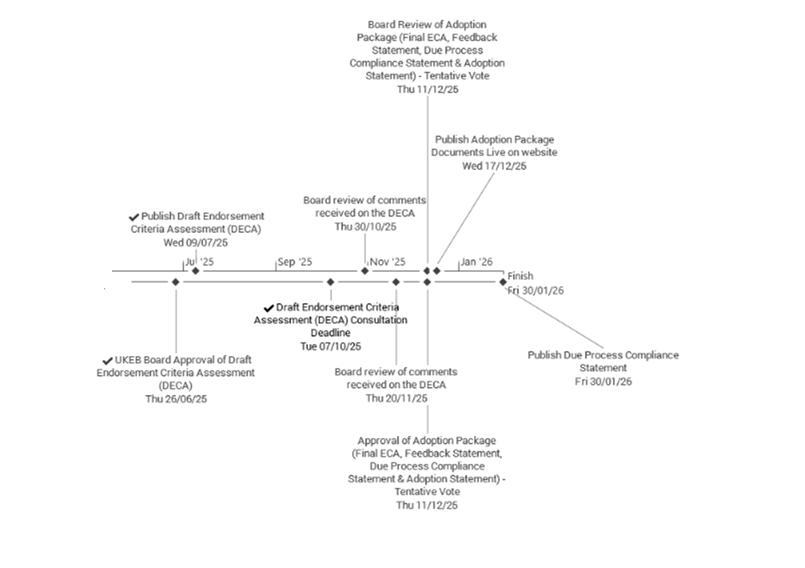
37Subject to feedback received from the Board on this paper, the adoption package will reflect the amendments proposed in this paper. 38It is intended to bring the adoption package for taking a vote on whether to adopt IFRS 18 for use in the UK to the December 2025 public meeting. If the Board wishes, the adoption package could be brought to the November 2025 meeting. This would allow stakeholders to apply IFRS 18 ahead of time of its effective date (1 January 2027). This would also signal to stakeholders that no major issues have been raised in respect of IFRS 18 and consequently, that there is no need to defer the use of IFRS 18 in their financial statements. 39Bringing the adoption package earlier could, however, give the Board and the Secretariat limited time for responding to additional issues that may emerge at the October 2025 meeting and for reflecting them in the adoption package. 40We recommend the Board considers the adoption package can be brought to the November 2025 meeting, ahead of the original timeline to consider adoption at the December 2025 meeting. 41The high-level project timeline is shown below.
Endorsement and adoption of IFRS 18 (effective 1 January 2027)—partial timeline for 2025
| Date | Milestones |
|---|---|
| Oct–Nov 2025 | Board review of feedback received on the [Draft] ECA. |
| 11 December 2025 | * Consideration of Adoption Package * Board members provide a tentative vote |
| December 2025 | * Voting form sent to Board members * Publication of voting outcome and Adoption Package on the UKEB website |
| 29 January 2026 | * Due Process Compliance Statement for noting |
Question for the Board: Timing of adoption package
- Does the Board agree with the Secretariat view that the adoption package can be brought to the November 2025 meeting, which is ahead of the original timeline to consider adoption at the December 2025 meeting?
Appendix A: Provisional assessment – Classification of insurance finance income or expenses in the operating category
Issue 4: Classification of insurance finance income and expense in the operating category
A1This issue examines the interaction between and the accounting impact of the requirements in IFRS 17 Insurance Contracts, and IFRS 18 Presentation and Disclosure in Financial Statements for the classification, presentation and disclosure of insurance finance income or expenses1 (IFIE) in the income statement.
Presentation and disclosure requirements
IFRS 17
A2IFRS 17 requires the separate presentation of insurance finance income or expenses (IFIE). A3In accordance with IFRS 172, IFIE mainly comprises the change in the carrying amount of the group of insurance contracts arising from the effect of (and changes in) the time value of money and financial risk, including the change in discount rate of insurance liabilities. A4For IFIE not arising from risk mitigation activities3, entities are required to make an accounting policy choice for each portfolio of insurance contracts on how to present IFIE. In accordance with paragraphs 88–90 of IFRS 17, such IFIE can be presented either:
- in profit or loss; or,
- disaggregated between profit or loss and other comprehensive income. IFRS 17 prescribes three specific approaches or bases of disaggregation of IFIE between profit or loss and OCI, which depend on the method that the entity applies to account for the insurance contract, and whether the IFIE relates to insurance contracts with direct participation features for which the entity holds the underlying items4.
A5IFRS 17 requires an entity to disclose and explain the total amount of IFIE in the reporting period. In particular, an entity is required to explain the relationship between IFIE and the investment return on its assets, to enable users of its financial statements to evaluate the sources of finance income or expenses recognised in profit or loss and OCI5. A6If an entity chooses to disaggregate IFIE into amounts presented in profit or loss and amounts presented in OCI, the entity is required to disclose an explanation of the methods used to determine the IFIE recognised in profit or loss6.
IFRS 18
A7The requirements in IFRS 18 introduce additional presentation and disclosure requirements for insurance companies that supplement those set out in IFRS 17. A8IFRS 18 requires entities to classify income and expenses into three different categories (operating, investing and financing). Entities for which investing and financing are their main business activities are required to classify income and expenses from those main business activities in the operating category7. A9IFRS 18 specifically defines some of the income and expenses that should be included in operating profit. The operating category is also a default category for residual income that is not classified elsewhere in other categories (i.e. investing or financing). As explained in paragraph BC89 of IFRS 18, the operating category includes an entity's main business activities as well as other income and expenses from supporting activities which may not generate revenue directly, including income and expenses that are volatile or unusual, to faithfully represent the results of an entity's operations in the period. A10In line with this, paragraph 64(b) of IFRS 18, requires insurers to present in the operating category insurance finance income or expenses included in profit or loss. As explained in paragraph BC196 of IFRS 18 “[IFIE] arises from insurance contracts issued, reinsurance contracts held and investment contracts with direct participation features that an entity accounts for in accordance with IFRS 17. Such income and expenses relate to an insurer's main business activities”. A11The following illustrates the presentation of an income statement for insurance companies using the requirements in IFRS 18 (this illustration assumes that there are no reinsurance contracts held for simplicity purposes).
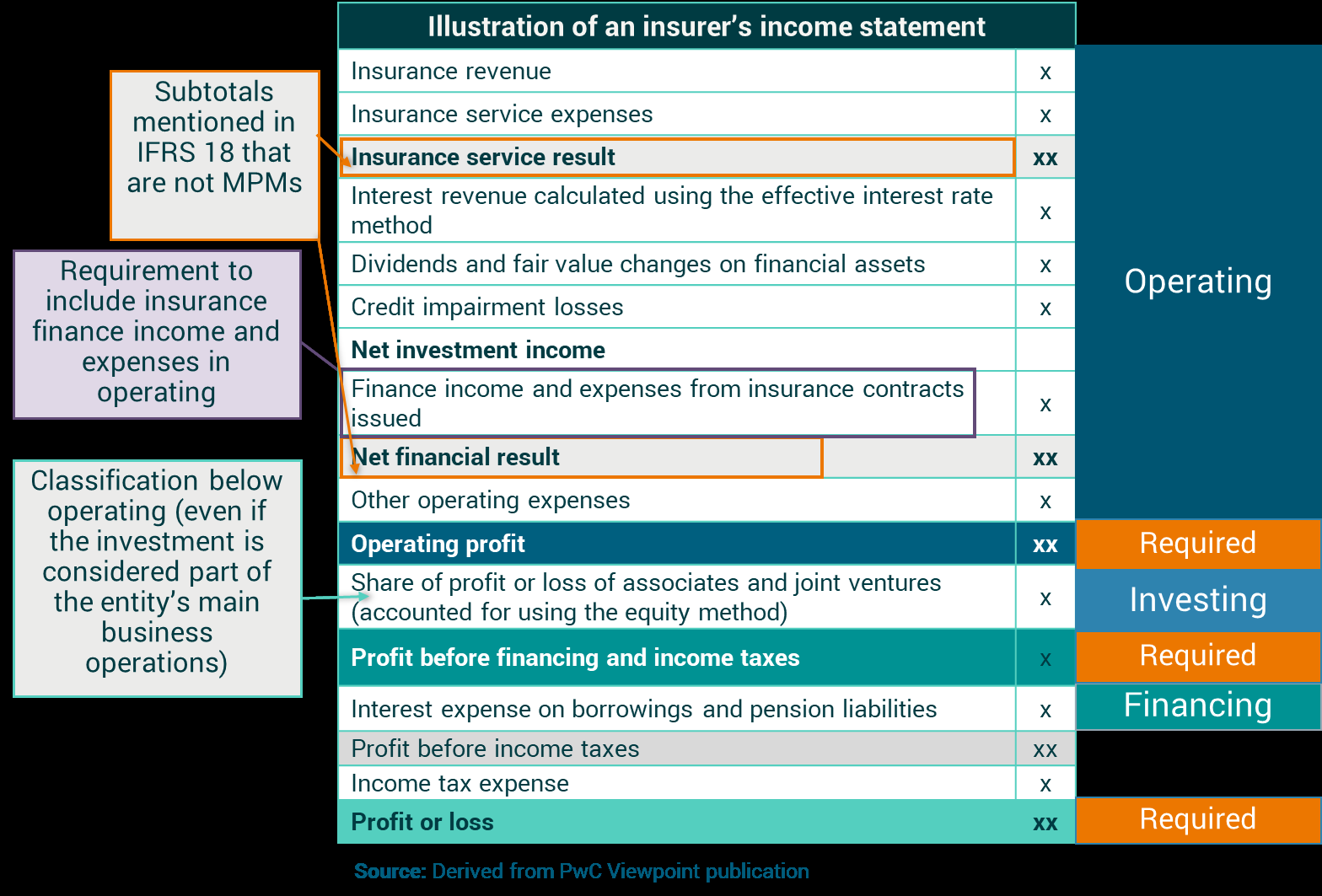
Accounting impact
A12Two respondents (preparer from an insurance entity and a professional body) observe that the requirement in paragraph 64(b) of IFRS 18 to classify insurance finance income or expenses8 (which includes the change in discount rate of insurance liabilities) in the operating category would reduce comparability between insurers as they believe that operating profit could differ significantly depending on the insurer's accounting policy choices made under IFRS 17 under IFRS 9. A13The preparer respondent observes that insurers who:
- apply the fair value through profit or loss (FVTPL) approach to the measurement of financial assets under IFRS 9 Financial Instruments; and
- choose not to apply the OCI option9 to disaggregate IFIE for the period between profit or loss and other comprehensive income (OCI) under IFRS 17 Insurance Contracts,
would experience significantly more volatile operating profit than insurers that measure their financial assets at fair value through OCI (FVOCI) under IFRS 9 and choose to apply the OCI option under IFRS 17. As a result, they believe that the operating profit would not be a fair reflection of these insurers' performance. A14In the view of this respondent, disaggregating the fair value investment variances and economic assumption changes, which they believe are often large and have no predictive value, is necessary to enable users to understand an insurer's performance. Therefore, they believe that additional non-GAAP measures will be needed to enable users of the accounts to understand an insurer's underlying profitability. A15Desk-based research indicates that most UK insurers account for the majority of their financial assets at fair value through profit or loss and do not apply the OCI option under IFRS 1710 limiting the concern around comparability within the UK insurance market. A16Our research11 also showed evidence that the use of alternative performance measures to disaggregate fair value investment variances and economic assumption changes is commonly used by UK insurers that write life insurance business since the short-term market fluctuations are usually not reflective of their main business activities, which are typically for a much longer time horizon. A17For example, an insurer in the UK12 refers that "[insurers] define their non-GAAP operating profit on an expected return basis, based on the expected long term investment return on assets; with the impact of investment variances, economic assumption changes and short-term market fluctuations in return on investments recognised outside of operating profit". A18IFRS 18, however, has now formalised the presentation of adjusted performance measures and may bring existing non-GAAP performance measures into the audited financial statements as 'management-defined performance measures' (MPMs) if they meet the relevant requirements in IFRS 18. Entities will be required to explain these metrics in a separate footnote and provide a reconciliation to an appropriate IFRS defined performance measure, such as operating profit. A19The following requirements in IFRS 17 and IFRS 18 may be particularly useful for insurance entities to explain their underlying performance:
- The requirement in paragraph 110 of IFRS 17, to explain the total amount of IFIE and its relationship with the investment return on assets to enable users of its financial statements to evaluate the sources of finance income or expenses recognised in profit or loss and OCI. If an entity chooses to disaggregate IFIE into amounts presented in profit or loss and amounts presented in OCI, the entity shall disclose an explanation of the methods used to determine the IFIE recognised in profit or loss in accordance with paragraph 118 of IFRS 17.
- The presentation of additional subtotals in accordance with paragraph 24 of IFRS 1813.
- The requirements in IFRS 18 for MPMs14 (e.g. an MPM that adjusts 'operating profit').
- The requirement in paragraph 20 of IFRS 18 to disclose additional information in the notes that enables users to understand the effect of transactions in the entity's financial performance.
Assessment against the technical accounting criteria
A20The UKEB acknowledges the concerns from preparers resulting from classifying IFIE in the operating category. Some insurers consider that presenting IFIE in the 'operating' category will not provide relevant, understandable or comparable information of their operating performance. A21The UKEB observes that, classifying IFIE within the income statement (as part of the operating category) provides users with a consistent starting point for their analysis. In addition, reflecting IFIE as part of the operating category reflects that these income and expenses relate to an insurer's main business activities. This is likely to provide users with relevant and reliable information and a fair representation of an insurance entity's operations. A22The application of some of the disclosure requirements in IFRS 17 and IFRS 18 may also help mitigate concerns over understandability of the information presented in the income statement (see paragraph A19(a)–(d) above which give examples of some different requirements that could help). A23The concern that comparability would be reduced across insurers depending on how the insurer choose to present IFIE under the accounting policy choice permitted in IFRS 17 has been previously considered by the UKEB as well as potential sources of mitigation to this concern15, when assessing IFRS 17 for adoption. Relevant paragraphs from the UKEB's IFRS 17 Endorsement Criteria Assessment (ECA) are reproduced below:
"The IASB introduced the OCI Option as an accounting policy choice to allow entities to avoid the costs and complexity of using OCI when the benefits of doing so do not outweigh those costs. Any optionality within a standard reduces comparability. Similar accounting ratios calculated for different entities may disguise different underlying performance depending on whether the option is adopted. This may impede users from adequately comparing the results of different insurers. Furthermore, the OCI Option is applicable on a portfolio-by-portfolio basis. This means that performance between portfolios will be less comparable.
However, it is anticipated that the OCI Option will be more appropriate for certain types of business, depending on the accounting policy applied to the assets backing the insurance liabilities. Therefore, in practice the option may be applied consistently by type of business or by entities employing similar asset/liability strategies. This could mitigate the extent to which comparability is compromised across insurers on these bases.” [ECA, ‘Other comprehensive income option' page 170].
A24In addition, in line with paragraph BC43 of IFRS 17's Basis for Conclusions, permitting an accounting policy choice for the presentation of IFIE also balances relevance and comparability. In this respect the UKEB's IFRS 17 ECA indicates that:
"Any risks to comparability or reliability need to be balanced against the enhanced relevance of the financial information in cases when use of the OCI Option enables entities to reduce or eliminate accounting mismatches. The specific disclosures required by IFRS 17 should also mitigate these risks. Users of insurers' accounts are likely to need to become familiar with new performance measures in any event, as IFRS 17 introduces significant change in a number of areas.” [ECA, ‘Other comprehensive income option' page 170].
Appendix B: Summary of feedback received
B1This Appendix summarises the feedback received on the IFRS 18 DECA. In the tables below the name of the respondent is hyperlinked to the response published on the UKEB's website.
| Table 1 | Overall feedback |
|---|---|
| Respondent | Feedback summary |
| Response 1, Deloitte LLP | Strongly supports a single set of global corporate reporting standards and as such fully supports the endorsement of IFRS 18. |
| Response 2, PwC | Strongly supports a single set of global corporate reporting standards and as such fully supports the endorsement of IFRS 18. |
| Response 3, W. Henzell | Did not explicitly comment on the UKEB's tentative conclusion that IFRS 18 meets the statutory endorsement criteria and on its tentative view that it will adopt IFRS 18 for use in the UK. Expressed disagreement with the assessment in Section 4 (long term public good) as they felt that the assessment of costs and benefits did not appropriately consider unlisted/smaller companies and Section 6 (Whether IFRS 18 is likely to lead to a significant change in practice) as in the respondent's view it overlooks the costs borne by private companies. |
| Response 4, Aviva | Did not explicitly comment on the UKEB's conclusion that IFRS 18 meets the statutory endorsement criteria and on its tentative view that it will adopt IFRS 18 for use in the UK. This respondent expressed concerns about the impact of specific requirements in IFRS 18 on insurance companies and disagreed that IFRS 18 would meet criteria of relevance, understandability and comparability (Section 3: Technical accounting criteria assessment). This respondent also disagreed with the assessment of benefits to users, discussed as part of the long term public good assessment, suggesting that IFRS 18 would not benefit users of insurance companies' financial statements. Finally, they disagreed that IFRS 18 is not contrary to the true and fair view (Section 5: True and fair view assessment). |
| Response 5, ICAEW | Supports the endorsement of IFRS 18 for use in the UK. |
| Response 6, CFA UK | Supports the changes introduced by IFRS 18. |
| Response 7, KPMG | Strongly supports a single set of global corporate reporting standards and as such fully supports the endorsement of IFRS 18. |
| Response 8, Forvis Mazars | Does not object to the endorsement of IFRS 18 for use in the UK. |
| Response 9, Grant Thornton UK LLP | Strongly supports a single set of global corporate reporting standards and as such fully supports the endorsement of IFRS 18. |
| Response 10, Anonymous | Supports the draft conclusion that IFRS 18 meets the statutory endorsement criteria while flagging some implementation areas that have been already considered in the DECA. |
| Table 2 | Feedback on the technical accounting criteria assessment (Section 3 of the ECA) |
|---|---|
| Respondent | Feedback summary |
| No comments from: Response 1: Deloitte LLP, Response 2: PwC, Response 3: W. Henzell, Response 7: KPMG, Response 8: Forvis Mazars and from Response 9: Grant Thornton UK LLP | |
| Response 4, Aviva | Disagrees that IFRS 18 would meet criteria of relevance, understandability and comparability because of concerns around the classification of: income and expenses from investments in associates and joint ventures accounted for under the equity method in the investing category; and insurance finance income and expenses. |
| Response 5, ICAEW | Agrees with this assessment. Acknowledges the DECA already reflects some concerns raised by preparers in the insurance sector relating to the classification of income and expenses from associates and joint ventures accounted for under the equity method. |
| Response 6, CFA UK | It further notes the concern that the requirement in IFRS 18 to classify insurance finance income and expenses in the operating category leads to a lack of comparability between insurers. |
| Response 10, Anonymous | Agrees with this assessment. Further notes that applying IFRS 18's requirements may involve significant judgement leading to inconsistencies or lack of comparability. In particular, derivative and other fair-value movements could be presented differently across entities, and classification inconsistencies may arise within group structures where the activities of individual entities differ from those of the consolidated group. |
| Table 3 | Feedback on the long term public good (Section 4 of the ECA) |
|---|---|
| Respondent | Feedback summary |
| No comments from: Response 1: Deloitte LLP, Response 2: PwC, Response 7: KPMG, Response 8: Forvis Mazars and Response 9: Grant Thornton UK LLP | |
| Response 3, W. Henzell | Note: Most of the response on the long term public good was drafted using Chat GPT Disagrees on the long term public good assessment, suggesting that: The DECA does not consider "smaller, unlisted entities" in the outreach and monetary assessment of costs. The assessment that compliance costs are scalable is incorrect, and smaller, unlisted entities are going to be disproportionately affected, for example because of criteria on MPMs. * Unlisted entities that apply IFRS may revert to UK GAAP as a result of IFRS 18 and therefore create further fragmentation. The assessment of benefits focuses on access to capital markets and does not appropriately consider unlisted entities. |
| Response 4, Aviva | Agrees on the assessment of costs, suggesting that the assessment that costs are going to be largely one-off and proportional to the size of the entity is correct. However, disagrees on the assessment of benefits, suggesting that: Intra-group, "legal entities” will incur most of the costs but won't reap benefits from improved interaction between users and financial statements. The insurance sector would not benefit from improved interaction between users and financial statements. |
| Response 5, ICAEW | Overall agrees on the long term public good assessment, but raises three concerns: Notes that estimated cost figures may be at the high-end of the spectrum as companies' assessments were at early stages. Suggests that the DECA should more carefully consider cost implications for the insurance sector. |
| Response 6, CFA UK | Suggests that the DECA should more carefully consider cost implications for unlisted companies, especially with consideration of MPMs. |
| Response 10, Anonymous | Agrees with this assessment. Further notes that: Preparers are expected to face some costs however these are considered to be manageable. Benefits for users are likely to outweigh the costs, however IFRS 18 may add volatility to the operating profits results. Nonetheless IFRS 18 is expected to “support investor confidence and efficient capital allocation". |
| Table 4 | Feedback on true and fair view (Section 5 of the ECA) |
|---|---|
| Respondent | Feedback summary |
| No comments from: Response 1: Deloitte LLP, Response 2: PwC, Response 3: W. Henzell, Response 5: ICAEW, Response 6: CFA UK, Response 7: KPMG, Response 8: Forvis Mazars Response 9: Grant Thornton UK LLP and Response 10, Anonymous | |
| Response 4, Aviva | Disagrees with this assessment. |
| This is consistent with the respondent's view of Section 3 Technical accounting criteria assessment (see table 2 above). This respondent observes that presenting insurance finance income and expenses (IFIE) in the operating category is not a fair reflection of an insurer's financial performance as it introduces a significant inconsistency for the insurance industry depending on the accounting policy choices made under IFRS 9 and IFRS 17 Insurance Contracts. |
| Table 5 | Feedback on whether IFRS 18 is likely to lead to a significant change in practice (Section 6 of the ECA) |
|---|---|
| Respondent | Feedback summary |
| No comments from: Response 1: Deloitte LLP, Response 2: PwC, Response 4, Aviva, Response 6, CFA UK, Response 7: KPMG, Response 9: Grant Thornton UK LLP and Response 10, Anonymous | |
| Response 3: W. Henzell | Objects to the UKEB's tentative conclusion, referring that the DECA: Is heavily biased towards the circumstances of large listed companies. Fails to properly consider the position of the approximately 14,000 unlisted UK entities that apply IFRS voluntarily. * Overlooks the disproportionate costs and operational burdens borne by private companies. |
| Response 5, ICAEW | Respondent agrees with UKEB's conclusion but noted that entities have conducted only a high-level assessment of the impact of IFRS 18 but have not yet fully evaluated the detailed impact of the new requirements. This raises the possibility that the Standard may lead to more substantial changes in accounting practices than initially expected. |
| Response 8, Forvis Mazars | Does not object to the UKEB's tentative view but suggests that the UKEB should closely monitor the situation as more information becomes available regarding the impact of IFRS 18. |
Footnotes
Footnotes
-
IFIE mainly comprises the change in the carrying amount of the group of insurance contracts arising from the effect of (and changes in) the time value of money and financial risk (IFRS 17.87(a)-(b)). ↩
-
Paragraphs B115-B118 of IFRS 17 provide specific requirements to the presentation of IFIE arising from risk mitigation activities, which dictate the presentation in profit or loss depending on the type of instruments used for risk mitigation (i.e. derivatives, non-derivative financial instruments measured at fair value through profit or loss or reinsurance contracts held). ↩↩
-
Paragraphs B130-B134 and Illustrative Examples 15 and 16 in IFRS 17. ↩↩
-
Paragraph 50 of IFRS 18. ↩
-
IFIE mainly comprises the change in the carrying amount of the group of insurance contracts arising from the effect of (and changes in) the time value of money and financial risk (IFRS 17.87(a)–(b)). ↩
-
Paragraphs 88-90 of IFRS 17 allow an entity to make an accounting policy choice (the OCI Option) between: a) including IFIE for the period in profit or loss; or b) disaggregating IFIE for the period between profit or loss and OCI Income (OCI). ↩
-
See page 24 of KPMG's publication: Insurers' 2024 annual financial statements—Real time IFRS 17 (April 2025). ↩
-
See page 8 of PwC's publication in FY23: IFRS 17 FY23 UK reporting analysis - April 2024 and page 7 of PwC's publication in FY24: IFRS 17 FY24: Analysis for UK life insurers. These publications show that UK insurers present Adjusted Operating Profit as a key performance measure. ↩
-
See page 4 of Aviva's comment letter to the IASB's General Presentation and Disclosures Exposure Draft (2019). ↩
-
For example, in line with paragraph 24 of IFRS 18 which allows entities to present additional line items and subtotals if such presentations are necessary for a primary financial statement to provide a useful structured summary. ↩
-
Refer to paragraphs 121-125 of IFRS 18. ↩
-
See analysis of the 'Other comprehensive income option' in the UKEB's Endorsement Criteria Assessment of IFRS 17, page 170. ↩