7 Post-implementation Review of IFRS 16 Leases
15 July 2025
Agenda Paper 7
OFFICIAL - PUBLIC

Executive Summary
Project Stage
| Agency | Research / Pipeline | Discussion paper | Redeliberation | Exposure Draft | Redeliberation | Final standard | Post Implementation Review |
|---|---|---|---|---|---|---|---|
| IASB | Research / Pipeline | Discussion paper | Redeliberation | Exposure Draft | Redeliberation | Final standard | Post Implementation Review |
| UKEB | Research / Influencing | Research / Influencing | Monitoring | Influencing | Monitoring | Endorsement | Influencing |
Project Type: Influencing Project Scope: Limited
Purpose of the paper
The purpose of this paper is to obtain Board feedback and approval for publication of the Draft Comment Letter (DCL), and the accompanying invitation to comment (ITC) questions, on the IASB's Request for Information (RFI) for the Post-implementation Review (PIR) of IFRS 16 Leases.
Summary of the Issue
On 17 June 2025, the IASB published the RFI with a comment deadline of 15 October 2025. Due to the timing of UKEB meetings, this DCL has been developed to an accelerated timeline. In anticipation, the Secretariat had already performed desk-based research and some limited outreach activities. This included conducting a survey of UK IFRS reporters who are lessees, to collect information on the ongoing costs and benefits of applying IFRS 16. This work is reflected in the DCL. Overall, the proposed DCL does not identify fatal flaws in IFRS 16. However, it identifies opportunities to mitigate ongoing costs and clarify the accounting for sale and leaseback transactions.
Decision for the Board
Subject to addressing any comments raised at the meeting, does the Board approve the DCL and ITC for publication on the UKEB website?
Recommendation
The Secretariat recommends that, subject to any necessary amendments requested by the Board, the Board approves the DCL and ITC for publication on the UKEB website.
Appendix
- Appendix A: Proposed Draft Comment Letter
- Appendix B: Proposed Invitation to Comment
- Appendix C: Overview of responses to preparer survey
Background
In January 2016, the IASB issued IFRS 16. The Standard was effective for annual periods beginning on or after 1 January 2019. Earlier application was permitted, as long as IFRS 15 Revenue from Contracts with Customers was also applied. In December 2023, the IASB decided to commence the PIR of IFRS 16. On 17 June 2025, the IASB published its RFI for the PIR of IFRS 16 Leases1 with a comment deadline on 15 October 2025.
The IASB's PIR is focusing on:
- stakeholders' experiences relating to IFRS 16 and their overall views on the Standard;
- costs and benefits;
- sale and lease back transactions.
The UKEB has undertaken desk-based research and conducted some limited outreach activities on this topic with the UKEB Investor Advisory Group (IAG), the UKEB Preparer Advisory Group (PAG), the UKEB Accounting Firms and Institutes Advisory Group (AFIAG), and the UKEB Academic Advisory Group (AAG). This work has informed the Project Initiation Plan (PIP) and is be reflected in the DCL.
During May 2025, the Secretariat also conducted limited and targeted initial outreach with UK IFRS reporters who are lessees through a survey to collect information on the ongoing costs and benefits of applying IFRS 16. There were 51 respondents and their feedback is reflected in the DCL.
Dr Andreas Barckow Chair International Accounting Standards Board Columbus Building 7 Westferry Circus Canary Wharf London E14 4HD
[Date]
Dear Dr Barckow
Invitation to Comment: Post-implementation Review of IFRS 16 Leases
1The UK Endorsement Board (UKEB) is responsible for endorsement and adoption of IFRS Accounting Standards for use in the UK and therefore is the UK's National Standard Setter for IFRS Accounting Standards. The UKEB also leads the UK's engagement with the IFRS Foundation on the development of new standards, amendments and interpretations. This letter is intended to contribute to the Foundation's due process. The views expressed by the UKEB in this letter are separate from, and will not necessarily affect the conclusions in, any endorsement and adoption assessment on new or amended international accounting standards undertaken by the UKEB.
2There are currently approximately 1,500 entities with equity listed on the London Stock Exchange that prepare their financial statements in accordance with IFRS.2 In addition, UK law allows unlisted companies the option to use IFRS and approximately 14,000 such companies currently take up this option.3
3The UKEB welcomes the opportunity to provide comments on the International Accounting Standards Board (IASB)'s Post-implementation Review of IFRS 16 Leases.
4In developing this letter, we consulted with stakeholders in the UK, including a survey of preparers on the ongoing costs and benefits of applying the Standard. Feedback indicates the following:
- There is general support for IFRS 16 and no fatal flaws have been identified.
- The ongoing costs of applying IFRS 16 remains high and that there may be opportunities for mitigation of these ongoing costs by simplifying some requirements and/or extending the exemptions currently in IFRS 16.
- There are wider concerns about the accounting for Sale and Leaseback transactions that may warrant a focused project to clarify the requirements.
5We will provide the IASB with a summary of the feedback received on the survey.
6If you have any questions about this response, please contact the UKEB project team at [email protected].
Yours sincerely
Pauline Wallace Chair UK Endorsement Board
Appendix A: Questions on Request for Information: Post-implementation Review IFRS 16 Leases
Overall assessment of IFRS 16
Question 1—Overall assessment of IFRS 16
- In your view, is IFRS 16 meeting its objective and are its core principles clear? If not, please explain why not.
- In your view, are the overall improvements to the quality and comparability of financial information about leases largely as the IASB expected? If your view is that the overall improvements are significantly lower than expected, please explain why.
- In your view, are the overall ongoing costs of applying the requirements and auditing and enforcing their application largely as the IASB expected? If your view is that the overall ongoing costs are significantly higher than expected, please explain why, how you would propose the IASB reduce these costs and how your proposals would affect the benefits of IFRS 16.
Objectives
The objective of IFRS 16 “is to ensure that lessees and lessors provide relevant information in a manner that faithfully represents those transactions. This information gives a basis for users of financial statements to assess the effect that leases have on the financial position, financial performance and cash flows of an entity."4
A13.UKEB outreach indicates that many stakeholders believe that IFRS 16 is meeting its objective and that the core principles are clear. The UKEB has not been made aware of any fatal flaws in IFRS 16.
Improvements
IFRS 16 was expected to result in a more faithful representation of a company's assets and liabilities and greater transparency about the company's financial leverage and capital employed.
This was expected to5:
- reduce the need:
- for investors and analysts to make adjustments to amounts reported on a lessee's balance sheet and income statement; and
- for companies to provide ‘non-GAAP’ information about leases. IFRS 16 provides a richer set of information than was available applying IAS 17, giving further insight into a company's operations.
- improve comparability between companies that lease assets and companies that borrow to buy assets.
- create a more level playing field in providing transparent information about leases to all market participants. A company will more accurately measure assets and liabilities arising from leases applying IFRS 16 as compared to the estimates made by only more sophisticated investors and analysts when companies applied IAS 17.
A14.Generally, user feedback suggests that quality and comparability of financial information about leases is largely as expected. IFRS 16 disclosures were more useful than those previously reported under IAS 17. Some users have suggested that while they are recasting IFRS 16 disclosures back to IAS 17 numbers, this effect may be transitory. However, the UKEB also received feedback that IFRS 16 disclosures are more useful than those previously reported under IAS 17.
A15.Preparers views are more mixed. The UKEB has received feedback that some companies adjust their non-GAAP measures such as EBITDA to reverse the effects of IFRS 16 and reintroduce rental cost as this gives users a more consistent view of the company. Also, creditors such as banks frequently ask for pre-IFRS 16 numbers for the purposes of debt covenants.
A16.There was also feedback from the preparer survey that rental cost was a much easier concept for users to understand. Splitting lease costs into depreciation and interest expense has impaired the understandability of the accounts.
A17.On balance, UKEB outreach indicates that the overall improvements are NOT significantly LOWER than expected.
Ongoing Costs
IFRS 16 eliminated the classification of leases as either operating leases or finance leases for a lessee. Instead, almost all leases are treated in a similar way to finance leases applying IAS 17. Finance lease accounting was generally seen as more complex, and therefore more costly, to undertake, when compared to operating lease accounting.
The IASB expected that once a company had updated its systems to provide the information required by IFRS 16, the costs to be only marginally higher compared to those incurred when applying IAS 17.6
The IASB believed the data required to apply IFRS 16 was similar to that needed to apply IAS 17, with the exception of discount rates that are required for all leases when applying IFRS 16.
The IASB did not expect that companies would need to reassess many lease liabilities. Even when a lease contains options to extend or terminate the lease, the IASB concluded that remeasurement of the lease liability is unlikely to be onerous because the threshold for reassessment is high.
The IASB concluded that changes to the lease term—and thereby a reassessment of the discount rate and lease payments—are expected only in a small number of cases.
A18.The UKEB has received feedback that indicates many preparers believe the ongoing costs of applying the requirements of IFRS 16 are overall higher than expected, particularly when compared to IAS 17.
A19.From the responses gathered in the UKEB Preparer Survey, the main drivers of the ongoing costs of applying IFRS 16 are:
- remeasurement of lease assets and lease liabilities;
- collecting information for disclosures; and
- determining the appropriate discount rate.
A20.Preparers suggested that enhanced disclosure requirements, coupled with the amount and frequency of data input and calculations, can cause a compounding effect on the ongoing costs of applying IFRS 16 (e.g. retail groups with thousands of stores, or companies with a large fleet of leased vehicles).
A21.The amount of data and judgement required also creates a second order impact on audit costs and results in preparers needing not only specialised software solutions but also specialists well-versed in IFRS 16.
A22.Companies with only a limited exposure to leases, such as a small number of company cars or office spaces, have observed that complying with the requirements of IFRS 16 is disproportionately costly.
A23.Some suggestions for mitigating the ongoing costs are:
- Clarify and possibly broaden the exemption for leases of low-value assets. Specifically remove the USD$5,000 reference from the Basis for Conclusions and consider providing a qualitative criteria similar to FRS 1027.
- Broaden the exemption for short-term leases, to 24 months for example.
- Simplify the discount rate requirements. For example, allowing a lessee to use its obtainable borrowing rate as an alternative to the lessee's incremental borrowing rate, which is expected to be simpler to determine while representing a broadly similar concept.
Usefulness of information resulting from lessees' application of judgement
Question 2—Usefulness of information resulting from lessees' application of judgement
- Do you agree that the usefulness of financial information resulting from lessees' application of judgement is largely as the IASB expected? If your view is that lessees' application of judgement has a significant negative effect on the usefulness of financial information, please explain why.
- Do you agree that the requirements in IFRS 16 provide a clear and sufficient basis for entities to make appropriate judgements and that the requirements can be applied consistently? If not, please explain why not.
- If your view is that the IASB should improve the usefulness of financial information resulting from lessees' application of judgement, please explain:
- what amendments you propose the IASB make to the requirements (and how the benefits of the solution would outweigh the costs); or
- what additional information about lessees' application of judgement you propose the IASB require entities to disclose (and how the benefits would outweigh the costs).
A24.The UKEB outreach [to date] has not identified that lessees' application of judgement has a significant negative effect on the usefulness of financial information
A25.From the responses gathered in the UKEB Preparer Survey, there were mixed views as to whether the application of judgement under IFRS 16 resulted in better comparability and transparency. There was general agreement that having most, if not all, leases capitalised on the balance sheet helped improve transparency. On the other hand, preparers considered that the application of judgement in determining lease terms and discount rates reduced comparability.
Usefulness of information about lessees' lease-related cash flows
Question 3—Usefulness of information about lessees' lease-related cash flows
Do you agree that the improvements to the quality and comparability of financial information about lease-related cash flows that lessees present and disclose are largely as the IASB expected? If your view is that the improvements are significantly lower than expected, please explain why.
A26.UKEB research has indicated that stakeholders want better information on cash flows related to leases. Current disclosures do not generally allow users to link information between the statement of financial position, the income statement and the cash flows. This is particularly relevant in the presence of merger and acquisition activity.
A27.The UKEB believe that lease-related cash flows should be addressed as part of the Statement of Cash Flows and Related matters project currently being undertaken by the IASB.
Ongoing costs for lessees of applying the measurement requirements
Question 4—Ongoing costs for lessees of applying the measurement requirements
- Do you agree that the ongoing costs of applying the measurement requirements in IFRS 16 are largely as the IASB expected? If your view is that the ongoing costs are significantly higher than expected, please explain why, considering how any entity-specific facts and circumstances (such as IT solutions) add to these costs.
- If your view is that the ongoing costs are significantly higher than expected, please explain how you propose the IASB reduce these costs without a significant negative effect on the usefulness of financial information about leases.
A29.As noted above the UKEB has received feedback that indicates many preparers believe the overall ongoing costs of applying the requirements of IFRS 16 are higher than expected, particularly when compared to IAS 17.
A30.Please see response to Question 1.
Potential improvements to future transition requirement
Question 5—Potential improvements to future transition requirements
Based on your experience with the transition to IFRS 16, would you recommend the IASB does anything differently when developing transition requirements in future standard-setting projects? If so, please explain how your idea would ensure:
- users have enough information to allow them to understand the effect of any new requirements on entities' financial performance, financial position and cash flows; and
- preparers can appropriately reduce their transition costs when implementing new requirements for the first time.
A32.The UKEB is not [currently] aware of any significant concerns with the transition requirements.
Other matters relevant to the assessment of the effects of IFRS 16
Question 6.1—Applying IFRS 16 with IFRS 9 to rent concessions
- How often have you observed the type of rent concession described in Spotlight 6.1?
- Have you observed diversity in how lessees account for rent concessions that has had, or that you expect to have, a material effect on the amounts reported, thereby reducing the usefulness of information?
- If your view is that the IASB should act to improve the clarity of the requirements, please describe your proposed solution and explain how the benefits of the solution would outweigh the costs.
Spotlight 6.1: The IFRS Interpretations Committee (IFRIC) discussed how lessors should account for rent concessions involving the forgiveness of lease payments, which partially extinguishes the lessee's lease liability. They identified two ways for lessees to account for this:
- IFRS 9 Approach: Recognise the effect of forgiven lease payments in profit or loss at the date of the concession.
- IFRS 16 Approach: Recognise the effect as a decrease in the carrying amount of the right-of-use asset.
The Committee suggested that the IASB should clarify the distinction between a lease modification and an extinguishment of a lease liability, as the current lack of clarity could impact the usefulness of financial information.
A34.While the UKEB is aware of the IFRIC suggestion, the UKEB has not [to date] been made aware of pervasive concerns with applying IFRS 16 with IFRS 9 to rent concessions in the UK.
Question 6.2—Applying IFRS 16 with IFRS 15 when assessing whether the transfer of an asset in a sale and leaseback transaction is a sale
- How often have you observed difficulties in assessing whether the transfer of an asset in a sale and leaseback transaction is a sale?
- Have you observed diversity in seller-lessees' assessments of the transfer of control that has had, or that you expect to have, a material effect on the amounts reported, thereby reducing the usefulness of information?
- If your view is that the IASB should act to help seller-lessees determine whether the transfer of an asset is a sale, please describe your proposed solution and explain how the benefits of the solution would outweigh the costs.
A35.From the responses gathered in the UKEB Preparer Survey, sale-and-leaseback transactions remain a difficult and complex area, responses included:
- similar transactions resulted in different accounting treatments depending on whether the “sale” test under IFRS 15 failed;
- sale and leaseback, where only a part of the property is leased back, requires significant judgement in applying the standard; and
- IFRS 16 does not provide guidance on intercompany sale and leasebacks that have below market value terms.
A36.The UKEB's response to the IASB's IFRS 15 PIR (Final Comment Letter - Post-Implementation Review of IFRS 15 Revenue from Contracts with Customers) stated that “We have not been made aware of any significant issues relating to the interaction between IFRS 15 and the requirements of other IFRS, in particular ... IFRS 16 Leases.” (para A25). However, the UKEB's feedback statement (Feedback Statement - Post-Implementation Review of IFRS 15 Revenue from Contracts with Customers, emphasis added) noted that some stakeholders had raised concerns about assessing whether control has passed in relation to sale and leaseback transactions" (page 16)
A37.There appear to be a range of matters related to sale and lease back that cause stakeholders concern. The IASB may want to consider a focused project to address the accounting for sale and lease back more comprehensively.
Question 6.3—Applying IFRS 16 with IFRS 15 to gain or loss recognition in a sale and leaseback transaction
- Do you agree that restricting the amount of gain (or loss) an entity recognises in a sale and leaseback transaction results in useful information?
- recognition requirements, and the usefulness of the resulting information, differ significantly from those expected?
- If your view is that the IASB should improve the cost-benefit balance of applying the partial gain or loss recognition requirements, please describe your proposed solution
A38.The UKEB has not been made aware of any specific issues around applying the partial gain or loss recognition requirements.
A39.However, as noted above, given there appear to be a range of matters related to sale and lease back that cause stakeholders concern. The IASB may want to consider a focused project to address the accounting for sale and lease back more comprehensively.
Question 6.4—Other matters relevant to the assessment of the effects of IFRS 16
A40.Are there any further matters the IASB should examine as part of the postimplementation review of IFRS 16? If so, please explain why, considering the objective of a post-implementation review
A41.The UKEB outreach [to date] has not identified any other significant matters relevant to the assessment of the effects of IFRS 16.
Appendix B: Invitation to Comment
Call for comments on the Request for Information—Post-implementation Review: IFRS 16 Leases
Deadline for completion of this Invitation to Comment:
Close of business, XXXX
Please submit to: [email protected]
Introduction
The objective of this Invitation to Comment is to obtain input from stakeholders on the UKEB's draft comment letter on the IASB's Request for Information – Post-implementation Review: IFRS 16 Leases.
Who should respond to this Invitation to Comment?
Stakeholders with an interest in the quality of accounts prepared in accordance with IFRS Accounting Standards.
How to respond to this Invitation to Comment
Please download this document, answer any questions on which you would like to provide views, and return it to [email protected] by close of business on XXXX.
Brief responses to individual questions are welcome, as well as comprehensive responses to all questions.
Privacy and other policies
The data collected through submitting this document will be stored and processed by the UKEB. By submitting this document, you consent to the UKEB processing your data for the purposes of influencing the development of and adopting IFRS for use in the UK. For further information, please see our Privacy Statements and Notices and other Policies (e.g. Consultation Responses Policy and Data Protection Policy)8.
The UKEB's policy is to publish on its website all responses to formal consultations issued by the UKEB unless the respondent explicitly requests otherwise. A standard confidentiality statement in an e-mail message will not be regarded as a request for non-disclosure. If you do not wish your signature to be published, please provide the UKEB with an unsigned version of your submission. The UKEB prefers to publish responses that do not include a personal signature. Other than the name of the organisation/individual responding, information contained in the “Your Details” document will not be published. The UKEB does not edit personal information (such as telephone numbers, postal or e-mail addresses) from any other response document submitted; therefore, only information that you wish to be published should be submitted in such responses.
Questions
Request for Information – Post-implementation Review: IFRS 16 Leases
Question 1—Overall assessment of IFRS 16
1The UKEB's draft comment letter [tentatively] concludes that:
- Many stakeholders believe that IFRS 16 is meeting its objective and that the core principles are clear. [paragraphs will be inserted later]
- The UKEB has NOT been made aware of any fatal flaws in IFRS 16.
- On balance, the overall improvements are NOT significantly LOWER than expected.
- The ongoing costs of applying the requirements of IFRS 16 are overall higher than expected, particularly when compared to IAS 17.
2The draft comment letter outlines potential mitigations the IASB could consider to address the higher ongoing costs.
Do stakeholders agree with the UKEB's [tentative] conclusions and the potential mitigations outlined?
| Yes | No |
|---|---|
Click or tap here to enter text.
Question 2—Usefulness of information resulting from lessees' application of judgement
3The UKEB's draft comment letter [tentatively] concludes that its outreach has not identified that lessees' application of judgement has a significant negative effect on the usefulness of financial information.
Do stakeholders agree with the UKEBs [tentative] conclusion?
| Yes | No |
|---|---|
Click or tap here to enter text.
Question 3—Usefulness of information about lessees' lease-related cash flows
4The UKEB [tentatively] believe that lease-related cash flows should be addressed as part of the Statement of Cash Flows and Related matters project currently being undertaken by the IASB.
Do stakeholders agree with the UKEBs [tentative] conclusion?
| Yes | No |
|---|---|
Click or tap here to enter text.
Question 4—Ongoing costs for lessees of applying the measurement requirements
5The UKEB's draft comment letter [tentatively] concludes that many preparers believe the overall ongoing costs of applying the requirements of IFRS 16 are higher than expected, particularly when compared to IAS 17.
6Mitigations are discussed at question 1.
Do stakeholders agree with the UKEBs [tentative] conclusion?
| Yes | No |
|---|---|
Click or tap here to enter text.
Question 5—Potential improvements to future transition requirements
7The UKEB's draft comment letter [tentatively] concludes that it is not aware of any significant concerns with the transition requirements.
Do stakeholders agree with the UKEBs [tentative] conclusion?
| Yes | No |
|---|---|
Click or tap here to enter text.
Question 6.1—Applying IFRS 16 with IFRS 9 to rent concessions
8While the UKEB is aware of the IFRIC suggestion, the UKEB's draft comment letter [tentatively] concludes that it has not been made aware of pervasive concerns applying IFRS 16 with IFRS 9 to rent concessions in the UK.
Do stakeholders agree with the UKEBs [tentative] conclusion?
| Yes | No |
|---|---|
Click or tap here to enter text.
Question 6.2—Applying IFRS 16 with IFRS 15 when assessing whether the transfer of an asset in a sale and leaseback transaction is a sale
9The UKEB's draft comment letter [tentatively] concludes that given the range of matters related to sale and lease back that cause stakeholders concern, the IASB may want to consider a focused project to address the accounting for sale and lease back more comprehensively.
Do stakeholders agree with the UKEBs [tentative] conclusion?
If your view is that the IASB should improve the cost-benefit balance of applying the partial gain or loss recognition requirements, please describe your proposed solution
| Yes | No |
|---|---|
Click or tap here to enter text.
Question 6.3—Applying IFRS 16 with IFRS 15 to gain or loss recognition in a sale and leaseback transaction
10The UKEB's draft comment letter [tentatively] concludes that it has not been made aware of any specific issues around applying the partial gain or loss recognition requirements.
11However, as noted above, given there appear to be a range of matters related to sale and lease back that cause stakeholders concern, the IASB may want to consider a focused project to address the accounting for sale and lease back more comprehensively.
Do stakeholders agree with the UKEBs [tentative] conclusion?
| Yes | No |
|---|---|
Click or tap here to enter text.
Question 6.4—Other matters relevant to the assessment of the effects of IFRS 16
12The UKEB's draft comment letter [tentatively] concludes that it has not been made aware of any other matters relevant to the assessment of the effects of IFRS 16.
Do stakeholders agree with the UKEBs [tentative] conclusion?
The UKEB is interested to hear if stakeholders have views on the IASB's decision to remove the option for “Type B leases”9 (proposed in the 2013 Exposure Draft Leases) from the final leases standard.
| Yes | No |
|---|---|
Click or tap here to enter text.
Any Other Comments
13Are there any other comments you would like to make on the IASB's Post Implementation Review of IFRS 16 Leases?
Response:
Thank you for completing this Invitation to Comment
Please submit this document by close of business on XXX to: [email protected]
Appendix C: Overview of responses to preparer survey
Background and purpose
C1.The IASB has noted that feedback from preparers indicated that the ongoing costs of applying IFRS 16 Leases remain high.
C2.In response, the UKEB Secretariat conducted limited, targeted initial outreach with UK IFRS reporters who are lessees through a survey. The aim was to collect information on the ongoing costs and benefits of applying IFRS 16.
C3.This paper provides a high-level overview of the responses to the survey, along with relevant observations from UKEB Advisory Groups.
Preparer survey
Details of survey and overview of respondents
C4.The survey was open from 29 April 2025 until 30 May 2025.
C5.In total, 51 respondents completed the survey, with 48 being within the scope of the survey, i.e. lessees applying IFRS 16.
C6.Respondents represented a range of UK industries and company sizes.
Survey questions
C7.The main areas of focus of the survey are listed below with an overview of the responses received.
- The types of assets held under leases.
- The drivers of the ongoing costs.
- A rating of the level of ongoing operational costs when compared to IAS 17.
- Suggested mitigations of high ongoing operational costs.
- A rating of whether the benefits as expected by the IASB have been realised.
Types of assets held under leases
C8. Unsurprisingly for the majority of respondents land and buildings was the most significant leased asset (Table 7). With vehicles being the second most common type of lease (Table 8).
| Answer Choices | Response Percent | Response Total |
|---|---|---|
| 1 Land/Buildings | 85.42% | 41 |
| 2 Large plant/Machinery | 2.08% | 1 |
| 3 Equipment, including IT hardware and software | 2.08% | 1 |
| 4 Vehicles | 4.17% | 2 |
| 5 Other (please specify): | 6.25% | 3 |
C9. Other assets held under leases were aircraft and concession counters in department stores.
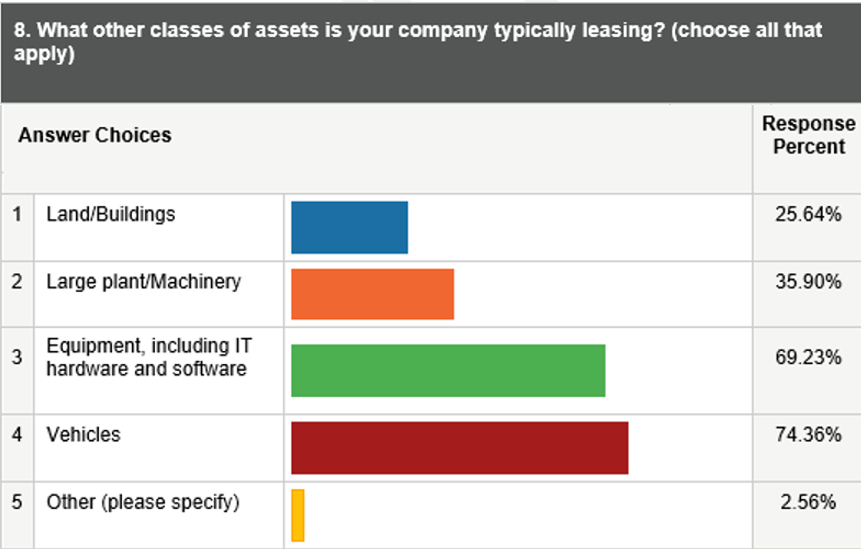
- What other classes of assets is your company typically leasing? (choose all that apply)
| Answer Choices | Response Percent |
|---|---|
| 1 Land/Buildings | 25.64% |
| 2 Large plant/Machinery | 35.90% |
| 3 Equipment, including IT hardware and software | 69.23% |
| 4 Vehicles | 74.36% |
| 5 Other (please specify) | 2.56% |
Drivers of ongoing costs
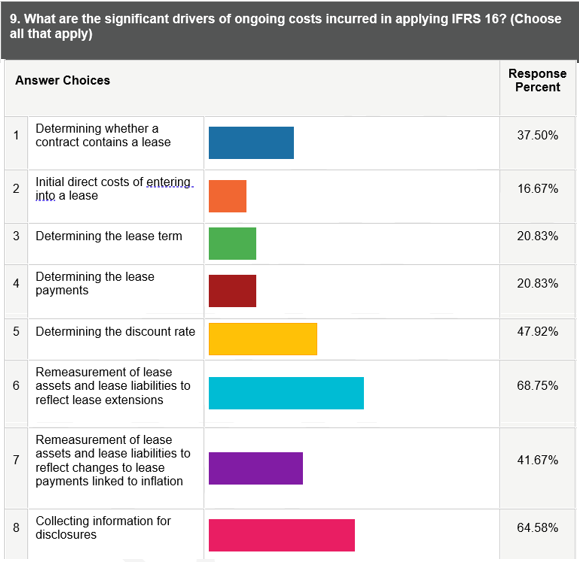
C10.The most significant drivers of cost are shown in Table 9 below. In the comments, many respondents mentioned that the costs of systems and staff to deal with remeasurement, the high volume of leases, determining the discount rate and maintaining the underlying accounting records are key drivers of high ongoing costs.
The UKEB Preparer Advisory Group (PAG) expressed similar views and highlighted remeasurement and determining discount rates as being the largest drivers of high ongoing costs.
The UKEB Accounting Firms and Institutes Advisory Group (AFIAG) noted that auditing the areas of judgement such as identifying leases, determining discount rates and treatment of lease extensions and renewals lead to a lot of debate with clients and, consequently, higher audit costs.
- What are the significant drivers of ongoing costs incurred in applying IFRS 16? (Choose all that apply)
| Answer Choices | Response Percent |
|---|---|
| 1 Determining whether a contract contains a lease | 37.50% |
| 2 Initial direct costs of entering into a lease | 16.67% |
| 3 Determining the lease term | 20.83% |
| 4 Determining the lease payments | 20.83% |
| 5 Determining the discount rate | 47.92% |
| 6 Remeasurement of lease assets and lease liabilities to reflect lease extensions | 68.75% |
| 7 Remeasurement of lease assets and lease liabilities to reflect changes to lease payments linked to inflation | 41.67% |
| 8 Collecting information for disclosures | 64.58% |
Consideration of level of ongoing costs compared with applying IAS 17 Leases (or UK GAAP, if applicable)
- Compared to applying the previous IFRS leases standard (IAS 17) (or UK GAAP, if applicable), are the ongoing costs of applying IFRS 16:
| Answer Choices | Response Percent |
|---|---|
| 1 Significantly lower | 2.08% |
| 2 Moderately lower | 2.08% |
| 3 More or less the same | 12.50% |
| 4 Moderately higher | 39.58% |
| 5 Significantly higher | 43.75% |
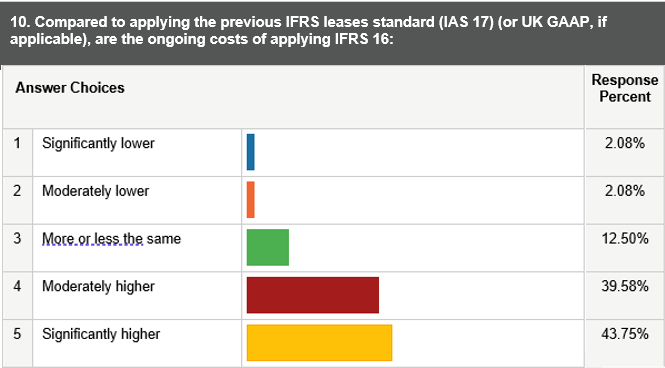
C11.Most respondents said that, when compared with IAS 17, the ongoing costs of applying IFRS 16 is either moderately or significantly higher than the costs of applying IAS 17 (Table 10). This is not necessarily surprising, as IFRS 16 was expected to incur some additional cost.
Members of the UKEB PAG and AFIAG noted that areas of high judgement are the main reasons for high ongoing costs and that simplifications may help mitigate those costs.
Consideration of the benefits of applying IFRS 16
- In your experience, have the benefits of applying IFRS 16 materialised as the IASB expected?
| Answer Choices | Response Percent |
|---|---|
| 1 Yes | 37.50% |
| 2 No | 62.50% |
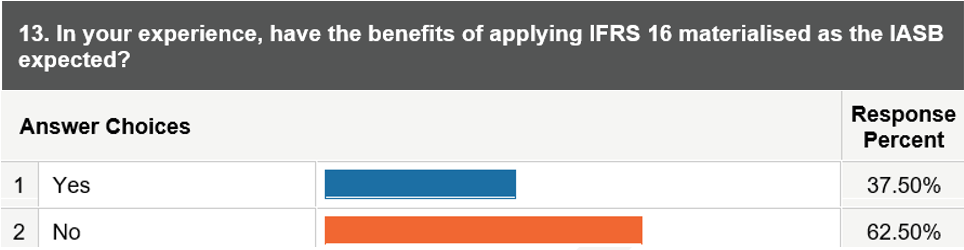
C12.The majority of respondents said that the benefits of applying IFRS 16 have not materialised as the IASB expected (Table 13). However, some respondents noted that they have better information to manage their assets and to make financing decisions.
C13.Those who saw benefits commented on:
- Transparency and accountability, e.g.:
- "Provides a level reporting playing field across similar companies.”
- "Provides a more transparent view of liabilities, giving users a clearer understanding of the net asset position."
- Investors have more information on leasing commitments and future cash flow impacts.
- Improved decision making, e.g.:
- "We were able to obtain more accurate data about our leases in IFRS 16 as compared to IAS 17. All balances are now accounted for in the books instead of off-books."
- Comparability, e.g.:
- "Standardising lease accounting has created greater comparability in statutory and regulatory reporting.”
C14.Those who did not see benefits commented on:
- Impact of judgements
- "Significant judgements in lease terms and discount rates make information non-comparable between entities. As a result we end up providing significant supplemental information on cash flows and future cash flows, split by operating and finance leases (legal definitions) to enable analysts to understand the lease portfolio.”
- Impact on financial reporting metrics, e.g.:
- "IFRS 16 artificially inflates EBITDA and creates discrepancies in financial metrics, making it difficult to compare performance across periods and with peers."
- Non-comparability with US GAAP, e.g.:
- GAAP. Counterintuitive that rent of a property is excluded from reported EBITDA.”
The UKEB Investor Advisory Group (IAG) noted mixed views on the usefulness of the information provided by IFRS 16 with some saying it provides better information than IAS 17 while others noted that they continue to make adjustments to get back to pre-IFRS 16 numbers.
Suggested mitigations for high ongoing costs
C15.Suggestions from respondents to mitigate high ongoing costs included simplification of discount rate requirements and widening the scope of exemptions such as increasing the threshold for low-value assets (from the current $5,000) and increasing short-term lease criteria from 12 to 24 months.
C16.Respondents also highlighted the need for more clarity on sale and leaseback transactions.
The UKEB PAG, IAG and AFIAG supported these suggestions noting that it will reduce costs but also cautioned against losing useful information.
Conclusions and next steps
C17.The preparer survey has provided extremely useful feedback.
C18.The views expressed have informed the development of the Draft Comment Letter. The copy provided to the Board was necessarily brief. The Secretariat will continue to analyse the comments that were received from users and may incorporate additional feedback into the Final Comment Letter.
C19.Preparers who agreed to be contacted will be notified once the draft comment letter is published, and thanked for their support.
Footnotes
-
See the published Request for Information on IASB's website. ↩
-
UKEB calculation based on LSEG and Eikon data, May 2024. This calculation includes companies listed on the Main market as well as on the Alternative Investment Market (AIM). ↩
-
UKEB estimate based on FAME, Company Watch and other proprietary data. ↩
-
IFRS - IFRS 16 Leases paragraph 1 ↩
-
IFRS 16 Effects Analysis page 5 ↩
-
IFRS 16 Effects Analysis page 36 ↩
-
FRS 102 (2024 Edition) paragraphs 20.9 - 20.11 ↩
-
These policies can be accessed from the footer in the UKEB website here: https://www.endorsement-board.uk ↩
-
"For most leases of property (ie land and/or a building or part of a building), a lessee would classify the lease as a Type B lease and would do the following: (a) recognise a right-of-use asset and a lease liability, initially measured at the present value of lease payments; and (b) recognise a single lease cost, combining the unwinding of the discount on the lease liability with the amortisation of the right-of-use asset, on a straight-line basis." (IASB 2013 Exposure Draft ED/2013/6 Leases, page 6). ↩