Updated Project Initiation Plan - Statement of Cash Flows
1The UKEB delegated functions include responsibility for “participating in and contributing to the development of a single set of international accounting standards." Undertaking pro-active thought leadership activities is key to the UKEB's ability to effectively deliver this statutory function.
2The UKEB's Terms of Reference (ToR) further explain that, with regard to thought leadership, the UKEB shall:
- Lead the UK debate on international accounting standards and reporting.
- Represent UK views in international fora with the aim of influencing debate.
- Engage with accounting and reporting and endorsement and adoption bodies in other jurisdictions, in order to improve influence and understand best practice.
- Proactively participate in the development of new global accounting standards, for example by undertaking research.
3A project on the statement of cash flows and related matters, as described below, supports the UKEB meeting these responsibilities. It is also consistent with the 2024-25 Regulatory Strategy 1, as it supports the UKEB's “aim to influence the IASB early on in its standards development cycle, providing evidence-based recommendations and thought leadership on emerging issues from a UK perspective” (page 8).
Background
4The IASB decided to add a project on the Statement of Cash Flows and Related Matters to its research pipeline following feedback on its 'Request for Information: Third Agenda Consultation'.
5Most respondents to the Request for Information recommended the addition of a potential project on cash flows to the IASB's workplan and many of them rated it as high priority. It is notable that most users of financial statements, who recommended addition of this topic, rated it as high priority.
6The Board received an update on this project, including an overview of the IASB's research plan, in an IASB General Update paper in October 2024.
7The IASB staff have identified the following topics to explore in this project:
- changing the requirements for classifying cash flows into operating, investing and financing categories;
- specific disaggregation requirements for information about cash flows (for example, separating capital expenditures into maintenance and growth);
- changing the definition of cash and cash equivalents;
- requiring the use of the direct method;
- presentation or disclosure requirements for additional information about the non-cash effects of some transactions;
- presentation or disclosure requirements for information about commonly used cash flow measures (for example, free cash flow); and
- specific requirements for the statement of cash flows for financial institutions.
IASB plan for research to support a decision on project scope
8The IASB staff plan to perform initial research to gather evidence of the nature and extent of the perceived deficiencies, and the likely benefits, of developing new financial reporting requirements for IAS 7 Statement of Cash Flows. This research is intended to provide evidence to support the IASB's decision on the scope of the project. The initial research will also address possible ways of improving the perceived deficiencies.
9The IASB is considering a number of approaches it could take to the project. These include:
- A comprehensive review of IAS 7, which could lead to a new IFRS Accounting Standard.
- A phased project that could make targeted improvements to address some of the issues identified in the short-term, while undertaking a longer-term project to perform a comprehensive review of IAS 7.
- A limited project which would identify and address a few specific areas of concern.
10Initial research findings are expected to be reported to the IASB in Q1 2025, when the IASB will be asked whether it has enough evidence to decide on the project scope at a subsequent meeting.
Opportunity for the UKEB
11There is an opportunity for the UKEB to build on the work already done in the UK by the FRC (and others). While there has been research into the problems with the statement of cash flows and possible solutions to these problems, to date, direct evidence from preparers and users has been limited. The UKEB can utilise its previous stakeholder engagement experience to seek more comprehensive feedback from preparers and investors.
12Subject to approval of this Project Initiation Plan, this project would aim to gather primary evidence on key stakeholder views, specifically, the improvements investors and creditors want made to the statement of cash flows, and preparer views on these possible improvements. This would provide a foundation for the UKEB to engage with the IASB on this project.
13Research would be grounded in previous work undertaken by the IASB, FRC and UKEB. It will focus primarily on exploring opportunities already identified for improvements to the statement of cash flows and related disclosures, using targeted stakeholder interviews, supported by UKEB Advisory Group discussions.
14IFRS 18 Presentation and Disclosure in Financial Statements made limited amendments to IAS 7. The UKEB's IFRS 18 surveys sought views on these changes, and these findings, along with additional research will form part of this research.
15The IASB's current timetable for completion of the research phase of their project means that the work would be more constrained than previous UKEB pro-active research projects.
Project Plan
Proportionality assessment
Significance and size
16The IASB is currently in the research phase of the project and no decision has yet been made on the IASB's project scope.
Entities affected by the proposals
17The statement of cash flows is a primary financial statement that all entities are required to prepare. Any changes have the potential to affect all entities that prepare financial statements using IFRS Accounting Standards.
Complexity
18The requirements of IAS 7 are quite limited. Generally, the statement of cash flows is not considered a complex area of accounting.
19However, over the past 14 years, the statement of cash flows has been consistently among the top 10 issues identified by the FRC's Corporate Reporting Review (CRR) team as part of the annual review of financial statements. In the last four years it has been one of the top three issues every year, resulting in 46 restatements in company accounts.
Expected timeline / urgency
20The IASB is expected to start making decisions about the scope of the project in 2025. To effectively participate in this discussion, publishing a research paper during H1 2025 would be ideally timed to contribute to the IASB process. The September 2025 Accounting Standards Advisory Forum (ASAF) meeting will provide an opportunity to present a summary of the UKEB's research.
Expected interest / sensitivity
21As noted above, there was a significant response to IASB's Request for Information: Third Agenda Consultation, calling for a project addressing the statement of cash flows. Given the pervasive nature of the statement there will be significant interest in the project.
22Early discussions with UK stakeholders have indicated significant interest in the project. There are also strong views on what should be prioritised and the extent to which change is feasible.
Feedback on the proposals from desk-based research / initial outreach
23There has been significant interest in the UK in the statement of cash flows. As part of this proposed project the Secretariat plan to provide the Board with a comprehensive review of the relevant literature. One key element to that literature is work already done by the FRC.
FRC's Improving the Statement of Cash Flows Report - 2016
24In 2016, the FRC published a discussion paper "Improving the Statement of Cash Flows" for public comment, which focused on the existing IAS 7 Statement of Cash Flows and was timed to feed into the IASB's Primary Financial Statements project, from which IFRS 18 Presentation and Disclosure in Financial Statements resulted. This was followed in 2017 by a feedback statement of comments received from stakeholders.
25The discussion paper made a number of recommendations, including:
- Notional cash flows should not be reported in any section of the statement of cash flows. However, transparent disclosure of non-cash transactions should be required.
- Operating activities should be positively defined or described (perhaps as including transactions with customers, employees and suppliers) rather than being a residual or default classification.
- Entities should be encouraged to disclose the extent to which expenditure on property, plant and equipment represents ‘maintenance' or 'growth'.
- The statement of cash flows should report inflows and outflows of cash, rather than cash and cash equivalents.
- A reconciliation of profit and cash flow should be presented in all cases (including where a direct method statement of cash flows is presented). The reconciliation should be required to reconcile a sub-total in the statement of profit or loss that represents operating income (rather than, for example, net profit or loss) and reconcile that to cash flow from operating activities.
26That discussion paper received 22 comment letters, 12 from the UK. Three letters were from preparers and four were from user groups. Some of the highlights from the feedback:
- A large majority of respondents agree that notional cash flows should not be reported in the statement of cash flows although there should be disclosure of non-cash transactions.
- A majority of respondents agree that operating activities be positively defined or described.
- There are split views as to whether the statement of cash flows should report flows of cash or of cash and cash equivalents.
Initial Engagement with UKEB Advisory Groups
27Early discussions with UKEB Advisory Groups (PAG, IAG, and AFIAG 2) have drawn a mixed response. While all AGs seem content that the key issues have been identified by the IASB, there is no clear consensus yet on how those issues could be best tackled. Focusing on the links between the statement of cash flows and the other primary financial statements, however, was a key theme.
28There was clear support for the UKEB undertaking further research, in particular for exploring possible approaches to enhance the statement of cash flows. A number of members also expressed an interest in participating in that research.
Connectivity
29A stakeholder who participated in the IAG indicated a growing interest in specifically identifying "green spending" as part of the statement of cash flows. With increasing focus on disclosure of entities' climate-related risks it is not unreasonable to expect a greater focus on “green cashflows”.
30This is also consistent with expectations of the Bank of England and the Basel committee's Principles for the effective management and supervision of climate-related financial risks. Both of which call for greater measurement, disclosure and monitoring of climate risks, and the important role that accounting plays in this process.
31The implications for connectivity will be assessed as part of the outreach on the project.
Recommended UKEB project scope
32Based on the proportionality assessment above we recommend a “moderate scope” project and the approach described in this document reflects this.
33The primary outputs of the project currently expected are:
- December 2024: Background and Key issues paper – This research paper will set the stage, examining the background of the project, relevant research including an examination of previous CRR findings. The paper would include discussion of the relevant recent changes made by IFRS 18.
- March 2025: UK Investor and Preparer Perspectives paper – This research paper will summarise user and preparer perspectives on how the statement of cash flows could be improved including consideration of financial institutions. The intention is to conduct around 10 – 12 interviews with a diverse range of users and the same number of preparers of financial statements along with discussion with the IAG (early February) and PAG (early March).
34In meetings, subsequent to the March 2025 Board meeting, the UKEB will consider whether:
- the UKEB papers, developed to that point, should be consolidated into a single comprehensive report for publication; and
- whether additional research is appropriate and feasible, given the IASB's project plan and UKEB priorities at that time.
35In addition to the work outlined above:
- In February 2025 the Secretariat presented a research paper: Non-mandatory and Voluntary Cash Flow Disclosures Provided by UK Listed Companies. The paper reported the findings of an examination undertaken into existing reporting practice in relation to cash flow information included in the annual reports of a sample of UK listed companies.
- Between 25 March and 22 April 2025, users were invited to complete an online poll. The poll provided an opportunity for a wider range of UK users of IFRS financial statements to provide feedback on the usefulness of the statement of cash flows, and the current concerns with, and potential improvements to, the requirements for cash flows.
36At the March 2025 meeting, the Board agreed that further research is appropriate and feasible, given the IASB's project plan and UKEB priorities at that time. As a result, the following outputs are expected:
- May 2025: Summary of UKEB initial research – a consolidated summary of the findings from all three UKEB research papers (including the finalised papers as appendices), incorporating a summary of the results of the user poll.
- July 2025: Alternative presentation formats and disclosures for the statement of cash flows – based on previous research conducted, alternate presentation formats of the statement of cash flows will be developed, incorporating the key suggestions made by users and preparers. Mocked-up presentation formats, and examples of voluntary disclosures provided by some UK listed companies, will be tested with primary users and preparers. Potential disclosures (on the face of the statement of cash flows or in the notes to the financial statements) that might be more useful would then be used to encourage further discussion about the ways forward for this project and provide valuable evidence to the IASB.
- July 2025: Interconnectivity of IFRS Standards / Cohesiveness of Financial Statements
- mapping the links between the statement of cash flows and requirements in other IFRS Standards to highlight the existing connections, (or refine the requirements to strengthen the connections). This could allow the IASB to make minor changes that bring significant incremental value to users.
- Connectivity between the statement of cash flows and other general purposes financial reports would be investigated, subject to resource availability.
37There is no intention to undertake research collectively with other parties as part of this project.
Project - key activities
| Key activities | Due Process Handbook |
|---|---|
| Identification of issues for research (this document) | 7.15 Mandatory |
| Creation of a Project Initiation Plan (this document) | 7.16 – 7.21 Mandatory |
Desk-based research to support the proportionality assessment including:
|
7.22 Optional |
| Outreach activities As described above the UKEB will gather views and opinions from UK stakeholders, particularly users and investors, to contribute to the development of this research. This will include one-to-one interviews with preparers and users, and discussions with UKEB Advisory Groups. | 7.23 – 7.24 Optional |
Publication of a Background paper 3:
|
7.25 Mandatory |
Publication of a Non-mandatory and Voluntary Cash Flow Disclosures paper 3:
|
7.25 Mandatory |
Resources allocated
38To undertake the activities described in this project plan a project team has been assigned, consisting of two Project Directors working with the Project Director Research Lead. The required resources are allowed for in the 2024/25 UKEB plan and budget. 4
Project timeline
39The proposed high-level project timeline is shown below. This provides a best estimate based on information known at this time. If necessary, a revised PIP 5 will be presented to the Board, to reflect any major changes, as the project progresses.
| Date | Milestones |
|---|---|
| November 2024 | Project Initiation Plan for Board approval |
| December 2024 | Background paper |
| February 2025 | Non-mandatory and Voluntary Cash Flow Disclosures paper |
| March 2025 | UK Investor and Preparer Perspectives paper |
| March–April 2025 | User poll |
| July 2025 | Alternative presentation formats for the statement of cash flows paper |
| July 2025 | Interconnectivity of IFRS Standards / Cohesiveness of Financial Statements paper |
A1. Project Initiation Plan: Statement of Cash Flows and Related Matters - Project timeline
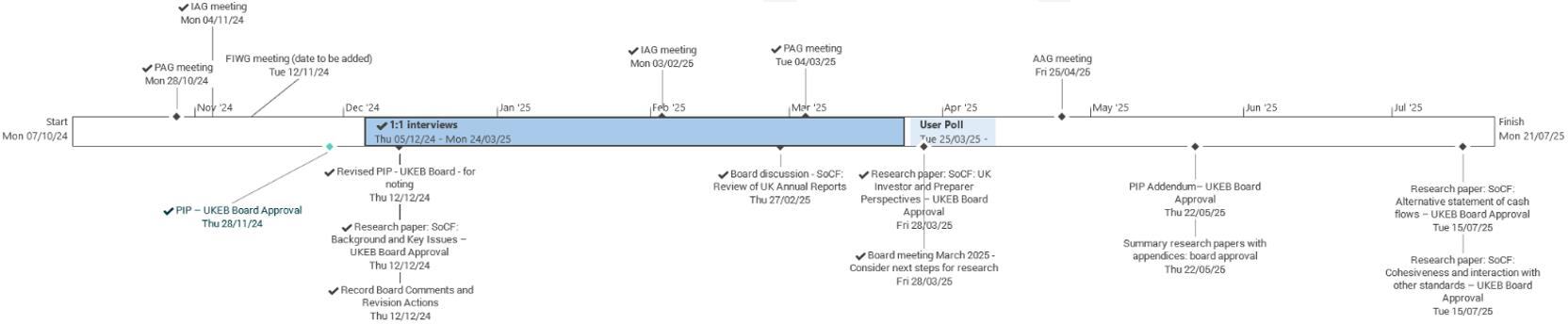
A1The diagram below is a graphical view of the mandatory milestone activities described above. This provides a best estimate based on information known at this time. If necessary, a revised PIP will be presented to the Board, to reflect any major changes, as the project progresses.
Footnotes
Footnotes
-
This Project Initiation Plan was updated in May 2025, following approval by the Board at the March 2025 UKEB meeting for additional UKEB research to be undertaken on the statement of cash flows and related matters, and such changes are highlighted in orange. ↩
-
Preparer Advisory Group; Investor Advisory Group; Accounting Firms and Institutes Advisory Group ↩
-
These three papers could be published individually or as part of a consolidated report. ↩↩
-
These two papers could be published individually or as part of a consolidated report. ↩
-
This Project Initiation Plan was updated in May 2025, following approval by the Board at the March 2025 UKEB meeting for additional UKEB research to be undertaken on the statement of cash flows and related matters, and such changes are highlighted in orange. ↩