7 IASB Fourth Agenda Consultation
26 June 2025 Agenda Paper 7
Executive Summary
| Project Stage | |||||||
|---|---|---|---|---|---|---|---|
| IASB | Research / Pipeline | Discussion paper | Redeliberation | Exposure Draft | Redeliberation | Final standard | Post Implementation Review |
| UKEB | Research / Influencing | Research / Influencing | Monitoring | Influencing | Monitoring | Endorsement | Influencing |
Project Type: Influencing Project Scope: Significant
Purpose of the paper
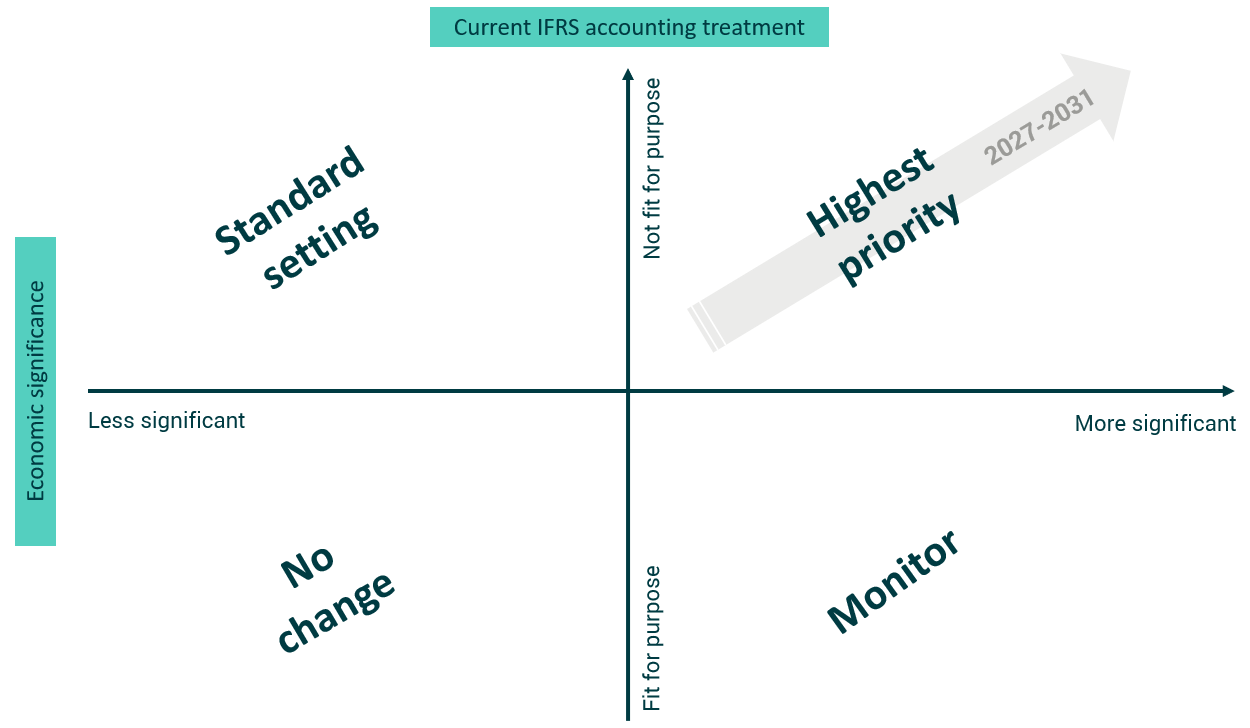
The purpose of this paper is to inform the Board's initial discussions regarding its approach to influencing the IASB's strategy and approach to the Fourth Agenda Consultation (Fourth AC). In addition, the paper seeks Board members views ahead of the Accounting Standards Advisory Forum (ASAF) meeting on 7–8 July 2025.
Summary of the Issue
IASB Agenda Consultations are conducted every five years, and the next consultation will address the IASB work plan for the period 2027–2031. The IASB is currently discussing an approach to the Fourth AC with its consultative groups. The IASB has indicated that it will issue a Request for Information (RFI) in Q4 2025.
The IASB staff recommended a similar strategy and approach to this Agenda Consultation that is consistent with the previous one which concluded in 2021, but no decision has been taken at the time of writing. The IASB intends to seek feedback from National Standard Setters (NSS) on the proposed approach and potential content of the RFI at the July 2025 ASAF meeting.
To inform the UKEB initial discussions, the UKEB Secretariat has sought early views from Board Members, UKEB Advisory Group (AG) and Working Group (WG) members and other NSS via meetings and surveys.
Decisions for the Board
ASAF Question 1. Do you have any comments or questions on the proposed approach to the IASB's Fourth Agenda Consultation?
Questions for UKEB Board members
- Do Board members have any comments on the amount of time the IASB should allocate to IFRS for SMEs or should the IASB consider delegating this work?
- Do Board members have any comments on whether the existing projects and the pipeline projects should be included in the Fourth AC?
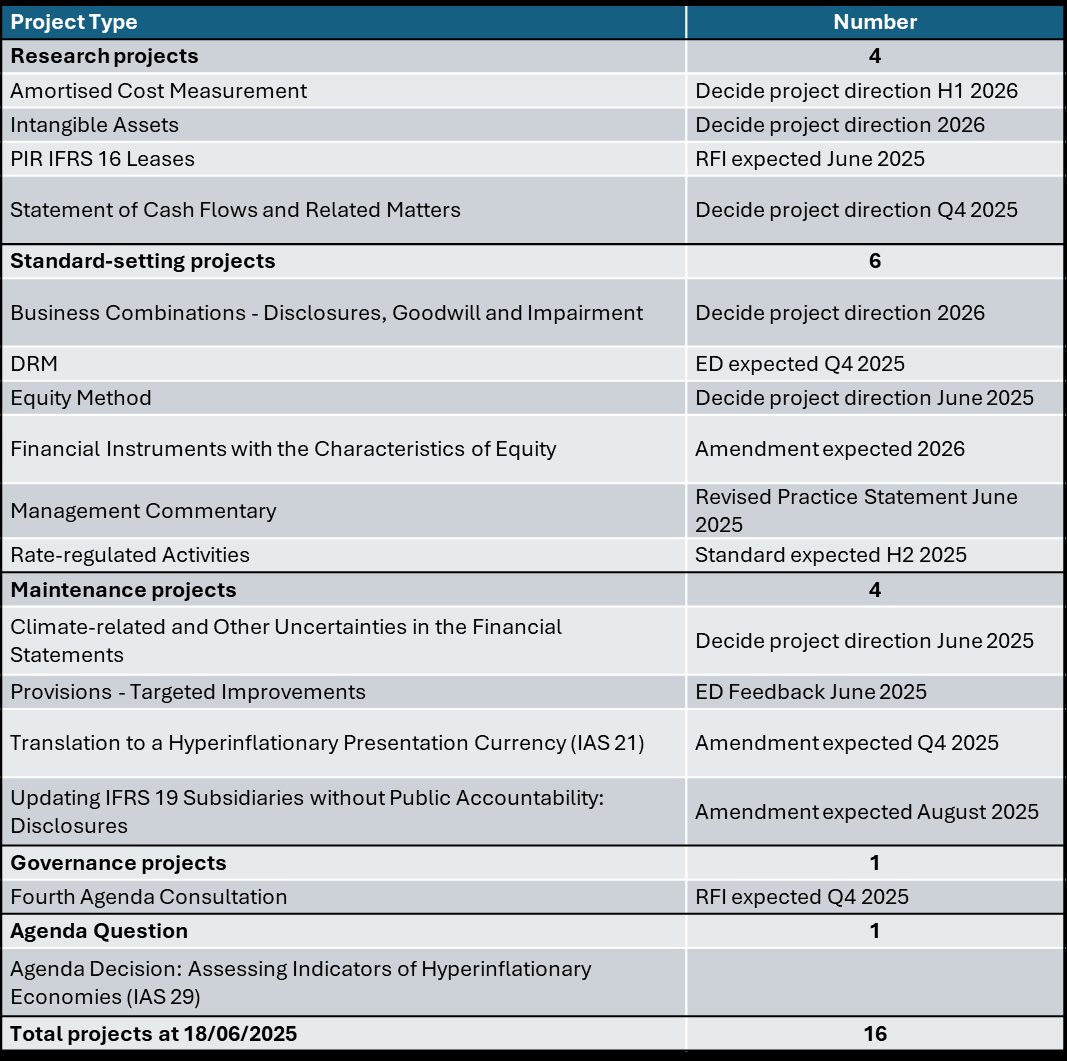
- Do Board members consider that the IASB's should seek views form consultative groups (ASAF and Advisory Council) before small or urgent projects are added to the work plan?
- Do Board members consider that the draft IASB technical project prioritisation criteria should include a separate technical criterion for maintaining principles based IFRS Accounting Standards?
- Does the Board consider that the draft prioritisation criteria should include 'maintaining convergence with US GAAP'?
- Does the Board have any views on the concept of including reciprocal connected information requirements to IFRS Sustainability Disclosure Standards in IFRS Accounting Standards? Does the Board have any other comments in relation to facilitating connectivity with the ISSB?
ASAF Question 2. The IASB Staff propose to identify 3-5 highly demanded projects in the RFI to seek focused stakeholder feedback on the most likely priorities. The IASB Staff also propose to describe alternative potential projects to be included that are demanded by stakeholders, although not at the same frequency as the highly demanded projects.
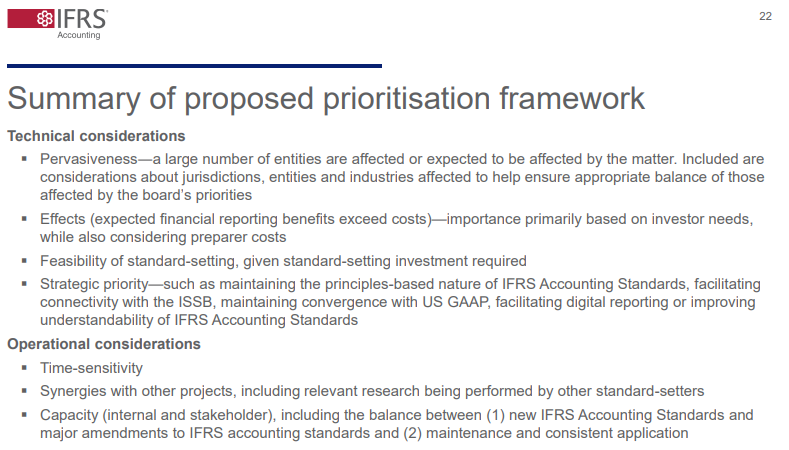
ASAF Q2 (a) Do you agree with this approach?
Question for UKEB Board members
- Does the Board consider that the proposed approach to propose 3-5 major projects and list other alternative projects (presumably smaller maintenance projects) appropriate?
ASAF Q2 (b) Which projects would you recommend to include in the list of 3-5 projects (recognising that not all can be undertaken)? IASB Staff recommend at least starting with 'reserve list' projects (pollutant pricing mechanisms and operating segments).
Questions for UKEB Board members
- Do Board members agree that: a) Pollutant Pricing Mechanisms should be included in the list of 3-5 high demand projects? b) operating segments should not be included in the list of 3-5 high demand projects??
ASAF Q2 (c) Do you have any comments on the tentative list of alternative potential projects?
Question for UKEB Board members
- Does the Board have any comments on the IASB prioritising the existing significant projects, Intangible Assets and Statement of Cashflows and Other Related Matters?
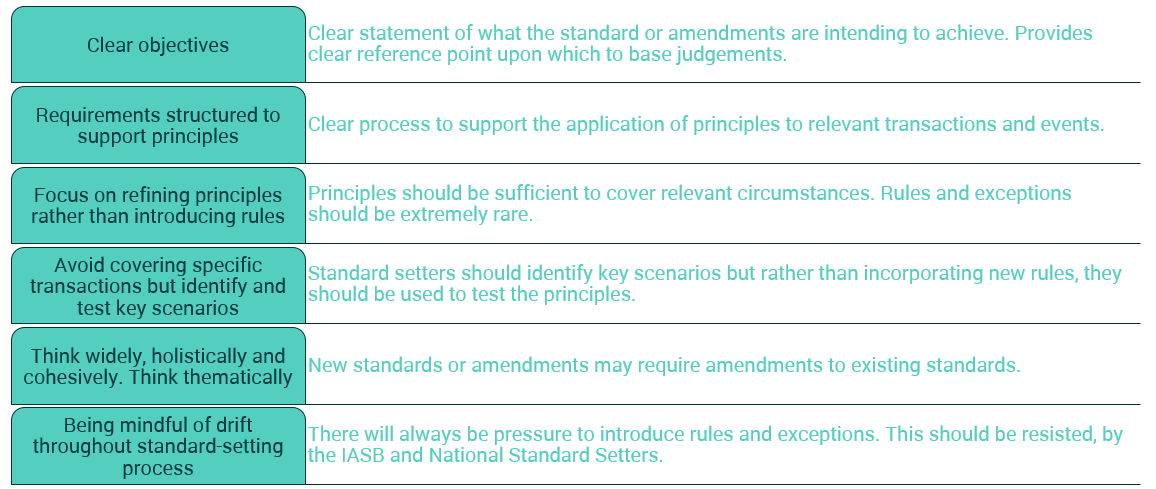
ASAF Q2 (d) Are there any projects you would add to the list?
ASAF Q2 (e) Are there any potential projects you would remove from the list?
Question for UKEB Board members
- Does the Board have any comments in relation to tentative projects to remove from the list?
Recommendation
n/a for discussion only
Appendices
- Appendix A Potential IASB projects to be included in the RFI for the IASB's Fourth Agenda Consultation
- Appendix B FASB project prioritisation process and criteria
- Appendix C Effects Analysis
Background
1The UKEB held an initial discussion at its May 2025 meeting to consider the IASB's tentative approach to the Request for Information (RFI) for the Fourth AC1. This paper contains updates from that discussion, feedback from the June meetings of the UKEB Investor (IAG), Preparer (PAG) and Accounting Firms and Institutes Advisory Groups (AFIAG) and seeks members views to share with the IASB at the 7–8 July 2025 ASAF meeting.
ASAF papers
2The main updates from the July 2025 ASAF papers2 are summarised below:
a) The consultation is intended to be an 'interim' step until the IASB and ISSB can conduct a joint agenda consultation in the medium-term. b) The IASB is seeking stakeholder feedback now to help identify priorities for projects to undertake from 2027. The IASB may only add new projects if it expects to have capacity to start them. c) The IASB could identify 3-5 ‘high demand' projects on which to seek focused stakeholder feedback with a caveat that not all could be undertaken. d) The proposal is to have a 120-day consultation period from Q4, 2025 to Q1, 2026. e) Active projects would not be considered for withdrawal, given they were identified as priorities in previous agenda consultations. f) It is proposed that the RFI will include information about the IASB's expected capacity to add projects to its work plan. The IASB anticipates having some capacity from 2027 due to the completion of several current projects. g) Four maintenance projects are proposed to be excluded from the RFI as the IASB has committed to them during the current work plan period (2022–2026). They are anticipated to be small projects. These are: i. International Tax Reform–Pillar Two Model Rules (IAS 12). ii. International Tax Reform–Pillar Two Model Rules (Amendments to the IFRS for SMEs Accounting Standard). iii. Removal of the temporary nature of the exemption in IFRS 6 from the application of paragraphs 11-12 of IAS 8. iv. Credit risk disclosures–Targeted improvements (IFRS 7 and IFRS 9). h) The maintenance project pipeline from the Third AC includes the 'Sale and Leaseback of an Asset in a Single-Asset Entity (IFRS 10 and IFRS 16)'. This is expected to be included in the RFI as it could be reconsidered as part of a potential project on corporate wrappers (which is on the IASB's potential projects list).
3The most recent consultation by the International Sustainability Standards Board (ISSB) on its agenda priorities concluded with the publication of its 2024–2026 work plan in June 2024. The ISSB is currently focusing on implementing its first two standards (IFRS S1 General Requirements for Disclosure of Sustainability-related Financial Information and IFRS S2 Climate-related Disclosures) and conducting research on biodiversity, ecosystems and ecosystem services (BEES), and human capital. The ISSB has not announced a timeframe for its next agenda consultation.
Questions for ASAF members
4The questions asked of ASAF members for the 7–9 July ASAF meeting are set out in the paper with additional questions for consideration by the Board.
ASAF Question 1: Do you have any comments or questions on the proposed approach to the IASB's Fourth Agenda Consultation?
5The section below considers the following aspects relating to this question:
a) Strategic direction. b) Balance of IASB work. c) Existing projects: Prioritisation. d) Draft project prioritisation framework i. Oversight ii. Principles v rules standard setting iii. Effects analysis iv. Maintaining convergence with US GAAP v. Facilitation connectivity with the ISSB
Strategic direction
6At the May 2025 meeting the Board considered alternative approaches to the strategic direction of the IASB's Fourth AC in terms of whether the next consultation process could be made more effective. To improve the outcome of the next consultation the Board supported an approach with a limited number of major projects:
a) which had the most significant impact on major capital markets that use IFRS Accounting Standards; and b) and for which there are sufficient resources available to complete on a timely basis.
7However, it was also noted that this approach would involve more reliance on the IASB's draft project prioritisation criteria to determine when time-sensitive and smaller scale projects should be added to the work plan.
8To assist the IASB's identification and assessment of strategic accounting issues the UKEB could suggest that these are mapped against their emerging economic significance and whether there are gaps in IFRS when considering the accounting treatment for those issues. This approach recognises the length of time required in standard-setting to develop accounting requirements. For example, while an issue may not be internationally material today, but it may become so over the work plan timeframe.
9The approach is illustrated graphically in the diagram below. The vertical axis represents the level of 'fitness for purpose' of current IFRS requirements and the horizontal axis represents the spectrum of economic significance of the underlying transactions. The arrow at 45 degrees represents the time over which the issue is assessed, illustrating increasing materiality over the five-year time horison 2027–2031.
Source: UKEB
10The four quadrants on the diagram represent:
a) Highest priority (top right): topics for which current international accounting standards are relatively unfit for purpose, and for which the underlying transactions are likely to emerge over the work plan period as economically significant. For example, intangibles. These would be highest priority and most urgent areas for the IASB to address. b) Standard setting (top left): topics where there are gaps or options in the current international accounting standards but are less economically significant. For example, cash flows, which is an older standard that needs to be improved for broader changes in accounting. The IASB should consider these topics for strategic standard-setting projects. c) Monitor (bottom right): topics for which international accounting standards are relatively fit for purpose and transactions are economically significant. The IASB should monitor these topics over time in case the situation changes. d) No change (bottom left): topics where the accounting treatment is relatively fit for purpose and the transactions are relatively less economically significant. The IASB is unlikely to be required to take any action.
Stakeholder feedback
11We have not yet engaged stakeholders on this possible approach. However, most Advisory Group members supported the IASB consulting on a limited number of significant projects.
Initial view
12The UKEB Secretariat encourage the IASB to consider adopting this approach to identify the highest priority issues.
Balance of IASB work
13The IFRS Foundation's mission is to develop Standards that bring transparency, accountability and efficiency to financial markets around the world. The mission does not specifically refer to Small Medium Enterprises (SMEs). However, our estimation is that over the current work plan (2022–2026) the IASB has invested approximately 8% of Board agenda time and capacity revising IFRS for SMEs Standard.
14The Foundations objectives as set out in the Constitution3 expand on the mission as follows:
The IFRS Foundation's objectives as set out the Constitution are to: * develop–in the public interest–high quality, understandable, enforceable and globally accepted IFRS Standards for general purpose financial reporting based on clearly articulated principles; * promote the use and rigorous application of IFRS Standards; * take account of the needs of varied sizes and types of entities in diverse economic settings when developing and promoting use of IFRS Standards; and * promote and facilitate adoption of IFRS Standards.
15The objectives include that the IFRS Foundation should take account of varied sizes and types of entities in diverse economic settings. This objective implicitly permits the IASB to continue to update the IFRS SME Standard. However, SMEs value stability and given the recent significant refresh of the Standard the IASB could focus over the next five-year work plan on implementation support.
Stakeholder feedback
16In relation to the balance of IASB work, AFIAG and PAG members considered that IFRS for SMEs should have a lower allocation due to the recent refresh and significant resources already dedicated to this standard. In addition, they raise questions about whether the IASB's expertise is more suited to developing requirements for entities listed on financial markets.
Initial view
17The UKEB Secretariat's initial view is, considering the significant demands and capacity challenges that the IASB is facing, it delegates to the SME Implementation Group, the role of managing any implementation support for IFRS for SMEs Standard as necessary. This would allow the IASB to concentrate on the most pressing projects that underpin the core mission to bring transparency, accountability and efficiency to financial markets around the world.
Question for the Board – Balance of IASB work
- Do Board members have any comments on the amount of time the IASB should allocate to IFRS for SMEs or should the IASB consider delegating this work?
Existing projects: Prioritisation
18The ASAF paper suggests that no active projects be considered for withdrawal because:
a) Active projects were determined to be priorities in previous agenda consultations. b) Many projects are at an advanced stage. c) Reconsideration of projects may mean that projects are started and stopped, leading to inefficiencies.
19The IASB's active projects as at 18 June 2025 are:
Source: UKEB and IASB Work plan.
20There are also four maintenance projects in the pipeline. The IASB has committed to these projects and so is not planning to include them in the Fourth AC. They are listed in paragraph 2(g).
21There is also another pipeline maintenance project from the Third Agenda Consultation, on Sale and Leasebacks of an assets in a single asset entity, listed in paragraph 2(h). This is expected to be included in the RFI as it could be reconsidered as part of a potential project on corporate wrappers (which is on the IASB's potential projects list).
Stakeholder feedback
22Most Advisory Group members considered that active and maintenance projects should also be in scope of the RFI as priorities were likely to have changed since the previous consultation which may release capacity for the IASB.
Question for the Board – Existing and pipeline projects
- Do Board members have any comments on whether the existing projects and the pipeline projects should be included in the Fourth AC?
Draft project prioritisation framework
23At the May 2025 UKEB Board meeting the members commented on how the oversight of the IASB work plan interacted with the draft project prioritisation criteria.
24The IASB has proposed a draft prioritisation framework in the July ASAF papers which is set out below.
Source: ASAF paper 3, July 2025
Oversight
25The IASB's Due Process Handbook4 (IASB DPH) includes the following paragraphs to the requirements relating to the IASBs work plan and project prioritisation:
a) Section 3: Principles, Transparency: Full and fair consultation states that the IFRS Advisory Council (Advisory Council) provides ‘broad strategic advice' to IASB and the Trustees on the IASB work plan and project priorities. The Board also presents updates to the Advisory Council on the work plan periodically (paragraph 3.54). b) Section 4: has requirements for the IASB's five-yearly agenda consultation on the Board's work plan. It requires: i. Paragraph 4.4: "As part of this public consultation, the Board consults the Advisory Council”. ii. Paragraph 4.5: the IASB “consults with the Trustees ... and through the DPOC, keeps the Trustees informed of its process in respect of its five-yearly consultation". iii. Paragraph 4.6 permits the IASB to add projects to the work plan or change its priorities between the five-yearly consultations. Where the IASB is planning on adding a major project to the work plan, that was not contemplated in the previous consultation, the IASB is required to consult the Advisory Council and ASAF on the potential project. The Board's discussion of potential projects to be added to the work plan takes place in public Board meetings. iv. Paragraph 4.7 permits the IASB not to consult the Advisory Council or ASAF before adding a minor or narrow-scope amendments to IFRS Accounting Standards, including annual improvements. In practice, some maintenance projects have been discussed at ASAF (emphasis added).
26The IASB due process requires consultation with both the Advisory Council and ASAF members before adding major projects to the work plan, but this is not required for minor or narrow scope amendments. This implies that if the project is not major, the IASB is free to apply the draft project prioritisation criteria without the need for consultation with any other advisory or oversight bodies. However, in recent years the IASB has sought views from ASAF before adding urgent projects such as Pillar II Tax and PPAs.
27One of the issues with involving ASAF or the Advisory Council is that their meetings occur periodically. Consequently, their involvement may risk causing unnecessarily delayed. Stakeholders would then be reliant on the draft project prioritisation criteria being sufficient to start a small or urgent project and assess the implications on the work plan.
Question for the Board – oversight
- Do Board members consider that the IASB's should seek views form consultative groups (ASAF and Advisory Council) before small or urgent projects are added to the work plan?
Principles v rules based standard setting
28At the May 2025 UKEB meeting it was noted that the nature of business and the business environment were rapidly changing making it critical that accounting standards were designed to be sufficiently flexible to cope with emerging issues. However, recent projects such as Contracts Referencing Nature-dependent Electricity, Amendments to the Classification and Measurement of (IFRS 9) Financial Instruments and IAS 12 Income Taxes for OECD Pillar Two Tax Reform all introduced practical expedients which are more in the nature of rules rather than principles.
29UKEB members expressed a preference for the IASB to focus on principle-based solutions to major accounting issues. Too many projects focused on narrow-scope amendments risked a drift towards rules-based standard setting, which would be less future proof and could lead to unintended consequences.
30The July 2025 ASAF paper 35 sets out summary of the proposed prioritisation framework and within the technical considerations notes that 'strategic priority'–includes "maintaining the principles-based nature of IFRS Accounting Standards".
31Principle-based accounting standards:
a) Provide broad concepts to create a framework that allows flexibility to present financial information in a way that best reflects the underlying economics of transactions and the entity-specific context. b) Require the application of judgement to ensure consistent application that allows for comparability of financial information. c) Reduce the length of requirements so that they are concise and applicable to a wide range of circumstances.
32Even in principles-based standards some rules, establishing specific requirements for defined circumstances, will always be necessary. This is particularly true where rules may enhance further comparability or transparency, or cost/benefit considerations heavily favour exceptions or simplifications. However, any rules should be limited in nature and should not be delivered at the cost of obscuring the underlying economics or substance of the transactions.
33To help articulate what this means, the table below provides an explanation for a principles-based approach.
Source UKEB
Stakeholder feedback
34The IAG considered the draft IASB prioritisation criteria was broadly appropriate but noted the importance of maintaining a principles-based approach. They noted that too many narrow scope amendments could result in a lack of consistency.
35The AFIAG also considered the criteria to be appropriate but suggested that it would help stakeholders if the IASB was more transparent in relation to how it was applied to both starting and stopping projects.
Initial view
36The UKEB Secretariat's initial view is that the draft IASB technical project prioritisation criteria should include a separate technical criterion for maintaining principles based IFRS Accounting Standards. This could be supplemented with the content of the table above. This approach could also acknowledge the preference for pursuing major projects with principles-based objectives, while dealing with some small urgent issues may require a more rules-based approach.
Question for the Board – principles v rules based standard setting
- Do Board members consider that the draft IASB technical project prioritisation criteria should include a separate technical criterion for maintaining principles based IFRS Accounting Standards?
Effects analysis
37The IASB established An Effects Analysis Consultative Group (EACG) in 2014 at the request of the IFRS Foundation Trustees. The EACG provided recommendations on how the IASB should conduct effects analyses. As a principle for assessing and reporting the likely effects of new financial reporting requirements it was noted that ‘The IASB is not required to assess any possible broader economic consequences, because these are beyond its objective6 (emphasis added).'
38Since then, the IASB DPH has been updated to include a section on effects analysis when a major Standard is issued. The IASB is required to publish a separate effect analysis report that summarises the likely effects and how the Board made its assessments. The table in Appendix C illustrates the extent of effects analysis work the IASB conducted for accounting standards issued since the EACG's recommendations were made.
39The table in Appendix C illustrates the extent of the effects analysis work conducted by the IASB on standards issued since the EACG's recommendations were made. This is shown by the red box on the table which indicates the scope of paragraphs 3.77 and 3.81 in the IASB DPH. The Secretariat's observation is that the table shows that the IASB analysis, in some instances, has gone further than recommended by the EACG. However, this additional work is covered by paragraph 3.80 in the IASB's Due Process Handbook which specifies that the “[IASB] Board may assess specific economic effects when relevant" without requiring a formal quantitative assessment.”
40The recent consultation on updating the IASB DPH proposed enhancements and suggested further amendments relating to associated wider economic effects. In the UKEB Final Comment Letter to the IASB on the Exposure Draft: Proposed Amendments to the IFRS Foundation Due Process Handbook7 the UKEB suggested several amendments aimed at broadening the scope of economic assessment. The UKEB Comment Letter recommended:
a) Quantification or monetisation of costs, benefits and other economic effects when feasible and proportionate. b) Prescribing that the analysis should focus on incremental costs and benefits associated with the adoption of a standard or amendment. c) Requiring the identification of a status quo situation to compare incremental costs/benefits against a “counterfactual”. d) Considering both one-off and ongoing costs and benefits, specifying the length of the appraisal period and introducing guidance on discount rates to be used. e) Considering the risk for stakeholders to incur sunk costs because of the standard-setting process. f) Requiring a discussion of the economic consequences of alternative standard-setting options for earlier-stage projects, including the consequences of maintaining the status quo. g) Including the cost categories most likely to be incurred when adopting a standard, e.g. familiarisation, system changes, audit etc. h) Referencing wider economic effects more explicitly, differentiating between capital market, microeconomic and macroeconomic effects, and considering the wider economic effects over the long-term.
Initial view
The Secretariat recognises that legal requirements for the UKEB effects analysis is wider than that of the IASB. However, the IASB may be able to consider some aspects of the UKEB effects analysis to enhance its own approach. We also note that the draft project prioritisation criteria states the 'importance primarily based on investor needs' but should refer to primary users as defined in the Conceptual Framework paragraph 1.2 i.e. to include lenders and other creditors.
Draft prioritisation framework: Maintaining convergence with US GAAP
41At the May 2025 UKEB meeting a member questioned why the IASB would need to maintain convergence with US GAAP. It was considered that the IASB's intention was to avoid divergence with US GAAP.
42The draft project prioritisation framework includes, as a strategic priority, maintaining convergence with US GAAP. An additional consideration relating to US GAAP is that the Board asked for information on how the US Financial Accounting Standards Board (FASB) conducted its Agenda Consultations, the criteria used to prioritise projects, and the progress made against the last consultation. Please refer to Appendix B of this paper for this information.
Question for the Board – maintaining convergence with US GAAP
- Does the Board consider that the draft prioritisation criteria should include 'maintaining convergence with US GAAP'?
Facilitating connectivity with the ISSB
43In relation to enhancing connectivity between the ISSB and the IASB it was noted at the May 2025 UKEB meeting that ISSB Disclosure Standards have a requirement for 'connected information' between sustainability-related financial disclosures and the data and assumptions used on the financial statements.
44The IASB Chair also noted this when addressing the European Accounting Association8 where he commented on the explicit requirement in ISSB Standards to connect sustainability-related financial disclosures to information in the financial statements. He also commented that, in due course the IASB may start thinking about providing a similar linkage from the financial statements where it was both feasible and appropriate.
45The Board requested further information on the ISSB's approach which is provided below.
46IFRS S1 General Requirements for Disclosure of Sustainability-related Financial Information, paragraphs 21–24 require information to be provided in a manner that enables users of general-purpose financial reports to understand the following types of connections. Paragraph 21 requires:
a) the connections between the items to which the information relates–such as connections between various sustainability-related risks and opportunities that could reasonably be expected to affect the entity's prospects; and b) the connections between disclosures provided by the entity: i. within its sustainability-related financial disclosures–such as connections between disclosures on governance, strategy, risk management and metrics and targets; and ii. across its sustainability-related financial disclosures and other general purpose financial reports published by the entity–such as its related financial statements.'
47Paragraph 23 requires that both data and assumptions used in preparing the sustainability-related financial disclosures shall be consistent–to the extent possible considering the requirements of IFRS Accounting Standards or other applicable GAAP–with the corresponding data and assumptions used in preparing the related financial statements (paragraph B42).
48Paragraph B42 clarifies that drawing connections between disclosures involves, but is not limited to, providing necessary explanations and cross-references and using consistent data, assumptions, and units of measure. In providing connected information, an entity shall:
a) explain connections between disclosures in a clear and concise manner; b) avoid unnecessary duplication if IFRS Sustainability Disclosure Standards require the disclosure of common items of information; and c) disclose information about significant differences between the data and assumptions used in preparing the entity's sustainability-related financial disclosures and the data and assumptions used in preparing the related financial statements.
Stakeholder feedback
49The IAG recognised that more work was required regarding the boundary of the financial statements but did not support this suggestion. They considered that financial statements should be able to stand alone and consider a reconciliation to narrative disclosures as decision useful information.
50PAG members did not consider that adding an explicit requirement in IFRS Accounting Standards to connect information in the financial statements to sustainability-related financial disclosures was necessary. They considered that the practicality of evidencing this reconciliation would be unrealistic and would be unlikely to provide decision useful information to users.
Questions for the Board – facilitating connectivity with the ISSB
- Does the Board have any views on the concept of including reciprocal connected information requirements to IFRS Sustainability Disclosure Standards in IFRS Accounting Standards? Does the Board have any other comments in relation to facilitating connectivity with the ISSB?
ASAF Question 2: The IASB staff propose to identify 3-5 highly demanded projects in the RFI to seek focused stakeholder feedback on the most likely priorities. Alternative potential projects will also be included in the RFI that are also demanded by stakeholders
ASAF Q2a. Do you agree with this approach?
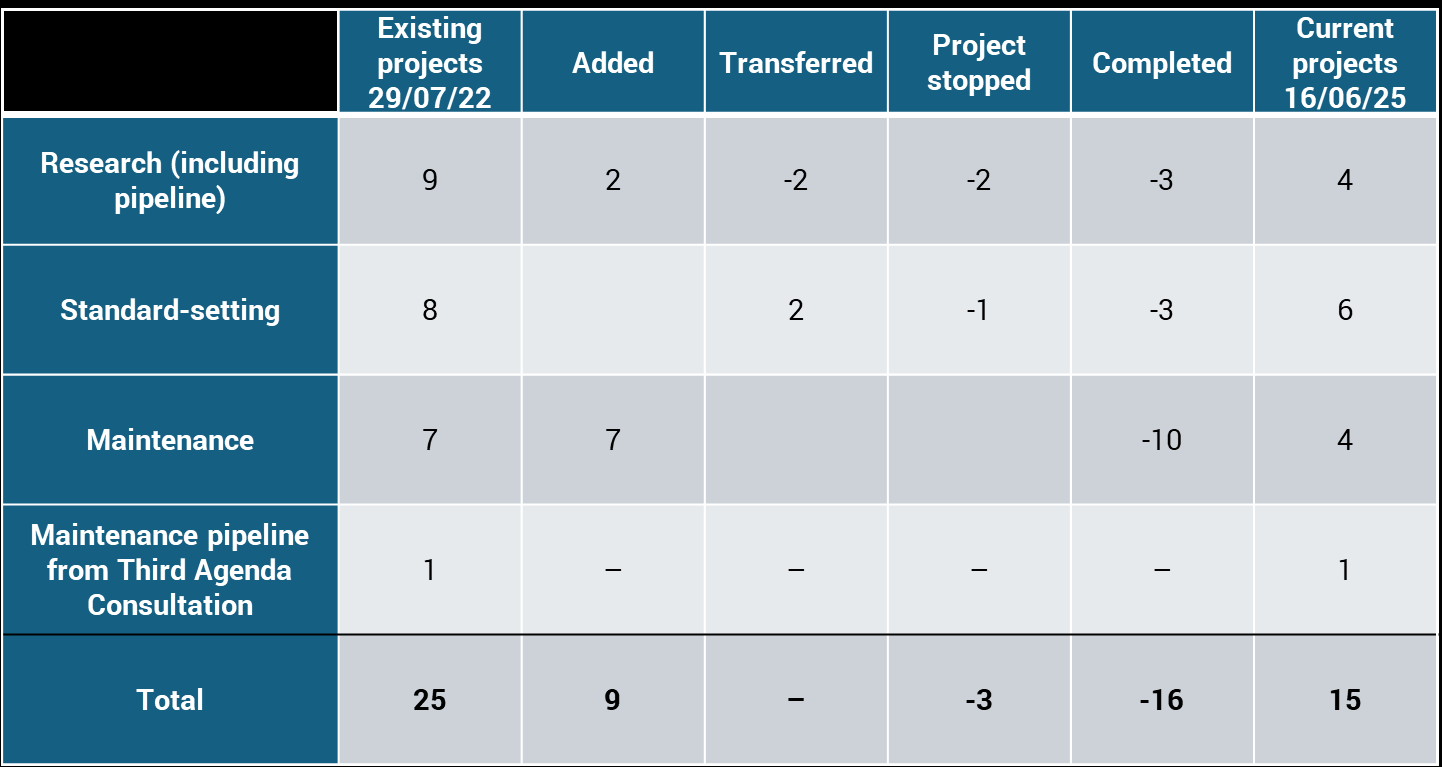
51The Secretariat has reconciled the projects at the beginning of this agenda period until June 2025 in the table below.
Source: UKEB
52In research, two projects were transferred to become standard-setting projects (Equity Method and Goodwill and Impairment). Another two projects were effectively stopped (Business Combinations under Common Control and Extractive Industries). The three projects that were completed are the Post-implementation Reviews (PIRs) of IFRS 9, Classification and Measurement and Impairment, and IFRS 15. In standard-setting, the project that was stopped is Disclosure Initiative: Targeted Standards-level Review.
53The suggested approach to identify 3-5 major projects and list other alternative projects (presumably smaller maintenance projects) seems consistent with what the IASB has been able to achieve over the last three years. Although it should be noted that all the completed research projects were Post Implementation Reviews (PIRs).
Initial view
54Due to the constraints under which the IASB is operating and given stakeholders have limited resources, it would appear a sensible approach to focus the consultation on a few major projects.
Questions for the Board – proposed approach
- Does the Board consider that the proposed approach to propose 3-5 major projects and list other alternative projects (presumably smaller maintenance projects) appropriate?
ASAF Q2b: Which projects would you recommend including in the list of 3-5 projects? IASB Staff recommend at least starting with ‘reserve list' projects Pollutant Pricing Mechanisms and Operating Segments.
Pollutant Pricing Mechanisms
55In response to an IASB request in March 2024 to National Standard Setters for information on Pollutant Pricing Mechanisms (PPMs) 9 the UKEB advised the IASB that:
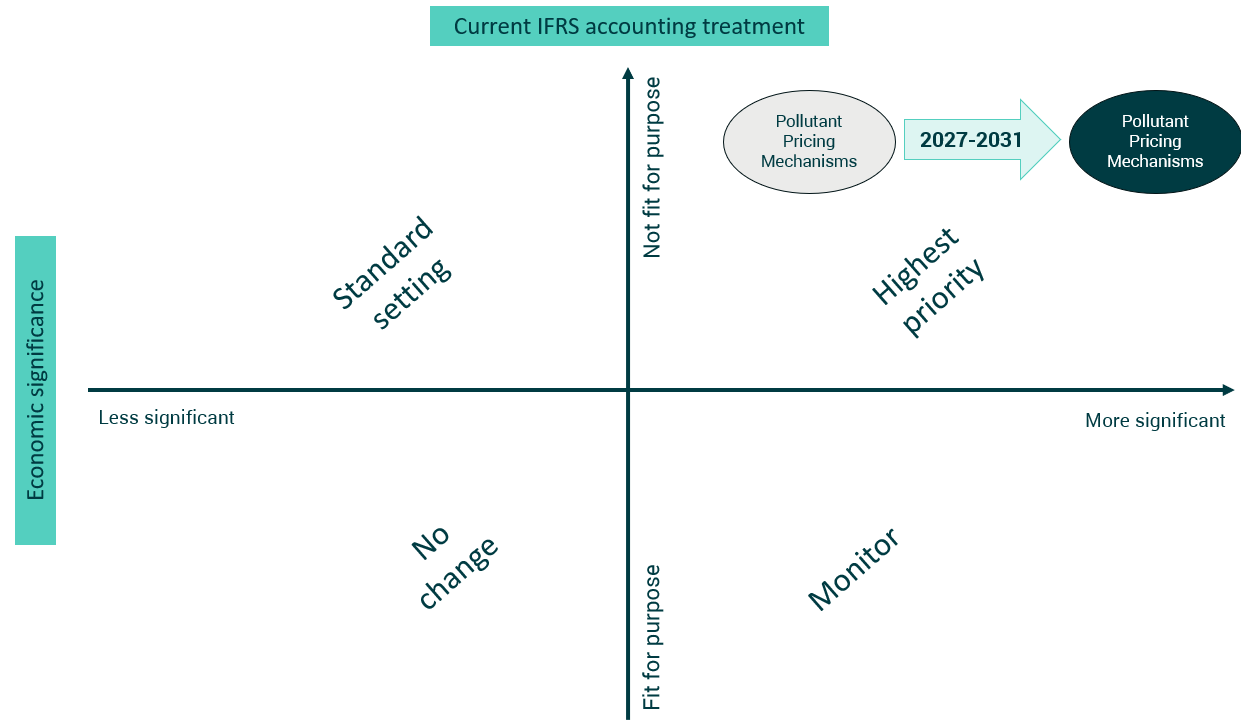
a) Respondents to the IASB's Third Agenda Consultation had identified a project on PPMs as a high priority. b) UK stakeholders considered that the significance and prevalence of both statutory and voluntary pricing mechanism schemes were increasing and that such schemes were likely to become more material in the short to medium term. c) PPMs and adjacent schemes appear to be increasing in significance globally as governments and entities consider using them to achieve net zero commitments. d) Regulators are indicating that free credit allowances may be wound down in the near to medium term. e) There was limited accounting guidance within IFRS specifically on accounting for emission allowances. f) IASB is aware that PPMs are increasing in prevalence globally and of the potential deficiencies in the accounting for these mechanisms.
56Earlier in the paper, we suggested that a specific strategic approach could be used to identify priority projects. The diagram below indicates that a project on PPMs should be included as one of the 3-5 strategic projects in the Fourth AC.
Source: UKEB
57The illustration shows that as PPMs are expected to become more prevalent in the medium term and considering that IFRS Accounting Standards usually take a minimum of five years to develop, PPMs would be a high priority project. This proactive approach would ensure principle-based standards are developed before practice develops independently leading to diverse outcomes.
Operating segments
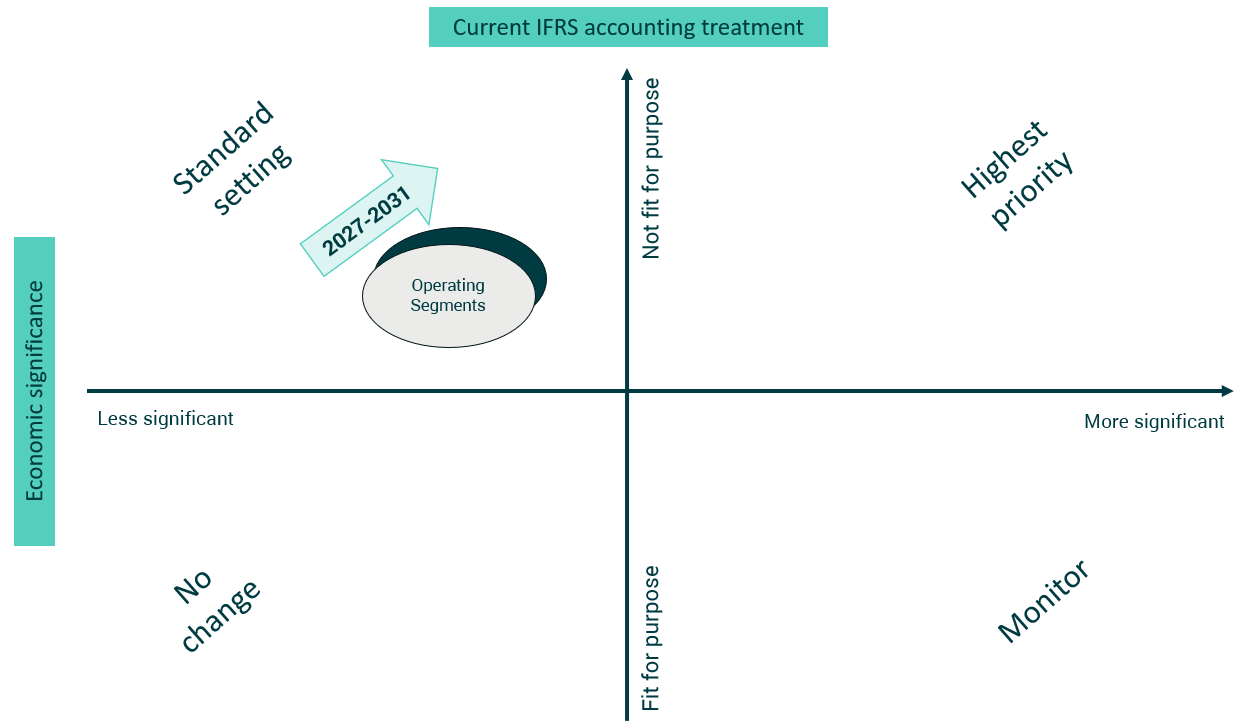
58For the Third AC, the UKEB undertook stakeholder outreach and research work. At that stage we considered the operating segments project to be low priority because the IASB's 2013 PIR of IFRS 8 Operating Segments concluded that the Standard achieved its objectives and improved disclosures in this area. Although we acknowledge that this information is important to investors.
59Using the proposed strategic approach explained earlier in the paper again, the diagram below indicates that a project on operating segments should be excluded as one of the 3-5 strategic projects in the Fourth AC.
Source: UKEB
Questions for the Board – Operating segments
- Do Board members agree that: a) Pollutant Pricing Mechanisms should be included in the list of 3-5 high demand projects? b) operating segments should not be included in the list of 3-5 high demand projects?
ASAF Q2c: Do you have any comments on the tentative list of alternative potential projects?
IASB projects
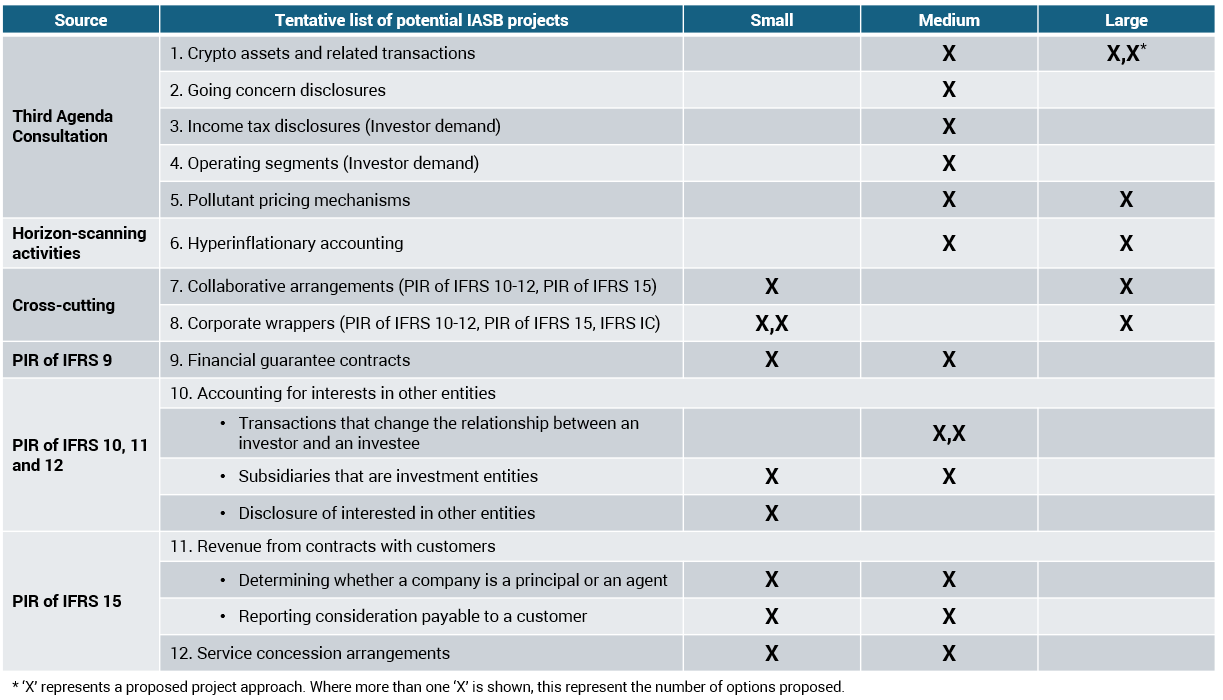
60The IASB Staff provided a detailed list of the tentative IASB consultation projects with indicative sizes and alternative scopes in the July 2025 ASAF papers10. A list of potential joint IASB–ISSB projects were also included but without sizing or scope options. The diagram below provides a summary of the tentative IASB projects. Please refer to Appendix A for more detail.
Source: UKEB analysis of July 2025 ASAF paper 3A
Stakeholder feedback
61Most members of the UKEB Advisory Groups considered that the IASB approach should prioritise the significant projects from the previous consultation as these were still at an early stage. The members suggested that the IASB should form a view of what it could realistically achieve based on the available resources and the duration of the standard setting process. There was an overall preference for a focus and completion of the Intangible Assets and Statement of Cashflows and Other Related Matters.
62Members of AFIAG noted that larger economies were becoming hyperinflationary, and therefore more material issues may be arising for UK groups. Both PAG and AFIAG members suggested that the IASB consider outsourcing or partnering with NSS, who have the relevant expertise for hyperinflationary research.
63Members of the PAG did not support a project on Going Concern. They noted updates to this standard due to the Covid pandemic and the significant management effort and audit costs incurred consequently.
Initial view
64The Secretariat consider that the existing significant projects, Intangible Assets and Statement of Cashflows and Other Related Matters should be prioritised.
Potential joint projects with the ISSB
65At the May 2025 UKEB meeting, when the Board discussed the potential joint projects between the IASB and ISSB it was noted that the projects should start with a limited scope rather than the significant scope of the projects proposed (a revised Conceptual Framework, Integration in Reporting and Materiality).
Stakeholder feedback
66Members of AFIAG and PAG considered that while the proposed joint projects were likely to be required in the future, a more practical approach was more appropriate over the next five years. AFIAG members suggested that the IASB should develop the examples to illustrate impacts on the financial statements from climate-related risks and opportunities.
Questions for the Board – tentative list of alternative potential projects
- Does the Board have any comments on the IASB prioritising the existing significant projects, Intangible Assets and Statement of Cashflows and Other Related Matters?
ASAF Q2d: Are there any projects you would add to the list?
A climate thematic project for a carbon constrained economy
67At the May 2025 meeting Board members discussed whether a climate-related thematic approach could potentially cater for anticipated impacts on IFRS Accounting Standards. For example, a thematic project could consolidate or map the recent climate-related narrow-scope amendments and enable a more principles-based approach to this area of accounting. While the Board did not consider that a 'climate accounting standard' would be required, the Secretariat were asked to consider what issues will give rise to a potential thematic project approach.
68We note that the UKEB Final Comment Letter11 to the IASB on the Third Agenda Consultation suggested a potential cross-standard review to identify and resolve any potential areas of interaction between IFRS Accounting Standards and the forth coming IFRS S2 Climate-related Disclosures.
69In that letter the UKEB recommended that where multiple IFRS Accounting Standards were impacted, the IASB could use a thematic approach, whereby amendments to all relevant Standards could be addressed as part of the same project with an overarching objective. This approach would allow for consistency across Standards and has potential for greater efficiency in the Standard-setting process.
70This concept was illustrated in the appendix to the letter and is reproduced below for context.
| Current Accounting Standard | Potential climate-related considerations |
|---|---|
| IAS 1 Presentation of Financial Statements | Amended to more effectively capture long-dated impacts of climate-related risks in the financial statements |
| IAS 2 Inventories | Educational material on the impact of transition risk on inventory valuation. |
| IAS 16 Property Plant and Equipment | Educational material on the impact of physical risk and transition risk on measurement. |
| IAS 36 Impairments | Amended to more effectively capture long-dated impacts of climate-related risks in the measurement of assets. |
| IAS 37 Provisions, Contingent Liabilities and Contingent Assets | Assess whether recognition and disclosure requirements for provisions and contingent liabilities result in sufficient relevant information on climate-related risks. |
| IAS 38 Intangible Assets | Assess whether recognition and measurement requirements provide sufficient relevant information on pollutant pricing mechanisms. Assess the implications of investment in development of climate-risk reduction technologies failing to meet the capitalisation criteria for development costs |
| IFRS 8 Operating Segments | Educational material on the potential impact on segmental disclosures of regulatory change to address climate-related risks. |
| IFRS 9 Financial Instruments | Assess the implications of some types of green bond failing the SPPI test and therefore being classified as Fair Value Through Profit or Loss |
| IFRS 10 Consolidated Financial Statements | Assess the implications of some renewable's funds failing to meet the investment entity criteria and therefore, unlike other funds, not being subject to the investment entity exception. |
Source: UKEB Final Comment Letter - Third Agenda Consultation (September 2021) Appendix 2, Table 1.
71At the May 2025 Board meeting the Secretariat were asked to provide feedback received from stakeholders in relation to any perceived deficiencies with current accounting standards.
72The Secretariat had previously conducted nine interviews with stakeholders on connectivity and carbon accounting in Q1 2025 for an IFASS agenda item. Relevant points from that outreach are summarised below for information. The following comments were received from preparers:
a) Preparers from heavy emitting industries noted that since the withdrawal of IFRIC 3 on Emission Rights, there had been a lack of guidance from the IASB. They considered that analogising to IAS 38 Intangible Assets was not practical as the standard didn't envisage new developments such purchasing, trading or generating carbon credits. The entity advised that the industry was having to create new accounting policies which resulted in inconsistent accounting policies across the industry, challenges with auditors and consumption of management time. b) A preparer from the asset management industry also found that the lack of accounting guidance in emission for rights a challenge. In addition, accounting guidance is lacking for assets that are used for investment, when they are not financial instruments, PPE or investment property. c) Most prepares commented that despite the same definition of materiality being used by both the IASB and ISSB it was challenging to apply in practice due to differing time horizon's, legal entity boundary and intended audiences. d) Some preparers supported the IASB's approach of climate-related narrow-scope amendments on the basis that it was a more agile than awaiting amendments or a new standard. However, another preparer expressed a strong preference for a more holistic, principles-based approach to be taken due to the emerging significant impact of climate-related matters.
Stakeholder feedback
73Neither the AFIAG nor PAG considered that there was currently a persuasive case for a climate-related accounting standard. However, a PAG member noted a risk of unintended consequences if the IASB continued with its approach of reactive narrow-scope amendments. Members of these groups would support the IASB consulting on a principles-based climate-related thematic project, where the objective was to identify further narrow scope amendments across different standards and to co-ordinate any amendments.
74IAG members considered that a climate-related standard may be required and that the IASB should allocate resources to address climate issues as they arose.
Initial view
75The IASB could consider consulting on whether a thematic approach to climate-related matters, where amendments to all relevant Standards could be addressed as part of the same project with an overarching objective should be included as a potential project in the RFI. This could consider accounting for emissions rights and assets held for investment purposes.
76The Secretariat is considering potential projects between the IASB and ISSB. One approach could be to further develop the connections between the CROUFS illustrative examples and IFRS S2. We intend to explore this further with stakeholders about the areas of concern and how best to address these. The Secretariat will bring more details once those discussions have concluded.
ASAF Q2e: Are there any potential projects you would remove from the list?
77In March 2024, the UKEB suggested 12 that the IASB may be able to create capacity to start a PPM project by deprioritising the following projects:
a) Business Combinations - Disclosures. b) Equity Method. c) Rate-regulated Activities. d) Dynamic Risk Management. e) Hyperinflation.
Questions for the Board – potential projects to be removed
- Does the Board have any comments in relation to tentative projects to remove from the list?
Next Steps
78The Secretariat will observe the 7–8 July ASAF meeting and provide an update on the Agenda Consultation discussion at a future UKEB meeting.
79We expect the RFI to be published in Q4, 2025. Ahead of commencing the formal project to respond to the RFI, the Secretariat, subject to resource availability, will investigate arranging a webinar and a joint event with a professional accounting body to gather stakeholder feedback.
26 June 2025 Agenda Paper 7: Appendix A
Appendix A: Potential IASB projects to be included in the RFI for the IASB's Fourth Agenda Consultation
Tentative IASB projects
A1The table below is a summary from the July 2025 ASAF paper1 and sets out the tentative IASB projects above, the indicative sizes and options of the IASB projects. No details were provided on the potential joint projects with the ISSB.
| Project Topic | Small | Medium | Large |
|---|---|---|---|
| Source - Third Agenda Consultation | |||
| Crypto assets and related transactions | – | Amending the scope of the IFRS Accounting Standards for financial instruments to include crypto assets | Option 1: Developing an IFRS Accounting Standard to cover a range of non-financial tangible or intangible assets held solely for investment purposes, including crypto assets |
| Option 2: Undertaking a comprehensive project on accounting for a broader range of crypto assets and liabilities | |||
| Going concern disclosures | – | Develop more prescriptive disclosure requirements about management's going concern assessment and conclusion | – |
| Income tax disclosures | – | Develop enhanced disclosure requirements about income taxes | – |
| Operating segments | – | Make targeted improvements to the requirements for identifying operating segments and the segment aggregation criteria, and develop enhanced disclosure requirements to provide investors with more decision-useful information | – |
| Source - Horizon Scanning | |||
| Pollutant pricing mechanisms | – | A disclosure only project with a more limited scope | Development of accounting requirements addressing recognition, measurement and disclosure issues for various types of pollutant pricing mechanisms |
| Hyperinflationary accounting | – | Assess whether, without amending other requirements of IAS 29, it could address concerns about the application of the scope requirements in IAS 29 | Undertake a comprehensive review of IAS 29 |
| Source - Cross-cutting | |||
| Collaborative arrangements | Develop requirements to assess when consideration exchanged between parties to collaborative arrangements qualifies as revenue under IFRS 15 | – | Develop accounting requirements for collaborative arrangements that are outside the scope of IFRS 11 |
| Source - PIR IFRS 9 | |||
| Corporate wrappers | Option 1: Develop requirements to account for transfers of control of a corporate wrapper–whether to apply IFRS 15 | – | Develop a principle for transactions that involve corporate wrappers. The structure of corporate wrappers depends on jurisdictional laws and/or regulations |
| Option 2: Develop requirements to account for the sale and leaseback of an asset in a corporate wrapper–whether to apply IFRS 16 | |||
| Financial guarantee contracts | Develop additional requirements for matters relating to issued financial guarantee contracts | Undertake a comprehensive review to address the broader application questions related to financial guarantee contracts | – |
| Source - PIR IFRS 10–IFRS 12 | |||
| Accounting for interests in other entities: Transactions that change the relationship between an investor and an investee | – | Option 1: Identify general principles applicable to all transactions that change the relationship between an investor and an investee | – |
| Option 2: Develop requirements for those transactions for which currently there are none | |||
| Subsidiaries that are investment entities | Develop disclosure requirements for subsidiaries that are investment entities | Reconsider which subsidiaries an investment entity parent should consolidate instead of measuring them at fair value | |
| Source - PIR IFRS 15 | |||
| Disclosures of interests in other entities | The IASB could consider improvements to disclosure requirements | – | |
| Service concession arrangements | Amend paragraph 21 of IFRIC 12 to clarify the accounting for contractual obligations to maintain or restore service concession infrastructure | Undertake a comprehensive review of IFRIC 12 to ensure that it aligns with all other IFRS Accounting Standards, in particular IFRS Accounting Standards issued or amended after IFRIC 12 was issued | – |
| Revenue from contracts with customers: Determining whether a company is a principal or an agent | Develop additional control indicators specific to services | Provide additional illustrative examples | |
| Reporting consideration payable to a customer | Include specific disclosure requirements | Develop additional requirements related to challenges identified by stakeholders |
Source: ap6b-potential-iasb-projects-request-for-information.pdf
Tentative joint IASB and ISSB projects
A2The table below shows the tentative joint IASB-ISSB projects. No further detail has yet been provided on their indicative sizes or scope. Any joint projects would be required to be a priority for both the IASB and the ISSB relative to each board's work plan to start. To help stakeholders provide feedback about both the IASB's work plan and the ISSB's work plan, the RFI will note this point and provide a link to the ISSB's work plan.
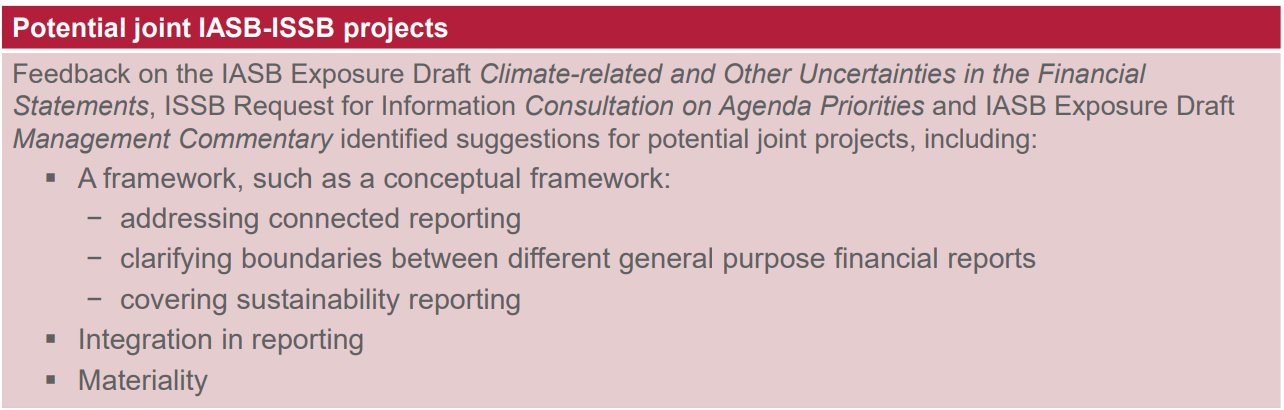
Source: IASB's Fourth Agenda Consultation: Proposed approach
26 June 2025 Agenda Paper 7: Appendix B
Appendix B: FASB project prioritisation process and criteria
FASB project prioritisation process
B1Neither the prioritisation process nor the Agenda Consultation process is included in the FASB Rules of Procedure1. However, information about prioritisation is set out on the FASB's website2. In addition to regular Agenda Consultations, stakeholders are invited to submit Agenda Requests at any time. These are then discussed at a public FASB meeting (called an Agenda Prioritisation), and a decision is made about whether to add these requests to the technical agenda. The same prioritisation criteria is applied for both Agenda Requests and Agenda Consultations.
Technical and Research Agendas
B2For a project to be added to or removed from the technical agenda, most FASB members must agree. The FASB notes that “the criteria help the board to use its time and resources effectively and efficiently on the highest priority projects that the FASB is able to complete in a timely manner”3.
B3The FASB Chair decides on whether a project should be added or removed from the research agenda. Research projects gather information and explore potential standard-setting solutions.
B4There is a reference in the Rules of Procedure to oversight of the agendas by the Financial Accounting Standards Advisory Committee (FASAC).
Prioritisation criteria
B5The criteria are stated in the Invitation to Comment (ITC) for the most recent Agenda Consultation4 The FASB is not seeking feedback on the prioritisation criteria in the ITC. The criteria are:
| FASB criterion | Explanation |
|---|---|
| There is an identifiable and sufficiently pervasive need to improve [US] GAAP | What improvement is needed? What is the case for change? |
| There are technically feasible solutions, and the expected benefits of those solutions are likely to justify the expected costs of change | What are the various alternative ways that an issue could be addressed? What are the expected benefits and expected costs of the solutions and can the solutions be implemented? |
| The issue has an identifiable scope | Can the FASB effectively identify the scope of the potential project? Can the issue be sufficiently described? |
B6There is no indication of a sequence or weighting applied to these criteria – but instead: "Decisions about whether the answers to those questions meet the criteria for a potential project is a matter of judgement based on research and analysis performed by the FASB staff”5.
Mapping the FASB criteria to the proposed IASB criteria
B7The diagram below, illustrates the FASB criteria (shown in orange) compared to the draft IASB criteria (shown in grey).
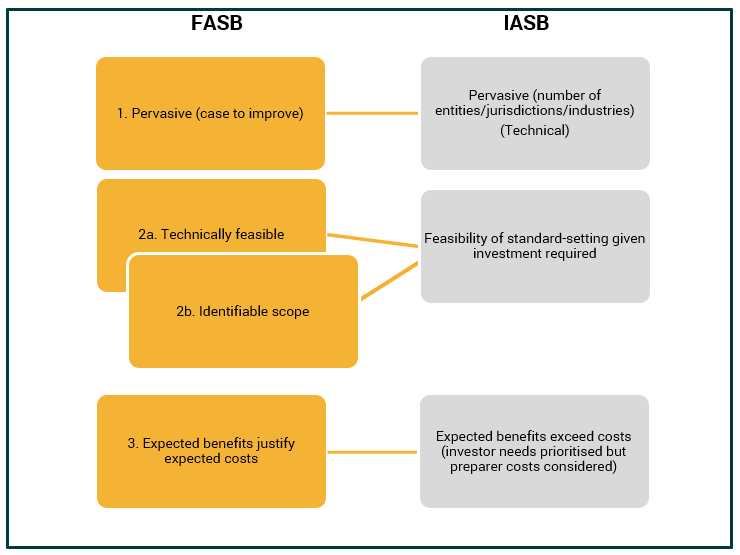
B8The draft IASB prioritisation criteria which do not appear to have a direct FASB equivalent are:
| Type | Criterion |
|---|---|
| Technical | Strategic priority |
| Operational | Time-sensitivity |
| Synergies | |
| Capacity |
FASB Agenda Consultations
B9The FASB issued an Invitation to Comment for its 2025 Agenda Consultation6 in January 2025, with a comment deadline of 30 June 2025.
B10The 2025 Agenda Consultation ITC notes how the top standard-setting priorities identified by stakeholders in the previous (2021) Agenda Consultation have been addressed.
B11The priority list was confirmed against the 2021 Agenda Consultation Report7. The table below shows the FASB's progress on each priority, as at early June 2025.
| 2021 Agenda Consultation (priorities) | FASB progress (January 2025) |
|---|---|
| Disaggregation of Financial Reporting Information | Accounting Standards Update (ASU) issued on Disaggregation of Income Statement Expenses (2024) |
| Statement of Cash Flows | Targeted improvements project on SCF for Financial Institutions (ongoing) Research project (ongoing) |
| ESG-Related Transactions or Disclosures | Proposed Accounting Standards Update (ASU) issued on Environmental Credit Programs (2024), no expected date for ASU |
| Intangible Assets | Proposed ASU issued on Accounting for Software Costs (2024), ASU expected Q3 2025 |
| Digital Assets | ASU issued on Crypto assets (2023) |
| Financial KPIs or Non-GAAP Metrics | Research project ITC issued (2024) |
| Income Tax Disclosures | ASU issued on Income Tax Disclosures (2023) |
26 June 2025 Agenda Paper 7: Appendix C
Appendix C: Effects Analysis
C1The table below illustrates the extent of effects analysis work the IASB conducted for accounting standards issued since the EACG's recommendations were made.
| IFRS 15 | IFRS 16 | IFRS 17 | IFRS 18 | IFRS 19 | |
|---|---|---|---|---|---|
| Costs to preparers | |||||
| Quantitative | No | No | No | No | No |
| Qualitative | Yes (pg. 83) | Yes (pg. 32) | Yes (pg. 58) | Yes (pg. 45) | Yes (pg. 21) |
| Benefits to users | |||||
| Quantitative | No | No | No | No | No |
| Qualitative | Yes (pg. 84) | Yes (pg. 22) | Yes (pg. 30) | Yes (pg. 30) | Yes (pg. 26) |
| C/B to auditors | No | No | No | Yes (pg. 56) | |
| C/B to regulators | No | Yes (pg. 35) | Yes (pg. 63) | Yes (pg. 56) | |
| Capital market effects | |||||
| Cost of capital | No | Yes (pg. 56) | No | No | No |
| Liquidity | No | No | No | No | No |
| Other (volatility) | No | No | Yes (pg. 49) | No | No |
| Microeconomic effects | No | No | Yes (pg. 106) | Yes (pg. 60) | No |
| Macroeconomic effects | No | Yes (pg. 62) | No | No | Yes (pg. 30) |
| Number of companies affected | No | Yes (pg.14) | Yes (pg.22) | No | No |
| Geographical breakdown | No | Yes (pg.14) | Yes (pg.23) | No | No |
| Industry breakdown | No | Yes - Sample Only (pg.16) | Yes (pg.23) | No | No |
| Link to document | IFRS 15 Basis of Conclusions | IFRS 16 Effects Analysis | IFRS 17 Effects Analysis | IFRS 18 Effects Analysis | IFRS 19 Effects Analysis |
Footnotes
Footnotes
-
IASB Fourth Agenda Consultation: Initial Discussion (UKEB Mary 2025) ↩↩↩
-
IASB's Fourth Agenda Consultation - Proposed approach (paper 3) and Description of potential IASB projects to be included in the Request for Information (paper 3A) ↩↩
-
FASB Agenda Requests ↩↩
-
European Accounting Association (EAA) Annual Congress 15 May 2024 ↩
-
The IASB requested feedback from Accounting Standards Advisory Forum (ASAF) members regarding the prevalence and nature of Pollutant Pricing Mechanisms (PPMs) in their jurisdictions and any associated accounting issues. Appendix A: Pollutant Pricing Mechanisms – IASB survey response (March 2024) ↩
-
IASB's Fourth Agenda Consultation - Description of potential IASB projects to be included in the Request for Information ↩
-
UKEB Final Comment Letter - Third Agenda Consultation (September 2021) ↩
-
IASB General Update - Appendix A: Pollutant Pricing Mechanisms – IASB survey response ↩