6 Post-implementation Review of IFRS 16 Leases
OFFICIAL - PUBLIC 26 June 2025 Agenda Paper 6
Executive Summary
Project Stage
| IASB Pipeline | Research / paper | Discussion paper | Redeliberation | Exposure Draft | Redeliberation | Final standard | Post Implementation Review |
|---|---|---|---|---|---|---|---|
| IASB | |||||||
| UKEB | Research / Influencing | Research / Influencing | Monitoring | Influencing | Monitoring | Endorsement | Influencing |
Project Type
Influencing
Project Scope
Limited
Purpose of the paper
The purpose of this paper is to:
- Obtain the Board's feedback on a proposed Project Initiation Plan (PIP) for the project to influence the IASB's Post-implementation Review (PIR) of IFRS 16 Leases.
- Request the Board's approval to publish the PIP on the UKEB website.
Summary of the Issue
On 17 June 2025, the IASB published the Request for Information (RFI) with a comment deadline on 15 October 2025. The PIP covers the influencing work proposed for this project to inform the UKEB's response to the IASB.
The consultation period overlaps with interim reporting and summer holidays for a significant number of UK stakeholders. There are few UKEB Board and advisory/working group meetings scheduled during this period.
In order to ensure that the UKEB's final comment letter is delivered in time for the IASB's deadlines, the Secretariat has already performed desk-based research and some limited outreach activities. This included conducting a survey of UK IFRS reporters who are lessees, to collect information on the ongoing costs and benefits of applying IFRS 16.
The proposed workplan in the PIP (see Appendix A) suggests limited additional outreach to ensure a proportionate approach to the project, reflecting both the context of the project and feedback received to date from UK stakeholders.
Decision for the Board
Subject to addressing any comments raised at the meeting, does the Board approve:
- the PIP for publication on the UKEB website?
Recommendation
The Secretariat recommends that subject to any necessary amendments requested by the Board, the Board approves the PIP.
Appendix
Appendix A: [Draft] Project Initiation Plan: Post-implementation Review of IFRS 16 Leases
Appendix A: Project Initiation Plan Post-implementation Review of IFRS 16 Leases
Purpose
A1On 17 June 2025, the IASB published the Request for Information (RFI) with a comment deadline on 15 October 2025. This paper sets out the plan to influence the IASB in response to its RFI for the Post-implementation Review (PIR) of IFRS 16 Leases1.
Background
A2In January 2016, the IASB issued IFRS 16. The Standard was effective for annual periods beginning on or after 1 January 2019. Earlier application was permitted, as long as IFRS 15 Revenue from Contracts with Customers is also applied. In December 20232, the IASB decided to commence the PIR of IFRS 16.
A3The UKEB Secretariat has undertaken desk-based research and conducted some limited outreach activities on this topic with the UKEB Investor Advisory Group (IAG), the UKEB Preparer Advisory Group (PAG), the UKEB Accounting Firms and Institutes Advisory Group (AFIAG), and the UKEB Academic Advisory Group (AAG). This work has informed this Project Initiation Plan (PIP) and will be reflected in the Draft Comment Letter (DCL).
A4During May 2025, the Secretariat also conducted limited and targeted initial outreach with UK IFRS reporters who are lessees through a survey to collect information on the ongoing costs and benefits of applying IFRS 16. There were 51 respondents and their feedback will be reflected in the DCL.
Project Plan
Proportionality assessment
Significance and size
IASB Project scope
A5The IASB has established a high threshold for initiating amendments following a PIR. "The IASB uses the PIR process to assess whether the effects of applying new requirements on users of financial statements, preparers, auditors and regulators are as intended when the IASB developed those new requirements" 3. This ensures that only significant issues or widespread concerns prompt additional action, thereby maintaining the integrity and stability of the standards.
UK context
A6IFRS 16 is relevant to most UK IFRS reporters. However, analysing Reuters-Eikon data for the 2023 year-end of UK listed companies (excluding funds and trusts) revealed the following:
- The total value of lease liabilities across the UK listed market as a whole amounted to £167.4bn, representing 1.8% of total recognised liabilities. The industries with the highest value of lease liabilities are the Consumer (£70.3bn), Energy (£32.8bn), Industrials (£22.9bn) and Telecommunications (£19.0bn) industries. However, a relatively small number of companies with very large total liabilities (primarily financial institutions) but low lease liabilities significantly skew this ratio.
- When analysed by company, rather than the market as a whole, the ratio of lease liabilities to total liabilities for an average company is 13.5%.
Complexity
A7Based on the list of questions within the RFI, which primarily focus on the costs and benefits of IFRS 16, the most complex issue relates to sale-and-leaseback transactions.
Expected timeline / urgency
A8There are limited UKEB Board and advisory/working group meetings scheduled within the IASB's RFI consultation period. The consultation period also overlaps with interim reporting and summer holidays for a significant number of UK stakeholders. In anticipation of the deadlines, the UKEB Secretariat has performed desk-based research and some limited outreach activities. This included conducting a survey of UK IFRS reporters who are lessees, to collect information on the ongoing costs and benefits of applying IFRS 16.
Expected interest / sensitivity
A9There has been interest in the project from a range of UKEB stakeholders, particularly preparers. This is reflected in the number of responses received to the UKEB preparer survey, and in discussions with UKEB advisory groups. There is no indication of any other significant wider UK concerns in relation to this project.
Feedback from desk-based research / initial outreach
A10Desk-based research and feedback from initial outreach with stakeholders (UKEB advisory and working groups as well as the UKEB preparer survey) indicate that:
- For some companies implementing and applying IFRS 16 has been costly, with ongoing costs continuing to be high. Stakeholders have suggested mitigations including simplification of discount rate requirements and broadening low value asset exemptions could be considered.
- A number of companies report supplementary non-GAAP measures as a result of applying IFRS 16.
- Technical challenges include:
- The level of judgement required in applying IFRS 16 can affect comparability within the same industry, particularly in determining whether a contract contains a lease, the lease term, and the discount rate.
- Sale-and-leaseback transactions and the interaction with IFRS 15 Revenue from Contracts with Customers.
- Investors are getting the information they need under IFRS 16, which is an improvement on IAS 17 Leases.
Connectivity
A11The potential overlaps between IASB Accounting Standards and ISSB Sustainability Disclosure Standards has been considered as part of the development of this PIP. There do not appear to be any significant connectivity implications for the project.
Recommended UKEB project scope
A12Based on the proportionality assessment above, the PIP has been developed based on a 'Limited' project scope. The project will:
- Publish a DCL, which will be primarily based a high-level overview of the findings from desk-based research and feedback from initial outreach with stakeholders.
- Include an Invitation to Comment (ITC) accompanying the DCL.
- Allow for a 45-day consultation period on the DCL to mitigate the fact that this period overlaps with interim reporting and summer holidays for a significant number of UK stakeholders.
Project - key activities
| Key activities | Due Process Handbook |
|---|---|
| Board Education Session | 4.10b Optional |
| Creation of a Project Initiation Plan (this document) | 5.4-5.8 Mandatory |
| Desk-based research to support the proportionality assessment including: a) Review of accounting firm manuals and publications. b) Review of IASB papers, presentations, meetings, and education materials. c) Review of direct communication received from stakeholders. |
5.9 Optional |
| Publication of a Draft Comment Letter for public consultation a) The DCL will be published on the UKEB website. b) Announcement of the publication of the DCL and ITC made available via the UKEB News Alert publication, and LinkedIn posts. c) The DCL and ITC to be issued for comment for 45 days. |
5.13-5.17 Generally mandatory |
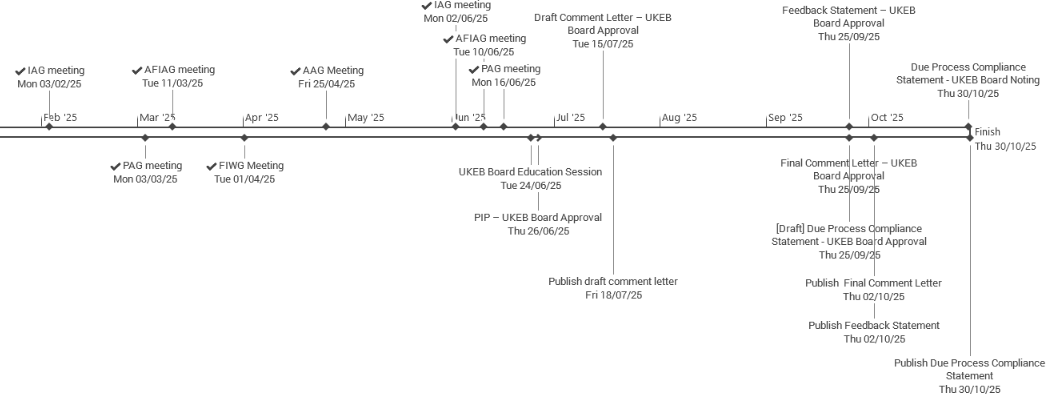
| Stakeholder outreach a) Presented to UKEB advisory and working groups on the following dates: a. Investor Advisory Group, 3 February 2025 and 2 June 2025. b. Preparer Advisory Group, 3 March 2025 and 16 June 2025. c. Accounting Firms and Institutes Advisory Group, 11 March 2025 and 10 June 2025. d. Academic Advisory Group, 25 April 2025. e. Financial Instruments Working Group, 1 April 2025. b) Conducted limited and targeted initial outreach with UK IFRS reporters who are lessees through a survey on the ongoing costs and benefits of applying IFRS 16. |
5.10-5.12 Mandatory |
| Final Comment Letter A final comment letter will be prepared for Board approval, submission to the IASB, and publication on the UKEB website. |
5.18 Mandatory |
| Project Closure A Feedback Statement and Due Process Compliance Statement will be prepared. Once approved by the Board these documents will be published on the UKEB website. |
5.19-5.26 Mandatory |
Resources allocated
A13To undertake the activities described in this project plan, a project team has been assigned consisting of a Project Director, with some oversight from a Senior Project Director. The required resources are allowed for in the 2025/26 UKEB plan and budget.
A14In addition, some support from the economics team during the outreach to UK IFRS reporters was allocated.
Setting up an ad-hoc advisory body
A15The UKEB will not require a separate ad-hoc advisory body for this project. Existing UKEB advisory groups have the necessary skills and expertise to support this project and have been consulted, as outlined in the project plan.
Project timeline
A16The proposed high-level project timeline is shown below. This provides a best estimate based on information known at the time of writing. If necessary, a revised PIP will be presented to the Board, to reflect any major changes, as the project progresses.
| Date | Milestones |
|---|---|
| 24 June 2025 | Board Education Session |
| 26 June 2025 | Project Initiation Plan for Board Approval (this document) |
| 15 July 2025 | Draft Comment Letter for Board approval |
| Estimated DCL consultation period (45 days): 18 July 2025 – 1 September 2025* | |
| 25 September 2025 | Board review of Final Comment Letter, Feedback Statement, draft Due Process Compliance Statement |
| By 15 October 2025 | Final Comment Letter submitted to IASB. |
| 30 October 2025 | Due Process Compliance Statement for noting. |
| * To be confirmed |
A17The diagram below is a graphical view of the mandatory milestone activities described above. This provides a best estimate based on information known at this time. If necessary, a revised PIP will be presented to the Board, to reflect any major changes, as the project progresses.
Footnotes
-
See the published Request for Information on IASB's website. ↩
-
See for example slides 13 and 14 of the November 2024 IASB Staff Paper Agenda Reference 3 Phase 1 – Identifying matters to be examined at the Capital Markets Advisory Committee meeting. ↩