5 Statement of Cash Flows and Related Matters
22 May 2025 Agenda Paper 5
Executive Summary
| Project Stage | IASB | Research / Pipeline | Discussion paper | Redeliberation | Exposure Draft | Redeliberation | Final standard | Post Implementation Review |
|---|---|---|---|---|---|---|---|---|
| UKEB | Research / Influencing | Research / Influencing | Monitoring | Influencing | Monitoring | Endorsement | Influencing |
Project Scope
Moderate
Purpose of the paper
At the 28 March 2025 UKEB meeting, the Board agreed to the preparation of a paper summarising the findings from three research papers produced as part of the UKEB's proactive research project on the Statement of Cash Flows and Related Matters:
- Statement of Cash Flows and Related Matters: Background and Key Issues (December 2024).
- Statement of Cash Flows and Related Matters: Non-mandatory and Voluntary Cash Flow Disclosures Provided by UK Companies (February 2025).
- Statement of Cash Flows and Related Matters: UK User and Preparer Perspectives (March 2025).
The summary research paper (Appendix A) also includes the results of a UKEB user poll, published between 25 March and 22 April 2025, that received 32 responses.
This research will provide evidence to support the Board's future discussions on the project including the IASB's decision on the scope of the project to address possible ways of improving the perceived deficiencies. The intention is to publish this research summary, with final versions of the three individual research papers as appendices.
Also, at the 28 March 2025 UKEB meeting, the Board agreed that further UKEB research be undertaken. The Project Initiation Plan (PIP), approved at the November 2024 Board meeting, has been updated to reflect the additional research. The updated PIP is attached as Appendix F, for approval.
Summary of the Issue
The summary paper concludes that almost all UK stakeholders consider that IASB should undertake targeted improvements to the statement of cash flows to address their priority concerns. Specific opportunities identified by stakeholders to enhance the statement of cash flows that the IASB might consider when progressing with the project include:
- Increasing cohesiveness between the primary financial statements.
- Increasing information on relevant non-cash information.
- Presenting non-GAAP measures, including a reconciliation of net debt.
- Improving interconnectivity between IFRS Accounting Standards.
- Assisting preparers in applying the requirements, including improving the definitions for the classifications of cash flows (given the misalignment with IFRS 18).
- Considering the usefulness of the statement of cash flows for banks and insurers – although stakeholders indicated that the project scope should focus on first improving the requirements for all entities, and only then examine alternative solutions that would reduce the cost to preparers whilst improving information for users for financial institutions.
Decisions for the Board
- The Board is asked for general comments and observations on the summary of UKEB research findings (Appendix A).
- Does the Board have any comments on the final versions of the research papers (Appendices B–D)?
- Does the Board agree to publishing the research summary, along with final versions of the three individual research papers, as appendices?
- Does the Board approve the updated PIP (Appendix F) for this project for publication on the UKEB website?
Recommendation
The Secretariat recommends that the Board approves publication of the research summary along with final versions of the three individual research papers. We also recommend approval of the updated PIP.
Appendices
- Appendix A Statement of Cash Flows and Related Matters: Summary of UKEB research findings
- Appendix B UKEB research paper 1 – Statement of Cash Flows and Related Matters: Background and Key Issues
- Appendix C UKEB research paper 2 – Statement of Cash Flows and Related Matters: Non-mandatory and Voluntary Cash Flow Disclosures Provided by UK Companies
- Appendix D UKEB research paper 3 - Statement of Cash Flows and Related Matters: UK User and Preparer Perspectives
- Appendix E UKEB user poll results
- Appendix F Updated Project Initiation Plan
Background: Statement of Cash Flows and Related Matters
The IASB added a project on the Statement of Cash Flows and Related Matters to its research pipeline following feedback on its Request for Information: Third Agenda Consultation (published March 2021).
In the Feedback Statement to the Request for Information (published July 2022) most respondents recommended the addition of a project on cash flows to the IASB's workplan, rating it as high priority.
The IASB staff have performed initial research to gather evidence of the nature and extent of the perceived deficiencies and the likely benefits of developing new financial reporting requirements for IAS 7. This research is intended to provide evidence to support the IASB's decision on the scope of the project and will also address possible ways of improving the perceived deficiencies. The IASB discussed the initial research outcomes in March 2025 and agreed to further research being undertaken, which will be presented to the Board at the July 2025 meeting.
A UKEB project on the statement of cash flows and related matters supports meeting the UKEB's responsibilities regarding thought leadership in accordance with the UKEB Terms of Reference. It will also help the Board to deliver the UKEB's 2024-25 Regulatory Strategy (page 8) aim, to influence IASB early in its development cycle, by providing timely and effective input.
The UKEB research has focused on gathering primary evidence on the improvements UK investors and creditors suggest for the statement of cash flows, and UK preparer views on those possible improvements. This will provide a foundation for the UKEB to propose potential solutions for the problems already identified by the IASB as well as any other issues identified through UKEB outreach.
Summary Research Paper - Statement of Cash Flows: UKEB research findings
1The summary research paper (Appendix A) is based on the three UKEB research papers previously presented to the Board
2The summary research paper also includes the results of a user poll that the UKEB published between 25 March and 22 April 2025 (Appendix E). The poll allowed a wider range of UK users of financial statements to provide their views. The UKEB received 32 responses. The results of the poll were consistent with the findings in the third research paper on UK user and preparer perspectives, as well as providing feedback on potential solutions.
3The summary research paper concludes that almost all UK stakeholders consider that IASB should undertake targeted improvements to address the priority concerns of those stakeholders and could potentially consider addressing the concern around the use of the statement of cash flows for financial institutions as a separate project, once the targeted improvements for all entities have been made.
4The three UKEB research papers previously presented to the Board will be attached to the summary research paper as appendices. Final versions of these papers are attached (Appendices B–D). The papers include minor amendments reflecting Board feedback on the original papers, marked-up in track changes (the mark-up will be accepted prior to publication).
Questions for the Board
5At the March 2025 UKEB meeting, the Board agreed for additional research to be undertaken including:
- Alternative statement of cash flows: Based on UKEB research conducted to date, developing an alternate version of the statement of cash flows, incorporating the key suggestions made by users and preparers. This could be used to encourage further discussion about the ways forward for this project, and provide valuable evidence to the IASB.
- Interconnectivity of IFRS Standards/Cohesiveness of Financial Statements: The UKEB initial research identified both the interconnectivity of IFRS Standards and the cohesiveness of the financial statements as key issues for users. Mapping the links between the statement of cash flows and requirements in other IFRS Standards could identify opportunities to highlight the existing connections, (or refine the requirements to strengthen the connections). This could allow the IASB to make minor changes that bring significant incremental value to users.
6The Project Initiation Plan, approved at the November 2024 Board meeting, has been updated to reflect the additional research being undertaken. The updated PIP is attached at Appendix F.
Question for the Board
- Does the Board approve the amended PIP (Appendix F) for this project for publication on the UKEB website?
Next Steps
7The additional UKEB research, approved by the Board in March 2025, is underway and will be presented to the Board in July 2025. This will allow sufficient time to consult with UK stakeholders on the UKEB proposals prior to presenting to the Board.
8The UKEB Secretariat continues to engage with the IASB project team, to ensure that the UKEB proposed additional research will be useful. An update on the May 2025 IASB meeting, where the IASB will consider a proposed project plan for the project, will be provided to the Board in June 2025.
Appendix A: Statement Of Cash Flows Initial UKEB Research Findings
This document provides a high-level summary of the findings from three research papers developed by the UK Endorsement Board:
- Statement of Cash Flows and Related Matters: Background and Key Issues
- Statement of Cash Flows and Related Matters: Non-mandatory and Voluntary Cash Flow Disclosures Provided by UK Listed Companies
- Statement of Cash Flows and Related Matters: UK User and Preparer Perspectives

The UK Endorsement Board
1The UKEB is the UK's National Standard Setter for IFRS Accounting Standards, responsible for the endorsement and adoption of IFRS Accounting Standards for use in the UK. The UKEB also leads the UK's engagement with the IFRS Foundation on the development of new international accounting standards, amendments and interpretations.
Which entities use IFRS Accounting Standards in the UK?
Currently, there are approximately 1,500 entities with equity listed on the London Stock Exchange that prepare their financial statements in accordance with IFRS Accounting Standards. In addition, UK law allows unlisted companies to use IFRS Accounting Standards and approximately 14,000 such companies currently take up this option.
Why has the UKEB conducted a research project on the statement of cash flows?
2In response to the 2022 International Accounting Standards Board (IASB) Third Agenda Consultation, stakeholders highlighted perceived deficiencies with the current requirements of IAS 7 Statement of Cash Flows, including its presentation requirements. Many respondents to the IASB consultation, including most users of financial statements who commented, rating a project on the statement of cash flows and related matters as a high priority.
3The IASB started a project in September 2024 to gather evidence of the nature and extent of perceived deficiencies in the requirements of IAS 7 and the likely benefits of developing new financial reporting requirements to better meet the needs of IFRS financial statement users.
4In anticipation of an international debate, the UKEB began a research project in November 2024 focused on understanding UK stakeholders' views on the statement of cash flows and potential improvements, to ensure that any future reporting requirements are viable for UK stakeholders. The UKEB is building on work already undertaken in the UK, including by UK Regulator, the Financial Reporting Council (the FRC). While previous research identified potential problems with the statement of cash flows and possible solutions, it has generally not been based on direct evidence from users and preparers.
An overview of the UKEB research project
5This summary is based on three research papers developed by the UKEB in late 2024/early 2025 related to the statement of cash flows:
1: Background and Key Issues (December 2024) Desk-based research, exploring perceived issues with the statement of cash flows
2: Non-mandatory and Voluntary Cash Flow Disclosures Provided by UK Listed Companies (February 2025). Review of current reporting practices among UK listed companies

3: UK User and Preparer Perspectives (March 2025). Interviews with investors and preparers to better understand their perspectives on the current and potential future reporting requirements
6All three papers are available on the UKEB's website (https://www.endorsement-board.uk/statement-of-cash-flows).
7The UKEB also published a user poll inviting a wider group of users to share views, between March–April 2025, the result of which are summarised in this document.
UKEB Report 1: Background and Key issues
Background
8Most of the reporting requirements for the statement of cash flows are set out in IFRS Accounting Standard, IAS 7 Statement of Cash Flows. There are very few additional requirements relevant to cash flow reporting in other IFRS Accounting Standards. In addition, no direct mention is made of the statement of cash flows in the Conceptual Framework for Financial Reporting.
9The first UKEB research paper explores the background of IAS 7 and the perceived issues with the requirements.
10IAS 7 was first issued in 1992, replacing IAS 7 Statement of Changes in Financial Position, issued in 1977, with only limited modifications since that time. There have been increasing calls for the IASB to undertake a comprehensive review of the Standard. Factors driving these calls include:
- The business environment has evolved substantially in this time. There is a risk that the statement of cash flows in its current form has failed to keep pace with changes in financial reporting practices, business environments and non-traditional transactions.
- The statement of cash flows has regularly featured in questions asked to the IFRS Interpretations Committee (Interpretations Committee).
- Regulators often cite the statement of cash flows as an area of concern. The UK's FRC annual corporate reporting reviews consistently rank the statement of cash flows amongst the top ten issues that lead to restatements.
11There have been limited recent changes to IFRS Accounting Standards that have impacted the statement of cash flows, including:
- Disclosure Initiative (Amendments to IAS 7), issued by the IASB in 2016, aimed at enabling users to evaluate changes in liabilities arising from financing activities, including both changes arising from cash flows and non-cash changes; and
- Supplier Finance Arrangements, issued by the IASB in May 2023, which amended IAS 7 and IFRS 7 Financial Instruments: Disclosures, aimed at enabling users to assess the effect of supplier finance arrangements on an entity's liabilities, cash flows and exposure to liquidity risk.
12However, stakeholders have continued to request more transparent, disaggregated information that enables users to not only calculate their own models more accurately, but to understand the link between the statement of cash flows and the other primary financial statements.
13IFRS 18 Presentation and Disclosure in Financial Statements, effective for annual reporting periods beginning on or after 1 January 2027, introduces a number of requirements that are either directly or indirectly relevant to the statement of cash flows, including1:
- Enhanced requirements for grouping (aggregation and disaggregation) of information, and whether to provide it in the primary financial statements2 or in the notes.
- Requirements to present operating profit (or loss) in the income statement and to use that subtotal as the starting point for the indirect method of reporting cash flows from operating activities.
- Removing the presentation alternatives for cash flows related to interest and dividends paid and interest and dividends received. However, for entities that invest in assets or provide financing to customers as a main business activity, there is still some flexibility in relation to the categorisation.
- Introducing categories of operating, investing and financing for the income statement, which have different meanings to those similarly named categories in the statement of cash flows. In developing IFRS 18, the IASB prioritised the objectives of each primary financial statement and did not seek alignment between the operating, investing and financing categories in the statement of profit or loss and the statement of cash flows.
Key issues identified by IASB
14At the commencement of its project on the statement of cash flows and related matters, the IASB identified seven key areas of concern with the current reporting requirements:
- Classification of cash flows – some stakeholders suggested that to reduce diversity in practice and to avoid confusion, the IASB should:
- revisit the categories in light of the different definitions in IFRS 18 for operating, investing and financing.
- more positively define ‘operating’, rather than a default category.
- require tax cash flows to be reported separately.
- Disaggregation of cash flow information – to improve transparency, some stakeholders suggested explicit requirement, rather than encouraged disclosure, of:
- cash flows related to maintenance expenditure separate from those related to growth.
- segmental cash flows, including cash flows from discontinued operations
- changes in working capital.
- Definition of cash and cash equivalents – comparability is hindered by diversity in practice in how the guidance “short-term, highly liquid investments that are readily convertible to known amounts of cash and that are subject to an insignificant risk of changes in values” is applied, including the emphasis placed on the guidance of three-month maturity from inception. Companies often internally define cash and cash equivalents differently. A high number of questions have been raised to the Interpretations Committee over the years.
- Reporting cash flows from operating activities – direct vs. indirect method – whilst IAS 7 encourages the direct method, it provides an option that creates diversity in application, affecting comparability. Some stakeholders suggested that both methods, used in combination, might help to eliminate basic cash flow errors.
- Effects of non-cash transactions – excluding all non-cash transactions from the statement of cash flows does not result in comparable information for similar transactions with the same economic effect. Some stakeholders said:
- it is difficult to reconcile the statement of financial position to the statement of cash flows, and there is a need for more information on non-cash effects of some transactions, such as leases and the factoring of trade receivables.
- companies should be explicitly required to present a statement of changes in net debt because there is a poor level of compliance with the current requirements [IAS 7.44A–44E] to disclose changes in liabilities arising from financing activities, including both changes arising from cash flows and non-cash changes.
- Cash flow measures and other disclosures – stakeholders suggested:
- standardised definitions of some cash flow measures would be useful;
- it might not be necessary for the IASB to define ‘free cash flow’ if companies were required to provide additional disclosures that provide transparent information needed for calculating such measures, and to understand how companies manage cash inflows and outflows to meet payment obligations and its plan for future payments.
- it would be useful to have a reconciliation between cash flows from operating activities and the company’s definition of free cash flow, which will eliminate the need to standardise the definition of free cash flow, since defining free cash flow could be challenging.
- Statement of Cash Flows for financial institutions – considered to be of limited usefulness (in particular for banks and insurers), as it does not reflect how financial institutions manage cash and assess liquidity risk exposure in practice. Some stakeholders suggested either removing the requirement for financial institutions or developing a statement of cash flows specifically for financial institutions.
- examined existing reporting practices in relation to cash flow information included in the annual reports of a sample of 30 UK companies listed on the Financial Times Stock Exchange (FTSE) or the Alternative Investment Market (AIM).
- conducted interviews with UK stakeholders, including both users with an interest in, and preparers of, financial statements produced in accordance with IFRS Accounting Standards.
- published a user poll, inviting a wider group of users to share their views.
UKEB Report 2: Non-mandatory and Voluntary Cash Flow Disclosures Provided by UK Listed Companies
16The second UKEB research paper examines existing reporting practices in relation to cash flow information included in the annual reports of a sample of 30 UK companies listed on the FTSE or AIM.
-
Examination of financial statement data on cash flow disclosures reported by a sample of 30 UK listed companies
-
Review of non-mandatory disclosures encouraged by IAS 7, including undrawn borrowing facilities, operating versus maintenance cash flows, segmental cash flows
-
Review of other voluntary cash flow related disclosures made by those companies in the sample
-
Other observations on cash flow information provided by the companies in the sample

Key findings
17The findings detailed below provide additional evidence that there is diversity in disclosure of cash flow statements and related information, and that there is an opportunity to leverage existing practices, identify potential improvements to disclosure requirements, including enhancing the cohesiveness of the financial statements and user understanding.
Disaggregation of cash flow information
18Regarding the non-mandatory disclosures encouraged by IAS 7, disclosure of segmental cash flows was uncommon, and no companies sampled separated cash flows representing growth versus maintenance of operating capacities.
19Few UK-listed companies sampled with exceptional, non-recurring or infrequently recurring items in their statement of profit or loss reflected these items in the statement of cash flows.
20Whilst over half the sample disclosed acquisitions during the year, few disclosed the aggregate cash and non-cash impact of merger and acquisition activities in a single note in the financial statements.
Definition of cash and cash equivalents
21Most companies in the sample included in their accounting policies only passing references to one or more of the distinguishing features of cash and cash equivalents (short-term, high liquidity and subject to an insignificant risk of changes in value). Short-term maturity, suggested in IAS 7 as referring to balances with an original maturity of three months or less, is generally taken as a rule.
22Accounting policies and related disclosures lacked sufficient detail to clearly explain the nature of restricted cash balances. Over half the sample offset bank overdrafts against cash and cash equivalents for the purposes of the statement of cash flows but very few explained the rationale.
Reporting cash flows from operating activities
23All UK listed companies in the sample adopted the indirect method for presenting cash flows from operating activities, despite IAS 7 encouraging the direct method.
Cash flow measures and other disclosures
24Most companies voluntarily reported a net debt measure (except for banks and insurers), and almost all those companies provided the information in the form of a net debt reconciliation, as suggested in IAS 7, and disclosed it in the financial statements. Adjustments varied, including leases, investments, debt-related and other derivatives, and other investments not classified as cash equivalents.
25Free cash flow was commonly disclosed although its measurement and location within the annual report varied.
26Very few companies sampled provide cross-references from the statement of cash flows to notes in the financial statements—a missed opportunity to explain cash flows.
UKEB Report 3: UK User and Preparer perspectives
27The UKEB conducted semi-structured interviews with 24 UK stakeholders, including both users with an interest in, and preparers of, financial statements produced in accordance with IFRS Accounting Standards.
Key findings
Classification of cash flows
28Assisting preparers in applying the requirements – improving the definitions for the classifications of cash flows, potential alignment with IFRS 18, and providing more guidance to assist preparers in applying the requirements in IAS 7.
Disaggregation of cash flow information
29It is important for users to have transparent information and sufficient disaggregation for material items, including non-recurring or infrequently recurring items, such as mergers and acquisitions (M&A), disposals, discontinued operations. However, disaggregation of growth and maintenance expenditure, as encouraged by IAS 7, is not a priority for users and preparers would find it challenging to provide.
30The project might also consider which requirements currently encouraged in IAS 7 are needed by users and:
- remove the requirement for those encouraged disclosures that are not essential, such as disaggregation of growth and maintenance and the preferred use of the direct method; and
- make mandatory those encouraged disclosures that users need, such as segmental information.
Providing more guidance would also reduce diversity in application of the requirements in IAS 7.
Reporting cash flows from operating activities
31Users prefer the indirect method of presenting the operating cash flows, despite the direct method being encouraged in IAS 7. UK preparers are not keen to change their current disclosures under the indirect method and are concerned with the potential cost implications of any changes.
“The downside of the direct method is the working capital movements are not shown on the statement of cash flows. "Credit rating agency
Effects of non-cash transaction
32Importance of non-cash information – ensure that companies are required to disclose transparent information about economically similar transactions that do not involve cash. Such information would include leases, and the impact of unrealised gains or losses, changes in fair value and foreign exchange movements. If provided, this information is often scattered throughout the financial statements, so it would be useful to have a single location where the information is referenced in order to improve accessibility.
“The problem with the statement of cash flows is that it only includes cash flows”. Analyst
"It would be desirable to have all cash flow-related information in one place as it is currently dispersed throughout the financial statements”. Credit rating agency
“Companies approach the statement of cash flows as a compliance exercise rather than a valuable financial tool.... enhanced reconciliations, cross references and narrative explanations would improve transparency”. Preparer
Cash flow measures and other disclosures
33Importance of non-GAAP measures – providing a standard definition of net debt, requiring companies to reconcile net debt to the statement of cash flows. Whilst free cash flow is a useful metric, it is more important for users to have transparent information to prepare their own free cash flow metrics, than a standardised definition or a mandated free cash flow disclosure.
“If I could make one change it would be to turn the statement of cash flows into a net debt statement”. Preparer
“It is not necessary to have a standardised or prescribed definition of free cash flows as there is variability on how free cash flow is defined, depending on the information that is being focused on”. Credit rating agency
“Improvements should focus on integration, better classification, and reconciliation to net debt". Analyst
Statement of Cash Flows for financial institutions
34Limited usefulness of the statement of cash flows for banks and insurers – non-GAAP measures and regulatory information are perceived to be more relevant and comparable. The IASB project scope could focus on first improving the requirements for all entities and then consider at a later stage if there is any loss of information to users from potentially providing an exemption for some entities, or if there are alternative solutions that would reduce the cost to preparers whilst improving information for users.
Other themes
35Cohesiveness between the primary financial statements – This might include:
- enhancing requirements in other IFRS accounting standards around disclosing cash flow information; and
- improving the requirements in IAS 7, similar to those for disclosing the changes in financing liabilities, which require disclosure of both changes arising from cash flows and non-cash changes. This could include changes arising from obtaining or losing control of subsidiaries or other businesses, the effect of changes in foreign exchange rates, and changes in fair values.
"The balance sheet and income statement doesn't tell a user how much [movement] is due to fair value changes, foreign exchange impacts or other items; by tying the income statement, balance sheet and cash flow statement together, users can understand how much cash is changing hands versus how much of a company's performance and balance sheet movements are due to accounting adjustments or valuation changes”. Preparer
36Interconnectivity between IFRS Accounting Standards – enhancing the guidance in other standards on how the relevant cash flows might be disclosed in the financial statements, which would improve transparency and comparability for users.
37Users suggest that qualitative disclosure, through commentary on the statement of cash flows, including a company's own assessment of its liquidity, would enhance its usefulness.
38Whilst some preparers acknowledged that recent changes to IFRS Accounting Standards, such as the introduction of IFRS 18 and other recent changes to IAS 7, were all significant improvements, almost all stakeholders considered that there is scope for targeted improvements to the requirements for cash flows in IAS 7 and other IFRS Accounting Standards, which could improve the usefulness of the statement of cash flows.
“IAS 7 is generally fit for purpose but there are areas where guidance is needed and areas where preparer discretion is necessary". Preparer
UKEB User Poll: A survey of users' views
39Between 25 March and 22 April 2025, users of IFRS financial statements were invited to complete a survey designed by the UKEB. 32 responses were received from a variety of users, including analysts and investors (60%), lenders and credit-rating agencies (6%) and other users (34%).
40Respondents were invited to share their views on the usefulness of the statement of cash flows and their preferences for targeted improvements to reporting requirements. The poll also included an optional section for the users of financial statements for financial institutions.
41It is notable the number and detail of additional comments that were made by respondents to the survey. This is perhaps indicative of the importance with which they view the statement of cash flows, and a desire to see enhancements to the relevant accounting requirements. This paper summarises the various views expressed.
Usefulness of the Statement of Cash Flows
4290% of survey respondents said that the statement of cash flows is very or quite important, with the remainder saying it was somewhat important. Most respondents noted that the statement of cash flows is as equally important as the income statement and balance sheet, and the three primary statements are used collectively to understand the financial position of a company.
43Most respondents used the cash flow statement to:
- Analyse cash movements
- Evaluate cash conversion (profit to cash)
- Evaluate working capital management
Chart: Uses of the statement of cash flows (no. of respondents out of 32 indicated on each bar)
What do you use the cash flow statement for?
| Activity | No. of respondents |
|---|---|
| Evaluate working capital management | 25 |
| Analyse cash movements | 25 |
| Assess a company's ability to generate future cash... | 23 |
| Evaluate quality of earnings | 19 |
| Estimate sustainable cash flows | 17 |
| Assess operational efficiency | 14 |
| Evaluate potential for future growth | 9 |
Improvements to the Statement of Cash Flows
44When questioned about alternative cash flow measures, like Free Cash Flow and Net Debt, many respondents think that, relative to the statement of cash flows, these alternative measures are:
- more useful than the statement of cash flows – Net Debt (16%) and Free Cash Flow (25%).
- very useful – Net Debt (44%) and Free Cash Flow (38%).
Therefore 60% of respondents consider a net debt reconciliation to be very useful.
45There was also overwhelming support for the IASB to provide a standardised definition for both these cash flow measures, in particular for net debt – one respondent suggested that a definition of gross debt was preferable to a net debt definition.
46Three respondents (10%) referenced the previous UK GAAP (FRS 1) requirement to provide a “source and application of funds” statement, stating that it was superior, since it provided more disaggregation and related to cash only.
Chart: Usefulness of other cash flow measures
NET DEBT
| Usefulness Level | Percentage |
|---|---|
| Somewhat useful | 16% |
| Quite useful | 28% |
| Very useful | 44% |
| More useful | 12% |
FREE CASH FLOW
| Usefulness Level | Percentage |
|---|---|
| Somewhat useful | 25% |
| Quite useful | 28% |
| Very useful | 38% |
| More useful | 9% |
47Respondents were asked for their feedback on a number of potential improvements to the statement of cash flows and notes.
48In response, there was little appetite for requiring:
- the direct method for reporting operating activities; an
- disaggregation of growth versus maintenance expenditure.
49The ranking of potential improvements is shown in the chart below:
Chart: Possible improvements to the Statement of Cash Flows
RATING OF POSSIBLE IMPROVEMENTS TO THE STATEMENTS OF CASH FLOWS
| Category | Not at all useful | Somewhat useful | Useful | Very useful |
|---|---|---|---|---|
| Net debt to be reconciled to the Statement of Cash flows | 3% | 13% | 26% | 58% |
| Reconciliation to other primary financial statements of amounts disclosed on face of cash flow statement, via.. | 3% | 9% | 31% | 58% |
| Commentary to disclose how much cash is distributable, detailing any constraints (e.g. restricted cash,... | 28% | 22% | 50% | |
| Breakdown in Business Combinations note to enable cross-referencing to statement of cash flows | 6% | 13% | 34% | 47% |
| Working capital movements specifically broken down for each major component, sub-totalled, and... | 16% | 13% | 28% | 44% |
| Single note disclosure for cash flows related to exceptional, one-off, or infrequently recurring major... | 3% | 25% | 31% | 41% |
| Segmental 'operating cash flows (encouraged in IAS 7), including operating cash flows from discontinued... | 25% | 34% | 41% | |
| Line items in 'Operating profit note, split between cash and non-cash elements and cross-referenced to other... | 9% | 28% | 25% | 38% |
| Single-note disclosure of non-cash transactions that are economically similar to cash transactions, to show off-... | 6% | 19% | 38% | 38% |
| Breakdown in leases note to enable cross-referencing to amounts shown in statement of cash flows | 13% | 16% | 44% | 28% |
| Breakdown in share-based payments note to enable cross-referencing to statement of cash flows | 9% | 6% | 59% | 25% |
| Breakdown in derivatives note to enable cross-referencing to amounts in statement of cash flows | 16% | 19% | 44% | 22% |
| Breakdown in provisions note to split amounts utilised between cash utilisation (e.g. paid) and non-cash... | 9% | 22% | 47% | 22% |
| Tax payments reconciled to a tax liabilities note | 9% | 34% | 34% | 22% |
| Breakdown of fixed asset additions to separately identify cash transactions, cash-timing differences (e.g.... | 9% | 41% | 31% | 19% |
| Tax payments disclosed outside of operating, financing, and investing categories | 16% | 41% | 25% | 19% |
| Disaggregation of growth versus maintenance 'operating' cash flows (encouraged in IAS 7) | 16% | 38% | 25% | 19% |
| Direct 'operating' cash flows for key 'operating' activities i.e. cash received from customers, cash paid to... | 25% | 38% | 13% |
50The results of the user poll are consistent with the feedback from the interviews included in the third research paper. They provide strong evidence for the need to enhance the statement of cash flows and notes to the financial statements, and a need for more granular and transparent disclosures, to improve the cohesiveness of the primary financial statements.
51Ten of the 32 respondents suggest other additional disclosures, including:
- A mandatory reconciliation of the movement in net debt (including currency, derivatives, acquired net debt) and a clear definition of net debt.
- A standardised Debt & Capital Activity disclosure, showing how a company raises funds through borrowing (debt) and issuing ownership (equity) – to improve transparency around a company's true leverage dynamics and capital structure decisions.
- A requirement to reconcile non-GAAP cash flow measures, such as free cash flow, to the closest GAAP measurement / relevant line item in the primary statements, for transparency on how such measures relate to audited financial numbers.
- An analysis of cash equivalents, earliest redemption date and any associated early redemption penalties, and greater transparency of foreign exchange effects on opening cash and cash equivalents balance.
- Better analysis / sufficient detail of adjusting non-cash items added back to operating profit, and other non-cash effects (e.g. foreign exchange movements).
- Better information on the working capital (and definition thereof), showing adjustments for business combinations.
52With regards to a potential requirement to provide commentary on the statement of cash flows, 25 of the 32 respondents suggested items for inclusion in such commentary might include. Those suggestions included:
- Whether the company's growth is fundamentally cash generative or cash absorptive, and management's strategy for change, if required.
- Explanation of any complex financing transactions.
- Explanation of reconciliation items needed to ensure integrity between cash flow statement, balance sheet and income statement, including description of exceptional or one-off infrequently recurring transactions (e.g. business combinations, assets sales, legal settlements) to enable cross-reference to another note (e.g. additions / injection of capital).
- Commentary on the company's debt levels, repayment schedules, and financing strategies, to help users evaluate the company's leverage, risk profile, and ability to meet its financial obligations.
- Commentary on forward-looking cash needs or major expected changes in cash flow drivers.
Conclusions and next steps
UK stakeholders have identified targeted improvements to the reporting of cash flows, including more transparent and granular information for non-cash items.
53The UKEB research to date has identified targeted improvements to IAS 7, to ensure that more consistent and useful information about cash flows is provided to meet user needs. It highlighted that there are opportunities to enhance the reporting of cash flows and non-cash information in the statement of cash flows and notes in order to improve the cohesiveness of the primary financial statements.
54There are a variety of views as to how this can be achieved, but it is clear that users want more granular and transparent information that would enable performance of their analyses more accurately.
55In addition, differences in reporting of cash and cash equivalents hamper users' ability to compare companies. Most analysts, however, place heavy reliance on net debt disclosures, which include information about cash and non-cash movements in financing activities. Users would like similar disaggregation and transparent information for other balance sheet movements, including working capital.
56The IASB's statement of cash flows project offers the opportunity to comprehensively consider the reporting of cash and non-cash information. A thorough exploration of stakeholder views about different alternatives to the statement of cash flows will be important.
UKEB Chair, Pauline Wallace
Contact Us
UK Endorsement Board 6th Floor
| 10 South Colonnade | London | E14 4PU www.endorsement-board.uk
Stay up to date: Subscribe to stay up to date on UKEB news and events
The UKEB does not accept any liability to any party for any loss, damage or costs howsoever arising, whether directly or indirectly, whether in contract, tort or otherwise from any action or decision taken (or not taken) as a result of any person relying on or otherwise using this document or arising from any omission from it. © (2025) All Rights Reserved
Appendix B: Statement of Cash Flows and Related Matters: Background and key issues
- Executive Summary
- Summary of the Issue
- Decisions for the Board
- Recommendation
- Appendices
- Background: Statement of Cash Flows and Related Matters
- Summary Research Paper - Statement of Cash Flows: UKEB research findings
- Questions for the Board
- Next Steps
- Appendix A: Statement Of Cash Flows Initial UKEB Research Findings
- UKEB Report 1: Background and Key issues
- UKEB Report 2: Non-mandatory and Voluntary Cash Flow Disclosures Provided by UK Listed Companies
- UKEB Report 3: UK User and Preparer perspectives
- UKEB User Poll: A survey of users' views
- Conclusions and next steps
- Appendix B: Statement of Cash Flows and Related Matters: Background and key issues
- UKEB research into the Statement of Cash Flows and Related Matters
- Background
- Conceptual Framework for Financial Reporting
- Concerns with IAS 7
- The importance of cash flow reporting for users of financial statements
- Why is cash flow important?
- UK perspective
- Alternatives to the statement of cash flows
- Key issues identified
- Classification of cash flows
- What's the issue?
- Recent changes to IAS 7 on issuing IFRS 18
- Stakeholder views
- UK perspective
- Disaggregation of cash flow information
- What's the issue?
- Stakeholder views
- Related changes to IAS 7 on issuing IFRS 18
- UK perspective
- Definition of cash and cash equivalents
- What's the issue?
- Stakeholder views
- UK perspective
- Reporting cash flows from 'operating' activities – direct vs. indirect method
- What's the issue?
- Stakeholder views
- UK perspective
- Effects of non-cash transactions
- What's the issue?
- Recent changes to IAS 7
- Stakeholder views
- Net Debt Reconciliation / Statement of changes in Net Debt
- UK perspective
- Cash flow measures and other disclosures
- Statement of Cash Flows for financial institutions
- Next Steps
- Annex I: Glossary
- Annex I: Glossary
- Annex 2: The IFRS Interpretations Committee Agenda decisions
- Annex 3: Bibliography
- Appendix C: Non-mandatory and Voluntary Cash Flow Disclosures Provided by UK Listed Companies
- Contents
- Background
- Purpose of research paper
- Review process and methodology
- Non-mandatory cash flow disclosures provided by UK listed companies
- Presentation of cash flows from operating activities
- Application of the indirect method
- Growth and maintenance expenditure
- Segmental cash flows
- Observations on non-mandatory cash flow disclosures
- Voluntary cash flow disclosures provided by UK listed companies
- Cash impact of exceptional or other adjusting items
- Cash impact of exceptional or other adjusting items
- Reconciliation of amounts in the statement of cash flows to other primary statements
- Observations on voluntary cash flow disclosures
- Other areas of cash flow reporting
- Appendix D: Statement of Cash Flows and Related Matters: UK User and Preparer Perspectives
- Background
- Key messages
- Usefulness of the Statement of Cash Flows for non-financial institutions
- Direct versus indirect method for operating cash flows
- Classification of cash flows
- Tax
- Disaggregation of information
- Growth versus maintenance cash flows
- Segmental cash flows
- Accessibility of information
- Suggestions for improving the usefulness of the statement of cash flows
- Cohesiveness between the primary financial statements
- Importance of non-cash information
- Non-cash operating activities
- Non-cash investing and financing activities
- Effective offsetting cash flows
- Suggestions for improving the disclosure of non-cash information
- Importance of non-GAAP measures
- Net debt
- Alignment with IFRS 18
- Suggestions for improving disclosure of important non-GAAP measures
- Interconnectivity with other IFRS Accounting Standards
- Suggestions for improving the interconnectivity with other IFRS
- Challenges for preparers
- Usefulness of the statement of cash flows for Financial Institutions
- Suggestions to improve usefulness of information provided for some financial institutions
- Concluding Observations
- Appendix D: Concluding Observations
- Appendix E: Statement of Cash Flows and Related Matters: A survey of users' views
- Background
- Purpose of User survey
- Chart 1: Demographic of respondents
- Usefulness of the Statement of Cash Flows
- Q1. How important to you is each of the three primary financial statements?
- Chart 2: Importance of Primary financial statements
- Q2. Please say why you consider the statement of cash flows is more or less important than, or equally important as, the other primary financial statements.
- Q3. What do you use the cash flow statement for (13 options provided)?
- Chart 3: Uses of the statement of cash flows
- Q4. Do you have any other uses for the statement of cash flows? If yes, please state what you use it for and why this is important?
- Q5. Are there any sectors for which the statement of cash flows is not relevant?
- Q6. Relative to the Statement of Cash Flows, are the following cash flow measures (net debt and free cash flow) useful?
- Chart 4: Usefulness of other cash flow measures
- Q7. Are there any other cash flow measures that are useful? If no, write "No". If yes, please say which cash flow measure is useful, how it is defined, and why it is useful.
- Q8. Do you have any additional comments or feedback on the usefulness of the Statement of Cash Flows?
- Improvements to the Statement of Cash Flows
- Q9. Please rate how useful the following disclosures listed below might be, if companies were required to provide them. Note: Some disclosures below are encouraged but not mandatory, whilst other disclosures may already be provided voluntarily by some companies.
- Statement of Cash Flows for financial institutions
- Concluding comments
- Appendix F: Project Initiation Plan (updated May 2025) Statement of Cash Flows and Related Matters
- Project Initiation Plan: Statement of Cash Flows and Related Matters - Project timeline
[UK stakeholders] attach considerable importance to the statement of cash flows and believe that a number of improvements to the requirements of IAS 7 should be considered. (FRC Letter to IASB, 2017)
UKEB research into the Statement of Cash Flows and Related Matters
B1The UKEB proactively participates in the development of new global accounting standards by:
- engaging with UK stakeholders and collecting evidence on relevant technical issues and communicating such evidence to the International Accounting Standards Board (IASB¹) and to other national standard-setters or regional organisations;
- developing potential ways to improve or remedy deficiencies in international accounting standards; and
- working proactively with others to stimulate debate on financial reporting matters on the IASB agenda at an early stage in the standard-setting process.
B2The UKEB has embarked on a proactive research project on the Statement of Cash Flows and Related Matters to enable it to gather an evidence base that can contribute to the future work of the IASB on this topic and to ensure that any future standard reflects the views of UK stakeholders.
B3The IASB decided to add a project on the Statement of Cash Flows and Related Matters to the research pipeline, following feedback on its Request for Information: Third Agenda Consultation.
B4Most respondents to the Request for Information recommended the addition of a potential project on this topic to the IASB's workplan. It is notable that most users of financial statements² who recommended addition of this topic rated it as high priority.
B5The IASB plans to perform initial research to gather evidence of the nature and extent of the perceived deficiencies and the likely benefits of developing new financial reporting requirements for IAS 7 Statement of Cash Flows. This research is intended to provide evidence to support the IASB's decision on the scope of the project. The initial research will also address possible ways of improving the perceived deficiencies.
B6The UKEB is contributing to this research by building on the work already done in the UK by the FRC (and others). While there has been research into the perceived problems with the Statement of Cash Flows, and possible solutions to these problems, to date direct evidence from preparers and users has been limited.
B7This research paper explores:
- the background of IAS 7 and relationship with the conceptual framework;
- the importance of the statement of cash flows to investors and other users; and
- the key issues with the statement of cash flows and whether standard setting could address some of those perceived issues, helping preparers better understand the requirements in IAS 7 and providing users with more useful information.
B8The paper also covers recent changes to IAS 7 including IFRS 18 Presentation and Disclosure in Financial Statements.
B9This paper was developed by undertaking a desk-top review of:
- IASB staff papers on the Statement of Cashflows and Related Matters research project. This included an academic literature review in September 2024, a joint meeting held between the IASB and the US Financial Accounting Standards Board (FASB) in October 2024, a joint Capital Markets Advisory Committee and Global Preparer Forum meeting in June 2024, and their respective separate meetings in November 2024³;
- Thematic reviews, and annual reviews of corporate reporting, published by the UK regulator, the Financial Reporting Council (FRC); and
- Accounting firm manuals and other accounting firm publications.
B10This paper is intended to assist the Board in its work and provide a thorough introduction to the topic for interested stakeholders. It will also inform interviews with UK Stakeholders, specifically users and preparers, to seek their perspectives on how the statement of cash flows could be improved.
B11These interviews will be summarised in a UK Investor and Preparer Perspectives paper, which to support UKEB discussions and future decision-making, and inform engagement with the IASB and other National Standard Setters (NSS) on this project.
Background
IAS 7 Statement of Cash flows
B12IAS 7 is a relatively short standard (consisting of only 63 paragraphs). This paper does not provide a detailed review of the standard, however, where relevant the main requirements are set out later in this paper.
B13The opening paragraph of IAS 7 sets out the purpose of the standard:
'Information about the cash flows of an entity is useful in providing users of financial statements with a basis to assess the ability of the entity to generate cash and cash equivalents and the needs of the entity to utilise those cash flows. The economic decisions that are taken by users require an evaluation of the ability of an entity to generate cash and cash equivalents and the timing and certainty of their generation.
The objective of the Standard is to require the provision of information about the historical changes in cash and cash equivalents of an entity by means of a statement of cash flows which classifies cash flows during the period from operating, investing and financing activities in a manner which is most appropriate to its business'. (Emphasis added)
B14IAS 7 goes on to provide a range of reasons the statement of cash flows can be useful (IAS 7:4–5), stating that it enables users to:
- Evaluate:
- changes in net assets of an entity;
- an entity's financial structure (including its liquidity and solvency); and,
- an entity's ability to affect the amounts and timing of cash flows in order to adapt to changing circumstances and opportunities.
- Assess an entity's ability to generate cash and cash equivalents.
- Develop models to assess and compare the present value of the future cash flows of different entities.
- Compare the operating performance of different entities, because it eliminates the effects of using different accounting treatments for the same transactions and events.
e) Assess the amount, timing and certainty of future cash flows. f) Check the accuracy of past assessments of future cash flows. g) Examine the relationship between profitability and net cash flow and the impact of changing prices.
Conceptual Framework for Financial Reporting
B15. The Conceptual Framework for Financial Reporting (conceptual framework) describes the objective of, and the concepts for, general purpose financial reporting.
B16. Paragraph 3.3 of the conceptual framework outlines that the financial statements consist of:
- The statement of financial position
- The statement of financial performance
- Other statements and notes presenting information about (among other things) cash flows.
While the conceptual framework mentions the Statement of Financial Position 28 times and the Statement(s) of Financial Performance 23 times no direct mention is made of the statement of cash flows.
B17. The "assessment of the amount, timing and uncertainty of (the prospects for) future net cash inflows" (conceptual framework paragraph 1.3) is identified as key to the decisions that users need to make based on general purpose financial accounting. The conceptual framework asserts that this is best achieved with the use of accrual accounting:
“Accrual accounting [which] depicts the effects of transactions and other events and circumstances on a reporting entity's economic resources and claims in the periods in which those effects occur, even if the resulting cash receipts and payments occur in a different period. This is important because information about a reporting entity's economic resources and claims and changes in its economic resources and claims during a period provides a better basis for assessing the entity's past and future performance than information solely about cash receipts and payments during that period.” (Conceptual Framework, paragraph 1.17, emphasis added)
B18. That being said, paragraph 1.20 of the conceptual framework (for easier reading the paragraph is reformatted) states that:
"Financial performance reflected by past cash flows Information about a reporting entity's cash flows during a period .... helps users: 1. to assess the entity's ability to generate future net cash inflows; and 2. to assess management's stewardship of the entity's economic resources.
That information indicates how the reporting entity obtains and spends cash, including information about its borrowing and repayment of debt, cash dividends or other cash distributions to investors, and other factors that may affect the entity's liquidity or solvency. Information about cash flows helps users: 1. understand a reporting entity's operations; 2. valuate its financing and investing activities; 3. assess its liquidity or solvency; and 4. interpret other information about financial performance”.
B19. The remainder of the conceptual framework is primarily relevant to the other financial statements.
Concerns with IAS 7
B20. IAS 7 was first issued in 1992, with only limited modifications made since that time. There have been increasing calls for the IASB to undertake a comprehensive review of the Standard. Factors driving these concerns include:
- The business environment has evolved substantially in this time. There is a risk that the statement of cash flows in its current form, has failed to keep pace with changes in financial reporting practices, evolving business environments and non-traditional transactions.
- The statement of cash flows has regularly featured in questions asked to the IFRS Interpretations Committee (Interpretations Committee), with several directly relevant Agenda Decisions currently listed on the IASB's website (see Appendix B).
- Regulators often cite the statement of cash flows as an area of concern. The UK's FRC annual corporate reporting reviews consistently rank it amongst the top ten issues that lead to restatements. However, it is not certain if such concerns arise from problems with the standard itself, or due to the apparent lower priority generally given to the preparation of the statement of cash flows relative to the other primary financial statements.
B21. Recent changes to other IFRS Accounting Standards have impacted the requirements in IAS 7, such as:
- Amendments to IAS 7 Statement of Cash Flows and IFRS 7 Financial Instruments: Disclosures (Supplier finance arrangements) effective 1 January 2024; and
- the new Standard IFRS 18 Presentation and Disclosure in Financial Statements effective 1 January 2027:
- the amendments will require all companies to use the ‘operating profit' subtotal as defined in IFRS 18 as the starting point for the indirect method of reporting 'operating' cash flows;
- the presentation alternatives for cash flows related to interest and dividends paid and received will be removed.
B22. While these changes have resulted in some positive impacts on the statement of cash flows, there have also been inconsistences noted. These issues are explored in a later in this paper.
The importance of cash flow reporting for users of financial statements
B23. Any targeted improvements to the statement of cash flows, or proposed changes made following a comprehensive review, need to consider how the statement of cash flows is currently used by the primary users, but also the likely benefits and enhanced usefulness of any changes to the reporting requirements.
B24. The extent to which the statement of cash flows is used varies significantly from one user to another making it difficult to satisfy all users with one statement. Any changes to IAS 7 will need to assess the priorities of users and how they use it to assist their decision-making.
Why is cash flow important?
B25. A statement of cash flows tracks the inflow and outflow of cash, providing insights into a company's financial health and operational efficiency. It measures how well a company manages its cash position, meaning how well the company generates cash to pay its debt obligations and fund its operating expenses.
B26. As one of the primary financial statements, the statement of cash flows complements and bridges the gap between the statement of financial position and the statement of financial performance, by showing how much cash is generated by, and spent on, operating, investing, and financing activities for a specific period.
B27. Academic evidence27 on the usefulness of the statement of cash flows for non-financial entities asserts that for users and lenders cash flow information is value relevant and is useful for predicting future cash flows from operating activities. Also, evidence also suggests that on whether predicting future cash flows from operating activities is mixed, but disaggregating earnings into cash and non-cash components improves such forecasts of future cash flows from operating activities.
B28. Cash flow information is often used as a proxy to understand earnings quality28 and therefore the statement of cash flows is a critical component of high-quality financial reporting for investors29.
UK perspective
B29. The Feedback Statement to the FRC's 2016 Discussion paper Improving the Statement of Cash Flows, concurred that information contained within the statement of cash flows is integral for assessing the liquidity, working capital management, and quality of earnings reported by companies.
B30. As suggested in a recent Footnote Analyst article, cash flow metrics are important when assessing liquidity, as the foundation of discounted cash flow (DCF) valuation and sometimes even in uncovering profit manipulation. Following the cash flows in both purchase and revenue transactions help in understanding the dynamics of a business and in forecasting future working capital changes and operating cash flows. The article states that investors are keen to understand cash conversion and the cash conversion cycle.
B31. Given the potential for earnings management, e.g. bringing forward revenue recognition or by deferring expenses, investors are interested in historical single-period cash flow metrics. Cash flows are seen as incredibly relatively difficult to manipulate31, compared to the potential for profit manipulation. A divergence between the trend in profitability versus cash generation may be an indicator of profit management.
Alternatives to the statement of cash flows
B32. Whilst some users base their assessment of the ability of an entity to generate cash and cash equivalents on the statement of cash flows, others calculate cash flows using their own models. Analysts may also use information from the statement of cash flows, such as capital expenditure (CapEx) when calculating free cash flows.
B33. Some of those analyst models could be explored as potential alternatives, or additions, to the statement of cash flows, including:
- Net debt reconciliation / Statement of changes in net debt (see paragraphs B107–B109)
- Free Cash Flow (see paragraphs B119–B124)
- Statement of changes in working capital (see paragraphs B125–B128)
Key issues identified
B34. The following section draws from the feedback on the IASB's Third Agenda Consultation, subsequent work undertaken by the IASB project team and the FRC's work to identify and examine seven key areas of concern regarding the statement of cash flows:
- Classification of cash flows
- Disaggregation of cash flow information
- Definition of cash and cash equivalents
- Reporting cash flows from ‘operating' activities – direct vs. indirect method
- Effects of non-cash transactions
- Cash flow measures and other disclosures
- Statement of Cash Flows for financial institutions
Classification of cash flows
IAS 7 requirements
B35. The statement of cash flows is divided into three primary sections, based around specific activities, namely operating, investing and financing.
B36. Operating activities are the principal revenue-producing activities of the entity and other activities that are not investing or financing activities (IAS 7.6).
B37. IAS 7.13 states that the amount of cash flows arising from operating activities:
is a key indicator of the extent to which the operations of the entity have generated sufficient cash flows to repay loans, maintain the operating capability of the entity, pay dividends and make new investments without recourse to external sources of financing.
B38. Investing activities are the acquisition and disposal of long-term assets and other investments not included in cash equivalents.
B39. IAS 7.16 states that the separate disclosure of cash flows arising from investing activities (emphasis added):
is important because the cash flows represent the extent to which expenditures have been made for resources intended to generate future income and cash flows. Only expenditures that result in a recognised asset in the statement of financial position are eligible for classification as investing activities.
B40. Financing activities are activities that result in changes in the size and composition of the contributed equity and borrowings of the entity.
B41. IAS 7.17 states that separate disclosure of cash flows arising from financing activities:
is important because it is useful in predicting claims on future cash flows by providers of capital to the entity.
What's the issue?
B42. Accurately classifying historic cash flows as 'operating', 'investing', or 'financing' activities is central to users' understanding of the nature of an entity's activities that have generated and used cash during the reporting period.
B43. If entities are inconsistent in their classification of cash flows, this results in the statement of cash flows not being comparable between entities and relevant information not being transparent.
B44. Research reviewed by the IASB found that entities with market-related incentives to inflate cash flows from operating activities were likely to opportunistically classify cash flow line items from one category to another32.
B45. It is often assumed that the 'operating' category includes only those cash flows that arise from an entity's principal revenue producing activities. However, cash flows arising from 'operating' activities represent a residual category, which includes any cash flows that do not qualify to be recorded within either 'investing' or 'financing' activities. As a result, operating activities can include cash flows that may initially not appear to be ‘operating' in nature (e.g. cash inflows from other revenue sources that are not from the sale of goods or rendering of services, such as proceeds from an insurance claim)33. Therefore, it is important for companies to disclose separately material items of a non-recurring, or infrequently recurring, nature, to provide useful information to users for their analyses.
B45.B46. Another concern around classification was considered by the Interpretations Committee meeting in July 2012, relating to IAS 7.16 (updated in 2009). The Interpretations Committee decided that only expenditures that result in a recognised asset in the statement of financial position are eligible for classification as investing activities34.
B46.B47. Other challenges identified include multiple-component transactions (see paragraph B99); factoring receivables; related inflows and outflows classified differently; and tax payments which are classified as cash flows from operating activities 'by default' and not presented separately, like in IFRS 18.
B47.B48. There are also a range of transactions where no specific guidance exists, leading to diversity in practice, including (but not limited to):
- cash received from factoring35 of trade receivables (see also paragraph B104 related to the effects of non-cash transactions);
- cash payments related to the purchase of an asset on deferred payment terms from the supplier;
- payment of variable consideration in a business combination;
- cash flows related to obtaining a contract, that are capitalised in accordance with IFRS 15 Revenue from Contracts with Customers,
- payments at the inception of a lease (if not all the amounts under a lease contract are due at inception of the lease).
Recent changes to IAS 7 on issuing IFRS 18
B48.B49. The current classification in the statement of cash flows is not aligned with the classification in the statement of profit or loss that was proposed in the Primary Financial Statements Project (this classification is included in IFRS 18 Presentation and Disclosure in Financial Statements effective from 1 January 202736).
B49.B50. While IFRS 18 does not itself deal with the format of the statement of cash flows, the IASB has made some limited amendments to IAS 7 as part of that project. Accounting policy choices for the presentation of cash flows related to interest and dividends paid and received have been removed. The new requirement is that these items must be reported outside of the operating activity section of the statement of cash flows in either investing or financing, as appropriate37. However, for entities that invest in assets or provide financing to customers as a main business activity, there is still some flexibility in relation to the categorisation of interest and dividend received and interest paid.
B50.B51. The other main change resulting from IFRS 18 is that the reporting of cash flows for operating activities (when presented using the indirect method (see paragraphs B80–B93 for more information on the indirect method) must start with the newly defined ‘operating profit'. At present companies start the calculation with a variety of profit measures, including operating profit, pre-tax profit and net income. Having a common starting point, plus the greater comparability achieved by removing presentation options, means that cash flow data will become more relevant and understandable, particularly the cash flows from operating activities metric38.
B51.B52. Unfortunately, while IFRS 18 uses the same categories as the statement of cash flows (operating, financing, and investing) the application of these labels in the statement of financial performance is not identical. The key difference is the treatment of CapEx – in the statement of cash flows this is part of investing cash flow but the equivalent (accruals accounting) statement of financial performance impact, in the form of depreciation and amortisation, is included in operating profit39.
B52.B53. Furthermore, the cash flows from operating activities requirement is post-tax, but the starting point of the indirect method ‘operating profit' is pre-tax.
Stakeholder views
B53.B54. Feedback received by the IASB from the Third Agenda Consultation, and from its independent user and preparer advisory bodies, namely the Capital Markets Advisory Committee (CMAC) and Global Preparers Forum (GPF):
Some stakeholders:
- requested the IASB revisit the classification of cash flows into operating, investing and financing categories specified in IAS 7, in the light of differences
- in the classification requirements of IFRS 18 Presentation and Disclosure in Financial Statements, which is effective from 1 January 2027. suggested classification requirements be revised to provide more detail on CapEx, in particular separating capital maintenance from capital growth expenditure (This topic is discussed later in this paper in the section on disaggregation of cash flow information – see paragraphs B59–B69).
UK perspective
B54.B55. The FRC's October 2016 Discussion paper ‘Improving the Statement of Cash Flows’ is useful in the context of the IASB's current research project on the Statement of Cash Flows and Related Matters, since the paper stimulated debate on opportunities to make the statement of cash flows more useful. In the Feedback Statement in July 2017, the FRC noted:
- Most respondents believe that 'operating activities' should be positively defined or described, and many request consistency between the statement of cash flows and the statement of profit or loss, as they believe it allows genuine disparities between cash and profit performance to be identified and explained.
- There were split views as to whether or not CapEx should be reported within operating activities rather than as an investing activity, with some suggesting a change in classification will not result in more relevant and reliable information.
- The majority of respondents consider that all cash flows relating to financing liabilities should be reported in the financing category of the statement of cash flows.
- A majority of respondents thought that tax should be in a separate section of the statement of cash flows.
B55.B56. The FRC's Corporate Reporting Review team has published a number of other reports identifying concerns with the reporting of cash flows in the financial statements, including:
- FRC 2020 thematic report on cash flow and liquidity disclosures;
- FRC 2022 thematic report on business combinations; and
- multiple annual corporate reporting reviews.
As noted in paragraph B20c) above, it is not certain if such concerns arise from problems with the standard itself, or due to the apparent lower priority generally given to the preparation of the statement of cash flows relative to the other primary financial statements.
B56.B57. The FRC consistently notes that many of the concerns they identify with the classification of cash flows could have been avoided if the company had a robust pre-issuance review built into its financial statement close process.
B57.B58. Finally, as a result of the UKEB's own outreach, one respondent to the recent UKEB preparer survey on IFRS 18 questioned why ‘operating' should be a default category in the statement of cash flows.
Disaggregation of cash flow information
IAS 7 requirements
B58.B59. As set out in IAS 7.50, additional information may be relevant to users in understanding the financial position and liquidity of an entity. Disclosure of this information, together with a commentary by management, is encouraged and may include:
- the amount of undrawn borrowing facilities that may be available for future operating activities and to settle capital commitments, indicating any restrictions on the use of these facilities;
- the aggregate amount of cash flows that represent increases in operating capacity separately from those cash flows that are required to maintain operating capacity; and
- the amount of the cash flows arising from the operating, investing and financing activities of each reportable segments.
B59.B60. The separate disclosure of cash flows that represent increases in operating capacity and cash flows that are required to maintain operating capacity is useful in enabling the user to determine whether the entity is investing adequately in the maintenance of its operating capacity. An entity that does not invest adequately in the maintenance of its operating capacity may be prejudicing future profitability for the sake of current liquidity and distributions to owners (IAS 7.51).
B60.B61. The disclosure of segmental cash flows enables users to obtain a better understanding of the relationship between the cash flows of the business as a whole and those of its component parts and the availability and variability of segmental cash flows (IAS 7.52).
What's the issue?
B61.B62. Due to the current flexibility in IAS 7 on how to aggregate information40, some users find the detail in the statement of cash flows insufficient to understand the sources and uses of cash. Given that the disclosures in IAS 7.50 (as set out in paragraph B59 above) are only encouraged and are not mandatory requirements, there is diversity in practice in how comprehensive information provided by companies is.
B62.B63. Limited academic evidence41 reviewed by the IASB on disaggregation of cash flow information, indicates that more disaggregated information is better for users.
Stakeholder views
B63.B64. Feedback received by the IASB from the Third Agenda Consultation and from its independent user and preparer advisory bodies (CMAC and GPF):
Several stakeholders said some information presented in the statement of cash flows should be required to be disaggregated in order to improve transparency, for example:
- Discontinued operations–net cash flows attributable to the operating, investing and financing activities;
- CapEx, specifically disaggregating growth and maintenance expenditure – although some GPF members said such distinction of cash flows would be difficult;
- changes in working capital (this is discussed further in the section on other cash flow measures – see paragraphs B125–B128); and
- cash flow by business segments–cash flows can be very different for different segments of a business.
B64.B65. Additionally, IAS 7 does not currently require a company to distinguish between dividends to non-controlling interests and to common shareholders. Disaggregation on the face of the statement of cash flows would be useful to users, for example, when considering dividend payments to estimate the value of the parent entity's equity. The new disaggregation principles set out in IFRS 18 (see paragraphs B66–B67 below) may help address this concern.
Related changes to IAS 7 on issuing IFRS 18
B65.B66. IFRS 18 provides enhanced guidance on aggregation and disaggregation including:
- roles of primary financial statements and the notes, which help determine the line items presented in the primary financial statements and the information disclosed in the notes; and
- principles which focus on grouping items based on their shared characteristics.
B66.B67. These principles are applied throughout the financial statements, including the statement of cash flows.
UK perspective
B68. In the Feedback Statement to the FRC's October 2016 Discussion paper ‘Improving the Statement of Cash Flows’ the majority of respondents do not consider that disclosure should be required of the extent to which CapEx represents ‘replacement' or 'expansion', although some respondents consider that disclosure of this could be encouraged (note however the issues already identified when disclosures are only encouraged see paragraph B62). The most frequent reason given to the FRC for not disaggregating was that the division of such cash flows would necessitate too many arbitrary judgements to be useful.
B67.B69. In 2020, the ACCA42, has also observed that 'companies have far too much latitude to aggregate very different categories and can avoid disclosing really important stuff. The article noted, among other things, that CapEx is frequently lumped with ‘investments', and that there is often a large (unexplained) number called 'movement in other liabilities'. The new disaggregation principles introduced in IFRS 18, that also apply to the statement of cash flows, should go some way to addressing this concern.
Definition of cash and cash equivalents
IAS 7 requirements
B68.B70. Central to the statement of cash flows is the ability of the entity to generate cash and cash equivalents. Cash equivalents are “short-term, highly liquid investments (such as short-term debt securities) that are readily convertible to known amounts of cash and that are subject to an insignificant risk of changes in value".
B69.B71. Per IAS 7.7 (for easier reading the paragraph is presented here in three parts):
- "Cash equivalents are held for the purpose of meeting short-term cash commitments rather than for investment or other purposes”.
- "For an investment to qualify as a cash equivalent it must be readily convertible to a known amount of cash and be subject to an insignificant risk of changes in value. Therefore, an investment normally qualifies as a cash equivalent only when it has a short maturity of, say, three months or less from the date of acquisition”.
- “Equity investments are excluded from cash equivalents unless they are, in substance, cash equivalents, for example in the case of preferred shares acquired within a short period of their maturity and with a specified redemption date”.
What's the issue?
B70.B72. The definitions of 'cash' and 'cash equivalents' are important for the statement of cash flows, particularly to ensure companies provide relevant and comparable information. There can be different interpretations on the definitions of cash and cash equivalents in applying the standard, which may cause diversity in practice which could affect comparability of the statement of cash flows between entities.
B71.B73. Specific concerns with the definitions of ‘cash' and 'cash equivalents' include:
- the meaning of ‘short-term maturity43';
- how much emphasis should be placed on the reference to ‘three months';
- whether central bank digital currencies would be cash and cash equivalents; and
- how to assess whether there is an insignificant risk of changes in value of an investment, that is otherwise readily convertible into cash.
B72.B74. Concerns have also been raised that the requirements in IAS 7 for which items can be considered cash equivalents are:
- too restrictive – exclusion of certain items with a slightly longer maturity than three months may not align with the entity's liquidity management approach, and the assessment of solvency by credit agencies, who may have a broader focus and look at investments that could be converted into cash within a six-months period; or
- not sufficiently restrictive – for the liquidity analysis, it is not useful to have items that cannot immediately be converted into cash i.e. they may take three months to be converted.
B73.B75. Over recent years, the Interpretations Committee have received a number of questions on applying IAS 7 and in particular questions on cash and cash equivalents (see Appendix B).
Stakeholder views
B74.B76. Feedback received by the IASB from the Third Agenda Consultation and from its independent user and preparer advisory bodies (CMAC and GPF):
Some stakeholders suggested the IASB consider whether the statement of cash flows should report separately flows of cash, from those of cash equivalents. Stakeholders further questioned:
- whether cryptocurrencies could be considered as cash44; and
- whether there is a better basis other than the maturity period of an investment to determine whether the investment is a cash equivalent.
Some GPF members noted that cash and cash equivalents:
- are internally defined differently than they are defined in IAS 7, resulting in different starting and ending points, and different classifications, in the statement of cash flows;
- different companies classify the same financial instruments differently, which might hinder comparability among companies.
UK perspective
B75.B77. In the FRC's letter to the Chair of the IASB, following its 2016 Discussion paper ‘Improving the Statement of Cash Flows’, the FRC noted, in relation to cash and cash-equivalents that there were split views as to whether or not the statement of cash flows should report flows of cash, or of cash and cash equivalents.
B76.B78. The FRC's 2020 thematic report on cash flow and liquidity disclosures observed inappropriate judgements or lack of disclosure on components of cash and cash equivalents.
B77.B79. In relation to the FRC's annual corporate reporting reviews, issues with how cash and cash equivalents had been defined by preparers, or issues with lack of explanations, were highlighted in seven of the past 14 annual reviews. The most common issue was that the basis for inclusion or exclusion of amounts from cash and cash equivalents (e.g. overdrafts, investments) were unclear or inconsistent (e.g. between the parent's and the consolidated statement of cash flows).
Reporting cash flows from 'operating' activities – direct vs. indirect method
IAS 7 requirements
B78.B80. An entity can report cash flows from operating activities in one of two different ways (IAS 7.18–20):
- the direct method, whereby major classes of gross cash receipts and gross cash payments are disclosed – these may be obtained either:
- from the accounting records of the entity; or
- by adjusting sales, cost of sales (interest and similar income and interest expense and similar charges for a financial institution) and other items in the statement of comprehensive income for:
- changes during the period in inventories and operating receivables and payables;
- other non-cash items; and
- other items for which the cash effects are investing or financing cash flows.
- the indirect method, whereby the net cash flow from operating activities is determined by adjusting profit or loss45 for the effects of:
- transactions of a non-cash nature, such as depreciation, provisions, deferred taxes, unrealised foreign currency gains and losses, and undistributed profits of associates;
- changes during the period in inventories and operating receivables and payables; and
- all other items of income or expense associated with investing or financing cash flows.
B79.B81Entities are encouraged to report cash flows from operating activities using the direct method, as it provides information which may be useful in estimating future cash flows and which is not available under the indirect method (IAS 7.9).
What's the issue?
B80.B82Providing an option for how entities present cash flows from operating activities creates diversity. This is especially challenging when different methods are used within the same group, which can potentially lead to inconsistencies in reporting.
B81.B83The indirect method is criticised for not showing actual cash flows, rather turning the statement of cash flows into a reconciliation of other statements. This means that the information needed to calculate cash flows from operating activities using the indirect method is already available in the other financial statements, without providing any new information3.
B82.B84There is also significant variability in how companies and industries present cash flows using the indirect method, which makes comparability and analysis more difficult for users.
B83.B85The primary argument favouring the direct method is that it provides information on the specific sources of operating cash receipts and payments. This information can be useful:
- In understanding a company's historical performance and capacity to repay existing obligations.
- In the prediction of the future financing needs of a company4.
B84.B86The main arguments in support of the indirect method are:
- It provides a link between, and allows users to reconcile, the statement of cash flows and the statement of financial position, which can be used alongside users' analyses5.
- It shows the reasons for differences between net income and cash flows from operating activities.
- It is useful for forecasting growth and understanding how much cash flow is being absorbed by working capital – the method mirrors a forecasting approach.
- Adjusting net income to cash flows from operating activities is easier and less costly than reporting gross operating cash receipts and payments.
B85.B87Academic evidence reviewed by the IASB6, showed that the direct method provides users with more useful information than the indirect method for forecasting entities' future cash flows and earnings. Direct method information is also more strongly associated with share prices than indirect method information.
B86.B88Some evidence suggests that indirect method information (such as reconciliation between cash flows from operating activities and net income) remains useful in the presence of direct method information. Some academics argued that using both the direct and indirect methods in combination would improve comparability across entities.
B87.B89Under US GAAP, companies must present a reconciliation between net income and cash flow when they use the direct method. This reconciliation is equivalent to the indirect method.
Stakeholder views
B88.B90Feedback received by the IASB from the Third Agenda Consultation and from its independent user and preparer advisory bodies (CMAC and GPF):
Some stakeholders requested the IASB consider the feasibility of requiring the direct method because, in their view, the indirect method fails to provide users with some decision-useful information. Stakeholders said:
- the direct method would reduce the difficulty of reconciling the statement of cash flows to the other primary financial statements;
- the direct method could provide more information about cash flows from operating activities, such as cash flows arising from supplier finance arrangements7 (see paragraphs B97 and B101) and cash collected from customers; and
- the direct and indirect methods, used in combination, might help to eliminate basic cash flow errors.
Some stakeholders and CMAC members noted that the indirect method does provide some useful information. Some stakeholders and GPF members noted the potential complexity and associated costs to preparers in implementing the direct method.
UK perspective
B89.B91While preferences vary across jurisdictions and organisations, most entities in the UK present cash flows from operating activities using the indirect method8.
B90.B92In the FRC's letter to the Chair of the IASB, based on the Feedback Statement to its 2016 Discussion paper ‘Improving the Statement of Cash Flows', the FRC noted that, in relation to the direct and indirect method, a majority of respondents agreed that:
- the direct method statement of cash flows should continue to be permitted; and
- a reconciliation of operating activities should be presented in all cases.
B91.B93The FRC's 2020 thematic report on cash flow and liquidity disclosures raised the following concerns where the indirect method had been used:
- working capital changes were inconsistent with statement of financial position movements9;
- material unexplained variances existed in impairment and depreciation charges between the statement of cash flows in reconciliation and other notes to the accounts.
Effects of non-cash transactions
IAS 7 requirements
B92.B94'Investing' and 'financing' transactions that do not require the use of cash or cash equivalents are excluded from the statement of cash flows. However, IAS 7.43 requires that these transactions are “disclosed elsewhere in the financial statements in a way that provides all the relevant information about these investing and financing activities”.
What's the issue?
B93.B95Many investing and financing activities do not have a direct impact on current cash flows although they do affect the capital and asset structure of an entity. The exclusion of non-cash transactions from the statement of cash flows is consistent with the objective of a statement of cash flows as these items do not involve cash flows in the current period. Examples of non-cash transactions provided in IAS 7.44 include:
- the acquisition of assets either by assuming directly related liabilities or by means of a lease;
- the acquisition of an entity by means of an equity issue; and
- the conversion of debt to equity.
B94.B96However, there is an argument that excluding all non-cash transactions from the statement of cash flows does not result in comparable information for similar transactions with the same economic effect. For example, the purchase of an asset (or a business) in exchange for an entity's own shares is similar to first selling its own shares and then purchasing an asset with the cash received. One might expect that the two transactions should be presented similarly in the statement of cash flows. The same could apply to other non-cash transactions, including, for example, sales in exchange for cryptocurrencies or obtaining a beneficial interest as consideration for transferring financial assets (excluding cash).
B95.B97The increasing prevalence of non-cash changes in debt that are regarded as being economically equivalent to cash flows, is an increasing challenge for investors. Because such changes in debt do not involve cash flows, they are not reflected in the statement of cash flows. One commonly cited example was supplier financing. However, recent changes to disclosure requirements for Supplier Finance Arrangements (May 2023) may go some way to resolving the lack of non-cash disclosures for such arrangements (see paragraph B101).
B96.B98Including non-cash transactions in the statement of cash flows could be argued to not be a faithful representation and could be confusing to users and it should be considered that there are already other requirements to disclose information about non-cash transactions, including information about non-cash changes in debt, for example disclosing changes in liabilities arising from financing activities which can often be found in the debt reconciliation that most companies provide10 (see paragraphs B102-B103).
B97.B99Non-cash flow transactions could also include multiple component transactions that involve cash or cash equivalents, but which result in cash flows to and from an entity being reduced compared to a situation where the various components had not been bundled. Multiple component transactions may not only affect the cash flows of a transaction but could also affect the classification of the cash flows.
B98.B100Other examples of non-cash itemstransactions are:
- when a company takes on acquired debt as part of an acquisition;
- foreign exchange changes; or
- changes in fair values.
Recent changes to IAS 7
Supplier Finance Arrangements
B99.B101In May 2023, the IASB introduced disclosure requirements11 for supplier finance arrangements to enable users to assess the effects of those arrangements on the entity's liabilities and cash flows and on the entity's exposure to liquidity risk. Companies are required to provide the new disclosures for the first time for annual reporting periods beginning on or after 1 January 2024.
Changes in liabilities arising from financing activities
B100.B102In 2016 the IASB's IAS 7 Disclosure Initiative added paragraphs 44A-E to IAS 7, which require companies to provide information in the notes to the accounts that enables investors to evaluate changes in debt, including those arising from both cash and non-cash movements. One way that companies fulfil this requirement is by disclosing a debt reconciliation from the opening to the closing statement of financial position.
B101.B103Although a reconciliation is not mandatory, the IASB have suggested it is an effective way for companies to meet this requirement and most companies disclose a reconciliation in applying the amendment. This disclosure is generally titled 'debt reconciliation', 'net debt reconciliation', or a 'reconciliation of liabilities from financing activities'12 (see paragraphs B107-B109).
Stakeholder views
B102.B104Feedback received by the IASB from the Third Agenda Consultation and from its independent user and preparer advisory bodies (CMAC and GPF):
Some stakeholders (including some users and some CMAC members) said it is difficult to reconcile the statement of financial position to the statement of cash flows, and there is a need for more information on non-cash effects of some transactions such as leases and the factoring of trade receivables. Some stakeholders suggested:
- either requiring non-cash movements be presented in the statement of cash flows or requiring further disclosures of non-cash movements in an accompanying note to the statement of cash flows;
- companies be required (as opposed to it being an option as currently presented in IAS 7 44A-44E) to present a provide a reconciliation between the opening and closing balances in liabilities arising from financing activities, including both changes arising from cash flows and non-cash changes (IAS 7 reconciliation). Although such a reconciliation is not mandatory, it is an effective way to meet the requirement introduced in 2016. Whilst most UK companies disclose a reconciliation in applying the 2016 amendmentstatement of changes in net debt, because there is a poor level of compliance with the general requirement the requirements in IAS 7.44A-44E to disclose 'changes in liabilities arising from financing activities', so making a reconciliation mandatory may be useful, including both changes arising from cash flows and non-cash changes.
B105In its March 2015 Investor perspectives: Helping Investors Better Understand Cash Flow, its February 2019 In brief: Changes in financing liabilities—what does good disclosure look like? and its October 2023 Investor perspective: Providing insights into cash flow economics published in October 2023, the IASB acknowledged that information about non-cash changes in debt is important for investment analysis. As investors seek insights into a company's ability to service its debt and to invest for the future and pay dividends, transparency around non-cash changes in debt is essential for an appreciation of the underlying cash flow dynamics of a business. As noted in the IASB's February 2019 In brief: Changes in financing liabilities—what does good disclosure look like? “the IAS 7 reconciliation, together with the cash flow statement, is expected to provide users with all the information they need to analyse a company's cash and debt in whatever format they find most useful".
B103.B106Investors often rebuild the statement of cash flows to include both reported cash flows and changes in debt regarded as economically equivalent to cash flows. Information from the statement of cash flows—together with information about movements in debt—can be used to:
- reconcile changes in net debt (from the opening to closing statement of financial position) to ensure that cash flows and changes in debt regarded as economically equivalent to cash flows have been identified;
- analyse a company's underlying cash flows from operating activities and free cash flow generation;
- understand the sources of a company's finance and how those sources have been used over time;
- improve confidence in forecasting a company's future cash flows;
- better assess a company's ability to service and repay its debts.
Net Debt Reconciliation / Statement of changes in Net Debt
B104.B107The amount of cash held by an entity can be affected just before the end of the reporting period by borrowing money, whereas the net debt will not be affected by such actions. Some users therefore consider a statement of changes in net debt, or net debt reconciliation more useful, for example, when estimating the value of an entity, such as enterprise value.
B105.B108The usefulness of a net debt reconciliation was confirmed by some respondents to the IASB Third Agenda consultation, who suggested the IASB require entities to present one. In addition to equity valuation, a net debt reconciliation can be used for investigating potential issues with debt or liquidity.
B106.B109Some of the perceived issues with the statement of cash flows, could be resolved by requiring a net debt reconciliation, despite there currently being no definition of 'net debt' in IFRS Accounting Standards. In addition to depicting cash movements and non-cash movements, a net debt reconciliation can be particularly helpful in understanding complex debt structures.
UK perspective
B107.B110Disclosure of non-cash transactions which comprise offsetting 'effective flows' was also noted in a recent Footnote analyst article13, as one area for the IASB to consider. Those investors that understand the issue, can make adjustments based on existing disclosures, but it would help all investors if the presentation of these items is improved.
B108.B111In the FRC's letter to the Chair of the IASB, following it 2016 Discussion paper ‘Improving the Statement of Cash Flows', the FRC noted in its overarching message that a majority of respondents agree that notional cash flows should not be reported in the statement of cash flows although there should be disclosure of non-cash transactions.
B109.B112Issues with non-cash transactions being incorrectly shown as cash flows were highlighted in eight of the past 14 FRC annual corporate reporting reviews. The most common error was related to the acquisition of assets under finance leases/right of use assets reported as a cash flow. IAS 7.44a specifically includes leased assets as a non-cash transaction, which should be excluded from a statement of cash flows but disclosed elsewhere in the financial statements (IAS 7.4314). Whilst this is a non-compliance issue, there may be an opportunity to help reduce errors by enhancing requirements related to such non-cash transaction might be disclosed.
B113In addition, in seven of the last 14 annual reviews, the FRC noted omissions or inadequate disclosures, the most common of which was the omission or incompleteness of disclosures on changes in liabilities arising from financing15.
B110.B114The FRC Lab project report: Net Debt Reconciliations published in 2012, explored existing voluntary practices to identify those that investors found useful. The report sets out best practices that include highlighting key movements and showing cash-drivers and non-cash drivers of changes:
- Cash drivers: investors are able to reconcile items in the financial statements with the relating changes in net debt. Information on cash movements can be used to understand how an entity's net debt movements reconcile to management's expectation of cash flows, so users can assess the effectiveness of management's financial policy and identify any potential variance. The net debt reconciliation also captures working capital absorption, debt-servicing dynamics and foreign exchange movements.
- Non-cash drivers: investors highlight the usefulness of separately presenting the reconciling items that are non-cash movements in net debt, such as finance lease additions, foreign exchange and fair value movements, acquired debt and disposals.
B111.B115A net debt reconciliation could present a reconciliation of each component of net debt from one date to another (for an example see page 189 of National Grid plc Annual Report and Accounts 2023-24—Note 29 Net Debt).
B112.B116The ACCA16, has suggested a logical place to finish a cashflow statement is with the movement in net debt, given net debt is a key performance metric. They noted that compliance with the IAS 7 Disclosure Initiative 'is patchy' and the information is often buried in the notes.
Cash flow measures and other disclosures
Stakeholder views
B113.B117Feedback received by the IASB from the Third Agenda Consultation and from its independent user and preparer advisory bodies (CMAC and GPF):
Stakeholders:
- Suggested standardised definitions of some cash flow measures, for example, free cash flow would be useful – most GPF and CMAC members agreed.
- Noted there is a lack of information in the statement of cash flows that is needed to calculate cash flows measures, such as free cash flow.
- Said it might not be necessary for the IASB to define free cash flow if it required entities to provide additional disclosures that provide transparent information calculating specific measures and understanding how companies manage cash inflows and outflows to meet payment obligations, plan for future payments etc.17
- Said it would be useful to have a reconciliation between cash flows from operating activities and the company's definition of free cash flow, which would eliminate the need to standardise the definition of free cash flow, since defining free cash flow could be challenging.
Measures and disclosures
B114.B118In addition to free cash flow, research has suggested that other measures, are also useful to investors, including changes in working capital (see paragraph B64c)). WeBoth measures are exploreexplored both below.
Free Cash Flow
B119Investors want to know how companies manage cash inflows and outflows to meet payment obligations and determine what cash is available to maintain the sustainability of the business, to invest in the future growth of the business, and to pay dividends. Investors use information in the statement of cash flows and other primary financial statements and accompanying notes to calculate other metrics, such as 'free cash flow'.
B120Free cash flow is a non-GAAP performance measure. It is generally defined as the amount by which a company's cash flows from operating activities exceeds its working capital needs and expenditures on fixed assets (that is, CapEx). However, investors often have their own definitions of such cash flow measures, with some analysts having multiple definitions which they apply depending upon, for example, the company, the industry sector or jurisdiction.
B121Free cash flow is considered an indicator of a company's financial flexibility and is of interest to holders of the company's equity, debt, preferred stock and convertible securities, as well as potential lenders and investors.
B122Some investors prefer using free cash flow instead of net income to measure a company's financial performance and calculate the intrinsic value of the company, because they consider that free cash flow is more difficult to manipulate18 than net income.
B115.B123Academic evidence reviewed by the IASB19, showed that an increasing number of entities disclose free cash flow and that:
- Free cash flow definitions varied among entities.
- Some entities disclose free cash flow to:
- present a more favourable financial position; or
- provide better information to users.
- There is a growing usefulness of free cash flow to users, particularly for entities with high levels of asymmetric information, younger entities, and entities in high technology industries.
B116.B124According to Vodafone in its 2024 Annual report “the use of free cash flow as the principal performance measure ensures we apply prudent cash management and rigorous capital discipline to our investment decisions”—see page 102 of Vodafone Group Plc Annual Report 2024—Long Term Incentive Plan (free cash flow is mentioned 47 times in their annual report).
Statement of changes in working capital
B125Whilst working capital is the difference between a company's current assets (such as cash, accounts receivable and inventories of raw materials and finished goods) and its current liabilities (such as accounts payable), due to limitations20 in the working capital metric, a statement of changes in working capital (net change in a company's operating assets and operating liabilities across a specified period21) can be more useful.
B126Change in working capital is a cash flow item that reflects the actual cash used to operate the business and will help determine where a company is in its working capital cycle.
B127Changes in working capital can help explain how a company uses its assets to generate growth. Understanding how a company uses its assets and liabilities, can allow investors to predict changes in company value22.
B117.B128One example of a UK listed entity providing information on changes in working capital is Tesco plc, which they include as part of their group consolidated statement of cash flows—see page 133 of Tesco PLC Annual Report and Financial Statements 2024—and in their segmental reporting.
UK perspective
B129In the FRC's October 2016 Discussion paper ‘Improving the Statement of Cash Flows', the regulator asked stakeholders which components of cash flows from operating activities should an accounting standard identify as particularly significant, and why, as well as how standard setters should decide whether to require disclosure of the amount of such components, or of changes in related working capital items.
B118.B130A variety of views were expressed in response to this question, which included the following.
- Existing requirements are sufficient. Each entity should determine which components are material, significant or relevant in their own circumstances.
- Further outreach is required to determine which components users would like to see disclosed and to judge the appropriate balance between costs and benefits.
B119.B131Only a few respondents identified specific items that they consider should be required. One standard-setter expressed the view that:
- movements in trade debtors, trade creditors, inventories, depreciation, amortisation and impairments plus other movements in working capital should be presented; and
- disclosure of payments from customers and payments to suppliers should not be required.
B120.B132Finally, one respondent to the recent UKEB preparer survey on IFRS 18 commented that one of the biggest challenges is that IFRS has no definition of free cash flow, which is an often used management and investor metric. Guidance would be useful, given that the analyst community generally reconcile from an alternative performance measure (APM). If defined, free cash flow would be captured as a management performance measure (MPM) and therefore a more useful reconciliation included in the notes to the financial statements.
Statement of Cash Flows for financial institutions
IAS 7 requirements
B121.B133IAS 7.3 states that the statement of cash flows should be relevant to all entities, even financial institutions:
Users of an entity's financial statements are interested in how the entity generates and uses cash and cash equivalents. This is the case regardless of the nature of the entity's activities and irrespective of whether cash can be viewed as the product of the entity, as may be the case with a financial institution. Entities need cash for essentially the same reasons however different their principal revenue-producing activities might be. They need cash to conduct their operations, to pay their obligations, and to provide returns to their investors. Accordingly, this Standard requires all entities to present a statement of cash flows.
What's the issue?
B122.B134It has been suggested that the statement of cash flows for financial institutions (in particular banks and insurance companies) is not seen to provide useful information to users of the financial statements.
Stakeholder views
B123.B135As part of the Third Agenda Consultation and reiterated at the June 2024 joint CMAC/GPF meeting:
Some stakeholders suggested that the statement of cash flows prepared in accordance with IAS 7 has limited usefulness for financial institutions:
- the statement of cash flows does not reflect how financial institutions manage cash and assess liquidity risk exposure in practice;
- enhanced disclosures on liquidity are already provided via the requirements set out in IFRS 7 Financial Instruments: Disclosures and sometimes even outside IFRS, such as liquidity ratios prescribed by the Basel Committee; and
- the requirements in IAS 7 are not specific to the banking industry, and it is difficult to calculate some items.
Some stakeholders suggested either:
- removing the requirement to present a statement of cash flows for financial institutions; or
- developing a statement of cash flows specifically for financial institutions.
However, some stakeholders also expressed that it is important for a financial institution to present a statement of cash flows because it provides essential information, such as cash flows relating to dividend payments, capital issued and repaid, and acquisitions and disposals.
UK perspective
B136There has been limited literature in the UK on the statement of cash flows for financial institutions. For example, issues that arise in the context of financial institutions were not discussed in the feedback statement on the FRC's October 2016 Discussion paper ‘Improving the Statement of Cash Flows'23. Similarly, financial services companies such as banks and insurers, which are subject to regulatory capital, liquidity and solvency regimes, were excluded from the FRC's 2020 Thematic review: Cash Flow and Liquidity Disclosures.
B137Early engagement by the Secretariat with certain UK stakeholders has indicated a view that any project considering financial institutions would need to account for very different business models within the different categories of financial institutions. Financial institutions include retail and commercial banks, credit unions, savings and loan associations, investment banks and companies, brokerage firms, insurance companies, mortgage companies, asset managers and multi-industry conglomerates.
B124.B138Early discussions with UK stakeholders indicate little appetite for focusing on the statement of cash flows for financial institutions at this stage of the project. Rather, the IASB could consider a fundamental review of the requirements for financial institutions in the longer term.
Next Steps
B139This research paper sets out results of desk-based research undertaken to understand the key issues with the statement of cash flows and whether standard setting could address some of those perceived issues, helping preparers better understand the requirements in IAS 7 and providing users with more useful information. The UKEB has not yet concluded on what recommendations it has, if any, for amending the statement of cash flows. Any future recommendations will be developed based on a range of evidence, research and outreach.
B140The UKEB Secretariat will now engage with UK stakeholders to hear their views.
B141Outreach will include seeking suggestions for targeted improvements to IAS 7, an understanding of the information investors request or receive outside of the financial statements and whether such information should be included in the primary financial statements.
B142Further research is needed to fully understand the changes required to the statement of cash flows before any path forward is considered. The UKEB will continue to undertake proactive research on the Statement of Cash Flows and Related Matters.
B125.B143There also remain opportunities for further research on the Statement of Cash Flows and Related Matters in the UK. The UKEB would encourageInterested stakeholders to alsomay want to consider undertaking relevant academic and professional research. There are many potential areas that would be of interest, from the perspectives of both preparers and users of financial statements in the UK.
B144sSeveral NSSnational standard-setters24 have ongoing, or recently completed, standard setting or research projects on the topic. We are reviewing tThe outputs of these projects will be reviewed for evidence on the nature and extent of the perceived key issues identified by the IASB in other jurisdictions, the likely benefits of developing new requirements, and to identify whether other issues have been raised. A summary will be considered by the Board at a future date.
B126.B145This paper, and others, will be used to assist the Board in its future work, including to stimulate debate, engage with the IASB and other NSSnational standard-setters or regional organisations, with the aim of ultimately supporting the development of high-quality international accounting standards for use in the UK and internationally.
Annex I: Glossary
| Term | Description |
|---|---|
| ACCA | The Association of Chartered Certified Accountants |
| AASB | The Australian Accounting Standards Board |
| AcSB | The Canadian Accounting Standards Board |
| CapEx | Capital expenditure |
| CMAC | The IFRS Foundation Capital Markets Advisory Committee |
| Conceptual Framework | IFRS Foundation Conceptual Framework for Financial Reporting (revised March 2018) |
| EFRAG | The European Financial Reporting Advisory Group |
| FRC | The Financial Reporting Council – UK regulator |
| GPF | The IFRS Foundation Global Preparers Forum |
| IAS 7 | International Accounting Standard (IAS) 7 Statement of Cash Flows |
| IASB | The International Accounting Standards Board |
| IFRS 7 | International Financial Reporting Standard (IFRS) 7 Financial Instruments: Disclosures |
| IFRS 9 | International Financial Reporting Standard (IFRS) 9 Financial Instruments |
| IFRS 15 | International Financial Reporting Standard (IFRS) 15 Revenue from Contracts with Customers |
| IFRS 18 | International Financial Reporting Standard (IFRS) 18 Presentation and Disclosure in Financial Statements |
| Interpretations Committee | The IFRS Interpretations Committee |
| Net Debt Reconciliation | Also known as Statement of changes in net debt |
| NSS | National Standard Setters |
| NWC | Net working capital |
| Users | Primary users of financial statements per the Conceptual Framework paragraph 1.5 |
22 May 2025 Agenda Paper 5: Appendix B
Annex I: Glossary
| Term | Description |
|---|---|
| ACCA | The Association of Chartered Certified Accountants |
| AASB | The Australian Accounting Standards Board |
| AcSB | The Canadian Accounting Standards Board |
| CapEx | Capital expenditure |
| CMAC | The IFRS Foundation Capital Markets Advisory Committee |
| Conceptual Framework | IFRS Foundation Conceptual Framework for Financial Reporting (revised March 2018) |
| EFRAG | The European Financial Reporting Advisory Group |
| FRC | The Financial Reporting Council – UK regulator |
| GPF | The IFRS Foundation Global Preparers Forum |
| IAS 7 | International Accounting Standard (IAS) 7 Statement of Cash Flows |
| IASB | The International Accounting Standards Board |
| IFRS 7 | International Financial Reporting Standard (IFRS) 7 Financial Instruments: Disclosures |
| IFRS 9 | International Financial Reporting Standard (IFRS) 9 Financial Instruments |
| IFRS 15 | International Financial Reporting Standard (IFRS) 15 Revenue from Contracts with Customers |
| IFRS 18 | International Financial Reporting Standard (IFRS) 18 Presentation and Disclosure in Financial Statements |
| Interpretations Committee | The IFRS Interpretations Committee |
| Net Debt Reconciliation | Also known as Statement of changes in net debt |
| NSS | National Standard Setters |
| NWC | Net working capital |
| Users | Primary users of financial statements per the Conceptual Framework paragraph 1.5 |
Annex 2: The IFRS Interpretations Committee Agenda decisions
B127.B146. The Interpretations Committee has considered a number of issues25 related to whether an asset is cash or cash equivalent, including:
- April 2022 Demand Deposits with Restrictions on Use arising from a Contract with a Third Party.
- June 2019 Holdings of cryptocurrencies.
- June 2018 Classification of short-term loans and credit facilities.
- May 2013 Identification of cash equivalents - whether investments can be classified as cash equivalents based on the remaining period to maturity.
- July 2009 Determination of cash equivalents - whether shares or units of money market funds that are redeemable at any time can be classified as cash equivalents.
- March 2008 Classification of expenditures - recommended that IAS 7 should be amended to make explicit that ‘only an expenditure that results in a recognised asset can be classified as a cash flow from investing activity’ (IAS 7.16 in April 2009).
- August 2005 Value added Tax - whether cash flows should be presented inclusive or exclusive of value added tax (VAT). The Interpretations Committee recommended that entities should disclose whether the gross cash flows are inclusive or exclusive of VAT.
B128.B147. In addition to the Interpretations Committee agenda decisions, whether ‘cash in transit’ is cash was reflected in Amendments to the Classification and Measurement of Financial Instruments (Amendments to IFRS 9 and IFRS 7), issued by the IASB in May 2024.
Effects of non-cash transactions
B129.B148. The Interpretations Committee has considered issues related to the effect of non-cash transactions:
- December 2020 Supply Chain Financing Arrangements–Reverse Factoring an Disclosure of changes in liabilities arising from financing activities.
- September 2019 Disclosure of Changes in Liabilities Arising from Financing Activities.
Annex 3: Bibliography
ACCA Why cashflow statements are useless. Accounting and Business Magazine. Published November 2020 (accaglobal.com)
Analyst Prep article Direct and Indirect Methods – Cash from Operating Activities published 5 March 2020
https://www.askmoney.com/investing/cash-inflow-outflow:
Basel Committee on Banking Supervision (2008). Principles for Sound Liquidity Risk Management and Supervision, Bank for International Settlements, ISBN 92-9197-767-5 (online). The Statement of Cash Flows–Objectives, usages, and issues 90
Basel Committee on Banking Supervision (2013). Basel III: The Liquidity Coverage Ratio and liquidity risk monitoring tools, Bank for International Settlements, ISBN 92-9197-912-0 (online).
BDO IFRS in Practice – IAS 7 Statement of Cash Flows 2022/23, BDO IFRS Advisory Limited.
Beatty, R., Riffe, S. and Welch, I. 1997. How Firms Make Capital Expenditure Decisions: Financial Signals, Internal Cash Flows, Income Taxes and the Tax Reform Act of 1986. Review of Quantitative Finance and Accounting, 9, 227-250.
Dechow P, University of California, Berkeley, Ge W, University of Washington, Schrand C, University of Pennsylvania Understanding Earnings Quality: A Review of the Proxies, their Determinants, and their Consequences, 50 J. Acct.& Econ. 344 (August 2010).
Deloitte. IFRS 18 IASB publishes new standard on presentation and disclosure in financial statements published May 2024
Deloitte GAAP 2024 (subscription required)
Deloitte IASB issues amendments to IAS 7 Statement of Cash Flows requiring disclosure of changes in liabilities arising from financing activities published February 2016
EFRAG Feedback statement The Statement of Cash Flows: Issues for Financial Institutions published May 2016.
EFRAG Short Discussion Series THE STATEMENT OF CASH FLOWS ISSUES FOR FINANCIAL INSTITUTIONS published July 2015
EY IFRS 18 changes financial performance reporting published 14 May 2024
Financial Accounting Standards Board (FASB) Feedback Summary on the 2021 Invitation to Comment: Agenda Consultation
FASB Statement of Cash Flows. Presentation for FASB/IASB Education meeting, September 2023
Financial Reporting Council (FRC) Annual Reviews of Corporate Reporting
https://www.frc.org.uk/library/supervision/corporate-reporting-review/crr-annual-activity-reports/
FRC Thematic review: Offsetting in the Financial Statements (2024) https://media.frc.org.uk/documents/Thematic_Review_on_Offsetting_in_the_financial_statements_W8voeL6.pdf
FRC Thematic review: The audit of cash flow statements (2021) https://media.frc.org.uk/documents/Audit_of_Cashflow_Statements.pdf
FRC Thematic review: Cash Flow and Liquidity Disclosures (2020) https://media.frc.org.uk/documents/Cash_flow_statements_and_liquidity_IAS_7_IFRS_7.pdf
FRC Thematic review: Review of financial reporting effects of Covid-19 (2020) https://media.frc.org.uk/documents/Review_of_financial_reporting_effects_of_Covid-19.pdf
FRC Thematic review: Small Listed and AIM Quoted Companies (2018) https://media.frc.org.uk/documents/Small_Listed_and_AIM_Quoted_Companies.pdf
FRC Lab project: Disclosures on the sources and uses of cash (2019) https://media.frc.org.uk/documents/Disclosures_on_sources_uses_of_cash_-_FRC_Financial_Reporting_Lab_Report.pdf
FRC Lab report: Net Debt Reconciliations (2012) https://media.frc.org.uk/documents/FRC_Lab_project_report_Net_Debt_Reconciliations.pdf
Greuning, H.V., Scott, D. and Terblanche, S. (2013). International Financial Reporting Standards: A Practical Guide – sixth edition (covers all IASB standards through September 2010)
Hales, J. and Orpurt, S. F. (2013), 'A Review of Academic Research on the Reporting of Cash Flows from Operations', Accounting Horizons, 27 (3), 539-578.
Investopedia / Hayes, A. Understanding Liquidity and How to Measure It. Investopedia updated 18 May 2024
Investopedia Cash Flow Statements: Reviewing Cash Flow From Operations updated 30 April 2024
Investopedia Different Types of Financial Institutions updated 19 September 2023
Investopedia Direct Method: Complexities of Cash Flow Method of Accounting updated 18 May 2024
Institute of Chartered Accountants in England and Wales (ICAEW) Tips and common pitfalls in preparing and auditing cashflow statements published 10 September 2024.
International Accounting Standards Board (IASB) IASB/FASB Staff Agenda Paper 7A (70A) October 2009 IASB/FASB meeting
IASB Staff Agenda Paper 11B December 2014 IASB meeting
Appendix C: Non-mandatory and Voluntary Cash Flow Disclosures Provided by UK Listed Companies
Contents
- Background
- Purpose of research paper
- Review process and methodology
- Non-mandatory cash flow disclosures provided by UK listed companies
- Presentation of cash flows from operating activities
- Growth and maintenance expenditure
- Segmental cash flows
- Observations on non-mandatory cash flow disclosures
- Voluntary cash flow disclosures provided by UK listed companies
- Cash impact of exceptional or other adjusting items
- Reconciliation of amounts in the statement of cash flows to other primary statements
- Derivatives cash flows
- Aggregate cash impact of M&A transactions
- Observations on voluntary cash flow disclosures
- Other areas of cash flow reporting
- Composition of cash and cash equivalents
- Alternative Performance Measures (APMs) in cash flow reporting
- Observations on other areas of cash flow reporting
- Concluding Observations
Background
Purpose of research paper
C1. This paper is the second in a series of research papers, as part of the UKEB’s proactive research project on the Statement of Cash Flows and Related Matters. The information in this paper builds on the information in the first research paper Statement of Cash Flow and Related Matters: Background and key issues presented to the Board in December 2024.
C2. The main purpose of this paper is to examine existing reporting practice among a sample of UK listed companies in relation to cash flow information included in their financial statements. Specifically, it identifies both non-mandatory and voluntary disclosures that UK listed companies include in their financial statements beyond the requirements of IAS 7 Statement of Cash Flows and other IFRS Accounting Standards.
C3. A review of UK listed companies’ financial statements highlighted practical steps taken by those companies in the following areas:
- Non-mandatory cash flow disclosures. These disclosures are encouraged but not required by IAS 7 or other relevant standards.
- Voluntary cash flow disclosures. IAS 7 or other relevant standards do not explicitly require refer to lack explicit guidance about these disclosures.
- Other areas of cash flow reporting. These disclosures require application of judgement and diverse approaches taken by companies have been identified.
C4. The UKEB research project team is currently interviewing users1 and preparers of financial statements to better understand their perspectives on how the statement of cash flows could be improved. Some of the disclosures identified in this paper have been explored during interviews to assess whether the disclosures provide useful information. The findings from these interviews are expected to be presented to the Board in a third research paper in March 2025.
Review process and methodology
C5. A desktop review of reports published by the UK Regulator, the Financial Reporting Council (FRC) and input from the FRC’s Corporate Reporting Review team identified examples of non-mandatory and voluntary cash flow related disclosures that are made by UK listed companies.
C6. After identifying such cash flow related disclosures included in this paper, a high-level analysis was conducted on a sample of 30 UK FTSE and AIM listed companies (the sample) to assess their prevalence among UK listed companies.
C7. The tables below analyse companies in the sample by size and industry sector.
| Sample by company size | |
|---|---|
| FTSE 100 | 50% |
| FTSE 250 | 27% |
| FTSE Small Cap | 10% |
| AIM | 13% |
| TOTAL | 100% |
| Sample by sector | |
|---|---|
| Consumer Products and Services | 23% |
| Industrial Goods and Services | 17% |
| Banks | 10% |
| Insurance | 10% |
| Energy and Mining | 10% |
| Utilities | 10% |
| Media | 7% |
| Personal Products | 7% |
| Telecommunications | 3% |
| Travel and Leisure | 3% |
| TOTAL | 100% |
C8. In this paper where specific numbers are not provided the following terms are used to give a broad indication of prevalence from the sample2:
| Term used | Extent of response | Number of companies in the sample |
|---|---|---|
| Almost all | All except a small minority | 26 - 29 |
| Most | A large majority | 21 - 25 |
| Many | A small majority or large minority | 11 - 20 |
| Some | A small minority | 6 - 10 |
| A few | A very small minority | 2 - 5 |
C9. The disclosure examples included in this paper are sourced from publicly available information from annual reports, accessible via the websites of the stated companies or the Financial Conduct Authority’s National Storage Mechanism.
C10. Inclusion of a company’s example in this paper does not imply an endorsement of those specific disclosures.
Non-mandatory cash flow disclosures provided by UK listed companies
C11. For the purposes of this paper, “non-mandatory cash flow” disclosures are those that are encouraged, but not required, by IAS 7. Two paragraphs in IAS 7 refer to such non-mandatory disclosures:
- IAS 7 paragraph 19 states that “Entities are encouraged to report cash flows from operating activities using the direct method.”
- IAS 7 paragraph 50 includes the following “encouraged” disclosures:
- “the aggregate amount of cash flows that represent increases in operating capacity separately from those cash flows that are required to maintain operating capacity”; and
- “the amount of the cash flows arising from the operating, investing and financing activities of each reportable segment”.
Presentation of cash flows from operating activities
C13. As noted above, IAS 7 allows companies to report their ‘cash flows from operating activities’ using either the direct method or the indirect method. It encourages the use of the direct method, as it is seen as providing information that may be useful for estimating future cash flows.
C14. The direct method discloses major classes of gross cash receipts and payments. For example, cash receipts from the sale of goods and the rendering of services, cash payments to suppliers for goods and services, and cash payments to and on behalf of employees. These cash flows may be obtained either from an entity’s underlying accounting records or they can be derived from information disclosed in the other primary statements.
C15. All 30 companies in the sample presented their statement of cash flows using the indirect method. Additional searches of UK listed companies’ annual reports did not identify any companies that separately disclosed supplementary information based on the direct method.
C16. A more comprehensive search of UK listed companies’ financial statements identified only a small number using the direct method. These UK listed companies appeared to be foreign issuers, with a secondary listing on the London Stock Exchange.
Application of the indirect method
C17. Of the 30 companies sampled, 22 (73%) provided a reconciliation from ‘profit or loss’ to ‘cash flows from operating activities’ on the face of the statement of cash flows. The starting point for calculating net cash flow from operating activities varied across the sample:
- 6 companies (20%) used ‘operating profit or loss’ as the starting point.
- 15 companies (50%) started with ‘profit or loss before tax’.
- 9 companies (30%) used ‘profit or loss for the year’ as the starting point.
C18. The diversity of approaches noted above is expected to reduce when companies begin reporting under IFRS 18 Presentation and Disclosure in Financial Statements, as the new Standard will require all companies to use ‘operating profit’ as the starting point for calculating ‘cash flows from operating activities’ presented using the indirect method.
C19. Companies in the sample made an average of 17 adjustments between their starting point and ‘cash flows from operating activities’, with individual companies’ adjustments ranging from 5 to 33 in number. The number of adjustments could be due to the level of disaggregation provided or the number of non-cash items in the statement of profit and loss.
C20. In many cases, the high number of reconciling items was associated with companies in the sample using a profit measure other than ‘operating profit’ as their starting point. Few companies in the sample explicitly distinguished between:
- adjustments required to ‘operating profit’ to calculate ‘cash flows from operating activities’ (e.g. non-cash items included in profit or loss and working capital movements); and
- adjustments arising from using a starting point other than ‘operating profit’ in their cash flow calculations (e.g. profit before tax would require adding back investing and financing profit and loss items).
Growth and maintenance expenditure
C21. IAS 7 paragraphs 50–51, state that it may be helpful for companies to disclose aggregate cash flows that represent increases in operating capacity separately from those cash flows that are required to maintain operating capacity.
C22. Such information is useful in enabling the user to determine whether the entity is investing adequately in the maintenance of its operating capacity. An entity that does not invest adequately in the maintenance of its operating capacity may be prejudicing future profitability for the sake of current liquidity and distributions to shareholders.
C23. The extract below shows an example of a company that provides such disclosures.
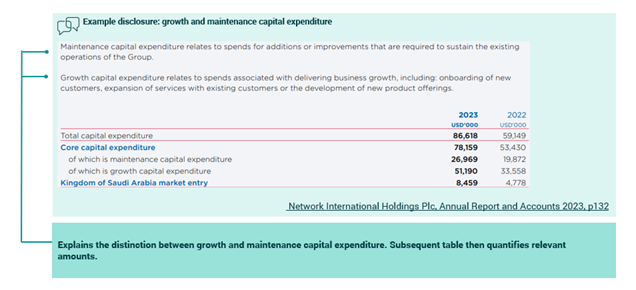
Explains the distinction between growth and maintenance capital expenditure. Subsequent table then quantifies relevant amounts.
C24. None of the companies in the sample disaggregated capital expenditure into growth and maintenance expenditure. Four companies in the sample partially addressed this matter by disaggregating asset additions made during the period (rather than the cash payments) or by making comments in the strategic report (but no corresponding disclosures in the financial statements were included). In one case, comments in the strategic report included references to maintenance capital expenditure but provided no information on growth capital expenditure.
Segmental cash flows
C25. As noted above, IAS 7 paragraph 50–51 encourage companies to disclose the amount of cash flows arising from the operating, investing and financing activities of each reportable segments. The disclosure of segmental cash flows enables users to obtain a better understanding of the relationship between the cash flows of the business as a whole and those of its component parts and the availability and variability of segmental cash flows. For example, different business segments may have differing cash generation and usage profiles or differing working capital absorption.
C26. Only a few companies. Disclosures in this regard were relatively uncommon in the sample, provided segmental disclosure of cash flows. Where provided, they were generally more detailed than the illustrative example in IAS 7 (Illustrative Example³ D), which presents only aggregate operating, investing, and financing cash flows for each operating segment. The extract below shows how one company provided the segmental cash flow information encouraged by the Standard.
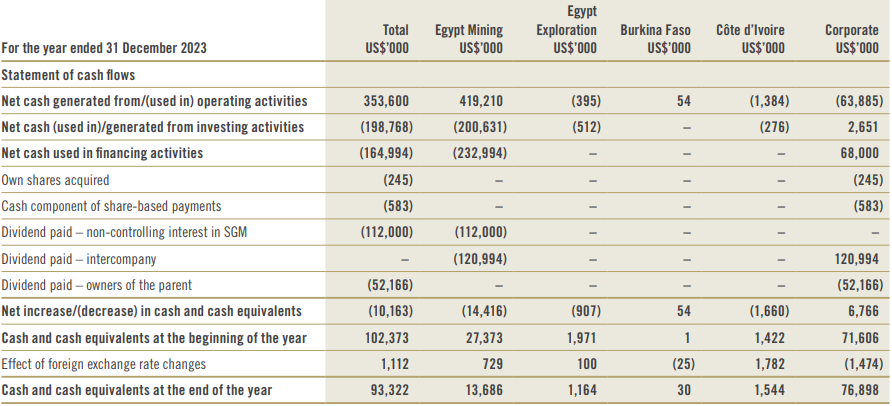
Entity presents summarized operating, investing and financing cash flows for each segment.
Corporate office cash flows, intercompany dividends and cash balances included to fully reconcile individual segment cash flow statements to the consolidated amounts.
C27. A few companies in the sample went further still. One company included full segmental cash flow information and additionally provided a separate column for exceptional and adjusting items.
Observations on non-mandatory cash flow disclosures
C28. It is striking how few UK listed companies provide the encouraged disclosures from IAS 7.
C29. Regarding the direct method, IAS 7 paragraph 19 encourages the direct method as it “provides information which may be useful in estimating future cash flows and which is not available under the indirect method”. It may be better if the Standard explicitly identified this information and required it to be disclosed in the financial statements when the indirect method is used.
C30. The virtual absence of information on segmental cash flows also seems anomalous. IFRS 8 Operating Segments paragraph 23 requires companies to report a measure of profit or loss for each reportable segment along with total assets and liabilities if this is regularly provided to the chief operating decision maker. The fact that segmental disclosure is not required for cash flow information, even if regularly provided to the chief operating decision maker, is notable.
C31. It will be important to consider the extent to which these disclosures are seen by users to be particularly relevant, and whether on this basis they should be required.
Voluntary cash flow disclosures provided by UK listed companies
C32. For the purposes of this paper ‘voluntary cash flow disclosures’ refer to cash flow-related information that UK companies include in the financial statements at their own discretion. Unlike the ‘non-mandatory cash flow disclosures’ described above, voluntary cash flow disclosures are not explicitly referenced or suggested in IAS 7 or other IFRS Accounting Standards.
Cash impact of exceptional or other adjusting items
C33. IFRS Accounting Standards do not explicitly refer to exceptional or other adjusting items. However, they are frequently included in the statement of profit or loss to communicate information intended to help users better understand the financial statements.
C34. Understanding the cash impact of non-recurring items is important to allow for a more realistic view of a company’s financial health and in making informed investment decisions. Understanding the nature of a non-recurring item and its cash flow impact is important in financial valuation. Generally, analysts adjust for non-recurring items. These one-time events can significantly distort a company’s reported profitability and/or cash flow, and if not adequately disclosed can lead to difficulty in accurately assessing a company’s true operating performance and future potential. Examples of such exceptional items might be:
- Selling a major asset at a significant gain or loss.
- Restructuring costs related to layoffs or major organisational changes.
- Legal settlements.
- Losses arising from natural disasters.
C35. IAS 7 does not explicitly require the disclosure of the cash impact of exceptional, one-off or infrequently recurring items. As noted, almost all UK listed companies use the indirect method for disclosing operating cash flows, by adjusting a profit measure as the starting point. If the starting point includes exceptional items, the cash impact of those exceptional items is not transparent, unless the full profit or loss impact is added back and then the cash impact separately disclosed, or otherwise explicitly disclosed in supporting commentary.
C36. The Basis for Conclusions to IFRS 18 paragraph BC93 notes that “an entity might disclose information about an aspect of its operating performance by presenting a management-defined performance measure of operating profit excluding expenses it regards as non-recurring or unusual”. No such requirement is set out in IFRS 18 in relation to ‘cash flows from operating activities’.
C32. For the purposes of this paper ‘voluntary cash flow disclosures' refer to cash flow-related information that UK companies include in the financial statements at their own discretion. Unlike the ‘non-mandatory cash flow disclosures' described above, voluntary cash flow disclosures are not explicitly referenced or suggested in IAS 7 or other IFRS Accounting Standards.
Cash impact of exceptional or other adjusting items
C33. IFRS Accounting Standards do not explicitly refer to exceptional or other adjusting items. However, they are frequently included in the statement of profit or loss to communicate information intended to help users better understand the financial statements.
C34. Understanding the cash impact of non-recurring items is important to allow for a more realistic view of a company's financial health and in making informed investment decisions. Understanding the nature of a non-recurring item and its cash flow impact is important in financial valuation. Generally, analysts adjust for non-recurring items. These one-time events can significantly distort a company's reported profitability and/or cash flow, and if not adequately disclosed can lead to difficulty in accurately assessing a company's true operating performance and future potential. Examples of such exceptional items might be:
- Selling a major asset at a significant gain or loss.
- Restructuring costs related to layoffs or major organisational changes.
- Legal settlements.
- Losses arising from natural disasters.
C35. IAS 7 does not explicitly require the disclosure of the cash impact of exceptional, one-off or infrequently recurring items. As noted, almost all UK listed companies use the indirect method for disclosing operating cash flows, by adjusting a profit measure as the starting point. If the starting point includes exceptional items, the cash impact of those exceptional items is not transparent, unless the full profit or loss impact is added back and then the cash impact separately disclosed, or otherwise explicitly disclosed in supporting commentary.
C36. The Basis for Conclusions to IFRS 18 paragraph BC93 notes that “an entity might disclose information about an aspect of its operating performance by presenting a management-defined performance measure of operating profit excluding expenses it regards as non-recurring or unusual”. No such requirement is set out in IFRS 18 in relation to 'cash flows from operating activities'.
C37. As illustrated in the example below, some UK listed companies, that include exceptional or other profit-related adjusting items, separately disclose their cash impact in the statement of cash flows.
C38. Disclosing the cash impact of exceptional items enhances consistency between cash flow disclosures and the statement of profit or loss disclosure requirements set out in IAS 1 Presentation of Financial Statements paragraphs 97–98. The UK Regulator FRC encourages companies to include this information.
Example disclosure: cash flow statement impacts of unusual or exceptional items
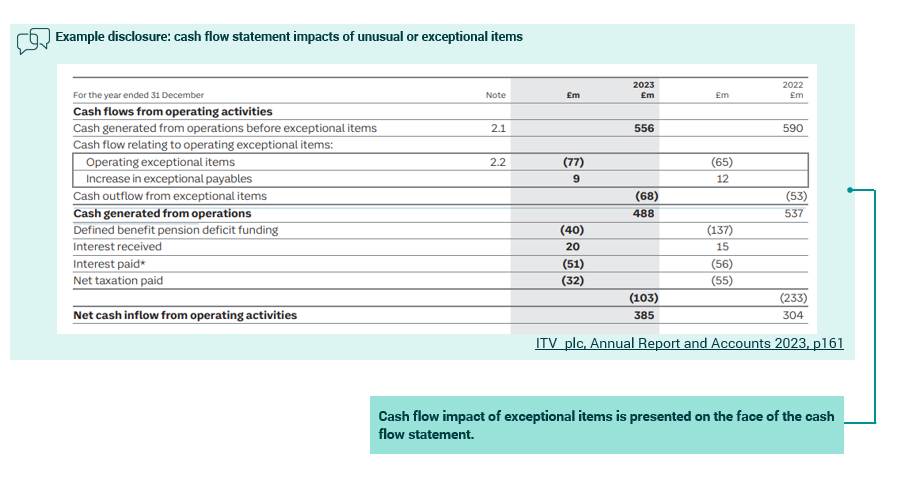
Cash flow impact of exceptional items is presented on the face of the cash flow statement.
C39. Most companies in the sample (23 companies) disclosed exceptional and other adjusting items in their statement of profit or loss. However, only seven of them disclosed cash flows relating to exceptional items either in their statement of cash flow or in a note to the financial statements.
C40. One such company, as shown in the extract below, demonstrates how the cash impact of exceptional and other adjusting items can be disaggregated by nature and by cash flow classification, clearly showing exceptional cash flows relating to operating, investing and financing activities.
Example disclosure: cash flow statement impacts of adjusting items across all cash flow categories
The table below shows the impact of adjusting items on the Group cash flow statement:
| Cash flows from operating activities | Cash flows from investing activities | Cash flows from financing activities | |||
|---|---|---|---|---|---|
| 52 weeks | 52 weeks | 52 weeks | 52 weeks | 52 weeks | |
| 2024 | 2023 (restated) | 2024 | 2023 | 2024 | |
| £m | £m | £m | £m | £m | |
| Property transactions^(b) | 53 | 335 | |||
| Disposal of subsidiaries^(c) | 15 | ||||
| Restructuring^(a) | (100) | (68) | |||
| Disposal of China associate | 9 | ||||
| Customer redress claims settlement in Tesco Bank | (4) | ||||
| ATM business rates refund | 5 | ||||
| Disposal of Asia operations | (2) | ||||
| Acquisition of property joint venture | 7 | (40) | |||
| Special dividend | (1) | ||||
| Total adjusting items from continuing operations | (100) | (69) | 84 | 295 | (1) |
| Adjusting items relating to discontinued operations | (1) | (8) | |||
| Total | (101) | (77) | 84 | 295 | (1) |
| (a) Comparatives have been restated to present Banking operations as a discontinued operation. Refer to Notes 1 and 7. | |||||
| (b) Property transactions include £14m proceeds (2023: £43m) relating to the sale of stores in Poland not included in the sale of the corporate business. | |||||
| (c) On 30 June 2023, the Group disposed of its Booker subsidiary Ritter-Courivaud Limited, part of the UK & ROI segment. | |||||
| (d) Cash outflows relating to operational restructuring changes as part of the multi-year ‘Save to Invest’ programme, which commenced in June 2022. |
Tesco PLC, Annual Report and Accounts 2024, p147
Reconciliation of amounts in the statement of cash flows to other primary statements
C41. Users often assess company performance holistically by considering the statement of cash flows alongside other primary financial statements, therefore cohesiveness between the primary financial statements is important.
C42. Being able to reconcile between the primary financial statements ensures that the information presented is accurate, reliable and provides transparency for users. This would be expected to enhance decision-making by users. For example, by comparing the cash generated from operations to operating profit, users can assess the quality of earnings and understand how well the company is managing its working capital.
C43. Thematic review reports published by the FRC note that reconciliations between the statement of cash flows and other primary financial statements are useful for understanding relationships between the different statements27. These reconciliations are especially helpful for understanding the impact of non-cash movements, such as exchange differences, fair value movements and acquisitions or disposals, on changes in working capital.
C44. IAS 7 paragraph 45 requires a company to present a reconciliation of the cash and cash equivalent amounts in its statement of cash flows with equivalent items reported in the statement of financial position.
C45. The only other relevant paragraph is IAS 7 paragraph 44D, which explains that if a company chooses to use a reconciliation of opening and closing balances in the statement of financial position for liabilities arising from financing activities (including both changes arising from cash flows and non-cash changes), the company shall provide sufficient information to enable users of the financial statements to link items included in the reconciliation to the statement of financial position and the statement of cash flows.
C46. With regard to reconciling the statement of cash flows to the statement of profit or loss, there are no specific requirements. However, where a company uses the indirect method for disclosing cash flows from operating activities, a reconciliation to the statement of profit or loss is implicit. Where the indirect method is used, adjustments to the starting profit figure, made by adding back non-cash items, provides an opportunity to reconcile items to the statement of financial position, where the notes have enough granularity to show increases and decreases in the balances that are the result of non-cash transactions.
C47. Some UK listed companies voluntarily provide reconciliations to clarify how working capital movements in the statement of cash flows relate to amounts in the statement of financial position (see example below).
Example disclosure: reconciliation of working capital movements in the cash flow statement to the balance sheet
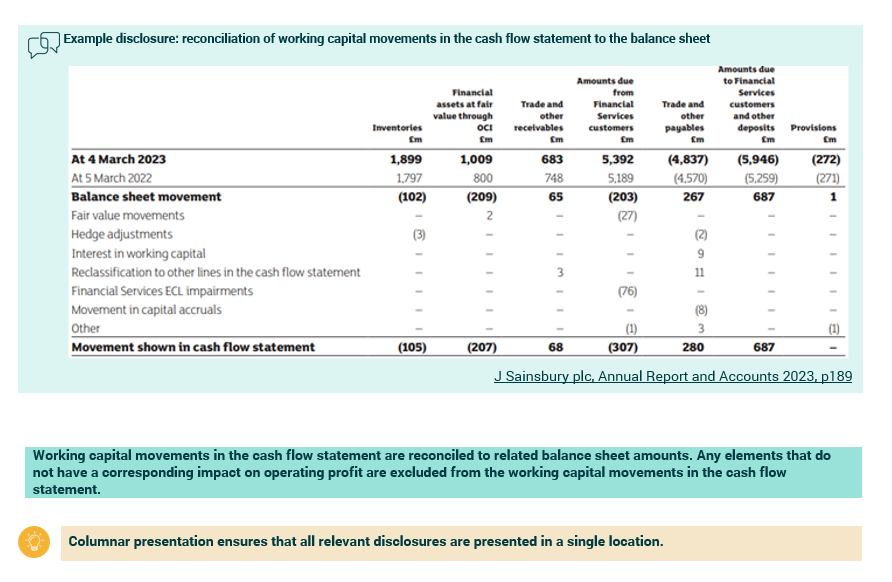
Working capital movements in the cash flow statement are reconciled to related balance sheet amounts. Any elements that do not have a corresponding impact on operating profit are excluded from the working capital movements in the cash flow statement.
Columnar presentation ensures that all relevant disclosures are presented in a single location.
C48. One company in the sample included a reconciliation similar to the one noted above. Other voluntary disclosures of a similar type included:
- A reconciliation between tax payments in the statement of cash flows and tax charges recognised in the statement of profit or loss and statement of financial position (provided by two companies in the sample):
Example disclosure: reconciliation of tax payments to other primary statements
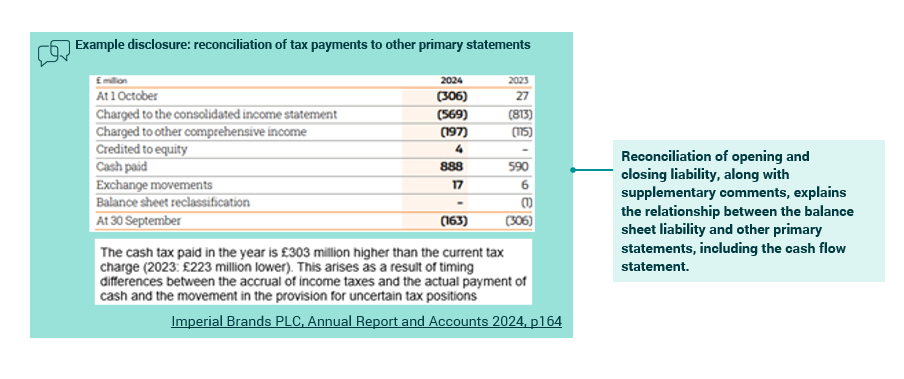 Reconciliation of opening and closing liability, along with supplementary comments, explains the relationship between the balance sheet liability and other primary statements, including the cash flow statement.
- A reconciliation explaining differences between capital expenditure payments and additions to property, plant, and equipment (provided by three companies in the sample):
Example disclosure: reconciliation of capex cash flows to asset additions
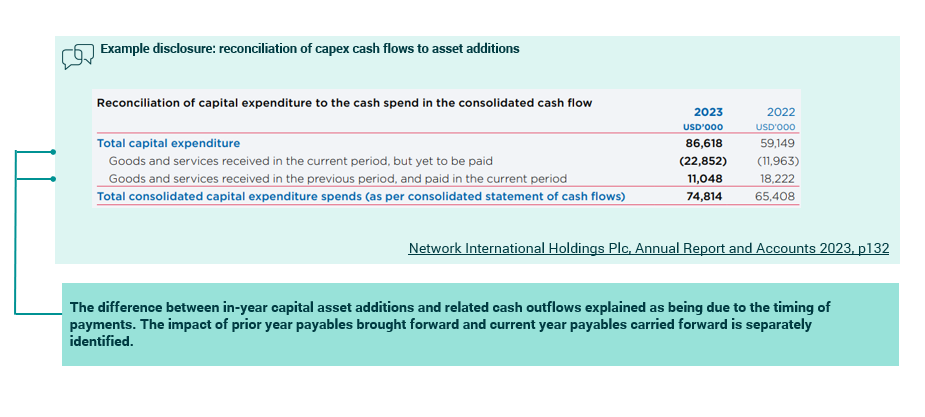 The difference between in-year capital asset additions and related cash outflows explained as being due to the timing of payments. The impact of prior year payables brought forward and current year payables carried forward is separately identified.
C49. More generally, the research highlighted that very few companies in the sample (all of which applied the indirect method), provide cross references from their statement of cash flows to relevant notes in their financial statements. This made it challenging to clearly understand the relationship between the statement of cash flows and other sections of the financial statements.
Derivatives cash flows
C50. IAS 7 paragraph 16 states that where a contract is accounted for as a hedge, its cash flows should be classified in the same manner as the hedged item. It does not, however, specify whether such cash flows should be separately identifiable. In addition, the Standard does not provide guidance on economic hedges or derivatives where hedge accounting is not applied.
C51. Understanding the cash flows from derivatives help users evaluate the potential financial impact of a derivative strategy, considering factors like the timing and amount of future payments, which is crucial for deciding whether to enter into a derivative position. The cash flows may also help users to assess whether there is sufficient liquidity to meet future obligations arising from derivative contracts.
C52. Our research highlighted that UK listed companies typically provide limited information on the cash effects of derivatives in the statement of cash flows.
C53. Some UK listed companies provide transparency by describing their accounting policies for classification of derivative cash flows – see example below.
Example disclosure: accounting policy for derivative cashflows

C54. A review of the sample identified the following:
- No companies voluntarily provided an accounting policy, explaining the classification of derivative cash flows in circumstances where hedge accounting is applied and those where hedge accounting is not applied.
- It was apparent, from disclosures provided in other sections of the financial statements, that many the companies in the sample had hedges relating to operating activities; however, none disclosed the impact of those derivatives in the operating activities section of the statement of cash flows.
- Seven companies disclosed derivative cash flows relating to investing and financing activities on the face of the statement of cash flows, as illustrated in the example below.
Example disclosure: gross derivative cash flows on the face of the statement of cash flows
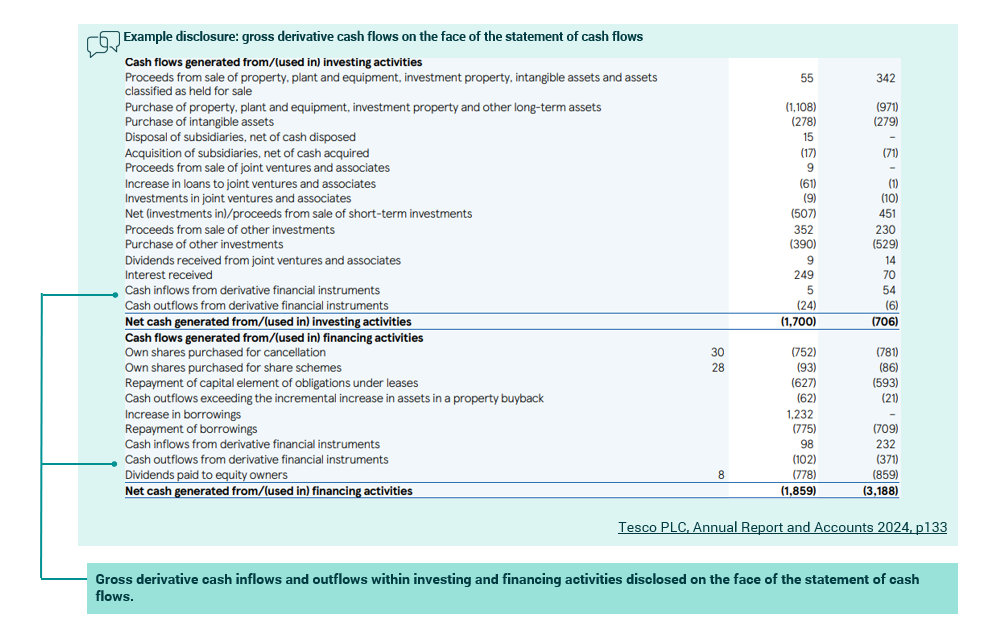 Gross derivative cash inflows and outflows within investing and financing activities disclosed on the face of the statement of cash flows.
Aggregate cash impact of M&A transactions
C55. Reporting the aggregate cash and non-cash impact of merger and acquisition (M&A) activities in a single note in the financial statements is useful as such transactions may be reported in different sections of the statement of cash flows. For example, the cash balance of a new subsidiary is reported as a cash inflow when first consolidated, the acquisition may be paid for in cash or by the issue of equity and there may be a deferred or contingent consideration element. Such cash flows should be disclosed within investing activities (as required by IAS 7 paragraph 39). There may also be cash flows for related acquisition costs which should be disclosed within cash flows from operating activities (as required by IAS 7 paragraph 14).
C56. Some transactions that result in a zero cash flow in fact comprise two offsetting 'effective' flows which, had they been transacted separately, would each have appeared in the statement of cash flows. Whether the purchase is a single transaction, or a separate equity issue followed by a cash purchase, does not affect the underlying economics, but does produce very different disclosures in the statement of cash flows. This applies to several situations in addition to business combinations, including leasing and supplier finance arrangements. Considering just cash flows reported in the statement of cash flows can lead to analyst metrics, such as free cash flow, which are incomplete and unsuitable for use in equity valuation.
C57. Issues may arise due to inherent tensions between the IFRS Accounting Standard requirements and companies' desire to present the aggregate cash impact of M&A transactions.
C58. One company in the sample addressed this challenge by:
- classifying acquisition-related expenses within operating activities (as required by IAS 7 paragraph 14) and net cash flows from the settlement of acquisition consideration within investing activities (as required by IAS 7 paragraph 39); and
- voluntarily providing a table in the notes to consolidate the aggregate cash impact of the various elements, even though they were included in different notes to the statement of cash flows (see extract below).
C59. The sample identified only three other companies whose reports included broadly similar disclosures, despite there being 16 companies in the sample that disclosed acquisitions during the year.
Example disclosure: aggregate impact of M&A transactions on cash flow
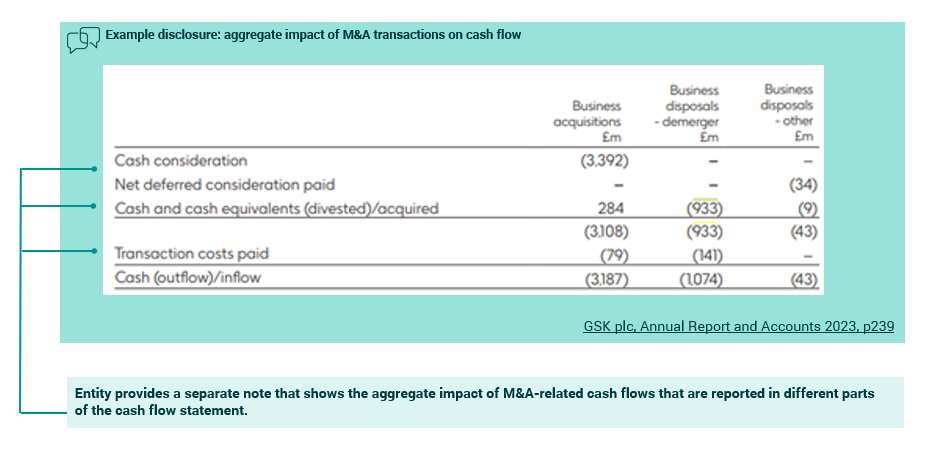
Entity provides a separate note that shows the aggregate impact of M&A-related cash flows that are reported in different parts of the cash flow statement.
C60. Users also need cash flow information about an acquired entity to accurately assess its ability to generate cash for future operations, and to evaluate the impact of an acquisition on the acquiring company's liquidity.
Observations on voluntary cash flow disclosures
C61. UK listed companies provide a range of voluntary disclosures, but the sample did not identify any that are consistently provided.
C62. The absence of cross referencing in the statement of cash flows to notes in the financial statements was surprising. There is often relevant information in various notes distributed across the financial statements (for example in the leases note, the reconciliation of financing liabilities and the provisions note). However few companies provide references to these notes for relevant cash flows. There would appear to be an opportunity to enhance the cohesiveness of the financial statements and enhance user understanding.
C63. Despite the UK Regulator specifically identifying information on the cash impact of exceptional or other adjusting items as an area in which they would like to see better disclosure, such information is not widely reported by companies in the sample.
C64. The fact that UK listed companies are voluntarily providing additional cash flow and related disclosures indicates that they believe they provide useful information to users. It will be important to explore these areas further with users as they provide an opportunity to leverage existing practice and identify potential improvements to disclosure requirements.
Other areas of cash flow reporting
C65. This section analyses areas where companies may need to exercise judgement when determining or disclosing cash flow amounts and related balances. These represent aspects of cash flow reporting where there is a high potential for diverse approaches being adopted by companies.
C66. Users understand cash and cash equivalents to be readily available funds for day-to-day operations and therefore provide an indication of its ability to pay short-term debts, that is its liquidity. In this context, it is important that amounts that companies include in cash equivalents reflect their cash management strategy.
Composition of cash and cash equivalents
C67. IAS 7 paragraph 46 requires companies to disclose their accounting policy for determining the composition of cash and cash equivalents. The FRC's thematic review on cash flow and liquidity disclosures27, emphasised the importance of:
- Providing sufficiently detailed accounting policies that clearly define the items included in cash and cash equivalents.
- Explaining the rationale for including overdrafts within cash and cash equivalents, if applicable.
- Providing information about restricted cash balances and the nature of the restrictions.
C68. The following sub-sections analyse disclosure practices observed in each of these areas during the research.
Composition of cash and cash equivalents
C69. IAS 7 paragraph 6 describes cash equivalents as “investments” that have three distinguishing features: short maturities, high liquidity and are subject to an insignificant risk of changes in value.
C70. Most companies in the sample included passing references to one or more of these features in their accounting policies. However, apart from “short-term maturity" (which was generally interpreted as referring to balances with an original maturity of three months or less), none of the companies provided company-specific interpretations of the other terms.
Restricted balances
C71. IAS 7 paragraph 48 sets a high-level disclosure requirement for restricted cash balances, requiring companies to disclose significant restricted balances and provide commentary. As a result, companies have to exercise judgement in determining the level of detail to include in their disclosures.
C72. The extract below provides an example of a company which:
- described the nature of the restricted balances and the associated restrictions; and
- explained the accounting implications – in this case, that the restrictions meant that the balances should not be included in cash and cash equivalents.
Example disclosure: restricted balances
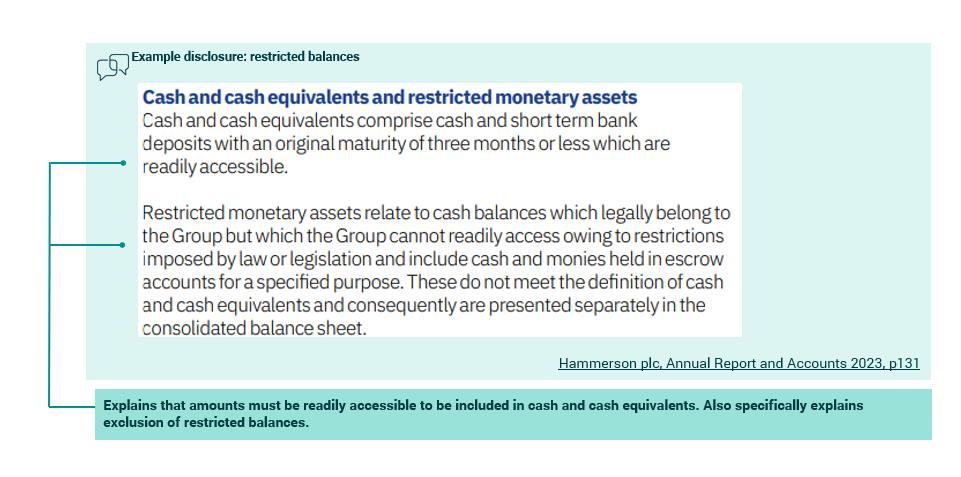
Explains that amounts must be readily accessible to be included in cash and cash equivalents. Also specifically explains exclusion of restricted balances.
C73. Disclosure of restricted balances was relevant to 12 of the 30 companies in the sample. However, for all but one, the accounting policies and related disclosures lacked sufficient detail to clearly explain the nature of the restrictions. In particular, companies did not explain their conclusion that the restrictions were not severe enough to impact their inclusion in cash and cash equivalents.
C74. In the companies sampled, the value of restricted cash ranged from £1m to £530m. On average, these balances represented 5% of the relevant companies' total cash balances and 1% of their net assets.
Bank overdrafts
C75. IFRS Accounting Standards apply different criteria for offsetting bank overdrafts against cash and cash equivalents, depending on whether they relate to the statement of financial position or the statement of cash flows. As a result, companies may be able to offset overdrafts in the statement of cash flows but not in the statement of financial position.
- In the statement of financial position, overdrafts can only be offset if the two offsetting criteria in IAS 32 Financial Instruments: Presentation paragraph 42 are satisfied.
- In the statement of cash flows IAS 7 paragraph 8 states that bank overdrafts repayable on demand and forming an integral part of cash management should be included in cash and cash equivalents. A key characteristic of such arrangements is that those bank balances frequently fluctuate between positive and overdrawn.
C76. The disclosure example below illustrates the key points:
Example disclosure: overdrafts
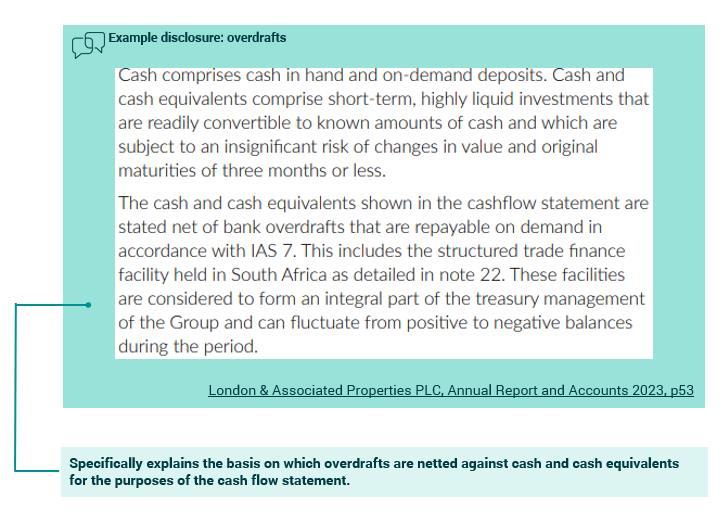
Specifically explains the basis on which overdrafts are netted against cash and cash equivalents for the purposes of the cash flow statement.
C77. In the sample, 16 companies (or 60%) had offset bank overdrafts against cash and cash equivalents for the purposes of the statement of cash flows but not the statement of financial position. However, only three of them explained the rationale for including overdrafts within cash and cash equivalents (for example, by explaining whether they were integral to cash management or by explaining that the relevant balances frequently fluctuate between negative and positive balances).
Alternative Performance Measures (APMs) in cash flow reporting
C78. In our previous research paper provided to the Board in December 2024, we noted that free cash flow and net debt were two of the most common cash flow alternative performance measures (APMs) among UK companies.
C79. Whilst users often calculate their own free cash flow measures, using information disclosed in the statement of cash flows and elsewhere in the financial statements, users often rely more heavily upon the information provided for net debt.
C80. The following sub-sections explore UK reporting practices in relation to these measures.
Reporting practices for free cash flow
C81. Free cash flow plays an essential role in valuation and is one of the most important ways to measure a company's financial performance, as it demonstrates the cash flow a company can potentially distribute i.e. return dividends to investors or buy back shares, after making reinvestments in the business via capital expenditure and working capital.
C82. Free cash flow can be defined and calculated in many ways. However, in its most generic form, free cash flow is calculated as cash from operations minus capital expenditure.
C83. UK reporting practices for free cash flow vary in several ways, including differences in terminology and calculation methods. The extract below illustrates how one company calculates free cash flow.
Example disclosure: free cash flow
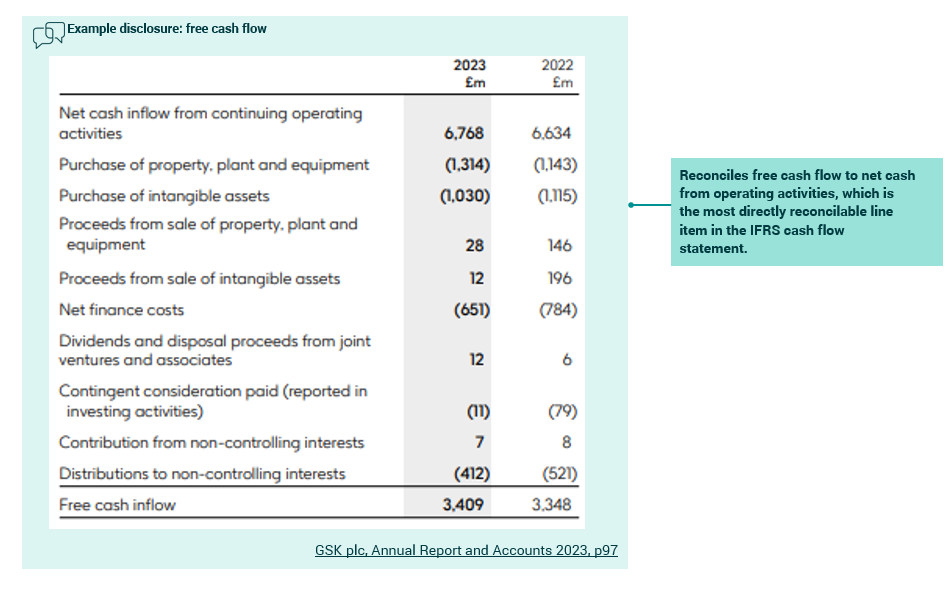
Reconciles free cash flow to net cash from operating activities, which is the most directly reconcilable line item in the IFRS cash flow statement.
C84. Of the sample, 16 companies presented a free cash flow measure in the annual report. There was an almost equal split between including free cash flow in their financial statements and including the measure in their strategic report.
C85. Nearly all the companies in the sample that presented free cash flow used net cash flow from operating activities as the starting point for their calculations. The precise composition of the starting point was, however, not identical.
C86. In eight cases net cash flow from operating activities was after net interest payments, whilst in six cases it was before net interest payments; the difference reflects the choice currently available in IAS 7 paragraph 31 in relation to whether companies present interest receipts and payments in operating, investing or financing activities28. The six UK companies in the latter category, separately adjusted for net interest payments in their free cash flow calculations.
C87. The most common adjustments made in free cash flow calculations were for capital expenditure (adjusted by all 16 companies in the sample that presented free cash flow) and the capital element of lease payments (adjusted by 13 companies).
C88. There were also other variations: some companies adjusted for cash flows relating to M&A transactions (four companies in the sample), proceeds from asset disposals (three companies) and exceptional cash flows (two companies).
Reporting practices for net debt
C89. Net debt is a financial liquidity metric that is used to determine how well a company can pay all its debts if they come due immediately, and whether the company is able to take on more debt. It measures a company's current interest-bearing debt on its statement of financial position compared to its liquid assets i.e. cash and cash equivalents. It shows how much cash would remain if all debts were paid off, and if a company has sufficient liquidity to meet its debt obligations. Net debt is commonly used in valuation.
C90. IAS 7 paragraph 44A requires companies to disclose information about changes in financing liabilities. The subsequent paragraphs explain, amongst other matters, that this information may be presented in the form of a reconciliation of the opening and closing balances of liabilities arising from financing activities29 (IAS 7 paragraph 44D).
C91. IAS 7 paragraph 44E explains that the information may be combined with disclosures of changes in other assets and liabilities. Most UK companies do this by presenting a net debt reconciliation.
C92. The extract below illustrates one company's approach to presenting its net debt reconciliation. This includes a cash column that reconciles to the statement of cash flows.
Example disclosure: net debt reconciliation
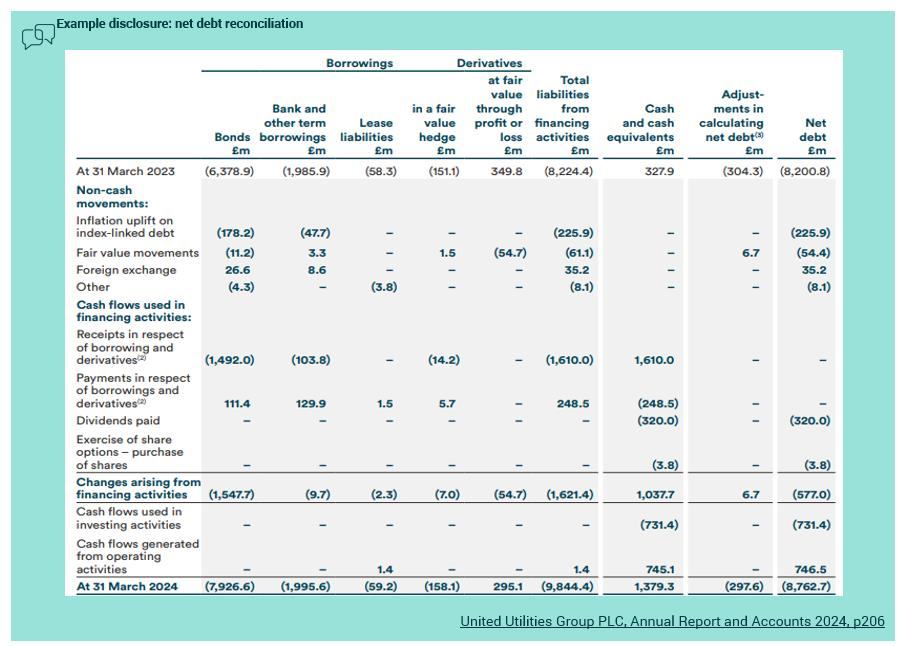
C93Another company provided an alternative format to demonstrate the interaction between free cash flow and the increase in net debt (see below).
Example disclosure: interaction between free cash flow and net debt movements
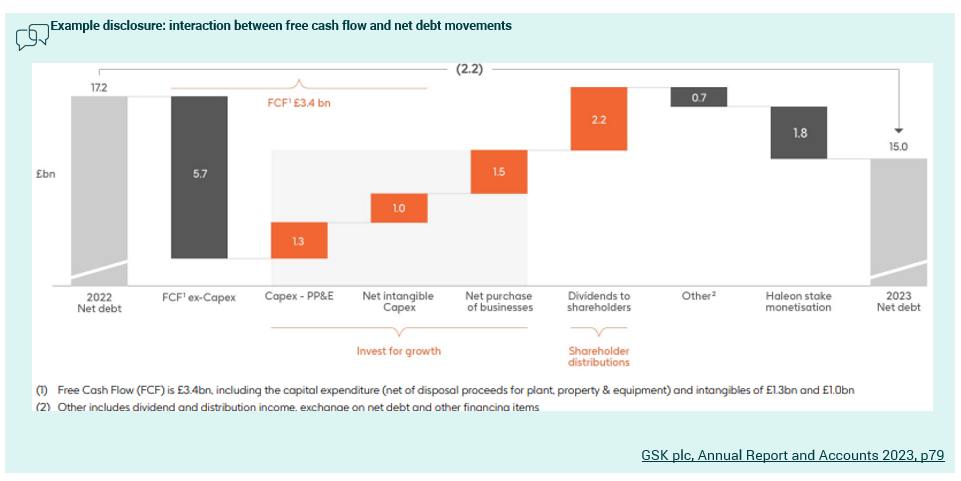
(1) Free Cash Flow (FCF) is £3.4bn, including the capital expenditure (net of disposal proceeds for plant, property & equipment) and intangibles of £1.3bn and £1.0bn (2) Other includes dividend and distribution income. exchange on net debt and other financina items
GSK plc, Annual Report and Accounts 2023, p79
C94In the sample, most companies reported a net debt measure. Almost all of them included net debt in their financial statements. The banking and insurance companies in the sample however did not disclose net debt.
C95As with free cash flow, calculation methods varied, primarily depending on whether companies in the sample included or excluded from their net debt calculations:
- Leases.
- Investments.
- Debt-related derivatives.
- Other derivatives not related to debt.
- Other investments not classified as cash equivalents.
Therefore, there may be an opportunity for the IASB to determine and specify the most relevant basis for net debt, and require a company to reconcile to that specified net debt any alternative net debt calculation (alternative performance measure) it presents in its financial statements.
Observations on other areas of cash flow reporting
C96Most companies in the sample provide a net debt reconciliation. On one level this is not surprising, since as providing a reconciliation between the opening and closing balances in the statement of financial position for liabilities arising from financing activities, it is suggested in IAS 7 paragraph 44D as one way a company can meet the requirements of IAS 7 paragraph 44A, to disclose information about changes in financing liabilities. Given the relevance and its prevalence in the UK of a net debt reconciliation, there may be an opportunity to incorporate it into the cash flow reporting requirements, to provide more cohesiveness between the statement of financial position and the statement of cash flows.
C97The disclosures on cash equivalents continue to be boilerplate in most instances with the IAS 7 paragraph 7 reference to short term maturity being "say, three months or less” being interpreted as a de facto rule.
C98Free cash flow was disclosed by many companies in the sample. While it was variously defined entities tended to provide a clear reconciliation to the statement of cash flows.
Concluding Observations
C99The purpose of this paper is to inform the Board about the nature and prevalence of non-mandatory and voluntary cash flow disclosures currently reported in UK listed companies' financial statements.
C100Analysing current practice by UK listed companies has identified a number of possible enhancements to the reporting on cash flows and related matters. This includes "encouraged” disclosures that are rarely provided and voluntary disclosures that are more widely observed.
C101This research provides evidence that can inform future Board discussions on the Statement of Cash Flows and Related Matters project.
C102The Board's feedback, along with relevant findings from this paper, will inform the remaining interviews to further assess the extent to which the voluntary disclosures reflect users' needs and expectations. The findings from this assessment will, where relevant, also be reflected in the research paper to be submitted expected to be discussed at the March 2025 Board meeting.
Appendix D: Statement of Cash Flows and Related Matters: UK User and Preparer Perspectives
- Executive Summary
- Summary of the Issue
- Decisions for the Board
- Recommendation
- Appendices
- Background: Statement of Cash Flows and Related Matters
- Summary Research Paper - Statement of Cash Flows: UKEB research findings
- Questions for the Board
- Next Steps
- Appendix A: Statement Of Cash Flows Initial UKEB Research Findings
- UKEB Report 1: Background and Key issues
- UKEB Report 2: Non-mandatory and Voluntary Cash Flow Disclosures Provided by UK Listed Companies
- UKEB Report 3: UK User and Preparer perspectives
- UKEB User Poll: A survey of users' views
- Conclusions and next steps
- Appendix B: Statement of Cash Flows and Related Matters: Background and key issues
- UKEB research into the Statement of Cash Flows and Related Matters
- Background
- Conceptual Framework for Financial Reporting
- Concerns with IAS 7
- The importance of cash flow reporting for users of financial statements
- Why is cash flow important?
- UK perspective
- Alternatives to the statement of cash flows
- Key issues identified
- Classification of cash flows
- What's the issue?
- Recent changes to IAS 7 on issuing IFRS 18
- Stakeholder views
- UK perspective
- Disaggregation of cash flow information
- What's the issue?
- Stakeholder views
- Related changes to IAS 7 on issuing IFRS 18
- UK perspective
- Definition of cash and cash equivalents
- What's the issue?
- Stakeholder views
- UK perspective
- Reporting cash flows from 'operating' activities – direct vs. indirect method
- What's the issue?
- Stakeholder views
- UK perspective
- Effects of non-cash transactions
- What's the issue?
- Recent changes to IAS 7
- Stakeholder views
- Net Debt Reconciliation / Statement of changes in Net Debt
- UK perspective
- Cash flow measures and other disclosures
- Statement of Cash Flows for financial institutions
- Next Steps
- Annex I: Glossary
- Annex I: Glossary
- Annex 2: The IFRS Interpretations Committee Agenda decisions
- Annex 3: Bibliography
- Appendix C: Non-mandatory and Voluntary Cash Flow Disclosures Provided by UK Listed Companies
- Contents
- Background
- Purpose of research paper
- Review process and methodology
- Non-mandatory cash flow disclosures provided by UK listed companies
- Presentation of cash flows from operating activities
- Application of the indirect method
- Growth and maintenance expenditure
- Segmental cash flows
- Observations on non-mandatory cash flow disclosures
- Voluntary cash flow disclosures provided by UK listed companies
- Cash impact of exceptional or other adjusting items
- Cash impact of exceptional or other adjusting items
- Reconciliation of amounts in the statement of cash flows to other primary statements
- Observations on voluntary cash flow disclosures
- Other areas of cash flow reporting
- Appendix D: Statement of Cash Flows and Related Matters: UK User and Preparer Perspectives
- Background
- Key messages
- Usefulness of the Statement of Cash Flows for non-financial institutions
- Direct versus indirect method for operating cash flows
- Classification of cash flows
- Tax
- Disaggregation of information
- Growth versus maintenance cash flows
- Segmental cash flows
- Accessibility of information
- Suggestions for improving the usefulness of the statement of cash flows
- Cohesiveness between the primary financial statements
- Importance of non-cash information
- Non-cash operating activities
- Non-cash investing and financing activities
- Effective offsetting cash flows
- Suggestions for improving the disclosure of non-cash information
- Importance of non-GAAP measures
- Net debt
- Alignment with IFRS 18
- Suggestions for improving disclosure of important non-GAAP measures
- Interconnectivity with other IFRS Accounting Standards
- Suggestions for improving the interconnectivity with other IFRS
- Challenges for preparers
- Usefulness of the statement of cash flows for Financial Institutions
- Suggestions to improve usefulness of information provided for some financial institutions
- Concluding Observations
- Appendix D: Concluding Observations
- Appendix E: Statement of Cash Flows and Related Matters: A survey of users' views
- Background
- Purpose of User survey
- Chart 1: Demographic of respondents
- Usefulness of the Statement of Cash Flows
- Q1. How important to you is each of the three primary financial statements?
- Chart 2: Importance of Primary financial statements
- Q2. Please say why you consider the statement of cash flows is more or less important than, or equally important as, the other primary financial statements.
- Q3. What do you use the cash flow statement for (13 options provided)?
- Chart 3: Uses of the statement of cash flows
- Q4. Do you have any other uses for the statement of cash flows? If yes, please state what you use it for and why this is important?
- Q5. Are there any sectors for which the statement of cash flows is not relevant?
- Q6. Relative to the Statement of Cash Flows, are the following cash flow measures (net debt and free cash flow) useful?
- Chart 4: Usefulness of other cash flow measures
- Q7. Are there any other cash flow measures that are useful? If no, write "No". If yes, please say which cash flow measure is useful, how it is defined, and why it is useful.
- Q8. Do you have any additional comments or feedback on the usefulness of the Statement of Cash Flows?
- Improvements to the Statement of Cash Flows
- Q9. Please rate how useful the following disclosures listed below might be, if companies were required to provide them. Note: Some disclosures below are encouraged but not mandatory, whilst other disclosures may already be provided voluntarily by some companies.
- Statement of Cash Flows for financial institutions
- Concluding comments
- Appendix F: Project Initiation Plan (updated May 2025) Statement of Cash Flows and Related Matters
- Project Initiation Plan: Statement of Cash Flows and Related Matters - Project timeline
Background
Purpose of research paper
D1This paper is the third in a series of research papers as part of the UKEB's proactive research project on the Statement of Cash Flows and Related Matters.
D2The paper builds on the two previous papers:
- Statement of Cash Flows and Related Matters: Background and key issues, presented to the Board in December 2024 – based on desk-top research. This paper provided background on IAS 7 Statement of Cash Flows, and perceived issues concerning cash flow reporting identified by the IASB and others (including the UK's Financial Reporting Council (FRC)); and
- Statement of Cash Flows and Related Matters: Non-mandatory and Voluntary Cash Flow Disclosures Provided by UK Listed companies, presented to the Board in February 2025 – based on a sample review of financial statements. This paper highlighted cash flow related disclosures that UK listed companies include in their financial statements beyond the requirements of IAS 7 and other IFRS Accounting Standards.
D3This third paper is based on interviews with UK preparers and UK users30 of financial statements and sets out their perspectives on the perceived issues with the reporting of cash flows identified in the first research paper. It includes the key messages received during those interviews that the IASB could consider when making any changes to cash flow reporting requirements.
D4In addition, it provides UK preparers' and users' suggestions on how to resolve some of the identified issues. Resolving these issues would improve the quality of cash and non-cash information by enhancing transparency for users and assist them in their decision-making.
D5The UK preparers' and users' views described in this paper do not necessarily represent UKEB opinions regarding the issues identified, or the relevance or desirability of suggested improvements.
Stakeholder interviews
D6This phase of the research comprised one-to-one interviews with 24 stakeholders (12 users and 12 preparers of financial statements), between December 2024 and the March 2025. Participants comprised a broad range of users and preparers from a number of different industry sectors, including financial institutions.
D7The tables below show the ownership type and industry sector of the preparers that participated in the interviews:
| Preparer by type | ||
|---|---|---|
| FTSE 100 | 8 | 67% |
| FTSE 250 | 1 | 8% |
| Unlisted IFRS Preparers | 3 | 25% |
| TOTAL | 12 | 100% |
| Preparer by sector | ||
|---|---|---|
| Basic Resources, Industrial Goods & Technology | 3 | 25% |
| Energy & Utilities | 2 | 17% |
| Health Care, Travel & Leisure | 2 | 17% |
| Financial Institutions - Insurance | 2 | 17% |
| Financial Institutions - Banks | 1 | 8% |
| Financial Institutions - Other | 1 | 8% |
| Food, Beverage and Tobacco | 1 | 8% |
| TOTAL | 12 | 100% |
D8The table below summarises the categories of the users that participated in the interviews.
| Users by category | ||
|---|---|---|
| Analysts / Researchers (Equity, Fixed Income) | 4 | 33% |
| Professional Body/Representative group members | 3 | 25% |
| Credit Rating Agencies | 2 | 17% |
| Institutional Investors | 2 | 17% |
| Creditors/Lenders | 1 | 8% |
| TOTAL | 12 | 100% |
D9In this paper, the following terms are used to give a broad indication of prevalence of the comments raised31:
| Term used | Extent of response among interviewees |
|---|---|
| Almost all | All except a small minority |
| Most | A large majority |
| Many | A small majority or large minority |
| Some | A small minority |
| A few | A very small minority |
D10The interviews were semi-structured with specific questions on the usefulness of the statement of cash flows, their experiences with the perceived deficiencies and challenges (as identified by the IASB), further issues identified by interviewees, how issues could be resolved, and the priority that should be given to resolving the issues from a UK perspective.
D11Interviewees were also asked whether the IASB's project should:
- focus on targeted improvements;
- carry out a fundamental review of the cash flow reporting requirements in IAS 7 and other IFRS Accounting Standards; or
- undertake a phased approach (comprising short term targeted improvements and a longer-term fundamental review of cash flow reporting requirements).
D12In addition to the interviews, feedback was sought from both the UKEB Investor Advisory Group (in November 2024 and February 2025)32, and the UKEB Preparer Advisory Group (in October 2024 and March 2025)33. Advisory Group members were consulted on the IASB perceived issues in the first of the meetings. During the latter meetings, preparers were asked to comment on the feedback received from investors, and investors were asked to comment on the feedback received from preparers.
Key messages
D13This paper makes no recommendations. However, some high-level observations include:
- The statement of cash flows is useful for users of financial statements for non-financial institutions, although the use of the statement varies.
- Users do not prefer the 'direct' method of presenting the operating cash flows, despite its encouragement in IAS 7. UK preparers said they are not asked for any information that would be provided if the direct method was presented, and are not keen to change their current disclosures under the 'indirect' method, being and are concerned with the potential cost implications of any changes.
- Users suggest that qualitative disclosure, through commentary on the statement of cash flows, including a company's own assessment of its liquidity, would enhance its usefulness.
- Users would like to see more cohesiveness between the statement of cash flows and the other primary financial statements, and any improvements should aim to enhance this.
- It is important for users to have transparent information and sufficient disaggregation about material items, including non-recurring or infrequently recurring items, such as merger and acquisitions (M&A), disposals, discontinued operations. However, disaggregation of growth and maintenance expenditure, as encouraged by IAS 7 is not a priority for users and preparers would find it challenging.
- Non-cash information is very important to users (including both transactions that have the same economic benefit as cash transactions, such as leases, and the impact of unrealised gains or losses, changes in fair value and foreign exchange (FX) movements). This information needs to be more transparent and connected. It is often scattered throughout the financial statements, so it would be useful to have a single location where the information is referenced in order to improve accessibility.
- Non-GAAP measures, in particular net debt, are important disclosures for investors and other users.
- Most interviewees agree that it would be useful if the IASB provides a definition for net debt. Some suggest that the net debt information could be elevated to the primary financial statements and integrated into the statement of cash flows, due to the importance of net debt in determining a company's liquidity.
- Whilst free cash flow is a useful metric, it is more important for users to have transparent information to prepare their own free cash flow metrics, than a standardised definition or a mandated free cash flow disclosure.
- There are cross-cutting issues relating to the lack of explicit disclosure requirements in IAS 7 and other IFRS Accounting Standards. In particular, most preparers suggest that inconsistencies with IFRS 18 Presentation and Disclosure in Financial Statements need to be addressed.
- Preparers would find more guidance and illustrative examples useful on some aspects of the requirements, including cash and cash equivalents, classification of cash flows and offsetting/netting. Whilst providing more guidance, as suggested by preparers, would also reduce diversity in application of the requirements in IAS 7, identifying why the application difficulties arise and making suitable revisions to the main text of the standard may be a better solution.
- Field-testing should be carried out for any proposed changes to ensure that the benefit to users exceeds any cost burden on preparers. Preparers are concerned about the incremental cost of applying any changes to the requirements; the application of the current requirements are already costly given that for most companies the preparation of the statement of cash flows is not automated.
- The statement of cash flows for banks and insurers provides little to no incremental value to users. Non-GAAP measures and regulatory information are perceived to be more relevant and comparable.
- Usefulness of the statement of cash flows for non-financial institutions (paragraphs D16-D72).
- Cohesiveness between the primary financial statements (paragraphs D73-D78).
- Importance of non-cash information (paragraphs D79-D110).
- Importance of non-GAAP measures (paragraphs D111-D139).
- Interconnectivity with other IFRS Accounting Standards (paragraphs D140-D145).
- Challenges for preparers (paragraphs D146-D169).
- Usefulness of the statement of cash flows for financial institutions (paragraphs D170-D178).
- Concluding observations (paragraphs D179-D183).
D15Whilst the IASB identified seven areas of perceived deficiencies in the requirements of IAS 7, as covered in the first research paper, this research paper is based on the key messages received during the UKEB outreach. (The outreach approach is explained in paragraphs D6–D12 of this paper).
Usefulness of the Statement of Cash Flows for non-financial institutions
D16The first research paper Statement of Cash Flow and Related Matters: Background and key issues described the usefulness of the statement of cash flows, as set out in IAS 734.
D17Interviews confirmed that, for most UK stakeholders, the statement of cash flows is useful, however the extent to which they consider it useful varies. Some users stated that the statement of cash flows is not useful, whilst others went so far as stating that the statement of cash flows it is the most important primary financial statement.
D18Users explained that they use it for a variety of reasons, including to validate information in the other primary financial statements, to assess a company' ability to generate future cash flows, and to assess a company's ability to distribute cash to investors through dividends or share buybacks.
D19One credit rating agency noted that several financial ratios used to assess credit quality are based on the statement of cash flows, including ‘funds from operations’35. They also noted, however, that “there could be more disclosures and disaggregation of key information” to allow them to undertake their own additional analyses.
“The statement of cash flows is more important than the statement of profit and loss". Credit-rating agency
D20A perceived impediment to the usefulness of the statement of cash flow identified by almost all users was the lack of commentary provided by companies, despite IAS 7 paragraph 50 suggesting "additional information may be relevant to users in understanding the financial position and liquidity of an entity. Disclosure of this information, together with a commentary by management, is encouraged".
“The statement of cash flows is not as well understood as the other primary financial statements". Preparer
D21One user suggested that companies should be required to provide a qualitative disclosure explaining how much cash at the end of the reporting period is distributable, whether there are any constraints in a company's ability to distribute cash and what such factors are, and to explain the impact of the constraints. This would include any restrictions on a parent company's ability to access cash of any of its subsidiaries.
“Improvements should focus on integration, better classification, and reconciliation to net debt". Analyst
D22A few preparers, by contrast, were not as convinced of the usefulness of the statement of cash flows. Companies generally do not use the statutory statement of cash flows format required by IAS 7 for internal treasury or liquidity management purposes, which may explain the perceived low priority given to its preparation, which most companies see as a compliance exercise. One preparer also commented that the company's treasury function does not use a cash flow statement.
“Companies approach the statement of cash flows as a compliance exercise rather than a valuable financial tool". .." enhanced reconciliations, cross-references and narrative explanations would improve transparency". Preparer
D23This view noted above was supported by a few preparers.
D23One preparer also specifically suggested that management commentary could be more useful for predicting future cash flows.
“It does not and cannot communicate the manner in which companies think about and use cash” “it is too condensed and prescriptive". Preparer
“It is useful for showing how a company has performed and managed its business in the short term and should not be used to project into the long term". Preparer
“A well-prepared cash flow statement conveys useful information that reconfirms information included in the other primary statements. The statement is less useful and may even be completely unhelpful if it is treated as an afterthought." Preparer
D24Overall, most preparers and users interviewed concur that statement of cash flows for non-financial institutions is useful and does not require a fundamental overhaul, but targeted improvements to improve clarity and transparency could enhance its usefulness.
Direct versus indirect method for operating cash flows
D25IAS 7 paragraph 19 encourages companies to report cash flows from 'operating' activities using the 'direct' method, stating "the direct method provides information which may be useful in estimating future cash flows and which is not available under the indirect method". However, it is not clear on what that information is and not clear on how it is used. As noted in the second research paper36, very few UK companies report ‘net cash flows from operating activities' using the 'direct' method.
D26During the interviews, one preparer noted that it uses the 'direct' method information internally but does not report that information externally, and one preparer with a US listing noted it discloses both methods.
D27None of the UK users interviewed stated that they prefer companies to report 'net cash flows from operating activities' using the 'direct' method. Some explicitly stated that they prefer the information presented by the ‘indirect' method.
D28The rationale for users preferring the ‘indirect' method is that they use operating profit as the basis for predicting sustainable future cash flows and future profitability. The disclosure of the adjustments to eliminate the non-cash elements of operating activities assist the user in identifying timing differences and non-cash elements of the profit or loss where management judgement has been used. These include accounting policy choices, accrued or deferred income and expenses, and provisions.
“The downside of the 'direct' method is the working capital movements are not shown on the statement of cash flows." Credit rating agency
D29The ‘indirect' method provides more transparent information about changes in working capital that enables investors to understand a company's cash and liquidity management practices. One rating agency user noted that 'funds from operations' is derived from operating cash flow after deducting working capital. Where the 'direct' method is used, identifying the working capital movements from the statement of financial position and the notes can be challenging, especially when there has been M&A activity or disposals during the period.
D30Some users were explicitly asked if they needed information on cash flows from 'operating' activities that would be provided by the 'direct' method (e.g. cash received from customers, cash paid to suppliers and employees). Only a few suggested they would welcome selected figures based on the direct method, though did not identify the critical information or how they would use it. One user did suggest that they needed more disaggregation, providing an example of 'cash from customers' broken down between ‘grants or customer contributions' and 'other cash from customers'.
D31The most important issue for users is to have transparent information about material items, including one-off items such as disposals, discontinued operations37, M&A activity, as well as information about non-cash transactions that have the same economic benefit as cash transactions (e.g. leases).
D32Some preparers stated that if companies were required to provide all, or some of, the information that would be disclosed using the 'direct' method, it would be costly, as their current systems and processes do not allow the information to be readily extracted. They also questioned the usefulness of disclosing cash flows required when the 'direct' method is used, since users do not currently ask for this information. One user suggested that they want to see how revenue recognised is ultimately converted into cash collected and also suggested that roll forwards for certain items might be an alternative to providing the direct method (see paragraphs D90-D92 for more details on roll forwards).
D33A number of preparers and one analyst suggested that the 'old UK GAAP’ requirements under SSAP 1038 to produce a 'statement of source and application of funds' (SSAF) or 'funds flow statement' in the annual report, was a more intuitive way to provide information. It showed how a company's business activities were financed (sources) and how the funds were used (applications). One preparer noted the SSAF presented information in a way which added to the understanding of the data in the other two primary financial statements. The analyst noted that the categories39 were more useful than the current requirements that separate only 'operating', investing, and ‘financing'.
Classification of cash flows
Inconsistencies with IFRS 18 Presentation and Disclosure in Financial Statements
D34The opening paragraph of IAS 7 sets out that the objective of the Standard "is to require the provision of information about the historical changes in cash and cash equivalents of an entity by means of a statement of cash flows which classifies cash flows during the period from operating, investing and financing activities". IAS 7 paragraph 11 requires that "An entity presents its cash flows from operating, investing and financing activities in a manner which is most appropriate to its business".
D35One preparer commented that the definitions of 'operating', 'investing', and 'financing' cash flows are not prescriptive enough, leading to inconsistencies in classification.
D36Most preparers noted that IFRS 18 introduces categories and sub-totals in the statement of profit or loss. Income and expenses in the statement of profit and loss are classified into operating, investing, financing, income taxes and discontinued operations, where operating is a residual category.
D37Some preparers commented that while IAS 7 and IFRS 18 use the same names for categories (operating, investing and financing), the definitions are not aligned40. In addition, the statement of cash flows does not currently have separate categories for tax and discontinued operations. The IASB has previously suggested that it will consider alignment of the definitions as part of its research project into the statement of cash flows.
D38IFRS 18's classification of income and expenses is largely driven by the nature of the underlying assets and liabilities, rather than the nature of the income or expense itself. This change in approach may require significant changes to existing systems and processes, and this will also impact the statement of cash flows41.
D39Mixed views were received about whether the categories should be aligned, but most preparers and users considered that aligning the definitions of the categories was an important step and would avoid confusion.
D40A few preparers commented that when applying IAS 7 to prepare the statement of cash flows, cash utilised to acquire property, plant, and equipment (PP&E) that will be used in the company's operations must be classified in the 'investing' category. However, when applying IFRS 18, income and expenses generated from the use of PP&E in the company's operations (depreciation and amortisation) must be included in the ‘operating' category in the statement of profit or loss. These preparers consider that the categorisation in the statement of cash flows should align with the classification of the related charges in the statement of profit and loss.
D41By contrast, one preparer commented that cash inflows and outflows are different concepts to income and expenditure, and therefore they do not see an
cash equivalents of an entity by means of a statement of cash flows which classifies cash flows during the period from operating, investing and financing activities". IAS 7 paragraph 11 requires that "An entity presents its cash flows from operating, investing and financing activities in a manner which is most appropriate to its business".
D35One preparer commented that the definitions of 'operating', 'investing', and 'financing' cash flows are not prescriptive enough, leading to inconsistencies in classification.
D36Most preparers noted that IFRS 18 introduces categories and sub-totals in the statement of profit or loss. Income and expenses in the statement of profit and loss are classified into operating, investing, financing, income taxes and discontinued operations, where operating is a residual category.
D37Some preparers commented that while IAS 7 and IFRS 18 use the same names for categories (operating, investing and financing), the definitions are not aligned42. In addition, the statement of cash flows does not currently have separate categories for tax and discontinued operations. The IASB has previously suggested that it will consider alignment of the definitions as part of its research project into the statement of cash flows.
D38IFRS 18's classification of income and expenses is largely driven by the nature of the underlying assets and liabilities, rather than the nature of the income or expense itself. This change in approach may require significant changes to existing systems and processes, and this will also impact the statement of cash flows43.
D39Mixed views were received about whether the categories should be aligned, but most preparers and users considered that aligning the definitions of the categories was an important step and would avoid confusion.
D40A few preparers commented that when applying IAS 7 to prepare the statement of cash flows, cash utilised to acquire property, plant, and equipment (PP&E) that will be used in the company's operations must be classified in the 'investing' category. However, when applying IFRS 18, income and expenses generated from the use of PP&E in the company's operations (depreciation and amortisation) must be included in the ‘operating' category in the statement of profit or loss. These preparers consider that the categorisation in the statement of cash flows should align with the classification of the related charges in the statement of profit and loss.
D41By contrast, one preparer commented that cash inflows and outflows are different concepts to income and expenditure, and therefore they do not see an overriding need to align their presentation. The interviewee provided an example, where they include 'revenue associated with contributions received' within operating profit in the income statement but include the related cash inflows in 'investing' activities in the statement of cash flows. They believe that gives a more meaningful representation of how the cash receipts benefit the business in the longer term and are utilised44.
D42Users seem less concerned with the categorisation of cash flows and are more focused on whether the statement of cash flows and other primary financial statements and notes include sufficient details about where the cash flows are classified, to facilitate their analyses.
D43Other investors said aligning the classification between IFRS 18 and IAS 7 for investments in associates and joint ventures, and income taxes and discontinued operations would be useful. IFRS 18 requires companies to classify all items of income and expenses into one of the five categories: operating, investing, financing, income taxes, and discontinued operations i.e.
- Under IFRS 18, income and expenses from associates and joint ventures are generally classified as investing activities, whereas IAS 7 may classify some of them as operating activities, depending on the nature of the business.
- Under IAS 7, income tax expenses are typically classified as part of operating cash flows, unless they can be specifically identified with financing or investing activities and classified accordingly. Under IFRS 18, taxes are treated as a distinct category in the statement of profit or loss, separate from operating, investing, and financing activities.
D44Some users suggested that cash flows (and profit) from discontinued operations would be more useful if presented in a segmental format. Feedback on IAS 7 encouraged disclosures (including segmental cash flows), is covered later in the paper in paragraphs D62–D69.
D45No mention of discontinued operations is made in IAS 7. However, paragraph 33 of IFRS 5 Non-current Assets Held for Sale and Discontinued Operations requires:
- income and expenses from discontinued operations to be presented separately from continuing operations in the statement of profit or loss and other comprehensive income, and
- net cash flows attributable to the operating, investing and financing activities of discontinued operations to be presented separately in the statement of cash flows or the notes.
Other than continue to require a separate line item disclosure, the IASB decided not to consider discontinued operations (or segmental reporting) in the IFRS 18 project, because doing so would widen the scope of the project45.
Tax
D46All interviewees who commented on tax cash flows, agreed that presenting tax cash flows in a separate category, rather than disaggregating them between operating, financing and investing activities, was the most appropriate disclosure. They held the view that there would be little benefit to users if preparers made potentially arbitrary and highly judgemental allocations.
D47Having a separate category for tax cash flows would align with the categories introduced for the statement of profit or loss under IFRS 18 (as noted in paragraph D36).
Disaggregation of information
D48As noted in the first research paper3, IAS 7 provides limited guidance on what cash flow information might be disaggregated.
D49IFRS 18 paragraphs 41–43 does however provide disaggregation principles, which will be relevant to all primary financial statements, when the Standard comes into force. The general principle is that items are aggregated based on shared characteristics. Items should be disaggregated when the resulting information is material.
D50One preparer acknowledged that disaggregation should be required where cash flows had different characteristics, since dissimilarities are material to understanding performance.
D51IAS 7 does encourage some disaggregated disclosures, including segmental cash flows and growth versus maintenance cash flows, but as identified in the second research paper4, few UK listed companies provide this information.
D52Having sought views on the encouraged disclosures, segmental cash flows seemed to be potentially more useful to users than the separate disclosure of 'maintenance' and 'growth' cash flows, due to the arbitrary nature of the latter. However, preparers noted challenges with providing the encouraged disclosures, which goes some way to explaining why such encouraged disclosures are not often provided.
Growth versus maintenance cash flows
D53IAS 7 paragraphs 50 and 51 encourage "the separate disclosure of cash flows that represent increases in operating capacity and cash flows that are required to maintain operating capacity" noting it "is useful in enabling the user to determine whether the entity is investing adequately in the maintenance of its operating capacity. An entity that does not invest adequately in the maintenance of its operating capacity may be prejudicing future profitability for the sake of current liquidity and distributions to owners".
D54Users observed that disaggregating 'growth' and 'maintenance' expenditure would be useful, but that this is not the most important information they need.
D55One user noted that capital expenditure (capex) is not embedded in a specific cash flow measure, but it helps in understanding a company's funding requirements (i.e. whether the intrinsic operational funding is sufficient to fund all the maintenance, what is needed to fund growth, and whether the company has the capacity to raise further funding). Therefore, disaggregation of capex supports analyses into whether there is enough capability to fund each type of capex. The analyst commented that 'maintenance' capex should ideally be funded intrinsically through depreciation (i.e. through revenue) and the ‘growth' capex might not be funded immediately.
D56The same user also noted that for some industries, such as utilities, 'maintenance' and 'growth' capex information might be obtained from regulatory accounts in the UK. However, this is dependent on the regulator distinguishing between allowances for general maintenance and allowances for enhancements.
D57Most preparers and users noted that requiring a standard definition of ‘growth' and 'maintenance' would not be practical, due to the different nature of businesses and judgements made.
D58Users also acknowledged that while it may be a useful insight for companies to disclose such disaggregation, together with how the company defines the split internally for their business, it would not increase comparability between companies. This is because management judgements would be unique to each company.
D59In addition, while analysts adjust free cash flow, most said they adjust all capex, and do not necessarily need a split between 'growth' and 'maintenance' capex; some use depreciation as a proxy for 'maintenance' expenditure.
D60Almost all preparers noted that it would be challenging, time-consuming and costly, to disaggregate 'growth' expenditure from 'maintenance' expenditure. They do not think that the effort in doing so would provide useful information to users.
D61Some preparers commented that often capex will comprise elements of both 'growth' and 'maintenance'. One preparer gave an example of the motor industry and questioned whether investing in electric is 'growth', or a necessary 'maintenance cost of sustaining the business.
Segmental cash flows
D62IAS 7 paragraphs 50 and 52 encourage "the disclosure of segmental cash flows" noting that it "enables users to obtain a better understanding of the relationship between the cash flows of the business as a whole and those of its component parts and the availability and variability of segmental cash flows".
D63IFRS 8 Operating Segments paragraph 23 requires companies to report a measure of profit or loss for each reportable segment along with total assets and liabilities if this is regularly provided to the chief operating decision maker. The fact that segmental disclosure is not explicitly required for cash flow information, even if regularly provided to the chief operating decision maker, is notable.
D64Given that segmental measures are those reviewed by management rather than IFRS measures, they would likely differ to the definitions under IAS 7 for what is cash and cash equivalents, classified as operating, investing or financing, etc. So segmental cash flows may not function as an analysis of the statement of cash flow. The IASB has stated it will decide whether to look at segmental reporting as a separate project, as it was considered out of scope for IFRS 18. Understanding how useful the income statement management-basis segment information is for users, would be beneficial before contemplating how useful segmental cash flow information might be.
D65Some users confirmed that cash flows for different business segments would be useful, where segments have differing cash generation and usage profiles, or differing working capital absorption. However, some users noted that this information was not always relevant, particularly where cash flows and working capital in different business segments were not materially different.
D66One user said that cash flows by currency would be useful, due to the complexity of FX clouding the consolidated statement of cash flows which is presented in the reporting currency. Another user suggested that cash balances by jurisdiction would be useful.
D67As mentioned in paragraph D44 above, one user noted that cash flow information for discontinued operations would be useful if presented as a segment. This would mean that cash flows within operating, investing and financing activities (not just the total for each category) in relation to the discontinued operation are transparent, as opposed to disclosing the total discontinued cash flows for each category.
D68While some preparers questioned the usefulness of segmental cash flows, other preparers interviewed acknowledged that segmental information may be useful to users. However, some of the preparers noted that the information may not always be available, since some segments may share assets, and the cash flows are not always distinguishable between segments.
D69One preparer suggested that segmental reporting of cash flows should be considered as a separate project.
Accessibility of information
"It would be desirable to have all cash flow-related information in one place as it is currently dispersed throughout the financial statements". Credit rating agency
D70Most users suggested that they would benefit from have a single note disclosure to provide more transparency on material cash and non-cash information, cross-referenced to other notes in the financial statements.
Suggestions for improving the usefulness of the statement of cash flows
D71Any targeted improvements to the statement of cash flows, or proposed changes made following a comprehensive review, should consider how the statement of cash flows is used by the primary users. However, despite different users having different objectives and uses for the statement of cash flows, most were seeking similar information.
D72Below are a number of suggested targeted improvements that stakeholders consider the IASB should consider making:
- Clarify more specifically why the 'direct' method is preferred, or remove that explicit preference from the standard, whilst retaining the two presentation options for companies, direct and indirect. The IASB might also consider introducing a connectivity principle, which would require, where the direct method is presented, a reconciliation between the ‘operating profit' subtotal presented in the income statement with the 'net cash flows from operating activities' shown in the statement of cash flows, to retain the connectivity between the primary financial statements.
- A company should be required to state whether it uses the 'direct' or 'indirect' method, the rationale for doing so, and whether it includes any information that would be disclosed under the alternative method elsewhere in the financial statements, with a cross-reference to the relevant notes.
- As noted in paragraph D21, one investor suggested companies should be required to provide commentary on what cash is available for distribution, and if there are any constraints with distributing cash, and the impact of such constraints on the distributable amount. This would include any restrictions on a parent company's ability to access cash of any of its subsidiaries5.
Most users said that it was not helpful when companies included a significant line item simply called 'other' in any of the categories in the statement of cash flows. As a minimum there should be qualitative information of the types of transactions that are included in 'other' and a requirement to explicitly disclose that there are no material offsetting amounts included in that figure.
Cohesiveness between the primary financial statements
Importance of cohesiveness
D73Cohesiveness improves the usefulness of the information provided to users, as noted in the second research paper6.
D74Some users specifically noted that they use the statement of cash flows to reconcile the other primary financial statements. Others used specific information in the statement of cash flows, but noted they often assess a company's performance holistically by considering the statement of cash flows alongside other primary financial statements. This holistic view of the primary financial statements was also noted by some preparers.
"The balance sheet and income statement doesn't tell a user how much is due to fair value changes, foreign exchange impacts or other items; by tying the income statement, balance sheet and cash flow statement together, users can understand how much cash is changing hands versus how much of a company's performance and balance sheet movements are due to accounting adjustments or valuation changes". Preparer
Many users noted that the lack of cross-referencing can make it challenging to clearly understand the connectivity relationship between the statement of cash flows and other sections of the financial statements7, necessary for users to understand the impact of non-cash movements. Some users stated that it is not helpful when the line items on the face of the statement of cash flows (and the reconciliation of profit to operating cash flows, where presented in a note) are not cross-referenced to specific notes to the financial statements.
"Financial statements are becoming increasingly technical, and excessive disclosure requirements may make them harder to understand rather than more useful. Analysts frequently request information that is already disclosed". Preparer
D76Many preparers noted that whilst opportunities to provide more information existed, they highlighted that it was challenging to gather some information that might assist users in fully reconciling between the financial statements, such as certain non-cash items.
D77The misalignment of categories between IFRS 18 and IAS 7 (as mentioned in paragraphs D34–D45) has the potential to add further complexity and reduce the ability to reconcile between the information in the statement of profit or loss and the statement of cash flows.
Suggestions for improving the cohesiveness of financial statements
D78Interviewees provided the following suggestions on potential improvements to the cohesiveness between the primary financial statements:
- One preparer suggested that ‘similar in nature' non-cash adjustments reported in the ‘indirect' method, could be aggregated, such as depreciation and amortisation. A cross-reference provided to the respective notes to the financial statements would provide the transparency needed by users, for any amounts aggregated, whilst simplifying and shortening the length of the statement of cash flows, making it more readable.
- Where the 'indirect' method is used, direct cash flows for material items are not easily found in the financial statements and are scattered. One suggestion is to show in an 'operating profit' note to the financial statements, the cash and non-cash element of the respective profit or loss items disclosed in that note.
- A few users suggested that the metric chosen as the starting point8 for the ‘indirect' method for presenting operating cash flows should clearly state whether the metric is before or after exceptional items. If the starting point includes exceptional items, an adjustment should be disclosed for the P&L effect of such one-off, or infrequently recurring, items and separate disclose of the cash impact of such, so that the cash and non-cash elements of the exceptional items are transparent.
- Roll forward of certain balance sheet line items, as mentioned in paragraphs D90–D92, might also assist with cohesiveness between the primary financial statements.
Importance of non-cash information
D79The first research paper in this series commented on the effects of non-cash transactions and the perceived issues9.
D80One of the most common points of feedback received during user interviews, was a request for more information on non-cash movements. Users noted that non-cash information is important to assessing a company's ability to generate cash and cash equivalents, comparing companies using different accounting treatments for similar transactions, and assessing management's general performance.
D81During the interviews it was apparent that users were interested in two different types of non-cash information:
- non-cash transactions – financial transactions that do not impact a company's cash balance, but impact a company's assets, liabilities, and equity (such as an acquisition not paid for with cash); and
- non-cash items – these include amounts that are outside a company's control (such as FX gains or losses) or within a company's control (such as judgements and estimates related to fair value accounting, and provisions).
Non-cash operating activities
D82Most users interviewed said it would be helpful to disaggregate key-non-cash items and provide contextual information on what they relate to.
D83IAS 7 paragraph 18(b) notes that where the ‘indirect' method is used for presenting cash flows from operating activities, "profit or loss is adjusted for the effects of transactions of a non-cash nature, any deferrals or accruals of past or future operating cash receipts or payments.....". IAS 7 paragraph 20(b) also states that "under the indirect method, the net cash flow from operating activities is determined by adjusting profit or loss for the effects of: ......(b) non-cash items such as depreciation, provisions, deferred taxes, unrealised foreign currency gains and losses, and undistributed profits of associates".
D84Therefore, the non-cash impact of ‘operating' items is generally reflected on the statement of cash flows. However, IAS 7 is not prescriptive about the level of disaggregation required; the transparency of such information is dependent upon the level of granularity the company provides in the statement of cash flows and related notes.
D85As noted in paragraph D49 above, IFRS 18 will require companies to disaggregate information in financial statements based on their characteristics. Most stakeholders interviewed provided no comment on the impact of IFRS 18 on disaggregation. However, when questioned, most preparers acknowledged that the disaggregation principles, which apply to all primary financial statements, might help to ensure that material information is not obscured. At the time of the interviews, not all preparers had fully assessed the impact of IFRS 18.
D86Some users noted that, in addition to the explicit requirement to disclose changes in liabilities arising from financing activities10, it would be useful to have similar disclosures for other assets and liabilities showing cash and non-cash movements. Users also suggested more explicit requirements for provisions (such as bad debt, litigation claims), trade receivables, capitalised interest, non-cash interest for pensions, non-cash accretion on inflation-linked debt11. One user suggested that roll forwards be provided for working capital.
Non-cash investing and financing activities
D87Per IAS 7, financing and operating cash flows should be disclosed on the face of the statement of cash flows by showing only cash inflows (receipts) and cash outflows (payments). IAS 7 paragraph 43 states that "investing and financing transactions that do not require the use of cash or cash equivalents shall be excluded from a statement of cash flows". It goes on to say that "such transactions shall be disclosed elsewhere in the financial statements in a way that provides all the relevant information about these investing and financing activities".
D88Examples of non-cash transactions that relate to investing and financing activities per IAS 7 paragraph 44 "are:
- the acquisition of assets either by assuming directly related liabilities or by means of a lease;
- the acquisition of an entity by means of an equity issue; and
- the conversion of debt to equity."
D89Such transactions may involve a financing component (for example, using a loan to buy PP&E).
D90Many users indicated that they wanted more roll forwards12 disclosed in the financial statements. Roll forwards are usually disclosed for fixed assets (i.e. PP&E, and accumulated depreciation), but are rarely provided for other balance sheet accounts. Even where roll forwards are provided, companies do not always separate movements arising from cash flows and non-cash changes. For example, paragraph 84 of IAS 37 Provisions, Contingent Liabilities and Contingent Assets, whilst requiring information necessary for a roll forward for each class of provision, does not require disclosure of cash and non-cash changes.
D91Roll forwards can provide more transparency for users by providing more reliable and complete information on the effects of M&A, leases, and FX rates, that help them reconcile information between the primary financial statements. However, roll forwards would need to separately disclose cash and non-cash movements, to facilitate such cross-referencing. This detailed view gives users a comprehensive understanding of a company's financial position, fostering confidence in the financial management.
D92A few preparers acknowledged that users might want such roll forward information, but suggested that, whilst auditors frequently use roll forward analysis to check for discrepancies and ensure the completeness of financial records, such disclosures should not be required in the financial statements.
D93A few users noted that non-cash information for M&A activity may be disclosed not only in separate notes to the financial statements, but also in different places in the statement of cash flows, or indeed there may be non-cash elements in the transaction (as noted in the second research paper13).
D94One credit rating agency noted that effects of M&A activity or disposals also makes it hard for analysts to extract working capital movements from the statement of financial position, when there are insufficient disclosures about such transactions.
Effective offsetting cash flows
D95Some transactions result in a zero cash flow, for example they comprise two offsetting 'effective' flows which, had they been transacted separately, each would have appeared in the statement of cash flows. For example, a purchase could be undertaken as a single transaction, or as a separate equity issue followed by a cash purchase. The approach taken does not affect the underlying economics but does produce very different disclosures in the statement of cash flows.
D96Interviewees noted situations to which this applies, include, M&A activity, a new capitalised lease14 and supplier finance arrangements. Considering solely cash flows reported in the statement of cash flows can lead to incomplete analyst metrics (such as free cash flow), that are unsuitable for use in equity valuation, as explained in the example below (see paragraph D98).
“The problem with the statement of cash flows is that it only includes cash flows". Analyst
D97Given that the purpose of statement of cash flows is simply to report cash movements, it may seem counterintuitive to expect them to include anything other than cash flows. However, most cash flow analysis is focused on metrics like free cash flow, and therefore offsetting flows arising from non-cash transactions are important15.
D98For example, when a company undertakes a new capitalised lease16, it reports an increase in fixed assets (specifically a right of use asset) and an increase in lease obligations, but there is no cash movement. The subsequent lease payments would be split between the interest and principal repayment components, with the interest flow included in operating17 and the capital element in financing. If instead the company purchases the asset by increasing its borrowings (and not via a lease), whilst the transaction is economically similar to a new capitalised lease, there would be two cash flows: a financing cash inflow from the additional borrowing and an investing outflow to purchase the asset. In this instance, the analyst would reduce free cash flow by the additional capex arising from the purchase.
D99Therefore, when analysts focus on a metric where only one of these cash flows would be included, such as free cash flow, then the offsetting 'effective' flows are important considerations (see the illustration below):
Illustration: Cash flow subtotals adjusted for effective flows from capitalised leases
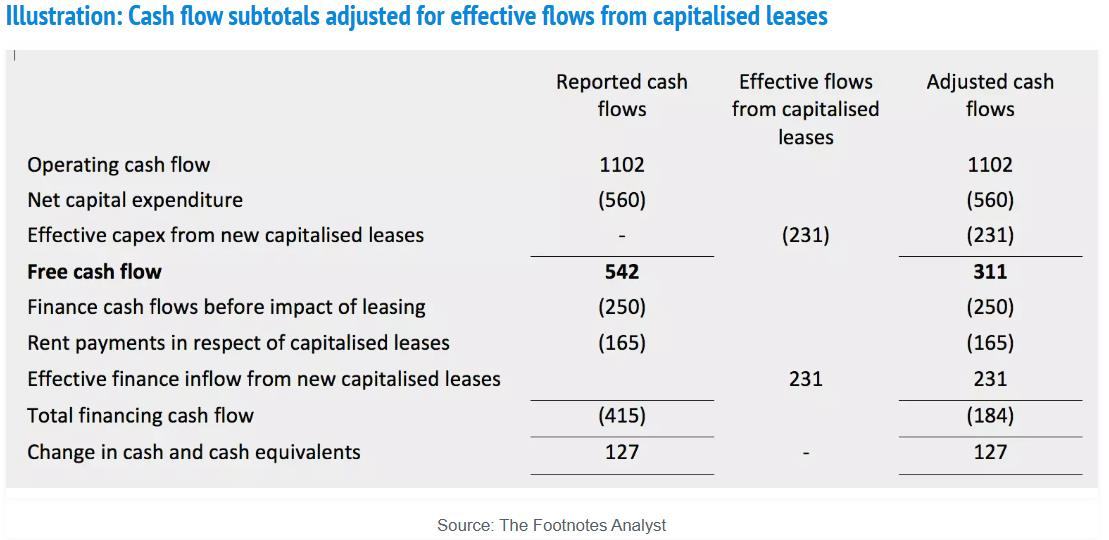 Source: The Footnotes Analyst
D100One preparer commented that “leases under IFRS 16 potentially degrade the statement of cash flows by hiding capex".
D101Another preparer interviewed, specifically pointed out their enhanced voluntary disclosure in the form of an additional explanatory note to the statement of cash flows, in order to enable a user to perform a full reconciliation between PP&E additions and cash outflows in respect of the purchase of PP&E included in the consolidated statement of cash flows. This included IFRS 16 right-of-use asset additions and accrued capex.
D102Other examples given by users of effective cash flows where they suggest more transparent information be required include pension service costs, share-based payments, restructuring costs, divestitures, business combinations where the consideration is non-cash, and reverse factoring.
D103Derivatives (both economic and hedge accounting) were mentioned by most users during the interviews. One credit rating analyst noted that they have to make sweeping assumptions when doing their credit analysis, since it is not easy to break out the impact of unrealised gains or losses, the change in fair value and FX movements.
D104Some preparers noted that the new disclosure requirements for supplier finance arrangements effective for reporting periods starting 1 January 2024, should provide more transparency for users about such transactions. However, they also acknowledged that there was opportunity to provide more transparent disclosure for other non-cash transactions too.
Suggestions for improving the disclosure of non-cash information
D105Although companies do not report the ‘effective' investing and financing flows arising from finance leases in the actual statement of cash flows, IAS 7 does require that significant non-cash transactions are disclosed. Ideally, analysts would like to see these on the same page as the statement of cash flows, or at least the location of this information clearly cross-referenced in that statement18.
D106Users noted that recently introduced disclosures help provide transparency for effective cash flows that involve financing activities19. One preparer specifically commented that, in order to meet the disclosure requirements in IAS 7 paragraphs 44A–44E to disclose changes in liabilities arising from financing activities, most UK companies apply the option20 in IAS 7 paragraph 44E to provide a reconciliation between the opening and closing balances in the statement of financial position for liabilities arising from financing activities, including the changes identified in paragraph 44B21, which include non-cash items, such as the effects of changes in fair value and FX rates.
D107Some preparers acknowledge that such requirements could be mandatory and also extend to other balance sheet movements, where the information is imperative to users' analyses.
D108Other suggested disclosures provided by interviewees, which might improve connectivity between the statement of cash flows and the other primary financial statements and notes, and improve accessibility for users to non-cash information include:
- Roll forwards for key items, disclosing separately cash and non-cash items (similar to the suggestion in paragraphs D90–D92 above).
- Single note disclosure, listing significant non-cash items by the various categories (operating, investing and financing) and cross-referencing to other notes to the financial statements, where more detail is provided.
- Line items in an 'operating profit' note, disaggregated between cash and non-cash elements, and cross-referenced to other notes to the financial statements (similar to the suggestion in paragraph D78b) above).
- Single-note disclosure of non-cash transactions that are economically similar to cash transactions, to show effective offsetting flows (e.g. leases, pension service costs, reverse factoring, and certain M&A where consideration is non-cash), similar to the example in paragraph D99 above – this might also assist analysts not to double count i.e. because non-cash transactions can have later real cash flows. For example, it would be important for analysts not to include in free cash flow measures, both the effective capex and the lease rental payments in respect of capitalised leases.
- Working capital movements specifically broken down for each major component, sub-totalled and reconciled to respective balance sheet notes, including disclosure of non-cash items (e.g. FX effects).
- Breakdown of fixed asset additions to separately identify cash transactions, cash-timing differences (e.g. accrued capex) and non-cash transactions (e.g. leased assets, transfer of assets, etc)
- Breakdown in provisions note to disaggregate 'amounts utilised' between cash utilisation (e.g. paid) and non-cash utilisation (e.g. transferred to a liability).
D109Introducing a principle of interconnectivity between the primary financial statements, might lead to improved cross-referencing between the primary financial statements and notes, and some additional disclosures, similar to those listed above, being provided.
D110One credit rating agency noted the importance of disclosure of cash and non-cash effects of movements in regulatory assets and regulatory liabilities will be needed when forthcoming standard, IFRS 20 Regulatory Assets and Regulatory Liabilities, is introduced22.
- Breakdown in provisions note to disaggregate 'amounts utilised' between cash utilisation (e.g. paid) and non-cash utilisation (e.g. transferred to a liability).
D109.Introducing a principle of interconnectivity between the primary financial statements, might lead to improved cross-referencing between the primary financial statements and notes, and some additional disclosures, similar to those listed above, being provided.
D106.D110.One credit rating agency noted the importance of disclosure of cash and non-cash effects of movements in regulatory assets and regulatory liabilities will be needed when forthcoming standard, IFRS 20 Regulatory Assets and Regulatory Liabilities, is introduced14.
Importance of non-GAAP measures
D107.D111.In both the previous research papers, it was noted that free cash flow15 and net debt16 were two of the most common cash flow alternative performance measures (APMs) among UK companies.
D108.D112.One preparer added that based on discussion with its Investor Relations Department, "the primary focus of investors is on free cash flow and net debt rather than the statement of cash flows itself, and therefore the primary function of the statement of cash flows is to explain how free cash flow is generated”.
Free cash flow
D109.D113.As noted in the second research paper17, free cash flow plays an essential role in valuation, as it demonstrates the cash flow a company can potentially distribute, after making reinvestments in the business via capex and working capital. However, IAS 7 does not define free cash flow.
D110.D114.Most users interviewed commented on free cash flow, noting their preference to calculate their own free cash flow measures, using information disclosed in the statement of cash flows and elsewhere in the financial statements. Therefore, there was little appetite amongst users for the IASB to define ‘free cash flows'.
“It is not necessary to have a standardised or prescribed definition of free cash flows as there is variability on how free cash flow is defined, depending on the information that is being focused on".
Credit rating agency
D111.D115.It is more important for companies to disclose transparent information needed for analysts to calculate their own measures of free cash flow, which can vary by industry sector or other criteria. Such disclosures that are important to users are included elsewhere in this paper, such as non-cash transactions, better disaggregation, cohesiveness between the primary financial statements and roll forwards.
D112.D116.One preparer noted that the company was highly leveraged, so investors' attention was focused on the borrowings. As a result, the company now discloses 'free cash flow before dividend' to show the company's ability to pay the borrowings and still invest.
Net debt
D113.D117.Most UK preparers (except those in banks and insurers), disclose a net debt measure, with most including net debt in their financial statements, and a few including net debt in the front half of the annual report, within the key performance indicator (KPI) disclosures required by UK Companies Act 2006.
D114.D118.In contrast to the view on free cash flow, almost all users interviewed (excluding those focused on financial institutions), said that net debt information was as important as the statement of cash flows.
D115.D119.Users rely upon the information that companies provide for net debt (current interest-bearing debt on its statement of financial position minus its liquid assets i.e. cash and cash equivalents), as a financial liquidity metric. It allows them to determine how much cash would remain if all debts became due immediately and measure the company's capacity to take on more debt.
D116.D120.A private investor commented that net debt is commonly used in valuations and noted that the main focus and use for the statement of cash flows is to ascertain Enterprise Value (EV). Since EV is the sum of equity value, net debt, preferred stock and minority interest, a net debt reconciliation is extremely useful.
D117.D121.As with free cash flow, calculation methods for net debt vary, primarily depending on whether analysts include or exclude certain items from net debt, such as leases, investments, debt-related derivatives, and other derivatives not related to debt.
D118.D122.However, unlike with free cash flow, almost all users and preparers commented that a standard definition for ‘net debt' provided by the IASB would be useful. Mandatory reporting of a net debt metric would enable comparability between companies. If net debt was defined, then any variations e.g. provided as a KPI, would lead to disclose of ‘adjusted net debt' metric as a management performance measure (see paragraph D135MPM), together with a reconciliation to the standard definition of 'net debt'.
D119.D123.Some users interviewed went further and suggested that information about a company's net debt position should be more prominent in a company's financial statements. Some of those users specified that the metric be elevated to the face of the primary financial statement and integrated into the statement of cash flows, due to the importance of net debt in determining a company's liquidity.
“If I could make one change it would be to turn the statement of cash flows into a net debt statement".
Preparer
D120.D124.Some users suggested that the net debt should be reconciled to the cash and cash equivalents figure to enhance transparency, and should be reconciled to free cash flow, where the company provides a free cash flow metric.
D121.D125.Examples of different company approaches to presenting 'net debt' and reconciling the metric to the statement of cash flows (cash and cash equivalents) were presented in the February 2025 research paper18. Two of the examples included were provided by two companies that were interviewed. One of those preparers noted that to provide more useful information, it extends the mandatory net debt information (which they provide in the form of a reconciliation), to show 'net debt' as defined internally by management – this includes removing fair value movements in derivatives.
D122.D126.One user noted that in some sectors, such as utility companies, there are highly covenanted financing transactions, where the company has financial ratio limits, and it is helpful if companies provide a reconciliation of the covenanted debt amount in their net debt disclosure.
Working capital movements
D123.D127.As noted in the first research paper in this series19, changes in working capital can help explain how a company uses its assets and liabilities, which in turn can allow investors to predict changes in company value.
D124.D128.IAS 7 paragraph 21 requires that 'under the indirect method, the net cash flow from operating activities is determined by adjusting profit or loss for the effects of: (a) changes during the period in inventories and operating receivables and payables". IAS 7 does not include additional presentation or disclosure requirements related to these movements.
D125.D129.Whilst the second research paper did not specifically refer to changes in working capital, through the analysis of financial statements it was apparent that companies often refer to the above-mentioned adjusting items in the 'operating cash flows' section of the statements of cash flows as 'changes in working capital'. It was also observed that some companies include changes in other current assets and liabilities, within ‘changes in working capital'. Differing levels of granularity regarding the assets and liabilities are included in ‘changes in working capital'. There is no standard definition of ‘working capital', and specific components could depend upon the nature of the business. Most companies provide:
- increase/decrease in trade receivables;
- increase/decrease in trade payables; and
- increase/decrease in inventory.
D126.D130.As noted in paragraph D19 above, one credit rating agency advised that many financial ratios used to assess the credit quality of companies are based on the statement of cash flows, such as 'funds from operations', which is essentially 'cash flows from operating activities less working capital'. Hence working capital is an important metric. It is necessary to understand the individual components of the company's definition of working capital to decide which should be included in the adjustments to operating cash flows.
D127.D131.That user also commented that working capital movements can be volatile, so the volatile element of the ratio needs to be removed. Therefore, it is important for users to be able to understand what components are in working capital that are driving the overall change, which can be difficult to understand from the financial statements. Individual components of working capital can be subject to different forces and may give different signals for user analysis, for example impairments of receivable balances versus management of trade payables.
D128.D132.A few users said that that they need appropriate disclosure and disaggregation of what comprises the working capital and its movements. Such information may be transparent when the movement in working capital is disaggregated on the face of the statement of cash flows (or in the related 'operating cash flows' note) and cross-referenced to the related notes for the statement of financial position movements. This reinforces that the cohesiveness between the statement of cash flows and the statement of financial position is important. However, such transparency is not always evident when there is M&A activity, disposals, non-cash transactions, and non-cash items, such as FX effects. See paragraphs D79–D110 of this paper for more information on non-cash items.
D129.D133.Many preparers acknowledged that it was not transparent how the movements in working capital relate to the opening and closing balances of the related trade receivables or trade payables. Most noted that this would often be due to the effect of FX rate differences that was not apparent in the notes, since roll forwards are not required to be provided for such balances.
D130.D134.One preparer noted that they provide commentary to their balance sheet note to state the difference between the balance sheet movement and the statement of cash flows relates to the effects of FX. However, another preparer noted that this information was not disclosed as they would have difficulty proving the FX difference to their auditors, even though they know that FX was the ‘balancing item'.
Alignment with IFRS 18
D131.D135.IFRS 18 significantly impacts Alternative Performance Measures (APMs) by introducing specific disclosure requirements for a subset of APMs called "Management-defined Performance Measures" (MPMs). This will mean companies are more transparent about how they use certain non-GAAP metrics to present their financial performance and improve the reliability and comparability of financial information for users by providing greater insight into management's perspective on a company's performance.
D132.D136.One preparer noted that cash flow APMs are out of scope of IFRS 18. They suggested these should be introduced by any project on the statement of cash flows, as only the APMs in scope of the standard will be required in the financial statements and audited. This would provide more transparent information about internally used cash flows metrics to help users perform their analyses.
Suggestions for improving disclosure of important non-GAAP measures
D133.D137.As noted above, most preparers and users agreed that a standard definition of net debt would be useful, with some suggesting it be elevated to the primary financial statement and be required to reconcile to the statement of cash flows 'cash and cash equivalents' figure.
D134.D138.Improvements to working capital disclosures are important to enable users, such as credit rating agencies, to remove the volatility, when calculating important ratios, such as 'funds from operations'20. It may be useful if the IASB provides more guidance on the level of granularity required in the statement of cash flows, requires a sub-total to be provided for ‘movements in working capital', and requires a company to disclose how the balance sheet movements reconcile to the amounts shown in the statement of cash flows.
D135.D139.TSince MPMs are typically linked to specific subtotals within the statement of profit or loss, the IASB could consider what sub-totals would be useful to be disclosed in the statement of cash flows. This would facilitate the reconciliation of cash flow MPMs to specific subtotals within the statement of cash flows.
Interconnectivity with other IFRS Accounting Standards
Issues raised concerning other IFRS
D136.D140.Whilst paragraphs 54–65 of IAS 7 refer to the consequential changes made to IAS 7 because of amendments to other standards, IAS 7 makes few other cross-references to cash flow disclosures required by other standards.
D137.D141.There is a notable lack of guidance in other IFRS accounting standards on related requirements for the statement of cash flows. It is apparent that most IFRS accounting standards make more reference to the other primary financial statements i.e. the statement of profit or loss and the statement of financial position.
D138.D142.Users highlighted challenges in finding certain information related to cash flows (and non-cash information), and preparers noted they would welcome more guidance on a number of areas that are covered by other IFRS accounting standards. Areas mentioned by interviewees relate to the following standards:
- IFRS 18 Presentation and Disclosure in Financial Statements.
- IFRS 16 Leases.
- IFRS 2 Share-based payments.
- IAS 21 The Effects of Changes in Foreign Exchange Rates.
- IFRS 3 Business Combinations / IFRS 12 Disclosure of Interests in Other Entities.
- IAS 37 Provisions, Contingent Liabilities and Contingent Assets.
- IFRS 5 Non-current Assets Held for Sale and Discontinued Operations.
- IFRS 7 Financial Instruments: Disclosures / IFRS 9 Financial Instruments
| IAS 39 Financial Instruments: Recognition and Measurement.
- IFRS 8 Operating Segments.
D139.D143.Other cross cutting issues already mentioned earlier in this paper include:
- Unrealised gains and losses, such as Fair value adjustments.
- Exceptional, one-off or unusual (recurring but volatile, or infrequently recurring) items, with different characteristics.
- IFRS 20 Regulatory Assets and Regulatory Liabilities.
D140.D144.One preparer noted the reduced disclosures under UK GAAP (FRS 101) in respect of the statement of cash flows, and suggested similar reduced disclosures be applied in IFRS 19 Subsidiaries without Public Accountability: Disclosures.
Suggestions for improving the interconnectivity with other IFRS
D141.D145.Whilst it is recognised that the other primary financial statements do not specifically have their own standard, albeit IAS 1 (to be replaced by IFRS 18) sets out the main requirements, most accounting standards have been issued since IAS 721. So, although IAS 7 set out the principles, some additional guidance in other standards as to how information should be disclosed in the statement of cash flows would be useful.
Challenges for preparers
D142.D146.During the interviews, it became apparent that there are lower priority areas for users, which are of higher priority for preparers, due to challenges the current requirements in IAS 7 present, including:
- Inconsistencies with IFRS 18 Presentation and Disclosure in Financial Statements (see paragraphs D34–D45 and paragraphs D135–D136).
- Cash and cash equivalent definitions - perceived to be too prescriptive (see paragraphs D147–D151).
- Classification of cash flows – lack of guidance for some items e.g. transaction costs, grants and contributions, capitalised interest (see paragraphs D152–D158).
- Systems restrictions and cost implications – the time burden and resulting cost of any additional disclosure proposals, whilst acknowledging the need of relevant information for users (see paragraphs D159–D162).
- Aggregation/netting (see paragraphs D163–D167).
Cash and cash equivalents
D143.D147.Per IAS 7 paragraph 6 "cash equivalents are short-term, highly liquid investments that are readily convertible to known amounts of cash and which are subject to an insignificant risk of changes in value'. IAS 7 paragraph 7 states that "an investment normally qualifies as a cash equivalent only when it has a short maturity of, say, three months or less from the date of acquisition". IAS 7 does not provide additional guidance to determine whether an item meets the definition of cash equivalents.
D144.D148.Users interviewed did not raise any concerns with regards to the definition of cash and cash equivalents, although it was noted that not all users were aware of the definitions in IAS 7. This may be because most of the users interviewed focussed on net debt rather than on cash and cash equivalents, so whether an investment is classified as a cash equivalent may not be so important to their analyses.
D145.D149.However, many preparers said the guidance on cash and cash equivalents could be enhanced. Some preparers said that investments they would classify internally as cash equivalents would not satisfy the definition in IAS 7, even though these investments are used as part of the company's cash management activities. One preparer said the three-month ‘rule' was arbitrary and companies should be given more discretion.
D146.D150.Some preparers suggested the current guidance is driving management behaviour to adjust their liquidity management approach and place surplus cash on shorter term deposits close to the reporting date, so that such investments can be included in cash equivalents. Some of those preparers suggested it would be useful to have a closer alignment between the definitions used for internal and external reporting because it might reduce costs and better reflect how a company is managing its liquidity.
D147.D151.Some preparers and one credit agency said liquid assets are more aligned to how companies manage their cash and referred to the source and application of funds statement previously required under UK GAAP (FRS 1 Revised). This was mentioned earlier in this paper in paragraph D33.
Classification of cash flows
D148.D152.IAS 7 paragraph 11 simply states that "an entity presents its cash flows from operating, investing and financing activities in a manner which is most appropriate to its business".
Transaction costs
D149.D153.One preparer pointed out that IAS 7 is silent on how transaction costs should be treated in the statement of cash flows and suggested that more guidance and illustrative examples would be useful on whether classification is operating or investing. IAS 7 might benefit from introducing clearer principles in the main body of the standard on how such costs might be classified.
Grants and contributions
D150.D154.Under the heading of 'Presentation of grants related to assets' paragraph 28 of IAS 20 Accounting for Government Grants and Disclosure of Government Assistance states that "the purchase of assets and the receipt of related grants can cause major movements in the cash flow of an entity. For this reason and in order to show the gross investment in assets, such movements are often disclosed as separate items in the statement of cash flows regardless of whether or not the grant is deducted from the related asset for presentation purposes in the statement of financial position". However, IAS 20 is silent on how cash flows should be treated under the heading of 'Presentation of grants related to income'.
D151.D155.One preparer specifically noted that IAS 7 is silent on how to account for 'grants and contributions received from customers' and noted diversity in practice in their industry. While IAS 7 paragraph 16 states that "only expenditures that result in a recognised asset in the statement of financial position are eligible for classification as investing activities", no mention is made of contributions received that are intended to fund such expenditure. Given the linkage of contributions to the PP&E created, and in the absence of specific IFRS requirements to the contrary, the preparer interviewed noted they classify grants and contributions within investing activities, as they believe it provides the most meaningful and relevant information to users.
Capitalised borrowing cost / interest
D152.D156.The core principle in Paragraph 1 of IAS 23 Borrowing Costs states that "borrowing costs that are directly attributable to the acquisition, construction or production of a qualifying asset form part of the cost of that asset. Other borrowing costs are recognised as an expense". Paragraph 32 of IAS 7, states that "the total amount of interest paid during a period is disclosed in the statement of cash flows whether it has been recognised as an expense in profit or loss or capitalised in accordance with IAS 23 Borrowing Costs". IAS 7 currently permits such interest paid to be classified as operating or financing cash flows.
D153.D157.One preparer and one user specifically commented on capitalised interest. The preparer noted that it voluntarily enhanced the disclosure of capitalised interest costs in the finance expense note to break down the amount capitalised under IAS 23 into amounts added to PP&E and amounts added to intangible assets, and set out in their accounting policies how interest is treated in the statement of cash flows.
D154.D158.One user commented that it is not always clear where a company has disclosed capitalised interest in the statement of cash flows22, and it would be helpful to users if connectivity in the financial statements was improved, such that interest cash flows can be reconciled back to the interest expense and asset notes accordingly.
Systems restrictions and cost implications
D155.D159.With respect to practical issues, only three preparers interviewed had systems that allowed the statement of cash flows to be produced automatically. All three presented ‘operating cash flows' using the indirect method, but one presented 'operating cash flows' using both the indirect and direct method. All those preparers noted that, although their systems are automated, a small number of manual adjustments are still necessary, noting its accuracy of the automated statement of cash flows relied on the quality of the data entered. Only one of those preparers said the statement of cash flows was embedded into the company's budget and forecasting software and continuously updated.
D156.D160.Other preparers do not have sophisticated ways of producing the information required from their systems and the production of the statement of cash flows was a manual exercise, often using spreadsheets, and generated late in the reporting process. Only a few preparers produced the statement of cash flows at the same time as the other primary financial statements. The fact that the IAS 7 statement of cash flows is rarely used by companies in their day-to-day treasury function and liquidity management, may explain why companies do not invest time and money into automating the preparation of an IAS 7 statement of cash flows, as the internal benefits would be unlikely to exceed the cost of doing so.
D157.D161.Other than preparers from financial institutions, most preparers do not want to see a significant change to the requirements in IAS 7 due to the potential cost implications. However, given the manual nature of the preparation of the statement of cash flows for most companies, a change in the requirements may not necessarily lead to expensive system changes, albeit there might be some new information to be collected outside the system (that would have an associated cost), but mostly the existing information gathered through the manual process may be presented in a different way (with potentially no incremental cost).
D158.D162.PHowever, preparers recognise that there might be more transparent ways to provide information that users need on both cash flows and non-cash items.
Aggregation/netting
D159.D163.IFRS 18 paragraph 42 does not permit offsetting/netting, except where expressly required or permitted by an IFRS Accounting Standard, however this requirement is only expressed in relation to net assets and liabilities or income and expenses, and not expressed in relation to cash inflows and cash outflows.
D160.D164.IAS 7 paragraphs 22 states that "cash flows arising from the following operating, investing or financing activities may be reported on a net basis:
- cash receipts and payments on behalf of customers when the cash flows reflect the activities of the customer rather than those of the entity; and
- cash receipts and payments for items in which the turnover is quick, the amounts are large, and the maturities are short".
D161.D165.Examples are provided in IAS 7 paragraphs 23-23A. IAS 7 paragraph 24 permit cash flows arising from certain activities of a financial institution to be reported on a net basis.
D162.D166.One preparer suggested that the standard is too prescriptive and that it should permit the netting of cash inflows and outflows for items such as short-term investments. The gross amounts of receipts and payments may vary year on year, whilst the net amount may be consistent.
“Disclosing £5bn outflows and £6bn inflows for the reporting period, rather than a net inflow of £1bn, does not provide useful information to users."
Preparer
D163.D167.No feedback was received from users interviewed with regards to aggregation or netting (except as noted in paragraph D78a)).
Suggestions to assist preparers in applying the requirements
D164.D168.In addition to addressing inconsistencies with IFRS 18, many preparers commented that more guidance and illustrative examples would be useful on some aspects of the requirements in IAS 7, including cash and cash equivalents, classification of cash flows and aggregation/netting. Identification of the application difficulties and introducing clearer principles in the main body of the standard may be helpful.
D165.D169.It would be useful if certain note disclosures, such as interest, show where the related cash flows have been accounted in the statement of cash flows, not just the interest credited or charged in statement of profit or loss, i.e. show the cash flows categories related for all interest payments.
Usefulness of the statement of cash flows for Financial Institutions
D166.D170.In contrast to non-financial institutions, most users and preparers believe that the statement of cash flows for banks and insurers provides little to no significant incremental value in addition to other primary financial statements and related disclosures. With banks and insurers typically managing portfolios of liquid assets beyond what is included within cash and cash equivalents, the statement of cash flows only represents a subset of such portfolios and therefore does not align with how the overall business is managed.
D167.D171.Preparers also expressed that it was rare to receive questions from users on cash flows.
D168.D172.One user noted that for insurers, they cannot easily assess whether a company can distribute cash, so regulatory surplus is used as a proxy.
D169.D173.When explicitly asked about the usefulness of the risk management disclosures required by IFRS 7 Financial Instruments: Disclosures, there were mixed views on the extent to which the required disclosures were useful. One preparer and one user expressed that the information provided was typically not cohesive, making it difficult to understand the impact of the risks to the business as a whole.
D170.D174.Due to the above issues, preparers and users place greater focus and reliance on the information provided using non-GAAP measures and within regulatory reporting. Information contained within regulatory reporting was noted to be more standardised and disclosures around liquidity and capital management were noted to be more extensive, resulting in enhanced comparability and relevance. Moreover, regulatory capital requirements are a key factor when considering whether there is capacity to pay out dividends.
D171.D175.An asset manager noted that the information provided by the statement of cash flows is more useful for their users than for banks and insurers, opting to include a condensed and simplified statement of cash flows within the Chief Financial Officer's review in the Strategic Report. This is consistent with the feedback received from a private investor who had the same valuation model for both asset managers and non-financial institutions but had different valuation models for banks and insurers.
Suggestions to improve usefulness of information provided for some financial institutions
D172.D176.Whilst there is general consensus that the statement of cash flows is not particularly useful for banks and insurers, there are a variety of views around how this could be addressed. Suggestions received during the interviews ranged from retaining the current requirements to exempting certain financial institutions. Other interviewees suggested possibly replacing the statement of cash flows with regulatory information, providing a bridge between the primary financial statements and regulatory required information.
D173.D177.Whilst alternative solutions should be explored before addressing the question of whether to exempt certain financial institutions from preparing a statement of cash flowsWith regards to exempting banks and insurers from preparing a statement of cash flows, some preparers acknowledged that it was difficult to appropriately scope out banks and insurers, especially in the context of consolidated groups which may have other ancillary business.
- One preparer from an insurer suggested that the IASB could refer to Applying IFRS 9 Financial Instruments with IFRS 4 Insurance Contracts (Amendments to IFRS 4)23, where the concept of activities predominantly connected with insurance was introduced.
- One preparer from a bank suggested scoping based on whether other regulatory reporting was required.
D174.D178.Lastly, some users suggested that roll forwards of some balance sheet line items could be disclosed, to include both cash and non-cash movements. However, one preparer and one user noted that while IFRS 17 Insurance Contracts requires a similar disclosure for (re)insurance contract assets and liabilities, the information is currently not used. With the implementation of IFRS 17 requirements being so recent, this may be due to the users needing more time to incorporate the additional information.
Concluding Observations
D175.D179.This paper makes no recommendations. The key messages received during the interviews with UK users and preparers are noted in paragraph D13 and D182 of the paper.
D176.D180.Feedback from UK users and UK preparers suggests that the statement of cash flows is useful for non-financial institutions and is less useful for banks and insurers.
“IAS 7 is generally fit for purpose but there are areas where guidance is needed and areas where preparer discretion is necessary".
Preparer
D177.D181.Some preparers acknowledged that recent changes to IFRS Accounting Standards, such as the introduction of IFRS 18 (see paragraphs D34–D45 in this paper) and other recent changes to IAS 724, were all significant improvements, but there is still scope for further improvements.
D178.D182.As identified through the key messages, there is an overlap between the topics outlined in this paper and that should be a consideration for the IASB when progressing with the project on the Statement of Cash Flows and Related Matters. In summary the most important areas that the IASB could consider are:
- Cohesiveness between the primary financial statements – the project could consider how such cohesion might be improved. This might include:
- adding an internal connectivity principle, requiring the financial statements and notes to clearly show how the figures in each of the primary financial statements, including the statement of cash flows, relate to the other primary financial statements;
- more requirements for disclosing cash flow information in other IFRS accounting standards; and
- improving the requirements in IAS 7, similar to those for disclosing the changes in financing liabilities, which require both cash flows and non-cash items in the movement of the opening and closing balances to be shown.
Such requirements might lead to more transparent disclosure in the notes about how the information for specific items (such as M&A, derivatives,
Appendix D: Concluding Observations
D175.D179. This paper makes no recommendations. The key messages received during the interviews with UK users and preparers are noted in paragraph D13 and D182 of the paper.
D176.D180. Feedback from UK users and UK preparers suggests that the statement of cash flows is useful for non-financial institutions and is less useful for banks and insurers.
"IAS 7 is generally fit for purpose but there are areas where guidance is needed and areas where preparer discretion is necessary".
Preparer
D177.D181. Some preparers acknowledged that recent changes to IFRS Accounting Standards, such as the introduction of IFRS 18 (see paragraphs D34–D45 in this paper) and other recent changes to IAS 724, were all significant improvements, but there is still scope for further improvements.
D178.D182. As identified through the key messages, there is an overlap between the topics outlined in this paper and that should be a consideration for the IASB when progressing with the project on the Statement of Cash Flows and Related Matters. In summary the most important areas that the IASB could consider are:
- Cohesiveness between the primary financial statements – the project could consider how such cohesion might be improved. This might include:
- adding an internal connectivity principle, requiring the financial statements and notes to clearly show how the figures in each of the primary financial statements, including the statement of cash flows, relate to the other primary financial statements;
- more requirements for disclosing cash flow information in other IFRS accounting standards; and
- improving the requirements in IAS 7, similar to those for disclosing the changes in financing liabilities, which require both cash flows and non-cash items in the movement of the opening and closing balances to be shown.
- Importance of non-cash information – the project could consider information about economically similar transactions that do not involve cash, to ensure that companies are required to disclose transparent information about such transactions.
- Importance of non-GAAP measures the project could consider the benefits to users of providing a standard definition of 'net debt', requiring companies to reconcile net debt to the statement of cash flows.
- Interconnectivity between IFRS Accounting Standards – the project could consider the benefits to preparers of specifying, for all IFRS Accounting Standards, an internal connectivity principle between the primary financial statements, which should assist in by improving the guidance in other standards on how the relevant cash flows and non-cash information might be disclosed in the financial statements, to which would improve transparency of information and comparability for users.
- Assisting preparers in applying the requirements – the project could consider the benefits to both preparers and users from improving the definitions for the classifications of cash flows, potential alignment with categories and definitions in IFRS 18, and providing more guidance to assist preparers in applying the requirements in IAS 7 (such as cash and cash equivalents). The project might also consider which requirements currently encouraged in IAS 7 are needed by users and:
- remove which of the requirement for disclosures encouraged in IAS 7 paragraph 50 of those encouraged disclosures that are not essential, such as disaggregation of growth and maintenance expenditure should be retrained, and if some should be made mandatory; and
- the encouragement in IAS 7 paragraph 19 and the preferred-use of the direct method for reporting cash flows from operating activities; and.
- make mandatory those encouraged disclosures in IAS 7 paragraph 50 that users need, such as segmental information.
- Usefulness of the statement of cash flows for banks and insurers - the project scope could focus on first improving the requirements for all entities and then consider at a later stage if there is any loss of information to users from potentially providing an exemption for some entities, or if there are alternative solutions that would reduce the cost to preparers whilst improving information for users.
D179.D183. There is a clear desire for the IASB to carry out sufficient field testing to ensure that any proposed changes to the requirements are practicable for preparers, provide relevant and reliable information, and are proportionate to any increased benefits for users.
Appendix E: Statement of Cash Flows and Related Matters: A survey of users' views
- Executive Summary
- Summary of the Issue
- Decisions for the Board
- Recommendation
- Appendices
- Background: Statement of Cash Flows and Related Matters
- Summary Research Paper - Statement of Cash Flows: UKEB research findings
- Questions for the Board
- Next Steps
- Appendix A: Statement Of Cash Flows Initial UKEB Research Findings
- UKEB Report 1: Background and Key issues
- UKEB Report 2: Non-mandatory and Voluntary Cash Flow Disclosures Provided by UK Listed Companies
- UKEB Report 3: UK User and Preparer perspectives
- UKEB User Poll: A survey of users' views
- Conclusions and next steps
- Appendix B: Statement of Cash Flows and Related Matters: Background and key issues
- UKEB research into the Statement of Cash Flows and Related Matters
- Background
- Conceptual Framework for Financial Reporting
- Concerns with IAS 7
- The importance of cash flow reporting for users of financial statements
- Why is cash flow important?
- UK perspective
- Alternatives to the statement of cash flows
- Key issues identified
- Classification of cash flows
- What's the issue?
- Recent changes to IAS 7 on issuing IFRS 18
- Stakeholder views
- UK perspective
- Disaggregation of cash flow information
- What's the issue?
- Stakeholder views
- Related changes to IAS 7 on issuing IFRS 18
- UK perspective
- Definition of cash and cash equivalents
- What's the issue?
- Stakeholder views
- UK perspective
- Reporting cash flows from 'operating' activities – direct vs. indirect method
- What's the issue?
- Stakeholder views
- UK perspective
- Effects of non-cash transactions
- What's the issue?
- Recent changes to IAS 7
- Stakeholder views
- Net Debt Reconciliation / Statement of changes in Net Debt
- UK perspective
- Cash flow measures and other disclosures
- Statement of Cash Flows for financial institutions
- Next Steps
- Annex I: Glossary
- Annex I: Glossary
- Annex 2: The IFRS Interpretations Committee Agenda decisions
- Annex 3: Bibliography
- Appendix C: Non-mandatory and Voluntary Cash Flow Disclosures Provided by UK Listed Companies
- Contents
- Background
- Purpose of research paper
- Review process and methodology
- Non-mandatory cash flow disclosures provided by UK listed companies
- Presentation of cash flows from operating activities
- Application of the indirect method
- Growth and maintenance expenditure
- Segmental cash flows
- Observations on non-mandatory cash flow disclosures
- Voluntary cash flow disclosures provided by UK listed companies
- Cash impact of exceptional or other adjusting items
- Cash impact of exceptional or other adjusting items
- Reconciliation of amounts in the statement of cash flows to other primary statements
- Observations on voluntary cash flow disclosures
- Other areas of cash flow reporting
- Appendix D: Statement of Cash Flows and Related Matters: UK User and Preparer Perspectives
- Background
- Key messages
- Usefulness of the Statement of Cash Flows for non-financial institutions
- Direct versus indirect method for operating cash flows
- Classification of cash flows
- Tax
- Disaggregation of information
- Growth versus maintenance cash flows
- Segmental cash flows
- Accessibility of information
- Suggestions for improving the usefulness of the statement of cash flows
- Cohesiveness between the primary financial statements
- Importance of non-cash information
- Non-cash operating activities
- Non-cash investing and financing activities
- Effective offsetting cash flows
- Suggestions for improving the disclosure of non-cash information
- Importance of non-GAAP measures
- Net debt
- Alignment with IFRS 18
- Suggestions for improving disclosure of important non-GAAP measures
- Interconnectivity with other IFRS Accounting Standards
- Suggestions for improving the interconnectivity with other IFRS
- Challenges for preparers
- Usefulness of the statement of cash flows for Financial Institutions
- Suggestions to improve usefulness of information provided for some financial institutions
- Concluding Observations
- Appendix D: Concluding Observations
- Appendix E: Statement of Cash Flows and Related Matters: A survey of users' views
- Background
- Purpose of User survey
- Chart 1: Demographic of respondents
- Usefulness of the Statement of Cash Flows
- Q1. How important to you is each of the three primary financial statements?
- Chart 2: Importance of Primary financial statements
- Q2. Please say why you consider the statement of cash flows is more or less important than, or equally important as, the other primary financial statements.
- Q3. What do you use the cash flow statement for (13 options provided)?
- Chart 3: Uses of the statement of cash flows
- Q4. Do you have any other uses for the statement of cash flows? If yes, please state what you use it for and why this is important?
- Q5. Are there any sectors for which the statement of cash flows is not relevant?
- Q6. Relative to the Statement of Cash Flows, are the following cash flow measures (net debt and free cash flow) useful?
- Chart 4: Usefulness of other cash flow measures
- Q7. Are there any other cash flow measures that are useful? If no, write "No". If yes, please say which cash flow measure is useful, how it is defined, and why it is useful.
- Q8. Do you have any additional comments or feedback on the usefulness of the Statement of Cash Flows?
- Improvements to the Statement of Cash Flows
- Q9. Please rate how useful the following disclosures listed below might be, if companies were required to provide them. Note: Some disclosures below are encouraged but not mandatory, whilst other disclosures may already be provided voluntarily by some companies.
- Statement of Cash Flows for financial institutions
- Concluding comments
- Appendix F: Project Initiation Plan (updated May 2025) Statement of Cash Flows and Related Matters
- Project Initiation Plan: Statement of Cash Flows and Related Matters - Project timeline
Background
Purpose of User survey
E1. Between 25 March and 22 April 2025, users of IFRS financial statements were invited to complete a UKEB survey on the statement of cash flows.
E2. The survey was split into three sections:
- Usefulness of the Statement of Cash Flows (questions 1–8)
- Improvements to the Statement of Cash Flows (questions 9–13)
- Optional section - for the users of financial institution financial statements (questions 14–15)
E3. 32 responses were received from a variety of users, including:
- analysts and investors (equity and fixed income analysts, sell-side analysts, institutional investors, retail and private investors, broker/dealers);
- lenders and credit-rating agencies; and
- others (including academic researchers and users of financial statements for reasons other than investing or lending).
Chart 1: Demographic of respondents
Pie chart showing the demographic of respondents: * Analysts & Investors: 58% * Other: 34% * Lenders & Credit rating agencies: 8%
- Retail investor / private investor
- Analyst / researcher (equity, fixed income)
- Institutional investor
- Sell-side / broker dealer
- Credit-rating agency
- Lender / creditor
- Academic researcher
- User of financial statements for reasons other than investing or lending
- Other
E4. It is notable the number and detail of additional comments that were made by respondents to the survey. This is perhaps indicative of the importance with which they view the statement of cash flows, and a desire to see enhancements to the relevant accounting requirements. This paper includes many of those comments to illustrate the various views expressed.
Usefulness of the Statement of Cash Flows
Q1. How important to you is each of the three primary financial statements?
E5. Overall, respondents considered that all parts of the financial statements were important. However, they believed that the Statement of Comprehensive Income was marginally more important, followed by the Statement of Financial Position and then the Statement of Cash Flows, with 90% of survey respondents considering the statement of cash flows as very or quite important.
E6. Users from lenders and credit rating agencies had the least use for the statement of cash flows.
Chart 2: Importance of Primary financial statements
Horizontal stacked bar chart showing the importance of primary financial statements (Income statement, Balance sheet, Cash flows) across different user groups (Analysts & Investors, Lenders & Credit rating agencies, Other). Importance is categorised as 'Somewhat important', 'Quite important', and 'Very important'. For example, for 'Cash flows', Analysts & Investors rated 84% 'Very important', 11% 'Quite important', and 5% 'Somewhat important'. Lenders & Credit rating agencies rated 50% 'Very important' and 50% 'Quite important'. Other rated 91% 'Very important', 9% 'Quite important'.
Q2. Please say why you consider the statement of cash flows is more or less important than, or equally important as, the other primary financial statements.
E7. Most respondents noted that the statement of cash flows is equally important as the income statement and balance sheet, and the three primary statements are used collectively to understand the financial position of a company.
E8. User comments received included:
- “Ultimately it is something that I could largely reconstitute for myself using the information in the other financial statements and in the notes to the accounts. I tend to look at it primarily when something looks anomalous. For example when screen potential investments, if I see a major change in the gearing ratio from one year to another.”
- "I would not be able to execute a discounted cash flow analysis without the cash flow statement. The three statements hook together, so together they convey insight in the financial dimension of a company.”
- "More important as shows where cash is going (or coming in from)."
- "Equally important as it provides insight into economic flows that are not apparent from the other primary statements on a standalone basis."
- "Cash generation is the ultimate purpose of a corporation determining its value. Short term key issue is solvency."
- "Each of the three primary statements is very important because only when in possession of all three, if produced consistently and accurately, can you understand performance. For some preparers, the cash flow statement has not progressed beyond a simplistic analysis of fund movements with any differences dropped into working capital and/or FX movements"
- "The statement of cash flows acts as a link between the income statement and the balance sheet and provides key information about the financing activities required to support operations.”
- "As someone who works in Banking, the cash flow statement presents less inherently useful information than Balance Sheet, liquidity/cash flow and classification between operating/investing/operating not typically the most significant information in a Bank's financial statements. Completely appreciate though in other industries that the statement of cash flows can present very pertinent information not always evident in the Balance Sheet or Income Statement."
- "To get the complete picture and because cash is equally important as nominal figures are, to assess investor returns, operating profitability, debt service capacity, investing and maintenance capacity etc."
- “More important than income statement, equally important as balance sheet."
- "With today's rather incomprehensible accounting standards for the ordinary viewer the cash flow statement, absent absolute fraud, is a better indication of the health of a business."
- "The cash flow statement provides information on the quality of the earnings in a period. In particular, information on how quickly earnings are turned into cash. It provides evidence of the movement of working capital and on how earnings for the period are impacted by non-cash items. It also shows the degree of investment a company is making in its tangible and intangible assets".
- “The statement of cash flow is equally important as the other financial statements. It provides a detailed view of a company's cash inflows and outflows, which is crucial for understanding liquidity and solvency. This helps stakeholders assess whether the company can meet its short-term obligations and invest in growth. It highlights cash generated from operating activities, offering a clear picture of the company's core business performance."
- "I understand that traditionally the cash flow statement is considered the most important for analysing the health of a company, but I find all three typically important for assessing companies. They all help piece together the financial story of the firm. I also find that different statements have different levels of importance depending on the industry - banking being a prime example where the Income Statement and Balance Sheet are more useful than the Cash Flow Statement."
- "When I analyse a company I tend to start at the income statement to understand top line growth and cost structure (does the money get spent on inventory and advertising or is it salaries?), and then I move to the cash flow statement to assess what drives free cash flow, movements in working capital, and the general state of financing. I use the balance sheet to assess quality, credit, and inventory (supported in the Cash Flow Statement).”
- "The statement of cash flows explains (or shows) why the balance sheet has evolved the way it has evolved - and the role (or impact) the profit and loss statement has played in this. You cannot understand the financial statements of a company without considering the statement of cash flows.”
- "I consider the statement of cash flows equally as important as the other primary financial statements as all three are essential in gaining a true understanding of the financial performance and position of a company. The cash flow statement provides insights into a company's ability to manage its cash flow, which is essential for its short-term and long-term viability. It also provides key information about the sources and uses of the funds of a business. In addition, the value of a firm is the present value of its future cash flows."
- "Cash is king. While technically artificial, cash/money is the substantive quantification of all financial transactions and positions. It is very hard if impossible to game. The statement of cash flows is therefore important in ensuring the financial statements fit together properly and underpins the other two primary statements.”
- "Cash is the lifeblood of business."
Q3. What do you use the cash flow statement for (13 options provided)?
E9. Most respondents used the cash flow statement to:
- Analyse cash movements
- Evaluate cash conversion (profit to cash)
- Evaluate working capital management
The results are ranked in order in the chart on the following page (no. of respondents indicated on each bar).
Chart 3: Uses of the statement of cash flows
Horizontal bar chart titled 'What do you use the cash flow statement for?', ranking 13 uses by number of respondents. Top uses include: * Evaluate working capital management (25 respondents) * Evaluate cash conversion (profit to cash) (25 respondents) * Analyse cash movements (23 respondents) * Assess solvency/financial stability (21 respondents) * Assess a company's ability to generate future cash flows (19 respondents) * Assess liquidity (19 respondents) * Evaluate quality of earnings (18 respondents) * Validate the other primary financial statements (17 respondents) * Estimate sustainable cash flows (16 respondents) * Evaluate cash management (14 respondents) * Assess operational efficiency (14 respondents) * Evaluate changes in net assets of a company (11 respondents) * Evaluate potential for future growth (9 respondents)
Q4. Do you have any other uses for the statement of cash flows? If yes, please state what you use it for and why this is important?
E10. 17 of the 32 respondents provided other uses for the statement of cash flows including:
- "To look for an explanation for major changes in the cash / net debt position."
- "Get some immediate basic insight in M&A activity, capital allocation policy (dividends versus share buybacks, versus M&A/capex)”
- “Get some understanding of non-cash transactions in the balance sheet movements."
- "The statement of cash flow is a measure of the CFO and Audit Committee's diligence and the auditor's competence because too often it can be the least understood statement - it remains for many a balancing statement where unexplained and unidentified differences are buried. This remains odd since the biggest risk for preparers' and auditors' concerns running out of the cash flows it presents. However, the training of accountants and auditors in the cash flow is lacking at grass roots, with the focus being far more on the other two primary statements.”
- "To calculate cash-based ratios such as Cash Earnings per Share and Enterprise Value/Free Cash Flow.”
- "Monitor costs of share buybacks in comparison to share count after issuance (esp. for share based payments). Compare cash taxes and finance costs with figures reported in P&L. Also pension scheme cash costs. Comparing CAPEX to depreciation and amortisation reported in P&L."
- "Understand if alternative profit measures are reasonable. i.e. if they are not reversed in operational cash flows then they are not reasonable."
- "Comparing on-going investment in productive assets with the depreciation/amortisation charged over time."
- "Primarily used for assessing liquidity, debt service capacity, working capital management, and the quality and sustainability of earnings. Also valuable for evaluating free cash flow generation, monitoring cash burn, identifying seasonal liquidity risks, reconciling net debt movements, and validating whether strategic initiatives are reflected in actual cash flows.”
- "The statement is also very important to assess stewardship. Management (and the Board) should always ask themselves the question: where will I get the money and what will I do with it? A company that does not think in cash flow and profitability terms - hence is often not aware of the risks taken - ... is never on the rights path.”
- "Validate differences between the time Cash Flow occurs and when Revenues or Expenses are recognized.”
- "To aid, to the extent which it can, the reconciliation of the movement in net debt. While the vast majority of companies prove such a reconciliation some do not."
E11. Three respondents (10%) referenced the previous UK GAAP (FRS 1) requirement to provide a “source and application of funds” statement, stating that it was superior, as it provided more disaggregation and related to cash only.
Q5. Are there any sectors for which the statement of cash flows is not relevant?
E12. Seven of the 32 respondents said that the statement of cash flows is not relevant for financial sector (investment trusts, investment companies and banks were specifically mentioned).
E13. Whilst some respondents recognised that the cash flows statement is not as relevant for financial sector, 19 respondents said it should still be provided for all entities.
E14. Comments in support of retaining the statement of cash flows for all entities included:
- "It still provides insight in the capital allocation policy (dividends, share buybacks, acquisitions)"
- "All businesses ultimately only survive if they generate cash."
- "The cash flow statement is more useful in some sectors than in others, but there is always additional information to be gleaned from cash flow statements."
- "The statement of cash flows is relevant for all sectors. It provides crucial insights into a company's liquidity, solvency, and overall financial health, which are important regardless of the industry.”
- “While the statement of cash flows can provide some insight into cash movements at banks, it is less central to assessing performance or financial health than for corporates. This is because cash is part of a bank's core operations, and movements can reflect interbank, customer, or treasury flows rather than operational cash generation. More meaningful indicators of cash generation in banks include pre-provision operating profit, loan-to-deposit ratio, and regulatory metrics such as LCR, NSFR.”
E15. Other comments included:
- "I would place less emphasis on firms at the growthier [sic] phase of their cycle."
- "For valuation it is also not very helpful for property development companies."
- "From a banking point of view the total interest paid/received requirement does not provide hugely relevant information to readers given most interest is from operating activities. Appreciate this is very pertinent in other industries where gearing and liquidity issues from financing can become evident from the cash flow statement."
- "For banks and similar entities, it is difficult to differentiate between investing and operating activities - therefore the more granular the movement in balance sheet captions the more understandable the cash flow statement becomes."
- “While the statement of cash flows can provide some insight into cash movements at banks, it is less central to assessing performance or financial health than for corporates. This is because cash is part of a bank's core operations, and movements can reflect interbank, customer, or treasury flows rather than operational cash generation. More meaningful indicators of cash generation in banks include pre-provision operating profit, loan-to-deposit ratio, and regulatory metrics such as LCR, NSFR.”
Q6. Relative to the Statement of Cash Flows, are the following cash flow measures (net debt and free cash flow) useful?
E16. Respondents think for all companies, relative to the statement of cash flows, net debt and free cash flow are:
- more useful than the statement of cash flows - Net Debt 16% and Free Cash Flow 25%.
- very useful - Net Debt 44% and Free Cash Flow 38%.
Chart 4: Usefulness of other cash flow measures
Two pie charts showing the usefulness of other cash flow measures. NET DEBT: * Very useful: 44% * More useful: 12% * Quite useful: 28% * Somewhat useful: 16% FREE CASH FLOW: * Very useful: 38% * More useful: 9% * Quite useful: 28% * Somewhat useful: 25%
Q7. Are there any other cash flow measures that are useful? If no, write "No". If yes, please say which cash flow measure is useful, how it is defined, and why it is useful.
E17. 20 of the 32 respondents did not consider other cash flow measures to be useful, over and above that already provided by the statement of cash flows (operating, investing and financing cash flows), free cash flow, and net debt. The remaining respondents provided various cash flow measures, that they considered useful, including the following:
- “Free cash flow, excluding working capital changes.”
- "Unlevered Free Cash Flow."
- "Operating free cash flow – which is after capex as well as working capital movements but before interest and tax – in order to look at the cash flow available to the enterprise to service all stakeholders.”
- “Cash flow (or cash flow from operations) / capex - tells me to what extent the company is able to finance its own growth (interesting to assess this over a longer period of time, relates also to the stewardship aspect)."
- “Cash flow (or cash flow from operations) / repayment obligations.”
- “Cash conversion – operating profit to free cash flow, good measure of earnings quality (two respondents noted this measure)."
- "Working Capital."
- "Working capital movements versus organic growth (shows whether growth consumes cash).”
- "A disaggregation of:
- the movement in working capital into its main component parts (minimum: trade debtors, trade creditors, inventory, accruals).
- cash flows from segments (these can have quite different cash flow dynamics) and discontinued operations (thereby giving a better insight into forecasting future cash flows) are particularly useful but seldom reported.
- capital expenditure between maintenance and growth is seen by many investors as a useful measurement but I am concerned about the ability to audit this with sufficient credibility.”
- “Debtor movements (shows whether customers are paying their bills; big increase is a warning sign)."
- "Capital expenditure as % depreciation (shows whether company is investing disinvesting)."
E18. Other comments received in relation to this question include:
- "Operating Cash Flow is a useful measure as it reflects the cash generated from core business operations, after adjusting for non-cash items and working capital changes."
- "Cash flow measures are very useful. But! [sic] this assumes that all statements are presented in the same way which is often not the case. As a consequence, you do not use the statement of cash flows as such to measure what you want to measure.”
- “The disclosure of net debt on its own is helpful but it is vastly more meaningful if there is an analysis of the movement during the year, showing cash and non-cash movements separately, of the component parts that make up net debt.”
- “An understanding of cash flows into stable, non-volatile investments that do not qualify as cash equivalents would be useful, as these represent pools of more certain liquidity than other non-cash assets. Any alternate cash flow measure would need to be tightly defined to ensure consistency of presentation between different preparers.”
- “Old UK GAAP standard FRS 1 having more useful and granular sections to the statement, as well as being a movement on "pure" cash.”
Q8. Do you have any additional comments or feedback on the usefulness of the Statement of Cash Flows?
E19. 17 of the 32 respondents provided additional feedback on the usefulness of the statement of cash flows. Comments included:
- "I find presentations which treat the incurring / repayment of debt as sources / applications of debt as not being particularly useful. I want to know the net debt / net cash position, and everything should be focused on that. If there is net debt, then I do of course want to know its maturity profile."
- "Ideally it would be better to understand Net Debt - which to my mind includes leases and pension obligations. I would also like to see clarity about non-cash P&L items including SBC which increases equity in issue (increasing the EV but not net debt and therefore has similar issues but different)."
- "Hardly any company distinguishes between dividends and share buybacks with minority interest/NCI. So few, that data aggregators like SP Global don't even gather them as a separate line item. Disaggregation rules should explicitly prescribe that distributions to non-common shareholders are separated out from dividend to common shareholders or share buybacks of common shares."
- "Investing cash flows could be better analysed between those used in the business for organic growth/maintenance and those used in M&A activities, with the distinction lost through merging into a single grouping in the statement of cash flows. Similarly, the merging of transactions with shareholders and with other financers in "financing" loses valuable information."
- "From a UK perspective, IAS 7 felt like a backward move from the old FRS where there were more categories of cash flows which distinguished between different types of cash flows.”
- “My only observation is that the old UK GAAP standard – FRS 1 (revised) was a far superior standard to IAS 7.”
- “Further clarity would be welcome on the impact of IFRS 18 on cash flow statements - limited guidance but from an initial read there will be required to align all interest within one category, but unclear as to expected implementation where interest falls across operating/financing.”
- “It would be helpful, if the company discloses unusual or exceptional items that they should also show the cash flows associated with those items separately in the cash flow statement. For example, if a company makes provision for a restructuring, it is helpful to know how soon/not soon that results in a cash outflow to the company."
- "Statement of cash flows serves as a critical tool for decision-making, enabling investors, creditors, and management to assess the company's financial health and make informed decisions regarding investments, lending, and operational strategies. It enhances transparency by providing a clear view of cash movements, which helps stakeholders understand how a company manages its cash resources.”
- "For my purposes, the current format is just fine. No need to change it at all."
Improvements to the Statement of Cash Flows
Q9. Please rate how useful the following disclosures listed below might be, if companies were required to provide them. Note: Some disclosures below are encouraged but not mandatory, whilst other disclosures may already be provided voluntarily by some companies.
E20. Respondents were asked for their feedback on eighteen potential improvements to the statement of cash flows and notes.
E21. In response to potential improvements, there was little appetite for requiring:
- the direct method
- disaggregation of growth versus maintenance expenditure.
E22. The ranking of the potential improvements is shown in the chart below:
Chart 5: Possible improvements to the Statement of Cash Flows
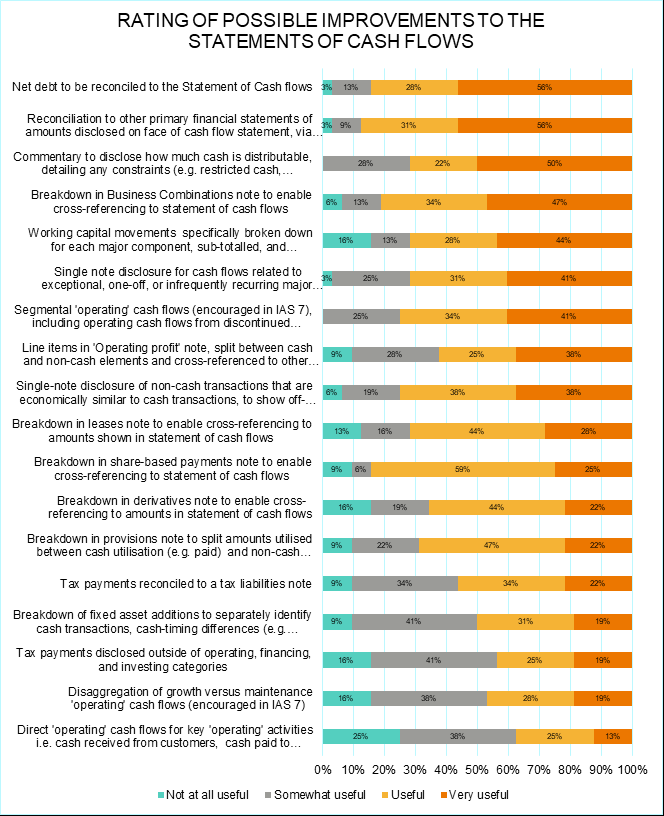
E23. The results of the user poll provide strong evidence for the need to enhance the statement of cash flows and notes to the financial statements, as well as a need for more granular and transparent information to be disclosed, to improve the cohesiveness of the primary financial statements.
Q10. Do you have any other suggested disclosures that you would find useful? If yes, please provide details and say why the disclosure would be useful.
E24. Ten of the 32 respondents suggested other improvements, including:
- "I see significant value in the mandatory requirement to prepare of a reconciliation of the movement in net debt (ie including as well as cash the likes of currency, derivatives, acquired net debt) and the provision of a clear definition of net debt (where a company's definition is different, they should provide the rationale and a reconciliation back to the required definition). A net debt reconciliation gives a fuller understanding of a company's financial performance than just cash and helps investor's to better evaluate liquidity/covenant risks.”
- "While the statement of cash flows includes cash movements, such as debt drawdowns and repayments, it does not clearly link these to their purpose (e.g., funding acquisitions or dividend recapitalisations), nor does it capture non-cash financing flows like payment in kind interest, lease liabilities, or debt-for-equity swaps. A standardised Debt & Capital Activity disclosure would improve transparency around a company's true leverage dynamics and capital structure decisions.”
- "Where a company publishes a non-GAAP cash flow measure, I believe that it should be required to reconcile this to the closest GAAP measurement. Most companies publish operating and/or free cash flow measures, and there are many different definitions of such measures. Their reconciliation back to the closest GAAP measure would enable investors to adjust the companies' definitions to their own (which can vary by sector even for an individual investor), thereby aiding comparability.”
- "Analysis of "cash equivalents" outside of the narrow construct of existing IAS 7 with details of when amounts may be realised and any redemption penalties that can be suffered to realise the amounts as cash sooner, if that is permitted by the instrument."
- “Require disclosure and reconciliation of the how the FX difference shown at the foot of the cash flow (i.e. FX differences arising on b/f cash balances) is calculated. Far too many companies use this as a balancing number to make the cash flow balance. Some of the balances I see here are factors of 10x different from any possible FX difference calculable from b/f cash balances."
- "Better analysis of non-cash items added back to operating profit.”
- "Preferable that working capital movements are included on the face of the cashflow statement and not relegated to a separate note.”
- "Better info on the working capital (the challenge will be to define what this means for the users). Impact from business combinations on the statement of cash flows. Because a takeover can turn things upside down."
- "Capex should be split into tangible assets, intangible assets and not aggregated with 'other' investments.”
- "It is often hard to reconcile provisions charged to the P&L with cash flow movements. Very important e.g. to assess remaining cash outflows from a partly used provision."
Q11. Regarding the following non-GAAP measures, would it be useful if the International Accounting Standards Board (IASB) provided a definition (i.e. became GAAP measures) against which companies would be required to disclose?
E25. There was also overwhelming support for the IASB to provide a standardised definition for both these cash flow measures, in particular for Net debt – one respondent suggested that "a sound definition of 'gross debt' is much more interesting to investors, than a definition of 'net debt’. Net debt is just gross debt minus cash. The real challenge is to have IFRS define gross debt”.
Chart 6: Support for non-GAAP measures to be defined by the IASB i.e. become GAAP measures
Pie charts showing support for defining non-GAAP measures (Net Debt and Free Cash Flow) as GAAP measures. For Net Debt: 78% Yes, 13% No, 9% No opinion. For Free Cash Flow: 69% Yes, 22% No, 9% No opinion.
Q12. If company were required to provide commentary to supplement the statement of cash flows, what information would be most useful to you, and why?
E26. With regards to a potential requirement to provide commentary on the statement of cash flows, 25 of the 32 (i.e. 78%) of respondents made suggestions as to what such commentary might include. Those suggestions included:
- "whether the company's growth is fundamentally cash generative or cash absorptive, and management's strategy for changing that";
- "cash position and capital expenditure (taking into account NCIs), as a proportion of source of funds and use of funds";
- "explanation of any complex financing transactions";
- "explanation of reconciliation items needed to ensure integrity between cash flow statement, balance sheet and income statement, including description of exceptional or one-off infrequently recurring transactions (e.g. business combinations, assets sales, legal settlements) to enable cross-reference to another note (e.g. additions / injection of capital)";
- "reconciliation of alternative performance measures to operating cash flows";
- "explanation of the company's cash and working capital management strategy / practices, including inventory, receivables, and payables, to assess the efficiency of the company's operations and its ability to manage short-term liquidity";
- "commentary on the company's debt levels, repayment schedules, and financing strategies, to help users evaluate the company's leverage, risk profile, and ability to meet its financial obligations.”;
- "commentary on forward-looking cash needs or major expected changes in cash flow drivers";
Q13. Do you have any additional improvements you would suggest or any further comments or feedback for us?
E27. Eight of the 32 respondents provided further comments on improvements to the statement of cash flows. Comments included:
- "Further clarity would be welcome on the impact of IFRS 18 on cash flow statements - limited guidance but from an initial read there will be require to align all interest within one category, but unclear as to expected implementation where interest falls across operating/financing.”
- "To make sure that the statement of cash flows can be linked to the other primary financial statements.”
- “I have noticed / discovered over time that if all the accounting standards are complied with then broadly speaking a user can check the cash flow statement as it relates to the other primary statements and disclosures. Errors in composition are often glaringly obvious - for example, where movements in working capital are calculated without adjusting for business combination additions to working capital, FX differences on b/f cash balances, deferred tax movements are wrapped into cash movements.”
- "To take into account certain non-cash transactions (e.g. debt conversion, leases...). They should be part of the statement of cash flows (that should become a ""statement of uses and sources of funds"" - which is a much better approach than simply trying to explain the cash position).”
- "I believe that companies should have a mandatory requirement to disclose average daily net debt. This gives a much more realistic view of the underlying financial strength of a business and would reduce the impact from the manipulation of the year end net debt/cash position by management in order to give a more favourable impression of the financial position of a company to investors. As result a significant number of future/impending company 'disasters' would have been more transparent to investors in advance."
Statement of Cash Flows for financial institutions
E28. An optional question was included in the survey for users of financial statements of financial institutions. For the purposes of the poll, it was noted that financial institutions include Central banks, Retail and Commercial banks, Credit unions, Savings and loan associations, Investment banks, Brokerage firms, Insurance companies, and Mortgage companies.
E29. 26 of the total 32 respondents to the survey answered these following two questions.
Q14. Please rate how useful the current Statement of Cash Flows is for financial institutions
E30. There was mixed feedback on the usefulness of the statement of cash flows for financial institutions. Consistent to the response for question 5 above, most respondents think that the statement of cash flows provides some useful information for financial institutions, albeit it is less useful for banks, more so than insurance companies and other financial institutions.
Chart 7: Usefulness of Statement of Cash Flows for financial institutions
Stacked bar chart showing usefulness ratings (Not at all useful, Somewhat useful, Useful, Very useful) of current cash flow statements for financial institutions, broken down by Analysts & Investors, Lenders & Credit rating agencies, and Other, across three categories: Banks, Insurance companies, and Other Financial Institutions.
Q15. Do you have any additional suggestions in relation to the usefulness of, or improvements to, the Statement of Cash Flows for certain types of financial institutions?
E31. Seven of the 26 respondents who answered the questions in this optional section on financial institutions, provided additional suggestions in relation to the usefulness or improvements to the statement of cash flows for such organisations.
E32. Comments included:
- “Standardisation of cash and cash equivalents (appreciate guidance has been provided but there is still divergence in application), clarity on impacts of IFRS 18, more specific guidance on presentation of total interest paid/received so that useful to the readers of the financial statements."
- "Some relevant disclosures (e.g. liquidity coverage ratio, loan-to-deposit ratios, claims payments) are already provided, but they are often outside the statement of cash flows and not well integrated. An approach that could be explored is to include or cross-reference key regulatory and funding flows to enhance the statement of cash flows's relevance for banks and insurers."
- "For financial institutions, as a result of the classification of financial instruments according to intention to hold to maturity, the disclosure of an item as cash may be misleading as an attempt to sell may imply significant losses due to market value changes in line with prevailing macro-economic factors."
- "Gold loans should be taken into account for cash flow."
Concluding comments
E33. The results of the survey are largely consistent with the feedback that the UKEB heard from users during outreach interviews which informed the third UKEB research paper Statement of Cash Flows and Related Matters: UK User and Preparer Perspectives (presented to the Board at the 28 March 2025 UKEB meeting).
E34. The UKEB will take into account the comments received during this user survey, together with the feedback received during other outreach, when undertaking further research (as approved by the Board at the 28 March 2025 UKEB meeting), including work to develop alternative statements of cash flows.
Appendix F: Project Initiation Plan (updated May 2025)1 Statement of Cash Flows and Related Matters
Purpose
F1. The UKEB delegated functions include responsibility for “participating in and contributing to the development of a single set of international accounting standards." Undertaking pro-active thought leadership activities is key to the UKEB's ability to effectively deliver this statutory function.
F2. The UKEB's Terms of Reference (ToR) further explain that with regard to thought leadership, the UKEB shall:
- Lead the UK debate on international accounting standards and reporting.
- Represent UK views in international fora with the aim of influencing debate.
- Engage with accounting and reporting and endorsement and adoption bodies in other jurisdictions, in order to improve influence and understand best practice.
- Proactively participate in the development of new global accounting standards, for example by undertaking research.
F3. A project on the statement of cash flows and related matters, as described below, supports the UKEB meeting these responsibilities. It is also consistent with the 2024-25 Regulatory Strategy as it supports the UKEB's “aim to influence the IASB early on in its standards development cycle, providing evidence-based recommendations and thought leadership on emerging issues from a UK perspective” (page 8).
Background
F4. The IASB decided to add a project on the Statement of Cash Flows and Related Matters to its research pipeline following feedback on its Request for Information: Third Agenda Consultation.
F5. Most respondents to the Request for Information recommended the addition of a potential project on cash flows to the IASB's workplan and many of them rated it as high priority. It is notable that most users of financial statements who recommended addition of this topic rated it as high priority.
F6. The Board received an update on this project, including an overview of the IASB's research plan in an IASB General Update paper in October 2024.
F7. The IASB staff have identified the following topics to explore in this project:
- changing the requirements for classifying cash flows into operating, investing and financing categories;
- specific disaggregation requirements for information about cash flows (for example, separating capital expenditures into maintenance and growth);
- changing the definition of cash and cash equivalents;
- requiring the use of the direct method;
- presentation or disclosure requirements for additional information about the non-cash effects of some transactions;
- presentation or disclosure requirements for information about commonly used cash flow measures (for example, free cash flow); and
- specific requirements for the statement of cash flows for financial institutions.
IASB plan for research to support a decision on project scope
F8. The IASB staff plan to perform initial research to gather evidence of the nature and extent of the perceived deficiencies and the likely benefits of developing new financial reporting requirements for IAS 7 Statement of Cash Flows. This research is intended to provide evidence to support the IASB's decision on the scope of the project. The initial research will also address possible ways of improving the perceived deficiencies.
F9. The IASB is considering a number of approaches it could take to the project. These include:
- A comprehensive review of IAS 7, which could lead to a new IFRS Accounting Standard.
- A phased project that could make targeted improvements to address some of the issues identified in the short-term, while undertaking a longer-term project to perform a comprehensive review of IAS 7.
- A limited project which would identify and address a few specific areas of concern.
F10. Initial research findings are expected to be reported to the IASB in Q1 2025, when the IASB will be asked whether it has enough evidence to decide on the project scope at a subsequent meeting.
Opportunity for the UKEB
F11. There is an opportunity for the UKEB to build on the work already done in the UK by the FRC (and others). While there has been research into the problems with the statement of cash flows and possible solutions to these problems, to date direct evidence from preparers and users has been limited. The UKEB can utilise its previous stakeholder engagement experience to seek more comprehensive feedback from preparers and investors.
F12. Subject to approval of this Project Initiation Plan, this project would aim to gather primary evidence on key stakeholder views, specifically, the improvements investors and creditors want made to the statement of cash flows, and preparer views on these possible improvements. This would provide a foundation for the UKEB to engage with the IASB on this project.
F13. Research would be grounded in previous work undertaken by the IASB, FRC and UKEB. It will focus primarily on exploring opportunities already identified for improvements to the statement of cash flows and related disclosures, using targeted stakeholder interviews, supported by UKEB Advisory Group discussions.
F14. IFRS 18 Presentation and Disclosure in Financial Statements made limited amendments to IAS 7. The UKEB's IFRS 18 surveys sought views on these changes, and these findings, along with additional research will form part of this research.
F15. The IASB's current timetable for completion of the research phase of their project means that the work would be more constrained than previous UKEB pro-active research projects.
Project Plan
Proportionality assessment
Significance and size
IASB Project scope
F16. The IASB is currently in the research phase of the project, and no decision has yet been made on the IASB's project scope.
Entities affected by the proposals
F17. The statement of cash flows is a primary financial statement that all entities are required to prepare. Any changes have the potential to affect all entities that prepare financial statements using IFRS Accounting Standards.
Complexity
F18. The requirements of IAS 7 are quite limited. Generally, the statement of cash flows is not considered a complex area of accounting.
F19. However, over the past 14 years, the statement of cash flows has been consistently among the top 10 issues identified by the FRC's Corporate Reporting Review (CRR) team as part of the annual review of financial statements. In the last four years it has been one of the top three issues every year, resulting in 46 restatements in company accounts.
Expected timeline / urgency
F20. The IASB is expected to start making decisions about the scope of the project in 2025. To effectively participate in this discussion, publishing a research paper during H1 2025 would be ideally timed to contribute to the IASB process. The September 2025 Accounting Standards Advisory Forum (ASAF) meeting will provide an opportunity to present a summary of the UKEB's research.
Expected interest / sensitivity
F21. As noted above, there was a significant response to IASB's Request for Information: Third Agenda Consultation, calling for a project addressing the statement of cash flows. Given the pervasive nature of the statement there will be significant interest in the project.
F22. Early discussions with UK stakeholders have indicated significant interest in the project. There are also strong views on what should be prioritised and the extent to which change is feasible.
Feedback on the proposals from desk-based research / initial outreach
F23. There has been significant interest in the UK in the statement of cash flows. As part of this proposed project the Secretariat plan to provide the Board with a comprehensive review of the relevant literature. One key element to that literature is work already done by the FRC.
FRC's Improving the Statement of Cash Flows Report - 2016
F24. In 2016, the FRC published a discussion paper “Improving the Statement of Cash Flows" for public comment, which focused on the existing IAS 7 Statement of Cash Flows and was timed to feed into the IASB's Primary Financial Statements project, from which IFRS 18 Presentation and Disclosure in Financial Statements resulted. This was followed in 2017 by a feedback statement of comments received from stakeholders.
F25. The discussion paper made a number of recommendations, including:
- Notional cash flows should not be reported in any section of the statement of cash flows. However, transparent disclosure of non-cash transactions should be required.
- Operating activities should be positively defined or described (perhaps as including transactions with customers, employees and suppliers) rather than being a residual or default classification.
- Entities should be encouraged to disclose the extent to which expenditure on property, plant and equipment represents 'maintenance' or 'growth'.
- The statement of cash flows should report inflows and outflows of cash, rather than cash and cash equivalents.
- A reconciliation of profit and cash flow should be presented in all cases (including where a direct method statement of cash flows is presented). The reconciliation should be required to reconcile a sub-total in the statement of profit or loss that represents operating income (rather than, for example, net profit or loss) and reconcile that to cash flow from operating activities.
F26. That discussion paper received 22 comment letters, 12 from the UK. Three letters were from preparers and four were from user groups. Some of the highlights from the feedback:
- A large majority of respondents agree that notional cash flows should not be reported in the statement of cash flows although there should be disclosure of non-cash transactions.
- A majority of respondents agree that operating activities be positively defined or described.
- There are split views as to whether the statement of cash flows should report flows of cash or of cash and cash equivalents.
Initial Engagement with UKEB Advisory Groups
F27. Early discussions with UKEB Advisory Groups (PAG, IAG, and AFIAG2) have drawn a mixed response. While all AGs seem content that the key issues have been identified by the IASB, there is no clear consensus yet on how those issues could be best tackled. Focusing on the links between the statement of cash flows and the other primary financial statements, however, was a key theme.
F28. There was clear support for the UKEB undertaking further research, in particular for exploring possible approaches to enhance the statement of cash flows. A number of members also expressed an interest in participating in that research.
Connectivity
F29. A stakeholder who participated in the IAG indicated a growing interest in specifically identifying "green spending" as part of the statement of cash flows. With increasing focus on disclosure of entities' climate-related risks it is not unreasonable to expect a greater focus on “green cashflows”.
F30. This is also consistent with expectations of the Bank of England and the Basel committee's Principles for the effective management and supervision of climate-related financial risks. Both of which call for greater measurement, disclosure and monitoring of climate risks, and the important role that accounting plays in this process.
F31. The implications for connectivity will be assessed as part of the outreach on the project.
Recommended UKEB project scope
F32. Based on the proportionality assessment above we recommend a "moderate scope” project and the approach described in this document reflects this.
F33. The primary outputs of the project currently expected are:
- December 2024: Background and Key issues paper - This research paper will set the stage, examining the background of the project, relevant research including an examination of previous CRR findings. The paper would include discussion of the relevant recent changes made by IFRS 18.
- March 2025: UK Investor and Preparer Perspectives paper - This research paper will summarise user and preparer perspectives on how the statement of cash flows could be improved including consideration of financial institutions. The intention is to conduct around 10 - 12 interviews with a diverse range of users and the same number of preparers of financial statements along with discussion with the IAG (early February) and PAG (early March).
F34. In meetings subsequent to the March 2025 Board meeting, the UKEB will consider whether:
- the UKEB papers, developed to that point, should be consolidated into a single comprehensive report for publication; and
- whether additional research is appropriate and feasible given the IASB's project plan and UKEB priorities at that time.
F35. In addition to the work outlined above:
- In February 2025 the Secretariat presented a research paper: Non-mandatory and Voluntary Cash Flow Disclosures Provided by UK Listed Companies. This paper reported the findings of an examination undertaken into existing reporting practice in relation to cash flow information included in the annual reports of a sample of UK listed companies.
- Between 25 March and 22 April 2025, users were invited to complete an online poll. This poll provided an opportunity for a wider range of UK users of IFRS financial statements to provide feedback on the usefulness of the statement of cash flows, the current concerns with, and potential improvements to, the requirements for cash flows.
F36. At the March 2025 meeting, the Board agreed that further research is appropriate and feasible, given the IASB's project plan and UKEB priorities at that time. As a result, the following outputs are expected:
- May 2025: Summary of UKEB initial research a consolidated summary of the findings from all three UKEB research papers (including the finalised papers as appendices), incorporating a summary of the results of the user poll.
- July 2025: Alternative statement of cash flows – based on previous research conducted, an alternate version of the statement of cash flows will be developed, incorporating the key suggestions made by users and preparers. This could be used to encourage further discussion about the ways forward for this project and provide valuable evidence to the IASB.
- July 2025: Interconnectivity of IFRS Standards / Cohesiveness of Financial Statements – mapping the links between the statement of cash flows and requirements in other IFRS Standards to highlight the existing connections, (or refine the requirements to strengthen the connections). This could allow the IASB to make minor changes that bring significant incremental value to users.
F35.F37. There is no intention to undertake research collectively with other parties as part of this project.
Project - key activities
| Key activities | Due Process Handbook |
|---|---|
| Identification of issues for research (this document) | 7.15 |
| Creation of a Project Initiation Plan (this document) | Mandatory |
| 7.16 – 7.21 | |
| Desk-based research to support the proportionality assessment | Mandatory |
| including: | |
| a) Review of IASB papers, FRC publications and various other published materials. | 7.22 |
| b) Preliminary discussions with UKEB Advisory Groups. | Optional |
| Outreach activities | 7.23 - 7.24 |
| As described above the UKEB will gather views and opinions from UK stakeholders, particularly users and investors, to contribute to the development of this research. This will include one-to-one interviews with preparers and users, and discussions with UKEB Advisory Groups. | Optional |
| Publication of a Background paper26: | |
| a) The paper will be published on the UKEB website. | 7.25 |
| b) Announcement of the publication of the paper will be made via the UKEB News Alert publication, and LinkedIn posts. | Mandatory |
| Publication of a Non-mandatory and Voluntary Cash Flow Disclosures paper26: | |
| a) The paper will be published on the UKEB website. | 7.25 |
| b) Announcement of the publication of the paper will be made via the UKEB News Alert publication, and LinkedIn posts. | Mandatory |
| Publication of a UK Investor and Preparer Perspectives paper26: | |
| a) The paper will be published on the UKEB website. | 7.25 |
| b) Announcement of the publication of the paper will be made via the UKEB News Alert publication, and LinkedIn posts. | Mandatory |
| Publication of a summary of UKEB initial research26: | |
| a) The summary will incorporate the findings of the three initial research papers produced between December 2024 and March 2025. | 7.25 |
| b) The summary will be published on the UKEB website. | Mandatory |
| c) Announcement of the publication of the summary will be made via the UKEB News Alert publication, and LinkedIn posts. | |
| Publication of Alternative statement of cash flows paper27: | 7.25 |
| a) [If agreed by the Board], this paper will be published on the UKEB website. | Mandatory |
| b) Announcement of the publication of the paper will be made via the UKEB News Alert publication, and LinkedIn posts. | |
| Publication of Interconnectivity of IFRS Standards / Cohesiveness of Financial Statements paper27: | |
| a) [If agreed by the Board], this paper will be published on the UKEB website. | 7.25 |
| b) Announcement of the publication of the paper will be made via the UKEB News Alert publication, and LinkedIn posts. | Mandatory |
Resources allocated
F36.F38. To undertake the activities described in this project plan a project team has been assigned consisting of two Project Directors working with the Project Director – Research Lead. The required resources are allowed for in the 2024/25 UKEB plan and budget.
Project timeline
F37.F39. The proposed high-level project timeline is shown below. This provides a best estimate based on information known at this time. If necessary, a revised PIP28 will be presented to the Board, to reflect any major changes, as the project progresses.
| Date | Milestones |
|---|---|
| November 2024 | Project Initiation Plan for Board approval |
| December 2024 | Background paper |
| February 2025 | Non-mandatory and Voluntary Cash Flow Disclosures paper |
| March 2025 | UK Investor and Preparer Perspectives paper |
| March–April 2025 | User poll |
| July 2025 | Alternative statement of cash flows paper |
| July 2025 | Interconnectivity of IFRS Standards / Cohesiveness of Financial Statements paper |
| Key activities | Due Process Handbook |
|---|---|
| Publication of Interconnectivity of IFRS Standards / Cohesiveness of Financial Statements paper27: | 7.25 Mandatory |
|
Resources allocated
F36.F38 To undertake the activities described in this project plan a project team has been assigned consisting of two Project Directors working with the Project Director – Research Lead. The required resources are allowed for in the 2024/25 UKEB plan and budget.
Project timeline
F37.F39 The proposed high-level project timeline is shown below. This provides a best estimate based on information known at this time. If necessary, a revised PIP28 will be presented to the Board, to reflect any major changes, as the project progresses.
| Date | Milestones |
|---|---|
| November 2024 | Project Initiation Plan for Board approval |
| December 2024 | Background paper |
| February 2025 | Non-mandatory and Voluntary Cash Flow Disclosures paper |
| March 2025 | UK Investor and Preparer Perspectives paper |
| March–April 2025 | User poll |
| July 2025 | Alternative statement of cash flows paper |
| July 2025 | Interconnectivity of IFRS Standards / Cohesiveness of Financial Statements paper |
Project Initiation Plan: Statement of Cash Flows and Related Matters - Project timeline
F38.F40 The diagram below is a graphical view of the mandatory milestone activities described above. This provides a best estimate based on information known at this time. If necessary, a revised PIP will be presented to the Board, to reflect any major changes, as the project progresses.
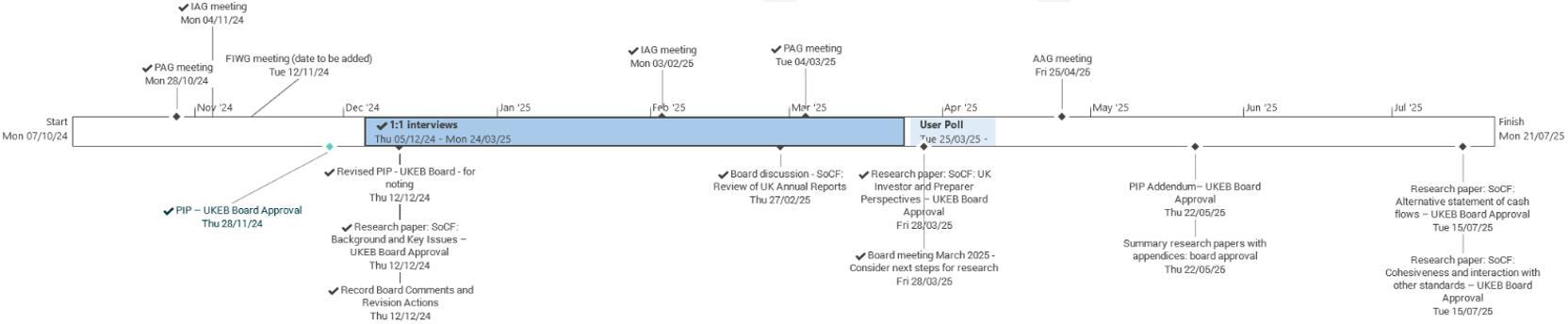
Footnotes
-
This Project Initiation Plan was updated in May 2025, following approval by the Board at the March 2025 UKEB meeting for additional UKEB research to be undertaken on the statement of cash flows and related matters, and such changes are highlighted in orange. ↩↩↩
-
Preparers Advisory Group; Investors Advisory Group; Accounting Firms and Institutes Advisory Group ↩↩↩
-
See paragraphs B59–B61 of the first research paper Statement of Cash Flows and Related Matters: A UK Perspective. ↩↩
-
See paragraph C11 of the second research paper Statement of Cash Flows and Related Matters: Non-mandatory and Voluntary Cash Flow Disclosures provided by UK Companies. ↩↩
-
IAS 7 paragraph 48 requires an entity to “disclose, together with a commentary by management, the amount of significant cash and cash equivalent balances held by the entity that are not available for use by the group”. IAS 7 paragraph 50 also states that “additional information may be relevant to users in understanding the financial position and liquidity of an entity. Disclosure of this information, together with a commentary by management is encouraged". While the IASB primarily focuses on financial reporting standards, its IFRS Practice Statement ↩↩
-
Management Commentary acknowledges the importance of narrative reporting and provides quidance on how to present management commentary alongside financial statements. Essentially, the IASB recognizes that narrative reports, which provide context and explanations for financial figures, are valuable for users of financial statements. ↩↩
-
See paragraphs C41–C49 of the second research paper Statement of Cash Flows and Related Matters: Non-mandatory and Voluntary Cash Flow Disclosures provided by UK Companies. This view is consistent with that noted in the FRC Thematic Review: Reporting by Smaller Listed and AIM Quoted Companies (pages 38 and 39) and the FRC Thematic Review: Cash flow statements and liquidity (IAS 7, IFRS 7) (page 8). ↩↩
-
When IFRS 18 Presentation and Disclosure in Financial Statements becomes effective, it introduces a requirement in IAS 7 that when the indirect method is used for reporting 'cash flows from operating activities' in the statement of cash flows, the starting point will be the newly introduced mandatory sub-total 'operating profit or loss' as defined in paragraph 70 of that Standard. ↩↩
-
See paragraphs B94–B116 of the first research paper Statement of Cash Flows and Related Matters: A UK Perspective. ↩↩
-
Inflation linked-debt such as daily inflation-indexed bonds, where the principal is indexed to inflation or deflation on a daily basis. ↩↩
-
A "roll forward" is a track how an account balance changes over a specific period of time, by starting with a beginning balance, adding any relevant transactions or adjustments during the period, and calculating the resulting ending balance; essentially showing the movement of an account balance from one reporting period to the next. ↩↩
-
See paragraphs C55–C60 of the second research paper Statement of Cash Flows and Related Matters: Non-mandatory and Voluntary Cash Flow Disclosures provided by UK Companies. ↩↩
-
Following on from the January 2021 Exposure Draft Regulatory Assets and Regulatory Liabilities, the IASB expects to publish a new Standard IFRS 20 Regulatory Assets and Regulatory Liabilities in the second half of 2025. The new Standard will replace IFRS 14 Regulatory Deferral Accounts. ↩↩↩
-
See paragraphs B119-B124 of the first research paper Statement of Cash Flows and Related Matters: A UK Perspective and paragraphs C81-C88 of the second research paper Statement of Cash Flows and Related Matters: Non-mandatory and Voluntary Cash Flow Disclosures provided by UK Companies. ↩↩↩
-
See paragraphs B114-B116 of the first research paper Statement of Cash Flows and Related Matters: A UK Perspective and paragraphs C89-C95 of the second research paper Statement of Cash Flows and Related Matters: Non-mandatory and Voluntary Cash Flow Disclosures provided by UK Companies. ↩↩↩
-
See paragraphs B119-B124 of the first research paper Statement of Cash Flows and Related Matters: A UK Perspective and paragraphs C81-C88 of the second research paper Statement of Cash Flows and Related Matters: Non-mandatory and Voluntary Cash Flow Disclosures provided by UK Companies. ↩↩↩
-
See paragraphs C89-C95 of the second research paper Statement of Cash Flows and Related Matters: Non-mandatory and Voluntary Cash Flow Disclosures provided by UK Companies. ↩↩↩
-
See paragraphs B125-B128 of the first research paper Statement of Cash Flows and Related Matters: A UK Perspective. ↩↩↩
-
The feedback received was similar to that received by the FRC as reported in the FRC Lab project report: Operating and investing cash flows (November 2012). ↩↩↩
-
IAS 7 was issued in December 1992, effective for annual periods beginning on or after 1 January 1994. ↩↩↩
-
IFRS 18 removes the accounting policy choice for interest paid, so that capitalised interest will be required to be shown in the statement of profit or loss under financing activities. ↩↩↩
-
The IASB issued "Applying IFRS 9 Financial Instruments with IFRS 4 Insurance Contracts (Amendments to IFRS 4)" on 12 September 2016. The amendments address concerns arising from implementing the financial instruments Standard, IFRS 9, before implementing IFRS 17 Insurance Contracts, the amendments also supplemented existing options in IFRS 4 to address those concerns. IFRS 9 Financial Instruments was issued on 24 July 2014 and became effective on 1 January 2018. IFRS 17 Insurance Contracts was issued on 18 May 2017 and became effective on 1 January 2023. ↩↩
-
Introduced in January 2016, the disclosure initiative (IAS 7 paragraphs 44A–44E) requires companies to disclose changes in liabilities arising from financing activities, that enable users of financial statements to evaluate changes in liabilities arising from financing activities, including both changes arising from cash flows and non-cash changes. In May 2023, supplier finance arrangements disclosure requirements were introduced (IAS 7 paragraphs 44F–44H), that enables users to assess the effects of such arrangements on the entity's liabilities and cash flows and on the entity's exposure to liquidity risk. ↩↩↩
-
These three papers could be published individually or as part of a consolidated report. ↩↩↩↩
-
These two papers could be published individually or as part of a consolidated report. ↩↩↩↩↩↩
-
This Project Initiation Plan was updated in May 2025, following approval by the Board at the March 2025 UKEB meeting for additional UKEB research to be undertaken on the statement of cash flows and related matters, and such changes are highlighted in orange. ↩↩↩↩
-
The Standard defines liabilities arising from financing activities as liabilities for which cash flows were, or future cash flows will be, classified in the statement of cash flows as cash flows from financing activities. ↩↩
-
In this paper the term 'users' is as described in paragraph 1.5 of the Conceptual Framework, which states that "primary users of financial statements are existing and potential investors, lenders and other creditors who must rely on general purpose financial reports for much of the financial information they need". ↩
-
This is consistent with the approach taken by the IASB, see for example paragraph 8 of: ap32-summary-of-feedback.pdf ↩↩
-
Meeting minutes for the Investor Advisory Group can be found here: https://www.endorsement-board.uk/investors-advisory-group-iaq ↩↩
-
Meeting minutes for the Investor Advisory Group can be found here: https://www.endorsement-board.uk/pag-advisory-group ↩↩
-
See paragraphs B13-B14 of the first research paper Statement of Cash Flows and Related Matters: A UK Perspective. ↩↩
-
Funds from operations is a figure used by real estate investment trusts (REITs) to define the cash flow from their operations, usually starting with cash flows from operating activities, it excludes one-time cash inflows, such as income from the sale of an asset. ↩↩
-
See paragraph C16 of the second research paper Statement of Cash Flows and Related Matters: Non-mandatory and Voluntary Cash Flow Disclosures provided by UK Companies. ↩↩
-
Users need to be able to understand the effect of a discontinued operation on an entity's future cash flows. Paragraph 33(c) of IFRS 5 Non-current Assets Held for Sale and Discontinued Operations requires an entity to provide "the net cash flows attributable to the operating, investing and financing activities of discontinued operations. These disclosures may be presented either in the notes or in the financial statements". ↩↩
-
Statement of Standard Accounting Practice 10: Statements of Source and application of funds was first issued in July 1975 and withdrawn in September 1991, when it was superseded by FRS 1 Cash Flow Statements. FRS 1 was further revised in 1996 and withdrawn for accounting periods beginning on or after 1 January 2015, when FRS 102 The Financial Reporting Standard applicable in the UK and Republic of Ireland became effective. ↩↩
-
The statement of source and application of funds shows how an organisation has raised finance for a specified period and how that finance has been applied. Sources of funds are typically trading profits, issues of shares or loan stock, sales of fixed assets, and borrowings. Applications are typically trading losses, purchases of fixed assets, dividends paid, and repayment of borrowings. Any balancing figure represents an increase or decrease in working capital. Source: Oxford Reference. The SSAP 10 definition of (net liquid) funds was 'cash at the bank and in hand and cash equivalents (e.g. investments held as current assets) less bank overdrafts and other borrowing repayable within one year of the accounting date'. ↩↩
-
https://www.grantthornton.global/globalassets/1.-member-firms/global/insights/insight-content-blocks-and-media/ifrs/ifrs-18/get-ready-for-ifrs-18.pdf ↩↩
-
https://www.grantthornton.global/globalassets/1.-member-firms/global/insights/insight-content-blocks-and-media/ifrs/ifrs-18/get-ready-for-ifrs-18.pdf ↩↩
-
Utilised specifically for the purpose of enhancing the group's fixed asset base is analogous to the treatment of PP&E in the statement of cash flows and its interaction with the income statement. ↩↩
-
See page 14 of Effects Analysis IFRS 18 Presentation and Disclosure in Financial Statements published April 2024. ↩↩