4 IFRS 18 Presentation and Disclosure in Financial Statements
22 May 2025 Agenda Paper 4
Executive Summary
Project Stage
| IASB | Research / Pipeline | Discussion paper | Redeliberation | Exposure Draft | Redeliberation | Final standard | Post Implementation Review |
|---|---|---|---|---|---|---|---|
| UKEB | Research / Influencing | Research / Influencing | Monitoring | Influencing | Monitoring | Endorsement | Influencing |
Project Scope
Significant
Purpose of the paper
The purpose of this paper is to seek comments from the Board on the revised long-term public good assessment (Section 4) of the [Draft] Endorsement Criteria Assessment (ECA) for IFRS 18 Presentation and Disclosure in Financial Statements. The revisions address the comments provided by the Board at the March 2025 meeting.
This paper also brings for Board consideration a list of agenda decisions issued by the IFRS Interpretations Committee that reference IAS 1 Presentation of Financial Statements and how the IASB is updating those references.
Summary of the Issue
The purpose of the [Draft] ECA is to assess whether the Standard meets the statutory criteria for adoption set out in SI 2019/685. Section 4 in this [draft] ECA assesses whether IFRS 18 is likely to be conducive to the long term public good in the UK. At the March 2025 meeting the Board requested revisions to the draft long-term public good assessment section. This paper provides a revised version of this section for Board's consideration.
In addition, the Secretariat has reviewed the list of agenda decisions identified by the IASB that include references to IAS 1, as per Board's request at the March 2025 meeting. The Secretariat's view is that most of the agenda decisions do not raise significant issues that may require further consideration. However, the withdrawal of one of the Agenda Decisions on Presentation of Liabilities or Assets Related to Uncertain Tax Treatments (September 2019) may impact some existing practice.
Questions and decisions for the Board
- Does the Board have any comments on Section 4 (UK long term public good assessment)?
- Does the Board agree that in general the agenda decisions identified do not raise significant issues that may require further consideration?
Recommendation
We recommend the Board:
- Approves the changes made to Section 4 of the [draft] ECA.
- Agrees that in general the agenda decisions identified do not raise significant issues that may require further consideration.
Appendices
Appendix A: Section 4: Revised UK long term public good assessment
Background
1At the March 2025 meeting the Board considered sections of the [Draft] Endorsement Criteria Assessment ([Draft] ECA) for the endorsement assessment of IFRS 18 Presentation and Disclosure in Financial Statements.
2At this meeting the Secretariat has brought for the Board's consideration:
- A revised assessment of whether IFRS 18 is likely to be conducive to the Long Term Public Good (LTPG) in the UK (Section 4 of the [Draft] ECA), addressing the Board's comments raised at the March 2025 meeting.
- A list of agenda decisions1 issued by the IFRS Interpretations Committee (Committee) that contain references to IAS 1 Presentation of Financial Statements. This is to:
- Inform the Board about how the IASB is planning to update references to IAS 1 that will be superseded by new or amended requirements in IFRS 18; and
- Ensure that stakeholders did not raise significant issues that may require further consideration.
Revision to the Long-Term Public Good assessment (Section 4)
3At the March 2025 meeting, the Board requested revisions to the draft LTPG assessment for IFRS 18. The Board also provided specific drafting comments.
4The revised Section 4 (see Appendix A) includes the following overall changes to address the Board's concerns:
- Streamlined the LTPG section, focusing on the main conclusions of the economic analysis. Where possible, the use of plain English was prioritised, with technical language and methodological aspects relegated to Appendices C, D and E2.
- Ensured that the reporting of the evidence on costs and benefits is coherent throughout the LTPG assessment, including the appendices.
- Improved the reporting of the monetary estimates of implementation costs by:
- Better caveating the analysis, explicitly noting the associated limitations.
- Carefully reconsidering the evidence collected. This led to a revised monetary estimate of ongoing costs.
- Explaining that quantitative cost estimates comprise both monetary costs and staff-time reallocation costs and conducting an approximate allocation between monetary and staff-reallocation costs based on the evidence collected.
- Better caveating the analysis of capital markets effects, explicitly noting the associated limitations.
Question for the Board
1Does the Board have any comments on Section 4 (UK long term public good assessment)?
Research on the agenda decisions3 that include explanatory material on IAS 1
6As requested by the Board, the Secretariat has reviewed the list of agenda decisions identified by the IASB (41 in total) and has identified one additional agenda decision4 that includes references to IAS 1 (42 agenda decisions in total). A complete list is presented in Annex A. From these agenda decisions:
- 15% (6 agenda decisions) have explanatory material that focuses exclusively on questions about the requirements in IAS 1.
- 84% (35 agenda decisions) have explanatory material that clarify requirements in other IFRS Accounting Standards and that include 'incidental' references to the requirements in IAS 1 (for example, references to 'remind' the reader about the application of the requirements in IAS 1).
- 1% (one agenda decision) has not yet been considered by the IASB.
7At the April 2025 meeting the IASB staff reported that the agenda decisions that contain references to IAS 1 would be either withdrawn or the references to IAS 1 be updated5. The IASB decided to ask the Committee to consider how an entity would apply the requirements in IFRS 18 to the fact pattern described in Agenda Decision Supply Chain Financing Arrangements—Reverse Factoring6. The table below summarises the approach that will be taken by the IASB:
| Agenda decisions | That relate solely to IAS 1 | With references to IAS 1 | Total |
|---|---|---|---|
| Withdraw | 1 | 1 | 2 |
| Update the references to IAS 1 | 5 | 33 | 38 |
| Approach to be decided by the Committee | - | 1 | 1 |
| Additional agenda decision | - | 1 | 1 |
| Total | 6 | 36 | 42 |
Do the agenda decisions raise significant issues that may require further consideration?
8The Secretariat's general view is that the IASB's approach to these agenda decisions do not raise significant issues that may require further consideration because:
- The analysis suggests most of the IASB's tentative decisions are appropriate (see paragraph 9 below for the exception).
- The potentially significant Agenda Decision Supply Chain Financing Arrangements—Reverse Factoring is going back to the IASB to be discussed.
9However, the approach taken to withdraw the Agenda Decision on Presentation of Liabilities or Assets Related to Uncertain Tax Treatments (September 2019) 7, may be problematic as the Big 4's accounting manuals all refer to this Agenda Decision as authoritative guidance on how to present Uncertain Tax Positions. Given the IASB staff paper from November 2024 reported an intention to add staff annotations to the references to IAS 1 for this Agenda Decision, this represents a change that may have unintended consequences. We are in communication with the IASB and we will keep the Board updated in this respect.
Questions for the Board
2Does the Board agree that, in general, the agenda decisions identified do not raise significant issues that may require further consideration?
Next steps
10At the next meeting, the Secretariat plans to bring:
- A complete [Draft] ECA for Board's discussion and approval.
- A paper discussing other outstanding issues raised at the Board's consideration at the March 2025 meeting, as follows:
- An analysis of the elements that have been imported from IAS 1 Presentation in the Financial Statements into IFRS 18 without significant change. This is to ensure that the [Draft] ECA assesses IFRS 18 as a whole against the endorsement criteria.
- Two alternatives for Section 6 of the [Draft] ECA on whether IFRS 18 represents a significant change in accounting practice: one setting out that IFRS 18 is likely to lead to a significant change in accounting practice; and an alternative assessment that sets out that IFRS 18 is not likely to lead to a significant change in practice.
Timeline
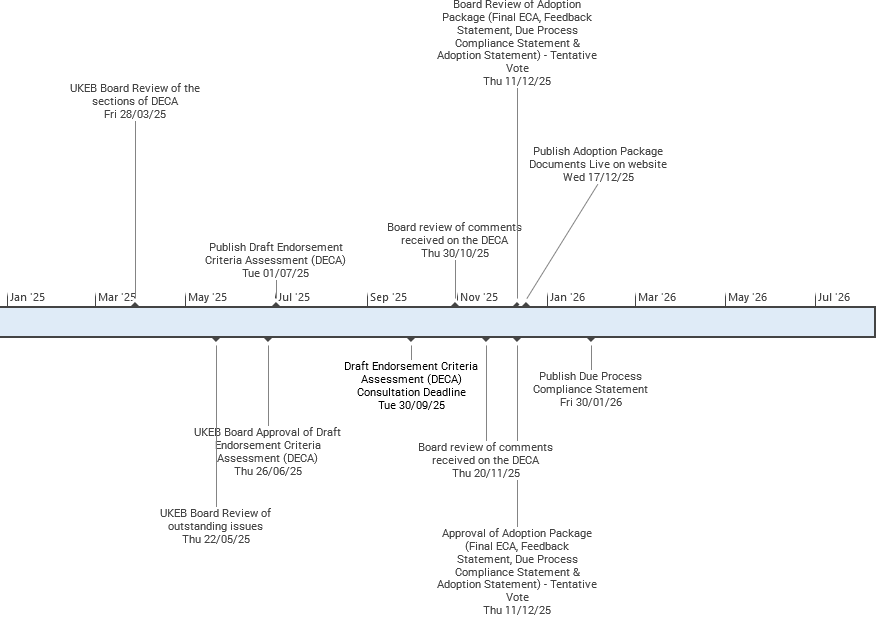
12The proposed timeline aims for the Board to consider whether to adopt IFRS 18 in December 2025. The proposed timeline is set out below.
| Date | Milestones |
|---|---|
| 23 February 2024 | Draft Project Initiation Plan for Board approval |
| 28 March 2024 | Final Project Initiation Plan for Board's noting |
| 28 March 2025 | [Draft] ECA for Board's consideration and comments |
| 22 May 2025 | [Draft] ECA–Long term public good section and relevant agenda decisions |
| 26 June 2025 | [Draft] ECA for Board approval |
| Estimated [Draft] ECA consultation period (90 days): 1 July–30 September 2025 | |
| Oct–Nov 2025 | Board review of feedback received on the [Draft] ECA. |
| 11 December 2025 | - Consideration of Adoption Package |
| - Board members provide a tentative vote | |
| December 2025 | - Voting form sent to Board members |
| - Publication of voting outcome and Adoption Package on the UKEB website | |
| 29 January 2026 | Due Process Compliance Statement for noting |
Endorsement and adoption partial timeline for 2025
Annex A: List of agenda decisions that refer to the requirement(s) in IAS 1
A1This section includes a list of the agenda decisions that include references to IAS 1 showing those that:
- Focus solely on clarifying requirements in IAS 1; and
- Clarify requirements in other IFRS Accounting Standards and that include incidental references to the requirements in IAS 1.
Agenda decisions focusing solely on IAS 1 requirements
A2The following six agenda decisions focus solely on IAS 1. They are expected to be treated in the following ways:
| Agenda decisions | IAS 1 paragraph references |
|---|---|
| Withdraw agenda decision8 | |
| 1 Presentation requirements (May 2014) | Various |
| Update references to IAS 19 | |
| 2 Comparative information for prospectuses (June 2005) | 36 |
| 3 Going concern disclosure (July 2010) | 25 |
| 4 Disclosure requirements relating to assessment of going concern (July 2014) | 25, 122 |
| 5 Preparation of Financial Statements when an Entity is No Longer a Going Concern (June 2021) | 25 |
| 6 Current or non-current asset classification–normal operating cycle (June 2005) | 57(a), 57(c) and 71 |
Agenda decisions with references to IAS 1
A3The following 35 agenda decisions have references to IAS 1 that are expected to be treated in the following ways:
A4The following agenda decision is additional to those reported in IASB April 2025 agenda paper 12D and is expected to be withdrawn as the questions were addressed as part of Lack of Exchangeability (Amendments to IAS 21 The Effects of Changes in Foreign Exchange Rates):
Additional agenda decision
| Agenda decision | IAS 1 references |
|---|---|
| 1 Determination of the exchange rate when there is a long-term lack of exchangeability (September 2018) | Paragraphs 112, 117–133 |
Appendix A: Section 4: Revised UK long term public good assessment
Introduction
4.1This section analyses whether IFRS 18 is likely to be conducive to the long term public good for IFRS 18. The assessment comprises the following pieces of evidence:
- Analysis of whether the use of IFRS 18 likely to improve the quality of financial reporting.
- Economic impact assessment, focusing on:
- Costs and benefits of applying IFRS 18.
- Wider economic effects associated with the application of IFRS 18.
- The consequences of not adopting IFRS 18 (counterfactual analysis).
Is use of IFRS 18 likely to improve the quality of financial reporting?
4.3Regulation 7(2)(a) of SI 2019/685 requires the UK long term public good assessment to consider whether the use of the standard is likely to improve the quality of financial reporting.
4.4In conducting this assessment, the UKEB adopts a relative approach rather than an absolute approach. This means that this assessment is a relative one (does IFRS 18 provide information that is more understandable, relevant, reliable and comparable than the current accounting?) rather than an absolute one (does IFRS 18 provide information that is understandable, relevant, reliable and comparable?).
Improvements introduced by IFRS 18
4.5The IASB developed IFRS 18 in response to strong demand from stakeholders, particularly from users of financial statements, for improvements to the reporting of financial performance16 as IFRS Accounting Standards do not have detailed requirements on:
- the classification of income and expenses in the statement of profit or loss;
- the subtotals to present above ‘profit or loss' in the statement of profit or loss; and
- grouping or disaggregation of information in the primary financial statements and in the notes to the financial statements.
4.6The absence of these requirements has led to diversity in practice, making it difficult for users to analyse and compare companies' performance.
4.7In addition, there are no mandatory requirements around the use of Alternative Performance Measures or 'APMs'17.
4.8The following paragraphs highlight the principal areas where IFRS 18 is likely to lead to improvements in the quality of financial reporting for entities in the UK.
Categories and subtotals
New specified subtotals and new structure for the statement of profit or loss
4.9The introduction of new specified subtotals and required categories in the statement of profit or loss is expected to provide users with:
- Additional useful information about the entity's operating performance and its performance before financing. This will result in more relevant and reliable information for users' decision making.
- Improved comparability through new required categories (operating, investing and financing) and through a definition of operating profit and a consistent starting point for their analyses. This will also enable users to understand financial information more easily as currently IAS 1 Presentation of Financial Statements does not provide a structure to the statement of profit or loss.
4.10The use of the operating category as the 'default' category, will also ensure that all income and expenses from an entity's main business activities are presented in the same category, which will facilitate comparability between entities.
4.11These views are shared by respondents to the UKEB surveys:
UKEB Preparer survey
"Respondents who agreed with the requirements on defined categories and subtotals [...] observed a number of benefits derived from these requirements. They think that these requirements will:
- help provide more comparable information [...] that would help users with their analysis;
- enhance the understandability of an entity's business activities; [...]"
UKEB User survey
"A great majority of respondents agree that the new structure and defined subtotals in the income statement will be useful as this will:
- improve users' ability to compare performance:
- between entities (91%); and
- between reporting periods for the same entity (86%);
- improve the understanding of the drivers of financial performance (77%);
Management-defined Performance Measures
Enhanced transparency, and reliability of MPM information
4.12The integration of a subset of APMs (i.e. those that meet the definition of an MPM in IFRS 18) as part of an entity's financial information will enhance the reliability and transparency for users of these measures and will add discipline in the disclosure of these measures. This view is shared by respondents to the UKEB surveys:
UKEB Preparer survey
"Nearly half of respondents (56%) considered that the requirements on MPMs will represent an improvement over current practices for communicating financial performance. Some of the reasons provided were that:
- including these measures in a single location in a note to the financial statements will bring discipline, transparency and confidence on those measures as they will be subject to external audit [...]”
UKEB User survey
"Many users (86%) observed that auditing MPMs will enhance users' confidence in and credibility of these measures.”
Enhanced relevance and understandability of MPM information
4.13The requirements on MPMs will also provide more relevant and understandable information for users on the entity-specific performance measures that qualify as MPMs and enable users to make adjustments they consider necessary in their analyses.
4.14These views are shared by respondents to the UKEB surveys:
UKEB Preparer survey
"Nearly half of respondents (56%) considered that the requirements on MPMs will represent an improvement over current practices for communicating financial performance. Some of the reasons provided were that:
- the MPM requirements will improve understandability and comparability of these measures for users"
UKEB User survey
"Many respondents (77%) were of the view that the requirements on MPMs will help users understand how entities view their performance [...]”
Aggregation and disaggregation
Enhanced comparability, understandability and relevance of the information presented or disclosed
4.15IFRS 18 enhances the grouping and disaggregation of financial information. It also introduces new and defined roles for the primary financial statements and the notes to guide the presentation and disclosure of information. These will result in greater disaggregation in the primary financial statements and notes that would allow users to understand and forecast performance metrics.
4.16IFRS 18 also enhances the guidance around the presentation and disclosure of an analysis of operating expenses, including new requirements for disclosure of operating expenses by nature. This will result in more comparable, understandable and relevant information for users.
4.17The guidance on labelling of items should also lead to more informative and relevant description of items, enabling users to understand the nature of the items included in the financial statements.
4.18These views are shared by respondents to the UKEB surveys as shown below:
UKEB Preparer survey
"A narrow majority of respondents (61%) supported the requirements on aggregation and disaggregation because they:
- Improve the comparability and consistency of the information presented and/or disclosed across different entities and industries [...]
- Enhance the understandability, relevance and reliability of the primary financial statements [...]"
UKEB User survey
"Most respondents (77%) agreed that the guidance on the use of the label 'other' and requiring the disaggregation of large 'other' items will enhance comparability"
Limited changes to IAS 7
Enhanced comparability, understandability and relevance of cash flows information
4.19Requiring the operating profit subtotal as a consistent starting point for the reconciliation of cash flows under the indirect method will simplify the reconciliation of cash flows from operating activities making this information more relevant and understandable. It will also make the statement of cash flows more consistent and help investors analyse and compare entities' cash flows.
4.20By removing alternatives for the classification of cash flows related to interest and dividends paid or received, will make the statement of cash flows more consistent and comparable. This will also bring more relevant information for users about the role of interest and dividends in an entity's business activities.
Potential improvement from interaction across the main changes
4.21The enhanced principles of aggregation and disaggregation, including the concept of 'useful structured summary', and the requirements of categories and subtotals should result in a more understandable structure of the statement of profit or loss.
Most respondents in a global survey18 conducted by CFA Institute expected that improvements in the structure of the statement of profit or loss and enhanced disaggregation of statement of profit or loss can also reduce the need for APMs.
Summary of whether IFRS 18 likely to improve the quality of financial reporting
4.22Implementing IFRS 18 will lead to:
- improvements to the presentation and disclosure of information in the primary financial statements and the notes; and
- financial information that is more useful and relevant to users.
Therefore, the UKEB [tentatively] concludes that IFRS 18 is likely to improve the quality of financial reporting in the UK.
Economic impact assessment
4.23The economic impact assessment considers the following:
- Government guidance.
- Third-party work on the economic assessment of IFRS 18.
- Analysis of costs and benefits that are likely to result from the use of IFRS 18.
- Whether the use of IFRS 18 is likely to have an adverse effect on the economy of the UK, including on economic growth (wider economic effects).
- The consequences of not adopting IFRS 18 (counterfactual analysis).
Government guidance
4.24The UK government's Better Regulation Framework (BRF) provides a set of guidelines on how to conduct economic impact assessments for UK government departments.19
4.25The UKEB currently is not required to apply the BRF. However, the UKEB considered and agreed that it should broadly follow the BRF guidance. Accordingly, the cost and benefits analysis (CBA) for the adoption of IFRS 18 was developed to be broadly consistent with the BRF. The analysis may deviate from government guidance where it does not lead to meaningful outcomes from an accounting standard setting perspective.20
Third-party work on the economic assessment of IFRS 18
4.26This section summarises the work carried out by other organisations on the costs and benefits of applying IFRS 18.
IASB Effects Analysis
4.27When the IASB published IFRS 18, the Effects Analysis alongside the Standard reports on the likely costs and benefits associated with the new requirements at an international level.
4.28The IASB gathered evidence on the topic largely through consultation, outreach with stakeholders (users, preparers, regulators, standard-setters, accounting firms and academics) and fieldwork.
4.29The main results are as follows.
Implementation costs:
4.30Preparers: Preparers are expected to incur some implementation costs, attributable mainly to: changes in internal processes and controls; changes to information systems; training for staff and management; and communication (internally and to third parties). Most implementation costs are anticipated to be one-off. The size of ongoing costs will largely depend on how IFRS 18 is applied. For example, companies might incur ongoing costs if application of the requirements leads to a change in how they communicate performance. The Standard may also result in ongoing costs if a company's processes require the manual collection of data. Ongoing costs are nonetheless expected to gradually reduce and be subsumed into business as usual.
4.31Users: Users will likely incur some minor costs to adjust models and methods of analysis to the new requirements.
4.32Regulators: Regulators may face some costs to revise regulatory templates and possibly develop procedures to regulate the new requirements (e.g. the enforcement of the new requirements for MPMs).
4.33Auditors: Auditors are likely to incur higher costs to evaluate the judgements entities will make to apply the new requirements (e.g. on presentation and disaggregation) and to audit the new requirements.
Benefits for users
4.34Comparability: IFRS 18 is expected to enhance comparability of financial statements by standardising the structure of the statement of profit or loss and requiring preparers to report consistent subtotals, particularly operating profit. As a result, users are expected to use time more efficiently when analysing financial statements. Users will also benefit from the use of the operating profit subtotal as a starting point for the indirect method of reporting cash flows from operating activities.
4.35Transparency: The new aggregation and disaggregation requirements may lead to decision-useful items that were aggregated in the past to be presented separately in the financial statements. As a result, users would benefit from additional (audited) decision-useful information. In addition, requirements on MPMs will improve the transparency of APMs that meet IFRS 18 criteria.
Draft EFRAG Endorsement Advice on IFRS 18
4.36In May 2025, EFRAG submitted its Final Endorsement Advice on IFRS 18 to the European Commission. This assessment summarises EFRAG's technical and economic analysis on IFRS 18. In its Endorsement Advice, EFRAG confirmed the initial assessment that IFRS 18 satisfies the criteria for endorsement in the EU and therefore is recommended for endorsement.21
4.37For its assessment, EFRAG gathered evidence through desk-based research, an analysis of 2023 annual reports and associated press releases of 45 European listed entities.22 EFRAG also considered the feedback received during its field testing, targeted stakeholder outreach and from EFRAG's technical expert groups and working groups.
4.38A summary of EFRAG's main observations derived from its economic analysis is presented below.
Implementation costs
4.39Preparers: Reporting entities will incur some initial one-off costs, but ongoing costs to comply with the new requirements should be relatively low.
4.40Users: EFRAG does not anticipate any significant costs. While users will need to become familiar with the new requirements, the costs involved are anticipated to be minimal.
Benefits
4.41Users: Users provided positive feedback, indicating that:
- The new structure for the statement of profit or loss will allow for better analysis and improved comparability.
- The enhanced aggregation and disaggregation requirements will lead to better understandability of the information presented.
- The information about the nature of expenses will make it easier to forecast future operating expenses.
- The disclosure of MPMs in a single note and the reconciliation requirements will improve the reliability of such information.
4.42Preparers: IFRS 18 will lead to a better presentation of preparers' performance, which will lead to a better evaluation of stewardship and more efficient capital allocation.
Work by other organisations
4.43At the time of writing, research from other organisations on the economic effects of IFRS 18 was relatively scarce.
4.44Reports from audit firms sometimes touched upon the economic consequences of adoption without conducting in-depth analysis.
4.45On costs:
- EY commented that IFRS 18 may require preparers to change their information systems and their data collection processes to apply IFRS 18.23
- PwC suggests that preparers may incur some extra costs, especially due to the new structure of the statement of profit or loss, the additional disclosures, and required changes in processes and IT systems for companies.24
4.46On benefits:
- KPMG suggests that IFRS 18 permits preparers to better “tell their story”. They also state that users will benefit from (a) greater consistency of presentation in the income and cash flow statements, and (b) more disaggregated information. The credibility of management's key performance indicators will increase as a result of making some non-GAAP measures part of the audited financial statements with the requirements for MPMs.25
- Grant Thornton believe IFRS 18 will improve the overall quality of financial reporting and help users compare financial statements.26
Analysis of costs and benefits likely to result from the use of IFRS 18
Objective
4.47The assessment of the long-term public good involves an analysis of costs and benefits associated with the use of IFRS 18.
4.48The cost and benefits analysis (CBA) looks at the economic impact in terms of direct compliance costs (one-off and ongoing). It also looks at direct benefits for stakeholders affected: preparers, users and other stakeholder categories (i.e. auditors, regulators). As is common with financial reporting regulation, preparers are expected to incur most compliance costs, largely for the direct benefit of users of financial statements.
4.49The analysis of costs and benefits associated with the implementation of IFRS 18 focuses on incremental costs and benefits, i.e. costs and benefits incurred as a direct result of meeting the requirements of the standard. These are then split between one-off and ongoing costs and benefits.
4.50Qualitative and quantitative evidence on costs comprises both expected monetary costs (e.g. external audit) and staff reallocation costs (e.g. because of familiarisation, changes to internal processes).
Collection of evidence
4.51Evidence was collected using different research tools.
- Surveys: During Q3 2024, the UKEB conducted two surveys, one for preparers and one for users, to collect evidence to assess whether IFRS 18 meets the technical and the long term public good assessment criteria for endorsement.27
- Webinar poll: In July 2024, the UKEB held a joint webinar with the IASB to discuss the key requirements of IFRS 18 and its implications. During the webinar, participants were asked to respond to a poll on the costs and benefits of adoption, the results of which are summarised below.
- Questionnaire to auditors: During Q3 2024, the UKEB sent a short questionnaire to members of the Accounting Firms and Institutes Advisory Group (AFIAG) to gather views on the likely costs and benefits of adoption.
- Engagement with UKEB Advisory Groups and with its Financial Instruments Working Group (FIWG).
- Interviews: During Q4 2024, The UKEB conducted a total of 15 interviews with preparers to gather additional quantitative information on implementation costs, as well as detailed contextual information for the long-term public good assessment.
- Other engagement: The UKEB engaged bilaterally with UK regulators, accounting professional bodies, industry associations (including the QCA), users and other national and regional standard setters to understand their views on costs and benefits associated with the adoption of IFRS 18.
Users
Benefits for users
4.52Respondents to the User survey were asked to provide information about benefits, such as incremental cost reductions, as well as incremental one-off and ongoing costs, associated with the implementation of IFRS 18.
4.53On direct benefits, users reported that the more consistent presentation of the statement of financial performance that IFRS 18 will bring should result in more efficient use of time spent analysing financial statements and an increase in the quality of analysis/reports. Nearly half of the respondents also believed the standard will lead to enhanced company assessments. Chart 1 provides a visual representation of the results:
Chart 1: Direct benefits of IFRS 18 to users of financial statements
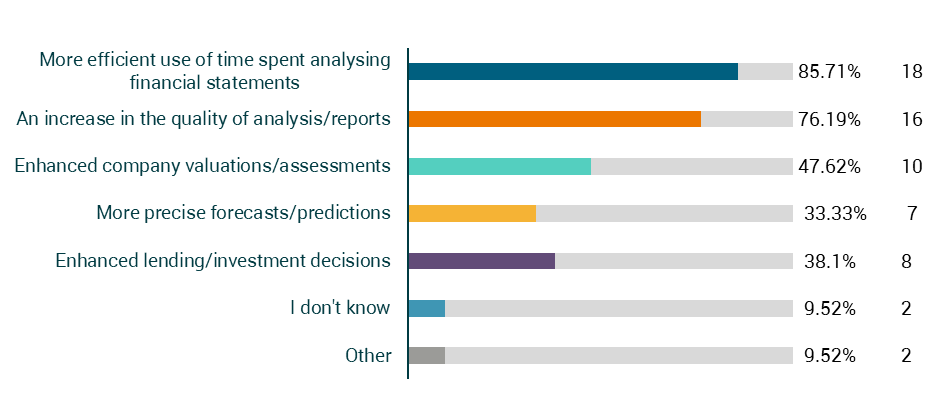
Note: Benefits are quantified when feasible and proportionate. The UKEB are unable to quantify the benefits listed above as it was not considered feasible.
4.54When considering individual sets of requirements, respondents to the UKEB User survey suggested the following:
- Categories and subtotals: A large majority of respondents agreed that the requirements will enhance the decision-usefulness of IFRS financial statements, improve comparability of financial performance information, and enhance the understandability of the drivers of financial performance.
- Management-defined performance measures: A large majority of respondents agreed that the requirements will add discipline and transparency to the MPM disclosures, enhance the credibility of the performance measures, and enable users to better understand and compare the financial performance.
- Aggregation and disaggregation: A large majority of respondents agreed that the general requirements will enhance decision-usefulness of financial statements and the notes. They also agreed that requiring specified expenses by nature and ‘more informative labelling' will enhance comparability and understandability of the performance drivers.
4.55The UKEB Preparer survey provided additional evidence on the potential benefits for users of IFRS 18. Specifically, the survey asked preparers to indicate whether they expected IFRS 18 to affect:
- The comparability of the entity's reporting of financial performance: A majority of respondents (60%) indicated that they anticipate a mild to strong positive effect.
- The transparency of the entity's financial performance: A slight majority of respondents (51%) indicated that they anticipate a mild to strong positive effect. A member of the IAG provided feedback in line with this result, noting that the IFRS 18 requirements may lead to more transparent financial information and allow the entities to tell their own story.
- The reporting of an entity's financial performance in line with underlying economics: A sizable minority of respondents (31%) indicated that they anticipate a mild to strong positive effect, however 44% indicated that they do not anticipate any effect.
Costs for users
4.56On implementation costs, users reported that they:
- Expected one-off costs to be nil in the majority of cases, and lower than 1% of their operating costs in the remaining cases.
- Did not expect to incur any ongoing costs.
- Did not generally expect ongoing cost reductions, except for a couple of respondents who commented that they may experience ongoing cost reductions.
Preparers
Benefits for preparers
4.57The UKEB Preparer Survey and interviews asked preparers to provide information about benefits, such as incremental cost reductions, as well as incremental one-off and ongoing costs, associated with the implementation of IFRS 18.
4.58The information from preparers suggests that they do not anticipate IFRS 18 to bring any direct benefits or cost savings to preparers. Preparers expected indirect benefits to be delivered as a result of the enhanced interaction between users and capital markets (e.g. potential cost of capital reductions).
Costs for preparers
4.59The majority of stakeholders indicated that they expected incremental one-off costs to be contained.
4.60Comments from interviewees indicated that:
- IFRS 18 implementation is not anticipated to be particularly costly: The main reason is that IFRS 18 sets out presentation and disclosure requirements but does not change the recognition and measurement of the components of financial statements. Interviewees noted that implementation costs would comprise both monetary costs (e.g. external audit) and staff reallocation costs (e.g. familiarisation).
- Implementation costs are a function of complexity and not just size: Costs associated with the implementation of IFRS 18 are not just a function of an entity's size but are correlated with the complexity of the business. For example, they would positively correlate with whether an entity has specified main business activities, joint ventures and associates measured using the equity method or non-controlling interests. These features are more likely to affect one-off costs than ongoing costs. IFRS 18 however includes cost mitigations that are likely to affect the scale of one-off costs.28
- Approach to compliance will vary: When adopting IFRS 18, some preparers indicated that they will simply ensure that they complied with the requirements, while others indicated that they will thoroughly re-think the presentation of their statement of profit or loss as well as their disclosures. Most entities placed themselves between these two approaches.
4.61Most preparers indicated that one-off costs are anticipated to be much higher than ongoing costs.
- One-off costs: The cost categories most likely to be affected upon implementation are audit costs, accounts preparation, familiarisation, and changes to data handling processes and controls. One interviewee indicated that management time dedicated handling the transition may lead to some one-off costs (i.e. management's time reallocation). Preparers indicated that all cost categories, except for audit costs, would lead to a reallocation of finance department staff time in most cases. Therefore, they would represent a “opportunity cost” for entities, with no direct monetary consequences on entities.29
- Ongoing costs: Most preparers anticipated incurring some incremental audit costs on an ongoing basis. Preparers expect to incur other costs on an ongoing basis, associated for example with accounts preparation and changes to data handling processes and controls. These are expected to be more contained than audit costs and largely attributable to staff time reallocations. On balance, preparers suggested that incremental ongoing costs, including audit fees, will be subsumed into business as usual after a few years. In some instances, preparers indicated that increases in audit fees are expected to be permanent. Results from the Preparer survey suggests that preparers anticipate incurring ongoing costs from implementing IFRS 18 for five years on average.
4.62Preparers were asked to rank the different topics in IFRS 18 in terms of costliness. The following emerged:
- Categories and subtotals: Preparers listed this as one of the costliest set of requirements upon implementation, but not an on ongoing basis. This is most likely to entail a reallocation of finance department staff time. In addition, preparers anticipate that auditors will dedicate extra time on a one-off basis to audit relevant changes to the presentation of the statement of profit or loss. When IFRS 18 requirements are not expected to significantly alter presentation (i.e. entities with “low complexity", see paragraph 4.60 b)), implementation costs are anticipated to be minimal.
- Management-defined performance measures: Preparers' views on this aspect were split as follows:
- Requirements on MPMs will cause high implementation costs: These preparers emphasised that, while MPMs are not individually difficult to prepare, the volume and complexity of required disclosures and the fact that they are subject to audit would lead to a significant increase in one-off and ongoing costs.
- Requirements on MPMs will not cause high implementation costs: These preparers indicated that incremental costs would be contained because they already report APMs or they make limited use to MPMs.
- Aggregation and disaggregation: Some preparers listed aggregation and disaggregation as a costly set of requirements on a one-off basis. This was mostly due to accounting system changes associated with disclosing items by nature in the notes and audit costs increases associated with considering the new disaggregation.
- Limited amendments to the statement of cash flows: Preparers associated this set of requirements with low implementation costs.
4.64To obtain additional evidence, the UKEB distributed a short questionnaire to AFIAG members to gather auditors' views on costs and benefits associated with the implementation of IFRS 18. Auditors' views on costs are summarised in the preparers' costs section as auditors pass extra costs on to preparers.
4.65AFIAG members indicated that the magnitude of one-off costs will largely depend on the nature and complexity of the business rather than just its size. This confirmed preparers' views from the one-to-one interviews. Considering IFRS 18 requirements, one-off audit costs may be higher depending on:
- The presence of specified main business activities.
- The number of associated and joint ventures measured using the equity method.
- The number and nature of MPMs.
- The presence of non-controlling interests.
- The prevalence of foreign exchange transactions.
- Changes due to the aggregation/disaggregation requirements.
4.66AFIAG members indicated that ongoing costs are anticipated to be much smaller than one-off implementation costs.
Quantitative assessment of implementation costs
4.67The UKEB conducted a quantitative assessment of the cost impact to entities associated with the implementation of IFRS 18 with the purpose of:
- Triangulating the qualitative evidence reported above; and
- Obtaining an important input in the analysis of capital market effects developed in paragraphs XX-XX below.
4.68This assessment is an informed estimate that provides an indicative size range for implementation costs across the entire population of entities that would be required to apply IFRS 18. It should not be interpreted as an accurate forecast of implementation costs.
4.69The quantitative assessment was based on:
- A regression model of implementation costs on consolidated revenues (source: Reuters-Eikon) using a sample of 18 responses from the UKEB Preparer survey and interviews.
- A subsequent market-wide extrapolation based on the regression results.
4.70The following limitations apply:
- Sample size: the assessment is based on a small sample not representative of the population.
- Model specification: the regression model is very simple, including only one variable (revenues).
- No causality: the interpretation of the results is a correlation and should not be interpreted as causal.
- Ex-ante estimates: the assessment is based on ex-ante cost estimates provided by finance department staff. The UKEB made all possible efforts to limit bias and imprecision when collecting data (see Appendix D). However, it is possible that preparers exerted caution, and estimates may lie at the higher end of the distribution.
4.71The assessment indicated that estimated total implementation costs (i.e. the sum of one-off and ongoing costs) amount to 0.022% of listed entities operating expenses as of 2023 year-end. This result is consistent with feedback from preparers.
4.72These costs can be further analysed as follows:
- One-off implementation costs: These are estimated to be approximately £270 million for the entire population of UK entities that will be required to implement IFRS 18. The UKEB conducted an approximate allocation of these costs based on the survey results. The analysis suggested that approximately 25% could be attributed to incremental audit fees (approximately £67 million), and the rest to opportunity costs associated with staff time reallocation (such as familiarisation, changes to templates and data handling processes).30
- Ongoing costs: These are estimated to be approximately £120 million for the entire population of UK entities that will be required to implement IFRS 18. This amount is calculated as the present value over a five-year horizon of ongoing costs. The UKEB conducted an approximate allocation of these costs based on the survey results. The analysis suggested that approximately 40% could be attributed to external audit fees (approximately £45 million, or £9 million per annum), and the rest to opportunity costs associated with staff time reallocation (such as changes to templates and data handling processes).3132
4.73Total implementation costs, comprised by expected one-off costs and the present value of ongoing costs, would therefore amount to £390 million.
4.74The technical details of the analysis, including summary statistics, are described in Appendix D.
Impact on small and medium-sized entities
4.75The UKEB received five Preparer survey responses from AIM-listed companies. Three interviews were also conducted with AIM-listed companies to further contextualise the further results. The UKEB conducted targeted engagement with AIM-listed companies to ascertain that IFRS 18 will not impose disproportionately large costs on smaller entities.
4.76Results from AIM-listed companies, as well as engagement with the Quoted Companies Alliance, an industry association representing smaller-cap companies, suggest that:
- Smaller-sized entities have limited resources dedicated to technical accounting and therefore are more likely to start compliance closer to the implementation date of IFRS 18.
- Familiarisation and audit costs are the cost categories most likely to be affected by the implementation of IFRS 18 for such companies.
- Implementation costs are however likely to be "scalable” and proportional to the size of the entity.
4.77Based on this evidence, the UKEB concluded that smaller-sized entities are unlikely to be disproportionately affected by the adoption of IFRS 18.
Costs and benefits for regulators
4.78The UKEB contacted several UK financial and economic regulators to ask whether IFRS 18 is anticipated to create extra costs or benefits to their organisation, and if so, why. For example, the UKEB asked whether IFRS 18 may lead to a revision to regulatory templates, the development of procedures to regulate the new requirements, costs to enforce new requirements.
4.79Regulators responded that IFRS 18 is not anticipated to generate any significant extra costs.
Summary of costs and benefits analysis
4.80Users anticipate significant benefits from the application of IFRS 18. For example, users reported that the implementation of IFRS 18 should result in more efficient use of time spent analysing financial statements and an increase in the quality of analysis/reports. Preparers have also acknowledged that users will likely reap benefits from the implementation of IFRS 18, for example enhanced comparability on the statement of profit or loss between entities. Users also indicated that they anticipate incurring minimal implementation costs.
4.81Preparers indicated that they will incur both one-off and ongoing incremental costs as a result of applying IFRS 18, though they expect them to be contained. Implementation costs will comprise both monetary costs (e.g. extra audit costs) and staff time reallocation (e.g. familiarisation, changes to internal processes). Preparers expect one-off costs associated with extra audit fees, familiarisation and changes to template to comprise most of the costs. Preparers expect ongoing implementation costs to be much lower that the one-off implementation costs. They also expect these costs to be subsumed into business as usual in a few years' time.
4.82It is acknowledged that preparers will incur most of the direct compliance costs, with users reaping most of the direct benefits associated with the implementation of IFRS 18.
4.83However, the fact that users expect to reap benefits from the increased transparency arising from the implementation of IFRS 18 suggests that their capital allocation decisions may improve. Enhanced capital allocation may translate into beneficial capital market effects, such as an appreciation of traded securities or a reduction in the cost of capital for entities. Therefore, based on this initial assessment, it is plausible that preparers are likely to recover costs in the longer term. The next section will discuss the likelihood of any such effects.
Analysis of wider economic effects
Structure of the analysis
4.84The assessment of the long-term public good involves a consideration of whether the use of IFRS 18 is likely to have an adverse effect on the economy of the UK, including on economic growth. This [draft] ECA will refer to these as “wider economic effects" in the remainder of this section.
4.85The analysis of wider economic effects looks at:
- Direct effects on preparers and users other than costs/benefits (transmission mechanisms): For example, whether the adoption of a standard would lead to a change in how information circulates within the organisation, different internal processes or a different assessment of competition. Transmission mechanisms include effects on management and stewardship.
- First-order indirect effects (capital market effects): These are indirect effects due to the enhanced interaction between users and capital markets attributable to the change in accounting, such as effects on liquidity or volatility in public equity markets, and cost of capital.
- Second-order indirect effects: Microeconomic effects on preparers, users and other stakeholders that go beyond capital market effects. Examples include any effects on management compensation schemes, covenants, dividend payments and tax obligations that may arise from changes in accounting line items. In addition, microeconomic effects such as product or pricing decisions, competition, economic output or productivity and capital investment are considered.
- Third order indirect effects: Micro and macroeconomic effects that go beyond preparers/users, such as:
- Externalities: The impact of a transaction on a third party who is not directly involved in the transaction itself, e.g. financial reporting.
- Network effects: Economic impacts that increase in magnitude as the number of network users increases, e.g. credit cards, social media.
- Macroeconomic effects: Economic impacts that spread to the national economy.
Chart 2: Direct and wider economic effects associated with the adoption of a new accounting standard
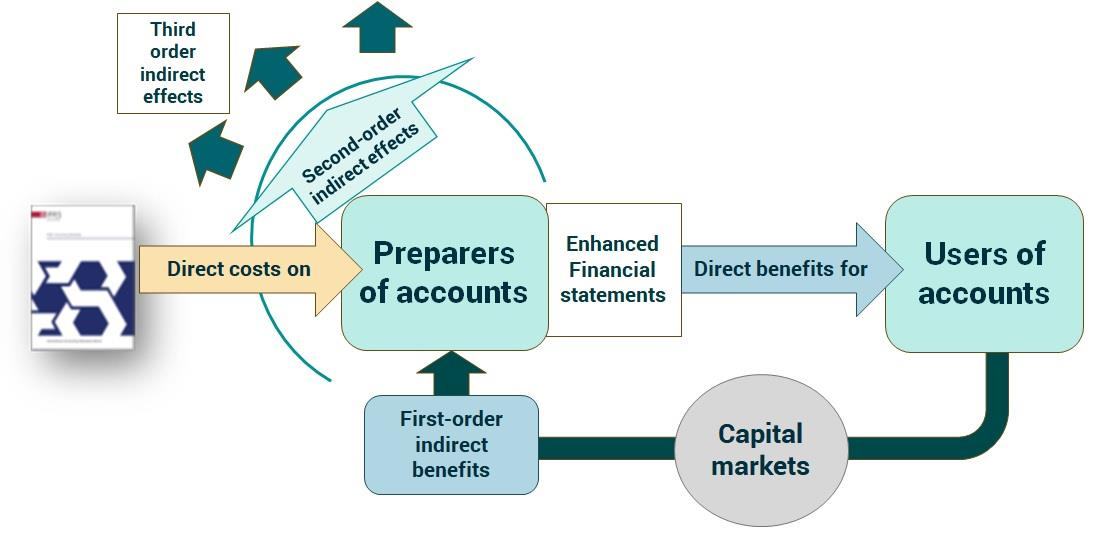
Source: UKEB
Collection of evidence
4.87To assess wider economic impacts, the UKEB collected evidence using a range of research tools, as follows:
- Surveys: Both the Preparer and User surveys contained questions on transmission mechanisms and indirect economic effects.
- Cost of capital analysis: The UKEB developed a methodological framework to assess capital market effects associated with the adoption of IFRS 18 that would deliver an indirect monetary benefit equivalent in value to the estimated market-wide implementation costs for preparers. The framework also allows the assessment of the plausibility of the results.
- Qualitative analysis: The UKEB assessed second- and third-order economic effects qualitatively, using desk-based research and economic reasoning.33
Direct effects other than costs and benefits (transmission mechanisms)
Preparers
4.88The UKEB Preparer survey included questions on the wider economic impact of IFRS 18, focusing on transmission mechanisms, i.e. direct economic effects other than costs and benefits.
4.89Preparers were asked to indicate the extent to which they expected the implementation of IFRS 18 to affect management's stewardship and other transmission mechanisms, such as whether IFRS 18 would affect how information circulates within the an entity or internal processes.
4.90Management's stewardship: Respondents were asked to indicate whether they expected IFRS 18 to affect:
- Presentation of management's use of economic resources to users: A majority of respondents (61%) indicated that they anticipate no effect.
- Transparency over management's performance in financial reporting: A slight majority of respondents (53%) indicated that they expected no effects.
- Management's discretion in presenting the entity's financial performance: The opinions on this outcome were divided, with the largest share of respondents (49%) indicating that they anticipate IFRS 18 to lead to less management's discretion in presenting entities' financial performance. However, 42% of respondents indicate that they anticipate no effect.
4.91On balance, preparers' views were that IFRS 18 is unlikely to affect management's stewardship.
4.92Other transmission mechanisms: Respondents were asked to indicate whether they expected IFRS 18 to affect:
- How information circulates within the organisation.
- Streamlining of internal systems and processes.
- Disclosure of proprietary information, where more disclosures were interpreted to be a negative effect.
- Competitors assessment of the entity's performance, where a better assessment was interpreted to have a negative effect.
- Internal assessment of competitors' financial performance, where a better assessment was interpreted to have a positive effect.
- Risk of litigation, where lower risk was interpreted to have a positive effect.
4.93Respondents either clearly indicated that no effect was expected or had split opinions with no clear pattern emerging. On balance, preparers' views were that IFRS 18 is unlikely to affect any of the above outcomes.
Users
4.94The UKEB User survey asked respondents to indicate whether the standard would affect a number of transmission mechanisms.
4.95On the items listed below, a majority of users indicated that IFRS 18 will either slightly improve or greatly improve their ability to analyse financial statements:34
- Compare entities' performance over multiple periods.
- Assess an individual entity's performance.
- Compare entities' performance with other entities
- Understand how entities measure their own performance.
- Conduct research.
- Allocate time spent analysing financial statements efficiently.
- Allocate capital efficiently between entities.
4.96A slight majority of respondents indicated that IFRS 18 would not help users better assess a company's solvency. Moreover, opinions were inconclusive on whether IFRS 18 would enhance users' ability to conduct credit ratings. These results are not surprising, considering that IFRS 18 mainly deals with the presentation of financial performance (and therefore is not likely to alter balance sheet line items or balance sheet ratios). One member of the IAG considered that the IFRS 18 requirements would not lead to additional information that could help users assess the creditworthiness or insolvency of entities.
4.97However, feedback from another user suggested that IFRS 18 could be especially helpful to lenders, because:
- For some lenders (e.g. leveraged finance specialists) adjusted EBITDA is an important metric. Paragraph 118 of IFRS 18 permits the disclosure of a subtotal (i.e. operating profit or loss before depreciation, amortisation and impairments within the scope of IAS 36, or ‘OPDAI’) 35 that provides similar information to many of the EBITDA measures currently provided. If a company provides an EBITDA subtotal in its public communications that is not calculated in the same way as OPDAI, that subtotal would be an MPM, so the entity will need to provide disclosures about it.
- Better principles for disaggregation would give some items greater visibility in the primary financial statements and provide information on the key drivers of cost (i.e. whether cost is part of their operating business).
First-order indirect effects - capital market effects
4.98Evidence from IFRS 18-related outreach indicated that users expect to reap benefits from the implementation of IFRS 18. IFRS 18 requirements are expected to enhance the transparency and comparability of financial statements and provide users with decision-useful information.
4.99In line with economic theory and evidence, the interaction between users and capital markets should improve as a result of IFRS 18. More specifically, better accounting resulting from IFRS 18 requirements should lead to more trading activity, more liquidity, and a reduction in bid/ask spreads on securities markets.36 Traders may demand lower returns for holding securities. In the longer term:
- The prices of publicly traded securities might increase.37
- Cost of capital on public capital markets might go down.
4.100As noted, preparers indicated that they expect to incur direct costs associated with the implementation of IFRS 18. However, if capital market effects materialise (e.g. an increase in market capitalisation or a decrease in cost of capital), preparers would reap indirect benefits in the longer term. These may allow preparers to partly cover, break even on, or even outweigh implementation costs, albeit indirectly.
4.101The UKEB has developed a methodology to conduct a plausibility assessment as to whether capital market effects potentially associated with the application of a standard may deliver indirect monetary benefits that would allow preparers to indirectly recover implementation costs. The methodology is based on evidence, ground in research, and makes use of updated market data.
4.102The analysis that follows allows assessment of whether capital market effects might materialise, and whether their magnitude is plausible. The results are not predictions of securities prices' trends or cost of capital reductions associated with IFRS 18 and should not be interpreted as such.
Effects considered
4.103The framework considers the following four concurrent market-wide effects potentially associated with the introduction of an accounting standard:
- An increase in market capitalisation, leading to an increase of shareholders' wealth at a market level.
- A decrease in the cost of equity, leading to more projects funded through public equity capital at a market level.
- An increase in the outstanding value of listed bonds, leading to an increase of bondholders' wealth at a market level.
- A decrease in the cost of debt, leading to more projects funded through public debt capital at a market level.
4.104Table 6 shows the interaction between these market-wide effects:
| Equity | Debt | |
|---|---|---|
| Stock (wealth effects) | Increase in market capitalisation | Increase in the outstanding value of corporate bonds |
| Flow (investment effects) | Decrease in the cost of equity leading to more projects funded through public equity | Decrease in the cost of debt leading to more projects funded through publicly traded corporate bonds |
Source: UKEB
Application of the methodology
4.105This section applies the cost of capital methodology to the assessment of IFRS 18. [The technical details of the methodology are to be reported in a stand-alone document to be considered at a future Board meeting].
4.106Market-wide implementation costs for preparers are the starting point for the analysis. The UKEB estimated market-wide implementation costs (one-off and ongoing costs) for preparers to be around £390 million (see paragraph 4.72).
4.107The estimated market-wide implementation costs are allocated to the market-wide capital markets effects shown in Table 6.
4.108Because the above effects may not apply evenly, the analysis is conducted using different scenarios with arbitrary allocations. The UKEB then assessed the plausibility of the results.38
4.109The scenario that the UKEB considered most likely assumes that 75% of the indirect benefits are delivered through equity markets (equally split between an increase in market capitalisation and an increase in the value of projects funded through equity), and 25% are delivered through bond markets (equally split between an increase in the value of bonds outstanding and an increase in the value of projects funded through fixed income). This section reports the results associated with this scenario. Appendix E contains results relating to other scenarios.
4.110The UKEB chose this scenario because feedback from stakeholders suggested that equity investors are the ones who would benefit the most from use of IFRS 18. Therefore equity markets are expected to deliver most capital market effects that might materialise after the implementation of IFRS 18. However, feedback from stakeholders suggested that lenders could still reap value from the changes brought by IFRS 18. Consequently, it is plausible to anticipate that part of the indirect benefits for preparers could materialise through public bond markets.
4.111Table X below shows the results for the chosen scenario.
| Scenario 4 | Proportion of implementation costs assigned to each potential capital market effect | Potential capital effects associated with the adoption of IFRS 18 in basis points |
|---|---|---|
| Increase in market capitalisation | 37.5% | 0.53 |
| Decrease in the cost of equity leading to more projects funded through public equity | 37.5% | 3.22 |
| Increase in the outstanding value of corporate bonds | 12.5% | 0.64 |
| Decrease in the cost of debt leading to more projects funded through publicly traded corporate bonds | 12.5% | 0.24 |
Source: UKEB calculations based on LSE and Reuters-Eikon data. A basis point is a hundredth of a percentage point.
4.112The results suggest that to allow preparers to recover implementation costs of £390 million (see paragraph XX above) the following effects should happen concurrently:
- Increase in market capitalisation: Market capitalisation for the UK listed market should increase by £146.25 million, or 0.53 Bps (basis points) using its value as of October 2024 (£2.69 trillion).
- Decrease in the cost of equity leading to more projects funded through public equity: Cost of equity should decrease by 3.22 Bps for the present value (PV) of projects funded through equity to increase by £146.25 million (the present value of equity issuances over a ten-year forecast equal to £143 billion; baseline cost of equity: 11.23%).
- Increase in the outstanding value of corporate bonds: The outstanding value of corporate bonds issued by UK companies on public bond markets should increase by £48.75 million, or by 0.64 Bps using its value as of October 2024 (£759 billion).
- Decrease in the cost of debt leading to more projects funded through publicly traded corporate bonds: Cost of debt should decrease by 0.24 Bps for the PV of projects funded through debt to increase by £48.75 million (present value of public corporate bond issuances over a ten-year forecast equal to £491.75 billion; baseline cost of debt: 5.03%).
4.113The results of the analysis show what capital market effects could materialise for preparers to indirectly recover the cost of implementing IFRS 18 in the long run. The splits are arbitrary and indicative. The results cannot be used to conclude or predict what capital market effects will materialise, if any, as a result of IFRS 18.
Are the results plausible?
4.114Stakeholder engagement shows that users have confidence that IFRS 18 requirements will deliver direct benefits, thereby enhancing their decision-making. This is supportive evidence that IFRS 18 could be expected to deliver a cost of capital reduction and may lead to an increase in the price of traded securities. Therefore, it is plausible to expect that preparers will reap indirect benefits that will materialise through capital markets in the longer term. This would allow them to recover at least part of the implementation costs they will have incurred upon implementing IFRS 18.
4.115As for the magnitudes, this analysis does not allow to isolate the effects that may be triggered as a direct result of the implementation of IFRS 18. However, compared to the size of implementation costs, the UKEB assessed that capital markets might plausibly deliver effects within the range identified in Table X, as:
- An increase in market capitalisation of £146.25 million (0.53 Bps) is well within the range of day-to-day market capitalisation volatility on the London Stock Exchange.
- A decrease in the cost of equity of 3.22 Bps, leading to the present value of projects funded through equity to increase by £146.25 million, is credible considering that the adoption of IFRS in the UK in 2005 was associated with a likely cost of equity reduction of approximately 100 Bps.39 As compared to the baseline cost of capital (11.23%), the required change is small, amounting to 0.3% of baseline cost of capital. The required change is also small as compared to the year-on-year volatility of cost of equity measures as reported in academic research.
- An increase in the outstanding value of corporate bonds of 0.64 Bps (£48.75 million) is well within the range of day-to-day price volatility of UK-listed bonds issued by UK companies.
- A decrease in the cost of debt of 0.24 Bps, leading to the present value of projects funded through debt to increase by £48.75 million, is credible considering that the adoption of IFRS in 2005 was associated with a likely cost of debt reduction of approximately 30 Bps.40 As compared to the baseline cost of capital (4.05%), the required change is small, amounting to 0.01% of baseline cost of capital
Second-order indirect effects
Effects on management compensation schemes, covenants, dividend payments and tax obligations
4.116The preparer survey asked respondents to indicate whether IFRS 18 is anticipated to affect the following items:
- Management compensation schemes.
- Covenants.
- Dividend payments.
- Tax obligations that may arise from changes in accounting line items.
4.117Most preparers expected no effect on any of these items. A preparer commented that "the new standard won't impact on measurement. Presentational differences from a statutory perspective will not impact any of the above measures".
Other second-order indirect effects
4.118The following second-order microeconomic effects on preparers are discussed:
- Effects on product or pricing decisions: The requirements of IFRS 18 are not expected to affect the underlying economics that determines the prices charged or the nature of products supplied by entities. Therefore, no effects on product and pricing decisions are expected.
- Effects on competition: IFRS 18 is not anticipated to affect the determinants of competition between entities (e.g. product or pricing decisions or barriers to entry or exit). IFRS 18 is anticipated to provide more comparable information about preparers, thus potentially enhancing preparers' ability to benchmark or assess their competitors. This suggests that IFRS 18 may have a minor role in fostering a competitive economic environment between entities.
- An increase/reduction in preparers' economic output or productivity: The changes in presentation and disclosure requirements in IFRS 18 are not expected to affect the preparers' output, or their productivity. However, a reduction in the cost of capital that may materialise as a result of implementing IFRS 18 may lead to an increase in capital investment.
- An increase/reduction in capital investments: IFRS 18 is not anticipated to directly alter preparers' output outlook or their strategic vision for the future and therefore is not likely to affect the entity's long-term capital needs. However, it is noted that a potential reduction in the cost of capital associated with IFRS 18 may lead preparers to fund more projects through public equity or debt, resulting in higher investment and/or a different capital structure.
Third-order indirect effects
Network effects
4.119IFRS 18 is not expected to affect network effects. Industries where network externalities are present (e.g. tech) are not likely to be more or less affected than other industries by IFRS 18. The requirements are not anticipated to affect the number of people accessing the platforms or services provided by such entities.
Externalities
4.120Economists view the provision of publicly available financial reporting as a positive externality.41 Therefore, enhancements to financial reporting brought by IFRS 18 are expected to improve the quality of the “public good” provided by preparers. This is a small, positive economic effect. It should be noted that the requirements of IFRS 18 are not anticipated to generate negative externalities.
Macroeconomic effects, including economic growth
4.121No significant macroeconomic effects are anticipated as a direct result of IFRS 18 requirements. However, as noted in the Capital Market effects section, IFRS 18 could:
- Positively affect the prices of traded securities. This would translate into higher shareholders' and bondholders' wealth.
- Reduce cost of capital. If actualised, this would translate into enhanced investment opportunities for entities applying IFRS 18.
4.122To the extent that capital market effects materialise, they could have a small positive effect on the consumption and investment components of GDP. The UKEB assessment is that IFRS 18 is not anticipated to have negative effects on economic growth.
Summary of the analysis of wider economic effects
4.123The analysis of wider economic effects suggests that IFRS 18:
- May plausibly lead to capital market effects that would benefit preparers in the medium to long run. A quantitative analysis of such effects conducted using an in-house methodology suggests that preparers may indirectly recover at least part of their implementation costs. The UKEB cannot predict however whether any such effects will materialise and, if so, of what magnitude.
- Capital market effects, to the extent that they materialise, could have a small positive effect on the consumption and investment components of GDP.
- Is not expected to lead to other wider economic effects that are detrimental to the UK economy, including on economic growth.
Consideration of the consequences of not adopting IFRS 18 (counterfactual analysis)
4.124This section considers the consequences of not adopting IFRS 18 for use in the UK (the 'non-adoption scenario') for:
- Users.
- Preparers.
4.125The analysis assumes that IFRS 18 is widely adopted in other jurisdictions.42
Users
4.126Under the non-adoption scenario, users would not reap the benefits that they expect to gain from IFRS 18.
4.127With reference to IFRS 18 requirements:
- Categories and subtotals: Users would not benefit from the added comparability brought about by a standardised structure with consistent and comparable subtotals in the statement of profit or loss, particularly specifying the subtotal operating profits.
- Management-defined performance measures: Users would not benefit from audited MPMs disclosed in one location and reconciled with the most comparable subtotal.
- Aggregation and disaggregation: Users would not benefit from consistent rules on aggregation and disaggregation, and the additional guidance on the use of the “other” category.
4.128The benefits that users of financial statements anticipate (see paragraphs XX-XX) would therefore not materialise, such as:
- Enhanced ability to compare entities' performance with other entities and over multiple periods.
- Enhanced ability to assess an individual entity's performance and understand how entities measure their own performance.
- More efficient allocation of time spent analysing financial statements.
- More efficient capital allocation between entities.
4.129Users would avoid IFRS 18 implementation costs, however, these are not expected to be significant, as evidenced in our assessment.
Preparers
4.130Considering the consequences on users described above, in a non-adoption scenario, UK and overseas investors may redirect funds to jurisdictions that apply IFRS 18.
4.131The size and importance of UK capital markets, together with the fact that investors consider a plurality of information sources (not only financial statements) when making investment decisions, are likely to continue to play a key role in retaining investor interest and capital. Therefore, non-adoption of IFRS 18 would likely have a small adverse long-term effect on the cost of capital for UK entities.
4.132Entities in other jurisdictions using IFRS 18 may be able to attract additional sources of capital and potentially benefit from a lower cost of capital, which could provide those companies with a competitive advantage over UK companies. Therefore, non-adoption of IFRS 18 would likely have a small adverse long-term effect on the competitiveness of UK business.
4.133From a cost perspective, entities would not incur implementation costs if IFRS 18 was not implemented. However, UK listed entities are not anticipated to incur significant costs to implement IFRS 18, as evidenced in the assessment above.
4.134Feedback from preparers also suggested that UK listed entities cross-listed abroad could incur extra costs if UK-adopted international accounting standards were to deviate from IFRS as issued by the IASB.
Summary of the counterfactual analysis
4.135Overall, not implementing IFRS 18 for use in the UK would have a potentially negative outcome from the perspective of the UK long term public good.
- Users would not benefit from more comparable and transparent financial reporting. In the long term, capital investment might flow from UK entities to entities residing in IFRS 18-adopting jurisdictions.
- As a result, UK entities would not benefit from more abundant, more differentiated and potentially cheaper capital in the long term. UK business may lose competitiveness in the long term.
- UK entities cross-listed abroad would face extra ongoing compliance costs if UK-adopted international accounting standards deviate from IFRS as issued by the IASB.
4.136These considerations suggest that non-adoption of IFRS 18 for use in the UK would not be likely to be conducive to the UK long term public good.
[Tentative] Overall assessment of long term public good
4.137There are three aspects to consider when assessing whether the use of IFRS 18 is likely to be conducive to the long term public good in the UK. These are:
- Whether IFRS 18 is likely to improve the quality of financial reporting.
- The costs and benefits that are likely to result from the use of IFRS 18.
- Whether the use of IFRS 18 is likely to have an adverse effect on the economy of the UK, including on economic growth.
4.138The conclusions drawn on each of these aspects as summarised below.
Quality of financial reporting
4.139Implementation of IFRS 18 is likely to improve the quality of financial reporting by specifying enhanced presentation and disclosure requirements for the financial statements. This will lead to financial reporting that is more useful to investors and other users of accounts, providing information that is more relevant, reliable and transparent. The new requirements in IFRS 18 are also likely to facilitate comparability and lead to clearer presentation and disclosure of information in the financial statements.
Costs and benefits
4.140Users anticipate significant benefits from the application of IFRS 18. For example, users reported that the enhanced presentation of financial performance brought by IFRS 18 should result in more efficient use of time spent analysing financial statements and an increase in the quality of analysis/reports. Users also indicated that they anticipate incurring minimal implementation costs.
4.141Preparers indicated that they will incur incremental both one-off and ongoing costs as a result of applying IFRS 18, though they expect them to be contained. Preparers expect one-off costs to be largely associated with extra audit fees, familiarisation and changes to templates. Preparers expect ongoing implementation costs to be much lower that one-off implementation costs, and to be subsumed into business as usual in a few years' time.
Effect on the economy of UK
4.142While it is acknowledged that preparers will incur most of the direct compliance costs, the fact that users expect to reap benefits from the increased transparency arising from the implementation of IFRS 18 suggests that their capital allocation decisions may improve. Enhanced capital allocation may translate into beneficial capital market effects, such as an appreciation of traded securities or a reduction in the cost of capital for entities.
4.143The analysis of wider economic effects suggests that IFRS 18 may plausibly lead to wider capital market effects that would benefit preparers in the medium to long run. A quantitative analysis of such effects conducted using an in-house methodology suggests that preparers may indirectly recover at least part of their implementation costs. The UKEB cannot predict however whether any such effects will materialise and, if so, of what magnitude.
4.144Any capital market effects associated with the application of IFRS 18, to the extent that they materialise, could have a small positive effect on the consumption and investment components of GDP.
4.145IFRS 18 is not expected to lead to other wider economic effects that are detrimental to the UK economy, including on economic growth.
Counterfactual analysis
4.146Overall, not implementing IFRS 18 for use in the UK would have a potentially negative outcome from the perspective of the UK long term public good.
[Tentative] overall assessment
4.147The tentative assessment is based on the joint consideration of the evidence reported above.
4.148Overall, based on a holistic assessment of the evidence reported in this section, the UKEB considered that the use of IFRS 18 is likely to be conducive to the long term public good in the UK.
Footnotes
Footnotes
-
Agenda decisions are issued by the IFRS Interpretations Committee and sometimes include explanatory material. This material explains how to apply the relevant principles and requirements in IFRS Accounting Standards to the question asked in the submission. Agenda decisions that include explanatory material typically focus only on the specific requirements that apply to the submitted fact pattern. If those requirements are replaced or amended, agenda decisions that refer to it become irrelevant and are withdrawn. ↩
-
These Appendices will be part of the complete [draft] ECA. ↩
-
Agenda decisions include explanatory material, whose objective is to improve the consistency of application of IFRS Accounting Standards. The objective of including such explanatory material is to improve the consistency of application of IFRS Accounting Standards. ↩
-
The Secretariat has shared with the IASB staff the additional agenda decision identified. ↩
-
In line with paragraph 8.5 of the IFRS Foundation's Due Process Handbook. ↩
-
This Agenda Decision is not specific to IAS 1. The Committee will consider how an entity applies the requirements in IFRS 18 to the fact pattern addressed in this Agenda Decision. This may result in the inclusion of additional references. ↩
-
The Big 4's accounting manuals all refer to this Agenda Decision as authoritative guidance on how to present Uncertain Tax Positions. ↩
-
This would involve withdrawing the agenda decision as it has been addressed by IFRS 18 and subjecting this approach to the Committee's due process. ↩
-
This would involve adding staff annotations to update the references to IAS 1 with equivalent or similar references in IFRS 18. ↩
-
This would involve asking the Committee to consider how IFRS 18 applies to the fact pattern addressed in this agenda decision. This approach would allow the Committee to publish for comment an updated tentative agenda decision. ↩
-
This would involve withdrawing the agenda decision as it has been addressed by IFRS 18 and subjecting this approach to the Committee's due process. ↩
-
Refer to paragraph 9 of this paper. ↩
-
At the April 2025 meeting the IASB decided to ask the Committee to replace only the references to IAS 1 with references to the new or amended requirements in IFRS 18. According to the IASB staff this approach would allow the Committee to publish for comment the updates to the agenda decisions as part of its normal consultation process for agenda decisions and allow stakeholders an opportunity to comment on the updates. ↩
-
At the November 2024 meeting the IASB staff recommended updating the references to IAS 1 in these agenda decisions with cross-references to the requirements in IFRS 18 (or to IAS 8 when applicable). ↩
-
IFRS 18 changed the title of IAS 8 from Accounting Policies, Changes in Accounting Estimates and Errors to Basis of Preparation of Financial Statements. Text moved to IAS 8 was left unchanged. This change is effective on 1 January 2027. ↩
-
The IFRS 18's Effects Analysis states (on page 3) that the Primary Financial Statements project (which led to the development of IFRS 18) was added to the IASB's research agenda in July 2014 in response to strong stakeholder demand for the IASB to improve the reporting of financial performance. ↩
-
See paragraph 2.27. ↩
-
Section 3.2.1 of Bridging the gap: Ensuring effective on-GAAP and performance reporting (2016) by CFA Institute. ↩
-
The BRF applies to "regulatory provisions", defined in paragraph 2.3 of the BRF. Paragraph 2.4 of the BRF clarifies that provisions in scope are made by ministers. See the BRF here. ↩
-
The BRF is ground in the principles of the Green Book, which applies to public entities more broadly (e.g. regulators, arm's length bodies). The Green Book was also consulted to ensure consistency. ↩
-
On 15 November 2024, EFRAG published its Draft Endorsement Advice (DEA) on IFRS 18 and invited stakeholders to submit comments by 26 March 2025. After considering the feedback received to its public consultation, EFRAG submitted its Final Endorsement Advice to the European Commission on 5 May 2025. ↩
-
To assess the long term public good, EFRAG analyses: (a) whether the standard improves financial reporting, (b) the costs and benefits associated with the standard, and (c) whether the standard might have an adverse effect on the European economy, including financial stability and economic growth. ↩
-
EY: Applying IFRS: A closer look at IFRS 18 (July 2024). ↩
-
PWC: In brief publication (April 2024). ↩
-
KPMG: How companies communicate financial performance is changing (April 2024). ↩
-
Grant Thornton: Introducing IFRS 18 – The IASB's new presentation and disclosure standard (June 2024). ↩
-
The Preparer survey collected 46 responses and the User survey collected 22 responses. ↩
-
For example, IFRS 18 provides relief from some classification requirements if those requirements would result in undue cost or effort. ↩
-
Opportunity costs are the costs of spending time and effort on the implementation of the Standard as opposed to a different productive activity. ↩
-
The reader should interpret the allocation between cost categories as indicative and approximate. ↩
-
At the March 2025 Board meeting, the UKEB presented a larger estimate for ongoing costs. This was due to the application of a 10-year appraisal period. The appraisal period was revised as a further investigation of data from the Preparer survey and 1-2-1 interviews suggested that five years is a more realistic appraisal period. ↩
-
The reader should interpret the allocation between cost categories as indicative and approximate. ↩
-
The Preparer survey included questions on direct effects other than costs as well as some second-order effects. Because the results indicated that preparers consider there will be minimal or no wider economic effects, further quantitative analysis or stakeholder engagement was not considered proportionate. ↩
-
The options assessed are considered transmission mechanisms as they refer to specific tasks/actions that users could conduct differently as a result of the standard, thus enhancing their interaction with capital markets. This [Draft] ECA notes that the difference between direct benefits and transmission mechanisms is subtle and subject to interpretation. ↩
-
An entity can label the subtotal OPDAI as 'EBITDA' if an entity has no income and expenses in the investing category, such that all its earnings are included in operating profit (see paragraph BC365 in the Basis for Conclusions of IFRS 18). ↩
-
The chain of events that leads to a reduction in the cost of capital in equity markets is well-understood from a theoretical perspective. Enhanced financial reporting provides traders with additional information, attracting more capital from less informed investors and lowering the risk of holding a given stock. This leads to enhanced trading activity and a reduction in bid/ask spreads, i.e. an increase in liquidity. ↩
-
For a literature review on value relevance, see Imhanzenobe (2022). ↩
-
The UKEB chose this approach as the methodology cannot be used to conduct predictions. ↩
-
Source: UKEB analysis based on desktop research and econometric models using Reuters-Eikon data. ↩
-
Florou and Kosi (2015) find that the cost of public debt decreased, on average, by 36 basis points for companies that mandatorily adopted IFRS. The research is a cross-country study that includes the UK. the UK is the largest individual jurisdiction in the sample by number of companies. ↩
-
Meeks and Meeks (2002): "it is held that accounting information possesses some of the characteristics of a 'public good': once the information has been released to one customer, it becomes available to all (i.e., non excludability); and one person's consumption of the good does not diminish the amount left for others." ↩
-
This was considered to be the most realistic counterfactual scenario for the UKEB. Other baseline scenarios are possible, for example that the standard was not issued at all, but this scenario has not been considered. ↩