International Forum of Accounting Standard Setters Slides May 2025
Presentation to International Forum of Accounting Standard Setters (IFASS) 12 March 2025 Pauline Wallace, UKEB Chair
Background of the project
- The UKEB has embarked on a proactive research project on the Statement of Cash Flows and Related Matters to enable it to gather an evidence base that can contribute to the future work of the IASB on this topic and to ensure that any future amendments to the standard reflect the views of UK stakeholders.
- Research involved:
- Financial Statements Analysis (the focus of this presentation)
- Investor/Creditor Interviews
- Preparer Interviews
Investors/Creditors: The statement of cash flows is useful for users of financial statements for non-financial institutions. "the statement of cash flows is more important than the statement of profit and loss"
Encouraged Disclosures
- Few UK listed companies provide the 'encouraged' disclosures from IAS 7.
- IAS 7 paragraph 19:
- "Entities are encouraged to report cash flows from operating activities using the direct method."
-
IAS 7 paragraph 50 includes the following "encouraged" disclosures:
- "the aggregate amount of cash flows that represent increases in operating capacity separately from those cash flows that are required to maintain operating capacity"; and
- "the amount of the cash flows arising from the operating, investing and financing activities of each reportable segment
-
IAS 7 paragraph 19 :"Entities are encouraged to report cash flows from operating activities using the direct method."
Investors/Creditors : Prefer the indirect method, but ... Disaggregation is important - where the indirect method is used, providing a note to disclose the cash flows of major items included in 'operating' cash flows, similar to that required for operating profit (IAS 1 Paragraph 104), would be useful "downside of the direct method is the working capital movements are not shown on the statement of cash flows"
- IAS 7 paragraph 50 includes the following "encouraged" disclosures:
- "the amount of the cash flows arising from the operating, investing and financing activities of each reportable segment
Investors/Creditors: Would like operating cash flows by segment including discontinued operations (IFRS 5 paragraph 33(c)) – one investor said IFRS 18 requirement to separate discontinued from operating was not useful - disclosing discontinued in segmental information is more useful.
- IAS 7 paragraph 50 includes the following "encouraged" disclosures:
- "the aggregate amount of cash flows that represent increases in operating capacity separately from those cash flows that are required to maintain operating capacity";
Investors/Creditors appreciate the challenge of disaggregating capital expenditure between growth and maintenance (disaggregation principles in IFRS 18 – different characteristics – should be helpful)
Voluntary Cash Flow Disclosures
- UK listed companies provide a range of voluntary disclosures, but the sample did not identify any that are consistently provided. Including:
- Reconciliations of how working capital movements in the statement of cash flows relate to amounts in the statement of financial position
- Reconciliation between tax payments in the statement of cash flows and tax charges recognised in the statement of profit or loss
- Gross derivative cash flows
- Aggregate cash impact of M&A transactions
Net Debt Reconciliation
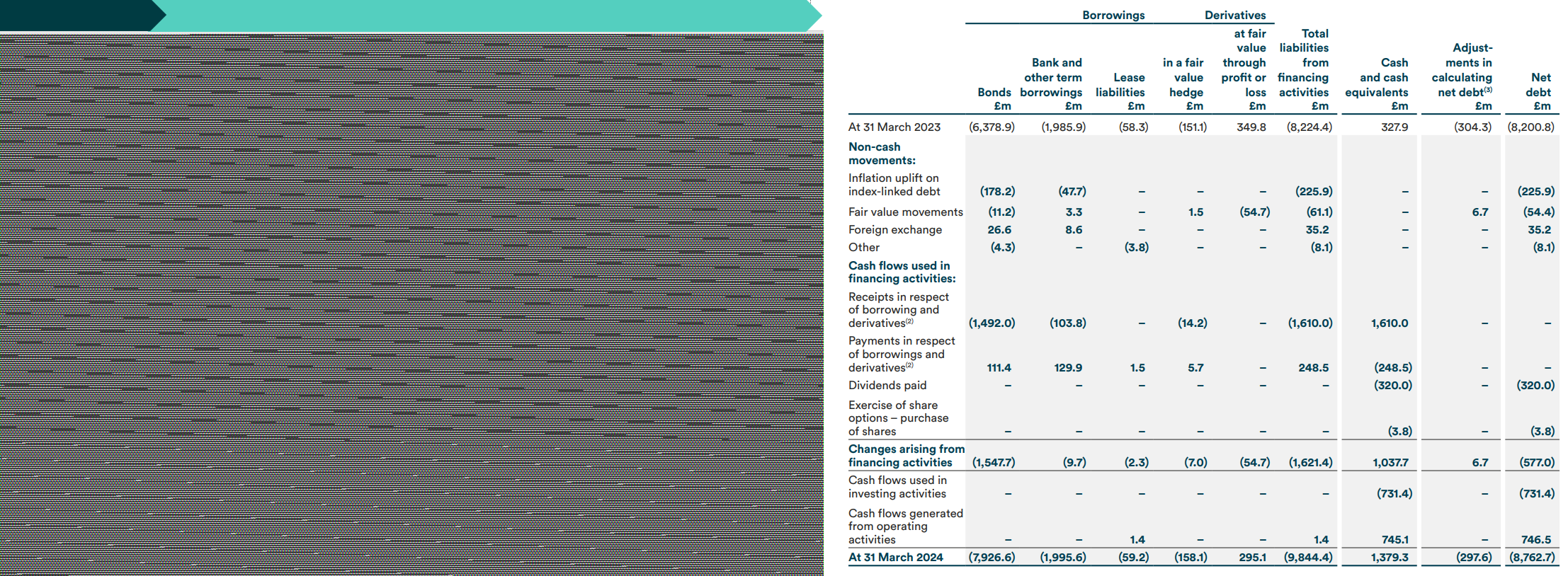
- Most companies in the sample provide a net debt reconciliation (see Appendix for example).
Investors/Creditors: Net debt is very important– a definition of net debt be useful and a mandatory reconciliation of net debt to the statement of cash flows and generally being able to reconcile between the primary financial statements would be useful.
Free Cash Flow and Non-recurring items
- Free cash flow was disclosed by many companies in the sample. While it was variously defined entities tended to provide a clear reconciliation to the statement of cash flows.
Investors/Creditors: “It is not necessary to have a standardised or prescribed definition of free cash flows as there is variability on how free cash flow is defined, depending on the information that is being focused on”.
- Information on the cash impact of exceptional or other adjusting items is not widely reported by companies in the sample.
Financial Statement Cohesiveness
- There is often relevant information in various notes distributed across the financial statements (for example in the leases note, the reconciliation of financing liabilities and the provisions note). However few companies provide references to these notes for relevant cash flows.
Investors/Creditors: Cohesiveness between the primary financial statements - being able to reconcile information between the statement of cash flows, the income statement and statement of financial position (balance sheet) is important. Some suggested account balance roll-forwards, splitting cash and non-cash items Qualitative disclosure through commentary on the statement of cash flows would enhance its usefulness.
- Implementation of IFRS 18 may raise concerns as there is a difference in definitions of operating, investing and financing
Other messages from the Investor/Creditor Interviews
- IFRS Standards frequently include explicit income statement or balance sheet related disclosure requirements, it is rare to require cash flow related disclosures. Investors/Creditors identified a range of standards where cash flow information could be useful, including:
- IFRS 3 Business Combinations / IFRS 12 Disclosure of Interests in Other Entities
- IFRS 5 Non-current Assets Held for Sale and Discontinued Operations
- IFRS 8 Operating Segments
- IFRS 9 Financial Instruments / IFRS 7 Financial Instruments: Disclosures and IAS 39 Financial Instruments: Recognition and Measurement
- IFRS 16 Leases
- IFRS 20 Regulatory Assets and Regulatory Liabilities
- IAS 37 Contingent Assets, Contingent Liabilities and Provisions
Conclusion
- The statement of cash flows is important to Investors/Creditors.
- There appear to be opportunities to improve the information provided.
- Cohesiveness of the financial statements is a recurring theme. Investors/Creditors want to see better integration of the statement of cash flows.
- An integrated statement of net debt
- Better cross referencing to relevant notes
- Better disclosure where relevant and material
Contact Us
UK Endorsement Board 6th Floor | 10 South Colonnade | London | E14 4PU www.endorsement-board.uk
Appendix: United Utilities plc - Net Debt Reconciliation