8 Statement of Cash Flows and Related Matters
28 March 2025 Agenda Paper 8 UKEB UK Endorsement Board
Executive Summary
Project Stage
| IASB | Research / Pipeline | Discussion paper | Redeliberation | Exposure Draft | Redeliberation | Final standard | Post Implementation Review |
|---|---|---|---|---|---|---|---|
| UKEB | Research / Influencing | Research / Influencing | Monitoring | Influencing | Monitoring | Endorsement | Influencing |
Project Scope
| Purpose of the paper | Moderate |
Purpose of the paper
This paper is the third in a series of research papers presented to the Board as part of the UKEB's proactive research project on the Statement of Cash Flows and Related Matters. It summarises the feedback received during the interviews with UK users and preparers of financial statements. The aim of the paper is to highlight the views of key UK stakeholders on current and potential future reporting requirements that the IASB may wish to consider, and to support the Board's future discussions on the topic.
Summary of the Issue
This paper makes no recommendations. The paper concludes based on the interviews that there are opportunities to enhance the statement of cash flow that the IASB could consider when progressing with the project.
- Cohesiveness between the primary financial statements – the project could consider how such cohesion might be improved. This might include:
- more requirements for disclosing cash flow information in other IFRS accounting standards; and
- improving the requirements in IAS 7, similar to those for disclosing the changes in financing liabilities.
- Importance of non-cash information – the project could consider information about economically similar transactions that do not involve cash, to ensure that companies are required to disclose transparent information about such transactions.
- Importance of non-GAAP measures – the project could consider the benefits to users of providing a standard definition of ‘net debt’, requiring companies to reconcile net debt to the statement of cash flows.
- Interconnectivity between IFRS Accounting Standards – the project could consider the benefits to preparers by improving the guidance in other standards on how the relevant cash flows might be disclosed in the financial statements, which would improve transparency and comparability for users.
- Assisting preparers in applying the requirements – the project could consider the benefits to both preparers and users from improving the definitions for the classifications of cash flows, potential alignment with IFRS 18, and providing more guidance to assist preparers in applying the requirements in IAS 7. The project might also consider which requirements currently encouraged in IAS 7 are needed by users and:
- remove the requirement for those encouraged disclosures that not essential, such as disaggregation of growth and maintenance and the preferred use of the direct method; and
- make mandatory those encouraged disclosures that users need, such as segmental information.
- Usefulness of the statement of cash flows for banks and insurers – the project scope could focus on first improving the requirements for all entities, and then consider at a later stage if there is any loss of information to users from potentially providing an exemption for some entities, or if there are alternative solutions that would reduce the cost to preparers whilst improving information for users.
Decisions for the Board
- The Board is asked for general comments and observations on the paper (Appendix A).
- Do Board members agree with preparing a summary of the research and finalising the papers?
- Do Board members have comments on the two possible research areas?
- Do Board members agree that the research should be extended as outlined?
Recommendation
The Secretariat recommends that, as a next step, the UKEB prepare a summary of the cash flow research, attaching final versions of the three research papers as appendices.
Appendices
Appendix A The Statement of Cash Flows: UK User and Preparer Perspectives
Background: Statement of Cash Flows and Related Matters
The IASB added a project on the Statement of Cash Flows and Related Matters to its research pipeline following feedback on its Request for Information: Third Agenda Consultation (published March 2021).
In the Feedback Statement to the Request for Information (published July 2022) most respondents recommended the addition of a potential project on cash flows to the IASB's workplan, rating it as high priority.
The IASB staff are performing initial research to gather evidence of the nature and extent of the perceived deficiencies and the likely benefits of developing new financial reporting requirements for IAS 7. This research is intended to provide evidence to support the IASB's decision on the scope of the project and will also address possible ways of improving the perceived deficiencies. The IASB plans to discuss the initial research outcomes and determine next steps at its March 2025 meeting.
A UKEB project on the statement of cash flows and related matters supports meeting its responsibilities regarding thought leadership in accordance with the UKEB Terms of Reference. It will also help the Board to deliver the UKEB's 2024-25 Regulatory Strategy (page 8) aim, to influence IASB early in its development cycle, by providing timely and effective input.
The UKEB research is grounded in previous work undertaken by the IASB, FRC and UKEB, with the aim to gather primary evidence on the improvements UK investors and creditors need to the statement of cash flows, and UK preparer views on those possible improvements. This will provide a foundation for the UKEB to propose potential solutions for the problems already identified by the IASB as well as any other issues identified through UKEB outreach.
Research Paper – The Statement of Cash Flows: UK User and Preparer Perspectives
1The research paper (Appendix A) is based on one-to-one interviews with 24 stakeholders (12 users and 12 preparers of financial statements) undertaken between December 2024 and the March 2025.
2The paper sets out interviewees' perspectives on the perceived issues with the reporting of cash flows, as identified in the first research paper (presented at the December 2024 UKEB meeting). The paper includes the key messages received during those interviews, that the IASB could consider when making any changes to cash flow reporting requirements.
Question for the Board
- The Board is asked for general comments and observations on the paper (Appendix A).
- Do Board members agree with preparing a summary of the research and finalising the papers?
- Do Board members have comments on the two possible research areas?
- Do Board members agree that the research should be extended as outlined?
Next Steps
3At the November 2024 Board meeting the UKEB agreed to add a research project with the aim to gather primary evidence on key stakeholder views. Specifically, the improvements investors and creditors want made to the statement of cash flows, and preparer views on these possible improvements.
4Three research papers have been presented:
- Background and Key Issues.
- Non-mandatory and Voluntary Cash Flow Disclosures Provided by UK Companies.
- UK User and Preparer Perspectives.
5The plan recommended that once the research papers were completed the Board should consider whether:
- the UKEB papers, developed up to that point, should be consolidated into a single comprehensive report for publication; and
- whether additional research is appropriate and feasible given the IASB's project plan and UKEB priorities at that time.
6In March 2025 the IASB considered a summary of the research work undertaken by IASB Staff. The IASB has asked the Staff to bring back a project plan to a future meeting, before they make any decisions on how to proceed with the project. The project plan will cover the scope of the project, suggested topics to cover, and the order in which topics could be addressed.
7The Secretariat propose presenting to the May 2025 UKEB Board meeting a consolidated summary of the findings from all three UKEB research papers and include the finalised papers as appendices.
8A short poll to allow a wider range of UK users of financial statements to provide their views, specifically on the purpose of the statement of cash flows, has also been published. If a meaningful response is received, this data will also be incorporated into the summary report.
9In line with the PIP, the Secretariat believe additional research is feasible given the IASB's project plan. Two possible research areas could be:
- Alternative statement of cash flows: Based on research conducted to date it may be possible to develop an alternate version of the statement of cash flows, incorporating the key suggestions made by users and preparers. This could be used to encourage further discussion about the ways forward for this project, and provide valuable evidence to the IASB.
- Interconnectivity of IFRS Standards/Cohesiveness of Financial Statements: The research has identified both the interconnectivity of IFRS Standards and the cohesiveness of the financial statements as key issues for users. Mapping the links between the statement of cash flows and requirements in other IFRS Standards could identify opportunities to highlight the existing connections, (or refine the requirements to strengthen the connections). This could allow the IASB to make minor changes that bring significant incremental value to users.
10If the Board agrees that either or both research areas are appropriate, an addendum or amendment to the Project Initiation Plan would be brought to the Board in May. The expected timeline for completing any research would be June/July 2025. However, to deliver to that timeline research would commence in the near term. We believe we have the resource to deliver on this work.
Appendix A: Statement of Cash Flows and Related Matters: UK User and Preparer Perspectives
- Executive Summary
- Background: Statement of Cash Flows and Related Matters
- Research Paper – The Statement of Cash Flows: UK User and Preparer Perspectives
- Appendix A: Statement of Cash Flows and Related Matters: UK User and Preparer Perspectives
- Background
- Key messages
- Usefulness of the Statement of Cash Flows for non-financial institutions
- Direct versus indirect method for operating cash flows
- Classification of cash flows
- Tax
- Disaggregation of information
- Accessibility of information
- Suggestions for improving the usefulness of the statement of cash flows
- Cohesiveness between the primary financial statements
- Importance of non-cash information
- Effective offsetting cash flows
- Importance of non-GAAP measures
- Interconnectivity with other IFRS Accounting Standards
- Challenges for preparers
- Suggestions to assist preparers in applying the requirements
- Usefulness of the statement of cash flows for Financial Institutions
- Suggestions to improve usefulness of information provided for some financial institutions
- Concluding Observations
- Footnotes
Background
A1This paper is the third in a series of research papers as part of the UKEB's proactive research project on the Statement of Cash Flows and Related Matters.
A2The paper builds on the two previous papers:
- Statement of Cash Flow and Related Matters: Background and key issues, presented to the Board in December 2024 – based on desk-top research. This paper provided background on IAS 7 Statement of Cash Flows, and perceived issues concerning cash flow reporting identified by the IASB and others (including the UK’s Financial Reporting Council (FRC)); and
- Statement of Cash Flows and Related Matters: Non-mandatory and Voluntary Cash Flow Disclosures Provided by UK Listed companies, presented to the Board in February 2025 – based on a sample review of financial statements. This paper highlighted cash flow related disclosures that UK listed companies include in their financial statements beyond the requirements of IAS 7 and other IFRS Accounting Standards.
A3This third paper is based on interviews with UK preparers and UK users1 of financial statements and sets out their perspectives on the perceived issues with the reporting of cash flows identified in the first research paper. It includes the key messages received during those interviews that the IASB could consider when making any changes to cash flow reporting requirements.
A4In addition, it provides UK preparers’ and users’ suggestions on how to resolve some of the identified issues. Resolving these issues would improve the quality of cash and non-cash information by enhancing transparency for users and assist them in their decision-making.
A5The UK preparers' and users’ views described in this paper do not represent UKEB opinions regarding the issues identified, or the relevance or desirability of suggested improvements.
Stakeholder interviews
A6This phase of the research comprised one-to-one interviews with 24 stakeholders (12 users and 12 preparers of financial statements), between December 2024 and the March 2025. Participants comprised a broad range of users and preparers from a number of different industry sectors, including financial institutions.
A7The tables below show the ownership type and industry sector of the preparers that participated in the interviews:
| Preparer by type | ||
|---|---|---|
| FTSE 100 | 8 | 67% |
| FTSE 250 | 1 | 8% |
| Unlisted IFRS Preparers | 3 | 25% |
| TOTAL | 12 | 100% |
| Preparer by sector | ||
|---|---|---|
| Basic Resources, Industrial Goods & Technology | 3 | 25% |
| Energy & Utilities | 2 | 17% |
| Health Care, Travel & Leisure | 2 | 17% |
| Financial Institutions - Insurance | 2 | 17% |
| Financial Institutions - Banks | 1 | 8% |
| Financial Institutions - Other | 1 | 8% |
| Food, Beverage and Tobacco | 1 | 8% |
| TOTAL | 12 | 100% |
A8The table below summarises the categories of the users that participated in the interviews.
| Users by category | ||
|---|---|---|
| Analysts / Researchers (Equity, Fixed Income) | 4 | 33% |
| Professional Body/Representative group members | 3 | 25% |
| Credit Rating Agencies | 2 | 17% |
| Institutional Investors | 2 | 17% |
| Creditors/Lenders | 1 | 8% |
| TOTAL | 12 | 100% |
A9In this paper, the following terms are used to give a broad indication of prevalence of the comments raised2:
| Term used | Extent of response among interviewees |
|---|---|
| Almost all | All except a small minority |
| Most | A large majority |
| Many | A small majority or large minority |
| Some | A small minority |
| A few | A very small minority |
A10The interviews were semi-structured with specific questions on the usefulness of the statement of cash flows, their experiences with the perceived deficiencies and challenges (as identified by the IASB), further issues identified by interviewees, how issues could be resolved, and the priority that should be given to resolving the issues from a UK perspective.
A11Interviewees were also asked whether the IASB’s project should:
- focus on targeted improvements;
- carry out a fundamental review of the cash flow reporting requirements in IAS 7 and other IFRS Accounting Standards; or
- undertake a phased approach (comprising short term targeted improvements and a longer-term fundamental review of cash flow reporting requirements).
A12In addition to the interviews, feedback was sought from both the UKEB Investor Advisory Group (in November 2024 and February 2025)3, and the UKEB Preparer Advisory Group (in October 2024 and March 2025)4. Advisory Group members were consulted on the IASB perceived issues in the first of the meetings. During the latter meetings, preparers were asked to comment on the feedback received from investors, and investors were asked to comment on the feedback received from preparers.
Key messages
A13This paper makes no recommendations. However, some high-level observations include:
- The statement of cash flows is useful for users of financial statements for non-financial institutions, although the use of the statement varies.
- Users do not prefer the ‘direct’ method of presenting the operating cash flows, despite its encouragement in IAS 7. UK preparers are not keen to change their current disclosures under the ‘indirect’ method and are concerned with the potential cost implications of any changes.
- Users suggest that qualitative disclosure, through commentary on the statement of cash flows, including a company’s own assessment of its liquidity, would enhance its usefulness.
- Users would like to see more cohesiveness between the statement of cash flows and the other primary financial statements, and any improvements should aim to enhance this.
- It is important for users to have transparent information and sufficient disaggregation about material items, including non-recurring or infrequently recurring items, such as merger and acquisitions (M&A), disposals, discontinued operations. However, disaggregation of growth and maintenance expenditure, as encouraged by IAS 7 is not a priority for users and preparers would find it challenging.
- Non-cash information is very important to users (including both transactions that have the same economic benefit as cash transactions, such as leases, and the impact of unrealised gains or losses, changes in fair value and foreign exchange (FX) movements). This information needs to be more transparent. It is often scattered throughout the financial statements, so it would be useful to have a single location where the information is referenced in order to improve accessibility.
- Non-GAAP measures, in particular net debt, are important disclosures for investors and other users.
- Most interviewees agree that it would be useful if the IASB provides a definition for net debt. Some suggest that the net debt information could be elevated to the primary financial statements and integrated into the statement of cash flows, due to the importance of net debt in determining a company’s liquidity.
- Whilst free cash flow is a useful metric, it is more important for users to have transparent information to prepare their own free cash flow metrics, than a standardised definition or a mandated free cash flow disclosure.
- There are cross-cutting issues relating to the lack of explicit disclosure requirements in IAS 7 and other IFRS Accounting Standards. In particular, most preparers suggest that inconsistencies with IFRS 18 Presentation and Disclosure in Financial Statements need to be addressed.
- Preparers would find more guidance and illustrative examples useful on some aspects of the requirements, including cash and cash equivalents, classification of cash flows and offsetting/netting. Providing more guidance would also reduce diversity in application of the requirements in IAS 7.
- Field-testing should be carried out for any proposed changes to ensure that the benefit to users exceeds any cost burden on preparers. Preparers are concerned about the incremental cost of applying any changes to the requirements; the application of the current requirements are already costly given that for most companies the preparation of the statement of cash flows is not automated.
- The statement of cash flows for banks and insurers provides little to no incremental value to users. Non-GAAP measures and regulatory information are perceived to be more relevant and comparable.
A14Each of the observations are covered in more detail in the relevant sections of this paper:
- Usefulness of the statement of cash flows for non-financial institutions (paragraphs A16–A71).
- Cohesiveness between the primary financial statements (paragraphs A72–A77).
- Importance of non-cash information (paragraphs A78–A108).
- Importance of non-GAAP measures (paragraphs A109–A137).
- Interconnectivity with other IFRS Accounting Standards (paragraphs A138–A143).
- Challenges for preparers (paragraphs A144–A167).
- Usefulness of the statement of cash flows for financial institutions (paragraphs A168–A176).
- Concluding observations (paragraphs A177–A181).
A15Whilst the IASB identified seven areas of perceived deficiencies in the requirements of IAS 7, as covered in the first research paper, this research paper is based on the key messages received during the UKEB outreach. (The outreach approach is explained in paragraphs A6–A12 of this paper).
Usefulness of the Statement of Cash Flows for non-financial institutions
A16The first research paper Statement of Cash Flow and Related Matters: Background and key issues described the usefulness of the statement of cash flows, as set out in IAS 75.
A17Interviews confirmed that, for most UK stakeholders, the statement of cash flows is useful, however the extent to which they consider it useful varies. Some users stated that the statement of cash flows is not useful, whilst others went so far as stating that it is the most important primary financial statement.
A18Users explained that they use it for a variety of reasons, including to validate information in the other primary financial statements, to assess a company' ability to generate future cash flows, and to assess a company’s ability to distribute cash to investors.
A19One credit rating agency noted that several financial ratios used to assess credit quality are based on the statement of cash flows, including ‘funds from operations’6. They also noted, however, that “there could be more disclosures and disaggregation of key information” to allow them to undertake their own additional analyses.
“The statement of cash flows is more important than the statement of profit and loss". Credit-rating agency
A20A perceived impediment to the usefulness of the statement of cash flow identified by almost all users was the lack of commentary provided by companies, despite IAS 7 paragraph 50 suggesting "additional information may be relevant to users in understanding the financial position and liquidity of an entity. Disclosure of this information, together with a commentary by management, is encouraged".
"The statement of cash flows is not as well understood as the other primary financial statements". Preparer
A21One user suggested that companies should be required to provide a qualitative disclosure explaining how much cash at the end of the reporting period is distributable, whether there are any constraints in a company’s ability to distribute cash and what such factors are, and to explain the impact of the constraints. This would include any restrictions on a parent company’s ability to access cash of any of its subsidiaries.
“Improvements should focus on integration, better classification, and reconciliation to net debt". Analyst
A22A few preparers, by contrast, were not as convinced of the usefulness of the statement of cash flows. One preparer also commented that the company’s treasury function does not use a cash flow statement.
“Companies approach the statement of cash flows as a compliance exercise rather than a valuable financial tool’. ..“ enhanced reconciliations, cross-references and narrative explanations would improve transparency". Preparer
A23This view noted above was supported by a few preparers.
A24One preparer also specifically suggested that management commentary could be more useful for predicting future cash flows.
“It does not and cannot communicate the manner in which companies think about and use cash" “it is too condensed and prescriptive". Preparer
"It is useful for showing how a company has performed and managed its business in the short term and should not be used to project into the long term". Preparer
“A well-prepared cash flow statement conveys useful information that reconfirms information included in the other primary statements. The statement is less useful and may even be completely unhelpful if it is treated as an afterthought." Preparer
A25Overall, most preparers and users interviewed concur that statement of cash flows for non-financial institutions is useful and does not require a fundamental overhaul, but targeted improvements to improve clarity and transparency could enhance its usefulness.
Direct versus indirect method for operating cash flows
A26IAS 7 paragraph 19 encourages companies to report cash flows from ‘operating’ activities using the ‘direct’ method, stating "the direct method provides information which may be useful in estimating future cash flows and which is not available under the indirect method". However, it is not clear on what that information is and not clear on how it is used. As noted in the second research paper7, very few UK companies report ‘net cash flows from operating activities’ using the ‘direct’ method.
A27During the interviews, one preparer noted that it uses the ‘direct’ method information internally but does not report that information externally, and one preparer with a US listing noted it discloses both methods.
A28None of the UK users interviewed stated that they prefer companies to report ‘net cash flows from operating activities’ using the ‘direct’ method. Some explicitly stated that they prefer the information presented by the ‘indirect’ method.
A29The rationale for users preferring the ‘indirect’ method is that they use operating profit as the basis for predicting sustainable future cash flows and future profitability. The disclosure of the adjustments to eliminate the non-cash elements of operating activities assist the user in identifying timing differences and non-cash elements of the profit or loss where management judgement has been used. These include accounting policy choices, accrued or deferred income and expenses, and provisions.
“The downside of the 'direct' method is the working capital movements are not shown on the statement of cash flows." Credit rating agency
A30The ‘indirect’ method provides more transparent information about changes in working capital that enables investors to understand a company’s cash and liquidity management practices. One rating agency user noted that ‘funds from operations’ is derived from operating cash flow after deducting working capital. Where the ‘direct’ method is used, identifying the working capital movements from the statement of financial position and the notes can be challenging, especially when there has been M&A activity or disposals during the period.
A31Some users were explicitly asked if they needed information on cash flows from ‘operating’ activities that would be provided by the ‘direct’ method (e.g. cash received from customers, cash paid to suppliers and employees). Only a few suggested they would welcome selected figures based on the direct method, though did not identify the critical information or how they would use it. One user did suggest that they needed more disaggregation, providing an example of ‘cash from customers’ broken down between ‘grants or customer contributions’ and ‘other cash from customers’.
A32The most important issue for users is to have transparent information about material items, including one-off items such as disposals, discontinued operations8, M&A activity, as well as information about non-cash transactions that have the same economic benefit as cash transactions (e.g. leases).
A33Some preparers stated that if companies were required to provide all, or some of, the information that would be disclosed using the ‘direct’ method, it would be costly, as their current systems and processes do not allow the information to be readily extracted. They also questioned the usefulness of disclosing cash flows required when the ‘direct’ method is used, since users do not currently ask for this information. One user suggested that they want to see how revenue recognised is ultimately converted into cash collected and also suggested that roll forwards for certain items might be an alternative to providing the direct method (see paragraphs A89–A91 for more details on roll forwards).
A34A number of preparers and one analyst suggested that the ‘old UK GAAP’ requirements under SSAP 109 to produce a ‘statement of source and application of funds’ (SSAF) or ‘funds flow statement’ in the annual report, was a more intuitive way to provide information. It showed how a company’s business activities were financed (sources) and how the funds were used (applications). One preparer noted the SSAF presented information in a way which added to the understanding of the data in the other two primary financial statements. The analyst noted that the categories10 were more useful than the current requirements that separate only ‘operating’, investing, and ‘financing’.
Classification of cash flows
Inconsistencies with IFRS 18 Presentation and Disclosure in Financial Statements
A35The opening paragraph of IAS 7 sets out that the objective of the Standard "is to require the provision of information about the historical changes in cash and cash equivalents of an entity by means of a statement of cash flows which classifies cash flows during the period from operating, investing and financing activities". IAS 7 paragraph 11 requires that "An entity presents its cash flows from operating, investing and financing activities in a manner which is most appropriate to its business".
A36One preparer commented that the definitions of ‘operating’, ‘investing’, and ‘financing’ cash flows are not prescriptive enough, leading to inconsistencies in classification.
A37Most preparers noted that IFRS 18 introduces categories and sub-totals in the statement of profit or loss. Income and expenses in the statement of profit and loss are classified into operating, investing, financing, income taxes and discontinued operations, where operating is a residual category.
A38Some preparers commented that while IAS 7 and IFRS 18 use the same names for categories (operating, investing and financing), the definitions are not aligned11. In addition, the statement of cash flows does not currently have separate categories for tax and discontinued operations. The IASB has previously suggested that it will consider alignment of the definitions as part of its research project into the statement of cash flows.
A39IFRS 18’s classification of income and expenses is largely driven by the nature of the underlying assets and liabilities, rather than the nature of the income or expense itself. This change in approach may require significant changes to existing systems and processes, and this will also impact the statement of cash flows12.
A40Mixed views were received about whether the categories should be aligned, but most preparers and users considered that aligning the definitions of the categories was an important step and would avoid confusion.
A41A few preparers commented that when applying IAS 7 to prepare the statement of cash flows, cash utilised to acquire property, plant, and equipment (PP&E) that will be used in the company’s operations must be classified in the ‘investing’ category. However, when applying IFRS 18, income and expenses generated from the use of PP&E in the company’s operations (depreciation and amortisation) must be included in the ‘operating’ category in the statement of profit or loss. These preparers consider that the categorisation in the statement of cash flows should align with the classification of the related charges in the statement of profit and loss.
A42By contrast, one preparer commented that cash inflows and outflows are different concepts to income and expenditure, and therefore they do not see an overriding need to align their presentation. The interviewee provided an example, where they include ‘revenue associated with contributions received’ within operating profit in the income statement but include the related cash inflows in ‘investing’ activities in the statement of cash flows. They believe that gives a more meaningful representation of how the cash receipts benefit the business in the longer term and are utilised13.
A43Users seem less concerned with the categorisation of cash flows and are more focused on whether the statement of cash flows and other primary financial statements and notes include sufficient details about where the cash flows are classified, to facilitate their analyses.
A44Other investors said aligning the classification between IFRS 18 and IAS 7 for investments in associates and joint ventures, income taxes and discontinued operations would be useful.
A45Some users suggested that cash flows (and profit) from discontinued operations would be more useful if presented in a segmental format. Feedback on IAS 7 encouraged disclosures, including segmental cash flows, is covered later in the paper in paragraphs A62–A68.
Tax
A46All interviewees who commented on tax cash flows, agreed that presenting tax cash flows in a separate category, rather than disaggregating them between operating, financing and investing activities, was the most appropriate disclosure. They held the view that there would be little benefit to users if preparers made potentially arbitrary and highly judgemental allocations.
A47Having a separate category for tax cash flows would align with the categories introduced for the statement of profit or loss under IFRS 18 (as noted in paragraph A39).
Disaggregation of information
A48As noted in the first research paper14, IAS 7 provides limited guidance on what cash flow information might be disaggregated.
A49IFRS 18 paragraphs 41–43 does however provide disaggregation principles, which will be relevant to all primary financial statements, when the Standard comes into force. The general principle is that items are aggregated based on shared characteristics. Items should be disaggregated when the resulting information is material.
A50One preparer acknowledged that disaggregation should be required where cash flows had different characteristics, since dissimilarities are material to understanding performance.
A51IAS 7 does encourage some disaggregated disclosures, including segmental cash flows and growth versus maintenance cash flows, but as identified in the second research paper15, few UK listed companies provide this information.
A52Having sought views on the encouraged disclosures, segmental cash flows seemed to be potentially more useful to users than the separate disclosure of ‘maintenance’ and ‘growth’ cash flows, due to the arbitrary nature of the latter. However, preparers noted challenges with providing the encouraged disclosures, which goes some way to explaining why such encouraged disclosures are not often provided.
Growth versus maintenance cash flows
A53IAS 7 paragraphs 50 and 51 encourage "the separate disclosure of cash flows that represent increases in operating capacity and cash flows that are required to maintain operating capacity" noting it "is useful in enabling the user to determine whether the entity is investing adequately in the maintenance of its operating capacity. An entity that does not invest adequately in the maintenance of its operating capacity may be prejudicing future profitability for the sake of current liquidity and distributions to owners".
A54Users observed that disaggregating ‘growth’ and ‘maintenance’ expenditure would be useful, but that this is not the most important information they need.
A55One user noted that capital expenditure (capex) is not embedded in a specific cash flow measure, but it helps in understanding a company’s funding requirements (i.e. whether the intrinsic operational funding is sufficient to fund all the maintenance, what is needed to fund growth, and whether the company has the capacity to raise further funding). Therefore, disaggregation of capex supports analyses into whether there is enough capability to fund each type of capex. The analyst commented that ‘maintenance’ capex should ideally be funded intrinsically through depreciation (i.e. through revenue) and the ‘growth’ capex might not be funded immediately.
A56The same user also noted that for some industries, such as utilities, ‘maintenance’ and ‘growth’ capex information might be obtained from regulatory accounts in the UK. However, this is dependent on the regulator distinguishing between allowances for general maintenance and allowances for enhancements.
A57Most preparers and users noted that requiring a standard definition of ‘growth’ and ‘maintenance’ would not be practical, due to the different nature of businesses and judgements made.
A58Users also acknowledged that while it may be a useful insight for companies to disclose such disaggregation, together with how the company defines the split internally for their business, it would not increase comparability between companies. This is because management judgements would be unique to each company.
A59In addition, while analysts adjust free cash flow, most said they adjust all capex, and do not necessarily need a split between ‘growth’ and ‘maintenance’ capex; some use depreciation as a proxy for ‘maintenance’ expenditure.
A60Almost all preparers noted that it would be challenging, time-consuming and costly, to disaggregate ‘growth’ expenditure from ‘maintenance’ expenditure. They do not think that the effort in doing so would provide useful information to users.
A61Some preparers commented that often capex will comprise elements of both ‘growth’ and ‘maintenance’. One preparer gave an example of the motor industry and questioned whether investing in electric is ‘growth’, or a necessary ‘maintenance cost of sustaining the business.
Segmental cash flows
A62IAS 7 paragraphs 50 and 52 encourage "the disclosure of segmental cash flows" noting that it "enables users to obtain a better understanding of the relationship between the cash flows of the business as a whole and those of its component parts and the availability and variability of segmental cash flows".
A63IFRS 8 Operating Segments paragraph 23 requires companies to report a measure of profit or loss for each reportable segment along with total assets and liabilities if this is regularly provided to the chief operating decision maker. The fact that segmental disclosure is not explicitly required for cash flow information, even if regularly provided to the chief operating decision maker, is notable.
A64Some users confirmed that cash flows for different business segments would be useful, where segments have differing cash generation and usage profiles, or differing working capital absorption. However, some users noted that this information was not always relevant, particularly where cash flows and working capital in different business segments were not materially different.
A65One user said that cash flows by currency would be useful, due to the complexity of FX clouding the consolidated statement of cash flows which is presented in the reporting currency. Another user suggested that cash balances by jurisdiction would be useful.
A66As mentioned in paragraphs A44–A45 above, one user noted that cash flow information for discontinued operations would be useful if presented as a segment. This would mean that cash flows within operating, investing and financing activities (not just the total for each category) in relation to the discontinued operation are transparent, as opposed to disclosing the total discontinued cash flows for each category.
A67While some preparers questioned the usefulness of segmental cash flows, other preparers interviewed acknowledged that segmental information may be useful to users. However, some of the preparers noted that the information may not always be available, since some segments may share assets, and the cash flows are not always distinguishable between segments.
A68One preparer suggested that segmental reporting of cash flows should be considered as a separate project.
Accessibility of information
“It would be desirable to have all cash flow-related information in one place as it is currently dispersed throughout the financial statements". Credit rating agency
A69Most users suggested that they would benefit from have a single note disclosure to provide more transparency on material cash and non-cash information, cross-referenced to other notes in the financial statements.
Suggestions for improving the usefulness of the statement of cash flows
A70Any targeted improvements to the statement of cash flows, or proposed changes made following a comprehensive review, should consider how the statement of cash flows is used by the primary users. However, despite different users having different objectives and uses for the statement of cash flows, most were seeking similar information.
A71Below are a number of suggested targeted improvements that stakeholders consider the IASB should consider making:
- Clarify more specifically why the ‘direct’ method is preferred, or remove that explicit preference from the standard, whilst retaining the two presentation options for companies, direct and indirect.
- A company should be required to state whether it uses the ‘direct’ or ‘indirect’ method, the rationale for doing so, and whether it includes any information that would be disclosed under the alternative method elsewhere in the financial statements, with a cross-reference to the relevant notes.
- As noted in paragraphs A21–A22, one investor suggested companies should be required to provide commentary on what cash is available for distribution, and if there are any constraints with distributing cash, and the impact of such constraints on the distributable amount. This would include any restrictions on a parent company’s ability to access cash of any of its subsidiaries.
- Most users said that it was not helpful when companies included a significant line item simply called ‘other’ in any of the categories in the statement of cash flows. As a minimum there should be qualitative information of the types of transactions that are included in ‘other’ and a requirement to explicitly disclose that there are no material offsetting amounts included in that figure.
Cohesiveness between the primary financial statements
Importance of cohesiveness
A72Cohesiveness improves the usefulness of the information provided to users, as noted in the second research paper16.
A73Some users specifically noted that they use the statement of cash flows to reconcile the other primary financial statements. Others used specific information in the statement of cash flows, but noted they often assess a company’s performance holistically by considering the statement of cash flows alongside other primary financial statements. This holistic view of the primary financial statements was also noted by some preparers.
"The balance sheet and income statement doesn't tell a user how much is due to fair value changes, foreign exchange impacts or other items; by tying the income statement, balance sheet and cash flow statement together, users can understand how much cash is changing hands versus how much of a company's performance and balance sheet movements are due to accounting adjustments or valuation changes". Preparer
A74Many users noted that the lack of cross-referencing can make it challenging to clearly understand the relationship between the statement of cash flows and other sections of the financial statements17, necessary for users to understand the impact of non-cash movements. Some users stated that it is not helpful when the line items on the face of the statement of cash flows (and the reconciliation of profit to operating cash flows, where presented in a note) are not cross-referenced to specific notes to the financial statements.
"Financial statements are becoming increasingly technical, and excessive disclosure requirements may make them harder to understand rather than more useful. Analysts frequently request information that is already disclosed". Preparer
A75Many preparers noted that whilst opportunities to provide more information existed, they highlighted that it was challenging to gather some information that might assist users in fully reconciling between the financial statements, such as certain non-cash items.
A76The misalignment of categories between IFRS 18 and IAS 7 (as mentioned in paragraphs A35–A45) has the potential to add further complexity and reduce the ability to reconcile between the information in the statement of profit or loss and the statement of cash flows.
Suggestions for improving the cohesiveness of financial statements
A77Interviewees provided the following suggestions on potential improvements to the cohesiveness between the primary financial statements:
- One preparer suggested that ‘similar in nature’ non-cash adjustments reported in the ‘indirect’ method, could be aggregated, such as depreciation and amortisation. A cross-reference provided to the respective notes to the financial statements would provide the transparency needed by users, for any amounts aggregated, whilst simplifying and shortening the length of the statement of cash flows, making it more readable.
- Where the ‘indirect’ method is used, direct cash flows for material items are not easily found in the financial statements and are scattered. One suggestion is to show in an ‘operating profit’ note to the financial statements, the cash and non-cash element of the respective profit or loss items disclosed in that note.
- A few users suggested that the metric chosen as the starting point18 for the ‘indirect’ method for presenting operating cash flows should clearly state whether the metric is before or after exceptional items. If the starting point includes exceptional items, an adjustment should be disclosed for the P&L effect of such one-off, or infrequently recurring, items and separate disclose of the cash impact of such, so that the cash and non-cash elements of the exceptional items are transparent.
- Roll forward of certain balance sheet line items, as mentioned in paragraphs A89–A91, might also assist with cohesiveness between the primary financial statements.
Importance of non-cash information
A78The first research paper in this series commented on the effects of non-cash transactions and the perceived issues19.
A79One of the most common points of feedback received during user interviews, was a request for more information on non-cash movements. Users noted that non-cash information is important to assessing a company’s ability to generate cash and cash equivalents, comparing companies using different accounting treatments for similar transactions, and assessing management’s general performance.
A80During the interviews it was apparent that users were interested in two different types of non-cash information:
- non-cash transactions – financial transactions that do not impact a company’s cash balance, but impact a company’s assets, liabilities, and equity (such as an acquisition not paid for with cash); and
- non-cash items – these include amounts that are outside a company’s control (such as FX gains or losses) or within a company’s control (such as judgements and estimates related to fair value accounting, and provisions).
Non-cash operating activities
A81Most users interviewed said it would be helpful to disaggregate key-non-cash items and provide contextual information on what they relate to.
A82IAS 7 paragraph 18(b) notes that where the ‘indirect’ method is used for presenting cash flows from operating activities, "profit or loss is adjusted for the effects of transactions of a non-cash nature, any deferrals or accruals of past or future operating cash receipts or payments.....". IAS 7 paragraph 20(b) also states that "under the indirect method, the net cash flow from operating activities is determined by adjusting profit or loss for the effects of: ......(b) non-cash items such as depreciation, provisions, deferred taxes, unrealised foreign currency gains and losses, and undistributed profits of associates".
A83Therefore, the non-cash impact of ‘operating’ items is generally reflected on the statement of cash flows. However, IAS 7 is not prescriptive about the level of disaggregation required; the transparency of such information is dependent upon the level of granularity the company provides in the statement of cash flows and related notes.
A84As noted in paragraph A50 above, IFRS 18 will require companies to disaggregate information in financial statements based on their characteristics. Most stakeholders interviewed provided no comment on the impact of IFRS 18 on disaggregation. However, when questioned, most preparers acknowledged that the disaggregation principles, which apply to all primary financial statements, might help to ensure that material information is not obscured. At the time of the interviews, not all preparers had fully assessed the impact of IFRS 18.
A85Some users noted that, in addition to the explicit requirement to disclose changes in liabilities arising from financing activities20, it would be useful to have similar disclosures for other assets and liabilities showing cash and non-cash movements. Users also suggested more explicit requirements for provisions (such as bad debt, litigation claims), trade receivables, capitalised interest, non-cash interest for pensions, non-cash accretion on inflation-linked debt21. One user suggested that roll forwards be provided for working capital.
Non-cash investing and financing activities
A86Per IAS 7, financing and operating cash flows should be disclosed on the face of the statement of cash flows by showing only cash inflows (receipts) and cash outflows (payments). IAS 7 paragraph 43 states that "investing and financing transactions that do not require the use of cash or cash equivalents shall be excluded from a statement of cash flows". It goes on to say that "such transactions shall be disclosed elsewhere in the financial statements in a way that provides all the relevant information about these investing and financing activities".
A87Examples of non-cash transactions that relate to investing and financing activities per IAS 7 paragraph 44 "are:
- the acquisition of assets either by assuming directly related liabilities or by means of a lease;
- the acquisition of an entity by means of an equity issue; and
- the conversion of debt to equity."
A88Such transactions may involve a financing component (for example, using a loan to buy PP&E).
A89Many users indicated that they needed more roll forwards22 disclosed in the financial statements. Roll forwards are usually disclosed for fixed assets (i.e. PP&E, and accumulated depreciation), but are rarely provided for other balance sheet accounts. Even where roll forwards are provided, companies do not always separate movements arising from cash flows and non-cash changes.
A90Roll forwards can provide more transparency for users by providing more reliable and complete information on the effects of M&A, leases, and FX rates, that help them reconcile information between the primary financial statements. However, roll forwards would need to separately disclose cash and non-cash movements, to facilitate such cross-referencing. This detailed view gives users a comprehensive understanding of a company’s financial position, fostering confidence in the financial management.
A91A few preparers acknowledged that users might want such roll forward information, but suggested that, whilst auditors frequently use roll forward analysis to check for discrepancies and ensure the completeness of financial records, such disclosures should not be required in the financial statements.
A92A few users noted that non-cash information for M&A activity may be disclosed not only in separate notes to the financial statements, but also in different places in the statement of cash flows, or indeed there may be non-cash elements in the transaction (as noted in the second research paper23).
A93One credit rating agency noted that effects of M&A activity or disposals also makes it hard for analysts to extract working capital movements from the statement of financial position, when there are insufficient disclosures about such transactions.
Effective offsetting cash flows
A94Some transactions result in a zero cash flow, for example they comprise two offsetting ‘effective’ flows which, had they been transacted separately, each would have appeared in the statement of cash flows. For example, a purchase could be undertaken as a single transaction, or as a separate equity issue followed by a cash purchase. The approach taken does not affect the underlying economics but does produce very different disclosures in the statement of cash flows.
A95Interviewees noted situations to which this applies, include, M&A activity, a new capitalised lease24 and supplier finance arrangements. Considering solely cash flows reported in the statement of cash flows can lead to incomplete analyst metrics (such as free cash flow), that are unsuitable for use in equity valuation, as explained in the example below (see paragraph A98).
“The problem with the statement of cash flows is that it only includes cash flows". Analyst
A96Given that the purpose of statement of cash flows is simply to report cash movements, it may seem counterintuitive to expect them to include anything other than cash flows. However, most cash flow analysis is focused on metrics like free cash flow, and therefore offsetting flows arising from non-cash transactions are important25.
A97For example, when a company undertakes a new capitalised lease26, it reports an increase in fixed assets (specifically a right of use asset) and an increase in lease obligations, but there is no cash movement. The subsequent lease payments would be split between the interest and principal repayment components, with the interest flow included in operating27 and the capital element in financing. If instead the company purchases the asset by increasing its borrowings (and not via a lease), whilst the transaction is economically similar to a new capitalised lease, there would be two cash flows: a financing cash inflow from the additional borrowing and an investing outflow to purchase the asset. In this instance, the analyst would reduce free cash flow by the additional capex arising from the purchase.
A98Therefore, when analysts focus on a metric where only one of these cash flows would be included, such as free cash flow, then the offsetting ‘effective’ flows are important considerations (see the illustration below):
Illustration: Cash flow subtotals adjusted for effective flows from capitalised leases
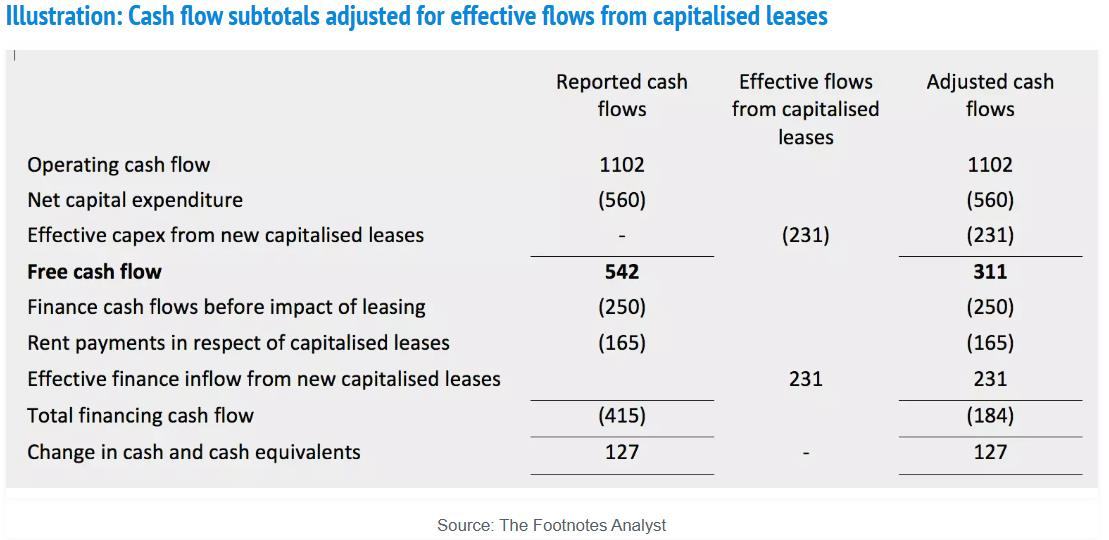
A99One preparer commented that “leases under IFRS 16 potentially degrade the statement of cash flows by hiding capex".
A100Another preparer interviewed, specifically pointed out their enhanced voluntary disclosure in the form of an additional explanatory note to the statement of cash flows, in order to enable a user to perform a full reconciliation between PP&E additions and cash outflows in respect of the purchase of PP&E included in the consolidated statement of cash flows. This included IFRS 16 right-of-use asset additions and accrued capex.
A101Other examples given by users of effective cash flows where they suggest more transparent information be required include pension service costs, share-based payments, restructuring costs, divestitures, business combinations where the consideration is non-cash, and reverse factoring.
A102Derivatives (both economic and hedge accounting) were mentioned by most users during the interviews. One credit rating analyst noted that they have to make sweeping assumptions when doing their credit analysis, since it is not easy to break out the impact of unrealised gains or losses, the change in fair value and FX movements.
A103Some preparers noted that the new disclosure requirements for supplier finance arrangements effective for reporting periods starting 1 January 2024, should provide more transparency for users about such transactions. However, they also acknowledged that there was opportunity to provide more transparent disclosure for other non-cash transactions too.
Suggestions for improving the disclosure of non-cash information
A104Although companies do not report the ‘effective’ investing and financing flows arising from finance leases in the actual statement of cash flows, IAS 7 does require that significant non-cash transactions are disclosed. Ideally, analysts would like to see these on the same page as the statement of cash flows, or at least the location of this information clearly cross-referenced in that statement28.
A105Users noted that recently introduced disclosures help provide transparency for effective cash flows that involve financing activities29. One preparer specifically commented that, in order to meet the disclosure requirements in IAS 7 paragraphs 44A–44E to disclose changes in liabilities arising from financing activities, most UK companies apply the option in IAS 7 paragraph 44E to provide a reconciliation between the opening and closing balances in the statement of financial position for liabilities arising from financing activities, including the changes identified in paragraph 44B30, which include non-cash items, such as the effects of changes in fair value and FX rates.
A106Some preparers acknowledge that such requirements could be mandatory and also extend to other balance sheet movements, where the information is imperative to users’ analyses.
A107Other suggested disclosures provided by interviewees, which might improve accessibility for users to non-cash information include:
- Roll forwards for key items, disclosing separately cash and non-cash items (similar to the suggestion in paragraphs A89–A91 above).
- Single note disclosure, listing significant non-cash items by the various categories (operating, investing and financing) and cross-referencing to other notes to the financial statements, where more detail is provided.
- Line items in an ‘operating profit’ note, disaggregated between cash and non-cash elements, and cross-referenced to other notes to the financial statements (similar to the suggestion in paragraph A77b) above).
- Single-note disclosure of non-cash transactions that are economically similar to cash transactions, to show effective offsetting flows (e.g. leases, pension service costs, reverse factoring, and certain M&A where consideration is non-cash), similar to the example in paragraph A98 above – this might also assist analysts not to double count i.e. because non-cash transactions can have later real cash flows. For example, it would be important for analysts not to include in free cash flow measures, both the effective capex and the lease rental payments in respect of capitalised leases.
- Working capital movements specifically broken down for each major component, sub-totalled and reconciled to respective balance sheet notes, including disclosure of non-cash items (e.g. FX effects).
- Breakdown of fixed asset additions to separately identify cash transactions, cash-timing differences (e.g. accrued capex) and non-cash transactions (e.g. leased assets, transfer of assets, etc)
- Breakdown in provisions note to disaggregate ‘amounts utilised’ between cash utilisation (e.g. paid) and non-cash utilisation (e.g. transferred to a liability).
A108One credit rating agency noted the importance of disclosure of cash and non-cash effects of movements in regulatory assets and regulatory liabilities will be needed when forthcoming standard, IFRS 20 Regulatory Assets and Regulatory Liabilities, is introduced31.
Importance of non-GAAP measures
A109In both the previous research papers, it was noted that free cash flow32 and net debt33 were two of the most common cash flow alternative performance measures (APMs) among UK companies.
A110One preparer added that based on discussion with its Investor Relations Department, "the primary focus of investors is on free cash flow and net debt rather than the statement of cash flows itself, and therefore the primary function of the statement of cash flows is to explain how free cash flow is generated”.
Free cash flow
A111As noted in the second research paper34, free cash flow plays an essential role in valuation, as it demonstrates the cash flow a company can potentially distribute, after making reinvestments in the business via capex and working capital. However, IAS 7 does not define free cash flow.
A112Most users interviewed commented on free cash flow, noting their preference to calculate their own free cash flow measures, using information disclosed in the statement of cash flows and elsewhere in the financial statements. Therefore, there was little appetite amongst users for the IASB to define ‘free cash flows’.
“It is not necessary to have a standardised or prescribed definition of free cash flows as there is variability on how free cash flow is defined, depending on the information that is being focused on". Credit rating agency
A113It is more important for companies to disclose transparent information needed for analysts to calculate their own measures of free cash flow, which can vary by industry sector or other criteria. Such disclosures that are important to users are included elsewhere in this paper, such as non-cash transactions, better disaggregation, cohesiveness between the primary financial statements and roll forwards.
A114One preparer noted that the company was highly leveraged, so investors' attention was focused on the borrowings. As a result, the company now discloses 'free cash flow before dividend' to show the company's ability to pay the borrowings and still invest.
Net debt
A115Most UK preparers (except those in banks and insurers), disclose a net debt measure, with most including net debt in their financial statements, and a few including net debt in the front half of the annual report, within the key performance indicator (KPI) disclosures required by UK Companies Act 2006.
A116In contrast to the view on free cash flow, almost all users interviewed (excluding those focused on financial institutions), said that net debt information was as important as the statement of cash flows.
A117Users rely upon the information that companies provide for net debt (current interest-bearing debt on its statement of financial position minus its liquid assets i.e. cash and cash equivalents), as a financial liquidity metric. It allows them to determine how much cash would remain if all debts became due immediately and measure the company’s capacity to take on more debt.
A118A private investor commented that net debt is commonly used in valuations and noted that the main focus and use for the statement of cash flows is to ascertain Enterprise Value (EV). Since EV is the sum of equity value, net debt, preferred stock and minority interest, a net debt reconciliation is extremely useful.
A119As with free cash flow, calculation methods for net debt vary, primarily depending on whether analysts include or exclude certain items from net debt, such as leases, investments, debt-related derivatives, and other derivatives not related to debt.
A120However, unlike with free cash flow, almost all users and preparers commented that a standard definition for ‘net debt’ provided by the IASB would be useful. Mandatory reporting of a net debt metric would enable comparability between companies. If net debt was defined, then any variations e.g. provided as a KPI, would lead to disclose of 'adjusted net debt' metric as a management performance measure (MPM), together with a reconciliation to the standard definition of 'net debt'.
A121Some users interviewed went further and suggested that information about a company’s net debt position should be more prominent in a company’s financial statements. Some of those users specified that the metric be elevated to the face of the primary financial statement and integrated into the statement of cash flows, due to the importance of net debt in determining a company’s liquidity.
“If I could make one change it would be to turn the statement of cash flows into a net debt statement". Preparer
A122Some users suggested that the net debt should be reconciled to the cash and cash equivalents figure to enhance transparency, and should be reconciled to free cash flow, where the company provides a free cash flow metric.
A123Examples of different company approaches to presenting 'net debt' and reconciling the metric to the statement of cash flows (cash and cash equivalents) were presented in the February 2025 research paper35. Two of the examples included were provided by two companies that were interviewed. One of those preparers noted that to provide more useful information, it extends the mandatory net debt information (which they provide in the form of a reconciliation), to show 'net debt' as defined internally by management – this includes removing fair value movements in derivatives.
A124One user noted that in some sectors, such as utility companies, there are highly covenanted financing transactions, where the company has financial ratio limits, and it is helpful if companies provide a reconciliation of the covenanted debt amount in its net debt disclosure.
Working capital movements
A125As noted in the first research paper in this series36, changes in working capital can help explain how a company uses its assets and liabilities, which in turn can allow investors to predict changes in company value.
A126IAS 7 paragraph 21 requires that 'under the indirect method, the net cash flow from operating activities is determined by adjusting profit or loss for the effects of: (a) changes during the period in inventories and operating receivables and payables". IAS 7 does not include additional presentation or disclosure requirements related to these movements.
A127Whilst the second research paper did not specifically refer to changes in working capital, through the analysis of financial statements it was apparent that companies often refer to the above-mentioned adjusting items in the 'operating cash flows' section of the statements of cash flows as 'changes in working capital'. It was also observed that some companies include changes in other current assets and liabilities, within ‘changes in working capital’. Differing levels of granularity regarding the assets and liabilities are included in ‘changes in working capital’. There is no standard definition of ‘working capital’, and specific components could depend upon the nature of the business. Most companies provide:
- increase/decrease in trade receivables;
- increase/decrease in trade payables; and
- increase/decrease in inventory.
A128As noted in paragraph A19 above, one credit rating agency advised that many financial ratios used to assess the credit quality of companies are based on the statement of cash flows, such as 'funds from operations', which is essentially 'cash flows from operating activities less working capital'. Hence working capital is an important metric. It is necessary to understand the individual components of the company's definition of working capital to decide which should be included in the adjustments to operating cash flows.
A129That user also commented that working capital movements can be volatile, so the volatile element of the ratio needs to be removed. Therefore, it is important for users to be able to understand what components are in working capital that are driving the overall change, which can be difficult to understand from the financial statements. Individual components of working capital can be subject to different forces and may give different signals for user analysis, for example impairments of receivable balances versus management of trade payables.
A130A few users said that that they need appropriate disclosure and disaggregation of what comprises the working capital and its movements. Such information may be transparent when the movement in working capital is disaggregated on the face of the statement of cash flows (or in the related ‘operating cash flows’ note) and cross-referenced to the related notes for the statement of financial position movements. This reinforces that the cohesiveness between the statement of cash flows and the statement of financial position is important. However, such transparency is not always evident when there is M&A activity, disposals, non-cash transactions, and non-cash items, such as FX effects. See paragraphs A78–A108 of this paper for more information on non-cash items.
A131Many preparers acknowledged that it was not transparent how the movements in working capital relate to the opening and closing balances of the related trade receivables or trade payables. Most noted that this would often be due to the effect of FX rate differences that was not apparent in the notes, since roll forwards are not required to be provided for such balances.
A132One preparer noted that they provide commentary to their balance sheet note to state the difference between the balance sheet movement and the statement of cash flows relates to the effects of FX. However, another preparer noted that this information was not disclosed as they would have difficulty proving the FX difference to their auditors, even though they know that FX was the 'balancing item'.
Alignment with IFRS 18
A133IFRS 18 significantly impacts Alternative Performance Measures (APMs) by introducing specific disclosure requirements for a subset of APMs called "Management-defined Performance Measures" (MPMs). This will mean companies are more transparent about how they use certain non-GAAP metrics to present their financial performance and improve the reliability and comparability of financial information for users by providing greater insight into management's perspective on a company's performance.
A134One preparer noted that cash flow APMs are out of scope of IFRS 18. They suggested these should be introduced by any project on the statement of cash flows, as only the APMs in scope of the standard will be required in the financial statements and audited. This would provide more transparent information about internally used cash flows metrics to help users perform their analyses.
Suggestions for improving disclosure of important non-GAAP measures
A135As noted above, most preparers and users agreed that a standard definition of net debt would be useful, with some suggesting it be elevated to the primary financial statement and be required to reconcile to the statement of cash flows 'cash and cash equivalents' figure.
A136Improvements to working capital disclosures is important to enable users, such as credit rating agencies, to remove the volatility, when calculating important ratios, such as 'funds from operations'37. It may be useful if the IASB provides more guidance on the level of granularity required in the statement of cash flows, requires a sub-total to be provided for 'movements in working capital', and requires a company to disclose how the balance sheet movements reconcile to the amounts shown in the statement of cash flows.
A137Since MPMs are typically linked to specific subtotals within the statement of profit or loss, the IASB could consider what sub-totals would be useful to be disclosed in the statement of cash flows.
Interconnectivity with other IFRS Accounting Standards
Issues raised concerning other IFRS
A138Whilst paragraphs 54–65 of IAS 7 refer to the consequential changes made to IAS 7 because of amendments to other standards, IAS 7 makes few other cross-references to cash flow disclosures required by other standards.
A139There is a notable lack of guidance in other IFRS accounting standards on related requirements for the statement of cash flows. It is apparent that most IFRS accounting standards make more reference to the other primary financial statements i.e. the statement of profit or loss and the statement of financial position.
A140Users highlighted challenges in finding certain information related to cash flows (and non-cash information), and preparers noted they would welcome more guidance on a number of areas that are covered by other IFRS accounting standards. Areas mentioned by interviewees relate to the following standards:
- IFRS 18 Presentation and Disclosure in Financial Statements.
- IFRS 16 Leases.
- IFRS 2 Share-based payments.
- IAS 21 The Effects of Changes in Foreign Exchange Rates.
- IFRS 3 Business Combinations / IFRS 12 Disclosure of Interests in Other Entities.
- IAS 37 IAS 37 Provisions, Contingent Liabilities and Contingent Assets.
- IFRS 5 Non-current Assets Held for Sale and Discontinued Operations.
- IFRS 7 Financial Instruments: Disclosures / IFRS 9 Financial Instruments | IAS 39 Financial Instruments: Recognition and Measurement.
- IFRS 8 Operating Segments.
A141Other cross cutting issues already mentioned earlier in this paper include:
- Fair value adjustments.
- Exceptional, one-off or unusual (recurring but volatile, or infrequently recurring) items, with different characteristics.
- IFRS 20 Regulatory Assets and Regulatory Liabilities.
A142One preparer noted the reduced disclosures under UK GAAP (FRS 101) in respect of the statement of cash flows, and suggested similar reduced disclosures be applied in IFRS 19 Subsidiaries without Public Accountability: Disclosures.
Suggestions for improving the interconnectivity with other IFRS
A143Whilst it is recognised that the other primary financial statements do not specifically have their own standard, albeit IAS 1 (to be replaced by IFRS 18) sets out the main requirements, most accounting standards have been issued since IAS 738. So, although IAS 7 set out the principles, some additional guidance in other standards as to how information should be disclosed in the statement of cash flows would be useful.
Challenges for preparers
A144During the interviews, it became apparent that there are lower priority areas for users, which are of higher priority for preparers, due to challenges the current requirements in IAS 7 present, including:
- Inconsistencies with IFRS 18 Presentation and Disclosure in Financial Statements (see paragraphs A35–A45 and paragraphs A133–A134).
- Cash and cash equivalent definitions – perceived to be too prescriptive (see paragraphs A145–A149).
- Classification of cash flows – lack of guidance for some items e.g. transaction costs, grants and contributions, capitalised interest (see paragraphs A150–A156).
- Systems restrictions and cost implications – the time burden and resulting cost of any additional disclosure proposals, whilst acknowledging the need of relevant information for users (see paragraphs A157–A160).
- Aggregation/netting (see paragraphs A161–A165).
Cash and cash equivalents
A145Per IAS 7 paragraph 6 "cash equivalents are short-term, highly liquid investments that are readily convertible to known amounts of cash and which are subject to an insignificant risk of changes in value'. IAS 7 paragraph 7 states that "an investment normally qualifies as a cash equivalent only when it has a short maturity of, say, three months or less from the date of acquisition". IAS 7 does not provide additional guidance to determine whether an item meets the definition of cash equivalents.
A146Users interviewed did not raise any concerns with regards to the definition of cash and cash equivalents, although it was noted that not all users were aware of the definitions in IAS 7. This may be because most of the users interviewed focussed on net debt rather than on cash and cash equivalents, so whether an investment is classified as a cash equivalent may not be so important to their analyses.
A147However, many preparers said the guidance on cash and cash equivalents could be enhanced. Some preparers said that investments they would classify internally as cash equivalents would not satisfy the definition in IAS 7, even though these investments are used as part of the company's cash management activities. One preparer said the three-month ‘rule’ was arbitrary and companies should be given more discretion.
A148Some preparers suggested the current guidance is driving management behaviour to adjust their liquidity management approach and place surplus cash on shorter term deposits close to the reporting date, so that such investments can be included in cash equivalents. Some of those preparers suggested it would be useful to have a closer alignment between the definitions used for internal and external reporting because it might reduce costs and better reflect how a company is manging its liquidity.
A149Some preparers and one credit agency said liquid assets are more aligned to how companies manage their cash and referred to the source and application of funds statement previously required under UK GAAP. This was mentioned earlier in this paper in paragraph A34.
Classification of cash flows
A150IAS 7 paragraph 11 simply states that "an entity presents its cash flows from operating, investing and financing activities in a manner which is most appropriate to its business".
Transaction costs
A151One preparer pointed out that IAS 7 is silent on how transaction costs should be treated in the statement of cash flows and suggested that more guidance and illustrative examples would be useful on whether classification is operating or investing.
Grants and contributions
A152Under the heading of 'Presentation of grants related to assets' IAS 20 Accounting for Government Grants and Disclosure of Government Assistance states that "the purchase of assets and the receipt of related grants can cause major movements in the cash flow of an entity. For this reason and in order to show the gross investment in assets, such movements are often disclosed as separate items in the statement of cash flows regardless of whether or not the grant is deducted from the related asset for presentation purposes in the statement of financial position". However, IAS 20 is silent on how cash flows should be treated under the heading of 'Presentation of grants related to income'.
A153One preparer specifically noted that IAS 7 is silent on how to account for 'grants and contributions received from customers' and noted diversity in practice in their industry. While IAS 7 paragraph 16 states that "only expenditures that result in a recognised asset in the statement of financial position are eligible for classification as investing activities", no mention is made of contributions received that are intended to fund such expenditure. Given the linkage of contributions to the PP&E created, and in the absence of specific IFRS requirements to the contrary, the preparer interviewed noted they classify grants and contributions within investing activities, as they believe it provides the most meaningful and relevant information to users.
Capitalised borrowing cost / interest
A154Paragraph 1 of IAS 23 Borrowing Costs states that "borrowing costs that are directly attributable to the acquisition, construction or production of a qualifying asset form part of the cost of that asset. Other borrowing costs are recognised as an expense". Paragraph 32 of IAS 7, states that "the total amount of interest paid during a period is disclosed in the statement of cash flows whether it has been recognised as an expense in profit or loss or capitalised in accordance with IAS 23 Borrowing Costs". IAS 7 currently permits such interest paid to be classified as operating or financing cash flows.
A155One preparer and one user specifically commented on capitalised interest. The preparer noted that it voluntarily enhanced the disclosure of capitalised interest costs in the finance expense note to break down the amount capitalised under IAS 23 into amounts added to PP&E and amounts added to intangible assets, and set out in their accounting policies how interest is treated in the statement of cash flows.
A156One user commented that it is not always clear where a company has disclosed capitalised interest in the statement of cash flows39, and it would be helpful to users if interest cash flows can be reconciled back to the interest expense and asset notes accordingly.
Systems restrictions and cost implications
A157With respect to practical issues, only three preparers interviewed had systems that allowed the statement of cash flows to be produced automatically. All three presented 'operating cash flows' using the indirect method, but one presented 'operating cash flows' using both the indirect and direct method. All those preparers noted that, although their systems are automated, a small number of manual adjustments are still necessary, noting its accuracy relied on the quality of the data entered. Only one of those preparers said the statement of cash flows was embedded into the company’s budget and forecasting software and continuously updated.
A158Other preparers do not have sophisticated ways of producing the information required from their systems and the production of the statement of cash flows was a manual exercise, often using spreadsheets, and generated late in the reporting process. Only a few preparers produced the statement of cash flows at the same time as the other primary financial statements.
A159Other than preparers from financial institution, most preparers do not want to see a significant change to the requirements in IAS 7 due to the potential cost implications.
A160However, preparers recognise that there might be more transparent ways to provide information that users need on both cash flows and non-cash items.
Aggregation/netting
A161IFRS 18 paragraph 42 does not permit offsetting/netting, except where expressly required or permitted by an IFRS Accounting Standard, however this requirement is only expressed in relation to net assets and liabilities or income and expenses, and not cash inflows and cash outflows.
A162IAS 7 paragraphs 22 states that "cash flows arising from the following operating, investing or financing activities may be reported on a net basis:
- cash receipts and payments on behalf of customers when the cash flows reflect the activities of the customer rather than those of the entity; and
- cash receipts and payments for items in which the turnover is quick, the amounts are large, and the maturities are short".
A163Examples are provided in IAS 7 paragraphs 23–23A. IAS 7 paragraph 24 permit cash flows arising from certain activities of a financial institution to be reported on a net basis.
A164One preparer suggested that the standard is too prescriptive and that it should permit the netting of cash inflows and outflows for items such as short-term investments. The gross amounts of receipts and payments may vary year on year, whilst the net amount may be consistent.
“Disclosing £5bn outflows and £6bn inflows for the reporting period, rather than a net inflow of £1bn, does not provide useful information to users.” Preparer
A165No feedback was received from users interviewed with regards to aggregation or netting (except as noted in paragraph A77a)).
Suggestions to assist preparers in applying the requirements
A166In addition to addressing inconsistencies with IFRS 18, many preparers commented that more guidance and illustrative examples would be useful on some aspects of the requirements in IAS 7, including cash and cash equivalents, classification of cash flows and aggregation/netting.
A167It would be useful if certain note disclosures, such as interest, show where the related cash flows have been accounted in the statement of cash flows, not just the interest credited or charged in statement of profit or loss, i.e. show the cash flows categories related for all interest payments.
Usefulness of the statement of cash flows for Financial Institutions
A168In contrast to non-financial institutions, most users and preparers believe that the statement of cash flows for banks and insurers provides little to no significant incremental value in addition to other primary financial statements and related disclosures. With banks and insurers typically managing portfolios of liquid assets beyond what is included within cash and cash equivalents, the statement of cash flows only represents a subset of such portfolios and therefore does not align with how the overall business is managed.
A169Preparers also expressed that it was rare to receive questions from users on cash flows.
A170One user noted that for insurers, they cannot easily assess whether a company can distribute cash, so regulatory surplus is used as a proxy.
A171When explicitly asked about the usefulness of the risk management disclosures required by IFRS 7 Financial Instruments: Disclosures, there were mixed views on the extent to which the required disclosures were useful. One preparer and one user expressed that the information provided was typically not cohesive, making it difficult to understand the impact of the risks to the business as a whole.
A172Due to the above issues, preparers and users place greater focus and reliance on the information provided using non-GAAP measures and within regulatory reporting. Information contained within regulatory reporting was noted to be more standardised and disclosures around liquidity and capital management were noted to be more extensive, resulting in enhanced comparability and relevance. Moreover, regulatory capital requirements are a key factor when considering whether there is capacity to pay out dividends.
A173An asset manager noted that the information provided by the statement of cash flows is more useful for their users than for banks and insurers, opting to include a condensed and simplified statement of cash flows within the Chief Financial Officer’s review in the Strategic Report. This is consistent with the feedback received from a private investor who had the same valuation model for both asset managers and non-financial institutions but had different valuation models for banks and insurers.
Suggestions to improve usefulness of information provided for some financial institutions
A174Whilst there is general consensus that the statement of cash flows is not particularly useful for banks and insurers, there are a variety of views around how this could be addressed. Suggestions received during the interviews ranged from retaining the current requirements to exempting certain financial institutions. Other interviewees suggested possibly replacing the statement of cash flows with regulatory information, providing a bridge between the primary financial statements and regulatory required information.
A175With regards to exempting banks and insurers from preparing a statement of cash flows, some preparers acknowledged that it was difficult to appropriately scope out banks and insurers, especially in the context of consolidated groups which may have other ancillary business.
- One preparer from an insurer suggested that the IASB could refer to Applying IFRS 9 Financial Instruments with IFRS 4 Insurance Contracts (Amendments to IFRS 4)40, where the concept of activities predominantly connected with insurance was introduced.
- One preparer from a bank suggested scoping based on whether other regulatory reporting was required.
A176Lastly, some users suggested that roll forwards of some balance sheet line items could be disclosed, to include both cash and non-cash movements. However, one preparer and one user noted that while IFRS 17 Insurance Contracts requires a similar disclosure for (re)insurance contract assets and liabilities, the information is currently not used. With the implementation of IFRS 17 requirements being so recent, this may be due to the users needing more time to incorporate the additional information.
Concluding Observations
A177This paper makes no recommendations. The key messages received during the interviews with UK users and preparers are noted in paragraph A13 of the paper.
A178Feedback from UK users and UK preparers suggests that the statement of cash flows is useful for non-financial institutions and is less useful for banks and insurers.
“IAS 7 is generally fit for purpose but there are areas where guidance is needed and areas where preparer discretion is necessary". Preparer
A179Some preparers acknowledged that recent changes to IFRS Accounting Standards, such as the introduction of IFRS 18 (see paragraph A35–A45 in this paper) and other recent changes to IAS 741, were all significant improvements, but there is still scope for further improvements.
A180As identified through the key messages, there is an overlap between the topics outlined in this paper and that should be a consideration for the IASB when progressing with the project on the Statement of Cash Flows and Related Matters. In summary the most important areas that the IASB could consider are:
- Cohesiveness between the primary financial statements – the project could consider how such cohesion might be improved. This might include:
- more requirements for disclosing cash flow information in other IFRS accounting standards; and
- improving the requirements in IAS 7, similar to those for disclosing the changes in financing liabilities.
- Importance of non-cash information – the project could consider information about economically similar transactions that do not involve cash, to ensure that companies are required to disclose transparent information about such transactions.
- Importance of non-GAAP measures – the project could consider the benefits to users of providing a standard definition of ‘net debt’, requiring companies to reconcile net debt to the statement of cash flows.
- Interconnectivity between IFRS Accounting Standards – the project could consider the benefits to preparers by improving the guidance in other standards on how the relevant cash flows might be disclosed in the financial statements, which would improve transparency and comparability for users.
- Assisting preparers in applying the requirements – the project could consider the benefits to both preparers and users from improving the definitions for the classifications of cash flows, potential alignment with categories and definitions in IFRS 18, and providing more guidance to assist preparers in applying the requirements in IAS 7 (such as cash and cash equivalents). The project might also consider which requirements currently encouraged in IAS 7 are needed by users and:
- remove the requirement for those encouraged disclosures that not essential, such as disaggregation of growth and maintenance and the preferred use of the direct method; and
- make mandatory those encouraged disclosures that users need, such as segmental information.
- Usefulness of the statement of cash flows for banks and insurers – the project scope could focus on first improving the requirements for all entities and then consider at a later stage if there is any loss of information to users from potentially providing an exemption for some entities, or if there are alternative solutions that would reduce the cost to preparers whilst improving information for users.
A181There is a clear desire for the IASB to carry out sufficient field testing to ensure that any proposed changes to the requirements are practicable for preparers, provide relevant and reliable information, and are proportionate to any increased benefits for users.
Footnotes
- changes from financing cash flows;
- changes arising from obtaining or losing control of subsidiaries or other businesses;
- the effect of changes in foreign exchange rates;
(d) changes in fair values; and (e) other changes.
Footnotes
-
In this paper the term ‘users’ is as described in paragraph 1.5 of the Conceptual Framework, which states that "primary users of financial statements are existing and potential investors, lenders and other creditors who must rely on general purpose financial reports for much of the financial information they need". ↩
-
This is consistent with the approach taken by the IASB, see for example paragraph 8 of: ap32-summary-of-feedback.pdf ↩
-
Meeting minutes for the Investor Advisory Group can be found here: https://www.endorsement-board.uk/investors-advisory-group-iaq ↩
-
Meeting minutes for the Investor Advisory Group can be found here: https://www.endorsement-board.uk/pag-advisory-group ↩
-
See paragraphs 13–14 of the first research paper Statement of Cash Flows and Related Matters: A UK Perspective. ↩
-
Funds from operations is a figure used by real estate investment trusts (REITs) to define the cash flow from their operations, usually starting with cash flows from operating activities, it excludes one-time cash inflows, such as income from the sale of an asset. ↩
-
See paragraph 16 of the second research paper Statement of Cash Flows and Related Matters: Non-mandatory and Voluntary Cash Flow Disclosures provided by UK Companies. ↩
-
Users need to be able to understand the effect of a discontinued operation on an entity’s future cash flows. Paragraph 33(c) of IFRS 5 Non-current Assets Held for Sale and Discontinued Operations requires an entity to provide "the net cash flows attributable to the operating, investing and financing activities of discontinued operations. These disclosures may be presented either in the notes or in the financial statements". ↩
-
Statement of Standard Accounting Practice 10: Statements of Source and application of funds was first issued in July 1975 and withdrawn in September 1991, when it was superseded by FRS 1 Cash Flow Statements. FRS 1 was further revised in 1996 and withdrawn for accounting periods beginning on or after 1 January 2015 when FRS 102 The Financial Reporting Standard applicable in the UK and Republic of Ireland became effective. ↩
-
The statement of source and application of funds shows how an organisation has raised finance for a specified period and how that finance has been applied. Sources of funds are typically trading profits, issues of shares or loan stock, sales of fixed assets, and borrowings. Applications are typically trading losses, purchases of fixed assets, dividends paid, and repayment of borrowings. Any balancing figure represents an increase or decrease in working capital. Source: Oxford Reference. ↩
-
See IFRS 18 paragraphs 52–66 and IAS 7 paragraph 6. ↩
-
https://www.grantthornton.global/globalassets/1.-member-firms/global/insights/insight-content-blocks-and-media/ifrs/ifrs-18/get-ready-for-ifrs-18.pdf ↩
-
Utilised specifically for the purpose of enhancing the group’s fixed asset base is analogous to the treatment of PP&E in the statement of cash flows and its interaction with the income statement. ↩
-
See paragraphs 59–61 of the first research paper Statement of Cash Flows and Related Matters: A UK Perspective. ↩
-
See paragraph 11 of the second research paper Statement of Cash Flows and Related Matters: Non-mandatory and Voluntary Cash Flow Disclosures provided by UK Companies. ↩
-
See paragraphs 42–50 of the second research paper Statement of Cash Flows and Related Matters: Non-mandatory and Voluntary Cash Flow Disclosures provided by UK Companies. ↩
-
This view is consistent with that noted in the FRC Thematic Review: Reporting by Smaller Listed and AIM Quoted Companies (pages 38 and 39) and the FRC Thematic Review: Cash flow statements and liquidity (IAS 7, IFRS 7) (page 8). ↩
-
When IFRS 18 Presentation and Disclosure in Financial Statements becomes effective, it introduces a requirement in IAS 7 that when the indirect method is used for reporting ‘cash flows from operating activities’ in the statement of cash flows, the starting point will be the newly introduced mandatory sub-total ‘operating profit or loss’ as defined in paragraph 70 of that Standard. ↩
-
See paragraphs 94–116 of the first research paper Statement of Cash Flows and Related Matters: A UK Perspective. ↩
-
Paragraphs 44A–44E of IAS 7 ↩
-
Inflation linked-debt such as daily inflation-indexed bonds, where the principal is indexed to inflation or deflation on a daily basis. ↩
-
A "roll forward" is a track how an account balance changes over a specific period of time, by starting with a beginning balance, adding any relevant transactions or adjustments during the period, and calculating the resulting ending balance; essentially showing the movement of an account balance from one reporting period to the next. ↩
-
See paragraphs 56–61 of the second research paper Statement of Cash Flows and Related Matters: Non-mandatory and Voluntary Cash Flow Disclosures provided by UK Companies. ↩
-
Paragraph 53 of IFRS 16 Leases requires lessees to disclose specific quantitative information, including: ......(f) total cash outflow for leases. Paragraph 52 of IFRS 16 requires a lessee to disclose information about leases in a single note or separate section in its financial statements. When this information is presented elsewhere in the financial statements, in the single note (or separate section) a lessee is required to include cross-references to that information. ↩
-
https://www.footnotesanalyst.com/some-cash-flow-measures-should-include-non-cash-flows/ ↩
-
Paragraph 53 of IFRS 16 Leases requires lessees to disclose specific quantitative information, including: ......(f) total cash outflow for leases. Paragraph 52 of IFRS 16 requires a lessee to disclose information about leases in a single note or separate section in its financial statements. When this information is presented elsewhere in the financial statements, in the single note (or separate section) a lessee is required to include cross-references to that information. ↩
-
The option for classifying interest paid under operating or financing, in accordance with the company’s accounting policy, will be removed under IFRS 18. The resulting changes to IAS 7, include removing the existing optionality for presentation of interests and dividends paid and received. Applying IAS 7, as amended, a corporate entity (that does not have a main business activity of providing financing to customers or investing in assets) presents dividends paid as financing cash flows, interests and dividends received as ‘investing’ cash flows and interests paid as ‘financing’ cash flows. See IFRS 18 Effect Analysis page 27. ↩
-
https://www.footnotesanalyst.com/some-cash-flow-measures-should-include-non-cash-flows/ ↩
-
Paragraphs 44A–44E of IAS 7 Changes in liabilities from financing activities. ↩
-
Paragraph 44B states "To the extent necessary to satisfy the requirement in paragraph 44A, an entity shall disclose the following changes in liabilities arising from financing activities: ↩
-
Following on from the January 2021 Exposure Draft Regulatory Assets and Regulatory Liabilities, the IASB expects to publish a new Standard IFRS 20 Regulatory Assets and Regulatory Liabilities in the second half of 2025. The new Standard will replace IFRS 14 Regulatory Deferral Accounts. ↩
-
See paragraphs 119–123 of the first research paper Statement of Cash Flows and Related Matters: A UK Perspective and paragraphs 82–89 of the second research paper Statement of Cash Flows and Related Matters: Non-mandatory and Voluntary Cash Flow Disclosures provided by UK Companies. ↩
-
See paragraphs 114–116 of the first research paper Statement of Cash Flows and Related Matters: A UK Perspective and paragraphs 90–96 of the second research paper Statement of Cash Flows and Related Matters: Non-mandatory and Voluntary Cash Flow Disclosures provided by UK Companies. ↩
-
See paragraph 90–96 of the second research paper Statement of Cash Flows and Related Matters: Non-mandatory and Voluntary Cash Flow Disclosures provided by UK Companies. ↩
-
See paragraph 90–96 of the second research paper Statement of Cash Flows and Related Matters: Non-mandatory and Voluntary Cash Flow Disclosures provided by UK Companies. ↩
-
See paragraphs 124–129 of the first research paper Statement of Cash Flows and Related Matters: A UK Perspective. ↩
-
The feedback received was similar to that received by the FRC as reported in the FRC Lab project report: Operating and investing cash flows (November 2012). ↩
-
IAS 7 was issued in December 1992, effective for annual periods beginning on or after 1 January 1994. ↩
-
IFRS 18 removes the accounting policy choice for interest paid, so that capitalised interest will be required to be shown in the statement of profit or loss under financing activities. ↩
-
The IASB issued "Applying IFRS 9 Financial Instruments with IFRS 4 Insurance Contracts (Amendments to IFRS 4)" on 12 September 2016. The amendments address concerns arising from implementing the financial instruments Standard, IFRS 9, before implementing IFRS 17 Insurance Contracts, the amendments also supplemented existing options in IFRS 4 to address those concerns. IFRS 9 Financial Instruments was issued on 24 July 2014 and became effective on 1 January 2018. IFRS 17 Insurance Contracts was issued on 18 May 2017 and became effective on 1 January 2023. ↩
-
Introduced in January 2016, the disclosure initiative (IAS 7 paragraphs 44A–44E) requires companies to disclose changes in liabilities arising from financing activities, that enable users of financial statements to evaluate changes in liabilities arising from financing activities, including both changes arising from cash flows and non-cash changes. In May 2023, supplier finance arrangements disclosure requirements were introduced (IAS 7 paragraphs 44F–44H), that enables users to assess the effects of such arrangements on the entity’s liabilities and cash flows and on the entity’s exposure to liquidity risk. ↩