6 IFRS 18 Presentation and Disclosure in Financial Statements – Draft Endorsement Criteria Assessment

March 2025
The UKEB does not accept any liability to any party for any loss, damage or costs howsoever arising, whether directly or indirectly, whether in contract, tort or otherwise from any action or decision taken (or not taken) as a result of any person relying on or otherwise using this document or arising from an omission from it.
© 2025 All Rights Reserved
Executive Summary
Project Stage
| Entity | Research / Pipeline | Discussion paper | Redeliberation | Exposure Draft | Redeliberation | Final standard | Post Implementation Review |
|---|---|---|---|---|---|---|---|
| IASB | Research / Pipeline | Discussion paper | Redeliberation | Exposure Draft | Redeliberation | Final standard | Post Implementation Review |
| UKEB | Research / Influencing | Research / Influencing | Monitoring | Influencing | Monitoring | Endorsement | Influencing |
Project Scope
Significant
Purpose of the paper
- Obtain Board feedback on the draft sections of Draft Endorsement Criteria Assessment (DECA) for IFRS 18 Presentation and Disclosure in Financial Statements (the Standard).
- Seek the Board's view on the approach for presenting evidence supporting the assessment in the DECA.
Summary of the Issue
The purpose of the DECA is to assess whether the Standard meets the statutory criteria for adoption set out in SI 2019/6851. The DECA includes:
- a description of the UK statutory requirements for adoption of new and amended international accounting standards at Section 1;
- a description of the main requirements in IFRS 18 and the entities in scope for the assessment of IFRS 18 at Section 2;
- an assessment of whether the Standard meets the statutory criteria for adoption:
- Section 3: Technical accounting criteria assessment;
- Section 4: UK long term public good assessment;
- Section 5: True and fair view assessment; and
- an assessment of whether the Standard leads to a significant change in accounting practice at Section 6.
The Standard has an effective date of 1 January 2027 with earlier application permitted (subject to the UKEB adoption in the UK).
Questions and decisions for the Board
1Does the Board have any comments on the draft sections of DECA at Appendix A?
2What is the Board's view on publishing the results of the Preparer survey, User survey and Auditors' questionnaire separately from the DECA?
Recommendation
We recommend the Board provide comments on the DECA of IFRS 18.
Appendices
- Appendix A Draft Endorsement Criteria Assessment IFRS 18 Presentation and Disclosure in Financial Statements
Background
1In April 2024 the International Accounting Standards Board (IASB) published IFRS 18 Presentation and Disclosure in Financial Statements (the Standard) which replaces IAS 1 Presentation of Financial Statements.
2The publication of the Standard concluded the IASB's decade-long project Primary Financial Statements. The Standard aims to improve the quality of financial reporting by:
- requiring defined categories and subtotals in the statement of profit or loss;
- requiring disclosures about management-defined performance measures; and
- adding new principles for aggregation and disaggregation of information.
3The Standard has an effective date of 1 January 2027 with earlier application permitted (subject to the UKEB adoption in the UK). If an entity applies IFRS 18 for an earlier period, it shall disclose that fact.
DECA
4Appendix A to this paper contains the draft sections of the DECA setting out the proposed preliminary assessment of the Standard against the statutory criteria. The DECA includes tentative assessments against the technical accounting criteria, the true and fair view and the overall long term public good. However, a few sub-sections in the long-term public good section are currently under development and will be brought to the May 2025 Board meeting. They are:
- "Tentative conclusions" for the sub-section on Costs and benefits of applying IFRS 18.
- "Plausibility assessment” in the sub-section on Estimating a cost of capital reduction for IFRS 18.
- "Network effects (spillover effects)" in the sub-section on Third-order indirect effects.
- "Tentative conclusions" for the sub-section on Third-order indirect effects.
5Some of the text is highlighted in yellow or has square brackets around it. These show where text might need to be updated. The discussion at this Board meeting will inform the development of those remaining sections and conclusions.
Collection of evidence
6Evidence was collected through stakeholder outreach and quantitative analysis.
Stakeholder outreach
7Feedback from stakeholder outreach until February 2024 was summarised in the Project Initiation Plan (PIP).2
8Stakeholder outreach after PIP approval includes:
- Discussion at the Financial Instruments Working Group (FIWG) in April 2024 (see Annex A). FIWG members were generally supportive of the requirements in IFRS 18.
- Educational activities (a webcast3 in May 2024 and a webinar4 in July 2024).
- Preparer and User surveys in Q3 2024 which focused on gathering evidence on whether IFRS 18 meets the technical accounting criteria and whether it is likely to be conducive to the long term public good in the UK. The survey results were presented to the Board in December 20245.
- Further discussions with UKEB advisory groups throughout 2024 (see Annex A). These focused on the design, piloting and distribution of the surveys, and on the preliminary survey feedback received.
- Preparer interviews conducted in Q4 2024 focusing on the likely costs and benefits associated with the implementation of IFRS 18.
- A presentation to the QCA Accounting, Auditing and Financial Reporting Expert Group in February 2025 as a targeted outreach to small and medium-sized listed entities. This outreach replaces the planned webinar with the QCA membership, as set out in the PIP.
- Bilateral engagement with UK regulators, accounting professional bodies, and users.
9The feedback from the above outreach is included in the DECA.
Quantitative analysis
10A quantitative analysis was conducted to extrapolate a market-wide estimate of implementation costs to preparers and to assess plausible cost of capital reductions potentially associated with IFRS 18.
Question for the Board
1Does the Board have any comments on the draft sections of DECA at Appendix A?
Approach for presenting evidence supporting the assessment
Feedback from stakeholder outreach
11Feedback from stakeholder outreach forms part of the evidence base for the DECA.
12The body of the DECA reflects relevant stakeholder feedback. Detailed stakeholder feedback that has not already been presented to the Board is set out in Appendix C of the DECA.
13The results of the Preparer survey, User survey and Auditors' questionnaire were discussed by the Board at its December 2024 meeting. Although the DECA refers to these surveys, it currently does not include the detailed results. If these documents are published alongside the DECA on the IFRS 18 webpage, this would help keep the DECA shorter whilst ensuring that the supporting evidence is publicly available.
14Publishing separate papers of outreach results is consistent with the approach used in the UKEB's endorsement project on IFRS 17 Insurance Contracts6.
Questions for the Board
2What is the Board's view on publishing the results of the Preparer survey, User survey and Auditors' questionnaire separately from the DECA?
Quantitative analysis: methodology for cost of capital model
15As part of the analysis of the long term public good specifically to aid the assessment of costs and benefits arising from the standard, the UKEB has developed a methodology to quantify the cost of capital reduction that would lead to an indirect monetary effect equal to the cost to implement a new IFRS accounting standard, as these costs are largely incurred by preparers.
16This is the UKEB's first time application of the methodology on an endorsement project. The results of the analysis are reported in the long term public good assessment section of the DECA.
Next steps and timeline
17Subject to amendments or additions to the draft sections of the DECA required by the Board, the Secretariat will bring additional sections of the DECA (and revised version of the draft sections presented at this meeting) to the Board meeting in May 2025, with an aim to present a complete DECA to the Board for approval in June 2025.
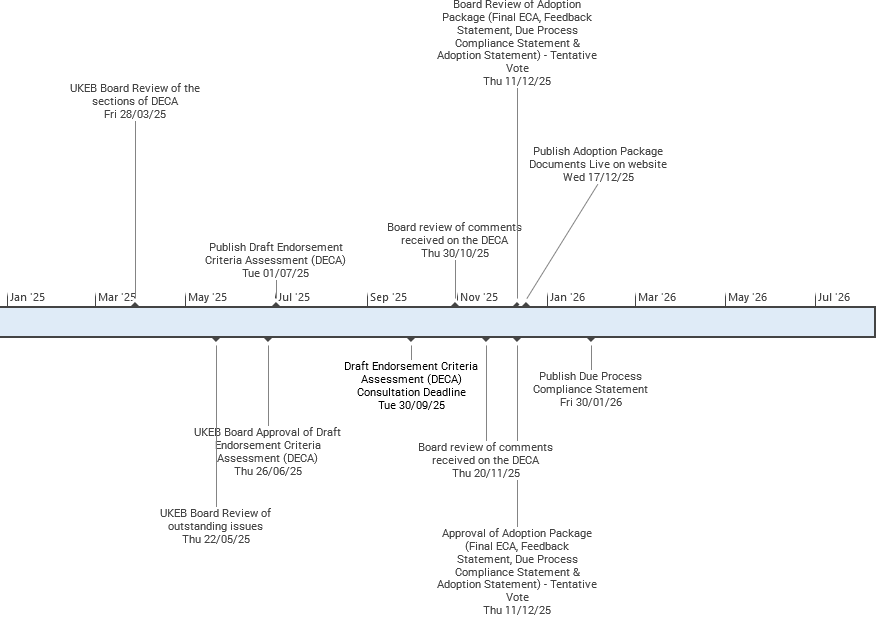
18In accordance with the Project Initiation Plan (PIP), the proposed timeline aims for the Board to consider whether to adopt the Standard in December 2025. The proposed timeline is set out below.
19Dependant on comments received by Board members at this meeting, it may be possible to bring the DECA for approval in May 2025.
| Date | Milestones |
|---|---|
| 23 February 2024 | Draft Project Initiation Plan for Board approval |
| 28 March 2024 | Final Project Initiation Plan for Board's noting |
| 28 March 2025 | Draft DECA for Board's consideration and comments |
| 22 May 2025 | Draft DECA—long term public good topics: Plausibility assessment and Network effects |
| 26 June 2025 | DECA for Board approval |
| Estimated DECA consultation period (90 days): 1 July–30 September 2025 | |
| Oct–Nov 2025 | Board review of feedback received on the DECA. |
| 11 December 2025 | * Consideration of Adoption Package |
| * Board members provide a tentative vote | |
| December 2025 | * Voting form sent to Board members |
| * Publication of voting outcome and Adoption Package on the UKEB website | |
| 29 January 2026 | Due Process Compliance Statement for noting |
Endorsement and adoption partial timeline for 2025
Annex A: List of meetings in 2024 with the UKEB advisory groups and working group
A1The Secretariat had further discussions with the UKEB advisory groups and working group throughout 2024 on the following topics:
| Meeting date | Advisory/Working group | Topic |
|---|---|---|
| 26 February 2024 | Investor Advisory Group (IAG) | Informed IAG members about survey piloting to obtain comments by email |
| 5 March 2024 | Preparer Advisory Group (PAG) | Informed PAG members about survey piloting to obtain comments by email |
| 14 March 2024 | Accounting Firms & Institutes Advisory Group (AFIAG) | Informed AFIAG members about the expected timing of survey launch and requested them to distribute the surveys within their networks when launched |
| 12 April 2024 | Academic Advisory Group (AAG) | Presented the survey design to AAG members and asked them for feedback |
| 23 April 2024 | Financial Instruments Working Group (FIWG) | Presented IFRS 18's main requirements to FIWG members and asked them for feedback on the identification of (any) significant endorsement issues |
| 10 June 2024 | IAG | Encouraged IAG members to complete the surveys and distribute the surveys within their networks |
| 17 June 2024 | PAG | Encouraged PAG members to complete the surveys and distribute the surveys within their networks |
| 1 July 2024 | AFIAG | Encouraged AFIAG members to complete the surveys and distribute the surveys within their networks |
| 28 October 2024 | PAG | Presented the preliminary survey result analysis to PAG members and asked them for further feedback |
| 4 November 2024 | IAG | Presented the preliminary survey result analysis to IAG members and asked them for further feedback |
| 7 November 2024 | AFIAG | Presented the preliminary survey result analysis to AFIAG members and asked them for further feedback |
- Executive Summary
- Purpose of the paper
- Summary of the Issue
- Questions and decisions for the Board
- Recommendation
- Appendices
- Background
- DECA
- Collection of evidence
- Quantitative analysis
- Question for the Board
- Approach for presenting evidence supporting the assessment
- Questions for the Board
- Quantitative analysis: methodology for cost of capital model
- Next steps and timeline
- Endorsement and adoption partial timeline for 2025
- Annex A: List of meetings in 2024 with the UKEB advisory groups and working group
- Introduction
- 1. Section 1: UK statutory requirements for adoption and the approach to the endorsement criteria assessment
- 2. Section 2: Main requirements in IFRS 18
- 3. Section 3: Technical accounting criteria assessment
- Approach to the assessment against the technical accounting criteria
- Assessment of main requirements in IFRS 18
- Defined categories and required subtotals in the statement of profit or loss
- Management-defined performance measures (MPMs)
- Aggregation and disaggregation
- Limited changes to the statement of cash flows
- Classification of interest and dividends paid and/or received
- Overall conclusion on whether IFRS 18 meets the technical accounting criteria
- 4. Section 4: UK long term public good assessment
- Introduction
- Will IFRS 18 improve the quality of financial reporting?
- IFRS 18's objective
- Improvements introduced by IFRS 18
- Categories and subtotals
- Management-defined Performance Measures (MPMs)
- Aggregation and disaggregation
- Limited changes to IAS 7
- Potential improvement from interaction across the main changes
- Economic impact assessment
- Government guidance
- Policy options
- Economic impact assessment
- Analysis of costs and benefits of applying IFRS 18
- Analysis of wider economic effects
- First-order indirect effects – cost of capital
- Estimating a cost of capital reduction for IFRS 18
- Plausibility assessment [To be developed for discussion at the May 2025 Board meeting]
- Second-order indirect effects
- Third-order indirect effects
- [Tentative] Conclusions
- Consideration of the consequences of not adopting IFRS 18 (counterfactual analysis)
- [Tentative] Overall assessment of long term public good
- 5. Section 5: True and fair view assessment
- 6. Section 6: Does IFRS 18 lead to a significant change in accounting practice?
- Appendix A: Glossary
- Appendix B: Individual assessment of technical issues raised by stakeholders
- Issue 1: Classification of income and expenses from associates and joint ventures accounted for using the equity method in the investing category
- Issue 2: Accounting policy choice for the classification of income and expenses for entities that provide financing to customers
- Issue 3: Disclosure of the income tax effect and the effect on non-controlling interests (NCIs) in the MPM reconciliation
- Assessment against the technical accounting criteria
- Appendix C: Evidence about costs and benefits for preparers
Introduction
Purpose
1The purpose of this Draft Endorsement Criteria Assessment (DECA) is to determine whether IFRS 18 Presentation and Disclosure in Financial Statements (the Standard), issued by the International Accounting Standards Board (IASB) in April 2024, meets the UK's statutory requirements for adoption as set out in Regulation 7 of Statutory Instrument 2019/6851 (SI 2019/685).
2The Standard has an effective date of 1 January 2027 with earlier application permitted (subject to the UKEB adoption in the UK). If an entity applies IFRS 18 for an earlier period, it shall disclose that fact in the notes.
3The UKEB Secretariat actively influenced the development of IFRS 18. This included submitting a Final Comment Letter on 30 September 20202 in response to the IASB's Exposure Draft ED/2019/7 General Presentation and Disclosures3.
Background to the Standard
4Section 2 in this DECA provides a brief description of the main requirements in IFRS 18.
Scope of the adoption assessment
5IFRS 18 replaces IAS 1 Presentation of Financial Statements and makes changes to the mandatory parts of IFRS accounting standards. These changes to the mandatory parts of the standards form part of the UKEB's adoption assessment.
6UK-adopted international accounting standards comprise only the mandatory sections of standards5. The Bases for Conclusion, Implementation Guidance, and Illustrative Examples of the IFRS Accounting Standards are not adopted by the UKEB and amendments to these non-mandatory sections are not considered in this DECA.
Structure of the assessment
7The UKEB's analysis is presented in the following sections:
- Section 1 describes UK statutory requirements for adoption of new or amended international accounting standards;
- Section 2 describes:
- the main requirements in IFRS 18 and what has changed; and
- the entities in scope for the assessment of IFRS 18.
- Sections 3–5 discuss whether IFRS 18 meets the requirements for adoption described in Section 1. More specifically:
- Section 3: addresses whether IFRS 18 meets the technical accounting criteria and explains the approach to the assessment of these criteria;
- Section 4: analyses whether IFRS 18 is likely to be conducive to the long term public good in the UK; and
- Section 5: addresses whether IFRS 18 is not contrary to the true and fair view principle for individual and consolidated accounts.
- Section 6 addresses whether IFRS 18 leads to a significant change in accounting practice.
7The UKEB's analysis is presented in the following sections:
- Section 1 describes UK statutory requirements for adoption of new or amended international accounting standards;
- Section 2 describes:
- the main requirements in IFRS 18 and what has changed; and
- the entities in scope for the assessment of IFRS 18.
- Sections 3–5 discuss whether IFRS 18 meets the requirements for adoption described in Section 1. More specifically:
- Section 3: addresses whether IFRS 18 meets the technical accounting criteria and explains the approach to the assessment of these criteria;
- Section 4: analyses whether IFRS 18 is likely to be conducive to the long term public good in the UK; and
- Section 5: addresses whether IFRS 18 is not contrary to the true and fair view principle for individual and consolidated accounts.
- Section 6 addresses whether IFRS 18 leads to a significant change in accounting practice.
1. Section 1: UK statutory requirements for adoption and the approach to the endorsement criteria assessment
UK statutory requirements
1.1Paragraph 1 of Regulation 7 of SI 2019/6856 requires that an international accounting standard only be adopted if:
- the standard is not contrary to either of the following principles—
- an undertaking's accounts must give a true and fair view of the undertaking's assets, liabilities, financial position and profit or loss;
- consolidated accounts must give a true and fair view of the assets, liabilities, financial position and profit or loss of the undertakings included in the accounts taken as a whole, so far as concerns members of the undertaking;
- the use of the standard is likely to be conducive to the long term public good in the United Kingdom; and
- the standard meets the criteria of understandability, relevance, reliability and comparability required of the financial information needed for making economic decisions and assessing the stewardship of management.
1.2This DECA assesses the criteria above in the following order:
- Whether the Standard meets the criteria of relevance, reliability, understandability and comparability required of the financial information needed for making economic decisions and assessing the stewardship of management (Regulation 7(1)(c)). We refer to these criteria collectively as the 'technical accounting criteria'.
- Whether the Standard is not contrary to the principle that an entity's accounts must give a true and fair view (Regulation 7(1)(a)).
- Whether use of the Standard is likely to be conducive to the long term public good in the UK (Regulation 7(1)(b)). Regulation 7(2) of SI 2019/685 includes specific areas to consider for this assessment. They are:
- whether the Standard is likely to improve the quality of financial reporting;
- the costs and benefits that are likely to result from the use of the Standard; and
- whether the use of the Standard is likely to have an adverse effect on the economy of the UK, including on economic growth.
Technical accounting criteria: Relevance, Reliability, Understandability and Comparability7
1.3A description of the technical accounting criteria is provided below:
| Technical criteria assessment | |
|---|---|
| Relevance | Information is relevant if it is capable of making a difference in the decision-making of users or in their assessment of the stewardship of management. The information may aid predictions of the future, confirm or change evaluations of the past, or both. |
| Reliability | Financial information is reliable if, within the bounds of materiality, it:
|
| Understandability | Financial information should be readily understandable by users with a reasonable knowledge of business and economic activities and accounting, and a willingness to study the information with reasonable diligence. |
| Comparability | Information is comparable if it enables users to identify and understand similarities in, and differences among, items. Information about an entity should be comparable with similar information about other entities and with similar information about the same entity for another period. |
1.4In conducting the overall assessment against the technical accounting criteria, the UKEB is required to adopt an absolute, rather than a relative, approach. This means that this assessment is an absolute one against the criteria (does IFRS 18 provide information that is understandable, relevant, reliable and comparable?) rather than a relative one (does IFRS 18 provide information that is more understandable, relevant, reliable and comparable than current, or any other, accounting?).
1.5When an assessment of any individual aspect or requirement of IFRS 18 uses comparative language (e.g. ‘enhances comparability’), this does not mean that the objective is to reflect a real comparison in relative terms. Instead, the objective is to explain that any individual aspect or requirement of the Standard has the potential to "enhance” one or more of the qualitative characteristics. Consideration of whether IFRS 18 is likely to improve the quality of financial reporting is separate from this assessment and is included within the UK long term public good assessment in Section 4.
1.6As explained in Section 3 the assessment of the technical accounting criteria considers all principal aspects of IFRS 18. However, in the interest of efficiency and effectiveness the Secretariat has reported a detailed analysis against the technical accounting criteria only in relation to significant issues (an 'exceptions-based approach'). The process adopted for identifying significant issues is described in more detail in Section 3.
True and fair view assessment
1.7As noted above, the first adoption criterion set out in Regulation 7(1) of SI 2019/685 requires that an international accounting standard can be adopted only if:
"[....] the standard is not contrary to either of the following principles—
- an undertaking's accounts must give a true and fair view of the undertaking's assets, liabilities, financial position and profit or loss;
- consolidated accounts must give a true and fair view of the assets, liabilities, financial position and profit or loss of the undertakings included in the accounts taken as a whole, so far as concerns members of the undertaking; [....]"
1.8For the sake of brevity, the UKEB refers to the assessment against this endorsement criterion as 'the true and fair view assessment' and to the principles set out in Regulation 7(1)(a) as the 'true and fair principle'. However, these abbreviated expressions do not imply that the assessment has considered anything other than the full terms of the endorsement criterion set out above.
1.9The duty of the UKEB under Regulation 7(1)(a) is to determine generically, before a standard is applied to a set of accounts, whether that standard is 'not contrary' to the true and fair principle. In other words, it is an ex-ante assessment. The UKEB has therefore considered whether IFRS 18 contains any requirement that would prevent accounts prepared using IFRS 18 from giving a true and fair view.
1.10The approach is to determine whether IFRS 18 is not contrary to the true and fair principle in respect of any of the specific items identified in Regulation 7(1)(a) (namely, the assets, liabilities, financial position and profit or loss) in the context of the preparation of the accounts as a whole. A holistic approach has been taken to this assessment, considering the impact of the IFRS 18 taken as a whole, including their interaction with other UK-adopted international accounting standards.
1.11For the purposes of the assessment, the UKEB considers the requirement in paragraph 15 of IAS 1 for financial statements to 'present fairly the financial position, financial performance and cash flows of an entity'8 to be equivalent to the Companies Act 2006 requirement for accounts to give a true and fair view.
1.12This assessment is separate from the duty of directors under section 393(1) of the Companies Act 2006, which requires directors to be satisfied that a specific set of accounts gives a true and fair view of an undertaking's or group's assets, liabilities, financial position and profit or loss.
[Draft Adoption decision]
1.13[Sections 3–5 discuss whether IFRS 18 meets the requirements for adoption described in Section 1.
1.14On the basis of these assessments, and subject to any stakeholder feedback, the UKEB [tentatively] concludes that IFRS 18 meets the statutory endorsement criteria. The UKEB is therefore of the view that it will adopt IFRS 18 for use in the UK.]
Does IFRS 18 lead to a significant change in accounting practice?
1.15A standard adopted by the UKEB under Regulation 6 of SI 2019/685 that it considers is likely to lead to a 'significant change in accounting practice', is subject to the requirements in paragraph 3 of Regulation 11 of SI 2019/685 that the UKEB:
- carry out a review of the impact of the adoption of the standard; and
- publish a report setting out the conclusions of the review no later than 5 years after the date on which the standard takes effect (being the first day of the first financial year in respect of which it must be used).
1.16Section 6 of the DECA discusses whether IFRS 18 leads to a significant change in accounting practice.
2. Section 2: Main requirements in IFRS 18
Background, context and objectives of IFRS 18
Background
2.1IFRS 18 is a new IFRS Accounting Standard aimed at improving how entities communicate in their financial statements and replaces IAS 1. The IASB did not reconsider all aspects of IAS 1 when developing IFRS 18 but instead focused on the statement of profit or loss.
2.2The IASB developed IFRS 18 in response to strong demand from stakeholders, particularly from users of financial statements, for improvements to the reporting of financial performance as IFRS Accounting Standards do not have detailed requirements on:
- where to classify income and expenses in the statement of profit or loss;
- what subtotals to present above 'profit or loss' in the statement of profit or loss; and
- how to group the information to be presented in the primary financial statements or disclosed in the notes.
2.3The absence of these requirements led to diversity in practice. This made it difficult for users to analyse and compare companies' performance.
Objective
2.4IFRS 18 sets out general presentation and disclosure requirements that apply across the primary financial statements and the notes. Paragraphs 10–12 of IFRS 18 define a complete set of financial statements as:
[10...]
- a statement (or statements) of financial performance for the reporting period [...];
- a statement of financial position as at the end of the reporting period;
- a statement of changes in equity for the reporting period;
- a statement of cash flows for the reporting period;
- notes for the reporting period;
- comparative information in respect of the preceding period [...];
- a statement of financial position as at the beginning of the preceding period [...].
11The statements listed in paragraphs ...−[...]d) (and their comparative information) are referred to as the primary financial statements. [...]
12An entity shall present its statement(s) of financial performance as either:
- a single statement of profit or loss and other comprehensive income, with profit or loss and other comprehensive income presented in two sections [...]
- a statement of profit or loss and a separate statement presenting comprehensive income that shall begin with profit or loss [....]
2.5IFRS 18 does not change the recognition and measurement of the components of financial statements.
Entities in scope for the assessment of IFRS 18
2.6All entities that prepare financial statements using UK-adopted international accounting standards are required to apply IFRS 18 retrospectively from 1 January 2027 with earlier application permitted (subject to the UKEB adoption in the UK).
2.7Therefore, this DECA considers all entities listed on the London Stock Exchange (LSE) 9 using IFRS Accounting Standards for 2023 year-ends.
2.8The entities considered have the following characteristics:
| Table 1: Characteristics of entities in scope | |
|---|---|
| Number of listed entities | 1,400 (including 300 stand-alone funds and trusts) that prepare their financial statements in accordance with UK-adopted international accounting standards. |
| Total assets (FY 2023) | £12.4 trillion |
| Total revenues (FY 2023) | £2.12 trillion |
| Market capitalisation | £2.65 trillion |
Source: Thomson Reuters-Eikon. It is important to note that approximately 14,000 unlisted entities take the option in UK law to use UK-adopted International Accounting Standards (source: UKEB estimates based on FAME, Companies Watch and other proprietary data.)
2.9The entities we consider will be most impacted by IFRS 18 will be those that have 'specified main business activities'. These are entities that:
- invest in assets (e.g. investment entities, investment property entities and insurers); and/or
- provide financing to customers (e.g. banks, entities that provide financing to customers to enable those customers to buy an entity’s products or lessors that provide financing to customers in finance leases).
2.10It was considered that the Banking, Insurance, Financial Services and Real Estate sectors are the most likely entities to be affected in the UK. In total, roughly 30% of UK-listed entities belong to one of these sectors and are therefore expected to have specified main business activities. Further detail is provided in Table 2 below.
| Table 2 – Industries with specified main business activities | Number of entities | Proportion of listed entities | Market cap (£ billion) | Proportion of market cap |
|---|---|---|---|---|
| Banks & Financial Services | 328 | 24% | 564 | 21% |
| Insurers | 17 | 1% | 77 | 3% |
| Real Estate | 72 | 5% | 63 | 2% |
| Total | 417 | 30% | 704 | 26% |
| All other industries | 983 | 70% | 1,946 | 74% |
| Grand total | 1,400 | 100% | 2,650 | 100% |
Source: UKEB calculations based on Reuters-Eikon data
2.11The total market capitalisation of entities in these sectors was approximately £704 billion, 26% of the total market capitalisation of the LSE.
2.12This analysis does not include entities in other industries that may also undertake specified main business activities. These may be entities that provide financing to customers to enable those customers to buy the entity's products (paragraph B32(c) of IFRS 18). For example, an entity that sells heavy machinery may lease equipment to customers under a lease.
2.13IFRS 18 contains specific requirements for entities that have:
- Investments in associates and joint ventures accounted for using the equity method (‘equity-accounted investments’).
- Non-controlling interests.
2.14The UKEB Secretariat analysed Reuters-Eikon data to ascertain the prevalence of these among UK-listed entities. The prevalence of equity-accounted investments is discussed in paragraphs B13–B14. The prevalence of non-controlling interests is discussed in paragraph B41.
Main requirements in IFRS 18 and what has changed
Main changes
2.15IFRS 18 is expected to give investors more transparent and comparable information about entities' financial performance and improve the quality of financial reporting by:
- defining new categories and subtotals in the statement of profit or loss to provide useful information and improve comparability;
- requiring the disclosure in a single note of information about performance measures defined by management (which IFRS 18 identifies as 'management-defined performance measures') to promote transparency and discipline in the presentation of these measures and to enhance investors' understanding of those measures; and
- introducing enhanced requirements for aggregating and disaggregating information in the primary financial statements and in the notes to help an entity provide useful information and to enhance the understanding of this information.
2.16IFRS 18 also makes limited amendments to IAS 7 Statement of Cash Flows and to the statement of financial position.
2.17The following section discusses in more detail the most important changes introduced by IFRS 18. This section sets out a high-level summary of the key features.
- Defined categories and required subtotals in the statement of profit or loss.
- Management-defined performance measures (MPMs).
- Aggregation and disaggregation.
- Limited changes to IAS 7.
- Limited changes to the statement of financial position.
- Transition requirements.
Defined categories and required subtotals in the statement of profit or loss
IAS 1 requirements
2.18IAS 1 does not have a requirement to classify income and expenses into “classes” or "categories" or a requirement to present ‘operating profit' (or a definition of this subtotal). This has led to diversity in the presentation and calculation of subtotals, making it difficult for users of financial statements to understand and compare information across different companies10.
What has changed?
General requirements
2.19An entity will be required to present in the statement of profit or loss two new defined subtotals—'operating profit' and 'profit before financing and income taxes' (paragraph 69 of IFRS 18)11 and to classify income and expenses in the statement of profit or loss based on three new categories. These categories are:
- the operating category (paragraph 52 of IFRS 18) includes income and expenses (i) not classified in the investing, financing, income taxes or discontinued operations categories (i.e. default category); and (ii) arising from a company's main business activities if they do not meet the requirements to be classified in any of the other categories;
- the investing category (paragraphs 53–58 of IFRS 18), includes income and expenses from: (i) investments in associates, joint ventures and unconsolidated subsidiaries; (ii) cash and cash equivalents; and (iii) other assets that generate a return individually and largely independently of the company's other resources;
- the financing category (paragraphs 59–66 of IFRS 18) includes income and expenses from:
- liabilities arising from transactions that involve only the raising of finance (e.g. interest expenses on debt instruments issued); and
- liabilities (other than those described in (c)(i) above) arising from transactions that do not involve only the raising of finance.
2.20IFRS 18 also includes specific requirements for the classification of certain items of income and expense and provides undue cost or effort reliefs for some of these items.
Specific requirements for entities with specified main business activities
2.21To classify income and expenses in the operating, investing and financing categories, an entity is required in accordance with paragraph 49 of IFRS 18 to assess whether it has either (or both) of the specified main business activities12:
- investing in assets; and/or
- providing financing to customers.
2.22Paragraphs 55–58 and 65–66 of IFRS 18 include specific classification requirements that would allow these entities to classify items of income and expense in the operating category (that would have been classified otherwise in the investing and/or financing categories if the activity was not a main business activity).
Management-defined performance measures (MPMs)
IAS 1 requirements
2.23IAS 1 requires the presentation of additional line items, headings and subtotals in the statement of profit or loss when such presentation is relevant to an understanding of the entity's financial performance (paragraph 85 of IAS 1). IAS 1 provides specific requirements for these subtotals, including a requirement to reconcile any additional subtotals with the subtotals or totals required in IFRS Accounting Standards.
2.24Entities provide their own management performance measures (sometimes called 'alternative performance measures' (APMs) or 'non-GAAP measures'). These measures are often presented outside the financial statements. Users of financial statements find the disclosure of these measures useful in analysing performance or making forecasts about future performance but expressed concern that information about such measures, can be difficult to find and understand including why the measure was used and how it was calculated13.
What has changed?
2.25IFRS 18 requires the integration of the APMs or non-GAAP measures that meet the definition of an MPM as part of an entity's financial information. An MPM is defined in paragraph 117 of IFRS 18 as a subtotal of income and expense used in public communications that communicates an aspect of the financial performance of the company as a whole.
2.26Paragraphs 122–124 of IFRS 18 require an entity to provide significant disclosures about MPMs in a single note to the financial statements:
- a description of the aspect of financial performance that it communicates, including why management believes the MPM provides useful information about the company's financial performance;
- a description of how the MPM is calculated;
- a reconciliation between the MPM and the most directly comparable subtotal listed in paragraph 118 of IFRS 18 or total or subtotal specifically required to be presented or disclosed by IFRS Accounting Standards. This includes the disclosure of the income tax effect and the effect on non-controlling interests (NCIs) for each item disclosed in the reconciliation; and
- a description of how the company determined the income tax effect.
2.27Furthermore, if an entity changes the calculation of an MPM, introduces a new MPM or ceases to use a previously disclosed MPM, it is required to disclose in accordance with paragraph 124 of IFRS 18 an explanation of the change, the reasons for the change and provide restated comparative information.
Aggregation and disaggregation
IAS 1 requirements
2.28IAS 1 includes requirements for the aggregation and disaggregation of information in the primary financial statements and the notes, but these are sometimes not understood or applied well in practice, leading to diversity in application. Entities sometimes also disclose large expenses in the notes as 'other expenses', with no information provided to help users of financial statements understand their composition14.
What has changed?
2.29Paragraphs 16–17 of IFRS 18 help entities determine whether information should be in the primary financial statements or in the notes and provide principles for determining the level of detail needed as follows:
- The role of the primary financial statements is to provide useful structured summaries of an entity's recognised assets, liabilities, equity, income, expenses and cash flows (paragraph 21 of IFRS 18); and
- The role of the notes is to provide material information necessary to enable investors to understand the items in the primary financial statements; and to supplement the primary financial statements with additional information to achieve the objective of the financial statements (paragraphs 19–20 of IFRS 18).
2.30IFRS 18 enhances requirements for grouping of information and labelling of items by requiring entities to aggregate or disaggregate information based on shared characteristics and to determine whether a more informative label exists before labelling items as 'other'.
2.31IFRS 18 also improves guidance to assess how to present operating expenses in the statement of profit or loss and requires entities that present line items for operating expenses classified by function to disclose five specified expenses by nature: depreciation, amortisation, employee benefits, impairment losses (and reversals of impairment losses) and write-downs of inventories (and reversals of write-downs of inventories).
Limited changes to the statement of cash flows
Starting point for the indirect method
IAS 7 requirements
2.32Paragraph 20 of IAS 7 requires the use of the 'profit or loss' total as the starting point for the indirect reconciliation of cash flows from operating activities. The Illustrative examples accompanying IAS 7, however, use ‘profit before tax' as the starting point for determining net cash flows from operating activities, which has led to diversity of practice.
What has changed?
2.33IFRS 18 amends IAS 7 to require all entities to use the operating profit subtotal as the starting point for the indirect method of reporting cash flows from operating activities.
Classification of interest and dividends paid and/or received
IAS 7 requirements
2.34Paragraphs 33 and 34 of IAS 7 allow entities to choose how to present cash flows arising from interest and dividends, leading to significant diversity in practice in the presentation of these line items.
What has changed?
2.35IFRS 18 amends IAS 7 to remove the presentation alternatives for cash flows related to interest and dividends paid and received.
Limited changes to the statement of financial position
2.36Paragraph 103 of IFRS 18 adds a requirement to present goodwill separately from intangible assets.
Transition requirements
2.37Paragraph C2 of IFRS 18 requires an entity to apply IFRS 18 retrospectively applying IAS 8 and to restate comparative information for the prior year presented.
2.38If an entity applies IAS 34 Interim Financial Reporting in preparing condensed interim financial statements in the first year of applying IFRS 18, it is required to present the headings that it expects to use in applying IFRS 18 and subtotals consistent with the requirements in IFRS 18. In addition, an entity is required to disclose reconciliations for each line item presented in the statement of profit or loss for the comparative periods immediately preceding the current and cumulative current periods.
2.39At the date of initial application of IFRS 18, an entity eligible to apply paragraph 18 of IAS 28 Investments in Associates and Joint Ventures is permitted by paragraph C7 of IFRS 18 to change its election for measuring an investment in an associate or joint venture from the equity method to fair value through profit or loss in accordance with IFRS 9 Financial Instruments15. If an entity makes such a change, the entity shall apply the change retrospectively by applying IAS 8. An entity applying paragraph 11 of IAS 27 Separate Financial Statements is required to make the same change in its separate financial statements.
3. Section 3: Technical accounting criteria assessment
Approach to the assessment against the technical accounting criteria
3.1SI 2019/685 requires an assessment of whether IFRS 18 meets the following criteria in regulation 7(1)(c):
...(c) the standard meets the criteria of understandability, relevance, reliability and comparability required of the financial information needed for making economic decisions and assessing the stewardship of management. (...)
3.2These criteria are referred collectively as the 'technical accounting criteria'.
3.3An explanation of the basis for and our interpretation of the technical accounting criteria is provided in Section 1.
3.4This section sets out the main requirements in IFRS 18 and analyses those requirements against the technical accounting criteria.
3.5Input for this assessment was obtained from:
- A review of the survey results from the UKEB Preparer survey and from the UKEB User survey (including feedback from small and medium-sized listed entities) and from the UKEB's webinar poll.
- Engagement with UKEB advisory groups and its working group.
- Interviews with preparers (including with preparers from small and medium-sized listed entities) and users.
- Engagement with the Quoted Companies Alliance (QCA).16
- A desktop analysis of the requirements in IFRS 18 and the basis for these requirements.
3.6A further consideration was whether the issues had the potential to be endorsement issues rather than those that were questions of interpretation or
...(c) the standard meets the criteria of understandability, relevance, reliability and comparability required of the financial information needed for making economic decisions and assessing the stewardship of management. (...)
3.2These criteria are referred collectively as the 'technical accounting criteria'.
3.3An explanation of the basis for and our interpretation of the technical accounting criteria is provided in Section 1.
3.4This section sets out the main requirements in IFRS 18 and analyses those requirements against the technical accounting criteria.
3.5Input for this assessment was obtained from:
- A review of the survey results from the UKEB Preparer survey and from the UKEB User survey (including feedback from small and medium-sized listed entities) and from the UKEB's webinar poll.
- Engagement with UKEB advisory groups and its working group.
- Interviews with preparers (including with preparers from small and medium-sized listed entities) and users.
- Engagement with the Quoted Companies Alliance (QCA).16
- A desktop analysis of the requirements in IFRS 18 and the basis for these requirements.
3.6A further consideration was whether the issues had the potential to be endorsement issues rather than those that were questions of interpretation or implementation. The distinction between endorsement and interpretation or implementation issues is not always clear cut.
3.7The issues listed below were not considered to be endorsement issues but UK stakeholders raised some practical challenges. Some of these topics are also considered to have a cost-benefit impact when implemented in the UK which is discussed as part of the 'cost and benefit analysis' in section 4. The issues are:
- Classification of income and expenses from associates and joint ventures accounted for using the equity method in the investing category.
- Accounting policy choice for the classification of income and expenses for entities that provide financing to customers.
- Disclosure of the income tax effect and the effect on non-controlling interests (NCI) in the management-defined performance measures reconciliation.
3.8These issues are analysed in Appendix B against the technical accounting criteria.
3.9Our outreach [to date] has provided assurance that there are no further issues of concern to UK stakeholders that have not been addressed in the DECA. For example, our outreach asked respondents/participants to highlight issues for consideration during the endorsement assessment.
3.10The UKEB notes that the IASB issued IFRS 18 after reaching an overall consensus, following extensive consultations with a wide range of constituents, including those from the UK. The main rationale behind the final IASB decisions is described in the Basis for Conclusions of IFRS 18 and has been used as part of the technical criteria assessment. The UKEB recognises that IFRS 18 is intended to define principle-based requirements which could be applied in a consistent manner across entities and industries.
3.11Our overall conclusion on whether IFRS 18 as a whole meets the technical accounting criteria is set out at the end of this section 3.
Assessment of main requirements in IFRS 18
3.12This section includes an assessment of the main areas of IFRS 18 against the technical accounting criteria. For a detailed description of these main areas refer to Section 2, paragraphs 2.15–2.39 of this DECA. This assessment considers the feedback from stakeholders from the UKEB's outreach activities, including from members of UKEB advisory groups. Overall, the UKEB received positive feedback from stakeholders that IFRS 18 improves the understandability, relevance, reliability and comparability required of the financial information.
Defined categories and required subtotals in the statement of profit or loss
IFRS 18 requirements
3.13IFRS 18 requires the presentation of new defined subtotals in the statement of profit or loss—operating profit and profit before financing and income taxes—and consistent classification of income and expenses in five categories (operating, investing, financing, income taxes and discontinued operations). For a further description of these requirements see paragraphs 2.19–2.22.
Accounting impact
3.14IAS 1 does not have a requirement to classify income and expenses into “classes” or "categories” or a requirement to present ‘operating profit' (or a definition of this subtotal). IFRS 18 includes specific requirements for the classification of income and expenses in separate categories (and specific classification rules depending on the entity's main business activities) and for the presentation of specific subtotals. These requirements are expected to reduce diversity in practice.
3.15Feedback from the UKEB Preparer survey showed that some entities may already be separating investing and financing items in the statement of profit or loss and therefore do not expect the implementation costs for these changes to be significant. However, practical challenges may arise as some of those requirements are perceived to be complex.17 Or, the application of IFRS 18 may require potential system changes, but preparers do not expect these changes to be costly (refer to paragraph 4.59).
3.16Entities already presenting an ‘operating profit' subtotal would also have to change the classification of some income and expenses that they normally exclude from 'operating'. Some entities may also not be able to present subtotals that they commonly present as these subtotals may not fit into the new structure of the statement of profit or loss. Any change in an entity's definition of operating profit may also require investors to make changes to the calculation of their metrics.
3.17The impact of the new presentation and classification requirements and subtotals will depend on an entity's current reporting practices. If an entity's practices differ from the new classification requirements for income and expenses, an entity may incur higher costs to implement any necessary changes to their current systems. However, some of these costs may be reduced through the application of classification reliefs for 'undue cost or effort' applicable to specific income and expenses.
Assessment against the endorsement criteria
3.18The new requirements for defined categories and subtotals will provide investors with relevant and reliable information to make more informed decisions as the evidence obtained from the UKEB Preparer and User surveys suggests that the new structure in the statement of profit or loss better aligns with the way investors analyse the statement of profit or loss.
3.19Feedback from the UKEB User survey also indicated that the introduction of new defined categories and of specific subtotals will give investors a comparable and consistent starting point for their analyses given that currently IAS 1 does not provide a structure to the statement of profit or loss.
3.20It is also anticipated that the requirements for defined categories and subtotals will provide users with a better understanding of the drivers of financial performance presentation. This should improve users' ability to compare performance between entities and between reporting periods for the same entity.
3.21IFRS 18 also includes specific classification requirements for certain items of income and expense and exceptions to the general classification requirements for entities with specified main business activities some of which provide cost reliefs. This may introduce a risk to the comparability and reliability of the information presented. However, these requirements were developed to ensure that, in providing useful information to investors about their performance, entities will not incur undue costs18. In addition, any risks to comparability or reliability should be balanced against the enhanced relevance of the information presented in the statement of profit or loss.
Management-defined performance measures (MPMs)
IFRS 18 requirements
3.22IFRS 18 requires the identification of management-defined performance measures (MPMs) and the disclosure of information about MPMs in a single note to the financial statements. For a further description of these requirements see paragraphs 2.25–2.27.
Accounting impact
3.23IFRS 18 requires the integration of MPMs as part of an entity's financial statements in a single note for those APMs that meet the definition of MPMs.
3.24UK entities that currently report APMs generally use the guidelines issued by the European Securities and Markets Authority's Guidelines on Alternative Performance Measures (ESMA APM guidelines)19, 20.These guidelines apply to APMs disclosed outside the financial statements. The location of these measures varies in the UK but generally entities place their APMs in the front half of the annual report21.
3.25Entities already disclosing information about APMs may need to revisit those non-GAAP measures that are used in public communications as some may meet the definition of MPMs and will need to be disclosed in the financial statements. Feedback received from our outreach activities revealed that small and medium sized listed entities tend to present a high number of these measures in their annual reports. Therefore, it is expected that these entities will be revisiting their performance measures to comply with the MPM requirements.
3.26The feedback from the UKEB surveys indicated support for the MPM requirements from the perspective of preparers and users as including these measures in a single location in a note to the financial statements will bring discipline, transparency and confidence on those measures as they will be subject to external audit.
3.27The results from the UKEB Preparer survey showed that current practices from UK entities for communicating performance measures are mostly aligned with the requirements for MPMs. However, the introduction of these requirements will prompt UK entities to provide more detailed information about their performance measures. This may also prompt some adjustments to systems and processes to capture all relevant measures and the information required to be disclosed, although these adjustments are not expected to be too costly (see paragraph 4.62(a)).
3.28The application of these requirements is expected to result in changes to:
- how an entity identifies performance measures, with the possibility of applying a rebuttable presumption22 (that exempts entities from making the required disclosures about a subtotal used in public communications to reduce the cost of application);
- the content of what is communicated about each MPM. IFRS 18 requires additional information that some entities may currently not disclose23 to enable users understand how a measure is calculated as well as the possibility of applying options or simplifications24 to reduce the cost of application.
- the location of performance measures (i.e. in a single note within the financial statements). This will trigger a change on the location of APMs that meet the definition of MPMs and that are currently provided outside the financial statements.
Assessment against the endorsement criteria
3.29It is anticipated, based on the results from the UKEB Preparer and User surveys, that the requirements for MPMs will add more discipline, transparency and credibility of these measures, therefore increasing the relevance of these measures for users.
3.30Presenting these measures in a single note to the financial statements will also help users locate and access information on MPMs more easily which would also aid in the understanding of these measures.
3.31Requiring MPMs to be disclosed within the financial statements would also enhance the assurance (because they will be audited) and reliability of those measures (i.e. by making sure that the related presentation and disclosures are free from material error and bias).
3.32In addition, users think that the requirements to explain how measures are calculated, what they intend to communicate, how they relate to the financial statements in the use and how they may have changed would improve users' understanding of how entities view their performance. This transparency would also enhance the reliability of individual measures because with all this information users are expected to be able to make a more complete assessment of these measures.
3.33The requirements to provide comparative information on MPMs will also make it easier for users to track an entity's performance over time and compare performance between entities in the same period.
3.34The risk to comparability and reliability when applying reliefs to the identification of MPMs (i.e rebuttable presumption) and options available to determine the income tax effects of the reconciling items may introduce a risk to the comparability and reliability of the information presented. However, this could be outweighed by the enhanced relevance of the information presented.
Aggregation and disaggregation
IFRS 18 requirements
3.35IFRS 18 provides enhanced requirements for grouping (aggregation and disaggregation) of information and for the presentation and disclosure of an analysis of operating expenses. For a further description of these requirements see paragraphs 2.29–2.31.
Accounting impact
3.36The results from the UKEB Preparer survey reflected that a narrow majority of respondents supported the principles of aggregation and disaggregation and considered them to be useful. However, a few concerns were raised about introducing judgment in applying this guidance as it could lead to inconsistent application and lack of comparability.
3.37The new guidance requires entities to assess whether to present operating expenses by nature or by function, which will impact how an entity presents those expenses in the statement of profit or loss. When an entity presents operating expenses by function, IFRS 18 requires the disaggregation to five specified operating expenses by nature. A narrow majority of respondents to the UKEB Preparer survey found disclosing information on depreciation, amortisation and impairment losses (including reversal of impairment losses) ‘easy' or 'very easy'. Around a third of respondents found the disclosure of inventory write-downs (including reversals of write-downs of inventories) to be ‘easy' or 'very easy' and only a small proportion considered this disclosure to be complex. Around a third of respondents found the disclosure of employee benefits ‘somewhat complex' or 'very complex'. However, entities are permitted to disclose cost amounts rather than the amounts recognised as an expense for the period for simplification purposes25. This will prompt entities to provide more detailed information about their operating expenses than they currently provide.
Assessment against the endorsement criteria
3.38The relevance of financial information is increased with enhanced requirements for aggregation and disaggregation as it will help entities provide useful structured summaries and material information that users can use in their analysis to make predictions or confirm or change evaluations of the past.
3.39Having application guidance on grouping or disaggregating items based on shared characteristics as well as additional guidance on how to label aggregated items improves the understanding and reliability of this information as it enhances the faithful representation of the characteristics of each item presented or disclosed.
3.40The degree of judgement involved in the application of the principles for aggregation and disaggregation, may create a risk to the comparability and reliability of financial statements. However, this is consistent with the fact that IFRS 18 requires judgement in a number of areas and permitting judgement is not inconsistent with other judgements required under other IFRS Accounting Standards.
3.41In addition, the UKEB acknowledges that permitting entities to disclose the cost amount rather than expense amount in the disclosure of specified expenses by nature may be challenging to understand and users may question the reliability of this information. However additional disclosures could mitigate these challenges26.
Limited changes to the statement of cash flows
Starting point for the indirect method
3.42IFRS 18 amends IAS 7 to require a different starting point for the indirect operating cash flow reconciliation (see paragraph 2.33).
Accounting impact
3.43Requiring the starting point of the indirect operating cash flows reconciliation to be 'operating profit' will simplify the presentation of cash flows from operating activities (e.g. as it will remove some of the reconciling items that entities currently present).
Assessment against the endorsement criteria
3.44The UKEB expects that requiring entities to use the operating profit subtotal as a consistent starting point will make the statement of cash flows more consistent and help investors analyse and compare entities' cash flows. Respondents from the UKEB Preparer survey observed that having a consistent starting point ('operating profit') for reporting cash flows from operating activities is helpful.
Classification of interest and dividends paid and/or received
3.45IFRS 18 amends IAS 7 to remove the presentation alternatives for cash flows related to interest and dividends paid and received (see paragraph 2.35).
Accounting impact
3.46The new classification requirements will reduce options and will enhance comparability on how entities classify interest received, interest paid and dividends received and paid in the statement of cash flows. Respondents from the UKEB Preparer survey observe that reducing options will enhance comparability and reduce diversity in practice.
Assessment against the endorsement criteria
3.47The UKEB expects that removing the classification alternatives for cash flows related to interest and dividends paid and received will make the statement of cash flows more consistent and comparable.
Overall conclusion on whether IFRS 18 meets the technical accounting criteria
3.48In drawing our conclusion as to whether IFRS 18 meets the technical accounting criteria we have considered:
- the main requirements in IFRS 18 (see paragraphs 3.12–3.47 above); and
- specific issues stakeholders have raised with us, set out in Appendix B.
3.49Our conclusion is that IFRS 18 sets out clear principles that can be applied to the financial statements and that will result in understandable, relevant, reliable and comparable information for users of the financial statements. In some cases (including for those issues raised by stakeholders which are addressed in Appendix B), it will be particularly important for management to provide appropriate disclosures as required both by IFRS 18 and more generally by IFRS Accounting Standards to achieve the objectives of understandability, relevance, reliability and comparability. We have taken account of such disclosure requirements in our assessment and in coming to our conclusion.
3.50Overall, therefore, we conclude that IFRS 18 meets the criteria of understandability, relevance, reliability and comparability required of the financial information needed for making economic decisions and assessing the stewardship of management.
4. Section 4: UK long term public good assessment
Introduction
4.1This section covers the assessment of the long term public good for IFRS 18. It is structured as follows:
- Will IFRS 18 improve the quality of financial reporting?
- Economic impact assessment:
- Government Guidance.
- Third-party work on the economic assessment of IFRS 18.
- Costs and benefits of applying IFRS 18.
- Wider economic effects.
- Consideration of the consequences of not adopting IFRS 18 (counterfactual analysis).
- Overall assessment.
Will IFRS 18 improve the quality of financial reporting?
4.2Regulation 7(2)(a) of SI 2019/685 requires the UK long term public good assessment to consider whether the use of the standard is likely to improve the quality of financial reporting. This section is to consider IFRS 18 for this criterion.
4.3In conducting this assessment, the UKEB adopts a relative approach rather than an absolute approach. This means that this assessment is a relative one (does IFRS 18 provide information that is more understandable, relevant, reliable and comparable than current, or any other, accounting?) rather than an absolute one (does IFRS 18 provide information that is understandable, relevant, reliable and comparable?).
IFRS 18's objective
4.4The objective of IFRS 18 is as follows:
"This Standard sets out requirements for the presentation and disclosure of information in general purpose financial statements (financial statements) to help ensure they provide relevant information that faithfully represents an entity's assets, liabilities, equity, income and expenses."
4.5IFRS 18 replaces IAS 1 which does not include detailed requirements on:
- the classification of income and expenses in the statement of profit or loss;
- the subtotals to present above the subtotal of 'profit or loss' in the statement of profit or loss; and
- the aggregation and disaggregation of information in both the primary financial statements and the notes to the financial statements.
4.6There is currently diversity in practice in the above areas. By contrast, IFRS 18 provides more robust general principles and clearer specific requirements on the presentation and disclosure of information in the financial statements, including on the presentation of MPMs.
4.7The IASB Effects Analysis states (on page 3) that the Primary Financial Statements project (which led to the development of IFRS 18) was added to the IASB's research agenda in July 2014 in response to strong stakeholder demand for the IASB to improve the reporting of financial performance.
Improvements introduced by IFRS 18
4.8Section 2 provides an overview of the main requirements introduced by IFRS 18 and what has changed in respect of the requirements in IAS 1.
4.9The following paragraphs highlight the principal areas where IFRS 18 is likely to lead to improvements in the quality of financial reporting for entities in the UK.
Categories and subtotals
Additional useful information about financial performance
4.10IFRS 18 introduces two new defined subtotals and three new categories to the statement of profit or loss. 27 The subtotals of ‘operating profit' and 'profit before financing and income taxes' are expected to provide users with additional useful information about the entity's operating performance and its performance before the effect of financing.
4.11The majority of respondents in a global survey28 conducted by CFA Institute preferred having key subtotals defined. The key subtotals include 'operating profit' and 'earnings before interest and tax' (EBIT), which serves a similar purpose to the new defined subtotal of 'profit before financing and income taxes' (paragraph BC149 of IFRS 18).
New structure of the statement of profit or loss
4.12IAS 1 only requires an entity to present the subtotal of 'profit or loss'29 in the statement of profit or loss and does not prescribe the classification of income and expenses. This ‘flexibility' has led to diversity in the underlying calculations of commonly used subtotals of 'operating profit' and EBIT and in the classification of income and expenses. IFRS 18's requirements on categories and subtotals, including those for entities with specified main business activities, will result in more relevant and reliable information for users' decision making. The new structure of the statement of profit or loss will provide a consistent starting point for users' analyses and enable users to compare and understand financial information more easily. 30
4.13The classification of income and expenses into three categories, along with the two new defined subtotals, would result in a new structure of statement of profit or loss and provide more comparable and understandable information in the statement of profit or loss. In its publication, Ernst and Young (EY) “believes that the use of the operating category as the 'default' category, thereby ensuring that all income and expenses from an entity's main business activities, whether volatile or not, are presented in the same category, will facilitate comparability between entities”31. This is consistent with the IASB's Basis for Conclusions in IFRS 18 and the results of the UKEB Preparer and User surveys. For example, below are selected comments from these surveys:
UKEB Preparer survey
"Respondents who agreed with the requirements on defined categories and subtotals [...] observed a number of benefits derived from these requirements. They think that these requirements will:
- help provide more comparable information [...] that would help users with their analysis;
- enhance the understandability of an entity's business activities; [...]"
UKEB User survey
"A great majority of respondents agree that the new structure and defined subtotals in the income statement will be useful as this will:
- improve users' ability to compare performance:
- between entities (91%); and
- between reporting periods for the same entity (86%);
- improve the understanding of the drivers of financial performance (77%);
Management-defined Performance Measures (MPMs)
Enhanced transparency and relevance of MPM information
4.14UK entities that currently report Alternative Performance Measures (APMs) generally follow the ESMA APM Guidelines. The guidelines are considered best practice32 but do not constitute mandatory requirements33. This contrasts with the mandatory requirements of IFRS 18 on MPMs for entities applying UK-adopted international accounting standards if IFRS 18 is adopted for use in the UK.
4.15ESMA APM Guidelines recommends that entities explain the use of APMs and disclose a reconciliation of the APM to the most directly reconcilable line item, subtotal or total presented in the financial statements34. By contrast, IFRS 18 enhances transparency of MPMs by including additional disclosure requirements on tax and NCI effects that the ESMA APM Guidelines do not address. Both EY and KPMG noted in their publications that the MPM disclosures are expected to improve the transparency of the MPMs35.
4.16The disclosure of tax and NCI effects in the MPM reconciliation is expected to be an enhancement to current practice and useful for users' analyses. This view is shared by the IASB in its Basis for Conclusions in IFRS 18 and by most of the respondents in the global survey conducted by CFA Institute36. The MPM disclosure is expected to provide more relevant and understandable information on the entity-specific performance measures that qualify as MPMs and enable users to make adjustments they consider necessary in their analyses. For example, below are selected comments from the Preparer and User surveys:
UKEB Preparer survey
"Nearly half of respondents (56%) considered that the requirements on MPMs will represent an improvement over current practices for communicating financial performance. Some of the reasons provided were that:
- the MPM requirements will improve understandability and comparability of these measures for users"
UKEB User survey
"Many respondents (77%) were of the view that the requirements on MPMs will help users understand how entities view their performance [...]"
Enhanced reliability of MPM information
4.17IFRS 18 also requires an entity to incorporate a subset of APMs, which meet the definition of MPMs, into the financial statements, therefore bringing MPMs within the scope of audit. The additional assurance will improve discipline on the presentation and disclosure of MPM information. It will also provide users with more reliable information related to these entity-specific information. This is consistent with the results of the UKEB Preparer and User surveys. For example, below are selected comments from these surveys:
UKEB Preparer survey
"Nearly half of respondents (56%) considered that the requirements on MPMs will represent an improvement over current practices for communicating financial performance. Some of the reasons provided were that:
- including these measures in a single location in a note to the financial statements will bring discipline, transparency and confidence on those measures as they will be subject to external audit [...]"
UKEB User survey
"Many users (86%) observed that auditing MPMs will enhance users' confidence in and credibility of these measures."
Aggregation and disaggregation
4.18IAS 1's requirements on aggregation and disaggregation of information are sometimes not well understood or applied, leading to diversity in practice (paragraph BC3 of IFRS 18). IFRS 18 enhances the principles on grouping of information, defines the roles of the primary financial statements and the notes, and introduces a new concept of 'useful structured summary'. IFRS 18 also adds specific guidance and requirements on the labelling of items and the disclosure of specified expenses by nature.
Improved comparability, understandability and relevance
4.19IFRS 18 includes enhanced requirements for grouping information (aggregation and disaggregation) and more detailed requirements and guidance on whether information should be in the primary financial statements or in the notes. This will result in more relevant and comparable information:
UKEB Preparer survey
“A narrow majority of respondents (61%) supported the requirements on aggregation and disaggregation because they:
- Improve the comparability and consistency of the information presented and/or disclosed across different entities and industries [...]
- Enhance the understandability, relevance and reliability of the primary financial statements [...]"
UKEB User survey
"Most respondents (77%) agreed that the guidance on the use of the label 'other' and requiring the disaggregation of large 'other' items will enhance comparability"
4.20The disclosure of specified expenses by nature37 (when an entity presents operating expenses by function) should provide users with additional useful information. The guidance on labelling of items should lead to more informative and relevant description of items, enabling users to understand the nature of the items.
Limited changes to IAS 7
Enhanced comparability
4.21IFRS 18 prescribes the new defined subtotal of ‘operating profit or loss' as the starting point of the indirect method for reporting cash flows from operating activities as well as the classification of interest and dividends paid and/or received.
4.22By prescribing a defined subtotal that is related to operating activities as a starting point for the indirect method, the information on the statement of cash flows is expected to be more relevant. By removing alternatives for cash flows related to interest and dividends paid or received, entities' statements of cash flows are expected to be more comparable.
Potential improvement from interaction across the main changes
4.23The enhanced principles of aggregation and disaggregation, including the concept of 'useful structured summary', and the requirements of categories and subtotals should result in a more understandable structure of the statement of profit or loss. The majority of respondents in a global survey38 conducted by CFA Institute expected that improvements in the structure of the statement of profit or loss and enhanced disaggregation of income statement can reduce the need for APMs.
Economic impact assessment
4.24The economic impact assessment is comprised of the following sections:
- Government guidance.
- Third-party work on the economic assessment of IFRS 18.
- Analysis of costs and benefits of applying IFRS 18.
- Analysis of wider economic effects.
- Consideration of the consequences of not adopting IFRS 18 (counterfactual analysis).
Government guidance
4.25The UK government's Better Regulation Framework (BRF) provides a set of guidelines on how to conduct economic impact assessments for UK government departments.39 These guidelines are based on the Green Book, a broader set of principles that applies to all UK public-sector organisations (e.g., departments, regulators, arm's length bodies).40
4.26The UKEB currently does not need to apply the BRF. However, the UKEB considered and agreed that it should broadly follow the BRF guidance. In accordance, the cost and benefits analysis (CBA) for the adoption of IFRS 18 was developed broadly considering the BRF, as well as using the principles of the Green Book.
4.27A summary of the relevant guidelines and their application to the economic impact assessment conducted as part of the DECA of IFRS 18 are set out below.
Policy options
4.28The BRF requires considering alternative policy options and recommending the most cost-effective one. However, in accounting standard setting the range of options is typically limited. UK law41 permits the UKEB to:
Economic impact assessment
4.24 The economic impact assessment is comprised of the following sections:
- Government guidance.
- Third-party work on the economic assessment of IFRS 18.
- Analysis of costs and benefits of applying IFRS 18.
- Analysis of wider economic effects.
- Consideration of the consequences of not adopting IFRS 18 (counterfactual analysis).
Government guidance
4.25 The UK government's Better Regulation Framework (BRF) provides a set of guidelines on how to conduct economic impact assessments for UK government departments.39 These guidelines are based on the Green Book, a broader set of principles that applies to all UK public-sector organisations (e.g., departments, regulators, arm's length bodies).40
4.26 The UKEB currently does not need to apply the BRF. However, the UKEB considered and agreed that it should broadly follow the BRF guidance. In accordance, the cost and benefits analysis (CBA) for the adoption of IFRS 18 was developed broadly considering the BRF, as well as using the principles of the Green Book.
4.27 A summary of the relevant guidelines and their application to the economic impact assessment conducted as part of the DECA of IFRS 18 are set out below.
Policy options
4.28 The BRF requires considering alternative policy options and recommending the most cost-effective one. However, in accounting standard setting the range of options is typically limited. UK law41 permits the UKEB to:
- adopt the standard in whole;
- adopt the standard in part;
- extend the scope of undertakings eligible to use an option in the standard; or
- not adopt the standard.
4.29 No evidence supports the need in the UK to either adopt the standard in part or to extend its scope. Therefore, these options are not considered in this economic impact assessment. However, a counterfactual assessment is necessary to ensure the assumptions made in the economic assessment can be tested. The economic consequences of not adopting IFRS 18 are discussed later in this DECA.
Cost and benefits impact
4.30 In line with the BRF, the analysis of the costs associated with adopting IFRS 18 needs to focus on incremental costs, that is, costs incurred as a direct result of meeting the requirements of the standard. In addition, the assessment of direct compliance costs are split into one-off implementation and ongoing costs. Similarly, the assessment of direct benefits focuses on incremental benefits, that is, benefits reaped as a result of the implementation of IFRS 18.
Monetisation
4.31 The BRF indicates that costs and benefits should be monetised when feasible and proportionate. The analysis conducted in this DECA quantified implementation costs for preparers. The assessment of benefits to users is however conducted using qualitative analysis, as a quantification of benefits was considered not feasible.
Counterfactual
4.32 Incremental costs and benefits are expressed in relation to a counterfactual, that is, the situation that would have prevailed in absence of the standard. The Green Book defines the counterfactual, or Business as Usual (BaU), as “the continuation of current arrangements, as if the proposal under consideration was not to be implemented”.
4.33 The purpose of identifying a counterfactual is to provide a benchmark against which all proposals for change will be compared. The counterfactual chosen in this DECA is a non-adoption scenario in which IFRS 18 is not adopted for use in the UK but is adopted in other jurisdictions.
Sunk costs
4.34 Our analysis was conducted at a pre-implementation stage for the stakeholders involved. Sunk costs are costs that have already been incurred by entities affected by IFRS 18 and cannot be recovered. Therefore, these costs do not matter for future decision-making. Stakeholder engagement suggested that preparers and users are very unlikely to have incurred costs associated with the implementation of IFRS 18. Consequently, sunk costs will not be considered further in this DECA.
Small and Micro Business Assessment (SaMBA)
4.35 The BRF explicitly requires the assessment of distributional effects for small- and medium-sized entities. A small and medium size business assessment (SaMBA) should be performed at early stages to assess whether a regulatory intervention is likely to disproportionately affect small and medium size businesses. If that is the case, the appraisal should discuss mitigation strategies.
4.36 This DECA considered the effects on smaller business by explicitly reaching out to smaller-sized entities when conducting outreach. Feedback from preparers suggested that smaller entities are not going to be disproportionately affected by the implementation of the standard. Therefore, a more detailed distributional analysis was not conducted as part of this DECA.
Third-party work on the economic assessment of IFRS 18
4.37 This section summarises the work carried out by other organisations focusing on the economic assessment of IFRS 18, in particular, cost-benefit analyses and their results.
4.38 The review focused on published work on the topic by the IASB, EFRAG and other national standard setters, accounting firms, accounting institutes and professional bodies, academics, and other organisations.
IASB Effects Analysis
4.39 At the same time as publishing IFRS 18, the IASB published an Effects Analysis. The report assesses the probable costs and benefits associated with the new requirements of IFRS 18 for users and preparers worldwide. The IASB gathered evidence on the topic largely through outreach meetings with various stakeholder types (users, preparers, regulators, standard-setters, large accounting networks and academics), analysis of comment letters and fieldwork. Research was qualitative in nature due to the inherent difficulty in quantifying costs and benefits.
4.40 The main results of the Effects Analysis are as follows:
Implementation costs:
4.41 Preparers: The expectation is that all preparers will incur at least some implementation costs. The following cost categories will likely be affected: changes in internal processes and controls; changes to information systems; training for staff and management; and communicating to internal and external parties. Most implementation costs are anticipated to be one-off, with ongoing costs expected depending on the application of IFRS 18. Ongoing costs are however expected to be gradually embedded in the company's systems, processes and routines.
4.42 Users: Users will likely incur costs to adjust models and methods of analysis to the new profit and loss structure and the additional information provided, including assessing long-term trend information.
4.43 Regulators: Costs for regulators may arise due to the revision of regulatory templates, and the development of procedures to regulate the new requirements. This would be for the enforcement of, say, the new requirements for MPMs and the grouping of information.
4.44 Auditors: Auditors may incur higher costs in relation to MPMs (e.g. to audit MPM disclosures or to audit a company's internal controls and procedures relating to disclosures of MPMs). They may also need to evaluate the judgements made by companies in applying other requirements, for example, on presentation and disaggregation.
Benefits for users
4.45 Comparability: IFRS 18 is anticipated to enhance comparability of financial statements in several ways. It standardises the structure and content of the statement of profit or loss. In addition, it requires preparers to use the operating profit subtotal as a consistent starting point for the indirect method of reporting cash flows from operating activities. For users, the requirements are expected to lead to a more efficient use of resources spent analysing financial statements.
4.46 Transparency: As information will be aggregated or disaggregated differently, items that were obscured could potentially appear, providing users with additional, decision-useful information. In addition, IFRS 18 will improve the transparency of APMs that meet the criteria to be disclosed in the notes as MPMs. This will provide investors with additional (audited) decision-useful information.
Draft EFRAG Endorsement Advice on IFRS 18
4.47 In November 2024, EFRAG published their Draft Endorsement Advice on IFRS 18. EFRAG publishes this to obtain input from its constituents on the analysis and preliminary conclusions on IFRS 18. The finalised document provides finalised Endorsement Advice to the European Commission. EFRAG's Endorsement Advice assesses whether the standard is conducive to the EU public good.42 EFRAG gathered evidence through desk-based research, an analysis of 2023 annual reports and associated press releases of 45 European listed entities,43 field testing, and stakeholder outreach.
4.48 The EFRAG Endorsement Advice results on public good assessment are as follows:
Implementation costs
4.49 Preparers: EFRAG concludes that reporting entities will incur some initial one-off costs, but that ongoing costs to comply with the new requirements should be relatively low. The main ongoing costs are associated with auditing MPM disclosures, particularly the reconciliation between MPMs and their most directly comparable subtotal.
4.50 Users: EFRAG does not anticipate any significant costs. However, users will need to invest time to become familiar with the new requirements, especially relating to MPMs. Nonetheless, the time involved is anticipated to be minimal. For some industries, the implementation of the standard may be more costly.
Benefits
4.51 Preparers: IFRS 18 will lead to a better structured summary of preparers' performance measures. IFRS 18 seeks to present an overview of the financial performance of an entity that is both useful and understandable. It also provides a discipline for preparers to be consistent in their analysis. Overall, better information about a company's performance is expected to contribute to proper evaluation of stewardship and fair capital allocation within the market.
4.52 Users: The provision of information about the nature of expenses makes it easier to forecast future operating expenses, as it also enables an understanding of the links with the information presented in the statement of cash flows.
Other organisations
4.53 Research from other organisations on the costs and benefits and other economic effects of IFRS 18 is relatively scarce. Reports from audit firms sometimes touch upon the economic consequences of adoption without conducting in-depth analysis. For example:
- PwC suggests that preparers may incur some level of extra costs, especially due to the new structure of the statement of profit or loss, the additional disclosures in the footnotes, and the subsequent required changes in processes and IT systems for companies.44
- KPMG suggests that IFRS 18 permits preparers to communicate their view of the financial statements. They also state that users will benefit from (a) greater consistency of presentation in the income and cash flow statements, and (b) more disaggregated information. IFRS 18 will represent a step towards more connected reporting. The credibility of management's key performance indicators will increase as a result of making some non-GAAP measures part of the audited financial statements with the requirements for MPMs.45
- Grant Thornton believe IFRS 18 will improve the overall quality of financial reporting and help users compare financial statements.[^47]
- EY noted that IFRS 18 may require preparers to change their information systems and their data collection processes. This is due to the nature of the changes, such as, the three new categories in the statement of profit or loss, the two new mandatory subtotals and the enhanced guidance on the aggregation of information across all the primary financial statements.46
4.54 No other organisation's research and analysis focused on economic costs and benefits associated with the adoption of IFRS 18 were found. Desk-based research was concluded on 31 January 2025.
Analysis of costs and benefits of applying IFRS 18
Objective
4.55 The assessment of the long term public good involves a consideration of costs and benefits associated with the adoption of IFRS 18.
4.56 The cost and benefits analysis (CBA) looks at the economic impact in terms of compliance costs and direct benefits for stakeholders affected: preparers, users, and other stakeholder categories (i.e. auditors, regulators). As is common with financial reporting regulation, preparers are expected to incur most compliance costs, largely for the direct benefit of users of financial statements.
Collection of evidence
4.57 Evidence was collected using different research tools.
- Surveys: During Q3 2024, the UKEB conducted two surveys, one for preparers and one for users, to collect evidence to assess whether IFRS 18 meets the technical and the long term public good assessment criteria for endorsement.
- Webinar poll: In July 2024, the UKEB held a joint webinar with the IASB to discuss the key requirements of IFRS 18 and its implications. During the webinar, participants were asked to respond to a poll on the costs and benefits of adoption, the results of which are summarised below.
- Questionnaire to auditors: During Q3 2024, the UKEB sent a short questionnaire to members of the Accounting Firms and Institutes Advisory Group (AFIAG) to gather views on the likely costs and benefits of adoption.
- Engagement with UKEB Advisory Groups and with its working group.
- Interviews: During Q4 2024, a total of 15 interviews with preparers were conducted as part of the outreach for the assessment of long term public good. The interviews were aimed at gathering additional quantitative information on implementation costs, as well as detailed contextual information.
- Other engagement: The UKEB engaged bilaterally with UK regulators, accounting professional bodies, industry associations (including the QCA), users and other national and regional standard setters to understand their views on costs and benefits associated with the adoption of IFRS 18.
Summary of evidence
Costs and benefits for preparers
4.58 The majority of stakeholders the UKEB engaged with indicated that they expected incremental one-off costs to be relatively contained (from Preparer survey, poll, PAG, webinar poll, interviews).
4.59 Comments from interviewees indicated that:
- IFRS 18 implementation is not anticipated to be particularly costly: Implementation of IFRS 18 is not going to be particularly burdensome, especially as compared to other recent standards, such as IFRS 15 Revenue from Contracts with Customers, IFRS 16 Leases or IFRS 17 Insurance Contracts. The main reason is because IFRS 18 does not alter recognition and measurement requirements, affecting only presentation and disclosures.47
- Implementation costs are a function of complexity, and not just size: Implementation costs associated with IFRS 18 are not just a function of company size but are associated with the complexity of the business. For example, it would depend on whether the business has, for example, specified main business activities, joint ventures and associates measured using the equity method or non-controlling interests. In other words, for two companies of similar size, implementation costs could be very different depending on the complexity of their businesses.
- Approach to compliance will vary: Some preparers indicated that they would conduct the minimum changes necessary to ensure they complied with IFRS 18. At the other extreme, other preparers indicated that they will use the adoption of IFRS 18 as an opportunity to entirely re-think their statement of profit or loss presentation as well as their disclosures. Most companies placed themselves between these two approaches, with more complex businesses more likely to re-think about their approach to presenting.
4.60 Most preparers indicated that one-off costs are anticipated to be much higher than ongoing costs.
- One-off costs: The cost categories most likely to be affected upon implementation are audit costs, accounts preparation, familiarisation, and changes to data handling processes and controls. One interviewee indicated that management's time dedicated handling the transition may lead to some one-off costs.
- Ongoing costs: On an ongoing basis, most preparers anticipated incurring at least some audit costs. One preparer suggested that educating investors about the new subtotals, MPMs and different levels of aggregation would take several years, thus representing an ongoing cost to be considered.
4.61 Evidence on this topic was collected from survey, poll, PAG, webinar poll, interviews.
4.62 Preparers were asked to rank the different sets of requirements in IFRS 18 in terms of costliness. The following themes emerged:
- Categories and subtotals: This was listed as one of the costliest set of requirements as these entail a change to the layout of the statement of profit or loss. However, not all preparers shared this view, especially when the structure of the statement of profit or loss was not expected to change as a result of IFRS 18. An example could be when the entity does not have specified main business activities, or associates and joint ventures measured using the equity method.
- Management-defined performance measures: Two distinct views emerged:
- Requirements on MPMs will cause high implementation costs: These preparers emphasised that, MPMs are not individually difficult to prepare, the volume of required disclosures, the complexity of some of the disclosures, and the fact that they are subject to audit, would lead to a significant one-off increase in costs, with some ongoing costs to be anticipated, especially in relation to audit fees.
- Requirements on MPMs will not cause high implementation costs: These preparers indicated that incremental costs of implementation would be contained because these entities already report APMs. Additionally, some companies indicated that they are going to make limited use to MPMs. These tended to be smaller entities with relatively less complex operations.
- Aggregation and disaggregation: This was sometimes listed as a costly set of requirements, mostly due to the accounting system changes associated with disclosing items by nature in the notes.
- Limited amendments to the statement of cash flows: This set of requirements was indicated as the one leading to the least implementation costs.
4.63 Interviewees confirmed that IFRS 18 is not anticipated to bring any direct benefits of cost savings to preparers, other than the indirect benefits delivered as a result of the interaction between users and capital markets (e.g. cost of capital reductions).
4.64 Appendix C includes more detailed evidence on costs and benefits for preparers.
Monetising implementation costs
4.65 The UKEB estimated the absolute direct monetary impact to entities associated with the implementation of IFRS 18. This was done using 18 responses from the UKEB Preparer survey and interviews. Consolidated revenues were also collected as a data point (source: Reuters-Eikon), as implementation costs are typically a function of the size of business.48
4.66 Summary statistics for these respondents are as follows:
| Indicator | Minimum | Maximum | Average | Median |
|---|---|---|---|---|
| Revenues | £1.5 million | Approx. £15 billion | £3.2 billion | £1.6 billion |
| One-off costs | £0 | £3 million | £312,000 | £100,000 |
| Ongoing costs (per annum) | £0 | £150,000 | £29,000 | £10,000 |
| Total implementation costs (PV) | £0 | £3.8m | £471,500 | £200,000 |
Sources: Reuters-Eikon, UKEB proprietary data.
Estimation of market-wide estimates
4.67 To monetise the implementation and ongoing costs, a regression model was estimated on the sample of companies obtained, whereby implementation costs were regressed against revenues, an indicator of size expected to be highly correlated.
4.68 Applying the estimates to the population of listed entities in the UK delivers market-wide one-off estimates as below:
| Lower bound estimate β₁ = 0.000073 | Mid-point estimate β₁ = 0.000128 | Upper bound estimate β₁ = 0.00018 |
|---|---|---|
| £154.8 million | £269.9 million | £381.6 million |
Source: UKEB estimates using Reuters-Eikon and proprietary data.
4.69 The estimate β₁ measures the relationship between revenues and one-off implementation costs. For example, the interpretation of the mid-point is that a company with revenues equal to £1billion is predicted, on average, to incur one-off implementation costs equal to £128,000. The estimate β₁ lies between the lower and the upper bounds with 95% probability. The regression results also suggest that companies are not expected to incur any fixed costs, i.e. non-scalable costs that are not dependent on company's size.
4.70 In the sample, ongoing costs per annum are estimated to be on average 10% of one-off costs. Using this rule of thumb to calculate ongoing costs delivers the following PV estimates for total implementation costs:
| Lower bound estimate | Mid-point estimate | Upper bound estimate |
|---|---|---|
| £283.5 million | £481.5 million | £699.1 million |
Source: UKEB estimates using Reuters-Eikon and proprietary data. PV value calculation based on a 10-year appraisal period, using a 3.5% discount rate.
4.71 The mid-point estimate of £481.5 million is referenced through the DECA as the UKEB monetary estimate of total implementation costs for IFRS 18 for UK-listed entities.
4.72 The estimate obtained is 0.026% of listed entities operating costs as of 2023 year-end.49 This result is consistent with feedback from preparers.
Impact on small and medium-sized entities
4.73 The UKEB received five Preparer survey responses and conducted three interviews with AIM-listed companies.
4.74 Results from AIM-listed companies, as well as engagement with the QCA suggest that:
- Smaller-sized entities have limited resources dedicated to technical accounting and therefore are more likely to start compliance later in the process.
- Familiarisation and audit costs are the cost categories most likely to be affected by the implementation of IFRS 18.
- Implementation costs are likely to be “scalable” and proportional to the size of the company.
4.75 Based on this evidence, the UKEB concluded that smaller-sized entities are unlikely to be disproportionately affected by the adoption of IFRS 18. As a result, no further distributional analysis was conducted.
Cost and benefits for users
4.76 The UKEB collected 22 responses from the UKEB User survey. Respondents were asked to provide information about incremental one-off and ongoing costs, as well as benefits, such as incremental cost reductions, associated with the implementation of IFRS 18.
4.77 On implementation costs, users reported that:
- One-off costs were expected to be nil in the majority of cases, and lower than 1% of their operating costs in the remaining cases.
- No ongoing costs were expected.
- Most users don't expect ongoing cost reductions, although a couple of respondents commented that they may experience ongoing cost reductions.
4.78 On direct benefits, users reported that the implementation of IFRS 18 should result in more efficient use of time spent analysing financial statements and an increase in the quality of analysis/reports. Nearly half of the respondents also believed the standard will lead to enhanced company assessments. Chart 1 provides a visual representation of the results:
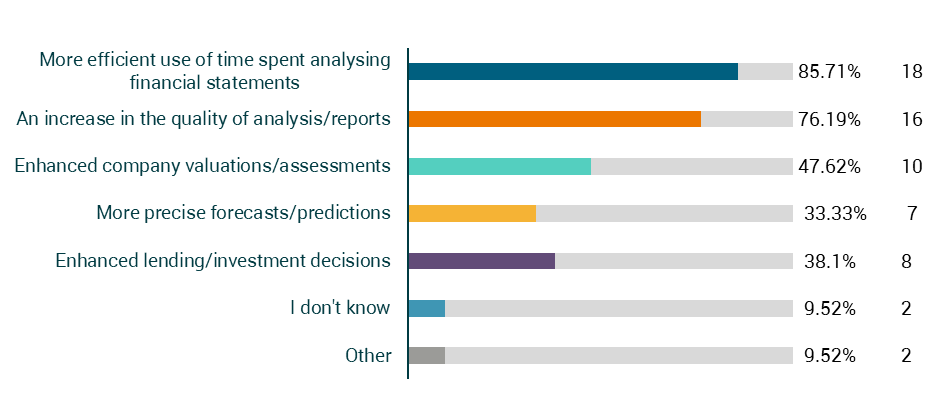
4.79 When considering individual sets of requirements, respondents to the UKEB User survey suggested the following:
- Categories and subtotals: A large majority of respondents agreed that the requirements will enhance the decision-usefulness of IFRS financial statements, improve comparability of financial performance information, and enhance the understandability of the drivers of financial performance.
- Management-defined performance measures: A large majority of respondents agreed that the requirements will add discipline and transparency to the MPM disclosures, enhance the credibility of the performance measures, and enable users to better understand and compare the financial performance.
- Aggregation and disaggregation: A large majority of respondents agreed that the general requirements will enhance decision-usefulness of financial statements and the notes. They also agreed that the detailed requirements of specified expenses by nature and ‘more informative labelling’ will enhance comparability and understandability of the performance drivers.
4.80 The survey results are broadly consistent with the results of third-party research discussed in paragraphs 4.37 to 4.54.
4.81 When conducting outreach, the UKEB also asked respondents to the UKEB Preparer survey to indicate whether they anticipate IFRS 18 to deliver benefits to users. Specifically, respondents were asked to indicate whether they expected IFRS 18 to affect:
- The comparability of the entity's reporting of financial performance: A majority of respondents, 60%, indicated that they anticipate a mild to strong positive effect.
- The transparency of the entity's financial performance: A slight majority of respondents (51%) indicated that they anticipate a mild to strong positive effect. A member of the IAG provided feedback in line with this result, noting that the IFRS 18 requirements may lead to more transparent financial information and allow the entities to tell their own story.
- The reporting of an entity's financial performance in line with underlying economics: A sizable minority of respondents (31%) indicated that they anticipate a mild to strong positive effect, however 44% indicated that they do not anticipate any effect.
4.82 UKEB Preparer survey results suggest that preparers anticipate the standard to enhance transparency and comparability and do not expect negative effects on users' decision-making.
Cost and benefits for auditors
4.83 The UKEB distributed a short questionnaire to AFIAG members to gather their views on costs and benefits associated with the implementation of IFRS 18.
4.84 AFIAG members indicated that the magnitude of one-off costs will largely depend on the nature and complexity of the business rather than just its size. This confirmed preparers' views from the one-to-one interviews. Considering IFRS 18 requirements, audit costs may be higher depending on:
- The presence of specified main business activities.
- The number of associated and joint ventures measured using the equity method.
- The number and nature of MPMs.
- The presence of non-controlling interests.
- The prevalence of foreign exchange transactions.
- Changes due to the aggregation/disaggregation requirements.
4.85 AFIAG members indicated that ongoing costs are anticipated to be much smaller than one-off implementation costs.
Costs and benefits for regulators
4.86 Several UK financial and economic regulators were contacted asking whether IFRS 18 is anticipated to create extra costs or benefits to their organisation, and if so, why, for example, revision of regulatory templates, the development of procedures to regulate the new requirements, costs to enforce new requirements.
4.87 Regulators responded that IFRS 18 is not anticipated to generate any significant extra costs.
[Tentative] Conclusions
4.88 [To be developed for discussion at the May 2025 Board meeting]
Analysis of wider economic effects
Structure of the analysis
4.89 The assessment of the long term public good involves a consideration of wider economic effects associated with the adoption of IFRS 18.50
4.90 The analysis of wider economic effects looks at:
- Direct effects on preparers and users other than costs/benefits (transmission mechanisms): For example, whether the adoption of a standard would lead to a change in information transmission within the organisation, a change in internal processes or a different assessment of competition. Effects on management and stewardship are considered among transmission mechanisms.
- First-order indirect effects (capital market effects): Indirect effects triggered by the enhanced interaction between users and capital markets attributable to the change in accounting, such as effects on liquidity or volatility in public equity markets, and costs of capital.
- Second-order indirect effects (real effects): Microeconomic effects on preparers, users and other stakeholders that go beyond capital market effects. Examples include any effects on management compensation schemes, covenants, dividend payments, tax obligations that may arise from changes in accounting line items, performance measures and ratios. In addition, microeconomic effects pricing and competition, capital investment and output are considered.
- Third order indirect effects: Micro and macroeconomic effects that go beyond preparers/users, such as:
- Externalities: An impact, of a transaction, on a third party who was not directly involved in the original transaction.
- Network effects: Economic impacts that increase in magnitude as the number of stakeholders involved increases.
- Macroeconomic effects: Economic impacts that involve the wider economy and national economy, and not purely accounting ecosystems.
4.91 Chart 2 provides a visual representation of direct and wider economic effects.
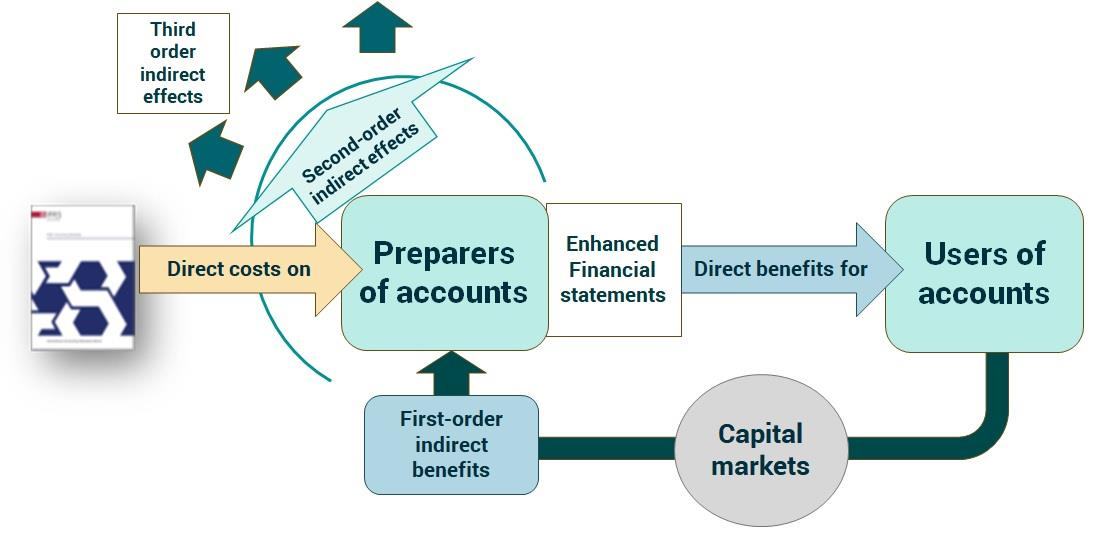
Source: UKEB
Collection of evidence
4.92 Evidence was collected using a range of research tools.
4.93 Surveys: During Q3 2024 the UKEB conducted two surveys, one for preparers and one for users, to collect evidence to assess whether IFRS 18 meets the technical and the long term public good assessment criteria for endorsement. Both surveys contained questions on transmission mechanisms and indirect economic effects. The surveys featured both closed-ended and open-ended questions and allowed the collection of both quantitative and qualitative data.
4.94 Cost of capital analysis: The UKEB developed a methodological framework to calculate the market-level cost of capital reduction estimate associated with the adoption of a standard that would be equivalent to the estimated market-wide implementation costs for preparers. The framework also allows to assess the plausibility of the results. This methodological framework was applied to the assessment of IFRS 18.
4.95 Qualitative analysis: Second- and third-order economic effects are largely assessed qualitatively, using desk-based research and economic reasoning. The Preparer survey included questions on direct effects other than costs as well as some second-order effects. Because the results indicated that preparers consider there will be minimal or no wider economic effects, further quantitative analysis or stakeholder engagement was not considered proportionate.
Direct effects other than costs and benefits (transmission mechanisms)
Preparers
4.96 The preparer survey included questions on the wider economic impact of IFRS 18, focusing on transmission mechanisms, i.e. direct economic effects other than costs and benefits. Preparers were asked to indicate the extent to which they expected the implementation of IFRS 18 to affect management's stewardship and other transmission mechanisms, such as information circulation within the firm and streamlining of processes.
4.97 Management and stewardship: Respondents were asked to indicate whether they expected IFRS 18 to affect:
- Presentation of management's use of economic resources to users: A majority of respondents (61%) indicated that they anticipate no effect.
- Transparency over management's performance in financial reporting: A slight majority of respondents (53%) indicated that they expected no effects.
- Management's discretion in presenting the entity's financial performance: The opinions on this outcome were divided, with the largest share of respondents (49%) indicating that they anticipate a mild to strong positive effect. However, 42% of respondents indicate that they anticipate no effect.
4.98 On balance, preparers' views were that IFRS 18 is unlikely to affect management's stewardship.
4.99 Other transmission mechanisms: Respondents were asked to indicate whether they expected IFRS 18 to affect:
- Information transmission within the organisation.
- Streamlining of internal systems and processes.
- Disclosure of proprietary information, where more disclosures were interpreted to be a negative effect.
- Competitors assessment of the entity's performance, where a better assessment was interpreted to have a negative effect.
- Internal assessment of competitors' financial performance, where a better assessment was interpreted to have a positive effect.
- Risk of litigation, where lower risk was interpreted to have a positive effect.
4.100 Respondents either clearly indicated that no effect was expected, or opinions were split with no clear pattern emerging. On balance, preparers' views were that IFRS 18 is unlikely to be associated with the above transmission mechanisms.
| Grant Thornton](https://www.grantthornton.global/en/insights/ifrs/introducing-ifrs-18/)
Preparers
4.96The preparer survey included questions on the wider economic impact of IFRS 18, focusing on transmission mechanisms, i.e. direct economic effects other than costs and benefits. Preparers were asked to indicate the extent to which they expected the implementation of IFRS 18 to affect management's stewardship and other transmission mechanisms, such as information circulation within the firm and streamlining of processes.
4.97Management and stewardship: Respondents were asked to indicate whether they expected IFRS 18 to affect:
- Presentation of management's use of economic resources to users: A majority of respondents (61%) indicated that they anticipate no effect.
- Transparency over management's performance in financial reporting: A slight majority of respondents (53%) indicated that they expected no effects.
- Management's discretion in presenting the entity's financial performance: The opinions on this outcome were divided, with the largest share of respondents (49%) indicating that they anticipate a mild to strong positive effect. However, 42% of respondents indicate that they anticipate no effect.
4.98On balance, preparers' views were that IFRS 18 is unlikely to affect management's stewardship.
4.99Other transmission mechanisms: Respondents were asked to indicate whether they expected IFRS 18 to affect:
- Information transmission within the organisation.
- Streamlining of internal systems and processes.
- Disclosure of proprietary information, where more disclosures were interpreted to be a negative effect.
- Competitors assessment of the entity's performance, where a better assessment was interpreted to have a negative effect.
- Internal assessment of competitors' financial performance, where a better assessment was interpreted to have a positive effect.
- Risk of litigation, where lower risk was interpreted to have a positive effect.
4.100Respondents either clearly indicated that no effect was expected, or opinions were split with no clear pattern emerging. On balance, preparers' views were that IFRS 18 is unlikely to be associated with the above transmission mechanisms.
Users
4.101The UKEB User survey asked respondents to indicate whether the standard would affect a number of transmission mechanisms.
4.102On the items listed below, a majority of users indicated that IFRS 18 will either slightly improve or greatly improve their ability to analyse financial statements: 51
- Compare entities' performance over multiple periods.
- Assess an individual entity's performance.
- Compare entities' performance with other entities
- Understand how entities measure their own performance.
- Conduct research.
- Allocate time spent analysing financial statements efficiently.
- Allocate capital efficiently between entities.
4.103A slight majority of respondents indicated that IFRS 18 would not help users better assess a company's solvency, while opinions were inconclusive on whether IFRS 18 would enhance users' ability to conduct credit ratings. These results are expected considering that IFRS 18 mainly deals with the presentation of financial performance (and therefore would not alter balance sheet line items or balance sheet ratios). One member of the IAG considered that the IFRS 18 requirements would not lead to additional information that could help users assess the creditworthiness or insolvency of entities.
4.104However, feedback from one user suggested that IFRS 18 could be also helpful for lenders, because:
- For some lenders (e.g., leveraged finance specialists) adjusted EBITDA is an important metric. Paragraph 118 of IFRS 18 permits the disclosure of a subtotal (i.e. operating profit or loss before depreciation, amortisation and impairments within the scope of IAS 36, or 'OPDAI’) 52 that provides similar information to many of the EBITDA measures currently provided. If a company provides an EBITDA subtotal in its public communications that is not calculated in the same way as OPDAI, that subtotal would be an MPM, so the entity will need to provide disclosures about it.
- Better principles for disaggregation would give some items greater visibility in the primary financial statements and provide information on the key drivers of cost (i.e., whether cost is part of their operating business).
First-order indirect effects – cost of capital
4.105Evidence from IFRS 18-related outreach indicated that the enhanced financial information required by IFRS 18 is anticipated to provide users of financial statements with decision-useful information.
4.106Economic theory and empirical evidence indicate that enhanced information on entities' performance should attract more capital from generalist users, leading to more trading activity, an increase in liquidity, and a reduction in bid/ask spreads. 53 Traders would tend to demand lower returns for holding their securities as a result. In turn, this should lead to a lower cost of capital on public capital markets.
4.107There is also abundant academic research showing that the adoption of IFRS and compliance with IFRS requirements positively affect stock prices ("value relevance"). 54
4.108The UKEB has developed a methodology to quantify the cost of capital reduction that would lead to an indirect monetary effect equal to the cost to implement a new IFRS accounting standard, as these costs are largely incurred by preparers. The methodology is evidence-based, ground in research, and makes use of updated market data.
4.109The following four market-wide effects potentially associated with the introduction of an accounting standard are considered:
- An increase in market capitalisation, leading to an increase of shareholders' wealth at a market level.
- A decrease in the cost of equity, leading to more projects funded through public equity capital at a market level.
- An increase in the outstanding value of listed bonds, leading to an increase of bondholders' wealth at a market level.
- A decrease in the cost of debt, leading to more projects funded through public debt capital at a market level.
4.110Table 6 provides a summary of the previous paragraph:
| Equity | Debt | |
|---|---|---|
| Stock (wealth effects) | Increase in market capitalisation | Increase in the outstanding value of corporate bonds |
| Flow (investment effects) | Decrease in the cost of equity leading to more projects funded through public equity | Decrease in the cost of debt leading to more projects funded through publicly traded corporate bonds |
Source: UKEB
Estimating a cost of capital reduction for IFRS 18
Inputs of the analysis
4.111This section applies the methodology to the adoption of IFRS 18.
4.112Market-wide implementation costs for preparers are the starting point for the analysis. The UKEB estimated market-wide implementation costs for preparers to be in around £481.5 million (see paragraph 4.70).
4.113The estimated market-wide implementation costs are allocated to market-wide effects on cost of capital.
4.114As the exact monetary effects are impossible to predict with accuracy, the analysis is conducted using five scenarios. By way of example, assuming that all four effects market-wide are expected to carry equal importance, the analysis would calculate monetary effects anticipated to equate one quarter of implementation costs for each.
| Scenario | (1) | (2) | (3) | (4) | (5) |
|---|---|---|---|---|---|
| Increase in market capitalisation | 25% | 50% | 75% | 37.5% | 45% |
| Decrease in the cost of equity leading to more projects funded through public equity | 75% | 50% | 25% | 37.5% | 45% |
| Increase in the outstanding value of corporate bonds | 0% | 0% | 0% | 12.5% | 5% |
| Decrease in the cost of debt leading to more projects funded through publicly traded corporate bonds | 0% | 0% | 0% | 12.5% | 5% |
Source: UKEB
4.115Another important input of the analysis is whether IFRS 18 is expected to deliver direct benefits for users, enhancing their decision-making. This is because users' confidence that the accounting changes brought by IFRS 18 will deliver direct benefits is interpreted as supportive evidence that the new standard would deliver a cost of capital reduction, in line with the evidence on the topic.
4.116The UKEB assessed that users are anticipated to reap benefits from the adoption of IFRS 18 (see paragraphs 4.78 and 4.79). Therefore, the UKEB assessed that a cost of capital reduction associated with the implementation of IFRS 18 is plausible.
Results
4.117The cost of capital analysis for IFRS 18 implementation delivered the following results:
| Scenario as per Table 7: | (1) | (2) | (3) | (4) | (5) |
|---|---|---|---|---|---|
| Increase in market capitalisation | 0.44 | 0.88 | 1.32 | 0.66 | 0.79 |
| Decrease in the cost of equity leading to more projects funded through public equity | 7.94 | 5.29 | 2.65 | 3.97 | 4.76 |
| Increase in the outstanding value of corporate bonds | 0.00 | 0.00 | 0.00 | 0.79 | 0.09 |
| Decrease in the cost of debt leading to more projects funded through publicly traded corporate bonds | 0.00 | 0.00 | 0.00 | 0.30 | 0.12 |
Source: UKEB calculations based on LSE and Reuters-Eikon data.
4.118Comments will revert on Scenario 4 as it was considered the most plausible. 55
4.119Scenario 4 assumes that 75% of the benefits are delivered through equity markets (equally split between an increase in market capitalisation and an increase in the value of projects funded through equity), and 25% are delivered through bond markets (equally split between an increase in the value of bonds outstanding and an increase in the value of projects funded through fixed income). More specifically, to be equivalent to implementation costs of £481.5 million:
- Increase in market capitalisation: Market capitalisation should increase by £180.5 million, or 0.66 Bps (basis points) using its value as of October 2024 (£2.69 trillion).
- Decrease in the cost of equity leading to more projects funded through public equity: cost of equity should decrease by 3.97 Bps for the PV of projects funded through equity to increase by £180.5 million at the present value at the of equity issuances over a ten-year forecast equal to £143 billion (baseline cost of equity: 11.23%).
- Increase in the outstanding value of corporate bonds: The outstanding value of corporate bonds issued by UK companies on public bond markets should increase by £57.8 million, or by 0.79 Bps using its value as of October 2024 (£759 billion).
- Decrease in the cost of debt leading to more projects funded through publicly traded corporate bonds: cost of debt should decrease by 0.3 Bps for the PV of projects funded through debt to increase by £57.8 million at the present value of public corporate bond issuances over a ten-year forecast equal to £491.75 billion (baseline cost of equity: 5.03%).
Plausibility assessment [To be developed for discussion at the May 2025 Board meeting]
Second-order indirect effects
Effects on covenants, dividend payments, tax payments
4.120The preparer survey asked respondents to indicate whether IFRS 18 is anticipated to affect the following items:
- Management compensation schemes.
- Covenants.
- Dividend payments.
- Tax liabilities.
4.121Most preparers expected no effect on any of these items. Preparers noted that "the new standard won't have impact on measurement. Presentational differences from a statutory perspective will not impact any of the above measures".
Other second-order effects
4.122The following second-order microeconomic effects on preparers are discussed:
- Effects on product or pricing decisions: as the requirements of IFRS 18 largely deal with how underlying economic results are presented, they are not expected to affect the underlying economics that determine the prices charged or the nature of products supplied by companies in the market, therefore no effects on product and pricing decisions are expected.
- Effects on competition: No significant change in competition is expected as the standard is not anticipated to affect any of the determinants of competition (e.g., product or pricing decisions, barriers to entry or to exit). IFRS 18 is anticipated to provide more comparable information about preparers, thus potentially enhancing preparers' ability to benchmark/assess their competitors (see paragraph 4.102c). This suggests that IFRS 18 may have a minor role in fostering a competitive economic environment between firms.
- An increase/reduction in capital investments: IFRS 18 is not anticipated to directly alter preparers' output outlook, or their strategic vision for the future and therefore the entity's long-term capital needs. However, it is noted that a reduction in the cost of capital associated with IFRS 18 may lead preparers to fund more projects through public equity/debt, resulting in higher investment and/or a different capital structure as an indirect consequence of the implementation of IFRS 18.
- An increase/reduction in preparers' economic output or productivity: IFRS 18 is not anticipated to affect the production function of preparers. As a result, changes in presentation and disclosure requirements are not expected to affect the preparers' output, or their productivity. However, to the extent that a reduction in the cost of capital may lead to an increase in capital investment, a minor indirect effect on preparers' output outlook may be anticipated.
Third-order indirect effects
Network externalities
4.123No network externalities are expected. Industries where network externalities are present (e.g. tech) are not likely to be more or less affected than other industries by IFRS 18, and the requirements are not anticipated to affect the number of people accessing the platforms/services provided by such companies.
Network effects (spillover effects) [To be developed for discussion at the May 2025 Board meeting]
Macroeconomic effects, including economic growth
4.124No significant macroeconomic effects are anticipated as a direct result of IFRS 18 requirements. If a cost of capital reduction will materialise, it will translate into higher shareholders' and bondholders' wealth, and into enhanced investment opportunities for companies applying IFRS 18. This can have a small positive effect on the consumption and investment components of GDP. The UKEB assessment is that IFRS 18 is not anticipated to have negative effects on economic growth.
[Tentative] Conclusions
4.125[To be developed for discussion at the May 2025 Board meeting]
Consideration of the consequences of not adopting IFRS 18 (counterfactual analysis)
4.126This section considers the consequences of not adopting IFRS 18 for use in the UK (the 'non-adoption scenario') for:
- Users.
- Preparers.
4.127The analysis assumes that IFRS 18 was issued by the IASB and widely adopted in other jurisdictions.56
Users
4.128Under the non-adoption scenario, the benefits that users of financial statements are expected to gain from IFRS 18 would not be realised.
4.129With reference to IFRS 18 requirements:
- Categories and subtotals: Users would not benefit from the added comparability brought by a standardised structure and consistent and comparable subtotals in the statement of profit and loss, particularly operating profits.
- Management-defined performance measures: Users would not benefit from audited MPMs disclosed in a consistent location and are reconciled with the most comparable subtotal.
- Aggregation and disaggregation: Users would not benefit from consistent rules on aggregation and disaggregation, and the added guidance on the use of the “other category”.
4.130The benefits that users of financial statements anticipate (see paragraphs 4.78–4.82) would therefore not materialise, such as:
- Enhanced ability to compare entities' performance with other entities and over multiple periods.
- Enhanced ability to assess an individual entity's performance and understand how entities measure their own performance.
- More efficient allocation of time spent analysing financial statements.
- More efficient capital allocation between entities.
4.131Users would avoid IFRS 18 implementation costs, however, as explained in paragraph 4.76–4.82 above, these are not expected to be significant.
4.132Any cost-savings associated with the adoption of IFRS 18 are unlikely to occur.
Preparers
4.133Considering the consequences on users described above, in a non-adoption scenario UK and overseas funds may be redirected to jurisdictions that apply IFRS 18.
4.134The size and importance of UK capital markets, together with the fact that investors consider a plurality of information sources (not only financial statements) when making investment decisions, are likely to continue to play a key role in retaining investor interest and capital. Therefore, non-adoption of IFRS 18 would likely have a small adverse long-term effect on the cost of capital for UK entities.
4.135It should be noted that if entities in other jurisdictions using IFRS 18 were to attract additional sources of capital and potentially benefit from a lower cost of capital, this could in turn provide those companies with a competitive advantage over UK companies.
4.136From a cost perspective, entities would not incur implementation costs if IFRS 18 was not adopted. However, as evidenced in our assessment (paragraphs 4.67–4.90 above), UK listed entities are not anticipated to incur significant costs to implement IFRS 18.
4.137Feedback from preparers also suggested that UK listed entities cross-listed abroad would incur extra costs if UK-adopted international accounting standards were to deviate from IFRS as issued by the IASB.
Counterfactual analysis: overall assessment
4.138Overall, therefore, non-adoption of IFRS 18 for use in the UK would have a potentially negative outcome from the perspective of the UK long term public good.
- Users would not benefit from more comparable and transparent financial reporting. In the long term, capital investment might flow from UK entities to entities residing in IFRS 18-adopting jurisdictions. As a result, UK entities would not benefit from more abundant, more differentiated and potentially cheaper capital in the long term.
- UK entities cross-listed abroad would face extra ongoing compliance costs if UK-adopted International Accounting Standards deviate from IFRS as issued by the IASB.
4.139These considerations suggest that non-adoption of IFRS 18 for use in the UK would not be likely to be conducive to the UK long term public good.
[Tentative] Overall assessment of long term public good
4.140Overall, therefore, and based on the above assessments, the use of IFRS 18 is likely to be conducive to the long term public good in the United Kingdom.
5. Section 5: True and fair view assessment
Legislative basis and our approach to the assessment
5.1The UKEB is required to consider whether an international accounting standard being assessed for use in the UK meets certain legislative criteria set out in Regulation 7 (1) of SI 2019/685. The first criterion set out in that regulation requires that an international accounting standard can be adopted only if:
a) ...the standard is not contrary to either of the following principles–
- an undertaking's accounts must give a true and fair view of the undertaking's assets, liabilities, financial position and profit or loss;
- consolidated accounts must give a true and fair view of the assets, liabilities, financial position and profit or loss of the undertakings included in the accounts taken as a whole, so far as concerns members of the undertaking; [...];57
5.2In this section of the DECA we consider whether IFRS 18 meets this endorsement criterion. For the sake of brevity, we refer to our assessment against this endorsement criterion as 'the true and fair view assessment' and to the principles set out in Regulation 7(1)(a) as the ‘true and fair view principle'. However, these abbreviated expressions do not imply that our assessment has considered anything other than the full terms of the endorsement criterion set out above.
5.3The duty of the UKEB under Regulation 7(1)(a) is to determine generically, before a standard is applied to a set of accounts, whether that standard is 'not contrary' to the true and fair view principle. In other words, it is an ex-ante assessment. We have therefore considered whether IFRS 18 contains any requirement that would prevent accounts prepared using the standard from giving a true and fair view.
5.4Our approach is to determine whether IFRS 18 is not contrary to the true and fair view principle in respect of any of the items identified in Regulation 7(1)(a) (namely, the assets, liabilities, financial position and profit or loss) in the context of the preparation of the accounts as a whole. In carrying out our assessment of the impact of IFRS 18, we have also considered the disclosures required by the standard and its interaction with other UK-adopted international accounting standards.
5.5For the purposes of our assessment, we consider the requirement in paragraph 15 of IAS 1 for financial statements to “present fairly the financial position, financial performance and cash flows of an entity”58 to be equivalent to the Companies Act 2006 requirement for accounts to give a true and fair view.
5.6Our assessment is separate from the duty of directors under section 393(1) of the Companies Act 2006, which requires directors to be satisfied that a specific set of accounts gives a true and fair view of an undertaking's or group's assets, liabilities, financial position and profit or loss.
Interaction with other UK-adopted international accounting standards
5.7We have considered whether any requirement of IFRS 18 would necessarily create distortions in its interaction with other UK-adopted international accounting standards. IFRS 18 introduces presentation and disclosure requirements that improve the relevance of financial information and do not change the recognition and measurement of the items in the financial statements. Therefore, it is unlikely that IFRS 18 will have a negative impact on other UK-adopted international accounting standards.
5.8[Tentative]In addition, feedback from stakeholders and our own assessments of significant technical accounting issues in Section 3 and in Appendix B have not indicated that any distortions arising from the interaction of IFRS 18 with other UK-adopted international accounting standards are a major concern for UK stakeholders.
[Tentative] Assessment
5.9[Consultation feedback on the DECA indicated that stakeholders generally agreed with the UKEB's tentative conclusion that IFRS 18 was not contrary to the true and fair view principle].
5.10Section 3 of this DECA concludes that IFRS 18 meets the technical accounting criteria. The technical accounting criteria refer to reliability which includes the notion of faithful representation of the economic substance of transactions and events (see Section 1 of the DECA). The technical accounting criteria assessment therefore further underpins the overall true and fair view assessment.
5.11[Our assessment has not identified any requirement of IFRS 18 that would prevent individual accounts prepared using the standard from giving a true and fair view of the entity's assets, liabilities, financial position and profit or loss. We are satisfied, therefore, that the circumstances in which the application of IFRS 18 would result in accounts which did not give a true and fair view would be extremely rare.]
5.12SI 2019/685 requires an assessment of whether IFRS 18 is not contrary to the true and fair view principle for both individual and consolidated accounts. [We have not identified any reason why the IFRS 18 true and fair view assessment should conclude differently for consolidated accounts.]
[Tentative] overall conclusion
5.13[Overall, therefore, we conclude that IFRS 18 is not contrary to the true and fair view principle set out in Regulation 7 (1) (a) of SI 2019/685.]
6. Section 6: Does IFRS 18 lead to a significant change in accounting practice?
6.1A standard adopted by the UKEB under Regulation 6 of SI 2019/685 that it considers is likely to lead to a 'significant change in accounting practice', is subject to the requirements in paragraph 3 of Regulation 11 of SI 2019/685 that the UKEB:
- carry out a review of the impact of the adoption of the standard; and
- publish a report setting out the conclusions of the review no later than 5 years after the date on which the standard takes effect (being the first day of the first financial year in respect of which it must be used).
6.2As stated in paragraph 8.8 of the UKEB Due Process Handbook, the obligations in paragraph 6.1 (above) can be substantially fulfilled by influencing and responding to an IASB post-implementation review (PIR). Accordingly, in a scenario where the IASB decides to undertake a post-implementation review of IFRS 18, the UKEB is required, in line with paragraph 8.11of the UKEB Due Process Handbook, to influence this post-implementation review. This scenario would occur where the IASB completes its own PIR within five years of the effective date of IFRS 18.
The influencing process set out in Section 5 of this Handbook applies to the UKEB response to a request for information on an IASB post-implementation review. This process includes the preparation of a project initiation plan, desk-based research, carrying out outreach activities (including consultation with UK stakeholders and UKEB advisory groups), preparing draft and final comment letters and preparing project closure documents such as a feedback statement and a due process compliance statement
6.3The UKEB is required, in line with paragraph 8.12 of the UKEB Due Process Handbook, to explain in a report how the UKEB feedback has been addressed by the IASB as well as any additional UK specific impacts of adoption of IFRS 18. This report ensures that the UKEB fulfils its obligations in Regulation 11(3)(a)–(b) of reviewing the impact of the adoption of the Standard and of setting out the conclusions of that review and includes:
- an overview of the IASB post-implementation review and of the UKEB's influencing process and its timeline;
- background information to the international accounting standard under review;
- a summary of the evidence gathered and findings;
- the UKEB's conclusions from the review; and
- recommendations or steps it plans to take, if any, as a result of the review.
Approach to our assessment
6.4In this section of the DECA we consider whether IFRS 18 is likely to lead to a 'significant change in accounting practice'. Paragraph 6 of Regulation 11 of Sl 2019/685 does not define the term “significant”. Paragraph 8.6 of the UKEB Due Process Handbook says:
Whether or not a standard adopted under Regulation 6 is likely to lead to a 'significant change in accounting practice' will usually depend on the number of entities affected and the impact on those entities and may require judgement. It usually occurs when a new standard is issued by the IASB.
6.5Paragraph 6.24 of the Due Process Handbook further observes that:
Whether or not the new or amended standard is likely to lead to a significant change in accounting practice (refer to paragraph 8.6 of this Handbook) and therefore, whether it meets the criteria for a post-implementation review. If it does, the DECA/ECA should additionally indicate the proposed timing of that review (refer to paragraph 8.7 of this Handbook) and follow the requirements in Section 8 'Post-implementation reviews' of this Handbook.
[Tentative] assessment
6.6IFRS 18 replaces IAS 1 and will impact entities across all sectors that prepare financial statements under IFRS Accounting Standards. It will not change how entities recognise and measure items in the financial statements. However, it will affect how entities present and disclose information in those statements.
6.7IFRS 18:
- Requires a more structured statement of profit or loss. This will bring significant changes on the way entities present their information and their results. Entities may also need to adapt their financial reporting systems to collect information about income and expenses into the new subtotals and
- background information to the international accounting standard under review;
- a summary of the evidence gathered and findings;
- the UKEB's conclusions from the review; and
- recommendations or steps it plans to take, if any, as a result of the review.
Approach to our assessment
6.4In this section of the DECA we consider whether IFRS 18 is likely to lead to a 'significant change in accounting practice'. Paragraph 6 of Regulation 11 of SI 2019/685 does not define the term “significant”. Paragraph 8.6 of the UKEB Due Process Handbook says:
Whether or not a standard adopted under Regulation 6 is likely to lead to a 'significant change in accounting practice' will usually depend on the number of entities affected and the impact on those entities and may require judgement. It usually occurs when a new standard is issued by the IASB.
6.5Paragraph 6.24 of the Due Process Handbook further observes that:
Whether or not the new or amended standard is likely to lead to a significant change in accounting practice (refer to paragraph 8.6 of this Handbook) and therefore, whether it meets the criteria for a post-implementation review. If it does, the DECA/ECA should additionally indicate the proposed timing of that review (refer to paragraph 8.7 of this Handbook) and follow the requirements in Section 8 'Post-implementation reviews' of this Handbook.
[Tentative] assessment
6.6IFRS 18 replaces IAS 1 and will impact entities across all sectors that prepare financial statements under IFRS Accounting Standards. It will not change how entities recognise and measure items in the financial statements. However, it will affect how entities present and disclose information in those statements.
6.7IFRS 18:
- Requires a more structured statement of profit or loss. This will bring significant changes on the way entities present their information and their results. Entities may also need to adapt their financial reporting systems to collect information about income and expenses into the new subtotals and categories and to make new assessments (i.e. about the entity's main business activities or on deciding whether presentation by function or by nature provides more useful information).
- Defines and requires the disclosure of management-defined performance measures (MPMs) in a single note. In practice there will not be much change considering that most entities already provide detailed reconciliations of their APMs. However, entities will need to revisit the APMs used in public communications as some will need to be disclosed as MPMs in the financial statements and be audited. Entities will need to disclose additional information as part of the MPM reconciliation (i.e. tax effects and non-controlling interest impact of each reconciling item).
- Provides enhanced guidance on aggregation and disaggregation. This will involve new assessments in deciding the appropriate level of aggregation and disaggregation across the financial statements as well as potential changes in financial reporting systems to track and collate disaggregated information.
- Makes some limited amendments to the statement of cash flows which may also trigger changes to an entity's financial systems to meet the requirements in IFRS 18.
[Tentative] overall conclusion
6.8IFRS 18 is a new standard that will bring a fundamental change in the way all entities communicate information in the primary financial statements and the notes. As a result, the UKEB [tentatively] concludes that all the changes brought by the standard in aggregate are likely to lead to a significant change in accounting practice and meet the criteria for a post-implementation review (PIR) under Regulation 11 in SI 2019/685.
Proposed timing for a PIR
6.9IFRS 18 is effective on 1 January 2027. Regulation 11 of SI 2019/685 requires that the post-implementation review of IFRS 18 be reported no later than 5 years after the date on which IFRS 18 takes effect. Therefore, in line with this Regulation the post-implementation review of IFRS 18 must be completed and reported before 31 December 2031.
Appendix A: Glossary
| Term | Description |
|---|---|
| AAG | Academic Advisory Group – provided feedback on the survey design and on the impact of the requirements in IFRS 18. AAG is an advisory group that reports to the UKEB Board. |
| AFIAG | Accounting Firms & Institutes Advisory Group (AFIAG) – provided feedback on the impact of the requirements in IFRS 18. AFIAG is an advisory group that reports to the UKEB Board. |
| AIM | Alternative Investment Market. A sub-market of the London Stock Exchange that is not a 'regulated market' |
| APMs | Alternative Performance Measures |
| The Standard | IFRS 18 Presentation and Disclosure in Financial Statements |
| DBT | Department for Business and Trade (formerly 'Department for Business, Energy and Industrial Strategy' (BEIS) |
| DECA | Draft Endorsement Criteria Assessment |
| ECA | Endorsement Criteria Assessment |
| ED | Exposure Draft |
| EFRAG | European Financial Reporting Advisory Group |
| ESMA | European Securities and Markets Authority |
| EU | European Union |
| FCA | the Financial Conduct Authority |
| Term | Description |
|---|---|
| FCL | Final Comment Letter |
| FIWG | Financial Instruments Working Group (FIWG) – provided feedback on the impact of the requirements in IFRS 18. FIWG is a working group that reports to the UKEB Secretariat. |
| FRC | Financial Reporting Council |
| IAG | Investor Advisory Group (IAG) – provided feedback on the impact of the requirements in IFRS 18. IAG is an advisory group that reports to the UKEB Board. |
| IAS 1 | IAS 1 Presentation of Financial Statements |
| IAS 2 | IAS 2 Inventories |
| IAS 7 | IAS 7 Statement of Cash Flows |
| IAS 8 | IAS 8 Accounting Policies, Changes in Accounting Estimates and Errors (IFRS 18 changed the title of IAS 8 to Basis of Preparation of Financial Statements) |
| IAS 27 | IAS 27 Separate Financial Statements |
| IAS 28 | IAS 28 Investments in Associates and Joint Ventures |
| IAS 34 | IAS 34 Interim Financial Reporting |
| IAS 36 | IAS 36 Impairment of Assets |
| IASB | International Accounting Standards Board |
| IASB Effects Analysis | The IFRS Standards Effects Analysis for IFRS 18, issued by the IASB in April 2024 |
| IFRS | International Financial Reporting Standard(s) |
| Term | Description |
|---|---|
| IFRS 15 | IFRS 15 Revenue from Contracts with Customers |
| IFRS 16 | IFRS 16 Leases |
| IFRS 17 | IFRS 17 Insurance Contracts |
| IFRS 18 | IFRS 18 Presentation and Disclosure in Financial Statements |
| LSE | London Stock Exchange |
| NCI(s) | Non-controlling interest(s) |
| PAG | Preparer Advisory Group (PAG) – provided feedback on the impact of the requirements in IFRS 18. PAG is an advisory group that reports to the UKEB Board. |
| Primary financial statements | The following statements and their comparative information are referred to as 'primary financial statements'. - a statement (or statements) of financial performance for the reporting period; - a statement of financial position as at the end of the reporting period; - a statement of changes in equity for the reporting period; and - a statement of cash flows for the reporting period; |
| QCA | Quoted Companies Alliance. The QCA is an industry association representing small and mid-sized publicly traded companies in the UK. Their members are quoted on the Main Market, AIM and the Aquis Stock Exchange. |
| SI 2019/685 | Statutory Instrument 2019/685 |
| UKEB | UK Endorsement Board |
| UKEB Preparer survey | The on-line survey conducted with preparers of information by the UKEB from July–September 2024 |
| UKEB User survey | The on-line survey conducted with users of information by the UKEB from July–September 2024 |
Appendix B: Individual assessment of technical issues raised by stakeholders
B1.Our approach to the assessment of IFRS 18 against the technical accounting criteria specified in SI 2019/685 regulation 7 (1) (c) is set out in Section 3 of this DECA.
B2.The technical accounting issues assessed in this Appendix are:
- Issue 1: Classification of income and expenses from associates and joint ventures accounted for using the equity method in the investing category.
- Issue 2: Accounting policy choice for the classification of income and expenses for entities that provide financing to customers.
- Issue 3: Disclosure of the income tax effect and the effect on non-controlling interests (NCIs) in the management-defined performance measure (MPM) reconciliation.
Issue 1: Classification of income and expenses from associates and joint ventures accounted for using the equity method in the investing category
IFRS 18 requirements
B3.IFRS 18 requires entities to classify in the investing category all income and expenses from investments in associates and joint ventures accounted for using the equity method (‘equity-accounted investments') in the statement of profit or loss. This includes (a) the entity's share of profit or loss from associates, joint ventures and unconsolidated subsidiaries; and (b) other income and expenses from those investments (e.g. impairment losses). This approach reflects that investments in associates and joint ventures generate returns individually and largely independent of the entity's other resources. This is consistent with other income and expenses classified in the investing category.
B4.The same presentation requirement applies to income and expenses from subsidiaries in separate financial statements accounted for using the equity method in accordance with paragraph 10(c) of IAS 27 Separate Financial Statements.
B5.The classification in the investing category is independent of whether the entity has equity-accounted investments in associates and joint ventures that are considered 'integral' to the entity's main business activities or whether the entity invests in assets as a main business activity (i.e. meets the definition of a specified main business activity).
B6.In addition, the transitional provisions in paragraph C7 of IFRS 18 allow an eligible entity to apply paragraph 18 of IAS 2859 to change its election for measuring an investment in an associate or joint venture from the equity method to fair value through profit or loss (FVTPL) in accordance with IFRS 9 at the date of initial application of IFRS 18.
Accounting impact
B7.IAS 160 requires the separate presentation of the share of the profit or loss of associates and joint ventures accounted for using the equity method without specifying where this line item should appear in the statement of profit or loss. The requirements in IFRS 18 will change the presentation of this item, where an entity considers that its associates and joint ventures are 'integral' to its main business activities.
B8.The results from the UKEB Preparer survey revealed that some entities in the insurance, utilities or banking sectors in the UK have ‘integral' investments in associates and joint ventures. Respondents to this survey were of the view that entities should have flexibility to classify equity-accounted investments in the operating category when these investments are considered:
- as part of the entity's main business operations; or
- strategic partnerships. For example, joint ventures are commonly used in large-scale infrastructure projects that require substantial capital to develop and structure large-scale infrastructure projects.
B9.In their view requiring the classification of the results from 'integral' investments in 'investing' (i.e. outside the operating category) may not allow users to understand the true nature and strategic value of these investments within the entity's main business operation.
B10.Another example is entities with specified main business activities such as insurance entities investing in assets. Respondents to the UKEB Preparer survey emphasised the importance of presenting income and expenses from investments in associates and joint ventures that are linked to insurance contracts (e.g. that are backing up liabilities) within the operating category. This is because it is common practice to include those results as part of ‘net financial result' (investment income minus insurance finance income and expenses) which is an important indicator of an insurer's operating performance. Otherwise in their view there would be a mismatch as the operating category would contain insurance finance income and expenses from insurance contract liabilities but might not contain all the associated investment income from the assets held to service those liabilities. Some insurance entities consider that this may prevent users from understanding and correctly evaluating their performance.
B11.The UKEB observes that these concerns have been acknowledged by the IASB (for example, in paragraphs BC114–BC115 of IFRS 18's Basis for Conclusions). The IASB concluded that specifying the location of income and expenses from equity-accounted investments in associates and joint ventures in a single category (i.e. the investing category) for all entities (including those that invest in assets as a specified main business activity):
- Provides users with a consistent starting point for their analysis.
- Is consistent with the way users of financial statements use information to analyse investments in associates and joint ventures. In this respect, users consider the results of equity-accounted investments to be different from other results. For instance, they are a blend of different amounts (i.e. operating, investing, financing and tax amounts of the investee) and the investing entity does not control these results as it exercises only significant influence over an associate or joint control over a joint venture.
- Avoids making an artificial distinction between ‘integral' and 'non-integral' investments which in the IASB's view would have led to:
- complexity and diversity in practice (given that the nature and purpose of investments in associates and joint ventures differ); or
- an opportunistic application of such a requirement.
B12.The IASB also acknowledged that a presentation ‘mismatch' may occur in the statement of profit or loss of insurance entities i.e. when excluding income and expenses of equity-accounted investments in associates and joint ventures from the 'operating' category. However, it further observed that this potential 'mismatch':
- would be entity-specific and it would depend on whether the insurer accounts for these investments using the equity method or measures them at fair value through profit or loss, in which case no mismatch would arise as the insurer would be able to classify those income and expenses within the operating category.
- may be material for some insurers but it did not appear to be pervasive in the insurance industry.
B13.This new presentation requirement in IFRS 18 will only impact the entities that have equity-accounted investments. The UKEB Secretariat conducted an analysis of Reuters-Eikon data to ascertain the prevalence of associates and joint ventures accounted for using the equity method among UK listed entities. This requirement may be significant to only a small number of UK entities given that, for 2023 year-ends:
- only 22% of entities in the UK have this type of investment and holdings in associates and joint ventures. The total balance sheet value of these investments was approximately £124 billion as of 2023 year-ends, accounting for just 1% of total assets of all listed entities;
- equity-accounted investments in associates and joint ventures were highly concentrated among few large companies. For instance, the five entities with the largest holdings in joint ventures and associates accounted for nearly 60% of all holdings; and
- equity-accounted investments in joint ventures and associates in the insurance sector are not very pervasive and make up a small proportion of the total assets of listed insurers.
B14.In addition, this analysis revealed that equity-accounted investments in joint ventures and associates in the insurance sector:
- were held by about 47% of listed entities;
- make up a small proportion (0.3%) of the total assets of listed insurers; and
- add up to £4bn.
B15.The UKEB observes that requirements in IFRS 18 will permit entities with 'integral' investments in associates and joint ventures to inform users that their equity-accounted investments are closely related to their core business activities. For example, by:
- presenting a line item for income and expenses from investments in associates and joint ventures accounted for using the equity method (if this provides a useful structured summary)61 immediately below its operating profit so that users could consider this line item as part of its analysis;
- presenting an additional subtotal that would add together operating profit and income and expenses from investments in associates and joint ventures accounted for using the equity method. This may be when an entity disaggregates into one or more line items income and expenses from associates and joint ventures with dissimilar characteristics62;
- providing additional information in the notes disclosing any impact on the operating result63;
- disclosing an MPM that adjusts 'operating profit'; and/or
- measuring an investment in an associate or joint venture from the equity method to fair value through profit or loss on transition to IFRS 1864. This change would enable an entity to present the results of those investments as part of the 'operating' category (as the remeasurement gains or losses are required to be presented in the operating category). The results from the UKEB Preparer survey indicated, however, that some respondents did not support the election offered on transition to IFRS 18 because:
- introducing an election would impair comparability across entities in the same sector/industry;
- the election offered on transition is limited to eligible entities;
- using fair value to measure an investment in an associate or joint venture would:
- increase earnings volatility in profit and loss, which may lead to the presentation of additional performance measures;
- add a layer of complexity and subjectivity in the measurement of these investments, for example, in determining the fair value of unlisted investees; and
- be onerous as entities will be required to prepare disclosures under other IFRS Accounting Standards.
Assessment against the technical accounting criteria
B16.The UKEB acknowledges the concerns from preparers resulting from classifying the results from all equity-accounted investments in the investing category. In the view of some stakeholders this could lead to the presentation of information that is not relevant or understandable. Some preparers also consider that presenting the results from those investments outside 'operating' will not provide a faithful representation of their operating performance. In contrast, users consider that this information will be relevant, reliable and understandable, because requiring a single classification in the investing category better aligns with the way users of financial statements use information to analyse investments in associates and joint ventures and avoids disrupting their analyses of operating margins.
B17.Users are of the view that prescribing a consistent classification for income and expenses of equity-accounted investments will reduce diversity in practice and bring comparability as it will provide a consistent ‘anchor' for users for their analysis.
B18.The concern expressed by preparers during our outreach activities about the potential lack of understandability of the nature of investments that are integral to an entity's main business activities being excluded from the operating category, can be mitigated by preparers by using other aspects of IFRS 18. Paragraph B15 gives examples of some different presentations that could help.
Issue 2: Accounting policy choice for the classification of income and expenses for entities that provide financing to customers
IFRS 18 requirements
B19.Paragraphs 65–66 of IFRS 18 require an entity that provides financing to customers to sub-categorise the income and expenses derived from liabilities that arise from transactions that involve only the raising of finance into income and expenses that:
- relate to the provision of finance to customers. These are classified in the 'operating' category.
- do not relate to the provision of finance to customers. An entity has an 'accounting policy choice' to classify these income and expenses in:
- the financing category; or
- the operating category, when an entity cannot distinguish between liabilities that relate to providing financing to customers and those that do not. The outcome will be that the operating category will include all income and expenses derived from transactions that involve only the raising of finance.
B20.Refer to paragraph 2.22 for the requirements in IFRS 18 applicable to entities that provide financing to customers.
Accounting impact
B21.IFRS 18 replaces the requirement in IAS 1 to present 'finance costs' as a separate line item with a separate 'financing' category. Entities with specified main business activities have specific classification requirements for specific types of liabilities. IFRS 18 also requires the exercise of judgement in determining which line items of income and expense an entity presents to provide a useful structured summary65).
B22.As described in paragraph 2.10 approximately 30% of UK-listed entities is expected to have specified main business activities and consequently are able to use the accounting policy choice for the classification of income and expenses for entities that provide financing to customers.
B23.The UKEB Secretariat response to the IASB's ED66 indicated that there is currently diversity of practice in the UK amongst entities that provide finance to customers as a main business activity. For example, it was observed that:
- Entities in the financial sector typically present the income and expenses derived from the provision of finance to customers within the operating category.
- Other (non-financial) entities that provide financing to customers as a main business activity may present the results of the provision of financing to customers either in the operating category or in the financing category.
B24.Feedback on the UKEB Preparer survey, revealed that a majority of respondents agreed with the requirements in IFRS 18 for entities with specified main business activities and observed that these requirements will have the following benefits:
- bring more comparability and consistency for investor's analysis;
- provide a more faithful representation of the nature of an entity's main business activities (for example, by excluding from operating profit income and expenses not directly related to an entity's main business activities); and
- allow these entities to portray their operations in a better way by giving them a choice in the presentation of certain income and expenses.
B25.Some members of UKEB advisory groups and UKEB working group noted that the application of the accounting policy choice that is permitted for entities that provide financing to customers as a main business activity would reduce comparability. This view was shared by a couple of preparers who responded to the UKEB Preparer survey. From our outreach to users, they have not commented on this topic. Feedback from an IASB's fieldwork exercise67 shows that entities may apply this accounting policy choice in different ways which could lead to diversity in practice.
Assessment against the technical accounting criteria
B26.This section assesses:
- The requirement to classify income and expenses that relate to the provision of finance to customers as part of the operating category; and
- The accounting policy choice to present income and expenses that are not related to the provision of financing to customers either in the financing category or in the operating category.
Classification of income and expenses that relate to the provision of finance to customers in the operating category
B27.The requirement to classify income and expenses that relate to the provision of finance to customers as part of the operating category will lead to:
- relevant financial information for users' decision-making process as it will enable entities to present in 'operating profit' the income and expenses that are related to an entity's main business activities and present key measures of operating performance. For example, as acknowledged by the IASB in paragraph BC180 of IFRS 18, it will enable an entity to present the difference between the interest revenue from that main business activity and the related interest expense incurred to obtain the financing needed for that main business activity.
- reliable information as entities will be able to provide a faithful representation of the results for an entity's operations for the period.
- comparable information for users, as well as allowing users to have a better understanding of an entity's operating performance.
The accounting policy choice to present income and expenses that are not related to the provision of financing to customers either in the financing category or in the operating category
B28.The UKEB acknowledges that having an accounting policy choice to present income and expenses that are not related to the provision of financing to customers either in the financing category or in the operating category may pose some risks to the comparability of the information presented in the statement of profit or loss and lead to diversity in practice.
B29.However, as acknowledged by the IASB (refer for example to paragraphs BC182 and BC185 of the Basis for Conclusions in IFRS 18), this accounting policy choice arises because it might not be possible for certain entities, for example those with a central treasury function, to easily distinguish the income and expenses from liabilities that relate to providing financing to customers in a non-arbitrary way and without undue cost or effort. Therefore, any risks to comparability need to be balanced against other criteria or mitigating factors depending on the choice made. For instance:
- Classifying income and expenses that are unrelated to the provision of in the financing category will lead to enhanced relevance and reliability of the information presented as it would provide users with a fair representation of an entity's business performance (i.e. by classifying income and expenses that are unrelated to the provision of finance to customers outside an entity's operations).
- Classifying all income and expenses that arise from transactions that involve only the raising of finance in operating (including the portion that is unrelated to the provision of finance), could potentially reduce the relevance and reliability of the information presented as the operating category will include income and expenses that are unrelated to the entity's main business operations. However, avoiding arbitrary allocations may also enhance the relevance and reliability of the information presented. In addition, the potential loss of comparability would be mitigated by the benefits of providing preparers with a practical option that would reduce their costs of application when they are unable to easily distinguish between income and expenses that relate to the provision of finance to customers.
B30.The reduced comparability can also be mitigated by separate disclosures68 so that users are able to understand the choice made by the entity as well as the nature and significance of the income and expenses recognised within and outside the operating category. This could help users analyse and compare the information presented.
Issue 3: Disclosure of the income tax effect and the effect on non-controlling interests (NCIs) in the MPM reconciliation
IFRS 18 requirements
B31.IFRS 18 requires an entity to disclose information about its MPMs in a single note to the financial statements, including the disclosure of the income tax effect and the effect on NCIs for each item disclosed in the MPM reconciliation.
B32.IFRS 1869 requires an entity to determine the income tax effects of the underlying transactions using one of the following approaches:
- at the statutory tax rate applicable to the transaction70;
- based on a reasonable pro-rata allocation of the current and deferred tax of the entity; and
- by using another method that achieves a more appropriate allocation.
B33.This section will focus on the disclosure of the income tax effect and the effect on NCIs for each reconciling item in the MPM reconciliation.
Accounting impact
B34.As mentioned in paragraph 3.24, UK entities currently use ESMA's guidelines to report Alternative Performance Measures (APMs). These guidelines do not require an entity to disclose the income tax effect and the effect on NCIs for each reconciling item in the reconciliation of APMs.
B35.Entities may already disclose information about APMs in the financial statements by providing a reconciliation of the APM to the most directly reconcilable line item, subtotal or total presented in the financial statements. However, entities may need to change this disclosure to comply with the requirement in IFRS 18 to disclose within the MPM reconciliation the income tax effect and the effect on NCIs for each reconciling item.
Impact of the disclosure of the income tax effect
B36.The impact of disclosing the income tax effect for each reconciling item in the MPM reconciliation would depend on the entities' current practices in disclosing information about performance measures.
B37.Desk-based research indicates that most entities currently disclose the aggregated tax effect for the combined reconciling items (and not for each individual reconciling item)71 and that only some preparers include the tax effect for each reconciling item72.
B38.The results from the UKEB Preparer survey indicated that just over half of the respondents do not include the tax effect for each reconciling item. The reasons are that:
- their reconciliation is to operating profit so adding the tax effects is viewed as unnecessary;
- the tax effects would be immaterial;
- the tax effects would be of little value, as users in other jurisdictions do not normally request this information; and
- the tax effects are normally provided aggregated for the combined reconciling items and not for each individual reconciling item.
B39.Entities that currently disclose aggregated tax effects or no tax effects in their reconciliations of performance measures are expected to incur additional costs to prepare this disclosure. The amount of costs would depend on whether the information is readily available internally. Nonetheless, all entities may incur additional costs in having the reconciliation of MPMs audited, as entities may need to develop or revise the internal processes and/or prepare documentation for preparing the reconciliation. The details of the cost implication on auditing these performance measures are in Section 4 and Appendix C.
B40.One member from AFIAG noted that the requirements on the effects of tax and NCIs in the MPM reconciliations could lead to additional work, but not necessarily useful information73. Another member welcomed more guidance around these requirements.
B41.The UKEB Secretariat conducted an analysis of Reuters-Eikon data's analysis of the prevalence of NCI amounts among UK listed entities. This analysis showed that at a market level NCI amounts are immaterial as they account for roughly 2.5% of total net assets for 2023 year-ends. For a limited number of UK-listed entities (less than 50), non-controlling interests made up greater than 10% of net assets.
Assessment against the technical accounting criteria
B42.The UKEB acknowledges the concerns raised that providing additional information in the MPM reconciliation about the tax and NCI effects will involve additional costs and may not lead to relevant and/or reliable information.
B43.Feedback from users indicates, however, that information on tax and NCI effects is useful for making necessary adjustments for their analysis. As mentioned in paragraphs BC384–BC385 of IFRS 18, users need information about the amounts of the adjustments attributable to owners of the parent and the tax effects of those adjustments to be able to adjust management's adjusted earnings per share (EPS) figure to calculate their own EPS measure (which will be based only on the adjustments they want to consider in their analysis). Therefore, having the required information for each reconciling item and within the financial statements would improve both the confirmatory and predictive value of this information. This provides users with relevant information, which mitigates concerns over the reliability of this information.
B44.In addition, feedback received by the IASB from users indicates that having high-level information about the tax effects (by applying the options in IFRS 18) would
iii. the tax effects would be of little value, as users in other jurisdictions do not normally request this information; and iv. the tax effects are normally provided aggregated with the combined reconciling items and not for each individual reconciling item.
B39Entities that currently disclose aggregated tax effects or no tax effects in their reconciliations of performance measures are expected to incur additional costs to prepare this disclosure. The amount of costs would depend on whether the information is readily available internally. Nonetheless, all entities may incur additional costs in having the reconciliation of MPMs audited, as entities may need to develop or revise the internal processes and/or prepare documentation for preparing the reconciliation. The details of the cost implication on auditing these performance measures are in Section 4 and Appendix C.
B40One member from AFIAG noted that the requirements on the effects of tax and NCIs in the MPM reconciliations could lead to additional work, but not necessarily useful information73. Another member welcomed more guidance around these requirements.
B41The UKEB Secretariat conducted an analysis of Reuters-Eikon data's analysis of the prevalence of NCI amounts among UK listed entities. This analysis showed that at a market level NCI amounts are immaterial as they account for roughly 2.5% of total net assets for 2023 year-ends. For a limited number of UK-listed entities (less than 50), non-controlling interests made up greater than 10% of net assets.
Assessment against the technical accounting criteria
B42The UKEB acknowledges the concerns raised that providing additional information in the MPM reconciliation about the tax and NCI effects will involve additional costs and may not lead to relevant and/or reliable information.
B43Feedback from users indicates, however, that information on tax and NCI effects is useful for making necessary adjustments for their analysis. As mentioned in paragraphs BC384–BC385 of IFRS 18, users need information about the amounts of the adjustments attributable to owners of the parent and the tax effects of those adjustments to be able to adjust management's adjusted earnings per share (EPS) figure to calculate their own EPS measure (which will be based only on the adjustments they want to consider in their analysis). Therefore, having the required information for each reconciling item and within the financial statements would improve both the confirmatory and predictive value of this information. This provides users with relevant information, which mitigates concerns over the reliability of this information.
B44In addition, feedback received by the IASB from users indicates that having high-level information about the tax effects (by applying the options in IFRS 18) would meet user needs (refer to paragraph BC386 of IFRS 18). Some PAG members noted that the three options for the tax effect calculation for each reconciling item within the MPM reconciliation should allow entities to obtain reasonable estimates of the tax effects for each reconciling item. This could potentially reduce the complexity and potential costs of preparation of this information. Although input from one member suggests that these options may be more difficult to apply for circumstances where an entity has for example, the Pillar 2 top-up tax74.
B45The requirement in IFRS 18 to disclose how the income tax effects are calculated along with the assurance from the auditing of this information is expected to provide users with reliable MPM information.
B46The requirement to disclose the tax and NCI effects and how tax effects are calculated75 has also been welcomed by the user community as it is expected to improve transparency on the calculation of MPMs and enable users to understand the underlying calculation of these performance measures.
B47Likewise, the requirements in IFRS 18 to disclose any changes on how an entity determines the income tax effects of reconciling items as well as restated comparative information76 will enable users to compare the financial performance both from one financial period to another and across different entities.
Appendix C: Evidence about costs and benefits for preparers
C1This Appendix reports detailed evidence that underpins the costs and benefits analysis conducted as part of the long-term public good assessment (paragraphs XX-XX).
Survey results
C2The preparers survey obtained information about incremental one-off and ongoing costs, with preparers having the option to express the costs as either a percentage of baseline costs77 when available, or as a percentage of operating costs otherwise. Questions on direct implementation costs focused on the following categories:
- familiarisation;
- accounting system changes;
- changes to data handling processes and controls;
- accounts preparation;
- communication with third parties;
- audit costs; and
- legal costs.
C3In summary respondents indicated the following:
- Incremental one-off costs expressed as a share of baseline costs are expected to be relatively contained, with the majority of respondents indicating that they expected them to be lower than 5% of baseline costs for all cost categories (no less than 8 out of 12 respondents). The three cost categories most likely to be affected are: accounts preparation, audit costs, and familiarisation.
- Incremental ongoing costs expressed as a share of baseline costs are expected to be even lower than one-off costs. The majority of respondents in all cost categories expected incremental ongoing costs to be nil or less than 1% of baseline costs (no less than 16 out of 23 respondents). The three cost categories most likely to be affected are: audit costs, accounts preparation, and accounting system maintenance.
- Incremental one-off costs expressed as a share of operating costs are expected relatively contained. A large majority of respondents in all cost categories expected incremental one-off costs to be nil or less than 1% of operating costs (no less than 14 out of 17 respondents). The three cost categories most likely to be affected are: audit costs, accounting system changes, and accounts preparation.
- Incremental ongoing costs expressed as a share of operating costs appear to be even lower. A large majority of respondents in all cost categories expected incremental ongoing costs to be nil or less than 1% of operating cost (no less than 13 out of 15 respondents). The three cost categories most likely to be affected are: audit costs, accounts preparation, with accounting system maintenance and changes to data handling processes and controls being joint third highest costs.
C4The survey results are broadly consistent with the results of third-party research discussed in paragraphs XXX and XXX.
C5The survey results are also broadly consistent with the those of a poll conducted by ICAEW during a webinar on IFRS 18 held in October 2024, which aimed to gather audience feedback on the expected challenges of the standard's implementation.78
C6The poll provided four categories of expected implementation challenges:
- Accounts preparation.
- Accounting system changes.
- Familiarisation with IFRS 18 requirements.
- Changes to data handling processes and controls.
C7Respondents could also choose “All of the above” and “No challenge” options.
C8The results are as follows:
Source: UKEB analysis on ICAEW data.
Engagement with advisory groups
C9Advisory groups provided the following feedback on preparers' costs and benefits associated with IFRS 18:
- PAG: members observed that applying IFRS 18 would lead to limited implementation costs (as compared to the size of an entity's operations) and would generally not require significant changes to the general ledger of accounts. It was observed that, at the time of stakeholder engagement and endorsement, many preparers were likely to be at an early implementation stage, which would limit the availability of cost estimates.
- AFIAG: members observed that the approach taken by entities in implementing IFRS 18 will influence the level of costs that they will incur on adoption. For example, some entities may take a simple 'compliance approach' whereas others may take a ‘wider compliance approach' in their implementation of IFRS 18 and look for additional areas of improvement in the presentation and disclosure of their financial information. These entities are likely to incur higher implementation costs.
Webinar poll results
C10Webinar participants were asked about the costs they expected to incur to implement IFRS 18 on transition and in the first year of adoption. Out of 43 responses:
- 53% said IFRS 18 would involve some (not too costly) changes to systems, procedures and/or current practices;
- 23% said IFRS 18 would involve significant and costly changes to systems, procedures and/or current practices;
- 12% said it would involve very low implementation costs as their practices were mostly aligned with the requirements in IFRS 18; and
- the rest (12%) did not know.
Results from qualitative interviews
C11A total of 15 interviews were conducted between Q4 2024 and Q1 2025.
C12Interview questions were based on the survey questions, and focused on implementation costs.79,80
C13Interviewees were asked to discuss incremental costs of IFRS 18 adoption, either as a share of baseline costs or as a share of operating costs. The results emerged were broadly in line with the survey results.
- One-off costs as a share of baseline costs: Familiarisation and audit were considered to be the cost categories that would experience the highest percentage increase. Legal costs and communication with third parties were the cost categories that were expected to experience the least percentage increase.
- Ongoing as a share of baseline costs: Audit was the cost category expected to face the highest percentage increase, while legal costs and accounting system maintenance were the cost categories associated with the lowest percentage increase.
- Implementation costs as a share of operating costs: Interviewees indicated that expected implementation costs would be minimal as compared to operating costs.
C14The following overarching themes emerged from the interviews.
C15IFRS 18 implementation is not anticipated to be particularly costly: Interviewees suggested that implementation of IFRS 18 is not going to be particularly burdensome, especially as compared to other recent standards, such as IFRS 15 Revenues from Contracts with Customers, IFRS 16 Leases and IFRS 17 Insurance Contracts. The main reason is because IFRS 18 does not alter recognition and measurement requirements, affecting only presentation and disclosures. The additional disclosures, and in particular MPMs, were generally not considered too burdensome to prepare or to audit, as most preparers already produce Alternative Performance Measures (APMs). Finally, some preparers indicated that they already present their statement of profit or loss in a way that is consistent with IFRS 18 requirements, and therefore do not anticipate incurring any major implementation costs.
C16Implementation costs are a function of complexity, and not just size: A common theme emerging from interviews was that implementation costs associated with IFRS 18 are not just a function of company size but are associated with the complexity of the business. For example, it would depend on whether the business has: specified main business activities; joint ventures and associates measured using the equity method; non-controlling interests; foreign exchange transactions. In other words, for two companies of similar size, implementation costs could be very different depending on the complexity of their businesses. Estimates provided by preparers were consistent with this assertion.
C17Entities will tackle compliance differently: preparers indicated that they are going to approach the implementation of IFRS 18 differently. At one extreme, some indicated that they would conduct the minimum changes necessary to ensure they complied with IFRS 18. At the other extreme, preparers indicated that they will use the adoption of IFRS 18 as an opportunity to entirely re-think their P/L presentation on the face of financial statements as well as their disclosures. Most companies placed themselves between these two approaches, with more complex businesses more likely to re-think about their approach to presenting.
C18On the individual items that comprise implementation costs, interviewees provided the following feedback:
- Familiarisation: respondents emphasised that familiarisation would entail reallocation of existing staff's time to tasks such as reading IFRS 18, preparing and disseminating accounting papers and organising internal seminars. Most respondents indicated that no extra monetary will be incurred (e.g., external training). Some respondents considered meetings with auditors to discuss the new requirements as part of their familiarisation costs.
- Changes to accounting systems: preparers generally agreed that they were not anticipating undergoing major accounting system changes as a result of the requirements in IFRS 18, with some preparers indicating that changes can be performed in-house and would require relatively simple re-mapping. When anticipated, changes to accounting systems are expected to be driven by the need to relabel the income and cash flow statements, and to move items across categories (e.g., from the operating to the investing category).
- Changes to data handling processes and controls: preparers noted that because IFRS 18 does not affect recognition and measurement, most internal accounting changes would generally affect templates (i.e., account preparation) but not the underlying data processes and control.
- Accounts preparation: Most preparers indicated that IFRS 18 will lead to some incremental costs associated with the adjustment of templates (one preparer commented: “everything has to be mapped”). How the adjustment of templates will be tackled will largely depend on internal processes. Some preparers indicated that the process will be done manually and in-house and involving staff time reallocation without extra monetary costs. Preparers noted that while the amendment of templates was anticipated to be a significant one-off change, associated ongoing cost would be nil or negligible. Some preparers said that incremental costs for them would be minimal as they already present information in line with IFRS 18 requirements.
- Communication with third parties: preparers indicated that incremental costs associated with communication with third parties was anticipated to be minimal. In some cases, communication to investors, banks and shareholders would be done through an agency (thus leading to extra monetary costs) while in some other cases it would be internally, leading to staff time reallocation.
- Legal costs: preparers indicated that incremental legal costs were anticipated to be minimal or nil. A preparer said that they would incur extra legal costs to re-assess their covenants.
- Audit costs: consistent with the survey results, audit costs were anticipated to increase a large majority of entities as a result of the implementation of IFRS 18. The anticipated magnitude of the increase as a share of their baseline costs however varied between preparers. Preparers with relatively less complex operations indicated that they would anticipate relatively contained extra audit costs. One preparer stated: "Once [the] auditors believe [we] have an acceptable interpretation of IFRS 18, there may be some work to do, but not big". Another preparer said that audit fees would be “more in the first year” but going forward would be less than 1% of baseline costs. Another stated that once IFRS 18 is implemented, the ongoing audit costs will be part of their day-to-day responsibilities. Another said IFRS 18 adds no extra hours to their audit.
- Other costs: Some preparers noted that there would be some management time reallocation to support the process changes associated with the implementation of IFRS 18.
C19Preparers were asked to rank the IFRS 18 sets of requirements in terms of costliness and comment on the results. The following themes emerged:
- Categories and subtotals: This was listed as one of the costliest sets of requirements due to having to change the layout of the statement of profit or loss. Not all preparers shared this view, however, especially when the structure of the profit or loss was not expected to change as a result of IFRS 18, for example because the entity does not have specified main business activities or joint ventures/associated measured using the equity method.
- Management-defined performance measures: two distinct views emerged:
- Requirements on MPMs will cause high implementation costs: These preparers emphasised that while MPMs were not individually difficult to prepare, the volume of required disclosures, the complexity of some of the disclosures, and the fact that they are subject to audit, would lead to a significant one-off increase in costs, with some ongoing costs to be anticipated, especially in relation to audit fees.
- Requirements on MPMs will not cause high implementation costs: These preparers indicated that incremental costs of implementation would be contained because they already report APMs. Additionally, some companies indicated that they will report relatively few MPMs, therefore incurring limited costs. These tended to be smaller entities with relatively less complex operations.
- Aggregation and disaggregation: this was consistently listed as one of the most costly items. A preparer, who commented that they do not present OPDAI as a line item but use EBITDA, questioned where they would want to disaggregate EBITDA as a line item.
- Limited amendments to the statement of cash flows: this set of requirements was indicated as the one leading to the least implementation costs.
Monetisation of incremental costs
Method
C20The UKEB estimated the absolute direct monetary impact to entities associated with the implementation of IFRS 18.
C21To monetise implementation costs, the UKEB used the following approach:
- Sample collection: The UKEB surveyed/interviewed a sample of preparers asking them to report monetary estimates of anticipated implementation costs.
- Regression model estimation: For the entities sampled, a regression model was used, whereby implementation costs were regressed against revenues, an indicator of size expected to be highly correlated.
- Extraction of market-wide estimates: The regression estimates were used to predict implementation costs for all entities that did not provide information during stakeholder engagement. Market-wide estimates were then obtained by totalling all entity-level estimates.
C22Sample data points on implementation costs were retained only from survey respondents/interviewees who reported absolute monetary cost estimates.81 Cost data points were generally utilised as reported. Follow-up interviews were conducted to validate the figures when the cost estimates necessitated further explanations, which led to revised figures in a limited number of cases.
Analysis of sample responses
C23The UKEB collected 18 observations from survey responses and interviews.82
C24Consolidated revenues were also collected as a data point (source: Reuters-Eikon), as implementation costs are typically a function of the size of an entity.83
C25Summary statistics for these respondents are as follows:
| Indicator | Minimum | Maximum | Average | Median |
|---|---|---|---|---|
| Revenues | £1.5 million | Approx. £15 billion | £3.2 billion | £1.6 billion |
| One-off costs | £0 | £3 million | £312,000 | £100,000 |
| Ongoing costs (per annum) | £0 | £150,000 | £29,000 | £10,000 |
| Total implementation costs (PV) | £0 | £3.8 million | £471,500 | £200,000 |
Sources: Reuters-Eikon, UKEB proprietary data. Sample comprised of 18 companies. Data collected through the UKEB Preparer Survey and 1-2-1 interviews.
C26Entities in the sample ranged from relatively young businesses listed on AIM to established businesses included in the FTSE100. This is reflected in the range of revenues, spanning from as little as £1.5 million to as much as over £10 billion. Entities belonged to a variety of industries, including technology, asset managers, manufacturers and utilities.
C27One-off costs spanned from as little as zero to a maximum of £3 million. Average implementation costs were equal to £312,000 and median implementation costs equal £100,000.
C28Ongoing costs spanned from as little as zero to a maximum of £150,000. Average implementation costs were equal to £29,000 and median implementation costs equal £10,000.
C29Total implementation costs (present value): Total implementation costs per entity are calculated as the present value (PV) of total one-off and ongoing costs. This was calculated using the following formula:
Total costs = One – off costs + $$\sum_{i=1}^{10} \text{Ongoing costs} \times (1 + 3.5\%)^{-\text{i}}$$ (1)
C30Where 3.5% is the rate typically used to discount costs and benefits in the BRF. The appraisal period is 10 years also in line with the BRF.84
C31Total implementation costs spanned from as little as zero to a maximum of £3.8 million. Average implementation costs were equal to £471,500 and median implementation costs equal £200,000.
Regression model estimation
C32The following regression model was estimated:
One – off implementation Costsᵢ = β₀ + β₁Revenuesᵢ + uᵢ(2)
C33Where one-off implementation costs are total implementation costs as estimated using equation (1), revenues are an indicator of company size, and uᵢ is an error term.
C34The model delivered the following estimates85:
| Dependent variable | Coefficient | t-statistic |
|---|---|---|
| Revenues - β₁ | 0.000128*** | (5.03) |
| Constant - β₀ | -95,404.3 | (0.09) |
Source: UKEB estimates using Reuters-Eikon and proprietary data. t statistics in parentheses. * p<0.05, ** p<0.01, *** p<0.001. R-squared: 61%. Number of observations: 18.
C35The estimates have the following interpretation:
- Revenues: β1: The coefficient indicates that a company whose revenues are £1 billion larger is anticipated to spend an additional £128,000 in one-off costs. There is a statistically strong relationship between revenues on one-off costs: the null that the coefficient is equal to zero is rejected with 99% probability. The estimate lies between 0.00007 and 0.00018 with 95% probability.
- Constant: β0: The negative coefficient does not have a meaningful economic interpretation. This coefficient is statistically not distinguishable from zero, suggesting that companies are not anticipated to incur non-scalable costs when adopting IFRS 18. This result is consistent with feedback from interviewees and data points collected from survey respondents and interviewees.
C36Based on the estimates obtained, a company with revenues equal to £3.2 billion (the average in the sample) is predicted to spend £410,000.
Extraction of market-wide estimates
C37The regression coefficients estimated through equation (2) are used to predict implementation costs values for companies for which cost information was not collected.
C38Applying the estimates to the population of listed entities in the UK delivers market-wide one-off estimates as below:
| Lower bound estimate | Mid-point estimate | Upper bound estimate | |
|---|---|---|---|
| β₁ | 0.000073 | 0.000128 | 0.00018 |
| £154.8 million | £269.9 million | £381.6 million |
Source: UKEB estimates using Reuters-Eikon and proprietary data.
C39In the sample, ongoing costs per annum are estimated to be on average 10% of one-off costs. Using this rule of thumb and applying equation (1) in paragraph C.29 delivers the following PV estimates for total implementation costs:
| Lower bound estimate | Mid-point estimate | Upper bound estimate | |
|---|---|---|---|
| £283.5 million | £481.5 million | £699.1 million |
Source: UKEB estimates using Reuters-Eikon and proprietary data. PV value calculation based on a 10-year appraisal period, using a 3.5% discount rate.
Contact Us UK Endorsement Board 6th Floor
| 10 South Colonnade | London | E14 4PU www.endorsement-board.uk
Footnotes
-
The International Accounting Standards and European Public Limited-Liability Company (Amendment etc.) (EU Exit) Regulations 2019 No. 685 (SI 2019/685) ↩↩
-
The webcast has attracted 273 views as of 7th March 2025. ↩↩
-
A total of 202 attendees registered to this event. See the webinar recording. ↩
-
These descriptions are based on the qualitative characteristics of financial statements in the Framework for the Preparation and Presentation of Financial Statements adopted by the IASB in April 2001. These qualitative characteristics became part of the criteria for endorsement and adoption of IFRS in the EU's IAS Regulation (1606/2002), and, subsequently, in SI 2019/685. ↩
-
IFRS 18 moved paragraph 15 of IAS 1 to IAS 8 (as paragraph 6A) and changed the title of IAS 8 from Accounting Policies, Changes in Accounting Estimates and Errors to Basis of Preparation of Financial Statements. Text moved to IAS 8 was left unchanged. This change is effective on 1 January 2027. ↩
-
AIM companies are included in the population as the LSE requires companies listed on AIM to apply IFRS. ↩
-
Refer to paragraph BC3(a) in the Basis for Conclusions of IFRS 18. ↩
-
An entity that provides financing to customers as a main business activity and that makes an accounting policy choice to classify in the operating category income and expenses from all liabilities that arise from transactions that involve only the raising of finance cannot present this subtotal. ↩
-
Some companies, for example investment and retail banks, may have both specified main business activities (i.e. investing in assets and providing financing to customers). ↩
-
Refer to paragraph BC3(c) in the Basis for Conclusions of IFRS 18. ↩
-
Refer to paragraph BC3(b) in the Basis for Conclusions of IFRS 18. ↩
-
Paragraph 18 of IAS 28 permits an entity which has an investment in an associate or a joint venture that is held by or indirectly through, a venture capital organisation, mutual fund, unit trust and similar entities to measure this investment at fair value through profit or loss in accordance with IFRS 9. ↩
-
The QCA is an industry association representing small and mid-sized publicly traded companies in the UK. Their members are quoted on the Main Market, AIM and the Aquis Stock Exchange. ↩↩
-
For example, one respondent to the UKEB Preparer survey commented that applying the requirements for the classification of fair value gains and losses from derivatives would be complex as fact patterns may vary and would involve systems changes. ↩
-
Issue 2 in Appendix B focuses on this aspect (see paragraphs B19-B30 of this assessment). ↩
-
ESMA APM guidelines, 5th October 2015 ↩
-
As mentioned in FRC's Thematic Review: Alternative Performance Measures (APMs) (October 2021), the ESMA APM guidelines are considered to provide helpful guidance and reflect best practice. ↩
-
This is based on our desk-based research. For example we consulted: An alternative picture of performance, PwC (January 2016) ↩
-
Paragraph 120 of IFRS 18 requires an entity to presume that a subtotal of income and expenses used in its public communications outside its financial statements communicates management's view of an aspect of the entity's financial performance, which can be rebutted with reasonable and supportable information. ↩
-
For example, IFRS 18 requires the disclosure of information about the income tax effect and the effect on non-controlling interests for each reconciling item in the MPM reconciliation. Appendix B-Issue 3 (paragraphs B31-B47) analyses the accounting impact of this requirement and provides a separate assessment. ↩
-
Paragraph B141 of IFRS 18 requires an entity to determine the income tax effects of each reconciling item by using one of the following options: (a) at the statutory tax rate applicable to the transaction (i.e. this is considered a 'simplified approach'); (b) based on a reasonable pro-rata allocation of the current and deferred tax of the entity; and (c) by using another method that achieves a more appropriate allocation. ↩
-
In line with paragraph B84 of IFRS 18. For example, applying paragraph 39 of IAS 2 Inventories, an entity might present a line item for changes in inventories of finished goods and work in progress. ↩
-
In line with paragraph B84(b) of IFRS 18 an entity is required to provide a qualitative explanation of the amounts disclosed that are not the amounts recognised as an expense in the period. ↩
-
See paragraphs 2.19-2.22 of this paper. ↩
-
Section 3.2.1. of Bridging the gap: Ensuring effective on-GAAP and performance reporting (2016) by CFA Institute. ↩
-
Paragraph 81A of IAS 1. ↩
-
See paragraph 3.19 of this paper. ↩
-
Page 37 of Applying IFRS: a closer look at IFRS 18 (July 2024). ↩
-
Section 2 of Financial Reporting Council (FRC)'s Thematic Review: Alternative Performance Measures (APMs), (October 2021). ↩
-
Paragraph 9 of Financial Conduct Authority's publication Brexit: our approach to EU non-legislative materials (October 2020) states that "...we consider that the EU non-legislative material will remain relevant post-IPCD...”. ↩
-
Paragraph 26-34 of ESMA Guidelines on Alternative Performance Measures, 2015. ↩
-
Page 69 of EY publication Applying IFRS: a closer look at IFRS 18 (July 2024) and Section 3.1 of KPMG publication IFRS 18 Presentation and disclosure, First Impressions, June 2024. ↩
-
Section 5.2.3 of Bridging the gap: Ensuring effective on-GAAP and performance reporting (2016) by CFA Institute. ↩
-
See paragraph 2.31 of this paper. ↩
-
Section 3.2.1 of Bridging the gap: Ensuring effective on-GAAP and performance reporting (2016) by CFA Institute. ↩
-
The BRF applies to "regulatory provisions", defined in paragraph 2.3 of the BRF. Paragraph 2.4 of the BRF clarifies that provisions in scope are made by ministers. See the BRF here. ↩↩
-
See Green Book, paragraph 1.1. See the Green Book here. ↩↩
-
See Regulation 9(1) of SI 2019/685. ↩↩
-
To assess the long term public good, it analyses: (a) whether the standard improves financial reporting, (b) the costs and benefits associated with the standard, and (c) whether the standard might have an adverse effect on the European economy, including financial stability and economic growth. ↩
-
The sample of 45 European listed entities was taken from S&P Europe 350 Index and STOXX 600 constituents, which apply FRS Accounting Standards. The entities included in the sample are drawn from a number of countries (15), industries (15) and sizes (market capitalisation:<£20 Billion, 20-50, 50-90, 90-150, >£150 Billion). ↩
-
https://viewpoint.pwc.com/dt/gx/en/pwc/in_briefs/in_briefs_INT/in_briefs_INT/ifrs-18-is-here-redefining-financial-performance-reporting.html#pwc-topic.dita_c6df8709-2419-4baa-8a4c-3a59e36983ae ↩
-
How companies communicate financial performance is changing. [^47]: [Introducing IFRS 18 – The IASB's new presentation and disclosure standard ↩
-
EY publication Applying IFRS: A closer look at IFRS 18 (July 2024). ↩
-
In contrast to most of the comments received, a minority of respondents (23%) to the webinar poll only said IFRS 18 would involve significant and costly changes to systems, procedures and/or current practices. ↩
-
It is acknowledged that, for the implementation costs for IFRS 18, the costs are related to both the size and complexity of the entity (see paragraph 4.62 b) i.). However, complexity cannot be easily measured so for the purpose of this calculation it is based only on size of the entity. ↩
-
Operating costs are taken from Reuters Eikon. The definition used is the ongoing expenses from the day-to-day running of the business. ↩
-
The assessment of wider economic impacts is ancillary to the cost and benefits analysis in the Better Regulation Framework (BRF). However, in the UKEB's work the assessment of wider economic impacts carries equal importance to the cost and benefit analysis due to the requirements of SI 2019/685. The principle of proportionality nonetheless applies to the assessment of wider economic impacts. ↩
-
The options assessed are considered transmission mechanisms as they refer to specific tasks/actions that users would conduct differently as a result of the standard, thus enhancing their interaction with capital markets. This DECA notes that the difference between direct benefits and transmission mechanisms is subtle and subject to interpretation. ↩
-
An entity can label the subtotal OPDAI as 'EBITDA' if an entity has no income and expenses in the investing category, such that all its earnings are included in operating profit (see paragraph BC365 in the Basis for Conclusions of IFRS 18). ↩
-
The chain of events that leads to a reduction in the cost of capital in equity markets is well-understood from a theoretical perspective. Enhanced financial reporting provides traders with additional information, attracting more capital from less informed investors and lowering the risk of holding a given stock. This leads to enhanced trading activity and a reduction in bid/ask spreads, i.e., an increase in liquidity. ↩
-
For a literature review, see Imhanzenobe (2022). ↩
-
The UKEB assessment is that equity investors are those who would benefit the most from IFRS 18, and therefore equity markets would deliver most of the cost of capital effects that will materialise after the introduction of IFRS 18. However, feedback from stakeholders suggested that lenders would still reap value from the changes brought by IFRS 18. Consistently, it is plausible to anticipate that part of the indirect benefits for preparers would materialise through public bond markets, as the determinants of fixed-income investment are similar to those of lenders. ↩
-
Other baseline scenarios are possible, for example that the standard was not issued at all. This was considered to be the most realistic counterfactual scenario for the UKEB. ↩
-
The full text of the Regulation is set out in Section 1 of this DECA. ↩
-
IFRS 18 moved paragraph 15 of IAS 1 to IAS 8 (as paragraph 6A) and changed the title of IAS 8 from Accounting Policies, Changes in Accounting Estimates and Errors to Basis of Preparation of Financial Statements. Text moved to IAS 8 was left unchanged. This change is effective on 1 January 2027. ↩
-
This is when in accordance with paragraph 18 of IAS 28, such an investment is held by, or is held indirectly through, an entity that is a venture capital organisation, or a mutual fund, unit trust and similar entities including investment-linked insurance funds. ↩
-
IAS 1, paragraph 82(c). ↩
-
In line with paragraph 73 of IFRS 18. ↩
-
See paragraph BC120 of IFRS 18. ↩
-
For example, in line with paragraph 20 of IFRS 18 which allows entities to provide additional disclosures to enable users understand the effect of transactions in the entity's financial performance. ↩
-
In line with the election available in paragraph C7 of IFRS 18. ↩
-
See paragraph 24 of IFRS 18. ↩
-
See paragraphs A17–A22 in the UKEB Secretariat response to the IASB's Exposure Draft on General Presentation and Disclosures. ↩
-
See paragraphs 21–22 of IASB July 2022 meeting agenda paper 21B. ↩
-
In line for example with paragraph 27A of IAS 8, which requires an entity to disclose material accounting policy information. ↩
-
See paragraph B141 of IFRS 18. ↩
-
These options were developed by the IASB to alleviate the costs of preparing disclosures about the tax effects (Paragraph BC 386 of IFRS 18). ↩
-
Section 15 of FRC Thematic Review: Alternative Performance Measures (APMs), October 2021. ↩
-
Section 1 of Financial Reporting Council (FRC)'s Thematic Review: Alternative Performance Measures (APMs), (October 2021) states that "Disclosures about tax relating to individual categories of adjusting items were not always provided, and APM accounting policies rarely explained tax matters, including companies' policies for classifying unusual tax items as adjusting items." ↩
-
One concern may be that a simplified approach for calculating income tax effects may exclude some tax effects. ↩↩
-
However, PAG members did not consider the effect of the Pillar 2 top-up tax to be significant, as the effect will be limited to operations in the jurisdictions that have a corporate tax rate of less than 15%. ↩
-
In line with paragraph 123 of IFRS 18. ↩
-
In line with paragraph 124 of IFRS 18. ↩
-
Baseline costs were defined in the survey as costs a company incurred to prepare their most recent set of annual financial statements. The following instructions were included in the survey: the cost figure is at group level (consolidated), if possible; comprised of: ongoing accounting system maintenance, staff costs; audit and legal costs; inclusive of any costs incurred to prepare interim reporting; exclusive of, to the extent possible, costs of producing non-financial statements information, such as the first half of the annual report or investors' presentations. ↩
-
ICAEW "Introducing IFRS 18: the new standard on presentation and disclosure in financial statements" [put link to event]. ↩
-
Specifically, the interviews sought to get information on: demographics; the structure and composition of their baseline costs; the structure and composition of the incremental costs associated with the implementation of the standard; any cost savings or other direct benefits associated with the standard; qualitative information the costs associated with implementing specific requirements; whether they would like to state a revised/second opinion on the cost estimates or aggregate costs. ↩
-
Interview questions available at: Implementation Costs Questions.pdf ↩
-
Many respondents only reported relative costs estimates as a share of baseline/operating costs. No further calculations were conducted as relative figures were considered too broad to infer precise estimates. ↩
-
Two outliers were removed from the analysis. ↩
-
It is acknowledged that, for the implementation of IFRS 18, implementation costs are related to both size and complexity, however complexity cannot be easily measured, so for the purpose of this calculation only size is used. ↩
-
The 10-year appraisal period was considered consistent with the standard setting cycle. ↩
-
In terms of economic interpretation, the intercept, β_0, is a fixed cost component that would be incurred by any company no matter their features. The respective coefficients, β_1 and β_2, relate to the variable cost component relating different indicators. For example, coefficient β1 would indicate by how much implementation costs would increase subject to a unit increase in the size indicator. ↩