8 Statement of Cashflows and Related Matters
27 February 2025 Agenda Paper 8 UKEB UK Endorsement Board
Executive Summary
Project Stage
| IASB | Discussion paper | Redeliberation | Exposure Draft | Redeliberation | Final standard | Post Implementation Review | |
|---|---|---|---|---|---|---|---|
| IASB | Research / Pipeline | ||||||
| UKEB | Research / Influencing | Research / Influencing | Monitoring | Influencing | Monitoring | Endorsement | Influencing |
Project Scope
Moderate
Purpose of the paper
This paper examines existing reporting practice among a sample of UK listed companies in relation to cash flow information included in the financial statements. It identifies both voluntary and non-mandatory disclosures that UK listed companies include in their financial statements beyond the requirements of IAS 7 and other IFRS Accounting The research suggests opportunities to improve the accounting more broadly to the benefit of users and at limited cost that will be explored further in future papers.
Summary of the Issue
This paper makes no recommendations. However, some high-level observations include:
- Few UK listed companies provide the encouraged disclosures from IAS 7. This includes segmental cash flows.
- UK listed companies provide a range of voluntary disclosures, but the sample did not identify any that are consistently provided.
- Very few UK listed companies in the sample provide cross-references from their statement of cash flows to other notes in the financial statements, missing the opportunity to explain certain cash flows.
- Few UK listed companies with exceptional items in their statement of profit or loss reflected these items in the statement of cash flow.
- A net debt reconciliation is extremely common among UK companies that are not financial institutions.
Decisions for the Board
The Board is not asked to make any decisions. The Board is asked for general comments or observations on the paper.
Recommendation
N/A
Appendices
- Appendix A Non-mandatory and Voluntary Cash Flow Disclosures Provided by UK Listed Companies
Statement of Cash Flows and Related Matters
-
The IASB decided to add a project on the Statement of Cash Flows and Related Matters to its research pipeline following feedback on its Request for Information: Third Agenda Consultation (published March 2021).
-
In the IASB's Feedback Statement to the Request for Information (published July 2022) most respondents recommended the addition of a potential project on cash flows to the IASB's workplan and many of them rated it as high priority.
-
The IASB staff are currently performing research to gather evidence of the nature and extent of the perceived deficiencies and the likely benefits of developing new financial reporting requirements for IAS 7. This research is intended to provide evidence to support the IASB's decision on the scope of the project. The initial research will also address possible ways of improving the perceived deficiencies. The IASB plans to discuss the initial research outcomes and determine next steps in the first quarter of 2025.
-
A UKEB research project is aimed at delivery of the Board's responsibilities regarding thought leadership in accordance with the UKEB Terms of Reference. It will also help deliver the UKEB’s 2024-25 Regulatory Strategy (page 8) aim to influence IASB early in its development cycle.
-
The research is grounded in previous work undertaken by the IASB, FRC and UKEB. It is gathering primary evidence on the improvements investors and creditors want made to the statement of cash flows, and preparer views on these possible improvements. This will provide a foundation for the UKEB to propose potential solutions for the problems already identified by the IASB for this project.
Appendix A: Non-mandatory and Voluntary Cash Flow Disclosures Provided by UK Listed Companies
- Executive Summary
- Decisions for the Board
- Recommendation
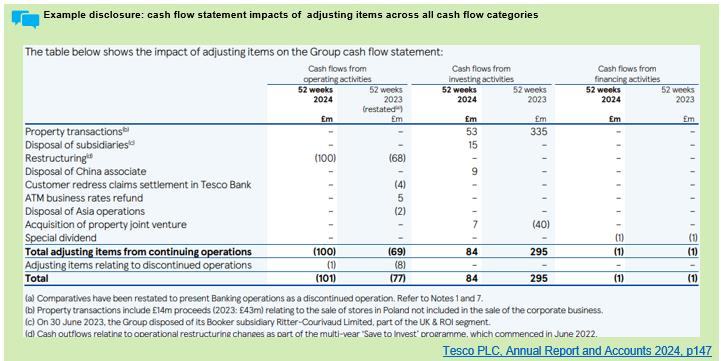
- Appendices
- Statement of Cash Flows and Related Matters
- Appendix A: Non-mandatory and Voluntary Cash Flow Disclosures Provided by UK Listed Companies
- Background
- Purpose of research paper
- Review process and methodology
- Non-mandatory cash flow disclosures provided by UK listed companies
- Presentation of cash flows from operating activities
- Application of the indirect method
- Growth and maintenance expenditure
- Segmental cash flows
- Observations on non-mandatory cash flow disclosures
- Voluntary cash flow disclosures provided by UK listed companies
- Cash impact of exceptional or other adjusting items
- Reconciliation of amounts in the statement of cash flows to other primary statements
- Derivatives cash flows
- Aggregate cash impact of M&A transactions
- Observations on voluntary cash flow disclosures
- Other areas of cash flow reporting
- Alternative Performance Measures (APMs) in cash flow reporting
- Reporting practices for free cash flow
- Reporting practices for net debt
- Observations on other areas of cash flow reporting
- Concluding Observations
- Footnotes
Background
Purpose of research paper
1This paper is the second in a series of research papers, as part of the UKEB's proactive research project on the Statement of Cash Flows and Related Matters. The information in this paper builds on the information in the first research paper Statement of Cash Flow and Related Matters: Background and key issues presented to the Board in December 2024.
2The main purpose of this paper is to examine existing reporting practice among a sample of UK listed companies in relation to cash flow information included in their financial statements. Specifically, it identifies both non-mandatory and voluntary disclosures that UK listed companies include in their financial statements beyond the requirements of IAS 7 Statement of Cash Flows and other IFRS Accounting Standards.
3A review of UK listed companies' financial statements highlighted practical steps taken by those companies in the following areas:
- Non-mandatory cash flow disclosures. These disclosures are encouraged but not required by IAS 7 or other relevant standards.
- Voluntary cash flow disclosures. IAS 7 or other relevant standards lack explicit guidance about these disclosures.
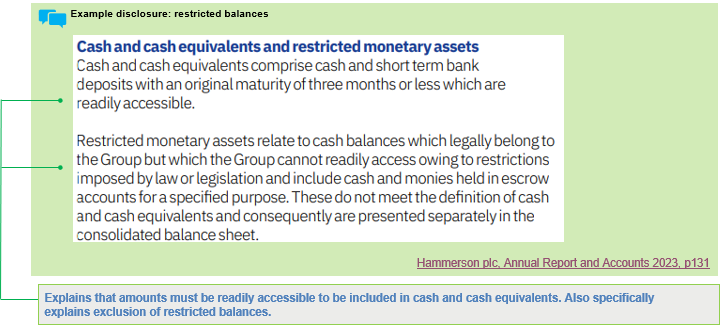
- Other cash flow reporting. These disclosures require application of judgement and diverse approaches taken by companies have been identified.
4The UKEB research project team is currently interviewing users1 and preparers of financial statements to better understand their perspectives on how the statement of cash flows could be improved. Some of the disclosures identified in this paper have been explored during interviews to assess whether the disclosures provide useful information. The findings from these interviews are expected to be presented to the Board in a third research paper in March 2025.
Review process and methodology
5A desktop review of reports published by the UK Regulator, the Financial Reporting Council (FRC) and input from the FRC's Corporate Reporting Review team identified examples of non-mandatory and voluntary cash flow related disclosures that are made by UK listed companies.
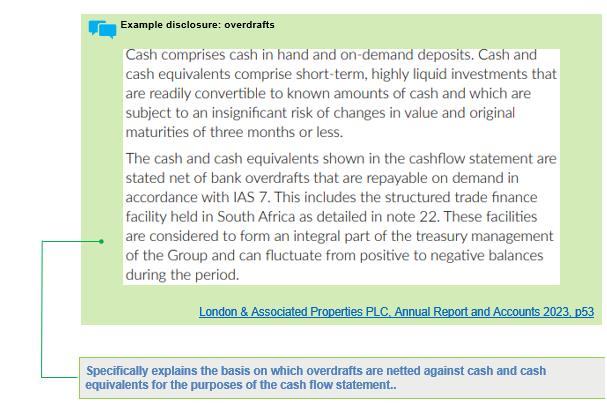
6After identifying such cash flow related disclosures included in this paper, a high-level analysis was conducted on a sample of 30 UK FTSE and AIM listed companies (the sample) to assess their prevalence among UK listed companies.
7The tables below analyse companies in the sample by size and industry sector.
| Sample by company size | |
|---|---|
| FTSE 100 | 50% |
| FTSE 250 | 27% |
| FTSE Small Cap | 10% |
| AIM | 13% |
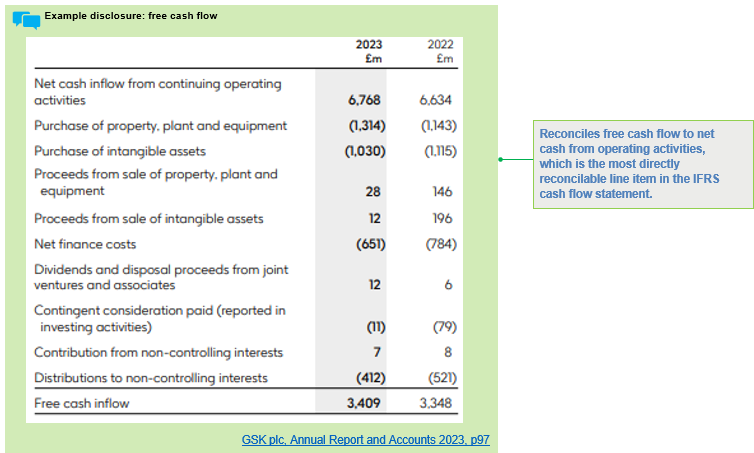
| Sample by sector | |
|---|---|
| Consumer Products and Services | 23% |
| Industrial Goods and Services | 17% |
| Banks | 10% |
| Insurance | 10% |
| Energy and Mining | 10% |
| Utilities | 10% |
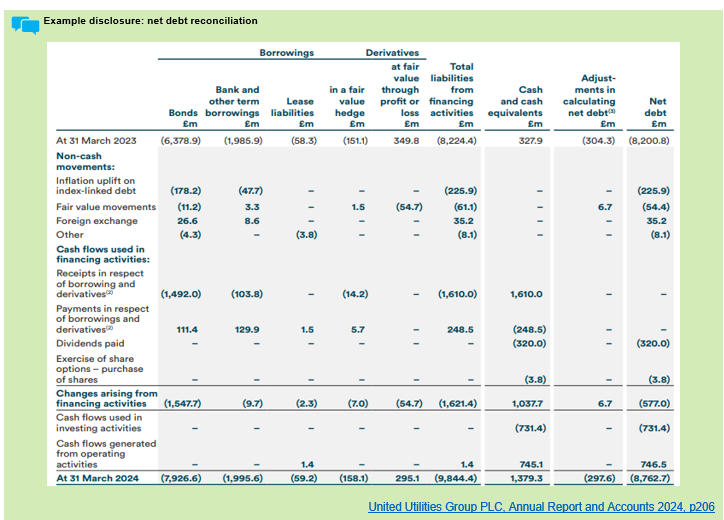
| Media | 7% |
| Personal Products | 7% |
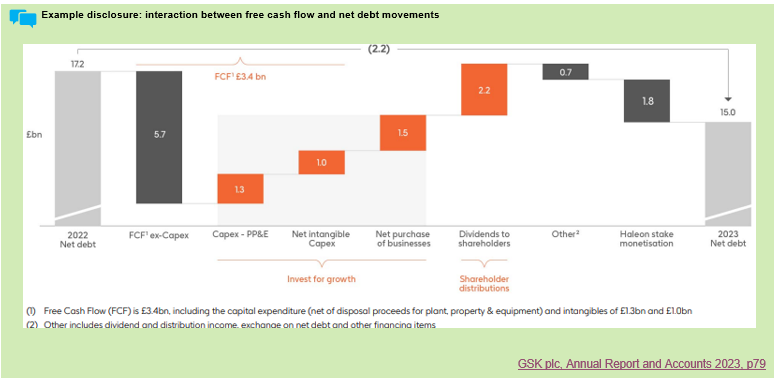
| Telecommunications | 3% |
| Travel and Leisure | 3% |
8In this paper where specific numbers are not provided the following terms are used to give a broad indication of prevalence from the sample2:
| Term used | Extent of response | Number of companies in the sample |
|---|---|---|
| Almost all | All except a small minority | 26 - 29 |
| Most | A large majority | 21 - 25 |
| Many | A small majority or large minority | 11 - 20 |
| Some | A small minority | 6 - 10 |
| A few | A very small minority | 2 - 5 |
9The disclosure examples included in this paper are sourced from publicly available information from annual reports, accessible via the websites of the stated companies or the Financial Conduct Authority's National Storage Mechanism.
10Inclusion of a company's example in this paper does not imply an endorsement of those specific disclosures.
Non-mandatory cash flow disclosures provided by UK listed companies
11For the purposes of this paper, “non-mandatory cash flow” disclosures are those that are encouraged, but not required, by IAS 7. Two paragraphs in IAS 7 refer to such non-mandatory disclosures:
- IAS 7 paragraph 19 states that “Entities are encouraged to report cash flows from operating activities using the direct method. "
- IAS 7 paragraph 50 includes the following “encouraged” disclosures:
- "the aggregate amount of cash flows that represent increases in operating capacity separately from those cash flows that are required to maintain operating capacity”; and
- "the amount of the cash flows arising from the operating, investing and financing activities of each reportable segment”
Presentation of cash flows from operating activities
13As noted above, IAS 7 allows companies to report their ‘cash flows from operating activities' using either the direct method or the indirect method. It encourages the use of the direct method, as it is seen as providing information that may be useful for estimating future cash flows.
14The direct method discloses major classes of gross cash receipts and payments. For example, cash receipts from the sale of goods and the rendering of services, cash payments to suppliers for goods and services, and cash payments to and on behalf of employees. These cash flows may be obtained either from an entity's underlying accounting records or they can be derived from information disclosed in the other primary statements.
15All 30 companies in the sample presented their statement of cash flows using the indirect method. Additional searches of UK listed companies' annual reports did not identify any companies that separately disclosed supplementary information based on the direct method.
16A more comprehensive search of UK listed companies' financial statements identified only a small number using the direct method. These UK listed companies appeared to be foreign issuers, with a secondary listing on the London Stock Exchange.
Application of the indirect method
17Of the 30 companies sampled, 22 (73%) provided a reconciliation from 'profit or loss' to 'cash flows from operating activities' on the face of the statement of cash flows. The starting point for calculating net cash flow from operating activities varied across the sample:
- 6 companies (20%) used 'operating profit or loss' as the starting point.
- 15 companies (50%) started with 'profit or loss before tax'.
- 9 companies (30%) used 'profit or loss for the year' as the starting point.
18The diversity of approaches noted above is expected to reduce when companies begin reporting under IFRS 18 Presentation and Disclosure in Financial Statements, as the new Standard will require all companies to use ‘operating profit' as the starting point for calculating 'cash flows from operating activities' presented using the indirect method.
19Companies in the sample made and average of 17 adjustments between their starting point and ‘cash flows from operating activities', with individual companies' adjustments ranging from 5 to 33 in number. The number of adjustments could be due to the level of disaggregation provided or the number of non-cash items in the statement of profit and loss.
20In many cases, the high number of reconciling items was associated with companies in the sample using a profit measure other than ‘operating profit' as their starting point. Few companies in the sample explicitly distinguished between:
- adjustments required to ‘operating profit' to calculate 'cash flows from operating activities' (e.g. non-cash items included in profit or loss and working capital movements); and
- adjustments arising from using a starting point other than ‘operating profit' in their cash flow calculations (e.g. profit before tax would require adding back investing and financing profit and loss items).
Growth and maintenance expenditure
21IAS 7 paragraphs 50–51, state that it may be helpful for companies to disclose aggregate cash flows that represent increases in operating capacity separately from those cash flows that are required to maintain operating capacity.
22Such information is useful in enabling the user to determine whether the entity is investing adequately in the maintenance of its operating capacity. An entity that does not invest adequately in the maintenance of its operating capacity may be prejudicing future profitability for the sake of current liquidity and distributions to shareholders.
23The extract below shows an example of a company that provides such disclosures.
Example disclosure: growth and maintenance capital expenditure
Maintenance capital expenditure relates to spends for additions or improvements that are required to sustain the existing operations of the Group.
Growth capital expenditure relates to spends associated with delivering business growth, including: onboarding of new customers, expansion of services with existing customers or the development of new product offerings.
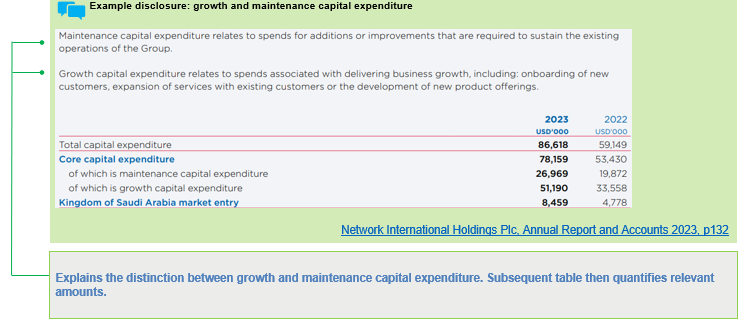
Explains the distinction between growth and maintenance capital expenditure. Subsequent table then quantifies relevant amounts.
24None of the companies in the sample disaggregated capital expenditure into growth and maintenance expenditure. Four companies in the sample partially addressed this matter by disaggregating asset additions made during the period (rather than the cash payments) or by making comments in the strategic report (but no corresponding disclosures in the financial statements were included). In one case, comments in the strategic report included references to maintenance capital expenditure but provided no information on growth capital expenditure.
Segmental cash flows
25As noted above, IAS 7 paragraph 50–51 encourage companies to disclose the amount of cash flows arising from the operating, investing and financing activities of each reportable segments. The disclosure of segmental cash flows enables users to obtain a better understanding of the relationship between the cash flows of the business as a whole and those of its component parts and the availability and variability of segmental cash flows. For example, different business segments may have differing cash generation and usage profiles, or differing working capital absorption.
26Disclosures in this regard were relatively uncommon in the sample. Where provided, they were generally more detailed than the illustrative example in IAS 7 (Illustrative Example3 D), which presents only aggregate operating, investing, and financing cash flows for each operating segment. The extract below shows how one company provided the segmental cash flow information encouraged by the Standard.
Example disclosure: segment cash flows
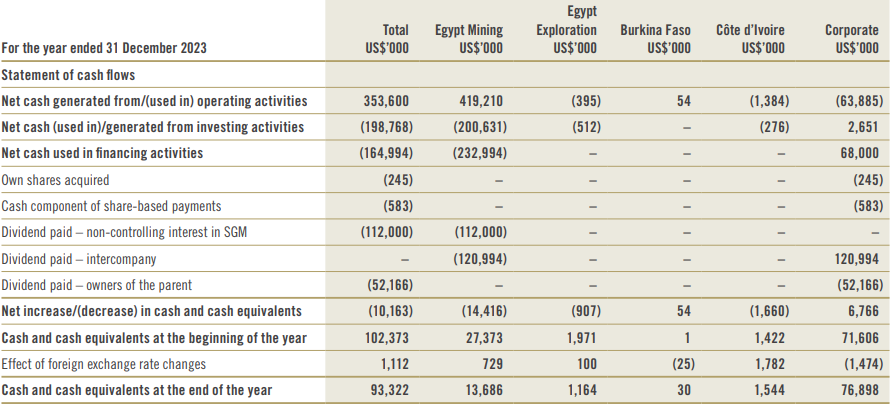
Entity presents summarized operating, investing and financing cash flows for each segment.
Corporate office cash flows, intercompany dividends and cash balances included to fully reconcile individual segment cash flow statements to the consolidated amounts.
27A few companies in the sample went further still. One company included full segmental cash flow information, and additionally provided a separate column for exceptional and adjusting items.
Observations on non-mandatory cash flow disclosures
28It is striking how few UK listed companies provide the encouraged disclosures from IAS 7.
29Regarding the direct method, IAS 7 paragraph 19 encourages the direct method as it "provides information which may be useful in estimating future cash flows and which is not available under the indirect method". It may be better if the Standard explicitly identified this information and required it to be disclosed in the financial statements when the indirect method is used.
30The virtual absence of information on segmental cash flows also seems anomalous. IFRS 8 Operating Segments paragraph 23 requires companies to report a measure of profit or loss for each reportable segment along with total assets and liabilities if this is regularly provided to the chief operating decision maker. The fact that segmental disclosure is not required for cash flow information, even if regularly provided to the chief operating decision maker, is notable.
31It will be important to consider the extent to which these disclosures are seen by users to be particularly relevant, and whether on this basis they should be required.
Voluntary cash flow disclosures provided by UK listed companies
33For the purposes of this paper 'voluntary cash flow disclosures' refer to cash flow-related information that UK companies include in the financial statements at their own discretion. Unlike the ‘non-mandatory cash flow disclosures' described above, voluntary cash flow disclosures are not explicitly referenced or suggested in IAS 7 or other IFRS Accounting Standards.
Cash impact of exceptional or other adjusting items
34IFRS Accounting Standards do not explicitly refer to exceptional or other adjusting items. However, they are frequently included in the statement of profit or loss to communicate information intended to help users better understand the financial statements.
35Understanding the cash impact of non-recurring items is important to allow for a more realistic view of a company's financial health and in making informed investment decisions. Understanding the nature of a non-recurring item and its cash flow impact is important in financial valuation. Generally, analysts adjust for non-recurring items. These one-time events can significantly distort a company's reported profitability and/or cash flow, and if not adequately disclosed can lead to difficulty in accurately assessing a company's true operating performance and future potential. Examples of such exceptional items might be:
- Selling a major asset at a significant gain or loss.
- Restructuring costs related to layoffs or major organisational changes.
- Legal settlements.
- Losses arising from natural disasters.
36IAS 7 does not explicitly require the disclosure of the cash impact of exceptional, one-off or infrequently recurring items. As noted, almost all UK listed companies use the indirect method for disclosing operating cash flows, by adjusting a profit measure as the starting point. If the starting point includes exceptional items, the cash impact of those exceptional items is not transparent, unless the full profit or loss impact is added back and then the cash impact separately disclosed, or otherwise explicitly disclosed in supporting commentary.
37The Basis for Conclusions to IFRS 18 paragraph BC93 notes that "an entity might disclose information about an aspect of its operating performance by presenting a management-defined performance measure of operating profit excluding expenses it regards as non-recurring or unusual”. No such requirement is set out in IFRS 18 in relation to 'cash flows from operating activities'.
38As illustrated in the example below, some UK listed companies, that include exceptional or other profit-related adjusting items, separately disclose their cash impact in the statement of cash flows.
39Disclosing the cash impact of exceptional items enhances consistency between cash flow disclosures and the statement of profit or loss disclosure requirements set out in IAS 1 Presentation of Financial Statements paragraphs 97–98. The UK Regulator encourages companies to include this information.
Example disclosure: cash flow statement impacts of unusual or exceptional items
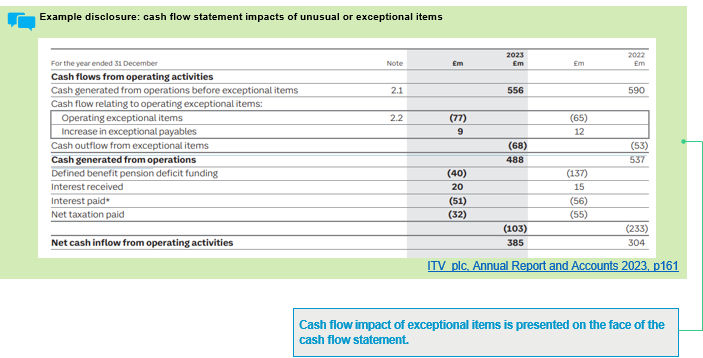
Cash flow impact of exceptional items is presented on the face of the cash flow statement.
40Most companies in the sample (23 companies) disclosed exceptional and other adjusting items in their statement of profit or loss. However, only seven of them disclosed cash flows relating to exceptional items either in their statement of cash flow or in a note to the financial statements.
41One such company, as shown in the extract below, demonstrates how the cash impact of exceptional and other adjusting items can be disaggregated by nature and by cash flow classification, clearly showing exceptional cash flows relating to operating, investing and financing activities.
Reconciliation of amounts in the statement of cash flows to other primary statements
42Users often assess company performance holistically by considering the statement of cash flows alongside other primary financial statements, therefore cohesiveness between the primary financial statements is important.
43Being able to reconcile between the primary financial statements ensures that the information presented is accurate, reliable and provides transparency for users. This would be expected to enhance decision-making by users. For example, by comparing the cash generated from operations to operating profit, users can assess the quality of earnings and understand how well the company is managing its working capital.
44Thematic review reports published by the FRC note that reconciliations between the statement of cash flows and other primary financial statements are useful for understanding relationships between the different statements4. These reconciliations are especially helpful for understanding the impact of non-cash movements, such as exchange differences, fair value movements and acquisitions or disposals, on changes in working capital.
45IAS 7 paragraph 45 requires a company to present a reconciliation of the cash and cash equivalent amounts in its statement of cash flows with equivalent items reported in the statement of financial position.
46The only other relevant paragraph is IAS 7 paragraph 44D, which explains that if a company chooses to use a reconciliation of opening and closing balances in the statement of financial position for liabilities arising from financing activities (including both changes arising from cash flows and non-cash changes), the company shall provide sufficient information to enable users of the financial statements to link items included in the reconciliation to the statement of financial position and the statement of cash flows.
47With regard to reconciling the statement of cash flows to the statement of profit or loss, there are no specific requirements. However, where a company uses the indirect method for disclosing cash flows from operating activities, a reconciliation to the statement of profit or loss is implicit. Where the indirect method is used, adjustments to the starting profit figure, made by adding back non-cash items, provides an opportunity to reconcile items to the statement of financial position, where the notes have enough granularity to show increases and decreases in the balances that are the result of non-cash transactions.
48Some UK listed companies voluntarily provide reconciliations to clarify how working capital movements in the statement of cash flows relate to amounts in the statement of financial position (see example below).
Example disclosure: reconciliation of working capital movements in the cash flow statement to the balance sheet

Working capital movements in the cash flow statement are reconciled to related balance sheet amounts. Any elements that do not have a corresponding impact on operating profit are excluded from the working capital movements in the cash flow statement.
Columnar presentation ensures that all relevant disclosures are presented in a single location
49One company in the sample included a reconciliation similar to the one noted above. Other voluntary disclosures of a similar type included:
- A reconciliation between tax payments in the statement of cash flows and tax charges recognised in the statement of profit or loss and statement of financial position (provided by two companies in the sample):
Example disclosure: reconciliation of tax payments to other primary statements
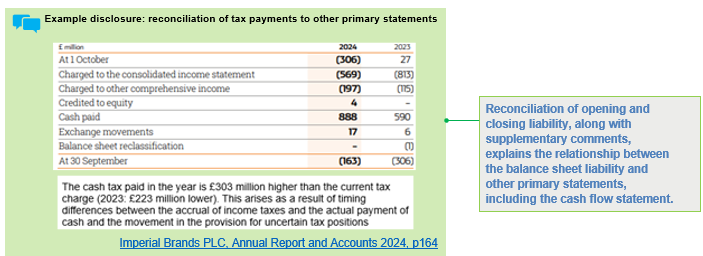
Reconciliation of opening and closing liability, along with supplementary comments, explains the relationship between the balance sheet liability and other primary statements, including the cash flow statement.
- A reconciliation explaining differences between capital expenditure payments and additions to property, plant, and equipment (provided by three companies in the sample):
Example disclosure: reconciliation of capex cash flows to asset additions
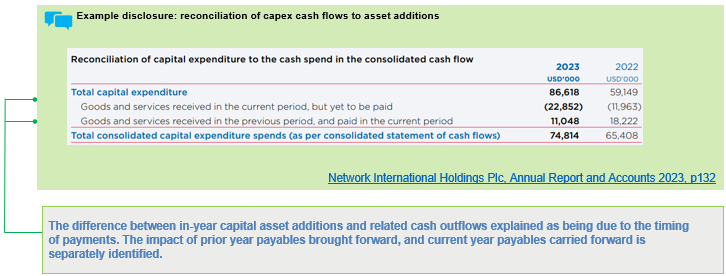
The difference between in-year capital asset additions and related cash outflows explained as being due to the timing of payments. The impact of prior year payables brought forward, and current year payables carried forward is separately identified.
50More generally, the research highlighted that very few companies in the sample (all of which applied the indirect method), provide cross references from their statement of cash flows to relevant notes in their financial statements. This made it challenging to clearly understand the relationship between the statement of cash flows and other sections of the financial statements.
Derivatives cash flows
51IAS 7 paragraph 16 states that where a contract is accounted for as a hedge, its cash flows should be classified in the same manner as the hedged item. It does not, however, specify whether such cash flows should be separately identifiable. In addition, the Standard does not provide guidance on economic hedges or derivatives where hedge accounting is not applied.
52Understanding the cash flows from derivatives help users evaluate the potential financial impact of a derivative strategy, considering factors like the timing and amount of future payments, which is crucial for deciding whether to enter into a derivative position. The cash flows may also help users to assess whether there is sufficient liquidity to meet future obligations arising from derivative contracts.
53Our research highlighted that UK listed companies typically provide limited information on the cash effects of derivatives in the statement of cash flows.
54Some UK listed companies provide transparency by describing their accounting policies for classification of derivative cash flows see example below.
Example disclosure: accounting policy for derivative cashflows

55A review of the sample identified the following:
- No companies voluntarily provided an accounting policy, explaining the classification of derivative cash flows in circumstances where hedge accounting is applied and those where hedge accounting is not applied.
- It was apparent, from disclosures provided in other sections of the financial statements, that many the companies in the sample had hedges relating to operating activities; however, none disclosed the impact of those derivatives in the operating activities section of the statement of cash flows.
- Seven companies disclosed derivative cash flows relating to investing and financing activities on the face of the statement of cash flows, as illustrated in the example below.
Aggregate cash impact of M&A transactions
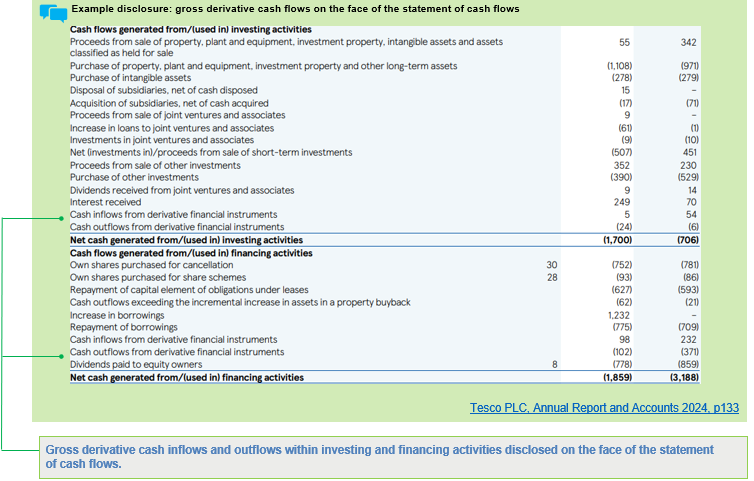
Gross derivative cash inflows and outflows within investing and financing activities disclosed on the face of the statement of cash flows.
56Reporting the aggregate cash and non-cash impact of merger and acquisition (M&A) activities in a single note in the financial statements is useful as such transactions may be reported in different sections of the statement of cash flows. For example, the cash balance of a new subsidiary is reported as a cash inflow when first consolidated, the acquisition may be paid for in cash or by the issue of equity and there may be a deferred or contingent consideration element. Such cash flows should be disclosed within investing activities (as required by IAS 7 paragraph 39). There may also be cash flows for related acquisition costs which should be disclosed within cash flows from operating activities (as required by IAS 7 paragraph 14).
57Some transactions that result in a zero cash flow in fact comprise two offsetting 'effective' flows which, had they been transacted separately, would each have appeared in the statement of cash flows. Whether the purchase is a single transaction, or a separate equity issue followed by a cash purchase, does not affect the underlying economics, but does produce very different disclosures in the statement of cash flows. This applies to several situations in addition to business combinations, including leasing and supplier finance arrangements. Considering just cash flows reported in the statement of cash flows can lead to analyst metrics, such as free cash flow, which are incomplete and unsuitable for use in equity valuation.
58Issues may arise due to inherent tensions between the IFRS Accounting Standard requirements and companies' desire to present the aggregate cash impact of M&A transactions.
59One company in the sample addressed this challenge by:
- classifying acquisition-related expenses within operating activities (as required by IAS 7 paragraph 14) and net cash flows from the settlement of acquisition consideration within investing activities (as required by IAS 7 paragraph 39); and
- voluntarily providing a table in the notes to consolidate the aggregate cash impact of the various elements, even though they were included in different notes to the statement of cash flows (see extract below).
60The sample identified only three other companies whose reports included broadly similar disclosures, despite there being 16 companies in the sample that disclosed acquisitions during the year.
Example disclosure: aggregate impact of M&A transactions on cash flow
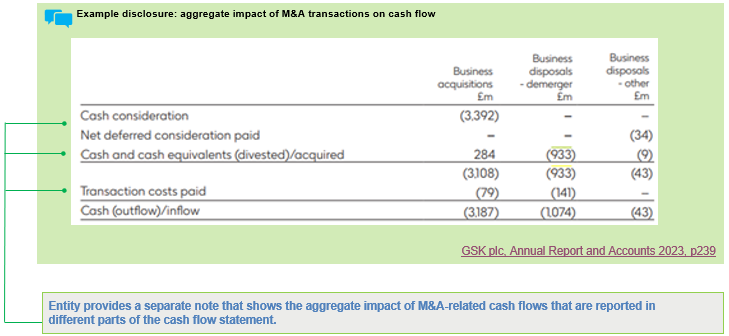
Entity provides a separate note that shows the aggregate impact of M&A-related cash flows that are reported in different parts of the cash flow statement.
61Users also need cash flow information about an acquired entity to accurately assess its ability to generate cash for future operations, and to evaluate the impact of an acquisition on the acquiring company's liquidity.
Observations on voluntary cash flow disclosures
62UK listed companies provide a range of voluntary disclosures, but the sample did not identify any that are consistently provided.
63The absence of cross referencing in the statement of cash flows to notes in the financial statements was surprising. There is often relevant information in various notes distributed across the financial statements (for example in the leases note, the reconciliation of financing liabilities and the provisions note). However few companies provide references to these notes for relevant cash flows. There would appear to be an opportunity to enhance the cohesiveness of the financial statements and enhance user understanding.
64Despite the UK Regulator specifically identifying information on the cash impact of exceptional or other adjusting items as an area in which they would like to see better disclosure, such information is not widely reported by companies in the sample.
65The fact that UK listed companies are voluntarily providing additional cash flow and related disclosures indicates that they believe they provide useful information to users. It will be important to explore these areas further with users as they provide an opportunity to leverage existing practice and identify potential improvements to disclosure requirements.
Other areas of cash flow reporting
66This section analyses areas where companies may need to exercise judgement when determining or disclosing cash flow amounts and related balances. These represent aspects of cash flow reporting where there is a high potential for diverse approaches being adopted by companies.
67Users understand cash and cash equivalents to be readily available funds for day-to-day operations and therefore provide an indication of its ability to pay short-term debts, that is its liquidity. In this context, it is important that amounts that companies include in cash equivalents reflect their cash management strategy.
Composition of cash and cash equivalents
68IAS 7 paragraph 46 requires companies to disclose their accounting policy for determining the composition of cash and cash equivalents. The FRC's thematic review on cash flow and liquidity disclosures, emphasised the importance of:
- Providing sufficiently detailed accounting policies that clearly define the items included in cash and cash equivalents.
- Explaining the rationale for including overdrafts within cash and cash equivalents, if applicable.
- Providing information about restricted cash balances and the nature of the restrictions.
69The following sub-sections analyse disclosure practices observed in each of these areas during the research.
70IAS 7 paragraph 6 describes cash equivalents as “investments” that have three distinguishing features: short maturities, high liquidity and are subject to an insignificant risk of changes in value.
71Most companies in the sample included passing references to one or more of these features in their accounting policies. However, apart from “short-term maturity" (which was generally interpreted as referring to balances with an original maturity of three months or less), none of the companies provided company-specific interpretations of the other terms.
Restricted balances
72IAS 7 paragraph 48 sets a high-level disclosure requirement for restricted cash balances, requiring companies to disclose significant restricted balances and provide commentary. As a result, companies have to exercise judgement in determining the level of detail to include in their disclosures.
73The extract below provides an example of a company which:
- described the nature of the restricted balances and the associated restrictions; and
- explained the accounting implications – in this case, that the restrictions meant that the balances should not be included in cash and cash equivalents.
Example disclosure: restricted balances
Explains that amounts must be readily accessible to be included in cash and cash equivalents. Also specifically explains exclusion of restricted balances.
74Disclosure of restricted balances was relevant to 12 of the 30 companies in the sample. However, for all but one, the accounting policies and related disclosures lacked sufficient detail to clearly explain the nature of the restrictions. In particular, companies did not explain their conclusion that the restrictions were not severe enough to impact their inclusion in cash and cash equivalents.
75In the companies sampled, the value of restricted cash ranged from £1m to £530m. On average, these balances represented 5% of the relevant companies' total cash balances and 1% of their net assets.
Bank overdrafts
76IFRS Accounting Standards apply different criteria for offsetting bank overdrafts against cash and cash equivalents, depending on whether they relate to the statement of financial position or the statement of cash flows. As a result, companies may be able to offset overdrafts in the statement of cash flows but not in the statement of financial position.
- In the statement of financial position, overdrafts can only be offset if the two offsetting criteria in IAS 32 Financial Instruments: Presentation paragraph 42 are satisfied.
- In the statement of cash flows IAS 7 paragraph 8 states that bank overdrafts repayable on demand and forming an integral part of cash management should be included in cash and cash equivalents. A key characteristic of such arrangements is that those bank balances frequently fluctuate between positive and overdrawn.
77The disclosure example below illustrates the key points:
Example disclosure: overdrafts
Specifically explains the basis on which overdrafts are netted against cash and cash equivalents for the purposes of the cash flow statement..
78In the sample, 16 companies (or 60%) had offset bank overdrafts against cash and cash equivalents for the purposes of the statement of cash flows but not the statement of financial position. However, only three of them explained the rationale for including overdrafts within cash and cash equivalents (for example, by explaining whether they were integral to cash management or by explaining that the relevant balances frequently fluctuate between negative and positive balances).
Alternative Performance Measures (APMs) in cash flow reporting
79In our previous research paper provided to the Board in December 2024, we noted that free cash flow and net debt were two of the most common cash flow alternative performance measures (APMs) among UK companies.
80Whilst users often calculate their own free cash flow measures, using information disclosed in the statement of cash flows and elsewhere in the financial statements, users often rely more heavily upon the information provided for net debt.
81The following sub-sections explore UK reporting practices in relation to these measures.
Reporting practices for free cash flow
82Free cash flow plays an essential role in valuation and is one of the most important ways to measure a company's financial performance, as it demonstrates the cash flow a company can potentially distribute i.e. return dividends to investors or buy back shares, after making reinvestments in the business via capital expenditure and working capital.
83Free cash flow can be defined and calculated in many ways. However, in its most generic form, free cash flow is calculated as cash from operations minus capital expenditure.
84UK reporting practices for free cash flow vary in several ways, including differences in terminology and calculation methods. The extract below illustrates how one company calculates free cash flow.
Example disclosure: free cash flow
Reconciles free cash flow to net cash from operating activities, which is the most directly reconcilable line item in the IFRS cash flow statement.
85Of the sample, 16 companies presented a free cash flow measure in the annual report. There was an almost equal split between including free cash flow in their financial statements and including the measure in their strategic report.
86Nearly all the companies in the sample that presented free cash flow used net cash flow from operating activities as the starting point for their calculations. The precise composition of the starting point was, however, not identical.
87In eight cases net cash flow from operating activities was after net interest payments, whilst in six cases it was before net interest payments; the difference reflects the choice currently available in IAS 7 paragraph 31 in relation to whether companies present interest receipts and payments in operating, investing or financing activities5. The six UK companies in the latter category, separately adjusted for net interest payments in their free cash flow calculations.
88The most common adjustments made in free cash flow calculations were for capital expenditure (adjusted by all 16 companies in the sample that presented free cash flow) and the capital element of lease payments (adjusted by 13 companies).
89There were also other variations: some companies adjusted for cash flows relating to M&A transactions (four companies in the sample), proceeds from asset disposals (three companies) and exceptional cash flows (two companies).
Reporting practices for net debt
90Net debt is a financial liquidity metric that is used to determine how well a company can pay all its debts if they come due immediately, and whether the company is able to take on more debt. It measures a company's current interest-bearing debt on its statement of financial position compared to its liquid assets i.e. cash and cash equivalents. It shows how much cash would remain if all debts were paid off, and if a company has sufficient liquidity to meet its debt obligations. Net debt is commonly used in valuation.
91IAS 7 paragraph 44A requires companies to disclose information about changes in financing liabilities. The subsequent paragraphs explain, amongst other matters, that this information may be presented in the form of a reconciliation of the opening and closing balances of liabilities arising from financing activities6 (IAS 7 paragraph 44D).
92IAS 7 paragraph 44E explains that the information may be combined with disclosures of changes in other assets and liabilities. Most UK companies do this by presenting a net debt reconciliation.
93The extract below illustrates one company's approach to presenting its net debt reconciliation. This includes a cash column that reconciles to the statement of cash flows.
Example disclosure: net debt reconciliation
94Another company provided an alternative format to demonstrate the interaction between free cash flow and the increase in net debt (see below).
Example disclosure: interaction between free cash flow and net debt movements
95In the sample, most companies reported a net debt measure. Almost all of them included net debt in their financial statements. The banking and insurance companies in the sample however did not disclose net debt.
96As with free cash flow, calculation methods varied, primarily depending on whether companies in the sample included or excluded from their net debt calculations:
- Leases.
- Investments.
- Debt-related derivatives.
- Other derivatives not related to debt.
- Other investments not classified as cash equivalents.
Observations on other areas of cash flow reporting
97Most companies in the sample provide a net debt reconciliation. On one level this is not surprising as it is suggested as one way a company can meet the requirements of IAS 7 paragraph 44A to disclose information about changes in financing liabilities. Given its prevalence there may be an opportunity to incorporate it into the cash flow reporting requirement to provide more cohesiveness between the statement of financial position and the statement of cash flows.
98The disclosures on cash equivalents continue to be boilerplate in most instances with the IAS 7 paragraph 7 reference to short term maturity being “say, three months or less” being interpreted as a de facto rule.
99Free cash flow was disclosed by many companies in the sample. While it was variously defined entities tended to provide a clear reconciliation to the statement of cash flows.
Concluding Observations
100The purpose of this paper is to inform the Board about the nature and prevalence of non-mandatory and voluntary cash flow disclosures currently reported in UK listed companies' financial statements.
101Analysing current practice by UK listed companies has identified a number of possible enhancements to the reporting on cash flows and related matters. This includes "encouraged” disclosures that are rarely provided and voluntary disclosures that are more widely observed.
102This research provides evidence that can inform future Board discussions on the Statement of Cash Flows and Related Matters project.
103The Board's feedback, along with relevant findings from this paper, will inform the remaining interviews to further assess the extent to which the voluntary disclosures reflect users' needs and expectations. The findings from this assessment will, where relevant, also be reflected in the research paper to be submitted expected to be discussed at the March 2025 Board meeting.
Footnotes
Footnotes
-
In this paper "users" is as described in paragraph 1.5 of the Conceptual Framework: "primary users of financial statements are existing and potential investors, lenders and other creditors who must rely on general purpose financial reports for much of the financial information they need". ↩
-
In the table "term used" and "extent of response" are consistent with the approach taken by the IASB see for example paragraph 8 of IASB Staff paper January 2025 ap32-summary-of-feedback.pdf ↩
-
Illustrative Examples (IEs) are part of the Accompanying Guidance to IFRS Accounting Standards. However, the IEs do not form a mandatory part of the Standards. ↩
-
FRC Thematic Review: Reporting by Smaller Listed and AIM Quoted Companies (pages 38 and 39); FRC Thematic Review: Cash flow statements and liquidity (IAS 7, IFRS 7) (page 8) ↩
-
IFRS 18 removes the option to choose how to classify interest and dividend cash flows. In the future, paid interest and dividends should be classified as financing activities. Received interest and dividends should be classified as investing activities. There are exceptions for certain business models, such as banks. ↩
-
The Standard defines liabilities arising from financing activities as liabilities for which cash flows were, or future cash flows will be, classified in the statement of cash flows as cash flows from financing activities. ↩