6 Provisions - Targeted Improvements
Executive Summary
| Project Type | Influencing |
|---|---|
| Project Scope | Moderate |
Purpose of the paper
The purpose of this paper is to provide the Board with a draft Project Initiation Plan (PIP) for the project to influence the IASB's forthcoming Exposure Draft (ED) resulting from its Provisions – Targeted Improvements project.
Summary of the Issue
The IASB is developing proposals to clarify the following in IAS 37 Provisions, Contingent Liabilities and Contingent Assets:
- when an entity recognises a provision;
- whether rates used to discount provisions reflect non-performance risk; and
- which costs to include in the measurement of a provision.
The IASB is expected to publish an ED in November 2024, with a 120-day comment period.
Decision for the Board
Subject to any suggested amendments, does the Board approve the Project Initiation Plan for this project for publication on the UKEB website?
Recommendation
We recommend the Board approves the Project Initiation Plan.
Appendix
Appendix A [Draft] Project Initiation Plan: Provisions – Targeted Improvements.
Appendix A: [Draft] Project Initiation Plan: Provisions – Targeted Improvements
Purpose
A1The International Accounting Standards Board (IASB) has indicated its intention to publish an Exposure Draft (ED) proposing targeted improvements to IAS 37 Provisions, Contingent Liabilities and Contingent Assets. The ED is anticipated to be published in November 2024, with a 120-day comment period.
A2This paper sets out a proposed approach and plan for an influencing project for the forthcoming ED Provisions – Targeted Improvements.
Background
A3The IASB has received stakeholder feedback that although IAS 37 generally works well in practice (and it doesn't need fundamental review), they have identified problems with particular aspects of the Standard1.
A4As a result, the IASB is developing proposals to clarify the following in IAS 37:
- when an entity recognises a provision – including whether and, if so, when an obligation conditional on an entity's own future actions is a 'present obligation' and hence a liability;
- whether the rate at which an entity discounts a provision for the time value of money should reflect the entity's own credit risk, that is, the possibility that it may fail to fulfil its obligation; and
- whether a provision for an obligation to deliver goods or services should comprise only the incremental costs of fulfilling the obligation or also include an allocation of other directly related costs.
A5In June2 and July3 2024, the Board considered papers summarising the IASB tentative decisions on this project.
Project Plan
A6A proportionate approach is proposed, incorporating mandatory milestones listed in paragraph 5.3 of the UKEB's Due Process Handbook (Handbook). The Secretariat recommends the 'moderate scope' project plan shown below. The factors considered in arriving at this project plan are described in paragraphs A9 – A13. A timeline for the key project milestones is presented in paragraphs A17 and A18.
A7Future dates are based on current expectations and are, therefore, subject to subsequent modification. The Board will be alerted to any significant changes.
| Key activities | Due Process Handbook reference |
|---|---|
| Project added to 17 October 2024 UKEB Work Plan. | 4.30(b)i Mandatory |
| Creation of a Project Initiation Plan (this document). | 5.4 to 5.8 Mandatory |
| An education session to be presented at the December 2024 UKEB meeting, subject to publication of the ED in November. | 4.10(b) Optional |
Desk-based research, including:
|
5.9 Optional |
Stakeholder outreach
|
5.10-5.12 Mandatory |
Draft Comment Letter (DCL) for public consultation
|
5.13 to 5.17 Generally mandatory |
Final comment letter (FCL) submitted to the IASB
|
5.18 Mandatory |
Project Closure
|
5.19 to 5.26 Mandatory |
A8The following considerations have shaped the project plan.
Proportionality assessment
Significance / relevance in the UK
A9IAS 37 is relevant to most UK IFRS reporters.
Complexity
A10The IASB has decided to propose targeted improvements to the existing requirements in IAS 37, mainly affecting the recognition and measurement of provisions4.
A11The anticipated amendments, in particular those affecting the recognition of provisions, are expected to address fundamental aspects of the requirements and potentially change current practice for some IFRS reporters. As a result, the anticipated changes to the existing requirements have a risk of unintended consequences.
Expected interest / sensitivity
A12We anticipate wide interest in this project from a range of stakeholders. We have not been made aware of any significant concerns with the proposed amendments to date. However, questions have been raised about the clarity of certain aspects of the anticipated proposals, such as the proposed changes to address the accounting for levies (which would result in the withdrawal of IFRIC 21).
Expected timeline / urgency
A13There is no particular urgency to the project and the IASB project follows the standard timeline for publications of Exposure Drafts. The ED is expected to be published in November 2024 with a 120-day comment period.
UKEB project scope
A14Based on the proportionality assessment above we recommend a 'moderate' project scope and the approach described in the project plan reflects this.
Resources allocated
A15Based on this project plan, we consider a project team consisting of one Project Director and one Project Manager, with technical support and oversight from a Senior Project Director, should ensure that project milestones are achievable. Communications support will be obtained as appropriate. The required resources are allowed for in the UKEB plan and budget.
Setting up an ad-hoc advisory group
A16It is not considered necessary to set up a separate, ad-hoc advisory group. The existing UKEB Advisory/Working Groups are well placed to provide feedback on this project.
Project timeline
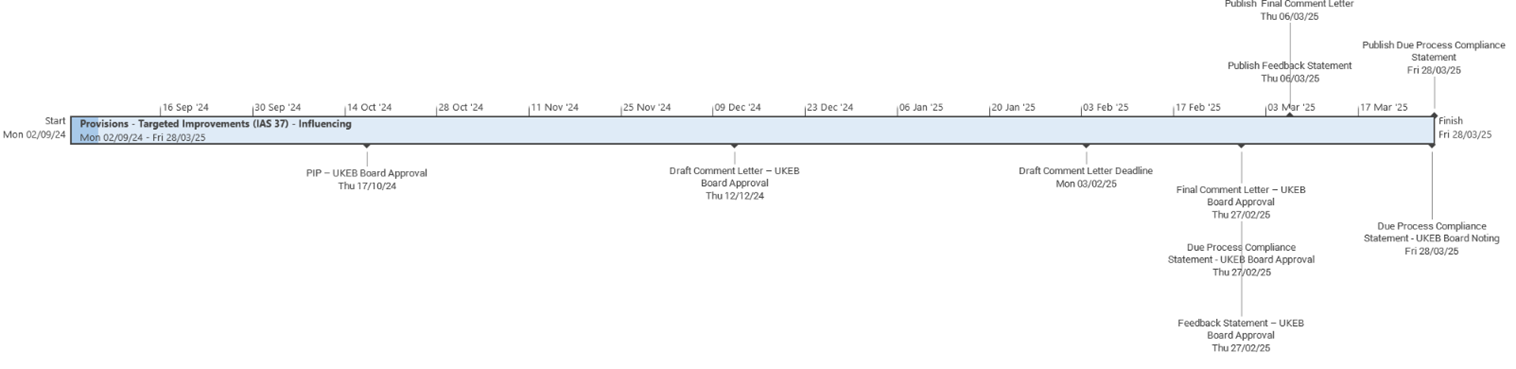
A17The proposed high-level project timeline is shown below. This provides a best estimate based on information known at this time, assuming the publication of the IASB's ED in November 2024. Future dates are based on current expectations and are therefore, subject to subsequent modification. The Board will be alerted to any significant changes.
| Date | Milestone |
|---|---|
| 17 Oct 2024 | Project Initiation Plan for Board approval. |
| November 2024 | IASB publishes Exposure Draft with 120-day comment period. |
| 12 Dec 2024 | Board Education Session. Draft Comment Letter for Board approval. |
| Estimated DCL consultation period (no less than 30 days) - mid-Dec 2024 to early-Feb 2025 | |
| 27 Feb 2025 | Final Comment Letter, Feedback Statement and draft Due Process Compliance Statement for Board approval. |
| March 2025 | Final Comment Letter submitted to IASB. |
| 28 Mar 2025 | Due Process Compliance Statement for noting. |
Provisions – Targeted Improvements – Proposed timeline
A18The diagram below is a graphical view of the content in the table (paragraph A17) above. It provides a best estimate based on information known at this time, assuming the publication of the IASB's ED in November 2024. Future dates are based on current expectations and are, therefore, subject to subsequent modification. The Board will be alerted to any significant changes.
Footnotes
Footnotes
-
Refer to June 2024 IASB General Update - Appendix A: Provisions - Targeted Improvements. ↩
-
Refer to July 2024 IASB General Update - Appendix A: Provisions - Targeted Improvements. ↩
-
No amendments are expected to the requirements in IAS 37 for contingent liabilities and contingent assets. ↩