4 Annual Improvements to IFRS Accounting Standards – Volume 11
17 October 2024 Agenda Paper 4
| Project Type | Endorsement and adoption |
|---|---|
| Project Scope | Narrow-scope |
Purpose of the paper
The purpose of this paper is to:
- Provide the Board with a proposed Project Initiation Plan (PIP) for the project to assess whether to adopt for use in the UK the narrow-scope amendments Annual Improvements to IFRS Accounting Standards—Volume 11 (the Amendments) issued by the IASB in July 2024.
- Obtain Board feedback on the proposed Draft Endorsement Criteria Assessment (DECA) and the proposed Invitation to Comment (ITC) for the Amendments.
- Request the Board's approval to publish the DECA and ITC on the UKEB website for stakeholder consultation with a 90-day comment period.
Summary of the Issue
Project Initiation Plan
The proposed PIP sets out the approach and timeline for the project to assess the amendments against the statutory adoption criteria1. The project plan proposes that the UKEB's endorsement and adoption of the amendments will be completed following the January 2025 Board meeting. This should allow sufficient time for UK entities to be able to use them by the International Accounting Standards Board's (IASB) effective date of 1 January 2026.
UKEB influencing work
The UKEB undertook stakeholder engagement and submitted a comment letter to the IASB in December 2023 on the IASB's Exposure Draft (ED) setting out proposals to clarify the wording in IFRS Standards and correct relatively minor unintended consequences, oversights or conflicts between existing requirements of the Standards2. The UKEB supported the original proposals in the ED with a minor suggestion about future consistency of the disclaimer language across illustrative examples and implementation guidance.
Draft Endorsement Criteria Assessment
During July 2024, the IASB issued the Amendments. While there have been some minor adjustments to the wording, the Amendments are consistent with the proposals in the ED. A summary of the Amendments is provided in the DECA (see Appendix B Section 2).
The purpose of the DECA is to assess whether the Amendments meet the statutory criteria for adoption set out in SI 2019/6853. The DECA includes:
- a description of the UK statutory requirements for adoption of new and amended international accounting standards;
- a description of the Amendments; and
- an assessment of whether the Amendments meet the statutory criteria for adoption.
Decisions for the Board
Subject to addressing any comments raised during the meeting:
- does the Board approve the proposed PIP (Appendix A)?
- does the Board approve the DECA (Appendix B) and ITC (Appendix C) for public consultation with a 90-day comment period?
Recommendations
The Secretariat recommends that the Board:
- approves the proposed PIP (Appendix A); and
- approves the proposed DECA (Appendix B) and ITC (Appendix C).
Appendices
- Appendix A Proposed Project Initiation Plan (PIP)
- Appendix B Proposed Draft Endorsement Criteria Assessment (DECA)
- Appendix C Proposed Invitation to Comment (ITC)
Appendix A: Project Initiation Plan
| Project Type | Endorsement and adoption |
|---|---|
| Project Scope | Narrow-scope |
Purpose
A1This paper sets out the plan to assess whether to adopt for use in the UK1 the narrow-scope amendments Annual Improvements to IFRS Accounting Standards—Volume 11 (the Amendments) issued by the IASB in July 2024. The Amendments either clarify the wording in IFRS Standards or correct relatively minor unintended consequences, oversights or conflicts between existing requirements of the Standards2.
A2The Amendments have an effective date of 1 January 2026, with earlier application permitted (subject to the UKEB endorsement in the UK).
A3The Board actively influenced the development of these Amendments by submitting a comment letter in December 2023 in response to the IASB's Exposure Draft (ED) IASB/AI/ED/2023/1—Annual Improvements to IFRS Accounting Standards—Volume 113.
A4The UKEB's statutory functions mean that it must consider the Amendments against the statutory adoption criteria1 before their formal adoption for use in the UK. The Board's aim would be to ensure adoption is completed in good time to permit UK entities to use the amendments on the IASB mandated effective date of 1 January 2026.
Background
A5The IASB issues amendments to international accounting standards as part of its continuous effort to maintain and improve IFRS Accounting Standards and to support consistent application.
A6The Amendments came from questions submitted by external stakeholders to the IFRS Interpretations Committee. A summary of the Amendments is provided below, Section 2 in DECA provides additional detail.
- Hedge accounting by a first-time adopter (IFRS 1 First-time Adoption of International Financial Reporting Standards)
- To add cross-references to paragraph 6.4.1 of IFRS 9 in paragraphs B5–B6 of IFRS 1; and
- To replace the word 'conditions' with 'qualifying criteria' in paragraph B6 of IFRS 9.
- Gain or loss on derecognition (IFRS 7 Financial Instruments: Disclosures)
- To replace the reference to paragraph 27A of IFRS 7, which no longer exists, with a reference to paragraphs 72–73 of IFRS 13; and
- To replace the phrase 'inputs that were not based on observable market data' with 'unobservable inputs'.
- Transaction price (IFRS 9 Financial Instruments)
- To revise the wording in paragraph 5.1.3 of IFRS 9; and
- To delete the reference to 'transaction price' and the associated references to IFRS 15 from Appendix A.
- Derecognition of lease liabilities (IFRS 9)
- To add a cross-reference to paragraph 3.3.3 of IFRS 9 in paragraph 2.1(b)(ii) of IFRS 9.
- Determination of a 'de facto agent' (IFRS 10 Consolidated Financial Statements)
- To clarify the requirements in paragraph B74 of IFRS 10.
- Cost method (IAS 7 Statement of Cash Flows)
- To replace the term 'cost method', which is no longer defined in IFRS Accounting Standards, with 'at cost'.
- Disclosure of deferred difference between fair value and transaction price (Implementation Guidance accompanying IFRS 7)
- To propose an amendment to paragraph IG14 to improve its consistent with paragraph 28 of IFRS 7 which it illustrates.
- Introduction and credit risk disclosures (Implementation Guidance accompanying IFRS 7)
- To add a statement that the implementation guidance accompanying IFRS 7 does not illustrate all the requirements in IFRS 7 in paragraph IG1 of IFRS 7; and
- To simplify the wording in paragraph IG20B of IFRS 7.
UKEB project scope
A8The UKEB project scope is limited to endorsement and adoption of six Annual Improvements that relate to mandatory sections of UK-adopted international accounting standards.
Description of the Amendments
A9A brief description of the Amendments is shown in the table below.
| Amendments | |
|---|---|
| Issued for public comment | IASB/AI/ED/2023/1—Annual Improvements to IFRS Accounting Standards—Volume 11—issued for public comment in September 2023 (comment period ended on 11 December 2023)3. |
| Amendments | |
|---|---|
| Title and issue date of final amendments | IFRS Accounting Standards Annual Improvements Volume 11 issued on 18 July 20245. |
| Origin | See Background on page 4 of the ED6 and Annex A of the UKEB Project Initiation Plan (PIP) for influencing the ED7 for further detail. |
| What has changed? | See Section 2 of DECA |
| Transition requirements | See Section 2 of DECA |
Project Plan
A10The following factors have been considered when developing the project plan.
The Amendments do not introduce new principles or change existing principles
A11The Amendments are limited to clarification of the wording in specific IFRS Accounting Standards or corrections of relatively minor unintended consequences, oversights or conflicts between existing requirements8. Therefore, the Amendments are not expected to introduce any new principles or change existing principles in the IFRS Accounting Standards.
Change in practice or a material effect on entities' financial statements is not expected
A12Given the Amendments are narrow scope in nature and merely clarify wording or correct minor oversights, no significant change in practice or material effect on entities' financial statements is expected.
The Amendments have been subject to public consultation
A13The Amendments were issued by the IASB for public comment as an Exposure Draft in September 2023. They were considered by the UKEB, and the Board issued a comment letter to the IASB9. The UK stakeholder feedback to the UKEB during the influencing stage was supportive of the Amendments.
A14Generally, feedback to the IASB from UK and international stakeholders, including the UKEB supported the proposals, though some suggested the amendments in paragraph A6d (Derecognition of lease liabilities (IFRS 9)) would benefit from more extensive amendments and therefore should be a narrow-scope standard setting project.
A15In May 2024 the IASB staff circulated to International Forum of Accounting Standard Setters members a draft of the final Amendments10. The UKEB Secretariat reviewed it on a confidential basis and submitted comments to the IASB staff.
A16The final amendments were published by the IASB in July 2024 and are consistent with those in the ED except for minor rewording to some amendments. A summary of the main changes is included in Annex B of this paper.
Proportionality
A17The UKEB Due Process Handbook, paragraph 3.711 notes that “the activities undertaken to achieve the milestones for each project should be proportionate to the significance, urgency, complexity (i.e., nature or scope), size, expected timeline and expected interest or controversy attached to the project".
Significance/size
A18The Amendments are minor in nature but would lead to changes to five different IFRS Accounting Standards. Therefore they are expected to be relevant to many entities using IFRS Accounting Standards.
Complexity
A19The Amendments are not technically complex. The focus of these amendments is to clarify the wording in an IFRS Accounting Standard or correct relatively minor unintended consequences, oversights or conflicts between existing requirements of the Standards.
Expected timeline/urgency
A20The effective date of the Amendments is annual reporting periods beginning on or after 1 January 2026, with earlier application permitted. The Amendments are minor in nature and can easily be accommodated by preparers as part of their annual consolidation packages. Therefore, no particular urgency for the endorsement is indicated.
Expected interest/sensitivity
A21During the UKEB influencing stage UK stakeholder feedback was supportive of the proposals and no significant concerns were identified.
Implication for project plan
A22Based on the considerations described in paragraphs A11–A21, a 'limited' project scope is proposed. The plan proposes public consultation on a Draft Endorsement Criteria Assessment (DECA) and limited outreach to the Accounting Firms and Institutes Advisory Group (AFIAG), Investor Advisory Group (IAG) and Preparer Advisory Group (PAG). No additional outreach is planned.
Research and plan for outreach
A23Desk-based research from the influencing stage and the analysis of the comment letters received by the IASB were used to inform the development of the PIP.
A24Considering the factors outlined above, the Secretariat plans to conduct limited outreach for the development of DECA, in line with the UKEB Due Process Handbook.
Paragraph 6.21 of the UKEB Due Process Handbook:
"As a minimum, Regulation 8 of SI 2019/685 requires the UKEB to consult with a representative range of stakeholders before adopting an international accounting standard. Publication of the DECA on the UKEB website and notifying UK stakeholders is expected to be sufficient in the following situations:
- When amendments to international accounting standards are minor and meet the criteria for annual improvements or for narrow-scope amendments."
A25In view of the assessment in paragraphs A11–A22, the Secretariat propose the following outreach after DECA publication:
- announcement of DECA consultation through the usual channels; and
- include information on the DECA as an item for noting with the UKEB PAG, IAG and AFIAG.
Project milestones
A26In line with the proposed proportionate approach, the table below provides a brief description of the work focused on the mandatory milestones listed in paragraph 6.11 of the UKEB Due Process Handbook.
| Proposed activity | Due Process Handbook reference |
|---|---|
| The project was added to UKEB technical work plan. | Handbook 4.30(d) |
| An education session is not proposed as the Board has been informed about the development of the Amendments.12 | Handbook 4.10(b) |
| Creation of a Project Initiation Plan (this document) | Handbook 6.12–6.16 |
| Desk-based research, including: • The IASB's work on the Amendments (mainly staff papers, ED feedback) and the Basis of Conclusions • Comment letters to the IASB on the ED from UK stakeholders • Previous work done by the UKEB (desk-based research and comment letters on our draft comment letter) • Relevant material produced by other parties, including accounting firms |
Handbook 6.17 |
Publication of a Draft Endorsement Criteria Assessment (DECA) for public consultation.
|
Handbook 6.23–6.28 |
| Stakeholder outreach • Publish DECA for stakeholder comment on the UKEB website. • Notify UKEB Advisory groups of the DECA publication, as appropriate (ongoing during the DECA comment period). |
Handbook 6.18–6.22 |
| Creation of an adoption package including the Final ECA, Adoption Statement, Feedback Statement and Due Process Compliance Statement. | Handbook 6.30–6.48 |
| Publication of required documents on the UKEB website. |
Resources allocated
A27On the basis of this project plan, the project team consists of one Project Manager with oversight from a Project Director to ensure the project timelines are achievable. The required resources are allowed for in the 2024/25 UKEB plan and budget.
A28In addition, some input from the economics team has been used in developing the contents of the economic impact assessment.
Setting-up an ad-hoc advisory group is not necessary
A29Given the narrow-scope nature of the Amendments and stakeholder feedback received during the influencing stage, it is not considered necessary to set up a separate, ad-hoc advisory group specific for this project.
Project timeline
Endorsement and adoption stage
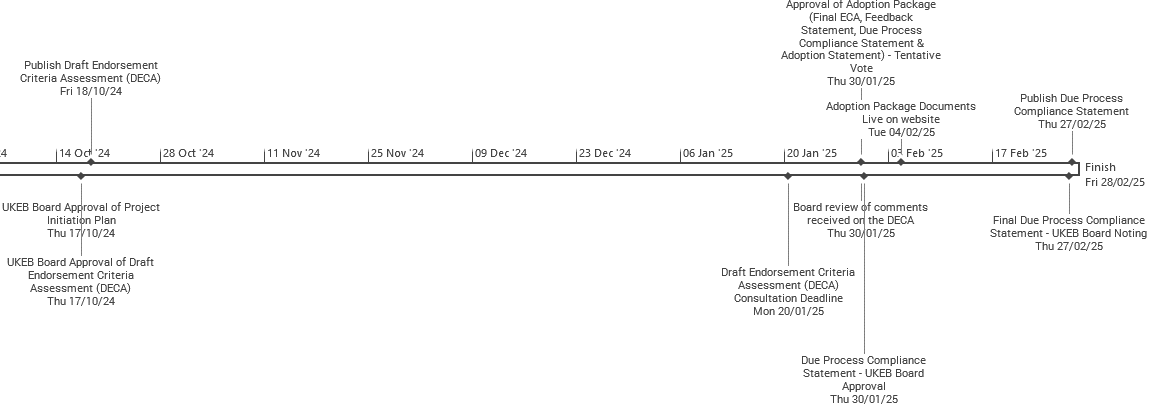
A30The proposed high-level project timeline is as follows:
| Date | Milestones |
|---|---|
| 17 October 2024 | Presentation of PIP and DECA for approval |
| DECA consultation period (90 days): 18 October 2024 – 17 January 2025* | |
| 30 January 2025 | Board review of comments received on the DECA |
| Consideration of Adoption Package | |
| Early February 2025 | Board members provide a tentative vote |
| Voting form is sent to Board members | |
| Mid-February 2025 | Publication of voting outcome and Adoption Package on the UKEB website |
| 27 February 2025 | Due Process Compliance Statement for noting |
| 1 January 2026 | Effective date of the Amendments |
| To be confirmed |
Annex A: Proposed timeline
Annex B: Illustration of changes post ED publication
The below table illustrates the changes to the mandatory amendments subsequent to the publication of the ED. This has been prepared based on the IASB's final amendments issued on 18 July 2024.
| Proposals in the ED | Stakeholder feedback | Final amendments
(The changes are highlighted) |-----------------------------------------------------------------------------------------------------------------------------------------------------------------------------------------------------------------------------------------------------------------------------------------------------------------------------------------------------------------------------------------------------------------------------------------------------------------------------------------------------------------------------------------------------------------------------------------------------------------------------------------------------------------------------------------------------------------------------------------------------------------------------------------------------------------------------------------------------------------------------------------------------------------------------------------------------------------------------------------------------------------------------------------------------------------------------------------------------------------------------------------------------------------------------------------------------------------------------------------------------------------------------------------------------------------------------------------------------------------------------------------------------------------------------------------------------------------------------------------------------------------------------------------------------------------------------------------------------------------------------------------------------------------------------------------------------------------------------------------------------------------------------------------------------------------------------------------------------------------------------------------------------------------------------------------------------------------------------------------------------------------------------------------------------------------------------------------------------------------------------------------------------------------------------------------------------------------------------------------------------------------------------------------------------------------------------------------------------------------------------------------------------------------------------------------------------------------------------------------------------------------------------------------------------------------------------------------------------------------------------------------------------------------------------------------------------------------------------------------------------------------------------------------------------------------------------------------------------------------------------------------------------------------------------------------------------------------------------------------------------------------------------------------------------------------------------------------------------------------------------------------------------------------------------------------------------------------------------------------------------------------------------------------------------------------------------------------------------------------------------------------------------------------------------------------------------------------------------------------------------------------------------------------------------------------------------------------------------------------------------------------------------------------------------------------------------------------------------------------------------------------------------------------------------------------------------------------------------------------------------------------------------------------------------------------------------------------------------------------------------------------------------------------------------------------------------------------------------------------------------------------------------------------------------------------------------------------------------------------------------------------------------------------------------------------------------------------------------------------------------------------------------------------------------------------------------------------------------------------------------------------------------------------------------------------------------------------------------------------------------------------------------------------------------------------------------------------------------------------------------------------------------------------------------------------------------------------------------------------------------------------------------------------------------------------------------------------------------------------------------------------------------------------------------------------------------------------------------------------------------------------------------------------------------------------------------------------------------------------------------------------------------------------------------------------------------------------------------------------------------------------------------------------------------------------------------------------------------------------------------------------------------------------------------------------------------------------------------------------------------------------------------------------------------------------------------------------------------------------------------------------------------------------------------------------------------------------------------------------------------------------------------------------------------------------------------------------------------------------------------------------------------------------------------------------------------------------------------------------------------------------------------------------------------------------------------------------------------------------------------------------------------------------------------------------------------------------------------------------------------------------------------------------------------------------------------------------------------------------------------------------------------------------------------------------------------------------------------------------------------------------------------------------------------------------------------------------------------------------------------------------------------------------------------------------------------------------------------------------------------------------------------------------------------------------------------------------------------------------------------------------------------------------------------------------------------------------------------------------------------------------------------------------------------------------------------------------------------------------------------------------------------------------------------------------------------------------------------------------------------------------------------------------------------------------------------------------------------------------------------------------------------------------------------------------------------------------------------------------------------------------------------------------------------------------------------------------------------------------------------------------------------------------------------------------------------------------------------------------------------------------------------------------------------------------------------------------------------------------------------------------------------------------------------------------------------------------------------------------------------------------------------------------------------------------------------------------------------------------------------------------------------------------------------------------------------------------------------------------------------------------------------------------------------------------------------------------------------------------------------------------------------------------------------------------------------------------------------------------------------------------------------------------------------------------------------------------------------------------------------------------------------------------------------------------------------------------------------------------------------------------------------------------------------------------------------------------------------------------------------------------------------------------------------------------------------------------------------------------------------------------------------------------------------------------------------------------------------------------------------------------------------------------------------------------------------------------------------------------------------------------------------------------------------------------------------------------------------------------------------------------------------------------------------------------------------------------------------------------------------------------------------------------------------------------------------------------------------------------------------------------------------------------------------------------------------------------------------------------------------------------------------------------------------------------------------------------------------------------------------------------------------------------------------------------------------------------------------------------------------------------------------------------------------------------------------------------------------------------------------------------------------------------------------------------------------------------------------------------------------------------------------------------------------------------------------------------------------------------------------------------------------------------------------------------------------------------------------------------------------------------------------------------------------------------------------------------------------------------------------------------------------------------------------------------------------------------------------------------------------------------------------------------------------------------------------------------------------------------------------------------------------------------------------------------------------------------------------------------------------------------------------------------------------------------------------------------------------------------------------------------------------------------------------------------------------------------------------------------------------------------------------------------------------------------------------------------------------------------------------------------------------------------------------------------------------------------------------------------------------------------------------------------------------------------------------------------------------------------------------------------------------------------------------------------------------------------------------------------------------------------------------------------------------------------------------------------------------------------------------------------------------------------------------------------------------------------------------------------------------------------------------------------------------------------------------------------------------------------------------------------------------------------------------------------------------------------------------------------------------------------------------------------------------------------------------------------------------------------------------------------------------------------------------------------------------------------------------------------------------------------------------------------------------------------------------------------------------------------------------------------------------------------------------------------------------------------------------------------------------------------------------------------------------------------------------------------------------------------------------------------------------------------------------------------------------------------------------------------------------------------------------------------------------------------------------------------------------------------------------------------------------------------------------------------------------------------------------------------------------------------------------------------------------------------------------------------------------------------------------------------------------------------------------------------------------------------------------------------------------------------------------------------------------------------------------------------------------------------------------------------------------------------------------------------------------------------------------------------------------------------------------------------------------------------------------------------------------------------------------------------------------------------------------------------------------------------------------------------------------------------------------------------------------------------------------------------------------------------------------------------------------------------------------------------------------------------------------------------------------------------------------------------------------------------------------------------------------------------------------------------------------------------------------------------------------------------------------------------------------------------------------------------------------------------------------------------------------------------------------------------------------------------------------------------------------------------------------------------------------------------------------------------------------------------------------------------------------------------------------------------------------------------------------------------------------------------------------------------------------------------------------------------------------------------------------------------------------------------------------------------------------------------------------------------------------------------------------------------------------------------------------------------------------------------------------------------------------------------------------------------------------------------------------------------------------------------------------------------------------------------------------------------------------------------------------------------------------------------------------------------------------------------------------------------------------------------------------------------------------------------------------------------------------------------------------------------------------------------------------------------------------------------------------------------------------------------------------------------------------------------------------------------------------------------------------------------------------------------------------------------------------------------------------------------------------------------------------------------------------------------------------------------------------------------------------------------------------------------------------------------------------------------------------------------------------------------------------------------------------------------------------------------------------------------------------------------------------------------------------------------------------------------------------------------------------------------------------------------------------------------------------------------------------------------------------------------------------------------------------------------------------------------------------------------------------------------------------------------------------------------------------------------------------------------------------------------------------------------------------------------------------------------------------------------------------------------------------------------------------------------------------------------------------------------------------------------------------------------------------------------------------------------------------------------------------------------------------------------------------------------------------------------------------------------------------------------------------------------------------------------------------------------------------------------------------------------------------------------------------------------------------------------------------------------------------------------------------------------------------------------------------------------------------------------------------------------------------------------------------------------------------------------------------------------------------------------------------------------------------------------------------------------------------------------------------------------------------------------------------------------------------------------------------------------------------------------------------------------------------------------------------------------------------------------------------------------------------------------------------------------------------------------------------------------------------------------------------------------------------------------------------------------------------------------------------------------------------------------------------------------------------------------------------------------------------------------------------------------------------------------------------------------------------------------------------------------------------------------------------------------------------------------------------------------------------------------------------------------------------------------------------------------------------------------------------------------------------------------------------------------------------------------------------------------------------------------------------------------------------------------------------------------------------------------------------------------------------------------------------------------------------------------------------------------------------------------------------------------------------------------------------------------------------------------------------------------------------------------------------------------------------------------------------------------------------------------------------------------------------------------------------------------------------------------------------------------------------------------------------------------------------------------------------------------------------------------------------------------------------------------------------------------------------------------------------------------------------------------------------------------------------------------------------------------------------------------------------------------------------------------------------------------------------------------------------------------------------------------------------------------------------------------------------------------------------------------------------------------------------------------------------------------------------------------------------------------------------------------------------------------------------------------------------------------------------------------------------------------------------------------------------------------------------------------------------------------------------------------------------------------------------------------------------------------------------------------------------------------------------------------------------------------------------------------------------------------------------------------------------------------------------------------------------------------------------------------------------------------------------------------------------------------------------------
| EXECUTIVE SUMMARY | | |
| Annual improvements to IFRS Accounting Standards—Volume 11: Project Initiation Plan and Draft Endorsement Criteria Assessment | | |--------------------|:-------------------|
| Status | Final | |
| Reviewers | S. Williams, N. Hussain, R. Jones, L. Kim, M. Johnson | |
| Due Date | | |
| Owner | Senior Project Manager | |
Executive Summary
The UK Endorsement Board (UKEB) is actively working on the endorsement of Annual Improvements to IFRS Accounting Standards—Volume
- This document, the Project Initiation Plan (PIP), outlines the proposed approach and timeline for assessing the amendments against the statutory adoption criteria.
The amendments, issued by the International Accounting Standards Board (IASB) in July 2024, are narrow in scope, primarily clarifying wording or correcting minor oversights in existing IFRS Standards. They are not expected to introduce new principles or materially change entities' financial statements.
Key aspects of this plan include:
- Public Consultation: The Board will seek feedback on a Draft Endorsement Criteria Assessment (DECA) and an Invitation to Comment (ITC) with a 90-day comment period.
- Stakeholder Engagement: Limited outreach will be conducted with key advisory groups, given the narrow scope of the amendments.
- Timeline: The endorsement and adoption process is expected to be completed following the January 2025 Board meeting, allowing UK entities to apply the amendments by the IASB's effective date of 1 January 2026.
- Resources: The project will be managed by a dedicated project team, with input from the economics team for the economic impact assessment. An ad-hoc advisory group is not deemed necessary.
This document covers the details of the project plan, the nature of the amendments, the proposed consultation process, and the anticipated timeline, concluding with a detailed illustration of changes post-exposure draft publication.
Footnotes:
| Proposals in the ED | Stakeholder feedback | Final amendments (The changes are highlighted) |
|---|---|---|
| minor point (Paragraph 13 of November 2023 AFIAG meeting summary). | ||
| Determination of a 'de facto agent' (IFRS 10) | ||
| The proposed amendments to IFRS 10 are to address the inconsistency between paragraphs B73 and B74 by clarifying the requirements in paragraph B74 so that both paragraphs allow room for judgement on the determination of a 'de facto' agency relationship. | Almost all respondents agreed with the proposed amendments. Consistent with the UKEB’s position15, some respondents identified a wider issue on the determination of a 'de facto agent'. These respondents suggested the IASB to undertake a separate project on this16. | B74 Such a relationship need not involve a contractual arrangement. A party is a de facto agent when the investor has, or those that direct the activities of the investor have, the ability to direct that party to act on the investor’s behalf. A party might also be a de facto agent when those that direct the activities of the investor have the ability to direct that party to act on the investor’s behalf. The In these circumstances, the investor shall consider its de facto agent’s decision-making rights and its indirect exposure, or rights, to variable returns through the de facto agent together with its own when assessing control of an investee. |
| Cost method (IAS 7) | ||
| The proposed amendment to IAS 7 is to replace the term 'cost method', which is no longer defined in IFRS Accounting Standards, with the term 'at cost' in paragraph 37 of IAS 7. | All respondents agreed with the proposed amendments. | No change was made to the amendments. |
The UKEB does not accept any liability to any party for any loss, damage or costs howsoever arising, whether directly or indirectly, whether in contract, tort or otherwise from any action or decision taken (or not taken) as a result of any person relying on or otherwise using this document or arising from any omission from it.
© 2024 All Rights Reserved
- Purpose of the paper
- Summary of the Issue
- Decisions for the Board
- Recommendations
- Appendices
- Appendix A: Project Initiation Plan
- Annex A: Proposed timeline
- Annex B: Illustration of changes post ED publication
- Executive Summary
- Introduction
- Section 1: UK statutory requirements for adoption
- Section 2: Description and assessment of the Amendments
- A) Hedge accounting by a first-time adopter (Amendments to IFRS 1)
- B) Gain or loss on derecognition (Amendments to IFRS 7)
- C) Derecognition of lease liabilities (Amendments to IFRS 9)
- D) Transaction price (Amendments to IFRS 9)
- E) Determination of a 'de facto agent' (Amendments to IFRS 10)
- F) Cost method (Amendments to IAS 7)
- Do the Amendments lead to a significant change in accounting practice?
- Appendix A: Glossary
- Appendix C: Invitation to Comment
- Call for comments on Draft Endorsement Criteria Assessment of Annual Improvements to IFRS Accounting Standards–Volume 11
- Introduction
- UK endorsement and adoption process
- Who should respond to this Invitation to Comment?
- How to respond to this Invitation to Comment
- Privacy and other policies
- Assessment against endorsement criteria
- Question
- Technical accounting criteria assessment
- True and fair view
- UK long term public good
Introduction
Purpose
1The purpose of this Draft Endorsement Criteria Assessment (DECA) is to determine whether Annual Improvements to IFRS Accounting Standards—Volume 11 (the Amendments), issued by the International Accounting Standards Board (IASB) in July 2023, meet the UK’s statutory requirements for adoption as set out in Regulation 7 of Statutory Instrument 2019/6851 (SI 2019/685).
2The Amendments have an effective date of 1 January 2026 with earlier application permitted.
3The UKEB actively influenced the development of the Amendments. This included submitting a Final Comment Letter on 14 December 20232 in response to the IASB’s Exposure Draft (ED) IASB/AI/ED/2023/13 Annual Improvements to IFRS Accounting Standards—Volume 11.
Background to the Amendments
4The IASB issues amendments to international accounting standards as part of its continuous effort to maintain and improve IFRS Standards and to support consistent application.
5The Amendments originate from questions submitted by external stakeholders to the IFRS Interpretations Committee4. The Amendments to mandatory sections of UK-adopted international accounting standards are listed below:
- Hedge accounting by a first-time adopter (Amendments to IFRS 1 First-time Adoption of International Financial Reporting Standards)
- Gain or loss on derecognition (Amendments to IFRS 7 Financial Instruments: Disclosures)
- Transaction price (Amendments to IFRS 9 Financial Instruments)
- Derecognition of lease liabilities (Amendments to IFRS 9)
- Determination of a ‘de facto agent’ (Amendments to IFRS 10 Consolidated Financial Statements)
- Cost method (Amendments to IAS 7 Statement of Cash Flows)
6Section 2 and Annex A in this DECA provides a brief description of the Amendments.
Scope of the adoption assessment
7The scope of the adoption assessment is limited to endorsement and adoption of six Annual Improvements that relate to mandatory sections of UK-adopted international accounting standards.
8As UK-adopted international accounting standards comprise only the mandatory7 sections of standards, two additional amendments to the Illustrative Examples, Implementation Guidance and Basis for Conclusions of the IFRS Accounting Standards5 are not adopted by the Board and are not considered in this DECA.
Structure of the assessment
9The UKEB’s analysis is presented in the following sections:
- Section 1: describes UK statutory requirements for adoption of new or amended international accounting standards; and
- Section 2: discusses how the Amendments meet the criteria in Section 1.
Do the Amendments lead to a significant change in accounting practice?
10A standard adopted by the UKEB under Regulation 6 of SI 2019/685 that it considers is likely to lead to a ‘significant change in accounting practice’, is subject to the requirements in paragraph 3 of Regulation 11 of SI 2019/685 that the UKEB:
- carry out a review of the impact of the adoption of the standard; and
- publish a report setting out the conclusions of the review no later than 5 years after the date on which the standard takes effect (being the first day of the first financial year in respect of which it must be used)”.
11Section 2 of the DECA discusses whether the Amendments lead to a significant change in accounting practice and, subject to any stakeholder feedback, [tentatively] concludes that they do not.
Section 1: UK statutory requirements for adoption
UK statutory requirements
1.1Paragraph 1 of Regulation 7 of SI 2019/685 requires that an international accounting standard only be adopted if:
- the standard8 is not contrary to either of the following principles—
- an undertaking’s accounts must give a true and fair view of the undertaking’s assets, liabilities, financial position and profit or loss;
- consolidated accounts must give a true and fair view of the assets, liabilities, financial position and profit or loss of the undertakings included in the accounts taken as a whole, so far as concerns members of the undertaking;
- the use of the standard is likely to be conducive to the long term public good in the United Kingdom; and
- the standard meets the criteria of understandability, relevance, reliability and comparability required of the financial information needed for making economic decisions and assessing the stewardship of management.”
1.2This DECA assesses the criteria above in the following order:
- Whether the Amendments meet the criteria of relevance, reliability, understandability and comparability required of the financial information needed for making economic decisions and assessing the stewardship of management (Regulation 7(1)(c)).
- Whether the Amendments are not contrary to the principle that an entity’s accounts must give a true and fair view (Regulation 7(1)(a)).
- Whether use of the Amendments is likely to be conducive to the long term public good in the UK (Regulation 7(1)(b)). Regulation 7(2) of SI 2019/685 includes specific areas to consider for this assessment. They are:
- whether the Amendments are likely to improve the quality of financial reporting;
- the costs9 and benefits that are likely to result from the use of the Amendments; and
- whether the Amendments are likely to have an adverse effect on the economy of the UK, including on economic growth.
Relevance, Reliability, Understandability and Comparability10
1.3Information is relevant if it is capable of making a difference in the decision-making of users11 or in their assessment of the stewardship of management. The information may aid predictions of the future, confirm or change evaluations of the past, or both.
1.4Financial information is reliable if, within the bounds of materiality, it:
- can be depended on by users to represent faithfully what it either purports to represent or could reasonably be expected to represent;
- is complete; and
- is free from material error and bias.
1.5Financial information should be readily understandable by users with a reasonable knowledge of business and economic activities and accounting, and a willingness to study the information with reasonable diligence.
1.6Information is comparable if it enables users to identify and understand similarities in, and differences among, items. Information about an entity should be comparable with similar information about other entities and with similar information about the same entity for another period.
1.7In conducting the overall assessment against the technical accounting criteria, the UKEB is required to adopt an absolute, rather than a relative, approach. This means that this assessment is an absolute one against the criteria (do the Amendments provide information that is understandable, relevant, reliable and comparable?) rather than a relative one (do the Amendments provide information that is more understandable, relevant, reliable and comparable than current, or any other, accounting?). When an assessment of any individual aspect or requirement of the Amendments uses comparative language (e.g. ‘enhances comparability’), this does not mean that the objective is to reflect a real comparison in relative terms. Instead, the objective is to explain that any individual aspect or requirement of the Amendments has the potential to “enhance” one or more of the qualitative characteristics. Consideration of whether the Amendments are likely to improve the quality of financial reporting is separate from this assessment and is included within the UK long term public good assessment in Section 2.
True and fair view assessment
1.8As noted above, the first adoption criterion set out in Regulation 7(1) of SI 2019/685 requires that an international accounting standard can be adopted only if:
“[....] the standard is not contrary to either of the following principles—
- an undertaking’s accounts must give a true and fair view of the undertaking’s assets, liabilities, financial position and profit or loss;
- consolidated accounts must give a true and fair view of the assets, liabilities, financial position and profit or loss of the undertakings included in the accounts taken as a whole, so far as concerns members of the undertaking; [....]”
1.9For the sake of brevity, the UKEB refers to the assessment against this endorsement criterion as ‘the true and fair view assessment’ and to the principles set out in Regulation 7(1)(a) as the ‘true and fair principle’. However, these abbreviated expressions do not imply that the assessment has considered anything other than the full terms of the endorsement criterion set out above.
1.10The duty of the UKEB under Regulation 7(1)(a) is to determine generically, before a standard is applied to a set of accounts, whether that standard is ‘not contrary’ to the true and fair principle. In other words, it is an ex-ante assessment. The UKEB has therefore considered whether the Amendments contain any requirement that would prevent accounts prepared using the Amendments from giving a true and fair view.
1.11The approach is to determine whether the Amendments are not contrary to the true and fair principle in respect of any of the specific items identified in Regulation 7(1)(a) (namely, the assets, liabilities, financial position and profit or loss) in the context of the preparation of the accounts as a whole. A holistic approach has been taken to this assessment, considering the impact of the Amendments taken as a whole, including their interaction with other UK-adopted international accounting standards.
1.12For the purposes of the assessment, the UKEB considers the requirement in IAS 1 Presentation of Financial Statements for financial statements to ‘present fairly the financial position, financial performance and cash flows of an entity’12 to be equivalent to the Companies Act 2006 requirement for accounts to give a true and fair view.
1.13This assessment is separate from the duty of directors under section 393(1) of the Companies Act 2006, which requires directors to be satisfied that a specific set of accounts gives a true and fair view of an undertaking’s or group’s assets, liabilities, financial position and profit or loss.
[Draft Adoption decision]
1.14[Section 2 of this DECA discusses how the Amendments meet the statutory endorsement criteria set out in this Section 1.
1.15On the basis of these assessments, and subject to any stakeholder feedback, the UKEB [tentatively] concludes that each of the six Amendments meet the statutory endorsement criteria. The UKEB is therefore of the view that it will adopt each of the six Amendments for use in the UK.]
Section 2: Description and assessment of the Amendments
| Amendments | Page |
|---|---|
| A) Hedge accounting by a first-time adopter (Amendments to IFRS 1) | 12–14 |
| B) Gain or loss on derecognition (Amendments to IFRS 7) | 15–18 |
| C) Derecognition of lease liabilities (Amendments to IFRS 9) | 19–22 |
| D) Transaction price (Amendments to IFRS 9) | 23–25 |
| E) Determination of a 'de facto agent' (Amendments to IFRS 10) | 26–28 |
| F) Cost method (Amendments to IAS 7) | 29–31 |
A) Hedge accounting by a first-time adopter (Amendments to IFRS 1)
| Title and issue date of final amendments | IFRS Accounting Standards Annual Improvements Volume 11 issued on 18 July 202413–Hedge accounting by a first-time adopter |
|---|---|
| Origin | The IASB was informed of potential confusion arising from an inconsistency in wording between paragraph B6 of IFRS 1 First-time Adoption of International Financial Reporting Standards and the requirements for hedge accounting in IFRS 9 Financial Instruments. |
| What has changed? | The Amendments to IFRS 1:
|
| Transition requirements | An entity shall apply the amendments for annual reporting periods beginning on or after 1 January 2026. If an entity applies the Amendments for an earlier period, it shall disclose that fact. |
| Technical criteria assessment | |
| Relevance, reliability, understandability and comparability | Paragraphs B5–B6 of IFRS 1 were originally written to be consistent with the requirements for hedge accounting in IAS 39 Financial Instruments: Recognition and Measurement. In particular, the use of the word ‘conditions’ in paragraph B6 is consistent with paragraph 88 of IAS 39. First-time adopters of IFRS Accounting Standards do not have an option to apply the hedge accounting requirements in IAS 39 and only apply IFRS 9. Replacing the word ‘conditions’ with ‘qualifying criteria’ ensures the wording in paragraph B6 of IFRS 1 uses terminology consistent with paragraph 6.4.1 of IFRS 9, thus improving understandability. Further, the addition of the cross-references to IFRS 9 is expected to avoid unintended consequences by clarifying that paragraph B5 of IFRS 1 sets out the ‘eligibility’ of hedge accounting while paragraph B6 of IFRS 1 sets out other ‘qualifying criteria’ of hedge accounting. This is expected to ensure consistent application of the requirements and therefore the comparability of the resulting information in the financial statements. |
| Conclusion | Overall, the UKEB concludes that the Amendments meet the criteria of relevance, reliability, understandability, and comparability required of the financial information needed for making economic decisions and assessing the stewardship of management, as required by Regulation 7(1)(c) of SI 2019/685. |
| True and fair view assessment | |
| Description | The Amendments clarify the wording and requirements in the IFRS Accounting Standards. As discussed above, the Amendments are expected to meet the relevance, reliability, understandability, and comparability of financial information. Reliability includes the notion of faithful representation of the economic substance of transactions and events. The technical accounting criteria assessment underpins the overall true and fair view assessment. |
| Conclusion | The assessment has not identified any requirement of the Amendments, either alone or in conjunction with international accounting standards adopted for use in the UK, that would prevent individual or group accounts prepared using the Amendments from giving a true and fair view of the undertaking’s or group’s assets, liabilities, financial position and profit or loss. The UKEB is satisfied, therefore, that the circumstances in which the application of the Amendments would result in accounts which did not give a true and fair view would be extremely rare. Overall, the UKEB concludes that the Amendments are not contrary to the true and fair view principle set out in Regulation 7(1)(a) of SI 2019/685. |
| UK long term public good | |
| Description of entities that will be impacted | The Amendments to IFRS 1 are only relevant to the very few UK companies that are first-time adopters of IFRS Accounting Standards. Further, the Amendments merely clarify the wording and the requirements in paragraphs B5–B6 of IFRS 1. Therefore, the UKEB does not expect UK companies to be materially affected. |
| Do the amendments improve financial reporting? | The Amendments provide an improvement in financial reporting by clarifying the wording and requirements in the IFRS Accounting Standards. As discussed above in the technical accounting criteria assessment, these Amendments are expected to meet the relevance, reliability, understandability, and comparability of financial information. Given this, it is expected that the Amendments will improve financial reporting. |
| Costs and benefits for preparers and users | Costs and benefits for preparers: Given that the Amendments are merely clarifying narrowly focused requirements in IFRS 1 for first-time adopters of the IFRS Accounting Standards, the UKEB believes that most preparers are not expected to be impacted. For first time adopters, the Amendments are not additive, they are simply expected to provide greater clarity with clearer language and make it easier for preparers to navigate the requirements through the updated cross-references. Therefore, the Amendments are not expected to generate any significant additional costs. Costs and benefits for users: The Amendments are not expected to have a material effect on the financial statements of the very few entities that are likely to be in scope. Therefore, the users are not expected to face material costs to adapt their ways of using the information in the financial statements. |
| Whether the amendments are likely to have an adverse effect on UK economy | The Amendments are narrow in scope and expected to bring improved financial reporting when compared to current standards. More specifically, the Amendments are expected to clarify the wording and enhance the cross-references in the IFRS Accounting Standards therefore leading to comparable and better information in the financial statements. The UKEB has not identified any factors that would indicate that these Amendments would lead to changes that are detrimental to the UK economy. |
| Conclusion | Having considered all relevant aspects, including the trade-off between the costs and benefits of implementing the Amendments jointly, the UKEB concludes that the use of the Amendments is likely to be conducive to the long term public good in the UK as required by Regulation 7(1)(b) of SI 2019/685. |
| A) Hedge accounting by a first-time adopter (Amendments to IFRS 1) | |
|---|---|
| financial information. Given this, it is expected that the Amendments will improve financial reporting. | |
| Costs and benefits for preparers and users | Costs and benefits for preparers: Given that the Amendments are merely clarifying narrowly focused requirements in IFRS 1 for first-time adopters of the IFRS Accounting Standards, the UKEB believes that most preparers are not expected to be impacted. For first time adopters, the Amendments are not additive, they are simply expected to provide greater clarity with clearer language and make it easier for preparers to navigate the requirements through the updated cross-references. Therefore, the Amendments are not expected to generate any significant additional costs. Costs and benefits for users: The Amendments are not expected to have a material effect on the financial statements of the very few entities that are likely to be in scope. Therefore, the users are not expected to face material costs to adapt their ways of using the information in the financial statements. |
| Whether the amendments are likely to have an adverse effect on UK economy | The Amendments are narrow in scope and expected to bring improved financial reporting when compared to current standards. More specifically, the Amendments are expected to clarify the wording and enhance the cross-references in the IFRS Accounting Standards therefore leading to comparable and better information in the financial statements. The UKEB has not identified any factors that would indicate that these Amendments would lead to changes that are detrimental to the UK economy. |
| Conclusion | Having considered all relevant aspects, including the trade-off between the costs and benefits of implementing the Amendments jointly, the UKEB concludes that the use of the Amendments is likely to be conducive to the long term public good in the UK as required by Regulation 7(1)(b) of SI 2019/685. |
B) Gain or loss on derecognition (Amendments to IFRS 7)
| B) Gain or loss on derecognition (Amendments to IFRS 7) | |
|---|---|
| Title and issue date of final amendments | IFRS Accounting Standards Annual Improvements Volume 11 issued on 18 July 202414–Gain or loss on derecognition |
| Origin | The IASB was informed of potential confusion in paragraph B38 of IFRS 7 Financial Instruments: Disclosures arising from the reference to a paragraph that has been deleted from the IFRS Accounting Standard (paragraph 27A). |
| What has changed? | The Amendments to IFRS 7: • correct a minor oversight by replacing the reference to paragraph 27A of IFRS 7, which no longer exists, with a reference to paragraphs 72-73 of IFRS 13; and • clarify the wording by replacing the phrase ‘inputs that were not based on observable market data’ with ‘unobservable inputs’. |
| Transition requirements | An entity shall apply the amendments for annual reporting periods beginning on or after 1 January 2026. If an entity applies the Amendments for an earlier period, it shall disclose that fact. |
Technical criteria assessment
| Technical criteria assessment | |
|---|---|
| Relevance, reliability, understandability and comparability | The Amendments replace the reference to paragraph 27A of IFRS 7, a paragraph that no longer exists, with a reference to paragraphs 72-73 of IFRS 13 Fair Value Measurement. The current reference to paragraph 27A is from an oversight during issuance of IFRS 13 in May 2011 when no consequential amendment was made to paragraph B38 of IFRS 7. The Amendments also replace the phrase 'inputs that were not based on observable market data' with 'unobservable inputs' in paragraph B38 of IFRS 7. The term 'unobservable inputs' is a defined term in IFRS 13 and well understood by the stakeholders. The removal of the obsolete cross-reference and the revised wording are expected to ensure understandability of the requirements and consistent implementation of the requirements leading to reliable and comparable information in the financial statements. |
| B) Gain or loss on derecognition (Amendments to IFRS 7) | |
|---|---|
| Conclusion | Overall, the UKEB concludes that the Amendments meet the criteria of relevance, reliability, understandability, and comparability required of the financial information needed for making economic decisions and assessing the stewardship of management, as required by Regulation 7(1)(c) of SI 2019/685. |
True and fair view assessment
| True and fair view assessment | |
|---|---|
| Description | The Amendments: a) correct a minor oversight between existing requirements of the IFRS Accounting Standards; and b) clarify the wording in the IFRS Accounting Standards. As discussed above, the Amendments are expected to meet the relevance, reliability, understandability, and comparability of financial information. Reliability includes the notion of faithful representation of the economic substance of transactions and events. The technical accounting criteria assessment underpins the overall true and fair view assessment. |
| Conclusion | The assessment has not identified any requirement of the Amendments, either alone or in conjunction with international accounting standards adopted for use in the UK, that would prevent individual or group accounts prepared using the Amendments from giving a true and fair view of the undertaking's or group's assets, liabilities, financial position and profit or loss. The UKEB is satisfied, therefore, that the circumstances in which the application of the Amendments would result in accounts which did not give a true and fair view would be extremely rare. Overall, the UKEB concludes that the Amendments are not contrary to the true and fair view principle set out in Regulation 7(1)(a) of SI 2019/685. |
UK long term public good
| UK long term public good | |
|---|---|
| Description of entities that will be impacted | The Amendments to IFRS 7 could be relevant to a wide range of stakeholders. However, the Amendments merely correct a minor oversight and clarify wording therefore they are not expected to change accounting practice or have a material effect on entities' financial statements. |
| B) Gain or loss on derecognition (Amendments to IFRS 7) | |
|---|---|
| Do the amendments improve financial reporting? | The Amendments provide an improvement in financial reporting by A) correcting a minor oversight in the IFRS Accounting Standards; and B) clarifying the wording in the IFRS Accounting Standards. As discussed above in the technical accounting criteria assessment, these Amendments are expected to meet the relevance, reliability, understandability, and comparability of financial information. Given this, it is expected that the Amendments will improve financial reporting. |
| Costs and benefits for preparers and users | Cost and benefits for preparers: Given that the Amendments are narrow in scope and not expected to introduce new principles or change existing principles, the UKEB estimated preparers' adoption costs by conducting a qualitative assessment of the costs likely to be borne by preparers. The UKEB believes that most preparers are not expected to face material costs implementing the Amendments as the Amendments merely correct a minor oversight and clarify the wording in the IFRS Accounting Standards. The Amendments are expected to provide greater clarity with clearer language and make it easier for preparers to navigate the requirements through the updated cross-references. This is unlikely to generate any significant additional costs. Costs and benefits for users: The Amendments are not expected to have a material effect on entities' financial statements therefore the users are not expected to face material costs to adapt their ways of using the information in the financial statements. |
| Whether the amendments are likely to have an adverse effect on UK economy | The Amendments are narrow in scope and expected to correct a minor oversight and clarify the wording in the IFRS Accounting Standards therefore leading to comparable and better information in the financial statements with little to no additional costs. The UKEB has not identified any factors that would indicate that these Amendments would lead to changes that are detrimental to the UK economy. |
| B) Gain or loss on derecognition (Amendments to IFRS 7) | |
|---|---|
| Conclusion | Having considered all relevant aspects, including the trade-off between the costs and benefits of implementing the Amendments jointly, the UKEB concludes that the use of the Amendments is likely to be conducive to the long term public good in the UK as required by Regulation 7(1)(b) of SI 2019/685. |
C) Derecognition of lease liabilities (Amendments to IFRS 9)
| C) Derecognition of lease liabilities (Amendments to IFRS 9) | |
|---|---|
| Title and issue date of final amendments | IFRS Accounting Standards Annual Improvements Volume 11 issued on 18 July 202415–Derecognition of lease liabilities |
| Origin | The IFRS Interpretation Committee received a request about a lessor's and a lessee's application of IFRS 9 Financial Instruments and IFRS 16 Leases when accounting for a rent concession in which the only change to the lease contract is the lessor's forgiveness of lease payments due from the lessee. The Interpretations Committee addressed a lessor's application of IFRS 9 and IFRS 16 in its Agenda Decision Lessor Forgiveness of Lease Payments (IFRS 9 and IFRS 16) published in October 2022. With regard to lessee accounting, there appeared to be more than one way to read the current requirements for a rent concession. |
| What has changed? | The Amendment to IFRS 9 clarify the requirement by adding a cross-reference to paragraph 3.3.3 of IFRS 9 in paragraph 2.1(b)(ii) of IFRS 9. |
| Transition requirements | An entity shall apply the amendment for annual reporting periods beginning on or after 1 January 2026. If an entity applies the Amendments for an earlier period, it shall disclose that fact. Prospective application of the amendment is required. That is, an entity would apply the amendment to lease liability extinguishments that occur after the beginning of the annual reporting period in which the entity first applies the amendment. |
Technical criteria assessment
| Technical criteria assessment | |
|---|---|
| Relevance, reliability, understandability and comparability | There may be more than one way to read the current requirements of lessee accounting for a rent concession. The lessee could either: • recognise the gain or loss in profit or loss applying paragraph 3.3.3 of IFRS 9; or • make a corresponding adjustment to the right-of-use asset recognised applying IFRS 16. The IASB has noted it intended a lessee to apply paragraphs 3.3.1 and 3.3.3 of IFRS 9 in sequence, and the lack of a cross-reference to paragraph 3.3.3 in paragraph 2.1(b)(ii) of IFRS 9 was an oversight. Paragraph 3.3.1 of IFRS 9 provides requirements for derecognition of a financial liability when it is extinguished, and paragraph 3.3.3 of |
| C) Derecognition of lease liabilities (Amendments to IFRS 9) | |
|---|---|
| IFRS 9 requires the entities to recognise the gain or loss from lease liability extinguishment in profit or loss. By adding the cross-reference to paragraph 3.3.3 of IFRS 9 to paragraph 2.1(b)(ii), the amendment is expected to ensure consistent application of the requirements and therefore the comparability of information in the financial statements. |
|
| Conclusion | Overall, the UKEB concludes that the Amendments meet the criteria of relevance, reliability, understandability, and comparability required of the financial information needed for making economic decisions and assessing the stewardship of management, as required by Regulation 7(1)(c) of SI 2019/685. |
True and fair view assessment
| True and fair view assessment | |
|---|---|
| Description | The Amendment clarify the requirements in the IFRS Accounting Standards. As discussed above, the Amendments are expected to meet the relevance, reliability, understandability, and comparability of financial information. Reliability includes the notion of faithful representation of the economic substance of transactions and events. The technical accounting criteria assessment underpins the overall true and fair view assessment. |
| Conclusion | The assessment has not identified any requirement of the Amendments, either alone or in conjunction with international accounting standards adopted for use in the UK, that would prevent individual or group accounts prepared using the Amendments from giving a true and fair view of the undertaking's or group's assets, liabilities, financial position and profit or loss. The UKEB is satisfied, therefore, that the circumstances in which the application of the Amendments would result in accounts which did not give a true and fair view would be extremely rare. Overall, the UKEB concludes that the Amendments are not contrary to the true and fair view principle set out in Regulation 7(1)(a) of SI 2019/685. |
UK long term public good
| UK long term public good | |
|---|---|
| Description of entities that will be impacted | The Amendments to IFRS 9 could be relevant to a wide range of stakeholders. However, the Amendments merely clarify the order in which the requirements apply therefore they are not expected to |
| C) Derecognition of lease liabilities (Amendments to IFRS 9) | |
|---|---|
| change accounting practice or have a material effect on entities' financial statements. The UKEB does not expect UK companies to be affected materially, as significant changes in accounting practice are not expected. |
|
| Do the amendments improve financial reporting? | The Amendments provide an improvement in financial reporting by clarifying the requirements in the IFRS Accounting Standards. As discussed above in the technical accounting criteria assessment, these Amendments are expected to meet the relevance, reliability, understandability, and comparability of financial information. Given this, it is expected that the Amendments will improve financial reporting. |
| Costs and benefits for preparers and users | Costs and benefits for preparers: Given that the Amendments are narrow in scope and not expected to introduce new principles or change existing principles, the UKEB estimated preparers' adoption costs by conducting a qualitative assessment of the costs likely to be borne by preparers. The UKEB believes that most preparers are not expected to face material costs implementing the Amendments as the Amendments merely clarify the requirement in the IFRS Accounting Standards. The Amendments are expected to make it easier for preparers to navigate the requirements through the updated cross-references. This is unlikely to generate any significant additional costs. Costs and benefits for users: The Amendments are not expected to have a material effect on entities' financial statements therefore the users are not expected to face material costs to adapt their ways of using the information in the financial statements. Deriving from the benefits for the preparers, the users are expected to receive comparable information in the financial statements due to more consistent underlying accounting practices. The Amendments may also help users better understand the requirements in the relevant IFRS Accounting Standards. |
| Whether the amendments are likely to have an adverse effect on UK economy | The Amendments are narrow in scope and expected to bring improved financial reporting when compared to current standards. More specifically, the Amendments are expected to clarify the requirements and enhance the cross-references in the IFRS |
| C) Derecognition of lease liabilities (Amendments to IFRS 9) | |
|---|---|
| adverse effect on UK economy | Accounting Standards therefore leading to comparable and better information in the financial statements. The UKEB has not identified any factors that would indicate that these Amendments would lead to changes that are detrimental to the UK economy. |
| Conclusion | Having considered all relevant aspects, including the trade-off between the costs and benefits of implementing the Amendments jointly, the UKEB concludes that the use of the Amendments is likely to be conducive to the long term public good in the UK as required by Regulation 7(1)(b) of SI 2019/685. |
D) Transaction price (Amendments to IFRS 9)
| D) Transaction price (Amendments to IFRS 9) | |
|---|---|
| Title and issue date of final amendments | IFRS Accounting Standards Annual Improvements Volume 11 issued on 18 July 202416– Transaction price |
| Origin | The IASB was informed of potential confusion arising from a reference in Appendix A of IFRS 9 Financial Instruments to the definition of 'transaction price' in IFRS 15 Revenue from Contracts with Customers. The term 'transaction price' is mentioned in four different paragraphs of IFRS 9. In paragraph 5.1.3 of IFRS 9, the term is followed by a note 'as defined in IFRS 15' while in other paragraphs of IFRS 9, the term is followed by a note 'ie the fair value of the consideration given or received'. |
| What has changed? | The Amendments to IFRS 9 clarify the requirements by: • revising the wording in paragraph 5.1.3 of IFRS 9 to simply refer to IFRS 15; and • deleting the reference to 'transaction price' and the associated references to IFRS 15 from Appendix A. |
| Transition requirements | An entity shall apply the amendments for annual reporting periods beginning on or after 1 January 2026. If an entity applies the Amendments for an earlier period, it shall disclose that fact. |
Technical criteria assessment
| Technical criteria assessment | |
|---|---|
| Relevance, reliability, understandability and comparability | Paragraph 5.1.3 was added to IFRS 9 as a result of the issuance of IFRS 15. This resulted in the term 'transaction price' having two different meanings in IFRS 9: (i) “as defined in IFRS 15” (per paragraph 5.1.3 of IFRS 9) and (ii) “as the fair value of the consideration given or received” (elsewhere in IFRS 9). The deletion of the reference to the definition of 'transaction price' in paragraph 5.1.3 of IFRS 9 is expected to leave only one meaning of 'transaction price' within IFRS 9 and remove potential confusion. The amendments are expected to ensure consistent application of the requirements and result in comparable information in the financial statements. |
| D) Transaction price (Amendments to IFRS 9) | |
|---|---|
| Conclusion | Overall, the UKEB concludes that the Amendments meet the criteria of relevance, reliability, understandability, and comparability required of the financial information needed for making economic decisions and assessing the stewardship of management, as required by Regulation 7(1)(c) of SI 2019/685. |
True and fair view assessment
| True and fair view assessment | |
|---|---|
| Description | The Amendments clarify the requirements of the requirements in the IFRS Accounting Standards. As discussed above, the Amendments are expected to meet the relevance, reliability, understandability, and comparability of financial information. Reliability includes the notion of faithful representation of the economic substance of transactions and events. The technical accounting criteria assessment underpins the overall true and fair view assessment. |
| Conclusion | The assessment has not identified any requirement of the Amendments, either alone or in conjunction with international accounting standards adopted for use in the UK, that would prevent individual or group accounts prepared using the Amendments from giving a true and fair view of the undertaking's or group's assets, liabilities, financial position and profit or loss. The UKEB is satisfied, therefore, that the circumstances in which the application of the Amendments would result in accounts which did not give a true and fair view would be extremely rare. Overall, the UKEB concludes that the Amendments are not contrary to the true and fair view principle set out in Regulation 7(1)(a) of SI 2019/685. |
UK long term public good
| UK long term public good | |
|---|---|
| Description of entities that will be impacted | The Amendments to IFRS 9 could be relevant to a wide range of stakeholders. However, the Amendments merely clarify the requirements therefore they are not expected to change the accounting practice or have a material effect on entities' financial statements. |
| Do the amendments improve financial reporting? | The Amendments provide an improvement in financial reporting by clarifying the requirements in the IFRS Accounting Standards. As discussed above in the technical accounting criteria assessment, these Amendments are expected to meet the relevance, reliability, understandability, and comparability of financial information. Given |
| D) Transaction price (Amendments to IFRS 9) | |
|---|---|
| this, it is expected that the Amendments will improve financial reporting. | |
| Costs and benefits for preparers and users | Costs and benefits for preparers: Given that the Amendments are narrow in scope and not expected to introduce new principles or change existing principles, the UKEB estimated preparers' adoption costs by conducting a qualitative assessment of the costs likely to be borne by preparers. Th The UKEB believes that most preparers are not expected to face material costs implementing the Amendments as the Amendments merely clarify the requirements in the IFRS Accounting Standards. The Amendments are expected to provide greater clarity with clearer language and make it easier for preparers to navigate the requirements through the updated cross-references. This is unlikely to generate any significant additional costs. Costs and benefits for users: The Amendments are not expected to have a material effect on entities' financial statements therefore the users are not expected to face material costs to adapt their ways of using the information in the financial statements. |
| Whether the amendments are likely to have an adverse effect on UK economy | The Amendments are narrow in scope and expected to bring improved financial reporting when compared to current standards. More specifically, the Amendments are expected to clarify the requirements and enhance the cross-reference in the IFRS Accounting Standards therefore leading to comparable and better information in the financial statements. The UKEB has not identified any factors that would indicate that these Amendments would lead to changes that are detrimental to the UK economy. |
| Conclusion | Having considered all relevant aspects, including the trade-off between the costs and benefits of implementing the Amendments jointly, the UKEB concludes that the use of the Amendments is likely to be conducive to the long term public good in the UK as required by Regulation 7(1)(b) of SI 2019/685. |
E) Determination of a 'de facto agent' (Amendments to IFRS 10)
| E) Determination of a 'de facto agent' (Amendments to IFRS 10) | |
|---|---|
| Title and issue date of final amendments | IFRS Accounting Standards Annual Improvements Volume 11 issued on 18 July 202417– Determination of a 'de facto agent' |
| Origin | The IASB was informed of potential confusion arising from an inconsistency between paragraphs B73 and B74 of IFRS 10 Consolidated Financial Statements related to an investor determining whether another party is acting on its behalf. |
| What has changed? | The Amendments to IFRS 10 correct minor unintended consequences by clarifying the requirements in paragraph B74 of IFRS 10. |
| Transition requirements | An entity shall apply the amendments for annual reporting periods beginning on or after 1 January 2026. If an entity applies the Amendments for an earlier period, it shall disclose that fact. |
Technical criteria assessment
| Technical criteria assessment | |
|---|---|
| Relevance, reliability, understandability and comparability | Confusion may arise because paragraph B73 of IFRS 10 states that a de facto agent is a party that acts on the investor's behalf — and that the determination of whether other parties are acting as de facto agents requires judgement. However, the second sentence of paragraph B74 includes more definitive language and states that “a party is a de facto agent when the investor has, or those that direct the activities of the investor have, the ability to direct that party to act on the investor's behalf” (emphasis added). By revising the wording in paragraph B74, the amendments are expected to ensure stakeholders have a clear understanding of the requirements and lead to reliable information in the financial statements. |
| Conclusion | Overall, the UKEB concludes that the Amendments meet the criteria of relevance, reliability, understandability, and comparability required of the financial information needed for making economic decisions and assessing the stewardship of management, as required by Regulation 7(1)(c) of SI 2019/685. |
| E) Determination of a 'de facto agent' (Amendments to IFRS 10) | |
|---|---|
| Description | The Amendments correct minor unintended consequences and clarify the requirements between existing requirements of the IFRS Accounting Standards. As discussed above, the Amendments are expected to meet the relevance, reliability, understandability, and comparability of financial information. Reliability includes the notion of faithful representation of the economic substance of transactions and events. The technical accounting criteria assessment underpins the overall true and fair view assessment. |
| Conclusion | The assessment has not identified any requirement of the Amendments, either alone or in conjunction with international accounting standards adopted for use in the UK, that would prevent individual or group accounts prepared using the Amendments from giving a true and fair view of the undertaking's or group's assets, liabilities, financial position and profit or loss. The UKEB is satisfied, therefore, that the circumstances in which the application of the Amendments would result in accounts which did not give a true and fair view would be extremely rare. Overall, the UKEB concludes that the Amendments are not contrary to the true and fair view principle set out in Regulation 7(1)(a) of SI 2019/685. |
UK long term public good
| UK long term public good | |
|---|---|
| Description of entities that will be impacted | The Amendments to IFRS 10 could be relevant to a wide range of stakeholders. However, the Amendments merely correct minor unintended consequences and clarify the requirements therefore they are not expected to change the accounting practice or have a material effect on entities' financial statements. |
| Do the amendments improve financial reporting? | The Amendments provide an improvement in financial reporting by correcting minor unintended consequences and clarifying the requirements in the IFRS Accounting Standards. As discussed above in the technical accounting criteria assessment, these Amendments are expected to meet the relevance, reliability, understandability, and comparability of financial information. Given this, it is expected that the Amendments will improve financial reporting. |
| E) Determination of a 'de facto agent' (Amendments to IFRS 10) | |
|---|---|
| Costs and benefits for preparers and users | Costs and benefits for preparers: Given that the Amendments are narrow in scope and not expected to introduce new principles or change existing principles, the UKEB estimated preparers' adoption costs by conducting a qualitative assessment of the costs likely to be borne by preparers. The UKEB believes that most preparers are not expected to face material costs implementing the Amendments as the Amendments merely correct minor unintended consequences and clarify the requirements in the IFRS Accounting Standards. The Amendments are expected to provide greater clarity with clearer language. Preparers are unlikely to face any significant additional costs as a result of the amendments. Costs and benefits for users: The Amendments are not expected to have a material effect on entities' financial statements therefore the users are not expected to face material costs to adapt their ways of using the information in the financial statements. |
| Whether the amendments are likely to have an adverse effect on UK economy | The Amendments are narrow in scope and expected to bring improved financial reporting when compared to current standards. More specifically, the Amendments are expected to correct minor unintended consequences and clarify the requirements in the IFRS Accounting Standards therefore leading to comparable and better information in the financial statements. The UKEB has not identified any factors that would indicate that these Amendments would lead to changes that are detrimental to the UK economy. |
| Conclusion | Having considered all relevant aspects, including the trade-off between the costs and benefits of implementing the Amendments jointly, the UKEB concludes that the use of the Amendments is likely to be conducive to the long term public good in the UK as required by Regulation 7(1)(b) of SI 2019/685. |
F) Cost method (Amendments to IAS 7)
| F) Cost method (Amendments to IAS 7) | |
|---|---|
| Title and issue date of final amendments | IFRS Accounting Standards Annual Improvements Volume 11 issued on 18 July 202418–Cost method |
| Origin | The IASB was informed of potential confusion in applying paragraph 37 of IAS 7 Statement of Cash Flows arising from the use of the term 'cost method' that is no longer defined in IFRS Accounting Standards. |
| What has changed? | The Amendments to IFRS 7 correct minor unintended consequences and clarify the wording by replacing the term 'cost method', which is no longer defined in IFRS Accounting Standards, with 'at cost'. |
| Transition requirements | An entity shall apply the amendments for annual reporting periods beginning on or after 1 January 2026. If an entity applies the Amendments for an earlier period, it shall disclose that fact. |
Technical criteria assessment
| Technical criteria assessment | |
|---|---|
| Relevance, reliability, understandability and comparability | The current use of the term 'cost method' results from an oversight during the issuance of Cost of an Investment in a Subsidiary, Jointly Controlled Entity or Associate (Amendments to IFRS 1 First-time Adoption of International Financial Reporting Standards and IAS 27 Separate Financial Statements) in May 2008 when no consequential amendment was made to paragraph 37 of IAS 7. The amendment removes potential confusion and allows stakeholders to understand the requirements more easily. Therefore, it should lead to reliable information in the financial statements. |
| Conclusion | Overall, the UKEB concludes that the Amendments meet the criteria of relevance, reliability, understandability, and comparability required of the financial information needed for making economic decisions and assessing the stewardship of management, as required by Regulation 7(1)(c) of SI 2019/685. |
True and fair view assessment
| True and fair view assessment | |
|---|---|
| Description | The Amendments correct minor unintended consequences and clarify the wording in the IFRS Accounting Standards. |
| Conclusion | As discussed above, the Amendments are expected to meet the relevance, reliability, understandability, and comparability of financial information. Reliability includes the notion of faithful representation of the economic substance of transactions and events. The technical accounting criteria assessment underpins the overall true and fair view assessment.
The assessment has not identified any requirement of the Amendments, either alone or in conjunction with international accounting standards adopted for use in the UK, that would prevent individual or group accounts prepared using the Amendments from giving a true and fair view of the undertaking’s or group’s assets, liabilities, financial position and profit or loss. The UKEB is satisfied, therefore, that the circumstances in which the application of the Amendments would result in accounts which did not give a true and fair view would be extremely rare.
Overall, the UKEB concludes that the Amendments are not contrary to the true and fair view principle set out in Regulation 7(1)(a) of SI 2019/685. |
| UK long term public good | |
|---|---|
| Description of entities that will be impacted | The Amendments to IAS 7 could be relevant to a wide range of stakeholders. However, the Amendments merely correct minor unintended consequences and clarify the wording therefore they are not expected to change the accounting practice or have a material effect on entities’ financial statements. |
| Do the amendments improve financial reporting? | The Amendments provide an improvement in financial reporting by correcting minor unintended consequences and clarifying the wording in the IFRS Accounting Standards. As discussed above in the technical accounting criteria assessment, these Amendments are expected to meet the relevance, reliability, understandability, and comparability of financial information. Given this, it is expected that the Amendments will improve financial reporting. |
| Costs and benefits for preparers and users | Costs and benefits for preparers: Given that the Amendments are narrow in scope and not expected to introduce new principles or change existing principles, the UKEB estimated preparers’ adoption costs by conducting a qualitative assessment of the costs likely to be borne by preparers. The UKEB believes that most preparers are not expected to face material costs implementing the Amendments as the Amendments merely correct minor unintended consequences and clarify the wording in the IFRS Accounting Standards. The Amendments are expected to provide greater clarity with clearer language. Preparers are unlikely to face any significant additional costs as a result of the amendments. Costs and benefits for users: The Amendments are not expected to have a material effect on entities’ financial statements therefore the users are not expected to face material costs to adapt their ways of using the information in the financial statements. |
| Whether the amendments are likely to have an adverse effect on UK economy | The Amendments are narrow in scope and expected to bring improved financial reporting when compared to current standards. More specifically, the Amendments are expected to correct minor unintended consequences and clarify the wording in the IFRS Accounting Standards therefore leading to comparable and better information in the financial statements. The UKEB has not identified any factors that would indicate that these Amendments would lead to changes that are detrimental to the UK economy. |
| Conclusion | Having considered all relevant aspects, including the trade-off between the costs and benefits of implementing the Amendments jointly, the UKEB concludes that the use of the Amendments is likely to be conducive to the long term public good in the UK as required by Regulation 7(1)(b) of SI 2019/685. |
Do the Amendments lead to a significant change in accounting practice?
1.16The UKEB is required to assess whether or not the Amendments are likely to lead to a 'significant change in accounting practice' and therefore meet the criteria for a post-implementation review.
1.17[The Amendments in Annual Improvements to IFRS Accounting Standards–Volume 11 do not fundamentally change the requirements in the IFRS Accounting Standards or introduce new principles. They merely clarify the wording and enhance the cross-references in the IFRS Accounting Standards. The Amendments are not expected to lead to change in accounting practice or a material effect on entities’ financial statement.]
1.18As a result, the UKEB [tentatively] concludes that the Amendments are not likely to lead to a significant change in accounting practice and do not meet the criteria for a post-implementation review under Regulation 11 in SI 2019/685.
Appendix A: Glossary
| Term | Description |
|---|---|
| The Amendments | Annual Improvements to IFRS Accounting Standards–Volume 11 |
| DECA | Draft Endorsement Criteria Assessment |
| ECA | Endorsement Criteria Assessment |
| ED | Exposure Draft: Annual Improvements to IFRS Accounting Standards–Volume 11 |
| IASB | International Accounting Standards Board |
| IAS | International Accounting Standard |
| IAS 7 | IAS 7 Statement of Cash Flows |
| IFRS | International Financial Reporting Standard(s) |
| IFRS 1 | IFRS 1 First-time Adoption of International Financial Reporting Standards |
| IFRS 7 | IFRS 7 Financial Instruments: Disclosures |
| IFRS 9 | IFRS 9 Financial Instruments |
| IFRS 10 | IFRS 10 Consolidated Financial Statements |
| SI | Statutory Instrument |
| UKEB | UK Endorsement Board |
Contact Us
UK Endorsement Board 6th Floor
| 10 South Colonnade | London | E14 4PU www.endorsement-board.uk

17 October 2024
Agenda Paper 4: Appendix C
Annual Improvements to IFRS Accounting Standards–Volume 11
DECA–INVITATION TO COMMENT
Appendix C: Invitation to Comment
Call for comments on Draft Endorsement Criteria Assessment of Annual Improvements to IFRS Accounting Standards–Volume 11
Deadline for completion of this Invitation to Comment:
Close of business, [XXXXXX DD MM YYYY]
Please submit to:
Introduction
The objective of this Invitation to Comment is to obtain input from stakeholders on the endorsement and adoption of Annual Improvements to IFRS Accounting Standards–Volume 11 (the Amendments), published by the International Accounting Standards Board (IASB) in July
- The Amendments aim to clarify the wording in IFRS Standards or correct relatively minor unintended consequences, oversights or conflicts between existing requirements of the Standards19. The Amendments will be effective for annual periods beginning on or after 1 January 2026. Earlier application is permitted. The information collected from this Invitation to Comment is intended to help with the endorsement assessment.
UK endorsement and adoption process
The requirements for UK adoption are set out in Statutory Instrument 2019/68520.
The powers to formally adopt international accounting standards for use in the UK were delegated to the UK Endorsement Board in May 202121.
Who should respond to this Invitation to Comment?
Stakeholders with an interest in the quality of accounts prepared in accordance with IFRS Accounting Standards.
How to respond to this Invitation to Comment
Please download this document, answer any questions on which you would like to provide views, and return it to [email protected] by close of business on [XXXXXX DD MM YYYY].
Brief responses to individual questions are welcome, as well as comprehensive responses to all questions.
Privacy and other policies
The data collected through submitting this document will be stored and processed by the UKEB. By submitting this document, you consent to the UKEB processing your data for the purposes of influencing the development of and adopting IFRS for use in the UK. For further information, please see our Privacy Statements and Notices and other Policies (e.g. Consultation Responses Policy and Data Protection Policy)22.
The UKEB's policy is to publish on its website all responses to formal consultations issued by the UKEB unless the respondent explicitly requests otherwise. A standard confidentiality statement in an e-mail message will not be regarded as a request for non-disclosure. If you do not wish your signature to be published, please provide the UKEB with an unsigned version of your submission. The UKEB prefers to publish responses that do not include a personal signature. Other than the name of the organisation/individual responding, information contained in the “Your Details” document will not be published. The UKEB does not edit personal information (such as telephone numbers, postal or e-mail addresses) from any other response document submitted; therefore, only information that you wish to be published should be submitted in such responses.
Assessment against endorsement criteria
Our draft assessment [tentatively] concludes that:
- the Amendments meet the criteria of relevance, reliability, understandability and comparability required of the financial information needed for making economic decisions and assessing the stewardship of management, as required by SI 2019/685 (see Regulation 7(1)(c));
- application of the Amendments is not contrary to the principle that an entity's accounts must give a true and fair view as required by SI 2019/685 (see Regulation 7(1)(a)); and
- that the Amendments are likely to be conducive to the long term public good in the UK as required by SI 2019/685 (see Regulation 7(1)(b)), having considered:
- whether they will generally improve the quality of financial reporting;
- the costs and benefits that are likely to result from their use; and
- whether they are likely to have an adverse effect on the economy of the UK, including on economic growth.
Our assessment of the Amendments is set out in Section 2 of the DECA.
| Amendments | Page |
|---|---|
| a) Hedge accounting by a first-time adopter (Amendments to IFRS 1 First-time Adoption of International Financial Reporting Standards) | 12–14 |
| b) Gain or loss on derecognition (Amendments to IFRS 7 Financial Instruments: Disclosures) | 15–18 |
| c) Transaction price (Amendments to IFRS 9 Financial Instruments) | 19–22 |
| d) Derecognition of lease liabilities (Amendments to IFRS 9) | 23–25 |
| e) Determination of a 'de facto agent' (Amendments to IFRS 10 Consolidated Financial Statements) | 26–28 |
| f) Cost method (Amendments to IAS 7 Statement of Cash Flows) | 29–31 |
Question
Technical accounting criteria assessment
1For each of the amendments, do you agree with the draft assessment of the Amendments against the technical accounting criteria? (please select one option)
| Yes | No |
|---|---|
| ☐ | ☐ |
If you disagree with the assessment noted in question 1, please specify which amendment(s) and why.
Click or tap here to enter text.
True and fair view
2For each of the amendments, do you agree with the draft assessment that the Amendments are not contrary to the true and fair view requirement? (please select one option)
| Yes | No |
|---|---|
| ☐ | ☐ |
If you disagree with the assessment noted in question 2, please specify which amendment(s) and why.
Click or tap here to enter text.
UK long term public good
3For each of the amendments, do you agree with the initial overall assessment of costs and benefits likely to arise from the Amendments? (please select one option)
| Yes | No |
|---|---|
| ☐ | ☐ |
If you disagree with the assessment noted in question 3, please specify which amendment(s) and why.
Click or tap here to enter text.
4For each of the amendments, do you agree with the draft assessment that the Amendments are likely to be conducive to the long term public good in the UK? (please select one option)
| Yes | No |
|---|---|
| ☐ | ☐ |
If you disagree with the assessment noted in question 4, please specify which amendment(s) and why.
Click or tap here to enter text.
5Do you have any other comments you would like to add?
Click or tap here to enter text.
Thank you for completing this Invitation to Comment
Please submit this document by close of business on [XXXXXX DD MM YYYY] to: [email protected]
Footnotes
-
See Regulation 7 of Statutory Instrument 2019/685 here. ↩↩↩↩
-
UKEB Final Comment Letter – Annual Improvements to IFRS Accounting Standards—Volume 11 ↩↩↩
-
IASB/AI/ED/2023/1 Exposure Draft: Annual Improvements to IFRS Accounting Standards—Volume 11 ↩↩↩↩
-
The IFRS Interpretations Committee had initial consideration on the proposed amendments in November 2022 and March 2023 before the proposed amendments were considered by the IASB in February 2023 and May 2023. These were summarised in the UKEB board papers for meetings in March 2023 and June 2023. ↩↩
-
In addition to the Amendments listed in paragraph 5, the IASB’s published Amendments also include two amendments to the illustrative examples and implementation guidance to IFRS 7: Disclosure of deferred difference between fair value and transaction price and Introduction and credit risk disclosures. These are not included in the mandatory sections of UK-adopted international accounting standards and therefore do not form part of this endorsement and adoption. ↩↩
-
IASB/AI/ED/2023/1-IFRS Accounting Standards Annual Improvements Volume 11 ↩
-
Mandatory pronouncements are IFRS Standards, IAS Standards, Interpretations and mandatory application guidance. Non-mandatory guidance includes basis for conclusions, dissenting opinions, implementation guidance and illustrative examples, together with the IFRS practice statements. This categorisation is set out in the introduction to the IASB yearly bound volumes. ↩↩
-
The term “standard” includes standards (International Accounting Standards (IAS), International Financial Reporting Standards (IFRS)), amendments to those standards and related Interpretations (Standing Interpretations Committee / International Financial Reporting Interpretations Committee interpretations) issued or adopted by the IASB. This DECA relates to amendments to those standards. ↩↩
-
As part of the assessment, the UKEB considered whether preparers would face costs related to familiarisation, design of data collection processes, IT system changes, governance processes, external audit and other costs. ↩↩
-
These descriptions are based on the qualitative characteristics of financial statements in the Framework for the Preparation and Presentation of Financial Statements adopted by the IASB in April 2001. These qualitative characteristics became part of the criteria for endorsement and adoption of IFRS in the EU’s IAS Regulation (1606/2002), and, subsequently, in SI 2019/685. ↩↩
-
In the Framework for the Preparation and Presentation of Financial Statements adopted by the IASB, the users of financial reports include present and potential investors, employees, lenders, suppliers and other trade creditors, customers, governments and their agencies and the public. While the UK has not adopted this Framework, in this document ‘users’ is taken to have a similar meaning. ↩↩
-
Paragraph 15 of IAS 1 Presentation of Financial Statements. ↩↩
-
IFRS Accounting Standards Annual Improvements Volume 11 ↩
-
IFRS Accounting Standards Annual Improvements Volume 11 ↩
-
IFRS Accounting Standards Annual Improvements Volume 11 ↩
-
Paragraph 6.11 of the IASB and IFRS Interpretation Committee Due Process Handbook, August 2020 ↩
-
The International Accounting Standards and European Public Limited-Liability Company (Amendment etc.) (EU Exit) Regulations 2019: https://www.legislation.gov.uk/uksi/2019/685/made ↩
-
The International Accounting Standards (Delegation of Functions) (EU Exit) Regulations 2021: https://www.legislation.gov.uk/uksi/2021/609/contents/made ↩
-
These policies can be accessed from the footer in the UKEB website here: https://www.endorsement-board.uk ↩