7 IASB General Update
19 September 2024 Agenda Paper 7
Executive Summary
| Project Type | Monitoring |
|---|---|
| Project Scope | Various |
Purpose of the paper
This paper provides the Board with an update on projects the Secretariat is currently monitoring, including the work of the IFRS Interpretations Committee.
As agreed with the Board, the Secretariat monitors projects being undertaken by the IASB and IFRS Interpretations Committee. This is undertaken to inform the Board about the progress and decisions being made by the IASB on active projects. Discussion by the Board may also help inform interactions with international standard setter meetings, including the IASB's Accounting Standards Advisory Forum (ASAF).
Summary of the Issue
Topics addressed in this paper include topics discussed by the IASB at its July 2024 meeting and the Interpretations Committee at its September 2024 meeting, as well as topics that are on the ASAF Agenda for the September 2024 meeting.
Topics for discussion
- Rate-regulated Activities
- Power Purchase Agreements
Topics for noting
- Financial Instruments with Characteristics of Equity
- Post-implementation Review of IFRS 9 – Impairment
Interpretations Committee Update
Topics on the ASAF agenda not covered in this paper
Some items on the ASAF agenda are not covered in this paper. The table below provides signposting in this regard and contains links to the ASAF papers.
| Topic | Signposting |
|---|---|
| Dynamic Risk Management | As set out in the UKEB 2024-2025 Regulatory Strategy, UKEB Secretariat work on this project is planned to commence in 2025, as resources become available. The IASB presentation for ASAF can be found here. Do Board members have any comments in response to the questions for ASAF members on slides 9 and 13 of the presentation? |
| Climate-related Risks and Other Uncertainties in the Financial Statements | Agenda item 6 of this Board meeting. |
| Pollutant Pricing Mechanisms | The IASB staff will provide ASAF members with an oral project update. We intend to use the existing UKEB position to provide any feedback at ASAF. |
| Statement of Cash Flows | AcSB will present the results of its research and will share users' perspectives on the application of IAS 7. Their slides summarise the AcSB staff's research findings and potential solutions that the IASB could explore when considering whether to undertake a comprehensive review of IAS 7 or make more targeted improvements. The AcSB's presentation can be found here. Do Board members have any comments or questions to be raised at ASAF? |
| IFRS 17 Insurance Contracts | AcSB will present on Canadian insurers' implementation experience and will share users' perspective on the first year and a half of reporting under IFRS 17. The AcSB would also like to understand how these experiences compare with those of other jurisdictions. The AcSB's presentation for ASAF can be found here. Do Board members have any comments or questions to be raised at ASAF? |
| Post-implementation review of IFRS 16 Leases | UKEB Secretariat work is due to commence in 2025 once the IASB issues its Request for Information. The IASB presentation for ASAF can be found here. Do Board members have any comments in response to the questions for ASAF members on slides 3 and 4 of the presentation? |
Questions for the Board
Topics for discussion
Rate-regulated Activities (Appendix A)
- Do Board members agree with the Secretariat's view on transition, transition reliefs and the effective date?
- Do Board members have any comments or questions on the IASB's tentative decisions on past business combinations?
- Do Board members have any comments or questions on the IASB's tentative decisions on extending the measurement and presentation proposals dealing with items affecting the regulated rates on a cash basis?
- Do Board members have any comments or questions on the IASB's decision to not re-expose significant items and on the compliance with due process requirements?
- Do Board members have any comments or questions on the IASB's tentative decisions in Q1 and Q2 2024 (the items that will be on the ASAF agenda in September 2024)?
Power Purchase Agreements (Appendix B)
- Do Board members have any comments on the paper or the verbal update ahead of the September 2024 ASAF meeting?
Topics for noting
- Do Board members have any questions or comments on the topics for noting?
Interpretations Committee Update (Appendix E)
- Do Board members agree that the UKEB will NOT undertake further work on the matter received but not yet presented to the Interpretations Committee at this time?
- In the light of the Interpretations Committee's tentative conclusions and, assuming there are no substantive changes to the conclusions once published, do Board members agree that the UKEB will NOT undertake any work on these matters?
Recommendation
N/A
Appendices
Appendix A: Rate-regulated Activities Appendix B: Power Purchase Agreements Appendix C: Financial Instruments with Characteristics of Equity Appendix D: Post-implementation Review of IFRS 9 – Impairment Appendix E: Interpretations Committee Update Appendix F: List of IASB projects
Appendix A: Rate-regulated Activities
Discussion
| UKEB Project Status: Monitoring | UKEB Project page |
|---|---|
| IASB Next Milestone: Continued redeliberations on remaining topics throughout 2024. | UKEB Final comment letter (Published July 2021) |
Background
A1At its July 2024 meeting, the IASB continued its redeliberations following feedback on its Exposure Draft Regulatory Assets and Regulatory Liabilities (the ED)1. The following topics were discussed:
- Extending the measurement proposals dealing with items affecting the regulated rates on a cash basis.
- Extending the presentation proposals dealing with items affecting the regulated rates on a cash basis.
- Transition – analysis of proposals for retrospective application.
- Transition reliefs.
- Past business combinations.
- Effective date.
- Consideration of the re-exposure criteria.
- Due process requirements.
A2This paper sets out the information on the following:
- IASB tentative decisions on items contained in the ED: For items c), d), e) and f) above - the IASB's proposals contained in the ED, any recommendations made by the UKEB in its final comment letter (FCL)2 and the IASB's tentative decisions made at its July 2024 meeting.
- IASB tentative decisions on items not contained in the ED: For items a) and b) above - the IASB's tentative decisions. The UKEB did not comment on these items in its FCL as the ED did not contain any proposals relating to these items.
- IASB decisions on issues relating to due process: For items g) and h) – an overview of the IASB's decisions and the UKEB Secretariat's initial views.
A3The paper also seeks Board member views ahead of the ASAF meeting in September 2024 on the IASB's tentative decisions made during Q1 and Q2 of 2024. Specific comments received from Board members and RRA TAG members have been included in this paper together with links to the Board papers when these topics were discussed.
IASB tentative decisions on items contained in the ED
Transition –proposals for retrospective application (AP9C3) and transition reliefs (AP9D4)
ED proposals
A4The ED, in paragraph C3, proposed fully retrospective application in accordance with IAS 8 Changes in accounting Policies, Accounting Estimates and Errors, with the option not to apply the fully retrospective approach to past business combinations (as stated in the ED paragraph C4).
A5Appendix D to the ED includes proposed requirements for consequential amendments to other standards. This includes a proposed amendment to IFRS 1 First-time Adoption of International Financial Reporting Standards, which would permit a first-time adopter of IFRS to use carrying amounts determined under a previous GAAP to recognise regulatory assets and regulatory liabilities.
UKEB FCL
A6The UKEB noted in its FCL that the fully retrospective approach does not address a number of the challenges associated with determining the opening balance for regulatory assets and regulatory liabilities. The UKEB also noted in its FCL that the starting position for entities that are within the scope of the proposed requirements will be different when they come to apply it for the first time. For example:
- Some entities will never have recognised regulatory assets and regulatory liabilities.
- Some other entities will be applying IFRS 14 Regulatory Deferral Accounts.
- Other entities will be applying US GAAP, which has a standard for the recognition of these types of assets and liabilities.
A7The UKEB's FCL stated that, dependent on an entity's starting position, the transition needs are likely to be different. For example, entities that have never recognised regulatory assets and regulatory liabilities may lack the records to apply the fully retrospective approach. The UKEB therefore did not consider it appropriate simply to rely on the requirements in IAS 8 relating to retrospective application including the guidance on when it is impracticable to apply retrospective application. Incorporating specific transition requirements into the proposed standard, in acknowledgement of the fact that entities will be recognising new types of assets and liabilities, is consistent with other IFRS which include such specific transition requirements. This approach is also likely to result in a more consistent application of the proposed requirements on transition which, in turn, will result in more understandable information for users of the financial statements.
A8With respect to the proposal to amend IFRS 1 to permit a first-time adopter to use carrying amounts determined under a previous GAAP to recognise regulatory assets and regulatory liabilities, the UKEB FCL stated that it seemed inconsistent that this relief is available to first-time adopters of IFRS but not to those entities that currently apply IFRS 14 or another GAAP, such as US GAAP, and that go on to apply the proposed standard in the Exposure Draft. The UKEB suggested in its FCL that the IASB rectify this inconsistency when finalising the standard by extending the IFRS 1 requirement to entities that currently apply IFRS 14 or another GAAP.
IASB tentative decisions
A9The IASB tentatively decided that the future standard should:
- For an entity already applying IFRS Accounting Standards:
- Permit the entity to elect to apply the final standard retrospectively either using IAS 8 or by using a modified retrospective approach.
- Regardless of which approach an entity elects to use: * require an entity to restate comparative information for the first year immediately preceding the year of initial application; * permit an entity to present unadjusted comparative information for any earlier periods presented and, if it does so, require that it identifies that comparative information as unadjusted and discloses that comparative information has been prepared on a different basis, explaining the basis; and * permit an entity to present adjusted comparative information applying the final standard for any earlier periods presented.
- For entities adopting IFRS Accounting Standards for the first time:
- Amend IFRS 1 to permit a first-time adopter to use a modified retrospective approach in applying the final standard.
- Retain the proposal that a first-time adopter present comparative information in accordance with IFRS 1 (and the definition of the date of transition to IFRSs in IFRS 1).
- Retain the proposals to amend IFRS 1 by aligning the terminology and requirements in the deemed cost exemption in paragraph D8B5 of IFRS 1 with the final standard, and by deleting paragraph 39V6 of IFRS 1.
A10Regarding transition reliefs for entities using the modified retrospective approach, the IASB tentatively decided that the final standard:
- Require an entity to state that fact, disclose which transition reliefs it has applied and where appropriate, describe how it has applied those reliefs.
- Permit an entity whose regulatory capital base (RCB) has a direct relationship with its property, plant and equipment (PPE) to limit the application of the requirements regarding regulatory returns on assets not yet available for use, to assets not yet available for use that exist at the beginning of the comparative annual period.
- Permit an entity to use hindsight and to use the regulatory interest rate at the beginning of the comparative annual period as the regulatory interest rate for the purpose of applying the requirements dealing with discounting estimates of future cash flows, including the minimum interest rate and the uneven regulatory interest rate requirements.
- Require an entity to present the quantitative information required by paragraph 28(f)7 of IAS 8 for the annual period immediately preceding the first annual period for which the final standard is applied (and permit but not require such an entity to present the quantitative information required by paragraph 28(f) of IAS 8 for the current annual period or for earlier comparative periods presented).
- Permit an entity applying the final standard using the full retrospective approach in IAS 8 to use the relief from paragraph 28(f) of IAS 8 (as described in the paragraph directly above).
A11Regarding the transition reliefs for first-time adopters of IFRS Accounting Standards, the IASB tentatively decided to amend IFRS 1 to:
- Permit an entity to apply any of the transition reliefs in the final standard, with one exception, being, instead of applying the transition relief described in paragraph c) ii) above, a first-time adopter that applies the exemption in paragraph D8B of IFRS 1 is required to apply the requirement to account for a regulatory asset arising from regulatory returns on assets not yet available for use prospectively.
- Require an entity applying any transition reliefs in the final Standard to disclose which reliefs it has applied and where appropriate, describe how it has applied those reliefs.
UKEB Secretariat view
A12The Secretariat's initial view is that the IASB's tentative decisions on transition have addressed the concerns raised by the UKEB in its FCL.
Effective date (AP9F8)
ED proposals
A13Paragraph C1 of the Exposure Draft proposes that an entity apply the final standard for annual reporting periods beginning on or after a date 18-24 months from the date of its publication, with earlier application permitted. The IASB's rationale for proposing a period of 18-24 months was that, to a large extent, the proposed model would use inputs that preparers are already expected to gather and process in determining regulated rates and this would allow sufficient time for entities to make necessary updates to their systems, collect the incremental information needed to apply the proposals, and make any other necessary changes.
UKEB FCL
A14The UKEB did not comment on the proposal in the ED.
IASB tentative decision
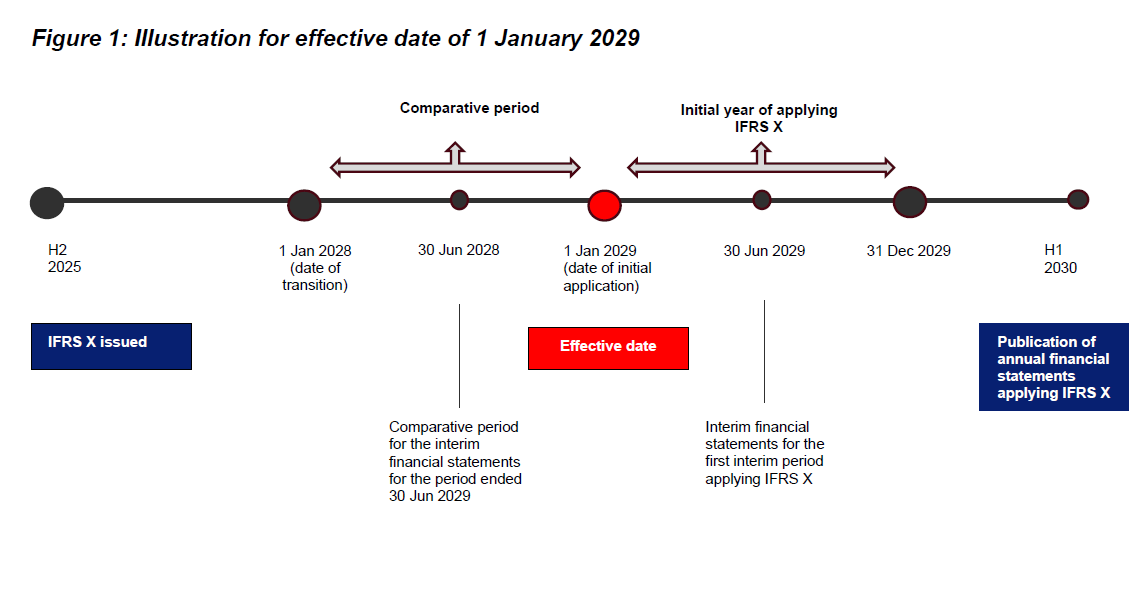
A15The IASB tentatively decided on an effective date of 1 January 2029, with early application permitted. Considering that the IASB expects to issue the final standard in H2 2025, entities will have over 36 months before the effective date.
A16The staff paper provides a timeline which IASB members found very useful. It has been included in Annex 1 to this paper.
A17Seven of 14 IASB members agreed with this decision. The Chair used his additional casting vote, making the vote eight-seven in favour of the decision. The main reason cited by those members who did not vote in favour of the 1 January 2029 effective date is that the effective date should be earlier as the information it will provide is highly relevant. The Chair noted that quality of reporting is more important than speed and that the endorsement processes in the different jurisdictions are typically quite lengthy.
UKEB Secretariat view
A18The Secretariat's initial view is that the effective date of 1 January 2029 will allow entities a reasonable amount of time to prepare for the final Standard, with early application available for those who choose it.
Questions for the Board
- Do Board members agree with the Secretariat's view on transition, transition reliefs and the effective date?
Past business combinations (AP9E9)
ED proposals
A19The ED proposed to require an entity to apply the final standard retrospectively to past business combinations, unless the entity elects to apply the simplified approach described in paragraph C4 of the ED.
A20Paragraph C4 of the ED proposes that an entity can elect not to apply the final standard retrospectively to past business combinations. If an entity makes this election, paragraph C4 proposes a simpler approach.
A21If an entity elects to use the proposed simplified approach, it would at the date of transition:
- Apply the election to all of its past business combinations.
- Apply the requirements in subparagraphs (c)–(g) separately to each past business combination.
- Recognise and measure, applying the standard, all regulatory assets acquired, and all regulatory liabilities assumed, in a past business combination, which still exist at the date of transition.
- Derecognise all items (such as some regulatory balances) that were recognised as assets or liabilities in that past business combination but would not have been recognised if the standard had always been applied.
- Recognise any deferred tax effects of the adjustments described in subparagraphs (c)–(d).
- Adjust the carrying amount of non-controlling interests from that past business combination remaining at the date of transition for their proportionate share of the net amount of the adjustments described in subparagraphs (c)–(e), if the entity measured those non-controlling interests at their proportionate share in the recognised amounts of the acquiree's identifiable net assets, rather than at fair value.
- Adjust the carrying amount of goodwill still remaining from that past business combination for the net amount of the adjustments described in subparagraphs (c)–(f). If that adjustment reduces the carrying amount of goodwill to nil, the entity would recognise any remaining amount of adjustment in retained earnings or, if appropriate, another category of equity.
UKEB FCL
A22The UKEB did not comment specifically on the proposals for past business combinations.
IASB tentative decisions
A23The IASB tentatively decided:
- Not to include the requirement proposed in the ED for an entity to apply the retrospective or simplified approach to regulatory assets acquired or regulatory liabilities assumed in a past business combination. The IASB tentatively decided that the final Standard should require the entity to apply the transition requirements of the prospective standard to these regulatory assets and regulatory liabilities. The transition requirements (as set out in paragraph 9) permit the entity to elect to apply the final standard retrospectively either using IAS 8 or by using a modified retrospective approach.
- To require an entity applying the transition requirements of the prospective standard to take the net adjustment to retained earnings (or another category of equity, as appropriate), including in that net adjustment, adjustments related to regulatory assets acquired and regulatory liabilities assumed in a past business combination.
- To omit the proposal in the ED to amend paragraph C4 of IFRS 1 to specify how a first-time adopter accounts for the derecognition of goodwill-related regulatory balances.
UKEB Secretariat view
A24The Secretariat will discuss this topic at a future UKEB Rate-regulated Activities Technical Advisory Group (RRA TAG) meeting.
Question for the Board
- Do Board members have any comments or questions on the IASB's tentative decisions on past business combinations?
IASB tentative decisions on items not contained in the ED
Extending the measurement proposals relating to items affecting the regulated rates on a cash basis (AP9A10)
Overview
A25Paragraph 59 of the ED states that, in some cases, a regulatory asset or regulatory liability arises because a regulatory agreement treats an item of expense or income as allowable or chargeable in determining the regulated rates only once an entity pays or receives the related cash, or soon after that, instead of when the entity recognises that item as expense or income in its financial statements (by applying, for example, IAS 12 Income Taxes, IAS 19 Employee Benefits or IAS 37 Provisions, Contingent Liabilities and Contingent Assets).
A26Paragraph 61 of the ED proposes that an entity measures the regulatory asset and regulatory liability described in paragraph 59 by:
- using the measurement basis used in measuring the related liability or related asset by applying IFRS Accounting Standards; and
- adjusting the measurement of the regulatory asset or regulatory liability to reflect any uncertainty present in it but not present in the related liability or related asset.
A27Feedback from a few respondents indicated that a regulatory agreement may treat an item of expense or income as allowable or chargeable using a criterion other than the cash basis such as on an accrual basis and a basis analogous to the cash basis. An example is pension costs that a regulator includes in regulated rates according to local GAAP treatment, with the difference between the local GAAP treatment and IFRS accounting giving rise to timing differences. These timing differences are in addition to timing differences arising from the time lag between when the expense is recognised under local GAAP and when it is included in the regulated rate.
IASB tentative decisions
A28The IASB tentatively decided:
- Not to extend the application of the measurement requirement for items affecting regulated rates only when related cash is paid or received (on a cash basis)—proposed in paragraph 61 of the Exposure Draft—to items affecting regulated rates on other bases.
- To exempt an entity from discounting the estimates of future cash flows arising from a regulatory asset or regulatory liability if:
- the regulatory asset or regulatory liability arises from an item of expense or income that relates to liabilities or assets measured on a present value basis and that affects regulated rates on an accrual basis; and
- the entity, having considered all reasonable and supportable information that is available without undue cost or effort, is unable to estimate the amount and timing of those future cash flows.
- To require an entity that chooses to apply the exemption described in (b) to disclose that fact and also to disclose the carrying amounts at the end of the reporting period of regulatory assets and regulatory liabilities to which the entity has applied that exemption.
- To include—as another example to which the proposed requirement described in (a) can be applied—expected credit losses that affect regulated rates only once the regulator determines that there is no reasonable expectation of the entity receiving the related cash.
A29All 14 IASB members agreed with decision (a), eight of 14 IASB members agreed with decision (b) and 12 of 14 IASB members agreed with decision (c). Seven of 14 IASB members agreed with decision (d). The Chair used his additional casting vote, making the vote eight–seven in favour of the decision.
A30Members who were not in support of the discounting exemption proposals in paragraph A8 (b) above gave the following reasons and concerns:
- The proposed accounting standard is already complex and adding the discounting exemption would further complicate the standard.
- The exemption seems to only apply to a small population of entities in a few jurisdictions.
- Exempting the discounting of cash flows is not permitted in other accounting standards, meaning the proposed exemption for regulatory assets and regulatory liabilities would be inconsistent with those other standards.
- The threshold to apply the exemption to discounting is high and may be difficult for entities to attain.
- One member questioned whether the requirements of IAS 1 Presentation of Financial Statements for critical judgements and key sources of estimation uncertainty would better address the issue, rather than permitting a discounting exemption.
A31The IASB staff noted their rationale for the exemption proposed in paragraph A8 (b) is the costs vs the benefits of trying to estimate the future expenses under local GAAP and the uncertainty involved in doing the estimate.
A32Members who were not in support of the proposals in paragraph A8 (d) above gave the following reasons and concerns:
- Including a specific example for expected credit losses due to the fact pattern being economically similar to items affecting the regulated rates on a cash basis may create confusion and open the door for interpretation challenges for other items that don't affect the regulated rate on a cash basis.
- A loss of cash inflow (such as the non-recovery of a receivable) is not economically similar to a cash outflow. More 'non-cash' transactions may be viewed in the same way. Some IASB members are concerned that including this example will lead to the Interpretations Committee receiving submissions in future for many other fact patterns.
UKEB Secretariat view
A33The Secretariat will discuss this topic at a future RRA TAG meeting.
Extending the presentation proposals relating to items affecting the regulated rates on a cash basis (AP9B11)
Overview
A34Paragraph 69 of the ED proposes that when an entity remeasures a regulatory asset or regulatory liability applying paragraph 61, the entity presents the resulting regulatory income or regulatory expense in other comprehensive income (OCI) to the extent that the regulatory income or regulatory expense results from remeasuring the related liability or related asset through OCI.
A35Feedback from a few respondents from North America and Europe shared that the presentation proposals should not be limited to items that a regulatory agreement treats as allowable or chargeable on a cash basis. These stakeholders were of the view that the presentation proposals relating to OCI should apply to all regulatory income and regulatory expense that arise from a remeasurement of the related liability or related asset through OCI. The rationale for this proposal is that it would make the financial statements more understandable as it would potentially result in significant mismatches e.g. between profit and loss and OCI income. It would also be aligned to the treatment in IFRS 14 Regulatory Deferral Accounts where presentation in OCI is not limited to items affecting the regulated rates on a cash basis.
IASB tentative decisions
A36The IASB tentatively decided not to extend the application of the presentation requirement for items affecting regulated rates on a cash basis—proposed in paragraph 69 of the Exposure Draft—to items affecting regulated rates on other bases.
A37Seven of 14 IASB members agreed with this decision. The Chair used his additional casting vote, making the vote eight–seven in favour of the staff proposal.
A38Members who were not in support of the staff proposal gave the following reasons and concerns:
- The mismatch would create unnecessary ‘noise' in the income statement which entities would have to explain to users. This may bring into question the relevance and credibility of IFRS Accounting Standards. The impact is likely to be significant for some entities and users will not understand the 'permanent difference' that exists between the profit and loss and the OCI.
- The proposal is not aligned to the requirements in IFRS 14, and it would get in the way of achieving the objective of the Standard which is to provide useful information for users.
- The future Standard is a supplement to other IFRS Standards and therefore it should be aligned with those Standards e.g. the IAS 19 requirement to present certain items in OCI.
A39Some members in favour of the staff recommendation noted that the future Standard is focused on revenue and therefore the proposal is appropriate as the regulatory income and expense would be reflected in profit and loss and suggested that there should be a requirement to disclose the amount in profit and loss that relates to OCI. In response to the disclosure suggestion another member said that this will be reported in alternative performance measures (APMs) anyway while another member noted that the fact that the information will be reported in APMs is not a good starting point for standard setting.
A40One member suggested that the IASB go out on public consultation on this issue while the future Standard is being drafted.
A41The Secretariat will discuss this topic at a future RRA TAG meeting.
Questions for the Board
- Do Board members have any comments or questions on the IASB's tentative decisions on extending the measurement and presentation proposals dealing with items affecting the regulated rates on a cash basis?
IASB decisions on issues relating to due process
Consideration of the re-exposure criteria (AP9G12)
Overview
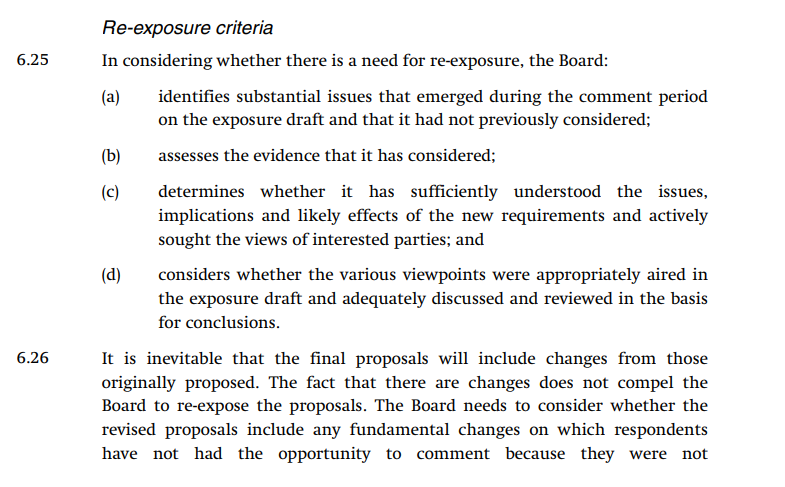
A42The IASB staff paper sets out the re-exposure criteria in the IFRS Foundation Due Process Handbook13 (the Handbook) and asks the IASB to consider whether it should finalise IFRS X Regulatory Assets and Regulatory Liabilities without re-exposing it for another round of public comments for the issues that were identified as substantial during the comment period14. Annex 2 of this paper sets out the re-exposure criteria in the Handbook.
A43Under the direct (no direct) relationship concept, entities with no direct relationship will not be permitted to recognise as regulatory assets and regulatory liabilities the enforceable rights and obligations arising from timing differences included in an entity's regulatory capital base (RCB). As all UK entities will be in the no direct relationship category, the UKEB raised its concerns about the expected consequences of the direct (no direct) relationship concept. Paragraph 43 of the IASB's staff paper refers to these concerns and paragraph 44 sets out that the IASB staff "held approximately 10 meetings with the UKEB and other UK stakeholders to understand their concerns".
IASB decision
A44The IASB decided that re-exposure of the proposals in the Exposure Draft with the changes made by its tentative decisions is not required. The IASB's rationale for this was that it thought that there were no fundamental changes on which respondents have not had the opportunity to comment and, thus it is unlikely that re-exposure will reveal any new information or concerns.
UKEB Secretariat view
A45As set out in the letter15 to the IASB dated 23 July 2024, the UKEB encourages the IASB to further consider the UKEB Secretariat's top-down approach for possible inclusion in the standard at a suitable juncture. The letter to the IASB was accompanied by the ‘Consolidated report'16 which summarises the UKEB's concerns, the work done to date in developing the approach and the additional work required to develop it to a standard-setting solution.
Due process requirements (AP9H17)
Overview
A46The IASB staff paper asks the IASB to confirm that it is satisfied that all the mandatory due process steps have been taken and requests permission for the staff to begin the balloting process for the IFRS X.
IASB decision
A47All 14 IASB members confirmed they were satisfied the IASB has complied with the applicable due process requirements and has undertaken sufficient consultation and analysis to begin the process for balloting the prospective standard.
A48Three IASB members indicated a possible intention to dissent from issuing the prospective standard. These members and their rationale for possible dissention given during the meeting are:
- Robert Url – due to the fact that the IASB member does not agree with the proposed treatment for the presentation of items affecting the regulated rate only when the cash is paid or received (paragraph 69 of the ED). The IASB member is also still contemplating whether he agrees with the proposals of paragraph 61 of the ED around measurement of items affecting the regulated rates on a cash basis.
- Patrina Buchanan – the IASB member wants to wait and see the whole package together to see if it is understandable.
- Rika Suzuki – due to the deviation from principles-based accounting the IASB member is still thinking about whether or not to dissent.
Questions for the Board
- Do Board members have any comments or questions on the IASB's decision to not re-expose significant items and on the compliance with due process requirements?
ASAF Meeting
A49In September 2024, the IASB staff will provide a project update and seek ASAF members' views on the IASB's tentative decisions in Q1 and Q2 2024. The IASB presentation to ASAF can be accessed here. The relevant topics have been listed in the table below. All of these topics have previously been discussed by the Board. Links to the Board papers for the meetings at which the topics were discussed have been included as well as significant comments received from UKEB and RRA TAG members.
| Topic | Comments received |
|---|---|
| February 2024 (UKEB Paper 9H – March 2024) | |
| 1. Boundary of the regulatory agreement. | 2. No significant comments. |
| 3. Amendments to IAS 36 Impairment of Assets. | 4. No significant comments. |
| 5. Disclosure requirements, including new disclosure requirements proposed by the IASB staff. | 6. RRA TAG members were generally of the view that disclosing the required information in the early years would be challenging and that materiality and sensitivity of information may be challenging, e.g. when an entity has a disagreement with a regulator. 7. RRA TAG members noted that the requirement for an entity to disclose the nature of unrecognised regulatory assets and unrecognised regulatory liabilities is not clear and that sufficient clarity needs to be provided in the [future] Standard. |
| March 2024 (UKEB Paper 7A - April 2024) | |
| 8. Discounting estimated future cash flows. | 9. See comments in paragraph 13 to 17 below. |
| 10. Reduced disclosures for rate-regulated entities under the reduced disclosures project for subsidiaries without public accountability. | 11. RRA TAG members confirmed that unlisted subsidiaries that have regulatory assets and regulatory liabilities might not have public accountability and therefore would be eligible to use IFRS 19. They also noted that subsidiaries using FRS 101 are unlikely to switch to IFRS 19. 12. RRA TAG members also supported developing reduced disclosures at the same time as the forthcoming IFRS Accounting Standard Regulatory Assets and Regulatory Liabilities is issued. However, if that is not feasible ie due to timing issues, reduced disclosures should be developed by the effective date of the forthcoming standard. |
| April 2024 (UKEB Paper 8A - May 2024) | |
| 13. Discounting future cash flows – minimum interest rate | 14. A RRA TAG member suggested that, since the objective of the proposed standard is to more fully reflect the economics, entities should be permitted to use their incremental borrowing rates similar to that prescribed in IFRS 16 Leases to address the issue of uncertainty. This member further suggested that the proposed standard should state that if an entity assumed its weighted average cost of capital (WACC) is materially different from the actual cost of borrowing then the actual cost of borrowing should be used by entities instead. This could be an exception for entities that are either distressed or overperforming. 15. RRA TAG members noted that they were unsure how the proposals will be applied in practice as entities would need clarification on whether they need to discount using the nominal rate or the real rate depending on what their respective starting points are. Other members highlighted that including examples in the proposed standard would be useful in addressing this concern. 16. Currently in the UK all regulatory agreements use a real interest rate approach. However, the energy regulator has indicated the intention to use a hybrid approach in regulatory agreements from the start of the next price control period (starting in 2026). This means that a portion of the return on capital will be calculated using a nominal interest rate while the other portion will be calculated using a real interest rate. The expected impact of this hybrid approach needs to be analysed and will be discussed at a future RRA TAG meeting. |
| 17. Scope—interaction with IFRS 17 Insurance Contracts. | 18. No significant comments received. |
| 19. Amendments to IFRS 5 Assets held for sale and Discontinued Operations. | 20. No significant comments received. |
| May 2024 (UKEB Paper 6D – June 2024) | |
| 21. Amendments to IFRS 3 Business Combinations. | 22. Some UKEB members noted that not remeasuring the PPE to fair value will impact goodwill in the business combination and that this may cause unintended consequences. 23. RRA TAG members agreed with the assessment that the remeasurement to fair value of the net assets in a business combination will not affect the individual entity accounts and that licenses typically remain unaffected after a business combination. 24. Regarding the fair value of PPE that exceeds the RCB value, RRA TAG members confirmed that this may lead to impairment of the PPE. |
| 25. Interaction with IAS 12 Income Taxes. | 26. No significant comments received. |
| 27. Amendments to IAS 8 Accounting Policies, Changes in Accounting Estimates and Errors. | 28. No significant comments received. |
Question for the Board
- Do Board members have any comments or questions on the IASB's tentative decisions in Q1 and Q2 2024 (the items that will be on the ASAF agenda in September 2024)?
Next steps
A50The IASB gave the staff permission to begin the balloting process. The staff will consider the need for future IASB discussion of any sweep issues that arise during the balloting process.
A51The UKEB Secretariat will continue to monitor the project and any further IASB tentative decisions.
Annex 1
Figure 1: Illustration for effective date of 1 January 2029
Annex 2
IFRS Foundation Due Process Handbook re-exposure criteria
1. The following extract from the Handbook18 sets out the criteria to be considered with respect to re-exposure:
Re-exposure criteria
In considering whether there is a need for re-exposure, the Board:
- identifies substantial issues that emerged during the comment period on the exposure draft and that it had not previously considered;
- assesses the evidence that it has considered;
- determines whether it has sufficiently understood the issues, implications and likely effects of the new requirements and actively sought the views of interested parties; and
- considers whether the various viewpoints were appropriately aired in the exposure draft and adequately discussed and reviewed in the basis for conclusions.
6.26It is inevitable that the final proposals will include changes from those originally proposed. The fact that there are changes does not compel the Board to re-expose the proposals. The Board needs to consider whether the revised proposals include any fundamental changes on which respondents have not had the opportunity to comment because they were not contemplated or discussed in the basis for conclusions accompanying the exposure draft. The Board also needs to consider whether it will learn anything new by re-exposing the proposals. If the Board is satisfied that the revised proposals respond to the feedback received and that it is unlikely that re-exposure will reveal any new concerns, it should proceed to finalise the proposed requirements.
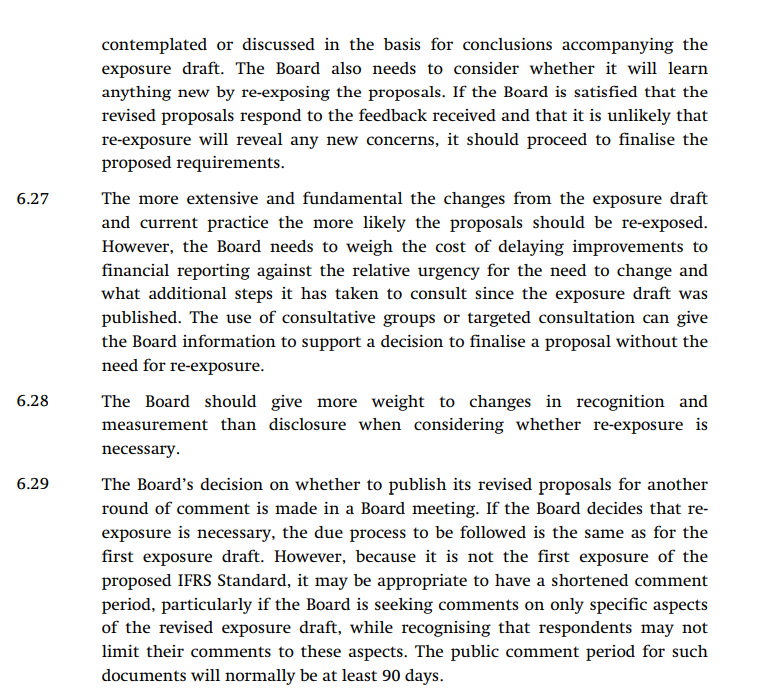
6.27The more extensive and fundamental the changes from the exposure draft and current practice the more likely the proposals should be re-exposed. However, the Board needs to weigh the cost of delaying improvements to financial reporting against the relative urgency for the need to change and what additional steps it has taken to consult since the exposure draft was published. The use of consultative groups or targeted consultation can give the Board information to support a decision to finalise a proposal without the need for re-exposure.
6.28The Board should give more weight to changes in recognition and measurement than disclosure when considering whether re-exposure is necessary.
6.29The Board's decision on whether to publish its revised proposals for another round of comment is made in a Board meeting. If the Board decides that re-exposure is necessary, the due process to be followed is the same as for the first exposure draft. However, because it is not the first exposure of the proposed IFRS Standard, it may be appropriate to have a shortened comment period, particularly if the Board is seeking comments on only specific aspects of the revised exposure draft, while recognising that respondents may not limit their comments to these aspects. The public comment period for such documents will normally be at least 90 days.
Appendix B: Power Purchase Agreements
Discussion
| UKEB Project Status: Monitoring | UKEB Project page |
|---|---|
| IASB Next Milestone: Final amendments expected December 2024. | UKEB Final comment letter (Published August 2024) |
Background
B1. The IASB staff presented an overview of feedback1 on the Exposure Draft Contracts for Renewable Electricity (the ED) at the August 2024 IASB meeting. No decisions were taken at the meeting.
B2. The IASB is due to discuss the scope of the ED and the proposals in respect of 'own use' at its meeting on 17 September 2024. The meeting papers have been published on the IASB website2. It appears that the IASB staff will be seeking tentative decisions from the IASB on these topics at that meeting.
B3. The IASB staff are due to present on Power Purchase Agreements to ASAF3 on 27 September 2024. Feedback will be sought from ASAF members on the IASB's tentative decisions, in anticipation of finalising amendments by the end of 2024.
B4. This paper summarises the feedback presented to the August 2024 IASB meeting, and some initial comments from IASB members. Paragraphs B29 and B30 also summarise the papers published for the September 2024 IASB meeting. The UKEB Secretariat will provide a verbal update in the September UKEB meeting of any key points arising from that IASB meeting, and any tentative decisions taken.
B5. This paper also seeks Board member views ahead of the September ASAF meeting.
Summary
B6. The ED resulted in 90 comment letters, in spite of the reduced 90 day comment period. The IASB staff summarised the main themes from the feedback, which were presented using a traffic light system.
B7. They staff summary highlighted broad support for the ED proposals on scope and 'own use', subject to a number of areas for clarification (ranked amber – proposals require some clarification).
B8. There was also broad support for the hedge accounting proposals, subject to some requests for clarification of certain aspects of how to operationalise the proposals (ranked amber/green).
B9. Concerns were however expressed by respondents at the disclosure proposals (ranked red: proposals require significant clarification).
B10. No decisions were taken at the meeting. However, it was clear from discussions in the meeting that the IASB consider that the feedback received gives a clear mandate to proceed with the proposals, in particular in relation to ‘own use' and hedge accounting.
B11. The discussions acknowledged that changes will be needed to the disclosure proposals. Members noted that where contracts were no longer being accounted for at fair value, users were losing valuable information, and some additional disclosures may be the price of being allowed to apply 'own use' to these contracts. However, the disclosure requirements should be better targeted, in particular to those contracts within scope of the amendments where 'own use' treatment was being applied.
Scope
B12. A significant number of comment letters had requested clarifications relating to the scope of the proposed amendments. The IASB staff and a number of IASB members were supportive of providing clarification on scope, but subject to a clear view that the scope should be kept narrow. Any changes should be to clarify the originally intended scope, rather than widening it to include other types of contract. This is broadly consistent with the position in paragraph 9 of the UKEB Final Comment Letter, recommending that if the IASB were to proceed, it should retain the current narrow scope to avoid the risk of unintended consequences.
B13. The IASB staff intend to develop proposals to address a number of issues highlighted in feedback, such as the meaning of 'nature dependent', and 'volume risk', while retaining the ringfenced nature of the proposed amendments.
B14. The UKEB Secretariat notes that a number of comment letters highlighted types of contract that respondents assumed should be included within the scope of the proposals. It appears unlikely that all these contracts can be accommodated if the IASB sticks to the stated narrow scope.
B15. One IASB member highlighted the risks of ongoing application issues if there is insufficient clarity on the scope of the amendments, while other members highlighted the risk of subsequent additional requests for further extension to include other similar types of contracts.
'Own use'
B16. On 'own use' the IASB staff papers highlighted a number of areas where clarification had been requested. These include the interaction of the proposals with factors such as access to storage as well as several points relating to the purchase of equivalent volumes of electricity after sales, such as;
- The 'reasonable time' permitted, and whether one month is an appropriate indicator, or whether this should be longer to allow for seasonality of supply and demand.
- The practicalities of matching purchases with sales, and whether they are required to take place in the same market.
B17. One IASB board member also raised a concern about the possible wider impact on the application of the ‘own use' requirements for contracts not within the scope of the amendments, similar to the point made in A8 of the UKEB Final Comment Letter.
Hedge accounting
B18. The feedback received on the hedge accounting proposals was generally positive. However, most respondents asked for clarifications about their application. This overall feedback is broadly consistent with the position taken in the UKEB Final Comment Letter.
B19. The IASB staff acknowledged that the designation of a variable nominal amount is a new concept for hedge accounting that had not previously been proposed, and recognised that there were a number of application questions. The IASB staff indicated they will consider how best to address this.
Disclosures
B20. While there was some support for aspects of the disclosure proposals, the feedback generally opposed the proposals. In particular, respondents felt the scope of the disclosure proposals was too broad and that the level of information required was excessive, could be costly to provide, and may result in disclosing commercially sensitive information. Respondents also highlighted existing disclosure requirements for some contracts.
B21. This summary echoes a number of the points raised in paragraphs 15 and 16 of the UKEB Final Comment Letter.
B22. IASB members raised a number of points in relation to the disclosure proposals. Some viewed it as important that some additional information was provided, in particular for contracts which would have been held at fair value without these amendments, where it was felt that users may be losing valuable information.
B23. Several IASB members referred to either the need for balance in the disclosure proposals, or the need to avoid overload of disclosures. One IASB member suggested a proposal put forward by a preparer to disclose information about expected cash flows under these contracts, which another member supported.
B24. The IASB staff indicated that addressing the scope of the disclosure requirements may reduce some of the pressure on certain of the disclosure issues.
B25. The UKEB Secretariat notes that there is a wide range of feedback on the disclosure points for IASB staff to address. It appears that the IASB staff intend to focus the scope of the disclosure requirements on those contracts within scope of the amendments which are accounted for as 'own use' contracts as a result of the amendments. However, caution may be required if any disclosure of expected cash flows is mandated alongside volume disclosures, as this may lead to additional concerns relating to the disclosure of commercially sensitive information4.
Transition and effective date
B26. Most respondents suggested an effective date of 1 January 2026, with early adoption permitted. This is consistent with the view expressed in the UKEB Final Comment Letter.
Next steps and September 2024 IASB meeting
B27. The IASB staff confirmed that they would be bringing some papers to the September IASB meeting, with further papers and decisions to the October IASB meeting. The expected date for the final amendments may need to slip one month to December 2024.
B28. The papers published for the September IASB meeting include papers on scope and 'own use'.
B29. In summary, the scope paper proposes:
- replacing the term 'contracts for renewable electricity' with 'nature dependent electricity contracts';
- clarification that nature, or natural sources, control the source from which electricity is produced, and whether electricity is produced by the referenced facility;
- clarification that, to be within scope of the amendments, cash flows under the contract vary based on contracted volume of electricity produced by the referenced production facility; and
- incorporating the concept of volume risk within the 'own use' requirements, rather than within the scope paragraph.
B30. In summary, the ‘own use' paper proposes:
- clarifying that risks arising from the contracts expose the entity to the risk of oversupply during a delivery interval, and the market design leaves them with no practical ability to avoid selling at market determined timing;
- requiring purchases to be in the same market as sales; and
- removing the one month restriction on the timing of purchases of equivalent amounts of electricity, to accommodate seasonality of supply or demand, while introducing a backstop position of 12 months, and introducing a rolling 12 month assessment period.
B31. The UKEB Secretariat will provide a verbal update on any key discussions at the September IASB meeting on this topic, and any tentative decisions taken.
Question for the Board
- Do Board members have any comments on the paper or the verbal update ahead of the September 2024 ASAF meeting?

Appendix C: Financial Instruments with Characteristics of Equity
Discussion
| UKEB Project Status: Active Monitoring | UKEB project page |
|---|---|
| IASB Next Milestone: Begin redeliberation (expected Q4 2024) | UKEB Final Comment Letter (Published 3 April 2024) |
Background
C1. In November 2023 the IASB published its Exposure Draft (ED) Financial Instruments with Characteristics of Equity (FICE), setting out proposed amendments to IAS 32 Financial Instruments: Presentation, IFRS 7 Financial Instruments: Disclosures, and IAS 1 Presentation of Financial Statements. The UKEB response to the IASB was submitted on 3 April 2024.
Purpose of this update
C2. The IASB met on 24 July 2024 to discuss a summary of feedback on the ED from users of financial statements, and a proposed project plan for the detailed analysis and redeliberation of all the feedback on the ED.
C3. The purpose of this paper is to provide the Board with an update on the IASB meeting and to give an indication of timeframes for this project.
July 2024 IASB meeting
C4. The IASB staff paper1 summarised the feedback from the comment letters from users, as well as other outreach meetings, including the UKEB Investor Advisory Group.
C5. In general, the feedback from users was broadly positive in relation to the disclosure and presentation proposals. Some users identified additional disclosures which they would find helpful, however the feedback from IASB members was that it was important to consider the cost and benefit of any additional disclosures.
C6. No decisions were taken at the meeting. The staff will return with detailed comment letter analyses on the different topics addressed by the ED for redeliberation at future IASB meetings.
C7. IASB staff also presented a proposed project plan2. The plan proposed to address the topics largely in the order addressed in the Invitation to Comment accompanying the ED, from Q4 2024 to Q2 2026.
C8. While some board members expressed support for the approach set out in the plan, one IASB member proposed an alternative approach to accelerate consideration of the core presentation and disclosure elements of the ED ahead of other areas. This may allow any presentation changes to be adopted at the same time as adoption of IFRS 18. While no decisions were taken, several board members expressed support for this alternative approach. IASB staff members indicated that they would not expect this alternative approach to delay the project overall.
C9. The staff paper also indicated that they do not consider it necessary to undertake field testing of the proposals, as suggested in some feedback. The paper highlights the extent of feedback received on the ED, and notes that staff consider this sufficient to allow the IASB to make decisions. IASB members who commented on this topic expressed their support for the staff position.
Next steps
C10. The IASB staff are expected to bring papers to future IASB meetings from Q4 2024 for detailed review and redeliberation of the feedback on the ED. The UKEB Secretariat will bring an update on progress to a future Board meeting.
Appendix D: Post-implementation Review of IFRS 9 - Impairment
| UKEB Project Status: Complete | UKEB project page |
|---|---|
| IASB Next Milestone: Project complete | UKEB Final Comment Letter (Published September 2023) |
D1. In July 2024 the IASB completed its work on its Post-implementation Review of IFRS 9 – Impairment (the PIR), and published a project summary. The Secretariat has previously provided the Board with summaries of IASB discussions on the recognition and measurement findings from the PIR. This paper provides an update on the final topics discussed by the IASB (disclosure, other matters) and the project summary.
D2. The IASB staff reported to the May 2024 IASB meeting that:
- Most stakeholders reported diversity in practice in the information entities disclose about expected credit losses (ECL).
- Some stakeholders emphasised that improvements to IFRS 7 should be proportionate. Comprehensive information should be disclosed by entities with significant credit risk such as financial institutions, while entities with no significant credit risk should not be unnecessarily burdened.
- Some stakeholders commented on the role of auditors and enforcers in supporting greater consistency. They noted the positive effects that the regulatory or industry group recommendations in some jurisdictions have had on the disclosure quality. For example, stakeholders noted that the recommendations by UK regulators1 about disclosures have resulted in banks providing more consistent and high quality ECL disclosures. The academic study2 presented at the meeting also noted the regulatory environment appears to be a significant driver of disclosure quality.
- The meeting also addressed two “other matters":
- the simplified approach for trade receivables, contract assets and lease receivables; and
- intra-group lending.
- The IASB staff recommended that Illustrative Examples be developed to demonstrate the application of IFRS 9 to instruments with atypical features, including such as those between related parties, or where limited credit risk information is available. However, not all members thought the creation of further materials would resolve the issue, nor that the benefits of taking action would exceed the costs. This question split the board, who decided (8 of 14 votes) to take no further action.
IASB conclusions on the Post-implementation Review
D3. After analysing the evidence gathered in the PIR, the IASB concluded that the impairment requirements in IFRS 9 are working as intended. In particular, the IASB concluded that:
- There are no fundamental questions (fatal flaws) about the clarity or suitability of the core objectives or principles in the requirements.
- In general, the requirements can be applied consistently. However, further clarification and application guidance is needed in some areas to support greater consistency in application.
- The benefits to users of financial statements from the information arising from applying the impairment requirements in IFRS 9 are not significantly lower than expected. However, targeted improvements to the disclosure requirements about credit risk are needed to enhance the usefulness of information for users.
- The costs of applying the impairment requirements and auditing and enforcing their application are not significantly greater than expected.
Summary of IASB decisions
D4. The PIR has resulted in one project being added to the research pipeline (Credit risk disclosures – Targeted Improvements) and the scope of one project already in the research pipeline being expanded (Amortised Cost Measurement). Matters related to accounting for financial guarantee contracts will be considered during the next agenda consultation.
D5. A summary of the topics discussed and decisions taken during the project is shown below.
| Topics for discussion | IASB discussion | IASB decisions |
|---|---|---|
| General approach to recognition of ECL | February 2024 | No standard-setting action |
| Significant increase in credit risk | February 2024 | No standard-setting action |
| Measuring ECL - general | March 2024 | No standard-setting action |
| Measuring ECL – Loan commitments and financial guarantees. | April 2024 | Matters related to financial guarantee contracts will be considered at the next agenda consultation. No standard setting action on other matters. |
| Purchased or originated credit-impaired financial assets. | April 2024 | Matters related to the modification, derecognition and write-off of financial assets will be addressed as part of the pipeline project Amortised Cost Measurement. No standard setting action on other matters. |
| Interaction of impairment requirements with other requirements in IFRS 9 and other IFRS accounting requirements. | April 2024 | Matters related to the modification, derecognition and write-off of financial assets will be addressed as part of the pipeline project Amortised Cost Measurement. No standard setting action on other matters. |
| Credit risk disclosures | May 2024 | The project Credit risk disclosures – Targeted Improvements has been added to the IASB research pipeline. |
| Other matters, including the simplified approach and intra-group financial instruments. | May 2024 | No standard setting action. |
Matters added to the research pipeline
D6. The scope of the matters added to the IASB research pipeline was as follows:
| Matters added to the IASB research pipeline | Scope |
|---|---|
| PIR: Application of the impairment requirements with other requirements in IFRS 9. Project: Amortised Cost Measurement |
As part of the IASB's response to the feedback on the Post-implementation Review of IFRS 9—Classification and Measurement, in July 2022 the IASB added to its research pipeline the Amortised Cost Measurement project to consider potential clarifications and further application guidance on the IFRS 9 requirements for modification, derecognition and write-off of financial instruments. At the time, the IASB acknowledged that there is an intersection between those requirements and the impairment requirements in IFRS 9. Therefore, the related matters identified in this PIR would be considered as part of that project, including: |
| * Whether, or when, to account for changes in expected cash flows as a modification, derecognition, write-off or as expected credit losses. | |
| * Whether to present a modification gain or loss as part of the impairment expense for the period or separately. | |
| * How to present a loss arising from writing-off a financial asset in the statement of profit or loss. | |
| * How to account for the recovery of amounts after a financial asset has been written-off. | |
| PIR: Credit risk disclosures Project: Credit risk disclosures – Targeted Improvements. |
In May 2024 the IASB decided to add to its research pipeline a project to consider targeted improvements to the credit risk disclosure requirements in IFRS 7. Potential targeted improvements include: Clarifying particular requirements in IFRS 7 or adding requirements for disclosure of specific items of information that would satisfy the applicable disclosure objectives in most cases. These improvements would link a specific disclosure objective with items of information that an entity is required to disclose to satisfy that objective, thereby assisting entities in meeting the disclosure objectives. Considering whether the disclosure burden could be reduced for entities with no significant exposure to credit risk, for example, by reducing the disclosure requirements for financial instruments in the scope of the simplified approach for recognising expected credit losses. |
Resolution of key issues raised in the UKEB comment letter
| Key UKEB comment letter recommendations | IASB decision |
|---|---|
| Recommended the IASB include further guidance to clarify the process for assessing a significant increase in credit loss, and measuring expected credit losses. Material previously published in relation to Covid-19 and from the IFRS Transition Resource Group could be used for this purpose. | No standard setting action. In the IASB's view, IFRS 9 already provides robust principles, simplifications, rebuttable presumptions and illustrative examples to enable entities to align the assessment with their internal credit risk management practices. Adding further requirements or application guidance would risk making the requirements rule based. Determining significant increases in credit risk is a fundamental element of the expected credit loss model. The IASB considered that adding more prescriptive application guidance could also reduce the alignment with entities' internal credit risk management practices, which would ultimately reduce the usefulness of information for users of financial statements. |
| Requested greater clarity on the interaction of the impairment requirements with the modification, derecognition and write-off requirements of IFRS 9. Recommended this topic be added to the IASB research pipeline project "Amortised cost Measurement". | Added to the IASB research pipeline project Amortised Cost Measurement. |
| Recommended further consideration be given to impairment requirements for intra-group lending, particularly whether the requirements are proportionate. | As noted in paragraph A2(e) the issue of providing further guidance for intra-group lending split the board. Ultimately, the IASB decided to take no standard setting action. The research pipeline project Credit risk disclosures – Targeted Improvements will consider whether the disclosure burden can be reduced for entities with no significant exposure to credit risk, such as those using the simplified approach. It is possible some intra-group lending will have such characteristics and therefore be within the scope of this project. |
| Requested illustrative examples or educational material to make clear that post-model adjustments are subject to IFRS 7 disclosure requirements, and that such adjustments should extend to Stage 1/2/3 categorisation in addition to the expected credit loss balance. | The IASB project summary3 confirmed that post-model adjustments will be included in the scope of the IASB research pipeline project Credit risk disclosures – Targeted Improvements. |
| Recommended the IASB consider the ways in which the IFRS 9 impairment requirements connect with wider sustainability reporting, as part of the IASB and ISSB's ongoing work on connectivity. | The project summary noted that the IASB has tentatively decided to create an illustrative example for this issue. This was subsequently included in the Exposure Draft Climate-related and Other Uncertainties in Financial Statements, published on 31 July 2024. |
Next steps
D7. This project is now concluded.
Appendix E: Interpretations Committee Update
| UKEB Project Status: Monitoring | |
|---|---|
| IASB Next Milestone: |
Background
E1. The UKEB's Due Process Handbook notes that the UKEB expects to respond to a limited number of tentative agenda decisions published by the IFRS Interpretations Committee (Interpretations Committee). Some factors to consider when deciding whether to respond may be:
- the degree of impact of the tentative agenda decision on UK companies (for example, in cases where the tentative agenda decision is expected to affect a significant number of UK companies);
- disagreement with the Interpretations Committee's analysis; or
- usefulness of the explanations and clarifications included in the tentative agenda decision.
E2. The IFRS Interpretations Committee met on 10 September 2024.
E3. In addition to the Agenda Decisions noted below the IFRS Interpretations Committee provided input on:
- Pollutant Pricing Mechanisms; and
- The Post-Implementation Review of IFRS 16 Leases.
These discussions form part of the wider stakeholder engagement on these projects and are not discussed in this update.
E4. Also, the IASB staff presented suggested changes to existing Agenda Decisions resulting from the issuance of IFRS 18 Presentation and Disclosure in Financial Statements1. The IASB staff recommendations included withdrawing one Agenda Decision as it has now been addressed by the new standard and changing a further eight Agenda Decisions to remove references to text in IAS 1 Presentation of Financial Statements that has been changed in IFRS 18. No decisions were made at the meeting and the discussion is expected to continue at the IFRS Interpretations Committee meeting in November 2024.
E5. At its July 2024 meeting the IASB ratified the Agenda Decision Disclosure of Revenues and Expenses for Reportable Segments (IFRS 8 Operating Segments).
MATTERS RECEIVED BUT NOT YET PRESENTED TO THE INTERPRETATIONS COMMITTEE
| Topic | Recognition of intangible assets resulting from climate-related commitments |
|---|---|
| Standard | IAS 38 Intangible Assets |
| Question2 | Whether (and if so, how) an entity recognises an intangible asset that may result from an entity's climate-related commitments. |
| Comment | The Secretariat's preliminary assessment is that we do not undertake further work at this time. However, we will monitor any IFRIC discussion closely and will reassess if a Tentative Agenda Decision is developed. |
Question for the Board
- Do Board members agree that the UKEB will NOT undertake further work on the matter received but not yet presented to the Interpretations Committee at this time?
TENTATIVE AGENDA DECISIONS OPEN FOR COMMENT
| Topic | Recognition of revenue from tuition fees |
|---|---|
| Standard | IFRS 15 Revenue from Contracts with Customers |
| Deadline | TBC |
| Question3 | The request asks, given a specific set of circumstances, about the period over which the educational institution recognises revenue from tuition fees—that is, evenly over the academic year (10 months), evenly over the calendar year (12 months) or over a different period. |
| Tentative conclusion4 | Evidence gathered by the Committee to date indicates that diversity in accounting for revenue from tuition fees are mainly the result of differing facts and circumstances. Based on its findings, the Committee concluded that the matter described in the request does not have widespread effect. Consequently, the Committee decided not to add a standard-setting project to the work plan. |
| Comment | This (or any similar) issue was not raised in our recent discussions with stakeholders related to the post-implementation review of IFRS 15. The Secretariat's view was that the matter was unlikely to impact a significant number of UK companies. At the July 2024 Board meeting the UKEB decided it would not undertake further work on this matter at this time. |
| Topic | Guarantees Issued on Obligations of Other Entities |
| Standard | IFRS 9 Financial Instruments |
| Deadline | TBC |
| Question5 | There are diverse views on whether a corporate guarantee contract issued by an investor entity in relation to obligations of its joint venture entity should be accounted for as a financial guarantee contract or not in the separate financial statements of the investor entity. The submission is seeking clarification from the IFRS Interpretations Committee on the issue detailed in 3 cases. |
| Tentative conclusion6 | Guarantees can arise or be issued in many ways and convey various rights and obligations to the affected parties. IFRS Accounting Standards do not define 'guarantees', and there is not a single Accounting Standard that applies to all guarantees. When determining which Accounting Standard applies to a particular guarantee that it issues, an entity is required to analyse all terms and conditions—whether explicit or implicit—of the guarantee unless those terms and conditions have no substance. The entity first considers whether a guarantee that it issues is a 'financial guarantee contract' in accordance with IFRS 9. If an entity concludes that the guarantee it issues is not a financial guarantee contract, the entity considers whether the guarantee is an insurance contract in accordance with IFRS 17. If an entity concludes that a guarantee it issues is neither a financial guarantee contract nor an insurance contract, an entity considers other requirements in IFRS Accounting Standards (IFRS 9, 15 or IAS 37) to determine how to account for the guarantee. The Committee concluded that the principles and requirements in IFRS Accounting Standards provide an adequate basis for an entity to consider when determining how to account for a guarantee that it issues. Consequently, the Committee decided not to add a standard-setting project to the work plan. At the meeting, the Committee suggested a number of amendments to the draft wording of the Tentative Agenda Decision. The amended Tentative Agenda Decision is expected to be published after the publication of this Board paper. |
| Comment | The Secretariat has discussed this question with the FRC, the Accounting Firms and Institutes Advisory Group (AFIAG), and the Financial Instruments Working Group (FIWG). The FRC's Corporate Reporting Review team was able to identify only seven potentially relevant examples related to guarantees over a 15-year period. Most gave rise to appendix points on matters of disclosure. They did not indicate this was a significant issue in the UK. The consensus in both the AFIAG and FIWG was that, while the question highlighted some broader uncertainty around the boundaries of the relevant standards (IFRS 9, IAS 37, IFRS 17), the particular fact patterns were not a significant issue in the UK. While such arrangements may exist, there have not been concerns about accounting outcomes or diversity in practice. The Secretariat's preliminary assessment was that the matter was unlikely to impact a significant number of UK companies. At the July 2024 Board meeting the UKEB decided it would not undertake further work on this matter at this time. |
Question for the Board
- In the light of the Interpretation Committee's tentative conclusions and, assuming there are no substantive changes to the conclusions once published, do Board members agree that the UKEB will NOT undertake any work on these matters?
TENTATIVE AGENDA DECISIONS CLOSED FOR COMMENT
| Topic | Classification of Cash Flows related to Variation Margin Calls on 'Collateralised-to-Market' Contracts |
|---|---|
| Standard | IAS 7 |
| Deadline | 19 August 2024 |
| Question7 | The Committee received a request about how an entity presents, in the statement of cash flows, cash payments and receipts related to variation margin calls on contracts to purchase or sell commodities at a predetermined price in the future. |
| Tentative conclusion8 | Evidence gathered by the Committee did not indicate that the matter described in the request is widespread. On the basis of that evidence, the Committee concluded that the matter described in the request does not have widespread effect. Consequently, the Committee decided not to add a standard-setting project to the work plan. |
| Comment | The UKEB considered this matter in February and June 2024 and concluded that it did not appear to affect a significant number of UK companies. It concluded it would not respond on this matter. The IFRS Interpretations Committee received 11 responses, including one from a UK-based respondent. The majority of respondents supported the TAD. However, ESMA did not, stating “ESMA strongly believes that providing clarity on this question would have a positive effect on the consistent application of the IAS 7 requirements.” |
Appendix F: List of IASB projects
This Appendix provides a list of all IASB projects1, including links to the IASB project page and, where relevant, to the UKEB project page and any UKEB reports or comment letters. Items highlighted in grey are changed from the last report.
Footnotes
Footnotes
-
This list does not include projects related to the IFRS Interpretations Committee or IASB's projects outside the UKEB's work remit (such as the Second Comprehensive Review of the IFRS for SMEs Accounting Standard). ↩↩↩↩↩↩
-
This provides a summary of the question only, please refer to the IFRS Website for the full details. ↩↩↩↩↩
-
This provides a summary of the question only, please refer to the IFRS Website for the full details. ↩↩↩↩
-
Where for example an entity has a single large contract, expected volume and cash flow disclosure would allow users to derive price information. ↩↩↩
-
This provides a summary of the question only, please refer to the IFRS Website for the full details. ↩↩
-
This provides a summary of the IASB staff recommended conclusion only, which could be subject to further amendment, please refer to the IFRS Website for the full details. ↩↩
-
This provides a summary of the question only, please refer to the IFRS Website for the full details. ↩↩
-
This provides a summary of the IASB staff recommended conclusion only, which could be subject to further amendment, please refer to the IFRS Website for the full details. ↩↩
-
IASB Agenda Paper 9E - July 2024. ↩
-
IASB Agenda Paper 9A - July 2024. ↩
-
IASB Agenda Paper 9B - July 2024. ↩
-
IASB Agenda Paper 9G - July 2024. ↩
-
IFRS Foundation Due Process Handbook. ↩
-
The following issues were identified as the substantial issues arising during the comment period on the ED: a) Regulatory assets and regulatory liabilities arising from differences between the regulatory recovery pace and the assets' useful lives. The paper explains that the project team's work on addressing this issue gave rise to the introduction of the direct (no direct) relationship concept. b) Regulatory returns on assets not yet available for use. c) Scope including interaction of the proposals with IFRIC 12 Service Concession Arrangements. d) Minimum interest rate. ↩
-
Consolidated report on the UKEB Secretariat's top-down approach - July 2024. ↩
-
IASB Agenda Paper 9H - July 2024. ↩
-
IFRS Foundation Due Process Handbook. ↩