5 Exposure Draft Amendments to IFRS 19 Subsidiaries without Public Accountability Disclosures
19 September 2024 Agenda Paper 5
Executive Summary
| Project Type | Influencing |
|---|---|
| Project Scope | Limited scope |
Purpose of the paper
The purpose of this paper is to obtain the Board's approval for publication of the Draft Comment Letter (DCL) (Appendix A) and the accompanying Invitation to Comment (ITC) (Appendix B) on the IASB Exposure Draft Amendments to IFRS 19 Subsidiaries without Public Accountability: Disclosures.
Summary of the issue
The IASB Exposure Draft (ED) was issued on 30 July 2024 with a comment deadline of 27 November 2024. The ED proposes reductions for new or amended disclosure requirements issued between 28 February 2021 and 1 May 2024 that were included in IFRS 19 without reduction because the IASB had not consulted on reducing those requirements.
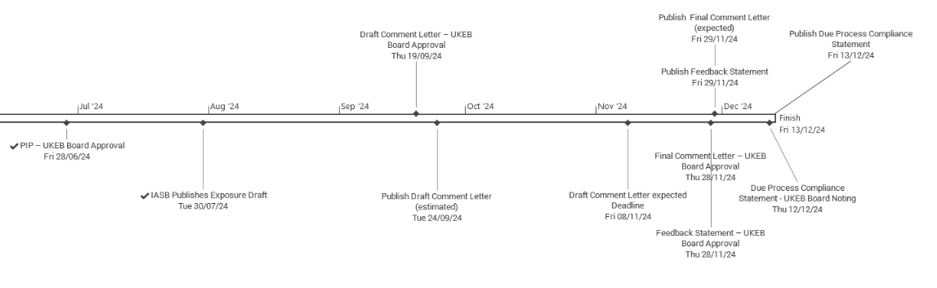
The UKEB Board approved the PIP at its June 2024 meeting. That included the publication of a DCL following the September 2024 meeting for consultation with stakeholders for a 45-day maximum consultation period and presentation of the Final Comment Letter (FCL) at the meeting on 28 November 2024.
Decisions for the Board
Subject to addressing any comments raised during the meeting, does the Board approve the DCL and ITC for publication to obtain stakeholder feedback?
Recommendation
The Secretariat recommends that the Board approves the DCL and accompanying ITC.
Appendices
Appendix A Draft Comment Letter (DCL) Appendix B Invitation to Comment (ITC)
Background
1The IASB issued IFRS 19 Subsidiaries without Public Accountability: Disclosures in May 2024. In developing the reduced disclosure requirements in IFRS 19, the IASB considered the disclosure requirements in IFRS Accounting Standards issued before 28 February 2021.
2Disclosure requirements in new or amended IFRS Accounting Standards issued or exposed between 28 February 2021 and May 2024 were included in IFRS 19 without reductions when IFRS 19 was issued in May 2024.
3The ED proposes a package of amendments to IFRS 19 designed to reduce these disclosure requirements. The ED adopts a 'conservative' approach by proposing few reductions (e.g. the ED proposes retaining almost all of the disclosure requirements for IFRS 18 Presentation and Disclosure in Financial Statements).
4The proposals in the ED relate to:
- the disclosure requirements in:
- IFRS 18 including amendments introduced by Non-current Liabilities with Covenants (Amendments to IAS 1) which was carried forward to IFRS 18.
- IAS 7 Statement of Cash flows, as amended by Supplier Finance Arrangements;
- IAS 12 Income Taxes, as amended by International Tax Reform—Pillar Two Model Rules; and
- IAS 21 The Effects of Changes in Foreign Exchange Rates, as amended by Lack of Exchangeability.
- the consequential amendments to IFRS 19 resulting from the Amendments to the Classification and Measurement of Financial Instruments (Amendments to IFRS 9 and IFRS 7) issued in May 2024; and
- the expected consequential amendments to IFRS 19 in the forthcoming IFRS Accounting Standard Regulatory Assets and Regulatory Liabilities.
Draft comment letter
5The DCL is attached at Appendix A for consideration and approval, with the accompanying ITC (see Appendix B). Overall, the DCL supports the IASB's proposed reductions to the disclosure requirements in IFRS 19 but makes recommendations for a few further potential improvements and reductions to ensure the amendments are proportionate and to enhance the attractiveness of the standard.
Research and outreach
6To inform the drafting of the DCL, the Secretariat has conducted desk-based research, including reviewing the ED, IASB staff papers and meeting summaries.
7In June and July 2024, the Secretariat discussed the IASB's tentative decisions expected to be included in the ED with the UKEB's Investor Advisory Group, Preparer Advisory Group, Accounting Firms and Institutes Advisory Group, Rate-Regulated Activities Technical Advisory Group and Financial Instruments Working Group.
8In addition, in early September the Secretariat carried out a few targeted preparer and user one-to-one interviews.
9All the above feedback has been incorporated in the DCL.
10If approved at the September 2024 UKEB meeting, the DCL and ITC can be published for a 45-day comment period, as agreed in the Project Initiation Plan (the PIP).
Questions for the Board
Subject to addressing any comments raised during the meeting, does the Board approve the DCL and ITC for publication, with a 45-day consultation period?
Next steps
11In line with the PIP, the DCL will be published for stakeholder comment on the UKEB website. Limited outreach with targeted preparers and users will continue whilst the DCL is out for comment.
12In line with the PIP, the Final Comment Letter, Feedback Statement and draft Due Process Compliance Statement are expected to be presented at the November 2024 meeting for Board approval.
13Further information on the project timeline is presented in the table below.
| Expected Dates | Milestone | Status |
|---|---|---|
| February to June 2024 | Secretariat: Preliminary analysis and outreach before publication of the catch-up ED. | Completed |
| 28 June 2024 | Board: Discusses and approves Project Initiation Plan (PIP). | Completed |
| 10 June 2024 | Secretariat: Outreach—UKEB Investor Advisory Group (IAG) | Completed |
| 17 June 2024 | Secretariat: Outreach—UKEB Preparer Advisory Group (PAG) | Completed |
| 27 June 2024 | Secretariat: Outreach—UKEB Rate-Regulated Activities Technical Advisory Group (RRA TAG) | Completed |
| 1 July 2024 | Secretariat: Outreach—UKEB Accounting Firms and Institutes Advisory Group (AFIAG) | Completed |
| 16 July 2024 | Secretariat: Outreach—UKEB Financial Instruments Working Group (FIWG) | Completed |
| IASB Exposure Draft consultation period (120 days): 30 July – 27 November 2024 | ||
| 30 July 2024 | IASB: Publishes catch-up ED with a 120-day comment period | Completed |
| 19 September 2024 | Board: Consideration and approval of Draft Comment Letter (DCL) | This meeting |
| 23 September 2024 (estimate) | Secretariat: Publishes DCL and Invitation to Comment on website and alerts key stakeholders (as soon as possible after 19 September Board meeting) | To be completed |
| UKEB DCL consultation period (45 days): 24 September – 8 November 2024 | ||
| 27 November 2024 | IASB: Exposure Draft consultation period ends | To be completed |
| 28 November 2024 | Board: Discusses and approves Final Comment Letter (FCL), Feedback Statement and draft Due Process Compliance Statement (DPCS) | To be completed |
| [29 November] 2024 | Secretariat: Submits FCL to IASB and publishes FCL on website (as soon as possible after 28 November Board meeting) | To be completed |
| 12 December 2024 | Board: Notes completed DPCS | To be completed |
| 13 December 2024 | Secretariat: Publishes DPCS on website | To be completed |
Timeline
Appendix A: Questions on ED Amendments to IFRS 19 Subsidiaries without Public Accountability: Disclosures
Dr Andreas Barckow Chairman International Accounting Standards Board Columbus Building 7 Westferry Circus Canary Wharf London E14 4HD
XX November 2024
Dear Dr Barckow
Exposure Draft IASB/ED/2024/5 Amendments to IFRS 19 Subsidiaries without Public Accountability: Disclosures
1The UK Endorsement Board (UKEB) is responsible for endorsement and adoption of IFRS Accounting Standards for use in the UK and therefore is the UK's National Standard Setter for IFRS Accounting Standards. The UKEB also leads the UK's engagement with the IFRS Foundation on the development of new standards, amendments and interpretations. This letter is intended to contribute to the Foundation's due process. The views expressed by the UKEB in this letter are separate from, and will not necessarily affect the conclusions in, any endorsement and adoption assessment on new or amended international accounting standards undertaken by the UKEB.
2There are currently approximately 1,500 entities with equity listed on the London Stock Exchange that prepare their financial statements in accordance with IFRS.1 In addition, UK law allows unlisted companies the option to use IFRS and approximately 14,000 such companies currently take up this option.2
3We welcome the opportunity to provide comment on the International Accounting Standards Board (IASB) Exposure Draft (ED) Amendments to IFRS 19 Subsidiaries without Public Accountability: Disclosures (the Amendments). In developing this letter, we have consulted with stakeholders in the UK, including preparers, accounting firms and institutes and users of accounts.
4We support the IASB's objective in developing the Amendments as well as the timely publication of the ED, and are broadly supportive of the proposals. We consider it important to amend IFRS 19 to address disclosure requirements in new or amended IFRS Accounting Standards issued between 28 February 2021 and 1 May 2024 that were included in full when IFRS 19 was issued in May 2024.
5Our main observations and recommendations are set out in the paragraphs that follow. Responses to the IASB's specific questions about the ED are included in the Appendix to this letter.
Main comments on the ED proposals
6We support the principles the IASB used in developing reduced disclosure requirements for IFRS 19 and in maintaining the standard. In assessing the needs of users of financial statements of eligible subsidiaries, we agree that these users are likely to be focused on these principles i.e. information about short-term cash flows, liquidity, measurement uncertainties, disaggregation of amounts in the financial statements and accounting policy choices.
7As stated above, the UKEB is broadly supportive of the proposals in the ED. However, given the broad nature of these principles, the ED adopts a 'conservative' approach by proposing few reductions (e.g. the ED proposes retaining almost all of the disclosure requirements from IFRS 18 Presentation and Disclosure in Financial Statements). We have identified further streamlining of some of the disclosure requirements included in the ED to ensure they are proportionate and to ensure the standard is attractive to those stakeholders most likely to be within its scope. Our detailed comments on potential improvements and reductions to the proposed disclosure requirements are set out in the Appendix.
8To maintain the attractiveness of IFRS 19 as an optional standard and in line with the objective of a reduced disclosure framework, we would encourage the IASB to give greater consideration to:
- The cost of providing the disclosures—to enable eligible subsidiaries to benefit from cost savings and reporting simplifications.
- Proportionality—to ensure that the disclosure requirements are not excessive for subsidiaries that are not publicly accountable.
9The proposed requirement that an entity applying IFRS 19 and the forthcoming IFRS Accounting Standard Regulatory Assets and Regulatory Liabilities (RARL Standard) should be required to apply all the disclosure requirements in the forthcoming RARL Standard, set out in Table 1 of the ED, is inconsistent with the objective of IFRS 19. We consider that reduced disclosures should be in place by the effective date of the forthcoming RARL Standard. Our detailed comments in relation to the forthcoming RARL Standard are in paragraphs A17-A22 of the Appendix.
Timeline for finalisation of the Amendments
10The UKEB plans to start its formal endorsement project in early 2025 to assess both IFRS 19 and the final amendments resulting from this ED as a package for adoption. We encourage the IASB to finalise the amendments to IFRS 19 as soon as practicable. This will enable eligible subsidiaries to implement the amended IFRS 19 without delay, subject to the UKEB decision on adoption of the standard for use in the UK.
11If you have any questions about this response, please contact the project team at [email protected].
Yours sincerely
Pauline Wallace Chair UK Endorsement Board
Question 1—Presentation and disclosure in financial statements (proposed amendments to paragraphs 137, 142–159 and 163 of IFRS 19, paragraph A3 in Appendix A of IFRS 19 and paragraph B8 of Appendix B of IFRS 19)
The IASB is proposing to retain the disclosure requirements in IFRS 19 relating to IFRS 18. The only substantial change proposed is to remove from IFRS 19 the requirements relating to management-defined performance measures. Instead, an eligible subsidiary that uses management-defined performance measures as defined in IFRS 18 would be required to apply the related disclosure requirements in IFRS 18. The IASB is also proposing to remove the disclosure objective in paragraph 137 of IFRS 19 relating to non-current liabilities with covenants.
Paragraphs BC6-BC13 of the Basis for Conclusions on this Exposure Draft explain the IASB's rationale for this proposal.
Do you agree with the proposal to remove from IFRS 19 the requirements for management-defined performance measures and to require an eligible subsidiary to disclose information about these measures if it uses them? If you disagree with this proposal, please explain your reasons.
Are there any other disclosure requirements in IFRS 18 that, in your view, are not applicable to eligible subsidiaries and should therefore be removed from IFRS 19? If so, please specify the disclosure requirements and explain your reasons.
Do you agree that following the removal of the disclosure objective in paragraph 137 of IFRS 19, the remaining requirements relating to non-current liabilities with covenants are sufficient and clear?
A1We support replacing the disclosure requirements for management-defined performance measures (MPMs) in IFRS 19 with a cross-reference to the paragraphs in IFRS 18 Presentation and Disclosure in Financial Statements that contain these disclosures i.e. to require an eligible subsidiary to disclose information about these measures if it uses them. We consider this is a pragmatic solution to improve the accessibility of the standard i.e. avoiding adding length to the standard for disclosure requirements that are expected to be rarely applicable. Consistent with the IASB's rational, we expect eligible subsidiaries that use MPMs to be rare.
A2However, stakeholders have indicated that requiring an eligible subsidiary that uses MPMs to provide all the disclosure requirements of IFRS 19 is burdensome. We therefore encourage the IASB to consider whether reductions in required disclosures could be made. For example, the requirement in paragraph 155 of IFRS 19 to disclose the income tax effect of each item in the reconciliation between an MPM and the relevant IFRS subtotal3 seems disproportionate.
A3Removal of the disclosure objective in paragraph 137 of IFRS 19 relating to non-current liabilities with covenants is consistent with IASB's previous decision not to include disclosure objectives in IFRS 19 and we support the reasoning behind this decision.
A4We also support the IASB's approach of not revisiting decisions relating to those disclosure requirements that were carried forward into IFRS 18 or relocated to another standard unchanged. Given that the IASB has already consulted on those disclosure requirements we agree that a reconsideration of those decisions is not warranted.
A5We support retaining most of the new and amended disclosure requirements from IFRS 18. However, we recommend considering whether paragraph 136 of IFRS 19 can be simplified. Paragraph 136 states:
“An entity will either present expenses by nature, or applying paragraph 133, disclose some expenses by nature. The amounts presented or disclosed need not be the amounts recognised as an expense in the period. They could include amounts that have been recognised as part of the carrying amount of an asset. If an entity: (a) presents amounts that are not the amounts recognised as an expense in the period, it will also present an additional line item for the change in the carrying amount of the affected assets. For example, applying paragraph 39 of IAS 2 Inventories, an entity might present a line item for changes in inventories of finished goods and work in progress. (b) discloses, applying paragraph 133(b), amounts that are not the amounts recognised as an expense in the period, the entity shall give a qualitative explanation of that fact, identifying the assets involved."
To ensure this paragraph includes only disclosure requirements consistent with the objective of the standard, we recommend omitting part (a) of the paragraph as it relates to presentation rather than disclosure requirements.
A6We also recommend the following changes to paragraph 163 of IFRS 19 which lists disclosure requirements in IFRS 18 that remain applicable i.e. cross-references:
| Cross reference—paragraph of IFRS 18 | UKEB recommendation | UKEB rationale |
|---|---|---|
| Paragraphs 19 and 20 | Delete cross references | The content of these two paragraphs is already covered in paragraphs 5 and 6 of IFRS 19. Therefore, these cross-references lead to duplication and potential unnecessary confusion. |
| Paragraph 28 | Replace the paragraph cross reference with the actual disclosure requirements within IFRS 19 under the sub-heading IFRS 18 Presentation and Disclosure in Financial Statements | Apart from the first sentence this paragraph contains only disclosure requirements.4 It is therefore not clear why this disclosure requirement is included by cross-reference. |
| Paragraph 43 | Delete cross references | We consider that these paragraphs contain guidance and presentation requirements rather than specific disclosure requirements. |
| Paragraph 92 | Whilst this paragraph sets out the process if certain presentation decisions are made, with effects on disclosure, it does not include specific disclosure requirements. | |
| Paragraph B8 |
Question 2—Supplier finance arrangements (proposed amendments to paragraphs 167–168 of IFRS 19)
The IASB is proposing to retain the disclosure requirements in IFRS 19 relating to supplier finance arrangements, with some amendments.
The IASB proposes to delete the disclosure objective previously included in paragraph 167 of IFRS 19, consistent with its decision not to include disclosure objectives in IFRS 19. It also proposes:
- to add a new paragraph, paragraph 167A, which would include the description of supplier finance arrangements from paragraph 44G of IAS 7; and
- to amend paragraph 168 of IFRS 19 to remove the reference to the disclosure objective.
Paragraphs BC14-BC17 of the Basis for Conclusions on this Exposure Draft explain the IASB's rationale for these proposals.
Do you agree that including explanatory text in paragraph 167A would be helpful to eligible subsidiaries that elect to apply IFRS 19? Please explain your reasons.
Are there any other disclosure requirements that should be removed from IFRS 19? Please explain your reasons.
A7We agree with the removal of the disclosure objective in paragraph 167 of IFRS 19 as this is consistent with the IASB's previous decision not to include disclosure objectives in IFRS 19.
A8However, we do not support adding the description of supplier finance arrangements in IFRS 19 because:
- IFRS 19 is a standalone disclosure standard and eligible subsidiaries applying the standard will apply the recognition, measurement and presentation requirements in IFRS Accounting Standards. Therefore, reproducing this description is unnecessary.
- In general, IFRS 19 does not include definitions which are similar to this description e.g. definition of fair value.
- It does not satisfy any of the principles used for reducing disclosure requirements in IFRS 19.
A9We consider that including the description by cross reference (similar to the reference to the definition of a 'subsidiary' and a 'group' in paragraph 8 of IFRS 19) would achieve the desired outcome i.e. providing context to the disclosure requirements.
A10We acknowledge that the disclosure requirement in paragraph 168b(ii) relating to financial liabilities that are part of a supplier finance arrangement and for which suppliers have already received payment from the finance providers may provide useful information to users of financial statements. However, preparers have expressed concerns about the burden imposed by this disclosure requirement. We suggest that in finalising the Amendments the IASB gives further consideration to whether the costs outweigh the perceived benefit of this disclosure in the context of eligible subsidiaries5.
Question 3—International tax reform—Pillar Two model rules (proposed amendments to paragraphs 198–199 of IFRS 19)
The IASB is proposing to retain the disclosure requirements in IFRS 19 relating to the amendments to IAS 12 that introduced:
- a temporary exception to the requirements to recognise and disclose information about deferred tax assets and liabilities related to Pillar Two income taxes; and
- targeted disclosure requirements for affected entities.
The only proposed change is to remove paragraph 198 of IFRS 19 and the reference to a disclosure objective in paragraph 199 of IFRS 19.
Paragraphs BC18-BC21 of the Basis for Conclusions on this Exposure Draft explain the IASB's rationale for this proposal.
Do you agree that following the removal of reference to the disclosure objective, the disclosure requirements in paragraphs 196–199 of IFRS 19 are sufficient and clear? Please explain your reasons.
A11We agree with the removal of the disclosure objective in paragraph 198 of IFRS 19 as this is consistent with the IASB's previous decision not to include disclosure objectives in IFRS 19. We agree that the disclosure requirements in paragraphs 196-199 of IFRS 19 are sufficient and clear.
Question 4—Lack of exchangeability (proposed amendments to paragraphs 221–223 of IFRS 19)
The IASB is proposing to retain the disclosure requirements in IFRS 19 relating to the amendments for lack of exchangeability issued in August 2023. The IASB amended IAS 21 to require an entity to apply a consistent approach:
- to assessing whether a currency is exchangeable into another currency; and
- to determining the exchange rate to use and the disclosures to provide if a currency is not exchangeable.
The only proposed change is to remove from IFRS 19 the disclosure objective and the reference to the amount of detail necessary to satisfy that objective.
Paragraphs BC22-BC26 of the Basis for Conclusions on this Exposure Draft explain the IASB's rationale for this proposal.
Do you agree that following the removal of reference to the disclosure objective, the disclosure requirements in paragraphs 221–223 of IFRS 19 are sufficient and clear? Are there any other disclosure requirements that should be removed from IFRS 19? Please explain your reasons.
A12We agree in general with the proposals. However, we recommend removing the disclosure requirement in paragraph 223 (f) of IFRS 19 relating to qualitative information about each type of risk to which the entity is exposed because the currency is not exchangeable into the other currency, and the nature and carrying amount of assets and liabilities exposed to each type of risk on the basis that:
- There are similar general requirements in IFRS 7 Financial Instruments: Disclosures in relation to an entity's exposure to credit risk and liquidity risk which are also retained in IFRS 19. In addition, IFRS 12 Disclosure of Interests in Other Entities includes disclosure requirements for an entity to disclose the nature of, and risks associated with, its interest in other entities.
- This disclosure requirement does not satisfy any of the principles for reducing disclosures in IFRS 19.
- It is not clear that this information would be critical to users of eligible subsidiaries' financial statements for their analysis.
Question 5—Financial instruments classification and measurement (no changes proposed)
Paragraphs 56A–56D of IFRS 19 were added due to Amendments to the Classification and Measurement of Financial Instruments issued in May 2024. The paragraphs contain disclosure requirements relating to the effect of contractual terms that could change the amount of contractual cash flows as a result of a contingent event that does not directly relate to basic lending risks and costs (such as the time value of money or credit risk).
The amendments to IFRS 19 were made without reducing the disclosure requirements. Having considered the amendments, the IASB proposes not to reduce the disclosure requirements because they provide users of eligible subsidiaries' financial statements with information about short-term cash flows and obligations, as well as solvency and liquidity.
Paragraphs BC27-BC31 of the Basis for Conclusions on this Exposure Draft explain the IASB's rationale for this proposal.
Do you have comments or suggestions on the proposal not to reduce the disclosure requirements introduced by the amendments to IFRS 7 issued in May 2024? Please explain your reasons.
A13We support the IASB's proposal not to reduce the disclosure requirements relating to contractual cash flows that were introduced by the Amendments to the Classification and Measurement of Financial Instruments issued in May 2024.
A14Given the less complex nature of eligible subsidiaries, the disclosure requirements introduced by the amendments to IFRS 7 are not expected to be applicable in the majority of cases. Also, we agree with the IASB's rational in paragraph BC31 of the ED that this information is likely to be available in the contract and will therefore not require undue effort by an eligible subsidiary.
A15The disclosure requirement in paragraph 56B of the consequential amendments to IFRS 19 about the effects of contractual terms that could change the amount of contractual cash flows may be seen as costly and challenging for preparers6. On the other hand, these disclosure requirements could provide useful information about an entity's short-term cash flows and obligations, as well as its solvency and liquidity. On that basis, we agree that these disclosure requirements achieve a reasonable balance between cost for preparers and benefits to users.
A16Finally, the disclosure requirement in paragraph 56C of the consequential amendments to IFRS 19 appears to be disclosure guidance. For this reason, we suggest the IASB to consider whether this guidance should be included in IFRS 19.
Question 6—Regulatory assets and regulatory liabilities
An entity that applies IFRS 19 and the prospective RARL Standard will be required to apply the disclosure requirements in the prospective RARL Standard. The IASB is proposing to remove the disclosure requirements relating to IFRS 14, which were included in IFRS 19, when the prospective RARL Standard is issued and to amend paragraph 4(b) of IFRS 19 such that the disclosure requirements in the prospective RARL Standard remain applicable. These changes would be consequential amendments in the prospective RARL Standard.
Table 1 describes the disclosure requirements the IASB has tentatively decided to include in the prospective RARL Standard. Eligible subsidiaries with regulatory assets and regulatory liabilities would be required to apply all these requirements if IFRS 19 were not amended to reduce the disclosure requirements. Table 1 also illustrates which requirements might be reduced if the IASB were instead to apply its principles for developing reduced disclosure requirements for entities applying IFRS 19.
This Exposure Draft proposes no reductions in disclosure requirements relating to regulatory assets and regulatory liabilities at this stage.
Paragraphs BC32-BC37 of the Basis for Conclusions on this Exposure Draft explain the IASB's rationale for these proposals.
Are you aware of entities that have regulatory assets and regulatory liabilities within the scope of the IASB's project on rate-regulated activities that would be eligible to apply IFRS 19?
Do you agree that an entity applying IFRS 19 and the prospective RARL Standard should be required to apply all the disclosure requirements in the prospective RARL Standard illustrated in Table 1? If you disagree, please suggest the disclosure requirements in Table 1 that an eligible subsidiary applying IFRS 19 should not be required to apply. Please explain your reasons.
A17We understand from stakeholders that unlisted subsidiaries that have regulatory assets and regulatory liabilities might not have public accountability and therefore would be eligible to apply IFRS 19.
A18We support the ED proposal not to reduce the disclosure requirements relating to regulatory assets and regulatory liabilities at this stage mainly because the tentative decisions reached by the IASB on the disclosure requirements in the forthcoming RARL Standard are not final until the standard is issued.
A19However, while we acknowledge the reason set out in paragraph BC36(b) of the ED for delaying any proposed reduced disclosure requirements, we are concerned that taking the approach of observing the application of a new standard before arriving at a reduced disclosure framework could create a precedent for other new IFRS standards that are issued in the future.
A20Consistent with the view in paragraph BC37 of the ED7, our preferred approach would be to have reduced disclosure requirements by the effective date of the forthcoming RARL Standard. This approach delivers the following advantages:
- It is consistent with the IASB's decision to include reduced disclosures for IFRS 14 Regulatory Deferral Accounts in IFRS 19.
- It ensures the objective of IFRS 19 to reduce costs for preparers is maintained.
- It is more cost-effective for eligible subsidiaries to have reduced disclosures at the time they implement the forthcoming RARL Standard, e.g. enabling them to design their data collection processes or IT system changes accordingly.
- It enhances the attractiveness of IFRS 19 for eligible subsidiaries.
A21We therefore recommend the IASB consult on reduced disclosure requirements in a separate ED shortly after the forthcoming RARL Standard is issued. The standard is expected to be issued in H2 2025 and the IASB has tentatively decided to require an entity to apply the final RARL Standard for annual periods beginning on or after 1 January 2029, with earlier application permitted. This provides the IASB sufficient time to implement our recommendation.
A22We welcome the IASB's preliminary assessment in Table 1 accompanying the ED that identify those disclosure requirements in the forthcoming RARL Standard that could be reduced in IFRS 19. We also recommend that in developing reduced disclosure requirements the IASB consider field testing to assess the cost of final disclosure requirements in the forthcoming RARL Standard for eligible subsidiaries. This will provide better insight on the costs of the disclosure requirements in practice and enable the IASB to reach informed decisions on the reduced disclosure requirements without compromising the usefulness of the financial statement of eligible subsidiaries for users. The UKEB Secretariat would be happy to assist IASB staff in that process.
Invitation to Comment
Call for comments on the UKEB Draft Comment Letter on IASB's Exposure Draft Amendments to IFRS 19 Subsidiaries without Public Accountability: Disclosures
Deadline for completion of this Invitation to Comment:
Midday on [Friday, 8 November 2024]
Please submit to:
Introduction
The objective of this Invitation to Comment is to obtain input from stakeholders on the UKEB Draft Comment Letter (DCL) on the Exposure Draft Amendments to IFRS 19 Subsidiaries without Public Accountability: Disclosures, published by the International Accounting Standards Board (IASB) on 30 July 2024. The IASB's comment period ends on 27 November 2024.
UK endorsement and adoption process
The UK Endorsement Board (UKEB) is responsible for endorsement and adoption of IFRS for use in the UK and therefore is the UK's National Standard Setter for IFRS. The UKEB also leads the UK's engagement with the IFRS Foundation (Foundation) on the development of new standards, amendments and interpretations. This letter is intended to contribute to the IASB's due process. The views expressed by the UKEB in the letter are separate from, and will not necessarily affect the conclusions in, any endorsement and adoption assessment on new or amended International Accounting Standards undertaken by the UKEB.
Who should respond to this Invitation to Comment?
Stakeholders with an interest in the quality of accounts prepared in accordance with international accounting standards.
How to respond to this Invitation to Comment
Please download this document, answer any questions on which you would like to provide views, and return it together with the 'Your Details' form to [email protected] by midday on [Friday, 8 November 2024].
Brief responses providing views on individual questions are welcome, as well as comprehensive responses to all questions.
Privacy and other policies
The data collected through responses to this document will be stored and processed by the UKEB. By submitting this document, you consent to the UKEB processing your data for the purposes of influencing the development of and adopting IFRS for use in the UK. For further information, please see our Privacy Statements and Notices and other Policies (e.g. Consultation Responses Policy and Data Protection Policy)8.
The UKEB's policy is to publish on its website all responses to formal consultations issued by the UKEB unless the respondent explicitly requests otherwise. A standard confidentiality statement in an e-mail message will not be regarded as a request for non-disclosure. If you do not wish your signature to be published, please provide the UKEB with an unsigned version of your submission. The UKEB prefers to publish responses that do not include a personal signature. Other than the name of the organisation/individual responding, information contained in the “Your Details” document will not be published. The UKEB does not edit personal information (such as telephone numbers, postal or e-mail addresses) from any other response document submitted; therefore, only information that you wish to be published should be submitted in such responses.
Questions
Presentation and disclosure in financial statements
Overall
1The UKEB's draft comment letter (DCL) supports the ED proposals on the disclosure requirements relating to IFRS 18 Presentation and Disclosure in Financial Statements, with further streamlining of some of the disclosure requirements. Do you agree with this position? Please explain why or why not.
| Yes | No |
|---|---|
| ☐ | ☐ |
Click or tap here to enter text.
Management-defined performance measures (MPMs)
2The DCL highlights that requiring an eligible subsidiary that uses MPMs to provide all the related disclosure requirements of IFRS 18 is burdensome. Do you agree and, if so, which of the MPMs disclosures could be omitted for eligible subsidiaries? Please explain your response.
| Yes | No |
|---|---|
| ☐ | ☐ |
Click or tap here to enter text.
Supplier finance arrangements
3The DCL does not support adding the description of supplier finance arrangements. Do you agree with this position? Please explain why or why not.
| Yes | No |
|---|---|
| ☐ | ☐ |
Click or tap here to enter text.
4On the disclosure of financial liabilities that are part of a supplier finance arrangement and for which suppliers have already received payment, the DCL recommends the IASB gives further consideration to whether the costs outweigh the benefit in the context of eligible subsidiaries. Do you agree with this recommendation? Please explain why or why not.
| Yes | No |
|---|---|
| ☐ | ☐ |
Click or tap here to enter text.
Lack of exchangeability
5The DCL does not support retaining the disclosure requirement in paragraph 223(f) of IFRS 19 to disclose qualitative information about each type of risk to which the entity is exposed because of lack of exchangeability, and the nature and carrying amount of assets and liabilities exposed to each type of risk. Do you agree with this position? Please explain why or why not.
| Yes | No |
|---|---|
| ☐ | ☐ |
Click or tap here to enter text.
Regulatory assets and regulatory liabilities
6The DCL supports the development of reduced disclosure requirements for the forthcoming IFRS Accounting Standard Regulatory Assets and Regulatory Liabilities (RARL) by the effective date of the forthcoming RARL Standard. Do you agree with this position? Please explain why or why not.
| Yes | No |
|---|---|
| ☐ | ☐ |
Click or tap here to enter text.
Other comments
7Please let us know if you have any additional points you would like to make on the ED.
Click or tap here to enter text.
Thank you for completing this Invitation to Comment
Please submit this document by Midday on Friday 8 November 2024 to [email protected]
Footnotes
-
UKEB calculation based on LSEG and Eikon data, May 2024. This calculation includes companies listed on the Main market as well as on the Alternative Investment Market (AIM). ↩
-
UKEB estimate based on FAME, Company Watch and other proprietary data. ↩
-
Paragraph 155 of IFRS 19 states: "The income tax effect for each item disclosed in the reconciliation between a management defined performance measure and the most directly comparable subtotal listed in paragraph 118 of IFRS 18 or total or subtotal specifically required to be presented or disclosed by IFRS Accounting Standards." ↩
-
Paragraph 28 of IFRS 18 states: An entity shall provide a complete set of financial statements at least annually. When an entity changes the end of its reporting period and provides financial statements for a period longer or shorter than one year, the entity shall disclose, in addition to the period covered by the financial statements: (a) the reason for using a longer or shorter period; and (b) the fact that amounts included in the financial statements are not entirely comparable. ↩
-
In the Amendments to FRS 101 Reduced Disclosure Framework – 2023/24 cycle, UK's FRS 101 provides an unconditional disclosure exception from this disclosure requirement on proportionality grounds. ↩
-
Specifically, the disclosures of items such as a qualitative description of the nature of the contingent event; quantitative information about possible changes to contractual cash flows; and carrying amount of financial assets and liabilities affected. ↩
-
Paragraph BC37 states: ". On the other hand, some preparers and users might prefer to have reduced disclosure requirements available from the outset so that they have continuity in reporting and do not incur costs in gathering information for disclosure requirements that could be reduced in the future. Allowing reduced disclosures as soon as the prospective RARL Standard is issued would give greater stability to eligible subsidiaries and users of their financial statements." ↩
-
These policies can be accessed from the footer in the UKEB website here: https://www.endorsement-board.uk ↩