6 IASB General Update
28 June 2024 Agenda Paper 6
Executive Summary
| Project Type | Monitoring |
|---|---|
| Project Scope | Various |
Purpose of the paper
This paper provides the Board with an update on projects the Secretariat is currently monitoring, including the work of the IFRS Interpretations Committee.
As agreed with the Board, the Secretariat monitors projects being undertaken by the IASB and IFRS Interpretations Committee. This is undertaken to inform the Board about the progress and decisions being made by the IASB on active projects. Discussion by the Board may also help inform interactions with international standard setter meetings, including the IASB's Accounting Standards Advisory Forum (ASAF).
Summary of the Issue
Topics addressed in this paper include topics discussed by the IASB at its May 2024 meeting as well as topics that are on the ASAF Agenda for the July 2024 meeting.
Topics for discussion
- Provisions – Targeted Improvements
- Intangibles
- Financial Instruments with Characteristics of Equity
- Rate-regulated Activities
- Climate-related matters
Topics for noting
- Post-implementation Review of IFRS 9 – Impairment
- Post-implementation Review of IFRS 15 Revenue from Contracts with Customers
- IFRIC Update
Decisions for the Board
Topics for discussion
Provisions - Targeted Improvements (Appendix A)
1Do Board members have questions or comments on the tentative decisions the IASB has made on the Provisions – Targeted Improvements project? In particular, do Board members have views on the possible amendments to the requirements supporting the present obligation recognition criterion and those related to obligations to transfer an economic resource subject to certain conditions or thresholds?
Intangibles
2Do Board members have comments on the scope considerations for the IASB's intangibles project?
3Do Board members have comments on:
- The possible approaches to staging the IASB's intangibles project?
- The suggestion by some IASB board members that phasing by intangible asset type rather than a 'disclosure first' approach should be considered?
Financial Instruments with Characteristics of Equity
4Do Board members have questions or comments on the IASB's feedback summary.
5Do Board members have any recommendations of topics that the UKEB should encourage the IASB to prioritise during the discussion at ASAF?
Rate-regulated Activities
6Do Board members have questions or comments on the tentative decisions the IASB made as set out in Table 1?
7Do Board members have questions or comments on the IASB staff responses to the suggested amendments to other IFRS Accounting Standards as set out in Table 2.
Climate-related matters
8Do Board members have comments on:
- AcSB PPM questions for ASAF or the UKEB Secretariat preliminary views?
- FASB's approach?
- Any additional points to be raised at ASAF regarding a potential IASB PPM project?
Topics for noting
Do Board members have any questions or comments on the topics for noting?
IFRIC Update
9In the light of the Interpretation Committee's tentative conclusion [on Classification of Cash Flows related to Variation Margin Calls on 'Collateralised-to-Market' Contracts], and assuming there are no substantive changes to the conclusion once published, do Board members agree that the UKEB will NOT undertake any work on this matter?
Recommendation
N/A
- Executive Summary
- Decisions for the Board
- IFRIC Update
- Recommendation
- Appendix A: Provisions – Targeted Improvements
- Definition of a liability
- Provisions - Definition and recognition criteria
- Present obligation recognition criterion
- A confusion of two distinct principles within the present obligation criterion.
- Levies and other obligations to transfer an economic resource subject to certain conditions/thresholds
- Current requirements
- Obligation to transfer an economic resource only if an entity takes two (or more) separate actions
- Obligation to transfer an economic resource only if a measure of its activity in a period exceeds a specified threshold
- What is the issue?
- IASB tentative decisions
- Obligation to transfer an economic resource only if an entity takes two (or more) separate actions
- Obligation to transfer an economic resource only if a measure of its activity in a period exceeds a specified threshold (threshold-triggered costs)
- Measurement – Costs to include in measuring a provision
- Measurement – Discount rate
- Other topics
- Questions for the Board
- Next steps
- Appendix A: Indicative drafting for decision tree to accompany IAS 37
- Appendix B: IASB General Update: Intangibles
- Appendix C: Financial Instruments with Characteristics of Equity
- Appendix D: Rate-regulated Activities
- Appendix E: Climate-related matters
- Accounting Standards Advisory Forum (ASAF) July 2024
- Annex A: ASAF July 2024 PPM
- Annex B: Renewable Energy Certificates (RECs)
- Appendix F: Post-implementation Review of IFRS 9 – Impairment
- Appendix F: Post-implementation Review of IFRS 9 – Impairment
- Appendix G: Post-implementation Review of IFRS 15 Revenue from Contracts with Customers
- Annex 1: IASB's tentative decisions made to date on topics raised by respondents to the RFI
- Appendix H: Interpretations Committee update
- Appendix I: List of IASB projects
- List of IASB projects
Appendix A: Provisions – Targeted Improvements
| UKEB Project Status: | Monitoring |
|---|---|
| IASB Next Milestone: | Exposure Draft (Q4 2024) |
Background
A1In this project, the IASB is assessing the following potential amendments to IAS 37 Provisions, Contingent Liabilities and Contingent Assets.
- To amend the definition of a liability, and the requirements and guidance for applying the present obligation recognition criterion using concepts added to the Conceptual Framework for Financial Reporting (the Conceptual Framework) in 2018.
- To indicate more clearly the rate an entity uses to discount a long-term provision to its present value.
- To clarify which costs an entity must consider in measuring an obligation.
A2In May 2024, the Board was presented with a high-level summary¹ of the IASB tentative decisions on this project to-date. Regular updates² on this project have also been presented to the Board over the past months.
A3In July 2024, the IASB will ask members of its Accounting Standards Advisory Forum (ASAF) for views on its tentative decisions. We anticipate the focus of the discussion will be on the possible amendments to the requirements supporting the present obligation recognition criterion and those related to obligations to transfer an economic resource subject to certain conditions or thresholds. Board members are invited to share views to help inform the UKEB feedback at ASAF.
Definition of a liability
Current requirements
A4The term ‘liability' is defined in IAS 37 as “a present obligation of the entity arising from past events, the settlement of which is expected to result in an outflow from the entity of resources embodying economic benefits”.
What is the issue?
A5When the IASB revised the Conceptual Framework in 2018, it revised the definition of a liability. A liability is defined in the Conceptual Framework as “a present obligation of the entity to transfer an economic resource as a result of past events". No amendments were made to IAS 37 at that time.
IASB tentative decision
A6In April 2024 the IASB tentatively decided to align the liability definition in IAS 37 with that in the Conceptual Framework.
A7In the IASB staff view, aligning the two definitions would streamline the requirements in IFRS Accounting Standards. In particular, it could help preparers of financial statements when developing an accounting policy for a transaction that is not specifically addressed by any IFRS Accounting Standard, by removing the need to make a judgement about which definition to apply.
A8The IASB staff also believe that updating the definition in IAS 37 would provide the framework for the proposed amendments to the 'present obligation recognition criterion' (see discussion below).
A9Overall, the IASB staff considers that updating the definition of liability would not, in itself, change the outcome of applying IAS 37 to any transaction.
Provisions - Definition and recognition criteria
Current requirements
A10IAS 37 defines a 'provision' as a liability of uncertain timing or amount.
A11Paragraph 14 in IAS 37 requires a provision to be recognised when the following three conditions (the 'recognition criteria') are met:
- an entity has a present obligation (legal or constructive) as a result of a past event (subsequently referred to in this paper as the 'present obligation recognition criterion');
- it is probable that an outflow of resources embodying economic benefits will be required to settle the obligation (subsequently referred to in this paper as the 'probable outflow of resources criterion'); and
- a reliable estimate can be made of the amount of the obligation.
IASB tentative decision
A12To clarify the requirements supporting the present obligation recognition criterion, in April 2024 the IASB tentatively decided to update the wording in IAS 37 paragraph 14(a) to align it with the Conceptual Framework. It proposes to do so by adding a requirement for the obligation to be an obligation "to transfer an economic resource".
A13Although not explicitly noted as a tentative decision, indicative drafting³ presented by the IASB staff for reference only suggested possible amendments to the probable outflow of resources criterion to state that "it is probable that the entity will be required to transfer an economic resource to settle the obligation".
Present obligation recognition criterion
Current requirements
A14One of the key considerations as part of the present obligation recognition criterion is identifying the 'past event'. Paragraph 17 of IAS 37 notes that a past event that leads to a present obligation is called an obligating event.
A15IAS 37 defines an 'obligating event' as “an event that creates a legal or constructive obligation that results in an entity having no realistic alternative to settling that obligation".
What is the issue?
A16The IASB staff identified application challenges, including:
- difficulties in disentangling the elements within the present obligation recognition criterion;
- dissatisfaction with IFRIC 21 Levies, which interprets the present obligation criterion; and
- questions arising in applying IAS 37 to climate-related regulations and commitments.
A confusion of two distinct principles within the present obligation criterion.
A17In the view of the IASB staff, there are two elements within the present obligation recognition criterion, that is,
- there must be a past event creating a present obligation [IAS 37 paragraph 14(a)], and
- the entity must have no realistic alternative to settling that obligation [IAS 37 paragraph 17].
A18Although these are two distinct criteria, IAS 37 does not describe them separately. It wraps both criteria into the definition of an obligating event. It then discusses both criteria within a single section of guidance (IAS 37 paragraphs 17-22).
A19In addition, IAS 37 paragraph 19 notes that "it is only those obligations arising from past events existing independently of an entity's future actions (i.e. the future conduct of its business) that are recognised as provisions”. This leads to difficulty in applying IAS 37 in instances where a past event of an entity could result in an outflow of economic resources, but the entity might avoid that outflow through its future actions.
A20IAS 37 was originally issued in September 1998 by the International Accounting Standards Committee and adopted by the IASB in April 2001. Over the years, application challenges have arisen, and questions have been submitted to the IFRS Interpretations Committee (the Committee) mainly in relation to identifying an obligating event. Those submissions have resulted in the following notable IFRICs and Agenda Decisions:
- IFRIC 6 Liabilities arising form Participating in a Specific Market – Waste Electrical and Electronic Equipment (September 2005).
- IFRIC 21 Levies (May 2013).
- Agenda Decision Negative Low Emission Vehicle Credits (IAS 37) (July 2022).
- Agenda Decision Climate-related Commitments (IAS 37) (April 2024).
IASB tentative decisions
A21In an effort to clarify the requirements supporting the present obligation recognition criterion, in April 2024 the IASB tentatively decided:
- To clarify the requirements⁴ supporting the present obligation recognition criterion by deleting the requirement for, and definition of, an obligating event and replacing with requirements to satisfying the following three conditions within that criterion:
- a strength condition – the entity has an obligation (legal or constructive) that it has no practical ability to avoid;
- a nature condition – the obligation is to transfer an economic resource; and
- a timing condition – the obligation is a present obligation that exists as a result of a past event.
- To expand the decision tree in the Guidance on implementing IAS 37 to show the process an entity could follow to determine whether to recognise a provision, disclose a contingent liability or do neither. Refer to Annex A for an indicative drafting of the decision tree.
- To add new examples to the Guidance on implementing IAS 37 and updating the explanation of the conclusions for some of the existing examples, without changing those conclusions.
Note: The IASB staff presented some indicative Illustrative Examples⁵ at the IASB April 2023 meeting, however those might be amended to reflect feedback received. The IASB staff intends to present revised examples for IASB members to review as part of the exposure draft balloting process.
Strength condition
A22In relation to the strength condition, that is, the entity has an obligation, the most substantive change suggested would be to replace the existing requirement that settlement of a legal obligation "can be enforced by law” with broader criteria for identifying a legal obligation that an entity has no practical ability to avoid.
A23The proposed amendment is expected to reflect the Conceptual Framework (paragraphs 4.33 and 4.34) and to be consistent with Agenda Decision Negative Low Emission Vehicle Credits (IAS 37) where the Committee concluded that it is not necessary for the counterparty to be able to use the legal system to compel the entity to settle its obligation. The Committee decided it is sufficient that the counterparty has the legal right to take some form of action against an entity that fails to do so, and the consequences of that action are such that the entity is left with no realistic alternative to settling its obligation.
A24The difficulties in applying the requirements in IAS 37 were recently brought into the spotlight by the submission to the Committee resulting in Agenda Decision Climate-related Commitments (IAS 37).
A25The UKEB comment letter to the Committee's tentative agenda decision noted uncertainty amongst stakeholders about the point at which a present obligation arises. The IASB efforts in clarifying the existing requirements are welcome, but, based on the indicative drafting, the proposed requirements in relation to constructive obligations are expected to remain broadly unchanged. The final wording in the Exposure Draft will be carefully assessed and stakeholder outreach will be performed to inform future Board discussions.
Nature condition
A26The nature condition would add an explicit requirement that the obligation must be an obligation to transfer an economic resource. It would also clarify that an obligation to exchange resources is not an obligation to transfer a resource unless the exchange is unfavourable for the entity (for example, if the terms of an executory contract are onerous).
A27The UKEB comment letter to the Committee on its tentative agenda decision Climate-related Commitments (IAS 37) recommended the Committee propose the probable outflow of resources assessment (e.g. exchange vs transfer of resources) to the IASB for consideration and potential standard setting, as part of the Provisions – Targeted Improvements project.
A28The IASB staff is expected to update the explanations of the conclusions in existing Illustrative Examples 6 ‘Legal requirement to fit smoke filters', 11A Refurbishment costs – no legislative requirement' and 11B Refurbishment costs – legislative requirement' to clarify that in these examples the entity does not recognise a provision because its obligation is to exchange, not transfer, economic resources.
Timing condition
A29The timing condition would replace existing paragraph 19 in IAS 37 with concepts identifying the past event from paragraphs 4.43 – 4.47 of the Conceptual Framework, including that an entity has a present obligation as a result of a past event only if the entity has obtained economic benefits or taken an action, and as a consequence, will or may have to transfer an economic resource it would not otherwise have had to transfer. This would also result in the withdrawal of IFRIC 21, which is widely seen as inconsistent with those concepts. See more information on levies below.
Levies and other obligations to transfer an economic resource subject to certain conditions/thresholds
Current requirements
A30The consensus in IFRIC 21 is that the obligating event that gives rise to a liability to pay a levy⁶ is "the activity that triggers the payment of the levy, as identified by the legislation”.
Obligation to transfer an economic resource only if an entity takes two (or more) separate actions
A31IFRIC 21 addresses circumstances in which a levy is charged only if an entity takes both (or all) of two (or more) specified actions. For example, if an entity generates revenue in a market in one year and is still operating in that market on a specified date in the next year. IFRIC 21 clarified that the liability arises only when the entity takes the second (or last) of those actions, triggering the outflow.
Obligation to transfer an economic resource only if a measure of its activity in a period exceeds a specified threshold
A32IFRIC 21 Illustrative Example 4 addresses circumstances in which a levy is triggered if the entity generates revenue above a minimum amount. The conclusion in that example is that a liability is recognised from the date the entity generates revenue above the threshold, because the obligating event, as identified by the legislation, is the activity undertaken after the threshold is reached (i.e. the generation or revenue after the threshold is reached).
What is the issue?
Dissatisfaction with IFRIC 21
A33The IASB staff noted that IFRIC 21 has been criticised by a range of stakeholders, as it appears inconsistent with other requirements in IAS 37, especially requirements for restructuring costs. Applying IFRIC 21 results in some recurring periodic levies being recognised as expenses at a single point in time.
IASB tentative decisions
A34In April 2024, the IASB tentatively decided to replace the requirements supporting the 'present obligation recognition criterion' with new requirements based on concepts in the Conceptual Framework, and then withdrawing IFRIC 21 Levies. The following paragraphs discuss the IASB's tentative decisions.
Obligation to transfer an economic resource only if an entity takes two (or more) separate actions
A35The IASB tentatively decided that when an obligation for payments is triggered only if an entity takes two (or more) separate actions, the entity incurs a present obligation when it takes the first action if it has no practical ability to avoid taking the other action (or all other actions). The amended requirements would change the timing of recognition of some provisions.
A36Possible application of the proposed amendments is presented below, based on indicative drafting of Illustrative Examples⁷ prepared by the IASB staff for reference only. The IASB staff indicative drafting has not been subject to IASB approval and the Illustrative Examples are therefore subject to change.
- Summary of Indicative Drafting Illustrative Example 13B – An entity is required to pay a levy as soon as it generates revenue in a year (20X1) and the amount to be paid is calculated as a percentage of the revenue the entity generated in the previous year (20X0). The entity generated revenue in 20X0 and it starts to generate revenue on 3 January 20X1. Conclusion: If as at 31 December 20X0 the entity concluded it has no practical ability to avoid generating revenue in 20X1, the entity would recognise a provision at the 20X0 year-end. At present, no provision is recognised until the entity has taken the last action in 20X1.
- Summary of Indicative Drafting Illustrative Example 13C – A bank is required to pay a levy for operating as a bank at the end of its annual reporting period. The amount of levy is calculated by reference to amounts in the bank's statement of financial position at that date. The amount is reduced or increased for reporting periods shorter or longer than 12 months. Conclusion: If the entity concluded it has no practical ability to cease operating as a bank before the end of its annual reporting period, it would recognise a provision progressively over its annual reporting period. At present, no provision is recognised until the entity has taken the last action (i.e. bank year-end).
Obligation to transfer an economic resource only if a measure of its activity in a period exceeds a specified threshold (threshold-triggered costs)
A37Examples of threshold-triggered costs within the scope of IAS 37 are:
- levies targeted on larger entities operating within a market, such as levies payable by entities whose annual revenue exceeds a specified monetary amount;
- some costs imposed by pollutant pricing mechanisms and other climate-related regulations, for example, penalties imposed on an entity whose greenhouse gas emissions in a specified measurement period exceed a quota allocated to that entity; and
- maintenance costs a lessee incurs if the condition of a leased asset at the end of the lease is lower than a specified threshold, for example, if the remaining time a leased aircraft will be able to fly before its next overhaul is lower than a specified number of hours.
A38The IASB tentatively decided to propose adding application requirements to IAS 37 for threshold-triggered costs, specifying that:
- a present obligation for a threshold-triggered cost arises as the entity carries out the activity that contributes to the total amount of activity on which the cost is measured; and
- at any date within the measurement period, the amount of the present obligation is a portion of the total estimated cost for the measurement period – the portion being the amount attributable to the activity carried out to that date.
A39As noted above (paragraph A37), the scope of these amendments is wider than levies. The amended requirements would change the timing of recognition of some provisions.
A40The IASB staff presented an example⁸ when an entity is required to pay a levy if it generates revenue in excess of CU50m in a calendar year. The levy is 2% of the entity's revenue generated in the year and the entity has an annual reporting period that ends on 31 December. Management forecasts that the entity's revenue for the year will be CU100m. Its actual revenue exceeds the CU50m threshold on 17 July. Conclusion: The obligation accumulates as the entity generates revenue, if the other recognition criteria in IAS 37 are met (i.e. probable outflow of resources and a reliable estimate can be made). At present, no obligation exists until the threshold is reached.
Measurement – Costs to include in measuring a provision
Current requirements
A41Paragraph 36 in IAS 37 requires the amount recognised as a provision to be the best estimate of the expenditure required to settle the present obligation at the end of the reporting period.
What is the issue?
A42IAS 37 is silent on what it means by 'expenditure', leaving scope for diversity in practice, especially in relation to obligations an entity settles by providing goods or services as opposed to paying cash.
IASB tentative decisions
A43In July 2023, the IASB tentatively decided to specify that:
- the expenditure required to settle an obligation comprises the costs that relate directly to settling the obligation; and
- the costs that relate directly to settling an obligation consists of both:
- the incremental costs of settling the obligation; and
- an allocation of other costs that relate directly to settling obligations of that type.
Measurement – Discount rate
Current requirements
A44IAS 37 states that where the effect of the time value of money is material, the amount of a provision shall be the present value of the expenditures expected to be required to settle the obligation.
A45The discount rate shall be a pre-tax rate that reflects current market assessments of the time value of money and the risks specific to the liability. The discount rate shall not reflect risks for which future cash flow estimates have been adjusted.
What is the issue?
A46IAS 37 does not specify whether the risks specific to the liability also include non-performance risk, that is, the risk that the entity will not settle the liability.
A47Reflecting non-performance risk decreases the amount at which a liability is measured. It is reflected by increasing the discount rate.
A48In the absence of specific requirements in IAS 37 diversity in practice exists.
IASB tentative decisions
A49In November 2023, the IASB tentatively decided:
- To specify the basis on which an entity calculates the discount rate it uses when measuring a provision.
- To specify that an entity uses a rate that reflects the time value of money, represented by a risk-free rate, with no adjustment for non-performance risk¹⁰.
A50In April 2024 the IASB tentatively decided to propose additional clarifications and to add specific disclosure requirements.
Other topics
Restructuring provisions
A51In April 2024 the IASB tentatively decided to improve the wording of the explanations of the application requirements for restructuring provisions, without changing those requirements.
Net zero transition commitments
A52In April 2024 the IASB tentatively decided against adding requirements relating specifically to net zero transition commitments. However, it is expected that the recent Agenda Decision Climate-related Commitments (IAS 37) would be reflected as an Illustrative Example in IAS 37.
Questions for the Board
1Do Board members have questions or comments on the tentative decisions the IASB has made on the Provisions – Targeted Improvements project? In particular, do Board members have views on the possible amendments to the requirements supporting the present obligation recognition criterion and those related to obligations to transfer an economic resource subject to certain conditions or thresholds?
Next steps
A53We intend to obtain feedback from AFIAG on some of the matters covered in this paper at the 1ˢᵗ July 2024 meeting, ahead of the ASAF meeting on 8ᵗʰ-9ᵗʰ July.
A54The IASB has refined the timing for the expected publication of an exposure draft from H2 2024 to Q4 2024. The Secretariat will continue to monitor the IASB's discussions and will bring further updates to the Board as required.
Footnotes
A53. We intend to obtain feedback from AFIAG on some of the matters covered in this paper at the 1st July 2024 meeting, ahead of the ASAF meeting on 8th–9th July.
A54. The IASB has refined the timing for the expected publication of an exposure draft from H2 2024 to Q4 2024. The Secretariat will continue to monitor the IASB's discussions and will bring further updates to the Board as required.
Appendix A: Indicative drafting for decision tree to accompany IAS 37
A55. In April 2024 the IASB tentatively decided to clarify the requirements supporting the present obligation recognition criterion by, amongst other things, expanding the decision tree in the Guidance on implementing IAS 37 to show the process an entity could follow to determine whether to recognise a provision, disclose a contingent liability or do neither.
A56. The following ‘indicative drafting’ for the decision tree was presented to the IASB at that meeting for reference only. No questions were asked of the IASB, and it is therefore subject to change.
Recognition criterion 1 – The entity has a present obligation to transfer an economic resource as a result of a past event – a liability exists.
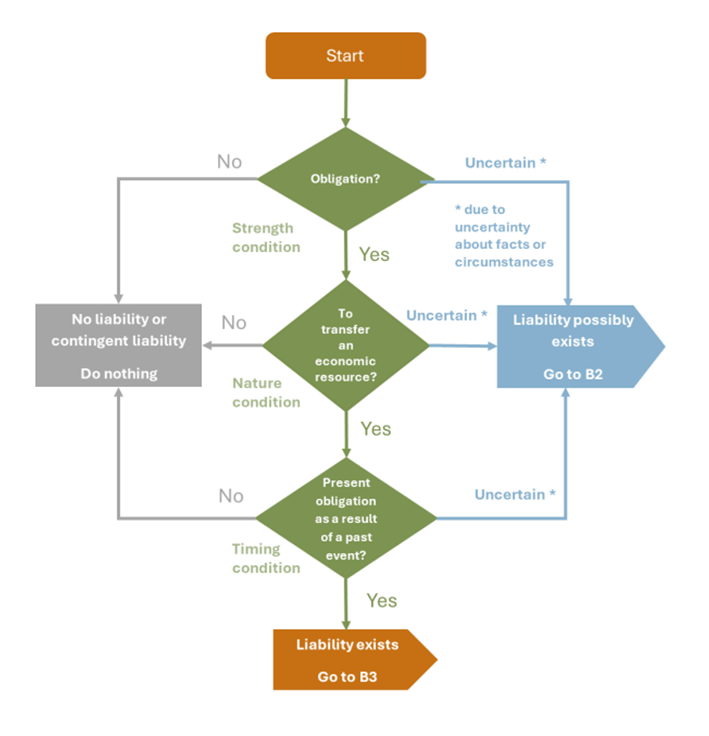
Source: IASB April 2024 Agenda Paper 22F.
Additional decisions needed if it is possible but not certain that a liability exists.
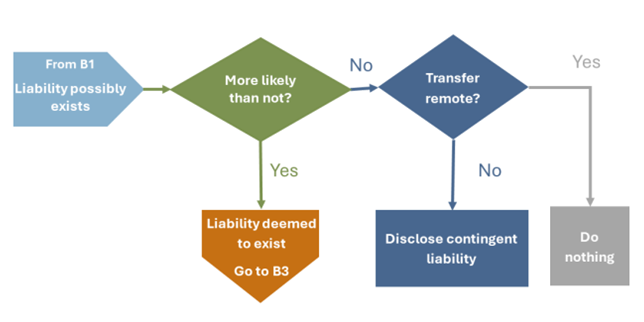
Source: IASB April 2024 Agenda Paper 22F.
Recognition criteria 2 and 3 – transfer probable and reliable estimate.
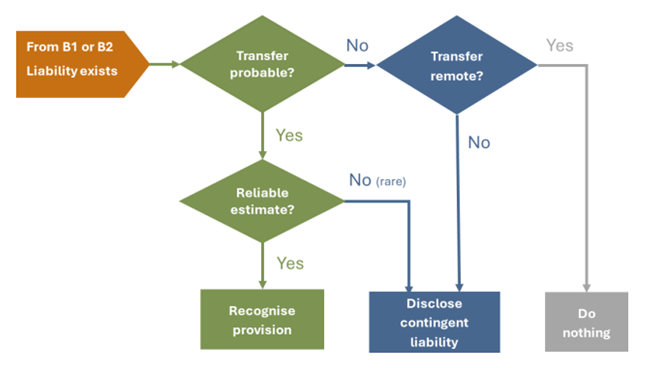
Source: IASB April 2024 Agenda Paper 22F.
Appendix B: IASB General Update: Intangibles
UKEB Project Status: Active Monitoring IASB Next Milestone: TBC
Background
B1. At its April 2024 meeting, the IASB started its project on Intangible Assets and discussed the initial work it will do on this project. The IASB was not asked to make any decisions, but it was presented with the staff's preliminary ideas about the scope of the project, and possible approaches that could be taken to staging the work. The IASB discussion is summarised in the IASB Update for the May 2024 UKEB Board meeting (Agenda Paper 8: Appendix D).
B2. The Secretariat understands that the IASB will use the rest of 2024 to discuss these same issues with stakeholders.
B3. As part of its engagement with stakeholders the IASB staff presented a paper on scope and approach to the IFRS Interpretations Committee at its June 2024 meeting11 and asked for members' input. A summary of members' views is provided at appropriate points in the paper below.
B4. The UKEB is also engaging with stakeholders, building on its extensive research12, to help inform its discussions with the IASB on this project. Currently it is focusing on Advisory Groups (AG). A summary of AG members' views is provided at appropriate points in the paper below.
B5. The UKEB will present its intangibles research at the July 2024 ASAF meeting. This session will be immediately followed by an IASB session on intangibles. The nature of the IASB session is described in the ASAF agenda as follows:
"The staff will commence discussions with ASAF on the project and will seek initial views on the scope of the project and how the project should be phased to achieve timely improvements to the accounting for Intangible Assets".
Possible IASB considerations for the scope of its intangibles project
B6. A list of questions about the possible scope of the IASB's intangibles project was presented in its April 2024 agenda papers and refined for the June 2024 IFRS Interpretations Committee discussion:
Scope
- Should the IASB focus on financial statement elements (for example, the useful lives of recognised intangible assets) or should it also explore a broader range of information (for example, customer numbers, footfall, net promoter scores and so on)?
- What intangible items should the IASB explore providing more information about: recognised intangible assets, unrecognised intangible assets, or intangible items that don't meet the definition of an asset?
- Should the IASB explore the recognition of intangible items that don't meet the definition of an asset (for example, assembled workforce)?
- Should goodwill remain out of scope of IAS 38 and the project?
- Should the IASB explore further scope exclusions from IAS 38 for intangible assets that might be better addressed in another IFRS accounting standard?
- If the IASB does not modify the scope of IAS 38, should the IASB specifically consider the accounting requirements for cryptocurrencies and emission rights in the project?
B7. In their discussion on scope, several IASB Board members highlighted the need to fully understand what the problem(s) is(are) and not to narrow the project scope too soon. Their initial aim is to better understand stakeholders views on the overall objective for the IASB's project.
B8. IFRS Interpretations Committee members expressed diverse views on the possible scope for the project. The most common view was that the project should be pragmatic and focus on narrow-scope amendments to address current application issues such as cloud computing, carbon credits and cryptocurrencies. A minority of members were concerned this approach would not future-proof the standard(s) for emerging intangibles in the future nor would this approach address users' concerns about lack of disclosure.
B9. At its June 2024 meeting, the UKEB's Investor Advisory Group (IAG) was asked to comment on these scope considerations. The key themes highlighted by IAG members during their discussion are shown in the table below13.
| Issue | IAG feedback |
|---|---|
| Comparability between companies that grow organically and those that grow by acquisition | Lack of consistency, undermines usefulness of IFRS financial statements (consistent with UKEB intangibles research). |
| The boundary between goodwill and intangible assets in business combinations; valuation | Clearer boundary needed; subjectivity and volatility in valuation of intangible assets (consistent with UKEB intangibles research). |
| Solving soluble problems | Some issues do not appear to have a feasible solution – IASB should focus on those issues where there is a feasible solution. |
| Market/book values; return on investment | Not useful to attempt to bridge the gap between market and book value by encouraging recognition of more intangible assets, as so many non-financial factors drive the gap. Improved sustainability disclosures may help to bridge the gap anyway. Is it more helpful to view intangibles from an ROI perspective and consider what would be useful information for users from that perspective? |
| Inconsistencies with US GAAP | FASB approach of addressing specific types of intangibles with US GAAP pronouncements seen as of interest to some. Reducing inconsistencies between IFRS and US GAAP would be useful. |
B10. At its June 2024 meeting, the Preparer Advisory Group (PAG) was also asked to comment on the scope considerations. The consensus among this group appears to be that the project should have a relatively narrow scope and should focus on ameliorating the practical issues with IAS 38 experienced by preparers and users.
Some key themes highlighted by PAG members during their discussion are shown in the table below.
| Issue | PAG feedback |
|---|---|
| Investors disregard intangibles | The preparers are strongly of the view that investors largely disregard intangibles. It is not the role of accounting to bridge the gap between book values and market values of companies. |
| Comparability between companies that grow organically and those that grow by acquisition | Because how the intangibles were derived largely drives the accounting, there is a lack of comparability between otherwise similar companies (consistent with UKEB's intangibles research). |
| Acquired intangibles | The value is relevant at the acquisition date but ceases to be so afterwards – effectively frozen as so difficult to revalue, with only amortisation and impairments impacting the balance. Companies that are acquisitive provide information for investors in the annual report, APMs etc, so further requirements are not needed. |
| Unrecognised intangibles | Concerns about extra disclosure requirements – companies that are are not in high R&D industries may not gather this granular expense information. Cost of recognition and disclosure may outweigh the benefit. |
| Boundary of intangibles project | Focus on IAS 38 – do not reopen goodwill and E&E assets. Oil and gas companies provide relevant information for investors already so new accounting standard requirements are not needed. |
| Conceptual framework | Could start by considering how to align IAS 38 with the 2018 CF and addressing those inconsistencies. |
Questions for the Board
- 1. Do Board members have comments on the scope considerations for the IASB's intangibles project?
Possible IASB approaches to undertaking its intangibles project
B11. The IASB staff presented three possible approaches to undertaking the project, with pros and cons of each one, while emphasising that each of these approaches would still constitute a comprehensive review. They also explained that the three approaches are not necessarily exhaustive.
B12. The approaches are summarised in the table below.
| All-in-one Approach | |
| • | All topics identified by stakeholders to be further researched to identify problems and possible solutions. Single discussion paper/exposure draft for consultation and new or amended IFRS accounting standard |
| • | The consultation documents and standard would only be issued after all topics have been fully considered |
| Early evaluation Approach | |
| • | Initial outreach used to assign priorities to topics. Only topics meeting thresholds (to be determined, but could be based on urgency, prevalence, likelihood of feasible solution, likelihood of benefits outweighing costs) would be explored further in the project to identify problems and possible solutions. Single consultation document relating to the priority topics only. |
| Phased Approach | |
| • | Phase work based on stakeholder feedback e.g., disclosure, then recognition, then measurement or by intangible asset type. Separate due process document issued on each stage |
| • | IASB staff envisage sequential phases, but more than one phase could be worked on concurrently, if there is sufficient resource allocated to the project |
B13. At its June 2024 meeting, the UKEB's Investor Advisory Group was asked to comment on these possible approaches to staging the project. The main themes highlighted by IAG members during their discussion are shown in the table below.
| Approach | IAG feedback |
|---|---|
| Early evaluation | May meet users' demands on a timely basis. A 20-year timeframe for an all-in-one project would not meet users' needs |
| Conceptual basis | Key question in determining approach is whether the project goes back to first principles or is a more reactive narrow-scope response to current issues. Members would like to see a principled approach, but not at the expense of taking significant time to complete. |
| Phased approach | An approach that phases by types of intangibles might be able to address the higher priority issues first, allowing other issues to be returned to later |
B14. At its June 2024 meeting, the Preparer Advisory Group was also asked to comment on the scope considerations. There was consensus among this group that an early evaluation approach should be taken. It should focus on identifying concrete examples of where the standard is currently not working. Once this phase had been completed, it would then be possible to review the rest of IAS 38 and amend it to create an overarching principles-based framework for accounting for intangibles, if desired.
Questions for the Board
- 2. Do Board members have comments on:
- The possible approaches to staging the IASB's intangibles project?
- The suggestion by some IASB board members that phasing by intangible asset type rather than a 'disclosure first' approach should be considered?
Next steps
B15. We will be discussing these topics with the Accounting Firms and Institutes Advisory Group (AFIAG) on 1 July 2024.
B16. The UKEB will present its research findings to the July 2024 ASAF meeting and participate in the subsequent discussion of the IASB's intangibles project.
B17. The UKEB is in the process of engaging with various UK and international stakeholders on its own intangibles research findings and the IASB's intangibles project.
B18. It is expected that the IASB will continue to have discussions with National Standard Setters and other stakeholders about project scope and approach over the coming months. The UKEB will participate in these discussions as appropriate. Today's session and engagement with stakeholders will inform these discussions.
Appendix C: Financial Instruments with Characteristics of Equity
UKEB Project Status: Active Monitoring IASB Next Milestone: Decide Project Direction (expected July 2024) UKEB project page UKEB Final Comment Letter (Published 3 April 2024)
Background
C1. In November 2023 the IASB published its Exposure Draft (ED) Financial Instruments with Characteristics of Equity (FICE), setting out proposed amendments to IAS 32 Financial Instruments: Presentation, IFRS 7. Financial Instruments: Disclosures, and IAS 1 Presentation of Financial Statements. The UKEB response to the IASB was submitted on 3 April 2024.
Purpose of this update
C2. The IASB met on 20 May 2024 to discuss an initial summary of the feedback and key themes emerging from comment letters responding to the ED.
C3. The purpose of this paper is to provide the Board with an update on the IASB meeting, and to give an indication of timeframes for this project. IASB staff are due to provide an update on the project at ASAF in July 2024, where they will seek ASAF members' views on the feedback summary, and the topics to be prioritised for redeliberations.
May 2024 IASB meeting
C4. The IASB staff paper14 summarised the feedback from the 137 comment letters, as well as other outreach meetings. No decisions were taken at the meeting. The staff will return with detailed comment letter analyses on the different topics addressed by the ED for redeliberation at future IASB meetings.
C5. While there was some general support for aspects of the proposals, only two of the ten topics were identified as having overall positive feedback. Those two topics were shareholder discretion and disclosure requirements for subsidiaries without public accountability.
C6. One of the ten topics (Laws and Regulations) was ranked as red15, and all other topics were marked as some shade of yellow. In addition, significant adverse comments were noted in relation to the proposals for obligations to purchase own equity instruments and reclassification of financial liabilities and equity instruments - the two topics highlighted in the UKEB Final Comment Letter. A number of other aspects of feedback provided in the UKEB Final Comment Letter are reflected in the IASB summary.
C7. No detailed technical discussion of any topics took place at this meeting. Detailed analyses of the feedback on those topics will be considered at future IASB meetings for further deliberation and tentative decisions.
C8. IASB members briefly discussed the possible next steps on topics where it received significant negative feedback to the proposals. A range of views were expressed, including whether in some cases potentially unpopular decisions would need to be taken to eliminate existing diversity in practice. Members noted that where there was mixed feedback on a topic, decisions as to whether to proceed with the proposals could give rise to a change in outcome that is unpalatable for stakeholders. It was also noted that the mixed feedback on these topics was unsurprising, given that they had been included in the project expressly to address known diversity in practice. It was recognised that, as this project was no longer focused on a more fundamental review of IAS 32, one alternative for some of these topics may be to drop the proposals, and, in effect, accept diversity in practice.
Next steps
C9. IASB staff are expected to bring papers to the July 2024 IASB meeting, currently tagged in the IASB workplan as a session to decide project direction. The UKEB Secretariat will bring an update on progress to a future Board meeting.
Question for the Board
- 1. Do Board members have questions or comments on the IASB's feedback summary.
- 2. Do Board members have any recommendations of topics that the UKEB should encourage the IASB to prioritise during the discussion at ASAF?
Appendix D: Rate-regulated Activities
Discussion
UKEB Project Status: Monitoring IASB Next Milestone: Continued redeliberations on remaining topics throughout 2024. UKEB Project page UKEB Final comment letter (Published July 2021)
Background
D1. At its May 2024 meeting, the IASB continued its redeliberations following feedback on its Exposure Draft Regulatory Assets and Regulatory Liabilities (the ED). The following topics were discussed:
- Interaction with IAS 12 Income Taxes; and
- Amendments to IAS 8 Accounting Policies, Changes in Accounting Estimates and Errors.
D2. The UKEB did not comment on either of these topics in its final comment letter (FCL)16.
D3. Table 1 below summarises the IASB's proposals contained in the ED and the IASB's tentative decisions on these two topics.
D4. The IASB also discussed additional amendments to other IFRS Accounting Standards for which the ED did not propose amendments. These had been raised by a few respondents to the ED. The staff provided their responses to these comments but the IASB was not asked to make any decisions. The UKEB did not comment on any of these topics in its FCL.
D5. Table 2 below summarises the other comments received about other IFRS Accounting Standards and the IASB staff responses.
| Table 1: ED proposal | IASB tentative decision |
|---|---|
| Interaction with IAS 12 Income Taxes | |
| The ED, in the Application Guidance, discusses: a) regulatory assets and regulatory liabilities that arise when the regulated rates do not yet fully reflect compensation (charge) for current tax expense (income), or for deferred tax liabilities (deferred tax assets); b) tax effects arising from the recognition of a regulatory asset or regulatory liability; and c) accounting for the tax effects in (b) when a regulator provides compensation (charge) for those effects in future regulated rates. Paragraph B43 states that an entity is required to recognise a regulatory asset (liability) if some or all of the current and deferred tax effects of transactions in the current period will affect the regulated rates in future periods or affected the regulated rates in earlier periods. Paragraph B44 goes on to state that the tax base of a regulatory asset (liability) is typically nil and, therefore, that the recognition of a regulatory asset (liability) typically gives rise to a deferred tax liability (asset) in accordance with IAS 12. This paragraph also states that, before applying IAS 12, an entity is required to assess how income taxes affect the measurement of regulatory assets and regulatory liabilities. |
The IASB tentatively decided to clarify that: a) the income tax consequences of a regulatory asset or regulatory liability might give rise to a separate regulatory asset or regulatory liability; and b) an entity would determine the tax base of a regulatory asset or regulatory liability by applying the requirements of IAS 12. Secretariat view The Secretariat will discuss this topic at a future UKEB Rate-regulated Activities Technical Advisory Group (RRA TAG) meeting. |
| Paragraph B45 states that an entity, in estimating the future cash flows from a regulatory asset (liability), is required to consider the effect of amounts it is entitled (obliged) to add (deduct) in determining future regulated rates as a result of paying (recovering) any income taxes as it recovers (fulfils) the regulatory asset (liability). | |
| Amendments to IAS 8 Accounting Policies, Changes in Accounting Estimates and Errors | |
| The ED proposes to delete paragraph 54G of IAS 8 because it provides a temporary exception that would no longer be needed when applying the proposals of the ED. The temporary exception requires an entity developing an accounting policy for regulatory account balances to refer to the Framework for the Preparation and Presentation of Financial Statements. |
The IASB tentatively decided to retain the proposal in the ED to delete the temporary exception in paragraph 54G of IAS 8. Secretariat view The Secretariat will discuss this topic at a future RRA TAG meeting. |
| Table 2: ED proposal | IASB staff response |
|---|---|
| Suggested amendments to other IFRS Accounting Standards | |
| IAS 7 Statement of Cash Flows | |
| Some respondents suggested the IASB include guidance in IAS 7 on how an entity should consider its regulatory income and regulatory expenses in its statement of cash flows. One respondent suggested amending IAS 7 to include an explanation that the cash flows of an entity would be unaffected as an entity would recover regulatory assets or fulfil regulatory liabilities indirectly by increasing or decreasing regulated rates charged to customers, not directly by receiving or paying cash. | The IASB staff responded that they did not consider that there is a need to amend IAS 7 to refer to regulatory assets and regulatory liabilities and that any improvements to the guidance in IAS 7 could be considered as part of the project on ‘Statement of Cash Flows and Related Matters'. Secretariat view It seems reasonable to address this matter in the pipeline research project on the statement of cash flows (expected to start in H2 2024). |
| IAS 34 Interim Financial Reporting | |
| Feedback included: a) The IASB should provide guidance on how an entity should account for its regulatory assets and regulatory liabilities in the interim financial statements. b) Some of the inputs affecting the recognition and measurement of regulatory assets and regulatory liabilities are available only on an annual basis. Regulatory agreements are often negotiated on the basis of annual data - consequently, information for shorter periods may not have been previously considered. As a result, the entities may not have the processes to collect data during the reporting period and preparing interim financial statements could be difficult or costly. |
a) Although the IASB staff acknowledged that an entity may be required to apply more judgement in recognising and measuring regulatory assets and regulatory liabilities at the end of the interim reporting period than at the end of an annual reporting period due to possible greater reliance on estimates and the need to consider cyclical or seasonal items, these issues are not confined to regulatory assets and regulatory liabilities and IAS 34 already contains some guidance on these matters. The staff therefore do not think the final Standard should amend IAS 34. b) The staff acknowledged that, although entities may need to modify their systems and processes to support the recognition and measurement of regulatory assets and regulatory liabilities in interim financial statements, the costs would be a one-off implementation cost. Secretariat view The Secretariat's initial view is that the staff's response to a) seems reasonable. Due to the fact that the entities agree timing differences with the regulators only at specific points in time, the Secretariat is not certain that the staff's response to b) addresses all the concerns raised and will discuss this topic at a future RRA TAG meeting. |
| IFRS 8 Operating Segments | |
| Feedback included: a) To amend IFRS 8 to require an entity to report rate-regulated activities separately from other activities. b) The IASB should require disclosure of the financial effects of regulatory assets and regulatory liabilities for each reportable segment. |
a) In its discussions on disclosures in February 2024, the IASB tentatively decided to retain the proposals on aggregation or disaggregation of disclosures in the ED and to include examples of the characteristics an entity could use to aggregate or disaggregate disclosures, including items relating to the different revenue categories an entity discloses by applying paragraph 114 of IFRS 15 Revenue from Contracts with Customers. b) The staff do not think it is appropriate to amend IFRS 8 as it is based on a management approach and mandating disclosure of |
specific items would be inconsistent with the management approach. Also, IFRS 8 is not routinely amended to reflect the disclosure requirements in new standards and it already requires the disclosure of specified amounts for each reportable segment.
Secretariat view
The staff response seems reasonable.
|
D6The IASB will continue its redeliberations on the feedback received on the ED at future meetings. Future redeliberations will focus on the following topics:
- Amendments to other IFRS Accounting Standards.
- Effective date and transition.
| Questions for the Board |
|---|
| 1. Do Board members have questions or comments on the tentative decisions the IASB made as set out in Table 1? |
| 2. Do Board members have questions or comments on the IASB staff responses to the suggested amendments to other IFRS Accounting Standards as set out in Table 2. |
Appendix E: Climate-related matters
E1This paper contains an update on the IASB project Climate-related and Other Uncertainties in the Financial Statements (CROUFS) and Pollutant Pricing Mechanisms (PPMs) discussions at the July 2024 Accounting Standards Advisory Forum (ASAF) meeting.
Climate-related and Other Uncertainties in the Financial Statements
| UKEB Project Status: Monitoring | |
|---|---|
| IASB Next Milestone: Exposure Draft (Q3, 2024) | IASB project page |
E2The IASB last discussed the Climate-related and Other Uncertainties in the Financial Statements (CROUFS) project to agree its direction for the project at its April 2024 meeting.
E3At that meeting the IASB tentatively decided 1 that:
- the CROUFS project would provide examples illustrating how an entity applies IFRS Accounting Standards to report the effects of climate-related and other uncertainties in the financial statements
- these illustrative examples would accompany IFRS Accounting Standards; and;
- it would publish an exposure draft with a 120-day consultation period to obtain feedback from stakeholders about the examples.
E4The IASB is currently in the process of balloting members for an exposure draft. Feedback on the exposure draft, which is planned to be published in Q3 2024, is expected to help the IASB decide whether any standard-setting is required.
E5The UKEB will consider a Project Initiation Plan at its July 2024 meeting.
Accounting Standards Advisory Forum (ASAF) July 2024
Pollutant Pricing Mechanisms – horizon scanning outcomes
E6At the July 2024 ASAF meeting, the IASB will present a summary of the feedback from outreach on PPM horizon scanning activities. ASAF members are expected to be asked to comment on the feedback, consider if the IASB should prioritise a project on PPMs, and what the impact may be on other projects in the IASB workplan.
E7The responses from international users, regulators, and National Standards Setters (NSS) noted in the IASB papers are broadly aligned with the UKEB PPM survey response to the IASB 2. The IASB staff paper summarising feedback from NSS noted several examples from the UKEB survey response regarding the research into accounting treatment of carbon credits in the aviation industry financial statements.
E8The UKEB participated in the IASB's original outreach on this matter. At its March 2024 meeting it also considered options for the IASB to create capacity for a new project. Please refer to Annex A of this paper for a summary of the IASB outreach and suggestions from the UKEB for the IASB to create capacity for a PPM project.
E9UKEB also provided a response to the IASB on its subsequent request to ASAF members for feedback on Renewable Energy Certificates (RECs). However, RECs do not appear to be discussed in the IASB papers. Annex B contains the UKEB response to the IASB regarding RECs.
AcSB and FASB PPM research
E10The July 2024 ASAF agenda also includes two further PPM related agenda items. The Canadian national standard setter (AcSB) will present an update on their carbon credits research 3 and the US Financial Accounting Standards Board (FASB) will present an update on their Accounting for Environmental Credit Programs 4.
E11Both AcSB and FASB previously presented these topics at the April 2024 meeting of the International Forum of Accounting Standard Setters (IFASS). A summary of the key points from those presentations was provided to the UKEB at the May 2024 meeting 5.
E12The AcSB paper includes four questions for ASAF members to consider which are set out below and include preliminary views from the UKEB Secretariat. The FASB presentation provides an overview of their approach but does not ask any specific questions of ASAF members. A summary of the FASB approach is also provided for information.
AcSB approach and questions for ASAF to consider
AcSB question one
E13Is a unique approach required in IFRS for the accounting for carbon credits or do the range of current approaches still provide the most useful information?
UKEB Secretariat preliminary comment
E14UKEB PPM survey response noted that while carbon credits were not yet material for many entities the lack of guidance had resulted in diversity in practice. Stakeholders expected that diversity to become more pronounced as entities increasingly used carbon credits to meet their carbon reduction targets or started to generate credits themselves.
E15Regulators have observed that PPMs can be a challenging area to enforce due to the lack of specific standards. Preparers have advised that they are having to create new accounting policies in the absence of standards and consistent guidance.
E16This appears to suggest that, while a different approach may be required it does not necessarily mean that the approach should be unique. For example, the UKEB Investor Advisory Group (IAG) noted 6 that some diversity in measurement for PPMs may be necessary but that this should be determined based on the entities rational for holding them and that a potential IASB PPM project could be incorporated within a broader IASB project on Intangibles.
AcSB question two
E17Voluntary credits purchased solely for retiring may only qualify for recognition as an asset (specifically, an intangible) to the extent they can be used to offset a related provision. Does that make them different enough from other intangibles to warrant a different accounting treatment?
UKEB Secretariat preliminary comment
E18Assuming there is no other use than offsetting a related provision it does seem reasonable voluntary carbon credits would only be recognised to that extent.
E19This does not necessarily make them different from other intangible assets. We can envisage circumstances where non-transferable licenses were purchased, but their intended use would be more limited than the full license allows (an intention to manage a fishery more sustainably and therefore take less than the full quota perhaps). This would presumably be assessed as part of any impairment testing of the value of the asset.
E20If there is a concern with the accounting it seems more likely that improving IAS 38 would provide a better solution than carving out a new standard, as it is likely that other similar instruments could emerge that raise similar issues.
AcSB question three
E21Given the areas of judgment and risk, is any additional guidance warranted beyond what IFRS currently contains (e.g., guidance on measuring credits that are internally-generated intangibles, additional disclosures for ex-ante credits)?
UKEB Secretariat preliminary comment
E22The existing guidance in IAS 38 has been applied by some UK entities in how they account for carbon credits. IAS 38 mentions within its scope fishing licences and import quotas (IAS 38 para.9), which have similar features to carbon credits. IAS 38 confirms that benefits underlying intangible assets can include potential future cost savings (IAS 38 para. 17) which would be the expected benefits from retiring carbon credits to extinguish a liability relating to carbon emissions.
E23We have not seen any examples in our review of listed company IFRS financial statements that indicate entities are using the capitalisation criteria (IAS 38 para.57) to capitalise internally-generated carbon credits as development costs. However, we have observed examples of carbon credits being classified into current and non-current intangibles due to range of periods over which it is anticipated credits will be utilised. In addition, preparers have advised of challenges with accounting for development costs for projects that will produce carbon credits in future e.g., creating a 'carbon sink' from restoring a peat bog. It is potentially challenging to attempt to read across from the capitalisation criteria designed for research and development and apply them to carbon credits.
E24It is feasible for purchased carbon credits recognised at cost to be revalued to fair value during their life cycle by reference to active carbon credits markets (IAS 38 para.75). However, existing guidance and required disclosures in IAS 38, as well as materiality, should form an adequate basis for entities to determine the level of disaggregation in their intangible asset notes regarding carbon credits.
E25We are aware that some entities in the UK recognise some carbon credits as inventory under IAS 2 Inventories (IAS 2) if they are held for sale in the ordinary course of business or are considered as being an input to produce the entity's products for sale to customers. We believe that the existing guidance in IAS 2 is sufficient for entities to apply this standard to carbon credits.
E26The UKEB staff's preliminary view is that we concur with the AcSB staff that 'there is a way to navigate [existing] IFRS to develop an accounting approach for carbon credits' (slide 18). However, to enhance understandability and improve consistency of the information provided in IFRS financial statements, UKEB research suggests that some (principles based) amendments (clarifications and updates) to IAS 38 may be helpful for some stakeholders These could address, the development costs capitalisation criteria and any related disclosures as a way for the IASB to provide additional guidance on the accounting for carbon credits.
AcSB question four
E27Would expensing voluntary credits inappropriately disincentivize entities that are trying to make a positive impact on climate?
UKEB Secretariat preliminary comment
E28We have not conducted any detailed outreach with stakeholders in relation to voluntary carbon markets (VCM) but note the AcSB comments that some users favoured immediate expense recognition, viewing the cost in a similar way to a marketing expense.
E29We note that in circumstances where voluntary carbon credit payments are treated as an expense, and where the payment relates to carbon anticipated to be emitted in a future accounting period, further guidance may be required as to whether such expenditure should be treated as a prepayment.
E30We are aware that some users have expressed lower confidence in voluntary credits due to a lack of regulation and that HMRC has recently advised the use of voluntary carbon credits in supplies of goods and services will attract VAT 7.
E31However, as noted above, from a financial reporting perspective, while there may be scope for improvement, the current standards appear broadly fit for purpose.
FASB approach - Accounting for Environmental Credit Programs
E32A summary of the FASB ASAF presentation is provided for information. FASB is currently preparing an exposure draft with a 90-consultation period. FASB intends to complete redeliberations in 2025.
Asset recognition
- Asset are recognised when it is probable that an entity will sell the environmental credit or use that credit to settle an environmental credit obligation. Cost of other credits are expensed as incurred. For example, the cost of credits acquired for voluntary purposes.
Measurement
- Generally measured at cost, less impairment.
Liability recognition
- Recognize a liability for the number of environmental credits that would be due to a regulator
Measurement
- Generally dependent on whether the entity owns sufficient compliance environmental credits. Funded liabilities measured using the carrying amount of compliance environmental credits to be derecognized upon settlement. Unfunded liabilities measured using the fair value of credits at the balance sheet date necessary to satisfy the environmental credit obligation.
Qualitative Disclosures (Annual Only)
- Information regarding an entity's environmental credit programs, including the activities that give rise to obligations
- Information about an entity's environmental credits, including how an entity obtains and uses environmental credits
Quantitative Disclosures (Annual and Interim)
- Description and carrying amount of significant environmental credit holdings and liabilities
- Revenues or gains/losses from sales of environmental credits
- Cost of environmental credits, including those expensed as incurred (cost of voluntary credits)
- Cash paid for purchases of environmental credits
Transition
- Modified retrospective application - prior periods not recast
- Additional guidance to facilitate transition
| Questions for the Board |
|---|
| Do Board members have comments on: |
|
Annex A: ASAF July 2024 PPM
Pollutant Pricing Mechanisms
ASAF update – IASB PPM horizon scanning activities
E33The IASB staff intend to share update on horizon scanning activities in relation to Pollutant Pricing Mechanisms (PPMs), including:
- an oral update on the discussion at the June 2024 IASB meeting
- a summary of feedback from the PPM questionnaire sent to ASAF members
- seeking input on whether the IASB should prioritise a project on PPMs
E34Following the ASAF meeting the IASB will discuss the topic with the IASB Advisory Council in September 2024. In Q4, 2024 the IASB intends to decide whether to prioritise a project on pollutant pricing mechanisms.
E35The IASB staff have reproduced the June 2024 IASB agenda papers for the ASAF briefing. A summary of the key points in each paper is provided below for information.
Horizon scanning activities and feedback summary
E36The IASB have conducted a wide range of horizon scanning activities with users and regulators. The key observations were noted as:
- The prevalence of both compliance schemes and voluntary schemes is increasing.
- Compliance markets are more mature than voluntary markets and the accounting issues are better defined.
- There is diversity in accounting for both compliance schemes and voluntary schemes.
- Limited outreach with users suggests that they receive insufficient information about an entity's participation in both types of schemes, although some of the requested information may be outside the scope of financial statements.
- It is difficult to assess the materiality of these schemes to IFRS reporters. However, an increasing number of IFRS reporters are participating in these schemes, and the effects are material to some entities.
E37The IASB noted that almost all users advised that the information provided by entities in their financial statements about their use of carbon credits was insufficient and that many users indicated that the IASB should prioritise a project on pollutant pricing mechanisms. The UKEB Investor Advisory Group 9 was noted as a participant in the survey.
E38It was also noted that most of the regulators engaged were experiencing enforcement challenges due to the diversity in accounting for PPMs, noting that the lack of requirements leads to various measurement approaches and insufficient disclosures.
Feedback summary - National Standard Setters 10
E39The IASB provided a summary of their outreach feedback on PPMs from National Standard Setters (NSS), including ASAF member responses.
E40The IASB's key observations were:
- Compliance PPM schemes
- Most NSS advised that some form of compliance scheme currently exists in their jurisdiction. The majority were cap-and-trade schemes.
- Many NSS noted that the financial effects of compliance schemes on IFRS reporters was not yet significant, however they expected this to change as governments and jurisdictions continue to look for ways to meet their climate-related commitments.
- Many NSS reported diversity in accounting for compliance schemes. The IASB noted the range of approaches such as the use of emissions rights, government grants or a net liability approach.
- Voluntary PPM schemes
- Almost all NSS noted that IFRS reporters in their jurisdictions participated in a voluntary PPM market.
- Most NSS considered that the prevalence of voluntary schemes was increasing in their jurisdictions, and they expected the financial effects of voluntary schemes to become more significant.
- Some NSS had observed diversity in accounting for voluntary schemes. Some NSS observed that these issues were like those in the compliance market such as issues related to the classification of carbon credits, and measurement approaches.
- Entities that generate or issue carbon credits
- Most NSS did not have enough information to estimate the number of IFRS reporters in their jurisdiction that generated or issued credits but believed the number to be low but increasing.
- Some NSS reported that issuing or generating credits gives rise to accounting issues that are difficult to resolve and had observed diversity in practice. The treatment of costs of generating credits and whether they should be expensed or capitalised was noted as an area that required clarification.
- PPM research
- Some NSS noted that they were conducting or planning to conduct research on PPMs.
Survey and questionnaire 11
E41The IASB paper contains the survey questions distributed to users and ASAF members. It was provided as information only.
UKEB considerations for the IASB to create capacity on its workplan for PPM project.
E42At the March 2024 UKEB meeting the board supported the IASB progressing a project on PPMs and suggested the following options to create capacity in the IASB workplan.
- Taking over capacity from IFRS 18 Primary Financial Statements, which is nearing completion.
- Incorporating a PPM project within the Intangibles project.
- Deprioritising the projects on Business Combinations – Disclosures, Goodwill and Impairment, Equity Method, Rate-regulated Activities, Dynamic Risk Management and Hyperinflation.
- Absorbing capacity from the discontinued project on Business Combinations under Common Control.
- Discontinuing the Annual Improvements project
Annex B: Renewable Energy Certificates (RECs)
E43This annex provides information on the UK market structure, prevalence, and accounting issues for Renewable Energy Certificates (RECs). Note RECs are not PPMs but rather a pricing mechanism for renewable energy. This additional information was requested post the IASB PPM survey from National Standard Setters.
Renewable Energy Certificates (RECs)
UK market structure
E44Renewable energy generators can apply for and receive renewable energy certificates to be issued to them by the regulator, Ofgem. These can be sold to other entities which may then use them to offset their energy use, for example.
Prevalence
E45Approximately 25% of the FTSE 350 referred to forms of Renewable Energy Certificates within their Annual Reports and 2% referred to them within the financial statements.
Accounting issues
E46Entities appear to classify RECs either within working capital or as intangible assets. Stakeholders observed that it was difficult to account for the RECs which accompanied power purchase agreements, as they were generally not regarded as readily convertible to cash, whereas electricity generally was.
E47Stakeholders observed contracts for power purchase agreements being accounted for as embedded derivatives, with the RECs as the host contract.
E48Users noted that if entities did not present disaggregated information, users of accounts could not adjust for the items without asking for further information, when, for example, establishing adjusted EBITDA.
Appendix F: Post-implementation Review of IFRS 9 – Impairment
| UKEB Project Status: Active Monitoring | |
|---|---|
| IASB Next Milestone: Project Summary (July 2024) | UKEB project page |
| UKEB Final Comment Letter (Published September 2023) |
F1At its May meeting the IASB concluded the Post-implementation Review of IFRS 9 - Impairment. A project summary and a feedback statement are expected to be published in July 2024.
F2A summary of the May IASB discussion and the project outcomes will be provided to the Board once the project summary and feedback statement are published.
Appendix F: Post-implementation Review of IFRS 9 – Impairment
| UKEB Project Status: Active Monitoring | UKEB project page |
|---|---|
| IASB Next Milestone: Project Summary | UKEB Final Comment Letter (Published September 2023) |
| (July 2024) |
F1At its May meeting the IASB concluded the Post-implementation Review of IFRS 9 - Impairment. A project summary and a feedback statement are expected to be published in July 2024.
F2A summary of the May IASB discussion and the project outcomes will be provided to the Board once the project summary and feedback statement are published.
Appendix G: Post-implementation Review of IFRS 15 Revenue from Contracts with Customers
| UKEB Project Status: Active Monitoring | UKEB project page |
|---|---|
| IASB Next Milestone: Feedback | UKEB Final Comment Letter (Published 26 October 2023) |
| Statement (expected Q3 2024) |
Background
G1In June 2023, the IASB published its Request for Information: IFRS 15 Revenue from Contracts with Customers (RFI) to seek stakeholders' views on the requirements in IFRS 15. The UKEB response to the IASB was submitted on 26 October 2023.
G2During its monthly meetings between February 2024 to April 2024, the IASB discussed application matters highlighted by respondents in their feedback on the various questions in the RFI.
G3Using the PIR Framework, the IASB tentatively decided whether action should be taken on any of those matters, and the priority of any such action. The annex to this paper summarises the IASB's tentative decisions to date.
Purpose of this update
G4The IASB met on 22 May 2024 and discussed:
- respondents' feedback on the final question (question 11) in the RFI, as to any Other matters12 that the IASB should examine as part of the PIR; and
- an updated academic literature review13 examining the effects of applying IFRS 15, further to the initial academic literature review discussed at the March 2023 IASB meeting. The IASB was not asked to make any decisions in relation to this literature review.
G5The purpose of this paper is to provide the Board with a summary of the tentative decisions taken by the IASB at the 22 May 2024 meeting and to set out the next steps in the project.
May 2024 IASB meeting
G6In addition to questions on specific topics, the RFI provided stakeholders with an opportunity to comment on other matters relevant to the PIR of IFRS 15. Based on the feedback the IASB staff identified one main application matter—allocating the transaction price to performance obligations in a contract.
Allocation of transaction price to performance obligations14
G7A few respondents to the RFI said applying IFRS 15 requirements on allocating the transaction price is challenging, in particular when determining a stand-alone selling price (SSP) for goods or services with no observable prices15. They suggested that the IASB add application guidance and illustrative examples to assist entities with estimating SSP, in particular for software and telecommunications industries.
G8Based on IASB staff analysis, estimating SSP and allocating the transaction price inherently requires judgement, especially when there are no observable prices. Respondents' examples of challenges mostly related to complex arrangements. Illustrative examples of specific complex fact patterns are unlikely to help many stakeholders, as the outcome could be dependent on the specific facts and circumstances.
G9The IASB tentatively decided to take no further action on the matter on the basis that the feedback provided no evidence that:
- there are fundamental questions about the clarity and suitability of the requirements;
- the benefits to users of financial statements of the information arising from applying the requirements are significantly lower than expected; or
- the costs of applying the requirements and auditing and enforcing their application are significantly greater than expected.
Other matters
G10The IASB tentatively decided to take no further action on other matters raised by one or a few respondents to question 11 of the RFI as it did not consider that there was sufficient evidence of a fundamental concern with the existing requirements, diversity in practice or ongoing costs.
G11The UKEB FCL did not make any recommendations to the IASB in response to other matters (question 11) of the RFI.
Academic literature review
G12The IASB undertook an initial review of academic literature in March 202316. The paper updated that literature review by a further 14 academic papers, examining the effects of applying IFRS 15. IASB was not asked to make any decisions.
G13The academic papers examine the implementation and application of both IFRS 15 and the Financial Accounting Standards Board (FASB) ASC Topic 606 Revenue from Contracts with Customers (Topic 606). Papers relevant to Topic 606 were included because IFRS 15 is substantially converged with Topic 606, although findings in the papers based on Topic 606 may not always reflect the experience of IFRS adopters, because of differences in previous US GAAP and IFRS revenue recognition requirements.
G14Key messages from the academic literature review were consistent with those identified in the initial review in March 2023 and are as follows:
- Overall assessment of IFRS 15 – the standard has fulfilled its objective to improve the usefulness of financial statement revenue information for users' decision-making, particularly through enhanced disclosures. Transition, whilst having a minimal impact on financial statements, involved high implementation costs due to technology updates and the need to hire skilled staff. However, the effects on management control and information technology systems led to improved operational efficiencies, despite high initial costs.
- The effects of transition to IFRS 15 on entities' financial statements – changes in practices were observed, such as the identification of performance obligations, timing of revenue recognition, measurement of contract progress, and capitalisation of contract-related costs17. However, most entities disclosed no material effects on financial statements, and for the minority that did disclose material effects, those effects varied across industry sectors and the size of entity18.
- The usefulness of revenue information for users' decisions – the implementation of IFRS 15 was not associated with an overall change in the value relevance of financial statement information, although the effects on revenue usefulness varied depending on the timing of revenue recognition, use of accounting discretion and revenue disclosures19.
- Other topics – studies showed significant differences in compliance with IFRS 15 disclosure requirements between sectors and regions. Evidence based on a European sample showed that telecommunication entities' compliance with IFRS 15 disclosure requirements was higher compared to construction entities. One study found that IFRS 15 influenced entities' strategic decisions and market share—entities simplified their operations to reduce their implementation and ongoing costs related to IFRS 15, which led to a decrease in market share for smaller entities.
Next Steps
G15In June 2024, the IASB and the FASB will hold an education session to share their findings and tentative decisions related to each board's PIR, in line with the IASB's planned timetable20. Following that meeting the IASB will finalise its decisions on the PIR, currently expected to be at the July 2024 meeting. We expect the IASB to publish a project report and feedback statement in Q3 2024.
G16The UKEB Secretariat will update the Board on developments and any further tentative decisions at future meetings.
Annex 1: IASB's tentative decisions made to date on topics raised by respondents to the RFI21
| Topics discussed | IASB's tentative decisions |
|---|---|
| 1. Identifying performance obligations (February 2024 Agenda paper 6A) | The IASB tentatively decided to take no further action on the matters related to: (a) applying the notion of a 'distinct' good or service; (b) identifying a promise to transfer goods or services; (c) convergence with FASB ASC Topic 606, Revenue from Contracts with Customers, and (d) other aspects of identifying performance obligations in a contract. |
| The IASB also tentatively decided to discuss at a later date (once all PIR topics have been discussed) whether to add some explanations from paragraphs BC105 and BC116K of the Basis for Conclusions to the Standard, along with possible clarifications of other aspects of IFRS 15. These explanations would help to clarify some aspects of (a) and, combined with the other possible clarifications, might result in sufficient improvement to IFRS 15 to warrant standard-setting. | |
| 2. Principal versus agent considerations (February 2024 Agenda paper 6B) | The IASB tentatively decided: (a) to classify as low priority the matter related to assessing control over services and intangible assets and to consider this matter in the next agenda consultation; and (b) to take no further action on the matters related to: (i) clarifying the relationship between the concept of control and the indicators in paragraph B37; (ii) identifying a customer of a supplier that sells its goods or services through an intermediary; (iii) identifying performance obligations in arrangements involving principal versus agent determinations; (iv) applying the disclosure requirements about principal versus agent determinations; and (v) other aspects of principal versus agent determinations. |
| The IASB also tentatively decided to discuss at a later date whether to add some explanations from paragraphs BC385H and BC385E of the Basis for Conclusions to the Standard, along with possible clarifications of other aspects of IFRS 15. These explanations would help to clarify some aspects of (b)(i) and (b)(ii) and, combined with the other possible clarifications, might result in sufficient improvement to IFRS 15 to warrant standard-setting. | |
| 3. Licensing (February 2024 Agenda paper 6C) | The IASB tentatively decided to take no further action on the matters related to: (a) accounting for licence renewals; (b) determining the nature of a licence; (c) determining the scope of licensing guidance; (d) accounting for sales-based or usage-based royalties; and (e) other aspects of licensing. |
| 4. Determining the transaction price (March 2024 Agenda paper 6A and April 2024 Agenda paper 6F) | The IASB tentatively decided: (a) to classify as low priority the matters related to the consideration payable to a customer; and (b) to take no further action on the matters related to: (i) variable consideration; (ii) sales-based taxes; (iii) non-cash consideration; (iv) the discount rate for contracts with a significant financing component; (v) other aspects of accounting for a significant financing component; and (vi) other aspects of determining the transaction price. |
| 5. Determining when to recognise revenue (March 2024 Agenda paper 6B) | The IASB tentatively decided to take no further action on the matters related to: (a) the application of the concept of control and the criteria for recognising revenue over time; (b) the measurement of progress for performance obligations satisfied over time; and (c) other aspects of determining when to recognise revenue. |
| 6. Disclosure requirements (March 2024 Agenda paper 6C) | The IASB tentatively decided to take no further action on the matters related to: (a) respondents' concerns about the cost-benefit balance of some disclosure requirements; (b) variation in the quality of disclosed information; and (c) other aspects of disclosure requirements. |
| 7. Applying IFRS 15 with IFRS 9 Financial Instruments (April 2024 Agenda paper 6A) | The IASB tentatively decided to take no further action on the matters related to: (a) the accounting for price reductions; (b) the accounting for liabilities arising from IFRS 15; and (c) other aspects of applying IFRS 15 with IFRS 9 Financial Instruments. |
| 8. Applying IFRS 15 with IFRS 3 Business Combinations (April 2024 Agenda paper 6B) | The IASB tentatively decided to take no further action on the matters related to: (a) the measurement of contract assets and contract liabilities acquired as part of a business combination; and (b) other aspects of applying IFRS 15 with IFRS 3 Business Combinations. |
| 9. Applying IFRS 15 with IFRS 10 Consolidated Financial Statements and IFRS 11 Joint Arrangements (April 2024 Agenda paper 6C) | The IASB decided to confirm it will consider the priority of the matters related to applying IFRS 15 with IFRS 10 Consolidated Financial Statements and IFRS 11 Joint Arrangements in the next agenda consultation instead of as part of the PIR of IFRS 15. |
| 10. Applying IFRS 15 with IFRS 16 Leases (April 2024 Agenda paper 6D) | The IASB tentatively decided: (a) to gather further evidence in the forthcoming PIR of IFRS 16 Leases on the application matters related to assessing whether the transfer of an asset is a sale in a sale and leaseback transaction; and (b) to take no further action on the matters related to: (i) the accounting for contracts that contain lease and non-lease components; and (ii) other aspects of applying IFRS 15 with IFRS 16. |
| 11. Applying IFRS 15 with other IFRS Accounting Standards (April 2024 Agenda paper 6E) | The IASB tentatively decided: (a) to classify as low priority the matter related to applying the requirements in IFRIC 12 Service Concession Arrangements on contractual obligations to maintain or restore service concession infrastructure; and (b) to take no further action on the other matters related to applying IFRS 15 with other IFRS Accounting Standards. |
Appendix H: Interpretations Committee update
| UKEB Project Status: Monitoring | |
|---|---|
| IASB Next Milestone: |
Background
H1The UKEB's Due Process Handbook notes that the UKEB expects to respond to a limited number of tentative agenda decisions published by the IFRS Interpretations Committee (Interpretations Committee). Some factors to consider when deciding whether to respond may be:
- the degree of impact of the tentative agenda decision on UK companies (for example, in cases where the tentative agenda decision is expected to affect a significant number of UK companies);
- disagreement with the Interpretations Committee's analysis; or
- usefulness of the explanations and clarifications included in the tentative agenda decision.
H2The Interpretations Committee held a meeting on 11 June 2024.
H3In addition to the Agenda Decisions noted below the Interpretations Committee provided input on:
- Intangible Assets
- Business Combinations – Disclosures, Goodwill and Impairment.
These discussions form part of the wider stakeholder engagement on these projects and are not discussed in this update.
| MATTERS RECEIVED BUT NOT YET PRESENTED TO THE INTERPRETATIONS COMMITTEE | |
|---|---|
| Topic | Accounting for corporate guarantee contracts issued by the Investor entity in relation to obligations of its joint venture in its separate financial statements. |
| Standard | IFRS 9 |
| Question22 | There are diverse views on whether a corporate guarantee contract issued by an investor entity in relation to obligations of its joint venture entity should be accounted for as a financial guarantee contract or not in the separate financial statements of the investor entity. The submission is seeking clarification from the IFRS Interpretations Committee on the issue detailed in 3 cases. |
| Comment | The Secretariat is currently assessing the potential degree of impact of the matter on UK companies. We plan to discuss it with the Accounting Firms and Institutes Advisory Group, the Financial Instruments Working Group and the FRC ahead of the July Board meeting. |
| TENTATIVE AGENDA DECISIONS OPEN FOR COMMENT | |
| Topic | Classification of Cash Flows related to Variation Margin Calls on 'Collateralised-to-Market' Contracts |
| Standard | IAS 7 |
| Deadline | TBC |
| Question23 | The Committee received a request about how an entity presents, in the statement of cash flows, cash payments and receipts related to variation margin calls on contracts to purchase or sell commodities at a predetermined price in the future. |
| Tentative conclusion24 | Evidence gathered by the Committee indicated that the matter described in the request is not widespread. On the basis of that evidence, the Committee concluded that the matter described in the request does not have widespread effect. Consequently, the Committee decided not to add a standard-setting project to the work plan. |
| Comment | The UKEB considered this matter in January 2024 and concluded that it did not appear to affect a significant number of UK companies. It concluded it would not respond to this matter. |
Question for the Board
1In the light of the Interpretation Committee's tentative conclusion, and assuming there are no substantive changes to the conclusion once published, do Board members agree that the UKEB will NOT undertake any work on this matter?
| AGENDA DECISIONS WAITING FOR IASB RATIFICATION | |
|---|---|
| Topic | Disclosure of revenues and expenses for reportable segments—Application of IFRS 8 |
| Standard | IFRS 8 |
| Question25 | Three questions are asked regarding the current application of IFRS 8 paragraph 23: 1. is an entity required to disclose the specified amounts in paragraph 23(a)−(i) of IFRS 8 for each reportable segment if those amounts are not reviewed separately by the chief operating decision maker (CODM)? 2. is an entity required to disclose the specified amounts in paragraph 23(f) of IFRS 8 for each reportable segment if the entity presents or discloses those specified amounts applying a requirement in IFRS Accounting Standards other than paragraph 97 of IAS 1 Presentation of Financial Statements? 3. How does an entity determine ‘material items' in paragraph 23(f) of IFRS 8? In particular: a. are 'material items' only those that are material on a qualitative basis? b. do 'material items' include amounts that are an aggregation of individually quantitatively immaterial items? c. is the materiality assessment performed at an income statement level (from an overall reporting entity perspective) or at a segment level? |
| Final conclusion26 | The Committee concluded that an entity is required to disclose the specified amounts in paragraph 23 of IFRS 8 not only when those specified amounts are separately reviewed by the CODM. The Committee observed that, in applying paragraph 23(f) of IFRS 8, an entity: a) applies paragraph 7 of IAS 1 and assesses whether an item of income and expense is material in the context of its financial statements taken as a whole; b) applies the requirements in paragraphs 30–31 of IAS 1 in considering how to aggregate information in the financial statements; c) considers the nature or magnitude of information, in other words, qualitative or quantitative factors, or both, in assessing whether an item of income and expense is material; and d) considers circumstances including, but not limited to, those in paragraph 98 of IAS 1 The Committee observed that paragraph 23(f) of IFRS 8 does not require an entity to disaggregate by reportable segment each item of income and expense presented in its statement of profit or loss. The Committee concluded that the principles and requirements in IFRS Accounting Standards provide an adequate basis for an entity to apply the disclosure requirements in paragraph 23 of IFRS 8. |
| Comment | The UKEB considered this matter in September and December 2023. The Board concluded that it did not appear to affect a significant number of UK companies nor did they disagree with the analysis. It concluded it would not respond to this matter. There have been minor changes to the wording of the Agenda Decision from that presented to the IFRIC in March 2024. However, the substance of the Agenda Decision is consistent with that previously discussed. |
Appendix I: List of IASB projects
This Appendix provides a list of all IASB projects27, including links to the IASB project page and, where relevant, to the UKEB project page and any UKEB reports or comment letters. Items highlighted in grey are changed from the last report.
List of IASB projects
Annual Improvements (Amendments to IFRS Accounting Standards: IAS 7, IFRS 1, IFRS 7, IFRS 9, IFRS 10)
| UKEB Project Status: Monitoring | UKEB project page |
|---|---|
| IASB Next Milestone: Final Amendments July 2024 | UKEB Project Initiation Plan (Published October 2023) |
| UKEB Draft Comment Letter (Published October 2023) | |
| UKEB Final Comment Letter (Published December 2023) | |
| UKEB Feedback Statement (Published December 2023) | |
| UKEB Due Process Compliance Statement (Published January 2024) |
Business Combinations—Disclosures, Goodwill and Impairment
| UKEB Project Status: Monitoring | UKEB project page (Discussion Paper) |
|---|---|
| IASB Next Milestone: Exposure Draft Feedback Q4 2024 | UKEB Final comment Letter on the Discussion Paper (Published January 2021) |
| Submit letter by: 15/07/24 | UKEB Feedback Statement (Published March 2021) |
| UKEB Report: Subsequent Measurement of Goodwill - A Hybrid Model (Published September 2022) | |
| UKEB project page (Influencing) | |
| UKEB Project Initiation Plan (Published March 2024) | |
| UKEB Draft Comment Letter (Published May 2024) |
Climate-related and Other Uncertainties in the Financial Statements
| UKEB Project Status: Monitoring | |
|---|---|
| IASB Next Milestone: Exposure Draft July 2024 |
Dynamic Risk Management
| UKEB Project Status: Monitoring | |
|---|---|
| IASB Next Milestone: Exposure Draft H1 2025 |
28 June 2024 Agenda Paper 6: Appendix I

List of IASB projects
| Business Combinations—Disclosures, Goodwill and Impairment | |
| UKEB Project Status: Monitoring IASB Next Milestone: Exposure Draft Feedback Q4 2024 Submit letter by: 15/07/24 | UKEB project page (Discussion Paper) UKEB Final comment Letter on the Discussion Paper (Published January 2021) UKEB Feedback Statement (Published March 2021) UKEB Report: Subsequent Measurement of Goodwill - A Hybrid Model (Published September 2022) UKEB project page (Influencing) UKEB Project Initiation Plan (Published March 2024) UKEB Draft Comment Letter (Published May 2024) |
| Climate-related and Other Uncertainties in the Financial Statements | |
| UKEB Project Status: Monitoring IASB Next Milestone: Exposure Draft July 2024 | |
| Dynamic Risk Management | |
| UKEB Project Status: Monitoring IASB Next Milestone: Exposure Draft H1 2025 | |
| Equity Method | |
| UKEB Project Status: Monitoring IASB Next Milestone: Exposure Draft Q3 2024 | |
| Financial Instruments with Characteristics of Equity | |
| UKEB Project Status: Monitoring IASB Next Milestone: Decide Project Direction July 2024 | UKEB project page UKEB Project Initiation Plan (Published October 2023) UKEB Draft Comment Letter (Published February 2024) UKEB Final Comment Letter (Published April 2024) UKEB Feedback Statement (Published April 2024) UKEB Due Process Compliance Statement (Published April 2024) |
| Intangible Assets | |
| UKEB Project Status: Monitoring IASB Next Milestone: Review Research Q4 2024 | UKEB project page Accounting for Intangibles a Survey of Users' Views' (Published May 2024) Accounting for Intangibles a Quantitative Analysis of UK Financial Reports (Published May 2024) UKEB Project Initiation Plan Updated (Published June 2023) Accounting for Intangibles UK Stakeholders' Views' (Published 2023) |
| Post-implementation Review of IFRS 15 Revenue from Contracts with Customers | |
| UKEB Project Status: Monitoring IASB Next Milestone: Feedback Statement Q3 2024 | UKEB project page UKEB Project Initiation Plan (Published June 2023) UKEB Draft Comment Letter (Published July 2023) UKEB Final Comment Letter (Published October 2023) UKEB Feedback Statement (Published October 2023) UKEB Due Process Compliance Statement (Published November 2023) |
| Post-implementation Review of IFRS 9—Impairment | |
| UKEB Project Status: Monitoring IASB Next Milestone: Feedback Statement July 2024 | UKEB project page UKEB Project Initiation Plan (Published June 2023) UKEB Draft Comment Letter (Published August 2023) UKEB Final Comment Letter (Published September 2023) UKEB Feedback Statement (Published September 2023) UKEB Due Process Compliance Statement (Published October 2023) |
| Power Purchase Agreements | |
| UKEB Project Status: Influencing IASB Next Milestone: Exposure Draft Feedback August 2024 Submit letter by: 07/08/2024 | UKEB project page UKEB Project Initiation Plan (Published April 2024) UKEB Draft Comment Letter (Published June 2024) |
| Provisions—Targeted Improvements | |
| UKEB Project Status: Monitoring IASB Next Milestone: Exposure Draft Q4 2024 | |
| Rate-regulated Activities | |
| UKEB Project Status: Monitoring IASB Next Milestone: IFRS Accounting Standard 2025 | UKEB project page (Pre-endorsement) UKEB Preliminary Economic Assessment (Published April 2024) Influencing project: UKEB project page UKEB Draft Comment Letter (Published July 2021) UKEB Final Comment Letter (Published August 2021) UKEB Feedback Statement (Published April 2022) |
| Updating the Subsidiaries without Public Accountability: Disclosures Standard | |
| UKEB Project Status: Monitoring IASB Next Milestone: Exposure Draft July 2024 | |
| Use of a Hyperinflationary Presentation Currency by a Non-hyperinflationary Entity (IAS 21) | |
| UKEB Project Status: Monitoring IASB Next Milestone: Exposure Draft July 2024 |
Footnotes
-
IASB Update April 2024 - Climate-related and Other Uncertainties in the Financial Statements (Agenda Paper 14) ↩
-
Pollutant Pricing Mechanisms – UKEB IASB survey response: Appendix A ↩
-
AP6: Carbon Credits Research - AcSB Presentation (July 2024 ASAF) ↩
-
HMRC internal manual VAT Supply and Consideration (April 2024) ↩
-
Paragraph 25 in IFRS 16 Leases clarifies that the obligations for the costs are recognised and measured applying IAS 37 (i.e. as a provision, not included in the measurement of the lease liability). ↩
-
Pollutant Pricing Mechanisms - Summary of feedback - national standard-setters ↩
-
Pollutant Pricing Mechanisms - Pollutant pricing mechanisms survey and questionnaire ↩↩
-
The requirements for allocating the transaction price to performance obligations are set out in paragraphs 73–90 of IFRS 15 Revenue from Contracts with Customers. Paragraph BC268 of the Basis for Conclusions on IFRS 15 notes that the Standard does not preclude or prescribe any particular method for estimating a SSP so long as the estimate is a faithful representation of the price at which the entity would sell the distinct good or service if it were sold separately to the customer. ↩↩
-
Examples given included: (a) for highly customised ('bespoke') software with multiple deliveries and complex pricing or for software updates; (b) for a mobile phone sold in a bundle with insurance contract if the seller is acting as a principal for the phone sale and as an agent for the insurance services sale; (c) for transactions with variable consideration; and (d) for service-type warranties. ↩↩
-
Key messages from the March 2023 initial academic literature review are included in Appendix A of the Staff paper Agenda 6B May 2024, including the effects of transition to IFRS 15 on entities' financial statements, the implementation process, the comparability and predictive ability of revenue for future earnings, the effect of managerial judgement on the amount and timing of revenue, usefulness of disaggregation of information and the effect on innovation through investment. ↩↩
-
These changes in practices were identified in a study focusing on the construction and telecommunications industries in nine European jurisdictions. ↩
-
Additional large-sample research from Australia and New Zealand showed that while 63% of entities disclosed no material effects or did not disclose any effects from the transition to IFRS 15 in their financial statements, the remaining 37% of entities disclosed effects that varied between smaller and larger entities and across industry sectors. ↩
-
In the US, Topic 606 was associated with improved financial report informativeness in the short term but influenced the accuracy of analysts' forecasts negatively over time; there was evidence of increased liquidity and comparability in financial reporting. ↩
-
See paragraph 16 of January 2024 Agenda Paper 6C for plan for PIR Phase 2. ↩
-
This summary of the IASB's tentative decisions to date can be found in the Appendix of Staff paper Agenda 6 May 2024 ↩
-
This provides a summary of the question only, please refer to the IFRS Website for the full details. ↩
-
This provides a summary of the question only, please refer to the IFRS Website for the full details. ↩
-
This provides a summary of the IASB staff recommended conclusion only, which could be subject to further amendment, please refer to the IFRS Website for the full details. ↩
-
This provides a summary of the question only, please refer to the IFRS Website for the full details. ↩
-
This provides a summary of the IASB staff recommended conclusion only, which could be subject to further amendment, please refer to the IFRS Website for the full details. ↩
-
This list does not include projects related to the IFRS Interpretations Committee or IASB's projects outside the UKEB's work remit (such as the Second Comprehensive Review of the IFRS for SMEs Accounting Standard). ↩