5 Updating the Subsidiaries Public Accountability – PIP
28 June 2024 Agenda Paper 5
Executive Summary
| Project Type | Influencing |
|---|---|
| Project Scope | Limited scope |
Purpose of the paper
This paper provides the Board with a Project Initiation Plan (PIP) for the project to develop a UKEB comment letter on the IASB's forthcoming proposed amendments to IFRS 19 Subsidiaries without Public Accountability: Disclosures (the 'catch-up ED').
Summary of the Issue
In developing the reduced disclosure requirements in IFRS 19, the IASB considered the disclosure requirements in IFRS Accounting Standards issued before 28 February 2021.
The catch-up ED will consult on reducing the disclosure requirements in new or amended IFRS Accounting Standards issued or exposed between 28 February 2021 and May 2024. The IASB is expected to issue the catch-up ED during late July 2024, with a 120-day comment period. As a result of the timing of UKEB Board meetings and with the IASB's likely comment deadline, the Secretariat asks the Board to consider two potential options for the length of the comment period on the UKEB Draft Comment Letter (DCL). 1. Publication of the DCL in September 2024 for a 45-day comment period and submission of a Final Comment Letter (FCL) that may be a few days late (option 1); or 2. Publication of the DCL in September 2024 for a short 15-day comment period to meet the IASB's deadline (expected to be end of November 2024) (option 2).
Decisions for the Board
- Which project timeline option does the Board consider should be followed?
- Subject to that decision, and any other amendments required, does the Board approve the draft PIP for this project for publication on the UKEB website?
Recommendation
The Secretariat recommends that the Board: 1. Approves option one – to publish the DCL in September 2024 for a 45-day comment period. 2. Subject to the decision on project timeline and any other amendments required, approves the PIP for publication on the UKEB website.
Project Initiation Plan (PIP)
1The draft PIP is attached at Appendix A for the Board's consideration and approval.
Project timeline options to consider
2We expect the IASB to issue the catch-up ED during late July i.e., after the UKEB's July 2024 meeting, with a 120-day comment period. Consequently, the timing of the publication of the catch-up ED means that the earliest a DCL can be considered by the Board is at its September meeting. Whilst the Board has been provided with updates on key IASB tentative decisions to be reflected in the catch-up ED, past experience has shown that review of the proposed amendments in a published ED provides clarity on their consequences.
3The interaction of the Board meeting dates and the IASB's expected comment deadline (end of November 2024) means it is difficult to adhere to the standard minimum UKEB consultation period for a DCL (30 days) and meet the IASB comment deadline. The Secretariat therefore asks the Board to consider and decide between two potential options for the length of the comment period on the DCL before finalisation of the PIP.
| Option | Pros | Cons |
|---|---|---|
| 1 Publication of a DCL following the 19 September 2024 Board meeting for a 45-day consultation period. Submit the FCL following approval at the 28 November 2024 Board meeting. |
- Provides more time to engage with stakeholders on the DCL. - Will allow more time for stakeholders to respond to the DCL consultation. - No exception required from due process as stakeholders would have more than the required minimum 30-day period to respond to the DCL. |
Will probably result in the FCL being delivered a few days after the IASB's expected comment deadline, which is currently expected to be end of November 2024. |
| 2 Publication of a DCL following the 19 September 2024 Board meeting for a 15-day consultation period. Submit the FCL following discussion at the 17 October 2024 Board meeting. |
- IASB deadline achieved - Will allow less time for stakeholders to respond to the DCL consultation. - Limited time to engage with stakeholders on the DCL. - Exception to the due process as the standard minimum consultation period for DCL is 30 days1. |
Recommendation
4Whilst neither option is ideal, on balance, the Secretariat recommends option one.
5This option provides stakeholders with more time to provide feedback on the DCL and avoids an exception from the UKEB's standard due process. The IASB's comment period deadline is expected to be during the week of November 2024 Board meeting, and depending on the exact date this might result in submitting the UKEB's FCL a few days late.
Questions for the Board
- Which project timeline option does the Board consider should be followed?
- Subject to that decision, and any other amendments required, does the Board approve the draft PIP for this project for publication on the UKEB website?
Next steps
6The Secretariat expects to bring the DCL for the Board's consideration to the 19 September 2024 meeting.
Appendices
Appendix A [Draft] Project Initiation Plan
Appendix A: Updating the Subsidiaries without Public Accountability: Disclosures Standard - Project Initiation Plan
| Project Type | Influencing |
|---|---|
| Project Scope | Limited scope |
Purpose
A1.This paper sets out the plan to influence the forthcoming proposals for amendments to IFRS 19 Subsidiaries without Public Accountability: Disclosures to be set out in the catch-up Exposure Draft (the 'catch-up ED'), expected to be published by the IASB during late July 2024.
Background
A2.The IASB issued IFRS 19 Subsidiaries without Public Accountability: Disclosures2 in May 2024. The standard responds to stakeholders' feedback (mainly from preparers) to permit eligible subsidiaries to apply IFRS Accounting Standards with reduced disclosure requirements (a reduced disclosure framework) – those with a parent that applies IFRS Accounting Standards for its consolidated financial statements.
A3.In developing the reduced disclosure requirements in IFRS 19, the IASB considered the disclosure requirements in IFRS Accounting Standards issued before 28 February 2021.
A4.As an interim measure, disclosure requirements in new or amended IFRS Accounting Standards issued or exposed between 28 February 2021 and May 2024 were incorporated in IFRS 19 without reductions because the IASB did not consult on reducing these disclosures when developing IFRS 19. The catch-up ED will therefore consult on reducing these disclosures, applying the principles3 that the IASB used in developing IFRS 19.
A5.In future, each new or amended IFRS Accounting Standard will include consequential amendments to IFRS 19. This will ensure that IFRS 19 remains up-to-date and eligible subsidiaries have reduced disclosure requirements available to them by the time they are required to apply a new or amended IFRS Accounting Standard.
Forthcoming Catch-up ED proposals
A6.The IASB expects to issue the catch-up ED for this project during July 2024.
A7.From February to April 2024, the IASB has taken tentative decisions which suggest that the catch-up ED will include the following proposals:
a) Supplier Finance Arrangements - it will remove the disclosure objective related to supplier finance (paragraph 167 of IFRS 19), consistent with the IASB's decision not to include disclosure objectives in IFRS 19 and will add the characteristics of supplier finance arrangements. b) International Tax Reform-Pillar Two Model Rules - it will remove the reference to a disclosure objective (paragraph 199 of IFRS 19) and will redraft the disclosure requirement related to an entity's exposure to Pillar Two income taxes. c) Lack of Exchangeability - it will remove the disclosure objective (paragraph 221 of IFRS 19) and disclosure guidance (paragraph 222 of IFRS 19) in relation to the impact of lack of exchangeability on an entity's financial statements. d) IFRS 18 Presentation and Disclosure in Financial Statements - it will replace the disclosure requirements in IFRS 19 relating to management-defined performance measures with a reference to those requirements in IFRS 18 and remove the disclosure objective (paragraph 137 of IFRS 19) from a disclosure requirement relating to non-current liabilities.
A8.Amendments to the Classification and Measurement of Financial Instruments (Amendments to IFRS 9 and IFRS 7) - the amendments were issued in May 2024 and included consequential amendments to IFRS 19 in relation to the disclosure requirements related to changes in contractual cash flows. These disclosure requirements were included in full in IFRS 19 and the catch-up ED is expected to include a question to seek views on the IASB's tentative decision not to propose any changes to these consequential amendments.
A9.Forthcoming IFRS Accounting Standard Regulatory Assets and Regulatory Liabilities (RARL standard) – the catch-up ED will seek views on the IASB's tentative decision not to develop reduced disclosures at this stage.
Project plan rationale
A10.The following considerations have shaped the project plan.
The objective of the project is to make narrow-scope amendments to IFRS 19
A11.The objective of the catch-up ED is to reduce the disclosure requirements in new or amended IFRS Accounting Standards issued or exposed between 28 February 2021 and May 2024. As such, the catch-up ED is expected to propose few reductions in the disclosure requirements for the new and amended IFRS Accounting Standards within the scope of the project i.e., mainly disclosure objectives.
A12.The Amendments are therefore expected to be narrow in scope with no significant reductions to the current disclosure requirements in IFRS 19.
A13.IFRS 19 is not yet part of UK-adopted IAS. Therefore, the catch-up ED will not change current practice in the UK until the standard is adopted for use in the UK.
Initial stakeholder feedback did not express significant concerns with the catch-up ED proposals
A14.The UKEB will need to assess whether the catch-up ED proposals achieve the objective of IFRS 19, in terms of cost savings for preparers (i.e., the disclosures are proportionate) whilst at the same time maintaining the usefulness of eligible subsidiaries' financial statements for users.
A15.Initial indications are that stakeholders do not have significant concerns with the catch-up ED proposals. At their June 2024 meetings, the Investor Advisory Group (IAG) and the Preparer Advisory Group (PAG) considered the five topics (A7-A8 above)4.
A16.IAG members indicated that they focus on the group accounts for the purpose of their analysis and only consider subsidiaries' financial statements on an exceptional basis, if they identify issues in the group accounts that require further analysis.
A17.PAG members indicated that UK Financial Reporting Standard 101 Reduced Disclosure Framework (FRS 101) is widely used in the UK. Some members considered that, companies currently using FRS 101 are unlikely to switch to IFRS 19 as the relevant subsidiaries are already providing reduced disclosures whilst complying with IFRS recognition and measurement requirements. In addition, systems are already designed to provide disclosures required by FRS 101. Therefore, for those subsidiaries the cost of transition from FRS 101 to IFRS 19 could be significant. Members also recognised that those groups with significant overseas subsidiaries would likely find an international standard on reduced disclosure helpful as it would help reduce cost by aligning all subsidiaries' reporting and reducing the disclosures for countries where no existing reduced disclosure frameworks are in place.
A18.Overall, PAG members were supportive of the adoption of IFRS 19 in the UK as an option available to eligible subsidiaries that conclude the benefits outweigh the costs.
Setting up an ad-hoc advisory group is not necessary
A19.Given the scope and nature of the project, it is not considered necessary to set up a separate, ad-hoc advisory group. The existing UKEB Advisory Groups are well placed to provide feedback on this project.
Project timelines
A20.[We have set out below two options for the timeline for the influencing phase. The Board is asked to decide its preferred timeline. Text pertaining to the two options is in square brackets throughout this document as we will publish the PIP with the approved option only.]
Project milestones
A21.A proportionate approach is proposed, incorporating mandatory milestones listed in paragraph 5.3 of the UKEB's Due Process Handbook (Handbook). The table below provides a brief description of the work we have done and that we intend to do as part of this project.
A22.Future dates are based on current expectations and are, therefore, subject to subsequent modification. The Board will be alerted to any significant changes.
| Milestone/activity | Brief description | Status |
|---|---|---|
| Technical project added to UKEB technical work plan (mandatory) [Handbook 4.30(b)i] |
Added to UKEB technical work plan. | Completed. |
| Education session on IASB proposals in catch-up ED (optional) [Handbook 4.10(b)] |
Not proposed in light of UKEB's influencing work on the ED on IFRS 19. However, updates on the catch-up ED were included in the agenda papers as part of the IASB General Updates for UKEB October and December 2023 and, February, March, April, and May 2024 Board meetings for noting. | Not applicable. |
| Desk-based research (optional) [Handbook 5.9] |
The Secretariat has begun its programme of desk-based research, which comprises mainly a detailed review of IASB staff papers and the catch-up ED when published. To facilitate discussion with advisory group members and external stakeholders, we have developed detailed illustrative analyses of the disclosures that the catch-up ED is expected to propose removing from and adding to IFRS 19, including the IASB's rationale for doing so. |
In progress. |
| Outreach activities (mandatory) [Handbook 5.10-5.12] |
The Secretariat has already engaged with IAG and PAG at their June 2024 meetings. In addition, we will engage with the Rate-regulated Activities Technical Advisory Group (RRA TAG) and the Accounting Firms & Institutes Advisory Group (AFIAG) at their upcoming meetings during June and July 2024. Additionally, we plan to undertake limited targeted outreach with potentially affected stakeholders, mainly preparers and users. The DCL will be published for stakeholder comment on the UKEB website. Outreach with users and preparers will continue whilst the DCL is out for comment. The Secretariat plans to promote our outreach activities and the DCL via the UKEB Advisory Groups and via the usual channels (LinkedIn, News Alerts to subscribers, UKEB/FRC website) to encourage responses. |
In progress. |
| Project Initiation Plan (PIP) (mandatory) [Handbook 5.4 to 5.8] |
This paper. | To be brought to June 2024 Board meeting, ahead of the IASB's publication of the catch-up ED. |
| Draft comment letter (DCL) published for comment (generally mandatory) [Handbook paragraphs 5.13 to 5.17] |
[Option one The Secretariat will publish the approved DCL for public comment for 45 days following the September 2024 Board meeting.] [Option two The Secretariat will publish the approved DCL for public comment for 15 days following the September 2024 Board meeting.] |
[Option one As soon as possible after the September 2024 Board meeting.] [Option two As soon as possible after the October 2024 Board meeting.] |
| UKEB submits final comment letter (FCL) to the IASB (mandatory) [Handbook paragraph 5.18] |
The IASB comment period is expected to close at the end of November 2024. [Option one The Secretariat will submit the FCL to the IASB as soon as possible following approval at the 28 November 2024 UKEB meeting. This will result in late submission of the FCL to the IASB by a few days.] [Option two UKEB submits the FCL to the IASB following approval at the 17 October 2024 UKEB meeting i.e., a few weeks before the comment period ends.] |
[Option one As soon as possible after the November 2024 Board meeting.] [Option two As soon as possible after the October 2024 Board meeting.] |
| Feedback statement and due process compliance statement for influencing stage of project (mandatory) [Handbook 5.19 to 5.26] |
Secretariat publishes Feedback Statement and Due Process Compliance Statement on the UKEB website. | To be completed. |
Resources allocated
A23.Based on this project plan, we consider a project team consisting of one Project Manager and one Assistant Project Manager with technical support and oversight from a Senior Project Director, should ensure the project milestones are achievable. Communications support will be obtained as appropriate.
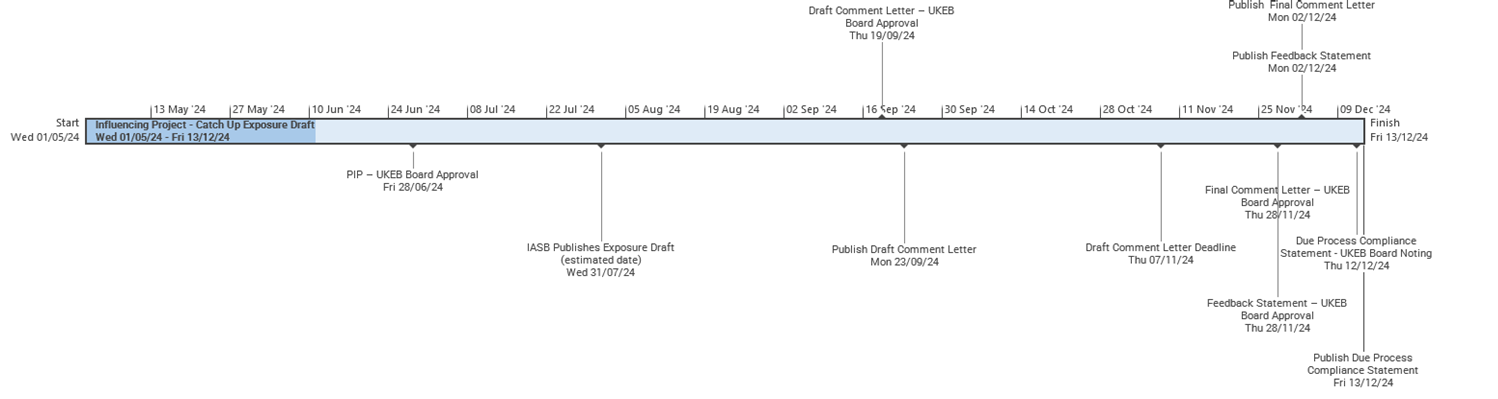
Detailed project timeline [Option one: DCL published in September 2024 for a 45-day comment period]
| Expected Dates | Milestone |
|---|---|
| February to June 2024 | Preliminary analysis and outreach before publication of the catch-up ED. |
| 28 June 2024 | Board: Discusses and approves Project Initiation Plan (PIP). |
| June/July 2024 | Secretariat: Outreach with UKEB advisory groups. |
| Late July 2024 (expected) | IASB: Publishes catch-up ED with a 120-day comment period. |
| 19 September 2024 | Board: Consideration and approval of DCL. |
| 23 September 2024 (estimate) | Secretariat: Alerts key stakeholders to publication of DCL. |
| 23 September to 7 November 2024 | 45-day comment period for DCL. |
| 28 November 2024 | Board: Discusses and approves Final Comment Letter (FCL), Feedback Statement and draft Due Process Compliance Statement. |
| As soon as possible after Board discussion | Secretariat: Submits FCL to IASB and publishes FCL on website. |
| 12 December 2024 | Board: Notes completed Due Process Compliance Statement. |
Detailed project timeline [Option Two: DCL published in September 2024 for a short 15-day comment period]
| Expected Dates | Milestone |
|---|---|
| February to June 2024 | Preliminary analysis and outreach before publication of the catch-up ED. |
| 28 June 2024 | Board: Discusses and approves Project Initiation Plan (PIP). |
| June/July 2024 | Secretariat: Outreach with UKEB advisory groups. |
| Late July 2024 (expected) | IASB: Publishes catch-up ED with a 120-day comment period. |
| 19 September 2024 | Board: Consideration and approval of DCL. |
| 23 September 2024 (estimate) | Secretariat: Alerts key stakeholders to publication of DCL. |
| 23 September to 8 October 2024 | 15-day comment period for DCL. |
| 17 October 2024 | Board: Discusses and approves Final Comment Letter (FCL), Feedback Statement and draft Due Process Compliance Statement. |
| As soon as possible after Board discussion | Secretariat: Submits FCL to IASB and publishes FCL on website. |
| 28 November 2024 | Board: Notes completed Due Process Compliance Statement. |
Project Initiation Plan: Updating the Subsidiaries without Public Accountability: Disclosures Standard – Proposed timeline [Option one]
Footnotes
-
UKEB Due Process Handbook, Draft comment letter, paragraph 5.15 ↩
-
Refer to IASB's news alert on the publication of IFRS 19 published in May 2024 ↩
-
These principles identify information users of financial statements of companies without public accountability are particularly interested in and include: i) liquidity and solvency; ii) short-term cash flows, obligations, commitments, and contingencies; iii) measurement uncertainty; iv) disaggregation of amounts; v) and accounting policy choices. ↩
-
The Secretariat also plans to discuss the catch-up ED i.e., the proposal in paragraph A9 with the Rate-regulated Activities Technical Advisory Group (RRA TAG) on 27 June 2024 and the proposals in paragraphs A7-A8 with the Accounting Firms and Institutes Advisory Group (AFIAG) on 1 July 2024. ↩