7 Rate-regulated Activities - UKEB Top-down Approach
24 May 2024 Agenda Paper 7
Executive Summary
| Field | Value |
|---|---|
| Project Type | Influencing |
| Project Scope | Significant |
Purpose of the paper
The purpose of this paper is to:
- describe the feedback we have received to-date relating to the top-down approach; and
- set out the work the UKEB Secretariat plan to present to the Board over the next two months to further develop the top-down approach.
Summary of the Issue
At its April 2024 meeting the UKEB approved the list of questions the UKEB Secretariat proposed to further develop the top-down approach. This paper sets out an analysis of the questions scheduled for discussion at this meeting, incorporating the feedback received from members of the RRA TAG.
Appendix A explores the following questions with stakeholders:
- What is the difference between the top-down approach and the IASB's proposals?
- What items comprise the difference between RCB and PPE?
- Do the assets and liabilities arising from the top-down approach meet the definitions of regulatory asset and/or regulatory liability as per IASB proposals?
- Does the top-down approach meet the unit of account requirements in the IASB's proposals?
- Does top-down approach meet recognition criteria in the IASB's proposals?
- Can the timing differences reflected in RCB be tracked and monitored?
The following questions will be addressed at the Board meetings in June and July 2024:
- Does the top-down approach meet the measurement requirements in the IASB's proposals?
- Does the top-down approach meet the disclosure requirements in the IASB's proposals? (This will include a discussion on the proposed requirement that an entity disclose the nature of unrecognised regulatory assets and unrecognised regulatory liabilities. There is no quantitative disclosure requirement.)
- Transition for the top-down approach.
In addition, this paper covers feedback and comments received from other stakeholders during outreach, together with the UKEB Secretariat's initial response.
Decisions for the Board
1Do Board members have any comments or questions on the analysis included in Appendix A?
Recommendation
That Board members provide their feedback on the analysis in Appendix A.
Appendices
- Appendix A: Rate-regulated Activities – Top-down approach Analysis
Background
1At the March 2024 meeting, the Board agreed that the Secretariat should continue to explore the top-down approach to the recognition of timing differences that are reflected in the regulatory capital base (RCB) for entities whose property, plant and equipment (PPE) and RCB have no direct relationship. The purpose of this paper is to:
a. describe the feedback received to-date relating to the top-down approach; and b. set out the work the UKEB Secretariat plan to present to the Board over the next two months to further develop the top-down approach.
IASB's proposals
2All UK rate-regulated entities have no direct relationship between PPE and RCB. The IASB's tentative decisions to-date are:
a. For entities with no direct relationship between its PPE and RCB (called no direct relationship entities): prohibit the recognition of allowable expenses or performance incentives (penalties) that are timing differences and reflected in RCB. This is due to it being "...difficult and costly for entities to track the movement of individual items of allowable expense or performance incentives included in the regulatory capital base."1 Preliminary estimates of the impact of this decision is that, for UK water entities only approximately 40% of the total timing differences arising would be recognised. b. For all rate-regulated entities: prohibit the recognition of inflation adjustments that are timing differences and reflected in RCB. This is because "... the costs arising from the recognition of that asset would outweigh the benefits of the information provided for users [...]."2 This issue generally affects only entities that use the real interest model. Almost all UK rate-regulated entities use a real interest model.
3In 2023, the IASB undertook a survey on the direct (no direct) relationship. It found that the direct (no direct) relationship is "... an appropriate approach for determining whether differences in timing arise from the regulatory compensation an entity receives on its regulatory capital base in a variety of regulatory schemes."3 It found that approximately 50% of entities surveyed did not have a direct relationship. This means that the IASB acknowledge that 50% of entities in scope of the proposed standard will not be able to recognise timing differences reflected in RCB4.
4The current expectation is that the IASB's standard will be published during 2025. The IASB have the following topics left to redeliberate, as set out below:
a. Interaction with other IFRS Accounting Standards. b. Amendments to other IFRS Accounting Standards. c. Effective date and transition.
5As indicated to the UKEB at the March 2024 meeting, the UKEB Secretariat aims to further explore and develop the top-down approach between May–July 2024.
Feedback
Outreach activities
6Outreach performed since the March 2024 UKEB meeting includes consulting with NSS and others.
a. We have asked EFRAG's Consultative Forum of Standard Setters (CFSS) for comments on the papers that the UKEB discussed at its March 2024 meeting. b. EFRAG subsequently invited the UKEB Secretariat to present the top-down approach to its Rate-regulated Activities Working Group (EFRAG RRAWG) on 16 May 2024. Comments and questions received during this session is reflected in this paper. c. The EFRAG team has also requested that the UKEB team present the top-down approach at the EFRAG FR TEG June 2024 meeting. d. The UKEB Technical Director, Seema Jamil-O'Neill, presented an overview of the top-down approach at the April 2024 International Forum of Accounting Standard Setters (IFASS) conference. Although a verbal update was provided at the April 2024 UKEB meeting, general feedback is that several national standard setters, specifically several of those within EFRAG, are considering the top-down approach.
7Outreach activities performed since the April 2024 UKEB meeting include the following:
a. RRA TAG members, during an interim meeting of the group on 13 May 2024 and a meeting with RRA TAG members from the energy sector. b. Presentation to the EFRAG RRAWG of the work done thus far on the top-down approach.
8The feedback received is set out in the next section.
Feedback received
RRA TAG members
9The feedback received from RRA TAG members has been incorporated into the technical paper in Appendix A.
EFRAG RRAWG members
10Comments and questions received as well as the UKEB Secretariat's initial response (where relevant) are set out in the following table:
| Comment/question | UKEB Secretariat initial response |
|---|---|
| 1.How would it be possible to ensure the 'portfolio approach' is not abused to manage earnings? Would the information provided be reliable? | In calculating the difference between RCB and PPE at the line of business level every year, an annual cohort is considered. From this, items that constitute 'non-timing differences' would be stripped out. IAS 12 Income Taxes uses a similar approach in terms of stripping out differences that are not temporary differences. Similar safeguards that are being applied for IAS 12 could be applied here. |
| 2.Would users understand the information provided by the 'portfolio approach'? | This type of approach is currently being applied in other IFRS Standards, e.g. IAS 12. Information on the relationship between an entity's income and expenses and its prospects for future cash flows is relevant to users of financial statements. The top-down approach will allow for the recognition of regulatory income and expense the entity is entitled to for the period and it will provide information on the entity's prospects for future cash flows. |
| 3.If the specialist investors are already ignoring the financial statements and only using the regulatory accounts, why would applying the top-down approach change their view of the financial statements? | The intention is to make the financial statements more useful for investors and other users. |
| 4.How would the top-down approach be applied for interim financial statements? | This is a measurement issue that will be further explored. |
| 5.Could there be items other than timing differences included in the difference between RCB and PPE e.g. differences in measurement models? | Further work needed to identify categories that would need to be stripped out. |
| 6.Would explaining the difference recognised as a regulatory asset or regulatory liability not be very costly? | Disaggregating the difference may be costly at the outset, but once the model is settled, the costs of doing this on an ongoing basis is likely to be low. |
| 7.If the UK water entities are comparing their PPE and RCB, would it not be possible to argue that there is actually a direct relationship between PPE and RCB? | As we understand it, the IASB does not consider there to be a direct relationship. We understand UK preparers concur with that view. |
| 8.The RCB is used as a tool by the regulators in the UK to manage an entity's financeability, etc. | The RCB is used by the regulator to smooth the effect of the costs entities incur on the regulated rates appearing on customer bills. The RCB can be analogised to the tax base under IAS 12. |
Other feedback
11Other feedback from various sources and the UKEB Secretariat's initial responses are included in the table below:
| Comment/question | UKEB Secretariat initial response |
|---|---|
| 1.Comparability between direct relationship entities and no direct relationship entities is not relevant as the underlying legal structure of the respective regulatory regimes are different. | The Conceptual Framework defines comparability as “the qualitative characteristic that enables users to identify and understand similarities in, and differences among, items”. And while comparability “is not uniformity”, ultimately, the legal structure does not alter the substance of rationale for the rate regulation. Under the direct (no direct) relationship concept, two entities operating in the same industry, with the same business approach, customers, etc may end up with very different accounting, driven by the legal structure. |
| 2.The top-down approach will result in recognising timing differences that arise in different reporting periods and that may have different expiry patterns obscuring the impacts of the origination and reversal of timing differences. | An analogy to tax effect accounting may be useful. Instead of focusing on reconciling the inputs into the model, the top-down approach focuses on reconciling the outputs, the differences between the carrying amounts and regulatory bases of items. This means that differences are addressed by adjusting for their cumulative effects, which can be a more efficient approach in the long run and will ultimately provide relevant information for users, namely the prospects for future cash flows. |
| 3.Recognising some RCB timing differences and not others (per the IASB's appraoch) make comparability challenging, considering that the apportionment of timing differences between revenue and the RCB can be very different across entities within the same sector. | The top-down approach is addressing the recognition of timing differences included in RCB. |
| 4.Once the regulator agrees to an amount to include in RCB, this becomes the entity's entitlement under its regulatory agreement. The agreement by the regulator is likely to be objective evidence for providing assurance over these amounts. | In the UK, the regulators agree the amounts included in RCB, which ultimately affect the amounts the entity is entitled to include in the future regulated rate. The only two parties in a regulatory agreement are the regulator and the entity. Once the regulator agrees to the amounts to be included in the RCB, the entity has the right to adjust the future regulated rate, that right has the potential to produce economic benefits and the entity has the present ability to direct the use of the right and obtain the economic benefits (see the Basis for Conclusions to the ED, BC38 and BC39). |
| 5.The timing of when the RCB value is being finalised vs when the audit opinion is finalised may pose a challenge. However, this would only relate to in-year movements, not all historical amounts. For many items there should be a precedent over what the regulator might do, noting that the proposals have a more likely than not test for existence. However, there could still be material items which are uncertain and have no historical precedent. | The entity would be required to exercise judgement and consider all relevant facts and circumstances such as those set out in paragraph 27 of the ED. Furthermore, paragraph 28 requires an entity to recognise a regulatory asset and regulatory liability if it is more likely than not to exist. |
| 6.Auditors would not rely fully on the amount agreed with the regulator but would seek to determine the value independently. For example, using the analogy of pension assets that are valued by a third party. | The amounts included in RCB are not valued by a third party, but by the regulator. This is the amount the entity becomes entitled to for recovery of fulfilment in future regulated rates (see point 4 above). |
| 7.An analogy can be drawn with deferred tax in IAS 12 where the difference between carrying amounts and tax written-down values is recognised as deferred tax assets or liabilities. | See point 2 above. |
Next steps
12Subject to the UKEB's decisions at its May 2024 meeting, the UKEB Secretariat plans to:
a. Address the remaining questions the UKEB asked for as set out in the April 2024 Board paper, namely: 1. Does the top-down approach meet the measurement requirements in the IASB's proposals? 2. Does the top-down approach meet the disclosure requirements in the IASB's proposals? (This will include a discussion on the proposed requirement that an entity disclose the nature of unrecognised regulatory assets and unrecognised regulatory liabilities. There is no quantitative disclosure requirement.) 3. Transition for the top-down approach. b. Address the questions received during our outreach, including the following: 1. Could there be items included in RCB that are not timing differences? 2. Whether in a business combination, the remeasurement to fair value of PPE would give rise to a timing difference and whether the RCB of the entities being consolidated also gets remeasured. 3. Further questions relating to measurement including how the approach would apply for interim reporting and how discounting might impact the top-down approach. c. To discuss the top-down approach with the UK regulators.
Appendix A: Possible top-down approach: Analysis
Introduction
1The IASB is continuing its redeliberations following feedback from its Exposure Draft Regulatory Assets and Regulatory Liabilities (ED). It expects to publish a standard in 2025.
2At its April 2024 meeting, the UKEB agreed that the UKEB Secretariat should continue to develop the possible top-down approach. This approach aims to address the lack of comparability embedded in the IASB's current proposals, arising from prohibition from recognition of timing differences included in the regulatory capital base (RCB) for rate-regulated entities whose property, plant and equipment (PPE) and RCB have no direct relationship (no direct relationship entities).
What is the difference between the IASB's current proposals and the top-down approach?
3This section sets out the difference between the IASB's current proposals and the possible top-down approach.
How does the IASB's proposed approach work?
4The table below sets out the requirements in the ED proposals as amended by subsequent tentative decisions by the IASB (the IASB's current proposals) until April 2024.
| Aspect of proposals | Requirements |
|---|---|
| Scope | The proposals apply to an entity that has regulatory assets and regulatory liabilities. The conditions for the existence of a regulatory asset or a regulatory liability as set out in paragraph 6 of the ED are: a) that the entity is party to a regulatory agreement; b) the regulatory agreement determines the regulated rate the entity charges for the goods and services it supplies to customers; and c) part of total allowed compensation (TAC) for goods or services in one period is charged to customers through the regulated rates for goods or services supplied in a different period. The ED scope has remained unchanged as a result of subsequent tentative decisions by the IASB. |
| Differences in timing | The amount of revenue an entity recognises in a period applying IFRS 15 Revenue from Contracts with Customers depends on the regulated rates for goods and services the entity supplies in the period. The amount of IFRS 15 revenue will differ from the TAC when differences in timing arise. This is because the regulatory agreement includes part of the TAC when determining the regulated rate for goods or services supplied by the entity in one period but recovered (deducted) via the regulated rate in a different period. |
| Unit of account | The proposals require that the right or obligation arising from each individual difference in timing should be accounted for as a separate unit of account. Timing differences may be grouped if they arise from the same regulatory agreement, have similar expiry patterns and are subject to similar risks. |
| Recognition | The proposals require an entity to recognise all regulatory assets and regulatory liabilities existing at the reporting date and all regulatory income and regulatory expense arising during the reporting period. If it is uncertain whether a regulatory asset or a regulatory liability exists, an entity should recognise that regulatory asset or regulatory liability if it is more likely than not that it exists. For items included in RCB: a) For direct relationship entities: an entity is required to recognise a regulatory asset or a regulatory liability relating to an allowable expense or performance incentive included in its RCB if it has an enforceable present right (obligation) to add (deduct) the allowable expense or performance incentive to (from) future regulated rates. b) For no direct relationship entities: an entity is prohibited from recognising a regulatory asset or a regulatory liability relating to an allowable expense or performance incentive included in its RCB. |
| Aspect of proposals | Requirements |
|---|---|
| Measurement | At initial recognition: The proposals require an entity to estimate uncertain future cash flows using one of the two methods—the 'most likely amount' method or the ‘expected value' method—the entity expects would better predict the cash flows. Discount the estimated future cash flows generally using the regulatory interest rate provided by the regulatory agreement. After initial recognition: The proposals require an entity, at the end of each reporting period, to update the estimated amounts and timings of future cash flows arising from the regulatory asset or regulatory liability to reflect conditions existing at that date. The entity should continue to use the discount rate determined at initial recognition, unless there is a change to the discount rate in the regulatory agreement. |
| Presentation | The proposals require an entity to present regulatory income or regulatory expense as a separate line item in the statement(s) of financial performance. The proposals require an entity to present separate line items for current and non-current regulatory assets and current and non-current regulatory liabilities in its statement of financial position. |
| Disclosure | The overall objective of the disclosure requirements is for an entity to disclose in the notes information about regulatory income, regulatory expense, regulatory assets and regulatory liabilities that enables users to understand: a) how the entity's financial performance was affected because part of the TAC for the goods or services supplied in one period was (or will be) included in determining the regulated rates, and hence included in revenue, for goods or services supplied in a different period, and b) the entity's regulatory assets and regulatory liabilities at the end of the reporting period to be able to assess how regulatory assets and regulatory liabilities will affect the amount, timing and uncertainty of the entity's future cash flows. Specific disclosures include: a) Components of regulatory income/expense. b) Quantitative information using time bands for recovery (fulfilment) of regulatory assets (liabilities). c) Discount rate. d) Explanation of risks and uncertainties affecting regulatory assets (liabilities). e) Reconciliation of opening and closing amounts of regulatory assets (liabilities). f) For no direct relationship entities: an explanation of the nature of the unrecognised regulatory assets (liabilities) arising from RCB. g) Model used to compensate entity for inflation (e.g. nominal or real). h) For direct relationship entities that capitalise borrowing costs: qualitative explanation of regulatory returns on construction work-in-progress and, whether there is a debt and/or equity return and the effect on the related assets. |
IASB proposals for recognition of timing differences
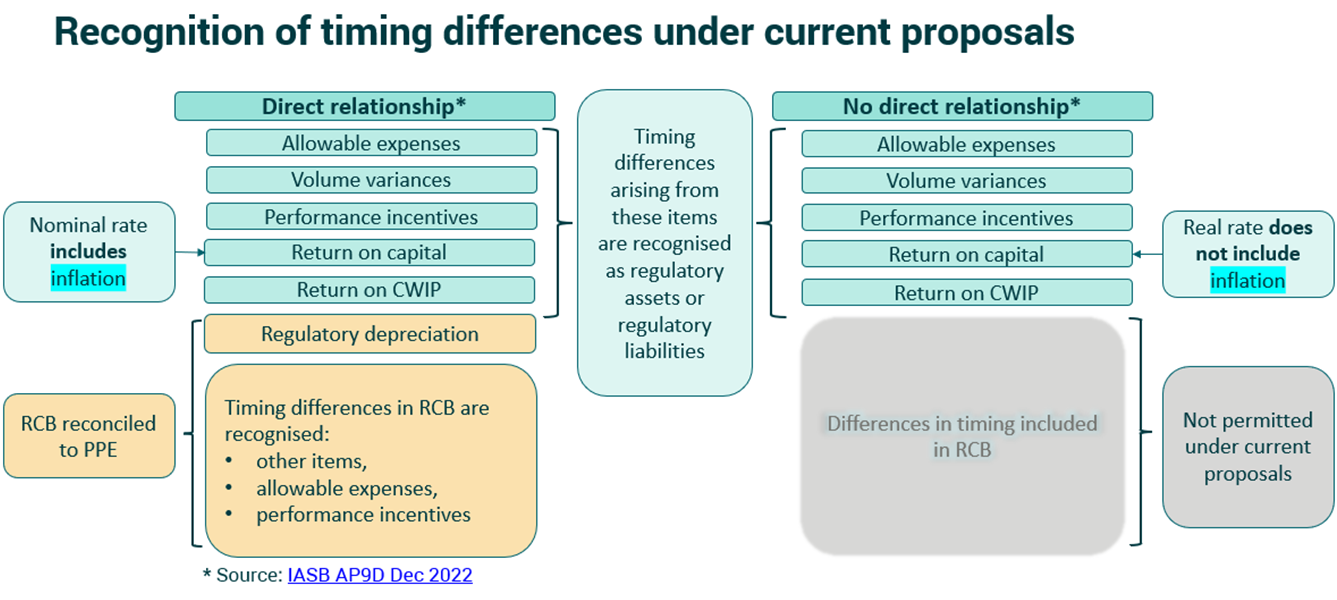
5Under the current IASB proposals, the accounting requirements for recognition of timing differences differs depending on whether the entity's PPE and RCB have a direct or no direct relationship. The requirements as currently proposed will be as follows:
a. All rate-regulated entities: are required to recognise regulatory assets or regulatory liabilities for enforceable present rights and obligations arising from timing differences that are recovered (fulfilled) in the regulated rate in the following regulatory period, e.g. 5 years. b. Rate-regulated entities whose PPE and RCB have a direct relationship (direct relationship entities): are also required to recognise all enforceable present rights and obligations arising from timing differences that are included in RCB and recovered (fulfilled) in the regulated rate through regulatory depreciation and return on capital over several regulatory periods, e.g. 20 years. c. Rate-regulated entities whose PPE and RCB have no direct relationship (no direct relationship entities): are prohibited from recognising enforceable present rights and obligations arising from timing differences included in RCB.
6The diagram below sets out the timing differences that commonly occur under regulatory agreements. The timing differences that are required to be recognised for all entities are shaded in light green. For entities with a direct relationship, the timing differences included RCB that are required to be recognised are shaded in light orange. For entities with a no direct relationship, the timing differences included in RCB for which recognition is prohibited are shaded in grey.
- Source: IASB AP9D Dec 2022
7The reason the IASB decided to adopt this prohibition for timing differences included in RCB for entities with a no direct relationship was:
a. Operating expenses and performance incentives (or penalties): “...we think it would be difficult and costly for entities to track the movement of individual items of allowable expense or performance incentives included in the regulatory capital base. Consequently, we think the costs of recognising regulatory assets or regulatory liabilities in such cases would outweigh the benefits. For this reason, we recommend that entities subject to schemes where there is no direct relationship between the regulatory capital base and the entities' property plant and equipment should not recognise regulatory assets (regulatory liabilities) arising from allowable expenses or performance incentives included in their regulatory capital base."1 b. Inflation: “We think an entity's right to add an amount relating to the inflation adjustment to the regulatory capital base to regulated rates charged in the future would give rise to a regulatory asset if that right is enforceable [...]. We think that, however, the costs arising from the recognition of that asset would outweigh the benefits of the information provided for users [...]."2
How would the top-down approach work?
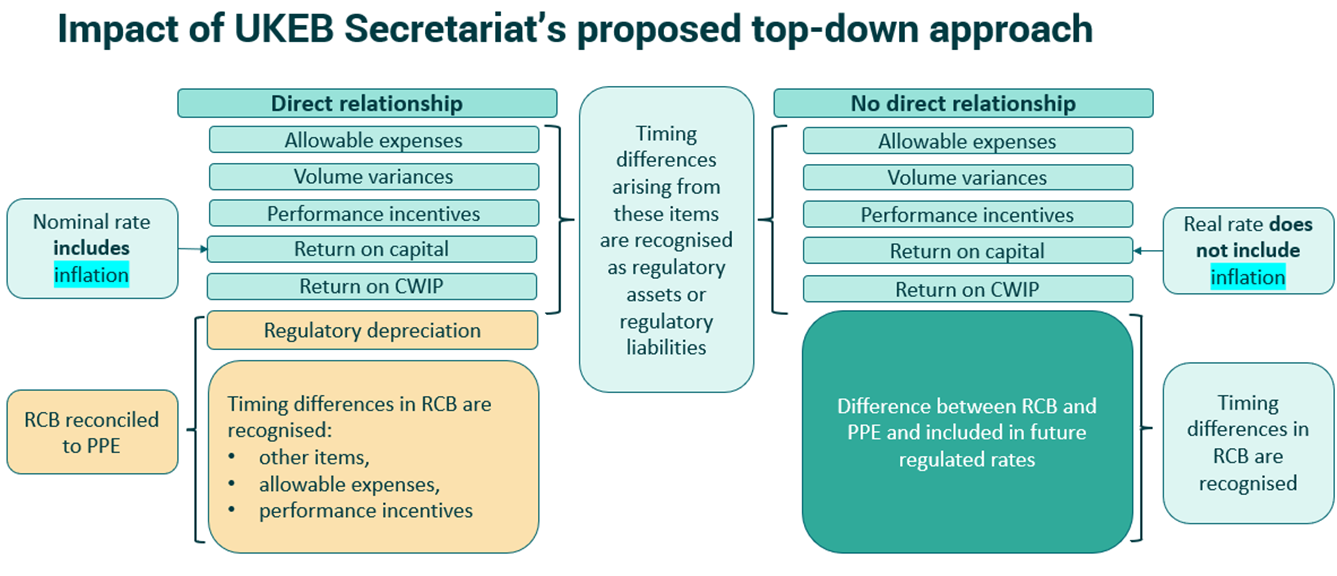
8Given that rate-regulated entities with no direct relationship between PPE and RCB cannot reconcile the two asset bases, the top-down approach is proposed to work for each year, as follows:
a. Identify the lowest level that the RCB is calculated, e.g. by line of business. b. Calculate the difference between the value of PPE and RCB at the end of the reporting period at the lowest level. c. Explicitly strip out items that will never be included in RCB, for example: 1. Borrowing costs capitalised under IFRS, and 2. Assets capitalised in PPE contributed by parties other than the entity. 3. The identifiable assets acquired and liabilities assumed in a business combination are recognised at their fair values in accordance with IFRS 3 Business Combinations, but no equivalent adjustment is made in the RCB. 4. Assets are revalued and no equivalent adjustment is made in the RCB. 5. Goodwill arises in a business combination that is not included in the RCB. d. Recognise the difference as: 1. A regulatory asset. If RCB exceeds PPE, there is excess value in RCB that is yet to be recovered from customers. If this is an enforceable right, in line with the regulatory agreement, the difference would result in an addition to future regulated rates charged to customers, if the difference recognised is an enforceable present right arising from the timing differences grouped together in RCB by the regulator and is more likely than not to exist. 2. A regulatory liability. If PPE exceeds RCB, part of the RCB value for providing goods or services in future periods has already been charged to customers. If this is an enforceable obligation, in line with the regulatory agreement, the difference would result in a deduction from future regulated rates if the difference recognised is an enforceable present obligation arising from the timing differences grouped together in RCB by the regulator and is more likely than not to exist. e. Measure the residual difference applying the approach proposed in the ED.
9The diagram below depicts the timing differences (included in RCB) that would be recognised under the proposed top-down approach.
Revenue adjustments
10The top-down approach does not affect the IASB's current proposals relating to enforceable present rights and obligations arising from timing differences (shaded in light green) that are recovered (fulfilled) in the regulated rate in the following regulatory period, e.g. 5 years. These are generally called “allowable revenue" / "revenue" adjustments.
RCB adjustments
11The top-down approach uses the difference between RCB and PPE to recognise regulatory assets and liabilities. The difference between PPE and RCB is tracked by line of business, by year. This difference is treated as the timing difference for the purpose of recognition of regulatory assets and liabilities (subject to stripping out items that are ‘permanent differences' referred to in paragraph 8(c)).
12This approach assumes that the unit of account will be at a line of business level (by year) rather than the IASB's approach, which focuses on individual timing differences.
13The discussion below considers whether the difference between PPE and RCB is comprised of timing differences and considers how the IASB's proposals could be applied.
14This paper is divided into the following sections:
a. What are the items that comprise the difference between RCB and PPE? b. Does the top-down approach meet the unit of account requirements in the IASB's proposals? c. Does the top-down approach meet the recognition criteria in the IASB's proposals? d. Can the differences in timing included in RCB be tracked and monitored? e. Initial conclusion.
Feedback from RRA TAG members
15Members generally agreed that this section reflects a fair description of the difference between the IASB's proposals and the UKEB's top-down approach.
16Comments or questions received and the UKEB Secretariat's initial response are included in the table below:
| Question or comment | UKEB Secretariat initial response |
|---|---|
| 1.Certain items included in PPE may not be included in RCB, for example assets provided by customers (e.g. in Australia) or developers (e.g. the UK) and borrowing costs capitalised under IFRS. These types of items being part of the difference between PPE and RCB would not constitute regulatory assets or regulatory liabilities. | An additional step was added to consider whether there are any items included in the difference that will never be included in RCB ('permanent differences'). |
| 2.The RCB of entities in the UK in some cases bear no relation to the PPE (e.g. at privatisation of the water sector). The RCB was determined to be the amount people were willing to pay for it and has since been growing by amounts invested (and included by the regulator) and declining for regulatory depreciation | The UKEB Secretariat will discuss this with the UK regulators. This is also an issue for transition. |
| 3.Whether in a business combination, the remeasurement to fair value of PPE would give rise to a timing difference and whether the RCB of an entity being consolidated also gets remeasured. We understand that, in the energy sector, a previous business combination led to an entity acquiring another business. In that case, the PPE was written down to a multiple of the RCB. The RCB was not revalued and the difference was added to goodwill. | An analogy can be drawn to IAS 12. The remeasurement to fair value under IFRS 3 would need to be considered against what the regulator will permit. If the RCB is not remeasured, this will be a 'permanent difference' that will be stripped out. |
| 4.Whether asset retirement obligations and decommissioning provisions that are capitalised in PPE would cause differences. | An analogy can be drawn to IAS 12. The entity will need to consider what the regulator will permit. If these amounts are not included in RCB, this will be a 'permanent difference' that will be stripped out. |
What are the items that comprise the difference between RCB and PPE?
Introduction
17To determine the components of the difference between RCB and PPE for entities with no direct relationship the following list initially considers items that may be treated differently in the regulatory calculations than in the IFRS financial statements:
a. Operating expenses including performance incentives (or penalties). b. Inflation adjustment. c. Difference between the regulatory depreciation and the accounting depreciation where the recovery period for an asset is different from the useful economic life. d. The split of any over- or under-spend of total regulatory allowed revenue between regulatory allowed revenue and RCB. The split is determined in the regulatory agreement, but that split may not reflect the nature of the actual expenses. e. Borrowing costs and/or asset retirement costs where they are capitalised in the IFRS financial statements but not included in RCB. f. Current assets.
18The possible top-down approach discussed at the March 2024 Board meeting3 used a simplified example so that the difference between the RCB and PPE balances relate only to4:
a. Inflation adjustment. b. The difference between the regulatory depreciation and the accounting depreciation. Because the useful economic life of the asset and regulatory recovery period are the same, the difference relates to regulatory depreciation as it is calculated on the uplifted amount of RCB due to the inflation adjustment.
19The discussion below focuses only on operating expenses including performance incentives (or penalties) and the inflation adjustment. Other differences between RCB and PPE will be considered at a future meeting.
20Additionally, the discussion below considers timing differences that arise in the current period only. It ignores any opening balance. How to determine any opening balance would be determined at the IASB's redeliberation of transition issues, after all the other issues had been discussed.
Operating expenses included in RCB
21Operating expenses lead to one of the differences between RCB and PPE. This is because the regulatory agreement requires that certain expenditures are to be included in RCB.
22In IFRS financial statements that expenditure would be recognised as an expense for the period. However, for rate-regulated entities, whilst the expense relates to the current period, the regulatory agreement requires that it is charged in a future period (in the regulated rate), making it a timing difference.
23Performance incentives (or penalties) for the current period are included in (or deducted from) the future regulated rate charged to customers. Because the performance incentive (or penalty) relates to performance in the current period but is charged (deducted) in a future period (in the regulated rate) it is also a timing difference.
Inflation adjustment included in RCB
24The inflation adjustment included in RCB is one of the differences between RCB and PPE. This is because the inflation adjustment is dealt with as a separate item in the regulatory agreement. This is a permitted adjustment by regulatory agreements within the UK as it is a part of the compensation for the return on capital.
25In IFRS financial statements income and expense amounts may be affected by inflation but it is not a separately recognised item. For example, inflation is not permitted to be recognised in PPE. Under IAS 16 Property, Plant and Equipment, PPE is initially recognised at cost. PPE is subsequently recognised under the cost model or the revaluation model. Measurement under the revaluation model is as follows:
"After recognition as an asset, an item of property, plant and equipment whose fair value can be measured reliably shall be carried at a revalued amount, being its fair value at the date of the revaluation less any subsequent accumulated depreciation and subsequent accumulated impairment losses."5
Fair value: "The price that would be received to sell an asset or paid to transfer a liability in an orderly transaction between market participants at the measurement date."
26Most entities do not use the revaluation model. Where an entity does use a revaluation model the amount is a fair value less accumulated depreciation and impairment losses.
27Because the inflation adjustment relates to goods or services provided in the current period but is charged in a future period (in the regulated rate) it is a timing difference.
Feedback from RRA TAG members
28Comments and questions received and the UKEB Secretariat's initial responses are included are included in the table below:
| Question or comment | UKEB Secretariat initial response |
|---|---|
| 5.Regulatory depreciation and the inflation adjustment are two of the most significant parts of the difference between PPE and RCB. | This is consistent with the work we have done on the UK water and energy sectors. |
| 6.For those entities operating under a total expenditure (Totex) mechanism, the regulator applies an arbitrary notional split of the over- or underspend of actual against allowed Totex. This means that an asset capitalised in PPE may not get capitalised in RCB, effectively impairing the asset when applying the top-down approach. A member expressed the concern that the top-down approach is too simplistic in dealing with these types of items. | Feedback previously received indicates that, although the notional split determined by the regulator is arbitrary, the actual split between operating expenditure and capital expenditure is broadly aligned with the notional split. Further work is required to determine if any discrepancies would be material. |
| 7.There are many different types of items that may be included in the Totex over- or overspend, including, for the UK energy sector: | These will be considered in our analysis of items that are included in RCB. |
| 8.That it is important to consider whether a Totex over- or underspend relates to accelerating or delaying a project and actual efficiency or inefficiency, especially considering that the UK energy sector has annual iterations of its allowances, while the UK water sector is only assessed against allowances every five years. | These will be considered in our analysis of items that are included in RCB. |
| 9.For the UK aviation sector, more specifically the airport, the traffic risk sharing mechanism is a significant item that should be on the list. | This has been included in the list. |
| 10.Whether the items referred to in paragraph 19(e) also includes other items included in the regulated rates when the cash is paid or received for example tax and pension costs. A member responded that entities' allowed revenue includes an allowance for tax every year, so it is not included in RCB. | Further work needed. |
| 11.In the UK aviation sector, more specifically the airport, there is a tax uncertainty mechanism that, in the first instance would be a revenue adjustment, but may in future be included in the RCB. | This has been included in the list. |
Do the assets and liabilities arising from the top-down approach meet the definitions of regulatory asset and/or regulatory liabilities as per IASB proposals?
IASB definitions for regulatory asset and regulatory liability
29The IASB has defined a regulatory asset and regulatory liability are as follows:
"Regulatory asset: An enforceable present right, created by a regulatory agreement, to add an amount in determining a regulated rate to be charged to customers in future periods because part of the total allowed compensation for goods or services already supplied will be included in revenue in the future.”
"Regulatory liability: An enforceable present obligation, created by a regulatory agreement, to deduct an amount in determining a regulated rate to be charged to customers in future periods because the revenue already recognised includes an amount that will provide part of the total allowed compensation for goods or services to be supplied in the future."
Enforceability
30The regulatory asset definition requires “an enforceable present right, created by a regulatory agreement...”. The IASB proposals include guidance on enforceability. This includes an assessment as follows6:
a. Whether there is an ability of the parties to a regulatory agreement to enforce the rights and obligations arising from the regulatory agreement. b. It depends on the legal and regulatory frameworks within the jurisdiction which an entity operates. c. The assessment is made at a point in time. d. Consideration of all reasonable and supportable evidence and the weight of that evidence. e. Consideration of the list of indicators in paragraph 27 of the ED aimed at enabling an entity to make an assessment of whether a regulatory asset or regulatory liability exists.
31Paragraph 27 of the ED says:
"An entity determines whether a regulatory asset or regulatory liability exists using judgement considering all relevant facts and circumstances, including any:
- confirmation from the regulator of amounts to be added or deducted in determining future regulated rates;
- explicit requirements or guidelines in the regulatory agreement;
- regulatory decisions or court rulings interpreting the regulatory agreement;
- evidence that allowable expenses have been incurred;
- evidence that performance criteria leading to a performance incentive bonus or penalty have been met or have not been met;
- direct precedents—the entity's experience with the regulator's interpretation of the regulatory agreement in similar circumstances;
- indirect precedents—such as the experience of other entities regulated by the same regulator, the decisions of other regulators or court rulings in similar circumstances;
- preliminary views expressed by the regulator; or
- advice from qualified and experienced legal or other advisors."
32Our initial consideration is that all the above factors are present for UK rate-regulated entities. In particular, UK regulators typically express their preliminary views publicly. If so, this would mean that the regulatory agreements and the legal environment under which UK rate-regulated entities operate are enforceable.
Added to regulated rate to be charged to customers in future periods
33The definition of a regulatory asset continues with “... to add an amount in determining a regulated rate to be charged to customers in future periods because part of the total allowed compensation for goods or services already supplied will be included in revenue in the future".
Operating expenses included in RCB
34Operating expenses included in RCB relate to expenses or performance incentives (or penalties) that are required by the regulatory agreement to be included in RCB. They relate to the goods or services supplied in the current period. The amounts are recovered (deducted) in future regulated rates through regulatory depreciation and return on capital.
35Consequently, operating expenses or performance incentives (or penalties) included in RCB meet the definition of a regulatory asset (regulatory liability).
Inflation adjustment included in RCB
36The regulatory agreement specifies that the RCB will include an inflation adjustment for the goods and services supplied in the current period. It is calculated on both the opening balance of RCB and the additions for the current year. As such, that inflation adjustment is part of total allowed compensation for goods or services supplied in that period. The amount is included in RCB and, in agreement with the regulator, is recovered in future regulated rates charged to customers, through regulatory depreciation and return on capital.
37Consequently, the inflation adjustment included in RCB meets the IASB's definition of a regulatory asset.
Feedback from RRA TAG members
38Comments received and the UKEB Secretariat's initial responses are included in the table below:
| Question or comment | UKEB Secretariat initial response |
|---|---|
| 12.With respect to enforceability, the items included in RCB is set out in the regulatory agreements and is not subject to negotiation. What is negotiated with the regulator is the amount. So, enforceability would be a measurement point, where entities would need to make the best estimate | This will be included when considering the measurement requirements. |
| 13.A member representing an audit firm commented that in the UK water sector, enforceability is for the entire five-year price control period, so entities will need to estimate the RCB value that will be enforceable within the price control period (annually). Another member commented that the UK energy regulator updates the RCB value every year, so enforceability is likely to be more straight-forward. | This will be taken into account in further work on the respective sectors. |
| 14.The initial consideration of items in paragraph 27 of the ED that are present of UK entities should also include (g), (h) and (i) and that it was especially (h) that is relevant in the UK as regulators typically express preliminary views publicly. | 15.The analysis in paragraph 32 has been updated to reflect this comment. |
Does the top-down approach meet the unit of account requirements in the IASB's proposals?
39The ED covers unit of account in paragraph 24:
"An entity shall account for the right or obligation arising from each individual difference in timing described in paragraph 12(a) as a separate unit of account. However, if rights, obligations, or rights and obligations arising from the same regulatory agreement have similar expiry patterns and are subject to similar risks, they may be treated as arising from the same individual difference in timing.”
Paragraph 12(a) says:
"differences in timing arise because the regulatory agreement includes part of that total allowed compensation in determining the regulated rates for goods or services supplied in a different period (past or future)"
Subsequent IASB tentative decisions
40Relating to the unit of account, the IASB (at its December 2023 meeting) agreed to:
"clarify that the unit of account is the right or obligation arising from a difference in timing or from a group of differences in timing. The differences in timing included in that group would:
- be created by the same regulatory agreement;
- have similar expiry patterns; and
- be subject to similar risks."7
41The description in paragraph 21 of Agenda Paper 9A8 of its December 2023 meeting says that:
"When a regulatory agreement groups differences in timing and considers them to be a single adjustment to the future regulated rate [...], those differences in timing would have the same expiry pattern and be subject to the same risks. This would be an example of a right or obligation arising from a group of differences in timing. We think paragraph 24 of the Exposure Draft would capture this example, but that paragraph could be redrafted for greater clarity and the final Standard could include such an example."
Applying the IASB's proposals on unit of account to the top-down approach
42For UK regulatory agreements, timing differences are “created by the same regulatory agreement” as the permissible items to be included in RCB are agreed e.g. by line of business, on an annual basis.
43The requirements for timing differences to have similar expiry patterns and be subject to similar risks, appear to depend on the grouping of individual timing differences. This could mean that timing differences arising from operating expenses, performance incentives (or penalties) and the inflation adjustment could be grouped together into one amount when they are treated by the regulator as a single adjustment.
44This may also have implications for the operational cost of tracking and monitoring, which would reduce if tracking is permitted for regulatory assets or regulatory liabilities at the level of line of business, by year.
45The Conceptual Framework (paragraph 4.51) states that a unit of account is selected to provide useful information, where treating a group of rights and obligations as a single unit of account may provide more relevant information. It gives an example where those rights and obligations are:
a. unlikely to be the subject of separate transactions; b. unlikely to expire in different patterns; c. similar in economic characteristics and risks so are likely to have similar implications for future cash inflows or outflows to the entity; and d. used together in business activities to produce cash flows and are measured by reference to estimates of their interdependent future cash inflows or outflows to the entity.
46Additionally, the Conceptual Framework (paragraph 4.49) acknowledges that in some circumstances it may be appropriate to select one unit of account for recognition and a different unit of account for measurement. It gives an example where contracts may sometimes be recognised individually but measured as a portfolio of contracts.
47These provisions in the Conceptual Framework seem to permit the unit of account to be set at line of business, by year, in the top-down approach. As noted before, this is aimed at alleviating the cost concerns relating to tracking at an individual timing difference level specified in the IASB's current approach.
48We note that the original tentative decisions relating to timing differences arising from operating expenses, performance incentives (or penalties) and the inflation adjustment included in RCB were made in December 2022 before the tentative decisions relating to unit of account which were made in December 2023.
49We believe the interaction between tentative decisions on the unit of account and those relating to the non-recognition of timing differences arising from operating expenses, performance incentives (or penalties) and the inflation adjustment included in RCB should be considered by the IASB. This could result in use of a higher unit of account so that the cost-benefit relationship changes to require recognition of these timing differences. However, this paper has only considered timing differences arising from operating expenses, performance incentives (or penalties) and the inflation adjustment to illustrate the key areas of interaction and concern. There are other items that may be included in the difference between RCB and PPE. These other items will be considered at a future date.
Feedback from RRA TAG members
50Comment and questions received and the UKEB Secretariat's initial responses are set out in the table below:
| Question or comment | UKEB Secretariat initial response |
|---|---|
| 16.Whether the items discussed earlier in the paper are subject to similar risks and have similar expiry patterns as they have difference economic characteristics. A member responded that, once the regulator includes an item in RCB, the items would then be subject to the same risks and have the same expiry patterns. This is because the RCB is a single economic amount. A number of other members agreed with this comment. | This is consistent with the UKEB Secretariat's analysis of the items included in RCB. |
| 17.An exception to this will be the traffic risk sharing mechanism for the UK airport. The amount include in RCB is dependent on where in the five-year price control period the entity is. Any amount under the traffic risk sharing mechanism is recovered (fulfilled) over 10 years whereas the RCB is depreciated over a longer period. | The entity would need to account for this type of mechanism as a separate unit of account. It is our understanding that this item is tracked and monitored individually. |
| 18.There may be different regulatory depreciation rates applied to the RCB for the different lines of business, effectively being different expiry patterns. However, the expiry patterns would be the same for items included within the RCB of the same line of business. | This would not be problematic as the unit of account will be the line of business. |
| 19.What was meant by the phrase 'by line of business, by year'? The UKEB Secretariat responded to this by saying this was included in the paper to seek member views on whether timing differences in their sectors are agreed by line of business on an annual basis. It was confirmed to be the case in the energy sector and a preparer in the water sector commented that they annual regulatory performance reports would go a long way to do this. | Further work needs to be done on the aviation paper. |
Enforceability compared with unit of account
51Whilst the unit of account considers individual timing differences it is worth considering the enforceability requirements. The IASB proposals consider that:
"By referring to 'regulatory assets' and 'regulatory liabilities', paragraph 28 of the Exposure Draft requires that entities carry out a single assessment, being whether it is more likely than not that an enforceable present right (that is, a regulatory asset) or an enforceable present obligation (that is a regulatory liability) exists. In other words, by requiring that entities recognise only those regulatory assets and regulatory liabilities that are more likely than not to exist, the Exposure Draft combines the assessment of existence uncertainty and enforceability in a single assessment."9 [emphasis added]
52In other words, the enforceability assessment seems to be set “at the level of the individual regulatory asset or regulatory liability”10.
53In practice, in the UK, regulators combine the individual timing differences included in RCB into one amount. This would be consistent with the unit of account grouping requirements. However, the level at which UK regulatory agreements are enforceable is not clear. [TAG member views are sought on this point.]
Feedback from RRA TAG members
54The members generally agreed that once items are included in RCB, these items become subject to the same risks and are subject to the same expiry patterns. There is an exception for specific items such as the traffic risk sharing mechanisms for the aviation sector.
Does the top-down approach meet the recognition criteria in the IASB's proposals?
Recognition criteria in ED
55The IASB's proposals require an entity to recognise:
a. "all regulatory assets and all regulatory liabilities existing at the end of the reporting period; and b. all regulatory income and all regulatory expense arising during the reporting period.”11
56Paragraph 28 of the ED proposes that if it is uncertain whether a regulatory asset or regulatory liability exists, it should be recognised if it is more likely than not that it exists. Per the IASB's proposals, this guidance is required to work in conjunction with the requirements in relation to meeting the regulatory asset and regulatory liability definition, which includes enforceability as a criterion.
Conceptual Framework
57The Conceptual Framework has recognition criteria which require that an item:
a. meet the definition of an asset/liability; b. provides users of accounts with relevant information that can be faithfully represented; and c. that the cost of recognition does not outweigh the benefits.
58The discussion on whether the timing differences we are considering in this paper (i.e. operating expenses, performance incentives (or penalties) and the inflation adjustment) included in RCB meet the definition of a regulatory asset or regulatory liability is in the section above.
59The non-recognition of the timing differences we are considering in this paper (i.e. operating expenses, performance incentives (or penalties) and the inflation adjustment) included in RCB means that the application of the IASB's current approach will lead to an incomplete representation of the relevant information related to the financial performance and position of these entities. Users of financial statements of entities with no direct relationship will continue to have insufficient information on the relationship between those entities' revenue and expenses, and so insufficient insight into the prospects for future cash flows. In addition, the financial statements of entities with direct and no direct relationship between PPE and RCB will not provide directly comparable information, undermining the information relevance of IFRS accounts.
60The current IASB proposals exclude the recognition of timing differences for entities with a no direct relationship because the costs of tracking individual timing differences outweigh the benefits of recognising them. The top-down approach proposes that the tracking of timing differences is undertaken at a higher unit of account – by line of business, by year – that is derived by comparing the balance of RCB and PPE. This should reduce the operational cost of tracking and monitoring of these timing differences.
61This paper has not considered all the items of difference between the balance of RCB and PPE. Below, it considers timing differences arising from operating expenses, performance incentives (or penalties) and the inflation adjustment. There are other items that may be included in the difference between RCB and PPE. These other items will be considered at a future date.
Operating expenses included in RCB
62For timing differences arising from operating expenses, performance incentives (or penalties), the definition of a regulatory asset (regulatory liability) is met (see above).
63The assessment of whether the timing difference arising from operating expenses, performance incentives (or penalties), is more likely than not to exist, will in most instances be undertaken and confirmed at the same time as the assessment on whether a regulatory asset or regulatory liability exists.
64The IASB's tentative decisions have indicated that allowable expense or performance incentives included in the regulatory capital base would need to be tracked individually over time. In other words, separately from other amounts that are included in RCB. And as tracking at this individual timing difference level was deemed too costly, the IASB prohibited recognition.
65By contrast, recognition under the top-down approach at the line of business level would de-couple the recognition from the on-going measurement (see discussion on Conceptual Framework requirements in relation to unit of account). [Measurement will be considered in more detail in later papers.]
Inflation adjustment included in RCB
66For the inflation adjustment, the definition of a regulatory asset is met (see above).
67When assessing whether the timing difference arising from the inflation adjustment is more likely than not that it exists, in most instances this will become apparent when assessing whether a regulatory asset or regulatory liability exists.
68The inflation adjustment included in RCB in an entity with no direct relationship is prohibited from recognising a regulatory asset due to the IASB considering that the costs of recognition in tracking the individual timing difference would outweigh the benefits.
69Similar to operating expenses in RCB, recognition under the top-down approach at the line of business level would de-couple the recognition from the on-going measurement (see discussion on Conceptual Framework requirements in relation to unit of account). [Measurement will be considered in more detail in later papers.]
Feedback from RRA TAG members
70Comments received and the UKEB Secretariat's initial responses are set out in the table below:
| Question or comment | UKEB Secretariat initial response |
|---|---|
| 20.It would be important for entities to consider the existence and enforceability of timing differences included in the RCB, especially for new mechanisms introduced by the regulators. It is likely that it will be easier to make a judgement on the existing mechanisms as the entities can consider their past experience with their regulators. | The entity will need to exercise judgement as required by paragraphs 27 and 28 of the ED. |
| 21.Clarification was sought on what is meant by 'de-couple the recognition from the ongoing measurement' in paragraph 69 (of the original paper). | The individual timing differences are included in RCB, but for measurement purposes they would be grouped together. |
Can the differences in timing included in RCB be tracked and monitored?
Introduction
71This section deals with the tracking and monitoring of differences in timing included in the RCB for the entities in each of the rate-regulated sectors in the UK:
a. Nature of differences typically included in RCB. b. Proportion of differences in timing typically included in RCB. c. Availability of information (i.e. whether its publicly available).
Nature of differences typically included in RCB
Water sector
72The following differences are included in the RCB:
a. non-PAYG Totex additions; [This would need to be broken down into components.] b. inflation indexation of both the opening balance of RCB and the additions to the RCB; and c. regulatory depreciation.
73The lowest level for which the above differences are monitored is by the following line of business:
a. Water network. b. Wastewater network. c. Water resources. d. Bioresources.
74Paragraph 17 lists some of the types of timing differences that could be in RCB. They include:
a. Operating expenses including performance incentives (or penalties). b. Inflation adjustment. c. Difference between the regulatory depreciation and the accounting depreciation where the recovery period for an asset is different from the useful economic life. d. The split of any over- or under-spend of total regulatory allowed revenue between regulatory allowed revenue and RCB. The split is determined in the regulatory agreement, but that split may not reflect the nature of the actual expenses. e. Borrowing costs and/or asset retirement costs where they are capitalised in the IFRS financial statements but not included in RCB. f. Current assets.
75Some of these differences are timing differences and some are not. We need to understand the components of non-PAYG Totex additions to determine whether they are timing differences. [This would need to be broken down into components.]
Energy (electricity and gas) sector
76Similar to the water sector, the energy sector also has the following differences that are included in the RCB:
a. non-PAYG Totex additions; [This would need to be broken down into components.] b. inflation indexation of both the opening balance of RCB and the additions to the RCB; and c. regulatory depreciation.
77The lowest level for which the above differences are monitored is by the following line of business:
a. Electricity transmission. b. Electricity distribution. c. Gas transmission. d. Gas distribution. e. Offshore electricity transmission.
78[Further work to do]
Aviation sector
79For the UK airport, items (some of which have been mentioned above) are:
a. the traffic risk sharing mechanism; b. capital expenditure incentives; c. cost of new debt mechanism; d. a reopener mechanism where the regulator can go back and reopen historical items and include them in the RCB; and e. the tax uncertainty mechanism (but this is typically a revenue adjustment).
80The lowest level for which the above differences are monitored is by the following line of business:
a. Airport: [Further work to do] b. National air traffic services: 1. Flights over the UK. 2. Flights for the North Atlantic service.
81[Further work to do]
Feedback from RRA TAG members
82Comments received included:
a. For the UK energy sector, the regulator currently has a big focus on load-related expenditure relating to the transition to green energy. b. It would be important to consider the lines of business and types of items included in RCB in other jurisdictions.
Proportion of differences in timing typically included in RCB
Water sector
83Based on our work to date, approximately 60% of the total differences in timing are included in RCB.
Energy (electricity and gas) sector
84Based on our work to date, approximately up to 55% of the total differences in timing are included in RCB.
Aviation sector
85[Further work to do]
Feedback from RRA TAG members
86Comments received are:
a. For the water sector, this seems a fair proportion. b. For the energy sector, it may be important to consider using an average taken over a longer period as the high ratio going to RCB is related to the spike in inflation in recent years. c. For the UK airport, the proportion of timing differences included in RCB varies depending on where it is in the price control period. The traffic risk sharing mechanism is recovered (fulfilled) over a 10-year period, with the proportion relating to the remaining part of the current price control period going into revenue, while the proportion relating to the period after the current price control period is included in the RCB.
Availability of information (i.e. whether its publicly available)
Water sector
87The annual regulatory accounts reflect changes between forecast and actual expenses incurred during the year. The regulator publishes the updated RCB balance every March.
88It is not clear whether the detailed adjustments to RCB are broken-down into timing and other differences. [Further work to do]
Energy (electricity and gas) sector
89The annual performance report for each entity is available within the Regulatory Performance Data File on the regulator's website. This data file contains links to where the annual performance report is published on the website of each respective entity. The annual performance reports show the detailed adjustments to RCB.
90It is not clear whether the detailed adjustments to RCB are broken down into timing and other differences. [Further work to do]
Aviation sector
91[Further work to do]
Feedback from RRA TAG members
92Comments received were:
a. For the water sector, this information is publicly available as set out in paragraph 88. b. For the energy sector, the information is in the regulatory model that is publicly available. c. For the UK airport. The transparency of the information will vary depending on the size of the amounts under negotiation and where it is in the price control period. d. For the UK air traffic control services, there is probably less transparency than in the other sectors.
Initial conclusion
93The discussion above shows:
a. Definition of regulatory asset or regulatory liability: Operating expenses or performance incentives (or penalties) and the inflation adjustment included in RCB meet the definition of a regulatory asset (regulatory liability). b. Unit of account requirements: The unit of account proposals imply that timing differences can be grouped when they are within the same regulatory agreement, have the same expiry pattern and be subject to the same risks. c. Recognition criteria: Operating expenses or performance incentives (or penalties) and the inflation adjustment included in RCB are prohibited from being recognised due to the cost of tracking and monitoring the individual timing difference in RCB. d. Tracking of individual timing differences: Further work is required to determine whether the differences between RCB and PPE are timing differences. Also further work is required as to whether they are tracked individually or taken forward as one total amount.
94A summary of the above findings is in Appendix A. It also sets out the situation for direct relationship entities.
95The top-down approach aims to reflect the economic reality of rate-regulated entities in the UK. It is based on the fact that where a regulator groups a number of timing differences included in RCB as a single adjustment, that amount could be treated as a single timing difference. This amount would in turn be tracked and monitored so that the cost/benefit ratio of recognising a timing difference as a regulatory asset (regulatory liability) would change from the current IASB assessment.
Annex 1: Timing differences included in RCB
Timing differences included in RCB
For no direct relationship entities
| Item | Meets definition regulatory asset / regulatory liability? | Meets recognition criteria? | Meets unit of account requirements? | Can be tracked at level of individual timing difference? |
|---|---|---|---|---|
| Inflation (UK no direct relationship entities have a separate inflation adjustment included in RCB) [IASB paper 9A, Dec2022] | ✓ | X Due to cost/benefit reasons | X Could be grouped for one timing difference per year in RCB? | X Can't be tracked at individual timing difference level |
| Operating expenses (allowable expenses and performance incentives/penalties) [IASB paper 9C, Dec2022] | ✓ | X Due to cost/benefit reasons | X Could be grouped for one timing difference per year in RCB? | X Can't be tracked at individual timing difference level |
For direct relationship entities
| Item | Meets definition regulatory asset / regulatory liability? | Meets recognition criteria? | Meets unit of account requirements? | Can be tracked at level of individual timing difference? |
|---|---|---|---|---|
| Inflation (direct relationship entities tend not to have a separate inflation adjustment included in RCB) [IASB paper 9A, Dec2022] | ✓ | ✓ | ✓ | ✓ |
| Operating expenses (allowable expenses and performance incentives/penalties) [IASB paper 9C, Dec2022] | ✓ | ✓ | ✓ | ✓ |
Footnotes
Footnotes
-
Paragraph 23, IASB paper 9C, December 2022: https://www.ifrs.org/content/dam/ifrs/meetings/2022/december/iasb/ap9c-other-items-included-in-the-regulatory-capital-base.pdf ↩↩
-
Paragraph 48, IASB paper 9A, December 2022: https://www.ifrs.org/content/dam/ifrs/meetings/2022/december/iasb/ap9a-inflation.pdf ↩↩
-
Page 19, IASB paper 9B, September 2023: https://www.ifrs.org/content/dam/ifrs/meetings/2023/september/iasb/ap9b-the-direct-no-direct-relationship-concept-report-on-findings-from-the-survey.pdf ↩↩
-
Paragraphs 34-37, IASB paper 9A, October 2023 discusses the types of adjustments in RCB in the UK: https://www.ifrs.org/content/dam/ifrs/meetings/2023/october/iasb/ap9a-survey-on-the-direct-no-direct-relationship-concept-additional-feedback.pdf ↩↩
-
IAS 16, paragraph 31. ↩
-
Summary of paragraph 34, IASB paper 9C, February 2023: https://www.ifrs.org/content/dam/ifrs/meetings/2023/february/iasb/ap9c-enforceability-and-recognition.pdf ↩
-
IASB Update December 2023: https://www.ifrs.org/news-and-events/updates/iasb/2023/iasb-update-december-2023/#2 ↩
-
Agenda Paper 9A of the December 2023 IASB meeting. ↩
-
Paragraph 38, IASB paper 9C, February 2023: https://www.ifrs.org/content/dam/ifrs/meetings/2023/february/iasb/ap9c-enforceability-and-recognition.pdf ↩
-
Paragraph 42, IASB paper 9C, February 2023: https://www.ifrs.org/content/dam/ifrs/meetings/2023/february/iasb/ap9c-enforceability-and-recognition.pdf ↩
-
Paragraph 25 of the ED. ↩