5 BCDGI – Draft Comment Letter
24 May 2024 Agenda Paper 5
Executive Summary
| Project Type | Influencing |
| Project Scope | Moderate |
Purpose of the paper
The purpose of this paper is to obtain Board members' feedback and approval for publication of the Draft Comment Letter (DCL) (Appendix A); and an Invitation to Comment (ITC) (Appendix B) on the IASB Exposure Draft Business Combinations, Disclosures, Goodwill and Impairment: Amendments to IFRS 3 and IAS 36 (the Amendments) (the 'ED').
Summary of the issue The IASB ED was issued on 14 March 2024 with a comment deadline of 15 July
- The Board approved the PIP at its March meeting. That included the publication of a DCL for consultation with stakeholders for a 30-day consultation period. An Initial Technical paper, discussed at the April 2024 Board meeting, summarised the issues identified by stakeholders as part of the Post-implementation review of IFRS 3 and in response to the subsequent Discussion Paper (the 'DP'), which led to the IASB's proposals. The DCL incorporates the Board's feedback at that meeting.
Decisions for the Board
DCL and Invitation to Comment
Subject to addressing any comments raised during the meeting, does the Board approve the DCL and ITC for publication to obtain stakeholder feedback?
Recommendation
The Secretariat recommends that the Board approves the DCL and accompanying ITC.
Appendices
- Appendix A Draft Comment Letter (DCL)
- Appendix B Invitation to Comment (ITC)
- Appendix C Invitation to Comment (ITC) – Your details
Background
1The ED proposes a package of amendments designed to meet the project's objective to explore whether entities can, at a reasonable cost, provide users with more useful information about business combinations, which would help them make better decisions by allowing them to better assess:
- the performance of an entity's business combinations; and
- how efficiently and effectively management has used the entity's economic resources to acquire these businesses.
2These proposed amendments build on the preliminary views in the March 2020 Discussion Paper Business Combinations—Disclosures, Goodwill and Impairment and reflect the IASB's consideration of feedback on those preliminary views.
3The proposals in the ED relate to:
- the disclosure requirements in IFRS 3, including:
- performance of a business combination;
- strategic business combinations;
- exemption from disclosing information;
- identifying information to be disclosed; and
- other disclosure proposals;
- the impairment test in IAS 36, including:
- clarification of the requirements and additional disclosures;
- changes to the value in use calculation;
- amendments to IFRS 19 Subsidiaries without Public Accountability: Disclosures;
- Transition requirements.
Draft comment letter
4The DCL is attached at Appendix A, together with the accompanying ITC (see Appendix B). Overall, the DCL supports the IASB's objective, but makes recommendations to enhance the proposals in the ED.
Research and outreach
5To inform the drafting of the DCL, the Secretariat has conducted desk-based research, including reviewing the ED and IASB staff papers and meeting summaries.
6In February and March 2024, the Secretariat discussed the IASB's tentative decisions, expected to be included in the ED, with the UKEB Advisory Groups, including the Investor Advisory Group, the Preparer Advisory Group, and the Accounting Firms and Institutes Advisory Group. The feedback received was summarised in the Initial Technical paper discussed at the April 2024 Board meeting.
7In April 2024, the Secretariat discussed the proposals in the ED with the Academic Advisory Group.
8In May 2024, the Secretariat held a joint user/preparer roundtable event, hosted with the IASB. The Secretariat also carried out some preparer one-to-one interviews.
9All the above feedback has been incorporated in the DCL.
10If approved at the May 2024 UKEB meeting, the DCL and ITC can be published for a minimum 30-day comment period.
Question for the Board
Subject to addressing any comments raised during the meeting, does the Board approve the DCL and ITC for publication, with a 30-day consultation period, to obtain stakeholder feedback?
Next steps
11In line with the Project Initiation Plan (the PIP), outreach with stakeholders will continue until the end of June 2024, including:
- publication of the DCL on the UKEB website;
- preparer one-to-one interviews;
- discussion of the DCL at a joint session with the Investor and Preparer Advisory Groups;
- discussion with other relevant stakeholders and stakeholder groups, including a presentation of the DCL to the Corporate Reporting Users Forum (CRUF) UK on 6 June 2024.
12In line with the PIP, the Final Comment Letter, Feedback Statement and draft Due Process Compliance Statement is expected to be presented at the July 2024 meeting for consideration and approval by the Board.
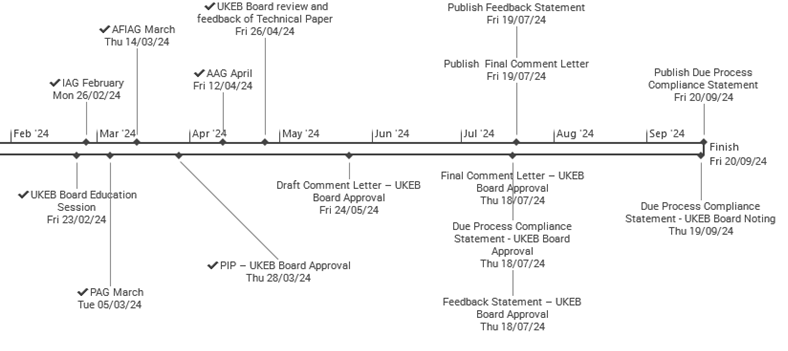
13Further information on the project timeline is presented in the table below.
| Expected Dates | Activities and Milestones | Status |
|---|---|---|
| January / February 2024 | Secretariat: Preliminary analysis and outreach before publication of ED | Completed |
| 23 February 2024 | Board: Education session (Private meeting) | Completed |
| 26 February 2024 | Secretariat: Outreach—UKEB Investor Advisory Group (IAG) | Completed |
| 5 March 2024 | Secretariat: Outreach—UKEB Preparer Advisory | Completed |
| 14 March 2024 | Secretariat: Outreach—UKEB Accounting Firms and Institutes Advisory Group (AFIAG) | Completed |
| IASB Exposure Draft consultation period (120 days): 14 March – 15 July 2024 | ||
| 14 March 2024 | IASB: publishes Exposure Draft with 120-day consultation period | To be completed |
| 28 March 2024 | Board: Discusses and approves Project Initiation Plan (PIP) | Completed |
| 12 April 2024 | Secretariat: Outreach—UKEB Academic Advisory Group (AAG) | Completed |
| 26 April 2024 | Board: Discusses Technical paper | Completed |
| May 2024 | Secretariat: Outreach—User/Preparer roundtable and Preparer 1:1 interviews carried out jointly | Completed |
| 24 May 2024 | Board: Consideration and approval of DCL | This meeting |
| 31 May 2024 (estimate) | Secretariat: Publishes DCL and Invitation to Comment on website and alerts key stakeholders (as soon as possible after 24 May Board meeting) | To be completed |
| UKEB Draft Comment Letter consultation period (30 days): 1 – 30 June 2024 | ||
| 15 July 2024 | IASB: Exposure Draft consultation period ends | To be completed |
| 18 July 2024 | Board: Discusses and approves Final Comment Letter (FCL), Feedback Statement and draft Due Process Compliance Statement | To be completed |
| 26 July 2024 (estimate) | Secretariat: Submits FCL to IASB and publishes FCL and Feedback Statement on website (as soon as possible after 18 July Board meeting) | To be completed |
| 19 September 2024 | Board: Notes completed DPCS | To be completed |
| 20 September 2024 | Secretariat: Publishes DPCS on website | To be completed |
Timeline
Dr Andreas Barckow Chair International Accounting Standards Board Columbus Building 7 Westferry Circus Canary Wharf London E14 4HD
xx July 2024
Dear Dr Barckow
Invitation to Comment: Exposure Draft Business Combinations—Disclosures, Goodwill and Impairment
1The UK Endorsement Board (UKEB) is responsible for endorsement and adoption of IFRS Accounting Standards for use in the UK and therefore is the UK's National Standard Setter for IFRS Accounting Standards. The UKEB also leads the UK's engagement with the IFRS Foundation on the development of new standards, amendments and interpretations. This letter is intended to contribute to the Foundation's due process. The views expressed by the UKEB in this letter are separate from, and will not necessarily affect the conclusions in, any endorsement and adoption assessment on new or amended international accounting standards undertaken by the UKEB.
2There are currently approximately 1,500 entities with equity listed on the London Stock Exchange that prepare their financial statements in accordance with IFRS.1 In addition, UK law allows unlisted companies the option to use IFRS and approximately 14,000 such companies currently take up this option.2
3The UKEB welcomes the opportunity to provide comment on the International Accounting Standards Board (IASB)'s Exposure Draft Business Combinations—Disclosures, Goodwill and Impairment. In developing this letter, we consulted with stakeholders in the UK, including preparers, accounting firms and institutes, academics, and users of financial statements.
Proposed amendments to IFRS 3 Business Combinations
4The UKEB is broadly supportive of the package of proposed amendments to the disclosure requirements in IFRS 3 Business Combinations and the impairment test in IAS 36 Impairment of Assets. The proposed amendments would provide investors with better information about the performance of an acquisition and how effectively management has used the entity's economic resources to acquire these businesses.
5Our main observations and recommendations, based on our UKEB outreach [to date]3 and desk-based research4, are set out in the paragraphs that follow.
6The UKEB broadly supports the IASB's proposals to require disclosure of information about the performance of the most important business combinations, based on the acquirer's acquisition-date key metrics and related targets (see paragraphs A1–A6), as users requested this information. However, the UKEB is uncertain about the usefulness of the resulting information in enabling users to assess the success of an acquisition, especially where the acquired business is integrated on, or shortly after, acquisition. In such instances, the disclosures will reflect the performance of the combined business rather than the performance of the acquired business.
7The UKEB is also generally supportive of the IASB proposals to require information for only a subset of the most important business combinations (the so-called 'strategic' business combinations), which we consider strikes the right balance between the needs of users and the costs to preparers. However, stakeholders raised concerns with the proposed terminology (see paragraph A7) and the threshold approach (see paragraphs A8–A28). The UKEB is not certain that the closed threshold approach will capture all the important acquisitions that a user would need information about, therefore the UKEB recommends that:
- the description in the Basis for Conclusions (paragraph BC54), which describes the most important business combinations, “as one for which failure to meet any one of an entity's acquisition-date key objectives would put the entity at risk of failing to achieve its overall business strategy", be included in the standard itself, given its importance in identifying the most important business combinations, such that information would be disclosed for a business combination if it meets the overall description and is therefore presumed to be 'strategic';
- a rebuttable presumption should accompany the description, that would allow an entity to rebut the presumption of a 'strategic' business combination if it does not meet any one of the thresholds.
- an entity should disclose the reason for the rebuttal to provide users with the information they need to understand management's rationale; and
- another term, such as major, fundamental or notable may be more appropriate than 'strategic' to describe the subset of the most important business combinations.
8The UKEB outreach suggests that users' needs about the most important business combinations when they occur in a 'series' is unlikely to be met by the current proposals. We include some recommendations in this regard in paragraphs A10–A14, to ensure that users receive a full picture of 'strategic' acquisitions undertaken.
9The UKEB is broadly supportive of the proposed quantitative thresholds for 'strategic' business combinations (see paragraphs A15–A23), and the proposed qualitative thresholds (see paragraphs A24–A28), to capture those business combinations that would represent a strategic shift for an entity but that would not be captured by the quantitative thresholds. However, the UKEB makes some recommendations, should the IASB decide to proceed with the proposals in the ED unamended, to address some stakeholder concerns with those thresholds mainly that the current proposals do not appropriately identify the most important business combinations.
10The UKEB is broadly supportive of a proposed exemption (see paragraphs A29–A42) to address some of the concerns that entities raised about the cost and commercial sensitivity of disclosing some information required for both material business combinations and 'strategic' business combinations. However, the UKEB has some suggestions to assist in the appropriate application of the exemption. The UKEB recommends that the IASB:
- removes the requirement for an entity to disclose the reason for invoking, where an entity considers the disclosure of the reason to be commercially sensitive. Instead, the IASB could consider adding a requirement to disclose the reason, when the reason is considered to be no longer commercially sensitive in a subsequent period;
- that it has invoked the exemption, for each item of information to which the exemption may be applied;
- previously exempt information that is considered no longer commercially sensitive;
- clarifies in the application guidance how an entity might 'sufficiently aggregate' information before invoking the exemption, for example, aggregating information for multiple business combinations;
- does not permit further aggregation of categories of synergy i.e. not permit the disclosure of total synergies for a business combination; this will ensure that important non-commercially sensitive information is retained for users;
- clarifies whether or not it expects the exemption to only be used in 'extremely rare cases', and the 'seriously prejudicial' principle, since this is a higher bar than 'commercially sensitive'; and
- to assist with assessing the auditability and enforceability, and the appropriate use of the exemption, carries out field-testing to include a list of non-exhaustive scenarios where the exemption could be appropriately applied, to replace or enhance the proposed non-exhaustive factors (see Basis for Conclusions paragraph BC90).
Proposed amendments to IAS 36 Impairment of Assets
12The UKEB is generally supportive of the proposed amendments to IAS 36:
- to clarify how an entity allocates goodwill to cash-generating units (CGUs) - although it is noted that this requirement may not achieve the intended reduction in shielding of goodwill (see paragraphs A76–A77); and
- requiring an entity to disclose in which reportable segment a CGU or group of CGUs containing goodwill (see paragraphs A78–A81) - however the UKEB is uncertain how effective this disclosure will be at reducing management over-optimism, which is inherent in management assumptions, although it aligns with the project objective of providing better information about business combinations.
13To address users' concerns that impairment losses are sometimes recognised too late and provide more transparency on any 'close calls' with regards to impairment losses not being recognised, the UKEB recommends that the IASB includes requirements to:
- disclose how CGUs have been identified and whether that has changed from the prior period; and
- disclose the amount of headroom (recoverable amount in excess of carrying value) there is for each CGU containing goodwill.
14The UKEB is generally supports the IASB's efforts to reduce the cost and complexity of the impairment test and the proposed changes to the calculation of value in use (see paragraphs A82–A88), which applies to all assets tested for impairment in accordance with IAS 36. However, permitting the inclusion of cash flows from future uncommitted restructuring and asset enhancements could increase the risk that management use optimistic inputs when calculating value in use, and the resulting increase in the measured value in use could delay the recognition of impairment losses. Therefore, the UKEB recommends that the IASB:
- require an entity to disclose:
- where recoverable amount includes cash flows from uncommitted restructuring or asset improvements;
- the risks associated with including such cash flows; and
- redraft the proposal, to require, rather than permit, the inclusion of, cash flows from uncommitted restructuring or asset improvements. This should lead to more consistent treatment and enhance comparability.
16If you have any questions about this response, please contact the UKEB project team at [email protected].
Yours sincerely
Pauline Wallace Chair UK Endorsement Board
Appendix A: Questions on IASB Exposure Draft Business Combinations—Disclosures, Goodwill and Impairment
Proposed amendments to IFRS 3 Business Combinations
Disclosures: Performance of a business combination
Question 1—Disclosures: Performance of a business combination (proposed paragraphs B67A–B67G of IFRS 3)
In the PIR of IFRS 3 and in responses to the Discussion Paper the IASB heard that:
- users need better information about business combinations to help them assess whether the price an entity paid for a business combination is reasonable and how the business combination performed after acquisition. In particular, users said they need information to help them assess the performance of a business combination against the targets the entity set at the time the business combination occurred (see paragraphs BC18–BC21).
- preparers of financial statements are concerned about the cost of disclosing that information. In particular, preparers said the information would be so commercially sensitive that its disclosure in financial statements should not be required and disclosing this information could expose an entity to increased litigation risk (see paragraph BC22).
Having considered this feedback, the IASB is proposing changes to the disclosure requirements in IFRS 3 that, in its view, appropriately balance the benefits and costs of requiring an entity to disclose this information. It therefore expects that the proposed disclosure requirements would provide users with more useful information about the performance of a business combination at a reasonable cost.
In particular, the IASB is proposing to require an entity to disclose information about the entity's acquisition-date key objectives and related targets for a business combination and whether these key objectives and related targets are being met (information about the performance of a business combination). The IASB has responded to preparers' concerns about disclosing that information by proposing:
- to require this information for only a subset of an entity's business combinations—strategic business combinations (see question 2); and
- to exempt entities from disclosing some items of this information in specific circumstances (see question 3).
- Do you agree with the IASB's proposal to require an entity to disclose information about the performance of a strategic business combination, subject to an exemption? Why or why not? In responding, please consider whether the proposals appropriately balance the benefits of requiring an entity to disclose the information with the costs of doing so.
- If you disagree with the proposal, what specific changes would you suggest to provide users with more useful information about the performance of a business combination at a reasonable cost?
A1The UKEB agrees with the IASB's objectives in requiring the disclosure proposals, i.e. to provide users with more useful information about the performance of a business combination at a reasonable cost. Users of accounts tell us that they would like entities to provide better information on the performance of business combinations, to help them assess the reasonableness of the price paid for a business combination and its performance after acquisition, against acquisition-date key objectives and related targets5.
A2UK preparers have shared concerns about such disclosures producing commercially sensitive information, leading to increased litigation risks, obscuring material information and significant costs. As such, the IASB's proposal to require the performance information for a subset of the most important business combinations, the 'strategic' business combinations, may help achieve the balance between users' needs and preparer's concerns.
A3The UKEB notes and supports the IASB's proposal to require an entity to disclose information about the performance for the 'strategic' business combinations (see Question 2 of this Appendix) and a proposed exemption (see Question 3 of this Appendix). However, UK preparers' concerns around the commercial sensitivity of providing the required performance information in some circumstances still remains. They note that the proposed requirement to disclose the key objectives and targets to which the exemption has been applied and the reason for applying the exemption to each item, in itself risks disclosure of potentially commercially sensitive information.
A4We consider that one way to counteract this risk may be to remove the requirement for an entity to disclose the reason for invoking the exemption. The IASB could consider adding a requirement to disclose that information when the information is no longer considered to be commercially sensitive.
A5An additional issue in relation to integration of acquired businesses may also require further consideration. If an entity plans to integrate the acquired business, those disclosures against acquisition-date key objectives will be based on a combined business, since information about the acquired business in isolation may not be available. However, stakeholders, in particular preparers, question the usefulness of the resulting information as the disclosures will reflect the performance of the combined business rather than achievement of acquisition-date key objectives and targets solely from the performance of the acquired business.
A6Barring the points in relation to disclosure of commercial sensitive information and combined businesses, the UKEB is of the view that the costs of the proposed requirements are not expected to outweigh the benefits of the resulting information.
Disclosures: Strategic business combinations
Question 2—Disclosures: Strategic business combinations (proposed paragraph B67C of IFRS 3)
The IASB is proposing to require an entity to disclose information about the performance of a business combination (that is, information about the entity's acquisition-date key objectives and related targets for the business combination and whether these key objectives and related targets are being met) for only strategic business combinations—a subset of material business combinations. A strategic business combination would be one for which failure to meet any one of an entity's acquisition-date key objectives would put the entity at serious risk of failing to achieve its overall business strategy.
The IASB is proposing that entities identify a strategic business combination using a set of thresholds in IFRS 3—a business combination that met any one of these thresholds would be considered a strategic business combination (threshold approach) (see paragraphs BC56–BC73).
The IASB based its proposed thresholds on other requirements in IFRS Accounting Standards and the thresholds regulators use to identify particularly important transactions for which an entity is required to take additional steps such as providing more information or holding a shareholder vote. The proposed thresholds are both
Disclosures: Strategic business combinations
Question 2—Disclosures: Strategic business combinations (proposed paragraph B67C of IFRS 3)
The IASB is proposing to require an entity to disclose information about the performance of a business combination (that is, information about the entity's acquisition-date key objectives and related targets for the business combination and whether these key objectives and related targets are being met) for only strategic business combinations—a subset of material business combinations. A strategic business combination would be one for which failure to meet any one of an entity's acquisition-date key objectives would put the entity at serious risk of failing to achieve its overall business strategy.
The IASB is proposing that entities identify a strategic business combination using a set of thresholds in IFRS 3—a business combination that met any one of these thresholds would be considered a strategic business combination (threshold approach) (see paragraphs BC56–BC73).
The IASB based its proposed thresholds on other requirements in IFRS Accounting Standards and the thresholds regulators use to identify particularly important transactions for which an entity is required to take additional steps such as providing more information or holding a shareholder vote. The proposed thresholds are both quantitative (see paragraphs BC63–BC67) and qualitative (see paragraphs BC68–BC70).
- Do you agree with the proposal to use a threshold approach? Why or why not? If you disagree with the proposal, what approach would you suggest and why?
- If you agree with the proposal to use a threshold approach, do you agree with the proposed thresholds? Why or why not? If not, what thresholds would you suggest and why?
Terminology
A7During our outreach with stakeholders, we noted that using the term 'strategic' to define the most important business combinations could be confusing. Some stakeholders told us that all business combinations are part of a company's overall strategy, and therefore strategic. The UKEB recommends that the IASB consider using another term, such as major, fundamental or notable.
Threshold approach
A8The Basis for Conclusions (paragraph BC54) describes a ‘strategic' business combination as “one for which failure to meet any one of an entity's acquisition-date key objectives would put the entity at risk of failing to achieve its overall business strategy”. We consider that the description of a so-called 'strategic' business combination should be included in the standard itself, given its importance to the application of requirements, such that information would be disclosed for a business combination if it meets the overall description (in paragraph BC54), and is therefore presumed to be 'strategic'. It should then be accompanied by a rebuttable presumption, that would allow an entity to rebut the presumption of a ‘strategic' business combination if it does not meet any one of the thresholds. A requirement to disclose the reason for the rebuttal should provide users with the information they would need to understand the management's rationale. [The UKEB poses a question in its ITC with regard to whether stakeholders support this UKEB recommendation.]
A9In addition, the UKEB considers that it would be more appropriate to accompany this description with an open-list6. Whilst we acknowledge that the IASB decided against such an approach on the basis that it could pose practical challenges to devise a list of factors due to the level of judgement involved, our recommendation is based on the fact that this is a more principle-based approach.
Series of acquisitions
A10Users of financial statements tell us that they would also need information about a 'series' of business combinations that are collectively 'strategic', by nature of being acquired under the same strategic objective, but individually would not meet the qualitative or quantitative thresholds.
A11Existing disclosure requirements for each material business combination in IFRS 3 relate to individually material or collectively material acquisitions, therefore it would seem logical to require a similar approach to ‘strategic' business combinations i.e. individually 'strategic' or collectively ‘strategic'.
A12The IASB also acknowledged this when devising these proposals. We note that, in the Basis for Conclusions (paragraph BC73), the IASB noted that the qualitative thresholds might at least help an entity to identify the first in a series of business combinations entered into to achieve the same strategic objective. For example, the first in a series of business combinations could result in an entity entering into a new line of business or geographical area, enabling the acquisition of other businesses in the future.
A13The UKEB recommends that, since a company will be required to disclose the strategic rationale for each material business combination, the IASB extend this requirement to disclose:
- those material acquisitions with the same strategic objective; and
- whether or not an entity considers this series of acquisitions with the same strategic objective to be 'strategic'.
This will ensure that:
- users receive a full picture of strategic acquisitions undertaken by the entity;
- for a series of business combinations with the same strategic objective that may be integrated, the acquisition-date key objectives for that series is disclosed when the first in the series is acquired; and
- the disclosures reflect how management will monitor the combined businesses with a similar objective e.g. increase in market share in a specific geographical area.
A14In addition, the UKEB recommends that some of the guidance in the Basis for Conclusions (paragraph BC739) be included in the standard itself.
Quantitative thresholds
A15Whilst there is some concern that the quantitative threshold of 10% may be too low, overall, stakeholders were generally supportive of the IASB's proposed quantitative thresholds, which they considered reasonable.
A16Academic research10 suggests that approximately 5% of acquisitions would likely be classified as 'strategic' using the proposed thresholds.
A17During our outreach, some stakeholders were concerned about the lack of a threshold based on market capitalisation. However, we note that thresholds that would be applicable for a wide range of entities are preferrable to specific ones, such as market capitalisation which is not applicable to non-listed entities.
A18Stakeholders highlighted concerns with the use of 'operating profit' (as defined by IFRS 18 Presentation and Disclosure in Financial Statements) to determine a 'strategic' business combination, including the following:
- if either the acquirer or acquiree had exceptional items in the year prior to the acquisition, the metrics at the end of the reporting period prior to the acquisition, used for the threshold assessment, could be distorted.
- the apparent inconsistency with the synergy categories proposed for quantitative information on expected synergies, where, for example, the strategic rationale for an acquisition might be the achievement of tax synergies.
A19Some stakeholders suggested using 'operating profit before exceptional items', as opposed to 'operating profit'. The UKEB recommends that consideration of such exceptional items be added to the application guidance. However, the rebuttable presumption method, recommended in paragraph A8 above, should mitigate any such concerns with applying the quantitative thresholds.
A20Another concern raised by stakeholders is that if the acquiree is a non-IFRS reporting entity, the acquiree's figures would need to be reworked before applying the thresholds. This would make it difficult to assess, pre-acquisition, whether that acquisition should be treated as a 'strategic' business combination.
A21However, the UKEB notes that the proposals in the ED include a requirement for an acquirer to disclose, as an accounting policy (see Question 5 in this Appendix), the basis of the contribution of the acquired business as an accounting policy, so this disclosure, should provide more transparency as to how the acquiree's numbers have been reworked to take account of differences in accounting policies, reporting periods, etc.
A22During our outreach, some stakeholders were unclear on how the quantitative thresholds would apply to partial11 acquisitions and step12 acquisitions. The UKEB understands that the IASB's intention is for the thresholds to apply to the total holding. For example, in a partial acquisition, if an entity acquires 60% of the acquiree, IFRS 3 requires 100% is consolidated (with a non-controlling interest of 40%), and the quantitative thresholds would be applied to the 100% of revenue, operating profit and assets (including goodwill), and not the 60%. Similarly in a step acquisition, where, for example, an acquirer has a 40% holding and increases its holding to 60%, the thresholds would apply to the 100% of the acquiree's relative amounts (and not 60%, nor the 20% incremental holding).
A23The UKEB agrees with the IASB's proposal and its rationale, such that an acquirer cannot avoid the proposed disclosure requirements by purchasing an entity in step acquisitions. However, we consider that illustrative examples or application guidance could help clarify the treatment of such partial and step acquisitions, to ensure no diversity in practice resulting from applying the requirements incorrectly.
Qualitative thresholds
A24The IASB's proposed qualitative thresholds are aimed at capturing those business combinations that would represent a strategic shift for an entity, but that would not be captured by the quantitative thresholds. Our outreach identified some lack of clarity amongst stakeholders in relation to those thresholds arising from the inconsistency between the ED (see application guidance paragraph B67C13) and the Basis for Conclusions (see paragraph BC5514 and BC6815).
A25The UKEB recommends the IASB clarify the qualitative thresholds by preceding both 'line of business' and 'geographical area' with the word 'new' or 'new major', depending upon the IASB's intention16. Additionally, the UKEB suggests that the words 'new major' should relate to both line of business and geographical area, since a 'new' geographical area in itself may not be ‘strategic' enough to warrant separate disclosure.
A26Stakeholders are also uncertain if there would be a common understanding of the qualitative thresholds and therefore, they may be applied differently. For example, a new geographical area may be a region, a country or a continent. Similar concerns arise with determining new major lines of business.
A27Some stakeholders expressed concern about the potential for diversity arising on application of the qualitative thresholds, in particular from their interaction with the concept of materiality. The IASB's intention set out in the Basis for Conclusions (paragraph BC53) is to identify a population of business combinations for which an entity would be required to disclose particular information. An entity would still assess materiality of the potential disclosures as usual.
A28The UKEB recommends inclusion of illustrative examples in IFRS 3, which could help clarify how the concept of materiality would apply where the proposed qualitative thresholds may capture business combinations that the acquirer considers are immaterial.
Disclosures: Exemption from disclosing information
Question 3—Disclosures: Exemption from disclosing information (proposed paragraphs B67D–B67G of IFRS 3)
The IASB is proposing to exempt an entity from disclosing some of the information that would be required applying the proposals in this Exposure Draft in specific circumstances. The exemption is designed to respond to preparers' concerns about commercial sensitivity and litigation risk but is also designed to be enforceable and auditable so that it is applied only in the appropriate circumstances (see paragraphs BC74–BC107).
The IASB proposes that, as a principle, an entity be exempt from disclosing some information if doing so can be expected to prejudice seriously the achievement of any of the entity's acquisition-date key objectives for the business combination (see paragraphs BC79–BC89). The IASB has also proposed application guidance (see paragraphs BC90–BC107) to help entities, auditors and regulators identify the circumstances in which an entity can apply the exemption.
- Do you think the proposed exemption can be applied in the appropriate circumstances? If not, please explain why not and suggest how the IASB could amend the proposed principle or application guidance to better address these concerns.
- Do you think the proposed application guidance would help restrict the application of the exemption to only the appropriate circumstances? If not, please explain what application guidance you would suggest to achieve that aim.
A29The UKEB Secretariat's response to the IASB's Discussion Paper17 (DP) noted that commercial sensitivity and confidentiality are valid reasons for lack of disclosure, as they contribute to confidence in transactions and markets. In addition, disclosure of commercially sensitive information could create commercial disadvantage if it is not required under other financial reporting regimes.
A30Therefore, the UKEB welcomes the proposal of a disclosure exemption in the ED, if disclosing that information can be expected to seriously prejudice the achievement of any of the entity's acquisition-date key objectives for the business combination.
A31During our outreach, there was general support for the exemption, however, both users and preparers raised concerns with its application. Preparers are concerned that the disclosure of the use of the exemption in itself may be commercially sensitive. Users are keen to have sufficient information to hold management to account on the performance of the business combination (see more detail in response to Question 1 above).
A32In our outreach with the regulator18, it referred to its recent thematic review on reporting by the UK's largest private companies19, noting that often the rationale for using an exemption is not clear. The regulator suggested that there is an increased likelihood of smaller companies using the exemption inappropriately.
A33The UKEB considers that (as per paragraph A4 above) one way to counteract the risk of disclosing commercially sensitive information when using the exemption may be to remove the requirement for an entity to disclose the reason for invoking the exemption. The IASB could consider adding a requirement to disclose that information when the information is no longer considered to be commercially sensitive.
A34The UKEB also recommends that the IASB provide illustrative examples of how such an exemption might be disclosed, for each item of information to which the exemption can be applied, as well as an example of how previously exempt information that is no longer sensitive be disclosed. [We pose a question in the ITC in this regard to ask if stakeholders agree with these recommendations.]
A35Some users are concerned about the proposed application guidance that accompanies the exemption (paragraphs B67D–B67G and Basis for Conclusions paragraphs BC90–BC107), in particular B67E–B67F, which requires an entity to consider disclosing information at a sufficiently aggregated level, if doing so would resolve concerns of commercial sensitivity, before considering using the exemption. Users were concerned that if such aggregation was applied, in certain circumstances it may lead to loss of useful information that alone was not commercially sensitive. For example, where revenue synergies that were commercially sensitive are aggregated with cost synergies that were considered to be non-commercially sensitive.
A36Those users recommend that they would be content to receive information about the cost synergies (assuming they were not commercially sensitive), and the exemption be applied to the revenue synergies (if they were commercially sensitive). They note that this would lead to more useful information being disclosed than information on the aggregated amount for more than one category of synergy, as they use the information differently.
A37We understand that the IASB's intention is to permit aggregation in different ways, such as aggregation of synergies across material acquisitions. However, the UKEB is not certain that this intention is clear and we suggest that the IASB clarify in the application guidance and provide further illustrative examples.
A38The UKEB recommends that the IASB does not permit the disclosure of further aggregated categories of synergy, i.e. the disclosure of total synergies, rather than applying the exemption, with respect to quantitative information on expected synergies (see Question 5 for more information on the requirement to disclose quantitative information on expected synergies for each material business combinations).
A39Users did not appear to be particularly concerned that the exemption would be used inappropriately and suggested that an entity would knowingly come under more scrutiny where it used an exemption, and therefore entities were likely to use the exemption in only limited circumstances.
A40As noted in the Basis for Conclusion (paragraph BC92), the IASB considered specifying how often it expects entities to apply the exemption—for example, whether it expects the application of the exemption to be extremely rare, similar to the requirement in paragraph 92 of IAS 3720, but decided against doing so. There is some diversity in the understanding of the application of the exemption and the UKEB recommends that the IASB clarify whether or not it expects the exemption to only be used in ‘extremely rare cases'.
A41There is diversity of understanding amongst our stakeholders of whether the exemption is applied in circumstances only where it is seriously prejudicial, or when the information is commercially sensitive. They are concerned that this will lead to disagreement with auditors and enforcers. We consider that further clarification will help alleviate these concerns.
A42We therefore consider that carrying out field-testing to include a list of non-exhaustive scenarios where the exemption might be appropriately used, could replace or enhance the currently proposed non-exhaustive factors21 and would assist with assessing the auditability and enforceability, and appropriate use of the exemption. [We will ask a question in the ITC for any examples that do not appear to fall within the scope of the exemption, where providing the information would be commercially sensitive and give cause for concern in disclosing that information and whether stakeholders agree with the recommendation for a non-exhaustive list.]
Disclosures: Identifying information to be disclosed
Question 4—Disclosures: Identifying information to be disclosed (proposed paragraphs B67A–B67B of IFRS 3)
The IASB is proposing to require an entity to disclose information about the performance of the entity's strategic business combinations (that is, information about its acquisition-date key objectives and related targets for a strategic business combination and whether these key objectives and related targets are being met) that is reviewed by its key management personnel (see paragraphs BC110–BC114).
The IASB's proposals would require an entity to disclose this information for as long as the entity's key management personnel review the performance of the business combination (see paragraphs BC115–BC120).
The IASB is also proposing (see paragraphs BC121–BC130) that if an entity's key management personnel:
- do not start reviewing, and do not plan to review, whether an acquisition-date key objective and the related targets for a business combination are met, the entity would be required to disclose that fact and the reasons for not doing so;
- stop reviewing whether an acquisition-date key objective and the related targets for a business combination are met before the end of the second annual reporting period after the year of acquisition, the entity would be required to disclose that fact and the reasons it stopped doing so; and
- have stopped reviewing whether an acquisition-date key objective and the related targets for a business combination are met but still receive information about the metric that was originally used to measure the achievement of that key objective and the related targets, the entity would be required to disclose information about the metric during the period up to the end of the second annual reporting period after the year of acquisition.
- Do you agree that the information an entity should be required to disclose should be the information reviewed by the entity's key management personnel? Why or why not? If not, how do you suggest an entity be required to identify the information to be disclosed about the performance of a strategic business combination?
- Do you agree that:
- an entity should be required to disclose information about the performance of a business combination for as long as the entity's key management personnel review that information? Why or why not?
- an entity should be required to disclose the information specified by the proposals when the entity's key management personnel do not start or stop reviewing the achievement of a key objective and the related targets for a strategic business combination within a particular time period? Why or why not?
Management approach
A43The UKEB agrees with the proposals that information required to be disclosed for 'strategic' business combinations should be that reviewed and monitored by key management personnel (KMP)22, since this would align with the objective of providing the most important performance information on the most important 'strategic' business combinations.
A44KMP is also a term that entities are familiar with, and the use of KMP also provides a disconnect from the reportable segment review under IFRS 8 Operating Segments, which is a higher level of review than that expected for the purposes of the subsequent performance of a 'strategic' business combination.
A45This was also reinforced in our outreach with stakeholders. Whilst, some stakeholders suggested that Chief Operating Decision Maker (CODM)23, as proposed in the DP, may be a more preferable level of management, most did not have any concern with the information required to be disclosed for 'strategic' business combinations, being that reviewed by an entity's KMP24. Some even suggested using a level of management lower than KMP, but this may result in more diversity of information.
A46The UKEB welcomes the proposed clarification to IAS 36 paragraph 83(b), that the level of management for the purpose of monitoring the subsequent performance of a 'strategic' business combination may not be the same as the level of management monitoring the business associated with goodwill for the purpose of impairment testing25. The UKEB recommends that the proposed clarification also be included in IFRS 3.
How long information is required to be disclosed
A47During our outreach, stakeholders were content with the requirements:
- to disclose if management do not start monitoring against acquisition-date key objectives and related targets, and the reasons for not starting to monitor.
- the core two full year period after the year of acquisition being a reasonable timeframe during which an entity must disclose if management stops monitoring the performance of the acquisition against the acquisition-date key objectives and related targets, and disclose the reason for stopping.
A48The UKEB supports the proposal that if the acquirer changes the metrics it uses to monitor the acquired business (whilst it would need to disclose that it had stopped monitoring against the acquisition-date key objectives), it would not need to disclose those new metrics or performance against those changed metrics, unless it refines (i.e. narrows the range of) the targets, as explained in the Basis for Conclusions (paragraph BC129). The UKEB recommends that this information is included in the application guidance, so that it is accessible and clarifies the requirements with regards to changed metrics.
A49The UKEB acknowledges that it will be useful information for users to know if an entity stops monitoring against acquisition-date key objectives and targets together with the reasons.
A50Some concerns were raised by stakeholders during our outreach, that an acquired business may not be monitored in isolation and therefore acquisition-date key objectives may not be available solely for the acquired business. However, we note that the Basis for Conclusions (paragraph BC147) and the Illustrative Example IE72A, make it clear that the acquisition-date key objectives and related targets may be combined targets, if the acquisition is planned to be integrated on or soon after acquisition. The UKEB recommends that such clarification be added to the application guidance, to make it more easily accessible.
A51The UKEB welcomes the addition of paragraph IE72A to the existing Illustrative Example 72, accompanying IFRS 3, which shows how entities might disclose the new requirements for ‘strategic' business combinations, on management's acquisition-date key objectives and related targets, and subsequent performance against those targets (per paragraphs B67A–B67B).
Disclosures: Other proposals
Question 5—Disclosures: Other proposals
The IASB is proposing other amendments to the disclosure requirements in IFRS 3. These proposals relate to:
New disclosure objectives (proposed paragraph 62A of IFRS 3)
The IASB proposes to add new disclosure objectives in proposed paragraph 62A of IFRS 3 (see paragraphs BC23–BC28).
Requirements to disclose quantitative information about expected synergies in the year of acquisition (proposed paragraph B64(ea) of IFRS 3)
The IASB proposes:
- to require an entity to describe expected synergies by category (for example, revenue synergies, cost synergies and each other type of synergy);
- to require an entity to disclose for each category of synergies:
- the estimated amounts or range of amounts of the expected synergies;
- the estimated costs or range of costs to achieve these synergies; and
- the time from which the benefits expected from the synergies are expected to start and how long they will last; and
- to exempt an entity from disclosing that information in specific circumstances.
See paragraphs BC148–BC163.
The strategic rationale for a business combination (paragraph B64(d) of IFRS 3)
The IASB proposes to replace the requirement in paragraph B64(d) of IFRS 3 to disclose the primary reasons for a business combination with a requirement to disclose the strategic rationale for the business combination (see paragraphs BC164–BC165).
Contribution of the acquired business (paragraph B64(q) of IFRS 3)
The IASB proposes to amend paragraph B64(q) of IFRS 3 to improve the information users receive about the contribution of the acquired business (see paragraphs BC166–BC177). In particular, the IASB proposes:
- to specify that the amount of profit or loss referred to in that paragraph is the amount of operating profit or loss (operating profit or loss will be defined as part of the IASB's Primary Financial Statements project);
- to explain the purpose of the requirement but add no specific application guidance; and
- to specify that the basis for preparing this information is an accounting policy.
Classes of assets acquired and liabilities assumed (paragraph B64(i) of IFRS 3)
The IASB proposes to improve the information entities disclose about the pension and financing liabilities assumed in a business combination by deleting the word 'major' from paragraph B64(i) of IFRS 3 and adding pension and financing liabilities to the illustrative example in paragraph IE72 of the Illustrative Examples accompanying IFRS 3 (see paragraphs BC178–BC181).
Deleting disclosure requirements (paragraphs B64(h), B67(d)(iii) and B67(e) of IFRS 3)
The IASB proposes to delete some disclosure requirements from IFRS 3 (see paragraphs BC182–BC183).
Do you agree with the proposals? Why or why not?
New disclosure objectives (proposed paragraph 62A of IFRS 3)
A52The UKEB supports the additional disclosure objectives in proposed paragraph 62A of IFRS 326, which provide the foundation for the proposed new disclosure requirements, to:
- respond to users' need for better information about business combinations at the time of acquisition and on the subsequent performance of the most important acquisitions; and
- allow users to assess those business combinations more effectively.
A53These more specific disclosure objectives should enable preparers to understand better why users need a particular item of information and help entities disclose information that better meets the needs of users.
Requirements to disclose quantitative information about expected synergies in the year of acquisition (proposed paragraph B64(ea) of IFRS 3)
A54The UKEB supports the new disclosure requirements in relation to the nature, timing and amount of expected synergies from a business combination as it provides users with a better understanding of why an entity paid the price it did for the business combination.
A55During our outreach, almost all stakeholders supported the IASB's decision not to define the word 'synergies', since the term appears to be widely understood27, and existing paragraph B64(e) of IFRS 3 requires an entity to disclose qualitative information about expected synergies. Feedback suggests that entities do not fail to identify expected synergies appropriately for the current requirements in IFRS 3.
A56Our outreach identified that in particular, the UK regulator welcomed the quantitative information on expected synergies. It considered that this would enable companies to provide contextual and relevant information rather than the often provided ‘boilerplate' disclosures on expected synergies, as highlighted in the thematic review of business combinations28. Assigning a value to expected synergies should help companies ensure that other separately identifiable intangibles are recognised by the acquirer, although the permission to use a range as opposed to a point estimate may result in less useful information.
A57The UKEB supports the proposals that such estimates be disclosed as a range, since it is more likely that entities will estimate the expected synergies as a range.
A58The UKEB supports the proposal to provide quantitative information on expected synergies aggregated by category i.e. to disclose (as a point or range) revenue synergies, cost synergies, etc. Requiring more detailed cost synergies, such as employee-related cost synergies, might lead to disclosure of more sensitive information. We think this proposal strikes the right balance between disclosure and maintaining confidentially of sensitive information and will address some preparer concerns raised during our outreach.
A59The UKEB also supports the requirement to disclose when the benefits expected from the synergies are expected to start and how long they are expected to last, noting that this disclosure would require the acquirer to specify whether the benefits from the synergies are expected to be finite or indefinite.
A60Some stakeholders expressed views that information on expected synergies was forward-looking and should not be required to be disclosed in the financial statements and would be better suited to the management commentary. However, users were generally supportive of including this information in the notes to the financial statements due to the audit assurance provided.
A61In the UK, the Financial Conduct Authority Listing Rules29 include guidance for premium listings on the contents of circulars; where a listed company includes details of estimated synergies in a class 1 circular, the company is required to include information about the basis for the belief that those synergies will arise and also a statement that those synergies could not be achieved independently. The UKEB notes that the proposal for quantitative information on expected synergies in IFRS 3 does not require such information. We think the IASB proposal strikes the right balance with providing useful information to users, whilst minimising cost for preparers.
A62Verification of the disclosure containing information that an entity's key management personnel receive to review a business combination, and whether there is adequate explanation and appropriate evidence supporting the information was raised by stakeholders in the UK. It appears that there may be an expectation gap between the assurance expected to be provided by auditors and the assurance expected by users. Auditors tell us that they would not be assuring
A62Verification of the disclosure containing information that an entity's key management personnel receive to review a business combination, and whether there is adequate explanation and appropriate evidence supporting the information was raised by stakeholders in the UK. It appears that there may be an expectation gap between the assurance expected to be provided by auditors and the assurance expected by users. Auditors tell us that they would not be assuring that the expected synergies are achievable. The IASB should aim to ensure that the expected level of assurance is clearly articulated to all stakeholders.
A63Some stakeholders raised concerns that quantitative information on expected synergies is only required in the year of acquisition and questioned the usefulness of such information if there was no requirement to provide information on the subsequent achievement of such synergies30. Similar to feedback received on the proposed information required to be disclosed for ‘strategic’ acquisitions (i.e. subsequent performance against acquisition-date key metrics and related targets), as noted in paragraph A5 above, any achievement of such synergies could be due to other factors and not necessarily associated with the success of the acquired business, so any disclosure of achievement of expected synergies in subsequent periods could be misleading.
A64It was also noted that other information disclosed in the year of acquisition might be provisional and be adjusted in the ‘measurement period’31, but the same opportunity to adjust information about expected synergies is not proposed32. Therefore, information disclosed might be inconsistent if other provisional information is adjusted in the measurement period, and therefore of limited use to users.
A65Our preparer stakeholders also noted that management’s view of expected synergies changes over time, and the price paid may be agreed some time ahead of completion of the acquisition. Those preparers did not concur with the IASB’s view that expected synergies are fixed at the time of acquisition (see Basis for Conclusion paragraph BC139), with some suggesting that this information may not be available at the time of acquisition (for example, in a hostile takeover close to the end of the reporting period), and where available, may be highly judgemental and be costly to provide evidence that the assumptions made in those estimates are reasonable and supportable and why the range of synergies are deemed achievable.
A66The UKEB recommends that the ‘measurement period’ be applied to quantitative information on expected synergies, to provide an acquirer with the opportunity to update information on expected synergies where information comes to light in the ‘measurement period’ and other provisional figures have been adjusted, to ensure that information is consistent. [We pose a question about this recommendation in the ITC to ask if stakeholders support this recommendation.]
A67The UKEB welcomes an exemption (see paragraphs A29–A42) from providing the above information, where disclosing an item of information on expected synergies can be expected to prejudice seriously the achievement of any one of the acquirer’s key objectives for the business combination. However, some UK preparers’ concerns around the commercial sensitivity of providing the required performance information in some circumstances still remains. They note that the proposed requirement to disclose the expected synergies to which the exemption has been applied and the reason for applying the exemption to each item, in itself risks disclosure of potentially commercially sensitive information.
A68As noted in paragraphs A4 and A33 above, we consider that one way to counteract the risk of disclosing commercially sensitive information may be to remove the requirement for an entity to disclose the reason for invoking the exemption. The IASB could consider adding a requirement to disclose that information when the information is no longer considered to be commercially sensitive.
A69Some users expressed concern over the proposed application guidance which requires an entity, before using the exemption, to consider whether it could disclose the item of information at a sufficiently aggregated level to address concerns over commercial sensitivity. Those users suggest that they need disaggregated information on cost synergies and revenue synergies and said they would analyse information about cost synergies differently from information about revenue synergies. Therefore, it may be preferable for users if the exemption was applied only to the commercially sensitive category of synergies, rather than categories of synergies being aggregated, resulting in loss of important information to users.
A70As noted in paragraph A37–A38 above, we understand that the IASB’s intention is to permit aggregation in different ways, such as aggregation of synergies across material acquisitions. However, the UKEB is not certain that this intention is clear and we suggest that the IASB clarify in the application guidance and provide further illustrative examples. The UKEB also recommends that the IASB does not permit the further aggregation of categories of synergy, i.e. revenue and cost synergies, ahead of applying the exemption, with respect to quantitative information on expected synergies (see Question 3 for more information on the exemption).
The strategic rationale for a business combination (paragraph B64(d) of IFRS 3)
A71The UKEB supports the IASB proposal to replace the requirement in the application guidance paragraph B64(d) of IFRS 3 to disclose the ‘primary reasons’ for a business combination, with a requirement to disclose the ‘strategic rationale’33 for the business combination, acknowledging that, per the Basis for Conclusions (paragraph BC165), the intention of the proposal is to provide a clearer link between the objectives for a business combination and an entity’s overall business strategy.
A72However, the IASB should be aware that this may lead to information being duplicated in the front half of an annual report and in the financial statements. For example, in the UK, the Companies Act 2006 requires an entity to include such information in the Strategic report34. The Financial Conduct Authority also has Disclosure Guidance and Transparency Rules (‘DTR’)35 for listed companies. A concern raised was that companies could use a checklist approach and determine that they already disclose such ‘strategic rationale' elsewhere in the Annual report, albeit not in the financial statements.
Contribution of the acquired business (paragraph B64(q) of IFRS 3)
A73The UKEB supports the IASB proposal in relation to contribution of the acquired business. These should be helpful for users of financial statements to forecast future performance of the combined entity.
Classes of assets acquired and liabilities assumed (paragraph B64(i) of IFRS 3)
A74The UKEB supports the IASB proposal to improve the information entities disclosed about the pension and financing liabilities assumed in a business combination. Users view such liabilities as part of the total capital employed in the business combination.
Deleting disclosure requirements (paragraphs B64(h), B67(d)(iii) and B67(e) of IFRS 3)
A75The UKEB supports the IASB proposal to delete certain paragraphs from IFRS 3 that are duplicated in other IFRS Accounting Standards or became redundant subsequent to amendments to IFRS 3 in 2008.
Proposed amendments to IAS 36 Impairment of Assets
Changes to the impairment test
Question 6—Changes to the impairment test (paragraphs 80–81, 83, 85 and 134(a) of IAS 36)
During the PIR of IFRS 3, the IASB heard concerns that the impairment test of cash-generating units containing goodwill results in impairment losses sometimes being recognised too late.
Two of the reasons the IASB identified (see paragraphs BC188–BC189) for these concerns were:
- shielding; and
- management over-optimism.
The IASB is proposing amendments to IAS 36 that could mitigate these reasons (see paragraphs BC192–BC193).
Proposals to reduce shielding
The IASB considered developing a different impairment test that would be significantly more effective at a reasonable cost but concluded that doing so would not be feasible (see paragraphs BC190–BC191). Instead, the IASB is proposing changes to the impairment test (see paragraphs 80–81, 83 and 85 of IAS 36) to reduce shielding by clarifying how to allocate goodwill to cash-generating units (see paragraphs BC194–BC201).
Proposal to reduce management over-optimism
The IASB’s view is that management over-optimism is, in part, better dealt with by enforcers and auditors than by amending IAS 36. Nonetheless, the IASB is proposing to amend IAS 36 to require an entity to disclose in which reportable segment a cash-generating unit or group of cash-generating units containing goodwill is included (see paragraph 134(a) of IAS 36). The IASB expects this information to provide users with better information about the assumptions used in the impairment test and therefore allow users to better assess whether an entity’s assumptions are over-optimistic (see paragraph BC202).
a) Do you agree with the proposals to reduce shielding? Why or why not?
b) Do you agree with the proposal to reduce management over-optimism? Why or why not?
Proposals to reduce shielding
How to allocate goodwill to cash-generating units (CGUs)
A76The UKEB supports the addition of paragraphs 80A and 80B36 to clarify that the CGU relevant for impairment testing is the lowest level at which management monitors the business associated with the goodwill, and that it should not be larger than an operating segment as defined by paragraph 5 of IFRS 8 before aggregation37. The change in focus to the business associated with the goodwill, as opposed to the goodwill, is also welcome since it is the business associated with goodwill that will be monitored, not the goodwill.
A77However, the IASB should be aware that this requirement may not achieve the intended reduction in shielding of goodwill. The allocation is not solely based on the CGUs expected to benefit from the synergies.
Proposal to reduce management over-optimism
Disclose reportable segments which include a CGU or group of CGUs containing goodwill
A78Whilst auditors and enforcers are key to reducing management’s over-optimism, it is not clear that they would be able to do so without the relevant disclosures. The UKEB therefore supports the proposal requiring an entity to disclose the reportable segment in which a CGU or group of CGUs containing goodwill is included. This should not result in significant costs, since entities already have this information, and some entities already disclose this information voluntarily. Therefore, the benefits of increased transparency for users would outweigh any costs.
A79Management over-optimism is inherent in any impairment-only model, as noted in the UKEB Secretariat response to the DP. Requiring disclosure of the reportable segment in which a CGU containing goodwill is included would help users better assess and challenge the reasonableness of assumptions used in the impairment test. Users would be able to compare these assumptions with the information they receive about reportable segments and with their own assumptions about the future performance of those reportable segments. It aligns with the project objective of providing better information about business combinations.
A80The UKEB recommends that to provide more transparency for users:
a) the IASB require entities to disclose how CGUs have been identified and whether that has changed from the prior period; and. b) an entity disclose the amount of headroom (recoverable amount in excess of carrying value) there is for each CGU containing goodwill.
A81This will help users identify if there are any ‘close calls’ with regards to impairment losses not being recognised and may go some way to address the concern of users that impairment losses are sometimes recognised too late.
Changes to the impairment test: Value in use
Question 7—Changes to the impairment test: Value in use (paragraphs 33, 44–51, 55, 130(g), 134(d)(v) and A20 of IAS 36)
The IASB is proposing to amend how an entity calculates an asset’s value in use. In particular, the IASB proposes:
- to remove a constraint on cash flows used to calculate value in use. An entity would no longer be prohibited from including cash flows arising from a future restructuring to which the entity is not yet committed or cash flows arising from improving or enhancing an asset’s performance (see paragraphs BC204–BC214).
- to remove the requirement to use pre-tax cash flows and pre-tax discount rates in calculating value in use. Instead, an entity would be required to use internally consistent assumptions for cash flows and discount rates (see paragraphs BC215–BC222).
a) Do you agree with the proposal to remove the constraint on including cash flows arising from a future restructuring to which the entity is not yet committed or from improving or enhancing an asset’s performance? Why or why not? b) Do you agree with the proposal to remove the requirement to use pre-tax cash flows and pre-tax discount rates in calculating value in use? Why or why not?
A82The proposed changes to the calculation of value in use applies to all assets tested for impairment in accordance with IAS 36, and not solely goodwill. Since impairment losses on certain assets (excluding goodwill) are permitted to be reversed, the proposed changes could lead to some reversal of impairment for some assets.
A83Reducing the need to identify cash flows that should be excluded from those used internally by management for financial budgets and forecasts, for the purpose of the value in use calculation and the impairment test, is expected to make the impairment test easier to perform, audit and enforce and less prone to error.
Removal of constraint to allowing cash flows from future uncommitted restructuring and from improving or enhancing an asset’s performance
A84During our outreach, stakeholders suggested that removal of the constraint could increase the risk that management use over-optimistic inputs in calculating value in use, so that the results are contrary to the IASB’s aim – timely recognition of impairment losses. An increase in the measured value in use could therefore delay the recognition of impairment losses; if the measured value in use (VIU) increases and is higher than the fair value less costs of disposal, and if the VIU (recoverable amount) is higher than the carrying value, it could avoid or further delay the recognition of any impairment.
A85Some stakeholders also suggest there may be difficulty in providing auditors with evidence to support uncommitted cash flows and therefore difficulty for auditors to provide assurance for uncommitted restructurings.
A86Consistent with the UKEB Secretariat response to the DP38, the UKEB recommends to the IASB that the proposal is redrafted so that entities are required to include cash flows from uncommitted restructuring or asset improvements. The proposal is to remove the restriction on including cash flows arising from uncommitted restructuring or asset improvements, rather than to require their inclusion, and this could lead to inconsistent treatment and lack of comparability.
A87The UKEB also recommends, as noted in the response to the DP, that the potential lack of consistency and comparability could be addressed by a requirement to disclose where recoverable amount includes cash flows from uncommitted restructuring or asset improvements. In addition, the UKEB suggests that an entity be required to disclose the risks associated with including such cash flows.
Permit the use of post-tax cash flows and post-tax discount rates
A88The UKEB welcomes the proposal to permit the use of post-tax cash flows and post-tax discounts rates in calculating value in use and to disclose which rate has been used, since it is anticipated that this will align the standard with current practice. The proposed amendment will align the value in use calculation with fair value in IFRS 13 Fair Value Measurement39 to use internally consistent assumptions about cash flows and discount rates.
Proposed amendments to IFRS X Subsidiaries without Public Accountability: Disclosures
Question 8—Proposed amendments to IFRS X Subsidiaries without Public Accountability: Disclosures
The IASB proposes to amend the forthcoming IFRS X Subsidiaries without Public Accountability: Disclosures (Subsidiaries Standard) to require eligible subsidiaries applying the Subsidiaries Standard to disclose:
- information about the strategic rationale for a business combination (proposed paragraph 36(ca) of the Subsidiaries Standard);
- quantitative information about expected synergies, subject to an exemption in specific circumstances (proposed paragraphs 36(da) and 36A of the Subsidiaries Standard);
- information about the contribution of the acquired business (proposed paragraph 36(j) of the Subsidiaries Standard); and
- information about whether the discount rate used in calculating value in use is pre-tax or post-tax (paragraph 193 of the Subsidiaries Standard).
See paragraphs BC252–BC256.
Do you agree with the proposals? Why or why not?
A89The UKEB notes that the Subsidiaries Standard40 which provides a reduced disclosure framework for entities without public accountability, will also exempt those qualifying subsidiaries from providing the new disclosure objectives proposed for IFRS 3 (see Question 5). As such, an eligible subsidiary would not be required to disclose:
a) Information about ‘strategic’ business combinations proposed in IFRS 3, that is acquisition-date key objectives and related targets and whether those are being met in subsequent periods – since the thresholds may captures more acquired businesses than would be useful to users, who would be less interested in assessing management stewardship; b) Segments to which CGUs containing goodwill are allocated proposed in IAS 36 – since such subsidiaries are not required to disclose information required by IFRS 8.
A90The UKEB welcomes the reduced disclosure requirements for eligible subsidiaries, which will reduce the cost for preparers by only requiring the disclosure of information considered useful to users of those financial statements.
A91We have included a question on our ITC to ensure the amended package of disclosure requirements for an eligible subsidiary balances the cost of providing the disclosures with the resulting benefits to users.
Transition
Question 9—Transition (proposed paragraph 64R of IFRS 3, proposed paragraph 1400 of IAS 36 and proposed paragraph B2 of the Subsidiaries Standard)
The IASB is proposing to require an entity to apply the amendments to IFRS 3, IAS 36 and the Subsidiaries Standard prospectively from the effective date without restating comparative information. The IASB is proposing no specific relief for first-time adopters. See paragraphs BC257–BC263.
Do you agree with the proposals? Why or why not? If you disagree with the proposals, please explain what you would suggest instead and why.
A92The UKEB is not aware of any significant concerns with the prospective transition requirements. The prospective requirements should provide enough time for internal controls and process to be updated. Not requiring restatement of comparative information will reduce any burden on preparers, and remove any potential for use of hindsight in providing the information.
A93The UKEB is not aware of any concerns with not providing relief for first-time adopters, given that they are expected to plan their transition to IFRS Accounting Standards with enough time.
Invitation to Comment
Call for comments on the UKEB Draft Comment Letter on IASB's Exposure Draft Business Combinations—Disclosures, Goodwill and Impairment: Proposed amendments to IFRS 3 and IAS 36
Deadline for completion of this Invitation to Comment:
Midday, Monday 1 July 2024
Please submit to:
Introduction
The objective of this Invitation to Comment is to obtain input from stakeholders on the UKEB Draft Comment Letter (DCL) on the Exposure Draft Business Combinations—Disclosures, Goodwill and Impairment. Proposed amendments to IFRS 3 and IAS 36, published by the International Accounting Standards Board (IASB) on 14 March
- The IASB’s comment period ends on 15 July 2024.
UK endorsement and adoption process
The UK Endorsement Board (UKEB) is responsible for endorsement and adoption of IFRS for use in the UK and therefore is the UK’s National Standard Setter for IFRS. The UKEB also leads the UK’s engagement with the IFRS Foundation (Foundation) on the development of new standards, amendments and interpretations. This DCL is intended to contribute to the IASB’s due process. The views expressed by the UKEB in the DCL are separate from, and will not necessarily affect the conclusions in, any endorsement and adoption assessment on new or amended International Accounting Standards undertaken by the UKEB.
Who should respond to this Invitation to Comment?
Stakeholders with an interest in the quality of accounts prepared in accordance with international accounting standards.
How to respond to this Invitation to Comment
Please download this document, answer any questions on which you would like to provide views, and return it together with a completed ‘Your Details’ form to [email protected] by midday on Monday 1 July 2024.
Brief responses providing views on individual questions are welcome, as well as comprehensive responses to all questions.
Privacy and other policies
The data collected through responses to this document will be stored and processed by the UKEB. By submitting this document, you consent to the UKEB processing your data for the purposes of influencing the development of and adopting IFRS for use in the UK. For further information, please see our Privacy Statements and Notices and other Policies (e.g. Consultation Responses Policy and Data Protection Policy)1.
The UKEB’s policy is to publish on its website all responses to formal consultations issued by the UKEB unless the respondent explicitly requests otherwise. A standard confidentiality statement in an e-mail message will not be regarded as a request for non-disclosure. If you do not wish your signature to be published, please provide the UKEB with an unsigned version of your submission. The UKEB prefers to publish responses that do not include a personal signature. Other than the name of the organisation/individual responding, information contained in the “Your Details” document will not be published. The UKEB does not edit personal information (such as telephone numbers, postal or e-mail addresses) from any other response document submitted; therefore, only information that you wish to be published should be submitted in such responses.
Questions
Proposed amendments to IFRS 3 Business Combinations
Disclosures: Strategic business combinations
1The UKEB's draft comment letter recommends:
- the description in the Basis for Conclusions (paragraph BC54), which describes the most important business combinations, “as one for which failure to meet any one of an entity’s acquisition-date key objectives would put the entity at risk of failing to achieve its overall business strategy”, be included in the standard itself;
- a rebuttable presumption is introduced, such that information would be required to disclosed for a business combination if it meets the overall description (per paragraph BC54); an entity may rebut that the acquisition is not a ‘strategic’ business combination if it does not meet any one of the thresholds;
- an entity should disclose the reason for the rebuttal to provide users with the information they need to understand management’s rationale the entity; and
- another term, such as major, fundamental or notable may be more appropriate than ‘strategic’ to describe the subset of the most important business combinations.
Do you agree with these recommendations? Please explain why or why not.
| Yes | No |
|---|---|
Please include any comments you may have in response to question 1:
Click or tap here to enter text.
Series of acquisitions
2The UKEB draft comment letter also recommends, further disclosures about the most important business combinations when they occur in a ‘series’ (see paragraphs A10–A14), that:
- the IASB extend the proposed requirement to disclose strategic rationale for each material business combination (paragraph B64(d)), to require an entity to disclose:
- those material acquisitions with the same strategic objective, and
- whether or not it considers this series of material acquisitions to be ‘strategic’ (in line with the definition of ‘strategic’ in paragraph BC54); and
- some of the guidance in the Basis for Conclusions (paragraph BC732) be elevated to the application guidance.
Do you agree with these recommendations? Please explain why or why not.
| Yes | No |
|---|---|
Please include any comments you may have in response to question 2:
Click or tap here to enter text.
Quantitative thresholds for 'strategic' business combinations
3The UKEB draft comment letter recommends that the IASB:
- give consideration in the application guidance, to exceptional items included in ‘operating profit’, since such exceptional items in the year prior to the acquisition, of either the acquirer or acquiree, could distort the application of the ‘operating profit’ threshold. However, if the rebuttable presumption method, recommended by the UKEB (see question 3 above), was adopted by the IASB, any such concerns about the identification of the most important business combinations should be mitigated; and
- add illustrative examples or application guidance, to include the expected treatment of partial and step acquisitions, to eliminate any diversity in practice that may result from applying the quantitative thresholds incorrectly.
Do you agree with these recommendations? Please explain why or why not.
| Yes | No |
|---|---|
Please include any comments you may have in response to question 3:
Click or tap here to enter text.
Qualitative thresholds for 'strategic' business combinations
4To ensure that the IASB’s intentions are clear when an entity applies the qualitative thresholds, the UKEB draft comment letter recommends:
- that the IASB clarify the phrasing of the qualitative thresholds (paragraphs A24–A25); and
- the inclusion of illustrative examples in IFRS 3 which could clarify how the concept of materiality would apply where the proposed qualitative thresholds may capture business combinations that the acquirer considers are immaterial (see paragraphs A27–A28).
Do you agree with these recommendations? Please explain why or why not.
| Yes | No |
|---|---|
Please include any comments you may have in response to question 4:
Click or tap here to enter text.
Disclosures: Exemption from disclosing information
5In relation to the proposed exemption, the UKEB’s draft comment letter recommends that the IASB:
- removes the requirement for an entity to disclose the reason for invoking, but adds a requirement to disclose the reason for applying the exemption, when the reason is considered to be no longer commercially sensitive in a subsequent period;
- provides illustrative examples of how an entity might disclose:
Paragraph 80B: The requirement in paragraph 80(b) sets the highest level at which an entity is permitted to allocate goodwill for the purpose of applying paragraph 80(a) and is therefore applied only after paragraph 80(a) has been applied.
Do you agree with these recommendations? Please explain why or why not.
| Yes | No |
|---|---|
| ☐ | ☐ |
Please include any comments you may have in response to question 3:
Click or tap here to enter text.
Qualitative thresholds for 'strategic' business combinations
4 To ensure that the IASB's intentions are clear when an entity applies the qualitative thresholds, the UKEB draft comment letter recommends:
- that the IASB clarify the phrasing of the qualitative thresholds (paragraphs A24–A25); and
- the inclusion of illustrative examples in IFRS 3 which could clarify how the concept of materiality would apply where the proposed qualitative thresholds may capture business combinations that the acquirer considers are immaterial (see paragraphs A27–A28).
Do you agree with these recommendations? Please explain why or why not.
| Yes | No |
|---|---|
| ☐ | ☐ |
Please include any comments you may have in response to question 4:
Click or tap here to enter text.
Disclosures: Exemption from disclosing information
5 In relation to the proposed exemption, the UKEB's draft comment letter recommends that the IASB:
- removes the requirement for an entity to disclose the reason for invoking, but adds a requirement to disclose the reason for applying the exemption, when the reason is considered to be no longer commercially sensitive in a subsequent period;
- provides illustrative examples of how an entity might disclose:
- that it has applied the exemption, for each item of information to which the exemption may be applied; and
- previously exempt information that is considered no longer commercially sensitive; and
- clarifies in the application guidance how an entity might 'sufficiently aggregate' information before invoking the exemption, for example, aggregating information for multiple business combinations; this will ensure that the IASB's intentions are clear;
- does not permit further aggregation of categories of synergy i.e. not permit the disclosure of total synergies for a business combination; this will ensure that important non-commercially sensitive information is retained for users;
- clarifies whether or not it expects the exemption to only be used in 'extremely rare cases' and the 'seriously prejudicial' principle, since this is a higher bar than 'commercially sensitive'; and
- to assist with assessing the auditability and enforceability, and the appropriate use of the exemption, carries out field-testing to include a list of non-exhaustive scenarios where the exemption could be appropriately applied, to replace or enhance the proposed non-exhaustive factors (see Basis for Conclusions paragraph BC90.
Do you agree with these recommendations? Please explain why or why not.
| Yes | No |
|---|---|
| ☐ | ☐ |
Please include any comments you may have in response to question 5:
Click or tap here to enter text.
Disclosures: Other proposals
Quantitative information on expected synergies
6 The UKEB recommends that the IASB consider, adding to the application guidance, that the 'measurement period'3 in IFRS 3 may be applied to the quantitative information on expected synergies; this would provide an entity with the opportunity to update information on expected synergies where information comes to light in the 'measurement period' and other provisional figures have been adjusted, as this will ensure that information is consistent.
Do you agree with these recommendations? Please explain why or why not.
| Yes | No |
|---|---|
| ☐ | ☐ |
Please include any comments you may have in response to question 6:
Click or tap here to enter text.
Proposed amendments to IAS 36 Impairment of Assets
Changes to the impairment test
7 The UKEB's draft comment letter recommends that the IASB require entities:
- to disclose how CGUs have been identified and whether that has changed from prior period; and
- to disclose the amount of headroom (recoverable amount in excess of carrying value) there is for each CGU containing goodwill.
Do you agree with these recommendations? Please explain why or why not.
| Yes | No |
|---|---|
| ☐ | ☐ |
Please include any comments you may have in response to question 7:
Click or tap here to enter text.
Changes to the impairment test: Value in use
8 The UKEB's draft comment letter recommends that the IASB:
- require an entity to disclose:
- where recoverable amount includes cash flows from uncommitted restructuring or asset improvements; and
- the risks associated with including such cash flows; and
- redraft the proposal, to require, rather than permit, the inclusion of cash flows from uncommitted restructuring or asset improvements; this should lead to more consistent treatment and enhance comparability.
Do you agree with these recommendations? Please explain why or why not.
| Yes | No |
|---|---|
| ☐ | ☐ |
Please include any comments you may have in response to question 8:
Click or tap here to enter text.
Proposed amendments to IFRS X Subsidiaries without Public Accountability: Disclosures
9 The UKEB welcomes the reduced disclosure requirements for eligible subsidiaries, which will reduce the cost for preparers by only requiring the disclosure of information considered useful to users of those financial statements (see paragraphs A89–A91).
Do you agree with this view that the amended package of disclosure requirements for an eligible subsidiary balances the cost of providing the disclosures with the resulting benefits to users? Please explain why or why not.
| Yes | No |
|---|---|
| ☐ | ☐ |
Please include any comments you may have in response to question 9:
Click or tap here to enter text.
Costs and benefits
10 What benefits would these proposals provide you with?
11 What costs would be associated with these proposals? Please share any qualitative or quantitative information on the cost of implementing the proposals you may be aware of.
Please include any comments you may have in response to questions 10 and 11 in the box below.
Click or tap here to enter text.
Please provide any final comments on the Exposure Draft in the box below.
Click or tap here to enter text.
Thank you for completing this Invitation to Comment
Please submit this document by midday on Monday 1 July 2024 to: [email protected]
Appendix C: Your details
1 Name: Click or tap here to enter text.
2 Email address: Click or tap here to enter text.
3 Are you responding:
| On behalf of an organisation | ☐ |
| As an individual | ☐ |
4 If responding on behalf of an organisation,
Name of organisation: Click or tap here to enter text.
5 Please select what best describes the organisation:
| An organisation applying IFRS Accounting Standards | ☐ |
| A user of company accounts prepared under IFRS | ☐ |
| An accounting firm / auditor | ☐ |
| A regulator | ☐ |
| Other | ☐ |
6 If your response was 'Other', please describe: Click or tap here to enter text.
7 Is your organisation a listed entity?
| UK listed | ☐ |
| UK AIM listed | ☐ |
| Unlisted | ☐ |
8 Please select which industry your organisation predominately operates in:
| ACCOMODATION AND FOOD SERVICE ACTIVITIES | ☐ |
| ADMINISTRATIVE AND SUPPORT SERVICE ACTIVITIES | ☐ |
| AGRICULTURE, FORESTRY AND FISHING | ☐ |
| ARTS, ENTERTAINMENT AND RECREATION | ☐ |
| CONSUMER GOODS | ☐ |
| CONSTRUCTION | ☐ |
| EDUCATION | ☐ |
| ELECTIRICITY, GAS, STEAM ANS AIR CONDITIONING SUPPLY | ☐ |
| EXTRACTIVES & MINERALS PROCESSING SECTOR | ☐ |
| REAL ESTATE ACTIVITIES | ☐ |
| FINANCIAL AND INSURANCE ACTIVITIES | ☐ |
| HUMAN HEALTHCARE AND SOCIAL WORK ACTIVITIES | ☐ |
| INTRASTRUCTURE | ☐ |
| INFORMATION AND COMMUNICATION | ☐ |
| MANUAFACTURING | ☐ |
| MINING AND QUARRYING | ☐ |
| PROFESSIONAL, SCIENTIFIC AND TECHNICAL ACTIVITIES | ☐ |
| OTHER SERVICES ACTIVITIES | ☐ |
| RENEWABLE RESOURCES & ALTERNATIVE ENERGY SECTOR | ☐ |
| TECHNOLOGY & COMMUNICATIONS SECTOR | ☐ |
| TRANSPORATION AND STORAGE | ☐ |
| WATER SUPPLY, SEWERAGE, WASTE MANAGEMENT AND | ☐ |
| REMEDIATION ACTIVITIES | ☐ |
| WHOLESALE AND RETAIL TRADE | ☐ |
Privacy and other policies
The data collected through submitting this document will be stored and processed by the UKEB. By submitting this document, you consent to the UKEB processing your data for the purposes of influencing the development of and endorsing IFRS for use in the UK. For further information, please see our Privacy Statements and Notices and other Policies (e.g. Consultation Responses Policy and Data Protection Policy.)1
The UKEB's policy is to publish on its website all responses to formal consultations issued by the UKEB unless the respondent explicitly requests otherwise. A standard confidentiality statement in an e-mail message will not be regarded as a request for non-disclosure. If you do not wish your signature to be published, please provide the UKEB with an unsigned version of your submission. The UKEB prefer to publish responses that do not include a personal signature. Other than the name of the organisation/individual responding, information contained in the “Your Details” document will not be published. The UKEB does not edit personal information (such as telephone numbers, postal or e-mail addresses) from any other document submitted; therefore, only information that you wish to be published should be submitted in such responses.
Footnotes
-
These policies can be accessed from the footer in the UKEB website here: https://www.endorsement-board.uk ↩↩↩
-
BC73 says "the IASB’s qualitative thresholds might at least help an entity to identify the first in a series of business combinations entered into to achieve the same strategic objective. For example, the first in a series of business combinations could result in an entity entering into a new line of business or geographical area, enabling the acquisition of other businesses in future". ↩↩
-
See IFRS 3.45–50. The measurement period is up to one year after the acquisition date, during which the acquirer may adjust the provisional amounts recognised for a business combination. The measurement period ends when the acquirer obtains the information it was seeking about facts and circumstances that existed at the acquisition date or learns that further information is unobtainable. ↩↩
-
The Secretariat's desk-based research included reviewing: the IASB's work (staff papers, meeting summaries, etc) on the PIR of IFRS 3, the March 2020 Discussion Paper and the IASB's tentative decisions prior to the publication of the Exposure Draft; accounting manuals; UK regulator, Financial Reporting Council (FRC), thematic reviews of IFRS 3 and IAS 36 disclosures. ↩
-
The IASB proposes to add the following definition for target to IFRS 3: A target describes the level of performance that will demonstrate whether a key objective for a business combination has been met. A target shall be specific enough for it to be possible to verify whether the related key objective is being met. A target is measured using a metric that could be denominated in currency units or another unit of measurement. BC38 provides examples of a target, such as 'additional revenue of CU100 million of Product V in Territory W in 202X compared to 202Y or 'increasing the number of customers for Product Z by 5,000 by 202X compared to 202Y. ↩
-
As noted in the Basis for Conclusions (paragraphs BC57–BC58) — see also IASB staff paper Agenda 18D September 2022 — an open-list approach would involve the IASB to describe in IFRS 3 the type of business combinations the subset is intended to capture—that is, 'strategic' business combinations (see paragraph BC54) and to supplement that description with an open list of factors an entity would consider when assessing whether a business combination meets that description. The factors on that list would be neither individually determinative nor exhaustive. An entity would be required to consider the factors in assessing whether the business combination meets the description but meeting one of the factors would not necessarily result in the entity being required to disclose information about that business combination. An entity would also not be limited to consider only the listed factors—the entity might determine that a business combination is 'strategic' (and that the entity is therefore, required to disclose information about that business combination) even if that business combination does not meet any of the listed factors. This approach would be similar to the requirements in IAS 21 The Effects of Changes in Foreign Exchange Rates, that define what functional currency is and provide a list of factors an entity needs to consider when assessing its functional currency. ↩
-
A 'series' of acquisitions refers to acquisitions of different entities (as opposed to step acquisitions in the same entity). ↩
-
The existing application guidance paragraph B65 of IFRS 3 says" For individually immaterial business combinations occurring during the reporting period that are material collectively, the acquirer shall disclose in aggregate the information required by paragraph B64(e)−(q)”. The existing application guidance paragraph B67 of IFRS 3 says "the acquirer shall disclose the following information for each material business combination or in the aggregate for individually immaterial business combinations that are material collectively:........" ↩
-
Basis for Conclusion paragraph BC73 says "the IASB's qualitative thresholds might at least help an entity to identify the first in a series of business combinations entered into to achieve the same strategic objective. For example, the first in a series of business combinations could result in an entity entering into a new line of business or geographical area, enabling the acquisition of other businesses in future". ↩
-
Research data was provided by a member of the UKEB Investor Advisory Group, based on data from The Review of Financial Studies: Mandatory Financial Disclosure and M&A Activity (Ortiz, Peter, Urzúa, Volpin) published 19 June 2023. ↩
-
A 'partial' acquisition, is an initial acquisition of more than 50%, but less than 100% of the acquiree. ↩
-
'Step' acquisitions, are multiple acquisitions of the same entity, where a subsequent acquisition leads to the acquirer obtaining control e.g. the acquirer owns a 40% stake and acquires a further 20% stake, so it becomes an acquisition, as opposed to an investment. ↩
-
Application guidance paragraph B67C says "....c) the business combination resulted in the acquirer entering a new major line of business or geographical area of operations". ↩
-
Basis for Conclusions paragraph BC55 says "....major new lines of business or geographies that are essential to the entity's overall business strategy....". ↩
-
Basis for Conclusions Paragraph BC68 says "......entering a new major line of business or geographical area of operations". ↩
-
As noted in the Basis for Conclusions (paragraph BC69), these thresholds are based on the thresholds in paragraph 32 of IFRS 5 Non-current Assets Held for Sale and Discontinued Operations used to identify discontinued operations. The thresholds have been adapted to reflect the purchase of a business instead of the discontinuance of an operation. Paragraph 32 of IFRS 5 says "A discontinued operation is a component of an entity that either has been disposed of, or is classified as held for sale, and (a) represents a separate major line of business or geographical area of operations, (b) is part of a single co-ordinated plan to dispose of a separate major line of business or geographical area of operations or (c) is a subsidiary acquired exclusively with a view to resale". ↩
-
The IASB's Discussion Paper DP/2020/1 "Business Combinations – Disclosures, Goodwill and Impairment" was published in March 2020. The UKEB Secretariat Final Comment Letter in response to the DP was submitted on 29 January 2021. ↩
-
Reference to the regulator means the Corporate Reporting Review team of the UK regulator, the Financial Reporting Council (FRC). ↩
-
FRC Thematic Review: Reporting by the UK's largest private companies published January 2024 ↩
-
Paragraph 92 of IAS 37 Provisions, Contingent Liabilities and Contingent Assets says that "in extremely rare cases, disclosure of some or all of the information required by paragraphs 84-89 can be expected to prejudice seriously the position of the entity in a dispute with other parties on the subject matter of the provision, contingent liability or contingent asset. In such cases, an entity need not disclose the information, but shall disclose the general nature of the dispute, together with the fact that, and reason why, the information has not been disclosed". ↩
-
Basis for Conclusion paragraphs BC90 notes that the application guidance would require an entity:
- ↩
-
IAS 24 Related Party Disclosures defines key management personnel (KMP) as those persons having authority and responsibility for planning, directing, and controlling the activities of the entity, directly or indirectly, including any directors (whether executive or otherwise) of the entity [IAS24.9]. Other IFRS Accounting Standards use KMP to identify information to be disclosed by an entity—for example, paragraph 34(a) of IFRS 7 Financial Instruments: Disclosures. ↩
-
IFRS 8 Operating Segments does not provide an absolute definition of the term 'Chief Operating Decision Maker' (CODM) but explains it is intended to mean a function rather than a particular executive with a specific title. The function is that of allocating resources to operating segments and assessing their performance. ↩
-
IAS 24 Related Party Disclosures defines key management personnel (KMP) as those persons having authority and responsibility for planning, directing, and controlling the activities of the entity, directly or indirectly, including any directors (whether executive or otherwise) of the entity [IAS24.9]. Other IFRS Accounting Standards use KMP to identify information to be disclosed by an entity—for example, paragraph 34(a) of IFRS 7 Financial Instruments: Disclosures. ↩
-
The level of management for the purpose of monitoring the subsequent performance of a 'strategic' business combination is intended to identify the most important information for the most important acquisitions. The level of management monitoring the business associated with goodwill for the purpose of impairment testing is intended to allocate goodwill at the lowest level within an entity at which management is monitoring the business associated with goodwill for the purpose of the impairment test. ↩
-
Proposed paragraph 62A says "The acquirer shall disclose information that enables users of its financial statements to evaluate:
- ↩
-
As noted in the Basis for Conclusion paragraph BC160, most dictionaries define 'synergies' as arising from a combination of two or more items, and resulting in a combined performance or value greater than the sum of the items when considered separately. ↩
-
FRC Thematic Review Business Combinations published in September 2022 ↩
-
Chapter 13 of the Financial Conduct Authority (FCA) Listing Rules Contents of Circulars Premium Listing includes guidance for class 1 transactions, which is a transaction outside the normal course of business (usually an acquisition or disposal) that accounts for more than 25% of the size of the existing business. In particular paragraph 13.5.9A says "where a listed company includes details of estimated synergies or other quantified estimated financial benefits expected to arise from a transaction in a class 1 circular, it must also include in the class 1 circular.
- ↩
-
Whilst quantitative information is required for each material acquisition only in the year of acquisition i.e. no information is required to be disclosed about the achievement of those expected synergies, if one of more of the acquisition-date key objectives for a strategic business combination relate to certain categories of expected synergies, then disclosure of whether those expected synergies have been achieved would be required to be disclosed in subsequent periods, if key management personnel is reviewing and monitoring the achievement of those synergies (see Basis for Conclusions paragraph BC163). ↩
-
The measurement period is up to one year after the acquisition date, during which the acquirer may adjust the provisional amounts recognised for a business combination. ↩
-
The Basis for Conclusions paragraph BC139 suggests that assumptions reflected in the acquisition price and the assets and liabilities recognised as a result of the business combination, including expected synergies, are fixed at the date of acquisition. ↩
-
Per the Basis for Conclusions (paragraph BC 164), the description of the strategic rationale is likely to be broad, for example, ‘to expand the entity’s geographical presence in Region Z by acquiring Entity B, which trades in Region Z’. ↩
-
Section 414C of the Companies Act 2006 requires all UK incorporated companies to provide a Strategic Report. This largely mirrors the DTR requirements (small company exemptions) and requires a company to provide a fair, balanced and comprehensive review of the development and performance of a company’s business during the financial year and its position at year end. There are additional requirements for quoted companies to explain main trends and factors likely to affect the future development, performance and position of the company’s business. ↩
-
The Financial Conduct Authority Disclosure Guidance and Transparency Rules (‘DTR’) applies to listed companies on the main market (London Stock Exchange / FTSE). An annual financial report should contain a management report to include a fair review of the company’s business, which should be a balanced and comprehensive analysis of: the development and performance of the business during the year; and the position of the business at the end of that year, consistent with the size and complexity of the business and include references to, and additional explanations of, amounts included in the financial statements, where appropriate. ↩
-
IAS 36 paragraph 80A: In applying paragraph 80, an entity first applies paragraph 80(a) to determine the lowest level at which the business associated with the goodwill is monitored for internal management purposes. Applying paragraph 80(a) requires an entity:
- ↩
-
IFRS 8 Operating Segments permits (but does not require) operating segments to be aggregated for reporting purposes if, and only if, certain criteria are satisfied. Aggregation often improves the usefulness of the disclosures by avoiding excessive detail and focusing more readily on the overall trends and key information. ↩
-
See paragraph A39 ii of the UKEB Secretariat Final Comment Letter dated 29 January 2021 to IASB March 2020 Discussion Paper DP/2020/1 "Business Combinations – Disclosures, Goodwill and Impairment" ↩
-
IFRS 13 Fair Value Measurement does not specify whether an entity is required to use pre-tax or post-tax cash flows and discount rates to measure fair value using the present value technique, but requires an entity to use internally consistent assumptions about cash flows and discount rates. ↩
-
As explained in the Basis for Conclusions (paragraph BC253), in deciding whether to amend the Subsidiaries Standard to reflect changes to the disclosure requirements in other IFRS Accounting Standards the IASB applies principles relating to:
-
-
-
-