4 Financial Instruments with Characteristics of Equity
14 December 2023 Agenda Paper 4
Executive Summary
| Project Type | Influencing |
|---|---|
| Project Scope | Moderate |
| Purpose of the paper |
This paper provides the Board with the opportunity for initial consideration of some of the key proposals contained in the Exposure Draft (ED) Financial Instruments with Characteristics of Equity – Proposed amendments to IAS 32, IFRS 7 and IAS 1. Further discussion of the proposals in the ED and consideration of a draft comment letter is planned for the Board's January 2024 meeting.
Summary of the issue
This paper presents a high level overview of the ED, published on 29 November 2023, and the key points identified to date. The issues included in this paper are mainly based discussion at the Financial Instruments Working Group (FIWG), held on the day of publication of the ED.
Topics addressed in this paper
The paper focuses on the following topics:
- the fixed for fixed condition;
- reclassifications;
- effects of laws and regulations;
- shareholders' discretion; and
- presentation and disclosure.
Some potential transitional challenges are included in this analysis but a more detailed transition analysis will be presented at the Board's January 2024 meeting.
Topics not addressed in this paper
This paper does not address proposals in relation to the following topics:
- obligations to purchase own equity (NCI put options), and
- contingent settlement provisions.
Preliminary feedback has highlighted some complexity in relation to these topics. An analysis of these points will be presented for the Board's January 2024 meeting, after further outreach with UK stakeholders.
Decisions for the Board
The Board is not asked to make any decisions. However, the Board may wish to consider the following questions during its discussion:
- 1Does the Board have any questions or comments on the proposals on:
- the fixed-for-fixed condition?
- reclassification?
- the effects of laws and regulations?
- shareholders' discretion?
- presentation and disclosure?
Recommendation
N/A
Appendices
Appendix A Financial Instruments with Characteristics of Equity – Proposed Amendments to IFRS 9, IFRS 7 and IAS 1: Preliminary analysis
Purpose
- 1This paper provides the Board with the opportunity for initial consideration of some of the key proposals contained in the Exposure Draft (ED) Financial Instruments with Characteristics of Equity – Proposed amendments to IAS 32, IFRS 7 and IAS 1. Further discussion of the proposals in the ED and consideration of a draft comment letter is planned for the Board's January 2024 meeting.
Background
- 2The Board approved the Project Initiation Plan for this project at the October 2023 Board meeting in anticipation of an IASB ED being published during November 2023. The IASB published the ED on 29 November 2023, with a comment period ending on 29 March 2024.
- 3Appendix A to this paper provides detailed analysis, including an assessment of transition challenges, based on the UKEB Secretariat analysis and outreach with stakeholders to date, of the following topics:
- the fixed for fixed condition;
- reclassifications;
- effects of laws and regulations;
- shareholders' discretion; and
- presentation and disclosure.
- obligations to purchase own equity (NCI put options), and
- contingent settlement provisions.
Initial overall impressions
- 6The Secretariat's preliminary review of the ED indicates that the contents are broadly consistent with expectations, based upon the previous IASB staff papers and the IASB's tentative decisions. Preliminary feedback from Accounting Firms and Institutes Advisory Group (AFIAG), Investor Advisory Group (IAG) and Financial Instruments Working Group (FIWG), obtained prior to the publication of the ED, was based on IASB staff papers and the IASB's tentative decisions.
- 7Overall, the AFIAG and the FIWG members broadly welcomed the proposals, which clarify application issues that arise increasingly frequently, as the complexity of financial instruments with characteristics of equity grows.
- 8However, several areas identified as sources of possible concern in FIWG and AFIAG meetings do not appear to have been clearly addressed either in the proposed amendments to the standard in the ED, the illustrative examples or basis for conclusions. These include:
- The absence of clear guidance for the initial measurement of certain obligations to purchase own equity and contingent settlement provisions containing stepped payments or performance-linked variable payments.
- The absence of instruction in the standard as to how to account for contingent settlement provisions that expire. Entities may previously have reclassified instruments in such scenarios, but appear to be prohibited from doing so under the proposals.
Summary of key points identified to date
Fixed-for-fixed condition
- 11Both FIWG and AFIAG members welcomed the proposals as clarifying this difficult area, reducing diversity in practice. Initial feedback from FIWG and AFIAG members was that certain instruments previously classified as equity may no longer meet the proposed requirements for equity classification. For example, certain instruments may narrowly fail the test that existing shareholders' rights should not be diminished in relation to future shareholders' rights. This could lead to reclassification for a small number of instruments, principally from equity to liability.
- 12However, full retrospective application may require entities to reassess numerous contracts, which may prove difficult and onerous. This is likely to be particularly challenging for older financial instruments.
- 13A change in classification as a result of retrospective application of the requirements may also present particular challenges for entities that have previously applied hedge accounting in respect of a liability which is now required to be restated as equity, for which hedge accounting is not possible.
Question for the Board
- a) Does the Board have any questions or comments on the ED proposals on the fixed-for-fixed condition?
Reclassifications
- 14Overall, FIWG and AFIAG members welcomed the additional guidance in this area. However, as with the fixed-for-fixed condition, AFIAG and FIWG members thought that full retrospective application of these proposals on reclassification could prove difficult and onerous, as entities would have to reassess classification of financial instruments in the light of the law at those instruments' inception and at key points in their life.
- 15While we are not expecting classification to change for a significant number of instruments, the clarification is likely to mean some historic reclassifications would no longer be permitted, potentially requiring a restatement, with possible implications similar to those for 'fixed for fixed' changes set out above.
Question for the Board
- b) Does the Board have any questions or comments on the ED proposals on reclassifications?
Effects of laws and regulations
- 16Discussions to date have focused on two principal scenarios that may be affected by these proposals: minimum legal dividends and bail-in features. FIWG and AFIAG members considered that the issue of minimum statutory dividends is less relevant in the UK, which does not have such a legal requirement, although it may affect foreign subsidiaries of UK groups. Initial feedback indicates that it is not anticipated there will be a significant impact from the proposals on regulatory capital issued by UK banks and insurers with bail-in features.
- 17Overall, therefore, initial feedback suggests the proposals in this area are unlikely to lead to significant change for UK companies.
Question for the Board
- c) Does the Board have any questions or comments on the ED proposals on the effects of laws and regulations?
Shareholders' discretion
- 18Overall, FIWG and AFIAG members welcomed the additional guidance provided by the proposals, although it is acknowledged that significant judgement will still be needed in this area. They did not consider that the proposals would change UK practice significantly.
Presentation and disclosure
- 19Investors Advisory Group (IAG) and AFIAG members welcomed the proposals as providing additional information on this complex area. At present, FIWG members were uncertain as to the extent to which the disclosure proposals would give rise to changes in UK practice. For example, many banks and building societies already disclosed much of the information proposed to be required. Some preparers have, however, expressed concern at the potential volume of additional disclosures.
Transition
- 20Some FIWG and AFIAG members have highlighted possible challenges with retrospective application of the proposals to older instruments. These points are addressed in the relevant sections of Appendix A. It is intended that the subject of transition will be addressed in further detail at the January 2024 Board meeting.
Questions for the Board
2. 2Does the Board have any overall comments in the light of the paper, including on transition, to inform the development of the draft comment letter?
- Does the Board have any questions or comments on the ED proposals on:
- shareholders' discretion?
- presentation and disclosure?
Next steps
- 21The Secretariat has already undertaken outreach with the following groups:
- FIWG – 7 September and 29 November
- AFIAG – 2 November 2023
- IAG – 23 November 2023
- HMRC – 5 December 2023
- UK Finance
- FIWG – 16 January 2024
- Follow up with individual members of FIWG and AFIAG
- Other relevant regulators.
Questions for the Board
- 3Does the Board have any comments or questions on the suggested outreach detailed in paragraph 22 of this paper?
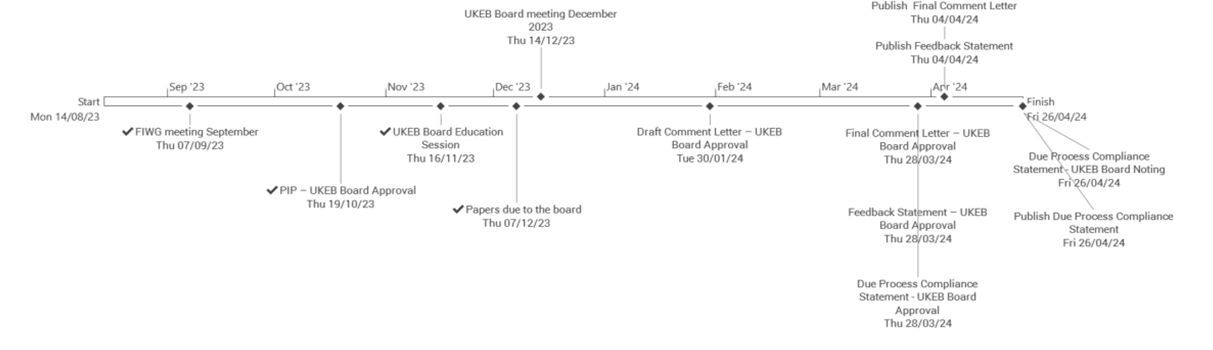
Detailed project timeline
| Date | Milestone | Status |
|---|---|---|
| October to November 2023 | Preliminary analysis and outreach before publication of Exposure Draft | Completed. |
| 19 October 2023 | Board: Discusses and approves Project Initiation Plan. | Completed. |
| 16 November 2023 | Board: Education session on proposed topics for Amendments. | Completed. |
| November 2023 | IASB publishes ED with 120-day comment period. | Completed. |
| November 2023 to January 2024 | Secretariat: Outreach with advisory groups, FIWG and relevant industry groups. | To be completed. |
| 14 December 2023 | Board: Discusses technical paper. | This meeting. |
| 30 January 2024 | Board: Discusses and approves DCL. | To be completed. |
| 6 February 2024 | Secretariat: Alerts key stakeholders to publication of DCL. | To be completed. |
| 6 February to 5 March 2024 | 30-day comment period. | To be completed. |
| 28 March 2024 | Board: Discusses and approves Final Comment Letter (FCL), Feedback Statement and Due Process Compliance Statement. | To be completed. |
| As soon as possible after Board discussion | Secretariat: Submits FCL to IASB and publishes FCL on website. | To be completed. |
| 26 April 2024 | Board: Notes Due Process Compliance Statement. | To be completed. |
Timeline
Appendix A: Financial Instruments with Characteristics of Equity: Proposed Amendments to IAS 32, IFRS 7 and IAS 1 | Preliminary analysis
Fixed-for-fixed condition
What is the issue?
A1There is limited guidance in IAS 32 Financial Instruments: Presentation on how the fixed-for-fixed condition in paragraph 16(b) of IAS 32 should be applied. In the IASB staff view, this has resulted in diversity in practice in the assessment of whether derivatives over own equity, such as a contractual obligation to issue more shares in the future, may be classified as equity instruments. A2Paragraph 16(b)(ii) refers to “a derivative that will be settled only by the issuer exchanging a fixed amount of cash or another financial asset for a fixed number of its own equity instruments". Practice has developed around the meaning of 'fixed', for example where the contract provides for adjustments to be made to the arrangement to adjust for dividends paid.
IASB proposals
A3Paragraph 22B of the ED states that:
“For a contract to meet the requirements in paragraph 22 to be classified as an equity instrument, the amount of consideration to be exchanged for each of an entity's own equity instruments is required to be denominated in the entity's functional currency (subject to paragraphs 16(b)(ii), AG27A(a) and AG29B) and either:
- fixed (will not vary under any circumstances); or
- variable solely because of a preservation adjustment or a passage-of-time adjustment or both (as specified in paragraph 22C).
A4Paragraph 22C of the ED states that:
"For the purposes of paragraph 22B(b):
- a preservation adjustment is an adjustment to the amount of consideration exchanged for each of an entity's own equity instruments (made by adjusting either the amount of consideration to be exchanged or the number of the entity's own equity instruments used to settle the derivative) that:
- is made upon the occurrence of a contractually specified event(s) that affects the economic interests of the current holders of the entity's own equity instruments (current equity instrument holders); and
- preserves the economic interests of the future holders of the entity's own equity instruments (the future equity instrument holders) to an equal or lesser extent, relative to the economic interests of the current equity instrument holders; and
- a passage-of-time adjustment is an adjustment to the amount of consideration exchanged for each of an entity's own equity instruments (made by adjusting either the amount of consideration to be exchanged or the number of the entity's own equity instruments used to settle the derivative) that:
- is predetermined at the inception of the contract;
- varies with the passage of time only; and
- has the effect of fixing on initial recognition the present value of the amount of consideration exchanged for each of the entity's own equity instruments–any difference in the amounts of consideration to be exchanged on each possible settlement date represents compensation proportional to the passage of time.”
A5Paragraph AG29B of the ED clarifies that “In consolidated financial statements, in applying the requirements in paragraph 22B, an entity classifies a financial instrument as equity if the consideration amount is in the functional currency of the entity within the group whose equity instruments will be delivered on settlement." A6The fixed-for-fixed condition is met when a fixed amount of functional currency units is exchanged per share (for example, exercise price of CU5 per share) or a fixed number of shares is exchanged for each functional currency unit (for example 10 shares for each CU1 outstanding in a convertible bond).1 A7Essentially, that principle means that the issuer must know the exact exchange or conversion ratio at inception of the derivative. The issuer's rights and obligations are fixed in a similar way that they would have been fixed if it had issued (or reacquired) the underlying equity instruments for cash instead. A8If it is possible that the issuer would need to give away more value to the derivative holder (future shareholder) than it would have given to the current equity holder, the derivative exposes the issuer to risks that are additional to the underlying equity instrument risk and would be inconsistent with equity classification. A9The Basis for Conclusions includes further detail on the assessment of the passage-of-time test, which requires a mechanical assessment, rather than any substance-based assessment of the value of the adjustment: BC54(c) states that “[...] the amount of consideration to be paid or received for each of an entity's own equity instruments on each possible settlement date to be predetermined at inception of the contract, to vary only with the passage of time (similar to the approach described in paragraph BC54(a)) and to have the effect of fixing on initial recognition the amount of consideration to be paid or received for each of the entity's own equity instruments in terms of a present value. This approach would require the extent of the adjustment to be analysed using a present value calculation to assess whether the difference between the amount of consideration to be paid or received on each settlement date represents only compensation proportional to the passage of time. The present value calculation is not intended to assess whether there is compensation for the time value of money or whether the adjustment is reasonable, and is not related to any effective interest method calculation."
To what extent could these proposals result in a change in UK practice?
A10Both the Financial Instruments Working Group (FIWG) and the Accounting Firms and Institutes Advisory Group (AFIAG) members welcomed the clarification of the fixed-for-fixed condition, as it is likely to reduce diversity in practice. A11Both FIWG and AFIAG members observed that the proposed assessment of whether preservation adjustments are permitted or not does not take the likelihood of existing shareholders' rights being diminished into account, which is a change from current practice. They described the common scenario of a share issue in which value is allocated between shareholders not based on a firm valuation but on an approximative formula. In this situation, it is unlikely but conceivable that future shareholders may be placed in a marginally better position relative to existing shareholders. FIWG and AFIAG members therefore expressed concern that instruments that currently meet the fixed-for-fixed criteria may no longer do so under the proposals. A12Of the eight examples provided in the Illustrative Examples accompanying the ED, only one example (IE example 19) is of an instrument which successfully passes the passage-of-time adjustment test. There are no examples of instruments successfully passing the preservation adjustment test. However, in addition to the four basic examples of instruments that either pass or fail the fixed criteria (IE examples 13 to 16), there are three examples showing instruments failing the criterion that instruments should be variable only with either preservation adjustments or passage-of-time adjustments (IE examples 17, 18 and 20). Additional examples of instruments passing the fixed-for-fixed test because they were variable only with either the passage of time or preservation adjustments would be helpful to users in addressing this new test. A13FIWG and AFIAG members also suggested that the clarification within paragraph AG29B that the consideration must be denominated in the functional currency of the entity whose equity instruments will be delivered on settlement may result in some changes to UK practice in consolidated financial statements. At present, accounting manuals guidance2 indicates that entities have a choice between designating the reference currency of the financial instrument as either (i) that of the entity whose equity instruments will be delivered under the agreement or (ii) that of the entity issuing the financial instrument itself.
What is the ongoing impact likely to be?
A14Overall, both FIWG and AFIAG members welcomed the clarification, as it would be practicable on an ongoing basis and would lead to less diversity in practice. A15Feedback from those members indicated there may be some initial complexity in applying the new requirements, but in time it should be possible for issuers of new instruments to ensure any terms and conditions comply with the requirements to achieve equity classification.
What is the likely impact on transition?
A16The IASB has proposed full retrospective application for the Amendments with restatement of comparatives in paragraph 97U of the ED. A17Initial feedback from FIWG and AFIAG members was that certain instruments previously classified as equity may no longer pass the test. For example, certain instruments may narrowly fail the preservation test, which could lead to reclassification for a small number of instruments, principally from equity to liability. A18However, full retrospective application may require entities to reassess numerous contracts, which may prove difficult and onerous. This is likely to be particularly challenging for older financial instruments. A19Change in classification as a result of retrospective application of the requirements may also present particular challenges for those who have previously applied hedge accounting in respect of a liability which is required to be restated as equity, for which hedge accounting is not possible.
Reclassifications
What is the issue?
A20IAS 32 Financial Instruments: Presentation is silent on whether and, if so, when financial liabilities should be reclassified to equity, and vice versa.3 The IASB noted that diversity in practice exists, and the ED paragraph BC126 observes that stakeholders have requested clarification in this area. The accounting firms' manuals currently suggest reclassification may be appropriate in several situations.
IASB proposals
A21Under the proposals, the Standard would prohibit reclassification from equity to debt and vice versa in all circumstances except those in which “the substance of the contractual arrangement changes because of a change in circumstances external to the contractual arrangement” (ED paragraph 32B). Such scenarios could include a change in functional currency or in a group's structure (ED paragraph 32C). Reclassifications already required by IAS 32 remain unaffected.4 A22In the ED paragraph BC149 and in the IASB staff papers, the IASB has drawn an analogy with the requirements in IFRS 9 Financial Instruments for classification of financial assets (paragraphs 4.1.2 to 4.1.5).5 Under those paragraphs, instruments are classified at inception and are not generally subsequently reassessed except for when there is a change in the entity's business model. A23The proposed approach is consistent with other standards, such as IFRS 15 Revenue arising from Contracts with Customers, IFRS 16 Leases and IFRS 17 Insurance Contracts. For example, in IFRS 176, it is not possible to reclassify a contract between the variable fee approach and the general measurement model. A24The IASB has proposed to clarify that when the substance of contractual terms changes because of changes outside the contract:
- A financial liability reclassified from equity would be measured at fair value at the date of reclassification. Differences between the carrying amount of the equity instrument and the fair value of the financial liability would be recognised in equity.
- An equity instrument reclassified from a financial liability would be measured at the carrying value of the financial liability at the date of reclassification. No gain or loss would be recognised.
- A reclassification would be accounted for in the reporting period in which the change in circumstances occurred.
To what extent could these proposals result in a change in UK practice?
A26A number of AFIAG members considered that reclassifications were not common in the UK, but clarity in this area remained welcome. There are a number of circumstances where current Big 4 guidance says reclassifications may be permitted or required.7 These would no longer be permitted except in defined circumstances.
What is the ongoing impact likely to be?
A27FIWG and AFIAG members expressed concern that preventing reclassification where a contingent settlement provision expired after a defined period could result in misleading information, particularly for non-derivatives, as it seems counter-intuitive to continue to recognise a financial liability. For example, consider an entity that issues preference shares redeemable in cash, should a contingent event such as a change of control occur within a 12-month period. However, if no such event occurs, subsequent dividends are discretionary and redemption is not required until liquidation. Under the IASB's proposals, reclassification would be prohibited as the expiry of the cash redemption obligation is anticipated within the contract. The preference shares would likely remain classified as a liability. A28However, it may be that the derecognition criteria could apply in these cases (see, for example, the ED paragraphs BC128 and BC129, which differentiate between derecognition and reclassification in the context of NCI puts). If so, the instrument would be derecognised after the 12-month period and a new equity instrument recognised, which would achieve a result consistent with the terms and conditions of the financial instrument from that point. A29Some FIWG members considered that few changes in circumstances outside the contract would impact on equity classification. Others thought that the definition would appear narrow until unexpected circumstances arose. As the proposals introduced a new principle of 'external to the contract', it was suggested that it would be helpful for the IASB to provide examples of applicable scenarios.
What is the likely impact on transition?
A30AFIAG and FIWG members thought that full retrospective application of the proposals on reclassification could potentially prove very challenging, especially for older financial instruments. Entities would have to reassess all financial instruments in the light of the law at the time the instrument was issued, which would be in addition to business-as-usual processes. A31FIWG members noted there could be specific challenges in the possible, although unusual, scenario in which a company that had applied hedge accounting to a liability now had to reclassify that financial liability to equity. This could also create an issue for a financial asset designated at fair value to eliminate an accounting mismatch in relation to that financial liability. If that financial liability had to be reclassified to equity, then the remeasurement of the financial asset would no longer be matched by corresponding remeasurement of the liability. A32As a potential mitigating factor, FIWG members observed that there would be sufficient lead time to prepare for transition by discontinuing existing hedging arrangements, but doing so could be burdensome for preparers. A33If instruments were required to be retrospectively reclassified from equity to liability, it would be necessary to measure their fair value either from inception or from early on in the instrument's life, which could also prove onerous. A34It was noted that IFRS 17 Insurance Contracts was required to be applied retrospectively unless it was impracticable to do so (IFRS 17 paragraph C3), consistent with IAS 8 Accounting Policies, Changes in Accounting Estimates and Errors. If it was impracticable, IFRS 17 paragraph C5 proposed a modified retrospective approach and a fair value approach based on the fair value of the contracts at the date of transition. Accounting firm guidance observed that for long-term contracts, retrospective application might be impracticable.8 A similar relief, classifying the instrument based on facts and circumstances at the date of transition, rather than at inception, would be welcome. A consequential relief to permit remeasurement of the fair value of the instrument using the fair value at the date of transition would also be welcome.9
Effects of laws
What is the issue?
A35In the IASB September 2021 Agenda Paper 5E, the IASB staff observed that in practice, questions arise around whether and, if so, to what extent a legal requirement – whether explicitly referenced within the contract or implied by law – is part of the contractual terms and must therefore be considered in classifying a contract as a financial liability or an equity instrument. Respondents to the 2018 Financial Instruments with Characteristics of Equity discussion paper urged the Board to provide guidance in this area. A36The ED paragraph BC13 sets out two principal examples affected by these proposals, minimum legal dividends and bail-in features. In relation to bail-in instruments, stakeholders have asked whether laws that impose a contingent conversion into ordinary shares or a write-down of the principal amount should be treated as part of the contractual terms, and whether the conclusion would differ if the contract referred to currently effective legal requirements or only those effective at the time of drawing up the contract. In relation to ordinary shares with statutory minimum dividends, stakeholders have asked whether a legal obligation to distribute a specified % of profit gives rise to a financial liability, (a) if the legal requirement is referenced explicitly within the contract or (b) if it is not. The IASB staff further distinguish ordinary shares issued subject to a legal requirement to distribute a certain proportion of profit, from ordinary shares issued subject to a contractual obligation to distribute a proportion of profit in excess of that legal requirement. A37Existing guidance from two accounting firms10 observes that an obligation established by local law or statute is not contractual; it does not, therefore, create a contractual obligation as required by the definition of a financial liability. One of those firms11 suggests that “statutory bail-in requirements do not impact the issuer's classification as financial liabilities or equity on initial recognition. However, bail-in features that are contractual terms of the instruments are considered in classification by the issuer.” A further firm notes that in March 2006, IFRIC discussed this issue, agreeing that IAS 32 is clear that, in order for an instrument to be classified as a liability, a contractual obligation must be established (either explicitly or indirectly) through the terms and conditions of the instrument.
IASB proposals
A38The ED paragraph 15A proposes that:
"In classifying a financial instrument (or its component parts) as a financial liability, a financial asset or an equity instrument, an entity:
- shall consider only contractual rights and obligations that are enforceable by laws [...] or regulations and are in addition to those created by relevant laws or regulations (such as statutory or regulatory requirements applicable to the instrument); and
- shall not consider any right or obligation created by relevant laws or regulations that would arise regardless of whether the right or obligation is included in the contractual arrangement.”12
A39The ED paragraph BC20 provides the rationale for the proposals:
“The Board was of the view that, based on the definitions of a financial liability, a financial asset and an equity instrument, it is necessary for the classification of a financial instrument to be based on the contractual terms and conditions of the instrument. However, the Board acknowledged the challenges that arise [from requiring laws and regulations being reproduced or referred to in a contract] and decided to develop an approach that considers only contractual rights and obligations that are in addition to those established by relevant laws or regulations.”
A40The ED paragraphs BC25 and BC26 elaborate further:
"[...] separating a contractual obligation and accounting for each element individually might, in some circumstances, be complex and give rise to more questions in practice [...] in determining the classification of a contractual right or obligation that is in addition to a right or obligation established by relevant laws or regulations, an entity considers such a right or obligation in its entirety".
To what extent could these proposals result in a change in UK practice?
A41FIWG and AFIAG members considered that the issue of minimum legal dividends is less relevant in the UK, which does not have such a legal requirement, although it may affect foreign subsidiaries of UK groups. They further considered that instruments with bail-in features would be unlikely to change classification, as the clarification is broadly consistent with how these instruments have generally been accounted for. Based on feedback to date, it is understood that the nature of any bail-in clauses in UK instruments is not currently expected to lead to change in classification. Our understanding is that AT1 instruments issued by large UK banks are generally expected to remain classified as equity instruments, as any bail in clauses generally would meet the criteria for equity classification (e.g. conversion to a fixed number of equity shares).
What is the likely impact on transition?
A42As stakeholder feedback indicates that these proposals are not expected to give rise to changes in practice in the UK, there is likely to be minimal impact on transition.
Shareholders' discretion
What is the issue?
A43IAS 32 paragraph 19 states that “If an entity does not have an unconditional right to avoid delivering cash or another financial asset to settle a contractual obligation, the obligation meets the definition of a financial liability.” A44IAS 32 paragraph AG26 explains that “When preference shares are non-redeemable, the appropriate classification is determined by the other rights that attach to them. [...] When distributions to holders of the preference shares, whether cumulative or non-cumulative, are at the discretion of the issuer, the shares are equity instruments.” A45IAS 32 does not currently include guidance on the classification of a financial instrument with a contractual obligation to deliver cash (or to settle it in such a way that it would be a financial liability) at the discretion of the issuer's shareholders. A46The IASB staff consider that the directors and management can generally be seen as an extension of the entity, following IAS 24 Related Party Disclosures paragraph 9. However, questions have arisen in relation to whether decisions taken by management which are subject to shareholder approval or decisions which shareholders can initiate, represent decisions of the entity (the issuer). The ED paragraph BC117 observes that, while some stakeholders are of the view that shareholders should always be seen as part of the entity, others are of the view that they never should be. A47The accounting firms' guidance suggests that shareholders can make decisions either (i) as part of the routine decision-making process of an entity or issuer, usually as part of a general meeting, or (ii) separate from it, as individual investors. A48In the former scenario, the shareholders are acting as part of the entity or 'issuer' which would indicate that the instrument should be classified as equity (see IAS 32.AG26). One firm13 suggests that dividend approvals “consistently carried out over the years as a matter of routine”, which constitute “a recurring item on the agenda of the annual general meeting” may indicate that the shareholders are acting as a body on behalf of the entity when approving or disapproving the payment of dividends on ordinary shares. Two other firms14 suggest actions reserved for the entity's shareholders in general meeting are actions of the entity. A49However, in the latter scenario, the shareholders are not acting as part of the 'issuer', which would indicate that the instrument should be classified as a financial liability.15 Examples provided by the firms of shareholders not acting as part of the entity include shareholders voting to dispose of their shareholding16 and preference shareholders who can vote for the entity to initiate an IPO without ordinary shareholder consent.17 A50Examples of situations in which judgement is required in this area include:
- An individual or entity is the manager or director of a company in which he or she owns shares.
- A payment which should be made if an initial public offering did not take place, but which could be avoided if 'best efforts' were made to instigate the process.
IASB proposals
A51The IASB acknowledges in the ED paragraph BC120 that “Focusing solely on whether a decision is routine and made as part of the entity's ordinary course of business might fail to address all scenarios that involve shareholder discretion.” The ED paragraph AG28A therefore provides a number of factors an entity is required to consider in making that assessment. These "[...] include whether:
- a shareholder decision is routine in nature—made in the ordinary course of the entity's business activities. Routine decisions that are part of the entity's ordinary course of business are more likely to be treated as entity decisions.
- a shareholder decision relates to an action proposed or a transaction initiated by the entity's management for shareholder approval. If the entity's management can avoid an outflow of cash from the entity by not proposing an action requiring shareholder approval, shareholder discretion would have no bearing on the classification of the instrument because the shareholders would not have to make a decision. In contrast, if a shareholder decision relates to an action proposed or a transaction initiated by a third party, the shareholder decision is unlikely to be treated as an entity decision.
- different classes of shareholders benefit differently from a shareholder decision. If so, each class of shareholder is likely to make an independent decision as investors in a particular class of shares, and the shareholder decision is unlikely to be treated as an entity decision.
- exercise of a shareholder decision-making right enables a shareholder to require the entity to redeem—or pay a return on—its shares in cash or another financial asset (or otherwise to settle it in such a way that it would be a financial liability). Such decision-making rights indicate that the shareholders would make their individual decisions as investors in the shares, and the shareholder decision is unlikely to be treated as an entity decision.”
To what extent could these proposals result in a change in UK practice? What is the ongoing impact likely to be?
A53Some FIWG members considered that the proposals would provide helpful guardrails on determining classification in this area. Others thought that the proposals could be read as supporting a range of diverse existing practices, due to the continuing extent of judgement involved. Nonetheless, FIWG members agreed that a bright line approach would not be welcome in this area. A54FIWG members considered that the proposals might lead to an increase in financial instruments classified as equity because the proposals provide guidance on whether decisions regarding the instrument are considered as being made by the entity. At present, the absence of guidance on whether an entity has an unconditional right to avoid delivering cash has led to a conservative approach being taken, with accounting firms considering that shareholder decisions are not made as part of the entity. It was further considered that the proposals could be clarified to specify whether each factor suggested either equity or liability classification, and that examples would be helpful.
What is the likely impact on transition?
A55It was observed at the FIWG meeting that, as the IASB has proposed a factor-based approach to this question, judgement will remain in this area. Adjustments may be required on transition if evaluation against the factors leads to a different conclusion in relation to an instrument's classification from that drawn previously. A56In applying a factor-based assessment retrospectively, there is a risk that it will be difficult for entities not to incorporate an element of hindsight into the assessment.
Disclosures and presentation
What is the issue?
A57The IASB identified in its 2018 Discussion Paper that users of financial statements would welcome further information on the following topics:
- An entity's capital structure, for example, on the nature and priority of claims against the entity, including on liquidation, especially important for perpetual instruments. 18
- Terms and conditions affecting the amount and timing of cash flows of both financial liabilities and equity instruments.
- The potential dilution of ordinary shares arising from financial instruments which require delivery of ordinary shares, such as convertible bonds and derivatives on own equity. 19
IASB proposals
A58In response to requests from users of accounts, in IFRS 7 Financial Instruments: Disclosures, the IASB20 has proposed more detailed disclosure for all financial instruments with characteristics of both debt and equity, including compound instruments but excluding stand-alone derivatives, comprising the following:
- Differences in nature and priority on liquidation: disclosing differences between debts that are secured and unsecured, contractually subordinated and unsubordinated, and issued/owed by parent and issued/owed by subsidiaries.
- Terms and conditions: including qualitative and quantitative information on 'debt-like' and 'equity-like' features, significant judgements, initial allocation between components for compound instruments and terms that stop being effective with the passage of time.
- Potential dilution of ordinary shares, including the maximum and minimum amount of shares that an entity could be required to issue.
- Various other topics, including reclassifications, remeasurement gains or losses on liabilities based on an entity's performance or net assets, and obligations to redeem own equity instruments.
To what extent could these proposals result in a change in UK practice?
A59IAG members welcomed the proposals. AFIAG members agreed that overall, the quality of disclosure could be enhanced in relation to financial instruments with characteristics of equity. FIWG members were uncertain as to the extent to which the disclosure proposals would give rise to changes in UK practice. Many banks and building societies were already making many of these disclosures. Some FIWG members expressed concern over the potential for voluminous additional disclosures; others considered that aggregation would mitigate this risk. Further consideration was required. A60FIWG members cautiously welcomed the focus on key judgements. However, they observed that IAS 1 Presentation of Financial Statements paragraph 122 already provides a general disclosure requirement. A61Some FIWG members expressed concern over the practical ability to distinguish reserves attributable to ordinary shareholders from those attributable to other shareholders. This requirement could be particularly difficult to apply to private equity vehicles with different classes of ordinary share capital allocated in accordance with a formula.
What is the ongoing impact likely to be?
A62Extrapolating from the feedback from FIWG and AFIAG, it may be that introducing additional disclosure requirements within the accounting standards has less of an impact on regulated entities than on other corporates issuing such instruments. However, the assessment of the impact of these requirements on the regulated sector is still at a preliminary stage, and this will be an area of focus for further engagement with the FIWG in January 2024.
What is the likely impact on transition?
A63There is likely to be additional cost to preparers, which will depend on the extent to which their current practice is aligned with the proposals.
Footnotes
-
See IE examples 13 to 20 on the application of the fixed-for-fixed condition. ↩
-
Deloitte 3.8.1-1; EY Chapter 42 6.6.5A; PwC 43.73; KPMG 7.3.600.50. ↩
-
Other than specifically in relation to puttable instruments and instruments that impose obligations to deliver a pro-rata share of the entity's net assets on liquidation (IAS 32 paragraphs 16E and 16F). ↩
-
These are the requirements in IAS 32 paragraphs 16E and 16F relating to puttable instruments. ↩
-
See the IASB March 2022 staff paper 5 paragraph 16. ↩
-
See IFRS 17 paragraph B102. ↩
-
See, for example: where a subsidiary whose functional currency differs from that of its parent: KPMG 7.3.600.50; PwC 43.73; EY Chapter 42 6.6.5, where parties to a call option subsequently become unrelated: Deloitte D3 3.8.1-1; Deloitte 8.2-4; see EY Chapter 42 4.9.3 for similar commentary. KPMG 7.3.430 – Example 29D has a similar scenario, but in which control is gained rather than lost; a warrant conversion price that was previously fixed but that becomes fixed with the passage of time: Deloitte 8.2-3; PwC FAQ 43.77.1; EY Chapter 42 4.9.2; KPMG 7.3.430 – Example 29A. ↩
-
To note ED paragraph 97W permits entities to "[...] not separate the components [of compound financial instruments with contingent settlement provisions] if the liability component is no longer outstanding at the date of initial application." ↩
-
PwC In the Spotlight – Transition to IFRS 17, page 2. ↩
-
KPMG 7.3.30.40 and 50; PwC FAQ 43.6.2. ↩
-
KPMG 7.3.50.60. ↩
-
See also the ASAF meeting summary July 2022 (ifrs.org) ↩
-
KPMG 7.3.70.100 ↩
-
EY Chapter 42 4.2.1; PwC FAQ 43.17.1; ↩
-
See KPMG 7.3.70.90 to 130; PwC 43.17 and FAQ 43.17.1 and 2; EY Chapter 42 4.2.1. Deloitte 2.2 notes the IFRIC discussion. ↩
-
KPMG 7.3.70.120; PwC 43.17.2 ↩
-
PwC FAQ 43.17.2 ↩
-
2018 Discussion Paper paragraphs 1.28 and 7.4 to 7.12. ↩
-
2018 Discussion Paper paragraphs 7.13 to 7.22. ↩
-
See ED Amendments to IFRS 7 paragraphs 12E, 17A, 20 and 30A to 30J and B5 and B5A to B5L. ↩