6 IASB General Update
16 November 2023 Agenda Paper 6
Executive Summary
| Project Type | Monitoring |
|---|---|
| Project Scope | Various |
| Purpose of the paper |
This paper provides the Board with an update on projects the Secretariat is currently monitoring, including the work of the IFRS Interpretations Committee.
As agreed with the Board, the Secretariat monitors projects being undertaken by the IASB and IFRS Interpretations Committee. This is undertaken to inform the Board about the progress and decisions being made by the IASB on active projects. Discussion by the Board may also help inform interactions with international standard setter meetings, including the IASB's Accounting Standards Advisory Forum (ASAF).
Summary of the Issue
Topics discussed by the IASB at its October 2023 meeting were:
Topics for discussion:
- Primary Financial Statements
- Rate-regulated Activities
In addition, although not discussed by the IASB at its October 2023 meeting, this paper includes an update on the Climate-related and Other Uncertainties in the Financial Statements project, as that is on the agenda for ASAF in December 2023.
Topics for noting:
- Subsidiaries without Public Accountability: Disclosures
- Equity Method
- Amendments to IFRS 9 - Classification & Measurement
- Interpretations Committee Update
Questions for the Board
The Board is not asked to make decisions on any of the topics presented in this paper. However, the Board is asked for its views on the following questions:
Items for discussion:
- Primary Financial Statements (Agenda Paper 6: Appendix A)
- The IASB's communications strategy:
- Does the Board have any comments on the IASB's proposed communications strategy?
- Does the Board agree the three areas in paragraph A8 should be given more focus in the IASB's implementation support? Does the Board have any comment on which other areas should be prioritised in the IASB's plan?
- Does the Board have any examples of best practice that the IASB should consider in developing the plans to support the implementation and consistent application of IFRS 18?
General update:
- Do Board members have any comments on the Primary Financial Statements update?
Rate-regulated Activities (Agenda Paper 6: Appendix B)
- Do Board members have any questions or comments on the Rate-regulated Activities update?
Climate-related and Other Uncertainties in the Financial Statements (Agenda Paper 6: Appendix C)
- Do Board members have any comments in response to the ASAF questions?
Items for noting:
Do Board members have any questions or comments on the items for noting?
Recommendation
N/A
Appendices
- Appendix A: Primary Financial Statements
- Appendix B: Rate-regulated Activities
- Appendix C: Climate-related and Other Uncertainties in the Financial Statements
- Appendix D: Subsidiaries without Public Accountability: Disclosures
- Appendix E: Equity Method
- Appendix F: Amendments to IFRS 9 – Classification & Measurement
- Appendix G: Interpretations Committee Update
- Appendix H: List of IASB Projects
Appendix A: Primary Financial Statements
Topic for Discussion
| UKEB Project Status: Active Monitoring | UKEB project page |
|---|---|
| IASB Next Milestone: IFRS Accounting Standard | UKEB Secretariat Comment Letter (Published in September 2020) |
Purpose of this update
A1In our last update we informed the Board that the IASB had tentatively decided to start the balloting process of the forthcoming IFRS Accounting Standard 18 Presentation and Disclosure in Financial Statements (IFRS 18). A high-level summary of all the tentative decisions made by the IASB (since the ED was published) can be accessed here.
A2In this paper:
a) we ask the Board for the input on the questions for ASAF members; and b) we present a summary of the outcome of the IASB's discussions at the October 2023 IASB meeting.
ASAF December 2023 meeting
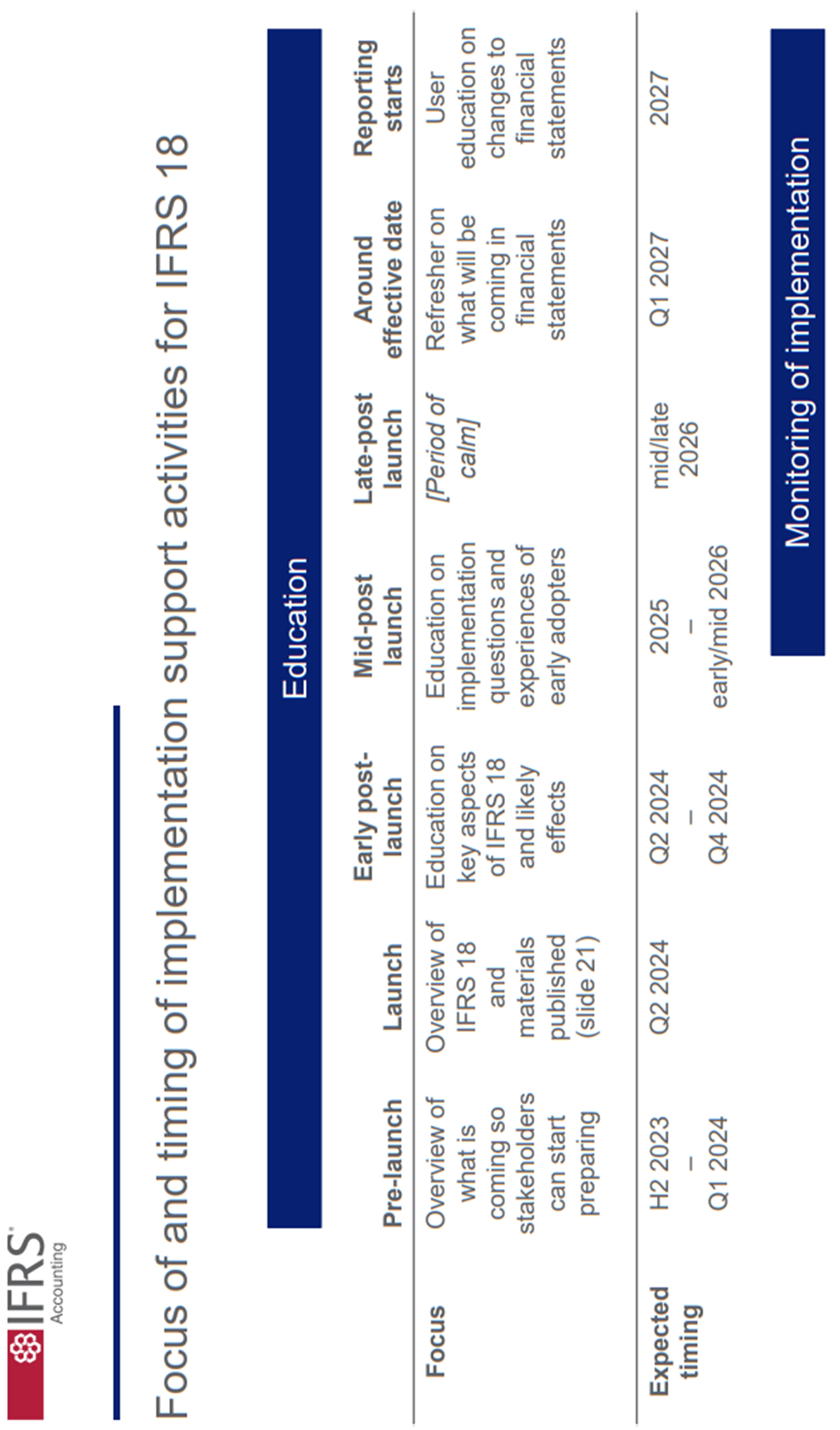
A3The IASB is seeking input and advice from ASAF members on steps after publication of IFRS 18 to support its implementation and consistent application.
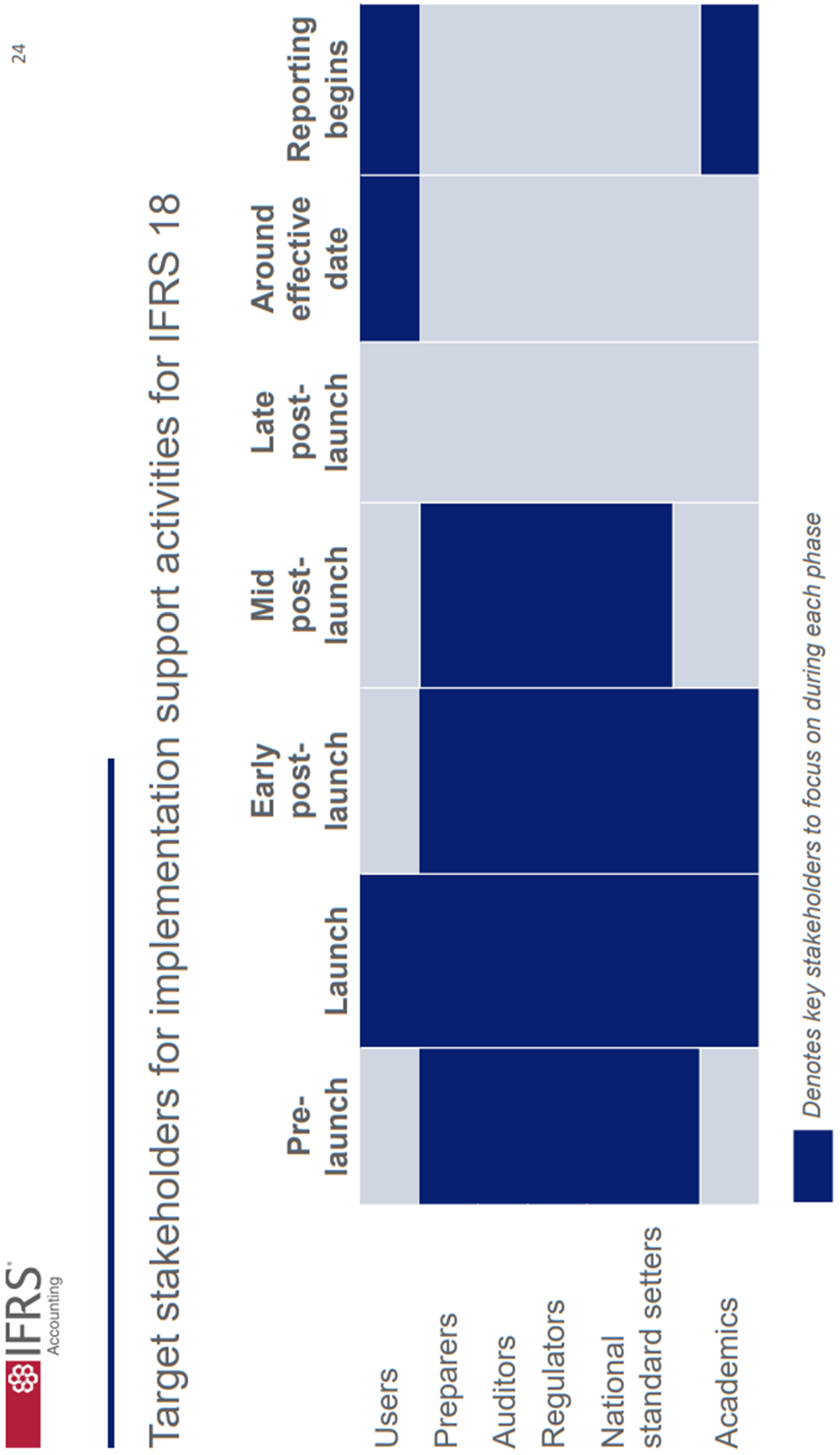
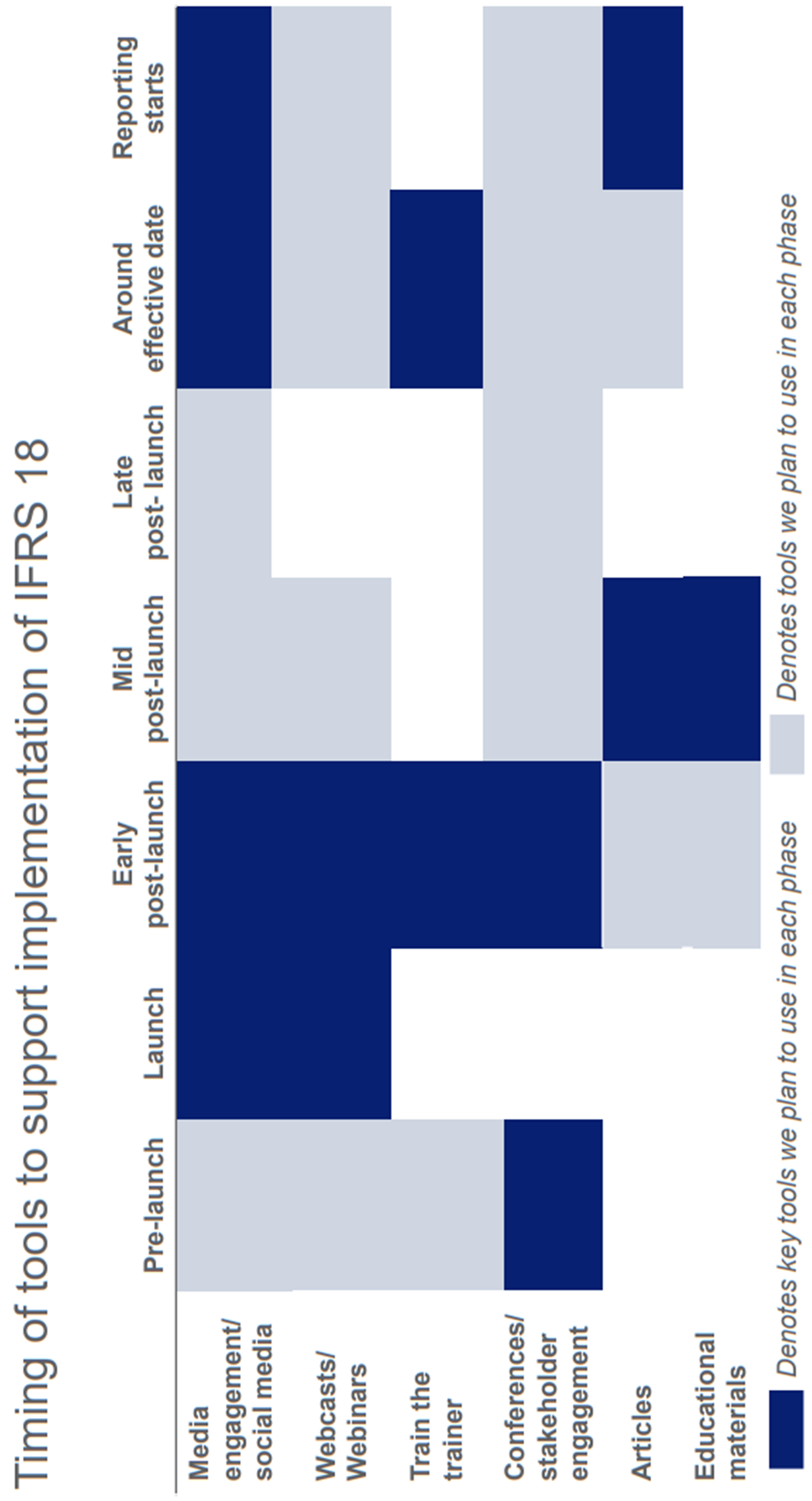
a) a project update including the IASB's communications strategy coupled with specific examples; and b) a high-level overview of the purpose, timing and tools the IASB plans to use to support the implementation and consistent application of IFRS 18.
Annex A of this paper includes the extract of the ASAF paper that illustrates the IASB's proposed focus and timing of the implementation support for IFRS 18.
Questions for ASAF members
A5The specific questions for ASAF members are reproduced below.
Questions for ASAF members (page 3 of ASAF agenda paper 22)
Project update, including communications strategy
- Do you have any comments on the high-level messages the IASB plans to use in the communications strategy?
The IASB's support to implementation and consistent application
Given that our resources and the resources of our stakeholders are limited, what areas should we strategically focus on to provide the most effective support for implementation and consistent application?
Are there any examples of best practice that we should consider in developing our plans to support implementation and consistent application?
Secretariat's view
Project update, including communications strategy
A6Based on our preliminary review, we consider that the high-level summary of the project update is aligned with our understanding on the project2.
The IASB's support to implementation and consistent application
A7We think that the main focus for this ASAF session should be the IASB's approach to supporting the implementation and consistent application of IFRS 18, specifically which area(s) to focus on and how.
UKEB Advisory Group
A8At the October 2023 Preparer Advisory Group (PAG) meeting and the November 2023 Accounting Firms & Institutes Advisory Group (AFIAG) meeting, the members identified the following areas as needing better communications:
a) Associates and joint ventures in investing category: Some PAG and AFIAG members considered there could be circumstances where joint ventures are within an entity's main business activity and therefore should be allocated to the operating category in the income statement. However, the line items related to joint ventures are required to be in the investing category in the income statement. The PAG and AFIAG members considered this could be confusing and not reflective of the actual operating profit. b) Management-defined performance measures (MPM): Some PAG and AFIAG members considered the boundary between Alternative Performance Measures (APM) and MPMs to be potentially confusing to stakeholders. Some PAG members envisaged challenges communicating MPMs internally and externally, particularly with regard to the scope of MPMs. c) Disclosure of specific expenses by nature: Some PAG and AFIAG members considered this disclosure could be confusing because the specified expenses, for example employee benefit, could be capitalised then depreciated or impaired and therefore go through different line items in the financial statements.
Questions for the Board—the IASB's communications strategy on IFRS 18 implementation and consistent application
Does the Board have any comments on the IASB's proposed communications strategy?
Does the Board agree the three areas in paragraph A8 should be given more focus in the IASB's implementation support? Does the Board have any comment on which other areas should be prioritised in the IASB's plan?
Does the Board have any examples of best practice that the IASB should consider in developing the plans to support the implementation and consistent application of IFRS 18?
October 2023 IASB meeting
A9In October 2023 the IASB discussed some sweep issues identified during the pre-balloting process for IFRS 18. At this meeting we provide an update of the IASB's tentative decisions in respect of the issues identified and invite the Board's input.3 The issues identified are:
a) Topic 1: The presentation of a line item for cost of sales and whether this line item should be separately presented from any other expenses classified by function in the statement of profit or loss. b) Topic 2: Whether the IASB should include in IFRS 18 a hierarchy of characteristics that an entity should consider for the aggregation/disaggregation of assets, liabilities and equity and for the presentation of line items in the statement of financial position. c) Topic 3: Whether the IASB should provide transitional relief from retrospective application of IFRS 18 for any earlier periods than the annual period immediately preceding the initial period of application.
Update on tentative IASB decisions in October 2023
A10The tables in the next page provide context around those decisions.
Topic 1: Decision to require the separate presentation of cost of sales from other items by function
| Current tentative decisions | Sweep issue | Changes to the tentative decision | Consistency with UKEB proposals |
|---|---|---|---|
| IFRS 18 would require: | Entities that provide a 'mixed presentation' of operating expenses4 would be faced with inconsistencies when applying the requirement to provide the most useful information on operating expenses. For example, for an entity presenting information mainly by nature with only one item by function (e.g. research and development) it would not be clear whether the 'cost of sales' line should be presented (even when an entity concludes that this may not provide the most useful information in the income statement). | The IASB observed that 'cost of sales' is a key line item for some entities. For example, for a manufacturing entity providing a separate 'cost of sales' line item provides useful information about the main drivers of its profitability. | We observe that the IASB's decision is consistent with the UKEB Secretariat's suggestion in paragraph A49 of the GPD Final Comment Letter to the IASB to clarify that entities choosing the nature of expense method5 should not be required to present cost of sales. |
| • An entity that presents one or more line items for operating expenses classified by function to: | Accordingly, the IASB decided to retain the requirement to present costs of sales but only in those circumstances where an entity classifies operating expenses by function that include expenses related to cost of sales. | ||
| (a) present a line item for its cost of sales; and (b) include inventory expense as specified in paragraph 36(d) of IAS 2 Inventories in that line item. | We note that during the discussion of this issue one IASB member questioned the need for this clarification given that each required line item in IFRS 18 or in other standards would be subject to consideration of the role of the primary financial statements. However, it was observed that providing more guidance in IFRS 18 is useful. | ||
| • The presentation of operating expenses in a manner that provides the most useful information about those expenses (i.e. using the characteristics of function or nature) and the aggregation and disaggregation of items to fulfil the role of the primary financial statements (i.e to provide a structured summary and an understandable overview). | The IASB retained the requirement to include inventory expense as specified in paragraph 36(d) of IAS 2 as part of cost of sales. |
Topic 2: Decision to include a hierarchy of characteristics for the statement of financial position
| Current tentative decisions | Sweep issue | Changes to the tentative decision | Consistency with UKEB proposals |
|---|---|---|---|
| IFRS 18: | IFRS 18 does not clarify whether the list of characteristics should be considered on an equal basis for presenting line items in the statement of financial position; or, whether a hierarchy should be observed on the consideration of those characteristics (e.g. by stating that 'nature' and 'function' are the 'primary' characteristics). | The IASB decided to develop a hierarchy for the characteristics to consider when presenting items in the statement of financial position. | The UKEB Secretariat's response to the IASB on the GPD ED supported the aggregation of items on the basis of 'shared characteristics' (see paragraph A38 of the Final Comment Letter) but did not make any specific comments on the characteristics that should be used. |
| • Includes as part of its application guidance a list of characteristics for the aggregation and disaggregation of items in the financial statements share characteristics such as: The function and nature, measurement basis, size, type, tax effects, geographical location or regulatory environment); and Other characteristics specific to assets, liabilities and equity (i.e. duration and timing, liquidity, measurement uncertainty or restrictions on the use of an asset)6. | IFRS 18 would explain that: • nature or function are used to aggregate assets and liabilities into separate line items—other characteristics, like duration, liquidity, measurement basis, type and tax effects, assist an entity identifying the nature or function of an item; and • the duration and timing of recovery and settlement are used when classifying assets and liabilities as either current or non-current and liquidity is used to classify assets and liabilities by order of liquidity. | The Secretariat's view is that the IASB could further: • Clarify with examples how the characteristics of duration, liquidity, measurement basis, type and tax effects, assist an entity to determine the nature or function of an item in the statement of financial position as we do not think that this is clear. • Explain the concept of 'characteristic' of an item and include this definition in the glossary section of IFRS 18 for easy reference. In our view the 'characteristic' of an item is the feature or quality that makes an item unique. | |
| • IFRS 18 does not provide a hierarchy or gives emphasis on the characteristics to consider for the presentation of line items in the statement of financial position. | |||
| • In addition, IFRS 18 requires the classification of assets and liabilities in line with paragraph 60 of IAS 1 Presentation of Financial Statements (i.e. classification between current and non-current (assets and/or liabilities) or based on an order of liquidity, whichever fulfils the role of the primary financial statements. |
Topic 3: Decision not to include transitional relief for additional comparative information7
| Previous tentative decisions | Sweep issue | New tentative decision |
|---|---|---|
| IFRS 18 would require: | The IASB considered whether to provide further relief for entities that are required by their local laws and regulations to provide additional comparative information, so these entities have sufficient time to prepare for IFRS 18. For example, in a jurisdiction where an entity is required to present two comparative periods, the entity applying IFRS 18 would have less than one year till the start of its earliest comparative period (i.e. 1 January 2025), assuming it applies IFRS 18 from the effective date of 1 January 2027. Therefore, the IASB considered providing additional relief that would: | The IASB noted that it has provided transitional relief for comparative information in other IFRS Standards.8 |
| • An entity to apply IFRS 18 for annual periods beginning on or after 1 January 2027; and | However, the IASB decided not to provide transitional relief from retrospective application of IFRS 18 for any earlier periods than the annual period immediately preceding the initial period of application. | |
| • To confirm the proposal in the ED to require an entity to apply the IFRS 18 retrospectively in accordance with IAS 8 Accounting Policies, Changes in Accounting Estimates and Errors. | • Not require an entity to present adjusted comparative information and disclosures (for its earliest comparative period); and | |
| IFRS 18 will carry forward some of the requirements in paragraphs 38A and 38C in IAS 1: | • Require an entity to explain that the information has not been adjusted and has been prepared on a different basis. | |
| • To require the presentation, as a minimum, of a current reporting period and preceding period in each of its primary financial statements and in the notes. | ||
| • To permit the presentation of comparative information in addition to minimum comparative information, as long as this information is prepared in accordance with IFRS Accounting Standards. |
Other 'minor' sweep issues
A11The IASB provided comments on other minor sweep issues that the IASB staff will be addressing in the drafting of IFRS 189. In this section we are referring to only one of those issues, where there was extensive board discussion.
Disclosure of specified expenses by nature—scope of line items subject to the requirement
A12IFRS 18 includes a requirement to disclose the amount of specified expenses by nature (depreciation, amortisation, employee benefits, write-down of inventories and impairments) that have been included in each function line item in the income statement. However, it is unclear whether this decision meant that an entity would be required to disclose those specified expenses for any line item presented in the income statement (i.e. not just for line items included in the operating category). For example, is an entity required to disclose depreciation on an investment property classified in the investing category?
A13The IASB staff recommended the IASB require the disclosure for any line item presented in the income statement to provide a complete picture of the entity's specified expenses by nature. However, many IASB members disagreed with this proposal as they were of the view that it was going beyond what was originally intended.
A14Although some IASB members mentioned potential confusion could arise from the differences between the total amounts of the specified expenses in the operating category and the total amounts of these specified expenses in the income statement, other IASB members acknowledged that the disclosures of these specified expenses are already required by other existing IFRS Accounting Standards, for example, IAS 16 Property, Plant and Equipment or IAS 40 Investment Property.
A15The IASB decided to confirm that entities will be required to disclose in a single note the amounts for the specified expenses that are included in each line item in the operating category only. In addition, entities will be required to include in the same note the below disclosures for each specified expense:
a) the total for the specified expenses by nature that are already required in IFRS Accounting Standards; and b) an explanation of the difference between the total of the amounts included in the line items in the operating category and the total described in A8(a). This is aligned with a previous IASB decision where entities are required to explain how a disclosed class of items is included in the primary financial statement10.
Next steps
A16The IASB is expected to continue the discussion of sweep issues until the publication of IFRS 18 (expected to be in H1 2024). The UKEB Secretariat has commenced planning activities for the UKEB's endorsement assessment of the forthcoming standard and is planning to bring a Project Initiation Plan for the endorsement of IFRS 18 in Q1 2024.
Question for the Board
- Does the Board have any comments on the updates in the paper?
Annex A: Extract of ASAF paper
Appendix B: Rate-regulated Activities
| UKEB Project Status: Monitoring | UKEB Project page |
|---|---|
| IASB Next Milestone: Continued redeliberations on remaining topics throughout 2023 and early 2024. | UKEB Final comment letter (Published July 2021) |
Background
B1The IASB is continuing its redeliberations following feedback on its Exposure Draft Regulatory Assets and Regulatory Liabilities1 (RRA ED). At its October 2023 meeting, the IASB:
a) Redeliberated the proposals on the boundary of the regulatory agreement. b) Discussed the IASB staff's analysis and feedback from the survey on the direct (no direct) relationship concept relating to borrowing costs, inflation and other items included in the regulatory capital base.
B2The second part of the update gives a brief overview of the discussion at the IASB's Consultative Group for Rate Regulation meeting on 13 October 2023.
B3The table below summarises the IASB's proposals contained in the ED, the recommendations made by the UKEB in its comment letter and the IASB's tentative decisions on the boundary of a regulatory agreement, made at its October 2023 meeting.
| ED proposal | UKEB comment letter2 | IASB tentative decision |
|---|---|---|
| Boundary of a regulatory agreement | The UKEB was of the view that it is unclear how to apply the proposed requirements relating to the boundary of the regulatory agreement with respect to the measurement requirements. For example, it was not clear how to deal with the practical issue that approvals from a regulator may be given well after the end of the reporting period, e.g. more than one year after the end of the regulatory period. It may well be that entities could recognise a regulatory asset or liability based on previous interactions with the regulator, but this needs to be included in the guidance. In addition, the application of the proposed requirements relating to the boundary of the regulatory agreement was unclear where there exists a regulatory pricing period and the resulting determination by the regulator. For example, where an entity has a rolling 25-year licence to operate and a 5-year agreement with the regulator relating to pricing and returns, it is not clear how the standard should be applied when the true-up negotiation occurs after the end of the 5-year period and takes a year to negotiate. The proposed requirements should state that, if part of the true-up relates to a return that will take the entity 10 years to recover, that should be included in the regulatory asset. | The IASB tentatively decided that the prospective Accounting Standard would: |
| The Exposure Draft proposes that an entity measure regulatory assets and regulatory liabilities using a cash-flow-based measurement technique. The technique would involve: a) estimating future cash flows and updating those estimates at the end of each reporting period to reflect conditions existing at that date; and b) discounting estimated future cash flows to their present value. | a) retain the proposed guidance in the ED on rights to renew or cancel a regulatory agreement. The IASB would clarify that those rights might be explicit or implicit. | |
| The Exposure Draft further states that these cash flows must be within the boundary of the regulatory agreement. The ED proposes that cash flows are within the boundary of a regulatory agreement only if: a) those cash flows would result from an enforceable present obligation that the entity has at the end of the reporting period to add or deduct amounts in determining a future regulated rate; and b) that addition or deduction would occur on or before the latest future date at which that right or obligation permits the addition or requires the deduction. | b) retain the proposed guidance in the ED on compensation for cancellation of a regulatory agreement. The IASB would clarify that the guidance also applies to other circumstances in which termination occurs. c) include the principles in paragraph 35(c) of IFRS 15 Revenue from Contracts with Customers that relate to an entity's right to payment for performance completed to date. An entity would use those principles to help it assess whether there exists an enforceable present right to receive, or an enforceable present obligation to pay, compensation on termination of a regulatory agreement for an amount comprising unrecovered regulatory assets and unfulfilled regulatory liabilities. d) retain the proposed requirements in the ED on reassessment of and changes to the boundary of a regulatory agreement. | |
| UKEB Secretariat view | ||
| The Secretariat welcomes the IASB's tentative decisions on the boundary of a regulatory agreement. The Secretariat notes that the IASB had at its February 20223 meeting, clarified in its tentative decision, that the boundary of a regulatory agreement does not refer to the end of the current regulatory period, and that the boundary is not determined by the end of the current regulatory period. |
Accounting for regulatory returns on assets not in use
B4The IASB's survey on the direct (no direct) relationship concept highlighted an issue relating to accounting for regulatory returns on assets not yet available for use in an entity with a direct relationship between its Property, Plant and Equipment (PPE) and Regulatory Capital Base (RCB).
B5The IASB tentatively decided to include in the prospective Accounting Standard guidance on how to account for regulatory returns on an asset not yet available for use that compensates for borrowing costs an entity has capitalised. The guidance would illustrate how an entity accounts for such regulatory returns if:
a) the entity determines the capitalised borrowing costs at a higher level of aggregation than the capitalised individual asset level; or b) a regulator determines the regulatory returns on a real basis.
UKEB Secretariat view
B6As UK entities do not have a direct relationship, they will not be affected by this tentative decision.
IASB next steps
B7The IASB will continue its redeliberations on the feedback received on the ED at future meetings. Future redeliberations will focus on the following topics:
c) Unit of account. d) Discount rate. e) Items affecting regulated rates only when related cash is paid or received. f) Presentation and disclosure. g) Amendments to other IFRS Accounting Standards. h) Effective date and transition.
Feedback from IASB Consultative Group for Rate Regulation meeting
B8The IASB's Consultative Group for Rate Regulation held a meeting on 13 October 2023 to discuss the ED proposals on the discount rate. The views shared will assist IASB staff in gathering feedback to help the IASB with its redeliberations on this topic.
B9The ED proposes to measure regulatory assets and regulatory liabilities using a cash-flow-based measurement technique that involves:
a) estimating future cash flows and updating them at the end of each reporting period to reflect conditions existing at that date; and b) discounting those estimates of future cash flows.
B10IASB Consultative Group members were asked several questions regarding the discount rate and shared the following views with IASB staff.
Regulatory interest rate as the discount rate
B11The ED proposes to measure regulatory assets and regulatory liabilities using a cash-flow-based measurement technique that involves:
a) estimating future cash flows and updating them at the end of each reporting period to reflect conditions existing at that date; and b) discounting those estimates of future cash flows.
B12The ED defines the regulatory interest rate as the interest rate provided by a regulatory agreement to compensate an entity for the time lag until recovery of a regulatory asset or to charge the entity for the time lag until fulfilment of a regulatory liability.
B13Most members reported that in their jurisdictions regulatory agreements do not include regulatory interest rates to compensate an entity for the time lag until recovery of a regulatory asset or to charge the entity for the time lag until the fulfilment of a regulatory liability.
B14One member shared that the regulatory agreements in their jurisdiction provided for a Weighted Average Cost of Capital (WACC) to be used instead of a regulatory interest rate. This view was further supported by 2 other members, including a UK user member.
B15One member shared that for the gas and electricity sector in their jurisdiction, it is rare that a regulator does not provide a regulatory interest rate. The reason for this is because the regulator wants to compensate entities for its regulatory assets and for entities to also compensate customers where a regulatory liability exists.
B16Most members also agreed that the recovery periods of regulatory assets or regulatory liabilities are generally short and therefore not significant.
B17Generally, members were supportive of possible exemptions from discounting regulatory assets or regulatory liabilities where:
a) they were recovered or fulfilled within a period of less than 12 months as this would be consistent with other IFRS Accounting Standards; and b) items were not considered to be significant.
Minimum interest rate
B18The ED proposed that on initial recognition of a regulatory asset and then subsequently if the regulatory agreement changes the regulatory interest rate:
a) an entity assesses whether there is any indication that the regulatory interest rate for a regulatory asset may be insufficient to compensate the entity for the time value of money and for uncertainty in the amount and timing of the future cash flows arising from the regulatory asset; and b) if such an indication exists, the entity estimates the minimum interest rate that is sufficient to provide that compensation. In such cases, the entity would use, as the discount rate, the higher of the regulatory interest rate and that minimum interest rate.
B19Generally, the few members who commented on the proposals in the ED regarding were in favour of the proposals being removed as the feedback provided to the IASB on this issue does not seem to indicate challenges with this topic in the various jurisdictions.
Uneven regulatory interest rate
B20The ED explains that a regulatory agreement may specify at initial recognition of a regulatory asset or regulatory liability a series of different regulatory interest rates for successive periods over the life of that regulatory asset or regulatory liability. In such cases, the ED proposed that an entity:
a) translates those uneven regulatory interest rates into a single discount rate at initial recognition and uses that rate throughout the life of the regulatory asset or regulatory liability. b) continues to use the discount rate determined at initial recognition unless the regulatory agreement changes the regulatory interest rate.
B21One member shared that it was common in their jurisdiction that regulatory agreements specify a series of different regulatory interest rates for successive periods over the life of a regulatory asset or regulatory liability and recommended that in such cases, a single rate of interest should be used. Other members further suggested that more information on this topic be sought from jurisdictions where this issue is common.
B22The group will be meet again on 30 November 2023, to discuss the proposed disclosure requirements contained in the ED.
Question for the Board
- Do Board members have any questions or comments on the Rate-regulated Activities update?
Appendix C: Climate-related and Other Uncertainties in the Financial Statements: Project direction
Topic for Discussion
| UKEB Project Status: Monitoring | IASB project page |
|---|---|
| IASB Next Milestone: Decide Project Direction (Q1, 2024) |
Purpose of this update
C1In our October IASB update1, we advised the Board that the IASB had tentatively decided the objective of the project would be to explore whether and, if so, how targeted actions could improve the reporting of financial information about climate-related and other uncertainties in the financial statements.
C2The IASB project team has requested feedback from the December 2023 meeting of Accounting Standards Advisory Forum (ASAF) regarding the potential development of illustrative examples for materiality and for other uncertainties to support the IASB project direction.
Materiality examples
C3The IASB is seeking feedback on whether new examples regarding the application of the definition of materiality may help address stakeholder concerns that information about climate-related and other uncertainties in the financial statements is insufficient or inconsistent (not connected) with information reported elsewhere.
C4The IASB presentation2 notes that any examples developed would not add to or change the requirements in IFRS Accounting Standards. However, they could build on examples C and K in IFRS Practice Statement 2 Making Materiality Judgments3 and tailor them for climate-related scenarios. The presentation also outlines the pros, cons and timeframes of different options for disseminating these examples: as educational material, illustrative examples accompanying Accounting Standards, or incorporation in IFRS Accounting Standards.
C5Questions to ASAF members regarding materiality examples are:
a) Would materiality examples significantly improve how entities apply IFRS Accounting Standards in reporting the effects of climate-related and other uncertainties? b) What is your experience of the application of Examples C and K by preparers in practice? What are the challenges in applying the concepts illustrated in Examples C and K in your jurisdiction? c) What recommendations do you have about the possible content of the examples? d) If the IASB decided to develop new examples on materiality what would be your preference for how the examples are treated: educational material, illustrative examples accompanying Accounting Standards; or Accounting Standards.
Other uncertainty examples
C6The IASB is also exploring developing examples to illustrate how an entity would apply the requirements in IFRS Accounting Standards in reporting the effects of other uncertainties in its financial statements. The staff are seeking feedback on the scope, fact patterns, areas of accounting, types of examples and the implementation options.
C7Questions to ASAF members regarding other uncertainty examples are:
e) Would examples (other than on materiality) significantly improve how entities apply IFRS Accounting Standards in reporting the effects of climate-related and other uncertainties? f) What areas of IFRS Accounting Standards and fact patterns do you think should be illustrated through examples? Should the examples illustrate the application of specific requirements (stand-alone examples) or 'walk through' requirements across multiple Standards? g) What are your views regarding the best vehicle and timing for the examples?
UKEB Advisory and Working Group feedback
C8The Preparers Advisory Group (PAG) discussed the IASB tentative decisions on this project at its October 2023 meeting. A PAG member representing an organisation significantly affected by climate related risks expressed disappointment at the limited scope of proposed IASB standard-setting activity.
C9PAG members discussed the application of IAS 37 to climate-related commitments. A member questioned whether climate commitments were obligations or more often framed as ambitions. Two members considered that IAS 37 was generally working well in practice, and that the standard set a high bar to the recognition of liabilities. One member also cautioned that making even small changes to the standard could cause confusion for existing areas of application and make practice less consistent.
C10As part of the horizon scanning discussion, two members highlighted emerging issues facing their organisations relating to the generation of carbon credits, including difficulties associated with the measurement of those credits. Sustainability Working Group members had also previously highlighted challenges associated with measurement of rates of carbon sequestration for certain types of assets.
C11The Advisory groups are increasingly raising a broad spectrum of areas that have origins in climate related risks faced by companies and their responses to them. Ones highlighted at recent meetings include:
h) reporting of disposals of windfarms held in corporate wrappers, i) consistency of classification and presentation of emissions certificates held for compliance purposes.
C12In the Secretariat's view, the adoption of IFRS SI and S2, and their requirements to disclose the financial effects of climate related risks, may lead to additional pressure on information reported on such matters in the financial statements. Additionally, IFRS S1 and S2 are agnostic as to where these effects are disclosed in a sustainability report or in the financial statements themselves. With that in mind, the narrow scope of the IASB's current project may limit these emerging issues being addressed appropriately, consistently or on a timely basis.
Next steps
C13We will seek further feedback from UKEB Advisory and Working Group members ahead of the December 2023 ASAF meeting and continue engagement with the IASB project team as the project approach develops.
Question for the Board
- Do Board members have any comments in response to the ASAF questions?
Appendix D: Subsidiaries without Public Accountability: Disclosures
| UKEB Project Status: Monitoring | UKEB project page |
|---|---|
| IASB Next Milestone: IFRS Accounting Standard (Q2 2024) | UKEB Final Comment Letter (Published February 2022) |
Background
D1At its October 2022 meeting, the IASB tentatively decided to modify the approach to developing the proposed disclosure requirements in the Exposure Draft (ED) to ensure the language used in the forthcoming standard is the same as that used in IFRS Accounting Standards1.
D2At its April 2023 meeting the IASB discussed how it would update the language in the forthcoming standard to be the same as in IFRS Accounting Standards2.
D3At its October 2023 meeting, the IASB considered the more judgemental changes proposed to the disclosure requirements in the ED as a result of following this modified approach, as well as instances where the IASB staff recommend a departure from the language in full IFRS Accounting Standards.
Summary of changes
D4The tentative decisions made by the IASB at its October 2023 meeting are included in Annex 1 of this paper and fall into the following categories:
a) deleting disclosure requirements that have no equivalent in full IFRS Accounting Standards (Table 1); b) amending disclosure requirements to require additional or alternative information to match what is required in full IFRS Accounting Standards (Table 2); and c) not amending disclosure requirements, notwithstanding differences between the language used in the forthcoming standard and the equivalent full IFRS Accounting Standards (Table 3).
Next steps
D5The IASB expects to issue the Standard in the second quarter of 2024.
D6The UKEB Secretariat will continue to monitor the IASB discussions.
Annex 1: summary of changes
Table 1: deleting disclosure requirements
| Section | Paragraph in ED | Changes | Rationale |
|---|---|---|---|
| IFRS 2 | 33 | Delete the paragraph (cash-settled share-based payment transactions—disclose information about how the liability was measured). | IFRS 2 disclosure requirements do not distinguish between equity-settled and cash-settled share-based payments. The staff therefore recommended deleting the specific requirement to disclose how the liability in a cash-settled share-based payment is measured3. |
| IFRS 7 | 56(b) | Delete the proposed requirement to disclose 'the nature of the risks being hedged including a description of the hedged item'4. | This requirement is not present in paragraph 22B of IFRS 7. |
| IFRS 16 | 100(c) | Delete the proposed requirement to disclose 'lease liabilities at the end of the reporting period'. | This is not required in paragraph 53 of IFRS 16. Paragraph 47 of IFRS 16, which remains applicable (presentation requirement), requires an entity to either present in the statement of financial position or disclose in the notes lease liabilities separately from other liabilities. |
| IFRS 16 | 101 | Delete the proposed requirement to disclose impairment losses on right-of-use assets5. | This is not required by IFRS 16. The proposed requirements in paragraphs 190 to 195 of the ED, based on IAS 36, would apply in such cases. |
| 109 | Delete the proposed paragraph on sale and leaseback transactions. | There is no equivalent in IFRS 16. For lessees, information about sale and leaseback transactions will be required by the amended text for paragraph 100(e) of the ED, based on paragraph 59 of IFRS 16. | |
| IAS 7 | 133 | Delete the sentence with examples. | This is not present in IAS 7. |
| IAS 19 | 158, 159 | Delete these paragraphs that require disclosing information about other long-term employee benefits and termination benefits. | These are not required by IAS 19. |
| IAS 29 | 181(c) | Delete the proposed requirement to disclose the amount of gain or loss on monetary items. | This requirement is not in paragraph 39 of IAS 29. |
Table 2: amending disclosure requirements
| Section | Paragraph in ED | Changes | Rationale |
|---|---|---|---|
| IFRS 2 | 32 | Amend the paragraph in respect of equity-settled share-based payment transactions to require disclosure of information about how the fair value of goods or services received or the fair value of the equity instruments granted, during the period was determined. | To match the requirement in paragraph 46 of IFRS 2 rather than the more specific requirements in the IFRS for SMEs Accounting Standard. |
| IFRS 3 | 38 | Amend the proposed disclosure requirement regarding an entity's rights to a contingent consideration asset or obligation for a contingent consideration liability by removing the requirement to disclose information 'for each material business combination or in the aggregate for immaterial business combinations that are material collectively'. | Paragraphs B67(b) and B67(d) of IFRS 3 require disclosures relating to contingent consideration and goodwill to be provided on this basis. In the ED, this phrase was not included in the requirements relating to goodwill (paragraph 37 of the ED). Removing this phrase from paragraph 38 of the ED is consistent with the reduced disclosure requirement in paragraph 37 of the ED. |
| IFRS 12 | 69(d) | Replace the description and examples of significant restrictions to be disclosed with the more generic description and examples included in paragraph 13(a) of IFRS 12. | These amendments are needed to use the same language in the proposed disclosure requirement as is used in paragraph 13(a) of IFRS 12. |
| 76 | Amend the proposed requirement to apply to 'each joint venture and associate that is material to the reporting entity' and remove the requirement to disclose the carrying amount of investments in joint ventures and investments in associates measured using the equity method and at fair value. | These amendments are needed to use the same language in the proposed disclosure requirement as is used in paragraph 21(b)(i) and 21(b)(iii) of IFRS 12. | |
| 77 | Amend the proposed requirement to require the disclosure of the carrying amount of investments in joint ventures and associates accounted for using the equity method. | This is required by paragraphs B14 and B16 of IFRS 12. | |
| IAS 2 | 128(d) | Amend the proposed requirement to require the separate disclosure of any write-down of inventories and any reversal of any write-down. | As required by paragraph 36(e)-(f) of IAS 2. |
| IAS 7 | 133 | Amend the proposed requirement to disclose the amount of significant cash and cash equivalent balances held by the entity that 'are not available for use by the entity' to those that 'are not available for use by the group'. | To match the requirement in paragraph 48 of IAS 7. |
| IAS 12 | 146(e) | Amend the proposed requirement to disclose the amount of benefit arising from a previously unrecognised tax loss, tax credit or temporary difference of a prior period that is used to reduce tax expense to separately disclose the effect on current tax expense and deferred tax expense. | As required by paragraph 80(e)-(f) of IAS 12. |
| IAS 12 | 147(e) | Amend the proposed requirement to disclose an 'analysis of the change in deferred tax liabilities' to disclose 'the amount of the deferred tax income or expense recognised in profit or loss, if this is not apparent from the changes in the amounts recognised in the statement of financial position'. | To match the requirement in paragraph 81(g)(ii) of IAS 12. |
| IAS 19 | 152(d) | Amend the proposed requirement to disaggregate the fair value of plan assets into classes, but retain only the examples in the ED. | To match the structure of the requirement in paragraph 142 of IAS 19. |
| IAS 19 | 152(f) | Amend the proposed requirement to remove the list of actuarial assumptions to disclose and include a reference to the discussion of actuarial assumptions in paragraph 76 of IAS 19. | As is done in paragraph 144 of IAS 19. |
| IAS 19 | 154 | Amend the proposed statement that disclosures 'may be made in total, separately for each plan, or in groupings the entity considers to be most useful' to assess whether disclosures 'should be disaggregated to distinguish plans or groups of plans with materially different risks' | To match the requirement in paragraph 138 of IAS 19 |
| IAS 37 | 196(a) | Amend the proposed requirement to require the separate disclosure of 'additional provisions made in the period' and 'the increase during the period arising from the passage of time and the effect of any change in the discount rate'. | As is required by paragraph 84 of IAS 37. |
| IAS 41 | 210 | Amend the paragraph to remove the reference to 'biological assets' measured at fair value less cost to sell. | The requirements in paragraphs 41 and 50 of IAS 41 apply to all biological assets, regardless of measurement basis. |
Table 3: not amending disclosure requirements
| Section | Paragraph in ED | Changes | Rationale |
|---|---|---|---|
| IFRS 3 | 36(e) | Retain the proposed requirement to disclose a 'description' of the components of the total consideration. | This contrasts with paragraph B64(f) of IFRS 3 that requires the disclosure of 'the acquisition-date fair value of each major class of consideration'. |
| IFRS 3 | 36(g) | Retain the proposed disclosure requirement to disclose the acquisition-date fair value of 'each class' of assets acquired and liabilities assumed. | This contrasts with paragraph B64(i) of IFRS 3 that requires disclosure of 'each major class'. However, the IASB tentatively decided in November 2021 to propose deleting the word 'major' from paragraph B64(i) of IFRS 3 as part of the Goodwill and Impairment project. |
| IFRS 15 | 92, 94, 98 | Do not add disclose 'all of the following' to the lead sentences of these paragraphs6 as is the case in paragraphs 116, 119 and 128 of IFRS 15. | This is a departure from the language in IFRS 15 because aligning the language would not be consistent with how the other disclosure requirements in the ED are worded. |
| IFRS 16 | 106(a), 107(a) | Do not amend the time buckets for the disclosure of lease payments receivable (no later than one year; later than one year and up to five years; later than five years). | This is a departure from the disclosure requirements in paragraphs 94 and 97 of IFRS 16 which require disclosure of lease payments receivable on an annual basis for the first five years and a total amount for the remaining years because this is a reduced disclosure requirement. |
Appendix E: Equity Method
| UKEB Project Status: Active Monitoring | IASB Next Milestone: Exposure Draft |
|---|---|
Background
E1At its September 2023 meeting1, the IASB discussed the implications of applying its tentative decisions (for investments in associates) to investments in:
a) subsidiaries in separate financial statements; and b) joint ventures.
E2At the September 2023 ASAF meeting, the IASB staff asked ASAF members for their views on this topic2.
E3At its October 2023 meeting, the IASB made tentative decisions on this topic.
IASB discussion
E4IASB members expressed the view that, given the project's scope, the IASB should retain only one version of the equity method. A second version of the equity method for subsidiaries should, if needed, be considered in a separate project on the requirements for separate financial statements in IAS 27 Separate Financial Statements. With regard to applying the equity method for investments in joint ventures, some IASB members were concerned that introducing two versions of the equity method would require reconsidering the IASB's decisions when developing IFRS 11 Joint Arrangements.
E5The IASB staff paper reported the feedback from ASAF members on this topic. Overall, ASAF members supported continuing to apply the equity method as would be described in IAS 28 Investments in Associates and Joint Ventures when a parent elects to use the equity method to account for its investments in subsidiaries in its separate financial statements. In addition, ASAF members agreed with the IASB staff analysis that the rationale for the IASB's tentative decisions for investments in associates can be applied to investments in joint ventures. This is consistent with the UKEB position at the September 2023 ASAF meeting.
E6The IASB staff recommended the IASB apply its tentative decisions on application questions for investments in associates when parents elect to use the equity method for investments in subsidiaries in their separate financial statements, i.e. the equity method as would be described in IAS 28.
E7Furthermore, the IASB staff think that applying the IASB's tentative decisions on application questions for investments in associates to investments in joint ventures would not lead to unintended consequences (including inconsistencies) with the requirements in IAS 28, IFRS 11, IFRS 10 Consolidated Financial Statements and the Conceptual Framework for Financial Reporting (Conceptual Framework).
E8In the IASB staff's view, deviating from any of the IASB's tentative decisions would be problematic mainly because it would create two versions of the equity method and introduce unnecessary complexity.
IASB tentative decision
E9All IASB members agreed with the IASB staff recommendations and tentatively decided that its tentative decisions on application questions for investments in associates apply:
a) when a parent elects to use the equity method to account for its investments in subsidiaries in separate financial statements; and b) to investments in joint ventures.
Next steps
E10At a future IASB meeting, the staff will ask the IASB to:
a) discuss possible improvements to disclosure requirements for investments, other than those in associates, accounted for using the equity method; b) decide whether to publish an exposure draft of amendments to IAS 28 or an exposure draft of IAS 28 revised; and c) discuss transition requirements for the proposals to revise IAS 28.
E11The IASB work plan, at the time of writing, indicates that the Exposure Draft is expected in H2 2024.
E12The UKEB Secretariat will continue to monitor the IASB discussions.
Appendix F: Amendments to the Classification and Measurement of Financial Instruments
| UKEB Project Status: Active Monitoring | UKEB Project page |
|---|---|
| IASB Next Milestone: Final Amendment (H1 2024) | UKEB Final Comment Letter (Published July 2023) |
Background
F1At its September meeting, the IASB discussed the overall responses it had received from the public consultation on the Exposure Draft (ED) Amendments to the Classification and Measurement of Financial Instruments. It did not take any decisions.
F2In October, the IASB discussed1 stakeholder feedback received specifically on Question 2 of the ED about contractual terms that are consistent with a basic lending arrangement. The IASB was not asked to make any decisions.
Summary of stakeholder feedback
F3Overall, respondents welcomed the IASB's intention to clarify the requirements in IFRS 9 Financial Instruments for assessing whether the contractual cash flows of financial assets are SPPI2, specifically in the case of financial assets with ESG-linked features. The feedback appears broadly consistent with the UKEB comment letter3.
Concept of a basic lending arrangement
F4Most respondents welcomed the clarifications to the elements of interest that are consistent with a basic lending arrangement (ED paragraph B4.1.8A). However, some considered that it remained unclear why certain ESG-linked features could be seen to represent compensation for basic lending risks or costs.
F5Many respondents expressed concerns on the statement that "a change in contractual cash flows is inconsistent with a basic lending arrangement if it is not aligned with the direction and magnitude of the change in basic lending risks or costs". Respondent concerns included the following:
a) the apparent inconsistency of this statement with requirements elsewhere in IFRS 9 on whether or not a quantitative assessment of compensation is required; b) the lack of clarity on how such a requirement should be applied to ESG-linked features when the change in contractual cash flows cannot be linked directly to a change of basic lending risks or costs; and c) whether this statement would be better incorporated into guidance on contractual terms that change the timing or amount of contractual cash flows.
A number of respondents suggested alternative wording.
Considering the size of changes in contractual cash flows
F6Many respondents further observed an apparent contradiction in paragraph B4.1.8A, between the assessment of interest, which focuses "on what an entity is being compensated for, rather than how much compensation an entity receives" and a change in contractual cash flows being "inconsistent with a basic lending arrangement if it is not aligned with the direction and magnitude of the change in basic lending risks or costs".
F7Most respondents agreed with the first statement. However, some did not, observing that IFRS 9 can require an entity to consider how much compensation it receives for a particular element of interest, such as at paragraphs B4.1.9B to B4.1.9D.4
F8Most respondents did not disagree that changes in cash flows should be consistent in direction with changes in basic lending risks or costs, but many expressed concerns with the term 'magnitude', which is not defined or used elsewhere in IFRS 9, for example, in relation to the concept of leverage. Suggested enhancements included relying on the existing application guidance on leverage, rewording the requirement and including additional application guidance on applying the requirement.
Contractual terms that change the timing or amount of contractual cash flows
F9In paragraph B4.1.10A of the ED, the IASB propose that "For a change in contractual cash flows to be consistent with a basic lending arrangement, the occurrence (or non-occurrence) of the contingent event must be specific to the debtor". Many respondents suggested that this could result in contractual terms that are currently generally considered consistent with a basic lending arrangement no longer being considered to represent SPPI cash flows. Those respondents considered that these requirements could be understood to cover increased cost clauses, which permit lenders to increase the interest rate to reflect changes in tax laws or regulations.
Contingent events specific to the debtor
F10Many respondents observed that the wording 'specific to the debtor' appears to preclude changes in the cash flows of instruments with ESG-linked targets set in relation to an industry sector, to the entire reporting group or to a different group entity from being classified as consistent with a basic lending arrangement.
Investment in the debtor and performance of specified assets
F11Some respondents expressed concerns with the statement in paragraph B4.1.10A of the ED that the resulting cash flows must represent neither an investment in the debtor nor an exposure to the performance of specified assets. Stakeholders noted that the wording differs from paragraph B4.1.16 of IFRS 9 which refers to 'an investment in particular assets or cash flows' and that it is not clear what is meant by the term 'an investment in the debtor' in this context.
IASB staff analysis
Overall approach
F12The IASB staff consider that the relevant application guidance in IFRS 9 for the SPPI assessment should be considered holistically. As a result, no specific paragraph or requirement takes precedence or can be applied in isolation and neither does the order in which paragraphs are located in the Standard affect whether cash flows are SPPI or not.
F13The IASB staff is of the view that the proposed clarifications do not change the basic principles behind the assessment of contractual cash flows of financial assets. Nevertheless, the IASB staff acknowledged that the proposed clarifications to the application guidance could be further refined to respond more effectively to the issues raised during the PIR while limiting the risk of unintended consequences.
F14Refinements suggested by the IASB staff are presented in the following paragraphs.
Concept of a basic lending arrangement
F15The IASB staff acknowledged concerns raised by respondents about the statement in paragraph B4.1.8A of the ED that 'a change in contractual cash flows is inconsistent with a basic lending arrangement if it is not aligned with the direction and magnitude of the change in basic lending risks or costs'.
F16The IASB staff agreed with respondents that it is not helpful to include such an unconditional statement as part of the clarified description of what constitutes a basic lending arrangement and that the principles articulated in this statement should be considered together with the requirements relating to 'contractual terms that change the timing or amount of contractual cash flows' (see below).
Contractual terms that change the timing or amount of contractual cash flows
F17The IASB staff noted that the core principle articulated in paragraph B4.1.10 of IFRS 9 is that the cash flows before and after a change in contractual cash flows should represent SPPI. This paragraph further states that an entity 'may need to assess the nature of any contingent event' but that the 'nature of the contingent event in itself is not a determinative factor'.
F18The IASB had attempted to give more definitive guidance by proposing that the occurrence of a contingent event should be 'specific to the debtor' to be consistent with a basic lending arrangement. However, given shortcomings identified as part of stakeholder feedback analysis, the IASB staff think it is worth considering a different approach to clarifying those principles.
F19The IASB staff consider that the requirements in paragraph B4.1.10 of IFRS 9 can be supplemented by clarifying that if a financial asset, that would otherwise have cash flows that are SPPI, contains a contractual feature that would change the timing or amount of contractual cash flows based on the occurrence of a contingent event and the nature of this contingent event does not clearly indicate that the contractual cash flows over the life of the financial asset are SPPI, the instrument could nevertheless have SPPI cash flows if:
a) the contractually specified changes in cash flows following the occurrence (or non-occurrence) of any contingent event would give rise to cash flows that are SPPI when considered in isolation; and b) the fair value of this contractual feature at initial recognition is insignificant.
F20Nevertheless, the entity will still need to make a holistic assessment of whether the contractual cash flows of the financial asset represent SPPI by taking into account the other requirements in IFRS 9, including that the resulting cash flows should not represent an investment in particular assets or cash flows.
F21In addition, considering the intention of the IASB and the concerns raised by respondents on the terminology used in the proposals, the staff are of the view that aligning the wording of the refined clarification with that which is used in paragraph B4.1.16 of IFRS 9, that is, that the resulting cash flows should not represent 'an investment in particular assets or cash flows' would resolve most of the concerns. Furthermore, since the IASB proposed in paragraph B4.1.8A of the ED that a share of revenue or profits of the debtor is an example of a risk not typically considered a basic lending risk or cost, the staff do not believe that further application guidance is needed in this context.
Next steps
F22The IASB will continue its discussions on this topic. According to the IASB work plan, the IASB expects to finalise the amendments in H1 2024. The UKEB Secretariat will continue to monitor the IASB discussions.
Appendix G: Interpretations Committee Update
| UKEB Project Status: Monitoring | IASB Next Milestone: |
|---|---|
Background
G1The UKEB's Due Process Handbook notes that the UKEB expects to respond to a limited number of tentative agenda decisions published by the IFRS Interpretations Committee (Interpretations Committee). Some factors to consider when deciding whether to respond may be:
a) the degree of impact of the tentative agenda decision on UK companies (for example, in cases where the tentative agenda decision is expected to affect a significant number of UK companies); b) disagreement with the Interpretation Committee's analysis; or c) usefulness of the explanations and clarifications included in the tentative agenda decision.
G2The Interpretations Committee's next meeting is scheduled for 28 – 29 November 2023. At the time of drafting this paper no agenda or papers for that meeting have been published. We will provide an update to the Board at its next meeting.
Pipeline matters
G3One new matter has been added to the Interpretations Committee pipeline: "Provisions for climate-related commitments (IAS 37)1".
G4This submission (which runs to 14 pages) requests that the Interpretations Committee consider whether:
a) "A Net Zero Transition Commitment meets the definition of a constructive obligation under IAS 37 paragraphs 10 and 20, and b) A Net Zero Transition Commitment should be recognised as a provision according to the principles of paragraphs 11–26 of IAS 37, and c) Starting with recognising a provision, the principles and accounting for asset decommissioning should be applied to a strategy and investment program designed to meet a Net Zero Transition Commitment—using the analogy that an entity is committing to decommission its carbon-emitting infrastructure."
G5If this submission is brought to the November 2023 Interpretations Committee meeting, the Secretariat will provide further information at the Board's December 2023 meeting to enable the Board to decide whether it will respond to any tentative agenda decision.
IASB ratification of agenda decisions
G6At its October 2023 meeting, the IASB was asked whether it objected to three Interpretations Committee agenda decisions2:
a) Premiums Receivable from an Intermediary (IFRS 7 and IFRS 9). b) Homes and Home Loans Provided to Employees. c) Guarantee over a Derivative Contract (IFRS 9).
G7No IASB member objected to any of these agenda decisions so they are now finalised.
Appendix H: List of IASB projects
This Appendix provides a list of all IASB projects1, including links to the IASB project page and, where relevant, to the UKEB project page and any UKEB reports or comment letters. Items highlighted in grey are changed from the last report.
List of IASB projects
Amendments to the Classification and Measurement of Financial Instruments
| UKEB Project Status: Influencing (completed) | UKEB project page |
|---|---|
| IASB Next Milestone: Final Amendment by H1 2024 | UKEB Project Initiation Plan (Published May 2023) |
| UKEB Final Comment Letter (Published July 2023) | |
| UKEB Feedback Statement (Published July 2023) |
Annual Improvements (Amendments to IFRS Accounting Standards: IAS 7, IFRS 1, IFRS 7, IFRS 9, IFRS 10)
| UKEB Project Status: Influencing | UKEB project page |
|---|---|
| IASB Next Milestone: Exposure Draft Feedback January 2024 | UKEB Draft Comment Letter (Published October 2023) |
| Submit letter by: 11/12/23 |
Business Combinations under Common Control
| UKEB Project Status: Monitoring | UKEB project page |
|---|---|
| IASB Next Milestone: Decide Project Direction November 2023 | UKEB Final Comment Letter (Published August 2021) |
| UKEB Feedback Statement (Published August 2021) |
Business Combinations—Disclosures, Goodwill and Impairment
| UKEB Project Status: Monitoring | UKEB project page |
|---|---|
| IASB Next Milestone: Exposure Draft Q1 2024 | UKEB Final comment Letter on the Discussion Paper (Published January 2021) |
| UKEB Report: Subsequent Measurement of Goodwill - A Hybrid Model (Published September 2022) |
Climate-related and Other Uncertainties in the Financial Statements
| UKEB Project Status: Monitoring | |
|---|---|
| IASB Next Milestone: Decide Project Direction Q1 2024 |
Disclosure Initiative—Subsidiaries without Public Accountability: Disclosures
| UKEB Project Status: Monitoring | UKEB project page |
|---|---|
| IASB Next Milestone: IFRS Accounting Standard (Q2 2024) | UKEB Final Comment Letter (Published February 2022) |
| UKEB Feedback Statement (Published February 2022) |
Dynamic Risk Management
| UKEB Project Status: Monitoring | |
|---|---|
| IASB Next Milestone: Exposure Draft (2025) |
Equity Method
| UKEB Project Status: Monitoring | |
|---|---|
| IASB Next Milestone: Exposure Draft (H2 2024) |
Extractive Activities
| UKEB Project Status: Monitoring | |
|---|---|
| IASB Next Milestone: Project Summary December 2023 |
Financial Instruments with Characteristics of Equity
| UKEB Project Status: Monitoring | UKEB project page |
|---|---|
| IASB Next Milestone: Exposure Draft November 2023 |
Post-implementation Review of IFRS 15 Revenue from Contracts with Customers
| UKEB Project Status: Influencing | UKEB project page |
|---|---|
| IASB Next Milestone: Request for Information Feedback January 2024 | UKEB Project Initiation Plan (Published June 2023) |
| UKEB Draft Comment Letter (Published July 2023) | |
| UKEB Final Comment Letter (Published October 2023) | |
| UKEB Feedback Statement (Published October 2023) |
Post-implementation Review of IFRS 9—Impairment
| UKEB Project Status: Influencing (completed) | UKEB project page |
|---|---|
| IASB Next Milestone: Request for Information Feedback November 2023 | UKEB Project Initiation Plan (Published June 2023) |
| UKEB Draft Comment Letter (Published August 2023) | |
| UKEB Final Comment Letter (Published September 2023) | |
| UKEB Feedback Statement (Published September 2023) |
Primary Financial Statements
| UKEB Project Status: Monitoring | UKEB project page |
|---|---|
| IASB Next Milestone: IFRS Accounting Standard (Q2 2024) | UKEB Final Comment Letter (Published September 2020) |
Provisions—Targeted Improvements
| UKEB Project Status: Monitoring | |
|---|---|
| IASB Next Milestone: Decide Project Direction December 2023 |
Rate-regulated Activities
| UKEB Project Status: Monitoring | UKEB project page |
|---|---|
| IASB Next Milestone: IFRS Accounting Standard (2025) | UKEB Final Comment Letter (Published August 2021) |
Footnotes
Footnotes
-
This list does not include projects related to the IFRS Interpretations Committee or IASB's projects outside the UKEB's work remit (such as the Second Comprehensive Review of the IFRS for SMEs Accounting Standard). ↩↩↩↩↩↩↩↩
-
For details of these matters see Agenda Paper 7 Appendix H of the Board's October 2023 meeting. ↩↩↩↩↩↩↩↩
-
Paragraphs B4.1.9B to B4.1.9D set out requirements for assessing whether the contractual cash flows of an element of interest relating to the time value of money that is modified represent solely payments of principal and interest on the principal amount outstanding. Sometimes the entity may be able to make a qualitative assessment; sometimes a quantitative assessment may be required. An entity is required to compare the contractual cash flows with those that would arise if the time value of money element was unmodified and also consider factors that could affect future contractual cash flows. ↩↩↩
-
This was based on paragraph 20.14 of the IFRS for SMEs Accounting Standard. ↩↩
-
Relating to contract balances, performance obligations and assets recognised from the costs to obtain or fulfil a contract with a customer. ↩↩
-
At the ASAF meeting (September 2023) the IASB asked ASAF members for information on any local laws or regulations that would require entities to provide comparative information for more than one comparative period in their financial statements. The IASB did not ask for members' views on whether the IASB should provide transitional relief in these circumstances, so we have not included any commentary on the consistency with UKEB's proposals or recommendations. ↩
-
For example, paragraph C27 of IFRS 17 Insurance Contracts states that: "If an entity presents unadjusted comparative information and disclosures for any earlier periods, it shall clearly identify the information that has not been adjusted, disclose that it has been prepared on a different basis, and explain that basis". ↩
-
A summary of these issues is in Appendix A of IASB agenda paper 21A (October 2023). ↩
-
The summary of these discussions is based on IASB agenda paper 21D (September 2021). ↩