4 Annual Improvements
19 October 2023 Agenda Paper 4
Executive Summary
| Project Type | Influencing |
| Project Scope | Narrow-scope |
Purpose of the paper
This paper provides the Board with the following for approval and publication on the UKEB website:
- a proposed Project Initiation Plan (PIP) for the influencing project relating to the proposed amendments in the Annual Improvements to IFRS Accounting Standards—Volume 11 Exposure Draft (ED) by the International Accounting Standards Board (IASB);
- a proposed draft comment letter (DCL) on the ED; and
- a proposed invitation to comment (ITC) accompanying the DCL.
Summary of the Issue
At its February 2023 and May 2023 meetings, the IASB discussed eight proposed amendments that are included in the ED of Annual Improvements to IFRS Accounting Standards (Annual Improvements) issued as part of the IASB’s Annual Improvements cycle on 12 September 2023.
The IASB ED’s comment period ends on 11 December 2023. An overview of the Amendments is included in this paper and further information on the amendments proposed in the ED is set out in the Annex A of the PIP. In addition, some educational material has been shared with the Board in private papers which further summarises the proposals and includes examples based on IASB material.
Due to the timing of the IASB ED and Board’s meetings, the UKEB project to develop its views on these Annual Improvements is further constrained. As a result, this paper includes a PIP and a DCL for this project. In addition, the Board must decide whether to aim for a full 30-day consultation on its DCL, leading to a delay in submission to the IASB, or a curtailed 14-day consultation. The latter is only permitted in the Due Process Handbook[^1] when there is limited time to consult and the rationale should be provided in the PIP.
Decisions for the Board
PIP
1The Board is asked to approve which of the project timeline options it prefers: * Option one A 30-day consultation period for the DCL, meaning the final comment letter (FCL) would be submitted to the IASB a week after its submission deadline, subject to approval at the 14 December 2023 Board meeting. * Option two A 14-day consultation period for the DCL, meaning the final comment letter to IASB submitted in time for the submission deadline, subject to approval at the 16 November 2023 Board meeting.
2Subject to the above decision, and amendments proposed during the meeting, the Board is asked to approve the PIP.
DCL
3Subject to addressing any comments raised during the meeting, the Board is asked to approve the DCL and ITC.
Recommendation
The Secretariat recommends that:
- The Board approves the timeline option one of allowing a 30-day consultation period for the DCL.
- The Board approves the PIP, DCL and ITC.
Appendices
| Appendix A | [Draft] Project initiation Plan |
| Appendix B | Draft Comment Letter |
| Appendix C | Invitation to Comment |
Background
1At its February 2023 and May 2023 meetings, the IASB discussed eight proposed amendments that are included in the Annual Improvements cycle. The IASB's Due Process Handbook (paragraph 6.10) notes that “Some proposed amendments to IFRS Standards that are sufficiently minor or narrow in scope can be packaged together and exposed in one document even though the amendments are unrelated."[^2]
Paragraph 6.11 of the IASB and IFRS Interpretation Committee Due Process Handbook:
"The justification for exposing unrelated improvements in one package is that such amendments are limited to changes that either clarify the wording in an IFRS Standard or correct relatively minor unintended consequences, oversights or conflicts between existing requirements of the Standards."
2All but one of the amendments are consistent with the proposals as summarised in the UKEB agenda papers for March 2023 and June 2023 meetings. In relation to the proposal on the determination of a ‘de facto agent’, the IASB decided to update the proposal by splitting the second sentence of paragraph B74 of IFRS 9 into two sentences.
3We have conducted desk-based research on the proposed amendments. We have also reached out to a small number of relevant stakeholders (and had one discussion). We will be discussing the DCL with the UKEB advisory groups in October and November 2023. Due to the narrow-scope nature of the proposed amendments, we do not expect to conduct any further outreach.
Project Initiation Plan (PIP)
4The draft PIP is attached at Appendix A for consideration, and the Board is asked whether it approves the approach set out in the PIP.
5The Board is also asked its preferred option for the length of the consultation period for the UKEB DCL. The consultation period for a UKEB DCL is generally not less than 30 days unless this period is shortened[^3]. Given the IASB's comment period ends on 11 December 2023 and the timing of the UKEB’s upcoming meetings, we consider the following two timelines are possible:
-
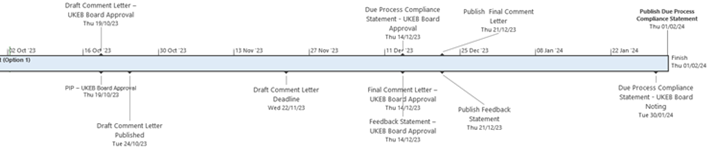
Option one A 30-day consultation period for the DCL, meaning the final comment letter (FCL) would be submitted to the IASB a week after its submission deadline, subject to approval at the 14 December 2023 Board meeting: If the full consultation period of 30 days is approved, the consultation period for the UKEB DCL will end after the 16 November 2023 Board meeting. The FCL could only be presented to the 14 December 2023 Board meeting at the earliest. This would result in a late submission of the UKEB FCL to the IASB. However, this option provides greater time for UK stakeholders to comment on the UKEB DCL.
-
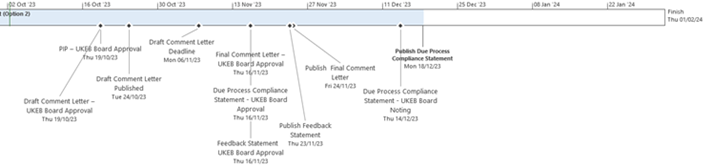
Option two – A 14-day consultation period for the DCL, meaning the final comment letter to IASB submitted in time for submission deadline, subject to approval at the 16 November 2023 Board meeting: If a shortened consultation period of 14 days is approved, the consultation period for the UKEB DCL will end in early November 2023. This allows time for the Secretariat to review the responses received and to prepare the FCL for the 16 November 2023 Board meeting. This would allow the UKEB to submit the FCL to the IASB on time, however it provides less time for UK stakeholders to comment on the UKEB DCL.
6The Secretariat recommends the Board approve option one which provides a full 30-day consultation period for the DCL. The Secretariat believe that it is important that stakeholders have time to comment on the UKEB DCL before finalisation, especially given the diverse nature of the amendments. The Secretariat will liaise with the IASB so they are aware the letter will be submitted late. We do not expect the delay to reduce the impact of the influencing activities.
Question for the Board
1The Board is asked to approve one of the following two project timeline options:
- Option one A 30-day consultation period for the DCL, meaning the final comment letter (FCL) would be submitted to the IASB a week after its submission deadline, subject to approval at the 14 December 2023 Board meeting.
- Option two A 14-day consultation period for the DCL, meaning the final comment letter to IASB submitted in time for submission deadline, subject to approval at the 16 November 2023 Board meeting.
2Subject to the decision and addressing any comments raised during the meeting, the Board is asked to approve the PIP at Appendix A.
Draft Comment Letter (DCL)
7The DCL is attached at Appendix B, and the draft Invitation to Comment (ITC) questions are at Appendix C. The Board is asked the following question:
Question for the Board
3Subject to addressing any comments raised during the meeting, the Board is asked to approve the DCL at Appendix B and draft ITC questions at Appendix C for publication.
Next steps
8The Secretariat expects to bring a Final Comment Letter for the Board's consideration at either the 16 November 2023 or the 14 December 2023 meeting, depending on the Board's decision in this meeting.
Appendix A: Project Initiation Plan
| Project Type | Influencing |
| Project Scope | Narrow-scope |
Purpose
A1This paper sets out the plan to influence the International Accounting Standards Board (IASB) in relation to the Annual Improvements to IFRS Accounting Standards—Volume 11 Exposure Draft (the ED), which was published on 12 September 2023.
Background
A2The IASB issues amendments to international accounting standards as part of its continuous effort to maintain and improve IFRS Standards and to support consistent application. Proposals for amendments often arise from questions submitted to the IFRS Interpretations Committee.
A3At its February 2023 and May 2023 meetings, the IASB discussed the following eight proposed amendments that are included in the ED of Annual Improvements to IFRS Accounting Standards (Annual Improvements). The IASB’s Due Process Handbook (paragraph 6.10) notes that "Some proposed amendments to IFRS Standards that are sufficiently minor or narrow in scope can be packaged together and exposed in one document even though the amendments are unrelated.”[^4]
Paragraph 6.11 of the IASB and IFRS Interpretation Committee Due Process Handbook:
"The justification for exposing unrelated improvements in one package is that such amendments are limited to changes that either clarify the wording in an IFRS Standard or correct relatively minor unintended consequences, oversights or conflicts between existing requirements of the Standards.”
A4A list of the proposed amendments in the Annual Improvements cycle is provided below, Annex A of this project initiation plan (PIP) provides additional detail[^5].
- #### Transaction price (IFRS 9 Financial Instruments)
The IASB was informed of a potential confusion arising from references to ‘transaction price’ in particular paragraphs of IFRS 9. The term is given a different meaning to that generally used in IFRS 9 when related to some trade receivables.
The proposal is to:
- Revise the wording in paragraph 5.1.3 of IFRS 9; and
- Delete the reference to ‘transaction price’ and the associated references to IFRS 15 from Appendix A.
- #### Derecognition of lease liabilities (IFRS 9)
The IASB staff was informed that there is lack of clarity on lessee accounting for derecognition of a lease liability. The lessee could either recognise a gain or loss in profit or loss applying IFRS 9 or make a corresponding adjustment to the right of use asset applying IFRS 16. The proposal is to:
- Add a cross-reference to paragraph 3.3.3 of IFRS 9 in paragraph 2.1(b)(ii) of IFRS 9.
- #### Gain or loss on derecognition (IFRS 7 Financial Instruments: Disclosures)
The IASB was informed about a lack of clarity from an obsolete cross-reference in IFRS 7 that was not removed upon the issuance of IFRS 13.
The proposal is to:
- Replace the reference to paragraph 27A of IFRS 7, which no longer exists, with a reference to paragraphs 72-73 of IFRS 13; and
- Replace the phrase 'inputs that were not based on observable market data' with 'unobservable inputs'.
- #### Disclosure of deferred difference between fair value and transaction price (Implementation Guidance[^6] accompanying IFRS 7)
The IASB was informed about an inconsistency that arose from the issuance of IFRS 13 resulting in consequential amendments to a paragraph in IFRS 7 but no corresponding amendments were made to the related paragraph in the implementation guidance.
The proposal is to:
- Propose an amendment to paragraph IG14 to improve its consistent with paragraph 28 of IFRS 7 which it illustrates.
- #### Introduction and credit risk disclosures (Implementation Guidance[^7] accompanying IFRS 7)
The IASB was informed of a potential confusion in the implementation guidance accompanying IFRS 7 because an example fails to state that it does not illustrate all the requirements of paragraph to which it relates.
The proposal is to:
- Add a statement that the implementation guidance accompanying IFRS 7 does not illustrate all the requirements in IFRS 7 in paragraph IG1 of IFRS 7; and
- Simplify the wording in paragraph IG20B of IFRS 7.
- #### Hedge accounting by a first-time adopter (IFRS 1 First-time Adoption of International Financial Reporting Standards)
The IASB was informed about a potential confusion arising from an inconsistency in wording between IFRS 1 and IFRS 9 as first time adopters can only apply hedge accounting requirements in IFRS 9 rather than IAS 39.
The proposal is to:
- Add cross-references to paragraph 6.4.1 of IFRS 9 in paragraphs B5-B6 of IFRS 1; and
- Replace the word 'conditions' with 'qualifying criteria' in paragraph B6 of IFRS 9.
- #### Determination of a 'de facto agent' (IFRS 10 Consolidated Financial Statements)
The IASB was informed about a potential confusion arising from an inconsistency between two consecutive paragraphs of IFRS 10. The first paragraph indicates the requirement for judgement while the second paragraph has more conclusive language about the determination of a de facto agency relationship.
The proposal is to:
- Clarify the requirements in paragraph B74 of IFRS 10.
- #### Cost method (IAS 7 Statement of Cash Flows)
The IASB was informed about a potential confusion about a term 'cost method' that was originally defined in IAS 27 but was subsequently removed during the revision of IAS 27. However, no consequential amendment was made to the related reference in IAS 7.
The proposal is to:
- Replace the term 'cost method', which is no longer defined in IFRS Accounting Standards, with 'at cost’.
A5In September 2023, the IASB issued the ED with a 90-day comment period ending on 11 December 2023. All but one of the amendments are consistent with the proposals as summarised in the UKEB agenda papers for March 2023 and June 2023 meetings. In relation to the proposal on the determination of a ‘de facto agent’, the IASB decided to update the proposal by splitting the second sentence of paragraph B74 of IFRS 9 into two sentences.
Scope of this project
A6Two of the proposed amendments, A4d) Disclosure of deferred difference between fair value and transaction price and A4e) Introduction and credit risk disclosures, are to Implementation Guidance accompanying IFRS 7 and therefore are not included in the mandatory pronouncements of the IFRS Accounting Standards[^8].
A7There is no impediment to the UKEB influencing all the proposed amendments including those to the Implementation Guidance. However, it should be noted that the proposed amendments to Implementation Guidance would be excluded from any UKEB endorsement and adoption assessment, if they are published by the IASB.
Desk-based research
A8Our initial desk-based research suggested no significant concerns related to the proposed amendments. However we considered it is appropriate to seek input from stakeholders on the application of the proposed amendments, particularly in the following areas of the ED:
- Transaction price; and
- Derecognition of lease liabilities.
Initial stakeholder feedback
A9We have undertaken some preliminary outreach and spoken informally to a small number of stakeholders including a regulator. To date, no stakeholder has raised significant concerns with the proposals.
Outreach
A10We will discuss the draft comment letter (DCL) with the UKEB Accounting Firms and Institutes Advisory Group (AFIAG) and the Preparer Advisory Group (PAG). We also drew attention of the Financial Instruments Working Group (FIWG) to the ED and asked the FIWG members to contact the project team if they have any feedback.
Project plan rationale
A11The following considerations have shaped the project plan.
The proposed amendments do not propose new principles or change existing principles
A12The proposed amendments are limited to clarification of the wording in specific IFRS Accounting Standards or corrections of relatively minor unintended consequences, oversights or conflicts between existing requirements[^9]. Therefore the proposed amendments are not expected to introduce any new principles or change existing principles in the IFRS Accounting Standards.
A13Two of the proposed amendments touch on areas which have separately been identified in other projects as possibly needing more comprehensive review (included below for reference only). This kind of review would go beyond the scope of Annual Improvements and does not form part of this project:
- Derecognition of lease liabilities (proposed amendments to IFRS 9) Stakeholders raised concerns on the boundary between modification and derecognition in IFRS 9[^10] and IFRS 16 requirements. We note that the IASB has included this topic in the project scope of a pipeline project, Amortised Cost Measurement[^11].
- Determination of a ‘de facto agent’ (proposed amendments to IFRS 10) The IASB has identified mixed views[^12] on the assessment of the de facto agency relationship and its interaction with the assessment of control. However, assessments of de facto control are infrequently needed in the UK[^13].
Change in practice or a material effect on entities' financial statements is not expected
A14Given the proposed amendments are narrow scope in nature and merely clarify wording or correct minor oversights, we do not expect any change in practice or a material effect on entities' financial statements.
Implication for project plan
A15Based on the considerations described in paragraphs A12-A13, we propose a proportionate project plan that involves public consultation on a draft comment letter and targeted outreach to the AFIAG, PAG and FIWG.
Setting up an ad-hoc advisory group is not necessary
A16Given the narrow scope and nature of the project, it is not considered necessary to set up a separate, ad-hoc advisory group as the existing UKEB Advisory Groups are well placed to provide feedback on this project.
Project milestones
A17A proportionate approach is proposed, incorporating the mandatory milestones listed in paragraph 5.3 of the UKEB’s Due Process Handbook (Handbook)[^14]. The table below provides a brief description of the work we have done and what we intend to do as part of this project.
| Milestone/activity | Brief description | Status |
|---|---|---|
| Influencing | ||
| Technical project added to UKEB technical work plan (mandatory) [Handbook 4.30(b)i] | Added to UKEB technical work plan. | Completed. |
| Education session (optional) [Handbook 4.10(b)] | Updates on Annual Improvements were included in the agenda papers for UKEB March 2023 and June 2023 meetings for the Board's noting. All but one of the final proposals in the ED are consistent with the proposals summarised in the agenda papers. In addition, educational material has been shared with the Board. | Not applicable |
| Desk-based research (optional) [Handbook 5.9] | The Secretariat has reviewed:
|
Completed. |
| Project Initiation Plan (mandatory) [Handbook 5.4 to 5.8] | This paper. | - |
| Milestone/activity | Brief description | Status |
|---|---|---|
| Outreach activities (mandatory) [Handbook 5.10 to 5.12] | We will seek feedback on this project from the:
|
To be completed. |
| DCL published for comment (generally mandatory) [Handbook 5.13 to 5.17] | A DCL is prepared for approval at this meeting. This will be issued for a consultation period of [14 days or 30 days, depending on the Board’s decision at this meeting]. | To take place following this meeting, dependent on the UKEB's decision |
| UKEB submission of FCL to the IASB (mandatory) [Handbook 5.18] | A final comment letter (FCL) will be presented to the board meeting on [16 November 2023 or 14 December 2023, depending on the Board’s decision at this meeting]. The FCL will be submitted to the IASB following the Board’s approval. | To be completed |
| Milestone/activity | Brief description | Status |
|---|---|---|
| Feedback statement and due process compliance statement for influencing stage of project (mandatory) [Handbook 5.19 to 5.26] | The Secretariat publishes Feedback Statement and Due Process Compliance Statement on the UKEB website. | To be completed |
Resources allocated
A18On the basis of this project plan, we consider that a project team consisting of one Project Manager supported by one Assistant Project Manager, with technical support and oversight from a Project Director, should ensure the project milestones are achievable.
[Project timelines]
A19[We have set out below two options for the timeline for the influencing phase. The Board is asked to decide its preferred timeline. Text pertaining to the two options is in square brackets throughout this document as we will publish the PIP with the approved option only.]
A20The ED was published on 12 September 2023, with the IASB’s comment deadline on 11 December 2023.
A21The consultation period for a UKEB’s DCL is generally not less than 30 days unless this period is shortened[^15]. Given the IASB’s comment period ends on 11 December 2023 and the timing of the UKEB’s upcoming meetings, [the Board decided to]:
[Option one – A 30-day consultation period for the DCL, meaning the final comment letter (FCL) would be submitted to the IASB a week after its submission deadline, subject to approval at the 14 December 2023 Board meeting: If the full consultation period of 30 days is approved, the consultation period for the UKEB DCL will end after the 16 November 2023 Board meeting. The FCL could only be presented to the 14 December 2023 Board meeting at the earliest. This would result in a late submission of the UKEB FCL to the IASB. However, this option provides greater time for the UK stakeholders to comment on the UKEB DCL.]
[Option two – A 14-day consultation period for the DCL, meaning the final comment letter to IASB submitted in time for submission deadline, subject to approval at the 16 November 2023 Board meeting: If a shortened consultation period of 14 days is approved, the consultation period for the UKEB DCL will end in early November 2023. This allows time for the Secretariat to review the responses received and to prepare the FCL for the 16 November 2023 Board meeting. This would allow the UKEB to submit the FCL to the IASB on time, however it provides less time for the UK stakeholders to comment on the UKEB DCL.]
The submission of the comment letter to the IASB in both options will be subject to the approval of the FCL at the relevant Board meetings.
A22A FCL will be presented to the Board for consideration and approval at the [16 November 2023 or 14 December 2023 meeting].
A23Further information on the proposed project timeline is presented in the table below.
Timeline
| Expected Date | Milestones |
|---|---|
| 19 October 2023 | Presentation of PIP and DCL for approval |
| DCL consultation period: [14 or 30 days] | |
| [16 November 2023 or 14 December 2023] | Board’s review of comments received on the DCL and consideration of FCL, Feedback Statement and draft Due Process Compliance Statement |
| [14 December 2023 or 30 January 2024] | Final Due Process Compliance Statement for the Board’s noting |
[The two timeline options are set out below. The Board is asked to decide its preferred timeline. The final PIP will be published with the approved option only.]
Timeline Option One
Timeline Option Two
Annex A: Summary of the Annual Improvements
1. Amendments to IFRS 9 – Transaction price
| Origin | The IASB was informed of potential confusion arising from a reference in Appendix A of IFRS 9 Financial Instruments to the definition of 'transaction price' in IFRS 15 Revenue from Contracts with Customers. The term 'transaction price' is used in particular paragraphs of IFRS 9 with a meaning that is not necessarily consistent with the definition of that term in IFRS 15. |
| Proposed amendments | The proposed amendments to IFRS 9 are to delete the reference to the IFRS 15's definition of 'transaction price' in Appendix A of IFRS 9 and revise the wording around the term 'transaction price' in paragraph 5.1.3. of IFRS 9. |
| Outcome of the proposed amendments | 5.1 Initial measurement 5.1.1 Except for trade receivables within the scope of paragraph 5.1.3, at initial recognition, an entity shall measure a financial asset or financial liability at its fair value plus or minus, in the case of a financial asset or financial liability not at fair value through profit or loss, transaction costs that are directly attributable to the acquisition or issue of the financial asset or financial liability. 5.1.1A However, if the fair value of the financial asset or financial liability at initial recognition differs from the transaction price, an entity shall apply paragraph B5.1.2A. |
| Mandatory or Non-Mandatory | The proposed amendments are to paragraph 5.1.3 and Appendix A of IFRS 9 which forms part of the mandatory text of the IFRS Accounting Standards. |
| Rationale for the proposed amendments | Paragraph 5.1.3 was added to IFRS 9 as a result of the issuance of IFRS 15. This resulted in the term ‘transaction price’ having two different meanings in IFRS 9: (i) “as defined in IFRS 15” (per paragraph 5.1.3 of IFRS 9) and (ii) “as the fair value of the consideration given or received” (elsewhere in IFRS 9). The deletion of the reference to the definition of ‘transaction price’ in paragraph 5.1.3 of IFRS 9 is expected to remove potential confusion. |
| Proposed transition requirement | There is no specific transition requirement. |
| Note | The IASB acknowledges a broader issue about the application of the requirements of IFRS 9 to a trade receivable with a significant financing component, however this is beyond the scope of these amendments. |
| 5.1.2 When an entity uses settlement date accounting for an asset that is subsequently measured at amortised cost, the asset is recognised initially at its fair value on the trade date (see paragraphs B3.1.3–B3.1.6). 5.1.3 Despite the requirement in paragraph 5.1.1, at initial recognition, an entity shall measure trade receivables at the amount determined by applying |
| Consideration within the scope of Annual Improvements[^16] | The Secretariat performed a word search on the mandatory text of IFRS 9. The term “transaction price” only appears in four different paragraphs (5.1.1A, 5.1.3, B5.1.1 and B5.1.2A) in IFRS 9. When the “transaction price" is mentioned in IFRS 9, it is:
|
2. Amendments to IFRS 9 – Derecognition of lease liabilities
| Origin | The IFRS Interpretation Committee received a request about a lessor’s and a lessee’s application of IFRS 9 Financial Instruments and IFRS 16 Leases when accounting for a rent concession in which the only change to the lease contract is the lessor’s forgiveness of lease payments due from the lessee. The Interpretations Committee addressed a lessor’s application of IFRS 9 and IFRS 16 in its Agenda Decision Lessor Forgiveness of Lease Payments (IFRS 9 and IFRS 16) published in October 2022. With regard to lessee accounting, there appeared to be more than one way to read the current requirements for a rent concession. |
| Proposed amendments | The proposed amendment to IFRS 9 is to add a cross-reference to paragraph 3.3.3 of IFRS 9 in paragraph 2.1(b)(ii) of IFRS 9. |
| Outcome of the proposed amendments | 2.1 This Standard shall be applied by all entities to all types of financial instruments except:
|
| Mandatory or Non-Mandatory | The proposed amendments are to paragraph 2.1(b)(ii) of IFRS 9 which forms part of the mandatory text of the IFRS Accounting Standards. |
| Rationale for the proposed amendments | There appears to be more than one way to read the current requirements of lessee accounting for a rent concession. The lessee could either:
|
| Proposed transition requirement | Prospective application of the amendments is required. That is, an entity would apply the amendment to lease liability extinguishments that occur after the beginning of the annual reporting period in which the entity first applies the amendment. |
| Note | There remains a broader issue regarding the boundary between modification and derecognition of a lease, as well as the requirements for the derecognition of financial assets following a contractual modification[^17]. We note that the IASB pipeline project Amortised Cost Measurement includes this topic in its scope[^18]. |
| Consideration within the scope of Annual Improvements[^19] Paragraph 3.3.3 is a clear follow-on of the paragraph 3.3.1 in the context of the paragraph 2.1(b)(ii). Given the proposed amendment essentially removes the “option” of adjusting right-of-use asset upon lease liability extinguishment, the Secretariat considered there could be potential unintended consequences to the current application practice. Therefore the Secretariat has done desk-based research including reading accounting firm manuals and started targeted outreach, with a particular focus on the application. To date, no significant concern has been identified. |
3. Amendments to IFRS 7 – Gain or loss on derecognition
| Origin | The IASB was informed of potential confusion in paragraph B38 of IFRS 7 Financial Instruments: Disclosures arising from the reference to a paragraph that has been deleted from the IFRS Accounting Standard (paragraph 27A). |
| Proposed amendments | The proposed amendments to IFRS 7 are to replace the reference to paragraph 27A of IFRS 7, a paragraph that no longer exists, with a reference to paragraphs 72-73 of IFRS 13 Fair Value Measurement, and to replace the phrase 'inputs that were not based on observable market data' with ‘unobservable inputs’ in paragraph B38 of IFRS 7. |
| Outcome of the proposed amendments | B38 Paragraph 42G(a) requires an entity to disclose the gain or loss on derecognition relating to financial assets in which the entity has continuing involvement. The entity shall disclose if a gain or loss on derecognition arose because the fair values of the components of the previously recognised asset (ie the interest in the asset derecognised and the interest retained by the entity) were different from the fair value of the previously recognised asset as a whole. In that situation, the entity shall also disclose whether the fair value measurements included significant unobservable inputs |
| Mandatory or Non-Mandatory | The proposed amendments are to paragraph B38 of IFRS 7 which forms part of the mandatory text of the IFRS Accounting Standards. |
| Rationale for the proposed amendments | The current reference to paragraph 27A is from an oversight during IFRS 13 issuance in May 2011 when no consequential amendment was made to paragraph B38 of IFRS 7. |
| Proposed transition requirement | There is no specific transition requirement. |
4. Amendments to Implementation Guidance accompanying IFRS 7 – Disclosure of deferred difference between fair value and transaction price
| Origin | The IASB was informed about an inconsistency between paragraph 28 of IFRS 7 Financial Instruments: Disclosures and its accompanying implementation guidance, paragraph IG14. The inconsistency arose when, after the issuance of IFRS 13 Fair Value Measurement, the IASB made a consequential amendment to paragraph 28 of IFRS 7 but did not make the corresponding amendments to paragraph IG14 of IFRS 7. |
| Proposed amendments | The proposed amendments to the Implementation Guidance accompanying IFRS 7 are to improve the consistency between paragraph IG14 of IFRS 7 and paragraph 28 of IFRS 7. |
| Outcome of the proposed amendments | The following text is extracted from the ED and reflects the outcome of the amendments. It should be noted that there are also minor editorial amendments to the rest of the illustrative example in paragraph IG 14 of IFRS 9. IG14 Fair value (paragraph 28) At initial recognition an entity measures the fair value of financial instruments that are not traded in active markets. However, in some cases, the transaction price of a financial instrument differs from its fair value at initial recognition, and that fair value is neither evidenced by a quoted price in an active market for an identical asset or liability (ie a Level 1 input) nor based on a valuation technique that uses only data from observable markets. In these circumstances, the difference will be recognised in profit or loss in subsequent periods in accordance with IFRS 9 Financial Instruments and the entity’s accounting policy. Such recognition reflects changes in factors (including time) that market participants would take into account when pricing the asset or liability (see paragraph B5.1.2A(b) of IFRS 9). Paragraph 28 requires disclosures in these circumstances. An entity might disclose the following to comply with some of the requirements in paragraph 28: |
| Mandatory or Non-Mandatory | The proposed amendments are to the Implementation Guidance accompanying IFRS 7 and therefore is not part of the mandatory text of the IFRS Accounting Standards and not included in UK-adopted international accounting standards. |
| Rationale for the proposed amendments | The current inconsistency arose when, upon the issuance of IFRS 13 Fair Value Measurement in May 2011, the IASB made a consequential amendment to paragraph 28 of IFRS 7 but made no corresponding amendments to paragraph IG14 of IFRS 7. |
| Proposed transition requirement | The proposed amendments are to the implementation guidance which is not a mandatory section of IFRS accounting standards[^20]. Therefore, there is no need to consider transition. |
5. Amendments to Guidance on implementing IFRS 7 – Introduction and credit risk disclosures
| | |
| Description |B5 An entity shall not reflect in its opening IFRS statement of financial position a hedging relationship of a type that does not qualify for hedge accounting in accordance with IFRS 9 (for example, many hedging relationships where the hedging instrument is a stand-alone written option or a net written option; or where the hedged item is a net position in a cash flow hedge for another risk than foreign currency risk) (see paragraph 6.4.1(a) of IFRS 9). However, if an entity designated a net position as a hedged item in accordance with previous GAAP, it may designate as a hedged item in accordance with IFRSs an individual item within that net position, or a net position if that meets the requirements in paragraph 6.6.1 of IFRS 9, provided that it does so no later than the date of transition to IFRSs.B6 If, before the date of transition to IFRSs, an entity had designated a transaction as a hedge but the hedge does not meet the qualifying criteria conditions for hedge accounting in paragraph 6.4.1(b)–(c) of IFRS 9, the entity shall apply paragraphs 6.5.6 and 6.5.7 of IFRS 9 to discontinue hedge accounting. Transactions entered into before the date of transition to IFRSs shall not be retrospectively designated as hedges. |
| Mandatory or Non-Mandatory** | The proposed amendments are to paragraphs B5-B6 of IFRS 1 which forms part of the mandatory text of the IFRS Accounting Standards.