3 Post-Implementation Review of IFRS 9 – Impairment
2 August 2023 Agenda Paper 3
Executive Summary
| Section | Description |
|---|---|
| Project Type | Influencing |
| Project Scope | Moderate |
Purpose of the paper
The purpose of this paper is to obtain Board approval for the issue of a Draft Comment Letter (DCL) and the accompanying invitation to comment questions on the International Accounting Standards Board (IASB)'s Request for Information (RFI) on its Post-Implementation Review (PIR) of IFRS 9–Impairment.
Summary of the Issue
The IASB is undertaking a PIR of IFRS 9 in three parts, classification and measurement, impairment and hedge accounting. The PIR assesses whether the new requirements are working as intended and whether stakeholders have specific questions about applying the new criteria that require a response from the IASB. Depending on responses, the IASB will consider what, if any, further action is required.
Decision for the Board
Subject to addressing any comments raised during the meeting, the Board is asked to approve for publication the Draft Comment Letter and Draft Invitation to Comment for stakeholder feedback.
Recommendation
The Secretariat recommends that the Board approves for publication the Draft Comment Letter and Draft Invitation to Comment for stakeholder feedback.
Appendices
- Appendix A Draft Comment Letter
- Appendix B Draft Invitation to Comment questions
Background
1In July 2014, the IASB issued IFRS 9 Financial Instruments. The Standard was effective for annual periods commencing on or after 1 January 2018. Insurers could defer the effective date until 1 January 2023 to align with the implementation of IFRS 17 Insurance Contracts if certain conditions were met.
2IFRS 9 replaced IAS 39 Financial Instruments: Recognition and Measurement. It introduced changes to the IAS 39 accounting requirements in three main areas: classification and measurement, impairment (introduction of Expected Credit Loss model) and hedge accounting. Accordingly, the IASB is undertaking its PIR of IFRS 9 in three parts. This part of the review focuses on the impairment requirements of IFRS 9, together with the related disclosure requirements in IFRS 7 Financial Instruments: Disclosures (together “IFRS9 – Impairment").
3The IASB issued its Request for Information (Rfl) on 30 May 2023. The Rfl focusses on the following topics:
- Impairment – overall assessment;
- General approach;
- Determining significant increases in credit risk (SICR);
- Measuring expected credit losses (ECL);
- Purchased or originated credit-impaired financial assets;
- Simplified approach for trade receivables, contract assets and lease receivables;
- Application of the impairment requirements in IFRS 9 with other requirements;
- Transition;
- Credit risk disclosures; and
- Other matters.
Outreach and feedback on the DCL
4The Secretariat discussed the IFRS 9 Impairment requirements at the March meeting of the Financial Instruments Working Group (FIWG), the March meeting of the Preparer Advisory Group (PAG), the February meeting of the Investor Advisory Group (IAG) and the March meeting of the Accounting Firms and Institutes Advisory Group (AFIAG).
5In July, the UKEB also discussed the proposals at a roundtable event with UK Finance.
6The Secretariat plans to seek feedback on the Draft Comment Letter (DCL) from the FIWG at its September meeting, as well as taking written feedback on the DCL into account. The Final Comment Letter will be submitted to the Board for consideration in September.
7The principal points raised by stakeholders were:
- Stakeholders agreed that IFRS 9's impairment requirements do not contain "fatal flaws" and represent an improvement on those in IAS 39.
- Many stakeholders noted challenges in the interaction of the impairment requirements with the IFRS 9 derecognition and modification requirements, and requested further guidance in this area.
- Stakeholders identified guidance issued by the IASB during the pandemic that was helpful in assessing SICR, and recommended this text be added to the Standard. Stakeholders also expressed interest in further information being made available to illustrate the extent to which qualitative factors may be used in place of quantitative factors in the assessment of SICR.
- Measurement issues were frequently operational in nature. However, it was suggested that standard setting activity could be helpful in:
- Consolidating elements of (non-authoritative) guidance produced by the IFRS Transition Resource Group into the Standard.
- Providing a definition of post-model adjustments.
- Providing further guidance to clarify the measurement requirements for loan commitments and financial guarantee contracts.
- The use of the simplified method had reduced the burden on non-banks, although the use of forward-looking scenarios remains challenging to operationalise for some. The disclosure requirements for non-banks were thought by some preparers to be disproportionately onerous.
- It was questioned whether use of the IFRS 9 expected credit loss methodology for intra-group lending produced useful results. Some thought that, for the purposes of impairment, it may be more beneficial to consider such lending as more akin to an investment in subsidiary and instead consider the application of IAS36 Impairment of Assets.
- Investors requested a new requirement to disclose ECL information by sector.
- Many UK insurers are implementing IFRS 9 for the first time this year. Early feedback suggests there may be challenges in the interaction between IFRS 9 and IFRS 17 Insurance Contracts, and requested this topic be included in the PIR of IFRS 17.
Draft Comment Letter (DCL)
8The DCL, and the proposed Invitation to Comment questions, are attached for consideration and, subject to amendments agreed by the Board, approval for publication on the UKEB website.
Decision for the Board
- Do Board members have any comments or questions on the Draft Comment Letter at Appendix A or the questions asked in our draft Invitation to Comment questions included at Appendix B?
- Subject to any amendments identified, do Board members approve for publication the Draft Comment Letter at Appendix A and Draft Invitation to Comment questions at Appendix B?
Next steps
9The Draft Comment letter and Invitation to Comment will be published on the UKEB website for a 30-day consultation period.
10The Final Comment Letter, Feedback Statement and draft Due Process Compliance Statement will be brought to the September meeting for approval by the Board.
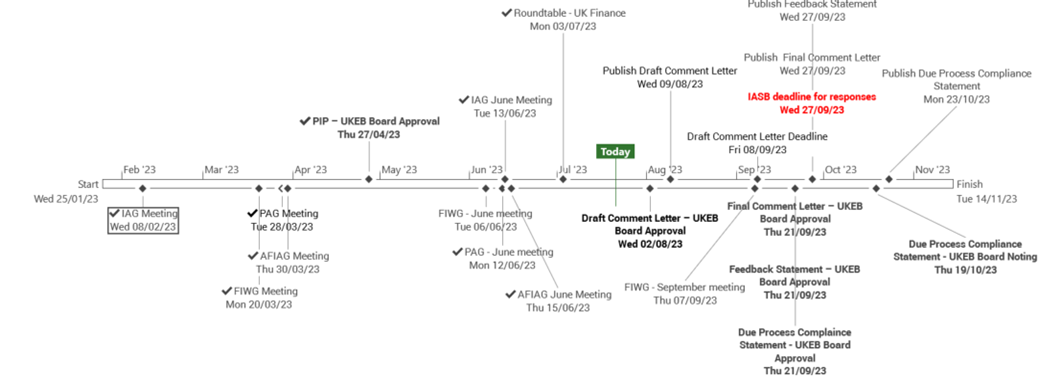
11Further information on the project timeline is presented in the table below.
IFRS 9: Impairment PIR Timeline
| Milestone/activity | Brief description | Status |
|---|---|---|
| Influencing | ||
| Technical project added to UKEB technical work plan (mandatory) [Handbook 4.30(b)] | Added to UKEB technical work plan. | Complete |
| Education session on IFRS 9 - Impairments (optional) [Handbook 4.10] | A two-part education session on the requirements of IFRS 9 – Impairments was provided to the board. | Complete (July 2022 and September 2022 private Board meetings). |
| Desk-based research (optional) [Handbook 5.9] | The Secretariat reviewed selected publications from regulators and accounting firms, including FRC thematic reviews of IFRS 9 disclosures and Covid-19 related matters. | Complete |
| Outreach activities (mandatory) [Handbook 5.11] | We have already received feedback from the UKEB: 1. Investor Advisory Group (8 February 2023) 2. Financial Instruments Working Group (20 March 2023) 3. Preparer Advisory Group (28 March 2023) 4. Accounting Firms and Institutes Advisory Group (30 March 2023). In addition we: - Are obtaining feedback from relevant regulators. - Observed relevant industry working groups when invited. - Published a project page on the UKEB website which included a request for stakeholders to contact the project team if they have feedback. UKEB News Alerts and LinkedIn posts were used to draw attention to this. - Held discussions with other National Standard Setters. | In progress |
| Project Initiation Plan (mandatory) [Handbook 5.4 to 5.8] | A PIP was prepared and presented to the Board. | Complete (April 2023 Board meeting) |
| DCL published for comment (generally mandatory) [Handbook paragraphs 5.13 to 5.17] | This paper. | To be completed (August 2023 Board meeting) |
| UKEB submits FCL before IASB comment period ends (mandatory). | The IASB comment period ends on 27 September 2023. | To be completed. |
| [Handbook paragraph 5.18] | ||
| Feedback statement and due process compliance statement for influencing stage of project (mandatory) [Handbook paragraphs 5.19 and 5.23] | Secretariat publishes Feedback Statement and Due Process Compliance Statement on UKEB website. | To be completed. |
Timeline
Appendix A: Draft Comment Letter
2 August 2023 Agenda Paper 3: Appendix A
Dr Andreas Barckow Chairman International Accounting Standards Board Columbus Building 7 Westferry Circus Canary Wharf London E14 4HD
XX September 2023
Dear Dr Barckow
Post-implementation Review of IFRS 9 Financial Instruments – Impairment
1The UK Endorsement Board (the UKEB) is responsible for endorsement and adoption of IFRS for use in the UK and therefore is the UK's National Standard Setter for IFRS. The UKEB also leads the UK's engagement with the IFRS Foundation on the development of new standards, amendments and interpretations. This letter is intended to contribute to the Foundation's due process. The views expressed by the UKEB in this letter are separate from, and will not necessarily affect the conclusions in, any endorsement and adoption assessment on new or amended International Accounting Standards undertaken by the UKEB.
2There are currently approximately 1,500 entities with equity listed on the London Stock Exchange that prepare their financial statements in accordance with IFRS. 1 In addition, UK law allows unlisted companies the option to use IFRS and approximately 14,000 such companies currently take up this option. 2
3We welcome the opportunity to provide comment on the IASB's Request for Information – Post-implementation Review: IFRS 9 – Impairment (RFI). To develop our response our work has included in-house research, consultation with the UKEB advisory groups, and feedback received during stakeholder roundtables and interviews. Stakeholders consulted included users of financial statements, preparers of financial statements, accounting firms and institutes, and regulators.
4Our stakeholder outreach has highlighted that the IFRS 9 Impairment requirements generally work as intended, and ensure more timely recognition of expected credit losses than the previous requirements under IAS 39 Financial Instruments: Recognition and Measurement. Whilst our response to the RFI focuses on areas of significant concern for UK stakeholders that may be addressed by standard setting or similar activities, no ‘fatal flaws' were identified during our work.
5Our principal comments are set out in the following paragraphs. Our answers to the RFI's specific questions are included in the Appendix to this letter.
Detailed comments
Modification and derecognition
6The Standard does not contain specific requirements for the derecognition of financial assets following a contractual modification, although it acknowledges at paragraph B5.5.25 that in “some circumstances” such modifications can lead to derecognition of the asset. When contracts are renegotiated or modified, the accounting to reflect this can have a significant impact on the calculation of expected credit loss (ECL). Stakeholders tell us that, following a contractual modification to an asset, they consider IFRS 9 often requires an assessment as to whether the change to contractual cashflows is “substantial". If yes, such "substantial" changes result in derecognition of the asset, but non-substantial changes do not. When assets are derecognised the new contract is often recognised for the purposes of calculating ECL as a “Stage 1" asset requiring a 12-month expected-loss calculation. When the asset is not derecognised it often retains its existing “stage” which may be “Stage 2” or “Stage 3", requiring the recognition of lifetime expected losses. Clear understanding, and accurate execution, of any derecognition test is necessary to understand the type of ECL calculation required. However, the Standard is unclear regarding such interaction of the modification, derecognition and impairment requirements giving rise to issues which are causing diversity in practice.
- It is not always clear whether the change in asset cashflows is “substantial”, and hence whether derecognition should take place. Improved guidance for assets is required in the Standard to ensure consistency in practice.
- It is not always clear how expected-loss allowances and write-offs charged to profit in loss in the prior and current periods should be treated for the purposes of calculating the "substantial” change in cashflows, nor the order in which these components should be included in the calculation. Examples include:
- Whether, following a contractual change, certain losses should be treated as impairments, write-offs or as modification losses.
- Whether write-offs should be taken prior to the calculation of "substantial" changes in cashflows, as this can potentially change the outcome of that calculation.
- Whether the forgiveness of interest on a loan is a modification or a partial write-off. This can affect whether the asset reverts to "Stage 1" after derecognition or stays in "Stage 2”.
- To improve consistency of application we suggest that further guidance be provided in the Standard on the interaction of ECL with the modification and derecognition requirements for financial assets.
We note the scope of the IASB pipeline project Amortised Cost Measurement 3 includes the topic of “modifications”. We assume this project will therefore assess the interaction of the modification/derecognition requirements with ECL, including the issues raised above. If not, we urge the IASB to include these matters within the scope of that project. We also recommend the IASB commence this pipeline project as soon as possible.
Consolidation of existing guidance
8We recommend that the IASB includes further guidance in the Standard to clarify the process for assessing a significant increase in credit risk (SICR), by bringing together guidance issued in relation to Covid-19 4, and certain elements of the IFRS Transition Resource Group for Impairment of Financial Instruments (ITG) non-authoritative guidance on SICR. This guidance was helpful when issued and is likely to remain relevant when assessing whether a significant increase in credit risk has occurred. We consider it would be helpful to incorporate this into the Standard. This recommendation is discussed further in paragraphs A7 and A13 of Appendix A
Intra-group lending
9Stakeholders were not convinced that the Standard provides useful information about intra-group lending. Reliable loss data for such loans is not readily available, and often the question of loss will depend more on whether the parent or other group companies will step in to address any borrower liquidity issues. The ability of other group companies to do so may vary depending on the circumstances at the time such support is required, and may therefore be different to their intention at the time of reporting. Stakeholders therefore question whether impairments attached to intra-group loans are useful, and whether any usefulness is proportionate to the effort required to calculate the expected credit loss using IFRS 9 methodologies. Some stakeholders have suggested that, for this purpose, intra-group lending may be more meaningfully compared to investment in subsidiaries. They suggest that the application of IAS 36 supported by appropriate disclosures may produce a more meaningful impairment outcome than the IFRS 9 methodology. We recommend the IASB considers such an approach as there is widespread feedback that the current methodology is neither meaningful nor proportionate.
IFRS 17 Insurance Contracts
10Finally, we note that it is too early to fully assess the interaction of IFRS 9 and IFRS 17 Insurance Contracts, as many UK insurers are currently implementing IFRS 9 for the first time this year. Early feedback suggests there may be challenges in the interaction of the two standards, and we recommend that the application of IFRS 9 to insurers be included in the PIR of IFRS 17.
11If you have any questions about this response, please contact the project team at [email protected].
Yours sincerely
Pauline Wallace Chair UK Endorsement Board
Appendix A: Questions on Request for Information: Post-Implementation Review of IFRS 9 - Impairment
Question 1—Impairment
Do the impairment requirements in IFRS 9 result in:
(a) more timely recognition of credit losses compared to IAS 39 and address the complexity caused by having multiple impairment models for financial instruments? Why or why not?
(b) an entity providing useful information to users of financial statements about the effect of credit risk on the amount, timing and uncertainty of future cash flows? Why or why not?
Please provide information about the effects of the changes to the impairment requirements introduced by IFRS 9, including the ongoing costs and benefits of preparing, auditing, enforcing or using information about financial instruments.
This question aims to help the IASB understand respondents' overall views and experiences relating to the IFRS 9 impairment requirements. Sections 2–9 seek more detailed information on specific requirements.
A1UK stakeholders agreed that overall, IFRS 9 results in more timely recognition of credit losses than its predecessor standard. They also agreed that it results in entities with lending as a primary business activity providing useful information to users about the effect of credit risk on the amount, timing and uncertainty of future cash flows.
A2Stakeholders were not convinced that the Standard provides useful information about intra-group lending. Reliable loss data for such loans is not readily available, and often the question of loss will depend more on whether the parent or other group companies will step in to address borrower liquidity issues. The ability of other group companies to do so may vary depending on the circumstances at the time such support is required, and may therefore be different to their intention at the time of reporting. Stakeholders therefore question whether impairments attached to intra-group loans are useful, and whether any usefulness is proportionate to the effort required to calculate the expected credit loss using IFRS 9 methodologies. Some stakeholders have suggested that, for this purpose, intra-group lending may be more meaningfully compared to investment in subsidiaries. They suggest that the application of IAS 36, supported by appropriate disclosures, may produce a more meaningful impairment outcome than the IFRS 9 methodology. We recommend the IASB considers such an approach as there is widespread feedback that the current methodology is neither useful nor proportionate.
Question 2—The general approach to recognising expected credit losses
(a) Are there fundamental questions (fatal flaws) about the general approach? If yes, what are those fundamental questions? Please explain whether requiring entities to recognise at least 12-month expected credit losses throughout the life of the instrument and lifetime expected credit losses if there has been a significant increase in credit risk achieves the IASB's objective of entities providing useful information about changes in credit risk and resulting economic losses. If not, please explain what you think are the fundamental questions (fatal flaws) about the clarity and suitability of the core objectives or principles of the general approach.
(b) Are the costs of applying the general approach and auditing and enforcing its application significantly greater than expected? Are the benefits to users significantly lower than expected? If, in your view, the ongoing costs of applying the general approach to particular financial instruments are significantly greater than expected or the benefits of the resulting information to users of financial statements are significantly lower than expected, please explain your cost-benefit assessment for those instruments.
Fatal flaws
A3Stakeholders considered that there were no fatal flaws in the general approach to recognising expected credit losses (ECL).
Cost-benefit analysis
A4As noted in paragraph A2, the ongoing costs associated with calculating the expected credit loss on intra-group lending appears disproportionate to the usefulness of the resulting information.
Question 3—Determining significant increases in credit risk
(a) Are there fundamental questions (fatal flaws) about the assessment of significant increases in credit risk? If yes, what are those fundamental questions? Please explain whether the principle-based approach of assessing significant increases in credit risk achieves the IASB's objective of recognising lifetime expected credit losses on all financial instruments for which there has been a significant increase in credit risk since initial recognition. If not, please explain what you think are the fundamental questions (fatal flaws) about the clarity and suitability of the core objectives or principles of the assessment of significant increases in credit risk.
(b) Can the assessment of significant increases in credit risk be applied consistently? Why or why not? Please explain whether the requirements provide an adequate basis for entities to apply the assessment consistently to all financial instruments within the scope of impairment requirements in IFRS 9. If diversity in application exists for particular financial instruments or fact patterns, please explain and provide supporting evidence about how pervasive that diversity is and explain what causes it. Please also explain how the diversity affects entities' financial statements and the usefulness of the resulting information to users of financial statements. If you have identified diversity in application of the assessment, please provide your suggestions for resolving that diversity.
In responding to (a) and (b), please include information about applying judgement in determining significant increases in credit risk (see Spotlight 3).
Fatal flaws
A5Stakeholders agreed that there were no fundamental flaws regarding the assessment of significant increases in credit risk (SICR).
Consistent application of assessment of SICR
A6The assessment of SICR will never be applied entirely consistently across all financial institutions, as different organisations manage risk differently, and place different weight on the risk indicators they use. However, within the banking sector, regulatory guidance, such as that published by Basel 5, has led to a common understanding which ensures reasonable consistency of approach.
A7Additional guidance on assessing SICR produced by the IASB during the pandemic was helpful in identifying whether a SICR had occurred. This remains a standalone document and therefore may be overlooked in future by those seeking guidance on the application of SICR. We recommend the relevant parts of that text are incorporated into guidance within IFRS 9. We suggest one amendment to that text, referring to future economic shocks rather than Covid. We have also incorporated an element of the guidance issued locally by the UK banking regulator, the Prudential Regulation Authority (PRA) 6, on expected credit loss and Covid.
IASB IFRS9 and Covid text, markup by UKEB
IFRS 9 requires the application of judgement and both requires and allows entities to adjust their approach to determining ECLs in different circumstances. A number of assumptions and linkages underlying the way ECLs have been implemented to date may no longer hold in the current environment. Entities should not continue to apply their existing ECL methodology mechanically. For example, the extension of payment holidays to all borrowers in particular classes of financial instruments following an economic shock should not automatically result in all those instruments being considered to have suffered an SICR, in the absence of any other indicators of a SICR occurring. If deemed material, an overarching allocation could be made based on a sample of accounts.
To assess SICR IFRS 9 requires that entities assess changes in the risk of a default occurring over the expected life of a financial instrument. Both the assessment of SICRs and the measurement of ECLs are required to be based on reasonable and supportable information that is available to an entity without undue cost or effort.
Entities are required to develop estimates based on the best available information about past events, current conditions and forecasts of economic conditions. In assessing forecast conditions, consideration should be given both to the effects of the economic shock, covid-19 and the significant including any government support measures being undertaken.
It is likely to be difficult at this the immediate time of the economic shock to incorporate the specific effects of covid-19 the event and government support measures on a reasonable and supportable basis. However, changes in economic conditions should be reflected in macroeconomic scenarios applied by entities and in their weightings. If the effects of the event covid-19 cannot immediately be reflected in models, post-model overlays or adjustments will need to be considered. The environment is subject to rapid change and updated facts and circumstances should continue to be monitored as new information becomes available.
Although current circumstances are may be difficult and create high levels of uncertainty, if ECL estimates are based on reasonable and supportable information and IFRS 9 is not applied mechanistically, useful information can be provided about ECLs. Indeed, in stressed environments, IFRS 9 and the associated disclosures can provide much needed transparency to users of financial statements.
A8IFRS 9 allows the use of qualitative factors in assessing SICR, and qualitative factors are permitted to be used exclusively in some situations to recognise a loss allowance at an amount equal to lifetime expected credit losses (B5.5.18). Despite this, during outreach sessions stakeholders continue to debate the use of qualitative factors, and to what extent/circumstances they could be used in place of quantitative factors. Further educational materials could be useful in bridging any gap in understanding on this topic.
Application of the effective interest rate following a SICR
A9At present, when a financial asset that is not purchased or originated credit-impaired subsequently becomes credit-impaired, IFRS 9 paragraph 5.4.1(b) requires entities to apply the effective interest rate (EIR) to the amortised cost balance of the loan in subsequent reporting periods. In practice some stakeholders apply the EIR to the amortised cost balance of the loan immediately the asset becomes credit-impaired, as this is less operationally complex for their systems. This appears a reasonable approach and we recommend it be accommodated in the standard by making the following change.
IASB IFRS 9, markup by UKEB
5.4.1(b) financial assets that are not purchased or originated credit-impaired financial assets but subsequently have become credit-impaired financial assets. For those financial assets, the entity shall apply the effective interest rate to the amortised cost of the financial asset in subsequent reporting periods no later than the beginning of the subsequent reporting period.
Question 4—Measuring expected credit losses
(a) Are there fundamental questions (fatal flaws) about requirements for measuring expected credit losses? If yes, what are those fundamental questions?
Please explain whether the requirements for measuring expected credit losses achieve the IASB's objective of providing users of financial statements with useful information about the amount, timing and uncertainty of an entity's future cash flows. If not, please explain what you think are the fundamental questions (fatal flaws) about the clarity and suitability of the core objectives or principles of the measurement requirements.
(b) Can the measurement requirements be applied consistently? Why or why not?
Please explain whether the requirements provide an adequate basis for entities to measure expected credit losses consistently for all financial instruments within the scope of impairment requirements in IFRS 9.
If diversity in application exists for particular financial instruments or fact patterns, please explain and provide supporting evidence about how pervasive that diversity is and explain what causes it.
Please also explain how the diversity affects entities' financial statements and the usefulness of the resulting information to users of financial statements. If you have identified diversity in application of the requirements, please provide your suggestions for resolving that diversity.
In responding to (a) and (b), please include information about forward-looking scenarios (see Spotlight 4.1), post-model adjustments or management overlays (see Spotlight 4.2) and off-balance-sheet exposures (see Spotlight 4.3), as relevant.
Fatal flaws
A10Stakeholders considered that there were no fatal flaws in the requirements for measuring expected credit losses.
Consistent measurement
A11Many of the issues arising from the measurement of expected credit losses are operational in nature, rather than issues arising from, or solved by, standard setting. In the UK the banking regulator, the Prudential Regulation Authority (PRA), has been working with banks to improve the consistency of measurements 8 and this work is ongoing.
A12However, we have identified a limited number of issues where further guidance in the Standard would be helpful in promoting consistency of application.
Forward-looking scenarios
A13IFRS 9 contains relatively little guidance in relation to forward-looking scenarios, despite the use of multiple economic scenarios now being commonplace. We believe it would be helpful to incorporate two elements of the (non-authoritative) guidance produced by the IFRS Transition Resource Group (ITG) into the Standard. This guidance was helpful when issued, and it is more likely future users of accounting standards will be aware of, and apply, the guidance if incorporated in IFRS 9 than if it remains in a stand-alone document. We recommend the following two items of ITG guidance from the December 2015 meeting 9 be considered for inclusion in the Standard:
- Paragraph 49: ITG members noted that, in an example where there is a non-linear relationship between the different forward-looking scenarios and their associated credit losses, using a single forward-looking economic scenario would not meet the objective in paragraph 5.5.17(a). Instead, more than one forward-looking scenario would need to be incorporated into the measurement of expected credit losses.
- Paragraph 53(c): With respect to reasonable and supportable information ----- while entities are not expected to consider every possible scenario, the scenarios considered should reflect a representative sample of possible outcomes, reflecting the intent at BC5.265.
Post-model adjustments
A14Post-model adjustments are largely an operational issue, reflecting that models and data are imperfect and therefore adjustments are necessary to mitigate this. Some stakeholders noted that a definition of a post-model adjustment in the standard would be useful to acknowledge this concept, and to allow for use of a common language when describing such adjustments in the financial statements. In the UK work in this area is already underway within the banking sector and we would be happy to assist IASB staff in learning more about this initiative.
Other exposures
Loan commitments
A15Stakeholders saw loan commitments as a difficult area of IFRS 9 to apply in practice. Challenges included assessing the behavioural life of revolving credit facilities for both retail and wholesale banking.
A16Stakeholders indicated that there is diversity in the interpretation of the criteria for application of the exception in paragraph 5.5.20 10 and therefore would welcome clarification. For example:
- Can the exception be applied to fully drawn loan commitments?
- Is B5.5.39(c) "the financial instruments are managed on a collective basis" a requirement or an example only? Is the exception allowed only when credit risk is managed collectively?
Further guidance in the Standard on this area would be welcome.
Financial guarantee contracts
A17Stakeholders noted a lack of consistency in the treatment of financial guarantees as IFRS 9 does not currently define the characteristics of credit enhancements that are “integral to the contractual terms”. As only guarantees integral to the loan should be included when measuring ECL, further clarification in this regard would be helpful in reducing diversity in practice. We recommend the IASB include additional guidance on such credit enhancements within the definition of credit loss, for example, as follows:
IASB IFRS9, markup by UKEB
IFRS 9 Appendix A “Credit Loss” definition. .....The cash flows that are considered shall include cash flows from the sale of collateral held or other credit enhancements that are integral to the contractual terms. The cash flows that are considered shall include cash flows from the sale of collateral held or other credit enhancements that are integral to the contractual terms. Consideration should be given, but not limited to the following, which may provide evidence that a credit enhancement is integral to the contractual terms:
- The guarantee, to which the same borrower, lender and guarantor are all parties, is embedded within the contract, or if it is not embedded within the same contract, the loan agreement may refer to the guarantee, or otherwise it may be implicitly part of the contractual terms of the debt instrument;
- The guarantee is entered into at or around the same time as, and in contemplation of, the debt instrument;
- The guarantee is required by laws and regulations that govern the contract of the debt instrument;
- The exposure and the financial guarantee are traded as a package in the market;
- The guarantee is given by the parent of the borrower or another company within the borrower's group; and
- The cost of the guarantee meets the definition of a transaction cost of the guaranteed financial asset.
Question 5—Simplified approach for trade receivables, contract assets and lease receivables
(a) Are there fundamental questions (fatal flaws) about the simplified approach? If yes, what are those fundamental questions?
Does applying the simplified approach achieve the IASB's objective of reducing the costs and complexities of applying IFRS 9 impairment requirements to trade receivables, contract assets and lease receivables? If not, please explain what you think are the fundamental questions (fatal flaws) about the clarity and suitability of the core objectives or principles of the simplified approach.
(b) Are the costs of applying the simplified approach and auditing and enforcing its application significantly greater than expected? Are the benefits to users significantly lower than expected?
If, in your view, the ongoing costs of applying the simplified approach are significantly greater than expected, or the benefits of the resulting information to users of financial statements are significantly lower than expected, please explain your cost-benefit assessment.
A18Disclosure requirements on the simplified method are discussed at paragraph A30.
Question 6—Purchased or originated credit-impaired financial assets
Can the requirements in IFRS 9 for purchased or originated credit-impaired financial assets be applied consistently? Why or why not?
Please explain whether the requirements can be applied consistently to these types of financial assets and lead to accounting outcomes that faithfully reflect the underlying economic substance of these transactions.
If there are specific application questions about these requirements, please describe the fact pattern and:
(a) explain how the IFRS 9 requirements are applied;
(b) explain the effects of applying the requirements (for example, the quantitative effect on an entity's financial statements or an operational effect);
(c) explain how pervasive the fact pattern is; and
(d) support your feedback with evidence.
Purchased or originated credit-impaired financial assets
A19Issues associated with originated credit-impaired financial assets following a modification to contractual cashflows are discussed in paragraph A23. We have no other matters to report.
Question 7—Application of the impairment requirements in IFRS 9 with other requirements
Is it clear how to apply the impairment requirements in IFRS 9 with other requirements in IFRS 9 or with the requirements in other IFRS Accounting Standards? If not, why not?
If there are specific questions about how to apply the impairment requirements alongside other requirements, please explain what causes the ambiguity and how that ambiguity affects entities' financial statements and the usefulness of the resulting information to users of financial statements. Please describe the fact pattern and:
(a) indicate the requirements in IFRS 9 or in other IFRS Accounting Standards to which your comments relate;
(b) explain the effects of applying the requirements (for example, the quantitative effect on an entity's financial statements or an operational effect);
(c) explain how pervasive the fact pattern is; and
(d) support your feedback with evidence.
In responding to this question, please include information about matters described in this section of the document.
Application of the ECL requirements alongside other requirements
Modifications and derecognition
A20The Standard does not contain specific requirements for the derecognition of financial assets following a contractual modification, although it acknowledges at paragraph B5.5.25 that in “some circumstances” such modifications can lead to derecognition of the asset. Modifications are specifically addressed for financial liabilities at paragraph 3.2.2. When contracts are renegotiated or modified, the accounting to reflect this can have a significant impact on the calculation of expected credit loss (ECL). Stakeholders tell us that, following a contractual modification to an asset, they consider IFRS 9 often requires an assessment as to whether the change to contractual cashflows is “substantial". If yes, such "substantial” changes result in derecognition of the asset, but non-substantial changes do not. When assets are derecognised the new contract is often recognised for the purposes of calculating ECL as a "Stage 1” asset requiring a 12-month expected-loss calculation. When the asset is not derecognised it often retains its existing "stage” which may be "Stage 2" or "Stage 3", requiring the recognition of lifetime expected losses. Clear understanding, and accurate execution, of any derecognition test is necessary to understand the type of ECL calculation required. However, the Standard is unclear regarding such interaction of the modification, derecognition and impairment requirements giving rise to issues which are causing diversity in practice.
A21It is not always clear whether the change in asset cashflows is “substantial", and hence whether derecognition should take place. The criteria for derecognition of a financial asset are less clear than those for the derecognition of a financial liability. Improved guidance for assets is required in the Standard to ensure consistency in practice.
A22It is not always clear how expected-loss allowances and write-offs charged to profit in loss in the prior and current periods should be treated for the purposes of calculating the “substantial” change in cashflows, nor the order in which these components should be included in the calculation. For example, it is not clear whether following a contractual change certain losses should be treated as impairments, write-offs or as a modification loss. And, whether write-offs should be taken prior to the calculation of “substantial” changes in cashflows, as this can potentially change the outcome of that calculation. Other examples include lack of clarity on whether the forgiveness of interest on a loan is a modification or a partial write-off? If this forgiveness of interest were assessed as a “substantial" change the asset could revert to “Stage 1” after derecognition, and, if assessed as a write-off, it stays in “Stage 2”. To improve consistency of application we suggest that further guidance be provided in the Standard on the interaction of ECL with the modification and derecognition requirements for financial assets.
A23When considering significant increase in credit risk (SICR), it is not clear in which circumstances, following a derecognition event, the newly recognised contract would be considered to be originated credit impaired, nor when a modified contract would have less credit risk. Stakeholders tell us that applying IFRS 9 guidance for this area is extremely challenging. For derecognised assets IFRS 9 para B5.5.26 notes that “typically” the new asset would attract a 12-month expected-loss allowance, but in “unusual circumstances" may be recognised as originated credit-impaired and attract a lifetime expected-loss allowance. Paragraph B5.5.27 notes that assets that were not derecognised are not "automatically considered to have lower credit risk” and requires evidence of improved performance such as a pattern of timely payment against the modified contract terms. However, the interaction of these requirements with paragraph 5.5.12, which states that SICR shall be assessed by comparing the risk of default occurring under the original contract terms to the risk of default occurring under the modified contract terms, can be unclear in practice. For example, the modified terms may be demonstrably more affordable for the customer and therefore likely to be lower credit risk than the original (less affordable) loan. We recommend the IASB produce educational material that incorporates examples of how this guidance would be applied in practice. We would be happy to assist IASB staff in identifying or testing suitable examples.
A24We note the scope of the IASB pipeline project Amortised Cost Measurement 11 includes the topic of “modifications”. We assume this project will therefore assess the interaction of the modification/derecognition requirements with ECL, including the issues raised above. If not, we urge the IASB to include these matters within the scope of this project. We also recommend the IASB commence this pipeline project as soon as possible.
Application alongside other standards
IFRS 17 Insurance Contracts
A25We note that it is too early to fully assess the interaction of IFRS 9 and IFRS 17 Insurance Contracts, as many UK insurers are currently implementing IFRS 9 for the first time this year. Early feedback suggests there may be challenges in the interaction of the two standards. For example, one preparer has reported to us a mismatch between IFRS 9 ECL requirements and the measurement of the IFRS 17 insurance liability. We consider it important that the application of IFRS 9 to insurers be included in the PIR of IFRS 17.
Sustainability standards
A26The UKEB recommends that the IASB considers the ways in which the IFRS 9 impairment requirements connect with wider sustainability reporting as part of the IASB and ISSB's ongoing work on connectivity. In particular, UK banking preparers have reported increased demands from users to identify the portion of the ECL that relates to climate, an exercise which is not straightforward at this time.
Question 8—Transition
Were the costs of applying the transition requirements and auditing and enforcing their application significantly greater than expected? Were the benefits to users significantly lower than expected?
Please explain whether the combination of the relief from restating comparative information and the requirement for transition disclosures achieved an appropriate balance between reducing costs for preparers of financial statements and providing useful information to users of financial statements.
Please explain any unexpected effects or challenges preparers of financial statements faced applying the impairment requirements retrospectively. How were those challenges overcome?
A27We have no matters to report.
Question 9—Credit risk disclosures
(a) Are there fundamental questions (fatal flaws) about the disclosure requirements in IFRS 7 for credit risk? If yes, what are those fundamental questions?
Please explain whether the combination of disclosure objectives and minimum disclosure requirements for credit risk achieves an appropriate balance between users of financial statements receiving:
(i) comparable information—that is, the same requirements apply to all entities so that users receive comparable information about the risks to which entities are exposed; and
(ii) relevant information—that is, the disclosures provided depend on the extent of an entity's use of financial instruments and the extent to which it assumes associated risks.
If an appropriate balance is not achieved, please explain what you think are the fundamental questions (fatal flaws) about the clarity and suitability of the core objectives or principles of the disclosure requirements.
(b) Are the costs of applying these disclosure requirements and auditing and enforcing their application significantly greater than expected? Are the benefits to users significantly lower than expected?
If, in your view, the ongoing costs of providing specific credit risk disclosures are significantly greater than expected or the benefits of the resulting information to users of financial statements are significantly lower than expected, please explain your cost-benefit assessment for those disclosures. Please provide your suggestions for resolving the matter you have identified.
If, in your view, the IASB should add specific disclosure requirements for credit risk, please describe those requirements and explain how they will provide useful information to users of financial statements.
Please also explain whether entities' credit risk disclosures are compatible with digital reporting, specifically whether users of financial statements can effectively extract, compare and analyse credit risk information digitally.
Fatal flaws
A28Stakeholders agreed there were no fatal flaws in the disclosure requirements in IFRS 7 for credit risk. Investors consulted during this outreach noted the disclosures by UK banks were of a high standard on a global basis. In part this is due to the work of the UK's Taskforce on Disclosures about Expected Credit Losses (DECL), a collaboration between regulators, preparers and users of financial statements to consider credit loss disclosures.
Analysis by sector
A29The key request from users of financial statements was for information on ECL by sector. This is particularly relevant to investors if, for example, they are forecasting a downturn in a specific sector. We therefore recommend that the IASB considers including a requirement for entities that hold assets across multiple industries to disclose basic ECL data (such as gross carrying amount, ECL amount and ECL charged to profit and loss) by sector.
Reducing disclosure requirements in relation to assets to which the simplified approach is applied
A30IFRS 7 paragraph 35D gives entities flexibility to consider how much detail to disclose, how much emphasis to place on the different aspects of the disclosure requirements, and the appropriate level of aggregation. Nonetheless, preparers using the simplified approach told us that they found the amount of disclosure disproportionate to the nature of their business. They said the disclosures were not relevant (write off policies and collateral management being frequently mentioned), that while receivables may be a material balance the ECL was not, and that disclosures were too complex for users other than professional analysts to understand. We recommend the IASB produce educational materials to better illustrate to preparers (and their auditors) how the proportionality provided by paragraph 35D can be applied to practical scenarios using the simplified approach.
Question 10—Other matters
(a) Are there any further matters that you think the IASB should examine as part of the post-implementation review of the impairment requirements in IFRS 9? If yes, what are those matters and why should they be examined?
Please explain why those matters should be considered in the context of this post-implementation review and the pervasiveness of any matter raised. Please provide examples and supporting evidence.
(b) Do you have any feedback on the understandability and accessibility of the impairment requirements in IFRS 9 that the IASB could consider in developing its future IFRS Accounting Standards?
A31There are no other matters to report.
Appendix B: IASB Post Implementation Review IFRS 9 Impairments - Draft Invitation to Comment questions
The Secretariat proposes the following questions for inclusion in the Invitation to Comment accompanying the Draft Comment Letter for this project. The term “impairment requirements” will be defined in the introduction to the Invitation to Comment.
| Theme | Question |
|---|---|
| Footnotes: |
Footnotes
-
UKEB calculation based on LSEG and Eikon data, May 2023. This calculation includes companies listed on the Main market as well as on the Alternative Investment Market (AIM). ↩
-
UKEB estimate based on FAME, Companies Watch and other proprietary data. ↩
-
https://www.ifrs.org/projects/pipeline-projects/ ↩
-
IASB, IFRS 9 and Covid-19 - Accounting for expected credit losses, 27 March 2020 ↩
-
Basel Committee on Banking Supervision, Guidance on credit risk and accounting and accounting for expected credit losses, December 2015. ↩
-
IASB, IFRS 9 and Covid-19 - Accounting for expected credit losses, 27 March 2020; ↩
-
PRA, Dear CEO letter on Covid-19 IFRS 9 Capital Requirements and Loan Covenants, 26 March 2020 ↩
-
Prudential Regulation Authority, Thematic Feedback from the 2021/2022 round of written auditor reporting ↩
-
Transition Resource Group for Impairment of Financial Instruments, Meeting Summary, 11 December 2015 ↩
-
IFRS 9 5.5.20 "However, some financial instruments include both a loan and an undrawn commitment component and the entity's contractual ability to demand repayment and cancel the undrawn commitment does not limit the entity's exposure to credit losses to the contractual notice period. For such financial instruments, and only those financial instruments, the entity shall measure expected credit losses over the period the entity is exposed to credit risk and expected credit losses would not be mitigated by credit risk management actions, even if that period extends beyond the maximum contractual period." ↩
-
https://www.ifrs.org/projects/pipeline-projects/ ↩